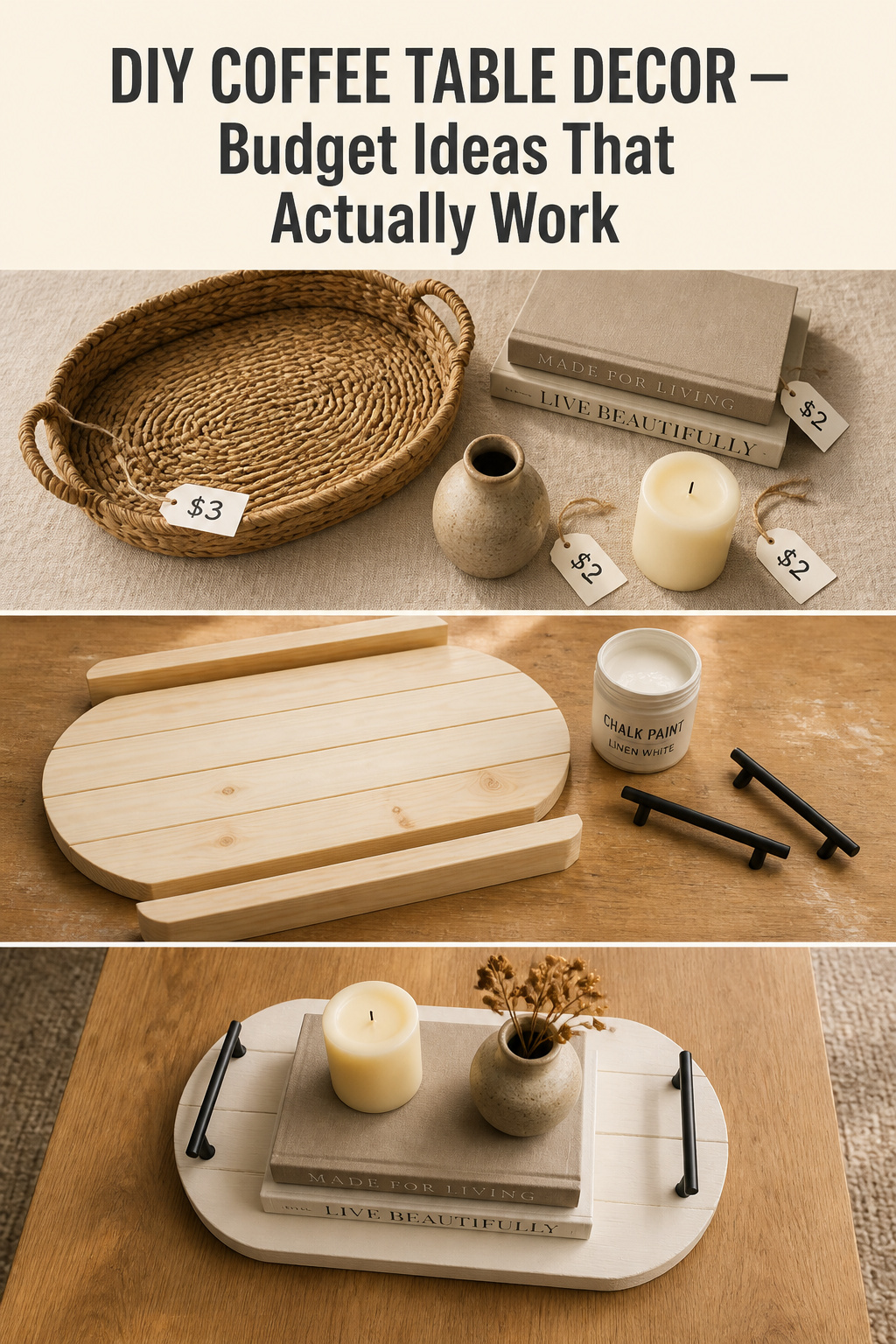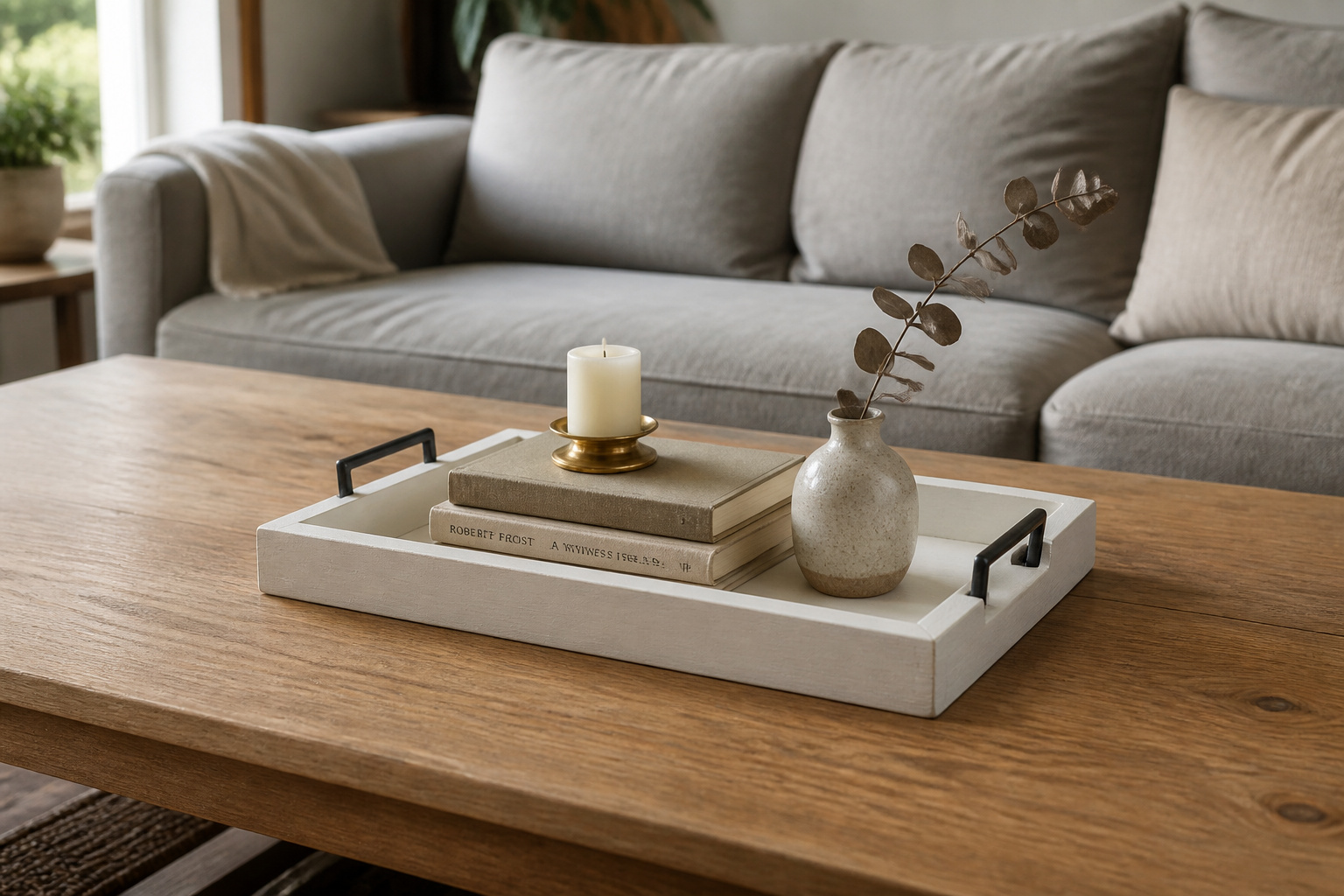
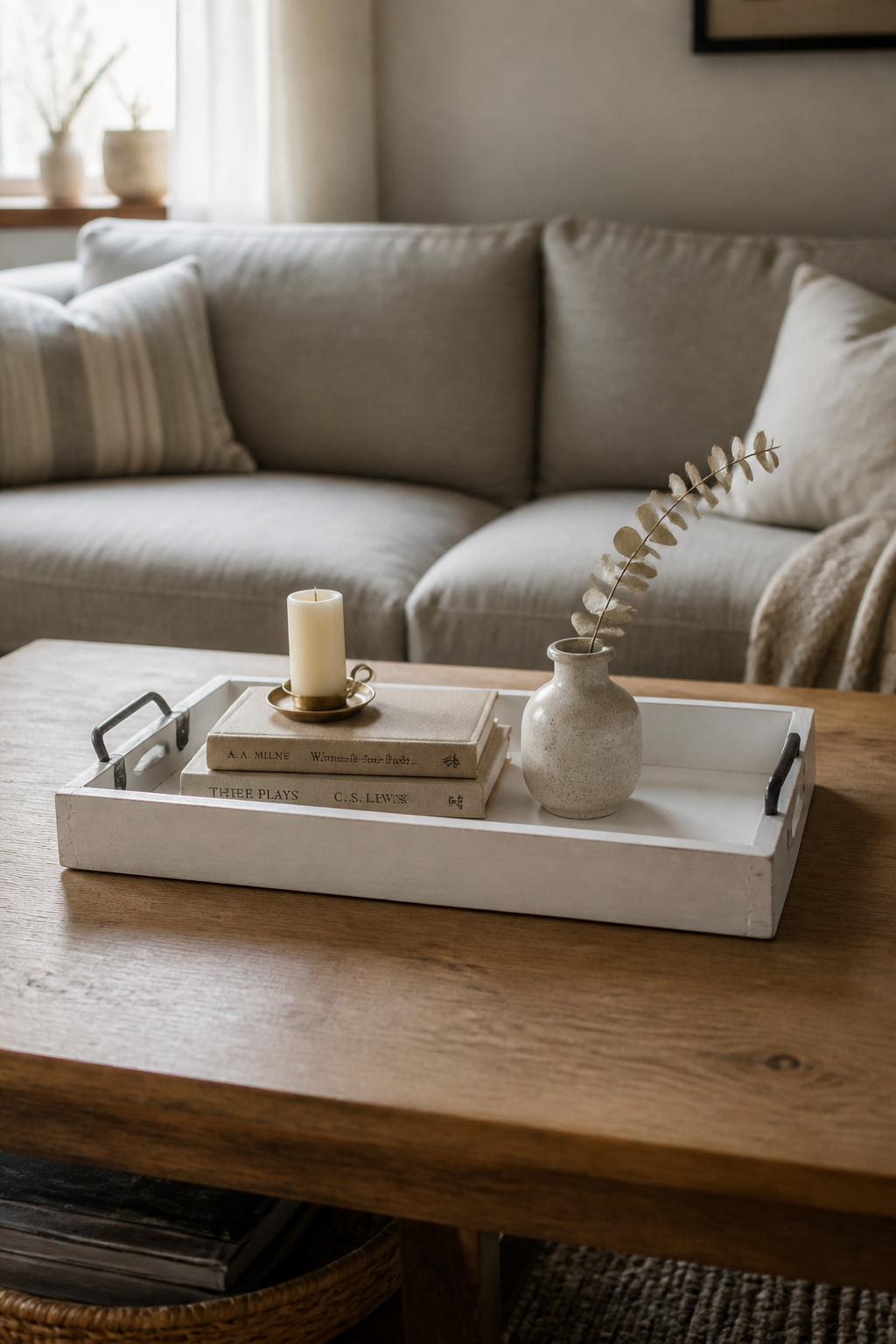
Set a $6 thrifted seagrass tray next to a $40 retail one, and the price tag does almost none of the visual work. That is the whole argument for budget DIY coffee table decor in one sentence. What actually matters is the size of the tray, the contrast of the materials, and the restraint of what you put inside — all free or close to it. Here is exactly what each path costs, without the expensive detours.
TL;DR
- A fully styled coffee table costs as little as $27 from thrift finds plus things you already own — one documented build used a $2 tray, a $2 vase, and a $6 sphere.
- The one DIY worth doing is a painted pine tray: $8-20 in materials, 2-4 active hours, no joinery, genuinely a first build.
- Hunt a tray of 18 inches or larger in a neutral finish, and thrift hardcover books at $2-3 each — those two finds carry most of the look.
What This Actually Costs and How Long It Takes
There are three honest entry points, and you pick the one that matches your wallet and your patience. Spend nothing and shop your own house. Spend $20-30 and run the thrift store. Or spend $15-20 in materials and build the tray yourself. None of them require the retail prices most styling guides quietly assume you will pay.
| Budget tier | What it gets you | Time | Skill level |
|---|---|---|---|
| $0 | Foraged and repurposed objects you already own | 20 min | None |
| $20-30 | Thrifted tray, vessel, and two books | One afternoon | None |
| $15-20 | A DIY painted pine tray you built | 2-4 hrs + dry time | First build |
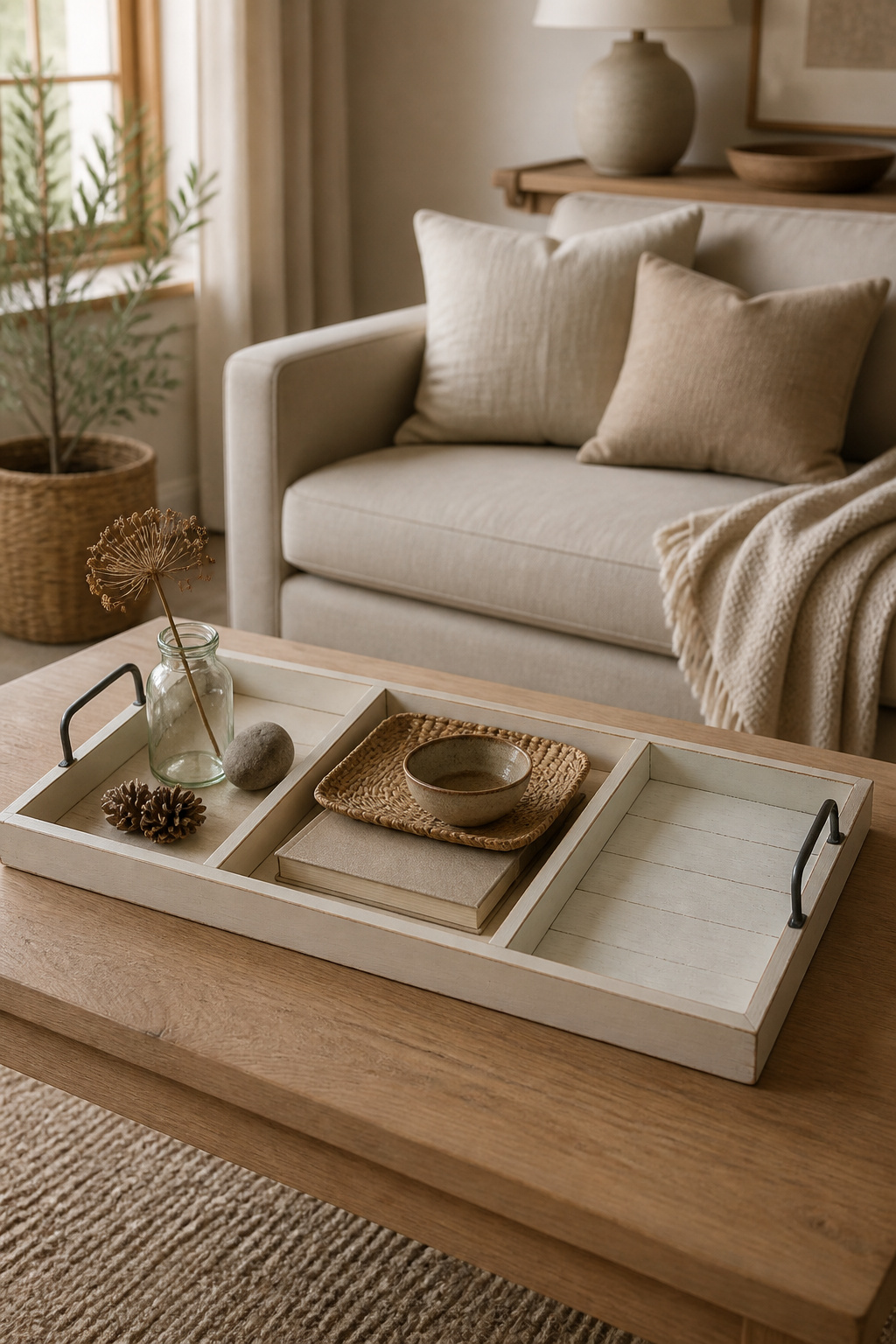
The $27 figure is not aspirational. Blogger Miranda Schultz of The Plus Life documented a full table built from a $2 Goodwill tray, a $2 thrift vase, a $6 sphere on sale, and books and a candle she already owned. Her rule is the right order of operations: shop your own home first, then thrift before any retail store. That order alone is the difference between $27 and $80. For the full system behind the arrangement itself, the pillar covers styling a coffee table from the rules down.
Free and Foraged: Styling a Table with What You Already Have
Before you spend a dollar, clear the table completely. Then put back only the three to five objects that earn their place. A table that looks cluttered with eight things often looks styled with three, and you cannot see what is missing until the surface is empty.
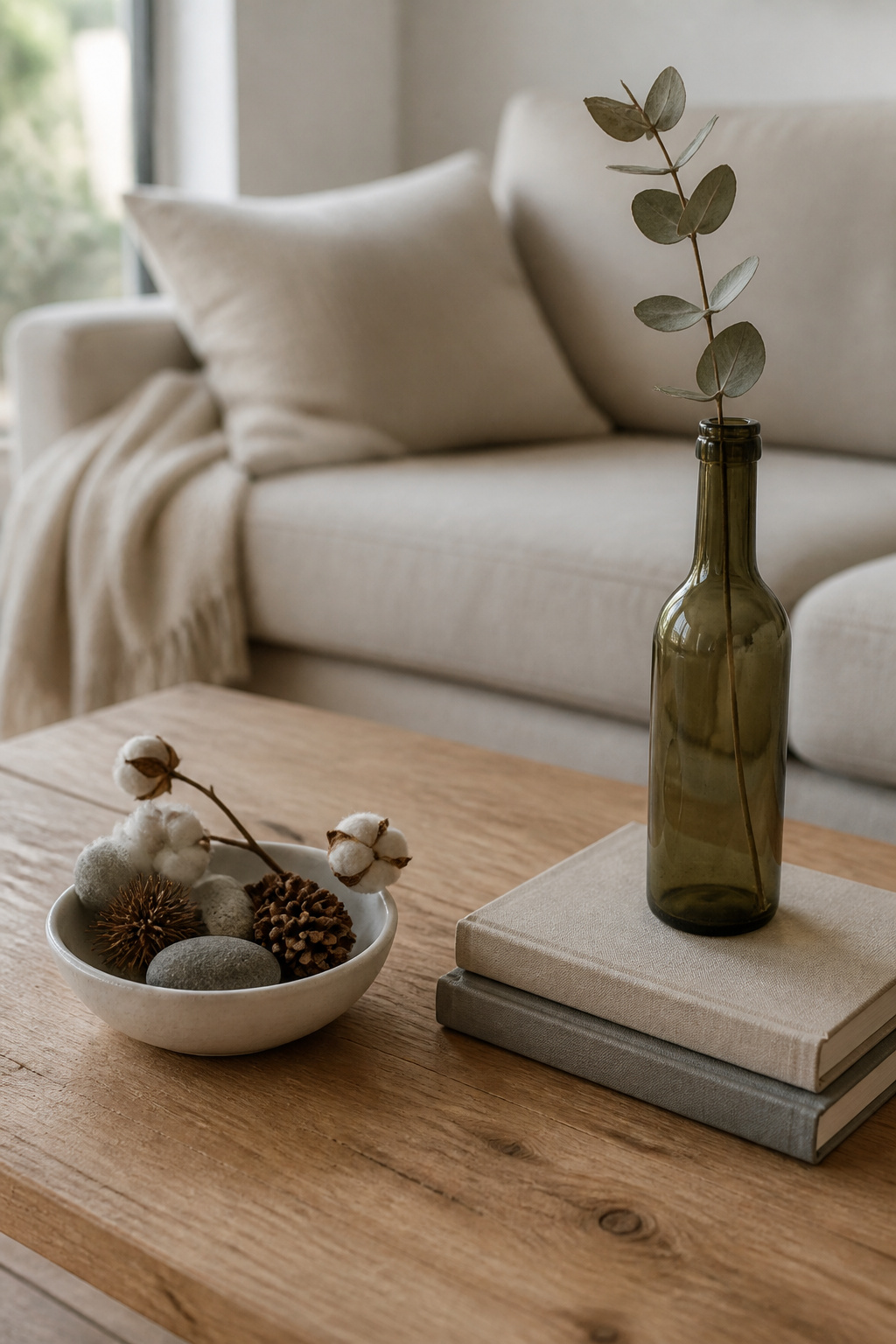
Most of what you need is already in the house or just outside the door. Walk through with this checklist:
- A ceramic bowl from the kitchen — works as a vessel or a standalone sculptural object, no cost.
- Books from other rooms — the single most effective free piece. Stack two or three, largest on the bottom, and strip the dust jackets; the cloth or embossed cover underneath usually looks better.
- An empty glass bottle — olive oil, wine, seltzer. Clean it, peel the label, and it reads as an intentional bud vase or candle holder.
- Foraged nature finds — smooth river stones, a pinecone cluster, dried seed heads, a cut eucalyptus or olive branch.
That last one is where budget tables usually fall short, because cheap pieces lack organic texture. Foraging fixes it for free. Autumn gives you pinecones, acorns, and dried seed heads; winter gives you evergreen sprigs and berried stems. As blogger Grace in My Space puts it, “earthy bits like pinecones, dried leaves, and acorns make the coffee table feel like a snapshot of the season.” A dried eucalyptus stem in a thrift-store vase is genuinely hard to tell apart from the $18-30 dried stems sold in homeware stores.
Thrift Shopping for Coffee Table Decor
The thrift store is your first shopping stop, not your last, because the three most useful coffee table objects — trays, ceramic vessels, and books — turn up there for a fraction of retail. Here is what to actually grab:
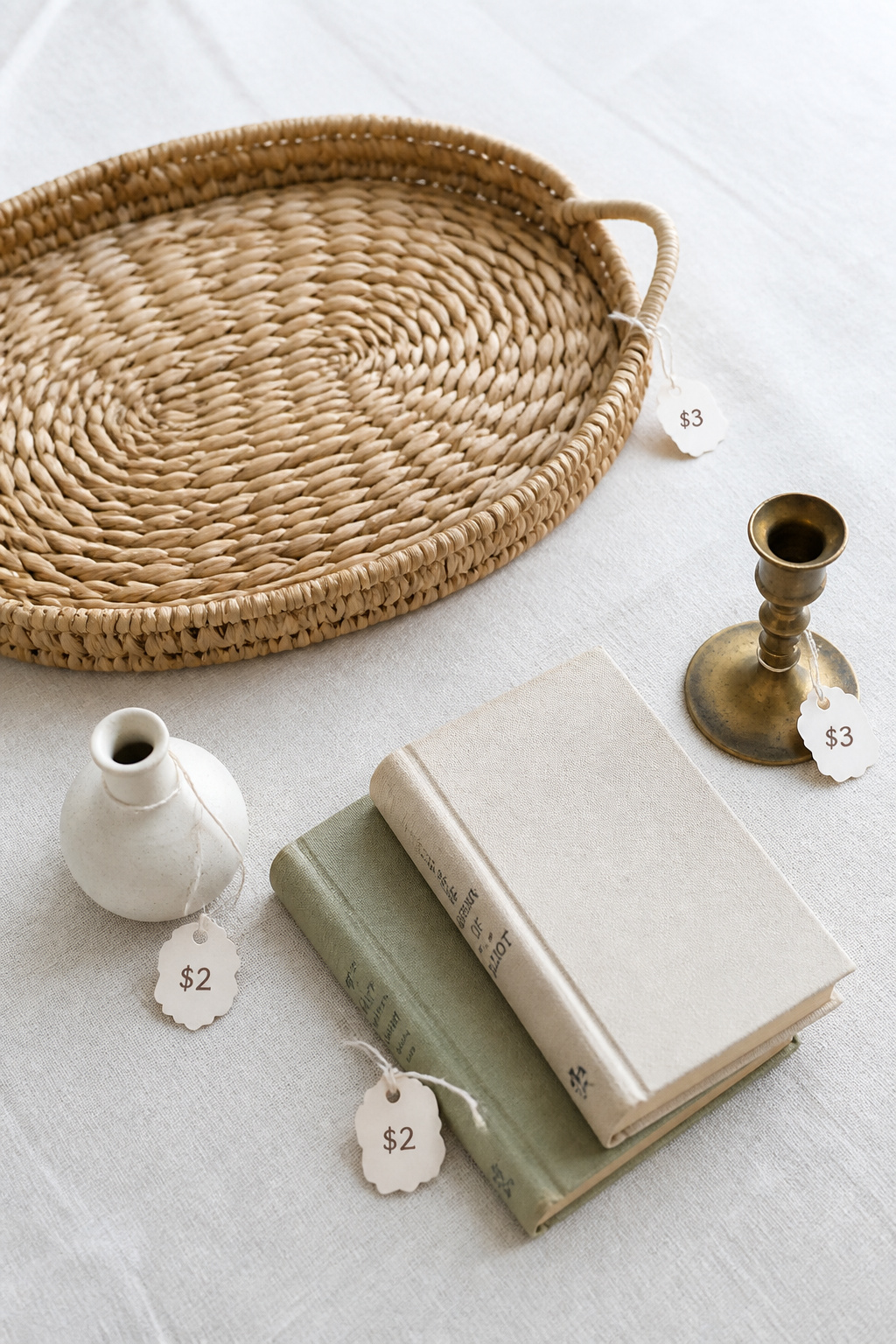
- A tray, 18 inches or larger. Anything smaller looks like it is floating. Hunt neutral finishes — whitewashed wood, natural rattan or seagrass, aged metal — that survive seasonal swaps. Woven seagrass trays routinely show up at Goodwill for $2-5.
- Ceramic vessels. Short bowls, bud vases, ginger jars. Vases are the easiest budget find there is — thrift stores overflow with them, and a $2 thrift vase is functionally identical to a $40 retail one on a coffee table. Do not splurge here.
- Hardcover books at $2-3 each. Art, design, architecture, and travel titles stack best. Stick to one spine-color family so the stack reads as collected, not random.
The skill is restraint. Skip novelty items — themed mugs, figurines, branded promo junk — because if you would not buy it at full retail, being cheap will not save it. And keep your materials within one or two families. A shiny metallic vase next to a rustic bowl next to a lacquer tray is visual noise. One more thing worth knowing before you walk past a piece: wrong color is not a dealbreaker. If the form is right, buy it and spray-paint it. A pink bowl becomes matte black in five minutes.
The One DIY Build Worth Doing: A Painted Wood Tray
If you build one thing for your coffee table, build the tray. It is flat assembly — no joinery — and it costs $8-20 in materials depending on lumber and handles. I rate it a genuine first build: if you have never made anything, this is where to start.
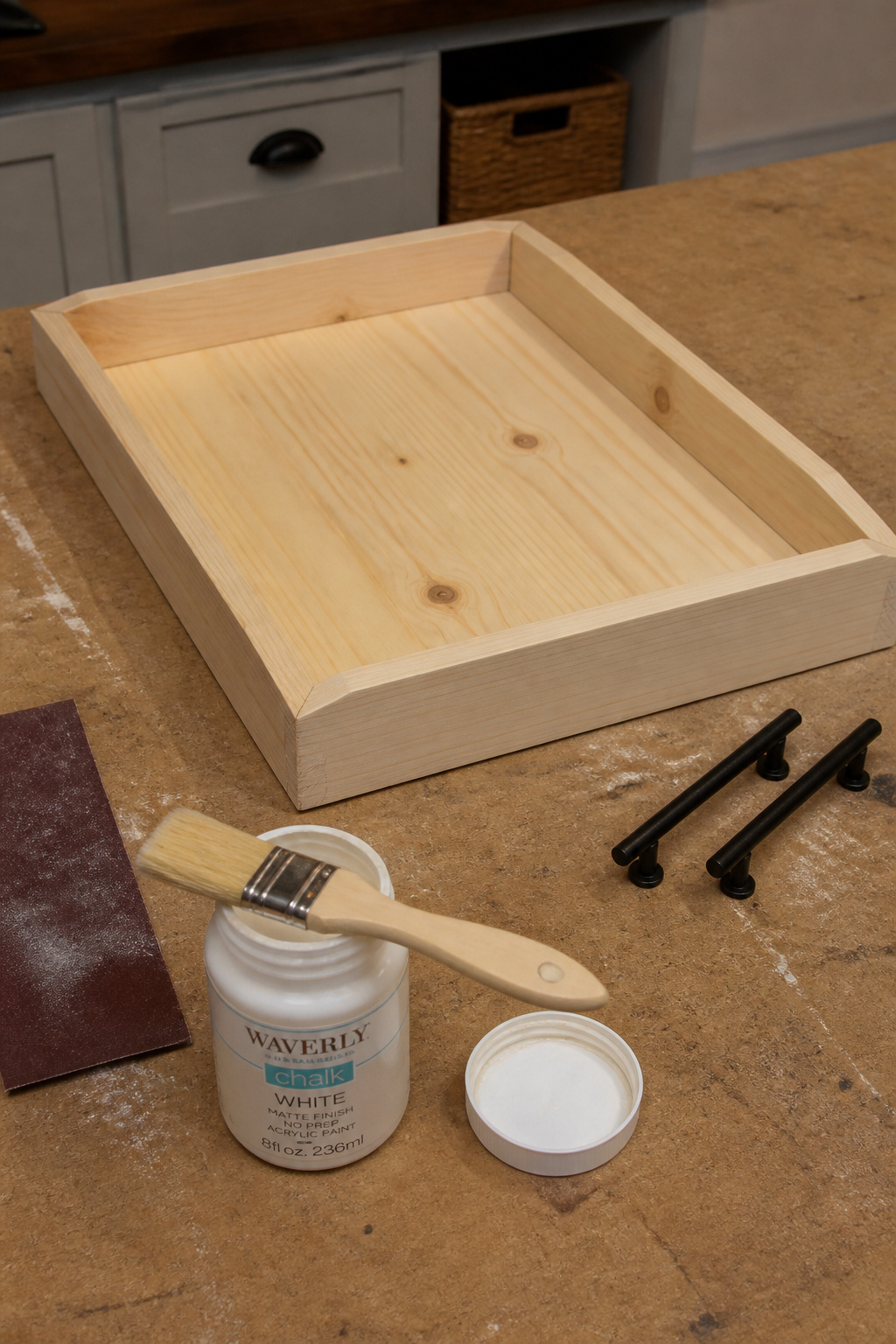
Here is the full cost breakdown before you touch a board:
| Item | Cost | Notes |
|---|---|---|
| Pine 1×6 boards (×4 at 28 in) | $12-18 | Lumber yard cuts free if you lack a saw |
| Pine 1×4 boards (×2 at 22 in) | Included above | Cut from same pine stock |
| 1-inch screws | Under $3 | Trim-head screws avoid splitting |
| Two bar handles | $4-8 | Black on white is the most versatile finish |
| Sandpaper (120 + 220 grit) | Under $5 | Both grits needed |
| Chalk paint (sample pot) | $13-15 | Rust-Oleum Chalked or Valspar Chalky; skip the $35 Annie Sloan quart |
| Total | $8-20 | Low end uses budget pine + handles at $4 |
The steps:
- Cut the boards to length — or have the lumber yard cut them free if you do not own a saw. No shame in the cut counter.
- Lay the four 1×6 boards face down and flush. Slide the 1×4 boards underneath, perpendicular at each end, to act as cleats and form the side lip.
- Fasten from the back with 1-inch screws. Check square before you drive them.
- Flip it, sand with 120 then 220 grit, pre-drill the handle holes, then chalk-paint two thin coats an hour apart. Dry overnight before attaching handles.
Now the mistake that ambushes first-timers: bleed-through. Pine is full of tannins, and the water in chalk paint pulls them up as brown streaks. More paint will not fix it — the tannins keep surfacing. Painting expert Tracey Amadio, who has 25 years and an ACT certification behind her, is blunt about it: the “no prep needed” promise of chalk paint “is actually a dirty lie when it comes to raw wood.” The fix is to stop, brush one coat of shellac-based stain-blocking primer (BIN, or Valspar Bonding Primer) over the stain, let it dry overnight — you will still see brown through the primer, which is normal, since primer seals rather than covers — then repaint. Test a small patch first and you will know before you have committed the whole tray.
Faux Stems, Candle Swaps, and Budget Accent Objects
Some things are cheaper bought than made, and pretending otherwise wastes a weekend. Here is where to spend the little money you have.
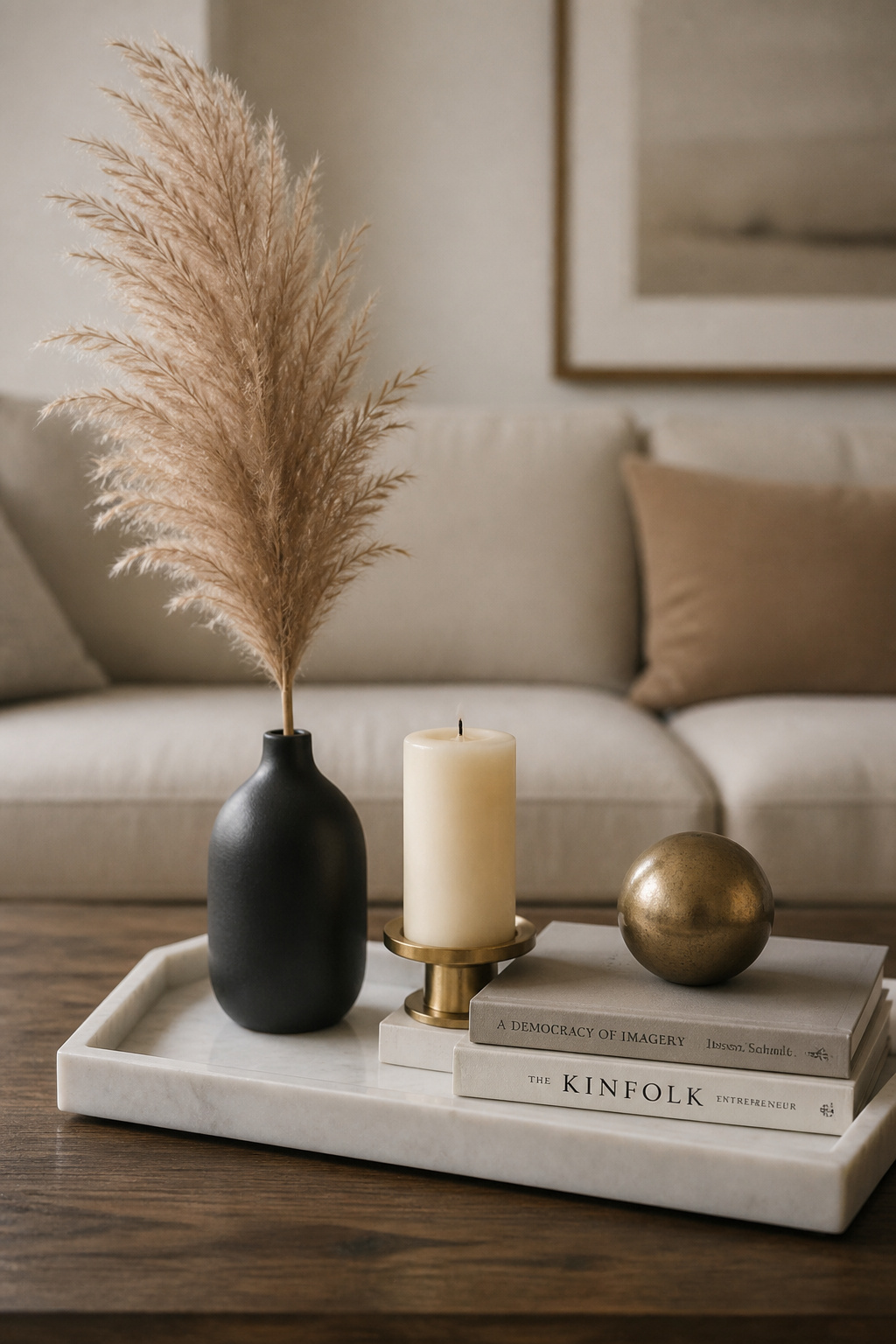
Faux stems are worth a small upgrade. Dollar Store flowers feel crunchy like a chip bag and have flat, uniform color — no arrangement can save them. As budget-decor blogger Lauren of Bless’er House says plainly, realistic faux flowers “aren’t found at the Dollar Store.” Look for soft, flexible petals, color variation, and wire-reinforced stems that hold a bent shape. Michaels routinely runs faux stems at 50% off, which puts a quality stem at roughly $3-5 — two good stems beat ten bad ones every time. Then fluff them: bend the leaves in different directions for thirty seconds and the rigid out-of-box look disappears.
For candles, buy unscented pillars in bulk, not gift-shop votives. A 3×3 or 3×6 pillar has the right scale to read from sofa height; a tiny votive does not. IKEA’s FENOMEN unscented pillars are the benchmark — roughly $4-5 for the 5.5-inch (45-hour) size and $6-8 for the 9-inch (90-hour) size. Target and HomeGoods pillars land in the $7-15 range with more color options, still well under the $20-35 specialty brands charge.
The one category where DIY loses: a single sculptural accent. A decorative sphere or a small geometric object carries a lot of visual weight, and a cheap homemade version reads cheap. A $6 sphere on sale does more here than an hour of effort would. Spend the $15-20 once, buy it right, and stop.
Seasonal DIY Refresh on the Same Budget
Once the base is built — tray, books, a permanent vessel, a candle holder — changing the season costs almost nothing, because only the accents move. Keep them in one labelled box and the whole refresh takes ten minutes.
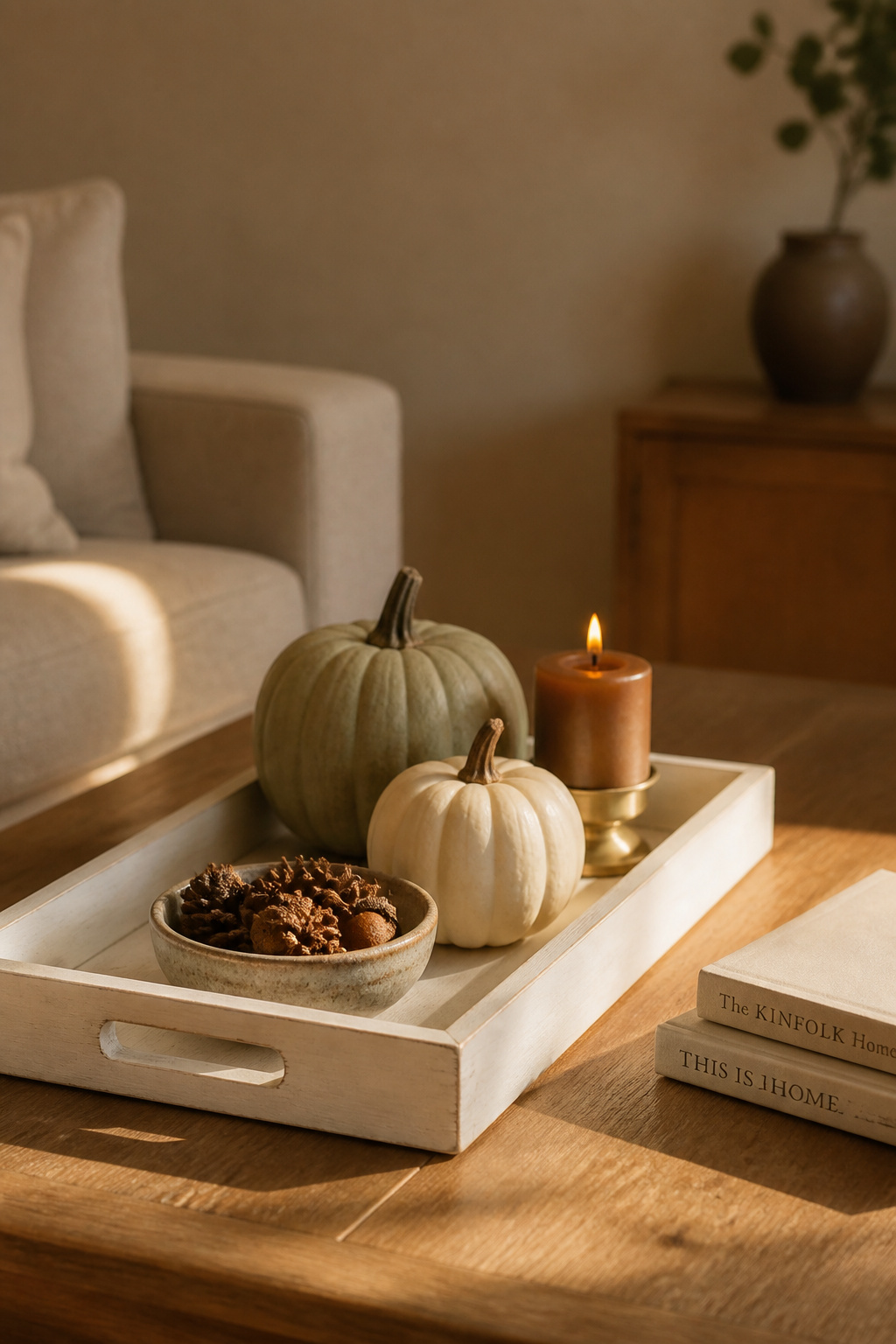
Two DIY swaps cover most of the year. For autumn, buy plain foam pumpkins from Dollar Tree at $1-3 and paint them sage, cream, or matte black with craft acrylic; seal with a clear matte spray so they do not scuff by week two. A $2 pumpkin repainted next year reads as new. For winter, cluster three IKEA pillars at staggered heights — 5.5, 7.5, and 9 inches — and tuck in a foraged evergreen sprig. That is the most expensive transition at $15-18, because candles are the one consumable.
Spring is the cheapest of all: $5-10 of grocery-store tulips or a budding branch in the vessel you already have, and you are done. The whole point is that you invest once and rotate, so no season costs more than $20. If you want the full season-by-season playbook, see seasonal coffee table decor. And if your table is small, the same edit-first discipline matters even more — start with small-space coffee table decor before you add a single object.
Start with the cheapest move you have: clear the table tonight and put back only what earns its place. You will see exactly what is missing — usually a tray and one tall element — before you spend a cent, and that single edit does more than any purchase will.
FAQ
How do you decorate a coffee table on a budget?
Start by shopping your own home — most people already own a bowl, a stack of books, and a candle. Then thrift a tray (18 inches minimum, neutral finish), a ceramic vessel, and a couple of hardcover books, typically $6-10 for all three. A full table can come together for as little as $27.
What can I put on my coffee table instead of buying new decor?
Use books from other rooms with the dust jackets removed, a ceramic bowl or mason jar from the kitchen, and a cleaned wine or olive oil bottle as a bud vase. Add foraged river stones, pinecones, or dried stems for free organic texture. Clear the table first, then return only what earns its place.
How do you make a DIY coffee table tray?
Assemble pine boards flat: four at 28 inches from 1×6 stock and two at 22 inches from 1×4, fastened with 1-inch screws, sanded, chalk-painted in two thin coats, and fitted with two bar handles. Total cost is $8-20. Watch for tannin bleed-through on raw pine, and fix it with a shellac-based stain-blocking primer before repainting.