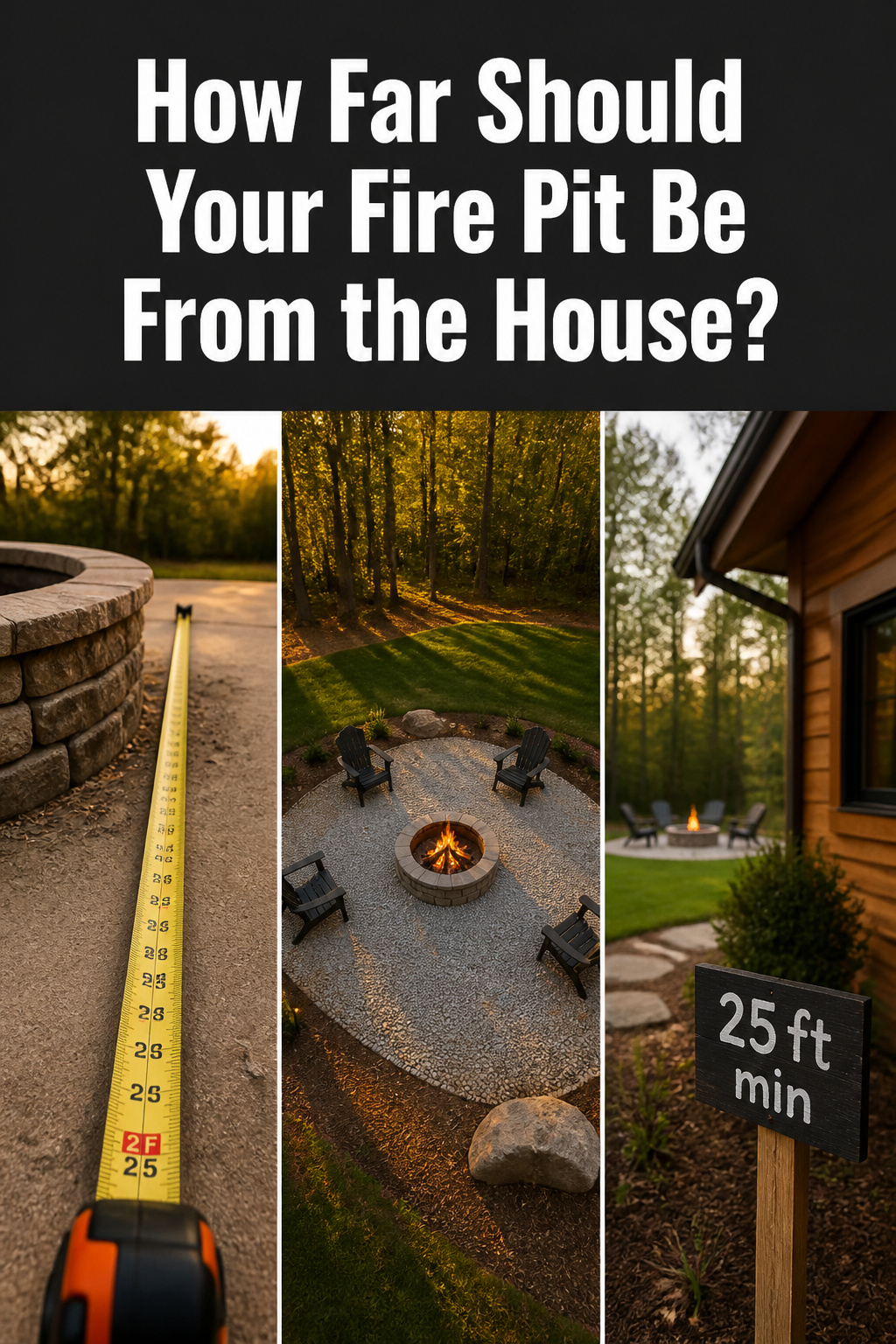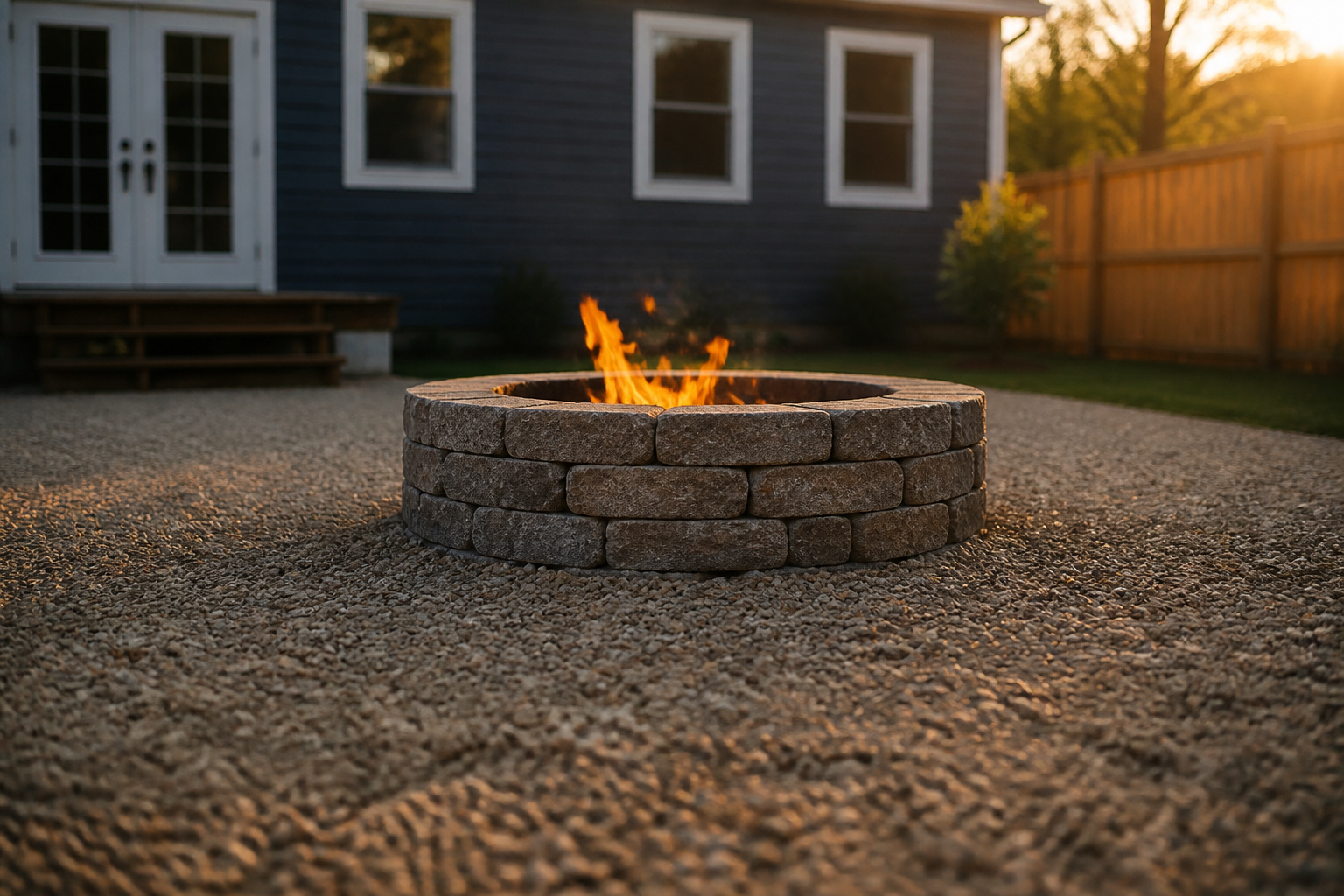
Ask around the patio aisle and you’ll hear the same number: ten feet from the house and you’re fine. It’s on half the backyard blogs, and it’s wrong. When people ask how far should a fire pit be from the house, the honest answer is that the 2021 International Fire Code and NFPA 1 both set the floor at 25 feet from any structure or combustible — for a wood fire. That’s two and a half times the usual rule of thumb.
TL;DR
- Wood-burning pits need 25 feet from the house and any combustible (fence, shed, mulch) per IFC 307.4.1 and NFPA 1; certified gas pits drop that to 36 inches because they throw no embers.
- Don’t forget the two clearances people miss: overhead (10–15 ft for wood, 84 inches for gas under a non-combustible roof) and the surface underneath (gravel ideal; a wood deck needs a deck-rated gas unit plus a fire mat).
- Local code always wins when it’s stricter, and it usually is — check your municipality’s open-burn ordinance before you pour the first course of block.
How Far Should a Fire Pit Be From the House? The 10-Foot Rule Is Wrong
The ten-foot figure is older, informal guidance. The standard that governs your yard is 25 feet.
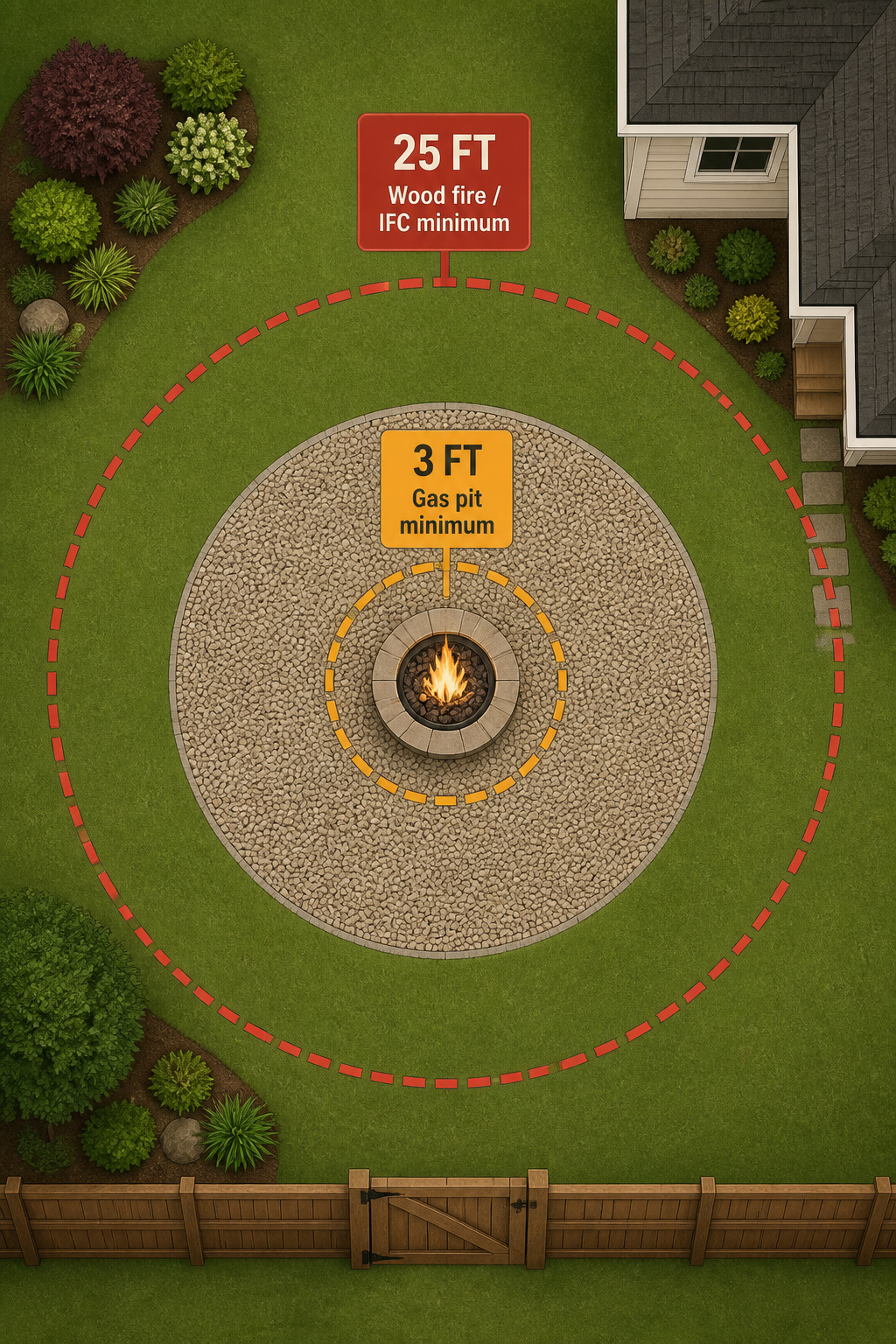
NFPA 1 and the 25-foot minimum: where it comes from and what it covers
The 2021 International Fire Code, Section 307.4.1, is unambiguous: “Recreational fires shall not be conducted within 25 feet of a structure or combustible material.” NFPA 1 agrees. Two details trip people up. First, a recreational fire is defined as one with a fuel area no larger than 3 feet across and 2 feet high — build bigger and a permit is required regardless of placement. Second, the 25 feet applies to any combustible — fences, sheds, decking, mulch beds, shrubs — not just the house wall.
Why local codes differ — and why local wins when it does
No national number settles this for you. States adopt the IFC verbatim, amend it down (commonly to 10–15 feet for approved portable units) or push it up, as California’s High Fire Hazard zones do. Municipalities can tighten it further — Pflugerville, Texas, sets 15 feet from structures and fencing. The most restrictive layer applies. Check your jurisdiction before you site anything.
The clearance table: NFPA guideline vs typical local range by fuel type
Read this as a starting reference, then verify every number with your local fire department.
| Clearance | Wood-burning | Gas (ANSI Z21.97 certified) |
|---|---|---|
| Horizontal from structure | 25 ft (IFC/NFPA 1); some locals reduce to 10–15 ft | 36 inches (3 ft) |
| Overhead to non-combustible | 10–15 ft typical | 84 inches (7 ft) |
| Property-line setback | 5–10 ft (varies locally) | 5–10 ft (varies locally) |
| Ground/surface | Non-combustible pad, 6 ft across | Deck-rated unit + fire mat for decks |
The jump from 25 feet to 3 feet comes down to one variable: embers. Catherine Traschenko, a fire-products design specialist at DreamCast, puts it plainly — gas “burns clean without stray embers or unpredictable flame spread.” For the full survey of types, fuels and layouts, start with our fire pit types and design guide.
Gas vs Wood Fire Pit Clearance: Why Fuel Type Changes the Number
Fuel type is the most consequential siting variable — it sets which number you start from.
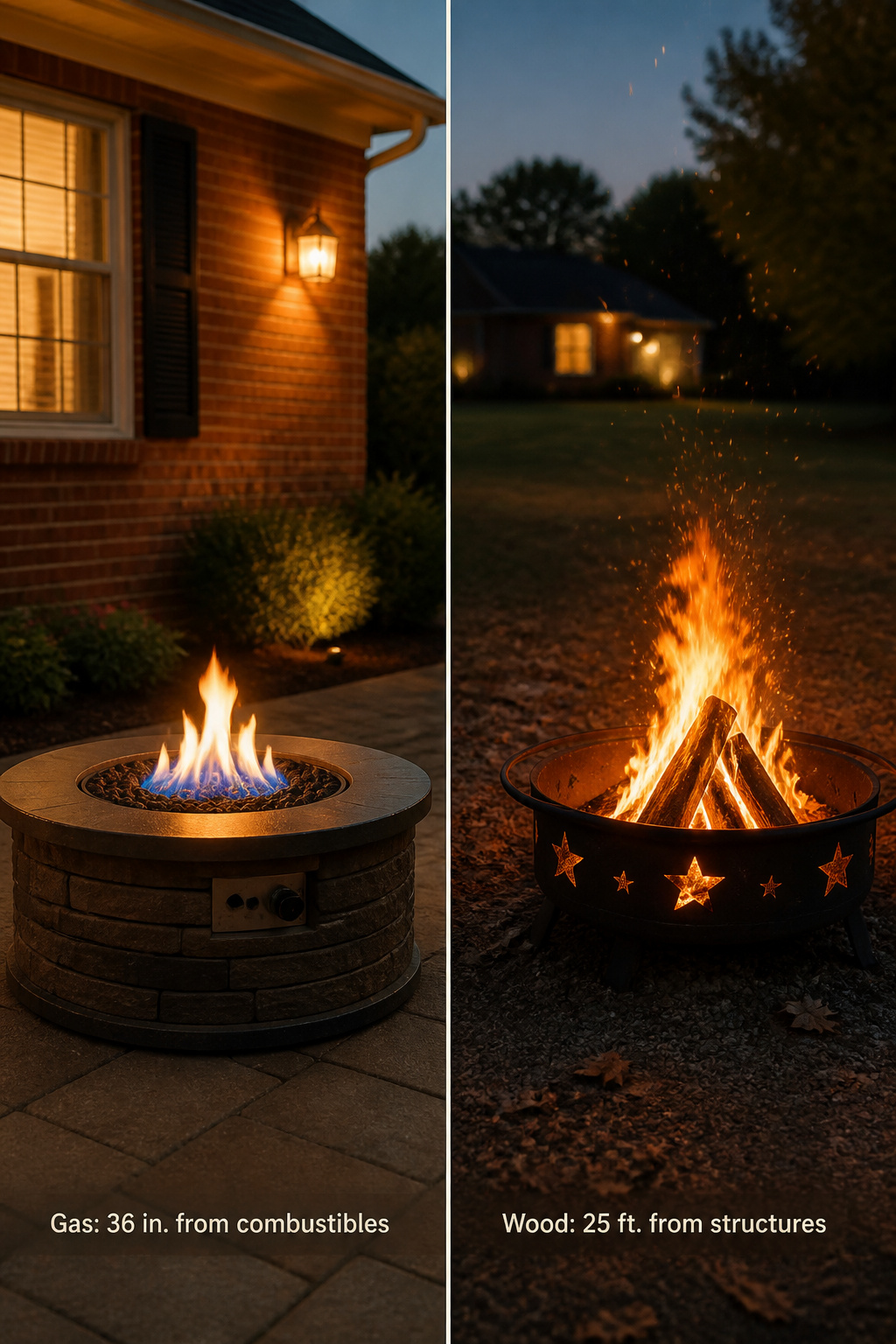
Wood fire: ember travel, wind, and why 25 feet is a minimum not a target
Airborne embers can travel 10–20 feet or more in a moderate breeze. The 25-foot buffer is the distance most embers need to cool below ignition temperature before reaching something that can catch — a minimum, not a target. Wind tightens things: most ordinances prohibit wood fires once sustained winds pass roughly 10–15 mph, an aggregate of local burn-ban practice rather than a single national standard. A spark-arrestor screen helps and is often required, but it never replaces the clearance.
Gas fire: smaller flame envelope but gas leak risk — what that means for siting
A gas pit certified to ANSI Z21.97 needs 36 inches from any combustible — house, shed, wooden fence. Stone or brick without combustible trim can sit closer; any wood framing triggers the 36-inch rule. Gas introduces a leak risk wood doesn’t: the install must meet NFPA 54, line work belongs to a licensed professional, and the shut-off valve must stay accessible.
Propane vs natural gas: the specific siting differences
Propane sinks and pools when it leaks, so enclosure vents go near the base; natural gas rises, so vents go high. Get this backwards and a slow leak collects inside. Propane’s tank stays 3 feet from the pit on a non-combustible surface; natural gas needs a permanent NFPA 54-compliant line. Our gas vs wood clearance comparison covers cost, heat and use if you haven’t settled the fuel choice.
Overhead and Vertical Clearance: The Rule Most Homeowners Miss
Horizontal distance gets all the attention. Vertical clearance is what gets people into trouble — invisible until something overhead starts smoking.
Tree canopy, pergola roofs, and deck overhangs: the vertical clearance minimum
For a wood pit, the consensus is 10–15 feet from the rim to anything combustible overhead — pergola beams, tree canopy, deck overhangs, awnings — with most guides pushing to 21 feet over branches. For gas, HPC Fire requires 84 inches (7 ft) from the top of a 200,000-BTU-or-less enclosure to any overhead structure. Chuck Parsons of HPC Fire is direct: “even pergolas that include spaced lumber are not sufficient. You must use a non-combustible material.” Trees get the same treatment — heat stress desiccates branches over time.
How to measure vertical clearance on an uneven site
Measure from the pit rim to the lowest overhead point — the lowest beam of a pergola, not its average height. On a slope, use the highest ground point under the structure; that’s where the gap is tightest.
String lights and shade sails over a fire pit: where the line is
String lights should not run over an active pit — route them around the perimeter, at least 12 feet above the rim. Shade sails are a specific hazard: the polyethylene fabric in most residential sails isn’t fire-rated, and a spark can melt the cloth into burning droplets. Travelers Insurance names the correct condition: nothing overhead except open sky. A retractable canopy folded back before lighting is the right answer — not a tensioned sail left up.
Surface and Ground Clearance: What You’re Siting the Pit On Matters Too
The ground under the pit is a clearance dimension most homeowners overlook.
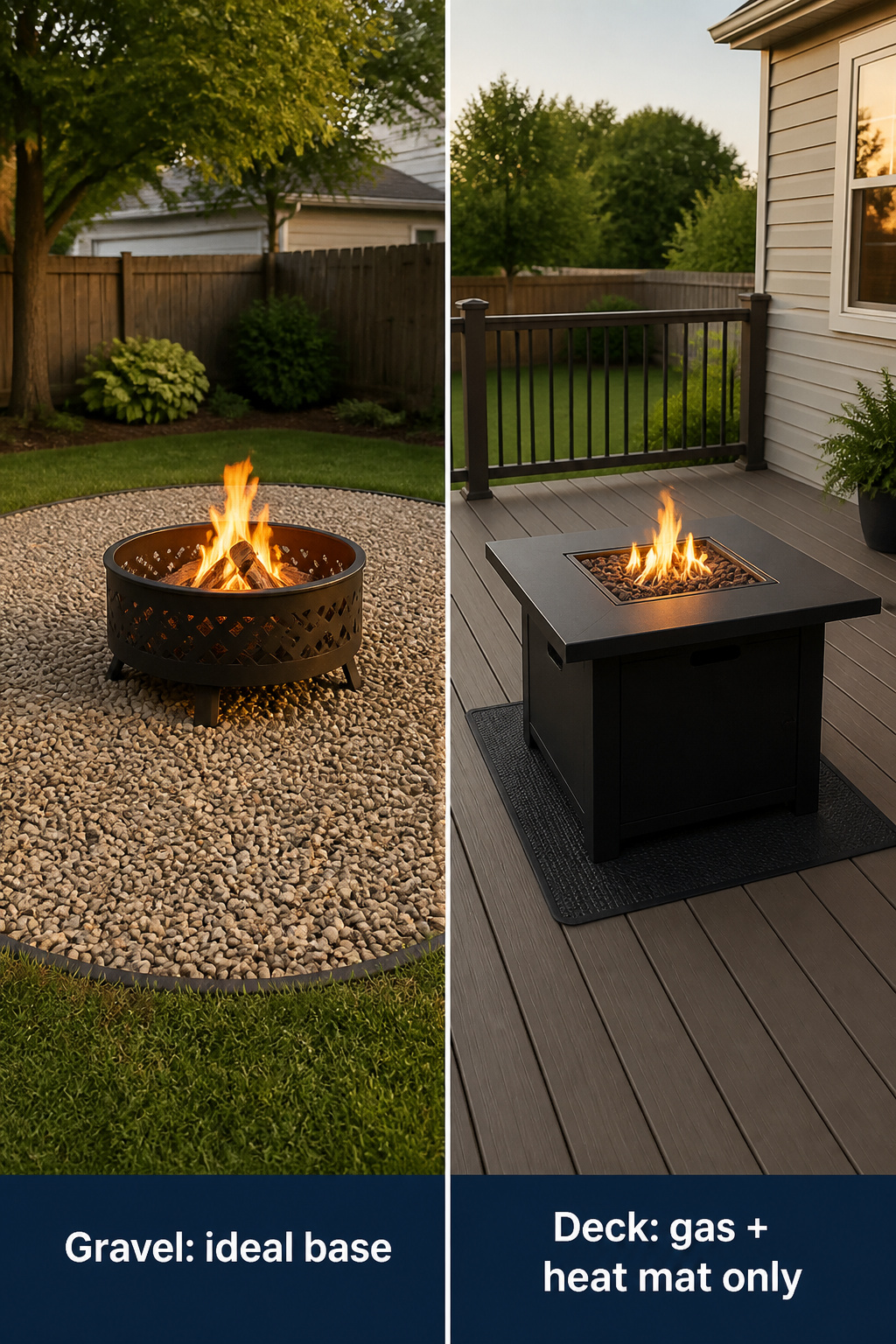
Fire pits on wood decks: the real answer (not just ‘don’t’)
A wood-burning pit does not belong on a wood or composite deck — embers plus heat transfer is too much risk for any mat to manage. A gas pit certified for deck use under ANSI Z21.97 can go on one — the certification is what matters, not the fuel label. A pit transfers 200 to 400°F of radiant heat into the surface below, so a fire mat extending 24 inches past the footprint is mandatory.
Grass, gravel, concrete, and pavers: relative risk and what each needs
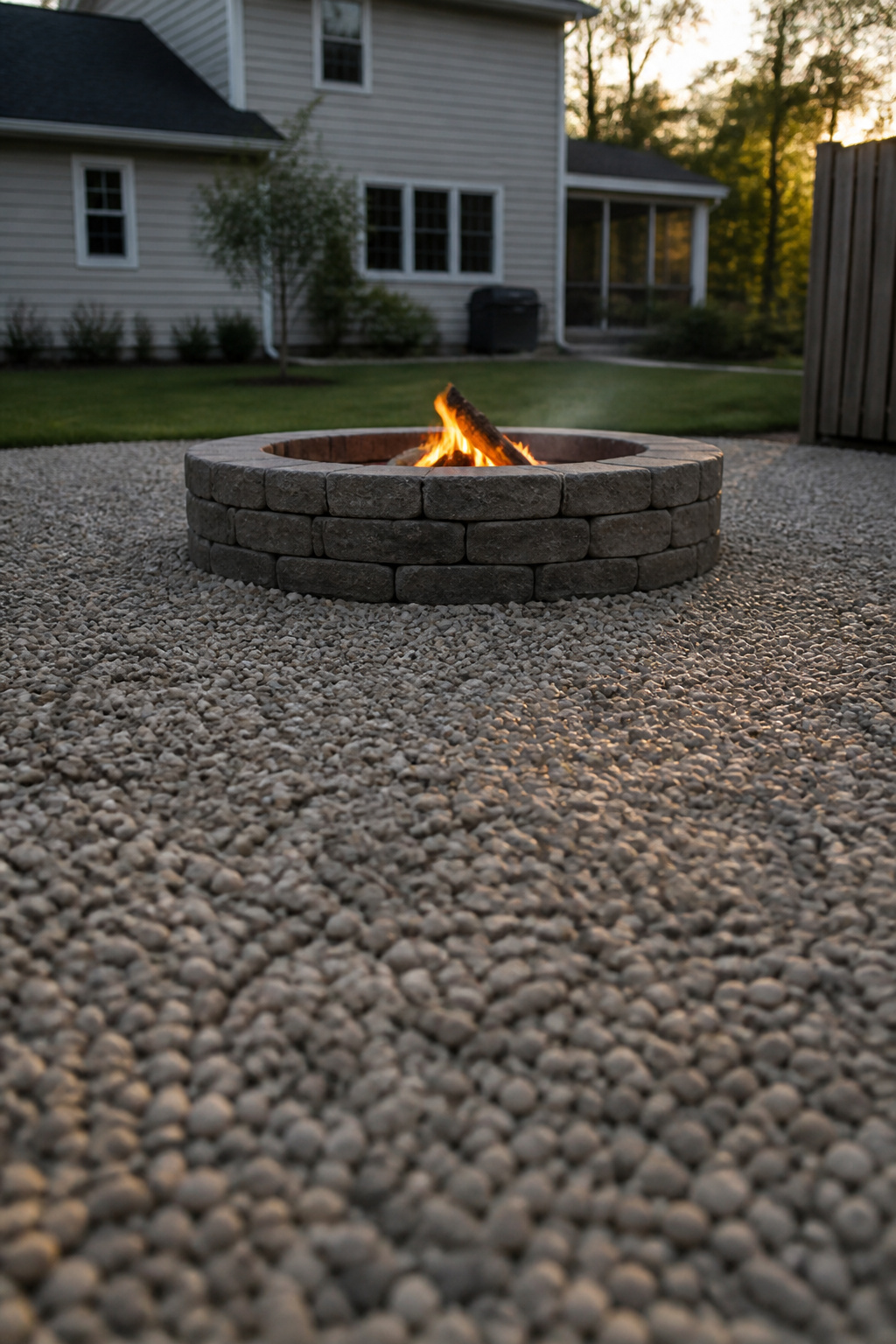
Pea gravel is the best base: non-combustible, no synthetic binders, it spreads heat and catches stray embers on a pad at least 6 feet across. Grass needs the same non-combustible apron — dry grass is an ignition path for any ember that clears the rim. Concrete and pavers work but can crack from thermal shock without a mat or heat shield between slab and pit.
Spark arrestor screens and heat shields: when they change the clearance math
A spark screen reduces ember travel but does not change the 25-foot structural clearance under IFC 307.4. Its practical effect is permission: some ordinances require one to run a wood pit at all, and insurers like Allstate and Farm Bureau treat screen-plus-cleared-perimeter as conditions of coverage. A heat shield cuts radiant transfer roughly 50–70%, letting some certified units sit on decking or pavers that a bare-base unit couldn’t.
Checking Your Local Code Before You Site the Pit
None of these numbers mean anything until you’ve matched them against your own town’s code. Checking takes about twenty minutes.

Where to find your municipality’s open-burn ordinance
Most open-burn ordinances live on the local fire department or city clerk website — search “[your city] open burn ordinance” or “[your city] fire pit permit.” In rural areas, start with CAL FIRE or your state DNR. HOAs add a non-public-law layer that bites just as hard: smaller setbacks, fuel bans, or outright prohibitions.
What a permit requires vs what an inspection checks
Portable, factory-made pits usually don’t need a building permit, though a seasonal open-burn permit may apply. Permanent built-ins almost always need one, and any hardlined natural gas pit needs a gas permit and inspection. Applications typically want a spec sheet, clearance documentation, fuel-type declaration, materials list and a site plan; inspection checks the result against that plan.
The three questions to ask before you pour the first course of block
Poudre Fire Authority in Fort Collins is direct: contact your local fire department before you buy or install. Three questions cover it.
- Is my fuel type permitted? Some zones ban wood while allowing gas; air-quality districts can prohibit wood on poor-air days.
- What are the exact clearances from structures and property lines? Property-line setbacks (often 5–10 ft) are separate from structural clearance.
- What documentation does a permit require? Knowing before you build stops the worst outcome: a finished pit that fails inspection.
Our guide to placing a fire pit in a small yard covers compact options and the variance rules that make them legal.
Wind, Slope, and Site-Specific Variables That Change Your Safe Placement
Codes set the floor; the site sets the ceiling. A spot that passes on a calm July night can fail on a gusty October one.
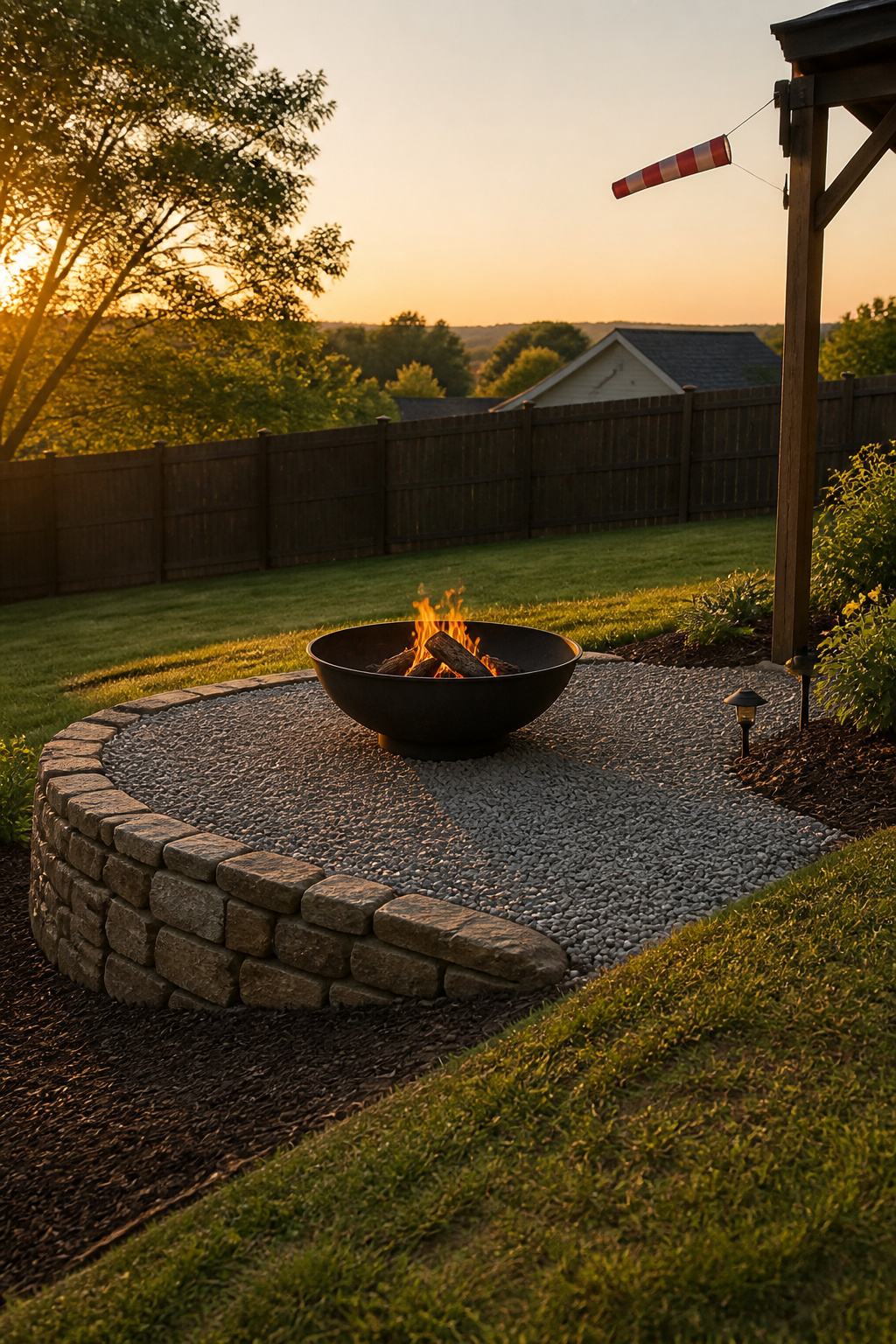
How prevailing wind direction should orient the pit (and the seating)
Orient the pit so the prevailing wind carries embers and smoke away from the house, seating and the neighbour’s windows. Pull your local direction from NOAA climate data; keep combustibles — shed, woodpile, fence — upwind. A pit broadside to a wind channel between house and garage will smoke the patio doors every time. Move it out of the channel and placement fixes what budget cannot.
Sloped yards: drainage, leveling, and uphill ember risk
A pit must sit on a level pad — a slight tilt sends embers rolling downhill, extending their travel past the clearance the code assumed. On slopes steeper than 5 degrees, build level with cut-and-fill over a compacted 6-inch gravel base, ring it with a 6-foot non-combustible apron, and cut a shallow swale to route runoff around the pad. A retaining wall can redirect ember roll back into the pad rather than down the slope.
Neighbour proximity and fence clearance: what the codes rarely say but you should consider
A wood fence carries the same clearance as the house — 25 feet for wood-burning, 36 inches for gas. On a typical suburban lot you often can’t hit 25 feet from both house and back fence, which is why local 10–15-foot variances matter in dense neighbourhoods, and why gas is sometimes the only fuel that fits. Most towns require 5–10 feet off the property line. If a neighbour’s fence sits just past it, your effective clearance is shorter than it looks. Plan for the gusty autumn evening, and the rest of the year takes care of itself.
FAQ
Can I put a fire pit 10 feet from my house?
For a wood-burning fire, no — the 2021 International Fire Code (307.4.1) and NFPA 1 set the minimum at 25 feet from any structure or combustible. Some jurisdictions amend it down to about 15 feet for approved portable units, so verify locally. A certified gas pit, however, only needs 36 inches.
Do I need a permit to build a fire pit in my backyard?
Often, yes. Portable factory-made pits usually need no building permit, though a seasonal open-burn permit may apply. Permanent built-ins almost always require a permit, and any hardlined natural gas pit needs a gas permit and a licensed installer. Check with your local fire or building department before you start — it takes days, not months.
How far does a fire pit need to be from a wood fence?
A wood fence is treated as a combustible structure, so it carries the same clearance as the house: 25 feet for a wood-burning pit, 36 inches for a certified gas one. Some local codes name fences explicitly — Pflugerville, Texas, lists structures and fencing together at 15 feet. Always confirm your jurisdiction’s figure.