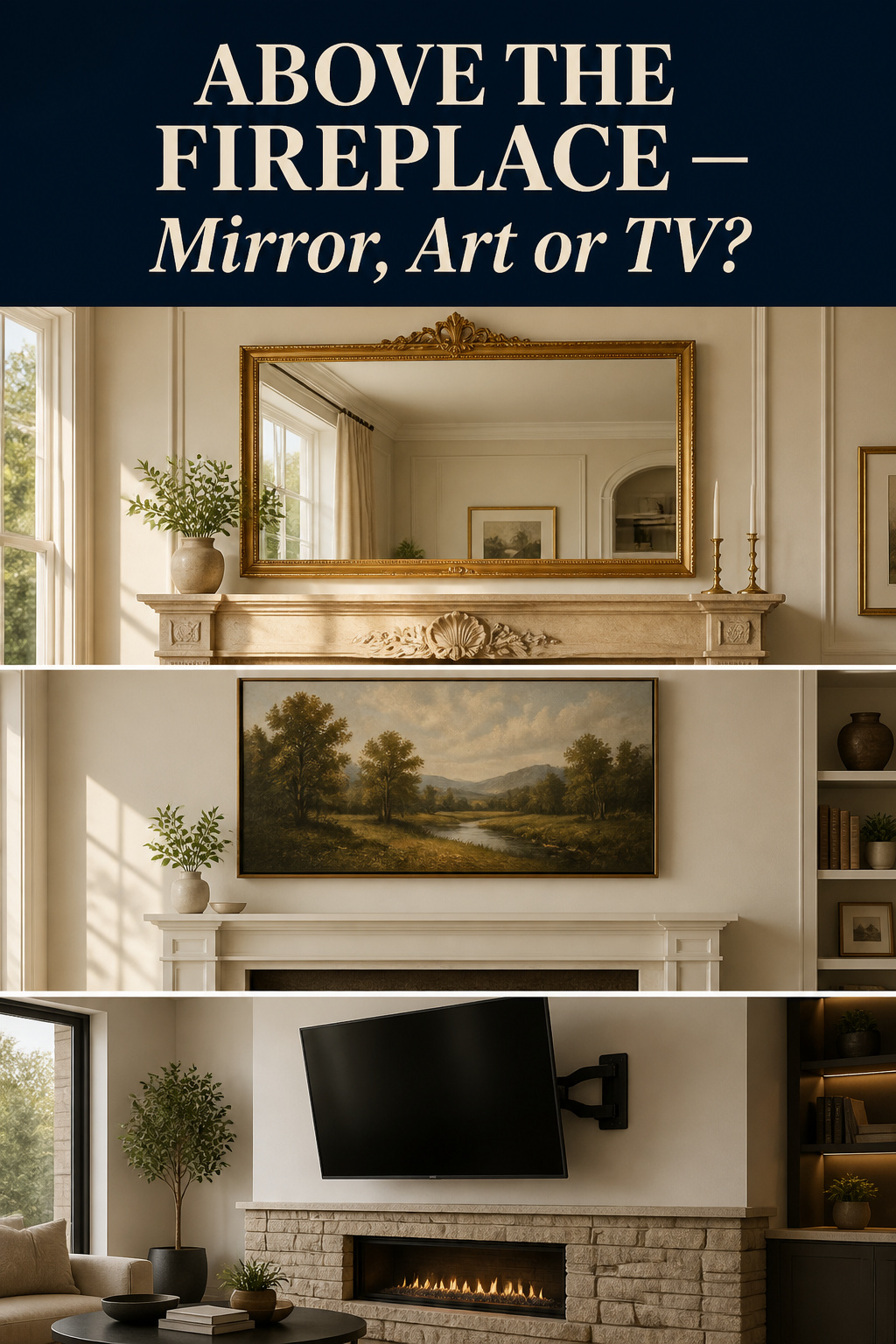
The wall above the chimneypiece has carried the same job for four hundred years: it is the surface everyone’s eye finds first. Get it wrong — a piece too small, hung too high, floating in its own patch of plaster — and the whole wall looks unfinished. The question of what to put above a fireplace is really two questions. The hard one is the maths, and it comes first.
TL;DR
- Size the piece at 50–75% of the firebox opening width, not the mantel shelf, and sit the bottom of the frame 4–12 inches above the mantel (4–6 inches for an anchored look).
- A mirror is the historic default and the most flexible choice — it bounces light and never ties you to a colour scheme; art commits the room to a palette; a TV is the only option with ergonomic and heat penalties.
- A standard mantel sits 52–58 inches from the floor, so a TV just above it lands near 65–70 inches — well above the seated eye level of 42–48 inches, which is why above-fireplace TVs need a tilting or pull-down mount.
The Sizing Rule That Applies to Everything You Hang Above a Fireplace
The 50–75% rule: width relative to the firebox opening, not the mantel shelf
The most common mistake is sizing the piece against the mantel shelf. Size it against the firebox — the opening that carries the visual weight. A 36-inch firebox calls for 18–27 inches; a 48-inch firebox, 24–36 inches. Don’t match the mantel’s edges exactly, and never run a mirror frame wider than the surround’s stiles.
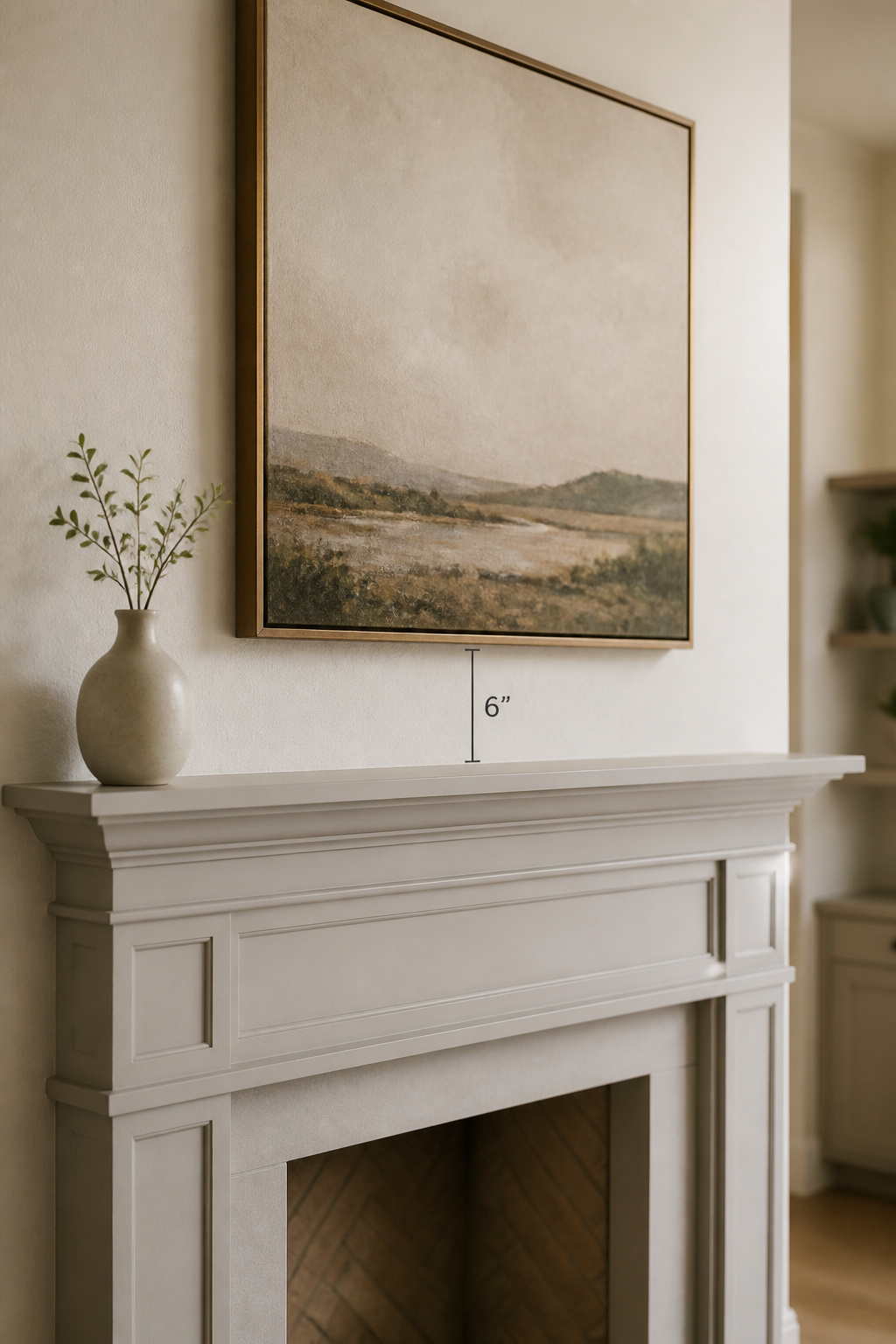
Hang height: why 4–12 inches above the mantel shelf is the professional standard
The bottom of the frame belongs 4–12 inches above the shelf. The tighter 4–6 inches gives an anchored look; 6–12 inches buys breathing room in taller rooms. Push past 12 inches and the piece floats — the error specialists name most often.
How ceiling height changes the calculation
Under 8-foot ceilings the gap between mantel and crown is often only 18–24 inches, so a horizontal piece sits better than a tall portrait one. In a 9-foot-or-taller room, a piece reaching toward the ceiling amplifies the height. Interior designer Lauren Carlucci notes: with art and architecture “in such close conversation,” getting the proportion wrong “is immediately obvious.”
| Option | Ideal width (relative to firebox) | Hang height (bottom of frame) | Special considerations |
|---|---|---|---|
| Mirror | 50–75% of firebox; never wider than the surround stiles | 4–6 inches above mantel | Check what it will reflect from your main seat first |
| Art | 50–75% of firebox; err larger, never smaller | 4–6 inches above mantel | Light it; undersized art is the most common error |
| TV | Sized to the wall, within the same visual band | Centre at 42–48 inches from floor, not “just above” | Needs a tilting or pull-down mount; 12-inch heat clearance |
For the styling rules that govern the mantel shelf itself, our complete mantel styling guide is the place to start.
A Mirror Above the Fireplace: When It Works and When It Doesn’t
A mirror is where I’d start most readers — it is the one choice that gives light back to the room.
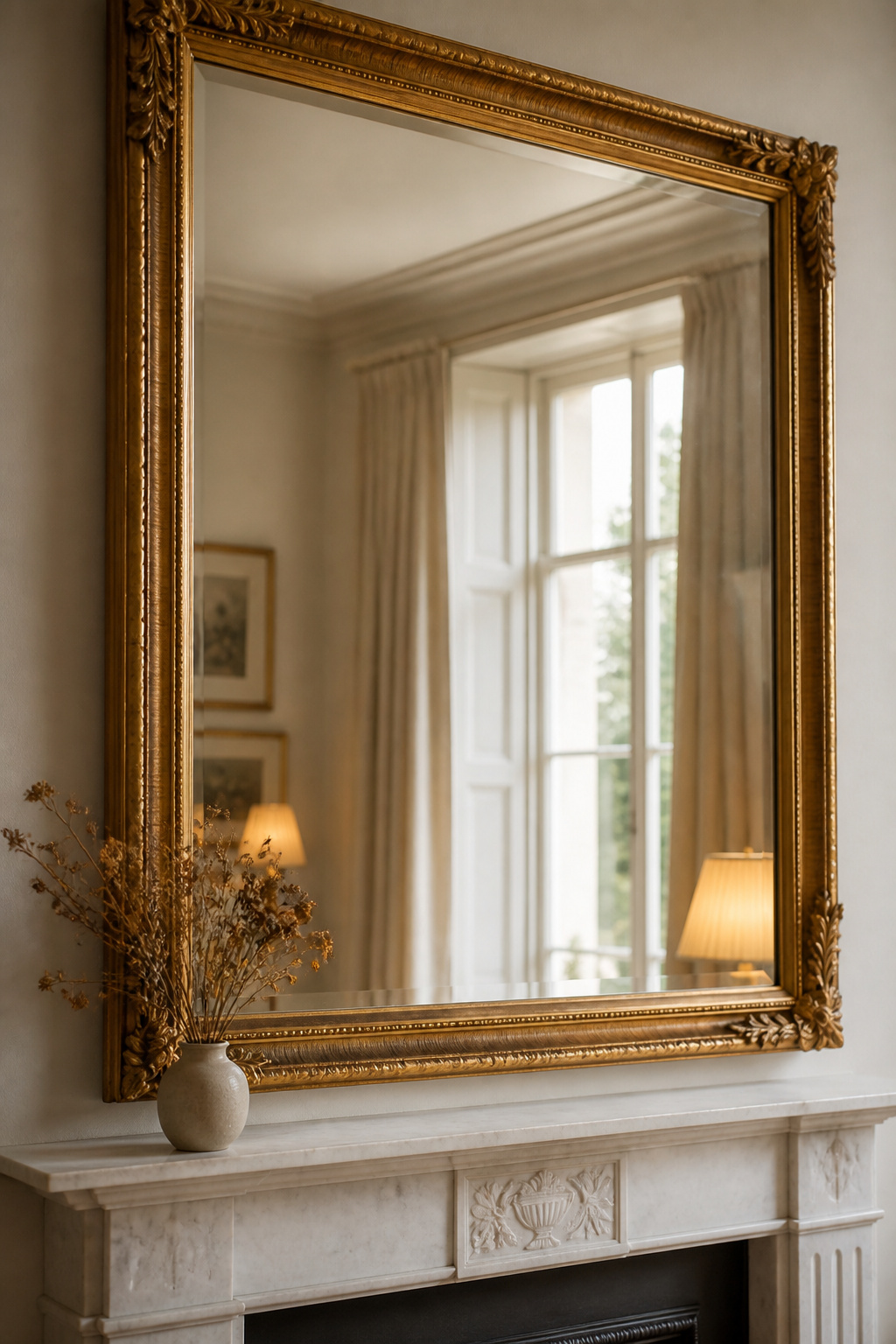
Why mirrors are the historic default — and what that means for period rooms
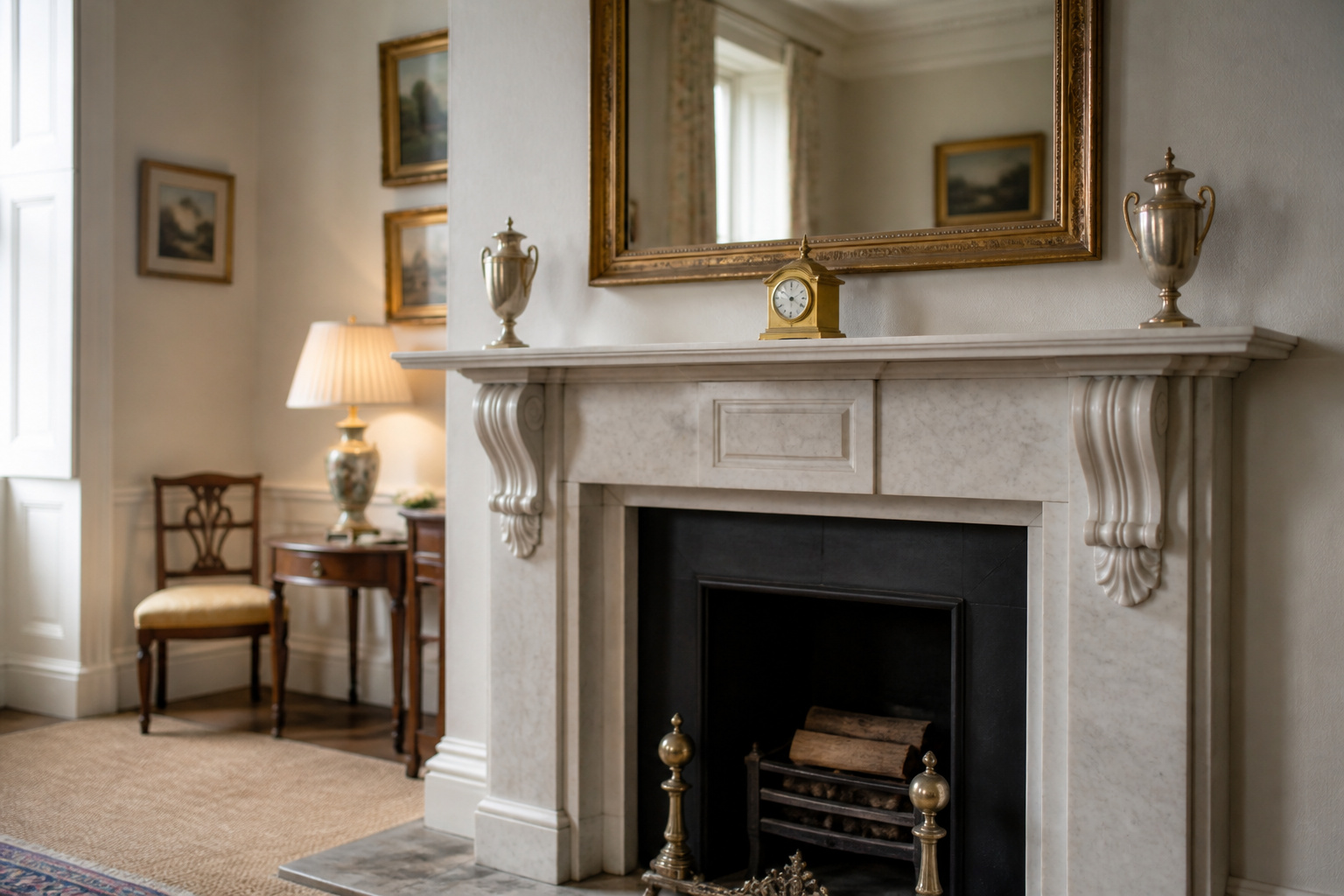
The overmantel mirror dates to the early 17th century, when French craftsmen first produced large plate glass to multiply scarce candlelight; by the Georgian period it was treated as almost architectural. In a period room with an original chimneypiece a gilt-framed mirror needs no justifying — though a contemporary room takes a slender arched or circular shape just as happily, provided the firebox-width rule holds.
Room light and mirror choice: what you are reflecting matters more than the frame
A mirror is only as good as what it reflects. Hung to catch a window, a chandelier or a garden view, it doubles the light; hung too high, reflecting only ceiling or blank wall, it depletes the space. Designer Jessica Davis chose a mirror for a dark Victorian room precisely “to bounce light around and make it feel a bit more airy.” Before you commit, sit in your main seat and check what the glass will actually show.
Frame styles by surround type: what reads with marble, brick, painted wood, and stone
Match the frame to the surround’s temperature — a starting point, not a rulebook. Marble takes cool finishes: silver, white lacquer, or gilt where the room already carries warm gold accents. Brick suits dark wood or forged iron; painted wood is the most forgiving and carries almost anything. Rough stone wants something organic and clashes with ornate gilt. On a busy surround, the cleanest answer is often the most restrained; the case for keeping it minimal holds.
Art Above the Fireplace: What to Hang and How to Hang It
Art is the most open of the choices and the one people most often get wrong — almost always by going too small.
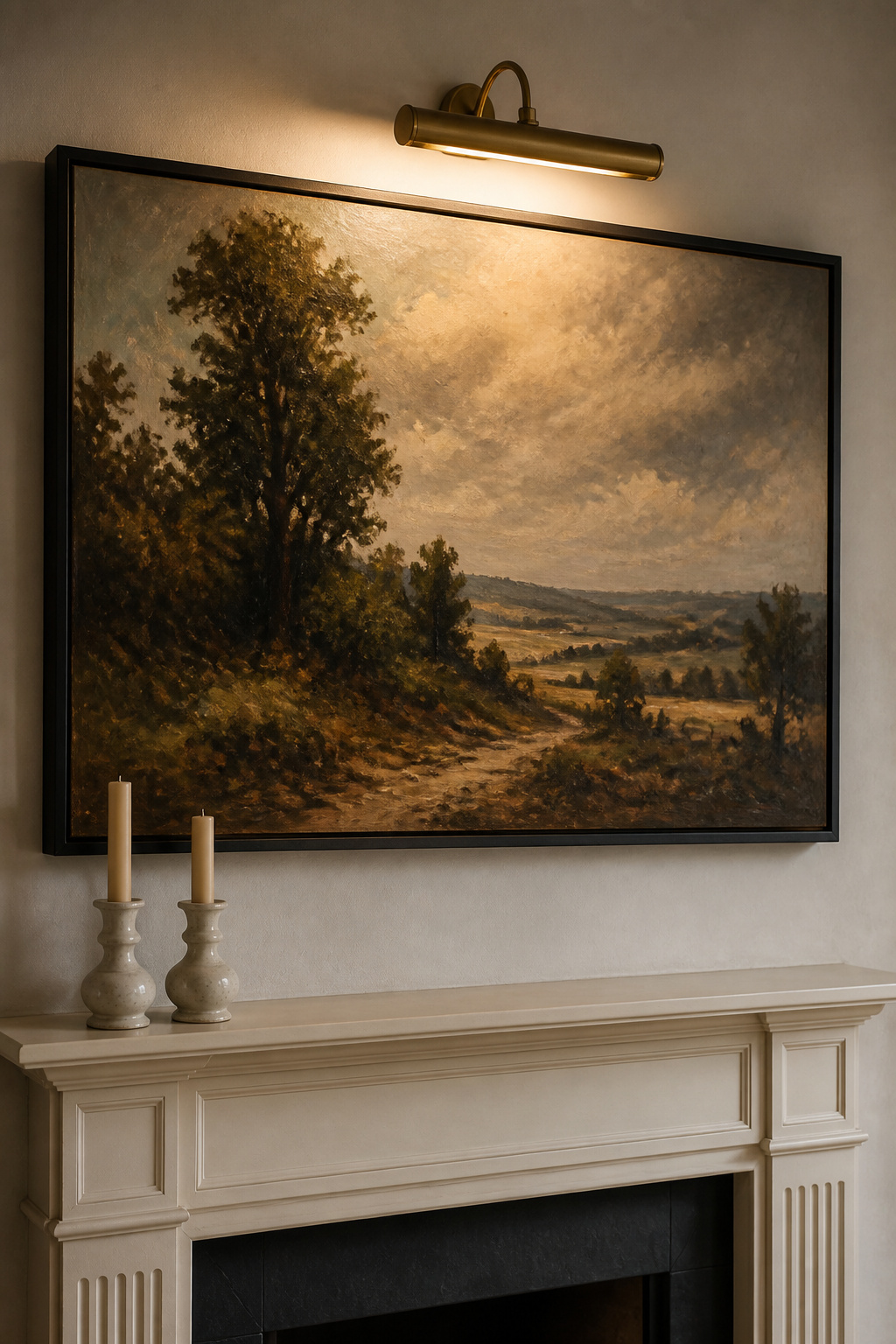
Scale: why most above-fireplace art is too small (and the fix)
Undersized art is the single most-cited mistake: err larger. A piece that looks right in your hands reads as a postage stamp above a real mantel. For a 48-inch mantel, aim for roughly 28–35 inches wide, and tape the dimensions onto the wall before you buy.
Single large piece vs gallery grouping: the case for each
One large piece almost always reads more resolved than a gallery wall: a scatter of small frames competes with the focal point rather than reinforcing it. A diptych or triptych is the sound alternative once the overmantel runs 48 inches or wider — the imagery flows across the panels as one composition, still sitting inside the 50–75% rule as a unit.
Subject and palette: what imagery and colour work with a fireplace surround
The piece above the fireplace sets the palette for the whole room, so choose the art first and pull accent colours from it — not the reverse. Against a dark or masonry surround, bold complementary colour pops. One non-negotiable: on a dark chimney breast, give the art a picture light or flanking sconces, or even a fine canvas sinks into the wall.
A TV Above the Fireplace: The Honest Trade-offs
For many open-plan rooms a TV above the fireplace is the only sensible wall — but it carries real penalties most guides underplay.
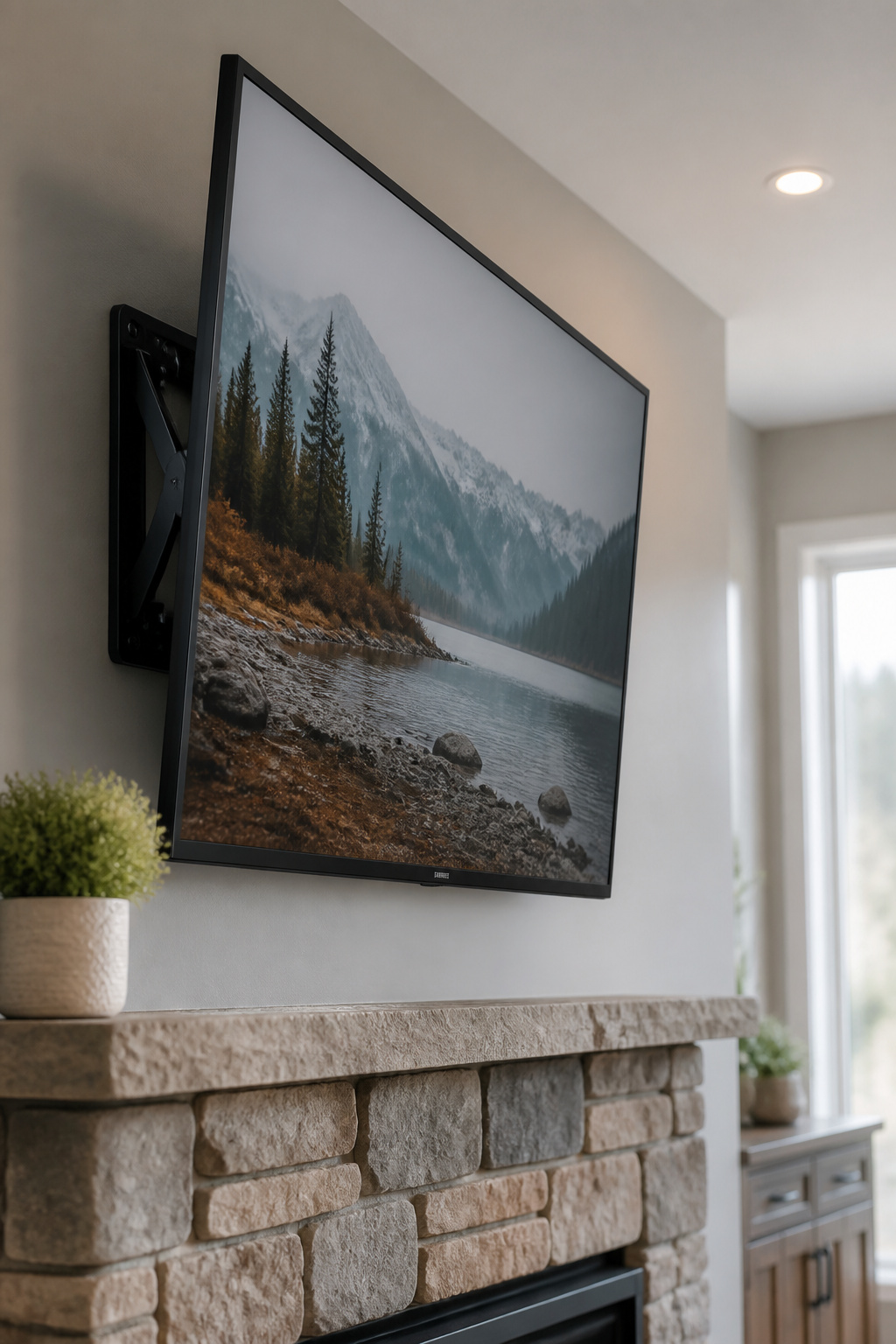
The eye-level problem: why most above-fireplace TVs are mounted too high
The ergonomic standard puts the screen centre at 42–48 inches from the floor — seated eye level. A standard mantel sits at 52–58 inches, so a TV just above it lands near 65–70 inches: 17–28 inches too high. Neck tilted past 30 degrees means strain and headaches. The fix is mechanical: a tilting mount angles the screen 5–15 degrees down when the mantel sits below 50 inches; above that, a pull-down drop mount is the answer.
The heat problem: what temperatures do to a screen and how to manage them
Most TVs specify a maximum operating temperature of 104°F (40°C); heat above that degrades electronics and panel adhesives. The field test: tape a thermometer where the screen centre will sit, run the fireplace for two hours, and if the wall reads above 100°F (38°C) the spot needs a heat shield. Gas and wood fires throw far more heat upward than electric ones and can void the warranty — keep at least 12 inches between the opening and the screen bottom.
When it actually works: room layouts where above-fireplace TV placement makes sense
It works best where the fireplace wall is the only uninterrupted wall and the mantel sits at or below 48 inches — which brings the screen near the ergonomic target. A seating distance of 10 feet or more helps. A motorised pull-down mount resolves height and heat at once — expect about $220 for a manual tilt-down, $1,100-plus for a full motorised drop.
Beyond the Big Three: Clocks, Architectural Salvage, and the Empty Wall
Mirror, art and TV are not the whole field. Three quieter options deserve a place, and the firebox-width rule applies to each:
- The statement clock. A large wall clock earns the focal position when it fills the 50–75% zone and has enough depth — 8–12 inches — to read as an object, not a flat disc. It suits a study, library or formal sitting room, where time is part of the room’s purpose.
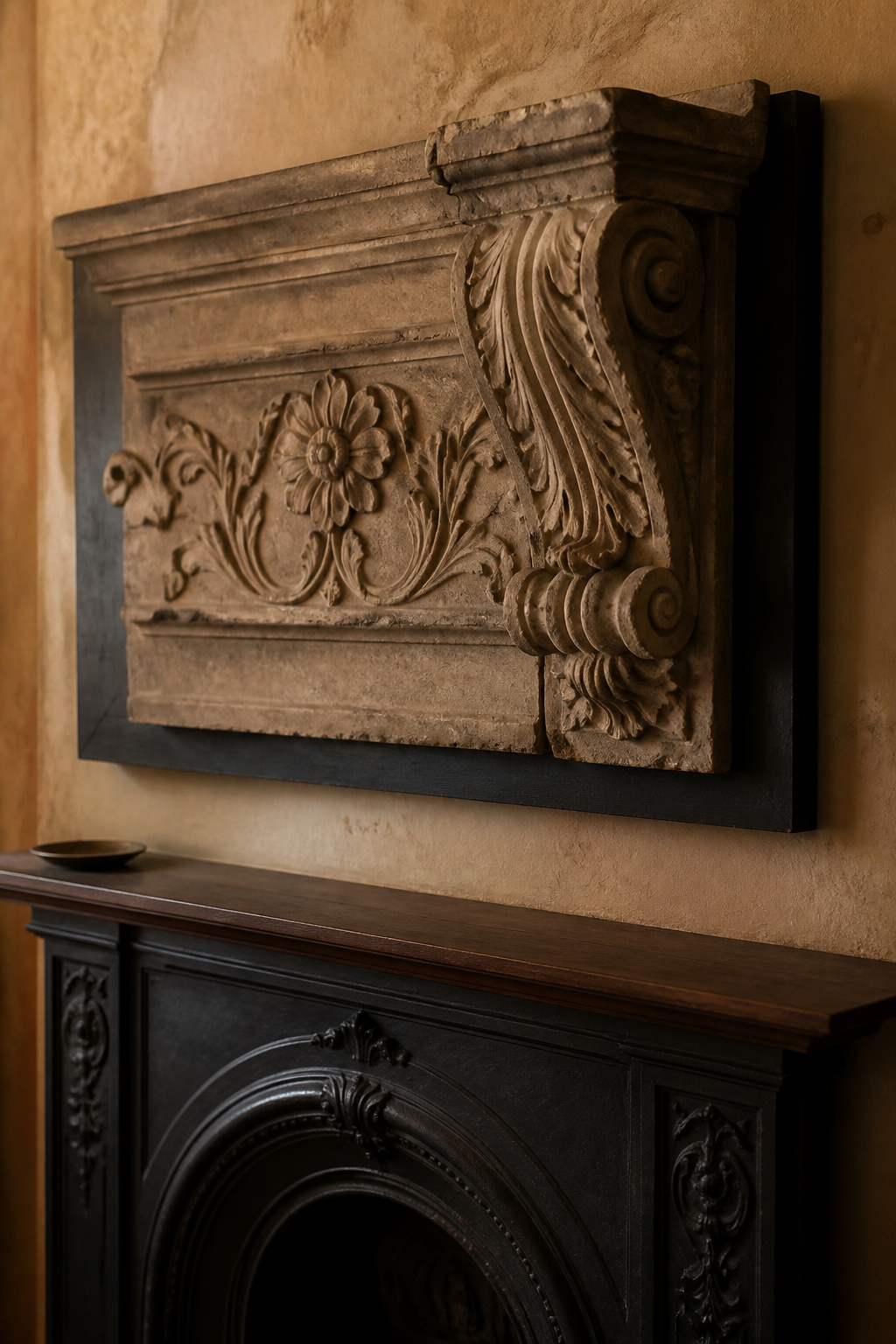
- Architectural fragments and salvage. A carved corbel, an overdoor panel, a cast-iron fireback mounted as relief — these carry a historical weight no reproduction can fake. They want a fireplace with genuine period character; against plain plaster, the fragment reads as a costume prop.
- Nothing at all. When the surround is the standout — dramatic marble veining, carved stone, statement tile — a clear wall is a real decision, not a gap, provided the room is otherwise well furnished. Designer Madelynn Hudson left a marble overmantel bare so the veining “became the focal point… using negative space as a design tool.” The piece above is also the natural thing to change with the calendar — see our take on swapping decor by season.
Choosing What Goes Above Your Specific Fireplace
Decision by surround: period mantels, brick, plain plaster, and stone each favour different options
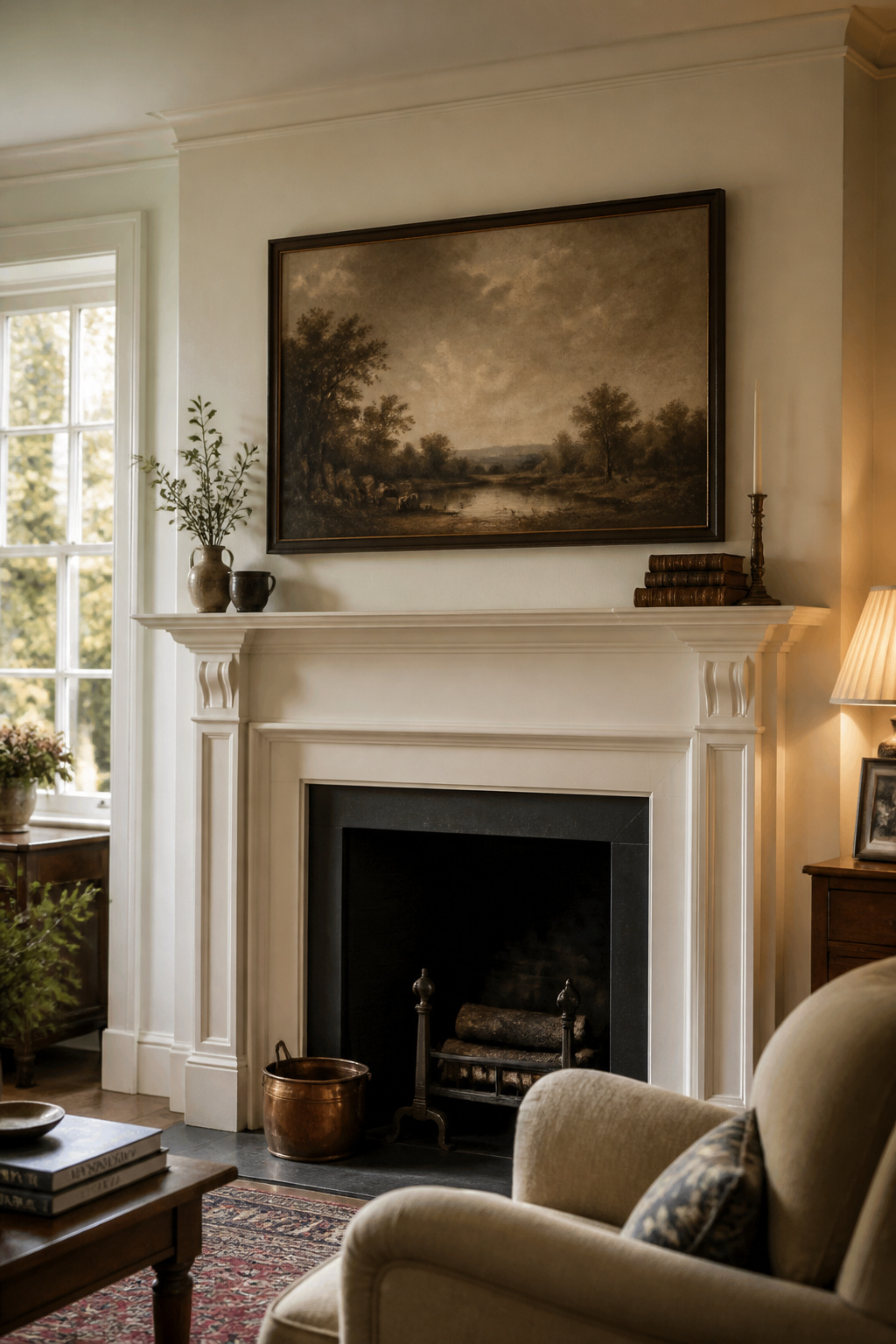
A period mantel takes a mirror that references its detail, or substantial art. Brick favours art over a mirror that would only reflect the busy pattern back; plain plaster reads well with anything; heavy stone suits art or salvage over an oversized mirror.
Decision by room: ceiling height, natural light, and how the room is used
In a dim or north-facing room, a mirror is the default — the only choice that actively improves the light. Under 8-foot ceilings, go horizontal; in a taller room, a piece reaching upward is the strongest play. Accept a TV only where the fireplace wall is the sole option.
The one question to ask before you hang anything
Sit in your primary seat and ask what you want to experience at the fireplace wall. Light or a reflected view points to a mirror; colour or meaning, to art; function, to a TV; confidence in the architecture, to a bare wall. Tape the dimensions up and live with the outline for a day before ordering. In a tie, the mirror wins — it never locks the room to one palette.
The wall above your fireplace is not an afterthought to fill — it is a continuation of the room’s decorative argument. Get the dimensions right and you have avoided the two mistakes that undo most overmantels; the choice between mirror, art, TV or nothing is then yours on the merits. Measure twice, tape it up, and trust your eye from your own seat.
FAQ
How big should a mirror be above a fireplace?
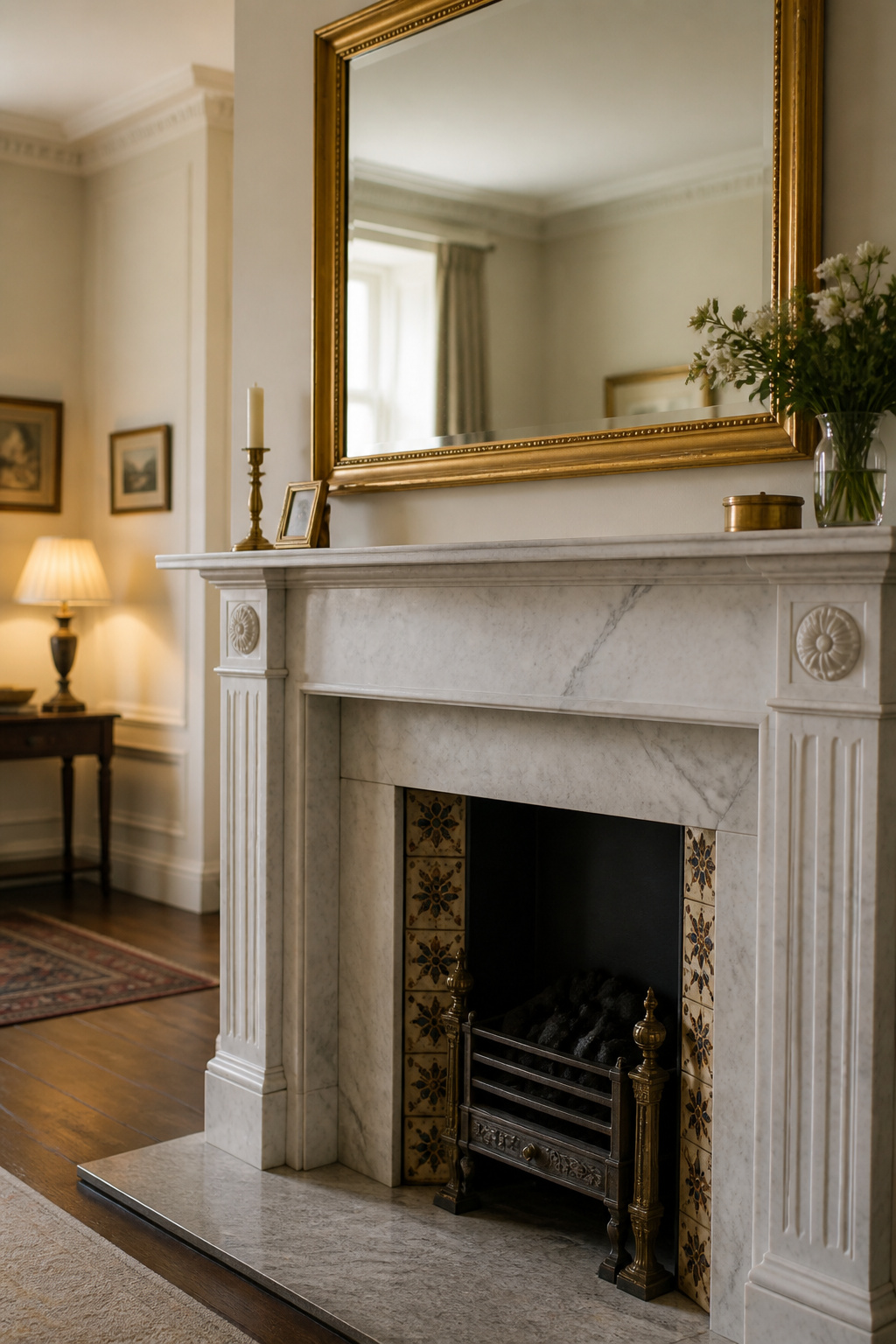
A mirror should span two-thirds to three-quarters of the firebox width — for a standard 48-inch opening, roughly 32–36 inches, never wider than the surround’s stiles. Sit the bottom of the frame 4–6 inches above the shelf. In rooms with 9-foot-plus ceilings, a taller mirror reaching toward the ceiling fills the wall and amplifies the height.
Is it safe to mount a TV above a fireplace?
It depends on heat. Tape a thermometer at the planned screen centre, run the fireplace two hours, and if the wall exceeds 100°F (38°C) the spot needs a heat shield. Electric fireplaces are safest; gas and wood-burning ones run hottest and can void warranties above the typical 104°F limit. Height is a separate problem — a tilting mount is required.
What looks good above a fireplace instead of a TV?
A mirror is the most versatile: it bounces light, suits any surround, and is never tied to one colour scheme. A single large canvas or triptych at 50–75% of firebox width anchors the space with colour and meaning. For period rooms, architectural salvage brings real material history; for pared-back schemes, a clear wall is a deliberate, finished statement.