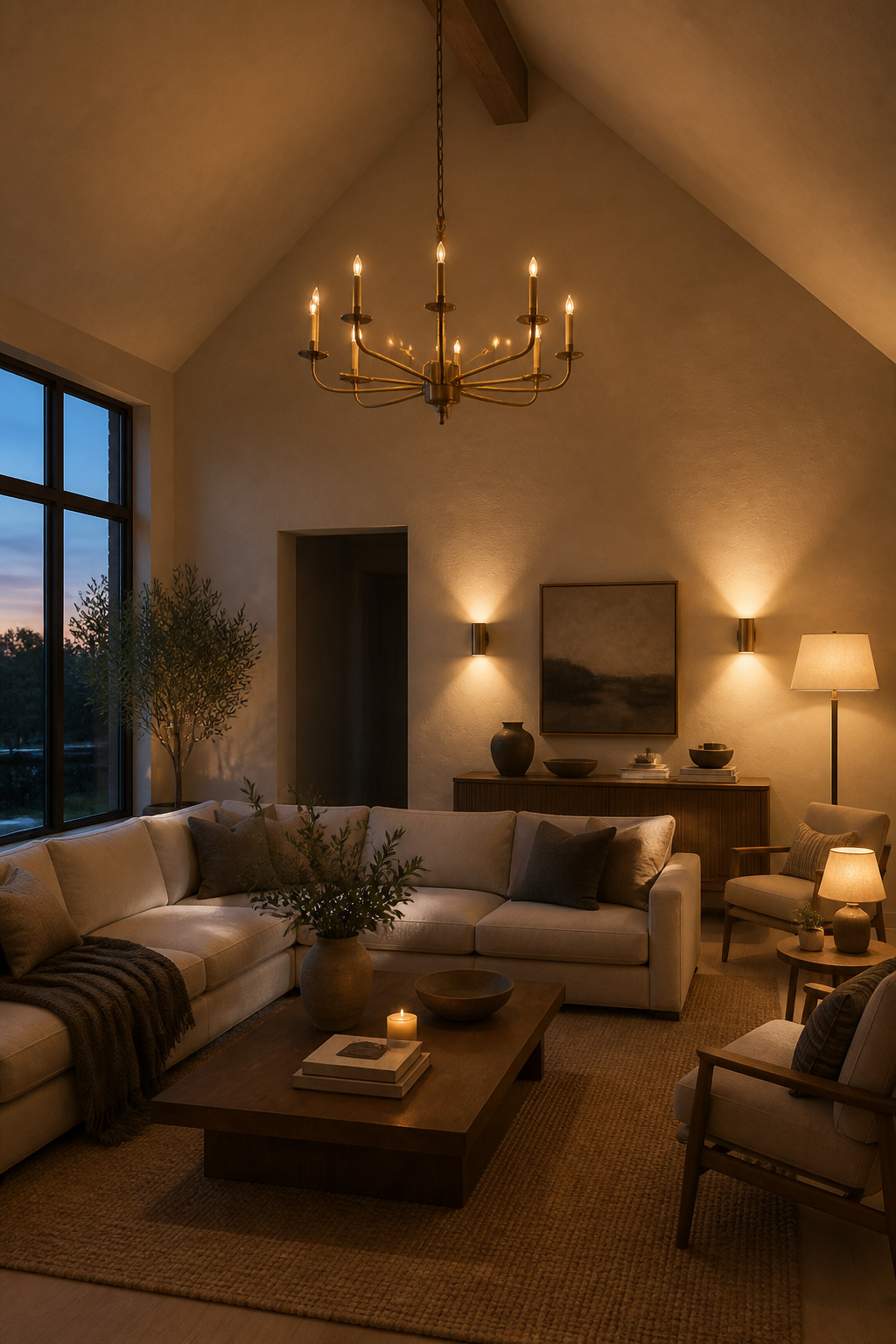
Here is what nobody tells you before you fall for a tall ceiling: one fixture at the apex makes the room colder, not warmer. The light falls straight down, the top of the vault stays dark, and everything below head height fades to shadow. In a cold country you learn this fast. In Nordic rooms we treat light as a structural decision made before the furniture arrives — a vault just gives you more room to get that decision wrong. The best vaulted ceiling lighting ideas are not about one fixture at all. They are about putting light at three heights at once.
TL;DR
- A single overhead fixture on a vaulted ceiling leaves everything below roughly the 9-foot line underlit; you need light at three levels — ceiling, mid-wall and seating height.
- Size a chandelier by adding the room’s length and width in feet for a diameter in inches, then add 10–20% for the volume, and hang its lowest point 8–10 feet above the floor, not at the apex.
- For angled ceilings, a swivel canopy keeps pendants hanging straight, gimbal trims aim recessed light perpendicular to the floor, and all sources should stay within 2700–3000K.
Why One Ceiling Fixture Is the Fastest Path to a Cold, Cavernous Room
A vaulted living room wants to feel held — warm where people sit. A single source works against that from the start.
How a tall ceiling scatters the light a flat room would keep
A fitting at the top of a cathedral ceiling shines straight down, leaving the vault dark and casting shadows on faces, so the one feature the room was built around goes unlit. In a 14-foot room the source sits six feet higher than in an eight-foot room, which cuts its useful floor-level brightness by more than half. So lumens matter more than the fixture — above 10 feet, plan on recessed fittings of 1,000 lumens or more each.
The dead zone where mid-height and floor go dark
With one source, everything below about the nine-foot line is underlit. That band — roughly five to nine feet, where you read, talk and live — is the dead zone. More lumens at the top will not fix it. Instead, you fix it by bringing light down: floor lamps, table lamps, sconces — what designers call the real secret to a cosy tall room.
The three-level rule professionals use
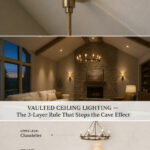
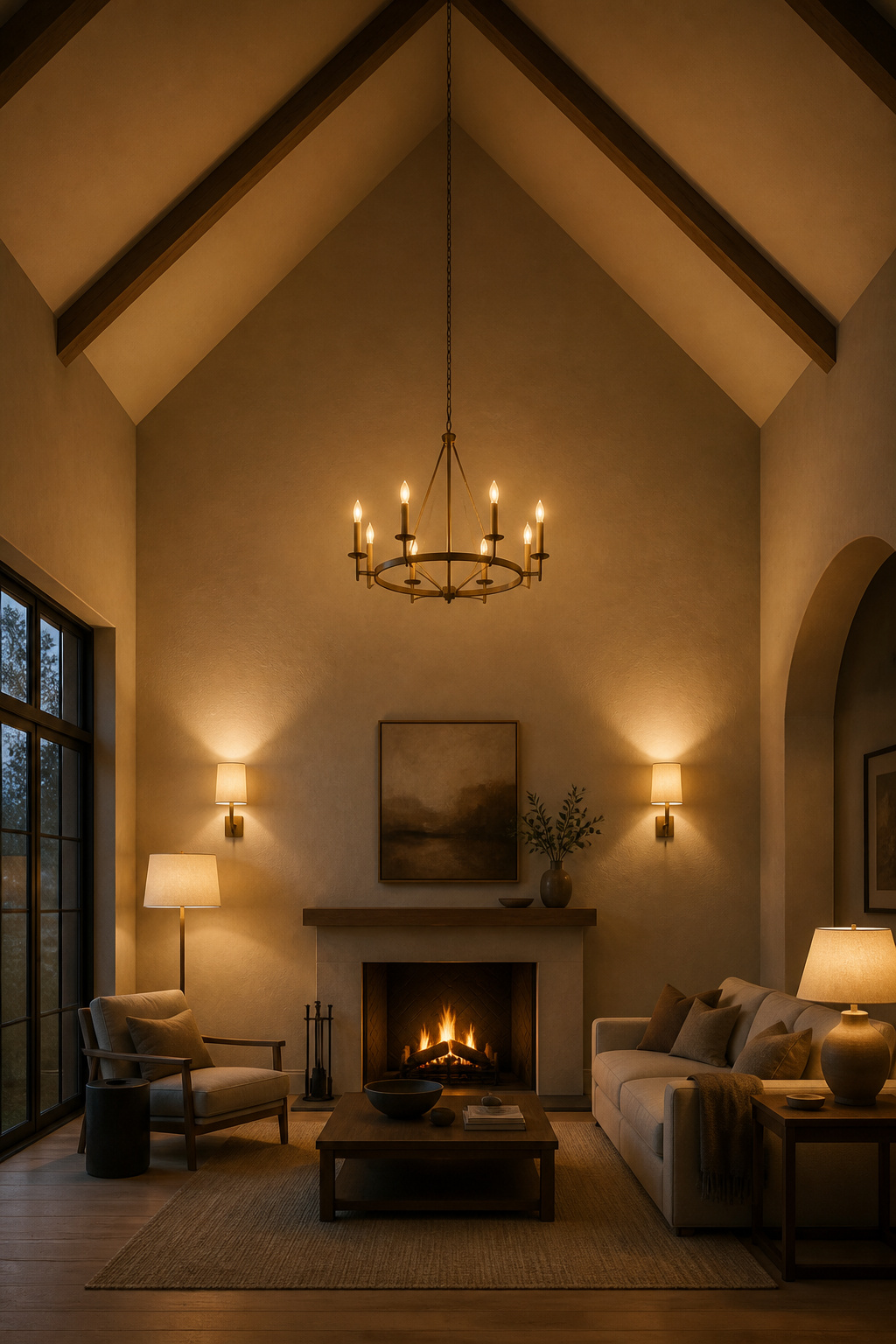
Light the room at three levels at once. Upper: a chandelier, pendant cluster or recessed fittings near the ceiling. Middle: wall sconces. Lower: floor and table lamps at seating level. As Pooky Lighting’s team puts it, the best schemes are rarely built around one fitting; they layer ambient, task and accent light, and Mullan Lighting says the same. Lighting all three at once kills the cave effect, and dimming them separately moves the room from daytime work to a quiet evening. The rest of this guide covers the four fixtures that do that work — the same principle behind designing a vaulted ceiling living room as a whole.
Statement Chandeliers: Sizing and Hanging Height for Tall Rooms
A high ceiling is the rare honest excuse for a large fixture — but only if you size it to the volume and drop it into the room.
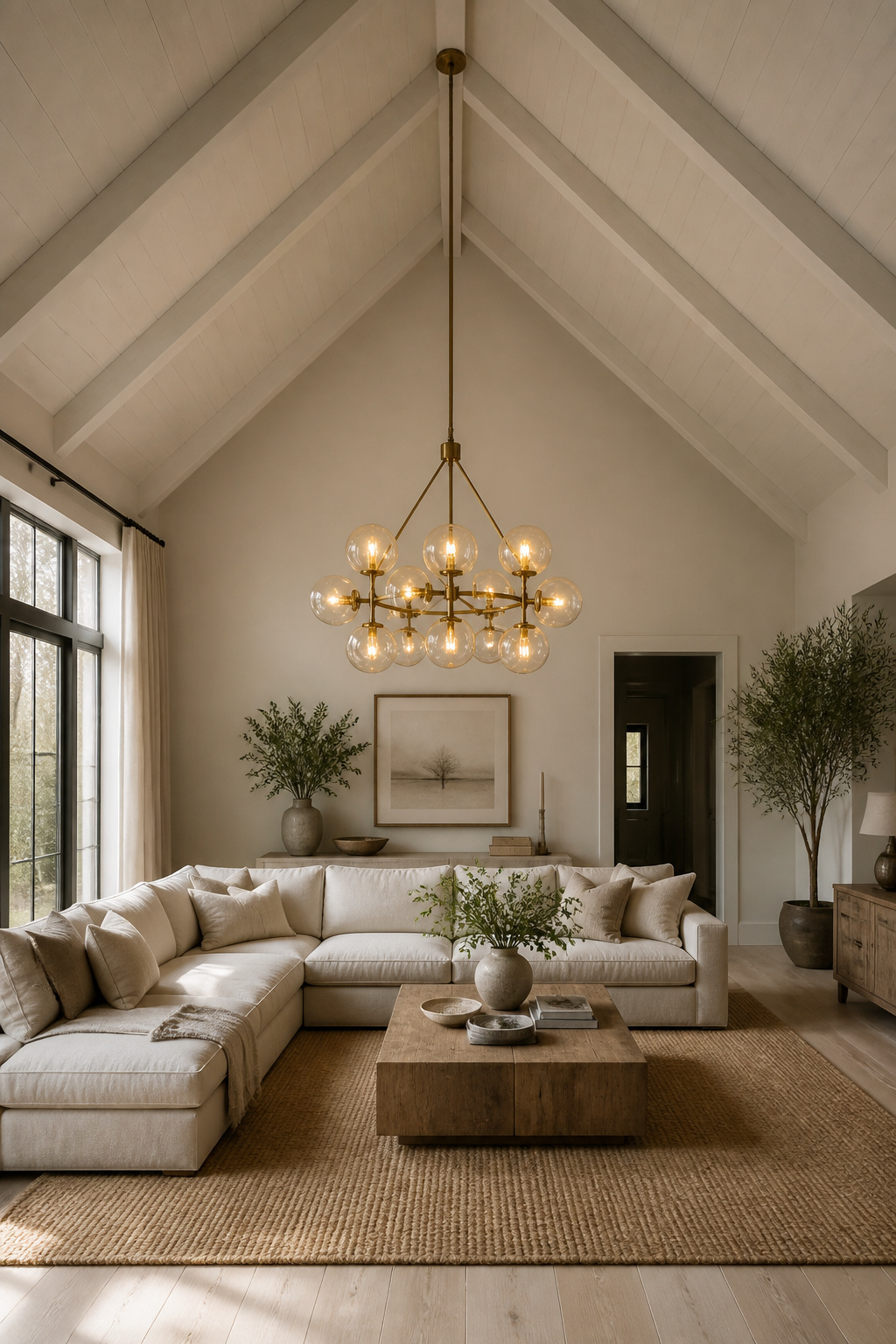
The diameter formula, then adjust up for the volume
Add the room’s length and width in feet; that sum in inches is your diameter — a 12-by-14-foot room calls for 26 inches. Under a vault, that reads too small. For ceilings peaking 12 to 25 feet, size up 10–20%; the same room under a 16-foot vault wants closer to 32–34 inches.
Hanging height: open living area versus dining table
This is where most people go wrong: they hang the chandelier near the apex, where it reads as a small fitting lost in the dark. Drop it instead — the table below sizes it properly.
| Situation | Hang the lowest point at | Why |
|---|---|---|
| Open living area, 12–16 ft ceiling | 8–10 ft above the floor | Mid-volume presence, clear sightlines, head clearance kept |
| Over a dining table, 8 ft ceiling | 30–36 in above the table | Standard clearance for diners |
| Over a dining table, per added foot of ceiling | + 3 in per foot above 8 ft | At a 12-ft ceiling, target 42–48 in above the table |
| Minimum open-floor clearance | 7 ft above the floor | Safe passage underneath |
In an open living room, commit to 8–10 feet: dramatic, but still part of the room people stand in.
Styles that fill the height without closing it
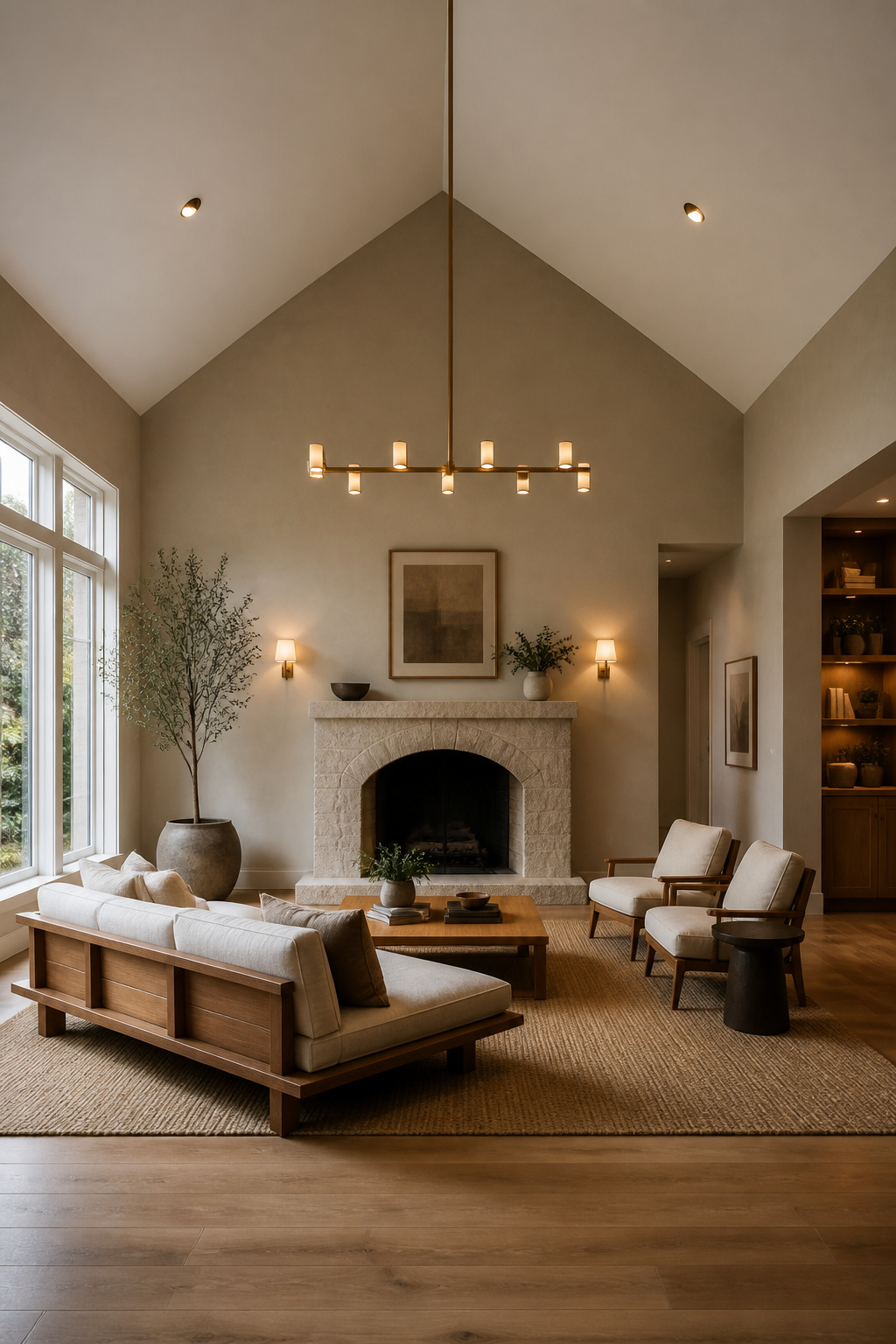
Choose a fixture the eye can travel through. A linear chandelier adds a horizontal line that counters the vault’s upward pull; multi-tier and globe clusters fill the height while the open frame still lets you read the ceiling above, and a sputnik works in a mid-century room for the same reason. One caution, from proportion alone: avoid a drum shade, whose solid form draws a hard lid at the fixture line and erases the height you bought the vault for.
Sloped-Ceiling Pendants: Swivel Canopies and Adjustable Cords
Pendants belong in a vaulted room, but the ceiling’s angle is a problem the hardware has to solve.
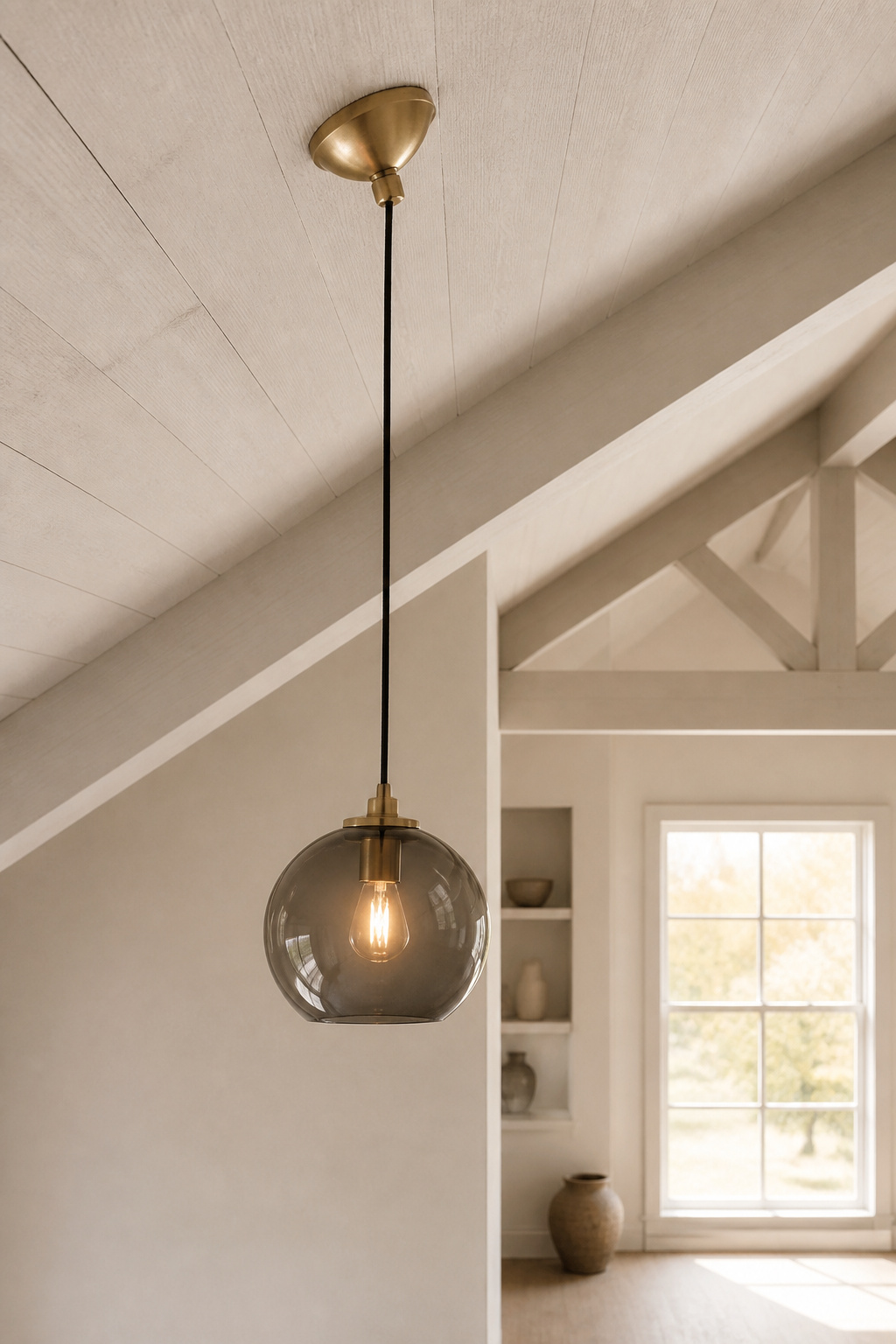
Why a standard mount fails on an angle
A normal canopy is made to sit flat. Forced against a slope, it bends the cord at the strain relief and hangs the shade at the angle of the roof — and over time that bend can wear the cord’s insulation where you cannot see it.
Swivel canopy types and the angles they handle
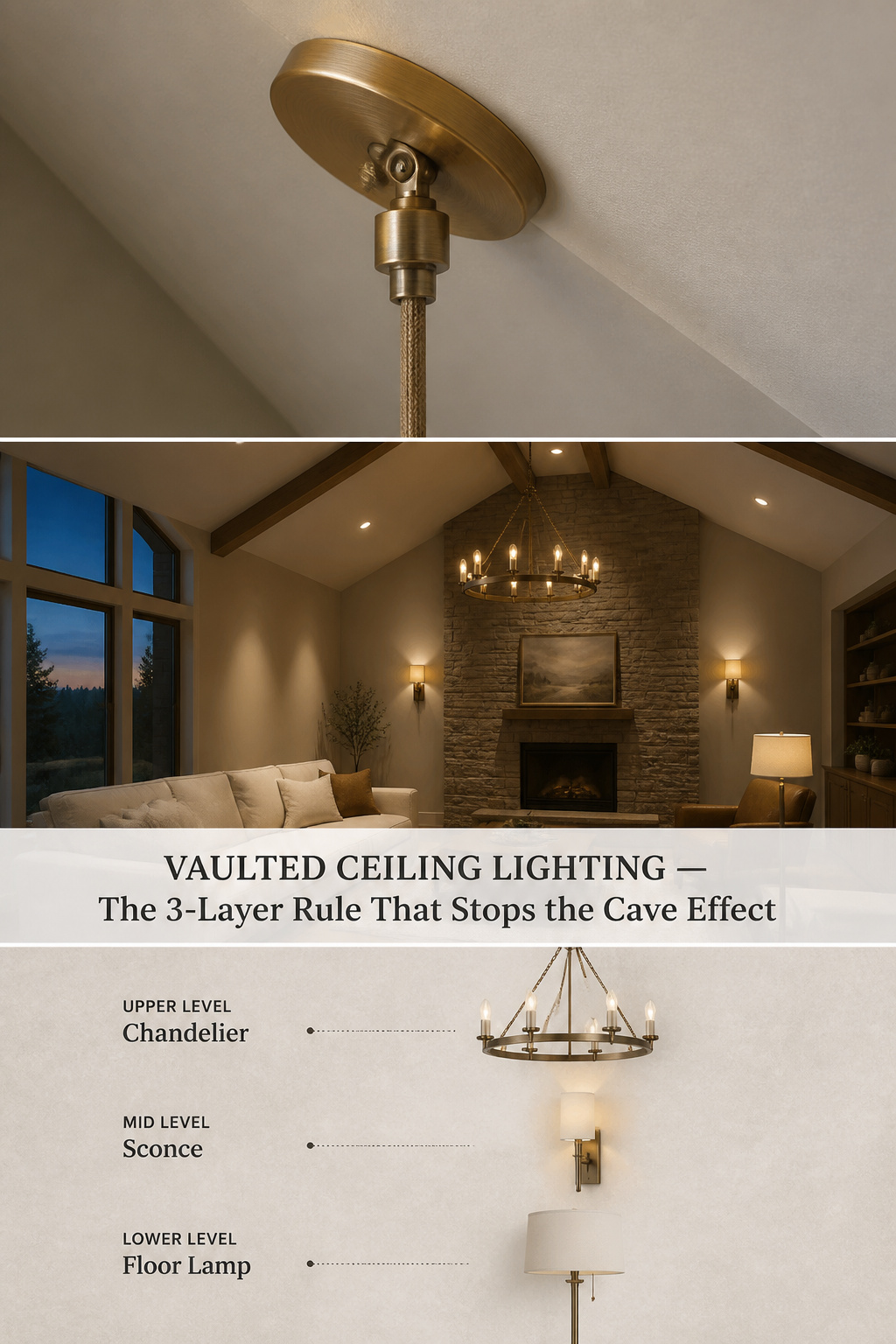
The fix is a swivel canopy — a hang-straight adapter that sits between the ceiling rose and the cord and pivots so the cord drops vertically at any pitch. The table below compares the options.
| Adapter | Slope it handles | Best for |
|---|---|---|
| Standard swivel canopy | Up to ~20–25° | Common 4/12–5/12 residential vaults |
| Fully adjustable adapter | 0–180° | Steep cathedral pitches above 8/12 (~34°) |
| Canopy box (angled mount) | Cut to the ceiling angle | Heavy fixtures, apex installations |
For most living rooms a standard swivel canopy is enough.
Cord length and weight, kept honest
Aim the pendant bottom at 7–8 feet for general use, or 6.5 feet over a reading chair for a tighter pool. One directional note, not a hard rule: a fixture near 50 pounds wants a canopy rated for the weight, not just the angle. And across a row of pendants on a slope, vary the cord lengths so every base sits level. The ceiling is angled; the line of light need not be.
Recessed Gimbal Lights: Directing Accent Light Down a Sloped Ceiling
Recessed light is the workhorse of the upper layer, but a standard can on a slope clips half the beam and aims the bare lamp into your eyes.
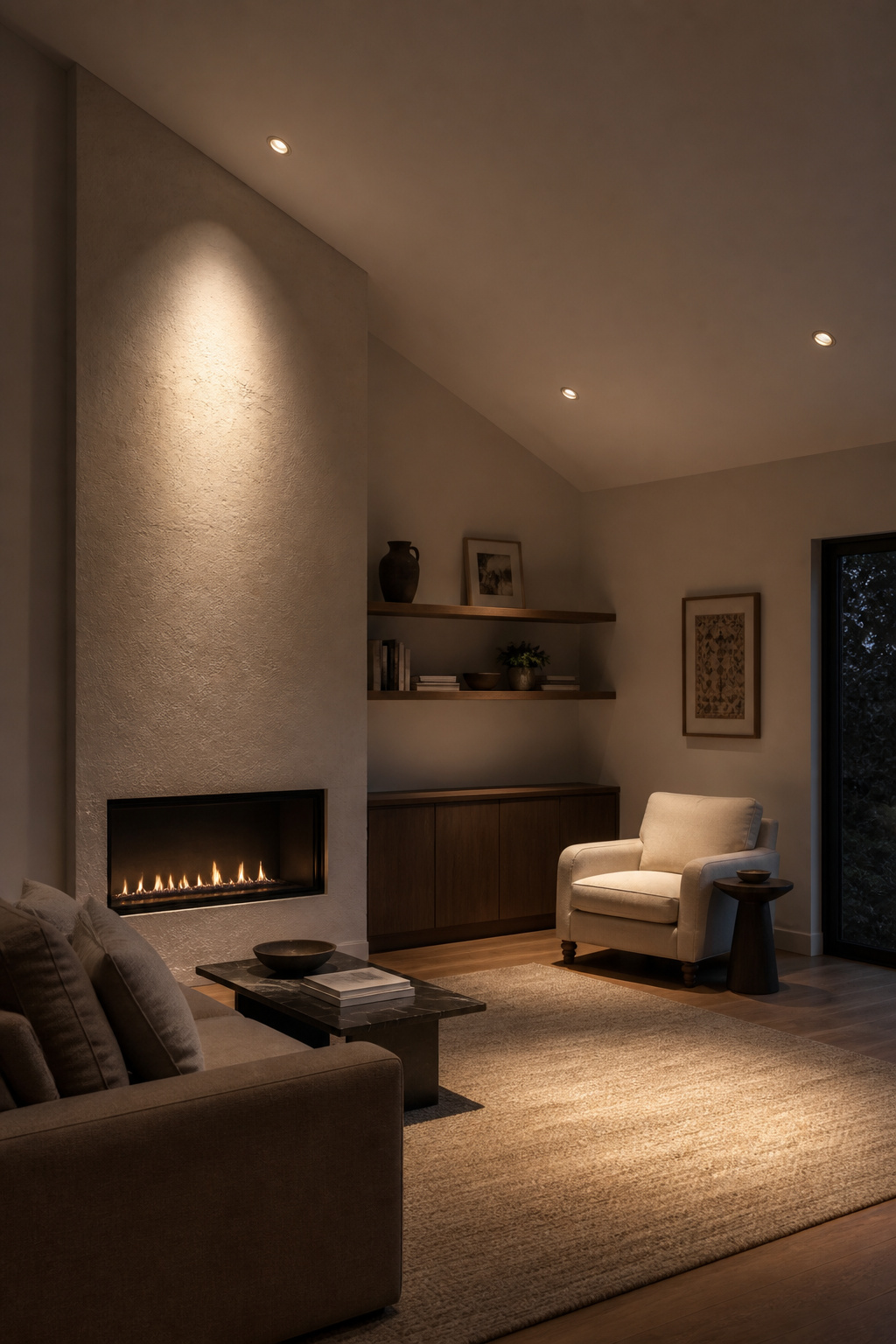
What a gimbal does, and why a can fails on a slope
A standard downlight on a slope throws a hot spot on the wall while the room below it stays dark. A gimbal, or eyeball trim, has a head that rotates inside the ring so you can tilt the beam back to vertical; most tilt 15–25 degrees, high-tilt versions 35–45 for steep vaults. One thing is not optional: insulated vaulted ceilings need IC-rated housings under NEC 410.16. That is code, not preference.
Aiming angles: wall-wash versus accent
The goal is always the same — the beam perpendicular to the floor. For an even wall-wash, set fixtures about a third of the ceiling height out from the wall and the same distance apart; on a 12-foot ceiling, four feet out and four feet on-centre. To accent a single piece, move in to 30–36 inches and aim at 30 degrees. Keep beams tight — 25–35 degrees — where the light travels far.
Spacing and quantity
Use the height-over-two rule: ceiling height in feet divided by two is your maximum spacing, so a 12-foot ceiling means gimbals no more than six feet apart. The catch people miss: measure spacing on the floor plan, not along the angled ceiling, because six feet up a steep slope covers far more than six feet of floor. Measure flat.
Wall Sconces: Filling the Mid-Height Dead Zone
Sconces are the layer almost everyone skips, and the one that does the most for warmth. They light the unreachable five-to-nine-foot band no chandelier and no floor lamp can reach. Without them, a vaulted room reads as two halves: a lit ceiling, a lit floor, a dark gap between. Uplighting sconces make the height feel intentional; downlighting ones make the volume feel held. Both belong to making the volume feel cozy.
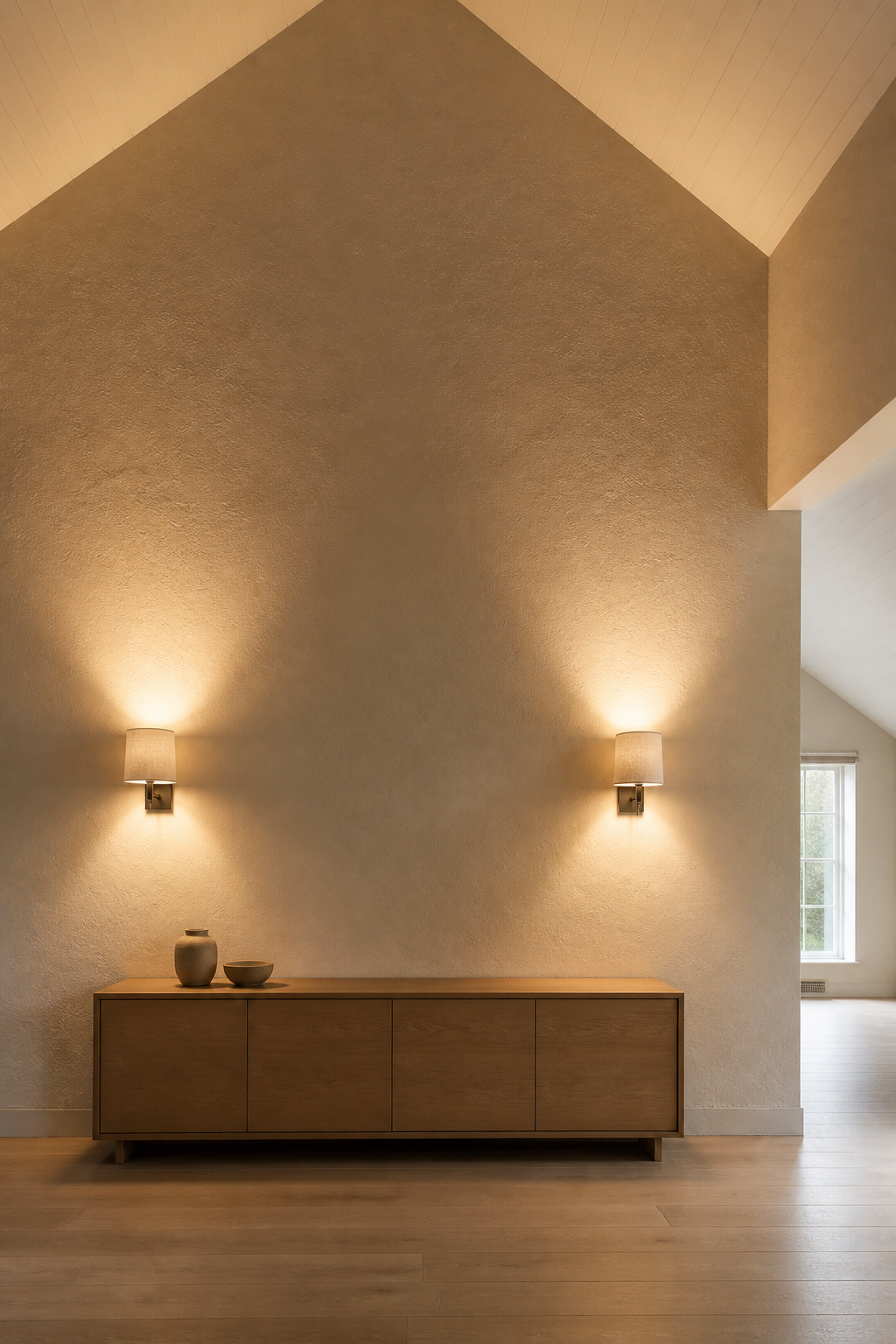
A few placement rules worth keeping:
- Mount at 66–72 inches to the centre — toward the top of the standard 60–72-inch range, to balance the taller proportion.
- On a very high wall, set them about three-quarters up the lower section; on a 12-foot ceiling that lands near nine feet, in the dead zone.
- Keep them within about eight feet of each other on a long wall, or the warm pools read as gaps.
On material, this is reasoning rather than a measured rule: a sconce’s texture does as much work as its light. A bare 14-foot plaster plane feels colder the emptier it is, so a rattan or alabaster sconce that casts patterned shadow breaks the scale down at exactly the height the wall feels most empty.
Putting the Vaulted Ceiling Lighting Ideas Together Into a Plan
The four fixtures only become a room once you sequence and control them. Here is the order I would commit to:
- Commit the ceiling fixtures first. Gimbals, pendants and the chandelier need structural decisions — junction box, wire runs, sloped housings, downrod length — made before finishes go on. They are the hardest to change.
- Rough in the sconce boxes next. Their gang boxes have to land at the right height during framing or drywall. Miss that window and you are chasing wire through a finished wall.
- Add the lamps last. Floor and table lamps are the flexible layer; place them once the room has taken shape, to fill the dark spots the upper layers reveal.
Dimmers and zones for a room that changes through the day
Put each layer on its own dimmer. A vaulted room earns three zones: the chandelier as statement, the gimbals as workhorses (full for tasks, low for atmosphere), and the sconces and lamps as the warmth layer kept high to hold the middle. Specify LED-compatible dimmers; old incandescent ones buzz, flicker and ghost in a quiet, tall room.
Colour temperature: keep it warm, keep it consistent
Hold every source between 2700K and 3000K — the 2700K end flatters timber, linen and plaster. The rule that matters most: do not mix sources more than 500K apart, or the warm-cool split shows badly on a pale vault. Warm light only lands when the walls are warm too, which is why this and paint colors that warm the room are really one decision.
So, the distilled position. Light at three levels, never one. Size the chandelier to the volume and drop it into the room; let swivel canopies and gimbals handle the angle; fill the middle with sconces. Get those four right, and the vault stops being a problem and becomes the best thing about the room.
FAQ
What size chandelier do I need for a room with a vaulted ceiling?
Add the room’s length and width in feet; that sum in inches is your baseline diameter, so a 14-by-16-foot room starts at 30 inches. For vaults of 12–25 feet, size up 10–20% to hold the volume. Then hang it so the lowest point sits 8–10 feet above the floor, never at the apex.
Can you use recessed lighting on a sloped vaulted ceiling?
Yes, but not with standard flat-ceiling cans — they throw a diagonal hot spot on the far wall. Use a gimbal trim with an adjustable head or a purpose-built sloped trim that redirects the beam perpendicular to the floor. Insulated vaulted ceilings also require IC-rated housings under NEC 410.16.
How do I hang a pendant light from a sloped ceiling without it tilting?
Fit a swivel canopy adapter, also called a hang-straight: a small pivoting joint between the ceiling rose and the cord that lets the canopy sit flush to the slope while gravity keeps the cord vertical. Standard adapters handle slopes up to about 20–25 degrees; steeper cathedral pitches need a fully adjustable one.