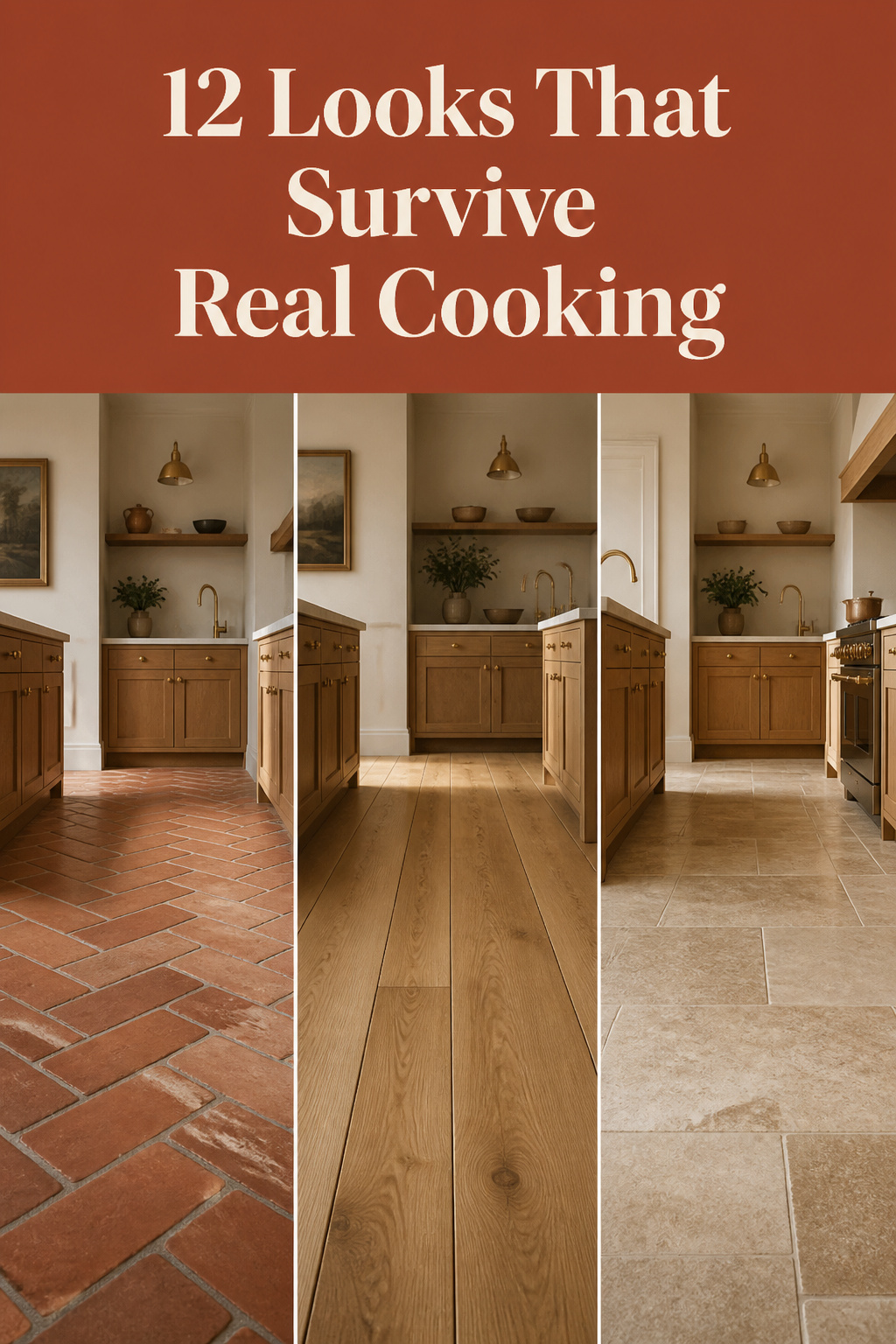
There are more kitchen floor ideas in circulation than there are kitchens, and every one of them photographs well. That is the problem. A styled photo gets taken once, in good light, before anyone has cooked in the room. It cannot tell you which of those floors handles a dropped skillet, a dishwasher that lets go at 2am, or three hours of standing.
I spent eight years running crews for a remodeling contractor in Tennessee, and the part that taught me most was never the install. It was going back. You return to a house two years later for something unrelated — a bathroom, a window — and there is a floor you laid, telling you exactly what it thought of that family. Nobody photographs a floor at year two. The crew is the only one who sees it twice.
The line I carried out of those years is that pros measure and beginners guess, and choosing a floor from a photograph is guessing. So this is a sort, not a gallery: twelve looks, each named with the material behind it and the specific thing that goes wrong with it.
How to Choose a Kitchen Floor (Not Just a Pretty One)
A kitchen floor gets judged on five things, and colour is only one. The other four are invisible in every photo you have saved.
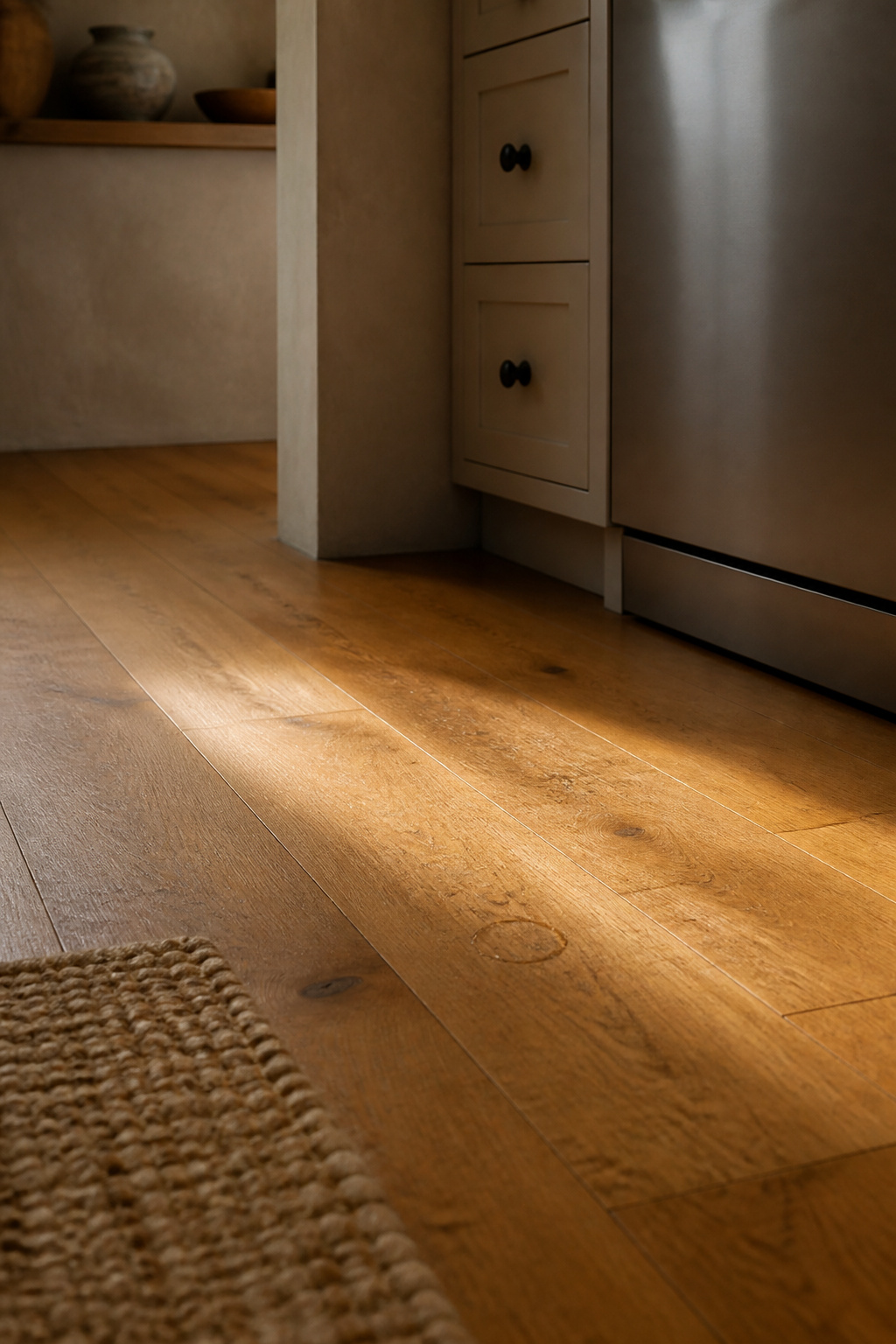
The Five Things a Photo Never Shows You
Standing-water tolerance comes first, because it is the one failure that ends a floor instead of weathering it. Leave water on a standard laminate seam for roughly half an hour and the core underneath starts to swell, and swelling does not reverse. That clock starts with an appliance leak, not with mopping.
Slip resistance is second, and it has a number: ANSI A326.3 — the standard that now houses the DCOF AcuTest, after it moved out of A137.1 — sets a minimum wet dynamic coefficient of friction of 0.42 for level interior floors expected to be walked on when wet. Glossy surfaces routinely fall under it, and one very fashionable tile falls a long way under it.
Third is chip risk, which follows how uniform a tile is rather than how hard. Fourth is comfort over hours of standing, the one thing a photo cannot convey at all — it comes down to give underfoot, so cork and cushioned vinyl treat your knees better than tile or concrete.
Fifth is cost, and cost is where sources genuinely disagree. HomeGuide contradicts itself: its general 2026 flooring guide prices cork at $5–$15 per square foot installed, while its own pet-flooring guide puts it at $6–$12. Neither page is lying; they answer different questions. Which is why no honest article hands you an average kitchen floor cost.
The table below sorts by look family rather than spec. Every band is installed cost per square foot, taken from HomeGuide’s general 2026 guide, so the rows are comparable.
| Look family | Usual material | Installed cost per sq ft (HomeGuide, 2026) | What upkeep means |
|---|---|---|---|
| Real wood | Solid or engineered oak, walnut | $11–$25 solid; $7–$20 engineered | Humidity control, then refinishing |
| Wood-look | LVP, laminate, wood-look porcelain | $4–$16 LVP; $4–$14 laminate | Fast spill cleanup; seams are the weak point |
| Patterned tile | Porcelain, ceramic, stone | $10–$50 for tile broadly | Grout, mostly |
| Stone and poured | Limestone, concrete | $6–$12 concrete | Sealing, and pH-neutral cleaners only |
| Clay | Terracotta, saltillo | No separate line; sits inside the tile band | Sealing, on a schedule of its own |
| Budget vinyl | Sheet, peel-and-stick tile | $2–$7 sheet; $2–$10 tile | Replace rather than repair |
Those five factors get compared row by row in how the eight main kitchen flooring materials compare.
Matching a Floor to How You Actually Cook
Sixty-one percent of American homeowners rank wood flooring as a priority when they buy or design a home, and mid-level wood tones beat brown, grey, beige and off-white. That tells you what people want, not what any particular kitchen can hold.
Here is the statistic I would put in front of anyone about to order samples: 75% of homeowners now refinish an existing wood floor rather than replace it, and doing so cuts the job’s embodied carbon by more than 89%. If there are sound boards under your kitchen, the best-value look on this entire list may be the one already down there.
Wood Tones: Light, Mid and Dark Oak
Wood is not one look. It is three, and the gap between them is wider than the gap between two different materials.
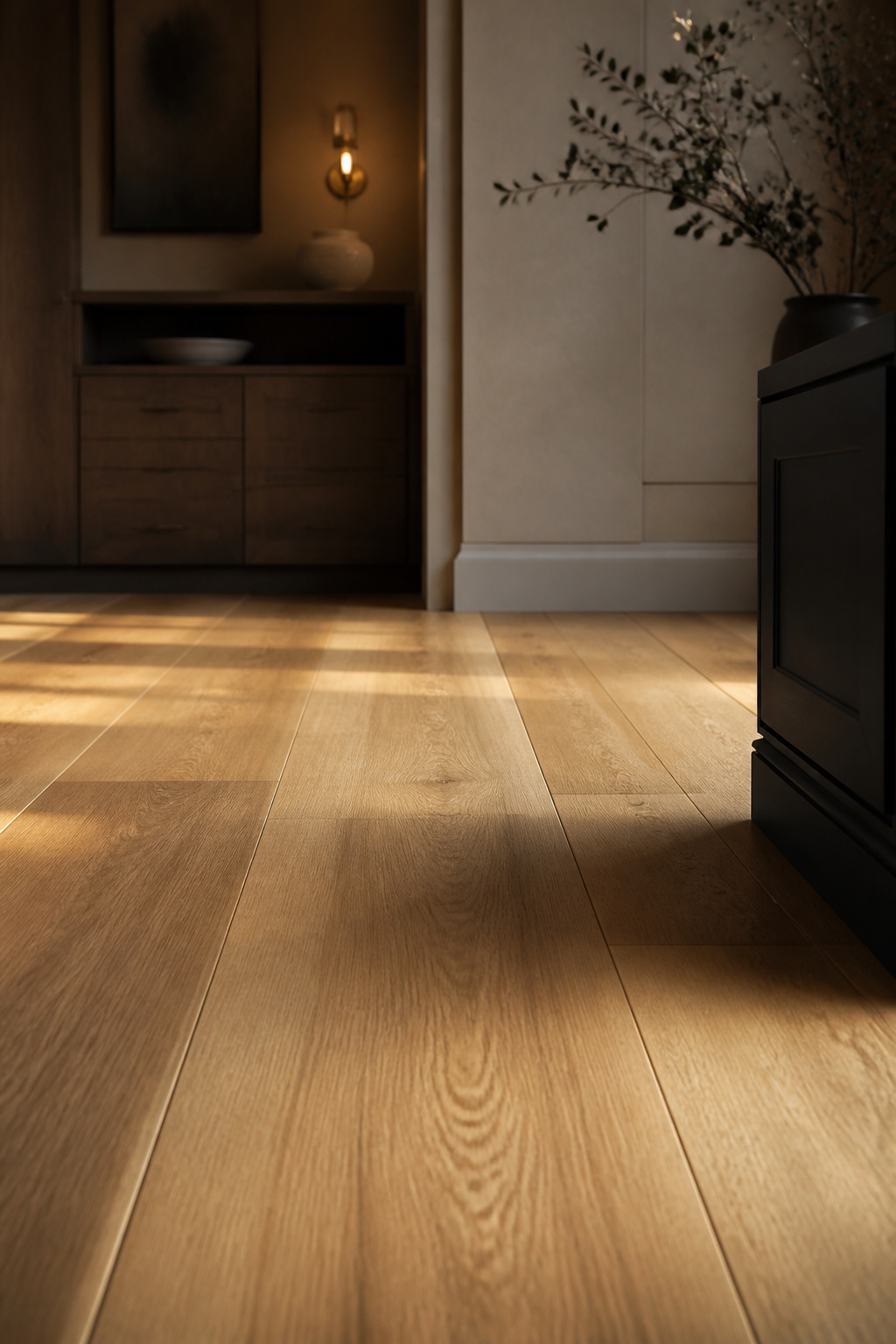
- Light rift-sawn oak — the calmest, and the one that gives a small room most back.
- Honey and mid-tone oak — the popular middle, most forgiving against cabinetry.
- Deep walnut and espresso — the highest-contrast option, anchoring a room instead of receding.
Light Rift-Sawn Oak
Rift-sawn milling is the whole story here. Cutting the log on the rift gives straight, consistent grain with almost none of the cathedral figuring a plain-sawn board throws, which is why a rift-sawn floor reads calm rather than busy. Honeyed, golden tones are named a defining kitchen floor colour for 2026 for a related reason: they carry a warmth cool greys cannot manage.
Honey and Mid-Tone Oak
Wide planks are where this tone is heading. Designer Arianne Bellizaire describes the shift as flooring that feels more intentional and more connected to a home’s architecture — and against a narrow uniform strip floor, she is right.
Wood in a kitchen carries one condition, and it is humidity rather than species. The National Wood Flooring Association publishes 30–50% relative humidity as wood’s stable interior range. A kitchen holding that band without heroics can carry real wood; one that swings hard between seasons cannot, whatever species you buy. Rachel Blackwood works through the question in what hardwood actually does in a kitchen.
Deep Walnut and Espresso Tones
Now the counterintuitive part. Black walnut rates 1,010 lbf on the Janka scale against white oak’s 1,360 — meaningfully softer. So a dark floor dents sooner than a pale oak one while hiding those dents better day to day. Dark and durable are unrelated properties people assume travel together.
Vinyl and Laminate That Read Like Wood or Stone
What actually gives a convincing fake away? Not the pattern. It is the sheen.
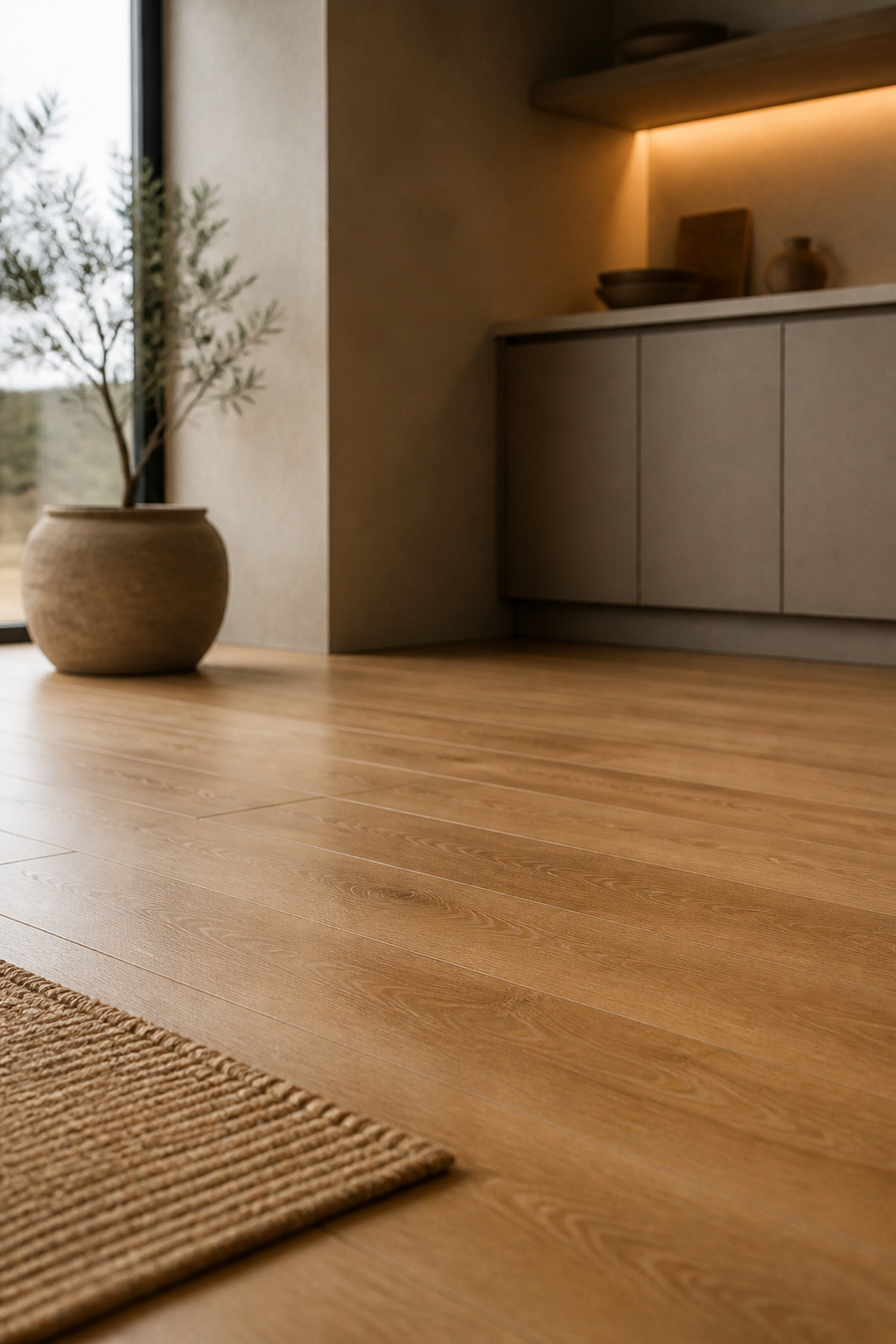
Where LVP Fools the Eye
Matte, low-sheen luxury vinyl passes at a glance as wood or stone. High-gloss vinyl never does — gloss is the fastest visual tell in this survey, because no honed stone has ever thrown light back like that. Get the finish right and LVP has a real edge over wood-look porcelain: it is fully waterproof and feels warmer underfoot.
The price spread is enormous and the category name explains none of it. HomeGuide’s general 2026 guide puts luxury vinyl plank and tile at $4–$16 per square foot installed; what moves a product inside that band is printed grain quality and the wear layer above it. Those specs get taken apart in vinyl plank flooring in the kitchen.
Laminate’s Honest Limits
Laminate’s weakness is not foot traffic, which it handles fine. It is a seam plus a clock: standing water from a dishwasher, an icemaker or an unattended spill, sitting for about thirty minutes, starts the swelling and cupping that ends a laminate floor.
The second failure flatters the material more than the installer: chipped edges usually trace back to a floor laid too tight, without enough expansion gap at the perimeter. At $4–$14 per square foot installed, laminate is the cheapest wood-look here, and a good one as long as nobody pretends it is waterproof.
Tile Patterns That Change the Room
Stand in the doorway of a tiled kitchen and the thing registering first is almost never the tile. It is the direction the joints run.
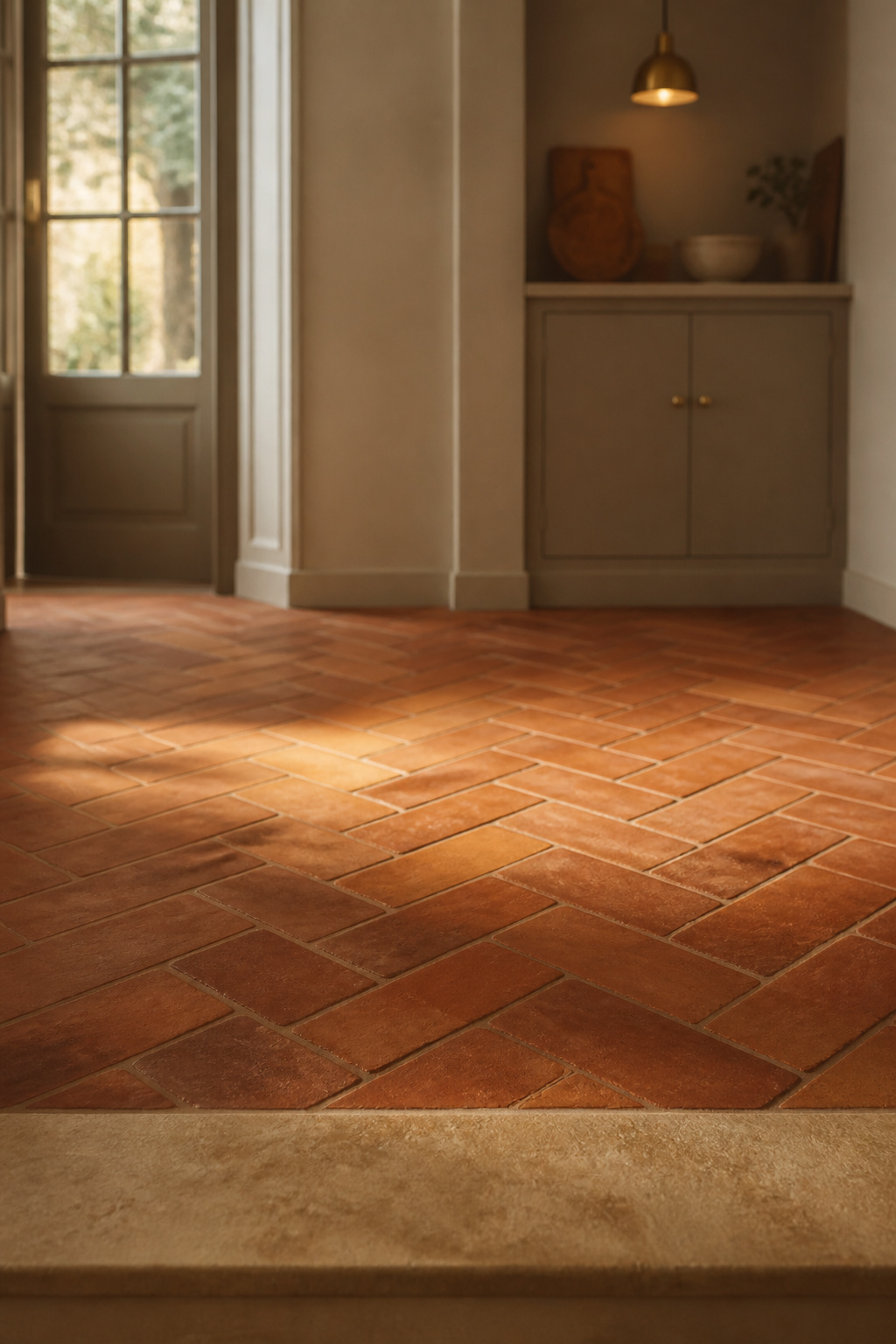
Herringbone and Chevron
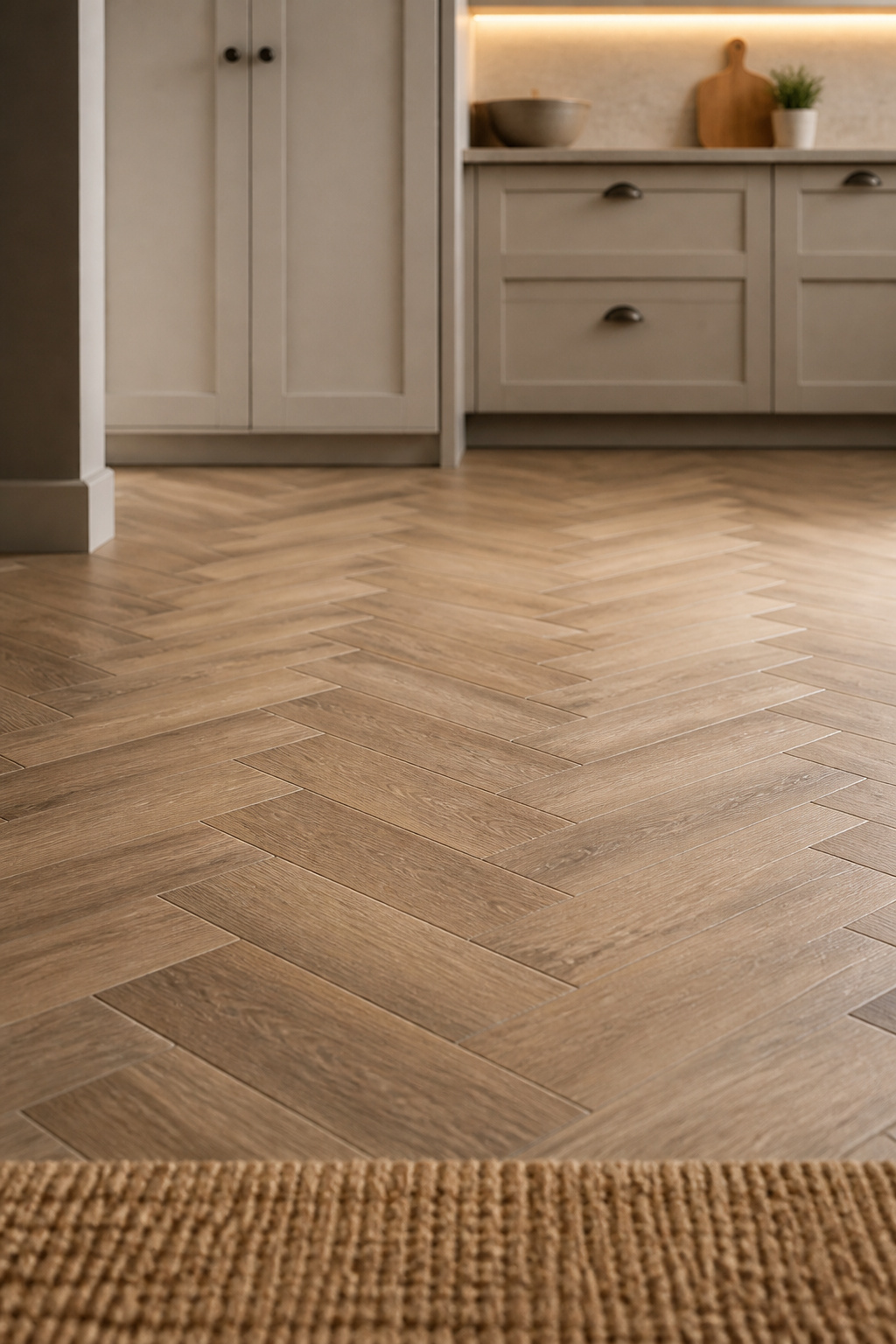
These two get used interchangeably and they are not the same layout. Herringbone butts rectangular tiles against each other at ninety degrees into a stepped zigzag. Chevron uses tiles pre-cut at an angle so the ends meet in one unbroken V.
Both cost extra, in two currencies people routinely add together. The tile overage is the part everyone agrees on — a herringbone field needs roughly 15–20% more tile than its exact square footage, because every row throws offcut triangles at both ends. Labour is not settled at all: published premiums disagree so widely that quoting a single percentage would mislead you. Rachel Blackwood sets the competing figures side by side in kitchen floor tile patterns; get your own room quoted.
Checkerboard’s Comeback
This one has data behind it: Houzz logged a 38% rise in checkerboard-floor searches through Q3 of 2025. What that hides is that checkerboard is two different looks. Hard black and white is bold and modern, and belongs in a monochromatic room with black accents. Tone-on-tone — warm taupe against soft cream, honey against dijon — is soft, quiet and easier to live with.
Two rules keep it from taking over. Confine it to the cooking zone rather than the whole room, and pair it with a simpler backsplash and neutral cabinetry. Matte or honed stone and unglazed ceramic are the tone-on-tone materials; the sophisticated take avoids gloss entirely.
Basketweave and Encaustic Borders
Basketweave sets rectangular tiles in pairs at alternating right angles so the joints interlock into something genuinely woven-looking, traditionally in marble, limestone or travertine.
Encaustic is the one people misunderstand. It is not a glaze and not a print — it is a medieval inlay technique, revived by Herbert Minton, where different coloured clays are set into the tile body itself, so the colour runs all the way through. Those borders travelled from expensive Victorian villas into ordinary terraced hallways by the Edwardian era, which is why a patterned border still looks period-appropriate rather than decorative.
Three verdicts before we leave pattern behind:
- Herringbone — the safest of the three in a working kitchen, and the one whose real cost is labour rather than tile.
- Checkerboard — excellent tone-on-tone, exhausting in hard black and white across a whole floor.
- Basketweave or an encaustic border — the highest detail per square foot, best used as a frame rather than a field.
Stone and Poured Looks: Limestone, Concrete and Zellige
The commonest stone mistake is choosing the finish last. Finish decides how the material behaves, what it costs to keep, and whether it is safe wet.
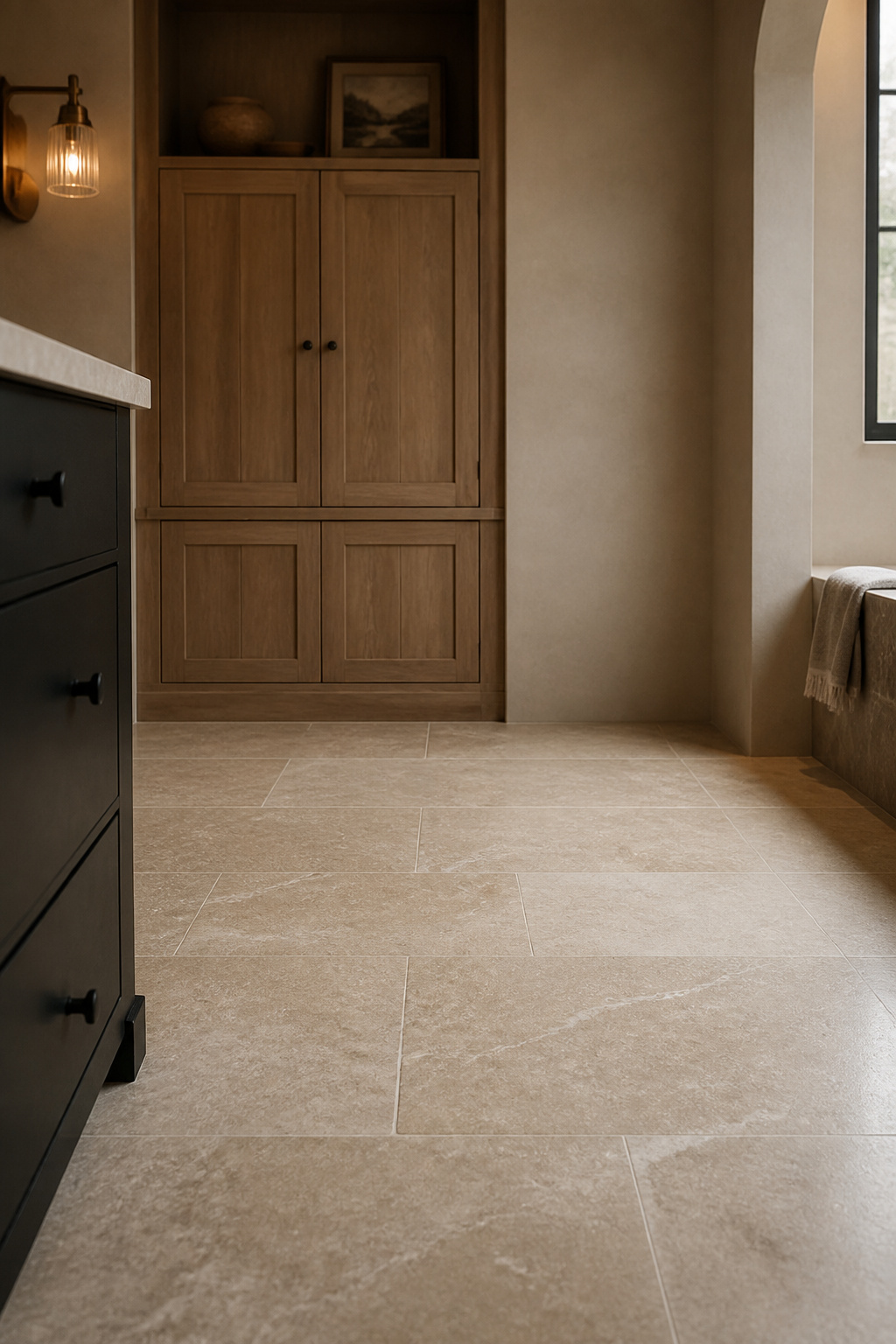
Honed Limestone in Dijon and Beige
Dijon limestone runs from beige to grey with small fossils and the occasional streak of crystallised calcite, so no two floors of it look alike even out of one quarry batch. That variation is the reason to buy it — tumbled limestone is named a 2026 kitchen flooring trend on exactly that basis.
It sells in four finishes, and they are not interchangeable: tumbled, brushed, honed and seasoned. Honed suits a warm matte kitchen; polished belongs to a different house. As Grazzie Wilson of Ca’ Pietra puts it, cream stone catches the light softly and warms a room from the ground up in a way cooler stones cannot replicate.
The practical case is better than the reputation suggests: Dijon is dense enough to be rated explicitly for high-traffic kitchen floors. It does need sealing at installation, resealing roughly every four to six years after that, and pH-neutral cleaners for life — an acidic product etches the surface permanently.
Sealed Concrete
Sealed concrete and polished concrete are two products wearing one name, and confusing them is how people end up disappointed. Sealed concrete carries a surface film, typically acrylic. Polished concrete is mechanically honed and treated with a penetrating silicate densifier that reacts with the slab rather than sitting on top of it.
They fail in opposite directions. A sealed floor is slippery when wet and shows scratches in the busy lanes, and repairing that means resurfacing the whole thing. A polished floor resists slipping and cannot fail from trapped moisture the way a film can.
That difference has a price attached. Craftsman Concrete Floors puts a basic acrylic seal at roughly $1.00–$1.75 per square foot to apply, against $3.50–$5.00 to polish. Both are application only — neither is the cost of a new concrete floor, which is the number HomeGuide’s two pages disagree about.
Zellige and Handmade-Edge Tile
Zellige is made in Fez, from a craft with roots in the tenth century. Each tile is hand-shaped from local clay, sun-dried, hand-dipped in glaze and fired in a beehive kiln fuelled with olive branches — a process unchanged for more than a thousand years, and recognised by UNESCO as Moroccan intangible cultural heritage.
And I would keep it off your floor.
Glazed zellige measures a wet DCOF of roughly 0.16. The ANSI A326.3 minimum for a level interior floor expected to be walked on when wet is 0.42. That is not a stylistic caution; it is under half the published safety threshold, measured, in front of the two places in a kitchen where water lands. The irregular thickness that makes zellige beautiful on a wall also makes it chip underfoot, and tile retailers are direct that its home is walls and backsplashes.
There is still a way to have the look. Machine-made “zellige-style” porcelain is produced floor-rated, though you confirm that with the manufacturer rather than assuming it — and the price gap is its own argument, at $15–$60 per square foot material-only for the real thing against $7–$10 for the lookalikes. Put the handmade tile on the wall behind your range and let porcelain take the floor.
Terracotta and Clay: The Warm Comeback
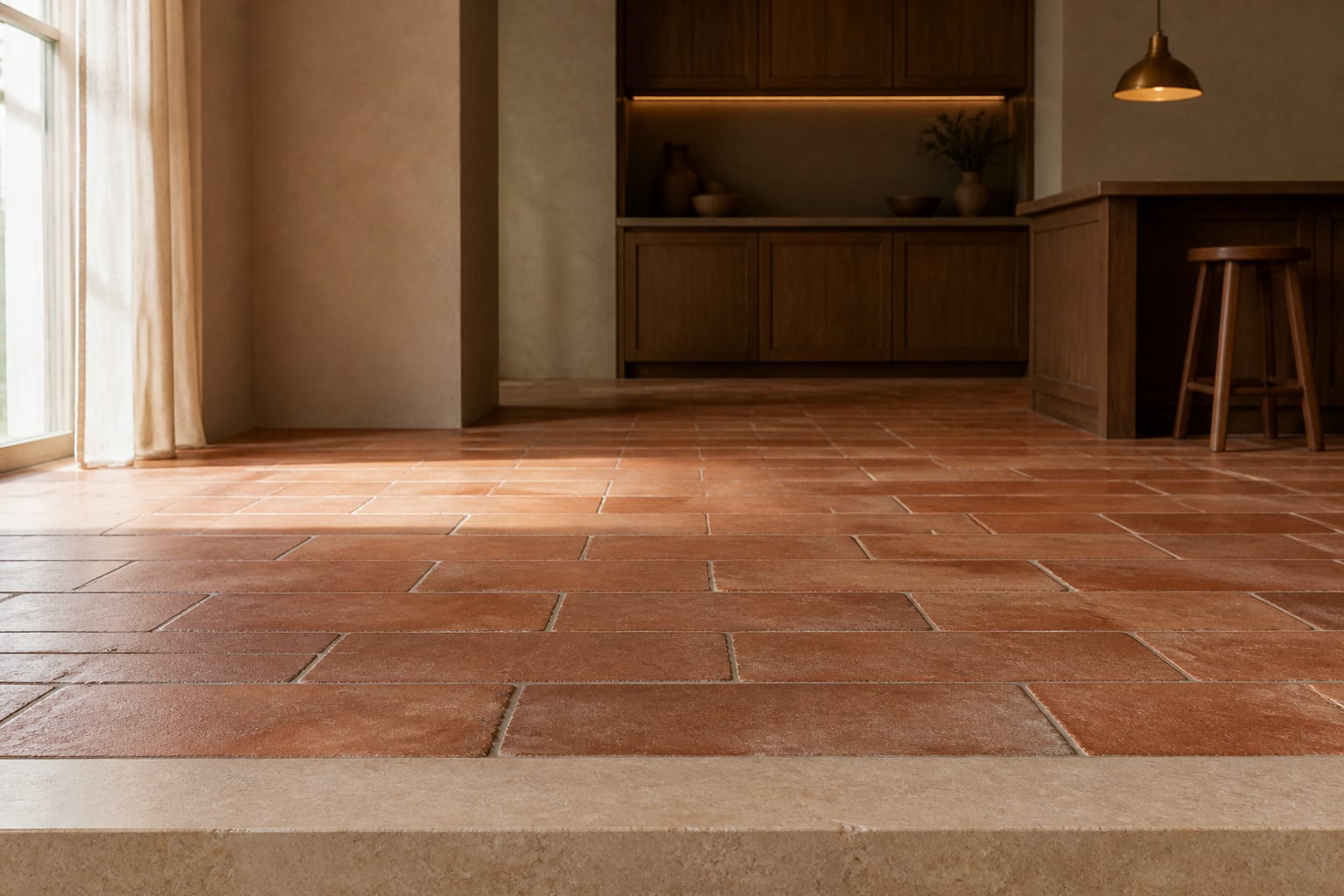
Terracotta spent thirty years as the punchline of the 1980s country kitchen, and the reputation attached to the wrong thing. What was wrong with those floors was mass production: uniform, machine-made, relentlessly orange tile.
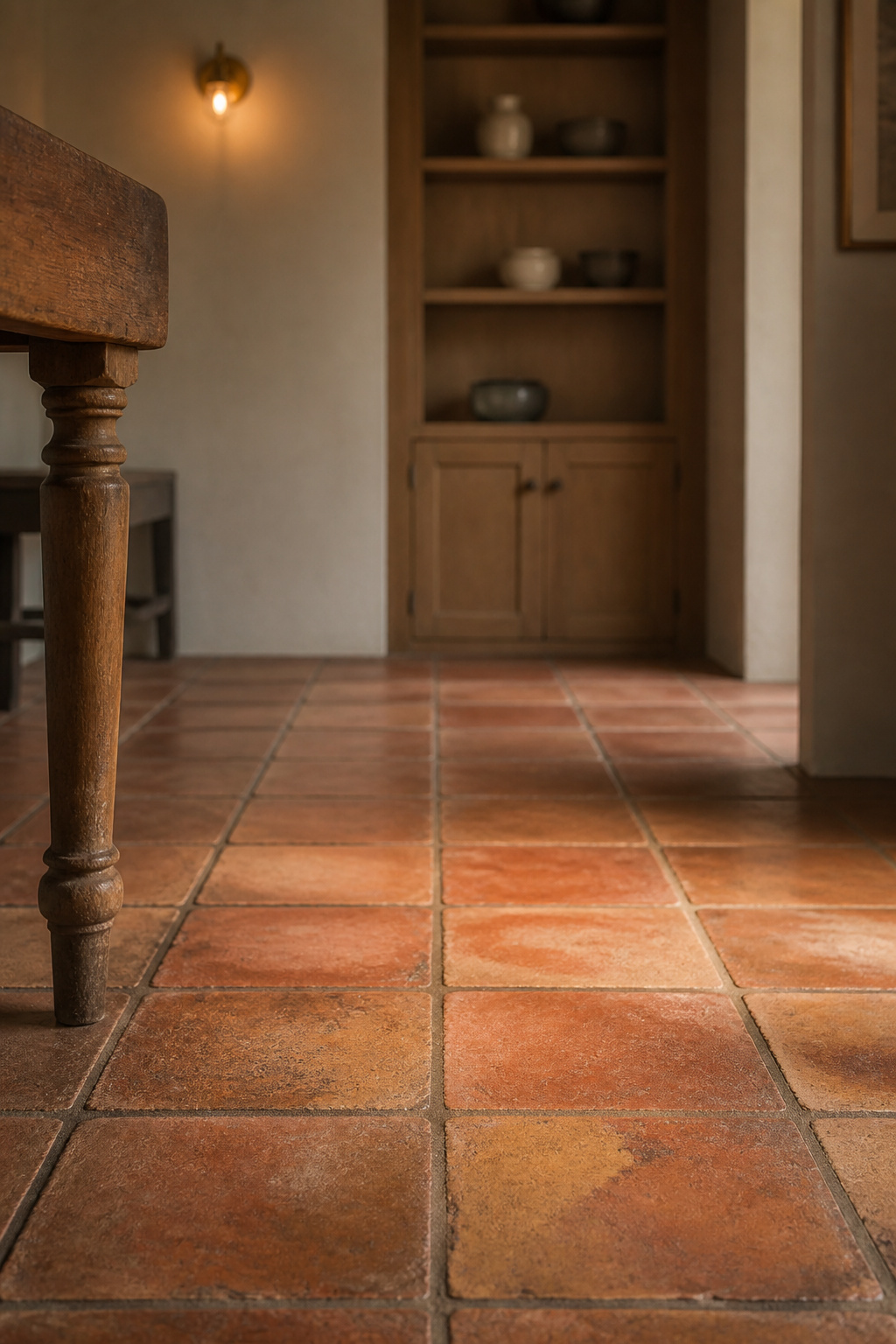
Handmade and Saltillo Terracotta
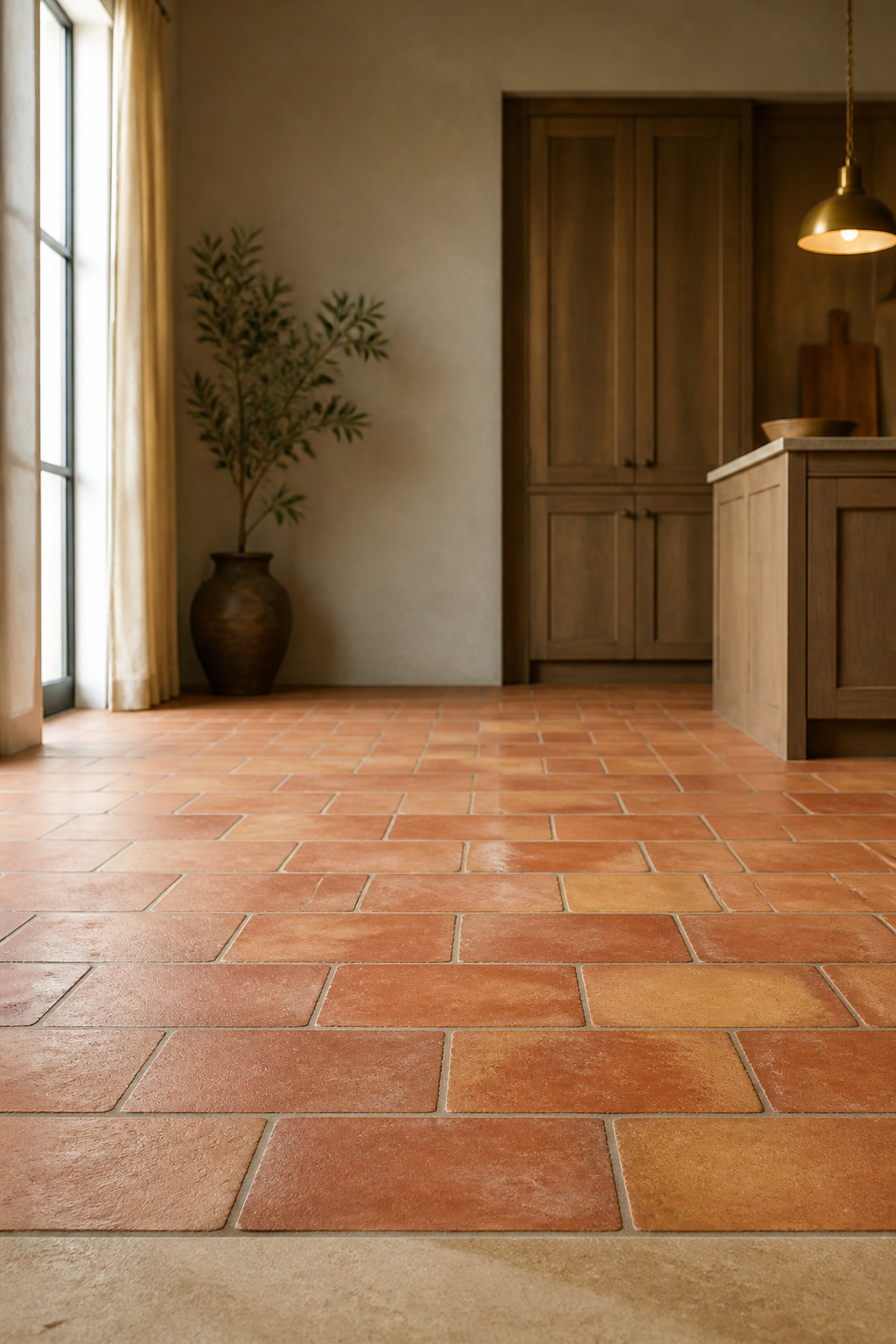
Handmade clay and saltillo are the opposite of uniform, and that is the entire point of them. Tone shifts tile to tile, edges are irregular, and the surface takes on colour and softness exactly where people walk.
The honest failure mode is softness. Terracotta is softer than porcelain or high-grade ceramic, so it marks and wears faster in a kitchen’s heaviest lanes. Whether that bothers you depends on whether you call the result patina or damage. There is no hardness rating to check either: no published Janka, PEI or Mohs figure exists for unglazed clay.
Clay is porous, which makes sealing structural rather than optional. It runs on a specific schedule, and Rachel Blackwood sets that out in terracotta kitchen floor tile.
Why It’s Back in 2026
Today’s version is curated where the 1980s version was uniform, in muted earthy tones — greens, warm terracottas, soft blues, charcoal — rather than one shade of orange repeated across a floor.
Shape does quiet work too. Hexagons give clay a modern read; traditional brick and octagon formats a classic one. And terracotta reinterprets far better than it reproduces: designer Charlotte Olby laid square terracotta in her 1910 period kitchen against sandy off-white cabinets, an unexpected red pantry cupboard and a vintage butcher’s block island.
Pairing Floor Tone With Your Cabinets
Which comes first, the floor or the cabinets? Almost always the cabinets, because they are already there — and the floor has to answer them.
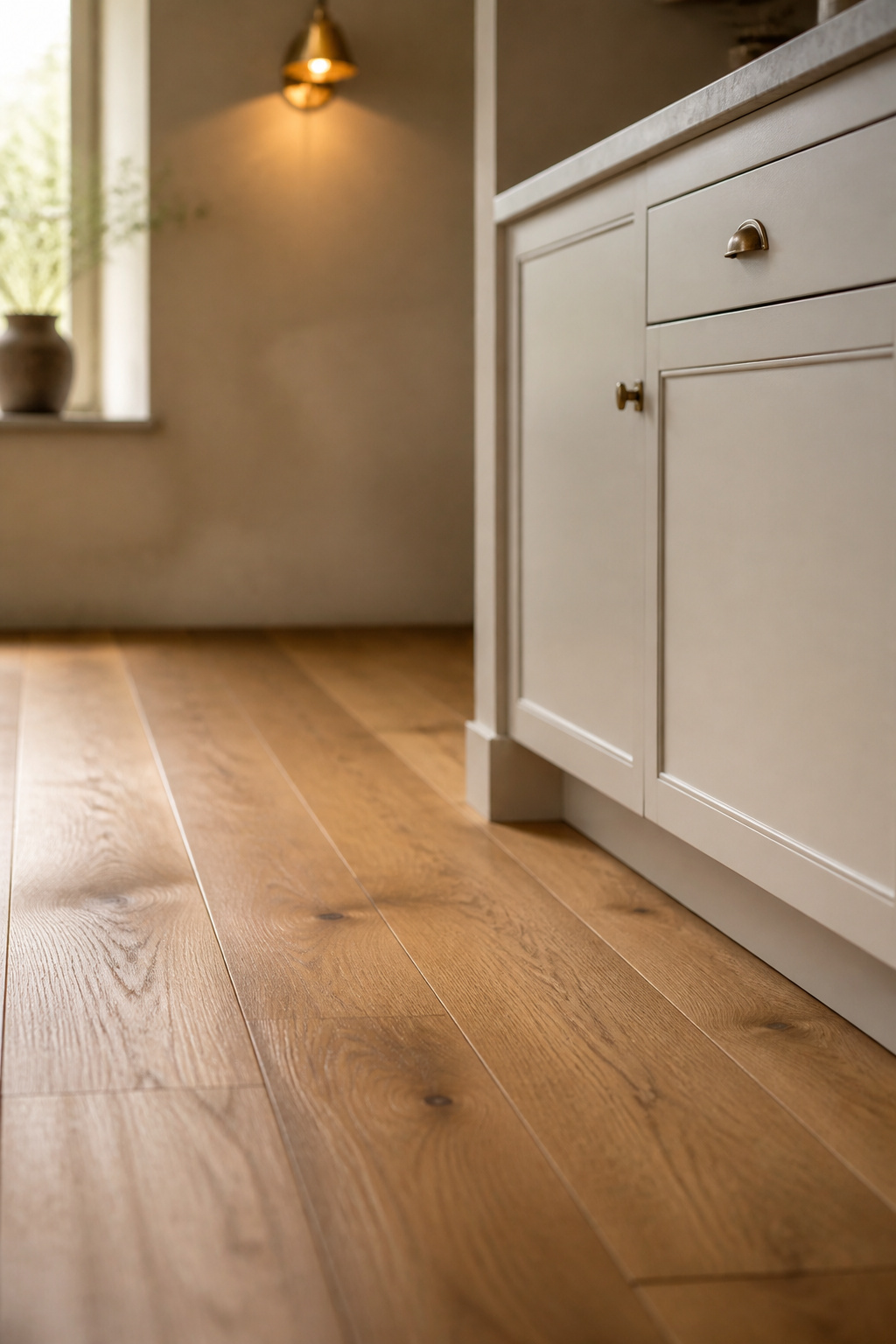
White Cabinets and Undertone
White is not a colour, it is a family, and the members do not all get on. The working rule is undertone to undertone: warm whites pair happily with mid-toned wood, pure crisp whites want clean white natural stone, and grey-leaning whites want grey-leaning stone or porcelain.
The mismatch runs both directions, which is the part people miss. A printer-paper white cabinet looks sterile above a yellowish limestone floor — but a cool-cast grey marble makes an ivory cabinet look dated and yellow by comparison. So test samples in the actual room, in its actual light, not against a paint chip in a showroom. Henrik Larsson takes the full system apart in choosing a floor for white cabinets.
Oak and Wood-Toned Cabinets
Wood cabinets do not change the method, only the input. A warm honey oak run above a cooler-toned floor creates exactly the friction a warm white cabinet does above a cool grey plank. Wood on wood is a dense enough question to deserve its own page, and it has one.
Small Kitchens and Open-Plan Sightlines
Half the kitchens this article is about are not really rooms. They are one end of a larger space, with a floor you look at from the sofa.
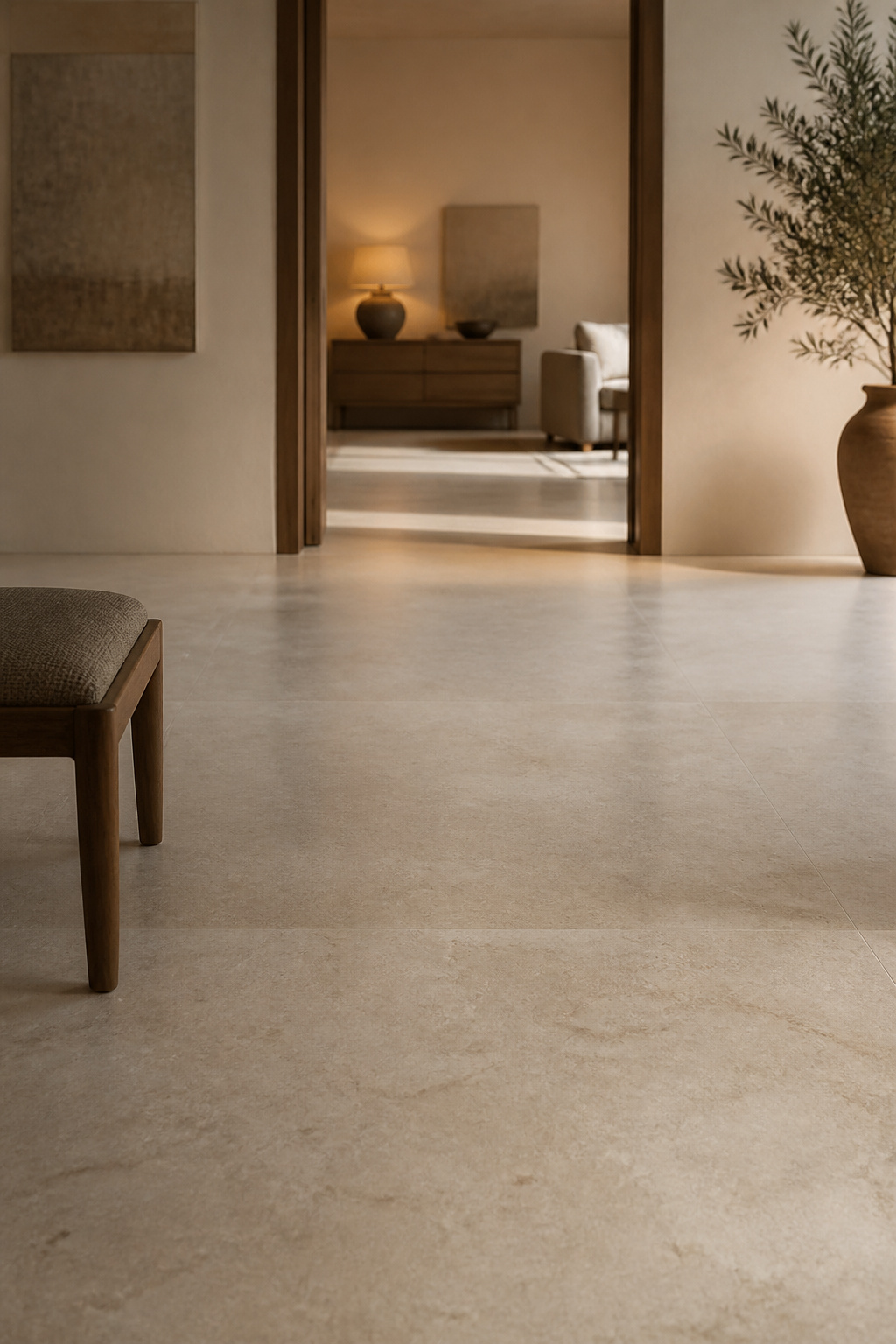
Making a Small Kitchen Read Larger
Scale is the lever. Large-format tile, roughly fifteen inches and up on a side, gives fewer grout lines and lets the floor read as one continuous surface instead of a pixelated grid. Grout colour matters as much: matched grout keeps the plane calm, high-contrast grout fragments it into pieces the eye then counts. Henrik Larsson takes this further in flooring ideas for a small kitchen.
When One Floor Should Run Into the Next Room
Continuity is not decoration in an open plan; it is what holds the space together. Run one material in one direction throughout the open area — and mean one direction, because changing plank direction between zones breaks the continuous read even when the material never changes.
Where the kitchen flows into a family room or breakfast area, keep contrast between adjoining materials low, because a hard colour or texture change registers as a boundary whether or not there is a wall there. There’s a resale case for this too: wood carried through an open plan is a genuine selling point, and unlike most of what a buyer will ask you to tear out, it can be refinished rather than replaced.
When It Shouldn’t
Continuity has a limit, and it is architectural. Reserve a material change for a real cased opening, or for spaces separated by roughly eight feet or more. Anywhere short of that, a change of floor reads as an accident rather than a decision — you have not zoned the room, you have interrupted it.
Tile earns its place across the kitchen, breakfast nook, family room, laundry and mudroom, while formal dining rooms, offices and bedrooms generally want to go back to wood. That gives you a defensible line to stop a tile floor at. What joint you use where the two meet has its own answer elsewhere on this site. The question at this stage is only whether that view wants to be one space or two.
Budget Kitchen Floor Ideas That Don’t Look Budget
Nothing on this list is off limits at a low price. What changes at the bottom of the market is not the look — it is which corner gets cut.
Peel-and-Stick and Sheet Vinyl
Vinyl holds the lowest bands in HomeGuide’s 2026 comparison: standard sheet at $2–$7 installed per square foot, standard vinyl tile at $2–$10.
The limits are specific rather than general. Peel-and-stick vinyl tile copes with brief spills, but prolonged moisture or grease lifts the edges — keep it away from the stove and the sink’s splash zone if it is going in a kitchen at all. The other catch matters most to renters: removability depends on not compensating for a damp subfloor with extra adhesive, because the moment you do, the tile is permanent.
Big-Box Porcelain in a Considered Pattern
Tile spans $10–$50 installed per square foot in HomeGuide’s general guide, and that range tells you nothing, because the cheapest big-box stock sits in the same row as handmade tile. The specific product sets the price, not the category.
So here is where I would spend a tight budget, and plenty of people will disagree: put it in the layout, not the material. Basic porcelain laid in herringbone or on the diagonal looks like a decision somebody made; a more expensive tile laid straight looks like a floor somebody bought. The trade-off is arithmetic — a straight lay loses roughly 10% of what you buy to offcuts, herringbone nearer 18%.
Three budget looks worth doing properly:
- Sheet vinyl in a matte stone or wood print — the lowest band here, and the cheap option with no field seam to fail.
- Big-box porcelain in herringbone or on the diagonal — buy the pattern, not the tile, and budget the extra material up front.
- A checkerboard border in two close warm tones — most of the effect for a fraction of the order.
At this end of the market you are paying for the fitting, not the tile. The full price-first breakdown, including the renter’s version, is in budget kitchen flooring that doesn’t look cheap.
Twelve looks, and three things carry across all of them.
Rule out on your worst risk before you rule in on looks. If a leak is your likeliest disaster, laminate leaves the list. If standing for hours is your reality, stone and concrete drop down it. If the dog corners hard, the wear layer matters more than the picture.
Choose the finish as deliberately as the material. Matte and honed keeps winning across this survey — over polished stone, over gloss vinyl, over hard-glazed tile — because low sheen hides wear, holds warmth and stays safe wet. And treat pattern as the cheapest way to buy a considered floor.
Now name your two or three. If they are wood, humidity decides it. If they are look-alikes, the wear layer does. If they are clay, the sealing schedule does. If they are tile in a pattern, get the labour quoted. Each has its own page in this series, and the shortlist you just made is the only thing you needed before reading it.