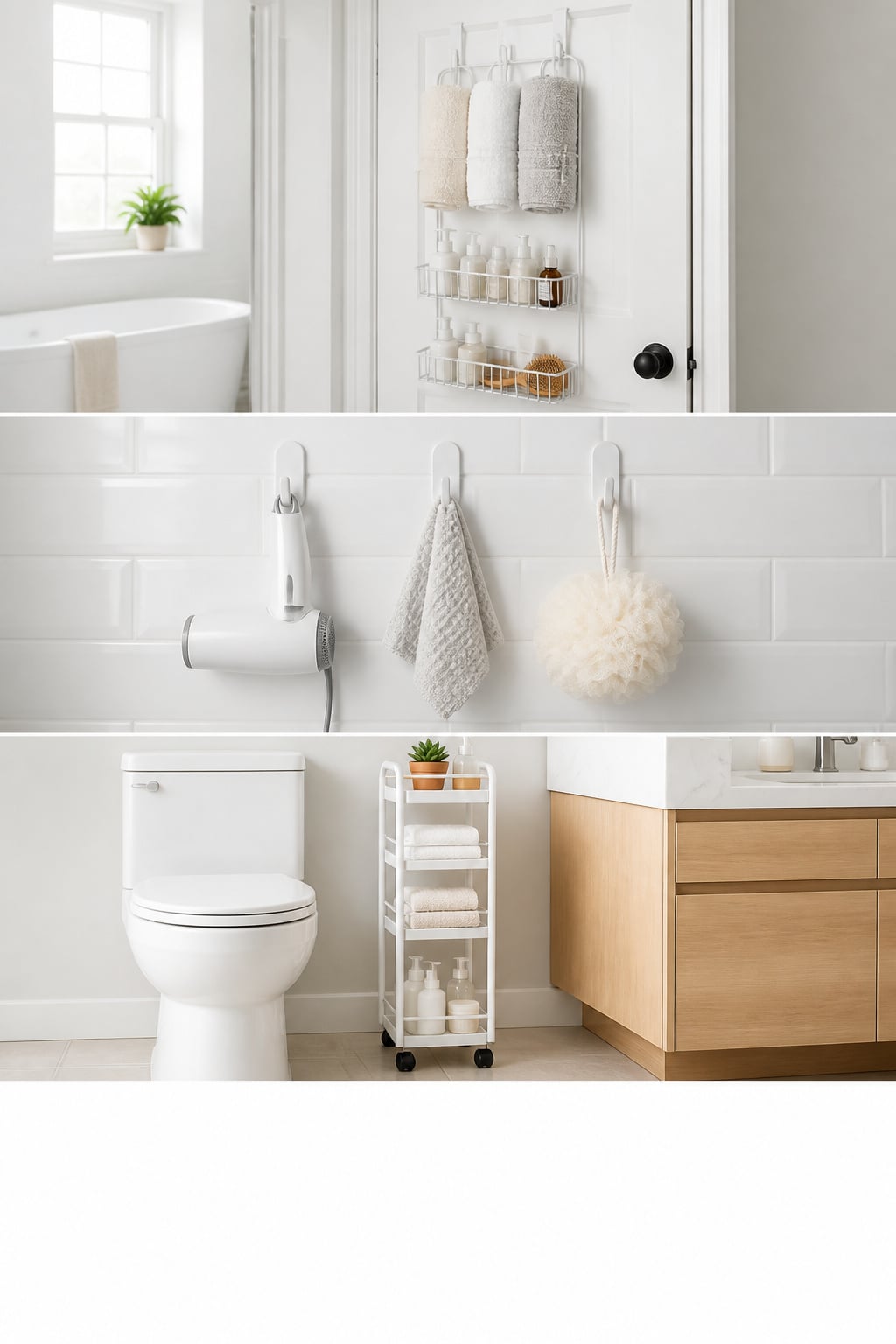
Here’s the part most renters get wrong: they assume no drilling means almost no storage. The opposite is closer to true. A bath-rated adhesive hook holds 7.5 lb, and a freestanding tower beside the toilet carries more than anything you’d screw to drywall. Renter friendly bathroom storage isn’t a compromise — it’s a toolkit. The catch is knowing which method works on which surface, because that’s where the 3 a.m. crash comes from.
TL;DR
- Command Bath hooks hold 3 lb (medium), 5 lb (large), and 7.5 lb (bathroom hook, shower caddy, corner caddy) on glazed tile — and pull off clean at move-out.
- Suction cups only grip smooth, nonporous tile; they fail on painted drywall and across grout lines.
- The highest-capacity no-drill options touch no wall at all: tension rods (10–25 lb by diameter), over-door organisers, and slim rolling carts as narrow as 5 inches.
What Adhesive and Suction Products Can Honestly Hold Now
The bath-specific adhesives changed the math — but the surface underneath decides everything, so start there before you spend a dollar.
How load ratings have changed — what a modern adhesive hook on tile can actually take
Command Bath medium hooks are rated to 3 lb, large bath hooks to 5 lb, and the Bathroom Hook, Shower Caddy, and Corner Caddy to 7.5 lb each. Those are single-hook ratings on clean, smooth, nonporous surfaces — not combined totals. The key word is bath: standard Command strips lose 25–50% of their hold in warm, humid air, while the bath line uses water-resistant strips that 3M tests above suction cups in wet conditions.
The surface truth: what sticks to glazed tile, painted drywall and textured walls
Suction cups need a smooth, nonporous surface — glazed tile, glass, mirror, or acrylic. They fail on painted drywall (porous surface, broken seal) and across grout lines (the cup must sit entirely on one tile face). Adhesive hooks are more forgiving — they work on painted walls too — but textured walls cut contact area and hold. Here’s the honest surface map:
| Surface | Adhesive hook | Suction cup | Removal risk |
|---|---|---|---|
| Glazed tile / glass | Holds well | Holds well | Low |
| Painted drywall (smooth) | Holds (bath strip) | Fails | Moderate |
| Textured / embossed wall | Reduced hold | Fails | Moderate |
| Over a grout line | Reduced hold | Fails | Low (tile) |
The removal test: what comes off clean vs what takes paint with it
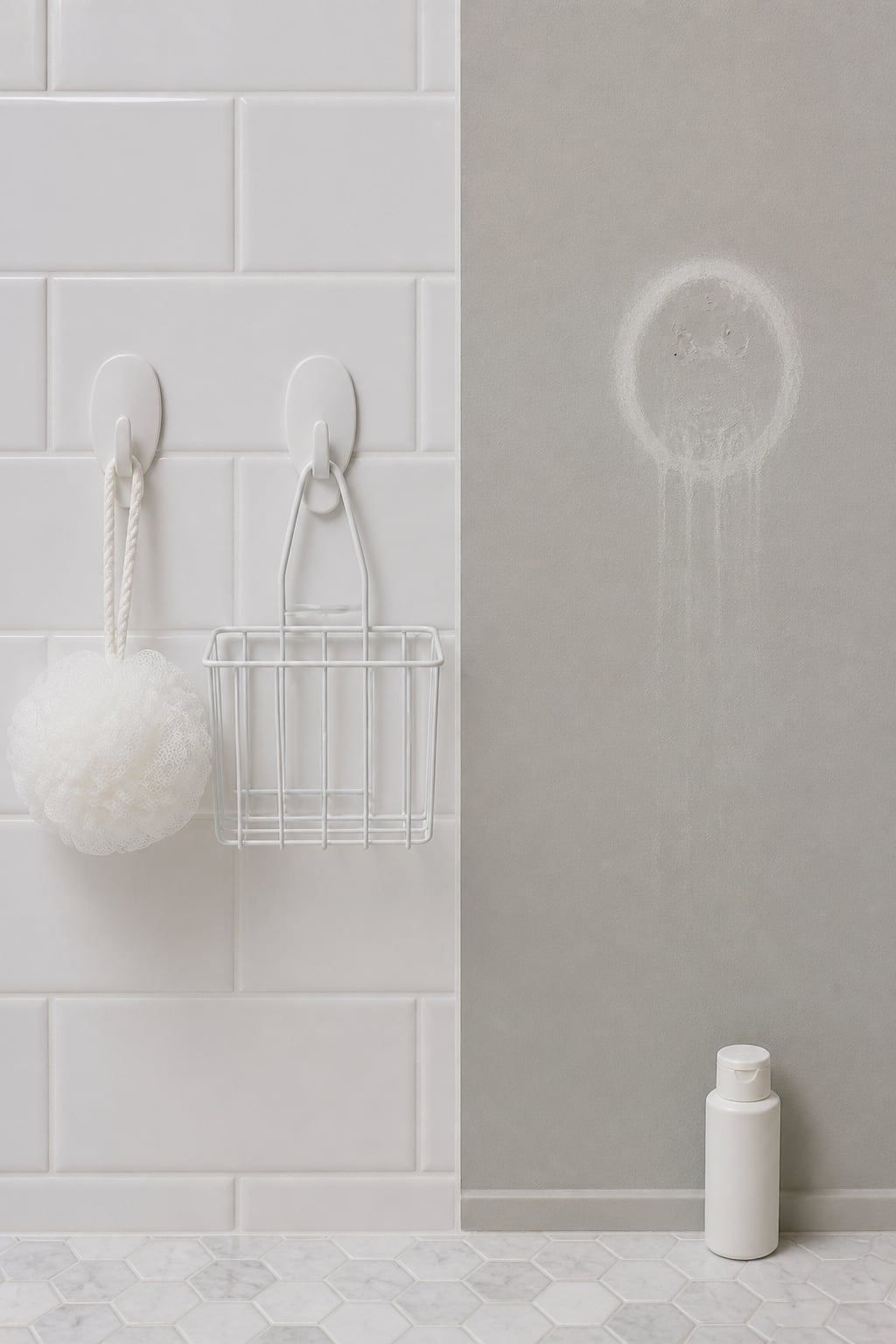
On glazed tile, Command strips pull off clean: grab the tab, pull straight down slowly, and the adhesive stretches and releases. Any residue wipes off with rubbing alcohol.
Painted drywall is where it goes wrong. Flat or matte paint, or paint less than 28 days cured, can lift on removal. Minor adhesive residue is normal wear and tear under HUD guidelines; pulled paint is damage. Only buy hooks labelled “removable” or “damage-free” — “permanent” or “industrial” means it’s not coming off clean.
Tension Rods: The Most Underused Tool in a Renter’s Bathroom
Tension rods work by pressing against two opposing surfaces — zero wall contact, zero marks — and depending on diameter they hold roughly 10 to 25 lb. Three positions unlock real storage.
Vertical tension rods between cabinet ceiling and floor: what fits in the created columns
Stand a rod upright inside a cabinet, pressing against floor and ceiling, and you’ve made column dividers with no screws. Each column holds flat things upright — organiser bins, rolled bath mats, trays. A 5/8-inch rod rated to 10 lb handles divider duty; a 1-inch rod takes 20–25 lb for heavier stacks. You need at least 8 inches of clear height.
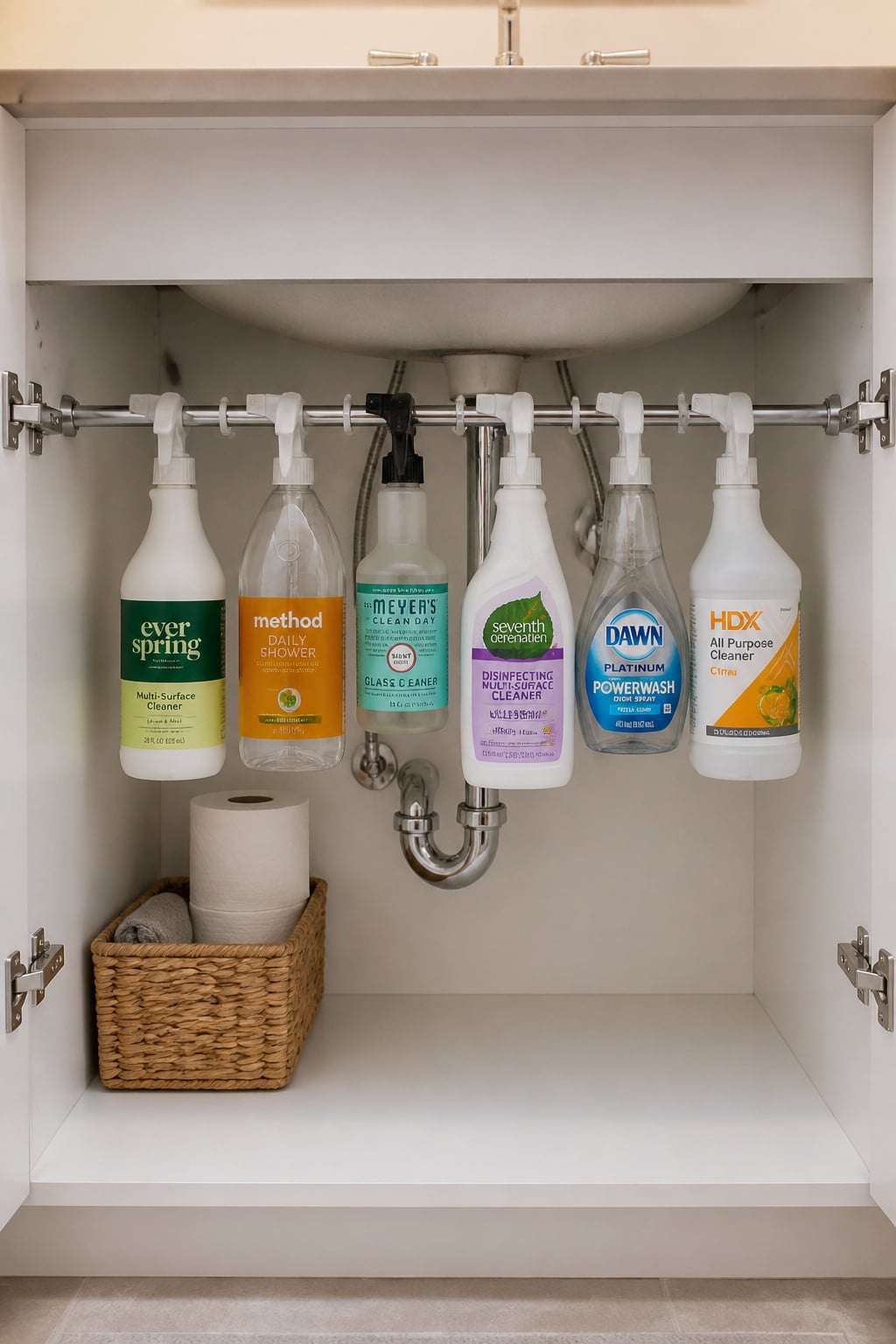
Horizontal tension rods inside the vanity cabinet to hang spray bottles
A $5–7 rod run horizontally near the top of the under-sink cabinet creates a hanging rail for spray bottles. Hang them by their trigger handles and the floor opens up for bulkier items. The Kitchn notes it keeps cleaners easy to grab and stops leaks pooling on the shelf. One caution: more than four bottles, or anything 2 lb-plus full, and a thin rod bows — use a 3/4-inch rod.
Above-the-door tension rods for hanging organisers with real capacity
Fit a rod inside the doorframe near the top, and the door zone becomes hanging storage without touching the door. S-hook baskets, cloth organisers, and wire bins all hang off it. For bathroom hanging, a 5/8-to-3/4-inch rod rated to at least 10 lb is enough; heavy-duty 1.26-inch systems carry far more than any toiletry load. Removal is the cleanest of any method — unscrew until the spring releases. Nothing to patch.
Adhesive Shelves and Hooks: What Works and What Falls at 3 a.m.
Adhesive hardware fails for three avoidable reasons: wrong strip, wrong surface, or a skipped cure.
Command strips vs construction adhesive hooks: the use case difference
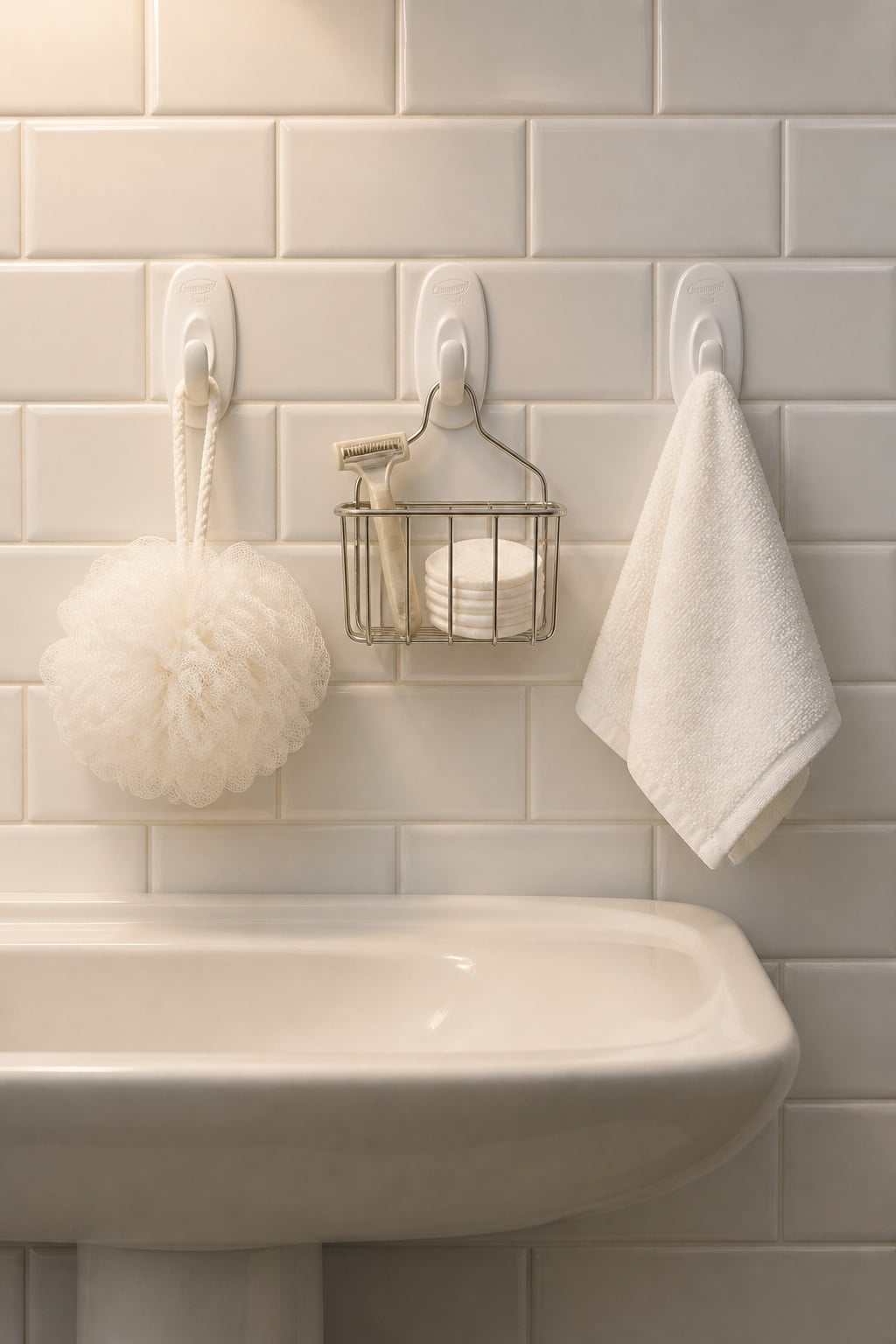
Command Bath hooks use a foam-backed, stretch-release strip that bonds under pressure and peels off clean. Construction adhesive hooks — labelled “permanent,” “heavy-duty,” or “industrial” — use contact cement or epoxy and won’t come off without taking tile or grout with them. For a rental, that’s a deposit charge waiting to happen. The Command Bath range runs from 3 lb (soap dish, medium hook, razor holder) to 7.5 lb (bathroom hook, shower caddy, corner caddy).
Maximum weight per hook and how to divide items so no single point fails
Spread the load; don’t test the limit. A wet bath towel runs 1.5–2.5 lb — two on a 3 lb medium hook is right at the edge. A big bath sheet wants a 5 lb hook minimum. A full toiletry caddy (shampoo, conditioner, body wash) can hit 3.5–4 lb, so use the Shower Caddy (7.5 lb) over a medium hook. For heavier combos, the Corner Caddy uses two adhesive attachment points, distributing load across two failure points instead of one.
The 24-hour wait rule and why skipping it is where most adhesive failures start
Here’s the boring step nobody wants to hear. Press firmly for 30 seconds, wait an hour before hanging anything, then wait 24 hours before loading to the rated weight. The foam keeps conforming through that first day — loading early is exactly when hooks let go in the night. In a busy family bath, push to 48 hours. Surface prep matters too: wipe with rubbing alcohol and give it 15 minutes. The strip bonds to whatever’s on the tile, not the tile itself.
Over-the-Door Organisers: The Deposit-Safe Cabinet Extension
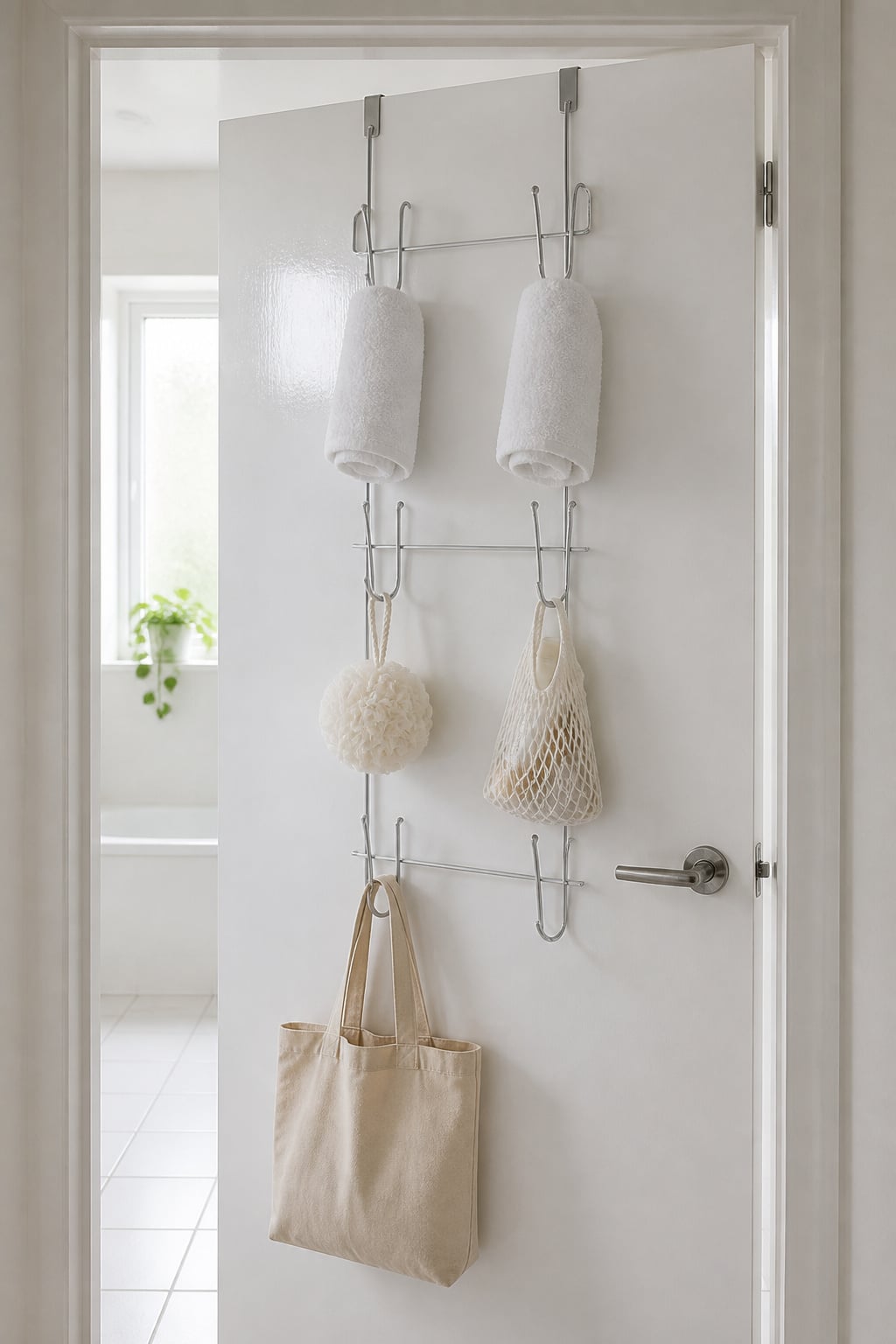
An over-door organiser hangs from hooks on the top edge of the door — nothing screwed, nothing touching a wall. Three checks before you buy.
Door-thickness and frame-clearance checks before buying any over-door product
Measure the door first. Standard interior doors are 1-3/8 inches (35mm) thick; solid-core and fire doors run 1-3/4 inches (44mm). Hooks that state “1-3/8 to 1-3/4 inches” cover both. Fire doors at 2 inches-plus need wide-slot “fire door” hooks. Run these checks before you commit:
- Door thickness — match the hook’s stated range to your actual door, measured with a tape.
- Top clearance — the door needs about 1/8 inch (3.5mm) of gap above the hook to still latch; test that it closes before loading.
- Swing path — make sure the loaded organiser doesn’t hit a towel rail or wall when the door opens.
- Rattle fix — felt pads or weatherstrip tape silence a shaky unit on a hollow-core door.
What to store at each height on an over-door organiser (and what not to)
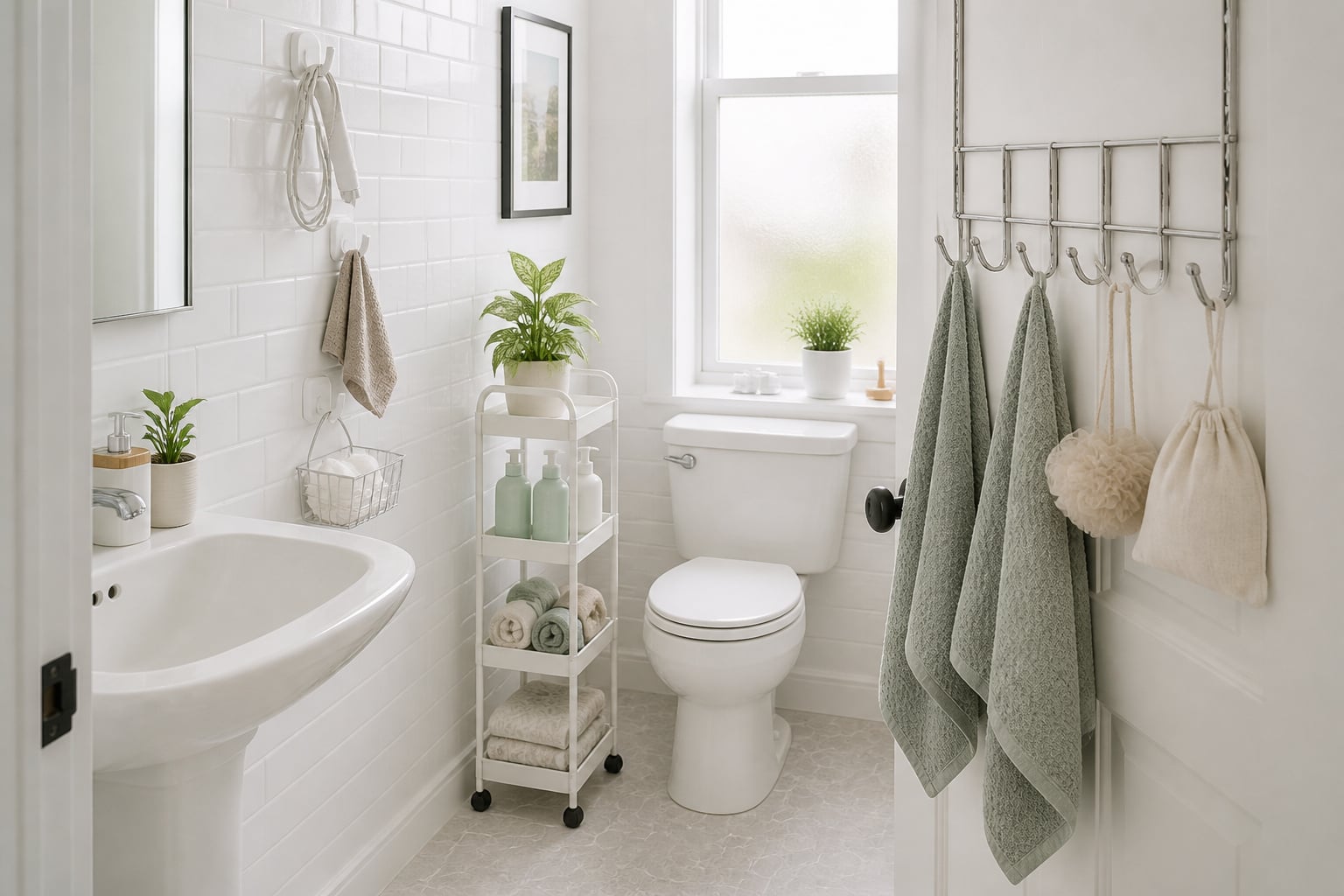
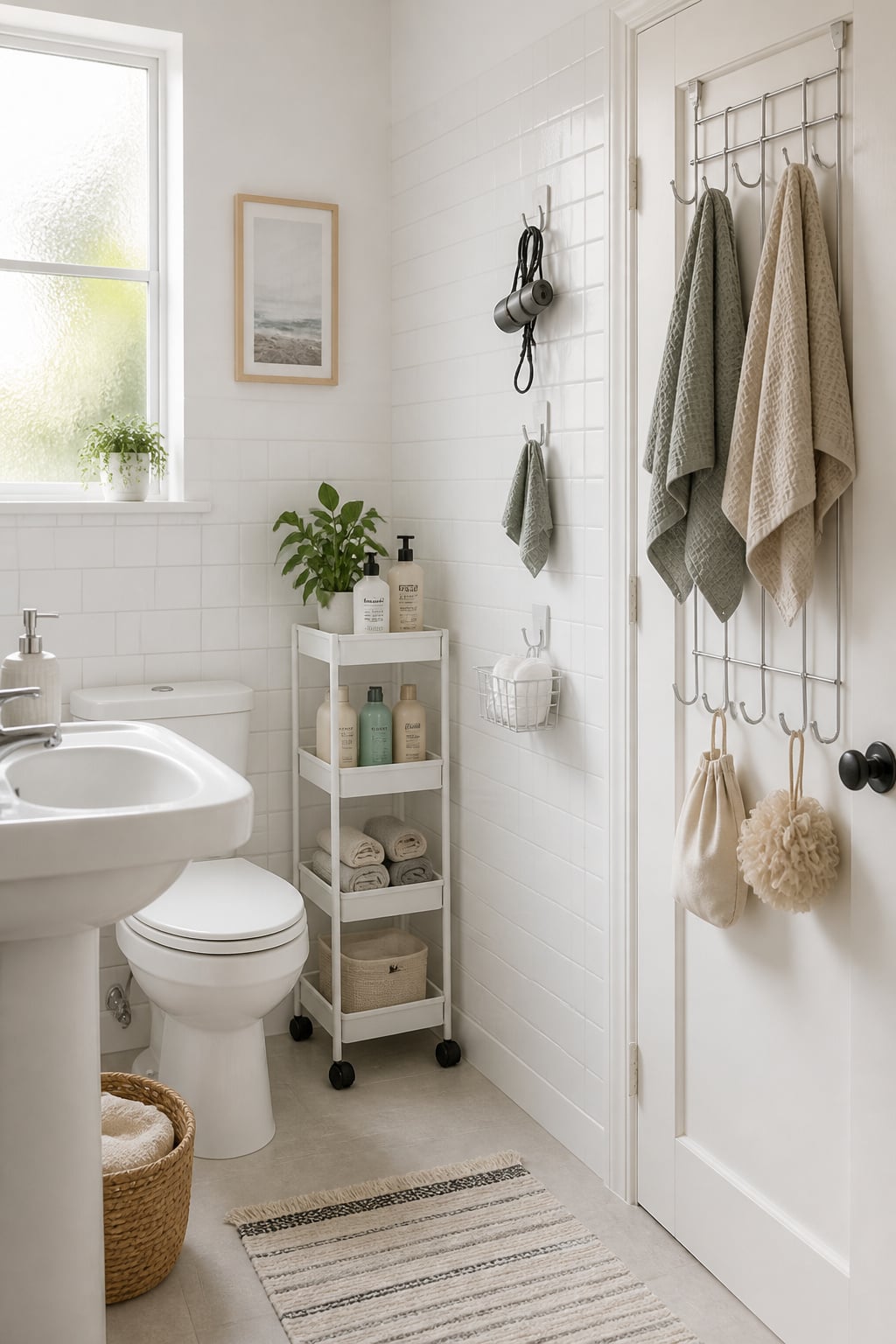
Height sorts the contents. Upper hooks are for towels and robes. Mid-level wire pockets suit rolled washcloths, small bottles, and a hairdryer pouch. Bottom hooks take a tote. One thing not to do: don’t hang full bottles from wire pockets by their caps — the neck cracks under repeated weight cycling. Decant into travel bottles. Clear vinyl shoe-pocket organisers earn their place for cotton rounds and floss — vinyl wipes clean where fabric grows damp.
Over-door vs inside-door: the different applications for each
The inside of the bathroom door is the more valuable surface — it handles daily grabs (hairdryer, face wash, a backup roll). The outside suits a hook bar for robes and guest towels. Wall-mounted units hold more (up to 50 lb on studs versus lighter over-door loads), but for a renter, deposit safety wins.
Freestanding Units: When Nothing Touches the Wall At All
When you want real capacity and zero wall contact, freestanding wins. Watch stability — a tall loaded unit on tile tips if you cut corners on the feet.
Freestanding over-the-toilet etageres for renters: what to look for
An over-the-toilet etagere straddles the tank on two floor-standing legs — no screws, no wall. Three-tier models typically hold 11–44 lb depending on build. Two specs decide the buy: the inner leg span must clear your tank with at least an inch each side (standard tanks run 17–20 inches wide), and many units ship with an anti-tip kit that screws into the wall. Skip the bracket. A metal tube frame with a wide stance is steadier than a narrow ladder unit that relies on wall contact. The over-the-toilet storage guide covers mounted options for this zone too.
Slim rolling carts and towers that earn their footprint in a tight bathroom
Slim carts come as narrow as 5 inches wide, slipping into the dead gap between a toilet and a vanity without touching either. At 3.5 inches deep per shelf, each tier holds one row — shampoo, toner, toothpaste — not a full caddy. Want more volume? IKEA’s HORNAVAN ($29.99) and RÅGRUND bamboo cart (from $59.99) hold significantly more, trading tight-gap fit for capacity. Homes & Gardens found buyers liked slim units precisely because they tidy a bathroom without damaging walls.
Stability on tile floors: rubber feet and anti-tip habits
Fixed plastic feet let a unit slide when someone brushes past; adjustable rubber feet grip, and stick-on silicone pads do the same for a couple of dollars. Then load low: heavy items go on the bottom shelves, light ones up top. A low centre of gravity is the single best anti-tip move without a wall bracket. Keep MDF or particleboard out of the splash zone — it swells within months. Metal or bamboo shrugs off the humidity. Empty corners are the next dead space worth claiming — the corner shelf ideas guide covers suction and adhesive caddies that suit renters. For how it all fits together room-wide, see the full small bathroom storage playbook.
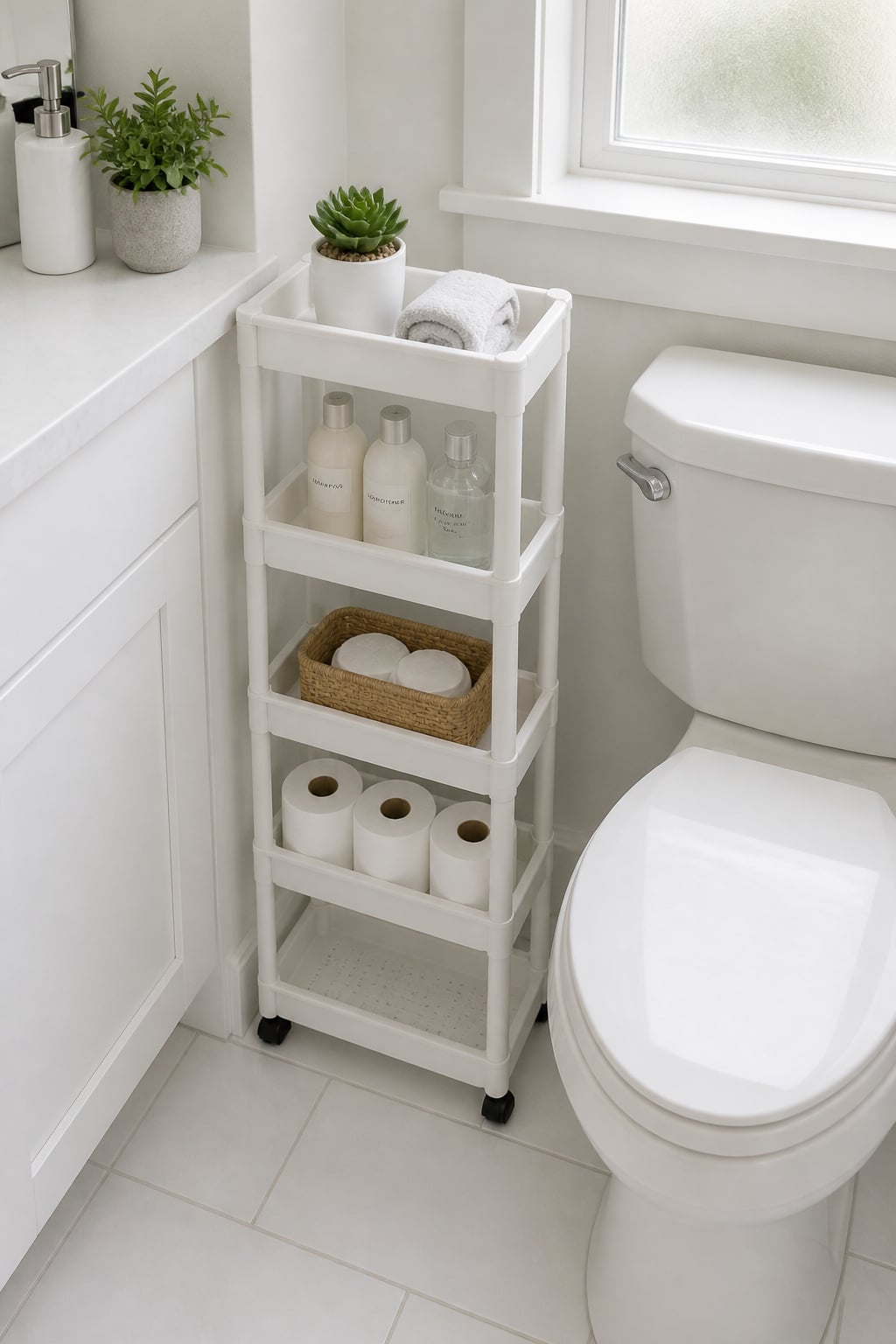
Pick one surface and start tonight. Glazed tile: clean a patch with rubbing alcohol, set a Command Bath hook, and leave it 24 hours. Painted walls: stand a tension rod in the under-sink cabinet, or roll a slim cart into the gap by the toilet. One method, matched to what you actually have, and the bathroom your lease said you couldn’t touch starts earning its keep — deposit fully intact.
FAQ
What bathroom storage doesn’t require drilling for renters?
Plenty, and some of it carries real weight. Freestanding over-the-toilet etageres straddle the tank with no wall contact and offer the highest no-drill capacity. Command Bath hooks hold 3–7.5 lb on glazed tile. Tension rods, over-door organisers, slim rolling carts, and suction caddies on smooth tile round out the toolkit, each leaving zero marks behind.
Do adhesive shelves really work in a bathroom?
Yes, if you use the bath-specific line. Command Bath hooks with water-resistant strips hold 3–7.5 lb per hook on smooth, nonporous surfaces like glazed tile, and 3M’s own testing rates them above suction cups in wet conditions. They fail on textured or freshly painted walls, on uncleaned surfaces, or when you skip the 24-hour bonding cure before loading.
How do you add storage to a rental bathroom without losing your deposit?
Stick to freestanding and over-door solutions that make zero wall contact — these are entirely deposit-safe. If you use adhesive, use only removable Command Bath hooks on glazed tile, never on painted walls, which risk lifting paint. Remove strips by pulling the tab straight down slowly, never sideways, and clear any residue with rubbing alcohol.