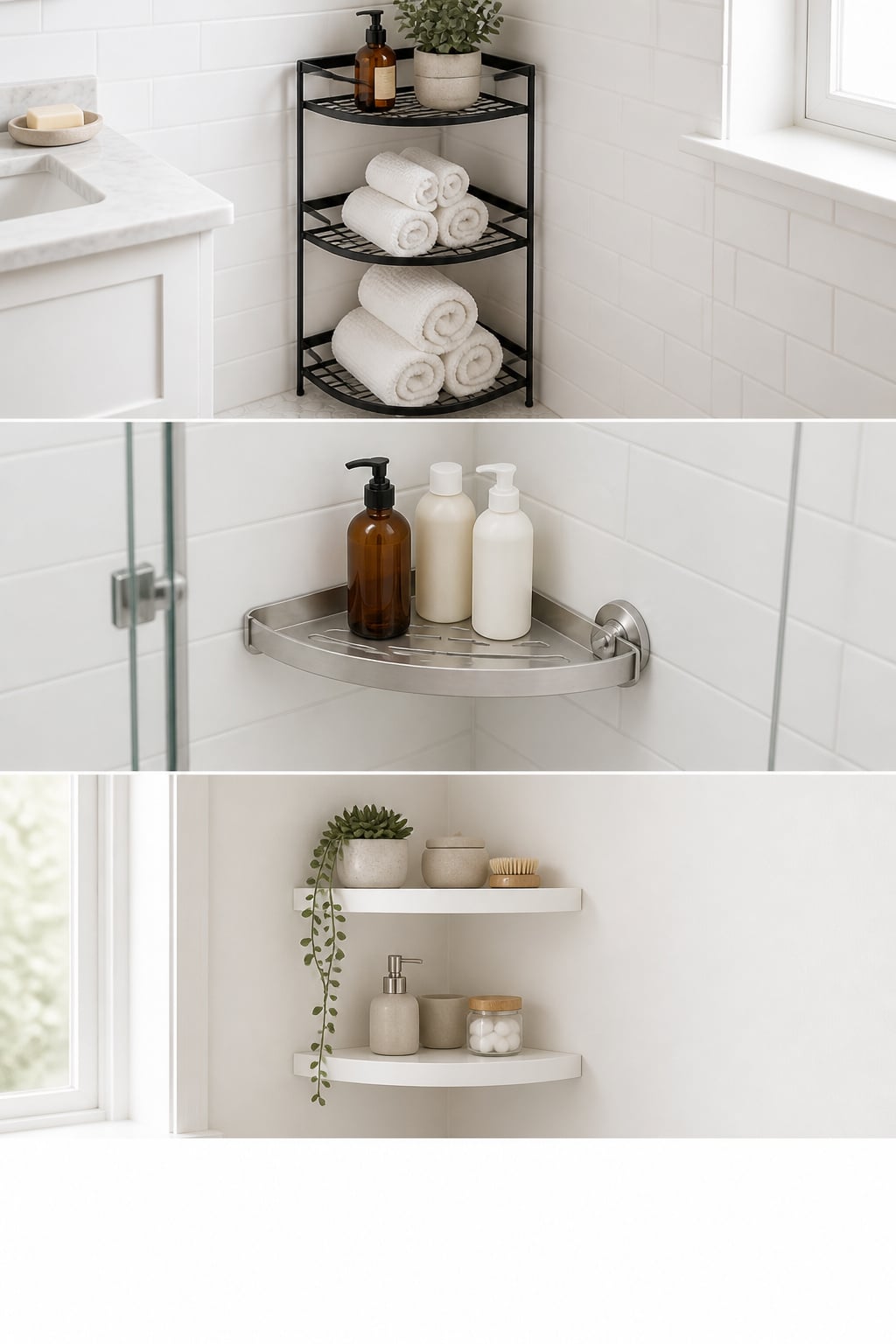
Look at the corner past your toilet. There’s a good chance it’s holding nothing but a cobweb. That triangle is the one piece of dead space the builder handed you free, and the best bathroom corner shelf ideas are really four ways to claim it — from a no-tools caddy you stick up tonight to a recessed cabinet that takes a real Saturday. Pick the one that matches your skill and your landlord.
TL;DR
- A compact corner caddy needs a 9 to 9.4-inch footprint per arm; a freestanding triangular etagere runs 11 to 15 inches per side and stands 54 to 70 inches tall.
- No-drill picks come first: suction caddies hold on smooth glazed tile only (never over a grout line), and adhesive units run from 7.5 lb (Command Bath) to 15 lb (Purdaz) — check the product spec.
- Wall-mounted shelves give the most storage per inch; anchor to a stud, or use toggle bolts rated 100–200 lb in half-inch drywall where no stud lands.
How Much Storage a Corner Holds: Sizing Bathroom Corner Shelf Ideas
Before you shop, measure the corner. It’s a triangle, not a wall, and that geometry decides what fits and what gaps. Three numbers settle it, and a fourth question — wet or dry — decides the whole product category.
The Corner Footprint Calculation
Corner units are sized per arm, the run along each wall. A compact caddy occupies 9 to 9.4 inches per arm; a taller triangular etagere runs 11 to 15 inches per side, with large models reaching 15.3 inches at the base.
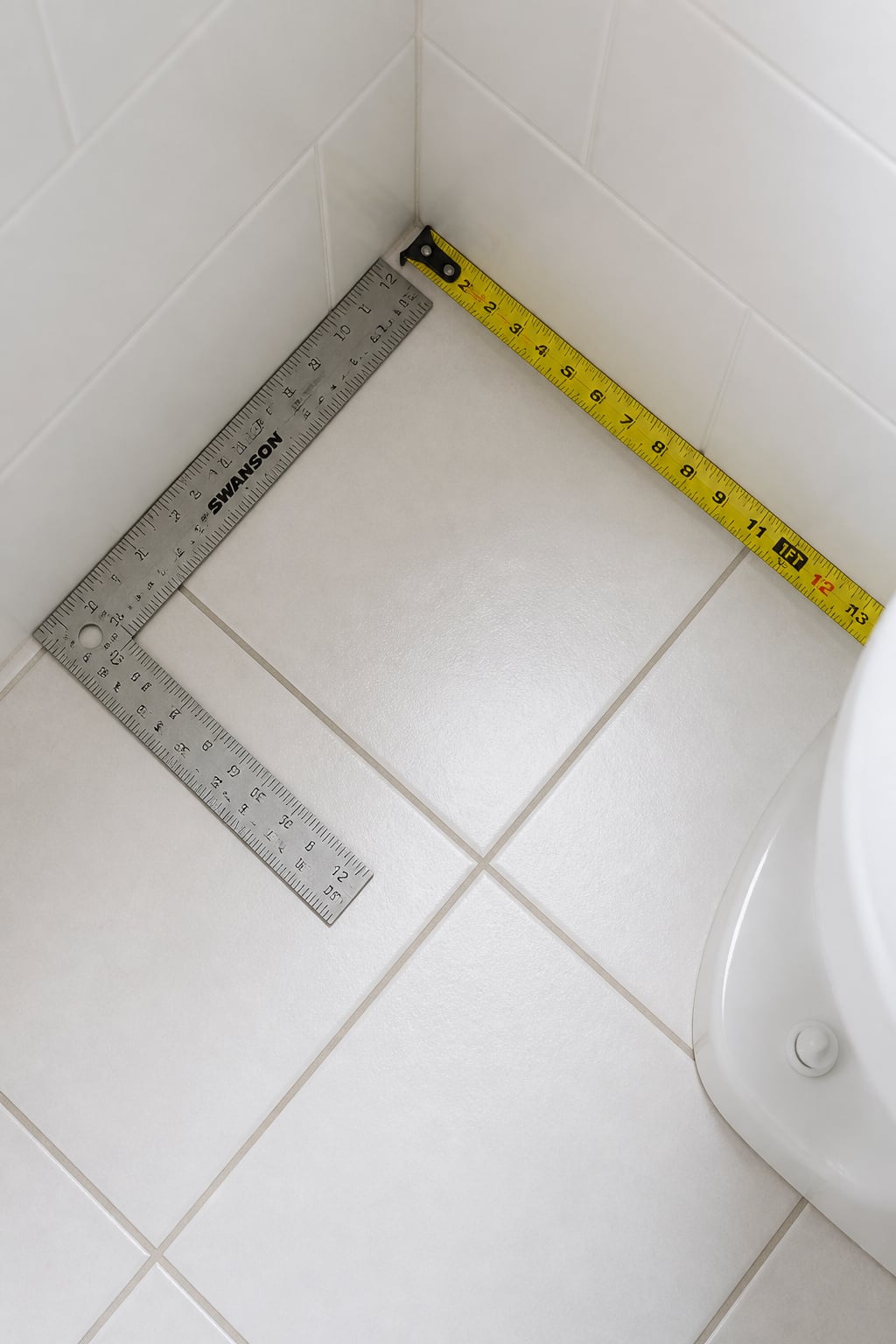
Here’s the trap. Your corner is probably not 90 degrees. Construction tolerances put real residential corners anywhere from 87 to 93 degrees, and a shelf cut for a perfect right angle gaps when the wall is off by two or three. Check the angle with a framing square or phone app first, then measure the clear depth on each wall to the first obstruction.
| What to measure | Tool | Why it matters |
|---|---|---|
| Wall angle | Framing square or phone app | An 88-degree corner gaps behind a shelf cut for 90 |
| Clear depth, each wall | Tape measure | Sets how deep a unit fits before hitting a fixture |
| Floor-to-ceiling height | Tape measure | Needed only for a tension-pole caddy |
Shower Corners vs Dry-Zone Corners
These are two different jobs. A shower corner needs drainage — slotted shelves so water doesn’t pool — plus rust-resistant material (stainless, aluminium, or wet-rated plastic) and mounting that survives constant humidity. A standard adhesive hook not rated for wet zones loses grip in there. A dry-zone corner — beside the vanity, behind the toilet, on the far wall — opens up the whole range: freestanding etageres, wood-arm wall shelves, solid-back cabinets. Match the tool to the zone and skip the heartbreak.
What Corner Geometry Rules Out, and What It Enables
A corner is almost always the unclaimed zone, and its angled shape is exactly why it stays empty — and why triangular shelves made for it are so efficient. As designer Beril Yilmaz of BY Design & Viz notes, volume builders line every fixture to straight walls and leave corners as afterthoughts; in a bathroom under about 65 square feet, corner placement pulls storage clear of the main traffic path. One limit: NKBA guidelines call for 18 inches from the toilet centre to any obstruction, so keep any freestanding corner unit outside that zone.
Suction and Adhesive Corner Caddies: Start Here
This is the first-build tier: zero tools, zero holes, easy to walk back. It’s where renters should start, alongside the other renter-friendly storage tricks. The catch is that these mounts have hard limits, and ignoring them is why caddies hit the tub floor at 2am.
Suction Caddies in the Shower
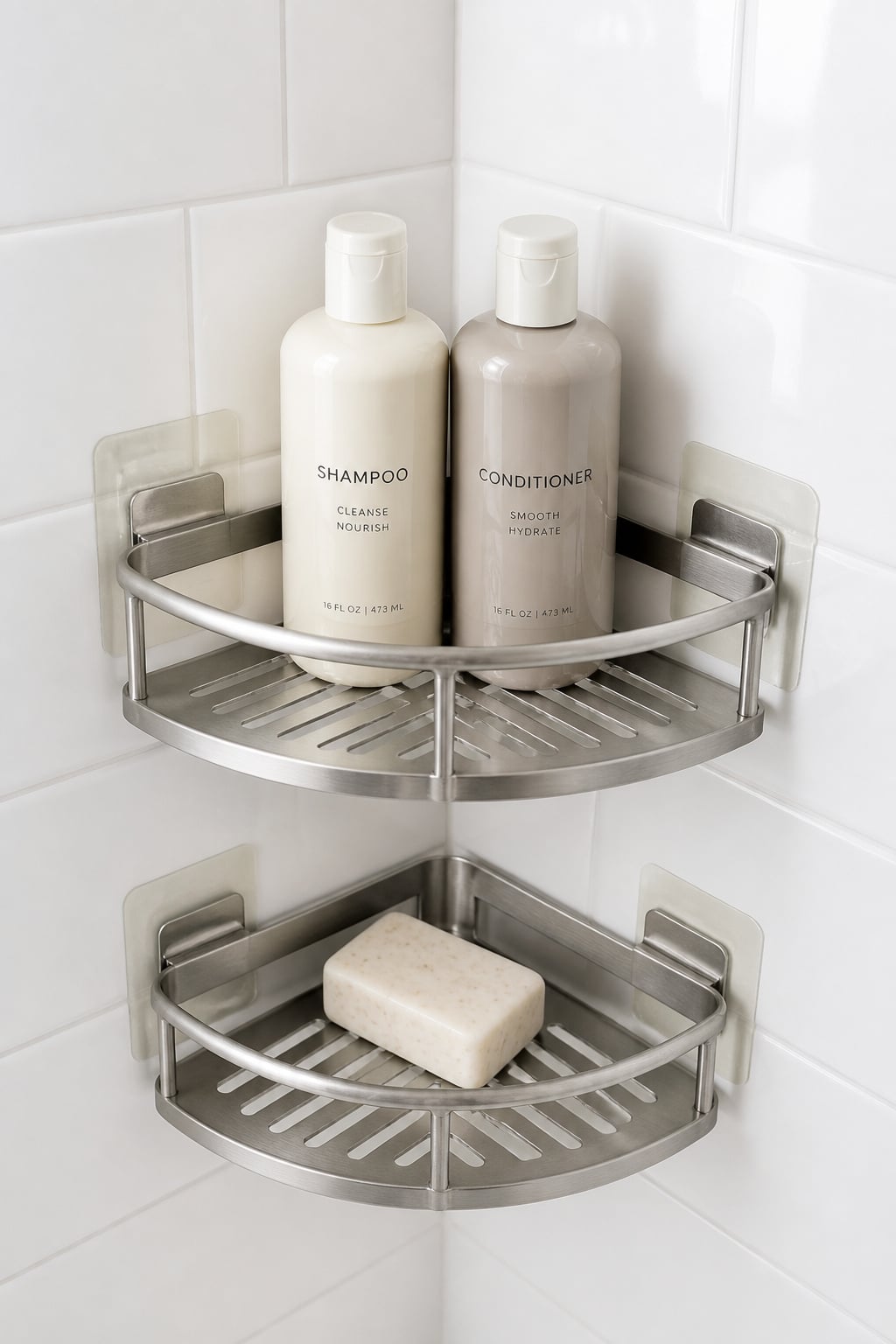
Suction works on smooth, non-porous surfaces only: glazed tile, glass, mirror, acrylic. It will not hold on textured tile, painted drywall, or any porous surface. The deal-breaker most people miss is grout — if any part of the suction cup spans a grout line, the seal breaks and the caddy falls.
Silicone cups grip wet tile better than old rubber ones, but the surface rule never changes and heat cycling still loosens them. As the Remodel Inspo team puts it, suction cups “may lose grip over time due to moisture or uneven surfaces,” so reseat them now and then. To skip suction entirely, a stainless tension-pole caddy presses against the ceiling instead — the simplehuman 9-foot pole runs around $139.
Before you trust any suction caddy, check:
- The whole pad lands on smooth tile or glass, no grout line crossing it.
- The surface is flat, not textured or pebbled.
- The heaviest bottles sit low, weight spread out.
Adhesive Corner Shelves on Tile
Adhesive units hold through humidity better than suction. The verified specs from named brands tell the honest story: the Command Bath Corner Caddy is rated by 3M at 7.5 lb, and the Purdaz stainless adhesive caddy lists 15 lb. You’ll see “50 lb” on some third-party listings for plastic shelves — I couldn’t tie that to any real manufacturer spec, so treat it as marketing and load to the number printed on your unit.
Two rules. In a shower, use the bath-rated water-resistant strip, not the standard indoor kind. On removal, adhesive lifts off glazed tile clean with a stretch-and-release pull, but on painted drywall it can take paint with it, especially within 28 days of painting.
Stacking Caddies to Go Vertical Without Mounting
One corner, three shelves, no drill. Stack adhesive or suction caddies 10 to 12 inches apart so the bottle on one isn’t blocked by the shelf above; 10 inches clears most bathroom bottles. No single caddy carries the whole load, which keeps each inside its rating.
The mistake here is impatience. Apply each caddy and wait the full bond time — usually 24 hours — before loading. Loading a fresh adhesive caddy before the bond cures is the top reason a new install lets go with a full shelf.
Freestanding Corner Shelving Units: No Wall, More Capacity
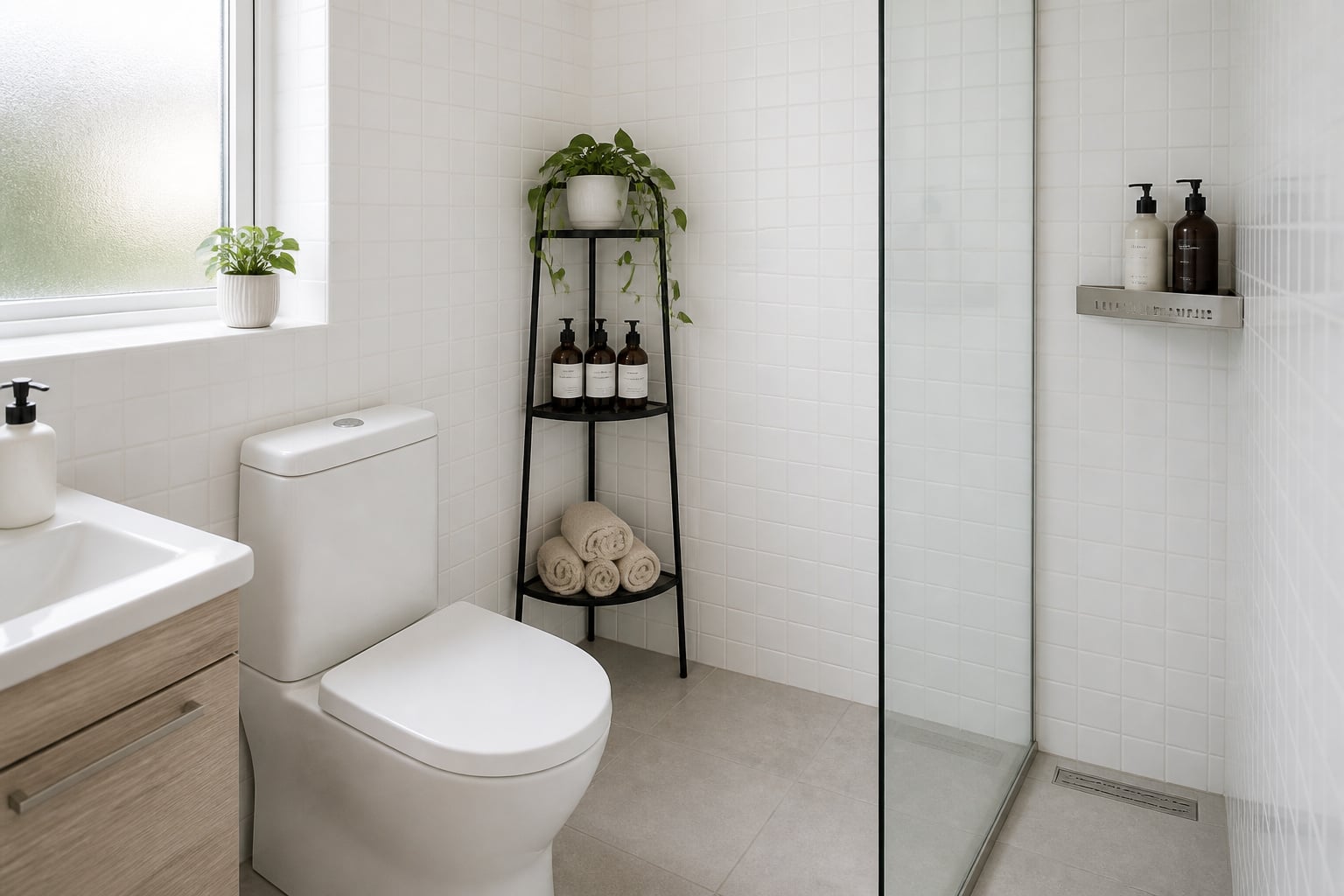
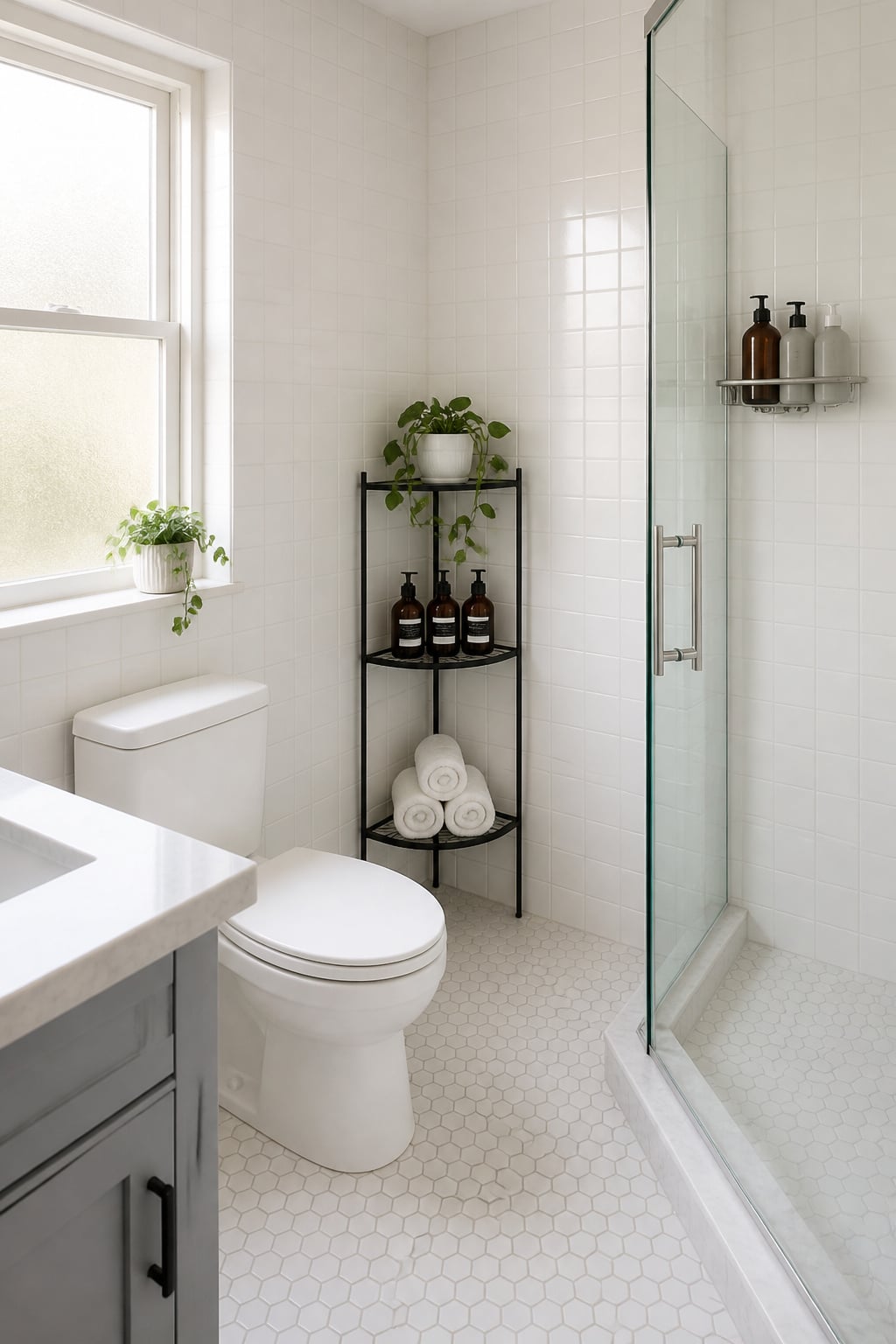
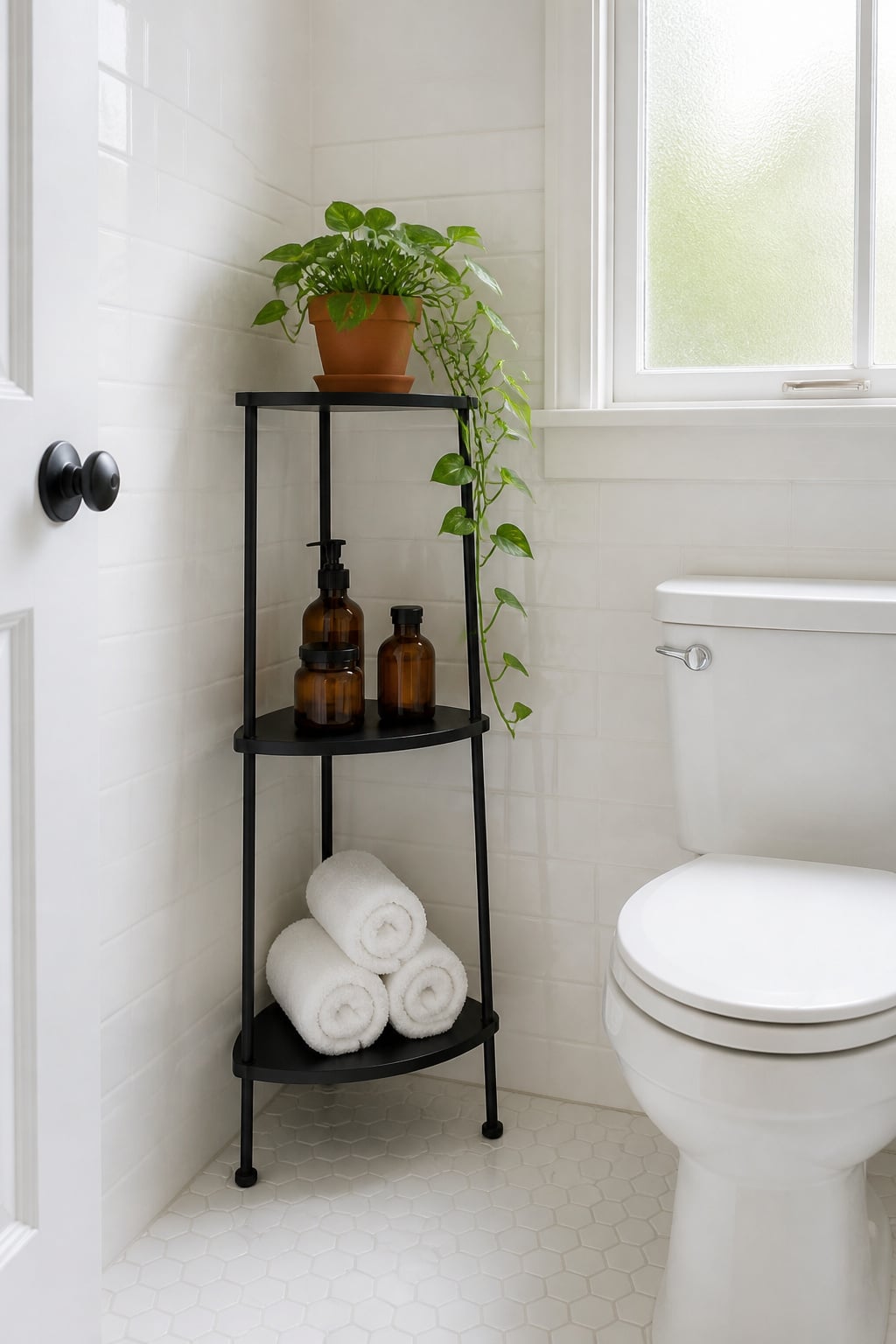
Step up a tier and you get real capacity with still no holes. A freestanding triangular etagere is the dry-zone workhorse — a top pick for the same corner-and-vertical logic behind over-the-toilet storage ideas. The trade is floor space and a stability question you have to answer honestly.
Corner Etageres: Sizing for Tight Footprints
A compact 3-tier caddy measures roughly 9.8 inches square and 27.5 inches tall — powder-room scale. The stable sweet spot for a 5-by-8 bathroom is 11 to 13 inches per side at 54 to 66 inches tall: enough vertical capture without a step stool, narrow enough to clear toilet and vanity. A rust-resistant powder-coated steel model runs under $60 — check current pricing where you shop, since it swings by finish. Powder-coated steel beats chrome for rust; bare bamboo and wood need sealing.
Floor Stability on Tile
Most etageres ship with adjustable rubber feet, good for about a quarter-inch of unevenness. But rubber grips tile far worse than carpet, and a tall narrow tower has a high centre of gravity over a small base — a tip risk. If you own the place, anchor it with an anti-tip strap; kits like Home Depot’s Simple Mount held 347 lb of force per anchor in Consumer Reports testing, far more than any shelf load. If you rent and can’t anchor, don’t fight it: buy a shorter, broader unit (closer to 15 inches per side, under 54 inches tall) so the low centre of gravity does the work the strap would.
Open Shelves vs Closed Towers
In a small room, open shelves win on visual weight. The see-through frame lets the wall behind read as space, so the corner doesn’t go dark and boxed-in. A closed tower reads as furniture and makes the room feel heavier — worse if it’s dark. Plumbworld’s design team agrees: open shelving helps a small bathroom feel less cramped, while chunky cabinets box it in. The catch is that open means everything shows — so a hybrid, open shelves up top and a closed section below, hides the cleaning spray while keeping the lightness where the eye lands.
Wall-Mounted Corner Shelves: Permanent Storage That Earns Its Wall
This is the some-builds tier, and it gives more storage per square inch than anything else here, because it uses wall space no floor unit reaches. The cost is drilling and the right anchor — an afternoon, not a renovation. The pillar covers the other small-bathroom storage strategies these shelves slot into.
Here’s the install sequence for a bracket-mounted corner shelf:
- Find the stud and mark it; check whether one even lands in your corner.
- Mark the shelf height with a level — a 1/8-inch tilt shows on a loaded shelf.
- Drill pilot holes — through tile first with a carbide masonry bit, then switch bits for the drywall behind.
- Set the anchor: a 2.5-inch wood screw into a stud, or a toggle bolt where no stud lands.
- Mount the bracket, re-check level, then add the shelf and load it gradually.
- In a wet-zone tile wall, seal every penetration with silicone caulk.
Corner Bracket Types and Which Wall Suits Each
L-shaped steel brackets are the standard. Into a stud, drive lag or long wood screws at least 2.5 inches deep — never drywall screws, which snap under a loaded shelf. Studs sit 16 or 24 inches on centre, which is the problem: in a corner, one rarely lands where you need it. When there’s no stud, toggle bolts carry the most — standard spring-wing toggles hold 100 to 200 lb per bolt in half-inch drywall, and heavy-duty SNAPTOGGLE bolts hold 238 lb, the overkill you want.
Single Shelf vs Stacked: Spacing That Stays Usable
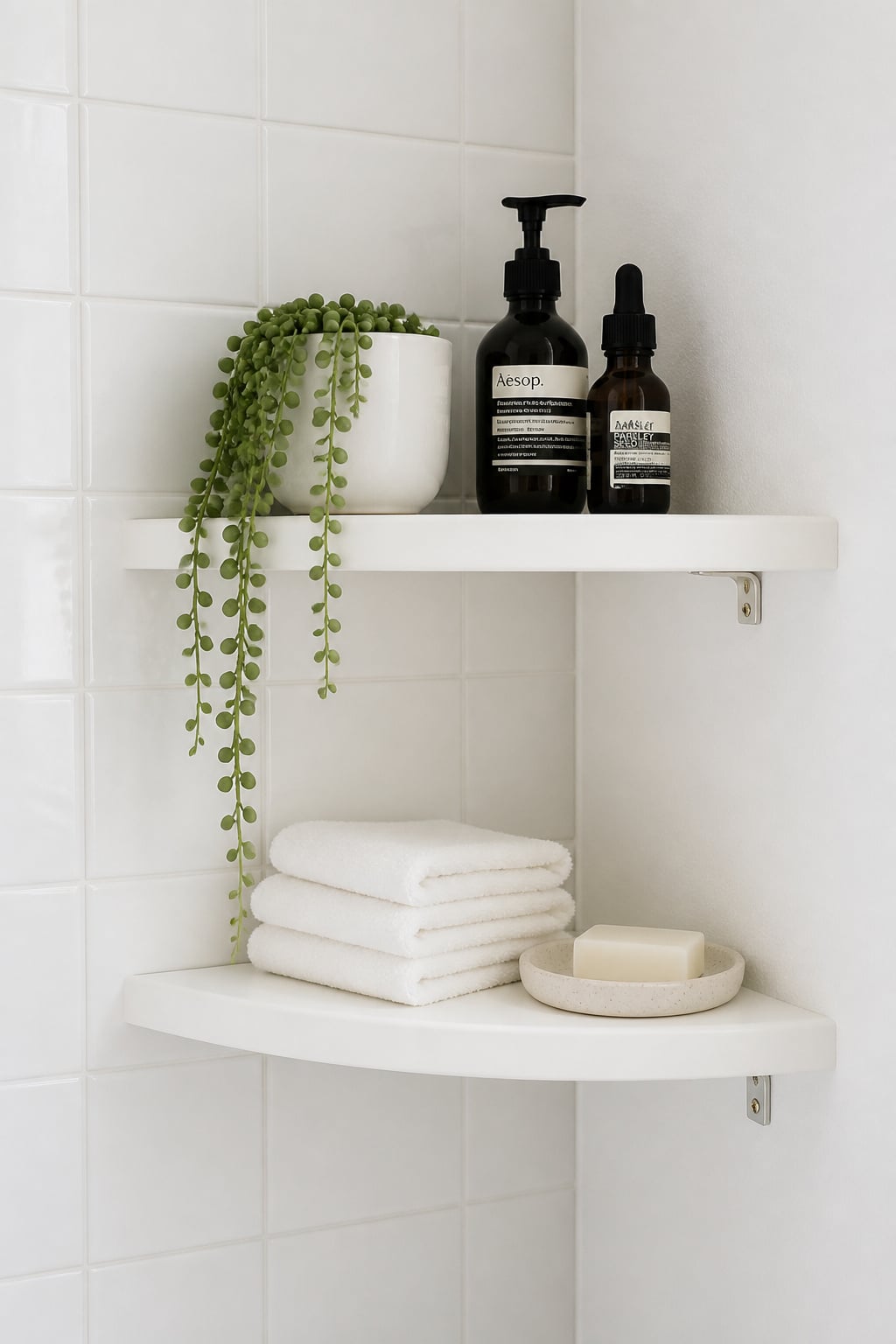
Stack corner shelves 10 to 12 inches apart, clear between surfaces. At 10 inches, a 7-to-8-inch shampoo bottle clears the shelf above with 2 inches to reach in. A practical two-shelf stack sits one at 48 inches (eye level) and one at 60. Keep them in a straight vertical line — corner shelves have two visible front edges that read as a set, and a staggered layout just looks like a mistake.
Depth and Angle That Don’t Jut Into Traffic
Bathrooms want 6-to-8-inch-deep shelves, with 8 the standard where space is tight — deep enough for small items, close enough to the wall to keep clearance below. Go past 8 inches near the toilet and the arm projects into the space where you stand. Favour the straight-corner design over a mitered 45-degree joint: two arms meeting at 90 degrees spread weight better and forgive an off-square wall, which matters most in older homes.
Corner Cabinets: Maximum Capacity in the Tightest Footprint
The confident-builder tier. A corner cabinet holds more than any shelf, and a recessed one — set into the wall cavity — barely projects at all. The price is the hardest install here, and one step where most first-timers get burned.
Recessed vs Surface-Mount
A recessed cabinet sits inside the wall, intruding almost nothing — ideal for a tiny bathroom. But its depth is capped by the cavity: standard 2×4 framing gives about 3.5 inches, leaving 3 to 4 inches of usable interior. That fits shampoo bottles (2.5 to 3 inches across) but not a wide hairspray can. A surface-mount cabinet attaches to both walls and protrudes 4 to 8 inches, so it takes any depth and holds the bulky stuff — and it’s the far easier build, no cutting into the wall.
| Cabinet type | Footprint / depth | Capacity | Install skill | Cost (unit) |
|---|---|---|---|---|
| Surface-mount corner | Protrudes 4–8 in | Holds bulky items | Some builds, 2–6 hrs | $50–$200 |
| Recessed corner | 3–4 in usable interior | Small items only | Confident builder, full day | $50–$200 + labour |
Standard Dimensions and What Fits
A compact surface-mount cabinet with a roughly 12-by-12-inch footprint suits a powder room; the Croydex Simplicity, at 11.81 inches wide, is a common benchmark. The 3-to-4-inch recessed interior takes standard toiletries but stops at anything over 3 inches across — wide jars and big cans need the deeper surface-mount. A basic unit runs $50 to $200 with 2 to 6 hours of DIY time; professional install adds $100 to $200 in labour.
The Mistake-Prone Step: Cutting the Drywall Opening
This is the step that goes wrong, so here’s how to not have it go wrong. Before you cut anything, probe the wall — drive a long screw into the planned opening and check for wires, pipes, or studs; bathroom corners often hide a supply line that rules out the spot entirely. This Old House calls that pre-purchase check the key first step, before you even buy the cabinet.
When you cut, mark the opening about a quarter-inch larger than the recess in both directions, because a tight fit leaves no room to adjust. Score the line with a utility knife first, then use a drywall saw or oscillating tool, never a circular saw, so the blade doesn’t dive too far and slice a pipe. If the opening misses the studs — common in a corner — add sister blocking between them for a nailing surface, or the door binds within a year. Dry-fit before a single fastener goes in.
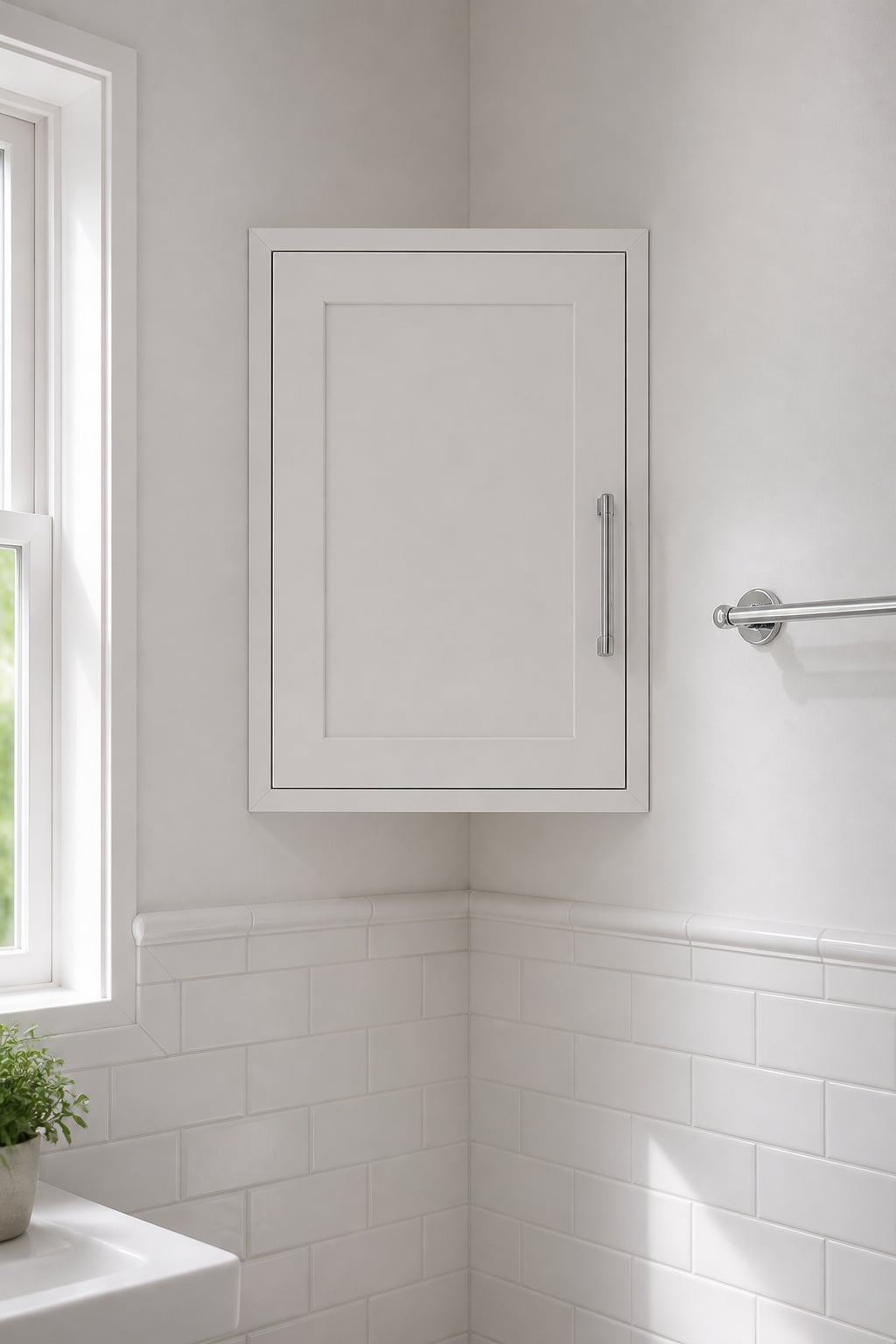
So the corner you’ve been ignoring has four answers, ranked by what you’re willing to do to the wall: a stick-up caddy tonight, a freestanding etagere this afternoon, mounted shelves on a free Saturday, or a recessed cabinet for the weekend you’ve got tools out anyway. Start at the tier that matches your skill, not the one with the most storage. The renter who sticks one drainage caddy in the shower corner has already beaten the cobweb — and that’s the whole point.
FAQ
What is the best corner shelf for a small bathroom?
For renters or anyone avoiding wall damage, a freestanding triangular etagere with an 11-to-13-inch footprint is the most practical start — no install, easy to move, and available in rust-resistant powder-coated steel under $60. Homeowners get the cleanest look from a pair of wall-mounted shelves 8 inches deep, spaced 10 to 12 inches apart.
How do you install a corner shelf in a bathroom without studs?
Use toggle bolts — the right anchor for stud-free drywall. Spring-wing toggles hold 100 to 200 lb per bolt in half-inch drywall, far more than any corner shelf needs. Mark the position, pre-drill to the toggle’s bit size, fold the wings through, and tighten so they clamp the back of the drywall. Use a level throughout.
Are corner shelves good for shower storage?
Yes — purpose-built shower corner shelves with drainage slots, rust-resistant material, and wet-rated mounting use the dead corner well, keeping bottles off the floor. Suction models work on smooth glazed tile only, never over a grout line; adhesive models like Purdaz (15 lb) work similarly. Avoid dry-zone shelves with solid backs or unsealed wood in there.