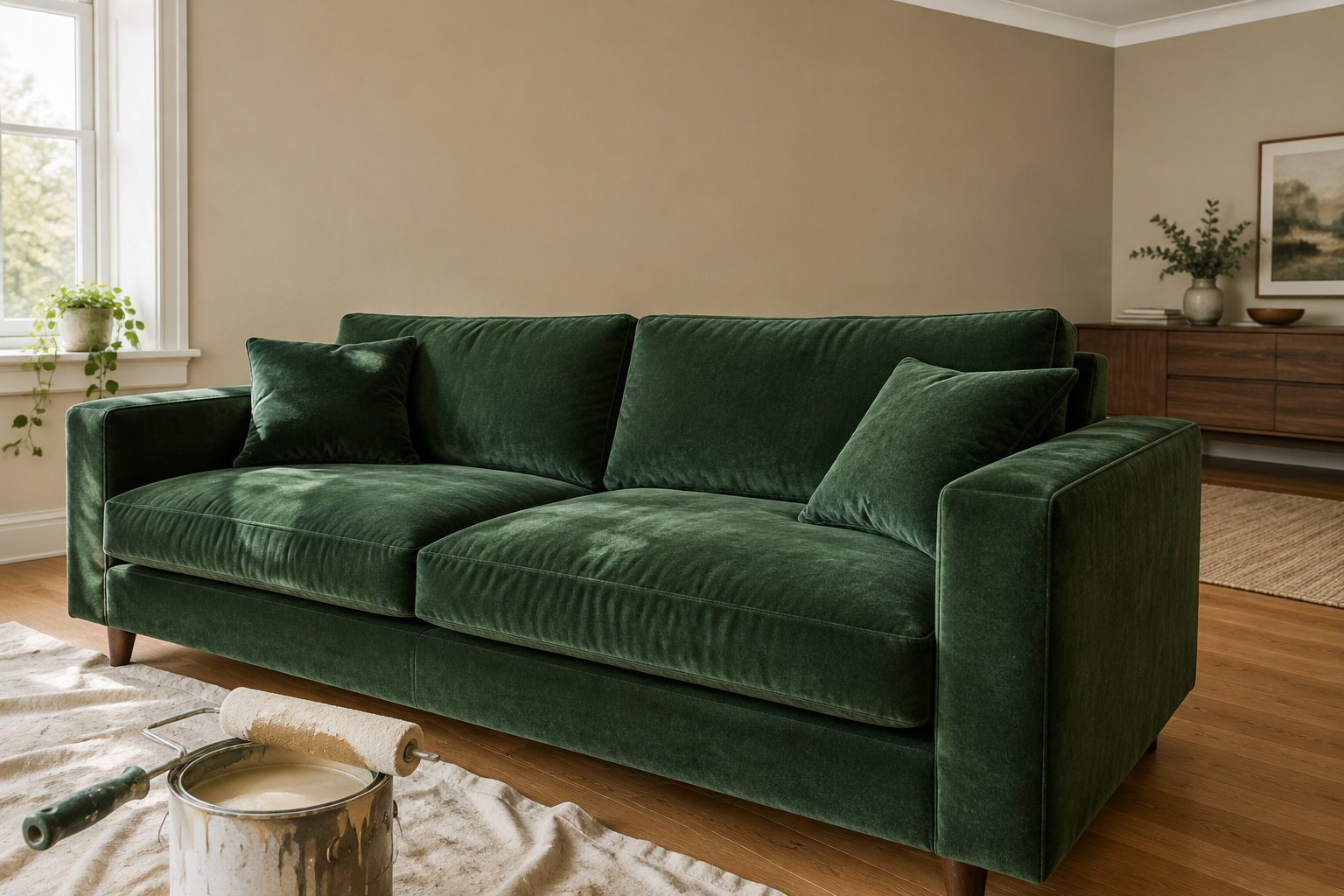

I built my sister a kitchen island from $212 of stock lumber, and her family still calls it “the showroom one.” It taught me something true in every room: the cheapest thing in it is usually the fix. That is my answer to green sofa what color walls. The sofa is bought and not going back, so the wall is the variable, and it costs a weekend.
TL;DR
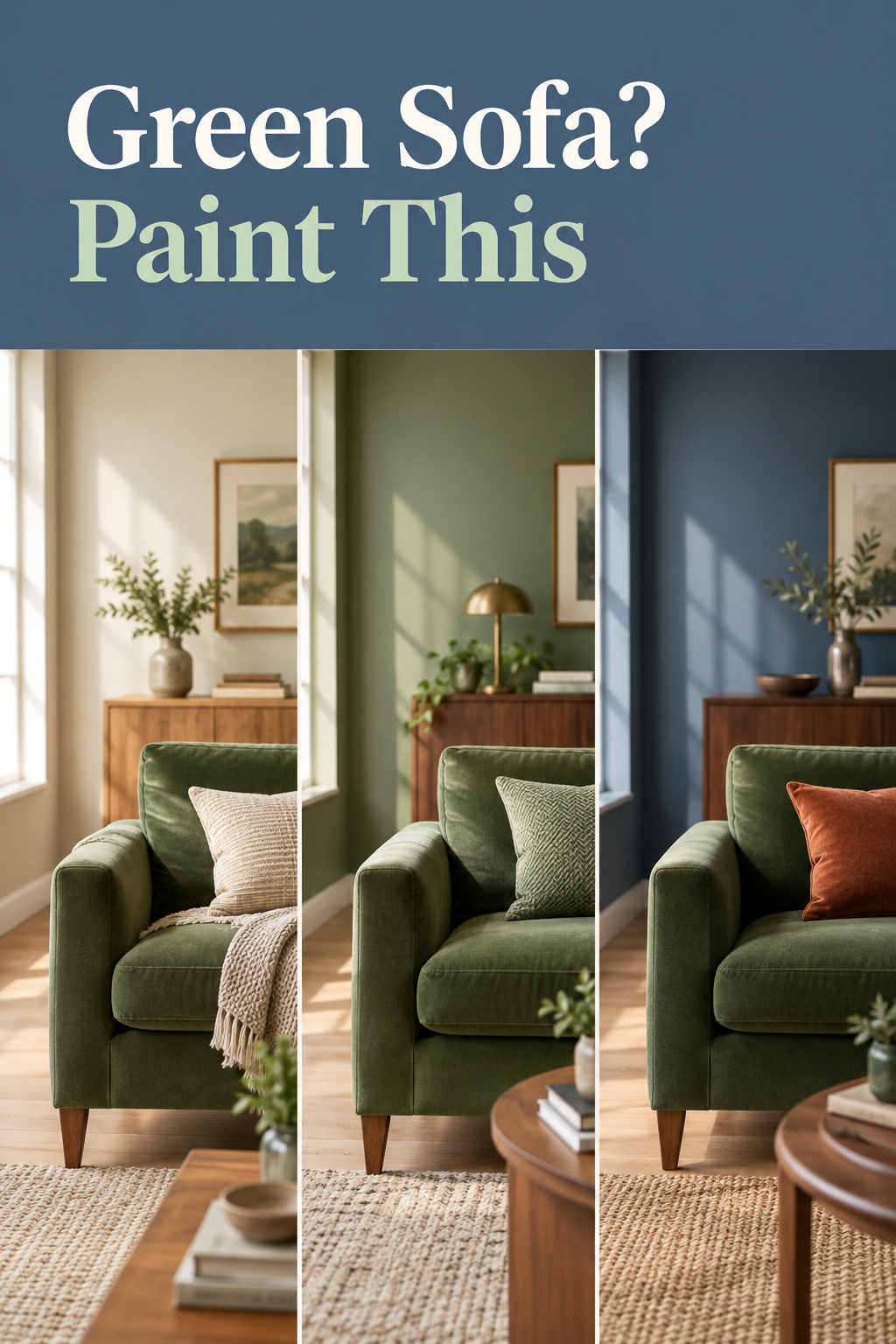
- Pick by the sofa’s shade, not by “green.” Olive wants warm walls: warm white, khaki, putty. Emerald wants contrast: crisp white, soft gray or charcoal.
- A DIY repaint costs $200 to $350 for the wall run, about 144 square feet. Reupholstering the sofa is $600 to $1,800; a new fabric sofa, $500 to $1,200.
- Velvet reads a dye darker than a flat paint chip does: nearly all the light bounces off the cut tips of the pile.
The Sofa Isn’t Going Back — the Wall Is the Cheap Fix
Numbers first, inspiration second.
Why repainting is the weekend-and-two-cans answer
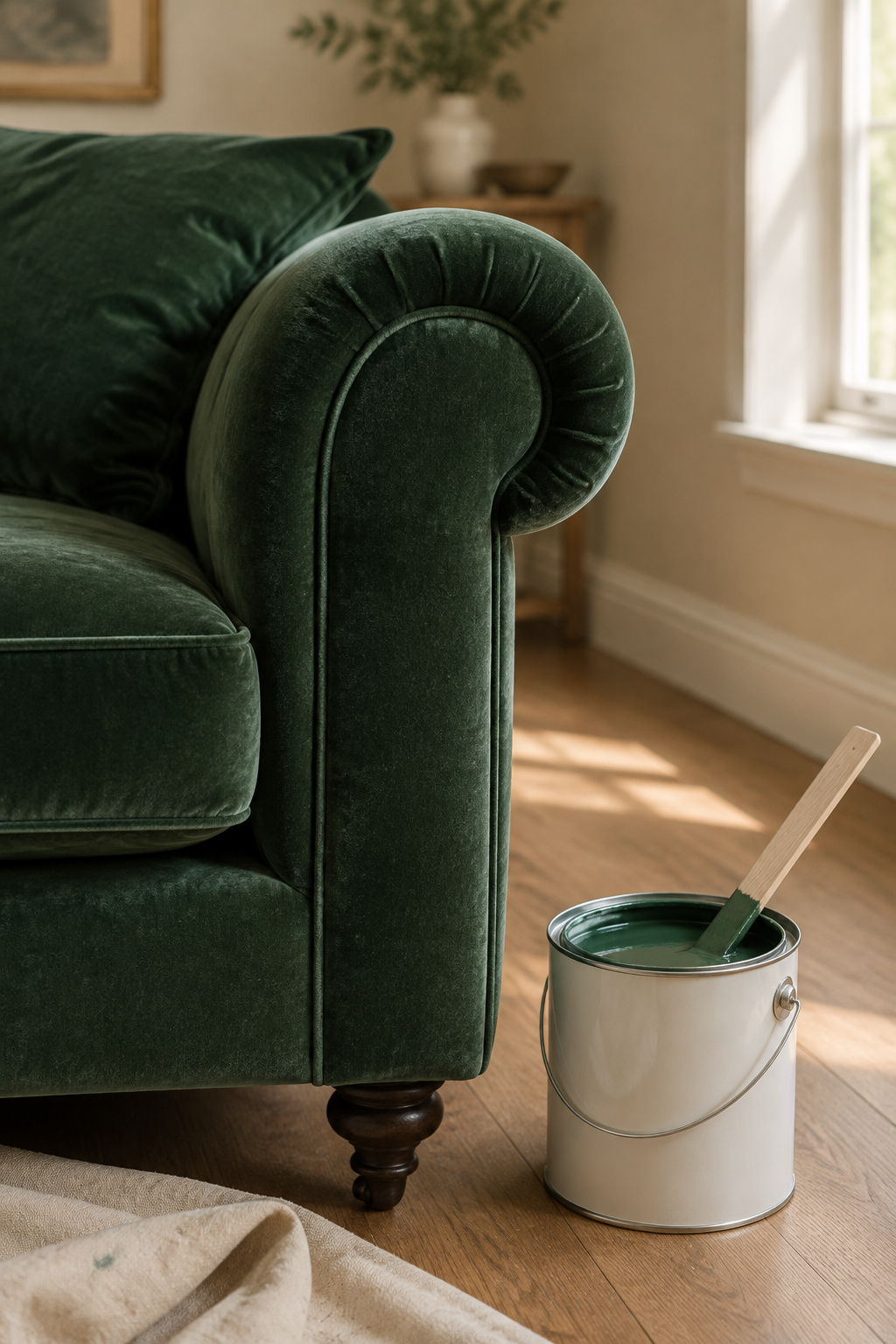
Per the manufacturers’ own data sheets, a gallon of premium interior paint covers 350 to 400 square feet per coat, so one wall takes well under a gallon a coat. Doing it yourself costs $200 to $350 for the wall run, about 144 square feet, against $400 to $800 to hire it out. The accent-wall guide has the fuller gallon math if you end up painting more than one wall.
What it costs: cans, hours, and one trip to the store
Skill level: first build. That $200 to $350 covers the can, tape, sheeting, brush and roller. Budget an afternoon to move furniture, patch and tape, then budget the store run, because there is always one.
The sofa’s shade decides the wall, not the other way around
Green is four decisions, not one, and a wall that flatters an olive sofa actively fights an emerald one.
Green Sofa What Color Walls: Match It to the Shade You Own
So which green is your sofa, exactly?
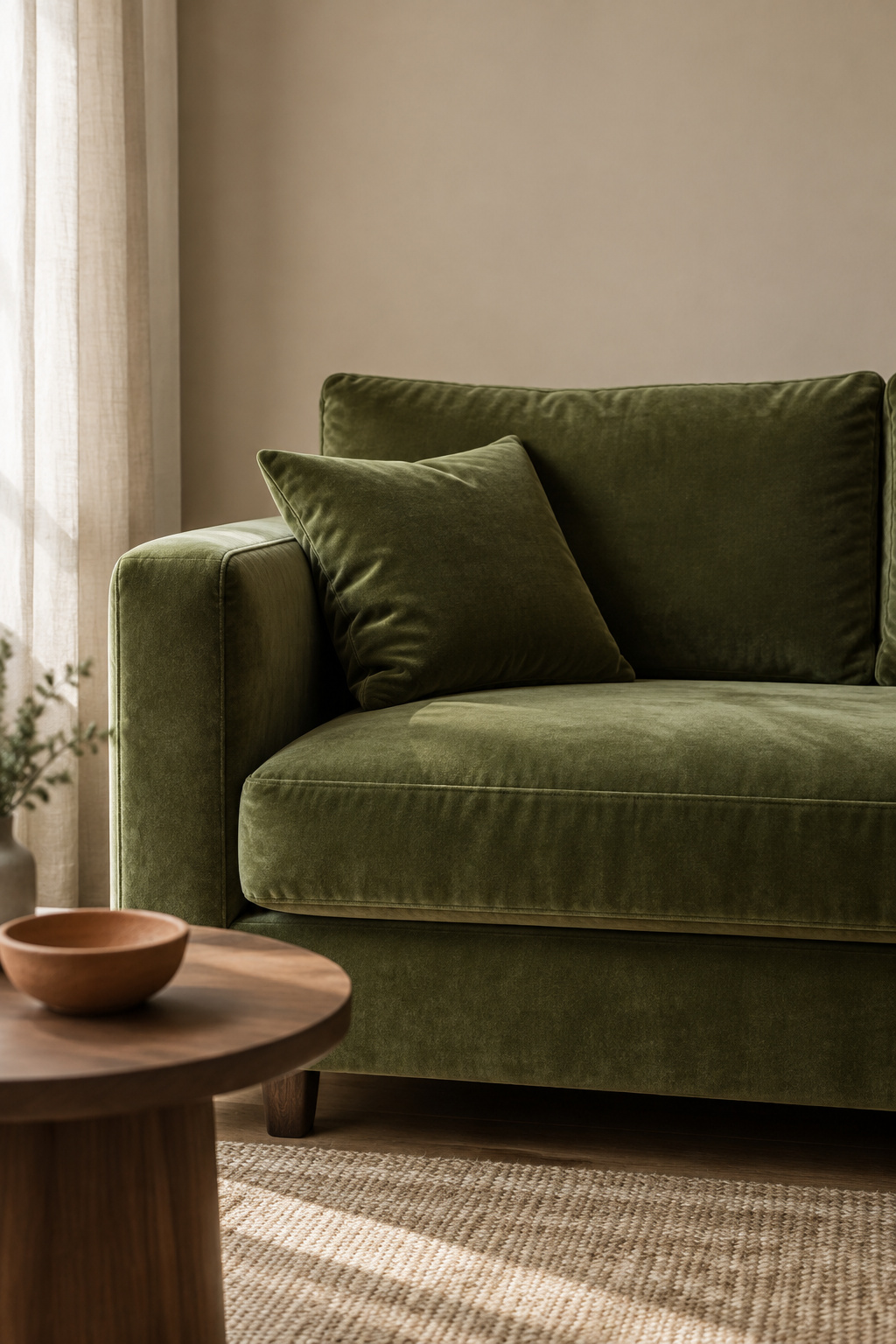
| Sofa shade | Wall that works | Wall to avoid |
|---|---|---|
| Olive | Warm white, khaki, putty | Cool or blue undertones |
| Emerald | Crisp white, soft gray, charcoal | A green at its own intensity |
| Sage | Warm white, pale putty, greige | Cool gray |
| Forest | White, off-white, pale sage | Little, honestly |
Olive sofa: the walls that work, and the ones that fight
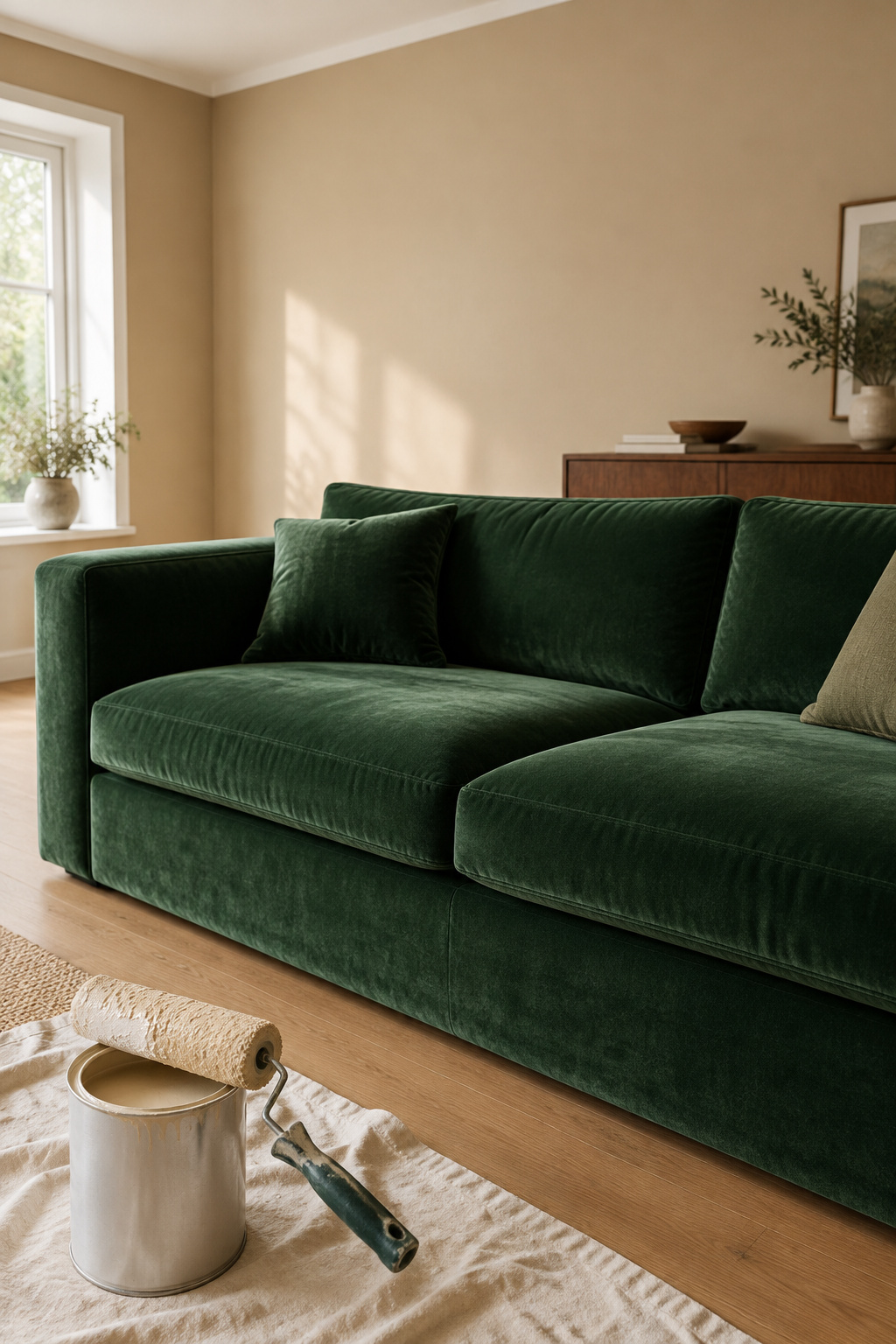
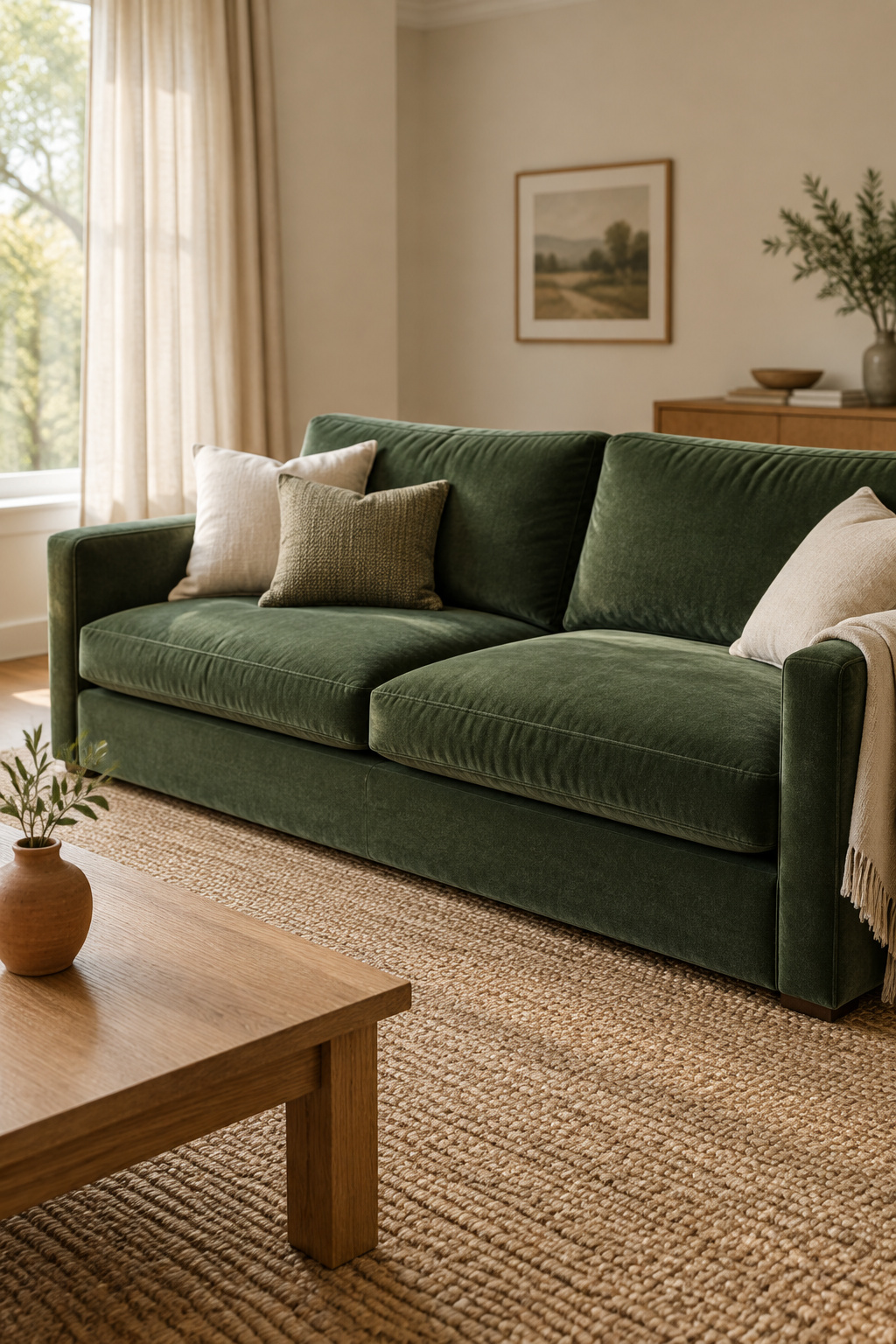
Olive carries yellow and brown underneath, and it moves across the day, more golden by mid-afternoon. It wants that warmth handed back. Use khaki or warm putty for a tonal room, warm white for the safe version.
Emerald sofa: why it wants a different wall than olive
Emerald is the opposite problem. It’s a jewel tone, more saturated and cooler-reading, needing contrast to look deliberate rather than heavy. Here is what I would put behind an emerald sofa: crisp white if the room is dim, soft gray or charcoal if it is not.
Sage or forest sofa: what changes at each end of the range
Sage sits closer to gray than to true green, so warm white or pale putty lets it lead. Skip cool gray, which flattens it. Forest wants white or off-white for contrast instead. Go further, to putting a deep green behind it, and it becomes a bigger decision than one can of paint.
Why the Swatch and the Sofa Are Never Quite the Same Color
Nearly all the light off a velvet sofa bounces off the cut tips of the fibers, not the fabric underneath.
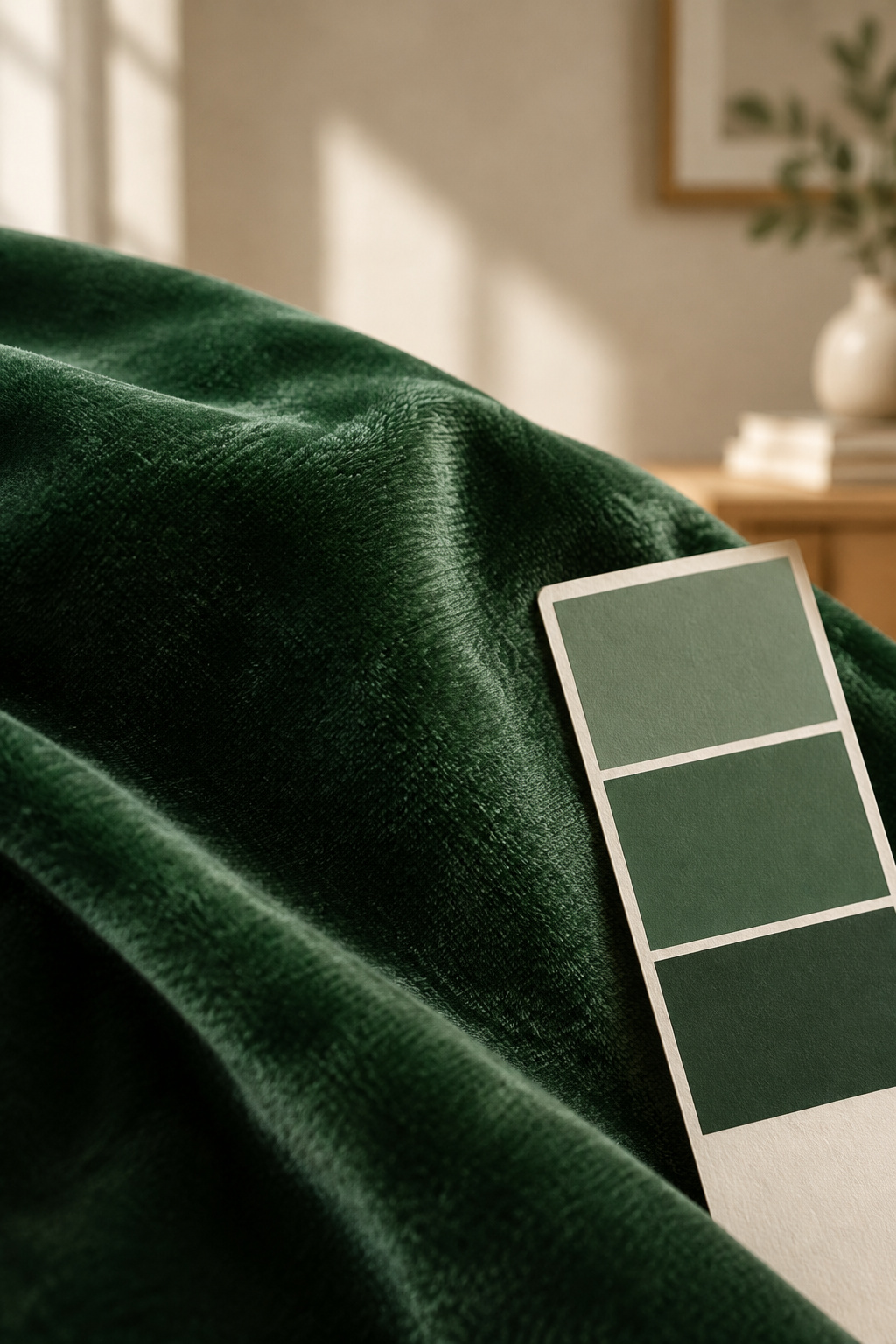
How velvet reads a dye darker than the same color on paper
Velvet is a cut warp-pile fabric: its surface is upright cut fiber ends, not a flat weave. A peer-reviewed Applied Optics study by Rong, Koenderink and Kappers measured that surface’s reflectance shifting with the angle of the incoming light, almost all of it coming off those cut tips. A paint chip reflects evenly, so the same dye looks darker in velvet than the chip predicts.
How linen and leather shift the same shade differently
Linen is a flat weave, so the same green looks lighter, closer to how it will look painted. Aniline leather is colored by dye penetrating the hide, with no pigment in the finish; pigmented-finish leather carries an opaque pigment layer on top. The Royal Society of Chemistry’s tanning-chemistry reference adds two more variables: the hide’s base color showing through, and the light source itself.
What to check before you trust a swatch
Hold the swatch flat against the fabric, not near it, in the daylight the wall will get. Look again in the afternoon, because the pile itself changes with the light.
The Weekend Repaint, Step by Step
Buy fresh tape. That is most of the difference between one weekend and two.
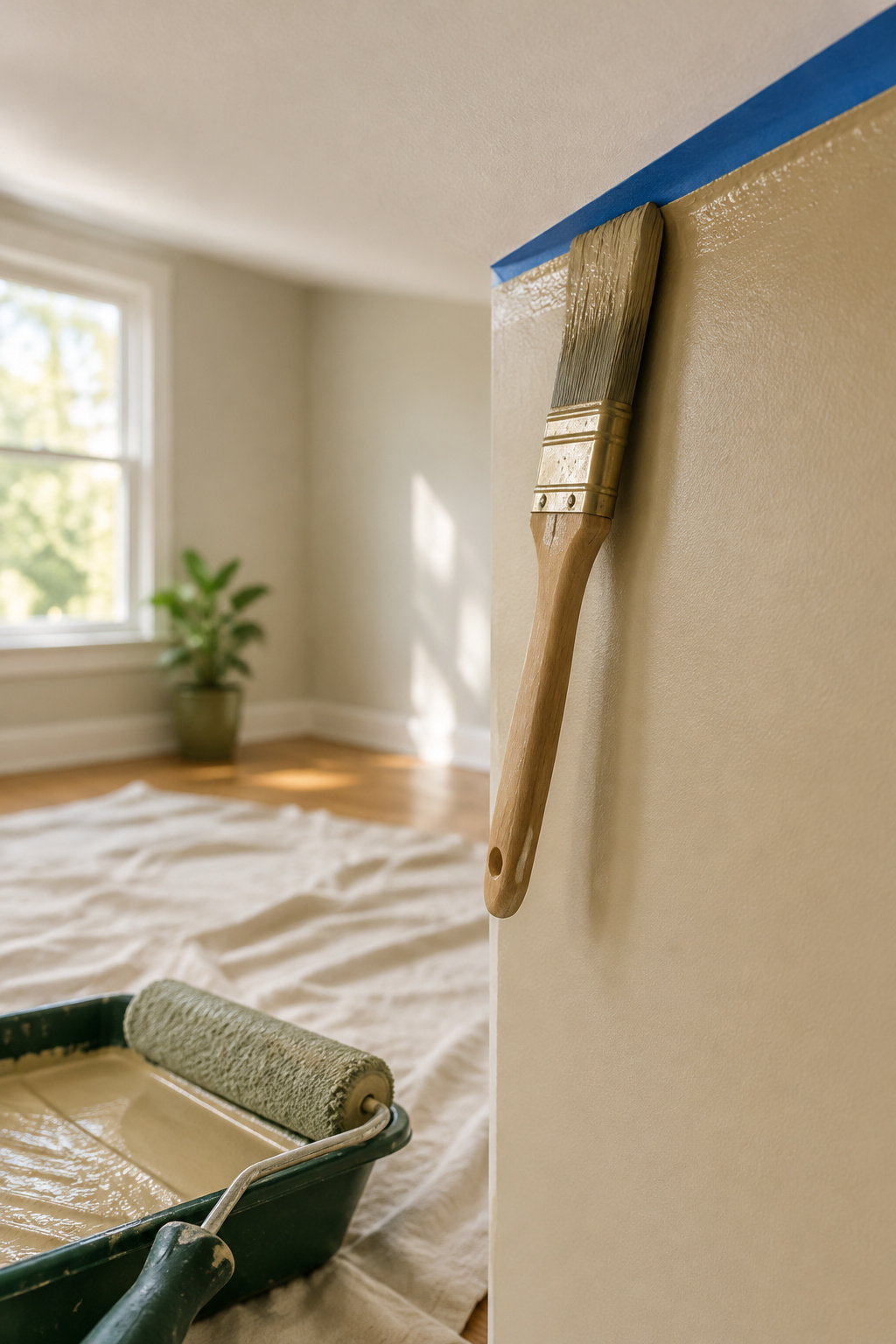
What you actually need: cans, tape, sheeting, brushes and rollers
Everything here fits in one cart:
- Fresh painter’s tape, not last year’s roll
- A canvas drop cloth, or plastic sheeting
- A 2.5-inch angled sash brush for cutting in
- 3/8-inch nap roller covers and a tray
- A spackle knife and 180-grit sandpaper
- The paint
The brush, tray and roller frame all get reused.
The order that avoids an unplanned second coat
Work top to bottom:
- Cut in the edges, corners and trim line by brush.
- Roll the walls while that cut-in edge is still wet.
- Give the first coat its full dry time.
- Roll the second coat, then paint the trim last.
On a color change, two coats on the wall is the standard, not a maybe.
The mistake that costs you the extra trip
The tape. Skimping along the ceiling and trim line, or reusing a roll that has lost its tack, sends more people back to the store than anything else. Underestimating paint on a textured or previously dark wall comes next.
Repaint vs. Reupholster vs. Replace: The Real Math
Three ways out, an order of magnitude apart.
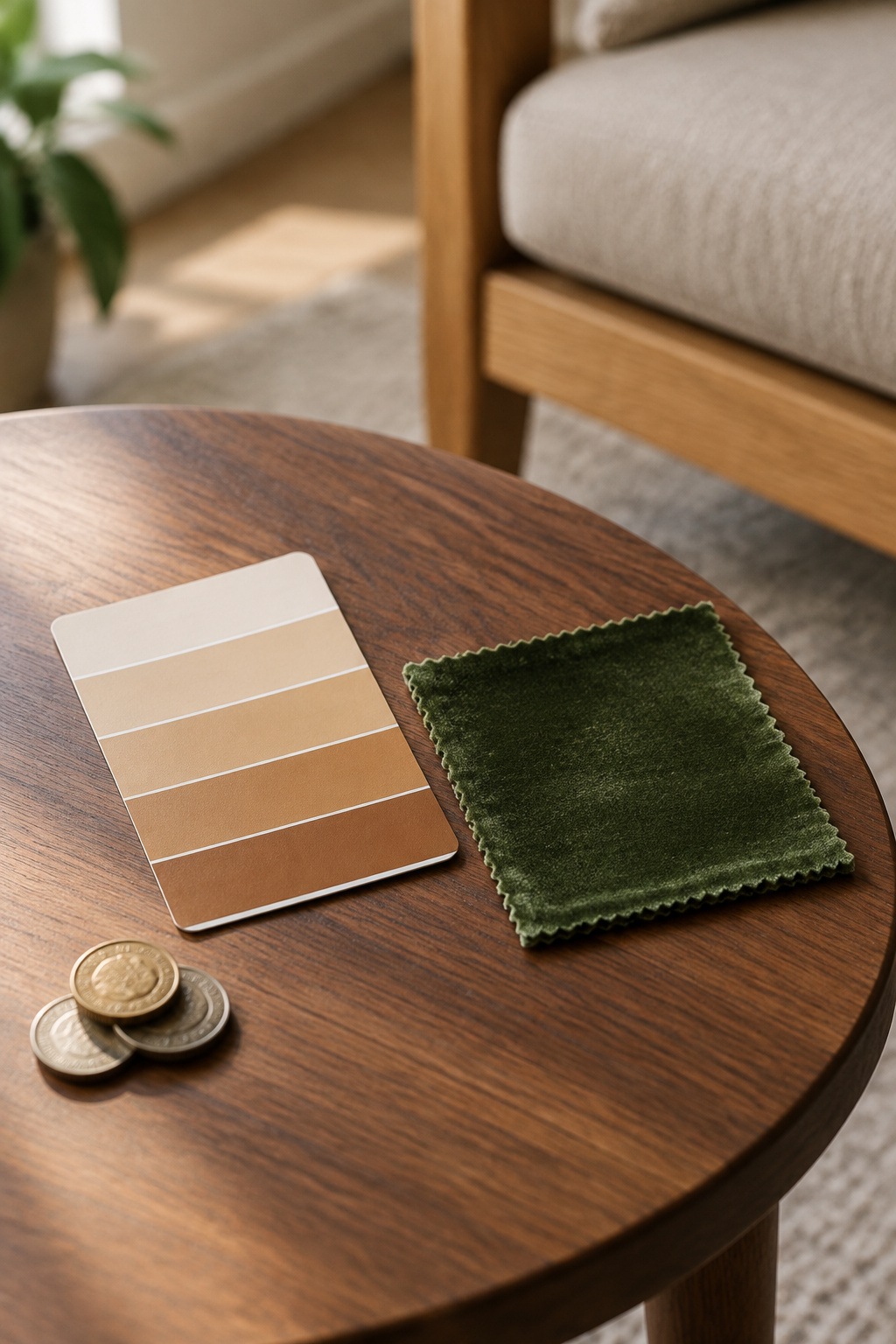
| Option | What it costs | You keep |
|---|---|---|
| Repaint the wall yourself | $200 to $350 for the wall run | The sofa |
| Reupholster | $600 to $1,800; $1,500 to $4,000 for a sectional | The frame |
| New fabric sofa | $500 to $1,200 | Nothing |
What a repaint actually costs in cans and hours
The DIY figure assumes you keep the tools. The time is the honest half: an afternoon of prep and cutting in, dry time overnight, the second coat next morning.
What reupholstering the sofa costs by comparison
Reupholstering a couch averages $600 to $1,800 in the US. As Angi points out, the price is set per piece of furniture rather than per square foot.
Why replacing the sofa is almost never the cheap option
A 2026 US market analysis puts fabric sofas at $500 to $1,200 average transaction price, and genuine leather at $1,200 to $2,500. Nobody should sell a green sofa over a wall color.
Once the Wall’s Settled, the Rest of the Room
The wall goes on over the weekend. By Monday the rug looks wrong.
Rugs, curtains and accent pieces next
Same logic, one step out. An emerald sofa wants a rug with real depth, because pale tones look thin beside a jewel tone. An olive sofa wants natural fiber, such as jute, sisal or seagrass, and nothing with a cool cast. A sage sofa wants a quiet rug, neutral or pastel.
Where the full pairing logic lives
You now have a wall color chosen from your sofa’s own shade, a repaint plan, and the numbers proving the wall is the cheap variable: a four-figure answer to a $250 problem, solved for the price of a weekend. Then work outward: the rest of the palette is a separate job, and how the green decisions stack up puts all of it in order.
FAQ
What color rug goes with a green velvet sofa?
It depends on the sofa’s specific green. Emerald wants depth, in richer tones that enhance its opulence rather than compete with it. Olive pairs best with natural fibers and warm, earthy tones, sage with something subtle in neutral or pastel.
Do green sofas clash with gray walls?
Usually not. One pairing does fail: cool gray walls with a sage sofa, because the two flatten each other. A warmer gray or greige works better. Against a saturated shade like emerald or forest, gray is commonly recommended precisely because the contrast looks intentional.
Can you have a green sofa and a green wall in the same room?
Yes, as long as the two greens sit at different depths. Pale sage walls behind a forest-green sofa work because the gap in depth carries the interest on its own. Two saturated greens at the same intensity are what fail.