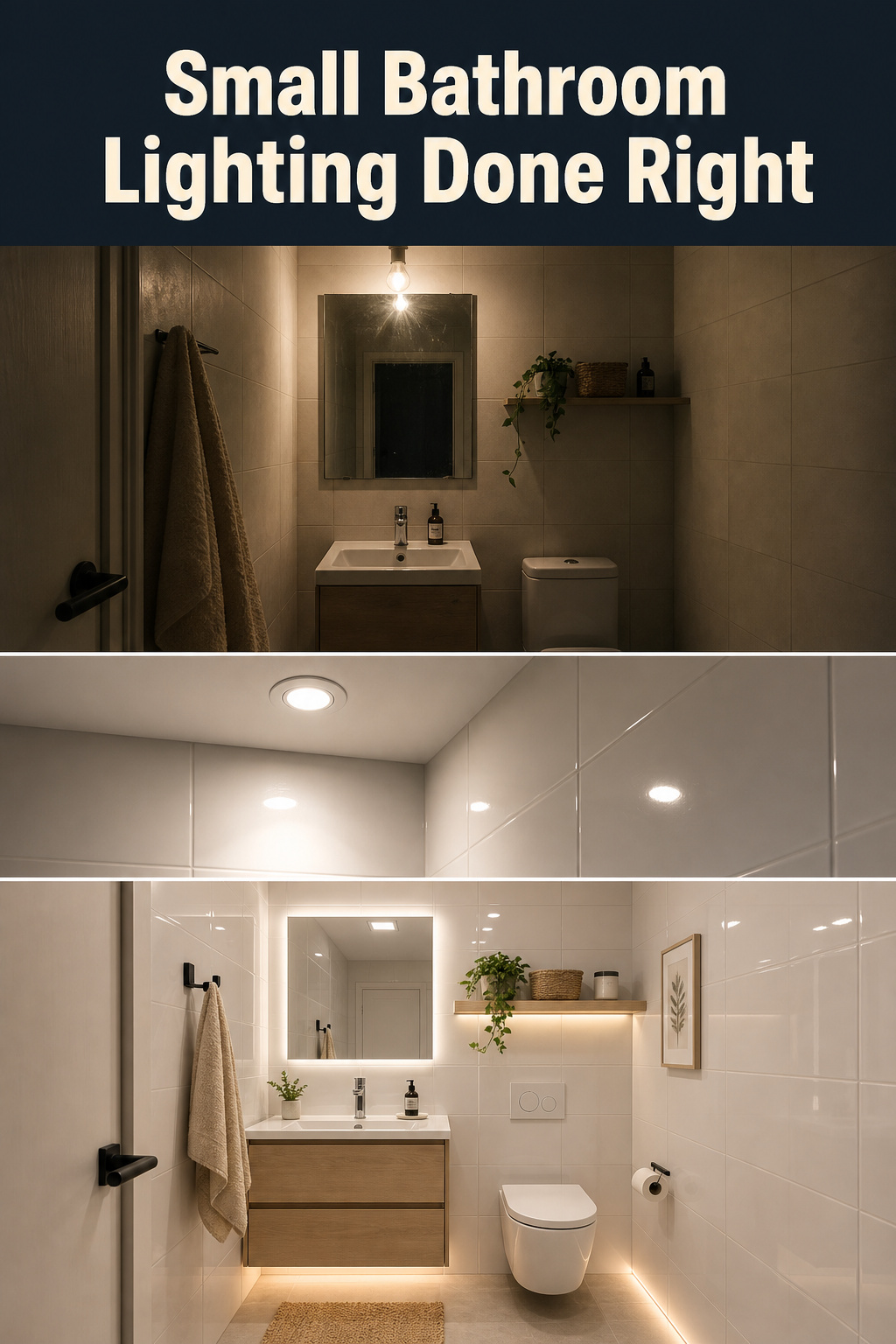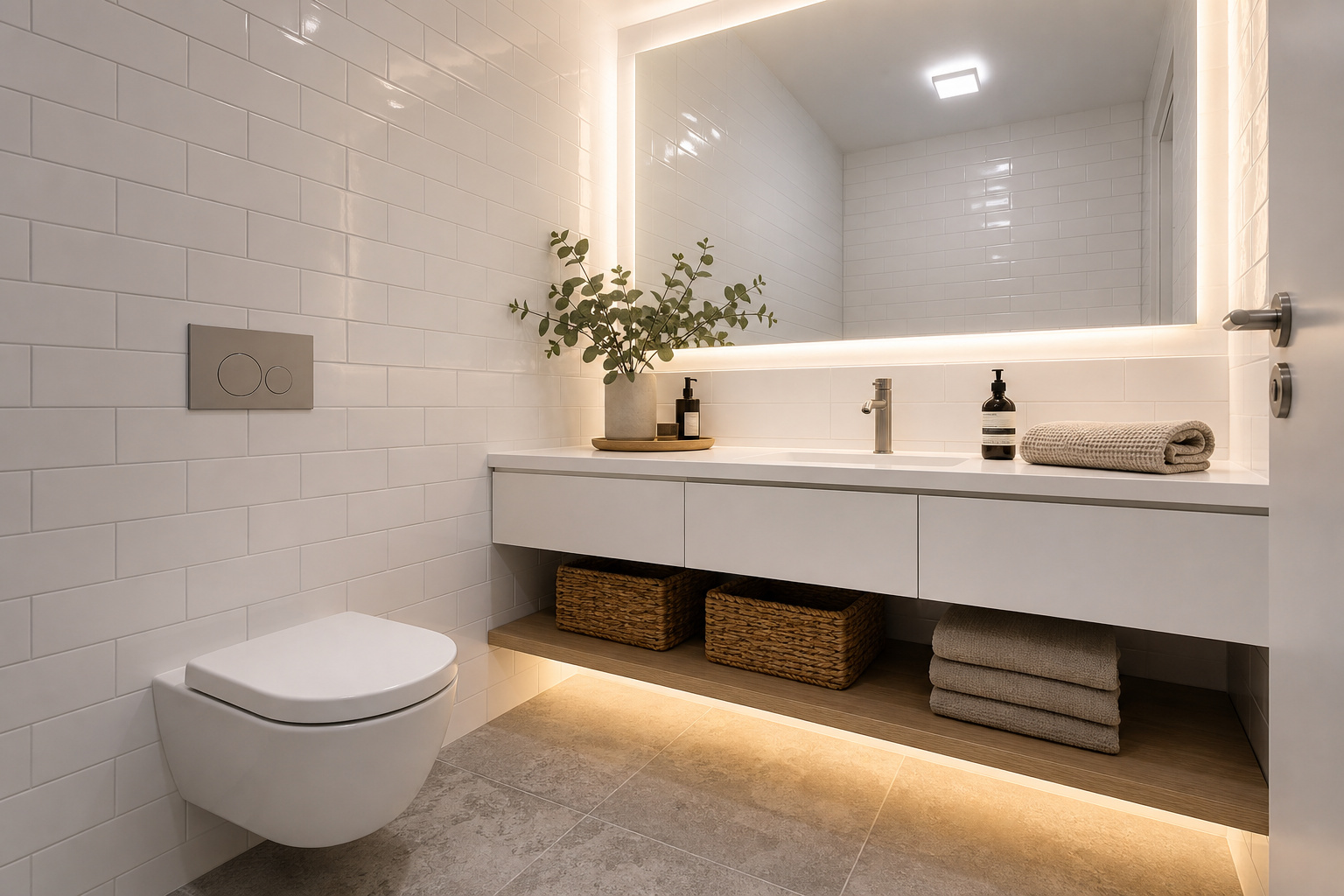

A client once apologised to me for her bathroom before I had stepped into it. Eighteen square feet, no window, one tired bulb above the mirror — she described it the way people describe a fault. I measured the room and told her it was exactly enough. That is the whole shift in small bathroom lighting: the constraint is not a problem to overcome. It is the brief.
TL;DR
- A small bathroom under 40 square feet wants 2,000–3,000 total lumens spread across two or three separate circuits — not one bright overhead source, which produces glare rather than brightness.
- The three highest-return changes cost little: gloss tile or semi-gloss paint to bounce light, one large mirror near ceiling height, and a dedicated vanity task light on its own switch.
- For a windowless room, 4000–5000K daylight-spectrum LEDs give a morning anchor; a diffuser and a dimmer keep them from reading clinical.
The Small Bathroom Is Not a Problem to Solve — It’s a Brief to Honour
Before you ask what light to add, ask what you want the room to be. A small bathroom done by default is a single bulb fighting four close walls. Done deliberately, it is something else entirely.
Why constraint forces the decisions that make a room work
In a large bathroom, the floor area forgives you — space for light to spread, for a poor fixture to go unnoticed. Eighteen square feet grants no such mercy. Every fixture has to earn its place. A room of 40 square feet or less needs 2,000–3,000 lumens; deliver that from one source and you get glare, not brightness.
The single-overhead-source failure: what it does to a small room specifically
One ceiling fixture above the mirror is the most common bathroom lighting mistake designers name, and a small room punishes it hardest. It throws shadows onto the brow, cheeks and chin — with no neighbouring fixture, nothing fills them in. The level that suits a 7am routine, as one guide puts it, will ruin a 10pm bath. A single switch gives you no way to choose.
Reframing: the question is not ‘how do I add more light’ but ‘where does light belong’
The professional move is placement first, brightness second. Sally Storey of John Cullen Lighting: use directional downlights to bounce light off the mirror onto the face, and skim light down the tiles to make simple surfaces look expensive. Ceiling lights at the perimeter pull the eye outward; a large mirror extends the apparent depth; low-level light keeps the floor from reading as a dark base. The room is lit by where the light lands — the small-room version of the thinking behind all good bathroom lighting ideas.
Light Has to Travel Farther in a Small Room — Help It
Surfaces are a lighting decision before a single fixture is chosen. In a tight room, walls either multiply what you put in or quietly absorb it.
Reflective surfaces: how gloss tile, white paint and polished hardware multiply what you put in
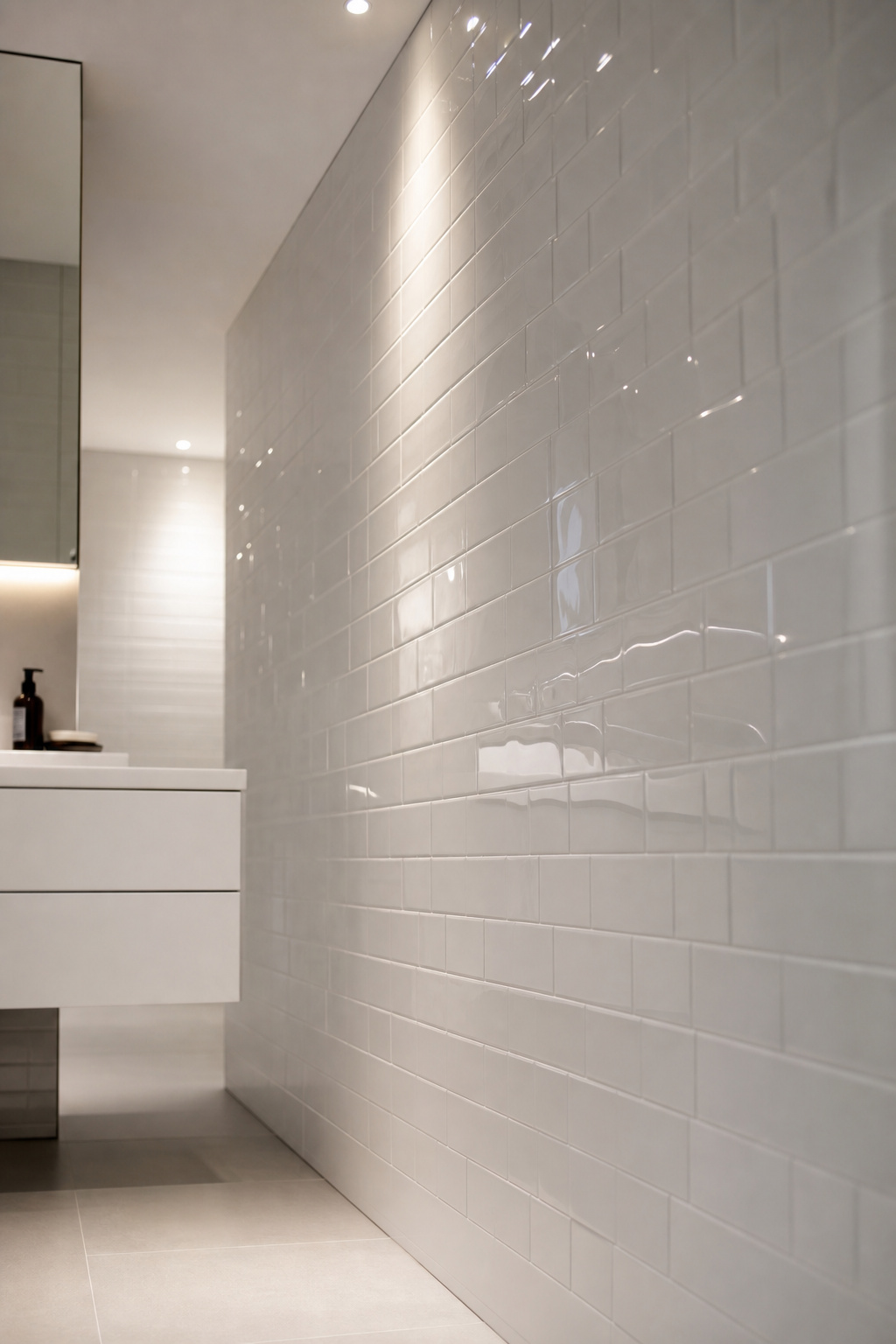
Glossy tile reflects both daylight and artificial light — recommended for small or windowless bathrooms where amplification is the whole point. Matte tile returns little, and a small dark room reads darker for it. The sensible mix is matte on the floor for grip, gloss or semi-gloss on the walls for bounce and height. Polished chrome or brushed nickel hardware throws light back into the room — keep matte black an accent when ambient light is scarce.
Wall colour and finish as a lighting decision, not a decor decision
Light Reflectance Value measures how much light a colour returns. For a small dark bathroom, whites and near-whites above LRV 70 are the baseline — Benjamin Moore White Dove, at LRV 83, returns 83 percent of the light that hits it. Pair a high-LRV colour with satin or semi-gloss sheen and the surface returns light directionally. Flat paint always reads a shade deeper in the same room.
What kills reflectance: dark grout, matte everything, furniture that blocks the bounce
The most common own-goal is dark grout on light tile — it turns a continuous bouncing wall into a grid of absorbing lines. Match the grout to the tile, or settle for mid-tone grey if pure white feels impractical. The other culprit is bulk: a pedestal sink or full-floor vanity creates dead zones the bounce never reaches. Wall-hung furniture removes the obstruction and lets light reach the floor.
One Large Mirror: The Cheapest Lumen-Multiplier in the Room
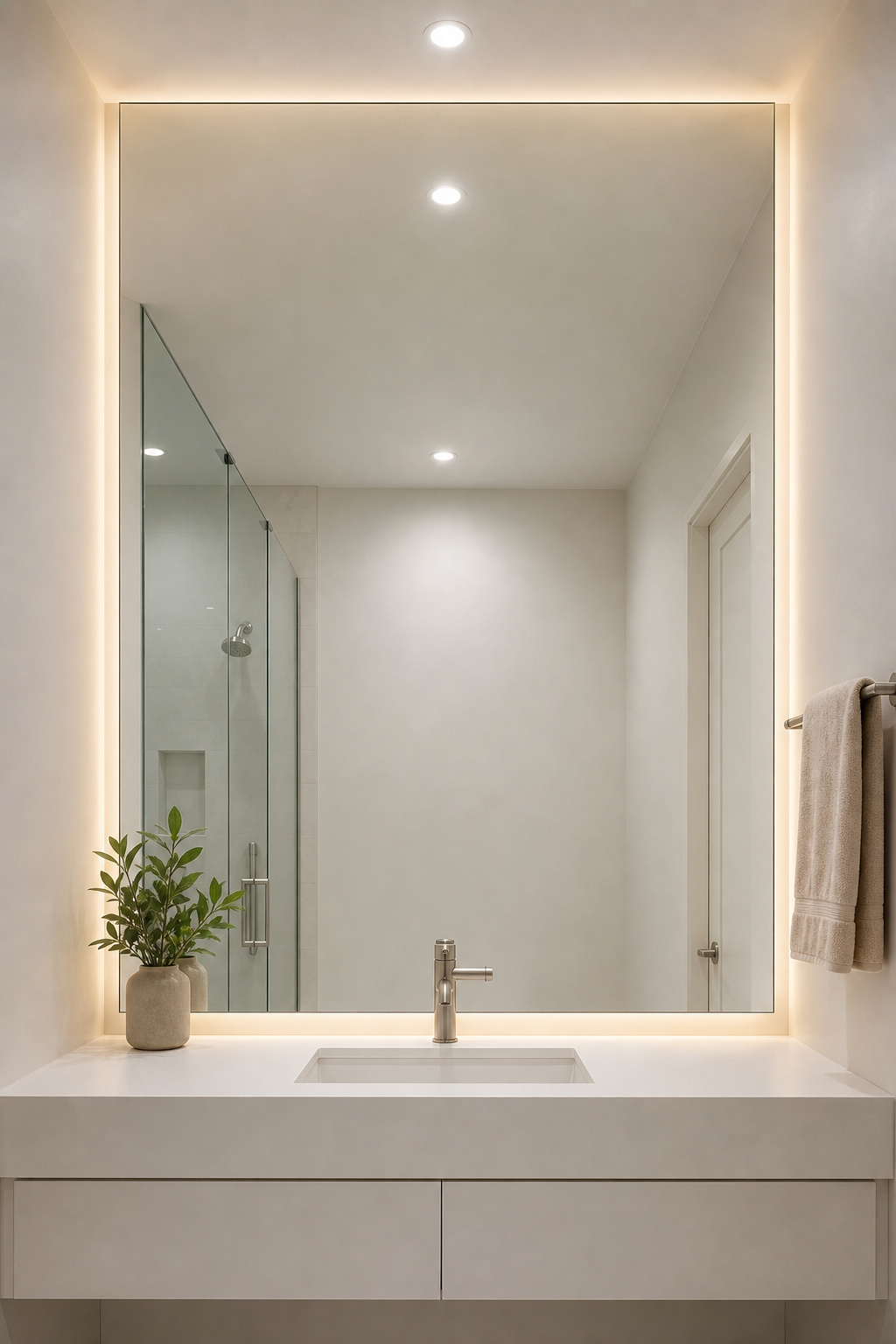
A mirror in a small bathroom is not an accessory. It is a passive light-distribution system.
How a full-wall or oversized mirror re-extends the apparent light source
A large mirror acts as a secondary light source — one trade estimate puts it at redistributing up to 85 percent of the room’s visible light, a figure to treat as direction rather than a lab measurement. One unbroken reflective plane captures light from the ceiling, the vanity and the perimeter at once and returns it evenly. Two small mirrors fragment that into competing reflections with dead space between.
Placement: opposite the brightest point, not opposite the door
The instinct is to hang the mirror opposite the door for symmetry. Resist it. For light gain, the mirror belongs opposite or angled toward the brightest source — the ceiling fixture or the vanity light. Height matters too: a mirror reaching near the ceiling captures more ambient light and draws the eye upward.
Framed vs frameless vs backlit: which gains the most in a tight space
Three things to check before you order:
- Frameless wins on space. A frameless mirror reads as more room; a thick frame can cast a shadow that, where the mirror is your main reflective tool, is a measurable loss.
- Reach for ceiling height. Standard small-bath mirrors run 28–36 inches tall, but a taller one captures more light and makes the room feel bigger.
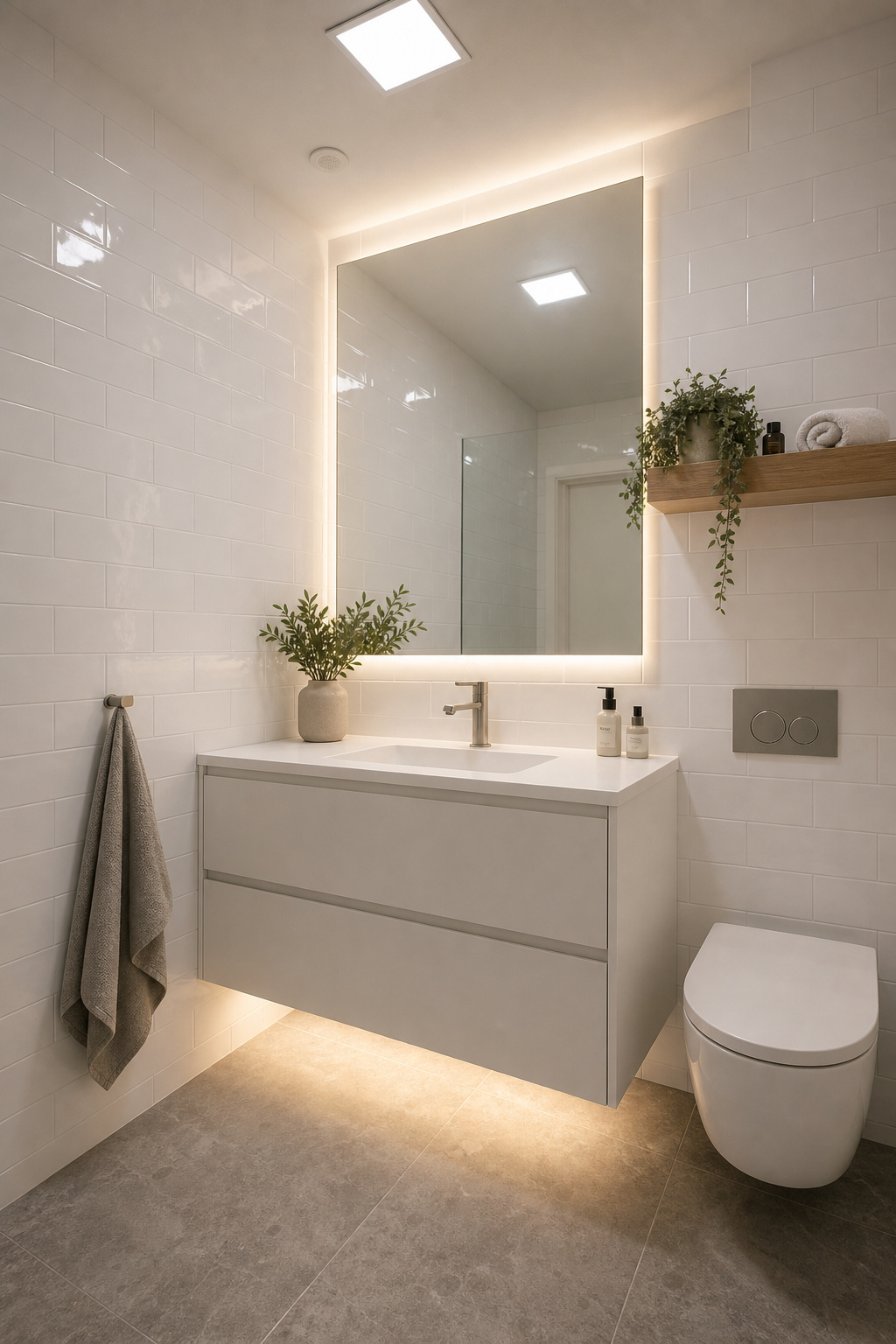
- Backlit doubles as task light. A backlit LED mirror builds the light into the glass and can do away with bulky side sconces — the decisive advantage when wall space is absent.
Layering in a Tight Footprint: Compact Fixtures That Still Separate the Jobs
A small bathroom can be lit in layers, each using the smallest fixture that does its job.
What a small bathroom can realistically fit: the two-layer minimum
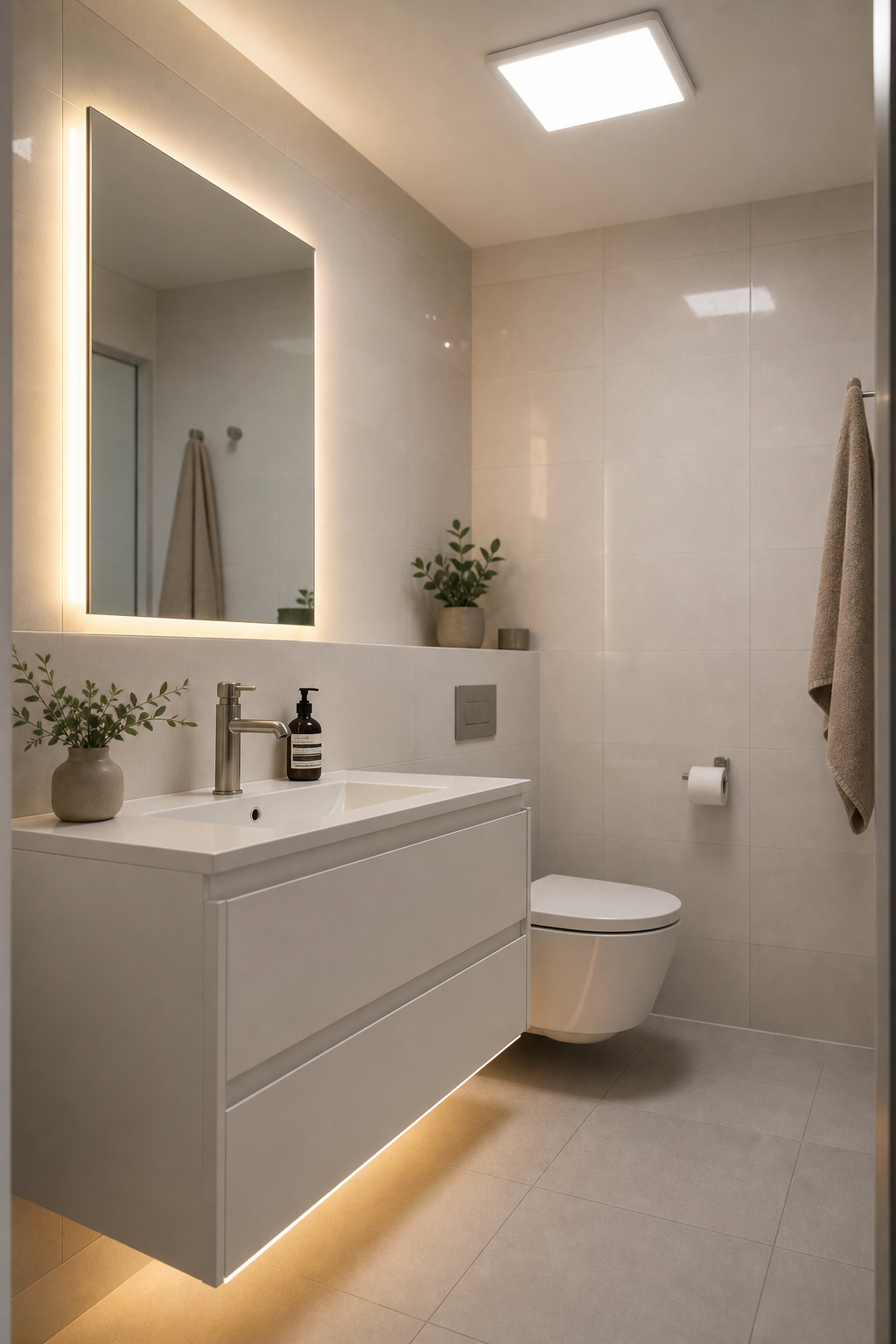
The minimum is two layers — ambient from the ceiling and task at the mirror — each on its own circuit. Without task separated from ambient, the mirror zone is compromised by overhead shadow. Aim for 2,000–3,000 total lumens, roughly 50–75 lumens per square foot, with 1,500–2,500 dedicated to the vanity. This is the compact translation of the layered approach, not a repeat of it; the full scheme-level thinking lives there.
Compact recessed or flush ambient that doesn’t eat ceiling height
A flush-mount fixture sits in the plane of the ceiling and spreads light through a diffuser, keeping a small room open. A pendant or surface cylinder lowers a ceiling you cannot spare. Keep the output moderate and diffused; a high, undiffused source at close range in a tight room is just glare.
Vanity-integrated task light when wall space for sconces isn’t there
Where there is no wall beside the mirror for sconces, a lighted mirror folds the reflective surface and the task light into one fixture. An LED strip under the vanity adds a low layer that prevents the floor reading dark. For the hardware, compact fixtures that fit is the place to choose.
The Windowless Bathroom: Faking Daylight Without a Window
A windowless bathroom has one input each morning: whatever light you give it. That raises the stakes on what kind of light it is.
The faux-window glow trick: a backlit frosted panel at daylight Kelvin
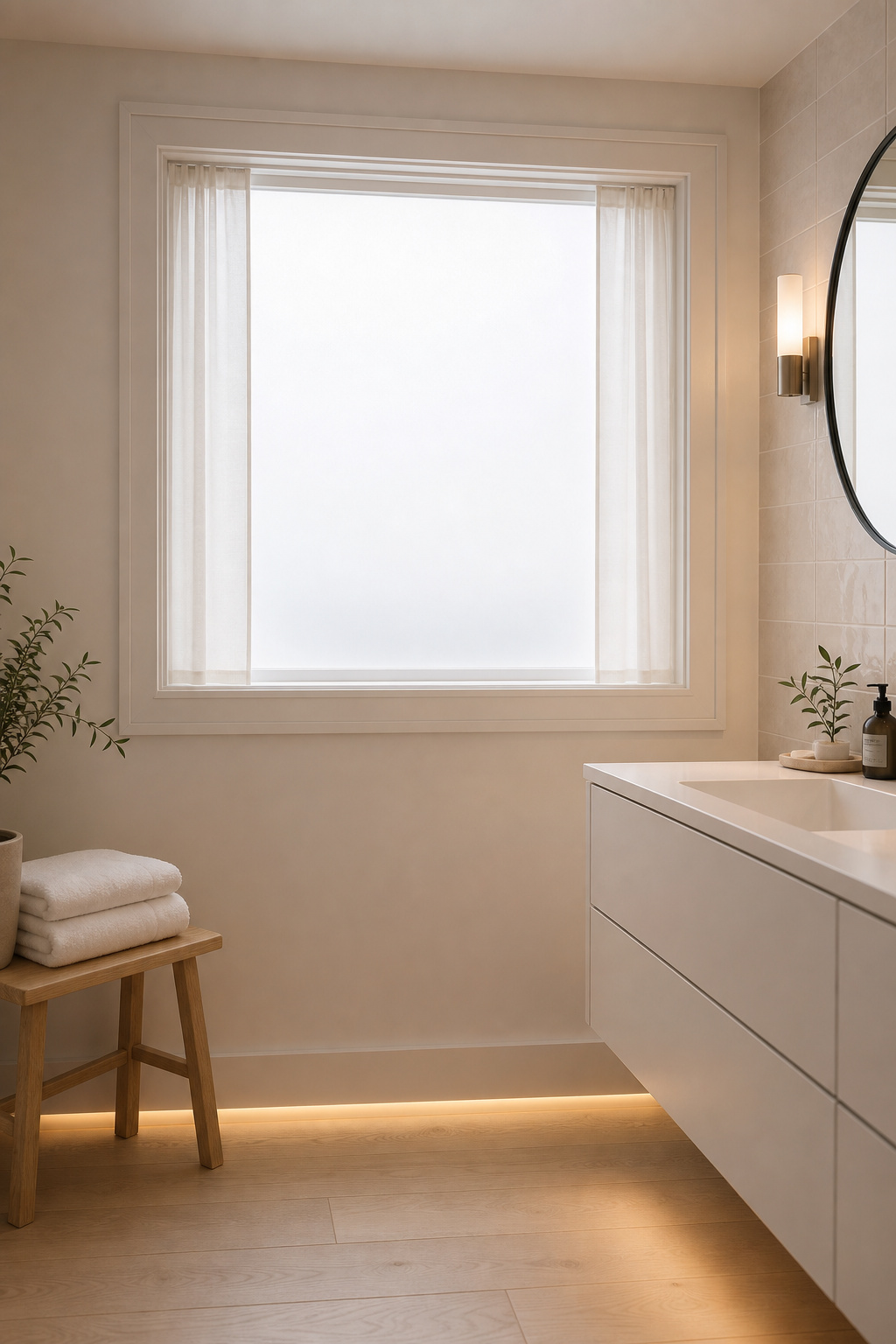
Here is an honest experiment rather than an established method. Homeowners have built convincing faux windows from flat LED panel lights — around $100 at Home Depot — framed with trim moulding and a curtain to suggest a window behind frosted glass. Apartment Therapy documented one such build that, a year on, still has guests convinced the panels are real windows; a How-To Geek version runs LED strips inside a shadow box behind an acrylic diffuser. A clever, low-cost trick worth trying — not in any design standard, and I would not present it as one.
Full-spectrum LEDs at 4000–5000K as a circadian anchor in a room with no natural light
For the ambient and task light, 4000–5000K is the choice I commit to in a windowless room. This range mimics daylight and gives the body the morning signal a room with no window otherwise withholds. General circadian research links cooler morning light to alertness and steadier sleep — that work is not bathroom-specific, so I hold the claim modestly. Keep warmer 2700K for an evening accent.
How to avoid the ‘operating theatre’ effect when using daylight-spectrum sources
The clinical look comes from one undiffused cool source overhead with nothing else. The fix is diffusion and more than one source. Put a frosted lens on the daylight panel, light the face from the sides with a lighted mirror rather than straight above, and — the real safeguard — keep everything dimmable. At 60–70 percent output a 4000K source reads bright and pleasant; the harshness only appears at full power.
Small Bathroom Lighting Done Well: What It Actually Feels Like
Stand in the doorway of the finished room. That is the test.
The test: standing in the doorway — where does the eye land, and does the room feel complete?
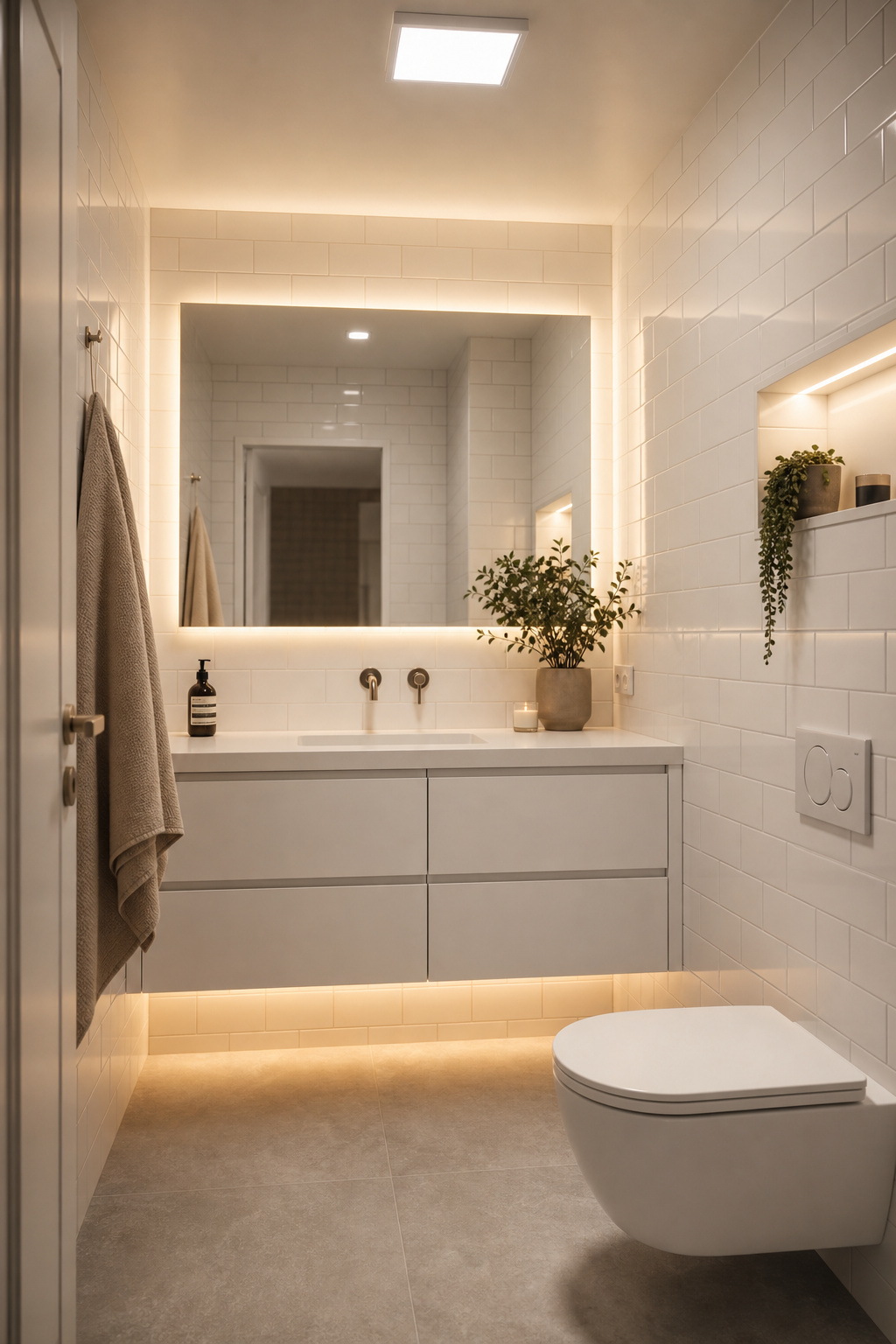
In a well-lit small bathroom, the eye travels to the perimeter and into the room rather than stopping at a flat pool of overhead light. The floor does not read as a dark base. The lights sit on different controls, so the room can be invigorating in the morning and a soft glow at night. A room that can only do one is not finished.
The brightness myth revisited: what felt generous vs what measured high
Perceived brightness tracks distribution and reflectance far more than raw output. A 2,000-lumen scheme hitting gloss walls and a large mirror across three circuits feels more generous than 4,000 lumens from one overhead source. My client’s eighteen square feet never measured high — it felt generous because every lumen was put somewhere it could work.
Three decisions that change the most with the least spend
If you change three things, change these:
- Surface. Gloss tile or semi-gloss paint, so every existing source reflects further — no electrical work at all.
- Mirror. One large frameless or backlit mirror near ceiling height, the single biggest brightness gain for one purchase.
- Task light independence. A dedicated vanity light on its own switch, which removes mirror shadow and lets the room serve both moods.
A small bathroom answered deliberately is not a compromise. It is a brief, honoured — and a room that feels finished.
FAQ
How do you make a small bathroom look brighter without adding windows?
Start with surfaces: swap matte paint or tile for semi-gloss paint above LRV 70 or gloss tile, which makes every existing light reflect further with no rewiring. Then add one large frameless or backlit mirror near ceiling height to redistribute light, and a dedicated vanity task light on its own switch.
What type of lighting is best for a windowless bathroom?
Layered lighting on separate dimmers: a flush or slim recessed ceiling panel for ambient fill, a backlit or lighted mirror for task light, and a warm LED strip at toe-kick level. Use 4000–5000K daylight-spectrum LEDs for the ceiling as a circadian anchor, keeping warmer 2700K for accents to avoid a clinical feel.
How many lights does a small bathroom need?
A bathroom under 40 square feet needs a minimum of two independently controlled sources — one ceiling ambient and one vanity task — and ideally three with a low-level accent. The separation matters more than the count. Aim for 2,000–3,000 total lumens across all sources, around 50–75 lumens per square foot.