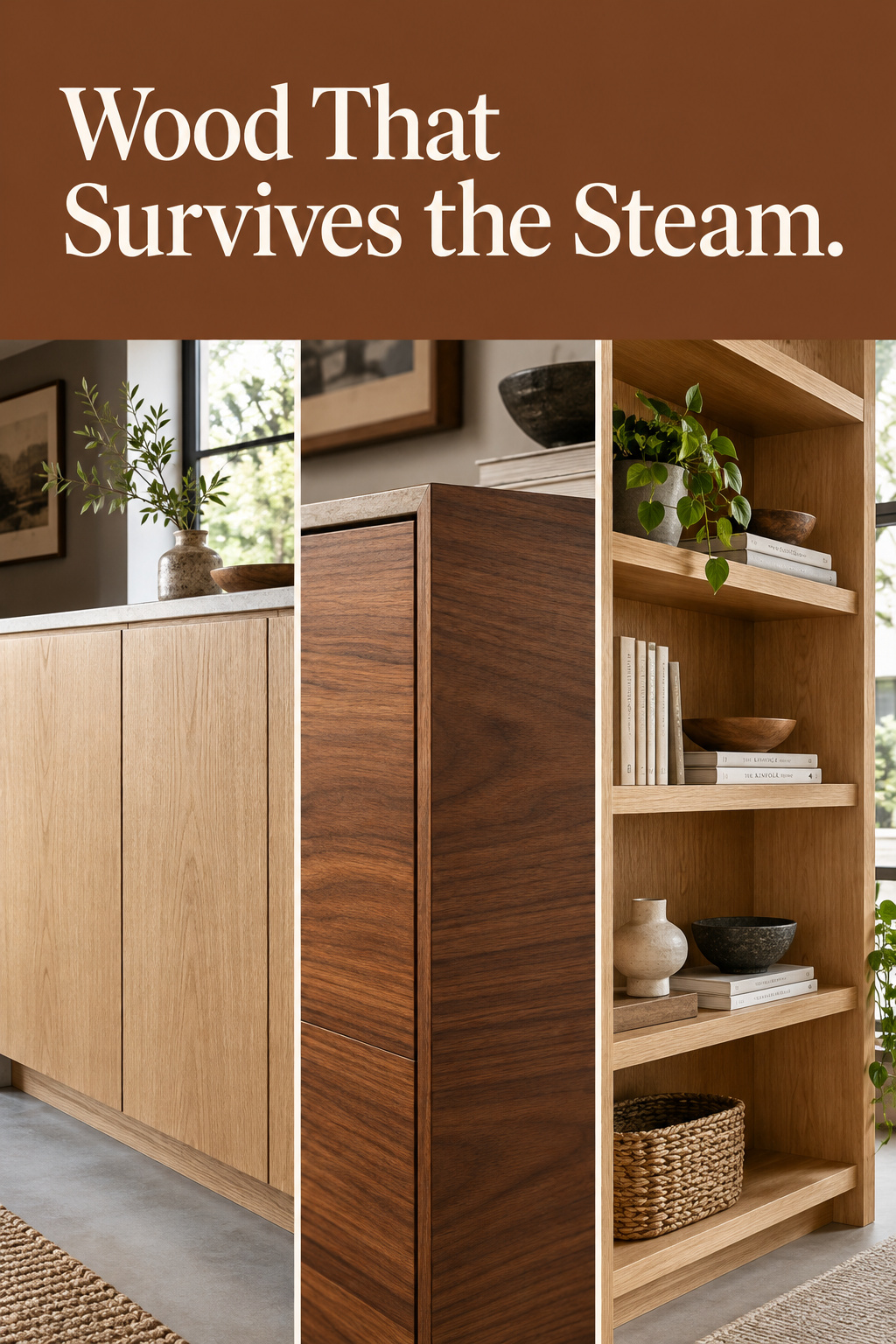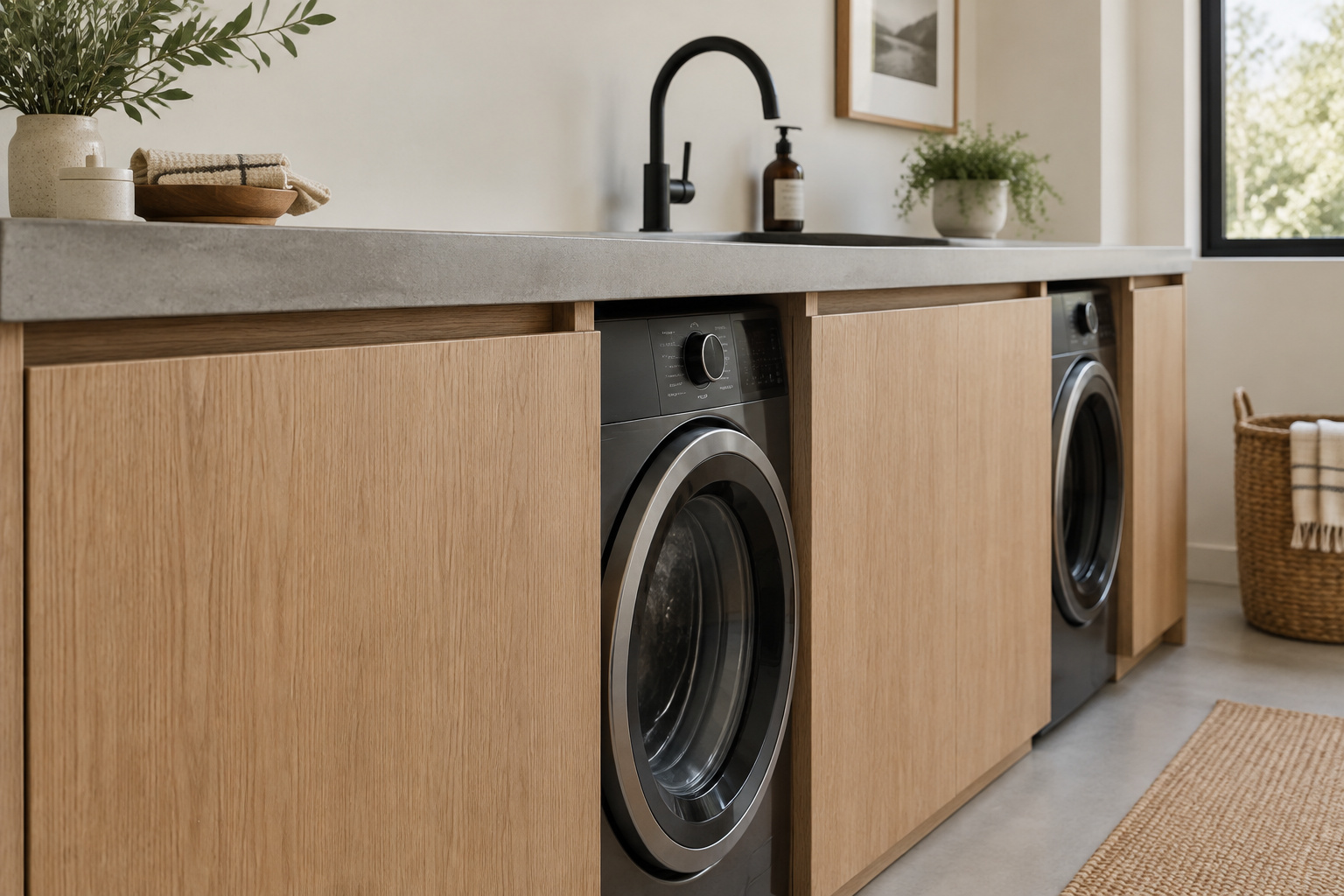

There is no standard for wood in a laundry room. No code, no trade body and no cabinet guideline says how much humidity a white oak door should face beside a dryer, or which finish a walnut front needs to stay flat through a winter of steam. These wood laundry room ideas are judged on the one thing a durability rating never touches, namely what steam does to timber. The walnut-fronted room you saved could last decades or start gapping at the joints next spring. The few numbers that exist, borrowed honestly from the trades that own them, show which.
TL;DR
- Cut matters as much as species. On a 24-inch front across a harsh 6-point moisture swing, flat-sawn white oak moves about 0.53 in and flat-sawn walnut about 0.39 in. A radially oriented oak board moves roughly half as much as flat-sawn, which is why rift-sawn oak is the pick.
- EN 350 is a decay rating, not a humidity rating. It grades resistance to fungi and insects and says nothing about cupping or cracking, which is why doors near the machines call for veneer on a stable core.
- The finish does the real work. Conversion varnish is its maker’s top water-resistant topcoat, and hardwax oil trades some resistance for patch repair. Keep wood off the machines and off this room’s floor.
Why Wood Reads as the Warm Half of a Modern Laundry Room
Most pieces that come back to my workshop, a converted carriage house, come back with the same complaint, and it is rarely rot. The trouble is in the joints. A frame-and-panel door that lived near a damp room arrives with hairline cracks where rail meets stile and a panel shrunk back from its groove, leaving a pale unfinished stripe along one edge. The wood is sound. It was asked to swell and shrink more often than its joinery and finish could follow, and a laundry room sets that problem every week.
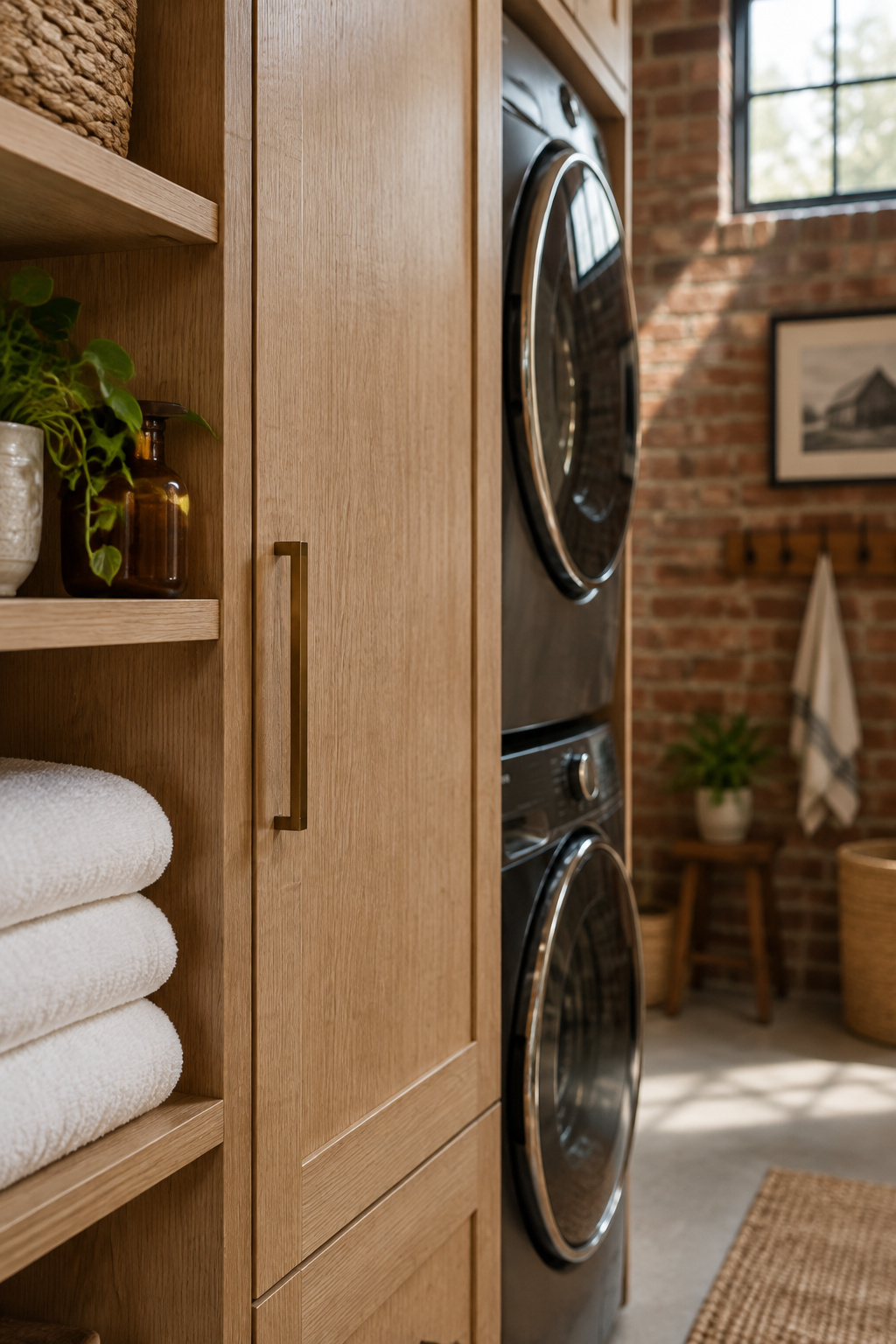
The pull toward wood is real. In the Houzz 2026 Kitchen Trends Study, wood cabinets edged past white for the first time in recent years, 29% of renovating homeowners against 28%. It is a kitchen number, used only as trend evidence.
Buyers check a durability class or a handsome grain photo. The North American Architectural Woodwork Standards (NAAWS) Resource Guide names the real culprit plainly: the most common cause of failure in finished woodwork is inconsistent relative humidity in the space. Movement, not decay, is what this room punishes.
Species and Cut That Actually Handle a Laundry Room
The USDA Forest Products Laboratory’s Wood Handbook gives white oak 10.5% tangential shrinkage from green to oven-dry and 5.6% radial. Black walnut shrinks 7.8% and 5.5%. Across domestic hardwoods tangential shrinkage runs about twice radial, which is why the saw matters as much as the tree.
In flat-sawn boards the growth rings run parallel to the face, so width moves at the tangential rate. Rift sawing turns the rings to roughly 30 to 60 degrees, which gives the straight, tight grain of good modern slab fronts and pulls movement toward the radial rate.
USDA dimensional-change coefficients are about 0.00365 per point of moisture content for white oak tangentially and 0.00274 for walnut. I worked them across a 24-inch front and a 6-point swing, roughly 6% moisture content in a heated winter house to 12% in a humid summer one. That is a wide indoor swing, chosen as a deliberately harsh case.
| Species | Cut | Shrinkage (tangential / radial) | Width change, 24 in front, 6-point swing |
|---|---|---|---|
| White oak | Flat-sawn | 10.5% / 5.6% | about 0.53 in (my arithmetic) |
| Black walnut | Flat-sawn | 7.8% / 5.5% | about 0.39 in (my estimate) |
| White oak | Radial face (the direction rift pulls toward) | 5.6% radial | about 0.28 in (my scaling) |
Working it out, flat-sawn white oak, 24 × 6 × 0.00365 = 0.53 in; flat-sawn walnut, 24 × 6 × 0.00274 = 0.39 in, about a quarter less. For the radial row I scale the oak coefficient by the Handbook’s own radial-to-tangential shrinkage ratio, 0.00365 × (5.6 ÷ 10.5) ≈ 0.0019, then 24 × 6 × 0.0019 ≈ 0.28 in, roughly half the flat-sawn figure. A rift board lands between the flat-sawn and radial rows, closer to the radial one the steeper its rings stand.
Rift-Sawn White Oak and Walnut
Walnut moves less than flat-sawn white oak, and rift-sawn white oak moves less than either. Oak’s pores are also plugged with tyloses, the growths that made it the barrel wood, so it resists surface water better than maple, birch plywood or pine. Walnut is the calmer species plain-sawn and suits a darker room. It ambers with light, so choose it for where it is headed.
Neither species has a laundry humidity standard of its own. The nearest band comes from flooring: the National Wood Flooring Association holds interiors at 30 to 50% relative humidity for wood stability, and NAAWS asks installed woodwork to see no more than a 15% swing. No closer laundry rule exists.
The EN 350 Trap: Durability Rating Is Not a Humidity Rating
What does a “durable” wood actually survive? EN 350:2016, the European standard behind most durability claims, defines natural durability as “the inherent resistance of wood to attack by wood-destroying organisms.” It sorts timber into five classes against decay fungi, from very durable to perishable, plus insect, termite and marine ratings. European oak sits at Class 2 to 3 against decay, and birch at Class 5.
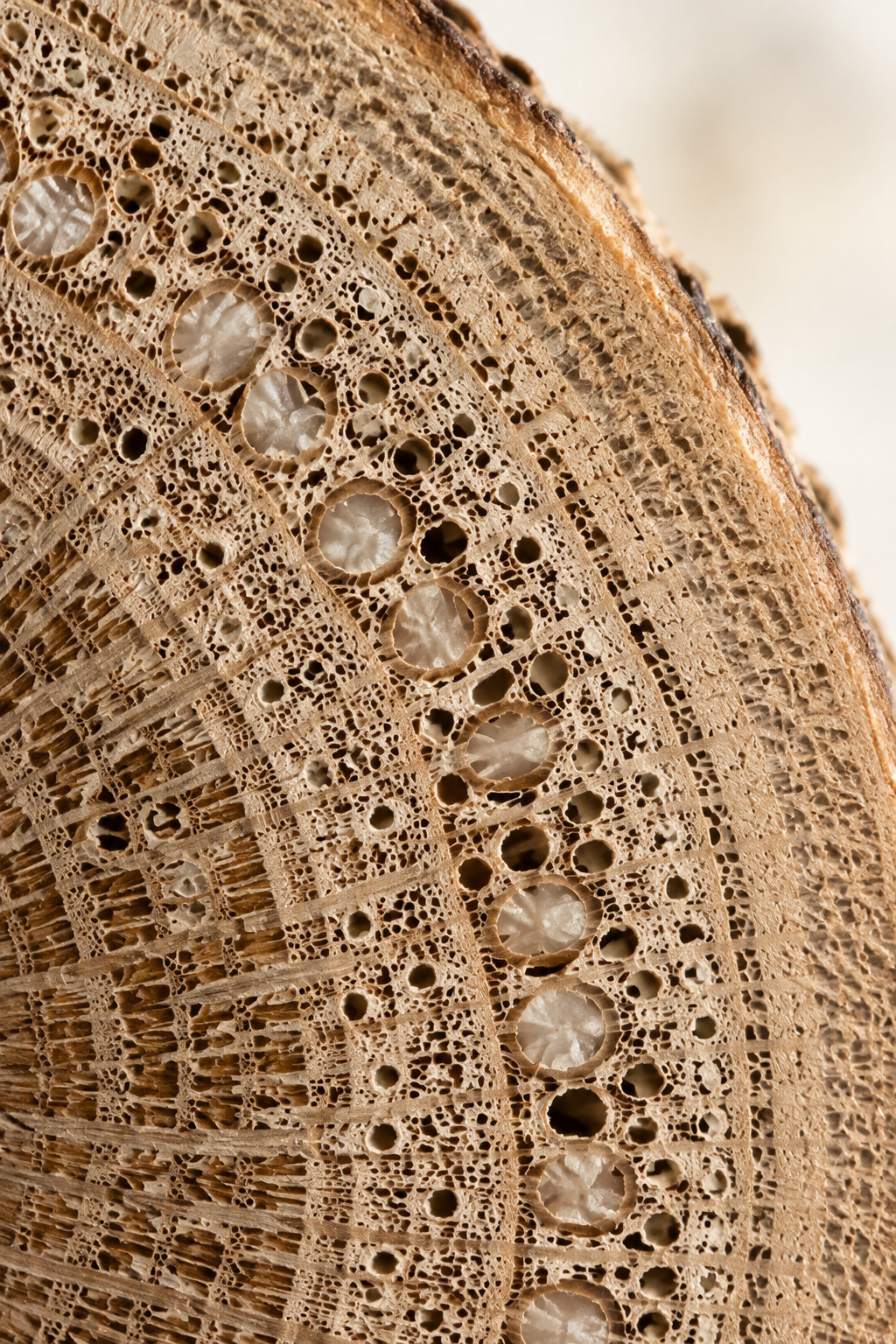
Those ratings are correct, and useless here. The standard says nothing about dimensional stability or movement. Decay resistance comes from density, extractives and anatomy, while movement comes from cut and humidity swing. A durable oak front sawn flat still moves its half-inch, and a Class 5 birch front needs sealing on every face, end grain included, for reasons its class never mentions.
When a showroom says a wood “handles moisture” and points to its class, ask how it was cut and what it is glued to. EN 350 asks whether fungi can eat the board. It never asks whether the board will be flat after a hundred wet winters.
Veneer on a Stable Core vs. Solid Wood Fronts
Old furniture taught me to respect solid wood and to know where it fails. A solid door moves as one panel. An engineered core of plywood, MDF or particleboard has crossed or scattered fibers, so the coordinated swelling that warps a solid slab has nothing to act on, and the thin face veneer rides along on a substrate that barely moves.
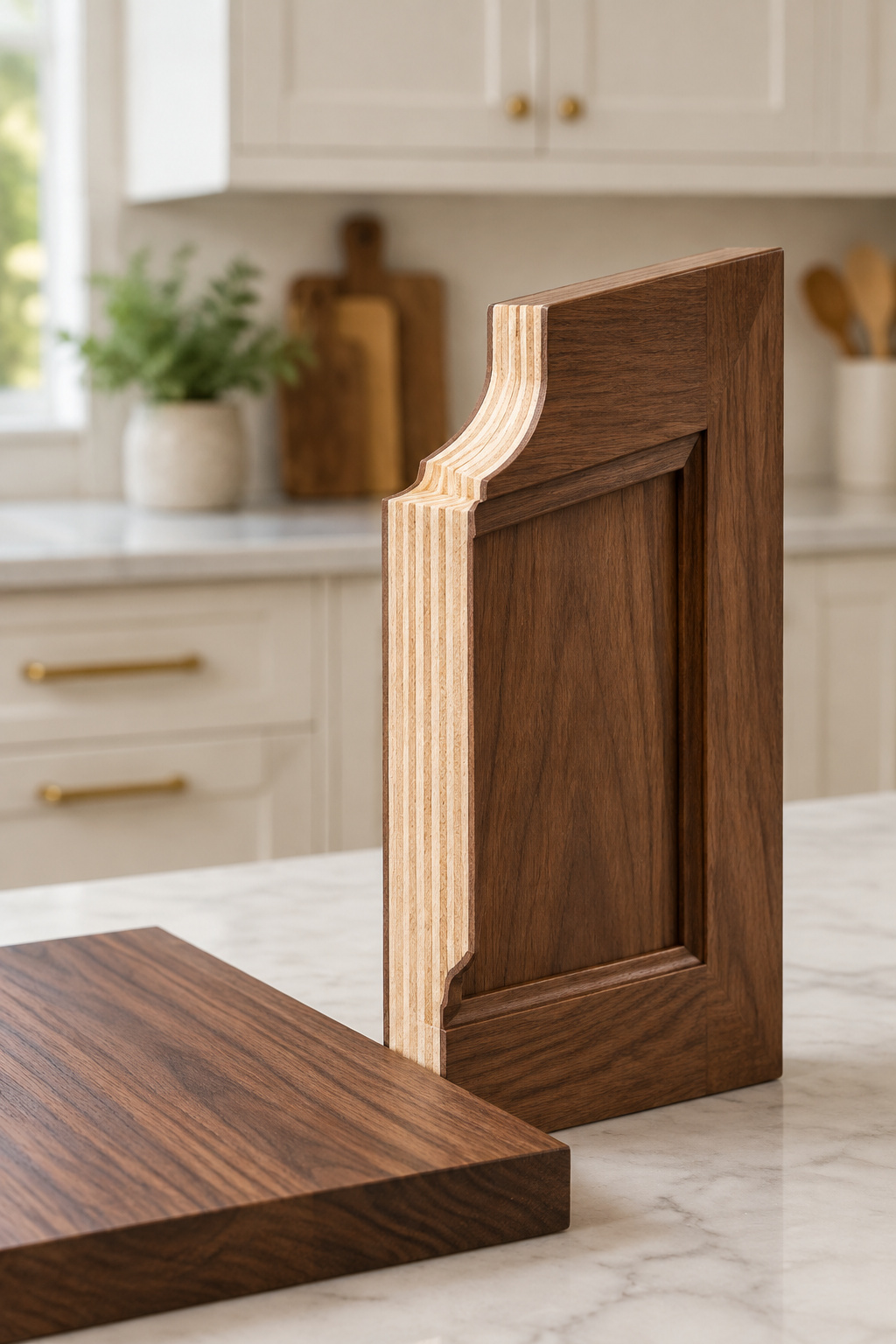
The comparison rests on one cabinet-door trade source plus the USDA mechanism above, so hold it modestly. Veneer does not remove risk; it relocates it.
| Construction | How it moves | How it fails | Best use here |
|---|---|---|---|
| Solid wood slab | As one panel, at the rate its cut allows | Warps, cracks finish at joints | Controlled humidity, where edge grain and staining matter |
| Veneer on engineered core | Face follows a stable core | Veneer bubbles or lifts if water gets behind a chip or seam | Default for fronts near steam and splashes; also the better base for paint |
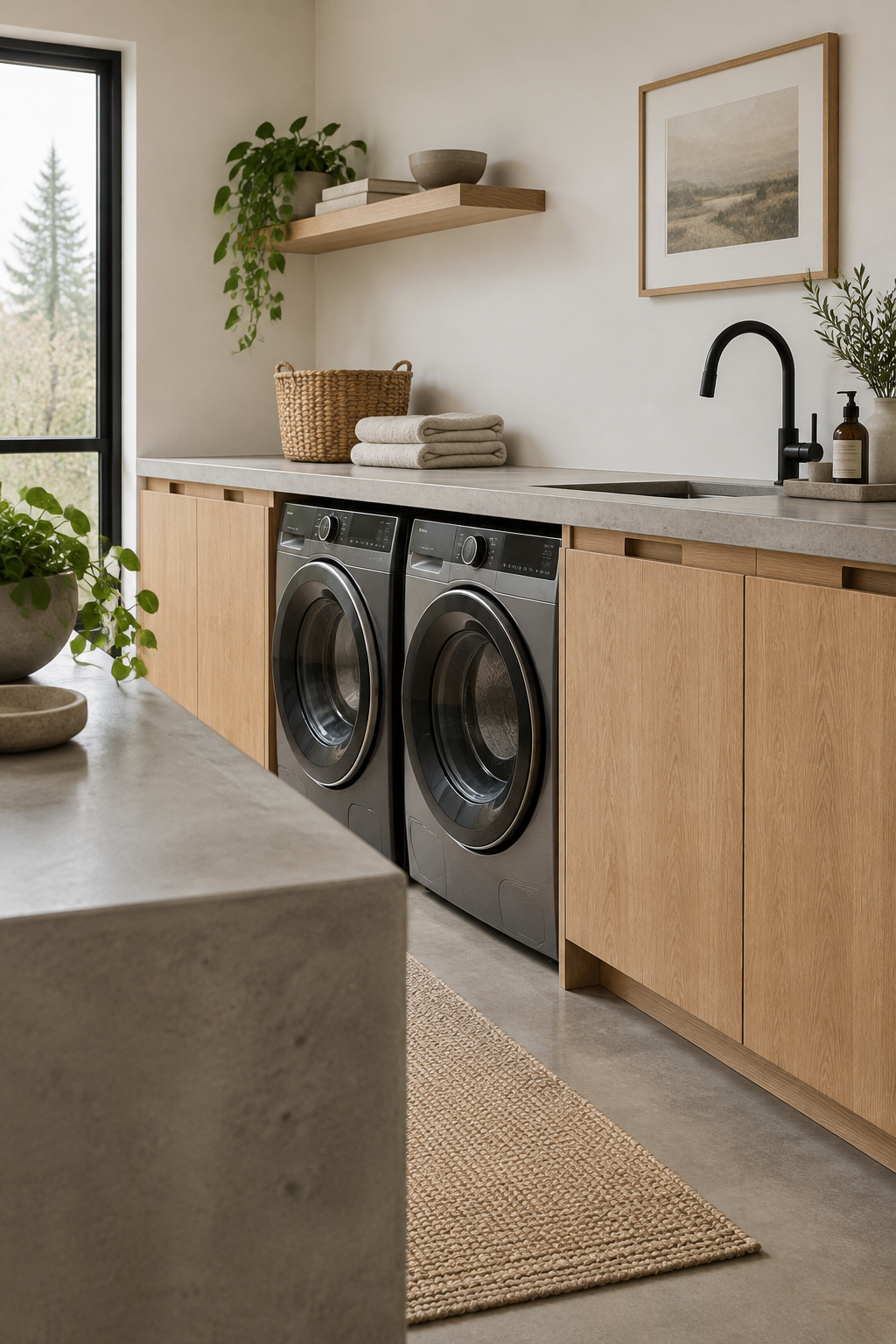
My verdict is veneer on a stable core for any front within splash range, with every edge sealed and any chip touched up the week it happens. Solid wood belongs on the drier wall, if at all. The choice also suits the flat, quiet slab fronts that make up what makes a laundry room read modern, since a warped slab shows every millimeter.
Finishes That Actually Stop Steam and Splashes
Manufacturers are clearer about finishes than most buying guides are. General Finishes rates its water-based Conversion Varnish as its most durable, most chemical- and water-resistant topcoat, recommended for countertops and bar tops. It scopes its Pre-Cat Lacquer only to places with “little risk of chemical contamination”: interior doors, casing, light-use furniture. A door beside the detergent shelf is not among them.
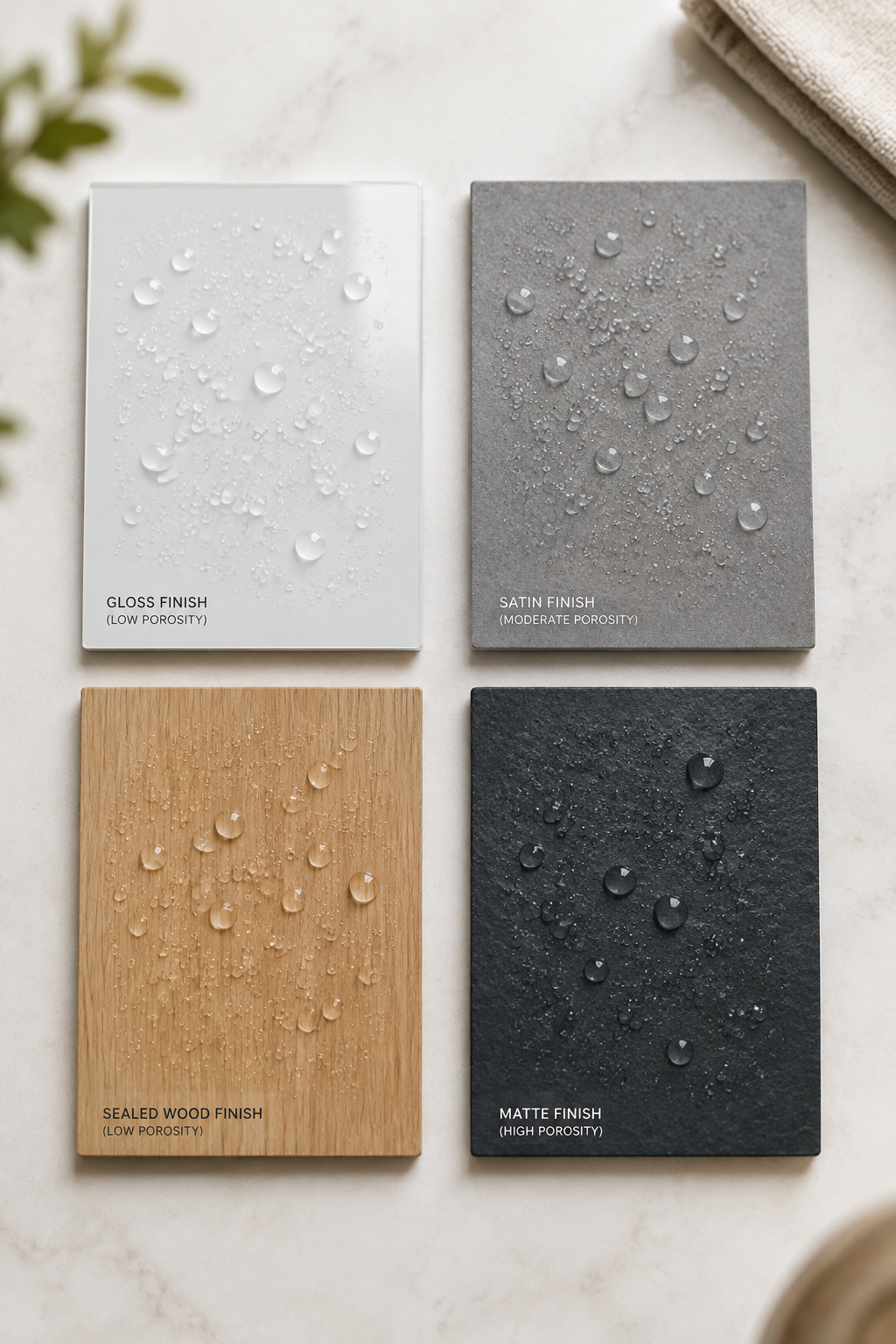
Hardwax oil sits on a different axis. Rubio Monocoat rates its Oil Plus 2C for wear, water and heat resistance in kitchens and bathrooms, and a worn or water-marked patch can be lightly sanded and re-oiled on its own. Neither polyurethane can be spot-patched invisibly. Repairability matters for a front that takes its damage in one corner beside the washer, and it fits the rule I work by: never do to a piece what the next owner cannot undo.
My rules of thumb:
- Conversion varnish for anything that takes daily splashes, pre-cat lacquer only on fronts well away from the wet zone.
- Hardwax oil where you want to repair a patch rather than refinish a door.
- Water-based polyurethane cures in about 3 to 5 days and oil-based takes 30 to 45 days. Dry to the touch is not cured.
- Three coats is the trade minimum for bathroom-grade protection, five or more on a surface that sees water daily.
- Wipe standing water within 30 minutes. Past 2 hours, it is far more likely to reach raw wood through a seam, whatever the finish.
Test any finish on an offcut in the room’s own light first. The same finish-first logic runs through a walnut, mid-century take on the same wood, where the look is decided and this durability is borrowed.
Wood Laundry Room Ideas: Where Wood Belongs, and Where It Never Goes
On Cabinet Fronts and Open Shelving
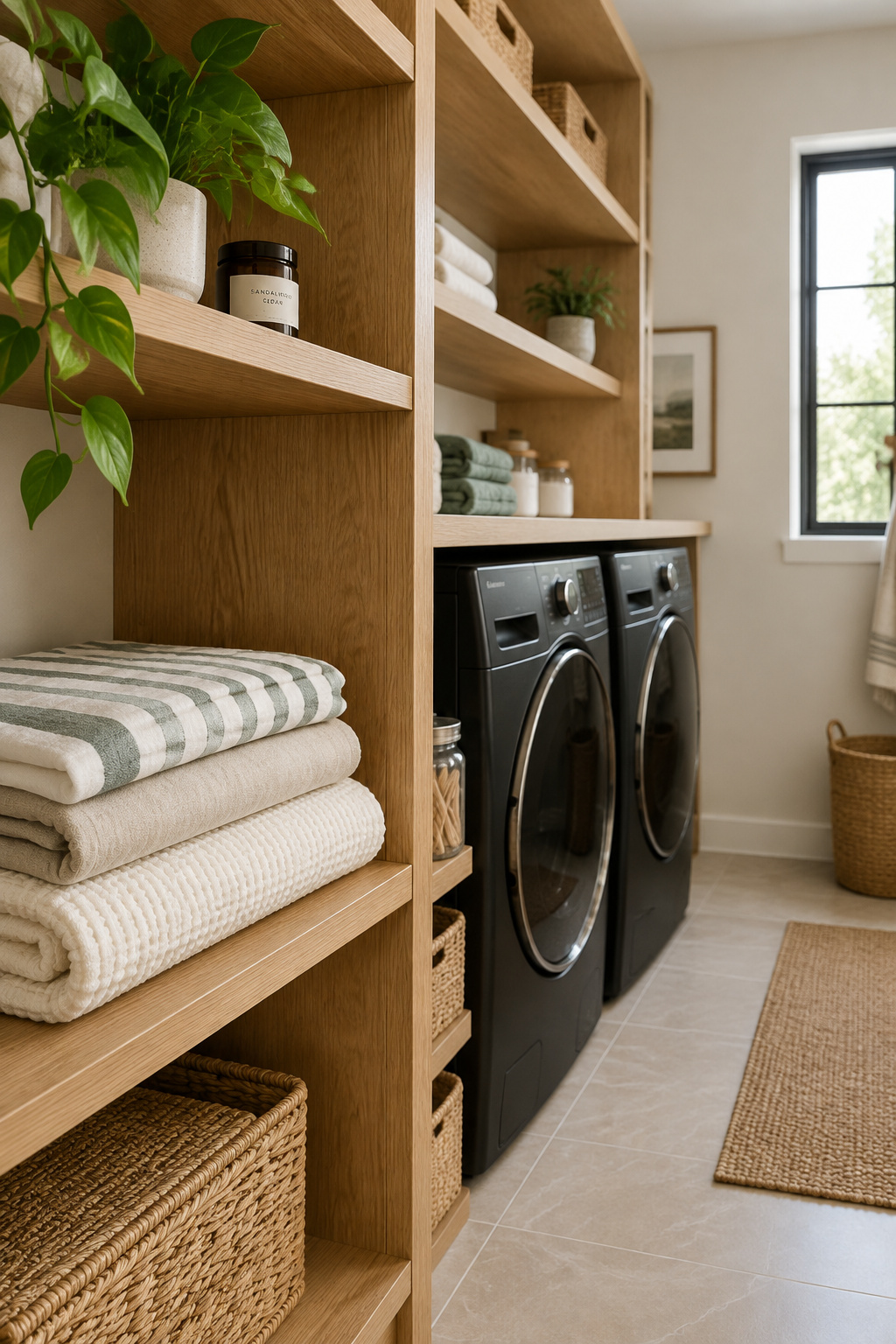
Fronts, trim and a single shelf are wood’s natural ground in this room. Sealed white oak gives the best surface-moisture protection among common shelf species, again thanks to those tyloses, and one oak shelf is often warmth enough. For the proportion, see pairing warm wood against a black-and-white scheme. Plan to inspect and reseal every one to two years. No laundry figure exists, so that interval is borrowed from bathroom shelving.
Never Directly on Machines or the Floor Here
The two places wood never goes are the machine tops and the floor. A ledge resting on a washer takes vibration that works at every hairline crack movement has opened, and it holds condensation and vented damp against its face far longer than the 30-minute window a finish forgives. Leave an air gap. The floor is a separate decision with its own leak arithmetic, covered in this series’ laundry flooring guide.
Carry this number out of the room: a 24-inch flat-sawn white oak front can move about 0.53 in by my arithmetic when its moisture content swings 6 points, a deliberately harsh case. Cut it rift, lay it as veneer on a stable core, seal it with conversion varnish or hardwax oil and keep it off the machines and the floor, and most of that half-inch never happens.
FAQ
Does wood veneer hold up better than solid wood in a laundry room?
Yes, for dimensional stability. Veneer over an engineered core of plywood, MDF or particleboard resists the coordinated swelling that warps a solid panel. It has its own risk, though. Water that gets behind the face through a chip, seam or unsealed edge can make the veneer bubble or lift, so seal every edge.
Can you use butcher block over a washer and dryer?
Not directly over the machines. Butcher block needs a 1/8-inch expansion gap at every wall edge and 48 to 72 hours acclimating on risers before installation, per manufacturer guidance, and vibration and steam work against both. For wood above the machines, keep an air gap and use a sealed shelf.
What’s the most humidity-resistant wood finish for cabinets?
Conversion varnish, among manufacturer-rated cabinet finishes. General Finishes positions it as its most chemical- and water-resistant topcoat, recommended for countertops and bar tops. Hardwax oil gives up some resistance in exchange for patch repair. Pre-catalyzed lacquer is scoped by its maker to lighter-use surfaces, not splash zones.