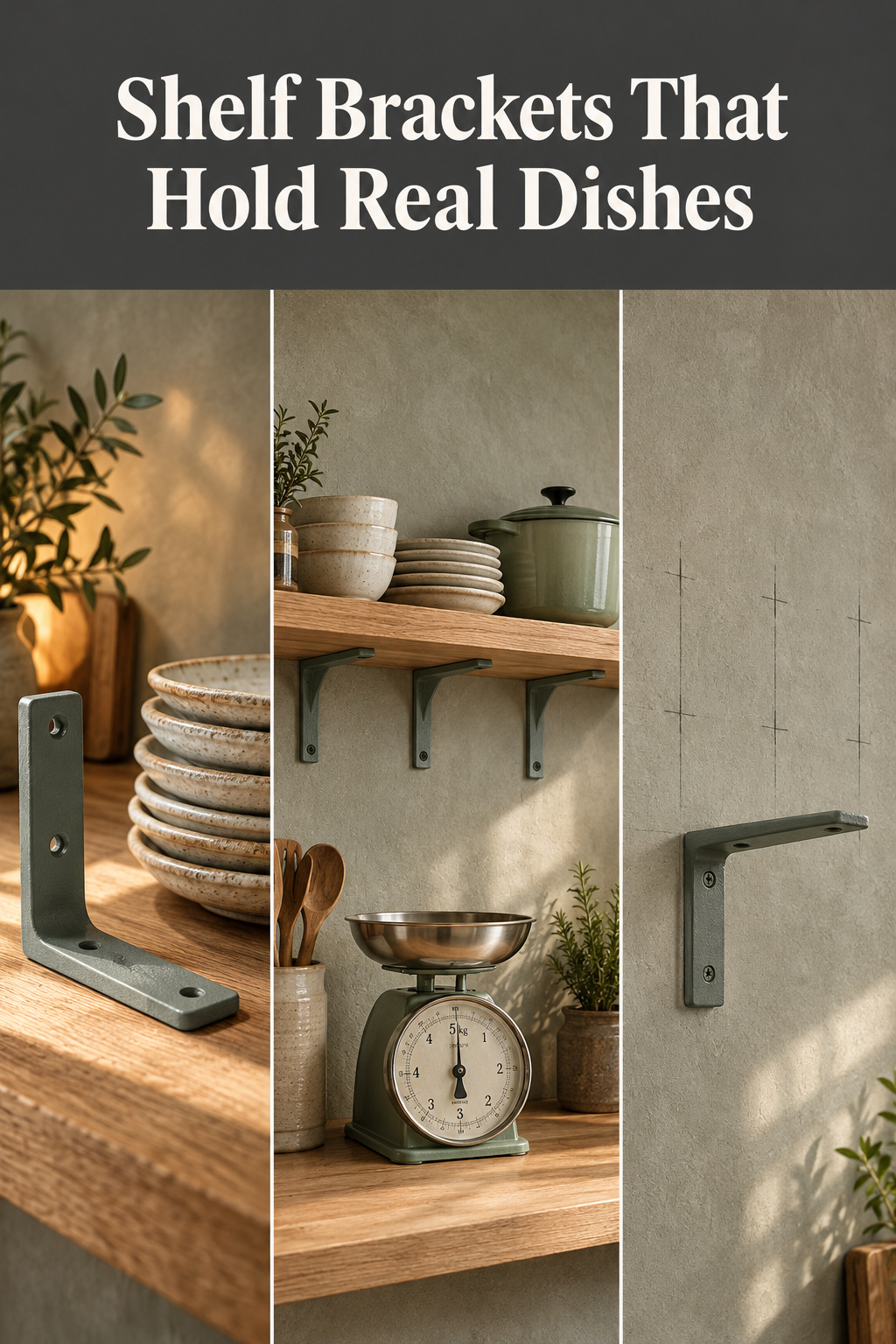
In my twenties I hung a shelf on drywall anchors and stacked plates on it. At 2 a.m. it dropped the lot. There is no good hour for a shelf to let go, but that one is the worst, and I have screwed into studs ever since.
Most shelf mistakes start earlier than mine, in the hardware aisle. You read “100 lb per pair” on a box of kitchen shelf brackets, picture the three plates in the product photo, and buy. Nobody has weighed a dish. That number is what the steel managed under the maker’s conditions: an even load, a set spacing, screws into something solid. A real stack of stoneware with a Dutch oven on the end is a different load, and the wall behind it is a different question. So weigh your dishes, match them to a published rating, and count the studs.
TL;DR
- Eight stoneware plates, eight stoneware bowls, a 5 qt cast iron Dutch oven and a 12 in skillet weigh about 49 lb. Add a 25% margin and plan for about 61 lb.
- Three steel L-brackets rated at 50 lb each, set 16 in apart, carry about 20 lb apiece, so the steel has plenty of room.
- The wall end is where capacity drops, so every bracket goes into a stud, and you find those studs yourself.
The Number on the Box Covers the Steel, Not Your Shelf
The residential code’s live-load table has rows for floors, sleeping areas, stairs, decks, guards and handrails, and none for a wall shelf. So the number on the box is the maker’s own claim, and these makers print their conditions right beside it.
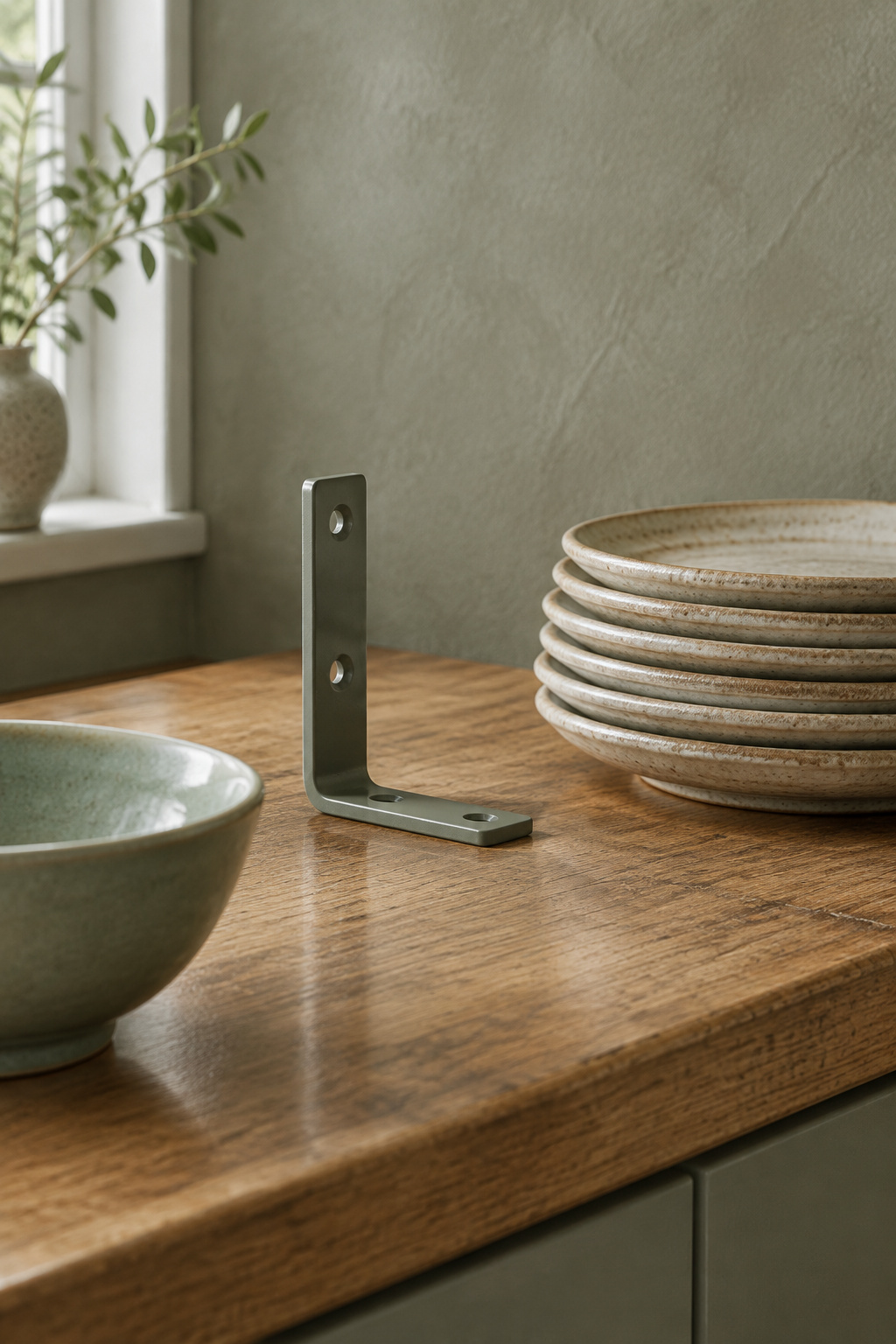
Tyler Morris Woodworking rates its wood brackets at 250 lb “when mounted properly and loaded uniformly.” Federal Brace rates its Industrial steel L at 50 lb each, 100 lb a pair, with no more than 18 in between brackets. Read the condition as part of the number. Uniformly loaded means spread along the board. A Dutch oven parked between two brackets is a point load, and that is a harder test than the one the rating describes.
So the rating covers the steel. It doesn’t cover your screws, your drywall, or where the heavy pot ends up. The whole chain decides: board, bracket, fastener, wall. Trust the box alone and here’s what you’ll see one day: a shelf that lets go takes the plates down with it.
Everything else about open kitchen shelving, from height to what lives where, comes after this one decision.
What a Working Shelf of Stoneware and Cast Iron Weighs
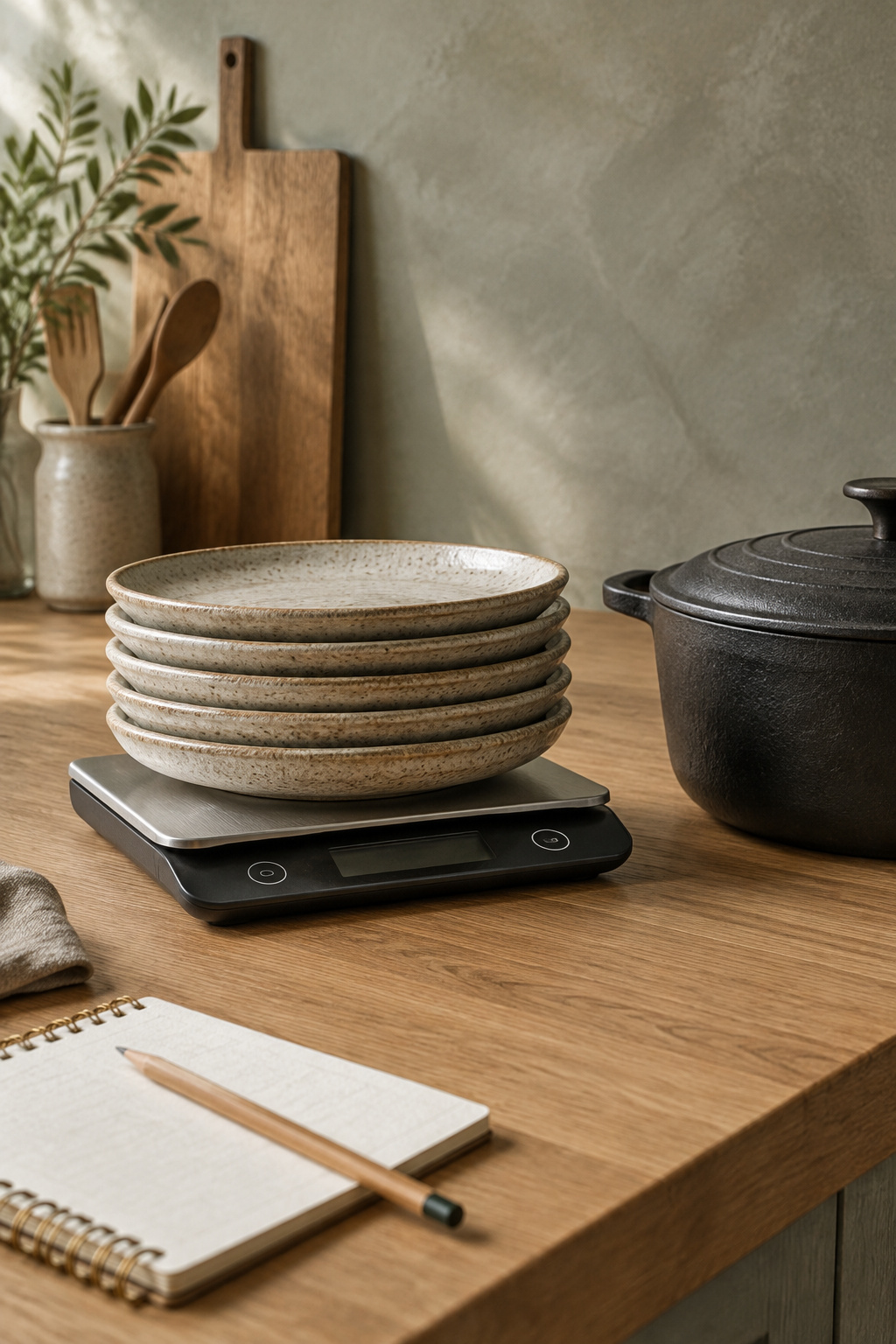
Here is what the makers list for the pieces that usually end up on an open shelf.
| Item | Weight each |
|---|---|
| Stoneware deep plate, 11 in (Thomas Clay Rock) | 2.41 lb |
| Porcelain dinner plate, 11 in (Rosenthal Loft) | 1.60 lb |
| Stoneware cereal bowl, 6 in (Thomas Nature Leaf) | 1.09 lb |
| Bone china cereal bowl, 6 in (Rosenthal) | 0.50 lb |
| Lodge cast iron Dutch oven, 5 qt | 13.29 lb |
| Lodge cast iron skillet, 12 in | 7.69 lb |
Stoneware runs about half again heavier than porcelain, and a stoneware bowl weighs more than twice a china one. Cast iron swamps everything. One 5 qt Dutch oven weighs what five and a half stoneware plates do. Retail listings round that Lodge up to 14 lb; Lodge’s own chart says 13.29, and that’s the number I use. A deep plate also outweighs a flat one, so 2.41 lb is a middle figure, not a ceiling.
Two slips show up at this step every time. People weigh the plates and forget the skillet that lives on the same board. Or they read a retailer’s shipping weight, box and all, as the weight of the item. Use the maker’s number, or better, put your own dishes on your own kitchen scale.
Kitchen Shelf Brackets: Steel L-Brackets and Corbels by Published Rating
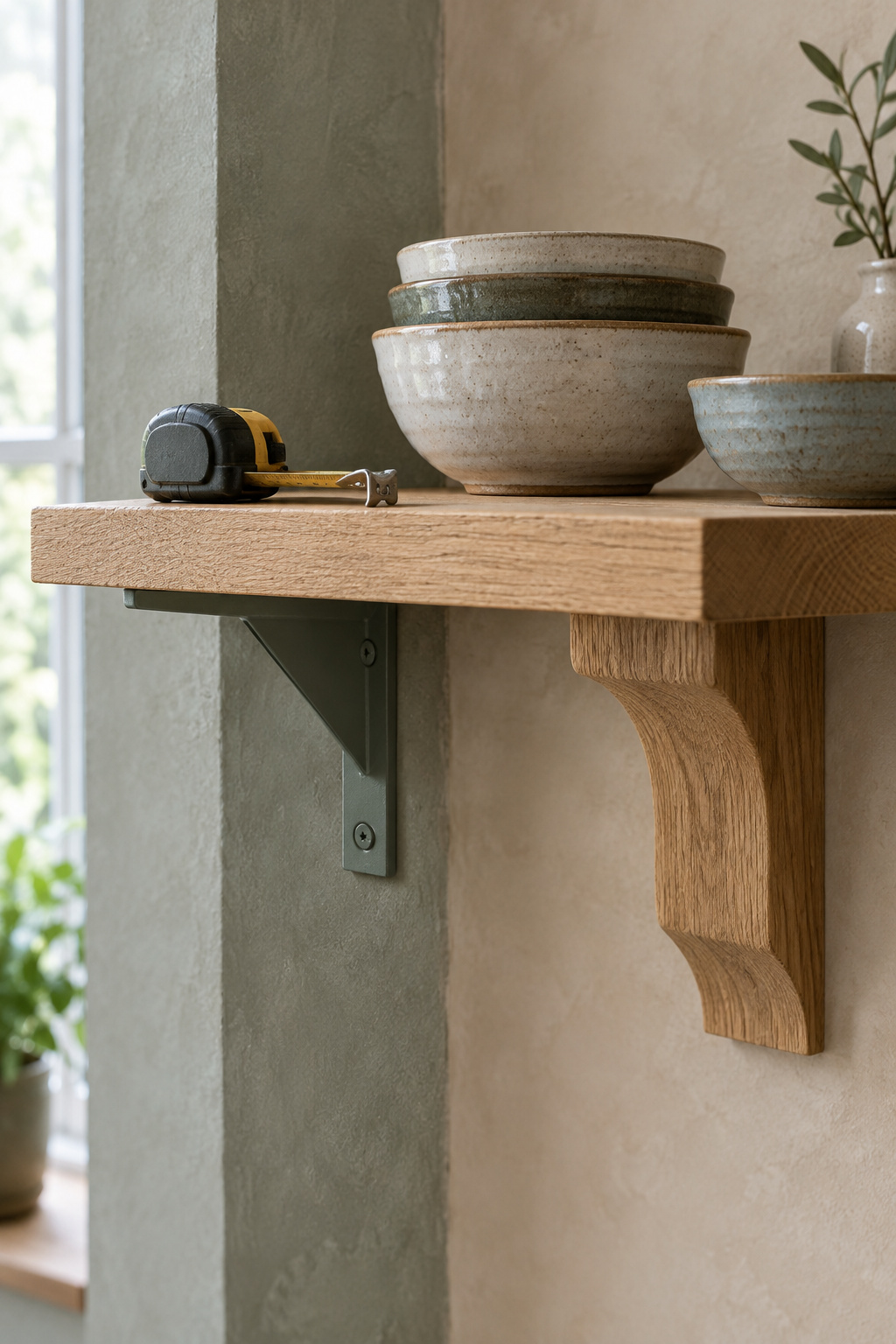
Once you know the weight, shop by published rating and read what each one assumes.
| Bracket | Published rating | What the rating assumes | Skill level |
|---|---|---|---|
| Federal Brace Industrial steel L, 8 or 10 in arm | 50 lb each, 100 lb a pair | No more than 18 in between brackets; fasteners not included | first build |
| Tyler Morris wood bracket (8SB or 10SB) | 250 lb | Mounted properly into wood, loaded uniformly; 30 in max unsupported | some builds |
| Federal Brace Brookdale maple corbel, reinforced | 375 lb each | Rating comes from the 1/4 in steel rib inside the wood | some builds |
| Federal Brace hidden bracket, 8 in arm | 50 lb each | Stud-mounted; board no more than 2 in past the arm | confident builder |
Match the arm to the board. Tyler Morris makes the 8SB for shelves 7.5 to 9.5 in deep and the 10SB for 9.5 to 12 in. A corbel carrying a shelf on its own should be at least two-thirds of the shelf’s depth, three-quarters if you can manage it, so a 12 in shelf wants an 8 in corbel and a 9 in one is better.
Be suspicious of pretty corbels. A decorative corbel with no published rating is trim, not a bracket. The Brookdale’s 375 lb belongs to the steel rib inside it; the maple is the cover.
When a beginner asks where to start, I point at the steel L. I used to steer students toward floating shelves because they look clean, until too many of them ended up with sagging boards. Floating shelves are harder than brackets, so start with brackets.
If you’re hanging two or three tiers, work through setting shelf height and spacing before you order, because the number of boards changes how many brackets you buy.
Studs Decide How Many Brackets You Need
Stud finders lie. Check with a nail or a magnet. I treat the beep as a first guess, then confirm it with a magnet on the drywall screws or a finish nail pushed through where the bracket will hide the hole. Check it twice, mark it in pencil, and only then take a bracket out of its bag.
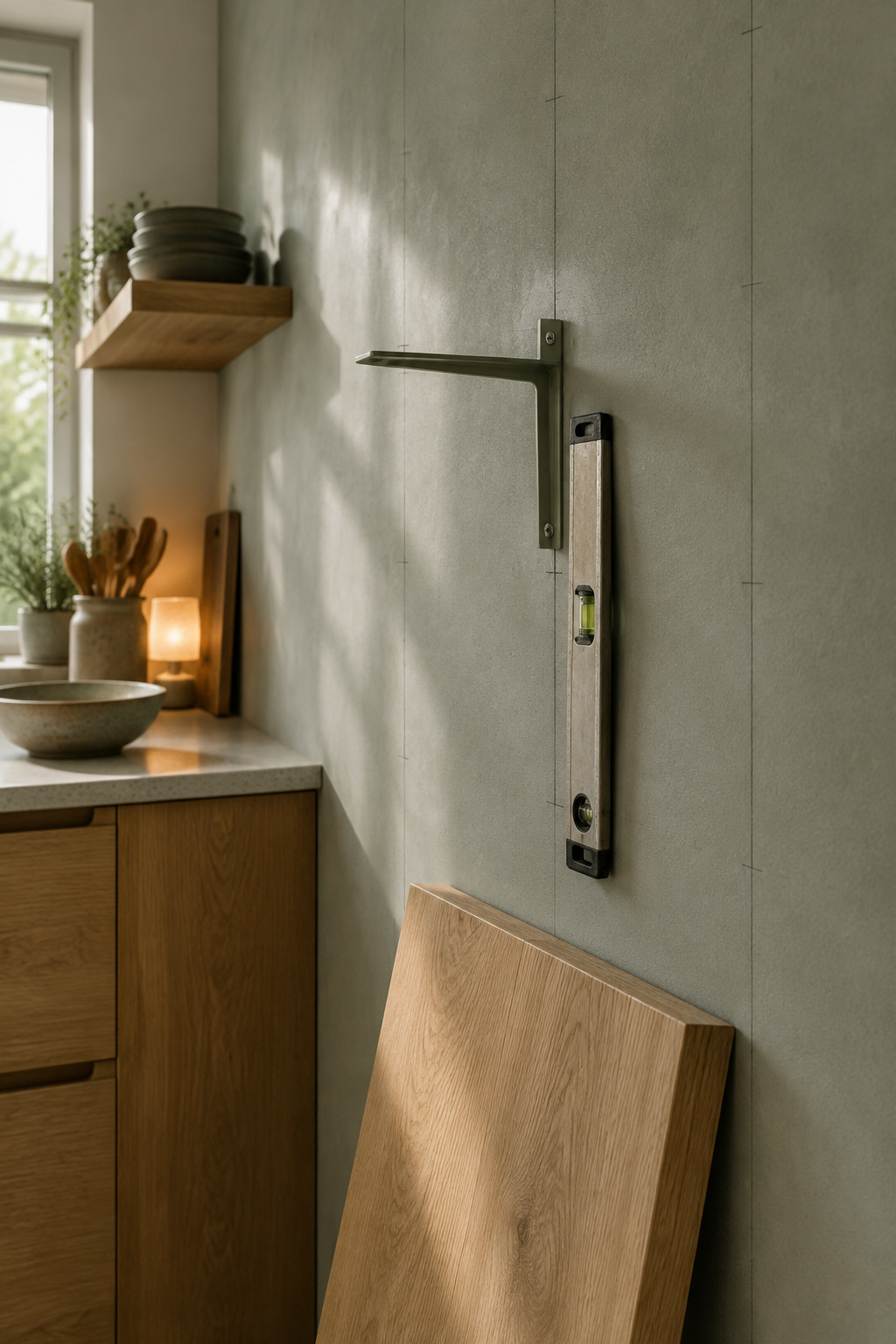
Don’t assume where the studs are, either. Sixteen inches on center is a habit that comes from 4 x 8 sheet goods. The code sets only a maximum spacing, from 16 to 24 in depending on the wall. Find yours.
Here is the mistake that catches people. Two brackets bite into wood and the third sits between studs on a drywall anchor, because that spot lined up nicely with the window. It looks fine for a month. Then the bowls go over that bracket, the anchor pulls through the drywall’s paper face, and the board tips toward the weak point. The fix is dull but complete: take the shelf down, move that bracket to the nearest stud, and let the board overhang a little more on that end.
How much does the wall matter? One shelf retailer puts a hidden floating bracket at 45 to 50 lb screwed into a stud and 20 to 25 lb on drywall toggles. Same hardware, about half the load. Tyler Morris saw its drywall-only mount give way at 220 lb, against a 250 lb rating into wood.
Thickness matters along the board as well. Under heavy loads a 2×10 can span 48 in between supports, where a 1×10 gets 24 in.
Replacing uppers? The old rail screws already found the studs, and what the wall shows once the uppers come down covers reading those holes before you fill them.
One Shelf of Stoneware, Worked From Weight to Stud
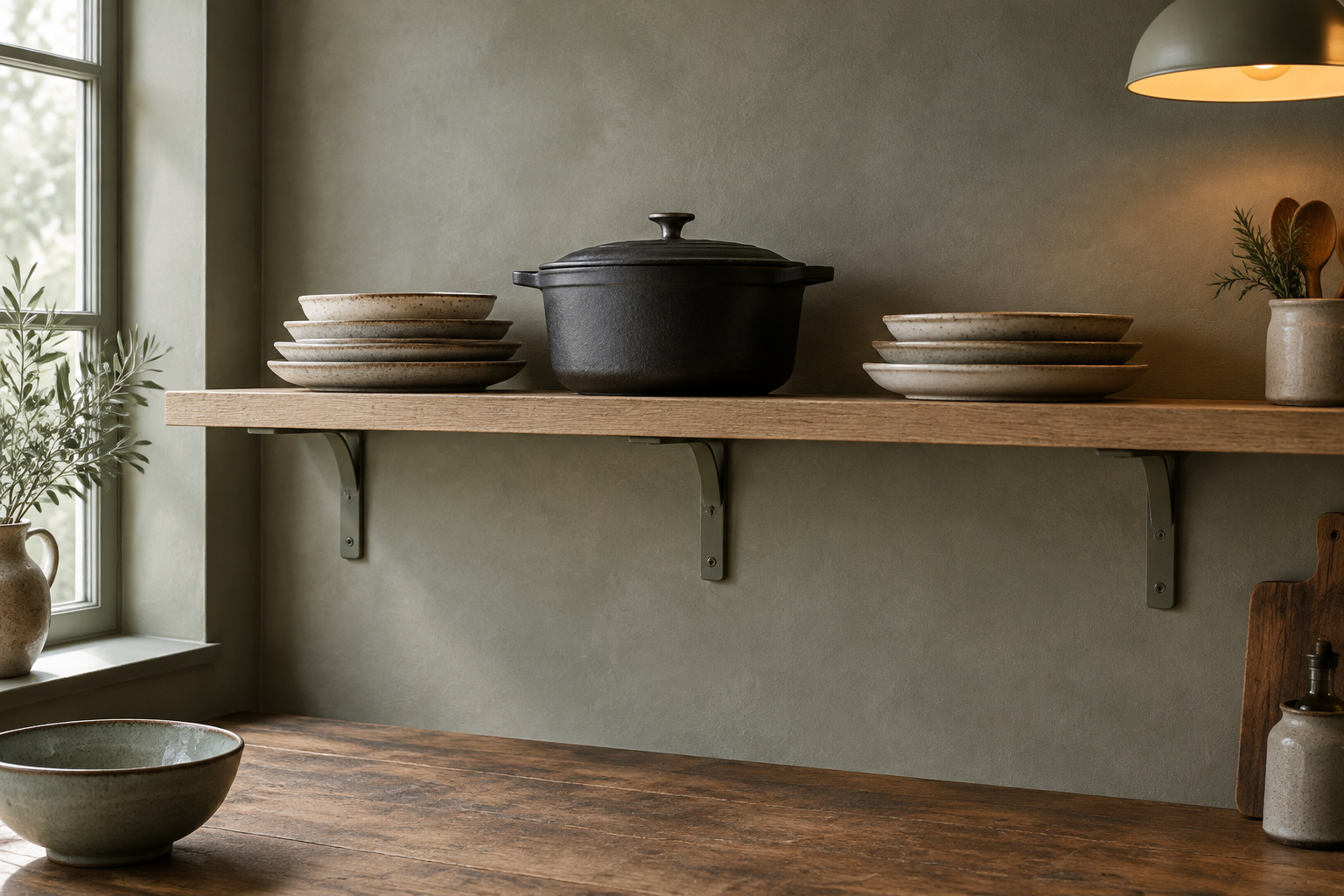
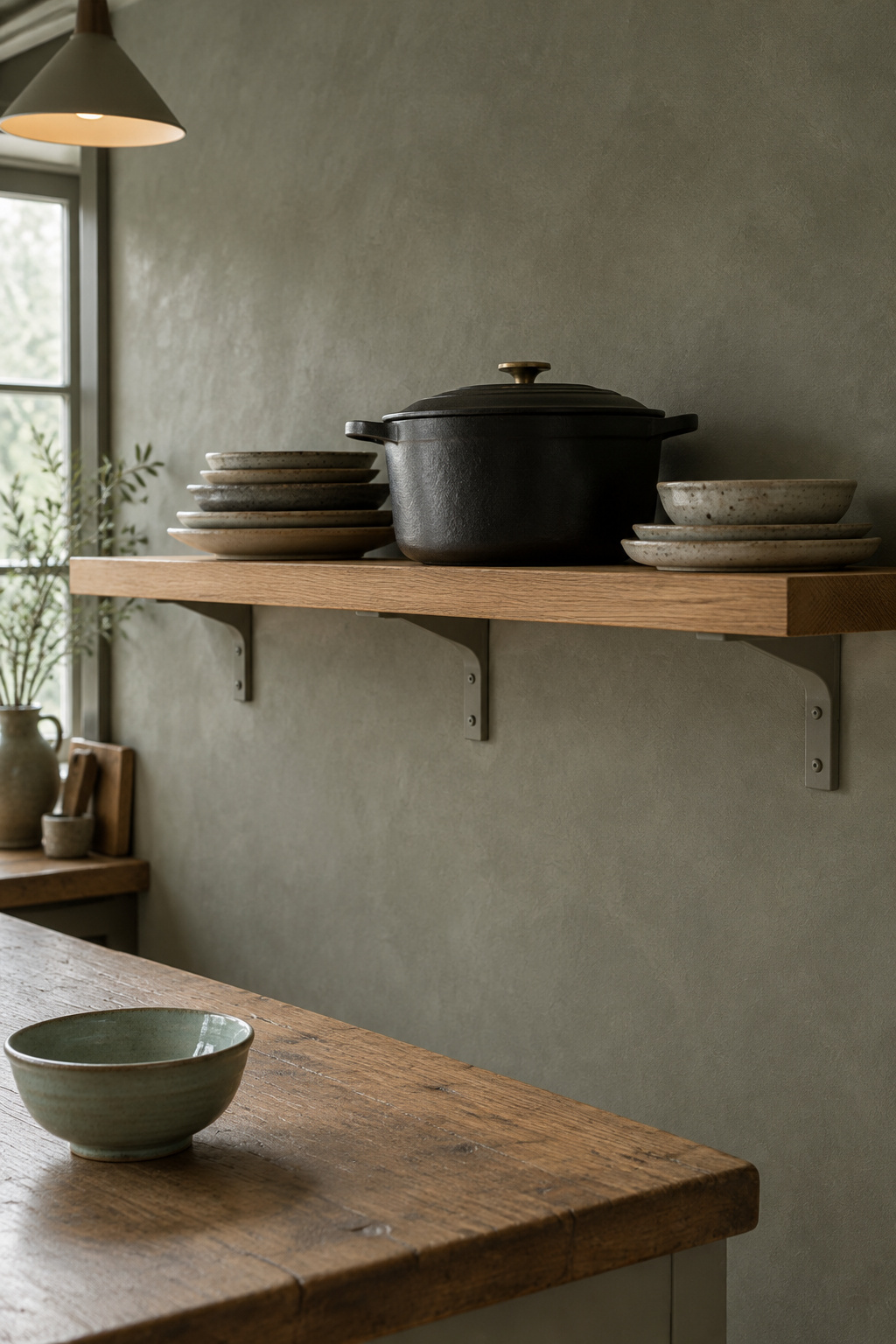
Take one shelf: a 36 in board, 10 in deep, carrying everyday dishes and the two pieces of cast iron that never fit in a cupboard.
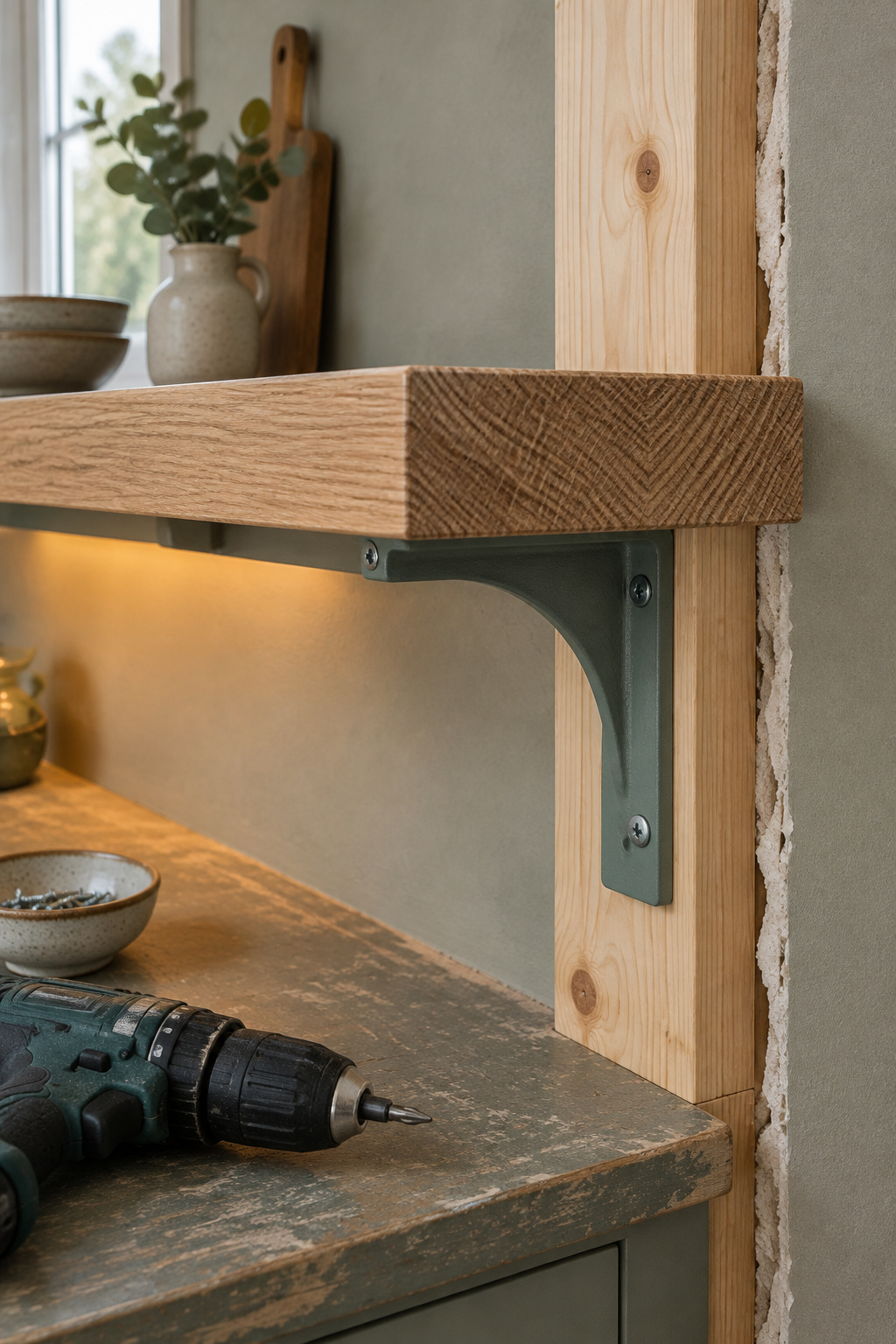
- Weigh the stack. Eight plates at 2.41 lb make 19.28 lb. Eight bowls at 1.09 lb make 8.72 lb. Add the Dutch oven at 13.29 lb and the skillet at 7.69 lb, and the shelf carries 48.98 lb.
- Add a margin. I add 25% for the gravy boat and the extra mugs that turn up later: 48.98 x 1.25 = 61.2 lb.
- Split it. Three brackets 16 in apart keep both gaps inside Federal Brace’s 18 in maximum. Shared evenly, that’s 20.4 lb per bracket.
- Check the bracket. At 50 lb each, the rating is 2.45 times the load. Set the Dutch oven directly over a bracket, not mid-gap, because the rating assumes an even load.
- Land it in studs. At 16 in on center, three brackets fall on three neighboring studs. Each carries 20.4 lb, under half the 45 to 50 lb a retailer gives for stud-mounted floating brackets, which isn’t an L-bracket rating but shows the scale. On a drywall toggle, that same 20.4 lb would sit right at the 20 to 25 lb edge. Stay on the stud.
Sixty-one pounds against 150 lb of published bracket capacity is comfortable. The steel was never close to its limit. If this shelf fails, it fails at the wall.
Hardware for this shelf comes to three 10 in black Industrial brackets at $38.99 each, $116.97, plus screws and the board.
What to Buy and What to Check This Weekend
Prices drift, so check them before you order.
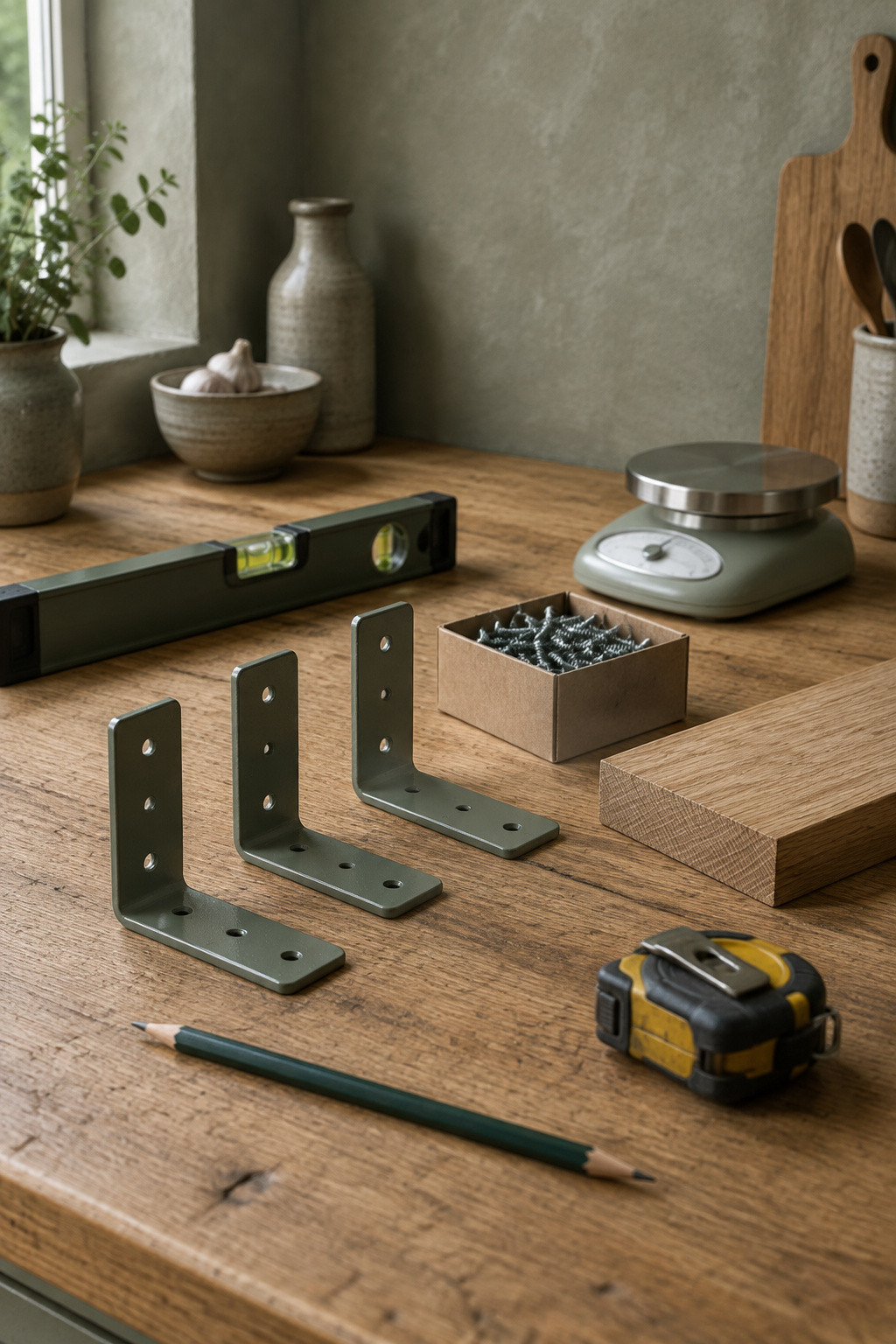
- Three Federal Brace Industrial brackets for a 36 in shelf, at $38.99 (10 in, black) to $62.99 (8 in, stainless) each. The black 10 in is the cheaper one and fits a 10 in board.
- If you want wood showing, the reinforced Brookdale maple corbel is $181.99 each, or $545.97 for three. A painted steel L carries this stack for about a fifth of that.
- For the board, one lumber seller lists 6/4 rift-sawn white oak at up to $19.50 a board foot. Hardwood board feet use the rough thickness, 1.5 in for 6/4, so a 36 x 10 in board is 36 x 10 x 1.5 / 144 = 3.75 board feet, or $73.13 at the top of that range. That seller has a 10 board-foot minimum order. Have the yard or a cut counter crosscut it; that’s what it’s there for.
- Screws. Federal Brace sells its brackets without them, while Tyler Morris includes hardware for wood studs and sells a drywall kit separately. Buy the extra box. I keep a box of spare screws behind the seat of my pickup for exactly this kind of job.
- A drill, a level, a stud finder backed up by a magnet or a finish nail, and the kitchen scale you already own.
Skill level for the whole job: some builds. The steel is simple. Finding three studs and keeping a 36 in board level is where the afternoon goes.
The cheapest version of this job costs nothing and undoes itself. Tonight, weigh the plates and pots you plan to shelve, in batches if your scale tops out, and write the total on a sticky note stuck where the board will go. Then find the studs behind that note, and check them twice. If the numbers say three brackets and three studs, buy them. If they don’t, you’ve lost an evening and a sticky note, not a stack of plates at 2 a.m.
FAQ
How do I stop a long kitchen shelf from bowing over time?
Bring the brackets closer together. Tyler Morris says its brackets shouldn’t sit more than 30 in apart unsupported or the shelf may sag, and the Industrial steel L wants 18 in or less. A thicker board helps too. A center bracket cuts the bowing, but it doesn’t multiply capacity, since it still needs solid backing.
Do shelf brackets need a finish to stand up to steam and grease?
Steel does. Bare steel rusts in humid air, so it needs paint, powder coat or galvanizing, plus a touch-up wherever the coating chips. Powder coat is sold as a waterproof finish for humid rooms. Wood brackets are easier to finish before you hang them, so you aren’t masking the wall around each one.
Can a stand mixer or microwave sit on an open kitchen shelf?
A mixer can, with care. A KitchenAid Artisan 5 qt tilt-head is listed at about 26 lb, roughly half of one Industrial bracket’s 50 lb rating, and all of it sits in one spot. Set it directly over a bracket, never mid-gap. For a microwave, weigh it or check its manual first.