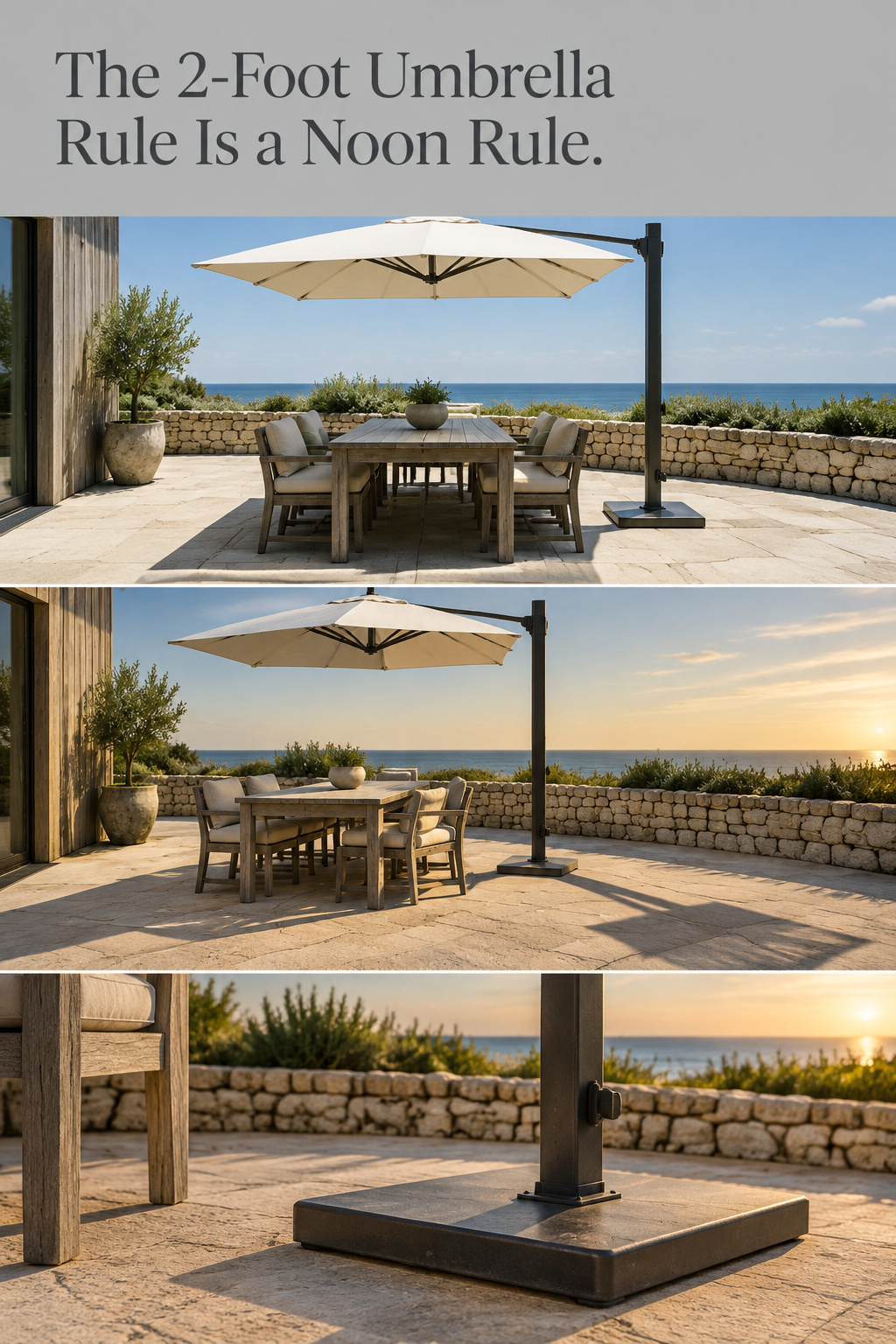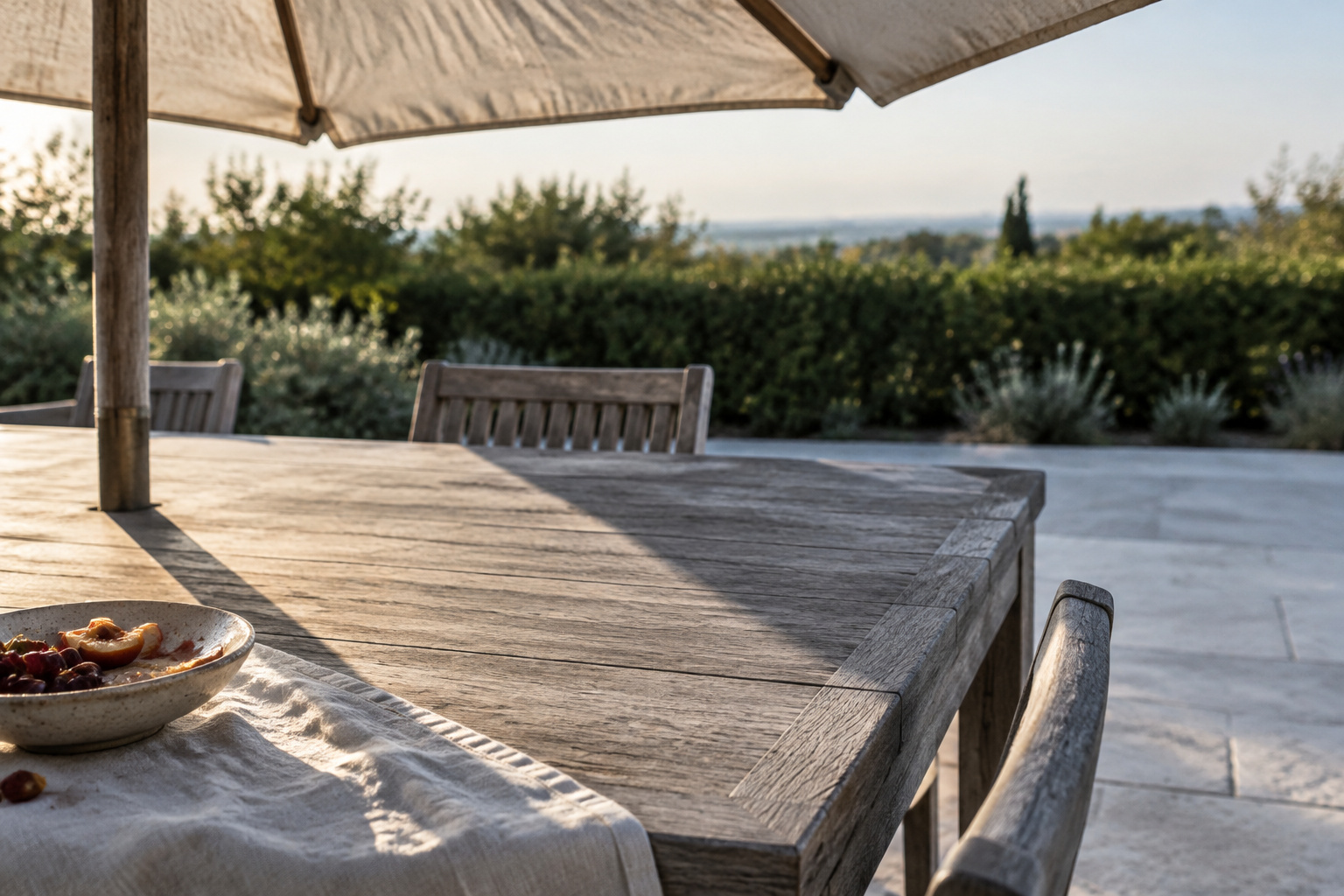
Every patio umbrella size guide says the same thing in nearly the same words: the canopy should reach about two feet past the table on all sides. Wabash Valley, California Umbrella, Patiowell and Frontera all give one figure and no citation. Several give the same reason: the sun moves across the afternoon. That’s odd, since a fixed buffer can’t follow a moving sun. Picture the textbook result: a nine-foot canopy centered over a forty-eight-inch table, correct by every chart going, with half that table in full sun by seven.
TL;DR
- Two feet of overhang is sound guidance — for the middle of the day. A 42–48 inch table takes a 9-foot canopy, 48–60 inches takes 9–11 feet, 60 and up takes 11–13 feet.
- Nobody can tell you where the rule came from. Ten retailer and design sources plus a direct ASTM check turn up no study or originator. F3681 is scoped to beach umbrellas, F3512 is a market-umbrella wind test method, and neither gives an overhang figure or a base weight.
- At 40°N on the summer solstice, the shade drifts 1.25 ft from under the canopy at solar noon, 8.65 ft at 5pm, 15.9 ft at 6pm, 56.9 ft at 7pm. Past mid-afternoon, only tilt and position help.
The Rule Everyone Quotes: Two Feet Bigger Than the Table
“Your umbrella should extend at least 2 feet past your table or seating area on all sides.” That’s Wabash Valley’s guide, and sellers aren’t the only ones who say it. New York Magazine’s Strategist reports that most of its experts agree the most important guideline is a canopy extending at least two feet past the area you want to shade. That roundup of named professionals is the strongest source the rule has. In the same piece, interior designer Kanika Bakshi Khurana names the failure mode exactly: homeowners “overlook changes in the sun’s angle during the afternoon.”
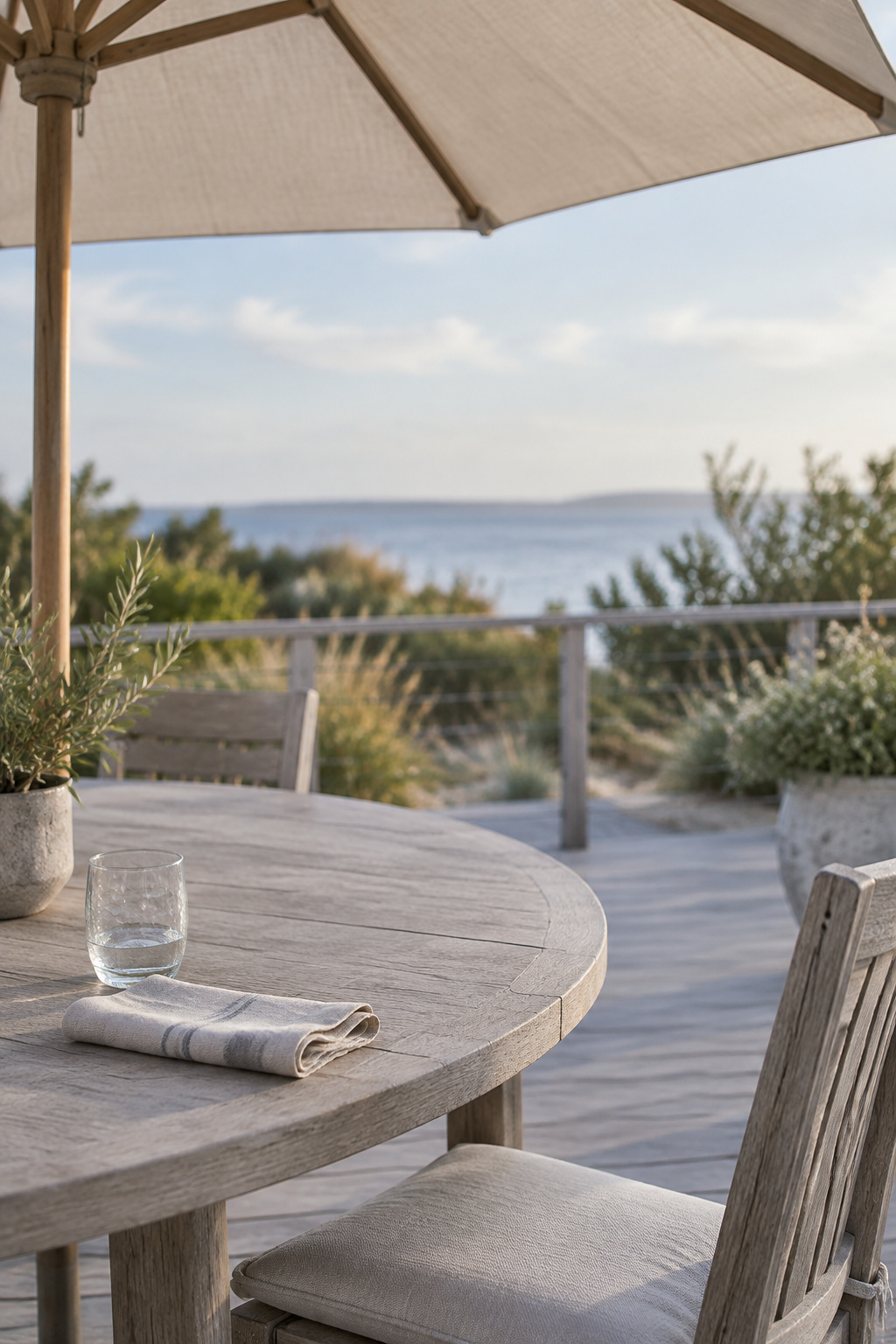
So the consensus and its best-informed critic sit in one article, agreeing about a number that can’t survive the objection. Shade is the first thing I settle in the whole outdoor dining area plan, because shade and wind shelter buy more usable evenings than any heater or gadget sold.
Chasing the Rule Back to Where It Actually Comes From
I looked for the origin and came back with nothing, which is the finding. Nine sources, among them Wabash Valley, California Umbrella’s blog, Patiowell, Aosom, BBQGuys and Frontera, state the figure as settled fact, with no study, no named originator and no rationale past “the sun moves.”
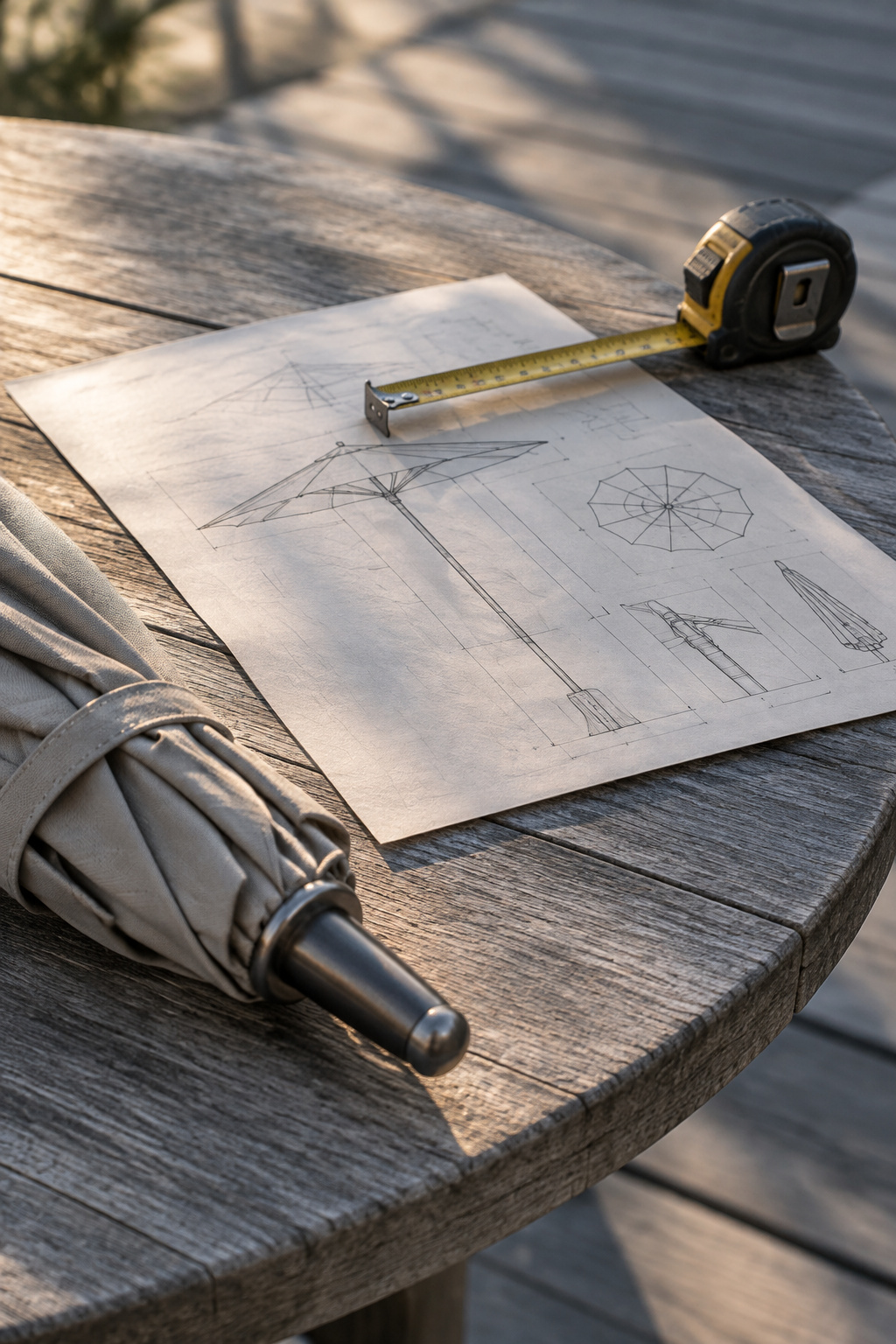
The standards trail is stranger. Two real standards exist and neither is about this. ASTM F3681 is real and current, a consumer safety specification for beach umbrellas. ASTM F3512 does cover the right category, market umbrellas in patio and hospitality use, but it is a wind-tunnel test method that rates a finished umbrella-and-base assembly on the Beaufort scale, as ANSI’s own summary confirms. It publishes no overhang figure, no sizing chart and no base weight. No landscape-architecture body, building code or shade standard I could locate publishes one.
So hold it as convention, not specification: roughly right, and unaware of what time it is.
What the Rule Gets Right — At Noon
73.4 degrees. That is the sun’s altitude at solar noon at 40°N on the summer solstice, and the whole reason two feet works at all. Working it out with the formula below, cos(zenith) = 0.2556 + 0.7028×cos(0°) = 0.9584, so zenith = 16.6° and altitude = 90° − 16.6° = 73.4°.
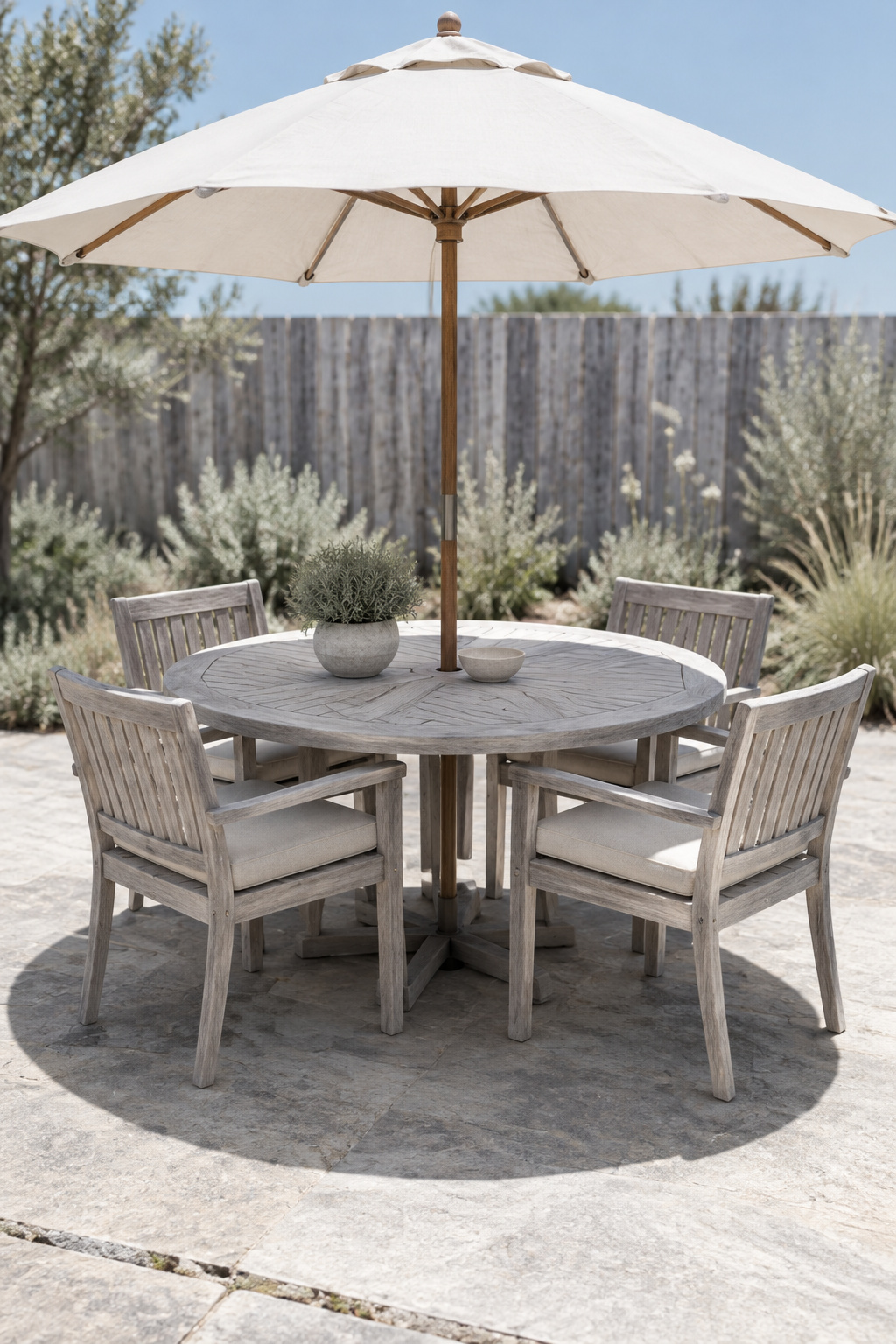
At that angle light falls close to straight down, so a canopy’s shadow stays near directly beneath it. It’s the most predictable sun pattern anyone plans for, and a fixed overhang only works against a shadow that barely moves.
The rule isn’t wrong. It is silently scoped to an hour almost nobody eats dinner in.
The Arithmetic the Rule Skips: Where the Shade Falls at 5, 6, and 7pm
The shade’s edge doesn’t creep. Past mid-afternoon it bolts. I have put a hand flat on a table’s far end at six and found it hot enough to want a cloth under the bowl.
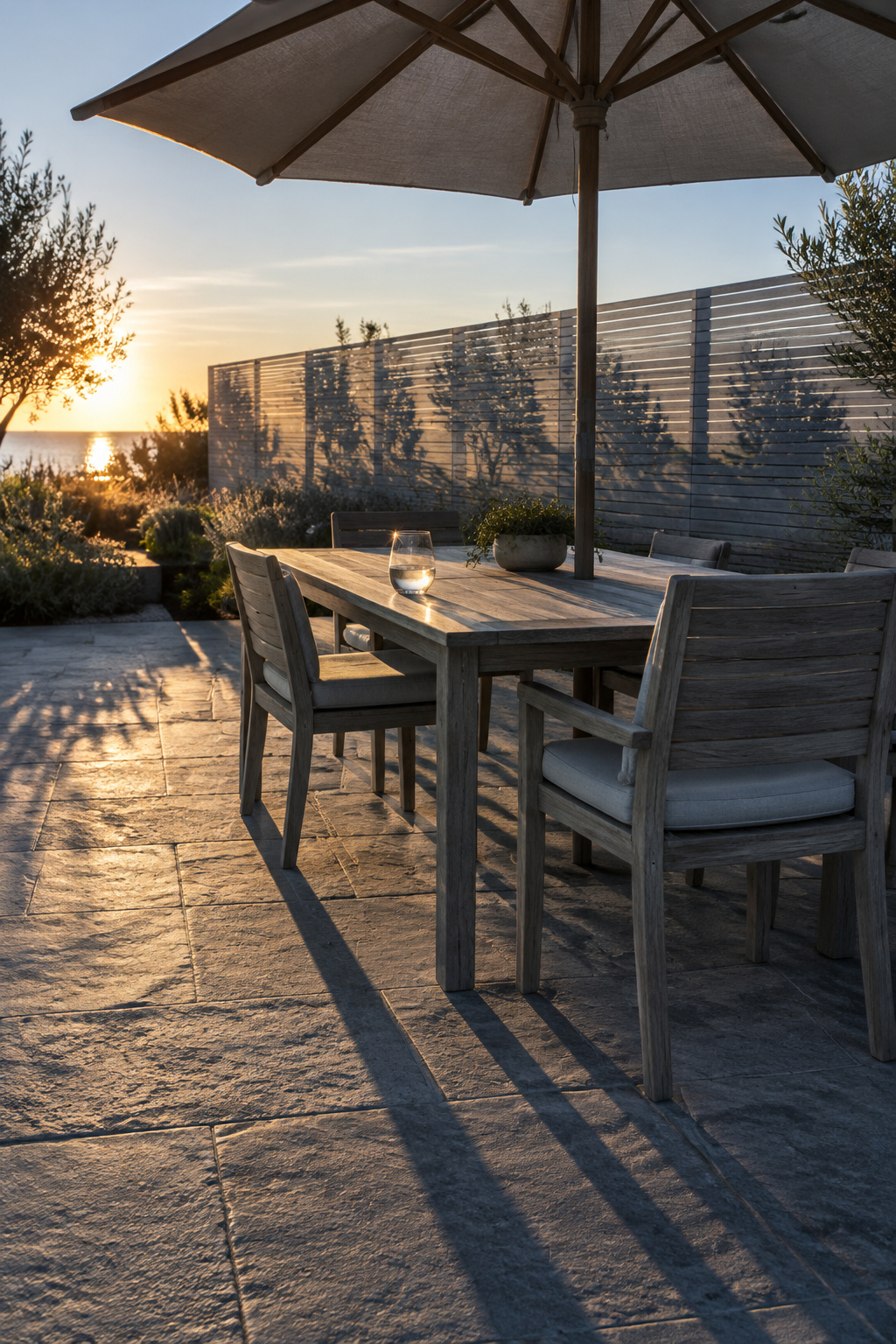
The calculation uses latitude 40°N (a mid-US patio) on the summer solstice, declination 23.44°, the annual maximum. NOAA’s formula: cos(zenith) = sin(latitude)·sin(declination) + cos(latitude)·cos(declination)·cos(H), with H the hour angle at 15° per hour from solar noon, and altitude = 90° − zenith. Two products recur at every hour: sin(40°)sin(23.44°) = 0.2556 and cos(40°)cos(23.44°) = 0.7028.
Turning an angle into a distance needs one height: the canopy edge above the tabletop. Frankford Umbrellas’ Aurora cantilever specs 80 inches of clearance; a standard outdoor dining table stands about 29.5 inches. My arithmetic: 80in − 29.5in = 50.5in = 4.21 ft, an illustrative input and not a constant, since pitch, pole height and table height vary by model. Offset is height ÷ tan(altitude). Every row below follows from it by my own arithmetic.
| Local solar time | Hour angle H | Solar altitude | Shadow offset |
|---|---|---|---|
| Noon | 0° | 73.4° | 1.25 ft |
| 5pm | 75° | 25.9° | 8.65 ft |
| 6pm | 90° | 14.8° | 15.9 ft |
| 7pm | 105° | 4.2° | 56.9 ft |
Here is the 5pm sum: cos(zenith) = 0.2556 + 0.7028×cos(75°) = 0.4375 → altitude 25.9°, and 4.21 ÷ tan(25.9°) = 4.21 ÷ 0.4859 = 8.65 ft. And at 7pm, cos(zenith) = 0.2556 − 0.1819 = 0.0737 → altitude 4.2°, and 4.21 ÷ tan(4.2°) = 4.21 ÷ 0.0740 = 56.9 ft.
At five, the offset already runs four times the two-foot buffer and beats an eleven-foot umbrella’s radius (by my arithmetic, 11 ÷ 2 = 5.5 ft). By seven, your canopy’s shadow lands fifty-seven feet away. No umbrella or chart covers that. Diameter has stopped being the variable.
Two limits. Clock time here stands for local solar time. The equation of time (±16 minutes) and daylight-saving and zone offsets (up to an hour) can shift which clock hour maps to which altitude, though not the magnitudes. And these are magnitudes only, not compass directions. Which side the low sun comes from is azimuth, settled by standing on your patio in July.
Sizing the Canopy: Patio Umbrella Size by Table Width
The commonest mistake is buying a canopy that matches the table’s diameter, leaving shade for the plates and sun on every elbow. Add the buffer and independent charts converge:
| Table width or diameter | Canopy diameter |
|---|---|
| 36–42 in | 7–9 ft |
| 42–48 in | 9 ft |
| 48–60 in | 9–11 ft |
| 60 in and up | 11–13 ft, or a rectangular canopy matched to the table’s shape |
Every row starts from the table, so settle the table dimensions a canopy is sized from before shopping. Size from that width for noon and spend the rest on how the thing moves.
Cantilever vs. Center Pole
A center pole runs its mast straight down through the canopy, so wind load travels directly into the base or the table hole. A cantilever hangs the canopy off an offset arm, and that arm is a lever: wind becomes rotational torque at the base instead of a push straight down. That is why makers say close a cantilever at 20–25 mph, while a center pole of the same canopy size tolerates more. Landscape architect Kevin Lenhart of Yardzen puts the trade honestly: cantilevers “cost more, but they’re much better at staying out of the way of things.” A legroom argument, not a shade one. Wabash Valley and Aosom agree on the split: center pole for a table with a built-in hole, cantilever when there’s no hole or the layout changes often.
Base Weight Big Enough for Real Wind
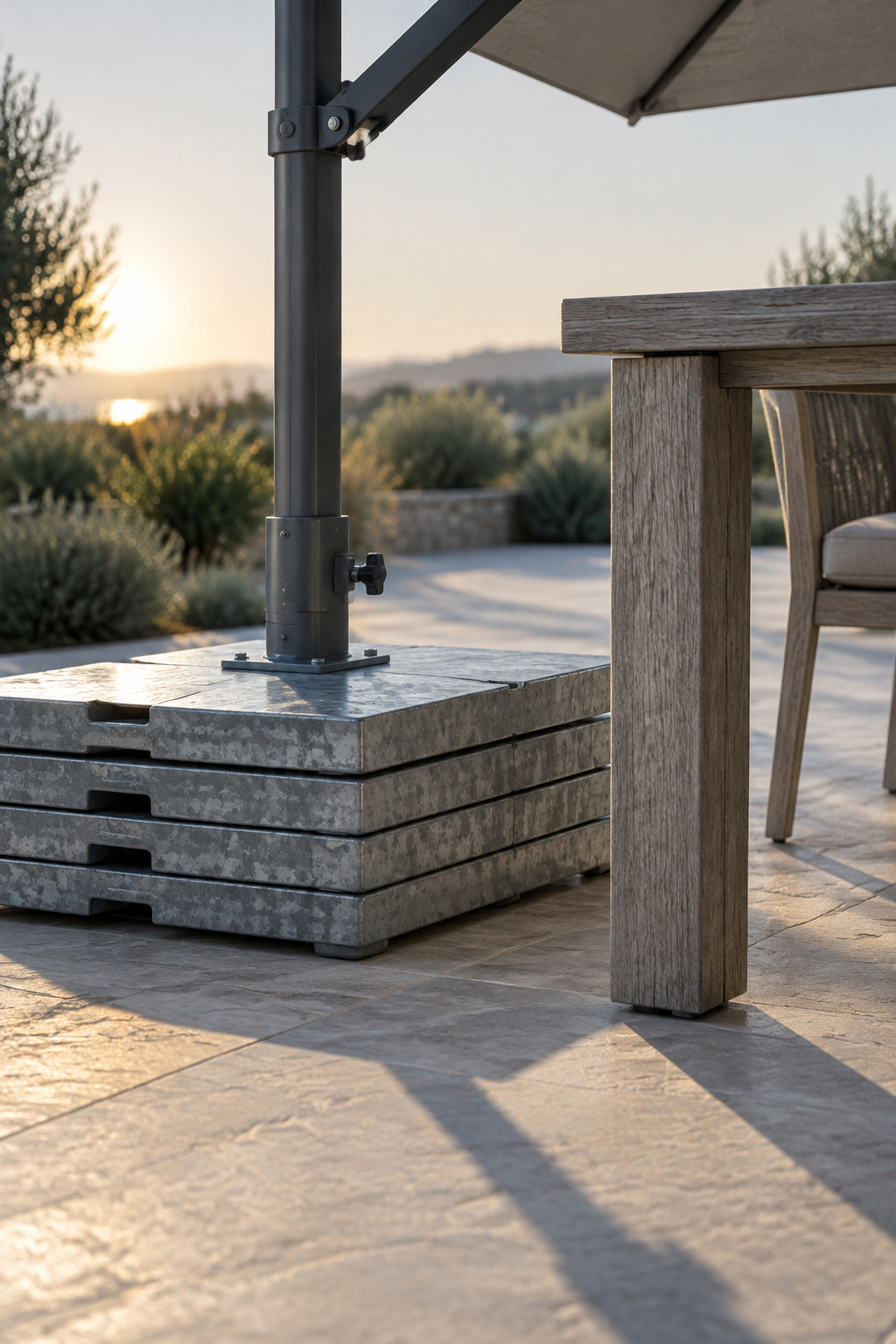
You’ll meet a tidy ratio of ten pounds of base weight per foot of canopy diameter, presented as an industry standard citing ASTM F3681 and ASCE 7. It isn’t one, since F3681 governs beach umbrellas, ASCE 7 is a general building wind-load standard nobody adapted into a consumer figure, and the ratio is a rule of thumb wearing borrowed credentials. Use the spec sheet for the umbrella you’re buying. California Umbrella’s Solana cantilever (10–11 foot canopy) calls for 340 lb of galvanized dual-plate ballast, and Frankford’s Aurora wants 335–400 lb of stacked plate, with the bigger Eclipse up to 555–600 lb. Market umbrellas live elsewhere: Aosom lists 30–70 lbs in comparable sizes, and maker Alizé’s field testing puts a 9-foot market umbrella at a 50 lb minimum, rising to 80 lbs where 25 mph gusts are ordinary. That’s from wind-tunnel work against F3512 and the Australian standard AS 4174, not any per-foot ratio. Size the base for the windiest ordinary evening your yard gets, not the calm afternoon in the catalog photo.
What This Buys You on an Actual Evening
Back to that nine-foot canopy over the forty-eight-inch table. The chart was right and so is the arithmetic. They answer different questions. You size for the sun overhead, then solve for the sun on the side, and the number on the box only does the first job.
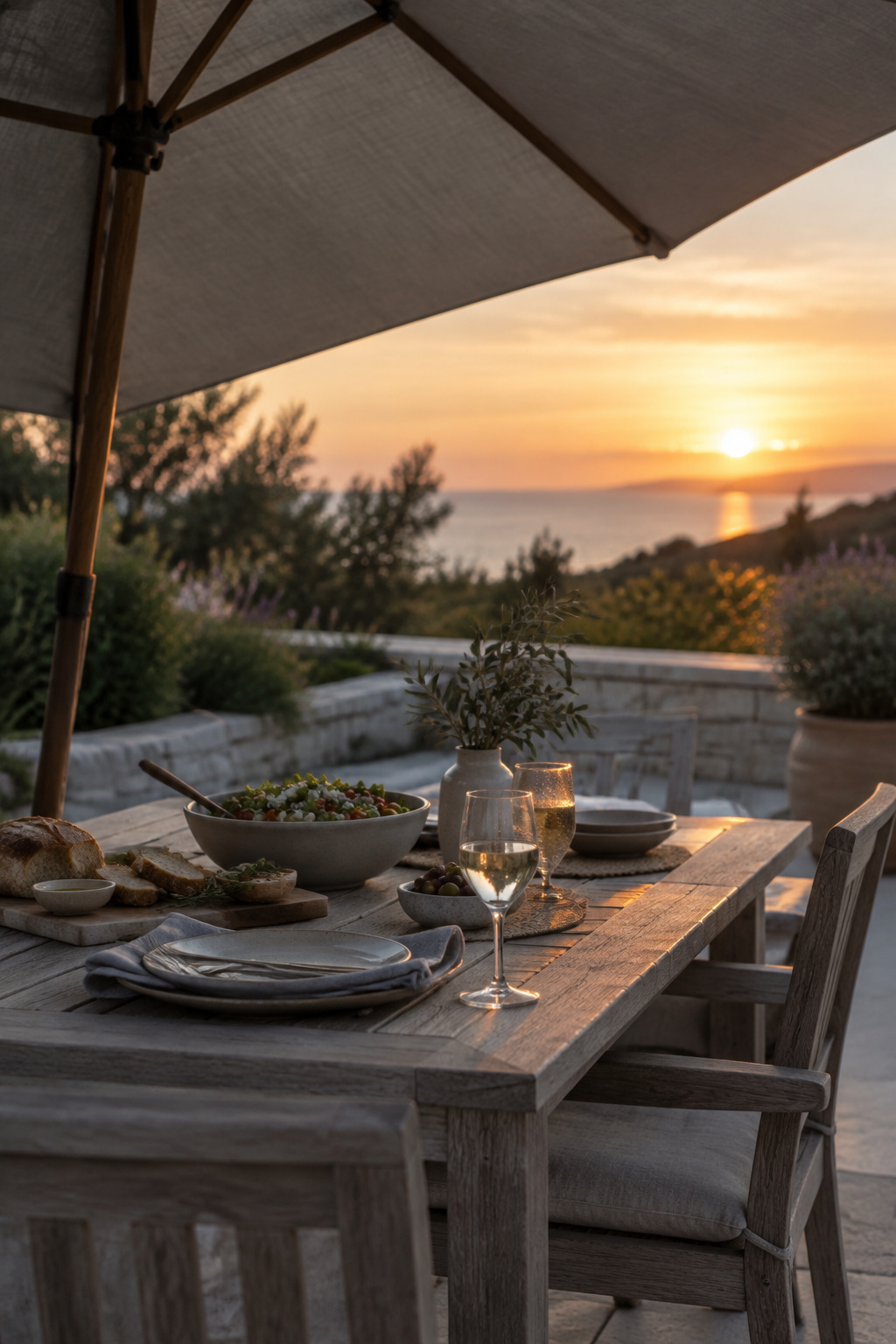
The second job is all motion. A tilt mechanism lets a fixed canopy track partway through a meal, and a cantilever’s 360-degree rotation and multi-axis tilt follow the low sun as it swings around to the side, which a center pole’s single-direction tilt can’t. Or put the table where something already blocks the west at seven and accept a bright first course.
One maintenance truth: a movable canopy is the part of a dining setup likeliest to be destroyed rather than worn out. An umbrella left open in a gust, or standing all winter, rarely fails slowly. Closing and storing it makes the whole difference, and getting an umbrella through a winter intact is its own short discipline. Size it for noon, point it at six, put it away in November.
FAQ
Does a bigger umbrella always mean better shade coverage?
Only up to a point, and only for the midday hours the two-foot rule was built around. The shadow’s offset grows explosively as the sun drops, so no fixed diameter keeps pace by late afternoon. An oversized canopy also catches more wind and needs a heavier base.
Why do cantilever umbrellas cost more than market umbrellas?
The offset arm’s leverage means a cantilever needs a base several times heavier for the same canopy, and spec sheets show 335–600+ lb against 30–70 lb for market umbrellas. It also needs a multi-axis tilt a center pole never does. Kevin Lenhart frames the premium as unobstructed space, not shade.
How much wind can a patio umbrella handle before it should come down?
No single number is published. ASTM F3512 is a real wind-safety test method rated on the Beaufort scale, but manufacturers test their own assemblies against it instead of publishing a threshold. One maker’s wind-tunnel benchmark was 50 km/h, about 32 mph, and cantilevers are commonly closed at 20–25 mph.