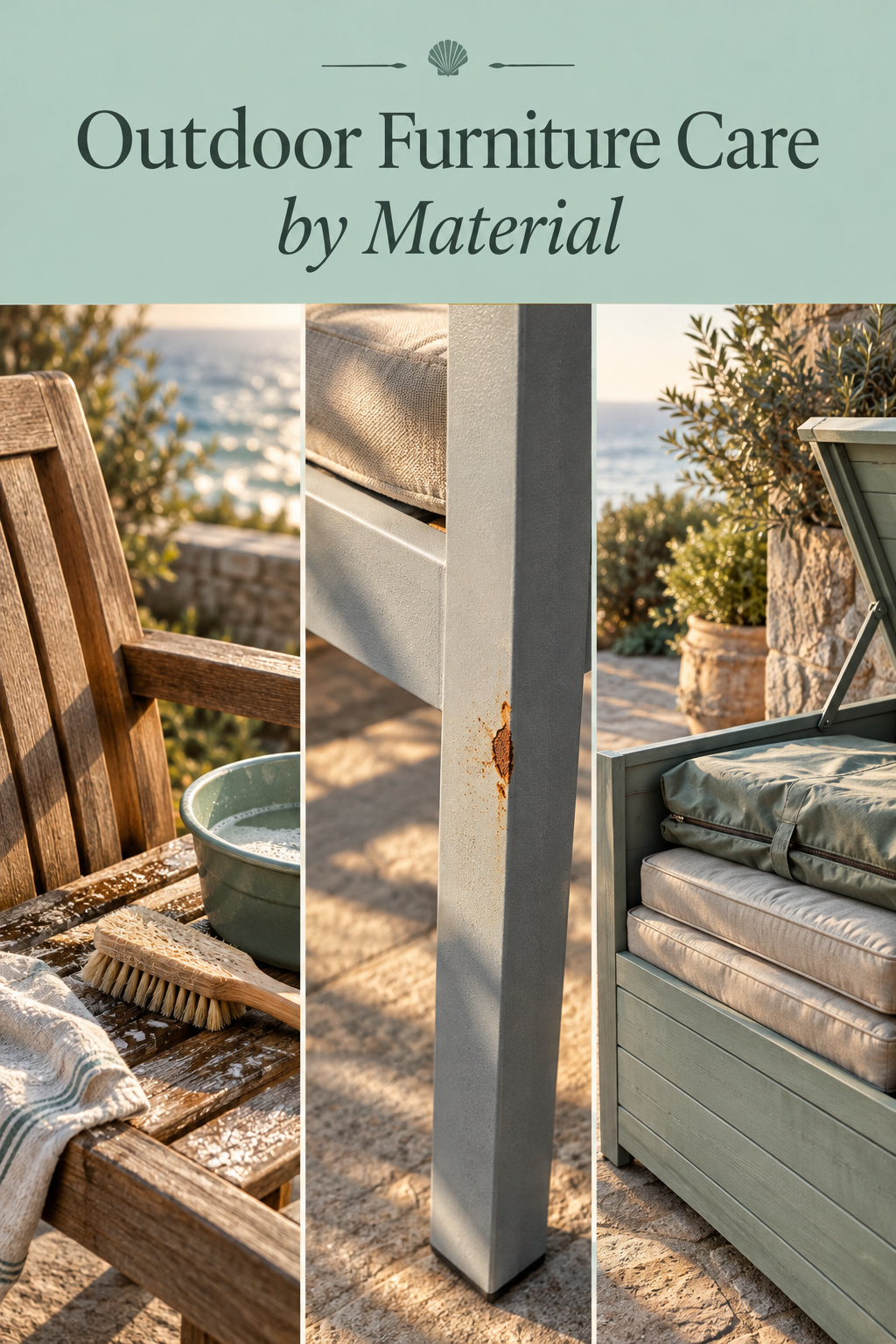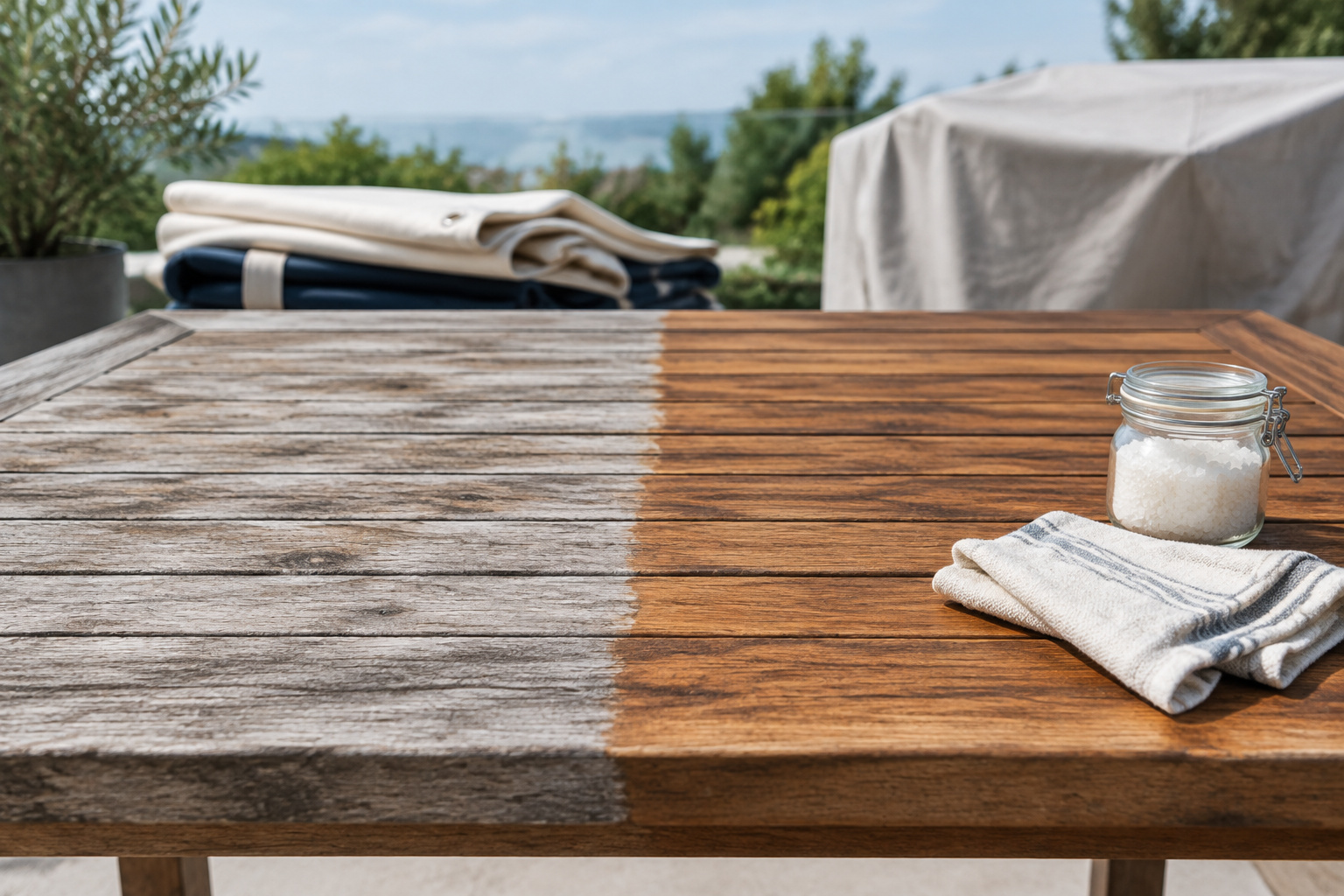

Search for a teak maintenance calendar and you’ll find plenty of instruction about what to do and nothing about when. No manufacturer, forestry body or conservation standard publishes one. That gap is the most useful fact in outdoor dining furniture care. The honest answer is a trigger you learn to read, material by material, not a date.
TL;DR
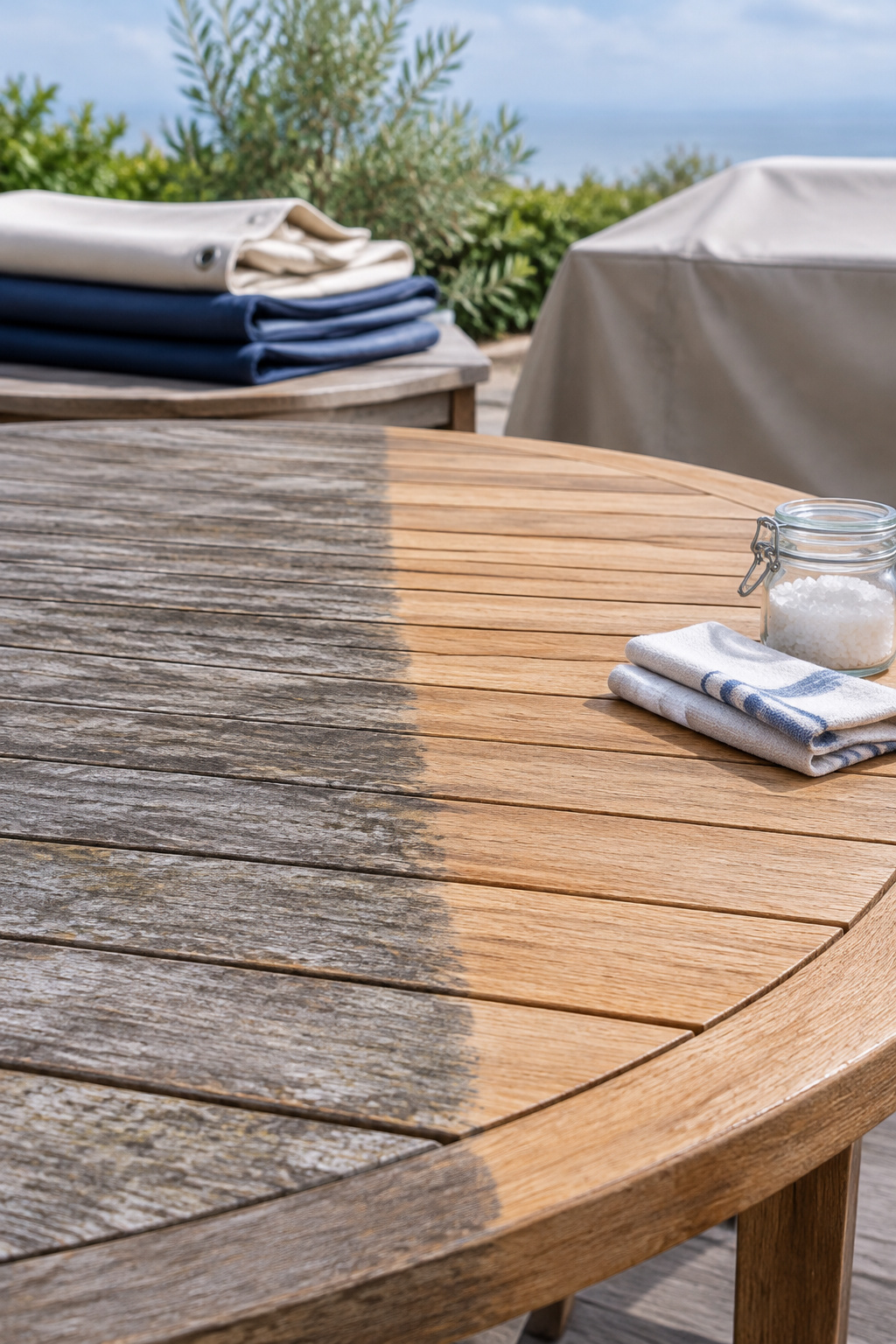
- Bleach is the villain on wood and the cure on fabric. It breaks down the lignin that stiffens wood cell walls, yet Sunbrella’s own mildew instruction for solution-dyed acrylic is a cup of bleach per gallon.
- Gray teak wants oxalic acid, and no schedule at all. Four to eight ounces of crystals per gallon chelates the iron-tannin staining and leaves the lignin alone. Use it as graying appears, not on a date.
- A fully waterproof cover causes the damage it was bought to stop. Non-breathable vinyl seals dew underneath; breathable is the standard, and in freeze-thaw climates cushions come indoors regardless.
What a Ruined Oak Chest Taught Me About Cleaning Outdoor Wood
I was nineteen and certain. The chest was oak, its finish cloudy in patches, and I had a can of stripper that had worked beautifully on a pine door. Within an hour the cloudiness was gone, and so was something else. The surface went flat and thirsty, and every coat afterward sat on it like wax on a countertop. It never really came back. My mistake was trusting a product because it had worked on something else.
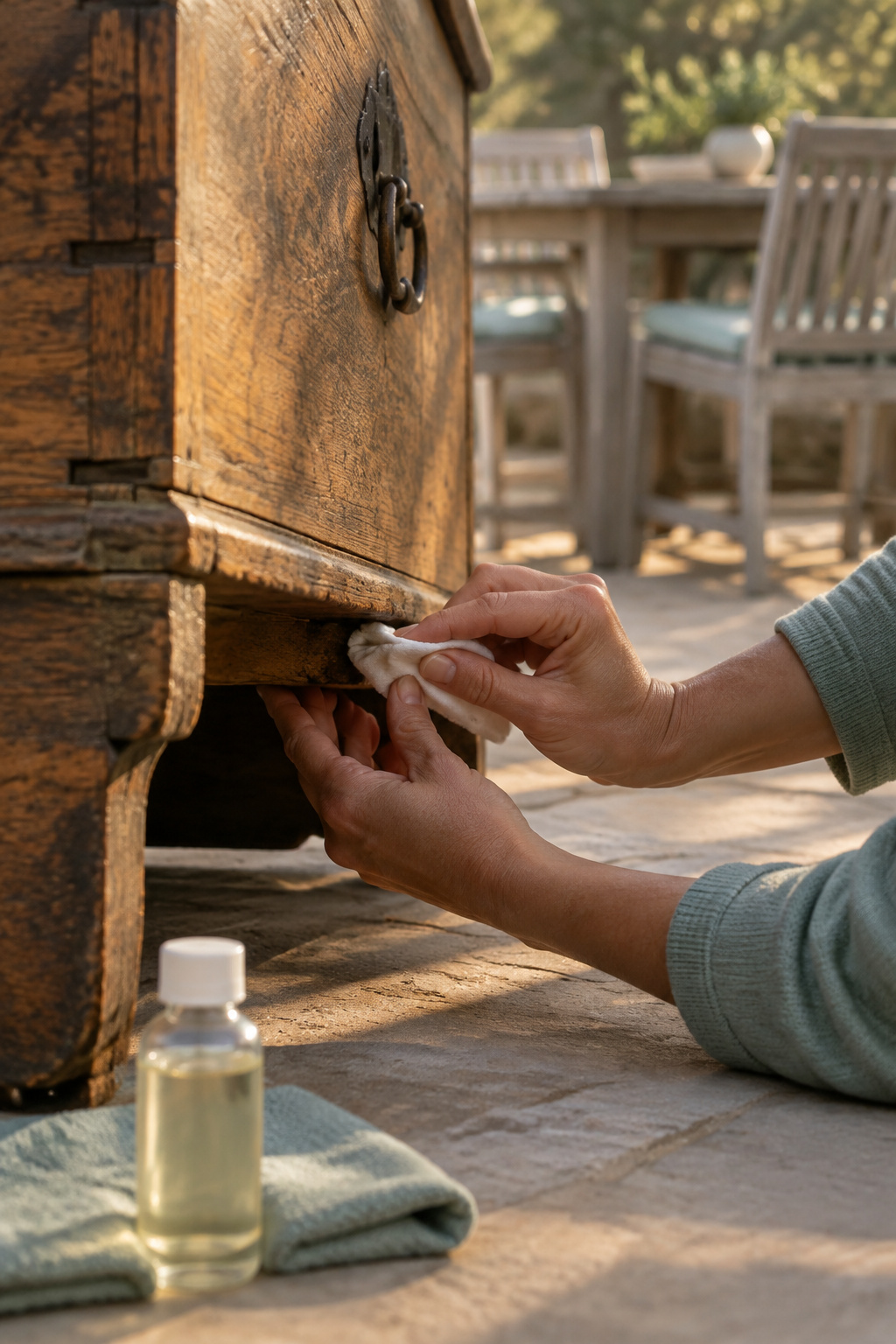
Conservation practice formalizes exactly that. The American Institute for Conservation’s Code of Ethics asks that treatment be undertaken only where it suits an object’s physical and aesthetic characteristics. Its Guideline 21 goes further: where non-intervention better serves preservation, recommending no treatment is the correct call. Guideline 23 requires that any repair be reversible. So identify the material before you reach for a bottle, and prefer the treatment you can undo.
Where the food gets cooked and what the floor is made of belong to other articles. Where care sits among the rest is mapped in the outdoor dining survey.
Teak and Hardwood: The Cleaner That Helps, and the One That Quietly Strips It
Two bottles on the same hardware-store shelf do opposite things to a hardwood table: chlorine bleach, and oxalic acid sold as wood or deck brightener.
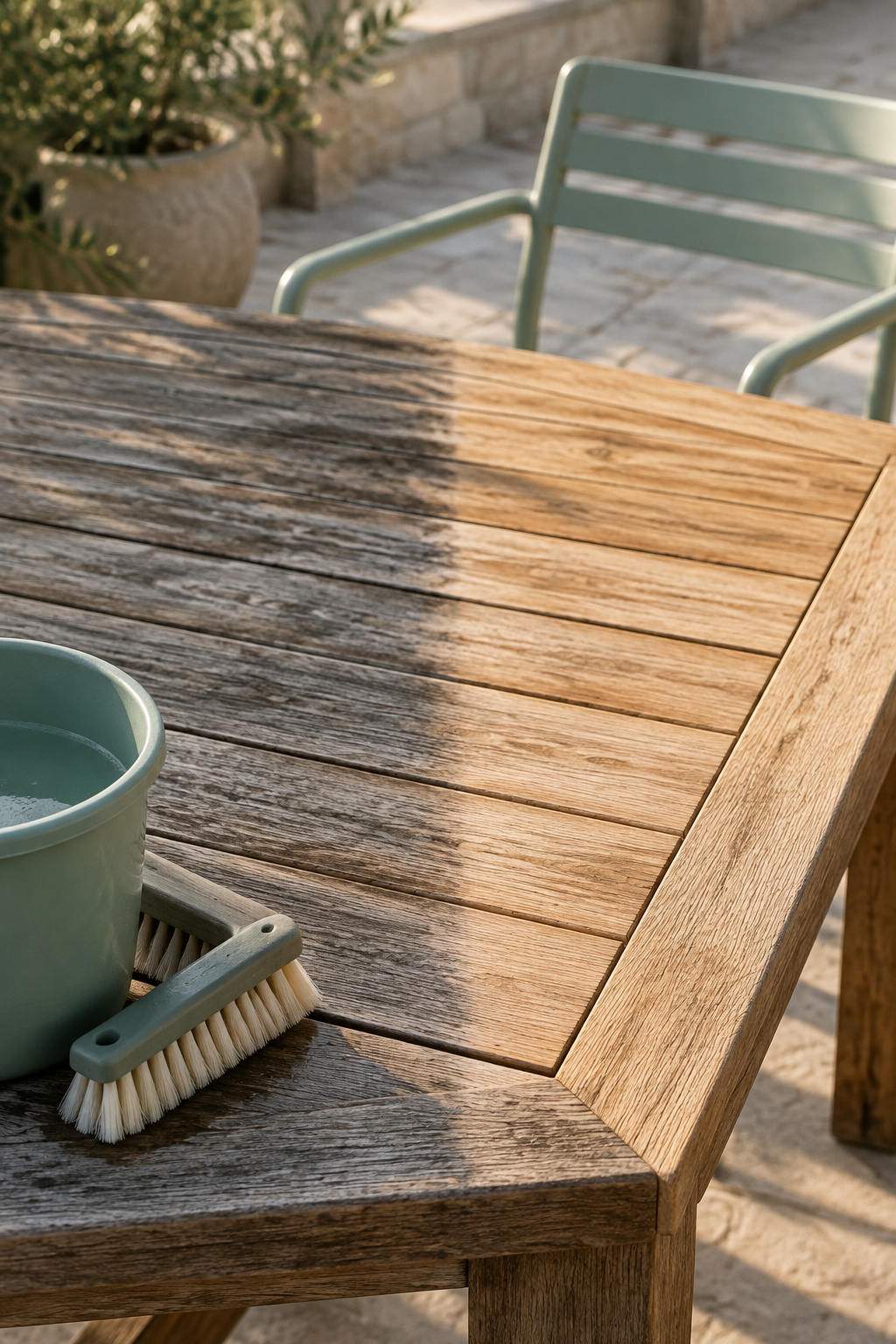
Bleach attacks lignin, the compound that hardens wood cell walls. Permachink, a log-home coatings maker, states the outcome plainly: the surface goes fuzzy and over-absorbent, and a film finish has nothing sound to bond to. A peer-reviewed materials study measured the damage. Wood immersed in undiluted sodium hypochlorite showed the lignin linkage among fibers clearly broken, and some samples could not finish a tensile test.
Oxalic acid works differently. It’s a chelating agent: it binds iron into water-soluble ferrous oxalate that rinses away, lifting iron-tannin staining without touching the lignin. The field mix is four to eight ounces of crystals per gallon of warm water, three to ten minutes of dwell, then a thorough rinse, since acid left in the grain interferes with any later finish. Use it on bare wood only.
Pressure washing is where the sources genuinely disagree. One source citing the Pressure Washer Manufacturers’ Association gives 500–800 PSI as the ceiling for wood decking. Simpson and Greenworks call 1,500 PSI more than sufficient and 1,500–2,500 PSI the sweet spot. The association’s own publication was never reached directly, only a secondhand attribution to it. On technique they agree: a 25-to-40-degree fan tip, six to eighteen inches off the surface, always with the grain. On teak’s soft earlywood I stay conservative.
The refinishing interval? There isn’t one, in any unit. Every source I found treats brightening and re-oiling as appearance-driven, and the conservation instinct is to let a hardwood weather instead of intervening on a cycle. Brighten when the gray stops looking like patina, not in April. Whether it should have been teak belongs to the material the piece is made of in the first place.
Metal, Poly Lumber, and Wicker: Low-Drama Materials, One Catch Each
Most damage to powder-coated aluminum isn’t done by weather. It’s done by a pressure washer, on one afternoon, by someone being thorough.
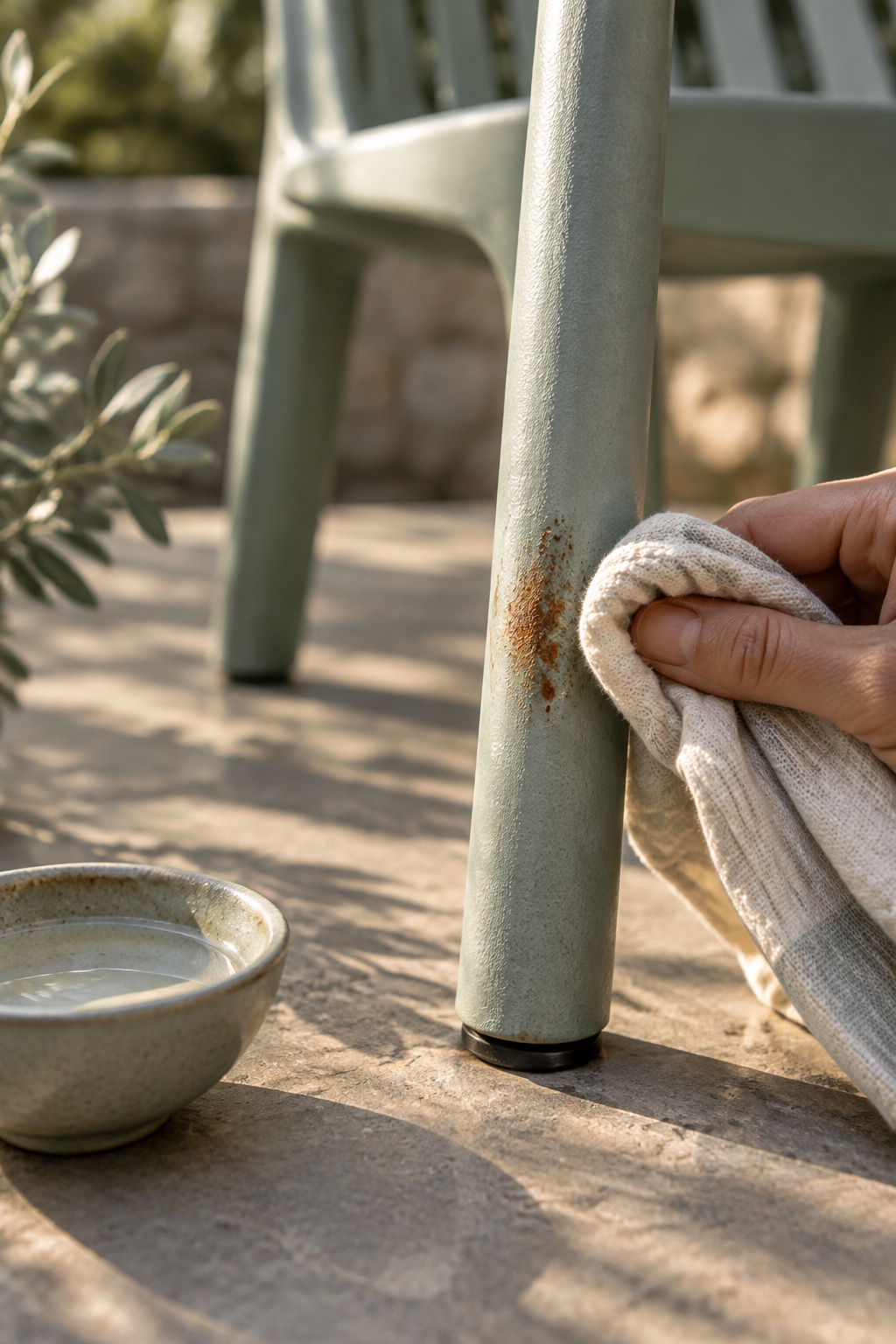
Each of these three has exactly one thing that ruins it. Sullivan Furniture’s method for powder-coated aluminum and steel is mild dish soap in lukewarm water with a soft brush. Abrasive cleaners and pressure washers attack the coating instead of the dirt, and a washer can strip powder coat off metal.
Wicker’s catch is water under pressure. Interior designer Samantha-Jane Agbontaen calls a hose or pressure washer “perhaps the worst thing you could do” to wicker, because pressure drives water into the weave joints, where it warps, loosens and grows mold. KC Collins of Chair King and Rafi Friedman of Coastal Luxury Outdoors both prescribe the same alternative: a damp, not soaked, microfiber cloth with dish soap, air-dried completely. It is strong enough for most dirt and gentle enough for the rattan.
HDPE poly lumber’s catch is the one I can’t document. Its manufacturer, RPI Lumber, states in its own data sheet that the product will not absorb moisture, rot, splinter or crack, and is “essentially maintenance free” beyond occasional soap and water. The warning repeated everywhere else, to avoid solvents and acetone especially, sits behind no data sheet or lab test I could find. So I give the maker’s instruction, not the prohibition.
| Material | Clean with | Avoid | How often |
|---|---|---|---|
| Powder-coated aluminum / steel | Mild dish soap, lukewarm water, soft brush; 1:1 vinegar and water for rust spots | Pressure washers, abrasive pads, harsh solvents | Wipe-down each season; rust spots as they appear |
| HDPE poly lumber | Soap and water (the manufacturer’s sole stated requirement) | Abrasive pads | As needed; no scheduled maintenance per the maker |
| Resin or natural wicker | Damp cloth, mild dish soap, air-dried fully | A hose or pressure washer at any setting | Wipe as dirt appears; full clean each season |
Rust Spots and Touch-Up Paint
A rust spot on powder coat is usually staining on the coating rather than corrosion beneath, and the two want different answers. For the first, Sullivan’s fix is equal parts white vinegar and water on a soft cloth, a soft brush for stubborn spots, then car wax so it doesn’t return. Touch-up paint is for the second case only, where the coating is chipped to raw metal.
Cushions and Canopy Fabric: Drying, Storing, and Stopping Mildew Before It Starts
Now the reversal. The bottle I just told you to keep away from a teak table is the one the fabric manufacturer prescribes. Sunbrella calls its fabrics mildew-resistant by design, yet its own mildew instruction is a quarter cup of dishwashing liquid and one cup of bleach per gallon of warm water, soaked fifteen minutes, then rinsed and air-dried. The surface decides the verdict on the same bottle.
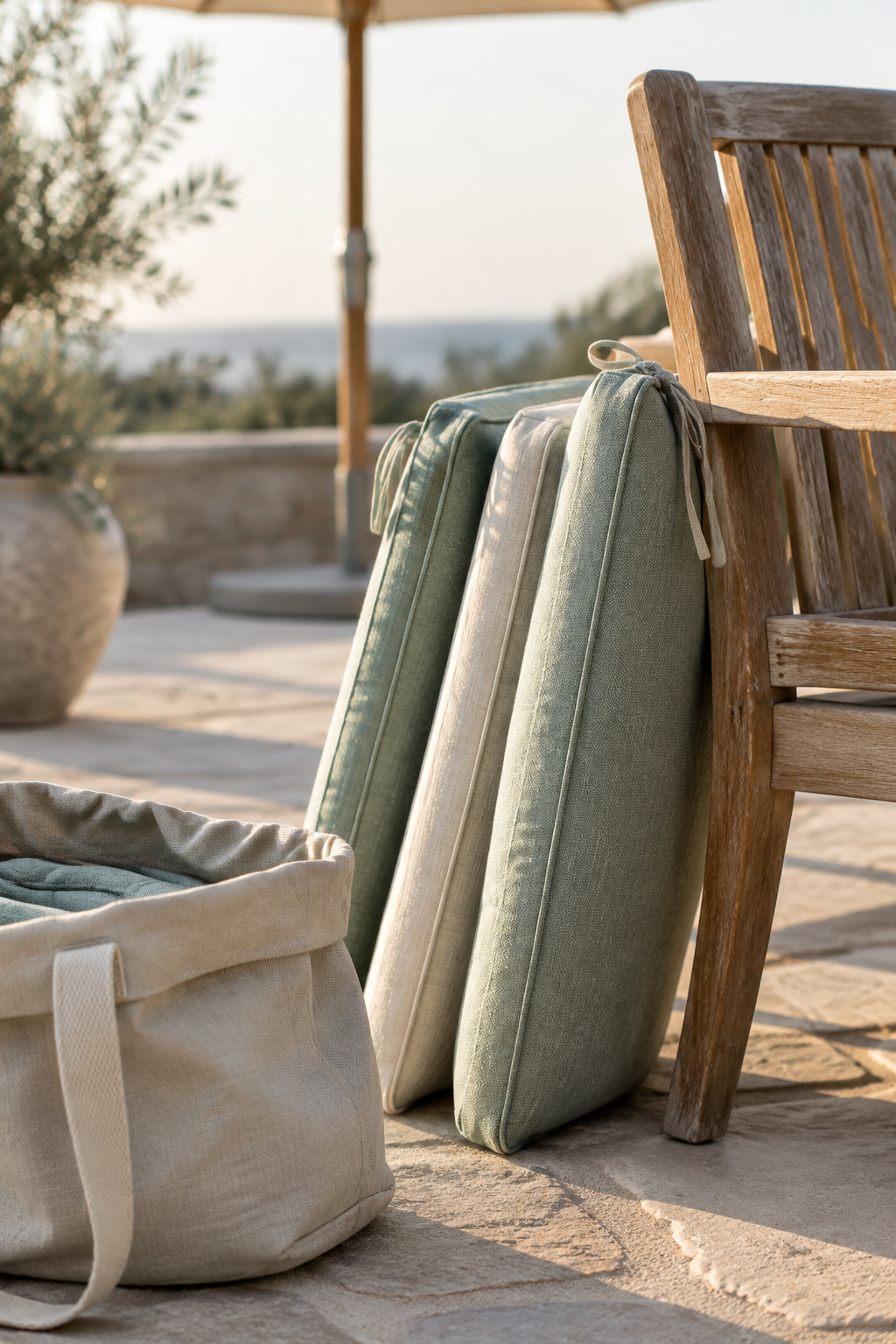
Resistant is not immune, and the fabric is rarely what fails; storage is. A foam core absorbs moisture and, trapped wet, becomes a mold site. So cushions go away bone dry, in breathable containers rather than sealed bins, with silica-gel packets if the space is humid.
In a freezing climate they go indoors. Paul Knapp, quoted by Family Handyman, puts it without qualification: bring cushions in for the winter even when the frames stay outside under a cover, because freeze-thaw cycling on damp fabric and foam accelerates wear that dry storage avoids.
The Umbrella and Canopy: The Piece Almost Everyone Stores Wrong
California Umbrella’s care guidance opens with the sentence every catalog buries: no umbrella is windproof. It says to close the canopy in strong wind even if the product is rated for higher wind, and never to leave one open unattended, least of all on an elevated deck, where wind is amplified. The manufacturer declines to let its own rating be read as permission.
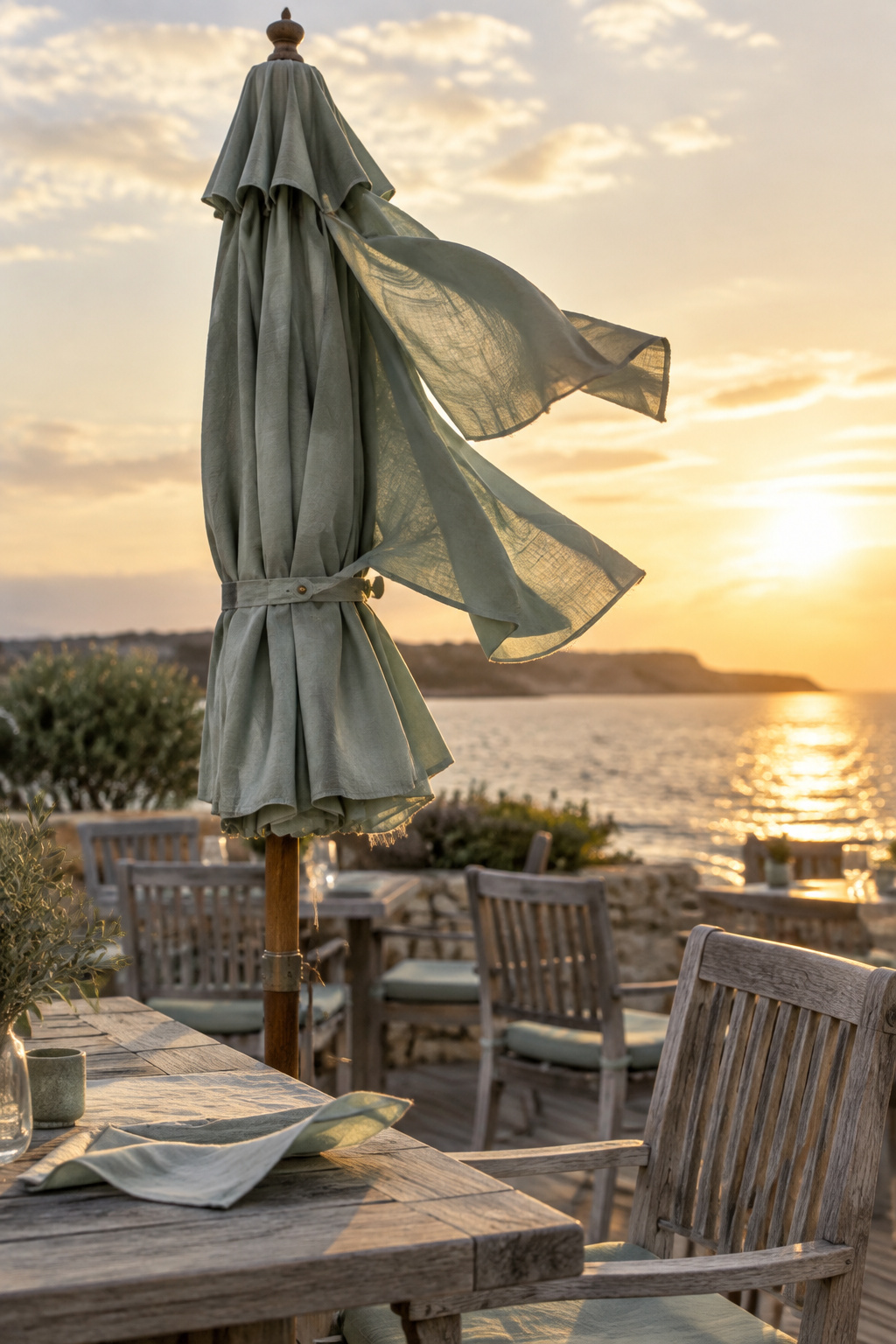
For seasonal storage the canopy comes off the frame. Both go somewhere dry, the frame upright under a cover to limit dust and UV, the fabric completely dry before folding. A damp canopy put away in November is a mold colony by March. How large that canopy needed to be is settled in the sizing of the umbrella over the table.
Wind and a Furled Canopy Left Up
A furled umbrella left mounted is not a neutral state, and the reason is arithmetic. Wind force scales with the square of speed: F = ½ × ρ × v² × A × C, where ρ is air density at 0.075 lb/ft³, v is speed in mph, A is exposed area and C a drag coefficient.
Here is my own working. Take an illustrative 8 sq ft of loosely furled fabric (not the canopy’s open area) and an assumed drag coefficient of 1.0. At 20 mph, F = 0.5 × 0.075 × 400 × 8 = 120 lb; at 40 mph, F = 0.5 × 0.075 × 1,600 × 8 = 480 lb. 480 ÷ 120 = 4, exactly the (40/20)² the formula predicts. Illustrative inputs, not a specification for any umbrella.
Double the wind, quadruple the load.
Outdoor Dining Furniture Care by Material: A Quick Reference
Everything above on one page: cleaner, contraindication, interval, winter home.
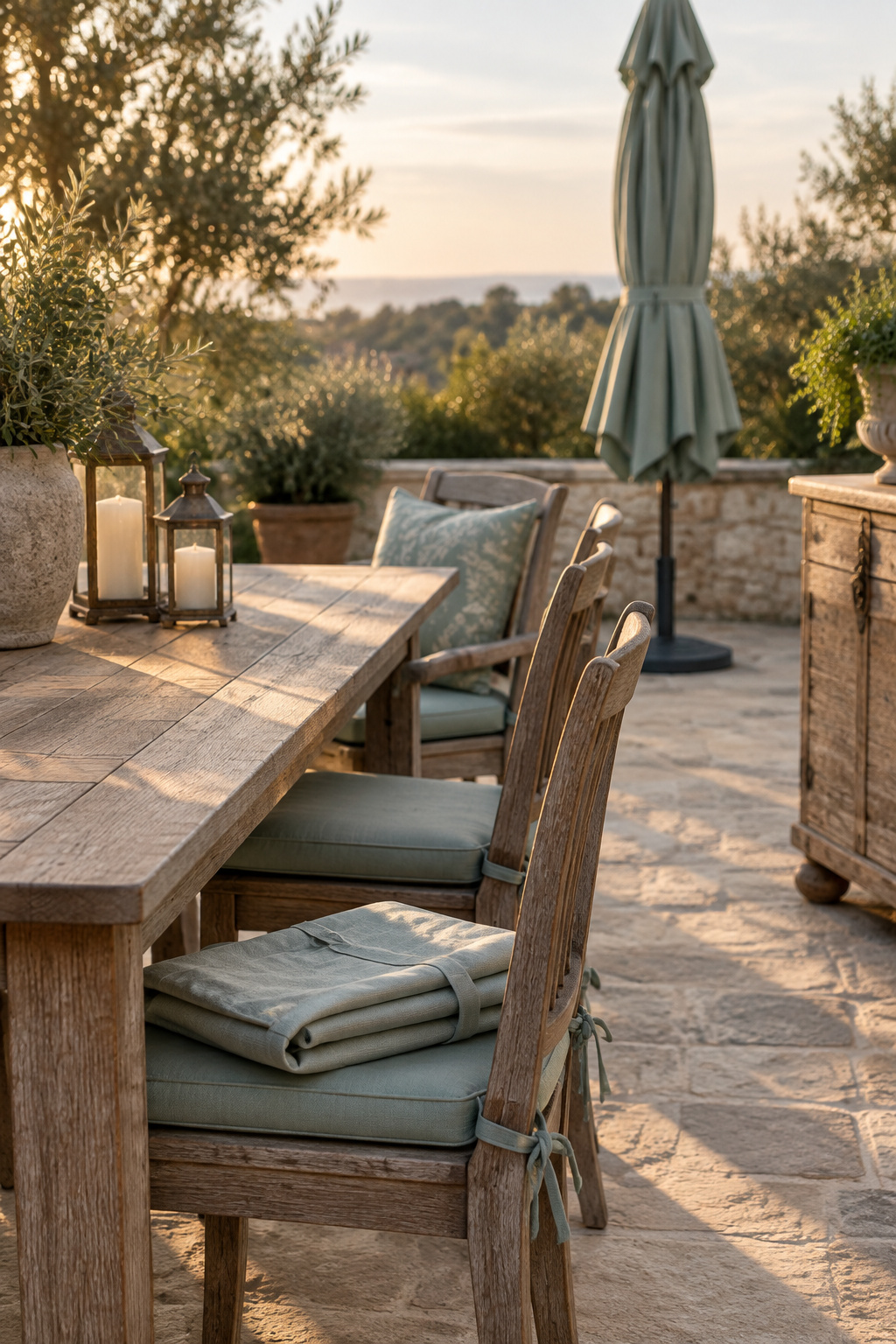
| Material | Clean with | Avoid | Attention interval | Cover or bring inside |
|---|---|---|---|---|
| Teak / outdoor hardwood | Mild soap and water; oxalic-acid brightener for graying | Chlorine bleach; high-pressure or close-range washing | Brightener as graying appears, not on a calendar | Breathable cover outdoors |
| Powder-coated aluminum / steel | Mild dish soap and water; 1:1 vinegar and water for rust spots | Pressure washers, abrasive pads | Seasonal wipe-down; rust spots as they appear; touch-up paint only where chipped | Breathable cover is enough |
| HDPE poly lumber | Soap and water | Abrasive pads | As needed; no scheduled maintenance per the maker | Can stay out uncovered; a cover is cosmetic |
| Resin / natural wicker | Damp cloth, mild dish soap | Hose, pressure washer | Wipe as needed; full clean each season | Breathable cover; never soak |
| Cushions / canopy fabric | Dish soap and water; diluted bleach (1 cup per gallon) for mildew, per Sunbrella | Storing while damp | Clean as stains appear; fully dry before every storage cycle | Indoors in any freeze-thaw climate, cover or no cover |
| Umbrella / canopy | Mild non-detergent soap and water | Leaving a furled canopy mounted in wind; storing damp | Close in strong wind regardless of rating; canopy off the frame for the season | Frame outdoors, covered and upright; canopy stored separately and dry |
That last column is where money gets wasted: a waterproof vinyl cover seals dew in and grows the mold it was bought to stop.
The oak chest is still in my workshop, still flat in the patches I ruined. Between nineteen and now I never found a schedule. I stopped asking when and started asking what, then watched for the signal each material gives. Teak tells you by graying, powder coat with a rust bloom at a weld. A cushion tells you by weighing more than it should, and a canopy with a forecast. Keep one date only: before the first frost, cushions dry and inside, canopy off its frame, a breathable cover over what stays out. Nothing else runs on a calendar. You are the current steward of that set, and the reversible choice is nearly always right.
FAQ
Can outdoor cushions stay outside all winter if they’re kept covered?
In a genuine freeze-thaw climate, no. Cushions should come indoors even when the frames stay outside under a cover, because repeated freezing and thawing of damp fabric and foam accelerates wear that dry storage avoids. A cover won’t fix that, because foam cores hold moisture and turn into mold sites.
Is it safe to pressure wash a resin wicker patio set?
No. Interior designer Samantha-Jane Agbontaen calls a hose or pressure washer perhaps the worst thing you could do to wicker, because pressure drives water into the weave joints and causes warping, cracking, loosened joints and mold. Use a damp, not soaked, microfiber cloth with dish soap.
What’s the real difference between a breathable and a non-breathable furniture cover?
A non-breathable PVC or vinyl cover is fully waterproof and seals humidity, dew and residual moisture underneath. Condensation there produces the mold, mildew and rust the cover was bought to prevent. A breathable cover lets that vapor escape and still sheds rain.