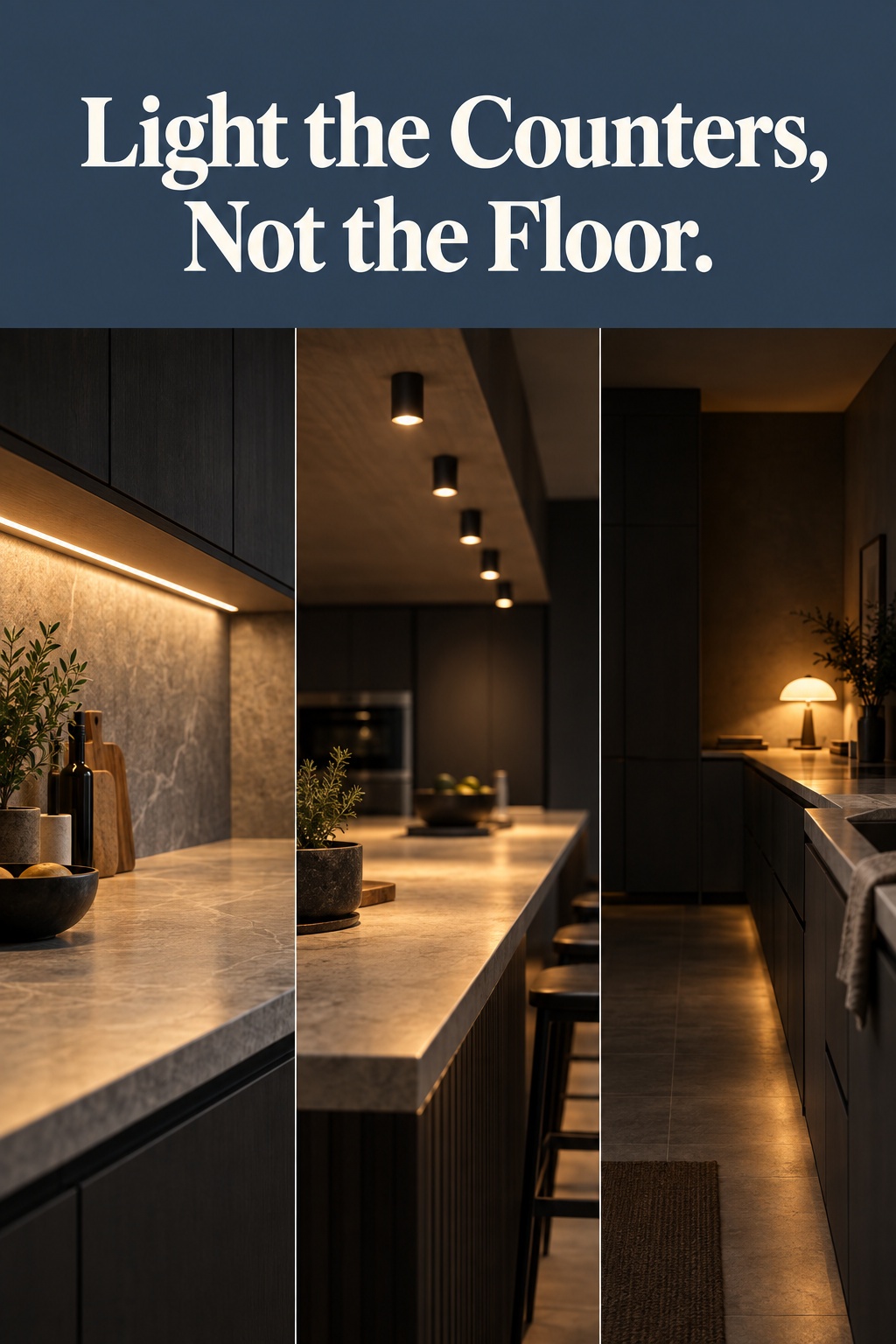
I pick up my one good chef’s knife, sharpened on Sunday evening, and lean in over the board. The edge shows any light that reaches it. In a galley lit by a single row down the middle of the ceiling, very little does. The dark patch on the board is your own head.
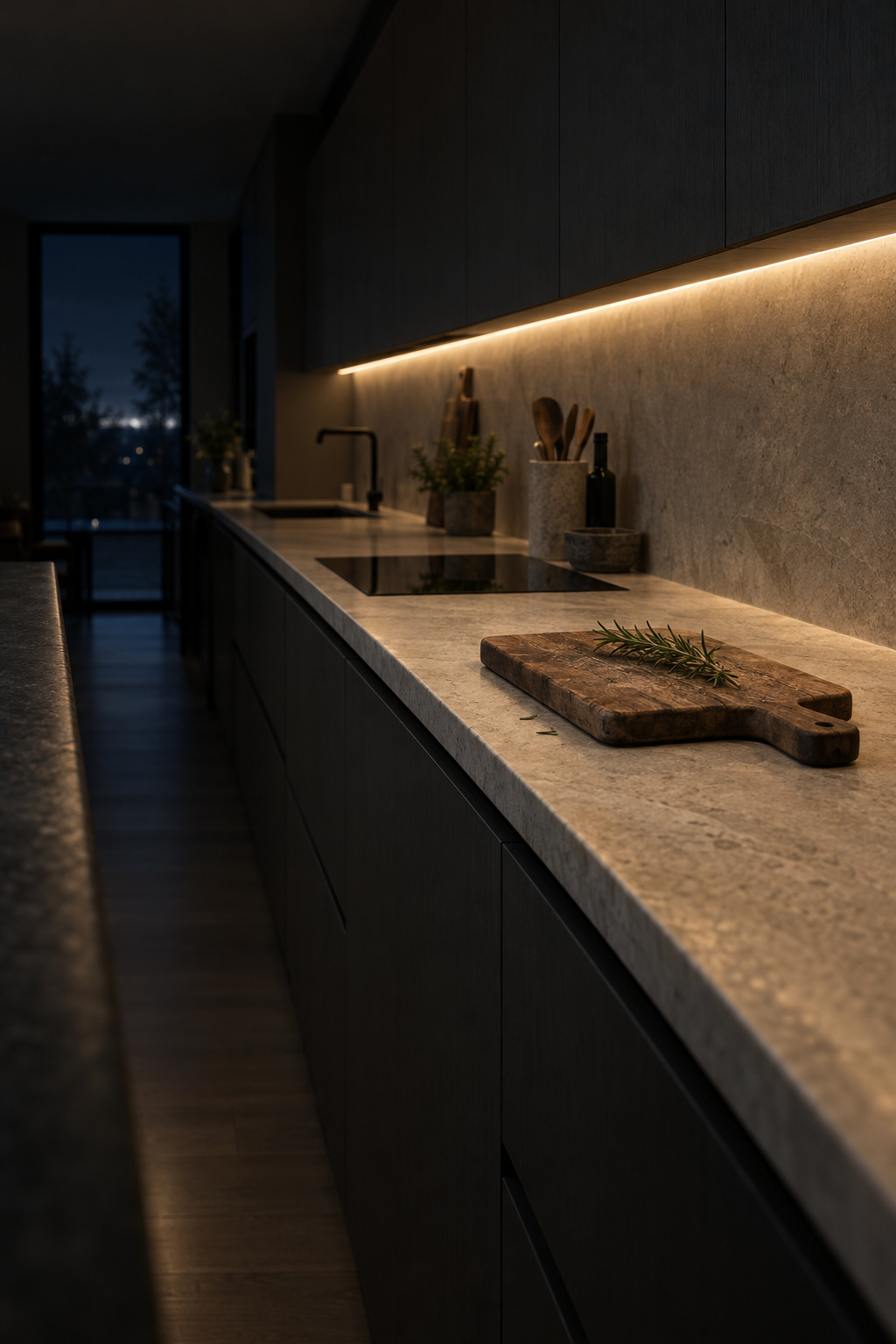
That is the trouble with most galley kitchen lighting. The ceiling row lights the floor, the aisle and your back, and the counters get whatever leaks past your shoulders. The fix is not a brighter bulb. Each counter gets its own light, the ceiling keeps the job it is good at, which is cleaning, and one low lamp takes the evening.
TL;DR
- A ceiling row down the middle of a galley sits behind you when you face a counter, so your head and body shade the work; put a light under the uppers on both runs, toward the front edge of the cabinet.
- Ceiling lights belong over the front edge of each counter, not down the aisle, and their real job is walking, looking into cupboards and cleaning.
- Set color by job: neutral 3500–4100K at the counters, warm 2700–3000K on the ceiling and the evening lamp, with each light on its own switch or dimmer.
Why standard galley kitchen lighting leaves you cooking in your own shadow
Builders usually light a galley with a row down the center of the ceiling. It gives you enough light to walk through and to see inside the cabinets. Then you turn to a counter to work, and you are standing between the light and the thing you are cutting.
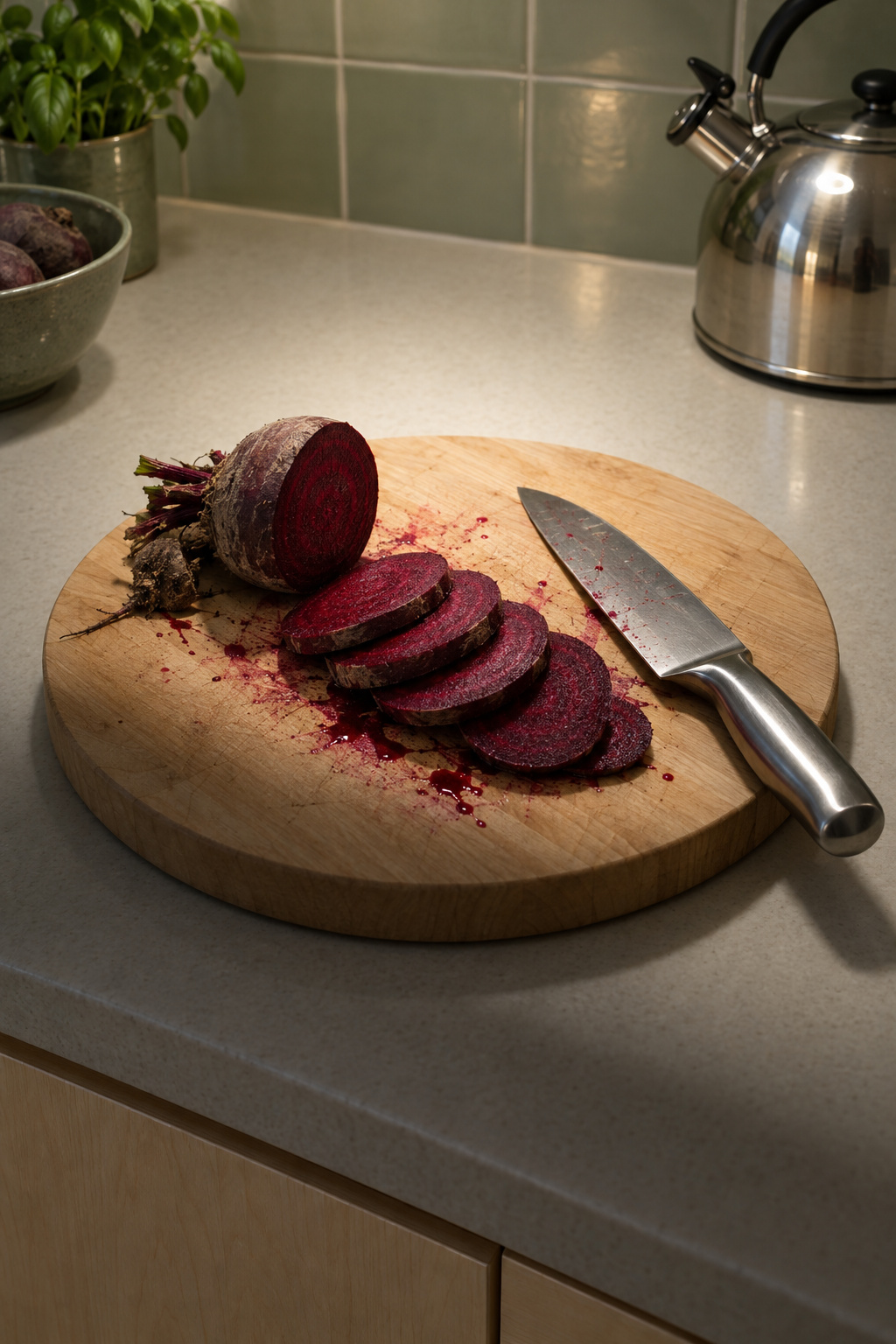
Steven Bliss puts it plainly in his best-practices guide to residential construction: “Overhead light often casts shadows from a person’s head and body onto the work surface.”
The uppers make it worse. Wall cabinets cut the line between a ceiling fixture and the counter underneath, so a galley can feel bright the moment you switch it on and still leave the chopping board dim.
The usual response is a bigger bulb. I have never known that to work, because more light from the same spot gives you the same shadow. The old BBC Homes advice on kitchen lighting still holds here: with only a central light, you will be “forever working in your own shadow.”
So move the light. Overhead lighting is for cleaning, not for living. A galley needs three lights with three jobs, one per counter for the work, the ceiling for the floor and the cupboards, and something low for the hours when nobody is cooking.
Job one: a light under the uppers on both counters
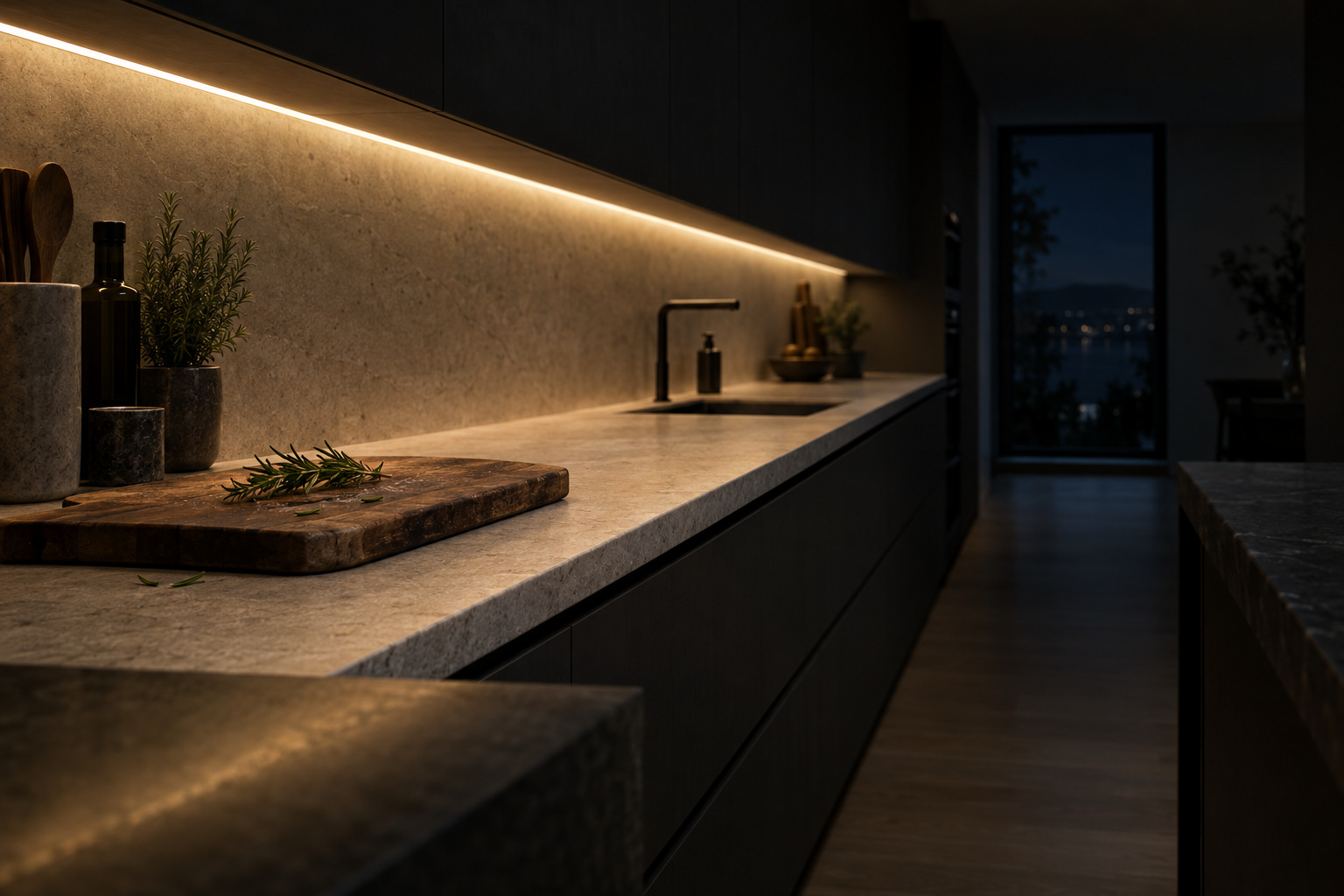
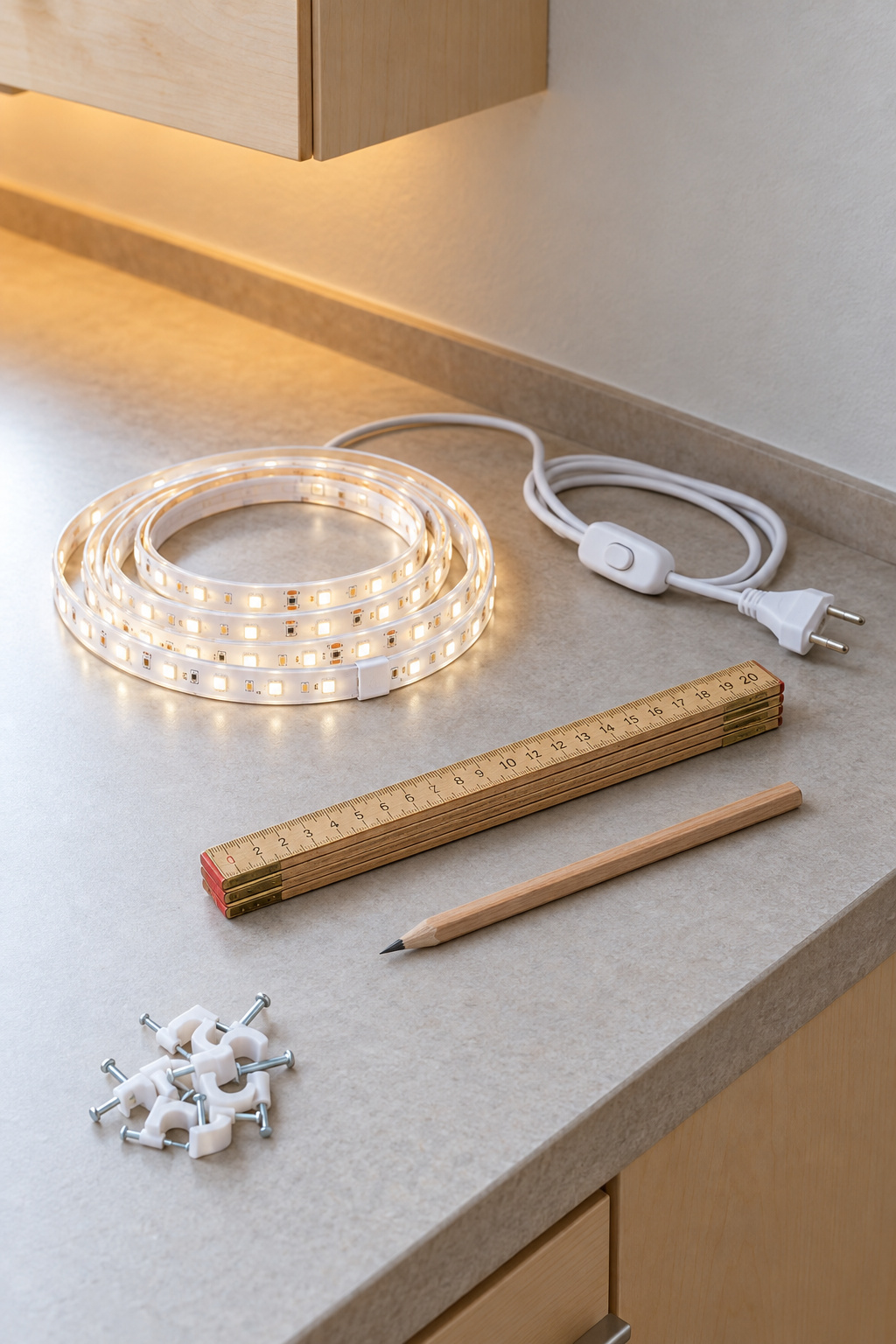
This is the light that does the work. Mounted under the wall cabinets, it sits between you and the counter, a little in front of your body, so your shadow falls behind you into the aisle where it does no harm.
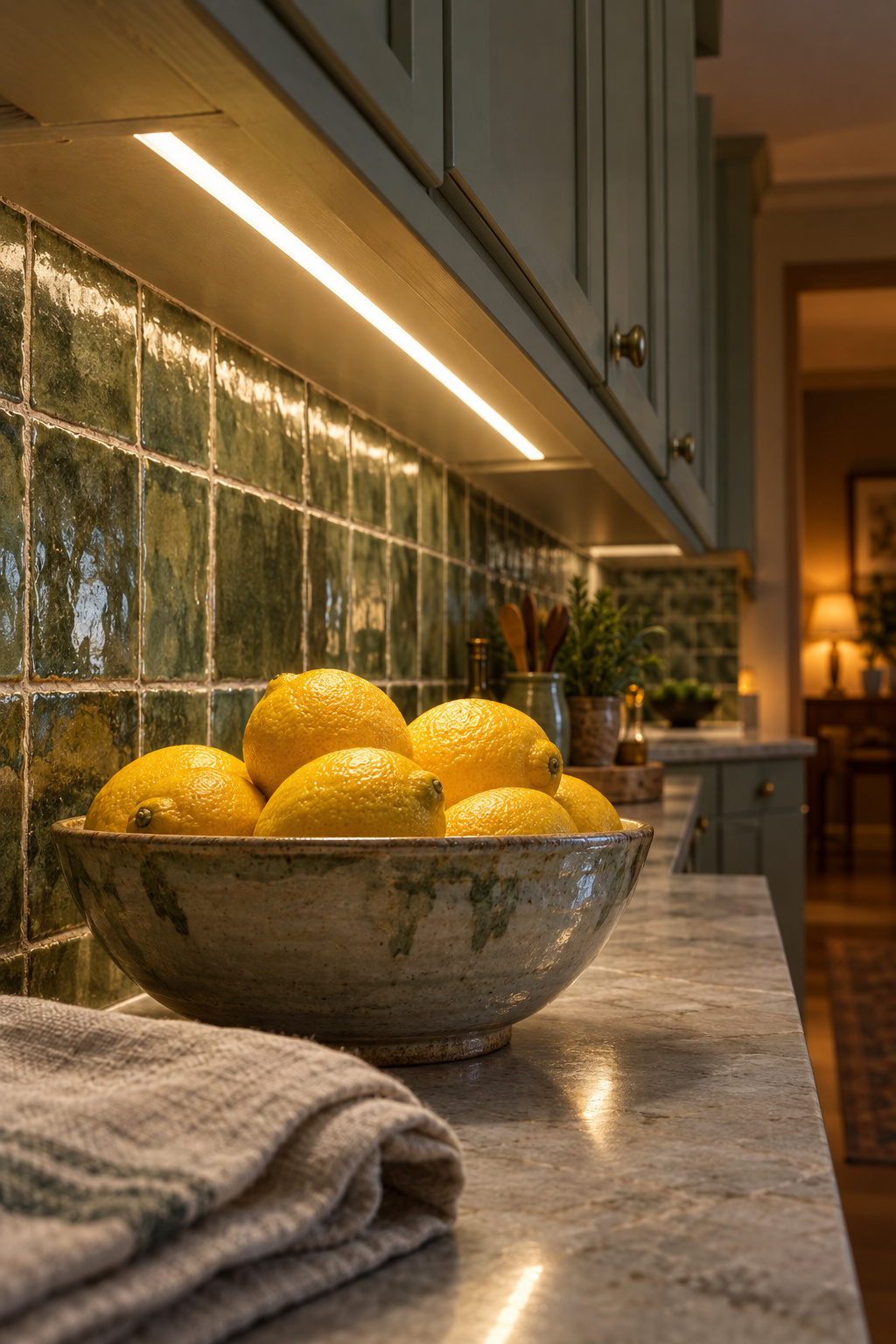
Where you put it along the depth of the cabinet matters more than what you buy. Push the strip back against the backsplash and it washes the wall while the front of the counter, where your hands are, stays dim. Bliss recommends placing under-cabinet lights as close as possible to the front of the cabinets, which also keeps glare from bouncing off a shiny worktop into your eyes. One retailer puts the figure at 5 to 8 cm back from the front edge, about 2 to 3 in.
Hide the source. A bare strip at eye level is a bright line you notice every time you sit down, so use a fitting with a diffuser and check it from standing and sitting before you fix it.
Distance does more than output. Double the distance from a light to the task and you get a quarter of the light, which is why a modest strip just above the board beats a powerful fixture on the ceiling.
Light both counters. It is easy to do the sink run and leave the other to the ceiling, and that other run then stays in your shadow. If you rent, plug-in strips that run to a nearby outlet spare you the wiring.
The run with no uppers
Some galleys have wall cabinets on one side only, or open shelves. With nothing above the counter, the answer for that run is a row of recessed lights directly over the outer edge of the counter, aimed down at the work. Where the run has open shelves, treat the shelf like a cabinet bottom: a strip toward its front edge, tucked out of sight from eye level.
Job two: ceiling lights over the counter edges, kept for cleaning
If the ceiling stays, move it: two lines instead of one, each over the front edge of a counter. A downlight over the front edge lands its light on the hands; one in the middle of the room lands it on your back.
How far out from the wall is less settled than you would expect. No standard sets the number. The NKBA’s planning guidelines say only that every work surface should be well lit by task lighting. The trade guides disagree, partly because they measure from different places. Measured from the wall, one trade guide says 12 to 18 in and another 24 to 26 in. Measured from the face of the wall cabinets, one maker says 12 to 18 in and another 20 to 24 in. Aim at the front edge of the counter instead. If the fixtures have adjustable trims, tilt them toward the work.
Then give the ceiling its proper job. It lights the floor when you mop and the inside of a cupboard when you are looking for the colander. I like it bright for exactly those moments and off the rest of the time. Put it on its own switch, so that turning it on is a decision rather than a reflex.
Job three: one low light at the end for evenings
From October I leave one lamp on in the kitchen window, so the house looks lived in from the road when I ski back. It taught me that the light people remember in a kitchen is rarely the one they cook under.
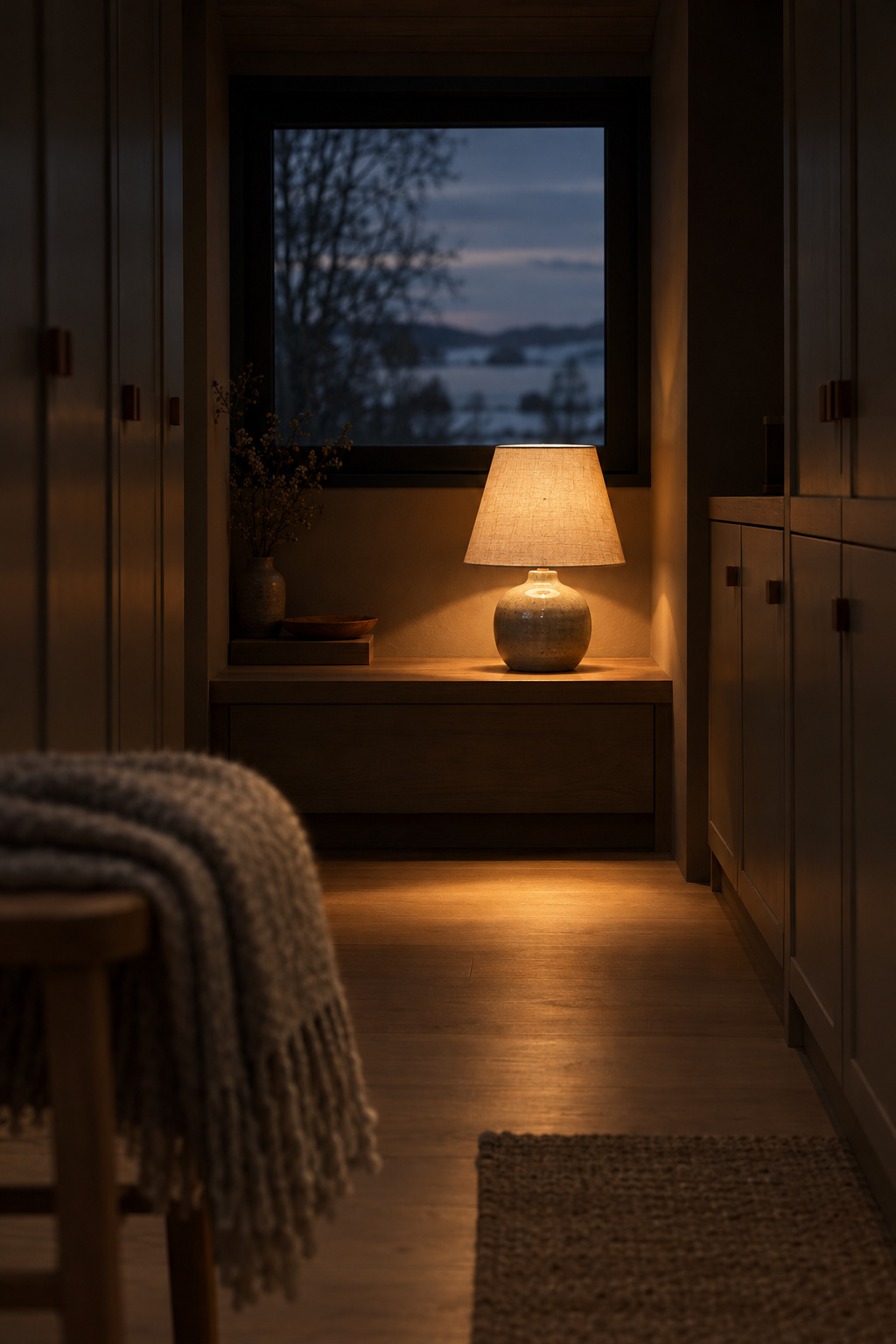
A galley spends much of its life not being cooked in. Someone looks for a glass, someone sits at the end with a cup after dinner. None of that needs the counter strips or the ceiling. It needs one low, warm source at the far end, bright enough to cross the room by and quiet enough to leave on.
Dim-to-warm LED bulbs suit this well. The Department of Energy describes them warming as they dim, down to as low as 1800K, which it calls the color of candlelight.
I drink from the same mug every day and have stopped apologizing to guests for not owning a set. The evening lamp is the same choice: one good one, in the right place. Where it goes, and whether it is a lamp on the end wall, is a decor question as much as a lighting one. The lighting rule is only to keep it low and warm.
Three switches, three jobs: dimming and color temperature
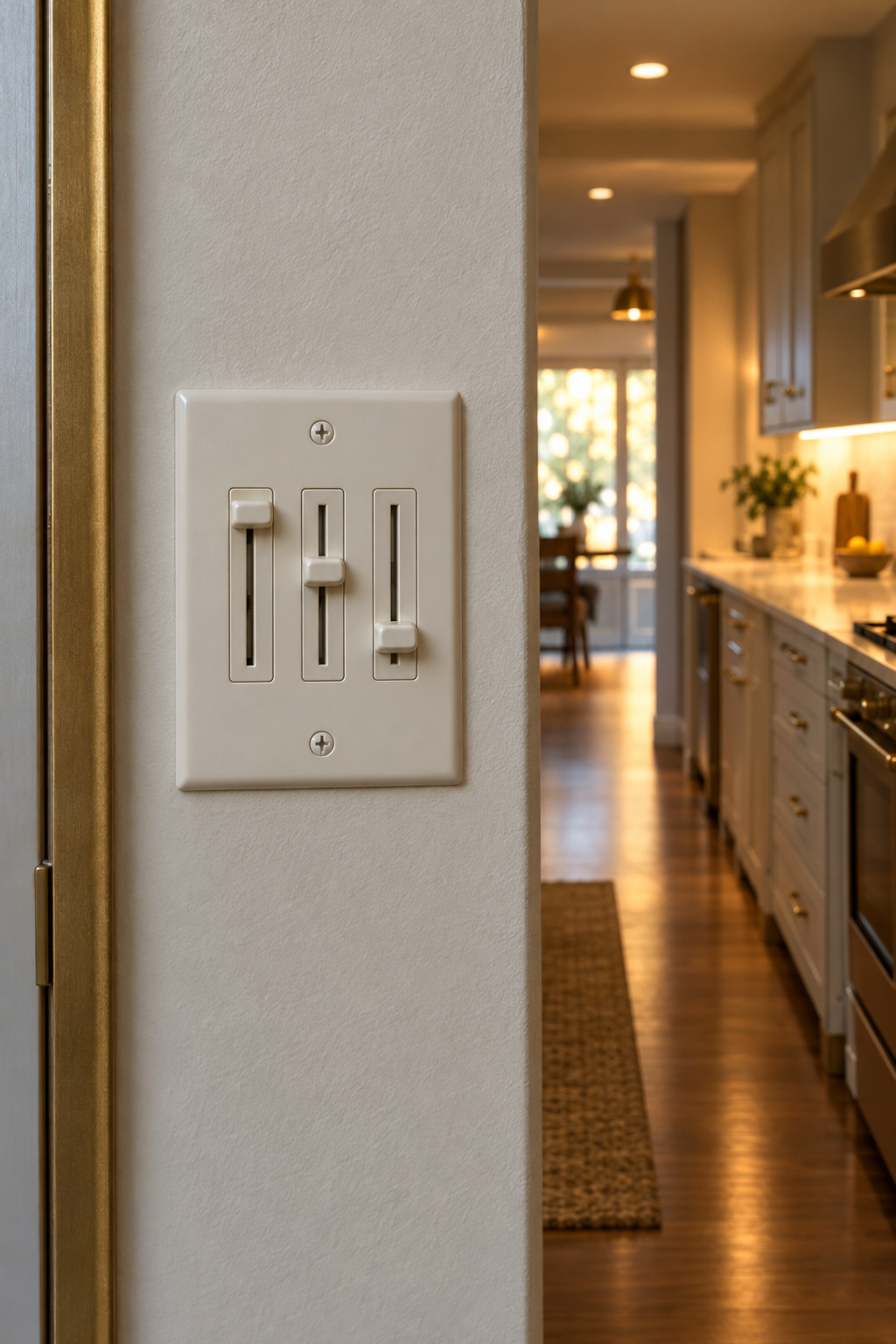
Three lights only work if you can use them separately. Bliss recommends switching groups of lights separately and adding dimmers, because what a room needs changes through the day. In a galley that means three controls, one per job.
| Job | Light | Color temperature | Control |
|---|---|---|---|
| Work at the counters | Strip under the uppers | 3500–4100K, neutral | Own switch |
| Walking and cleaning | Ceiling lights over the counter edges | 2700–3000K, warm | Own switch, dimmer |
| Evenings | One low lamp at the end | 2700–3000K, dim-to-warm | Dimmer or lamp switch |
If you change one number, make it the top row. Neutral light at the counter shows you what the knife is doing.
The color question has two honest answers. ENERGY STAR describes neutral and cool white as good for kitchens and work spaces, which is the range in the table. An industry presentation hosted by the same agency lists 2700 to 3500K for kitchens. I put the neutral light where the work is and keep everything else warm, because a kitchen at dinner should not feel like a workshop.
Whatever you choose, keep the layers close. One or two steps apart on the Kelvin scale looks deliberate; a warm lamp beside a blue-white strip looks like a mistake. Buy by the Kelvin number on the box, not the marketing name.
I make coffee in a plain filter cone and won’t own a machine with a screen. I feel the same about lights. A wall switch for each job, labeled by use, is all the control a galley needs. Enough is a good word.
A warm bulb flatters warm wood and a neutral one sharpens white stone, so settle the bulbs first and then choose paint colors that suit a galley’s light.
The short list: what to keep, what to skip, what to do first
Keep:
- A light under the uppers on both counters, set toward the cabinet’s front edge and hidden from eye level.
- Ceiling lights over the counter edges, on their own switch, for cleaning and walking through.
- One low, warm lamp at the end for evenings.
Skip:
- A brighter bulb in a center row. It leaves the shadow where it was.
- Mixed color temperatures in one line of sight.
- One switch for every light in the room.
Do first: the strip under the uppers on the counter where you chop. It fixes the shadow on the first evening. Light is only one of the things that make a narrow kitchen feel like a corridor, and the full set of galley kitchen ideas takes on the others.
I can tell you where the light should land, what color it should be and how many switches it wants. I am not an electrician. A new circuit or a hard-wired fixture is work for a licensed one, and my part of the job ends at the switch plate.
FAQ
How many lumens does a galley kitchen need?
Plan on roughly 400 to 800 lumens for each working stretch of counter, the range one lighting retailer gives. As a check, an industry deck hosted by ENERGY STAR puts task surfaces at 30 to 50 foot-candles, and a foot-candle is one lumen per square foot. A 10 ft run 2 ft deep therefore wants 600 to 1,000 lumens landing on it.
How do you light a galley kitchen that has no window?
Build it entirely from the three lights: strips under the uppers on both counters, ceiling lights over the counter edges, and a warm lamp at the end. Paint the ceiling matte white so it throws light back down. Choose bulbs with a color rendering index of at least 80, and 90 if you can find it.
Do you need a pendant light in a galley kitchen?
No, not for the counters. A single pendant down the middle of a galley is the same center light with the same shadow, just more decorative. A pendant has a real job only where a galley has a table or eating counter at one end, hung over the surface you sit at, not the one you cut on.