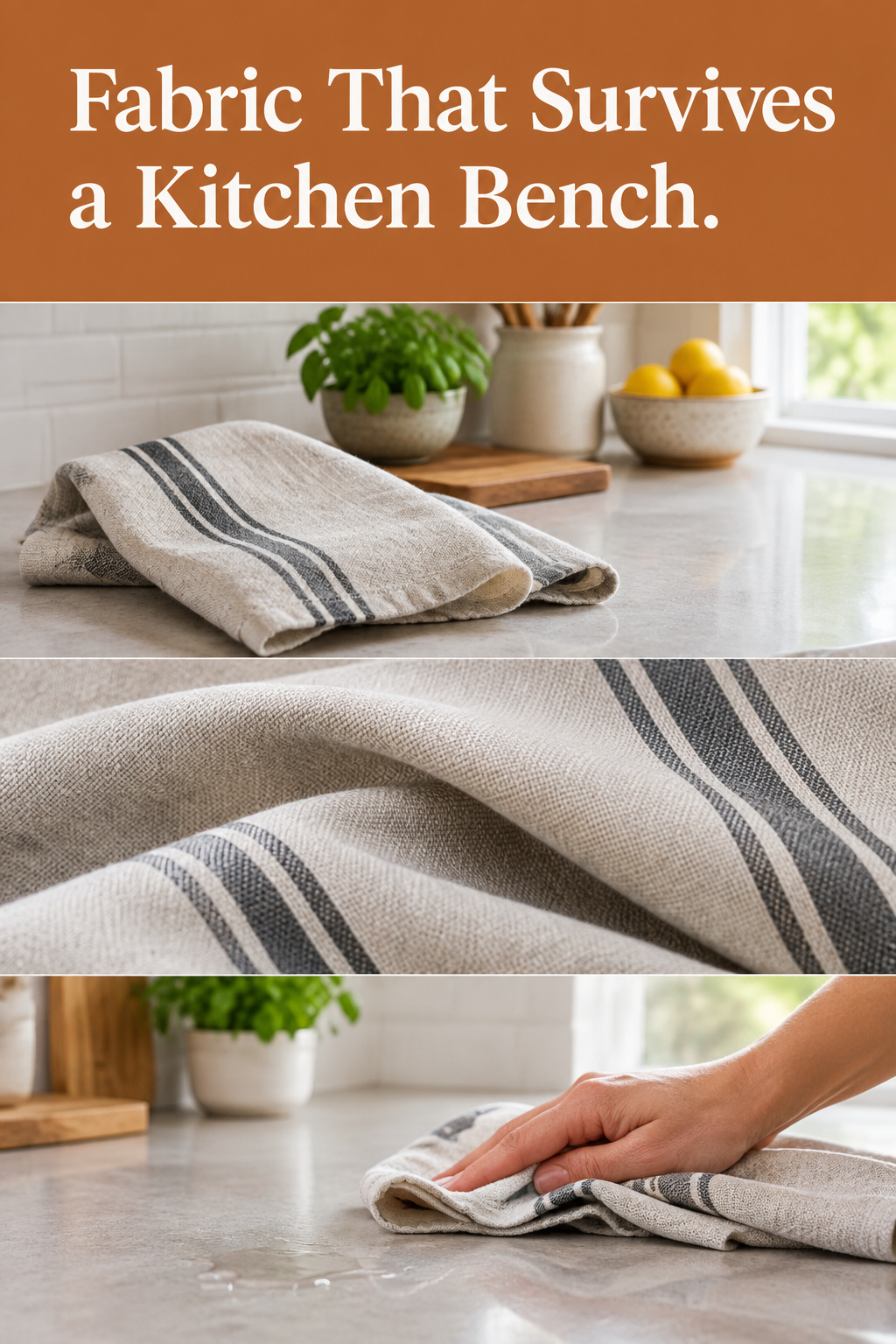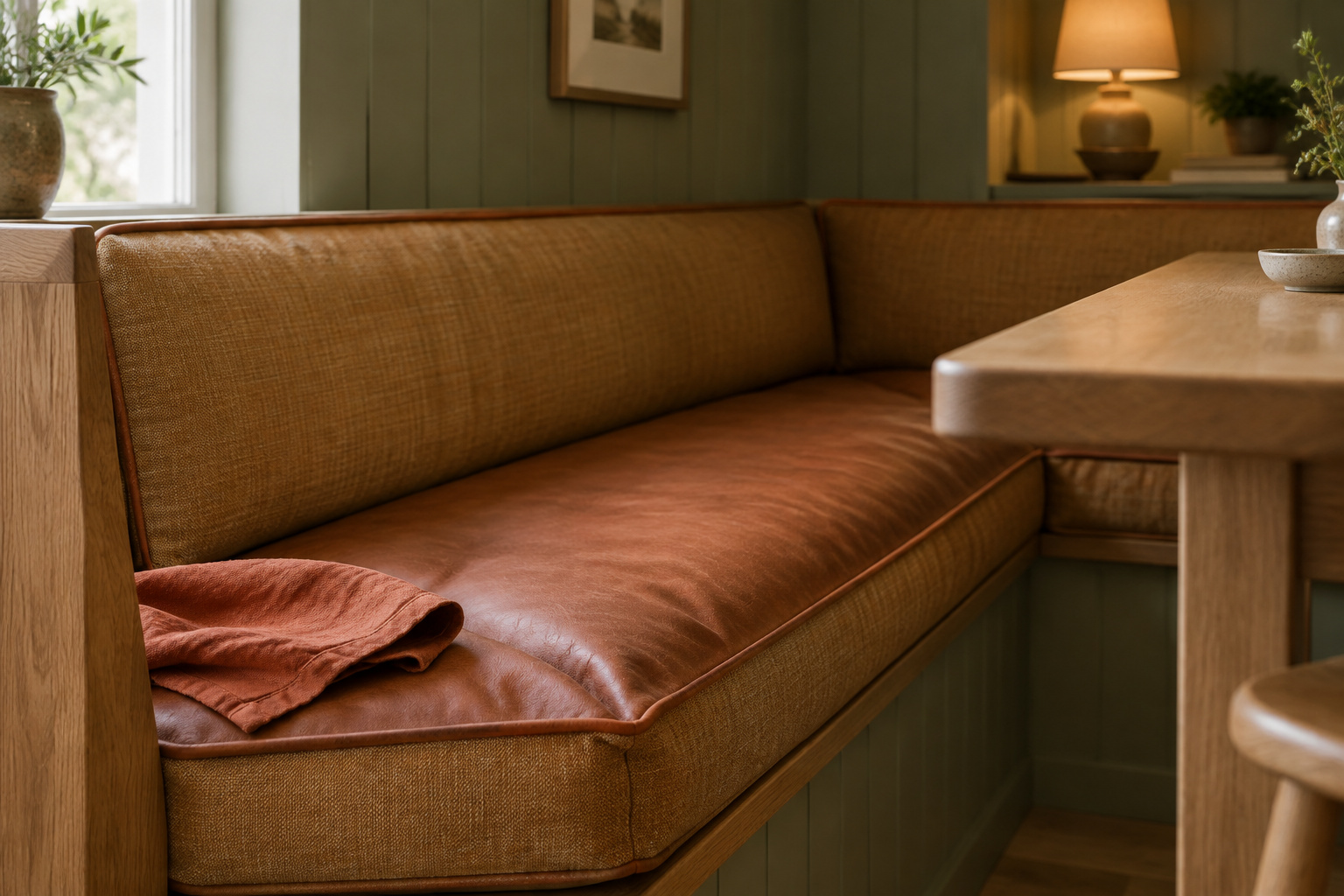
People brace for a torn seam on a kitchen bench. What shows up first is usually a faint sheen along the front edge, where sleeves and jeans have crossed the same four inches of weave twice a day since the bench went in. Most people choose banquette upholstery fabric the way they choose a paint chip: by hand-feel, by color, by how it sits against the cabinets. The numbers that predict what that cushion looks like next year are on the tag, and nobody reads them.
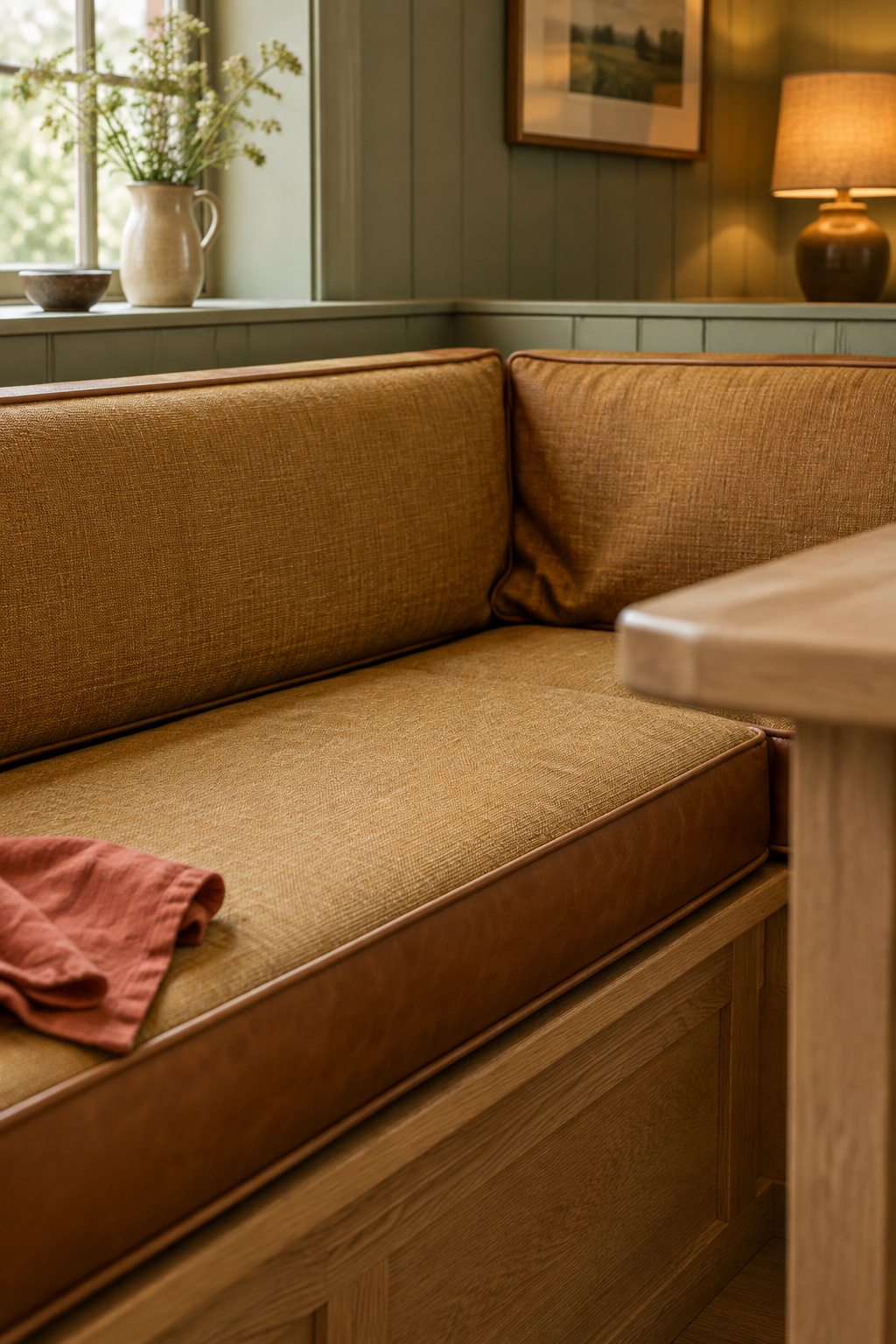
TL;DR
- Abrasion: the Association for Contract Textiles (ACT) sets 15,000 Wyzenbeek double rubs or 20,000 Martindale cycles for low-traffic private spaces. They are two separate tests, never converted into each other, since ACT’s own study found at least 60 percent variance retesting one fabric.
- Foam: 2.3-2.8 lb/ft³ density with a firm 36-45 ILD for seating used daily. Density predicts how long a cushion holds its shape; ILD only how firm it feels on day one.
- Cleaning: the W, S, WS and X codes come from a committee under the American Home Furnishings Alliance, self-assigned by each mill with no third-party check. A cover that zips off beats a better code sewn shut.
The banquette upholstery fabric question, worked backward from failure
Rubelli, a single fabric mill, fields around 600,000 memo and sample requests a year (about 12,000 a week, roughly a tenth of its operating expense). That is the scale of the choice before durability comes up at all.
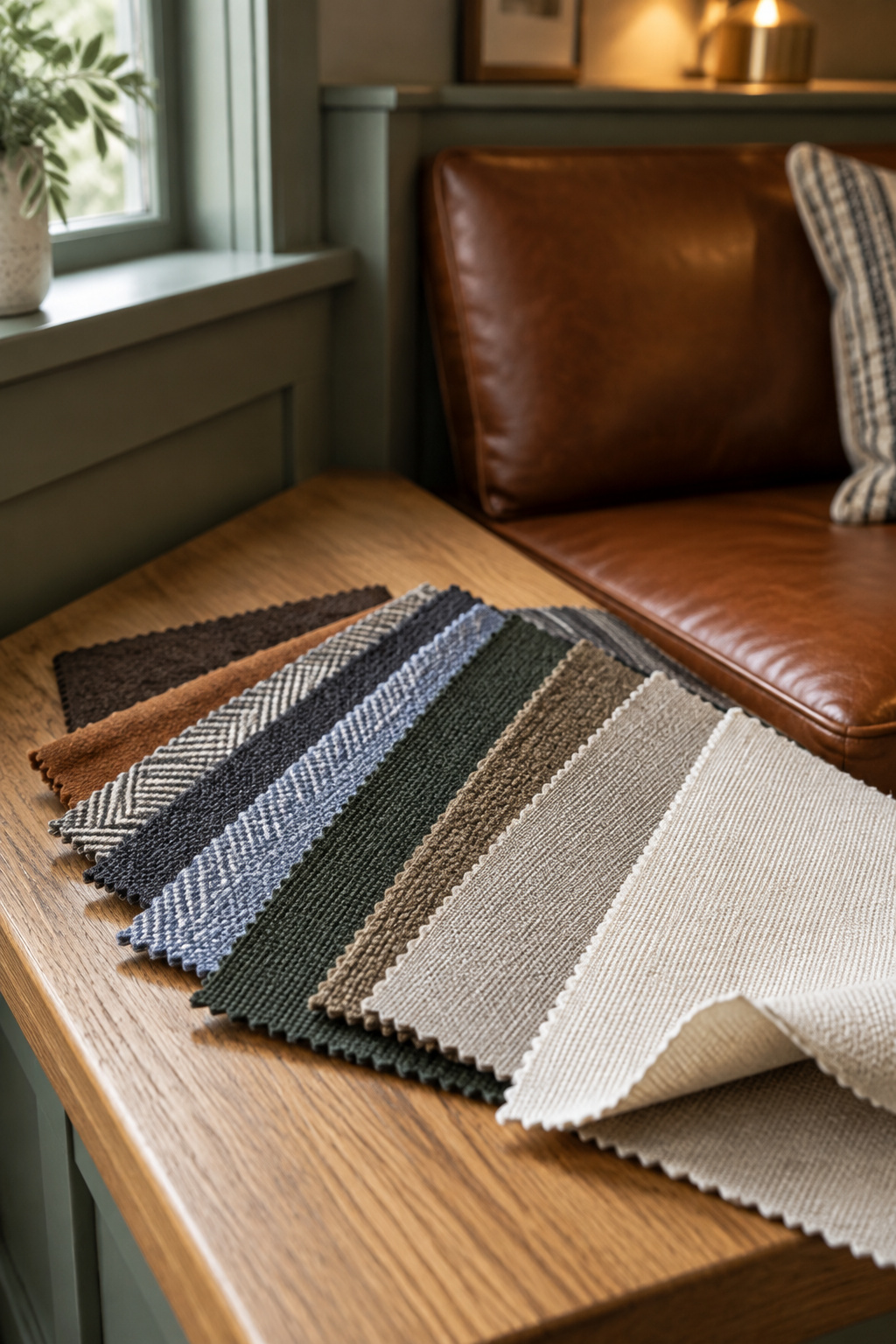
Run the decision backward. Start from the four ways a kitchen bench destroys fabric, then ask which fibers and specs answer each. That reordering hands you four numbers: a Wyzenbeek double-rub count, a Martindale cycle count, a foam ILD paired with its density, and one letter on the cleaning tag. Each carries a limit that matters as much as the figure.
Where kitchen fabric actually fails first
A kitchen bench is the hardest-worn upholstered surface in most houses because all four forces arrive together, on different clocks:
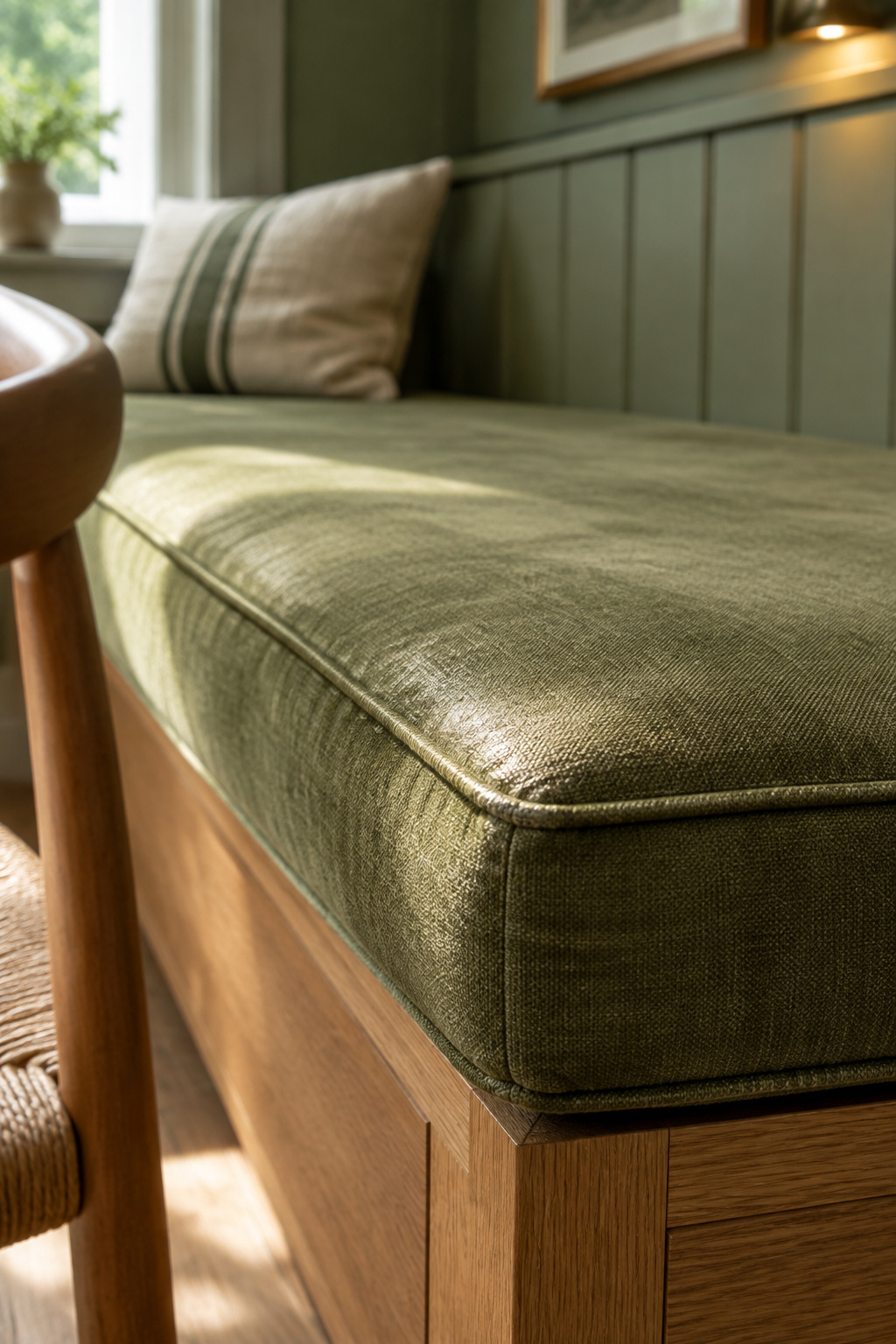
- Abrasion at the sit edge. Clothing crosses the front seam every time somebody slides in or out, the flat rubbing the abrasion tests exist to simulate.
- Staining from food and grease. Crypton markets its residential line around repelling liquid and releasing oil-based stains rather than surface wear, a performance-fabric maker naming the everyday threat.
- Fading from window light. One window-film source puts visible fading at roughly 18 to 36 months of sustained exposure, cotton and linen first. Treat that range as illustrative rather than exact; the direction is better established than the figure.
- Foam collapse underneath. Polyurethane foam below about 1.8 lb/ft³ polymer density takes a body-shaped dent long before the cover wears out, per the foam manufacturers’ trade association.
ACT surveyed its member companies and found field failures more often caused by inappropriate cleaning, lack of maintenance, physical abuse or the wrong fabric for the job than by abrasion. The abrasion number most buyers shop on is rarely the one that decides the outcome.
Fiber choice, argued from what it has to survive
The common mistake here is treating “performance” as a fiber. It is a bundle of properties different fibers deliver unevenly, so the right pick depends on which failure your corner faces hardest.
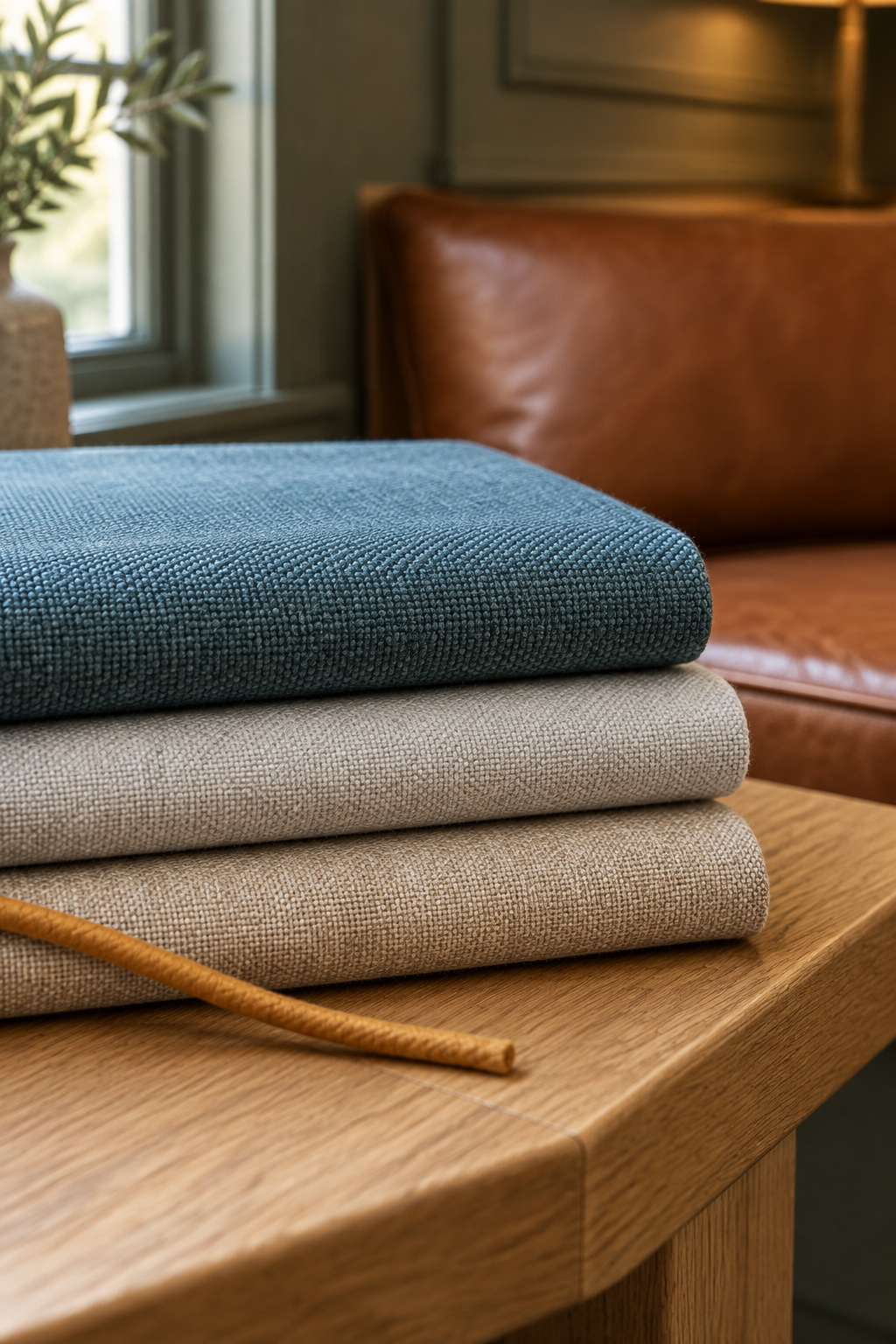
| Fiber | Strongest at | Where it gives way on a kitchen bench |
|---|---|---|
| Solution-dyed acrylic | Fade resistance: pigment enters the fiber before spinning, giving roughly 7–8 lightfastness | Only moderate resistance to oil-based stains unless separately treated; lower tenacity (2.0–3.5 cN/dtex) |
| Solution-dyed polyester | Stain resistance plus raw strength (4.0–6.0 cN/dtex) and abrasion resistance; mimics linen, velvet or bouclé; cheaper | Lightfastness 5–6, a step behind acrylic |
| Olefin (polypropylene) | Bleach tolerance — handles full-strength bleach without color damage in most cases | Lightfastness 5–6; fades faster in sun, a smaller risk indoors than on a porch |
| Treated natural blend (e.g. Crypton-treated cotton) | Natural hand-feel with a liquid-repelling, stain-releasing finish cross-linked into the fiber | Depends entirely on the finish; the “7 years” of extended fabric life is Crypton’s own marketing claim, not an independent test |
Where my outdoor fabric experience ends and yours begins
One plain sentence, said once: my own fabric experience is outdoor rather than indoor (patio cushions, covered porches, deck seating), and the overlap with your kitchen bench is specifically solution-dyed acrylic and solution-dyed polyester, the same two fiber families with an identical fade mechanism. The outdoor-specific thresholds I hold a fabric to (a 7-to-8 lightfastness floor, mildew resistance, salt-air resistance) do not bind indoors.
Your bench faces neither standing moisture nor salt, and gets filtered daylight rather than eight hours of sun, so abrasion and cleanability outrank UV in a way they never do on my projects. Sunbrella sells overlapping ranges as suitable indoors and out rather than running two lines. What transfers is the durability vocabulary and the habit of asking how a surface looks after a year of weather and washing. Everything past that (the ACT thresholds, the foam figures, the cleaning codes) is cited industry fact rather than my practice.
Reading the abrasion numbers without being fooled by them
ACT’s Voluntary Abrasion Guideline is written for contract specification, and a family kitchen is not a “commercial low traffic” space. It is still the closest published reference point; treat its lowest tier as a floor. Read down a column; never across.
| ACT tier | Wyzenbeek (double rubs) | Martindale (cycles) | What it means for a bench |
|---|---|---|---|
| Commercial low traffic / private spaces | 15,000 | 20,000 | The practical floor for a fabric taking daily household sitting |
| Commercial high traffic / public spaces | 30,000 | 40,000 | More than a bench needs; a sensible target for a household hard on furniture |
| Coated fabrics, high traffic | 50,000 | Graded separately | Vinyls and coated goods are held to their own figure |
| Anything past ~100,000 | Marketing territory | Marketing territory | ACT states twice the cycles does not mean double the service life |
A card boasting 250,000 double rubs sells a lab figure that does not translate into years of service. Buying on one impressive figure while the other three go unchecked is how you get the failure modes that show up as banquette-seating mistakes.
Why Wyzenbeek and Martindale numbers don’t convert
Conversion ratios circulate in the trade, most often one double rub to roughly two Martindale cycles. This article prints none of them. The reason is technical: the two tests are not dialects of one measurement.
Wyzenbeek drags a taut sample back and forth against #10 cotton duck canvas; Martindale rubs a mounted sample in a multidirectional figure-eight against worsted wool. Different abradant, different motion. James Dunlop Textiles, which lists both numbers on its own sampling, calls the tests mutually exclusive.
Then there is the variance. ACT’s 2009 Wyzenbeek Performance Verification Fabric Study found results on the same sample varying by at least 60 percent from test to test. A single double-rub figure is a rough range dressed as a precise number, and converting one rough range into another produces nothing useful.
Foam density and ILD, in plain numbers
Density and firmness are different measurements, and confusing them is how a bench that felt perfect in the workroom looks slept-on by its third winter. The Polyurethane Foam Association puts it bluntly: there is no such thing as hard or firm density. Occasional or sofa seating runs 1.8-2.2 lb/ft³ (PFA’s “High Comfort” grade) at a medium 26-35 ILD/IFD; a kitchen bench target steps up on both counts at once, to 2.3-2.8 lb/ft³ and a firm 36-45 ILD/IFD.
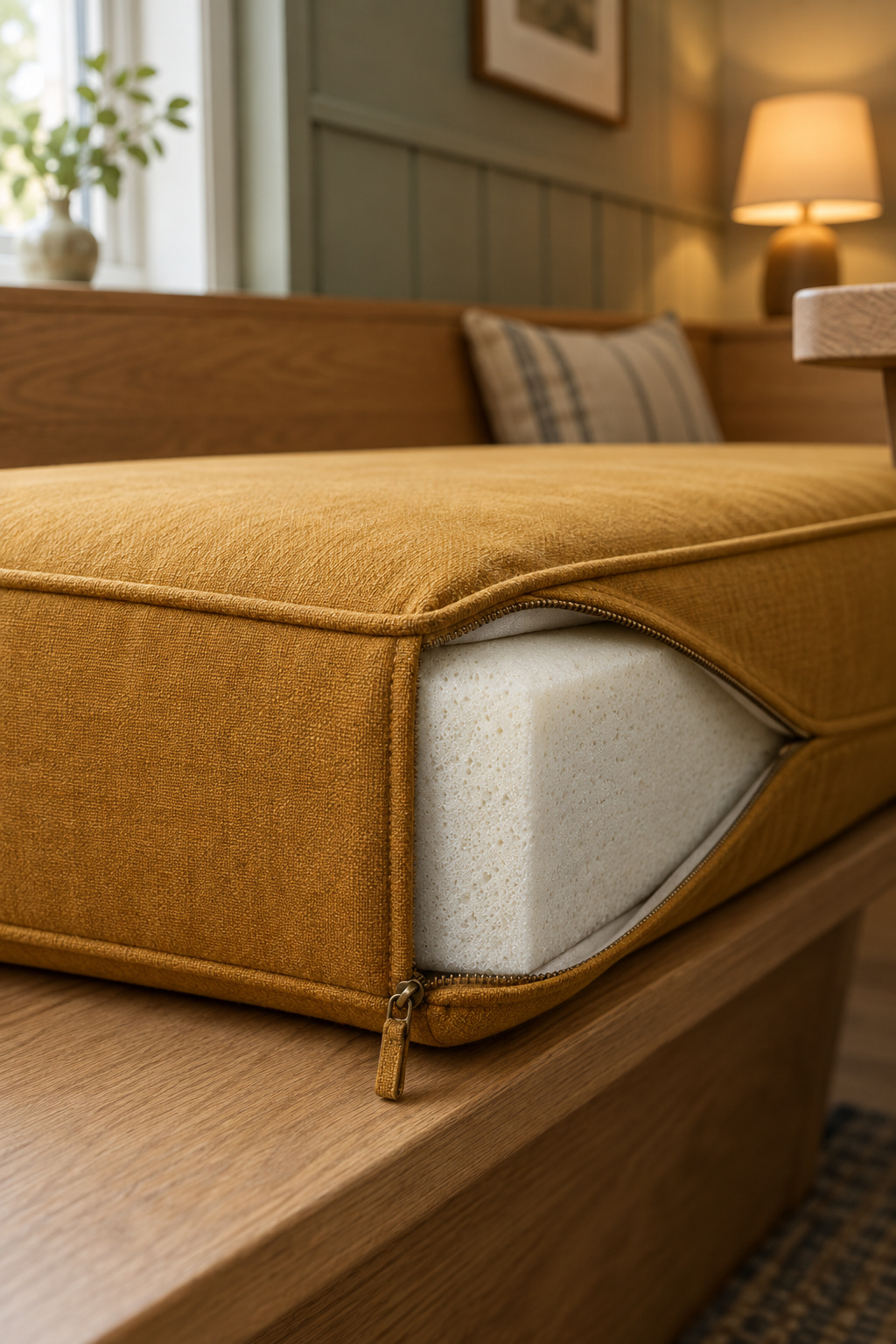
Three independent sources agree on that bench target: Pomona Quality Foam specifies 2.5-2.8 lb/ft³ for constant heavy use, Sailrite’s CushionRite HR runs 2.3 lb/ft³ with its 36-45 IFD “Firm” grade reserved for high-use areas, and the PFA sets 1.8 lb/ft³ as the floor.
Reading an ILD number on a cushion spec sheet
ILD (indentation load deflection, sometimes printed as IFD) is the force in pounds needed to compress a four-inch foam sample by 25 percent of its height with a 50-square-inch indentor foot. It measures surface firmness and says nothing about durability.
Thickness is where the spec sheets go quiet. Six foam manufacturers and trade bodies were checked (Pomona, Sailrite, the PFA, Future Foam, FXI and Carpenter Co.) and not one publishes a cushion thickness for a dining bench. The 2-to-2.5-inch figure in circulation traces to entryway and mudroom guidance reasoned around a forty-second sit; it does not transfer to a bench you eat a meal on.
Work thickness out from the build instead. Fix density and ILD first, then let thickness fall out of the finished height you are building to. The height that counts is the cushion compressed under an adult, not its loft on the workbench. A firm 36-45 ILD foam gives up less of itself than a medium one, so it keeps more of its thickness in use. That is the reasoning behind how cushion thickness changes seated height. A back cushion runs the other way: whatever it measures front to back comes out of the depth you actually sit on.
The cleaning codes that decide whether you’ll actually clean it
Who decides what that letter on the tag means? The W/S/WS/X codes are authored and maintained by the Joint Industry Fabric Standards and Guidelines Committee, convened under the American Home Furnishings Alliance.
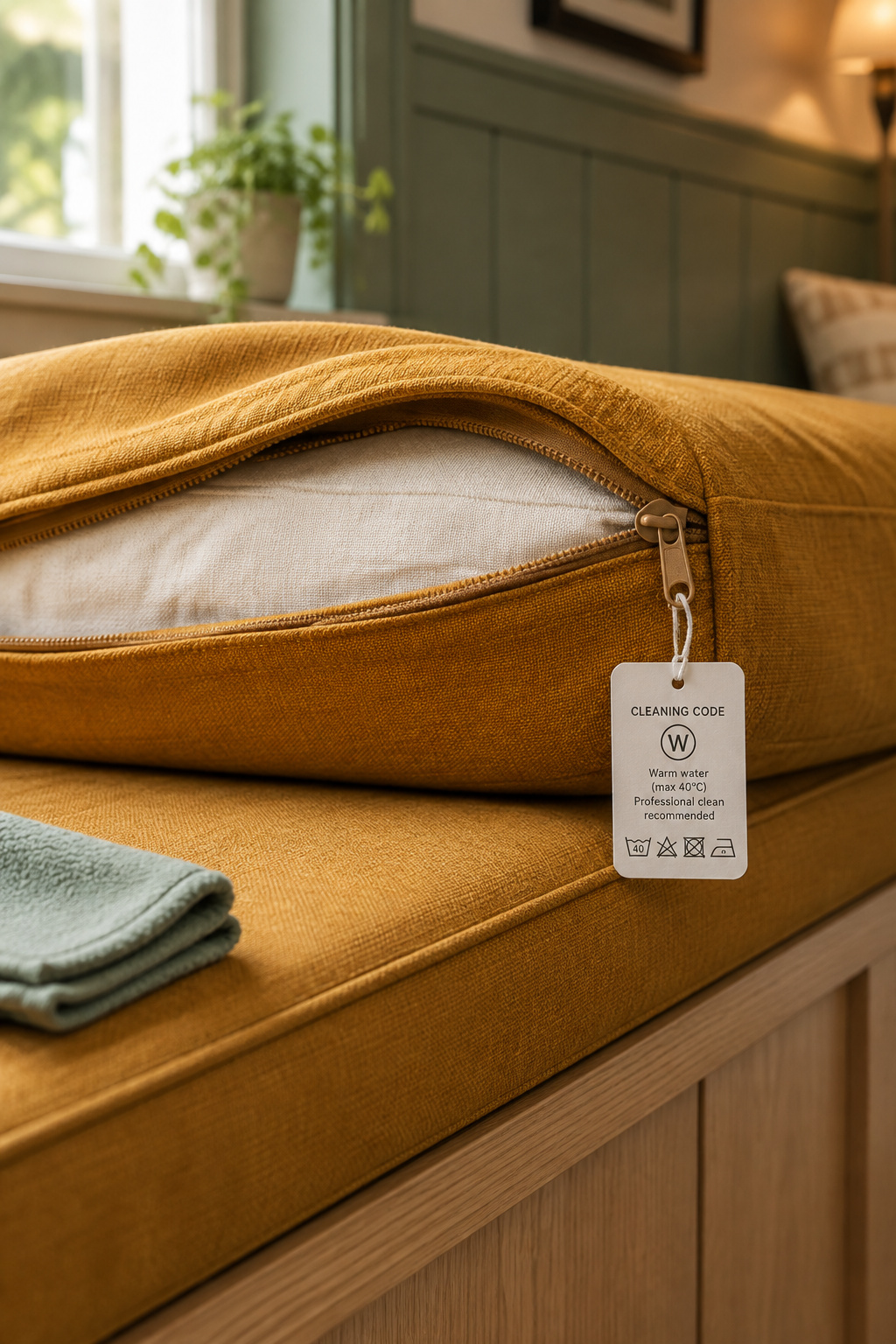
The W, S, WS and X codes, decoded
| Code | What it permits | What it rules out |
|---|---|---|
| W | Water-based shampoo or foam cleaner, spot cleaning only | Solvents |
| S | Water-free dry-cleaning solvent, spot cleaning only | Water |
| WS | Either method may be used | Neither |
| X | Vacuuming or light brushing only | Water and solvent alike |
That committee is a trade group, not an accredited standards body. No ANSI or ASTM standard sits behind these letters: ASTM D6322, the nearest candidate, explicitly excludes upholstery from its scope, and upholstery is exempt from the FTC’s Care Label Rule. The guideline puts the duty on the mill, and no third-party lab verifies it; some label everything “S” regardless of performance. The committee itself warns these are not, as many believe, cleanability codes.
When to zip off a cover instead of cleaning in place
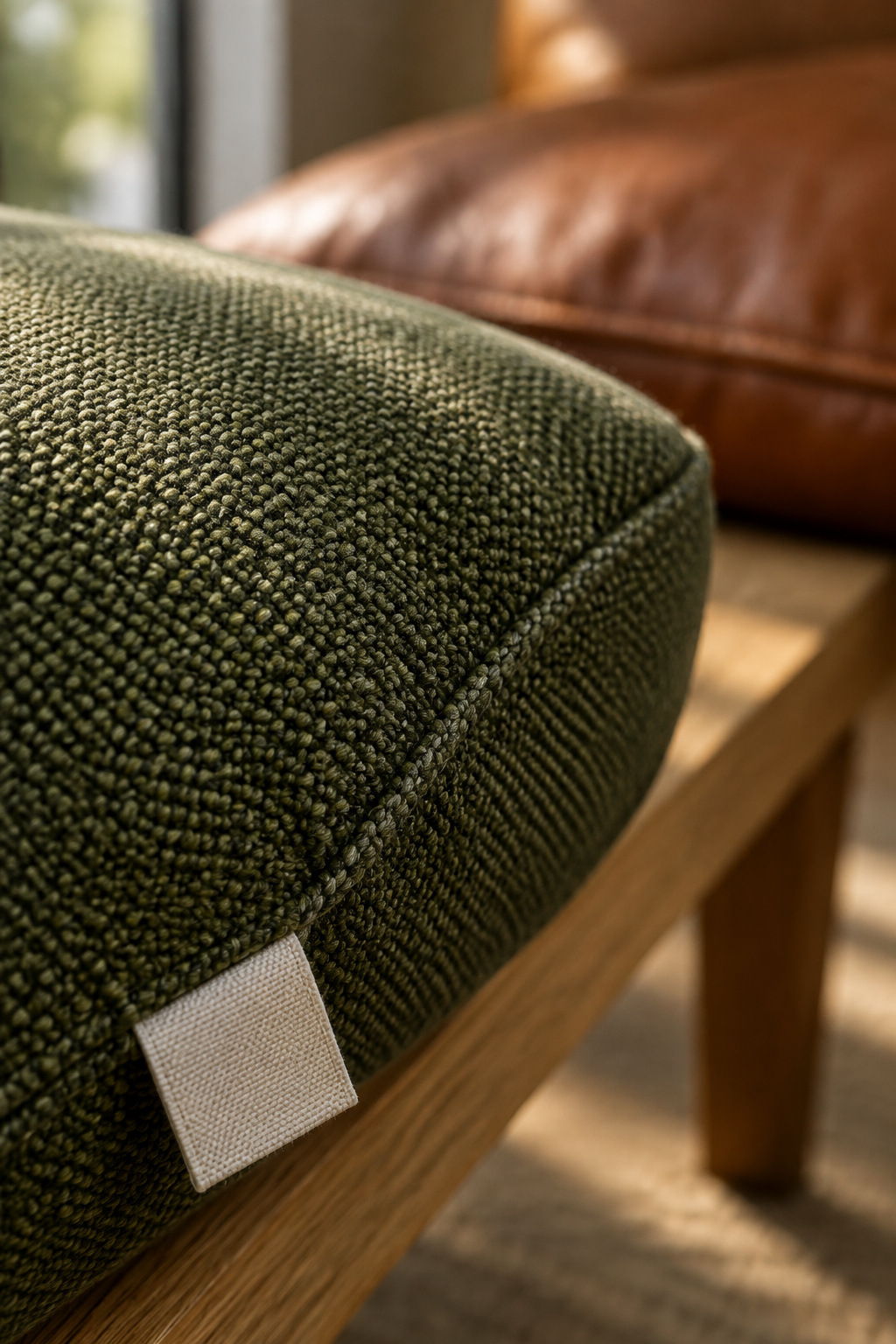
A removable cover raises every code’s practical ceiling from spot-clean to full wash: cotton and linen covers generally take a cold delicate cycle, polyester blends a cool one. A sewn-shut cushion caps out for life at a handheld cleaner for W and WS, or careful solvent treatment for S, and soaking the foam inside is the failure to avoid either way.
No source I found publishes an interval for replacing a cover rather than cleaning it. Codes govern method, not lifespan. So what follows is my position, not a citation.
The cedar deck I built with my uncle when I was sixteen has been re-oiled every spring since. Not because I am diligent, but because the job takes an afternoon, the can lives in the same place, and I have never once had to look up how. Maintenance survives when it is easy and familiar; it dies when it takes a decision. A cover with a zipper you can strip in a minute gets washed. A sewn-shut cushion with an S code and a 100,000-double-rub swatch card gets spot-treated twice, apologized for, and eventually covered with a throw.
Choose for the maintenance you will actually perform in March, not the one you intend at the showroom. Get the fiber right for your window, hold the foam at 2.3-2.8 lb/ft³ and 36-45 ILD, read any abrasion figure as a range rather than a promise, then make sure the cover comes off. That last decision costs almost nothing at fabrication and outweighs the rest combined, once the rest of the bench, from frame to table is right underneath it.
FAQ
Is outdoor performance fabric a good substitute for indoor banquette upholstery?
Partially. Solution-dyed acrylic and polyester are shared between both categories, and the fade mechanism is identical. But the outdoor-specific spec (a 7-to-8 lightfastness rating, mildew and salt-air resistance) solves problems a kitchen bench does not have. Outdoor fabric indoors is not wasted, just not necessary.
What foam density holds up under daily kitchen bench use?
Roughly 2.3-2.8 lb/ft³, paired with a firm ILD in the mid-30s to mid-40s; Sailrite recommends its 36-45 IFD grade specifically for high-use seating. The Polyurethane Foam Association sets the absolute floor at 1.8 lb/ft³. Below that, expect the foam rather than the fabric to fail first.
How often should banquette cushion covers be replaced rather than cleaned?
No industry or manufacturer source publishes a fixed interval. Cleaning codes cover method, not lifespan. Since ACT’s research blames inappropriate cleaning and neglected maintenance for most field failures, the better answer is to make washing easy and frequent, then replace a cover when cleaning stops restoring it.