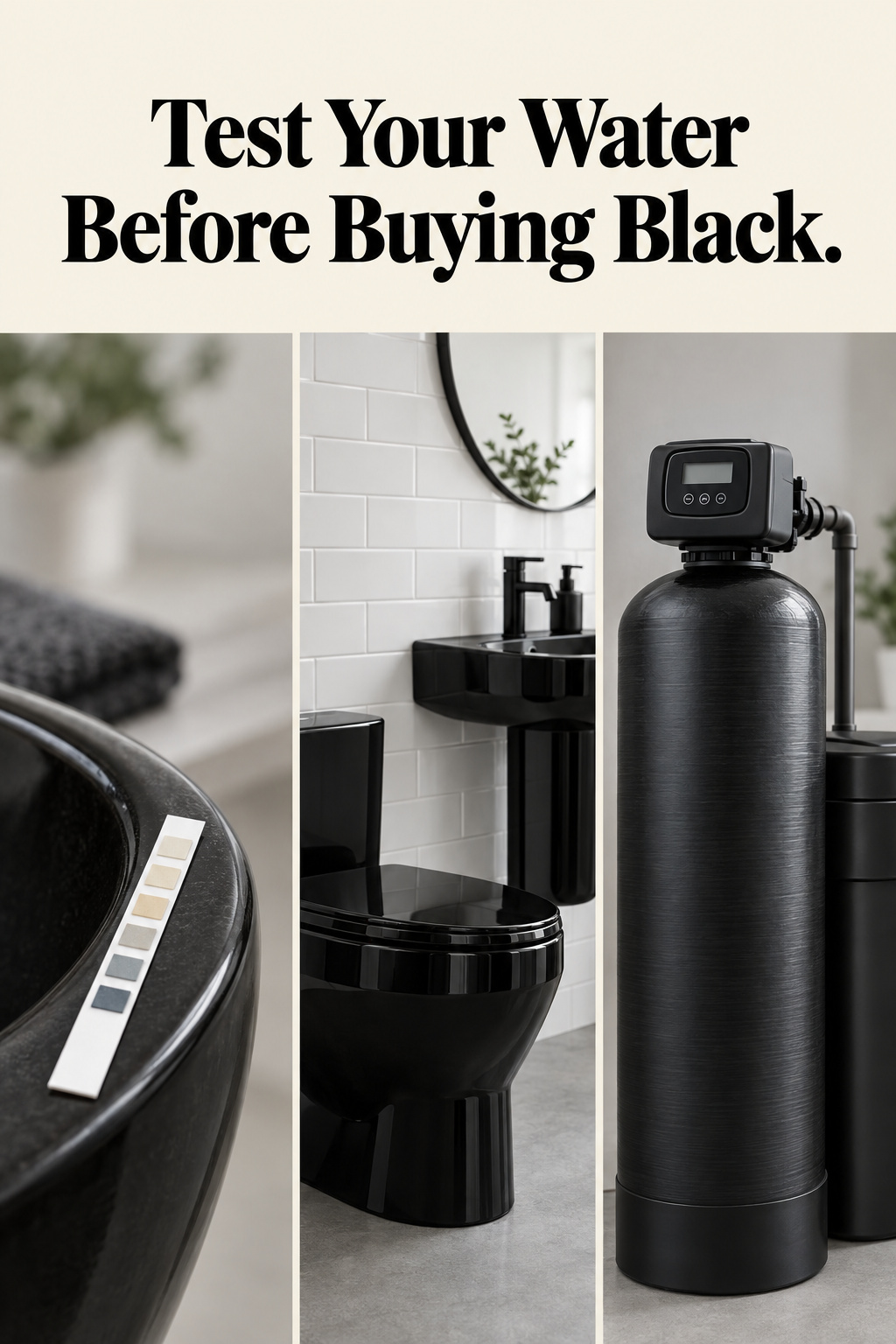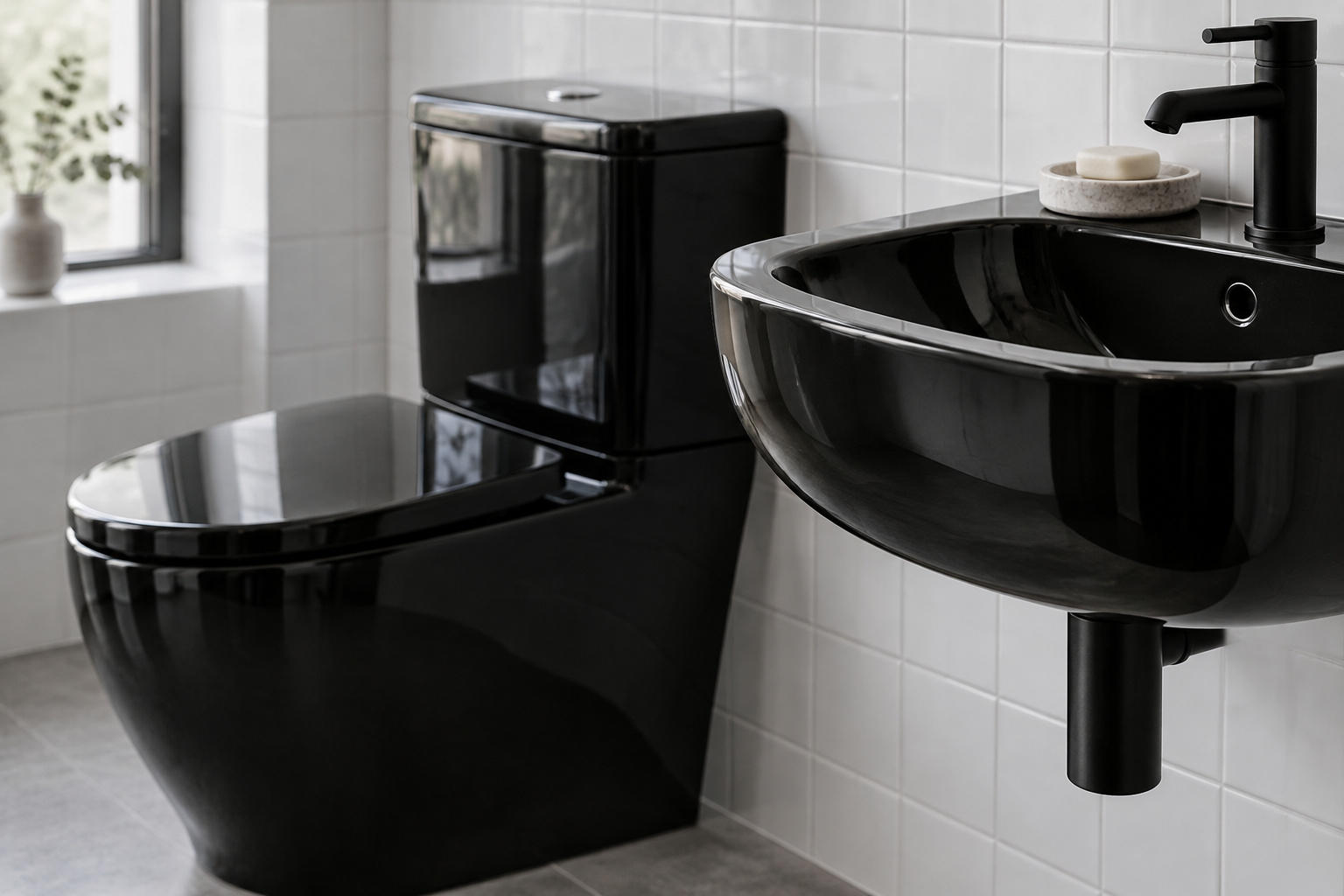

One hundred and twenty milligrams per liter. That is the line I would want drawn on a water report before anyone sold me a black toilet. Below it, a black bowl and basin stay close to the catalog photograph: deep, glossy, a little dramatic. Above it, the same fixture grows a pale ring at the waterline and a chalky film around the drain, and you either wipe it every day or start pricing a softener.
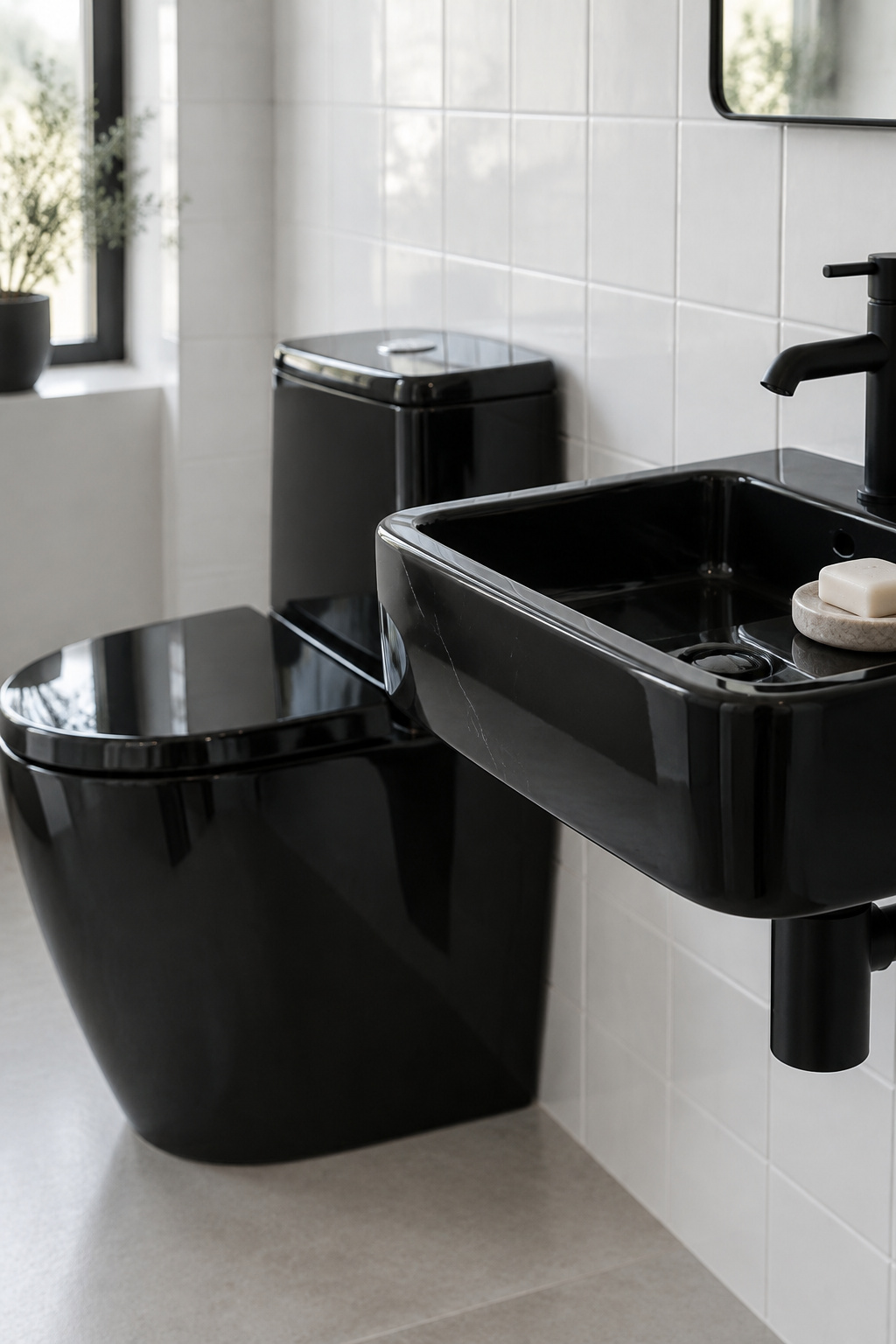
Most people pick the color first and meet their water afterward. Do it the other way round: find your hardness number, set it against four classes, and you will know before you order what black will cost you to keep.
TL;DR
- Get your hardness from the water utility’s annual report or a test strip, and multiply grains per gallon by 17.1 to get mg/L; under 120 mg/L (7.0 gpg), black glaze is a low-risk choice.
- In hard water a black fixture costs a wipe-dry after each use or a whole-house softener, typically $1,200 to $3,800 installed and about $102 to $337 a year to run.
- A black composite sink is no escape: its makers say dark colors show limescale and soap scum as readily as lighter ones, or more.
Test Your Water Before You Buy a Black Toilet
Hardness is dissolved calcium and magnesium, measured as calcium carbonate. The USGS sorts it into four classes. The right-hand column is my own call on what each class means for black glaze; no maker draws that line.
| USGS class | mg/L as calcium carbonate | Grains per gallon | What it means for black glaze |
|---|---|---|---|
| Soft | 0–60 | 0–3.5 | Black is a low-risk choice |
| Moderately hard | 61–120 | 3.5–7.0 | Low risk; dry the basin when you dry the tap |
| Hard | 121–180 | 7.0–10.5 | A daily wipe-dry, or a softener |
| Very hard | Over 180 | Over 10.5 | Price in a softener, or choose white |
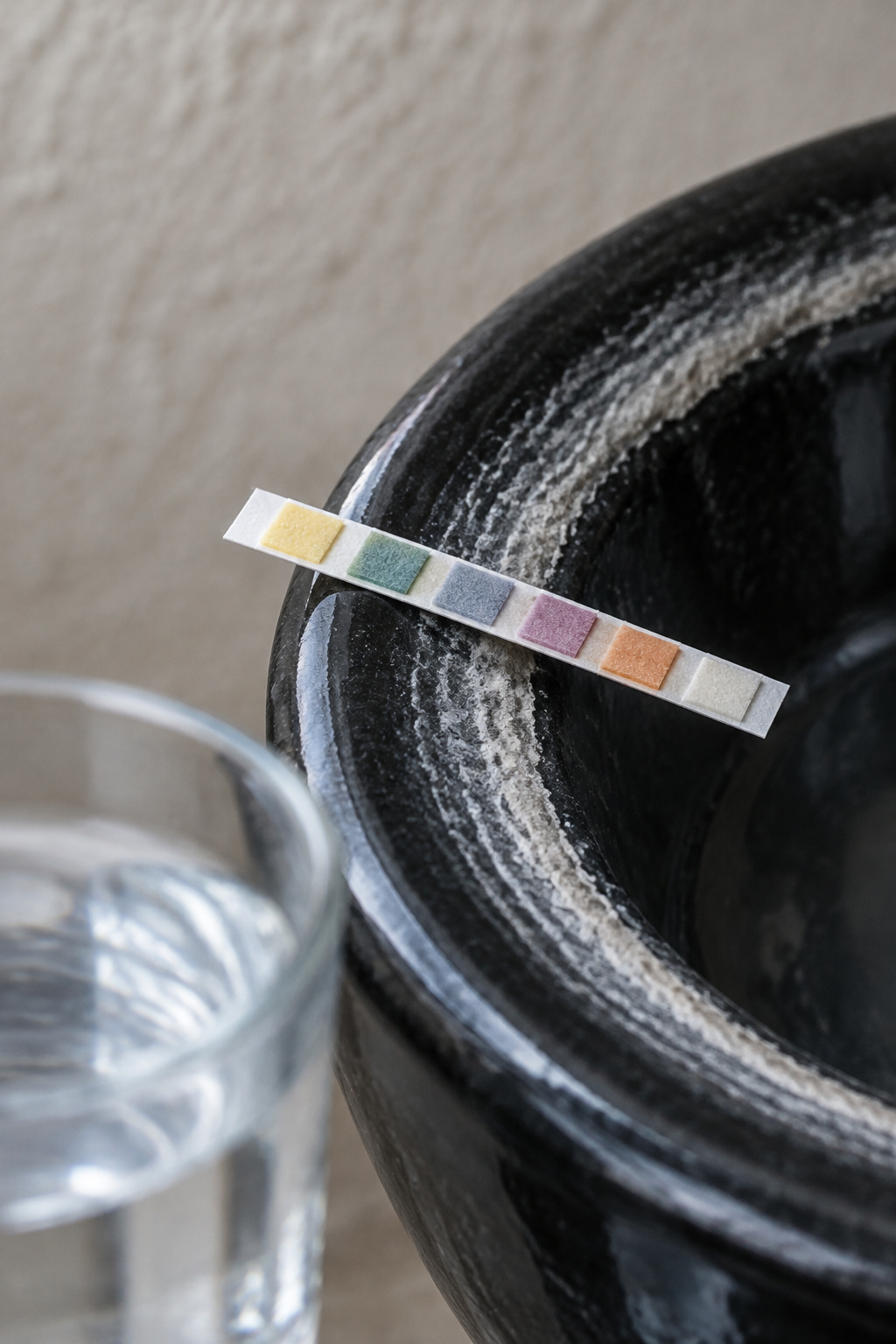
Public water systems publish an annual consumer confidence report, and it may list hardness; if yours doesn’t, phone the supplier and ask. A test strip gives a good estimate, but only a range, and a typical chart jumps from 120 straight to 250 ppm, which is coarse for a decision this size. On a private well, send a sample to a lab.
Read the units before you read the class. One grain per gallon is 17.1 mg/L, so a report showing 7 grains is 120 mg/L, the top of moderately hard. You may also meet five classes instead of four: Extension services and the Water Quality Association split the bottom band into soft (up to 17.1 mg/L) and slightly hard (17.1 to 60), and above that the boundaries match.
The same water lands on every surface in the room, which is why it also decides what black grout does in the same water.
What a Black Toilet Costs in Hard Water: The Daily Wipe or the Softener
I scrub a white ring off the sink in my workshop, the converted carriage house behind the house, which is cold in January and smells of linseed oil all year. On black glaze that ring would be the first thing anyone saw. In hard water, black is a running cost, and you pay it in minutes or in dollars.
The daily wipe
Kohler’s care instructions for vitreous china and fireclay are short: rinse, then wipe the fixture dry with a soft cloth after each use. For a sense of the time involved, a fireclay kitchen-sink care guide puts the daily clean with mild dish soap at under two minutes, and drying the basin after its last use of the day at about 30 seconds. It is a small habit, if somebody in the house has it.
A toilet is a different animal. For vitreous china toilets in hard-water areas, Kohler’s New Zealand guidance is to keep the holes under the rim clean, use a long-handled brush so deposits don’t build down into the trap, and run a toilet cleaner at least once a week. You can dry a basin, but nobody dries a toilet bowl.
The softener
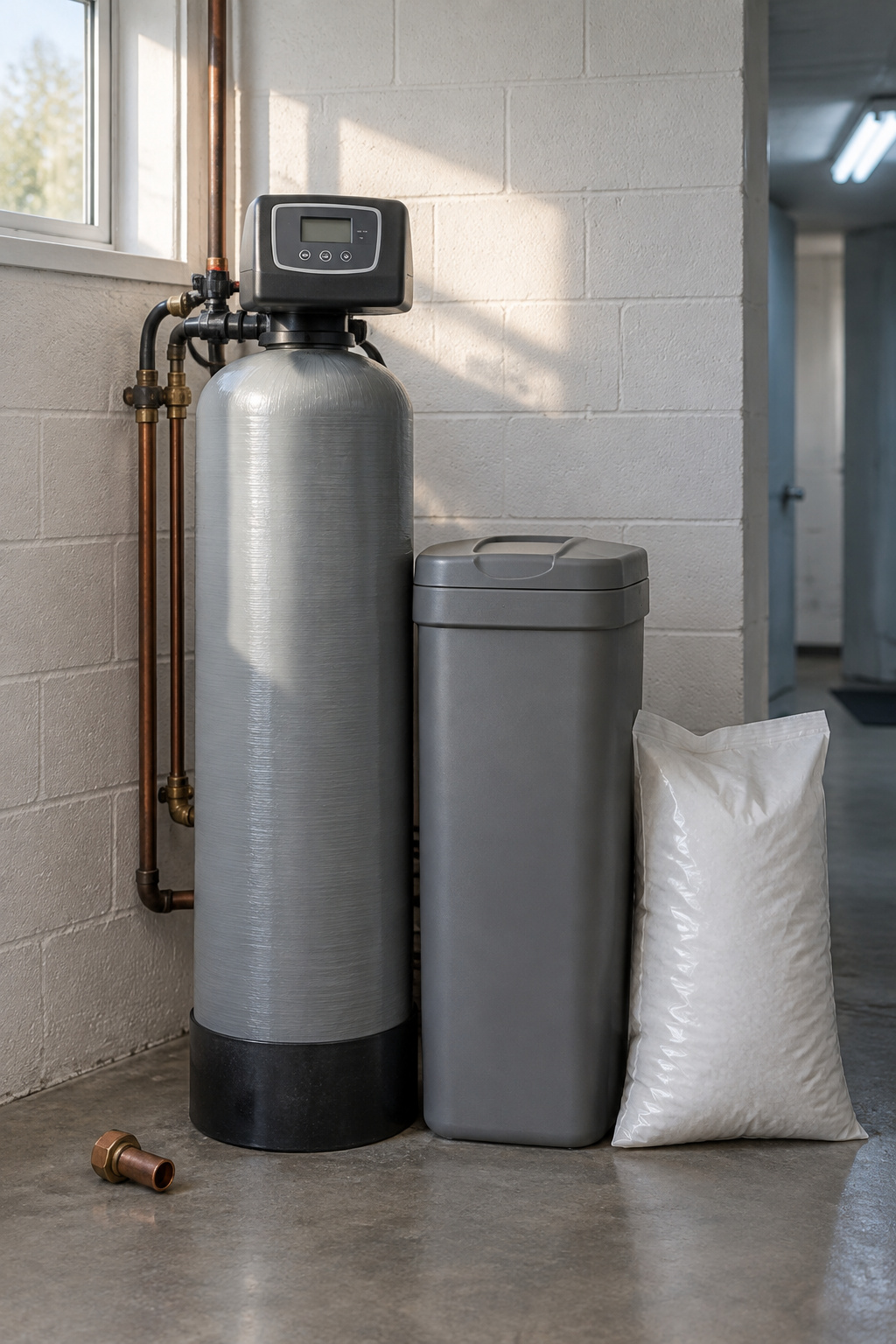
A professionally installed, salt-based whole-house softener typically runs $1,200 to $3,800. Where you land in that band is disputed: one national cost guide puts the average near $1,500, while a set of twenty documented installer quotes has a median of $3,450. Running it costs $8.51 to $28.07 a month, most of it salt: $8.51 × 12 is $102 and $28.07 × 12 is $337 a year. A salt-based unit lasts 10 to 25 years.
Water under 120 mg/L generally needs no treatment, and there I would buy black without a second thought. Between 121 and 180, ask whether anyone will really wipe the fixtures dry every day; if nobody will, the softener belongs on the same invoice as the toilet. Over 180, I would buy black only with a softener going in.
Glazed China, Fireclay or Composite: How Each Black Fails
Black china is older than its current fashion: Kohler showed all-black fixtures at the Metropolitan Museum of Art in 1929, and the period pieces belong to the vintage bathroom fixtures guide. New black comes in three materials, so choose the material along with the color. Let’s see what each is made of.
| Material | Where you meet it | How the black is made | How scale shows | Scratches and chips |
|---|---|---|---|---|
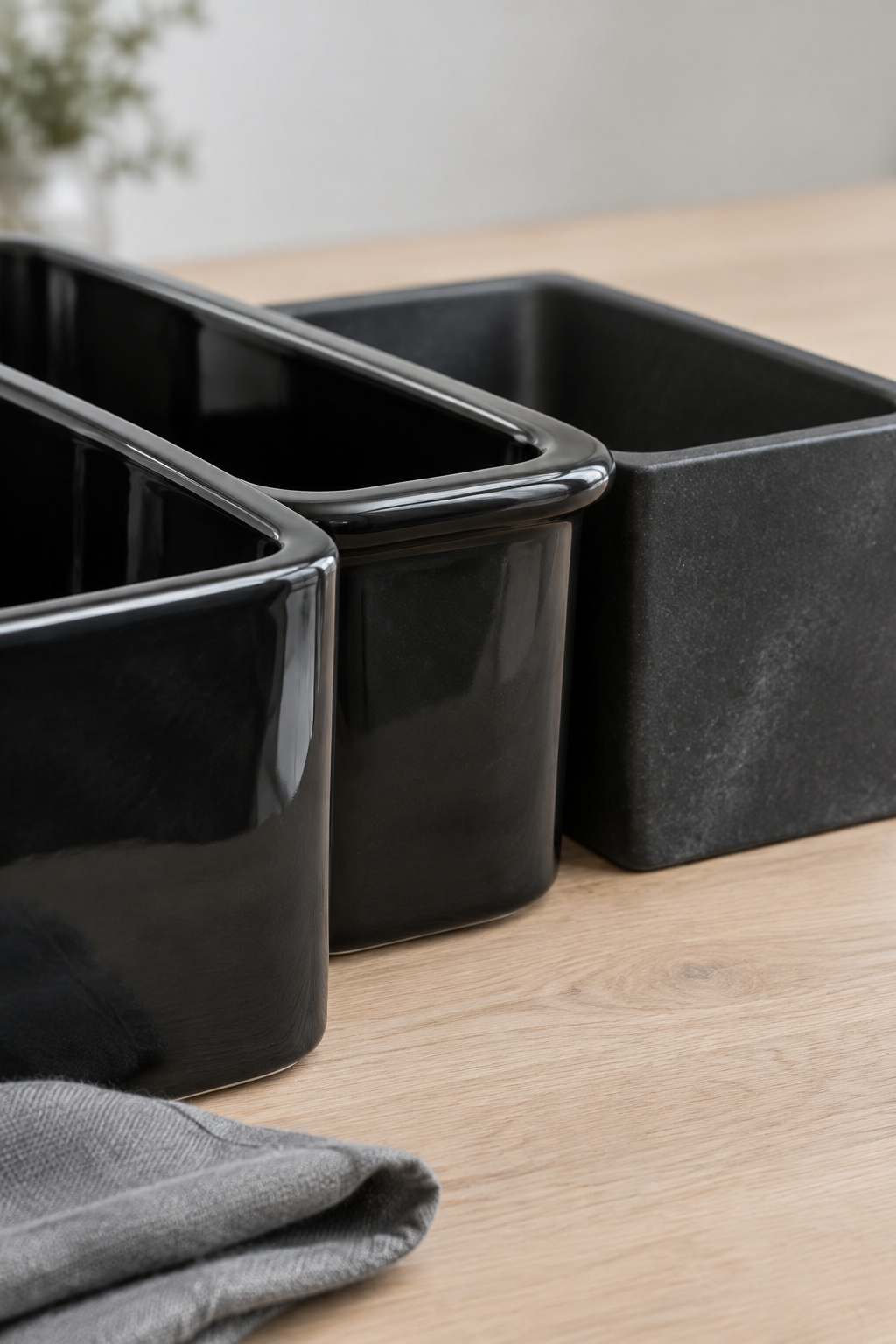
| Glazed vitreous china | Toilets and most basins | Glaze fired onto a china body | White lines and film on the gloss | Color-match kits, cosmetic only |
| Fireclay | Sinks and basins | Glaze and clay fused into one non-porous body, fired about 24 hours at 1,600–2,100°F (871–1,149°C) | Limescale builds, and shows once food or drink stains it | Color-match kits, cosmetic only |
| Composite quartz or granite | Sinks only | Pigment through a resin-bound body, in Blanco’s case up to 80% quartz sand | White lime shows more on dark colors | Wet-sand at 80–100 grit, then 200–400, and polish |
Composite is the one people hope will forgive them. Its makers say it won’t: Blanco says white lime shows up more on dark colors and that the color does not change how often you need to clean; another composite maker says black can show hard water and soap scum more readily than lighter colors. Composite wins on repair, because the color runs all the way through and a scratch sands out. A chip in glaze can only be patched with a color-match kit, and on black I would not count on the patch disappearing.
What the Cleaner Aisle Does to Black Glaze
A cleaner can dull black glaze for good, and a dull patch on black is the one mark no wipe-dry will fix. The makers agree on most of the rules:
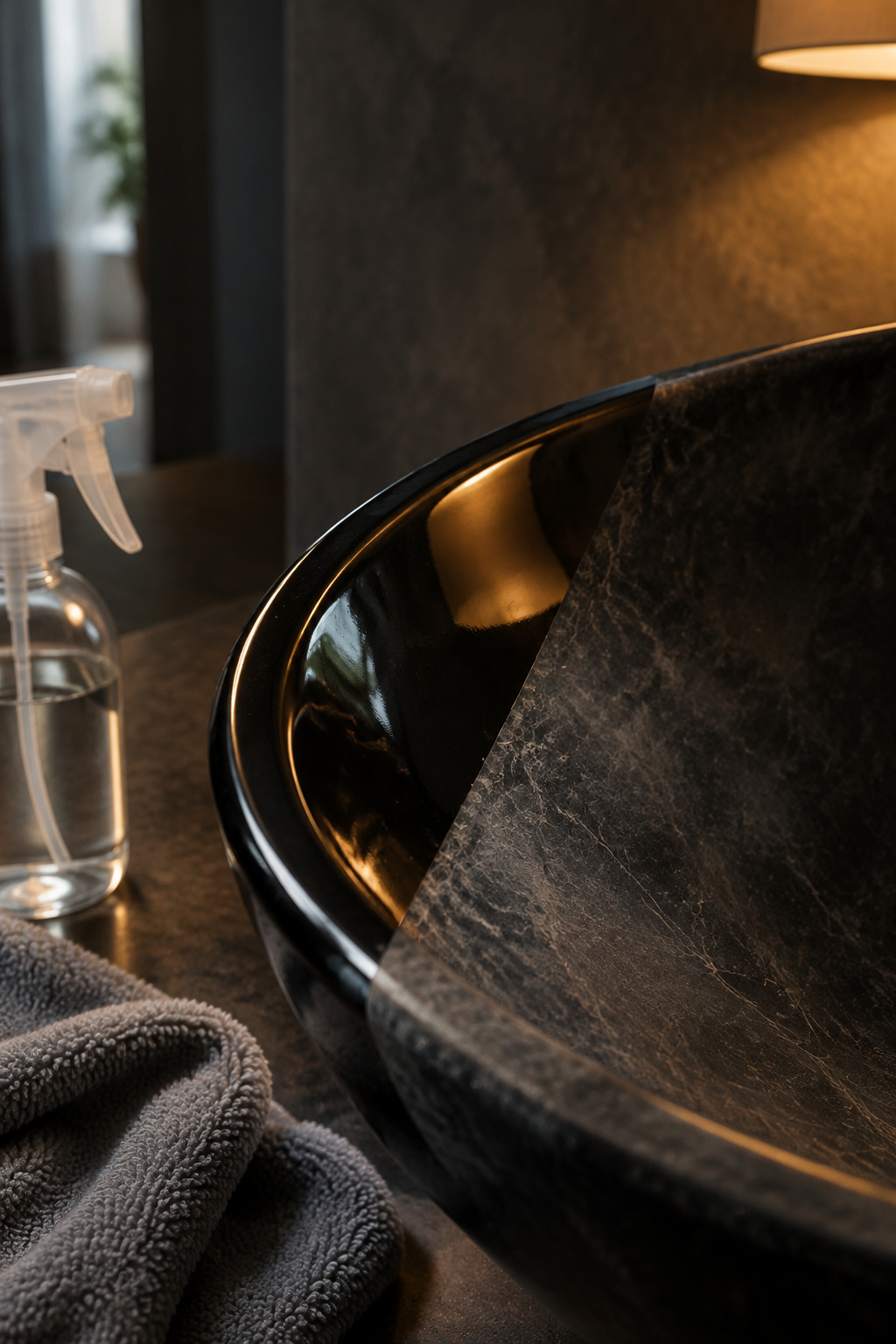
- No steel wool, wire brushes, scouring powder or abrasive pads. Use a non-scratch pad or a soft cloth.
- Keep ammonia, strong alkalis, oven cleaner, drain cleaner and undiluted chlorine bleach off it. Any of them can permanently dull or etch a glaze.
- Rinse cleaners off rather than leaving them to soak, and don’t leave anything that stains sitting on the glaze.
- Keep the seat and lid up until a bowl cleaner is rinsed out, because the fumes can discolor the seat.
- Skip the cleaners that sit in the tank. They can wear out the gaskets and valves.
On acid, the makers split into two camps. Kohler’s New Zealand care page and Bocchi say to avoid acid cleaners on their china, and Bocchi treats gloss lost to acid or alkaline etching as wear, with improper care voiding the warranty. Other china and fireclay care sheets allow a diluted citric or vinegar cleaner, or a descaler such as CLR, for hard-water stains. Diluted bleach divides them the same way. Each answer is written for that maker’s own glaze, so follow the care sheet that came with your fixture, and keep it.
Whatever you use on the bowl, keep it off the matte black tap beside it. That finish has rules of its own, and the fixture-finishes guide covers them.
A Black Bathroom Sink Is Easier Than a Black Toilet
If your water lands in the hard band, I would split the decision: a black sink, yes; a black toilet, think twice. A basin is rinsed and dried in passing, and Kohler’s own advice is to wipe it after every use. A bowl holds standing water around the clock, and the deposits gather at the rim holes and in the trap, exactly where a cloth never goes.
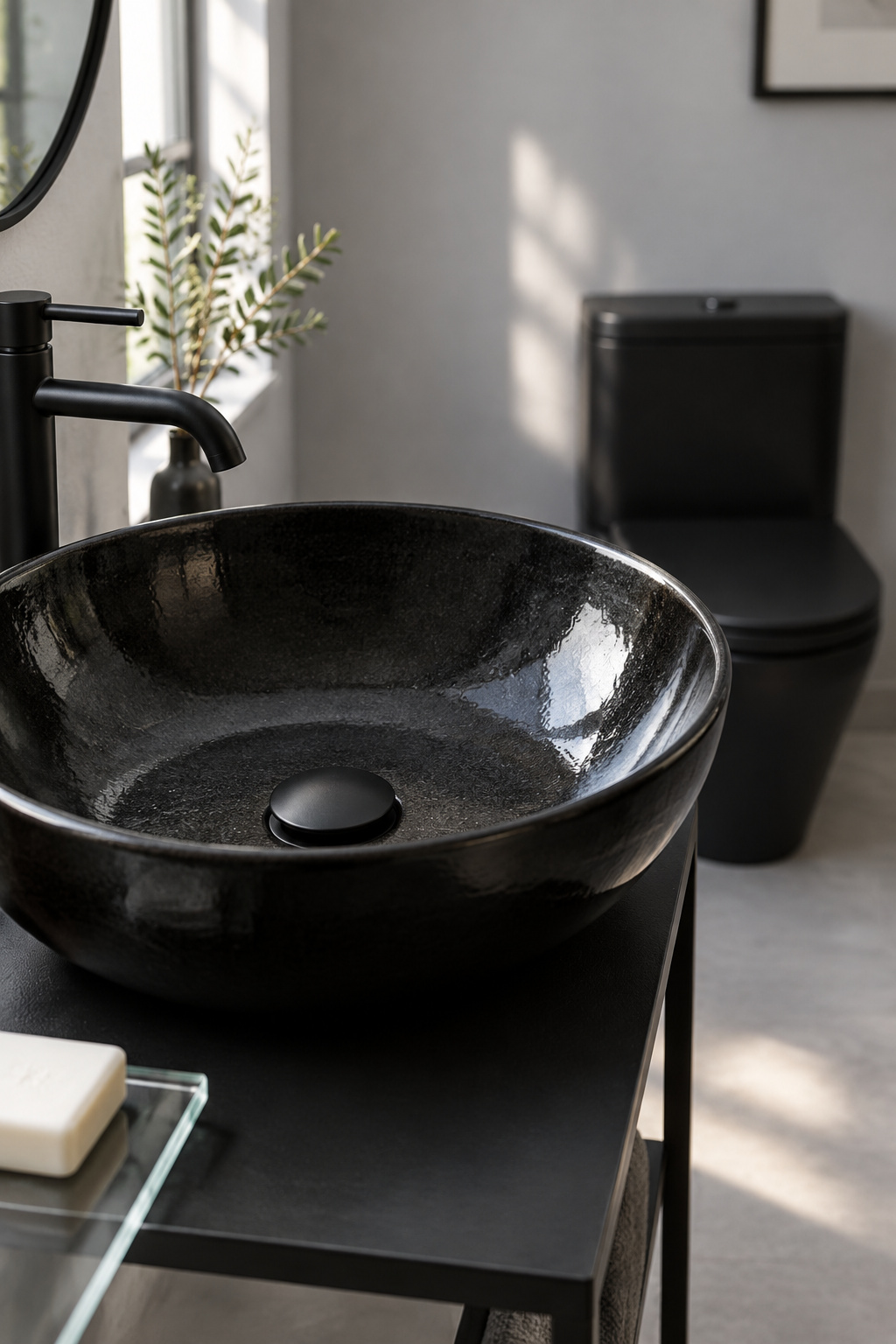
Choose a black basin and the black vanity under the sink together, since the eye takes them in as one piece.
Matching two blacks from two makers
Black is not one color. Kohler’s own finish chart lists several blacks under separate codes, Black Black and Caviar among them, so blacks from two different makers are even less likely to agree. A composite basin takes its color from pigment in a resin body and a toilet from a fired glaze, so expect them to differ. Old houses are stubborn about matching, and new fixtures are no better. Buy the toilet, seat and basin from one range, or get samples and set them side by side in daylight before you order.
When a White Fixture Is the Better Call in a Black Room
White china is the plain answer in a black room when the water is very hard and nobody will wipe daily. Even a maker that sells black sanitaryware tells hard-water households to choose carefully or install a softener first. White fixtures don’t break the scheme. Tile, paint and hardware can carry the black, and the question of which surfaces suit black in a bathroom is worth settling before the fixtures are.
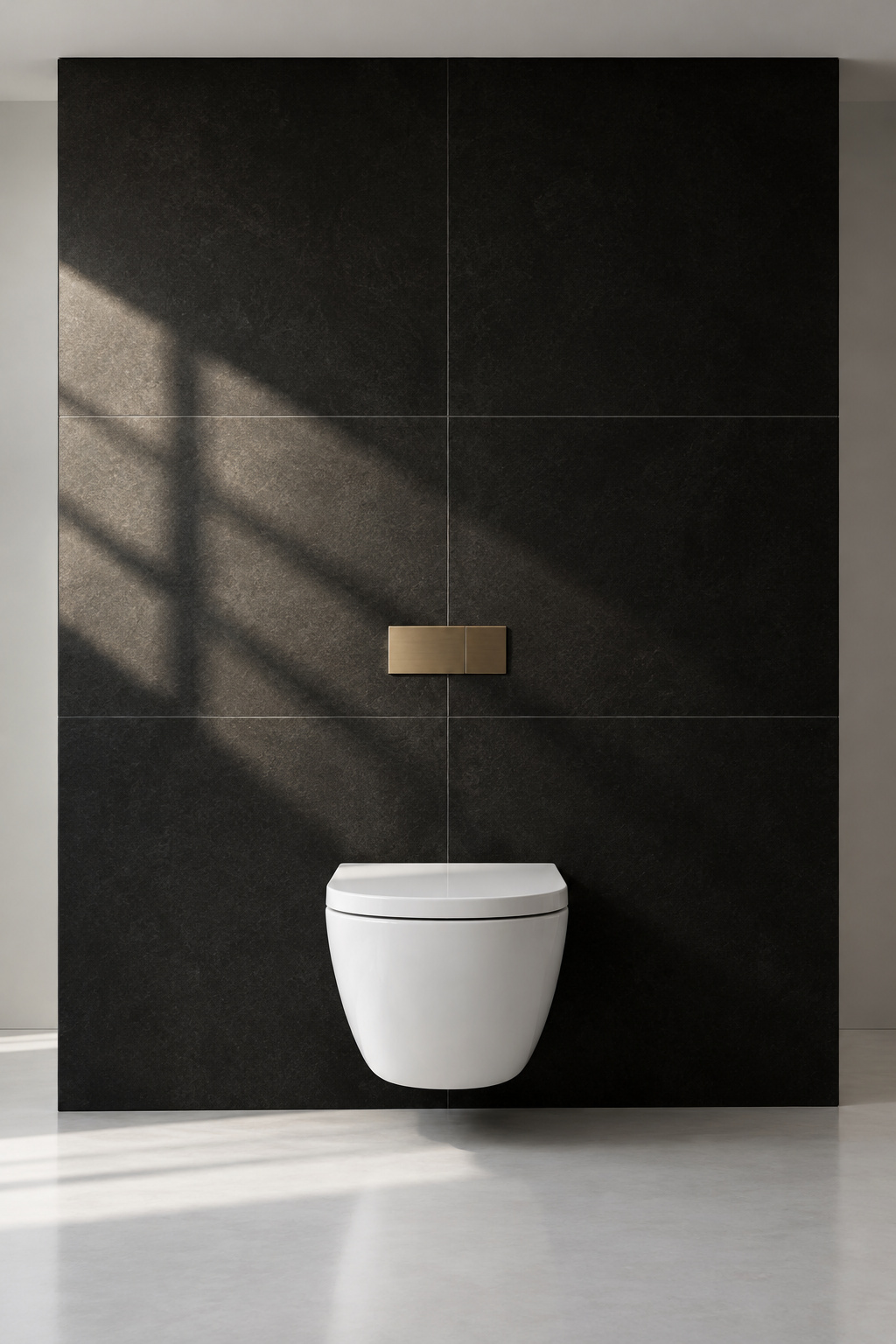
I judge any modern change to a house by whether the next owner can undo it, and fixtures deserve the same test. The most reversible version of a black bathroom keeps the toilet white and puts the black on things a later owner can repaint or unscrew.
Your first move today is small. Find the utility’s water report or buy a strip, read your class against the table, and write the number and the date on the inside of the vanity door. A good restorer leaves notes for the next one, and whoever owns the bathroom after you will want to know why the toilet is the color it is.
FAQ
Do black toilets cost more than white ones?
It depends on the model, and the price differences quoted online disagree too widely to use. There is no published price list that sets the same toilet from the same maker side by side in both colors, so look up the exact model you want in black and in white and compare the two before you decide.
Are black toilets as easy to repair and fit with standard seats as white ones?
They fit the same way, but the seat is harder to replace. Black toilets come in one-piece and two-piece, round and elongated, and comfort height of 17 to 19 inches, so the usual measurements apply. A white seat is a commodity item, while a seat in a non-white color is often a special order that costs more.
Will a black toilet hurt resale value?
There is no good evidence either way. Taste is easier to read: in 2018 Kohler’s marketing manager said white and biscuit were still the overwhelming choice, with black third. If you plan to sell soon, white is the lower-risk choice; if you plan to stay, buy for your water.