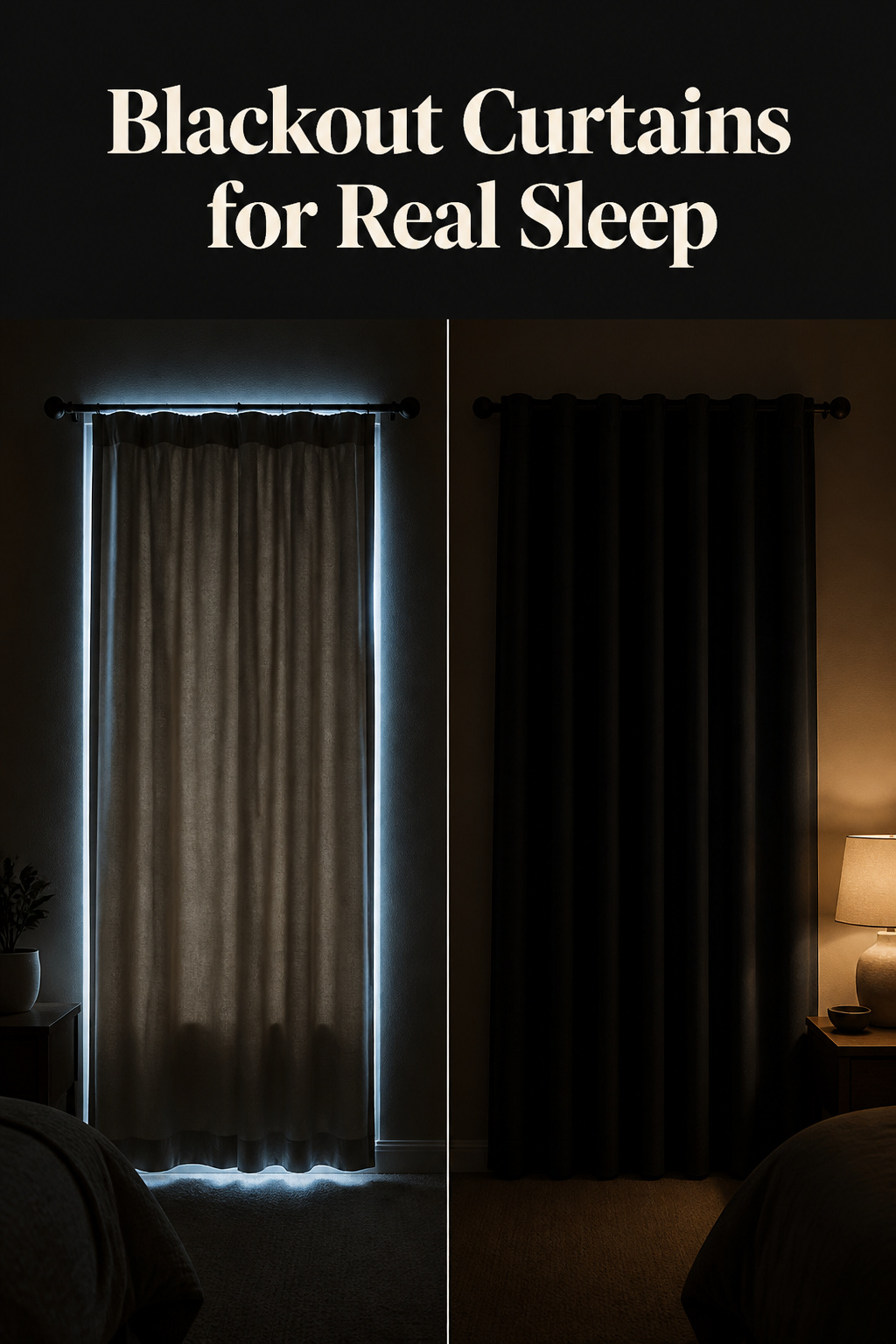
Rest is not something you decide to do. It is something a room either allows or quietly interrupts, night after night, in ways the sleeper rarely traces back to the window — a streetlight held just past the curtain edge, the pale wash of early dawn, a neighbour’s porch light that never goes off. None of it wakes you fully. That is the problem: it keeps a part of you awake without your consent. Choosing blackout curtains for bedroom sleep is really about designing for darkness itself, not buying a label.
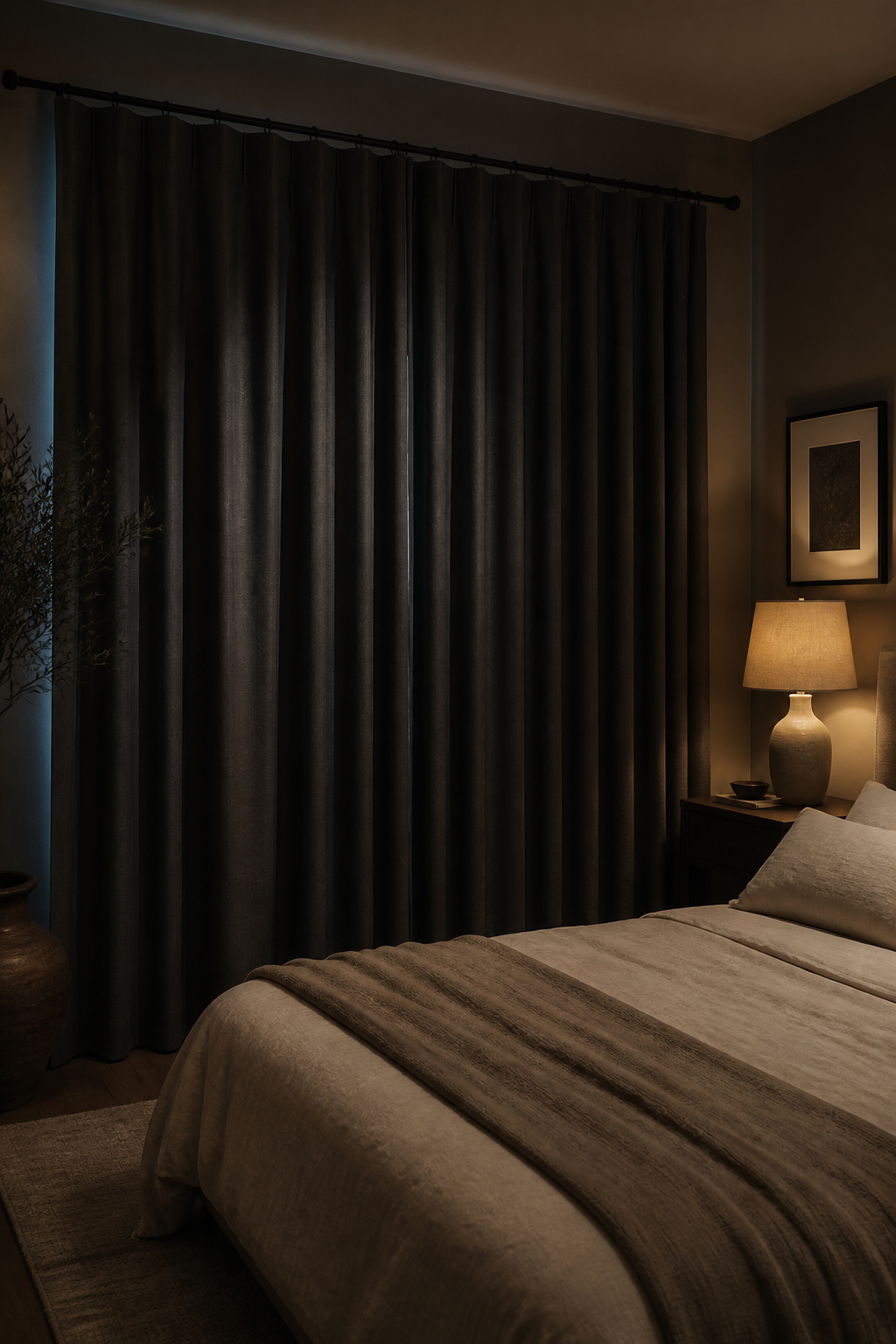
TL;DR
- For deep sleep, aim for under 1 lux in the room at night; even 5–10 lux before bed can cut melatonin by roughly half and delay its peak by about 90 minutes.
- A “100% blackout” label rates the fabric, not the room — quality blackout fabric blocks 95–99% of light, but light still leaks at the top, sides, bottom, and center gap unless the curtain is hung wide and high.
- Match three choices to your light problem: blackout percentage (85–90% for a distant streetlight, 99–100% for daytime sleep), a well-backed mid-weight fabric, and a back-tab or pinch-pleat heading that seals at the rod.
What Darkness Actually Does for Sleep
Before any percentage or fabric, understand what you are choosing for. Darkness is an input the body reads all night.
Light as an input to the nervous system
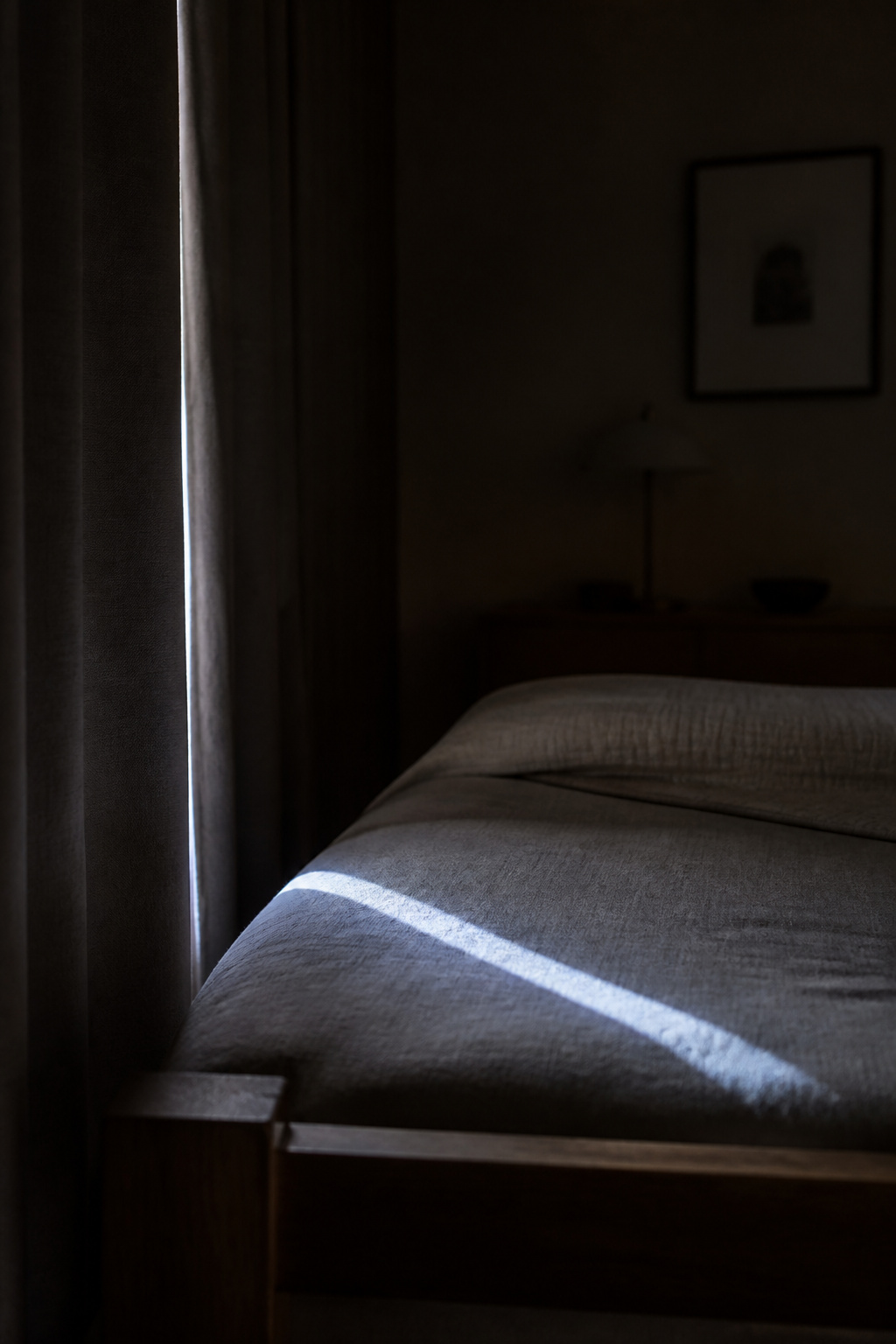
Light entering the eye during sleep reaches the suprachiasmatic nucleus, the body’s central clock, which resets daily in response to it. That clock cannot tell a sunrise from a streetlight; both are simply a signal to wake.
The sensitivity is finer than most expect. Light as low as 5 lux measurably reduces melatonin and interferes with sleep quality, and one study linked a single night under moderate 100-lux light to a higher heart rate and next-morning insulin resistance. The body treats an under-lit room as a physiological event, not a mild annoyance.
Why partial dark keeps you in shallow sleep
A room that is almost dark is the quiet saboteur, because the eye adapts and stops noticing while the nervous system does not. Just 5–10 lux in the hours before bed can cut melatonin by roughly half and delay its peak by about 90 minutes — which does more than slow sleep’s arrival, it thins the deep phases once you are under.
For melatonin to work as it should, a bedroom needs to sit under 1 lux at night, yet a hallway nightlight or a strip of streetlight under the door easily clears that.
Recognizing light as an input, not decor
During my teacher training in Dharamshala, the practice hall had almost nothing in it — a plank floor, a row of cushions, and one window. The only decoration, if you could call it that, was the light moving slowly across the floor as the sun crossed the sky. Nobody had designed that room to be beautiful. They had designed it to be honest about what light does to attention, hour by hour.
A bedroom asks for the opposite honesty at night: no light moving across the floor at all. A half-lit bedroom is not a style failure to redecorate around — it is an unresolved input to quiet, and you quiet it with three choices: percentage, fabric, heading.
Blackout Percentage: What the Numbers Mean
Blackout percentage sounds like a promise about your room. It is only a rating of the fabric — this is where the marketing gets in the way.
Medium, high, and full blackout explained
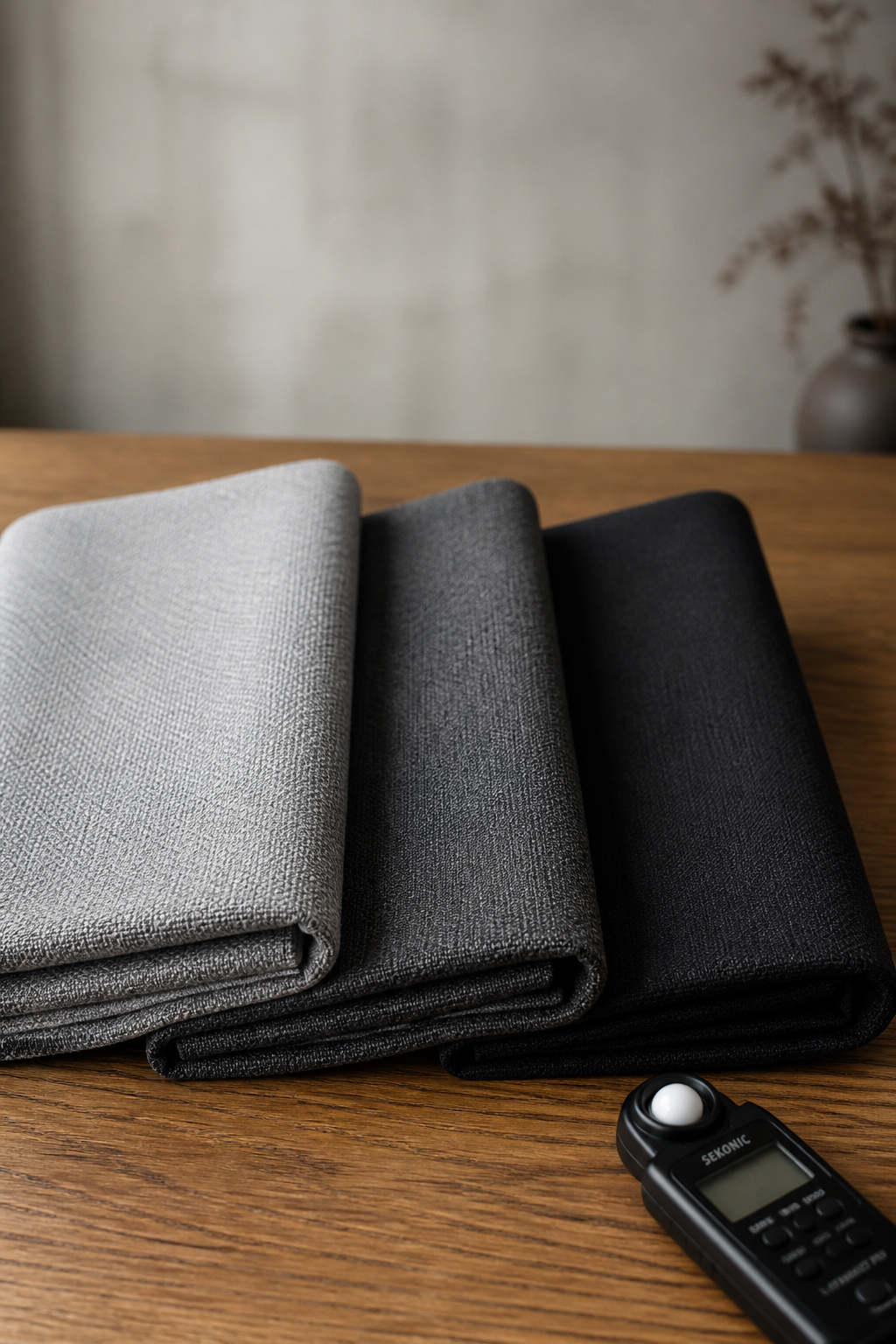
Medium blackout, around 50–70%, suits living rooms where some ambient light is fine. High blackout, 80–95%, leaves a room dim and cozy with a little leakage. For bedrooms, 60–90% meets most needs — though light-sensitive sleepers should reach for the top of that band or beyond. Quality blackout curtains block 95–98% of light, premium fabric touching 99%.
Yet even a “100% blackout” panel describes its weave, not your finished room. Fully opaque cloth still leaks at the top, sides, and center gap unless it is hung wide and high.
Why the label alone doesn’t guarantee darkness
A curtain hangs from a rod. It cannot seal against the frame the way a fitted panel can, so it leaks at four predictable points — the sides, the top, the bottom, and the center where panels meet. The gap between a dark grey room and pitch blackness is often installation, not fabric.
Matching percentage to your room’s light sources
Choose against your actual problem, not the highest number on the shelf. A room with a single distant streetlight and no direct sun can often rest at the 85–90% tier. A room facing dawn, a porch light, or an east window needs the top of the range, because that input never fully switches off. For anyone sleeping through daylight, blackout is close to essential — daylight signals wakefulness even in small amounts, which is the same reasoning that makes safe, cordless window treatments for a kids’ room worth checking if naps down the hall face the same problem.
Fabric Weight and Weave
The instinct is to reach for the heaviest cloth in the shop. It feels safe, and it is often wrong.
Why heavier isn’t always darker
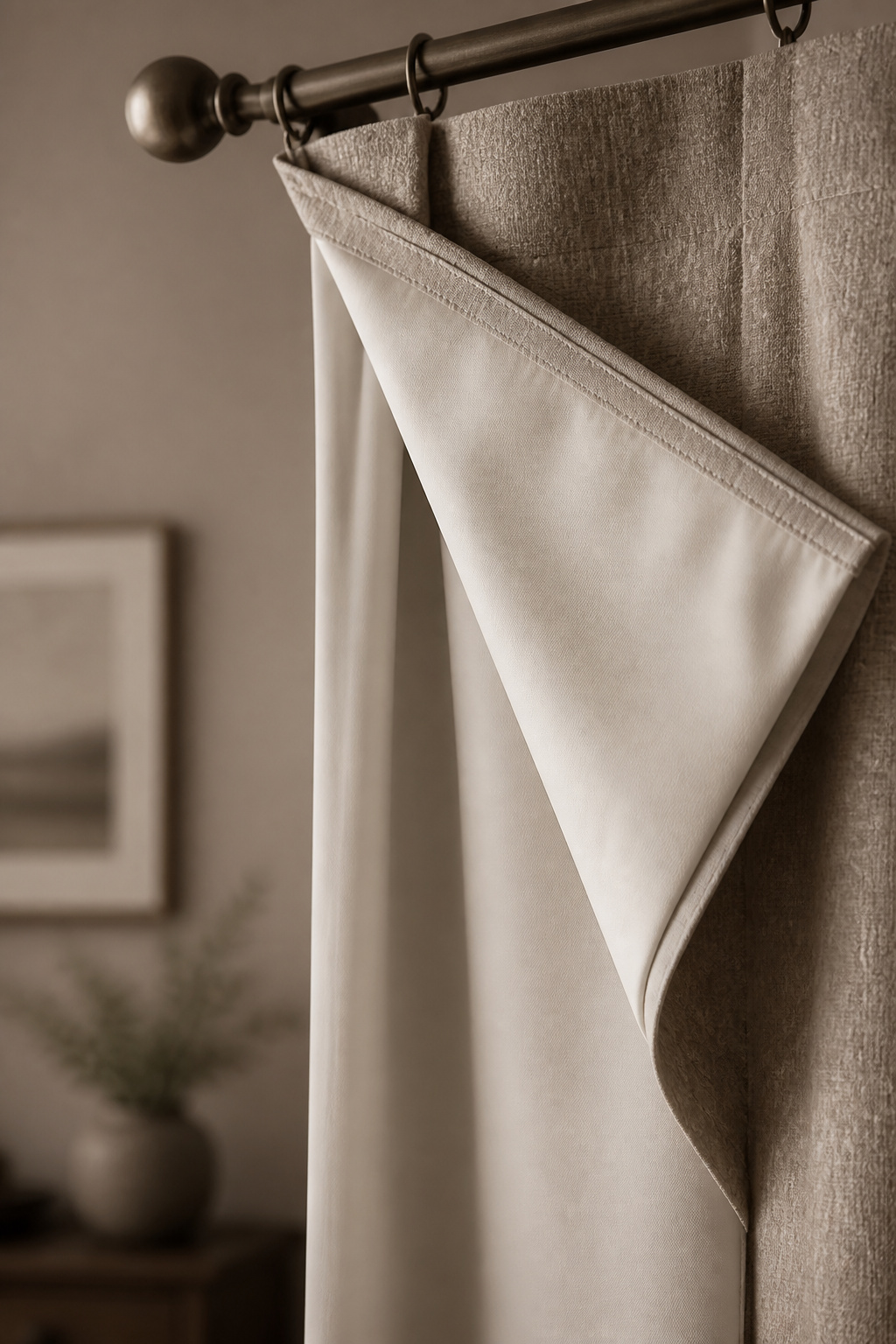
Most effective blackout fabrics fall between 200 and 350 GSM, with 240–280 GSM the sweet spot for a home. Weight alone predicts little. A tightly woven 300 GSM fabric can block more light than a loose 350 GSM one, because the gaps between threads matter as much as their mass. A workable weave sits at a minimum of 180 threads per inch; below that, light slips through the cloth whatever the label weighs.
Weave density and light leak
What most true blackout fabrics rely on is a backing — a foam, acrylic, or polyurethane layer that blocks light between the fibers, separate from the weave. This is why a 200 GSM curtain with a quality blackout backing can match a 400 GSM fabric with none at all: the backing does the work, and the base cloth carries the look.
Layering a liner for an existing curtain
If you already own curtains you love, you do not have to replace them to reach true darkness. Ready-made blackout linings attach to existing panels using the same rings and hooks, no sewing needed. A Velcro-style universal lining lets you test genuine blackout, then remove it if it isn’t right. Lining what you have usually solves the same problem for less than new curtains.
Heading Style: The Detail Most Guides Skip
Most roundups treat this as decoration. It is not: the heading decides how much light escapes at the rod, before the fabric is ever tested at the wall or floor.
Back tab vs. rod pocket vs. pinch pleat
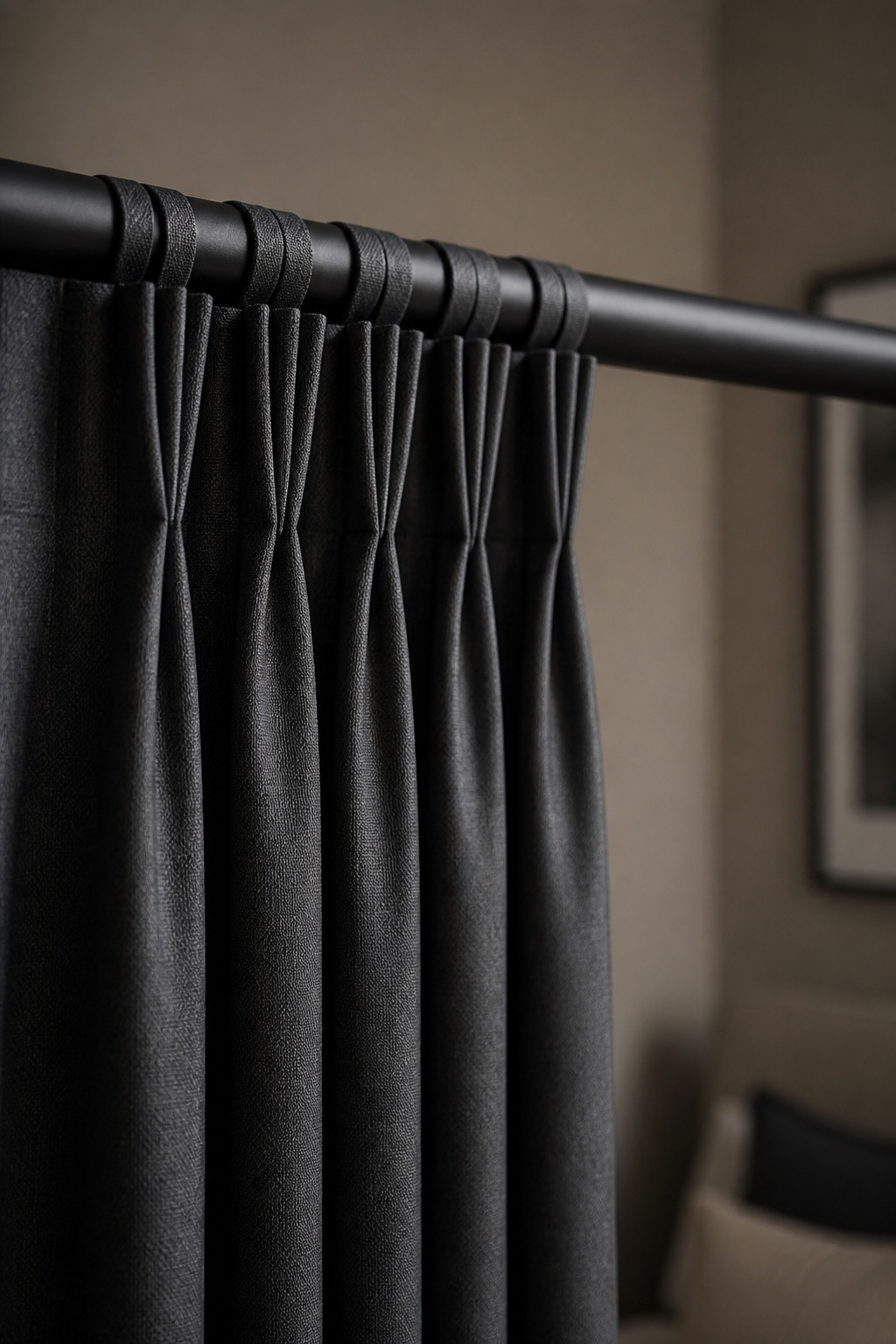
Rod pocket curtains thread the rod through a sewn channel, leaving small persistent gaps that let light filter through even fully closed. Back tab hides the loops behind the panel and conceals the rod, giving a closer seal at the top. Triple pinch pleats gather the fabric fully with minimal rod-to-fabric gap — one of the most effective headings for blocking light. Opaque ring-top and back-tab headings suit blackout; sheer grommet and rod pocket styles belong to light-filtering, not true dark.
How heading style changes light leak at the top
The top edge is where an otherwise good curtain quietly fails. Pinch pleats paired with a blackout lining minimize seepage at the header better than grommet or rod pocket styles manage alone. Where overhead light is stubborn, a pelmet box — a horizontal cover over the rod — blocks any spill above the panel.
Choosing a heading that fits your rod
Grommet and back tab styles slide smoothly, so they suit a curtain drawn every day. Whichever you choose, hang it on a wide rod well above and beyond the frame — the heading seals the rod, it does not cover the window.
Closing the Gaps: Side and Bottom Light Leak
Suppose the percentage, fabric, and heading are all right, and a thread of light still crosses the room. That light is almost always hardware, not fabric.
Panel width and overlap
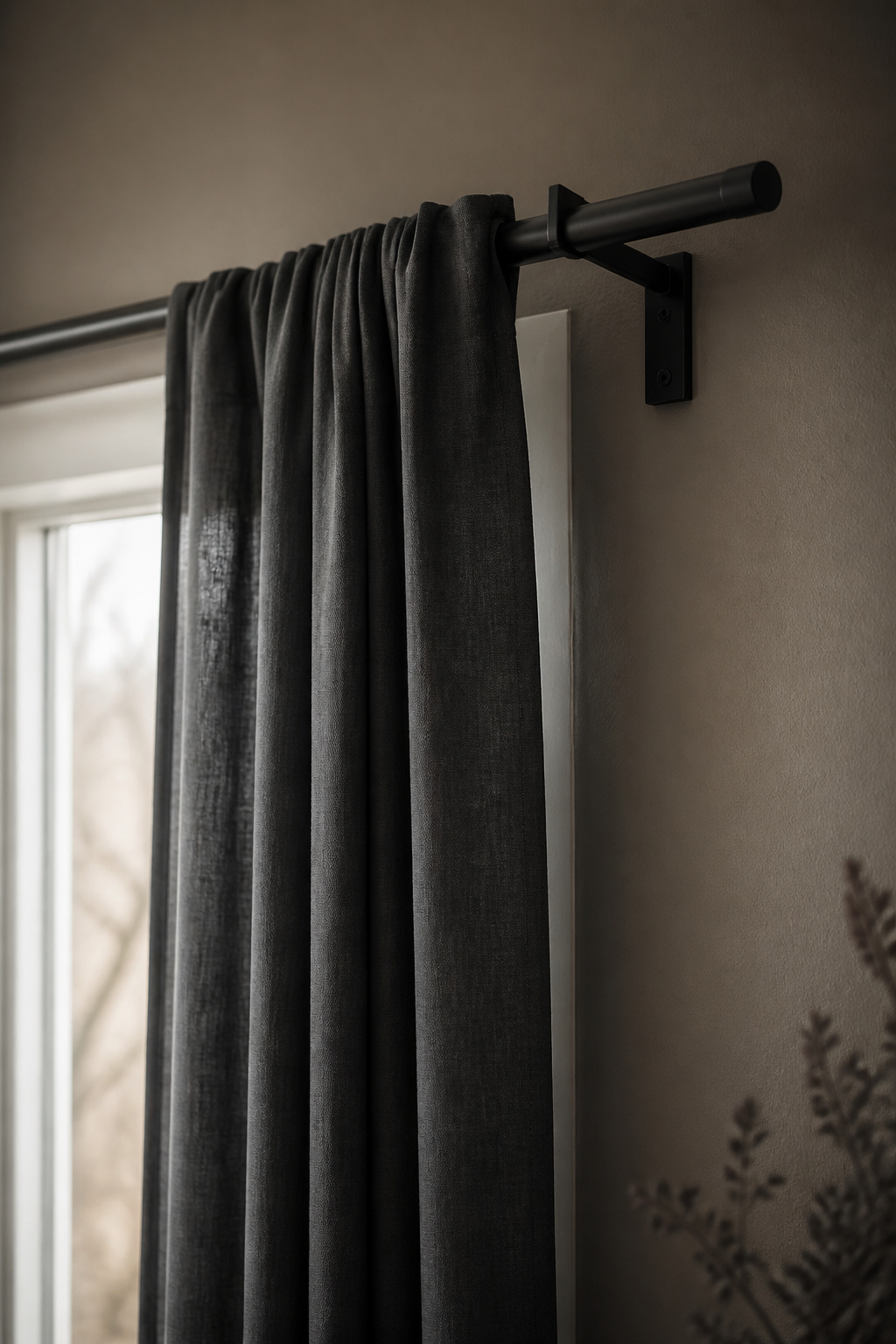
Fabric width is the first fix. Across both panels, aim for at least 2.5 times the window’s width — on a 36-inch window, roughly 90 inches of combined cloth. Then mount the rod at least 8 inches above the frame and extend it about 10 inches past it on each side; that single move is the highest-leverage cure for side and top gaps. A small center overlap where the panels meet closes the last vertical seam.
Wall-mounted brackets vs. inside-frame mounting
Where the hardware sits decides the rest. Outside-mount brackets overlap the frame on the top and sides, covering the exact gaps light enters through — they consistently beat inside-frame mounting, which leaves gaps on all four sides by design. Returns, the wraparound rod ends that pull the panel’s edge back to the wall, close the last of the side leak.
Small fixes that make a real difference
The last of the light yields to small things. Removable adhesive strips let the curtain edge seal against the wall with no hardware. A hem that grazes the floor reduces bottom-gap leak, and discreet weights keep the fabric hanging straight.
A Room That Finally Goes Dark
Bring the three choices together and the room stops fighting you.
Bringing percentage, fabric, and heading together
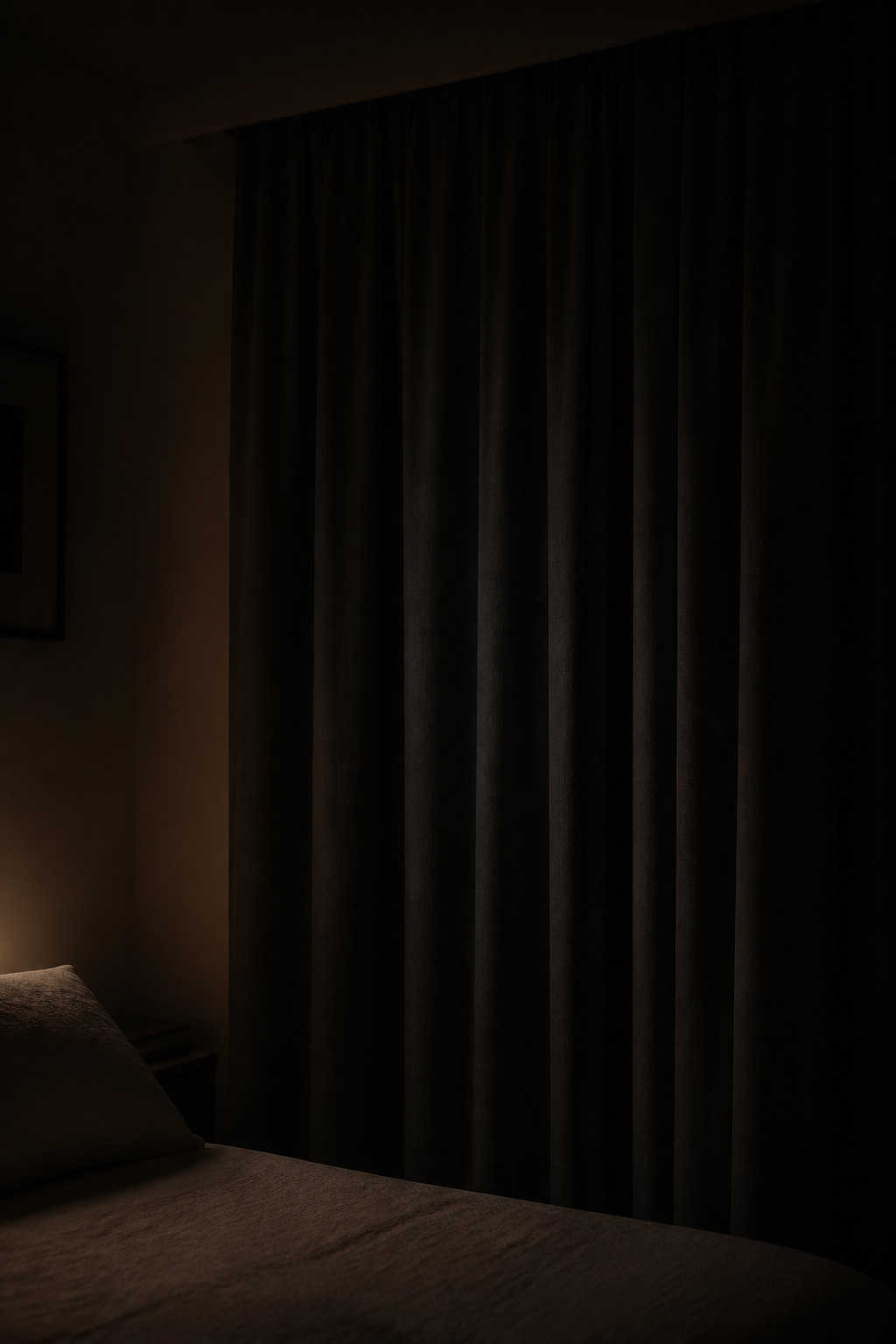
The choices work as a stack, not alternatives. Percentage sets the fabric’s ceiling; weave and backing decide whether that ceiling is reached; heading style decides how much leaks at the rod. Facing only a distant streetlight, you can often stop at 85–90% blackout with a well-backed mid-weight fabric and a back-tab or pinch-pleat heading; sleeping through daylight pushes every choice to its top end.
What to check on your first night
The real test is not on the packaging. Stand in the closed room, let your eyes adjust for a few minutes, and look for any visible edge of light — top, sides, bottom, or center seam. Wherever it glows tells you which fix to apply. A phone light-meter app, though not lab-grade, gives a rough lux reading to check against the under-1-lux target. If your window is an awkward shape, blacking out an angled bay window takes a different approach, and the full survey of every bedroom window covering style helps too.
The room you want is the one you stop noticing at 2 a.m. — percentage, fabric, and heading, chosen for the light you actually have.
FAQ
How dark should a bedroom be for sleep?
For optimal melatonin production, a bedroom should stay under 1 lux at night — effectively complete darkness. Even moderate light around 100 lux for a single night has been linked to a higher heart rate and next-morning insulin resistance. In the three hours before bed, keep total light exposure under 10 lux to avoid delaying melatonin onset.
Do blackout curtains really block all light?
Blackout fabric itself blocks 95–99% of the light passing through the weave, but the finished room rarely reaches true 100% darkness, because curtains hang from a rod rather than sealing to the frame. Four predictable gap points — top, sides, bottom, and center — account for most leaks. Installation matters as much as the fabric’s rated percentage.
Are blackout curtains worth it for shift workers?
For anyone sleeping during daylight hours, blackout curtains are close to essential, since even small amounts of daylight signal wakefulness to the brain. Shift workers should aim for the top of the range — 99–100% rather than the 95–97% room-darkening tier that suffices for typical nighttime sleepers. Most report falling asleep faster and waking less once genuine blackout is achieved.