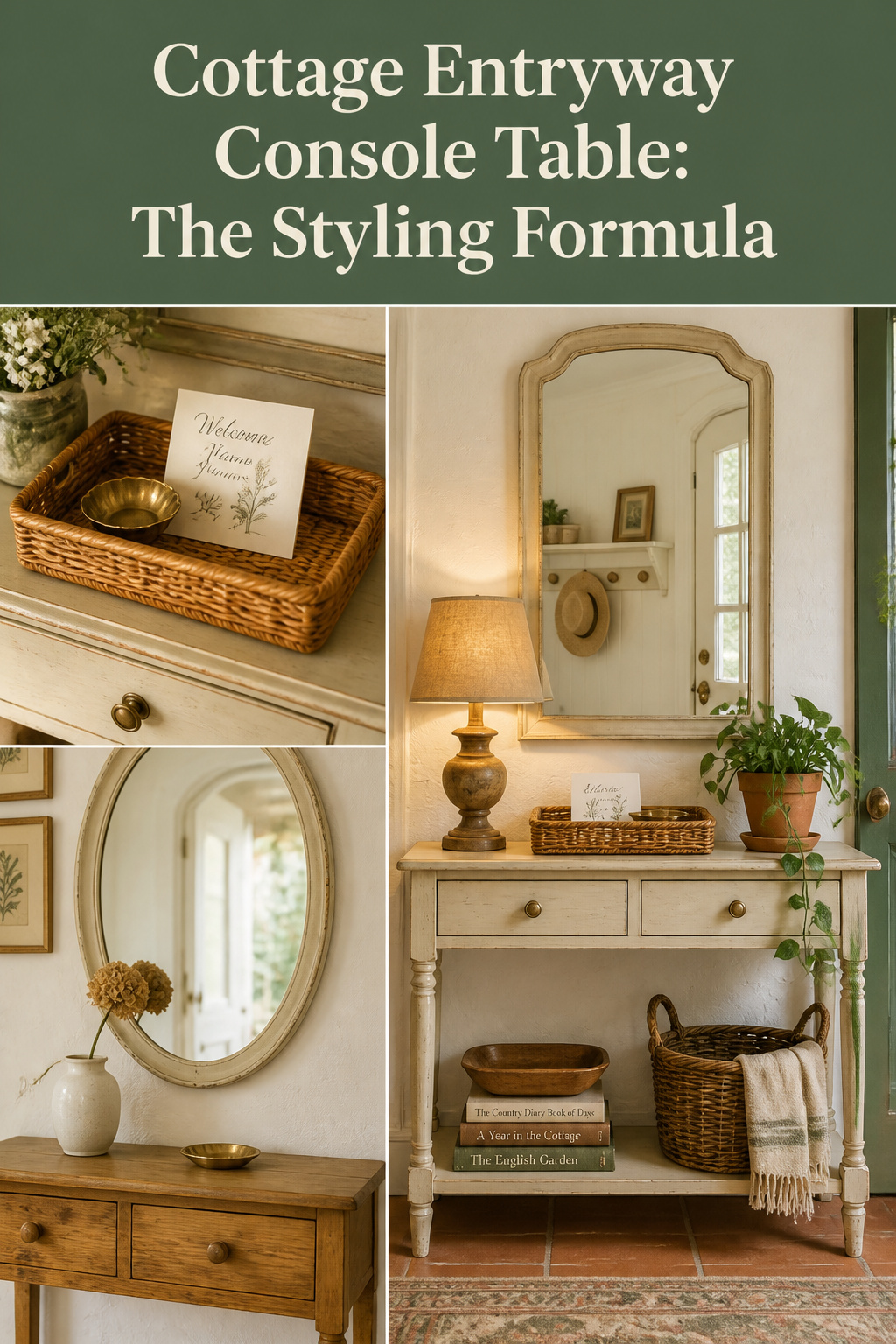
Every flat surface in a working entry eventually becomes a shelf for things people haven’t decided where to put yet. The cottage entryway console table is supposed to be different — a composed piece with a mirror above it, a lamp beside it, and something green that proves someone thought about it. It stays different for roughly three days. Then the keys appear, then a charging cable, then a receipt, and the composed entry is a shelf again. The console doesn’t fail because it was the wrong table. It fails because there was no formula.
TL;DR
- Choose a console 30–32 inches tall and no deeper than 12 inches for halls under 48 inches wide; halls 50–60 inches wide can take 14–16 inches of depth while keeping 36 inches of clear passage.
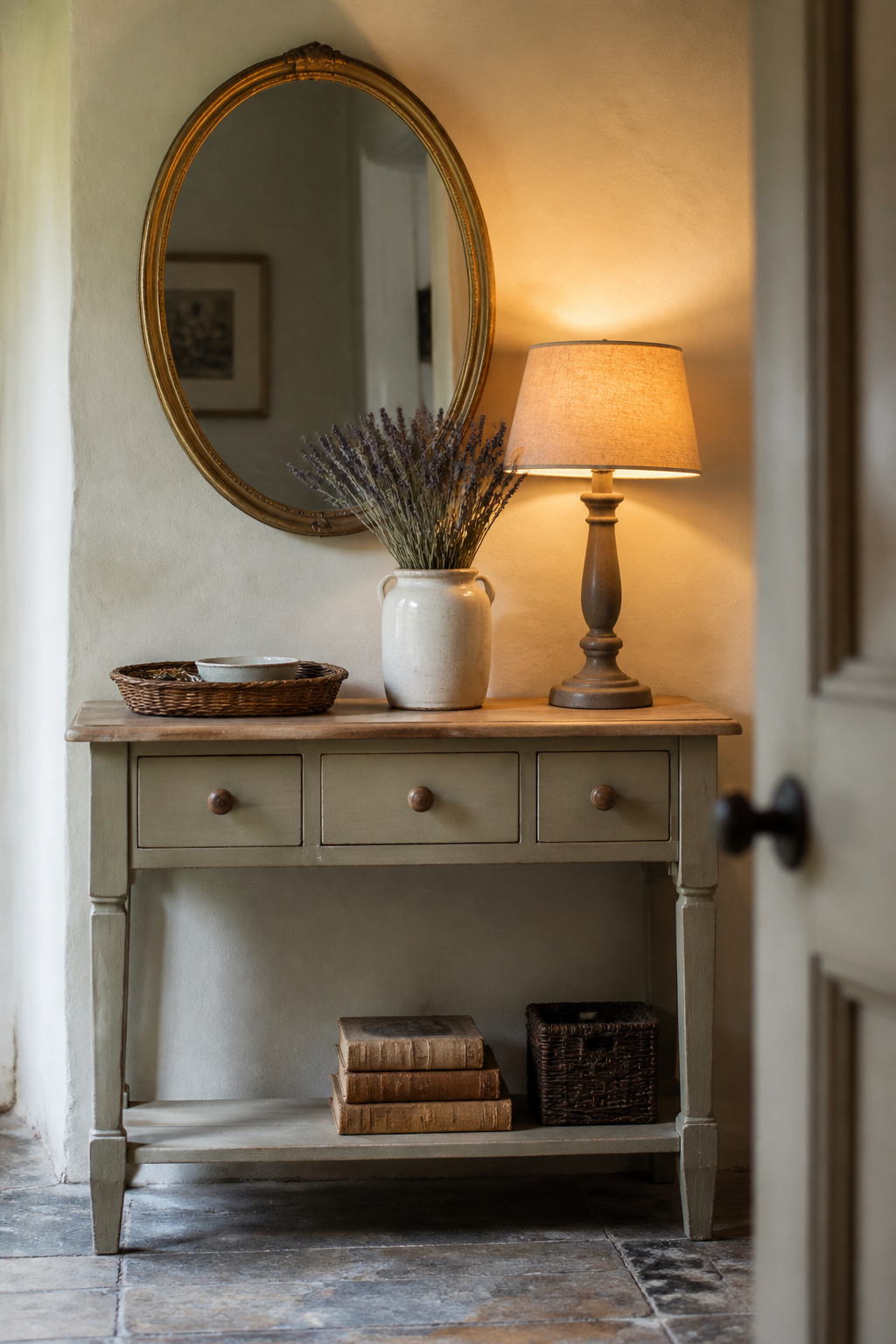
- Apply the four-element formula: a tray that anchors daily function, a lamp for height and warmth, a mirror hung at 50–75% of the table’s width, and one botanical element.
- Use the swap principle for seasons — keep tray, lamp and mirror fixed all year, rotate only the botanicals, one found object, and an occasional textile.
The Console Table and Why a Cottage Entry Needs One (Or Doesn’t)
The console is the most aspirational piece of furniture in a cottage entry and the most easily skipped. Not every entry should have one, and knowing which category yours falls into is the first decision — because a console that blocks passage is worse than no console at all.
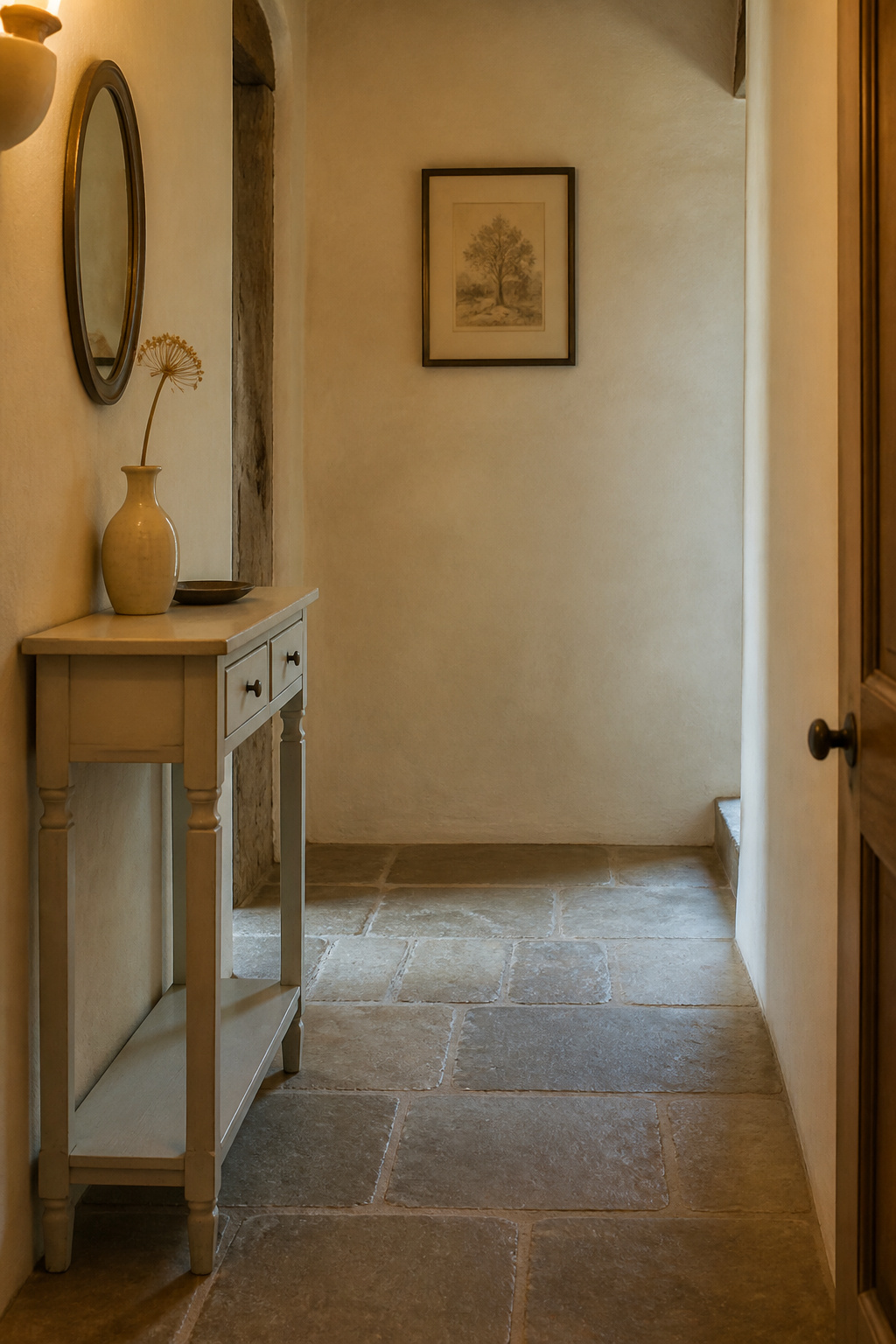
For cottage entryway inspiration that ties all six entry zones together, the pillar guide is the place to start before committing to any single piece.
What a landing surface actually provides beyond decoration
A console gives the entry its working structure. It is where the mirror has something to relate to, where the lamp has a platform to stand on, and where the greenery has a level from which to rise. Without it, those three elements scatter across the wall with nothing to hold them together.
It also creates a drop-zone system: a dedicated surface for daily-use items — keys, a wallet, incoming post — that prevents them from migrating to every flat surface in the house. The tray is the boundary. When it is there and understood, the system holds.
The historical weight behind this is worth knowing. The pier table — the console’s direct ancestor — developed in continental Europe in the 1500s and 1600s and arrived in English homes in the last quarter of the seventeenth century, placed against the wall between windows with a tall pier glass above it to double the candlelight. During the Regency period (1800–1830), a mirror was routinely mounted above or between the table’s back legs — and that pairing has been the entry convention ever since. The Victorian hall table evolved the tradition further: a silver salver for visiting cards, a drawer for correspondence, a place for hats and gloves. The tray on a modern cottage console is a direct descendent of that salver.
The entry width that makes a console practical vs. the one that makes it an obstacle
The standard minimum clearance after the console depth is accounted for is 36 inches — enough for one person to move past without turning sideways. Interior designer Catherine Kindleson of Petalwood Interiors puts it as 90–120 cm of clearance from the table’s front edge to the opposite wall. In practice: a hallway narrower than 48 inches total needs a console no deeper than 12 inches. A 60-inch hallway can accept 14–16 inches of depth comfortably.
In a hallway under 36 inches wide, the console becomes an obstacle regardless of how narrow it is. A floating shelf, a slim ledge bracket at counter height, or the mirror alone serves the landing-surface function without blocking passage.
Console length follows the two-thirds rule: the table should span approximately two-thirds of the wall it sits against. A 72-inch wall calls for a 48-inch table. Shorter than that reads as an afterthought; wider than three-quarters of the wall makes the entry feel cramped.
The historical cottage hall table — when it appeared and what it was originally for
The Arts and Crafts movement of the 1880s to 1910s shaped the cottage hall table most directly, rejecting Victorian mahogany in favour of oak and painted pine with visible joinery — honest materials, nothing disguised. That is the direct heritage of the hall table that reads as authentically cottage today, and it explains why a reproduction in polished mahogany never quite sits right in a cottage entry, however well-made.
Choosing the Right Console: Scale, Depth, and Material for the Cottage Entry
Before any styling, the table must fit the room in three dimensions. Writers on cottage interiors frequently discuss scale and proportion without giving numbers. Here they are.
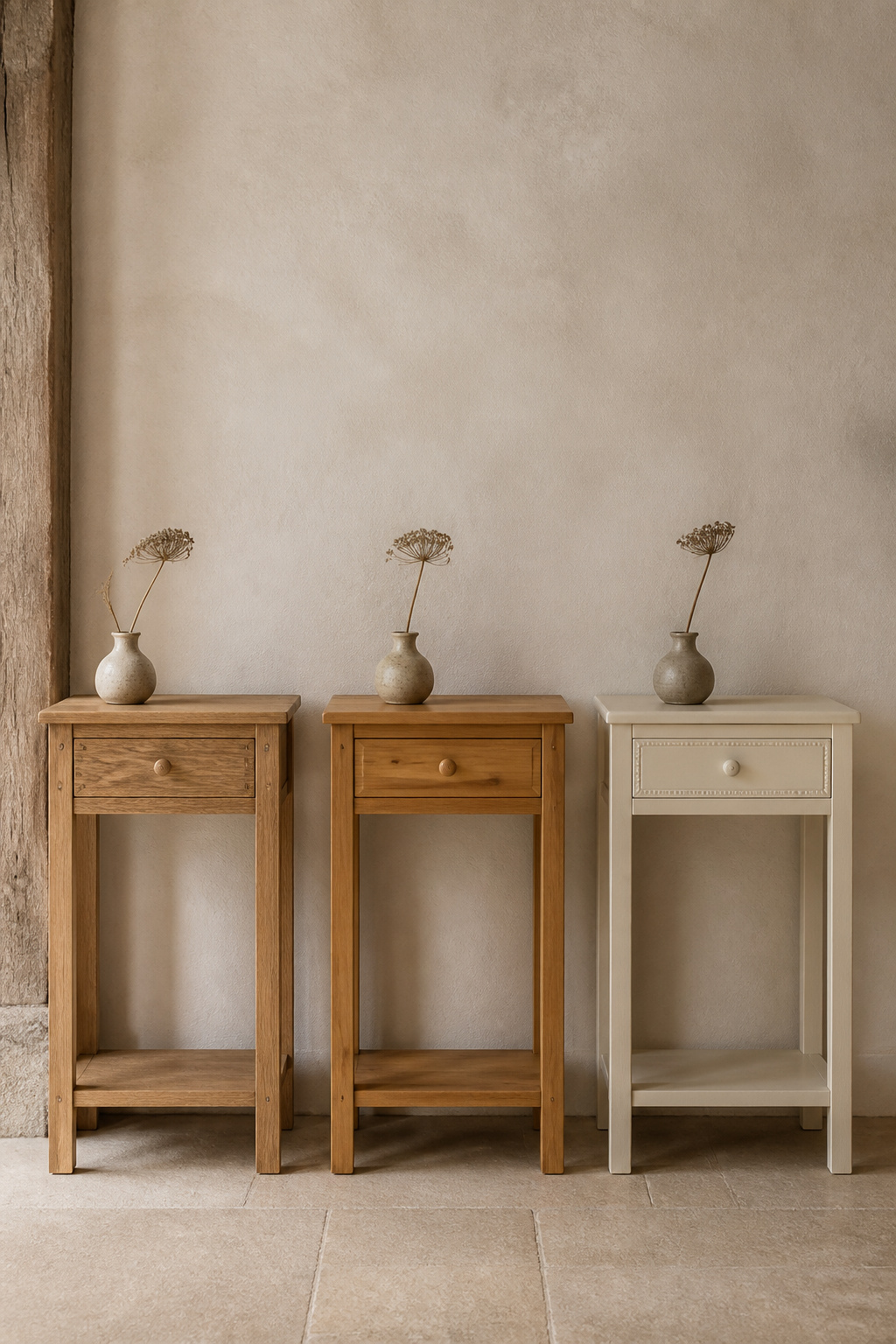
| Hallway width | Max console depth | Console height | Clearance |
|---|---|---|---|
| Under 36 in | No freestanding console | — | Use floating shelf |
| 36–48 in | 12 in | 30–32 in | 36 in |
| 50–60 in | 14–16 in | 30–32 in | 36–46 in |
| Over 60 in | Up to 18 in | 30–34 in | 42+ in |
The depth rule for an entry — why 12 inches is usually the maximum
Most entry consoles should run 12–16 inches deep. Petalwood Interiors recommends 30–40 cm (approximately 12–16 inches) as the ideal range for most hallways, keeping sufficient surface for a tray, a lamp and a vase without the table reading as a shelf obstruction. Where a console has drawers or a lower shelf, measure the total projection including drawer pulls and hardware — not just the tabletop depth.
Height standards: the 30-to-32-inch table in relation to the mirror above
The standard entryway console runs 30–36 inches tall. For cottage-scale rooms with eight-foot or lower ceilings, 30–32 inches is the practical recommendation; taller tables read as formal or commercial in intimate-scale rooms. At 30–32 inches, a console positions a mirror hung 6–8 inches above the surface with its bottom edge at 36–40 inches from the floor — placing the mirror’s reflective centre comfortably at eye level for most adults.
At 30–31 inches, the table sits naturally at the height where adults drop keys and post — what Kindleson describes as the sweet spot of the 75–85 cm range: the drop-and-go motion of entering requires no conscious reach.
Material and period: oak, pine, painted wood, and the finish that reads as cottage
Material choice carries more period information than any other decision. Oak with visible joinery and a wax or oil finish sits authentically in the Arts and Crafts or earlier cottage tradition. Pine with a clear wax reads as the working farmhouse entry — informal, honest. Painted wood in chalky whites, soft greys or sage references the Victorian and Edwardian tradition of seaside cottages and farmhouses, where paint protected softer timbers against humidity.
Mahogany and rosewood suited urban Victorian drawing rooms. In the cottage context they read as borrowed finery. Where period-authenticity matters, oak or pine is the honest choice.
The Formula: Tray, Lamp, Mirror, Greenery — Why It Works Every Time
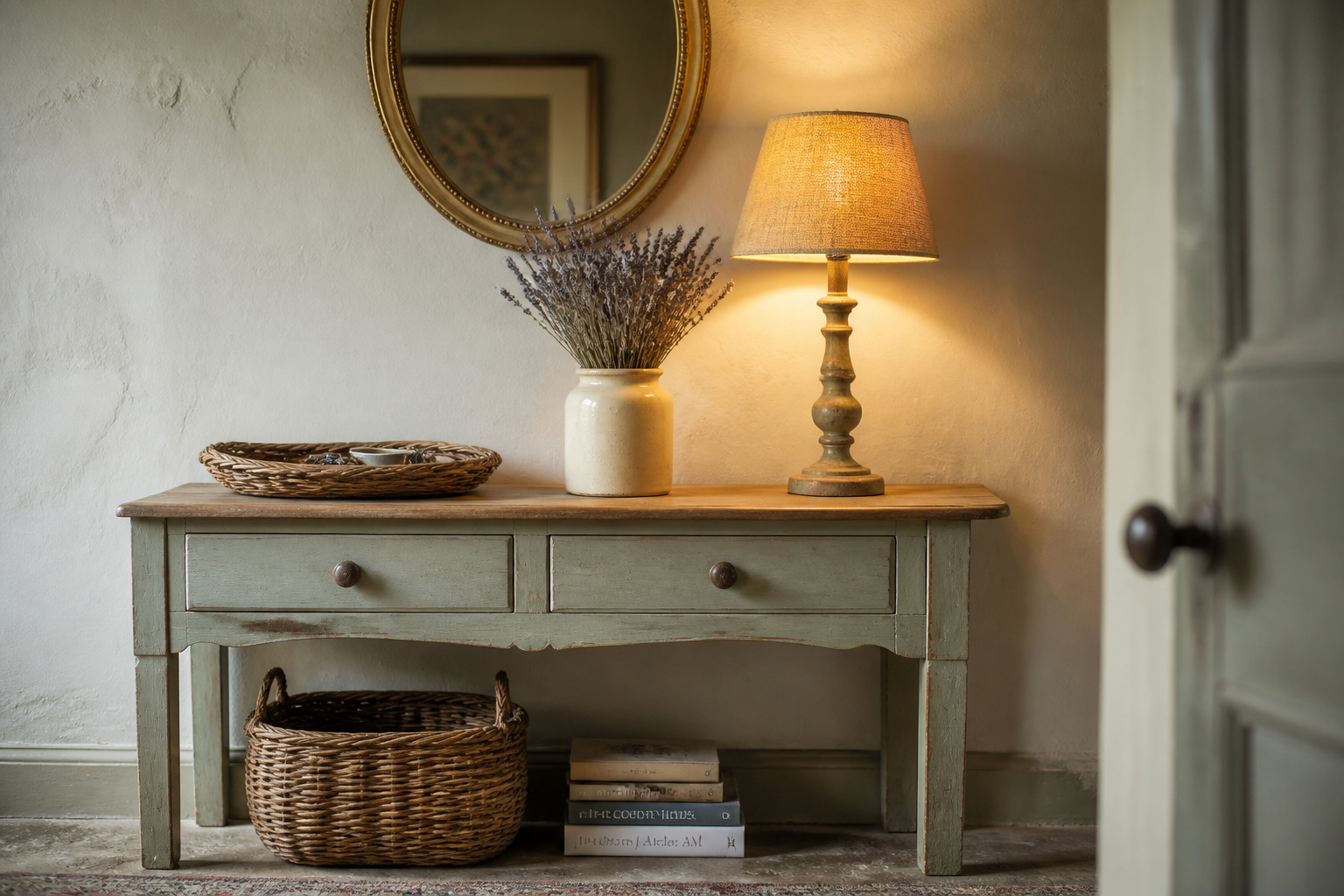
The tray-lamp-mirror-greenery formula works because it assigns each element a structural role. Remove any one and the arrangement looks incomplete; add elements beyond these four and the surface reads as accumulated rather than composed.
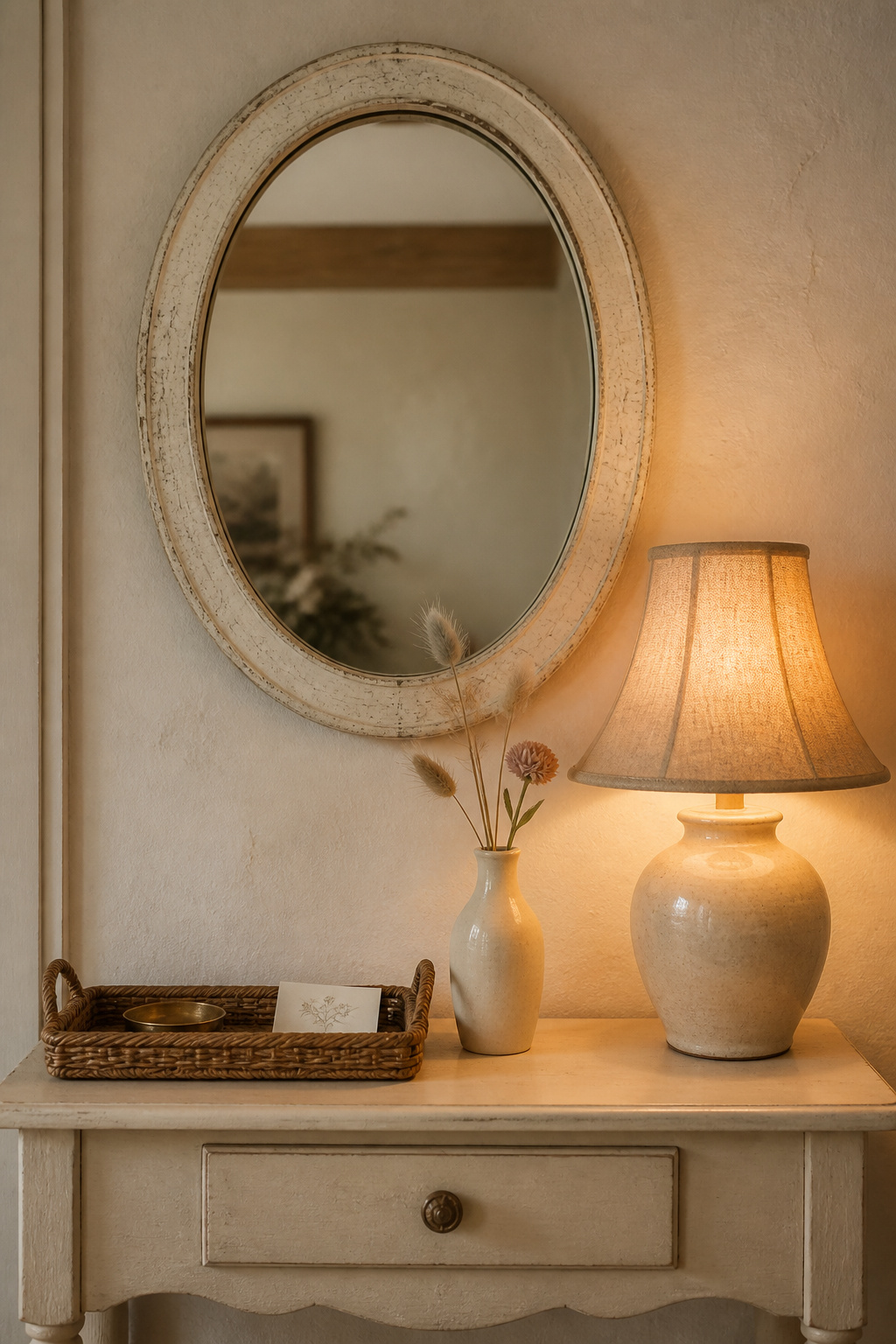
The tray as the organisational anchor — what goes in it and what stays out
A tray on a console defines a functional zone within the display surface — a clear boundary between items that live here and items that have wandered here. Without a tray, the entire surface becomes the drop zone. With one, the tray holds the daily function: a key dish, a notepad, a folded card.
Items that belong inside the tray: a small ceramic dish or brass bowl for keys, a notepad, a folded card. Items outside the tray but on the console: the lamp, the vase with botanicals. Items that should not be on the console surface at all: charging cables, sunglasses, post — these belong in a drawer or dedicated slot.
The tray itself is a considered object, not an afterthought. Wicker, aged rattan, painted wood, or hammered copper all read authentically in a cottage context. Acrylic or chrome trays undercut the material honesty that makes the whole arrangement cohere. Together, the tray and displayed companions should cover no more than 50–60% of the console surface; the remaining 40–50% stays clear. Group objects in odd numbers — three or five on most consoles, seven on a longer console over 50 inches.
Lamp scale and the 24-to-32-inch table lamp rule for a cottage entry
Table lamps on a console should stand 24–32 inches tall including the shade — the professional range for adequate ambient uplighting and proportion. Below 24 inches and the lamp reads as a desk accessory. A lamp more than 1.5 times the table height overpowers the surface and appears top-heavy; on a 30-inch console, the practical limit is a lamp whose shade peaks around 15 inches above the console top.
Fixture selection belongs to entryway lighting layers. What concerns the console surface is placement and proportion: place the lamp toward one end, off-centre, to avoid the symmetrical look of a commercial display. For shade material, loose-woven linen, cotton, and aged-paper read as cottage-authentic.
Mirror proportion above the console: the 75% width relationship
A mirror hung above a console should be approximately two-thirds of the furniture’s width; the acceptable range is 50–75% of the table’s width. Wider than the table and the mirror creates visual instability. The bottom edge should sit 6–8 inches above the console top, which on a 30–32-inch table places it at 36–40 inches from the floor. The mirror’s centre then lands at approximately 57–60 inches — standard eye level for most adults.
Round and oval mirrors suit cottage entries particularly well. The curved outline contrasts the linear table top and softens the entry without the formality of a large rectangle. For round mirrors, choose a diameter roughly two-thirds the console width.
Kindleson describes the surface as a city skyline in miniature: a tall lamp on one end, a medium-height vase in the centre-off, something low like the tray on the opposite end — peaks and valleys that guide the eye across the display. The mirror above is the sky.
The Greenery Layer: Plants, Botanicals, and Cut Flowers for the Entry Context
The greenery element softens a composed arrangement into something that reads as alive rather than staged. It is also the element that changes most with light and season, which makes the choice more specific than it appears. Entry conditions are often difficult for plants — low light, temperature swings from door opening, and irregular watering make many houseplants unreliable here.
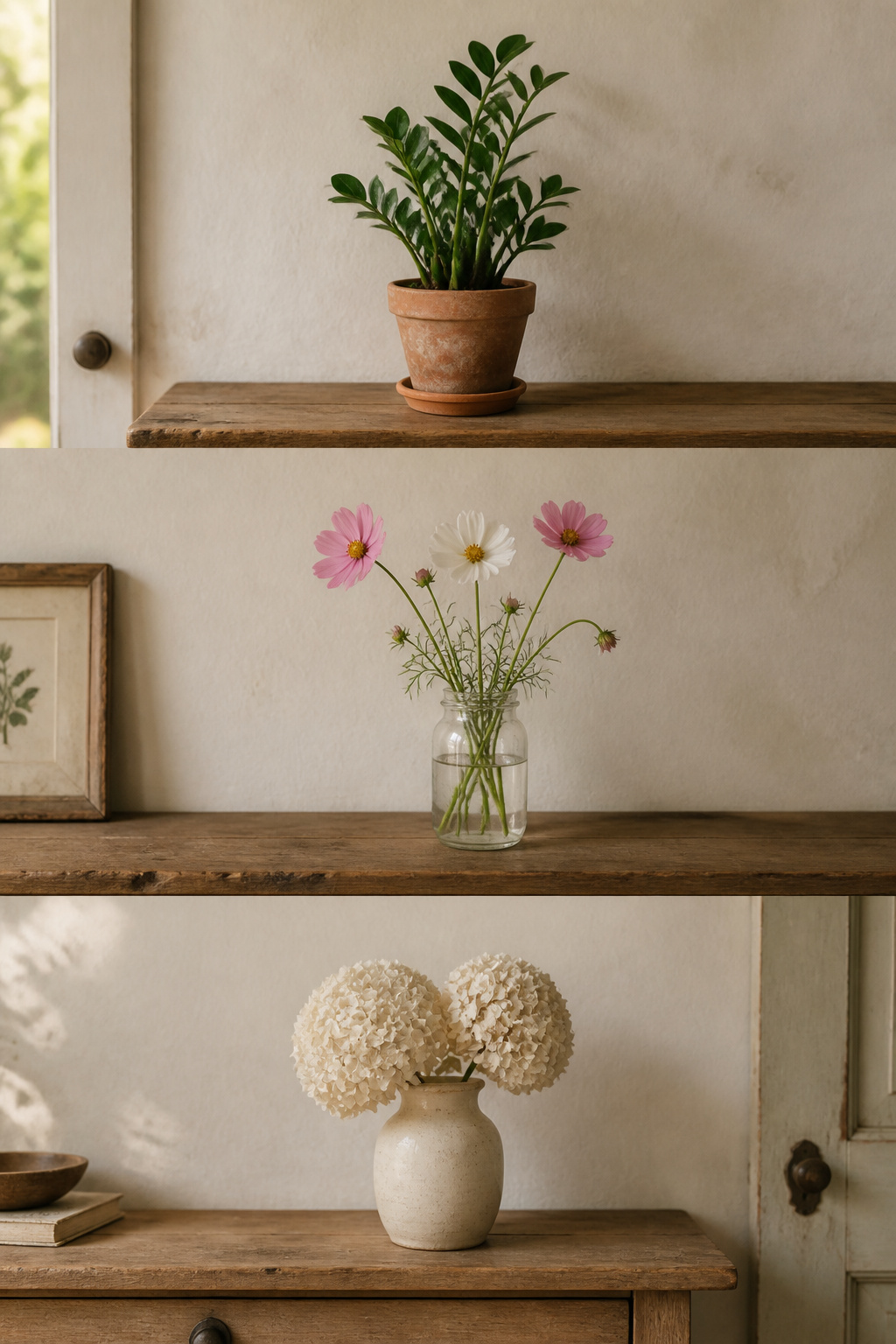
Low-light tolerance — which plants survive an entry with a single north window
- ZZ plant — ranks highest for genuine low-light and drought tolerance. Indigenous to arid East African environments, it can go weeks without water and survives entries with no direct natural light.
- Pothos — tolerates low light but shows it: leaves grow smaller, variegation fades, and vines become leggy. Water less often in low light, not more — overwatering is the most common mistake when growth stalls.
- Snake plant — reliable in low light; upright form suits a narrow console well.
- Cast iron plant (Aspidistra elatior) — the most historically authentic choice. It was the dominant Victorian hallway plant specifically because it tolerated gas fumes, dust, low light and drought. It arrived in Europe in the 1820s and became a hallmark of Victorian entrance halls; placing one in a cottage entry is not pastiche but continuity.
Seasonal cut flowers and the cottage entry’s connection to the garden
Cottage gardens were historically planted for cutting: lupins in May and June, delphiniums in midsummer, cosmos, larkspur, and hydrangeas through late summer. The RHS notes that cottage garden planting was designed both for colour and to provide cut blooms for the table — the connection between garden and interior was intentional, not decorative coincidence.
For the entry vase, restraint reads more authentically than abundance: three to five stems of a single variety in a simple ceramic or glass vessel is more honest than a florist-styled arrangement. The entry vase should look as though someone cut it on the way through the garden gate. Hydrangeas are particularly suited to this position: they dry beautifully in place so a fading fresh arrangement naturally transitions to a dried one, and they come in the off-whites and dusty blues that suit the cottage palette year-round.
When dried botanicals earn their place over fresh — and how not to make them look funereal
Dried flowers have one practical advantage in an entry: they require no water and last months or years without maintenance. They fail when they are dark, dusty, and over-abundant; a large black-brown arrangement in a dark vase reads as neglected. The antidote is light colour and an edited quantity — bleached pampas, cream dried hydrangeas, pale grasses: three to five stems in a simple vessel, presence without density. Store dried arrangements away from direct sunlight; UV bleaches colour faster than normal ageing and produces the faded look associated with neglect.
Seasonal Vignettes: Keeping the Console Fresh Through the Year
A seasonal rotation system keeps the console composed all year without constant re-styling. The method is a swap principle: a permanent layer — tray, lamp, mirror — stays fixed and is never removed. A rotating seasonal layer — botanicals, one or two accent objects, an occasional textile runner — is the only thing that changes.
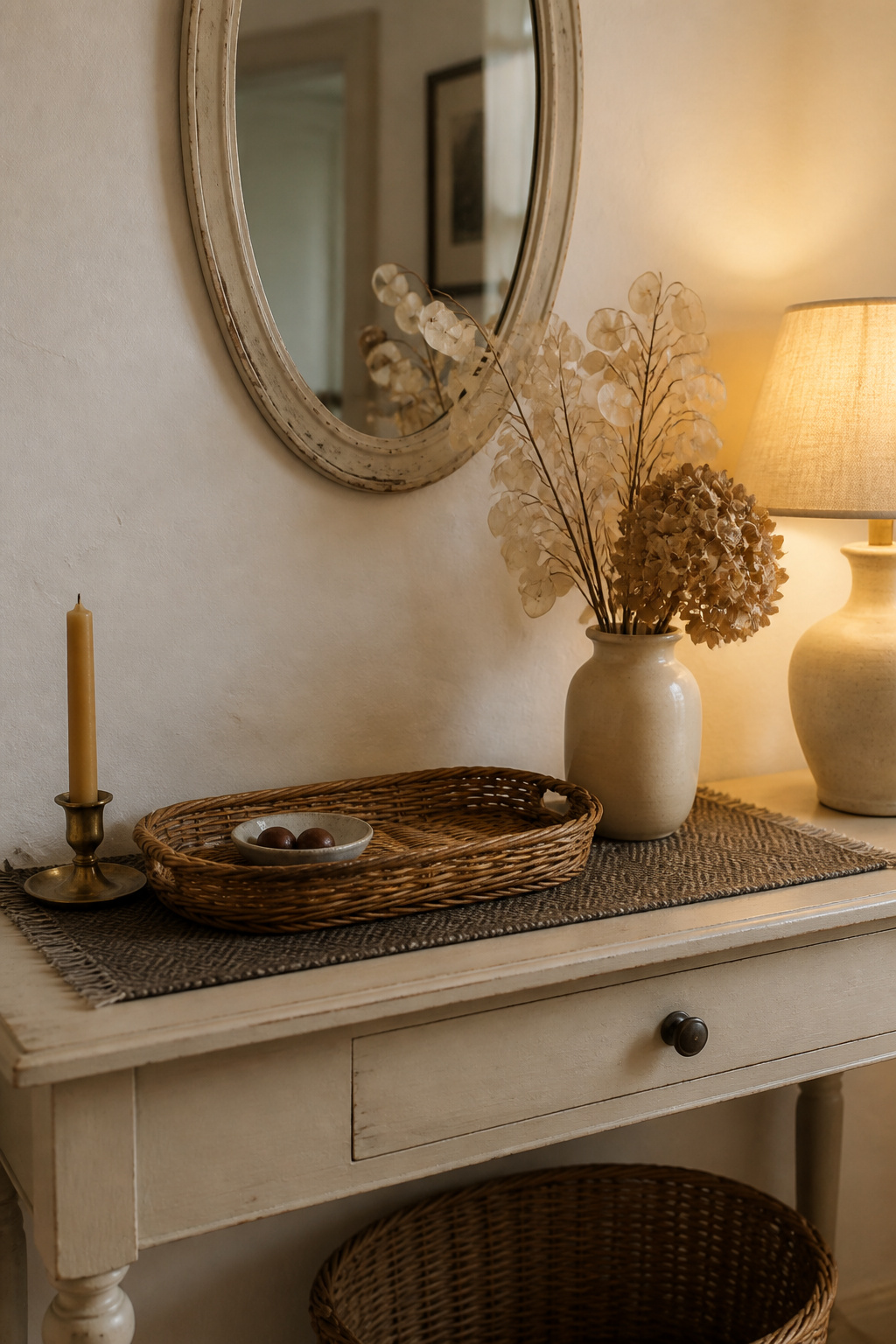
The swap principle — what stays (tray, lamp, mirror) and what rotates (botanicals, objects, textiles)
Keep the core anchor pieces fixed and swap only two or three smaller accent pieces that reflect seasonal colours, textures, or natural elements. Changing the structural pieces — mirror, lamp, tray — creates the disconnected look of a staged display because these elements carry the composition’s weight.
What stays all year: the tray (removing it breaks the drop-zone system), the lamp (removing it breaks the layered lighting scheme), and the mirror (wall-hung and architecturally permanent). What rotates: the botanical element, one or two small found or seasonal objects, an occasional slim textile runner under the tray.
Autumn and winter cottage vignettes: the warmth materials and found objects that read honestly
Autumn accents that read honestly: a small dried seed head arrangement — honesty/lunaria, dried hydrangeas, seed pods — a brass or clay candleholder with a beeswax pillar candle, a handful of conkers or acorns in the key dish. These are found or seasonal objects with material honesty. They came from the garden or a walk.
A useful test for any candidate seasonal object: would this have existed in a working cottage 80 years ago? If yes, it earns its place. This rules out commercially produced seasonal sets — matching pumpkin ornaments, branded holiday signs, foam-based wreath offcuts — which all signal a shop display rather than a home. Winter accents: a small cut of evergreen in the vase position, beeswax candles in the tray area, and a narrow woven wool or tartan runner under the tray if the console top is unfinished wood.
The wall color behind it is part of the vignette’s palette at every season — what the botanicals read against changes with the light quality through the year.
The one mistake that makes seasonal vignettes look like shop windows rather than homes
The shop-window mistake is swapping every element at once for a matched seasonal set. Real homes accumulate objects from different sources and different times; a display composed entirely from the same purchase date always reads as purchased as a display.
The antidote is mixing provenance: one purchased item, one found or inherited object, one seasonal natural element. A bought beeswax candle, a conker from the garden, and a dried stem from last summer’s hydrangeas create a vignette that reads as gathered rather than bought. Seasonal colour should enter through the botanical and one small accent only. Four rust-toned objects is a display; one rust-toned object in an otherwise unchanged vignette is autumn.
Function and Display: Keeping the Console Working in a Real Household
The most common console table failure is not a styling failure. It is a function failure. The surface reverts to a general drop zone because daily items — keys, post, charging cables — need somewhere to go and the console is the most convenient flat surface in the entry. The solution is not to resist that pull but to design the function in.
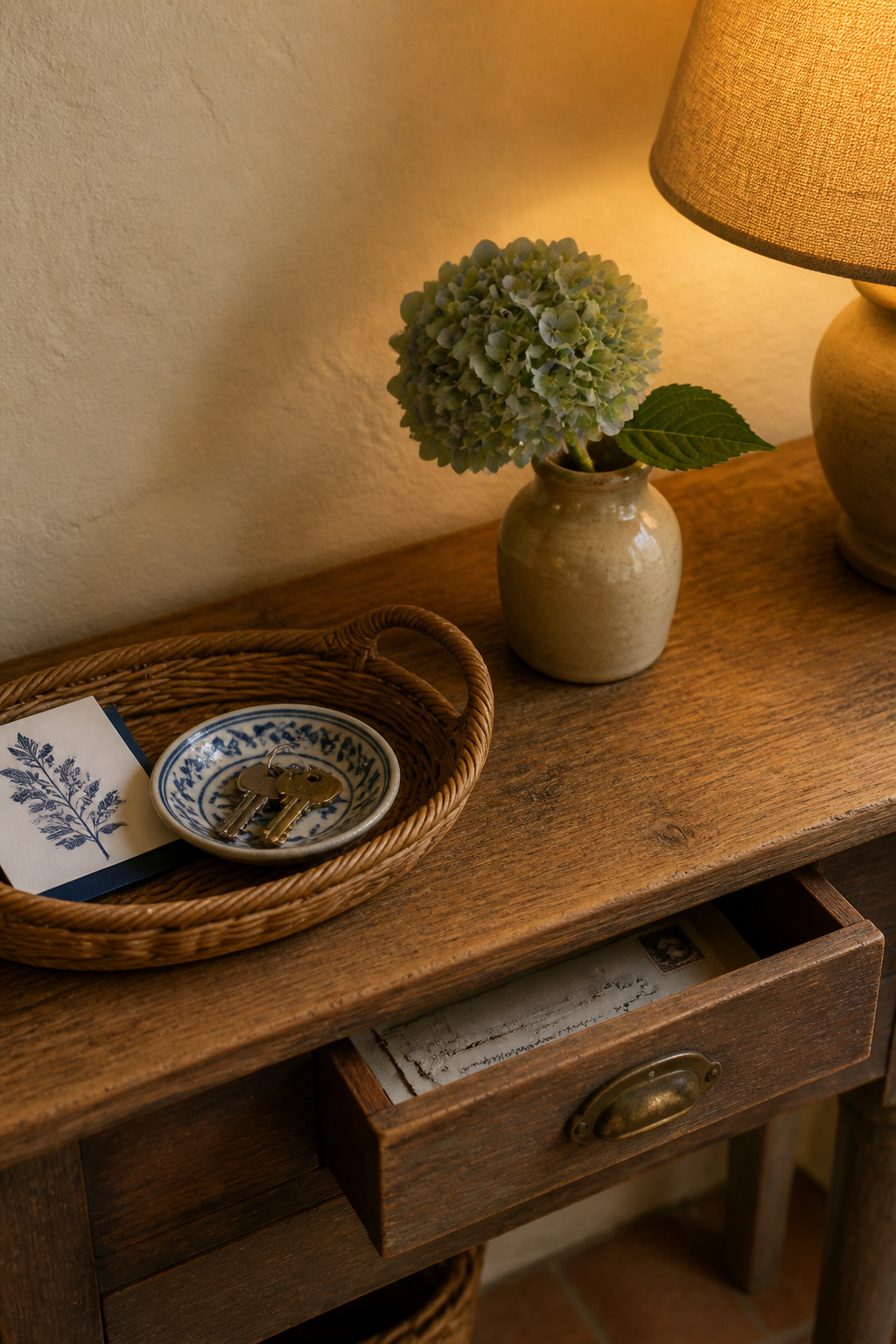
The key bowl and tray system — contained function that doesn’t break the vignette
A small bowl or dish inside the tray as a designated key drop creates a contained system where daily essentials stay within the display’s functional zone rather than scattering across the surface. The tray is the boundary: if it doesn’t fit in the tray, it doesn’t live on the console surface.
In a cottage context, the key bowl should be an object in its own right: a small blue-and-white ceramic dish, a brass or copper shallow bowl, an aged pottery vessel. Commercial key hook rails belong on the wall — the coat hooks spoke covers that territory, not the console’s open display surface.
Mail, post, and daily clutter: drawer console vs. open console for a working entry
Console tables with drawers hide clutter better than open designs. A drawer handles keys, sunglasses, dog leads and post without those items appearing on the surface; an open-base console requires daily discipline because everything on it is visible. Open-base consoles suit entries where the console is genuinely a display-only surface — households with a dedicated mudroom or coat room handling the daily storage load. For a working entry where the console is the household’s single organisation point, a console with at least one drawer is more practical.
A hybrid approach — a slim top drawer for small daily items plus a lower open shelf for a basket — gives the best of both. This is also historically accurate: Victorian and Edwardian hall tables routinely featured a single centre drawer for correspondence and small items. A drawer is not a compromise in a cottage context; it is a period-appropriate feature.
For enclosed storage beyond a single drawer — cubbies, baskets, built-in cabinetry — that is the territory of the mudroom storage spoke. The console owns the open surface; enclosed storage belongs elsewhere.
The three-day test: what gets moved on a finished entry surface
After three days of normal household use, I look at every item that has moved, appeared, or been displaced. Not to tidy them away — to understand what they reveal. Items that drift onto the surface indicate unmet functional needs. If a charging cable keeps reappearing, the nearby outlet needs a cable management solution, not another clear-the-clutter attempt.
The fastest way to improve a console table is to stop over-styling it. The three-element rule — one vertical element, one practical anchor, one sculptural or personal object — provides enough display without competing with daily function. A surface that requires daily effort to hold its appearance is not a styled surface; it is a space fighting its users.
Once the function is genuinely designed in, a two-minute daily reset — scanning for non-vignette items and returning them to the tray or drawer — becomes the whole maintenance requirement. Attached to an existing routine like checking the door before leaving, it becomes automatic within a couple of weeks. At that point, the console is what it was always meant to be: not a shelf with ambitions, but a surface that does its job every time you walk through the door.
FAQ
What size console table works best in a small entryway?
For entries under 60 inches wide, choose a console no deeper than 12–14 inches to preserve at least 36 inches of walking clearance — the minimum comfortable passage. Height should be 30–32 inches for compact cottage entries, and the table should span roughly two-thirds of the wall it sits against in length. In hallways under 36 inches total width, a floating shelf or slim wall-mounted ledge serves the landing-surface function without the depth intrusion of a freestanding table.
How do you style a hallway table without it looking cluttered?
Apply the four-element formula: a tray for daily-use items, a lamp for height and light, a mirror above at 50–75% of the table’s width, and one botanical element. Limit display objects to an odd number — three or five — and keep approximately 30% of the surface clear. Vary heights — one tall element, one medium, one low — to create a visual skyline that reads as arranged rather than accumulated. The tray is the key: anything that would otherwise scatter across the surface goes in the tray or in a drawer, not on the open console.
What plants are good for an entryway with low light?
The ZZ plant is the most tolerant of genuinely low light and irregular watering — it can go weeks without water and survives entries with no direct natural light. Snake plant and pothos both tolerate low light but show stress faster: pothos vines become leggy in near-dark conditions, and both need less water in low light, not more. The cast iron plant (Aspidistra) is the historically authentic low-light cottage entry plant — it was the dominant Victorian hallway plant specifically chosen for its ability to tolerate gas fumes, dust and near-darkness.