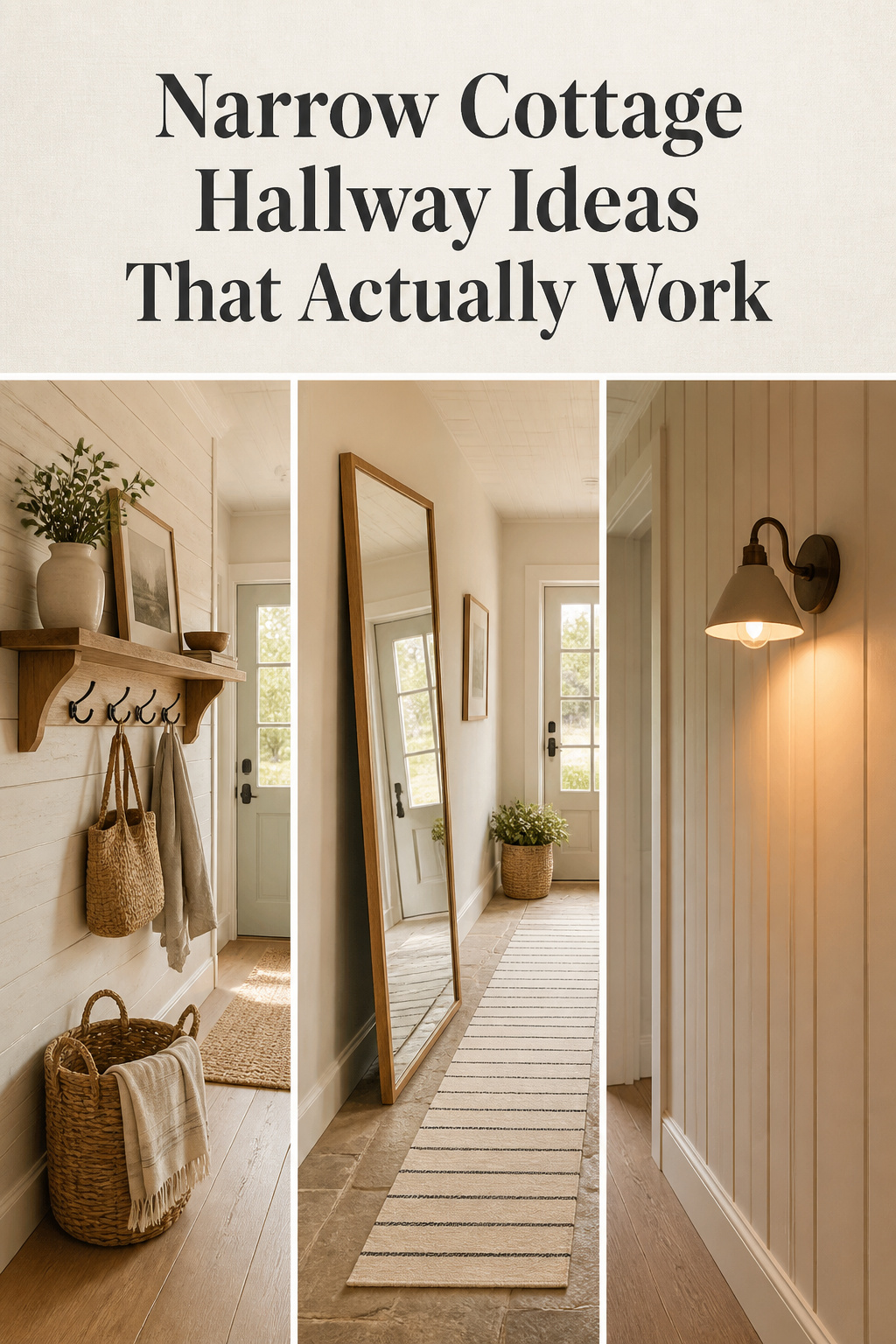
You have probably decided your narrow hallway can’t be designed — a place you pass through sideways, stepping over boots, brushing a coat on the way past. So you stopped trying. Most narrow cottage hallway ideas promise to fix this with more storage, which is the wrong instinct. The tight entry that works is not wider; it is emptier in the right places, then warm in the few that remain. That entry is reachable this weekend, with no wall moved.
TL;DR
- The constraint is rarely the width: the residential code minimum is 36 inches, and most cottage halls already meet it, so editing out what doesn’t belong beats adding storage.
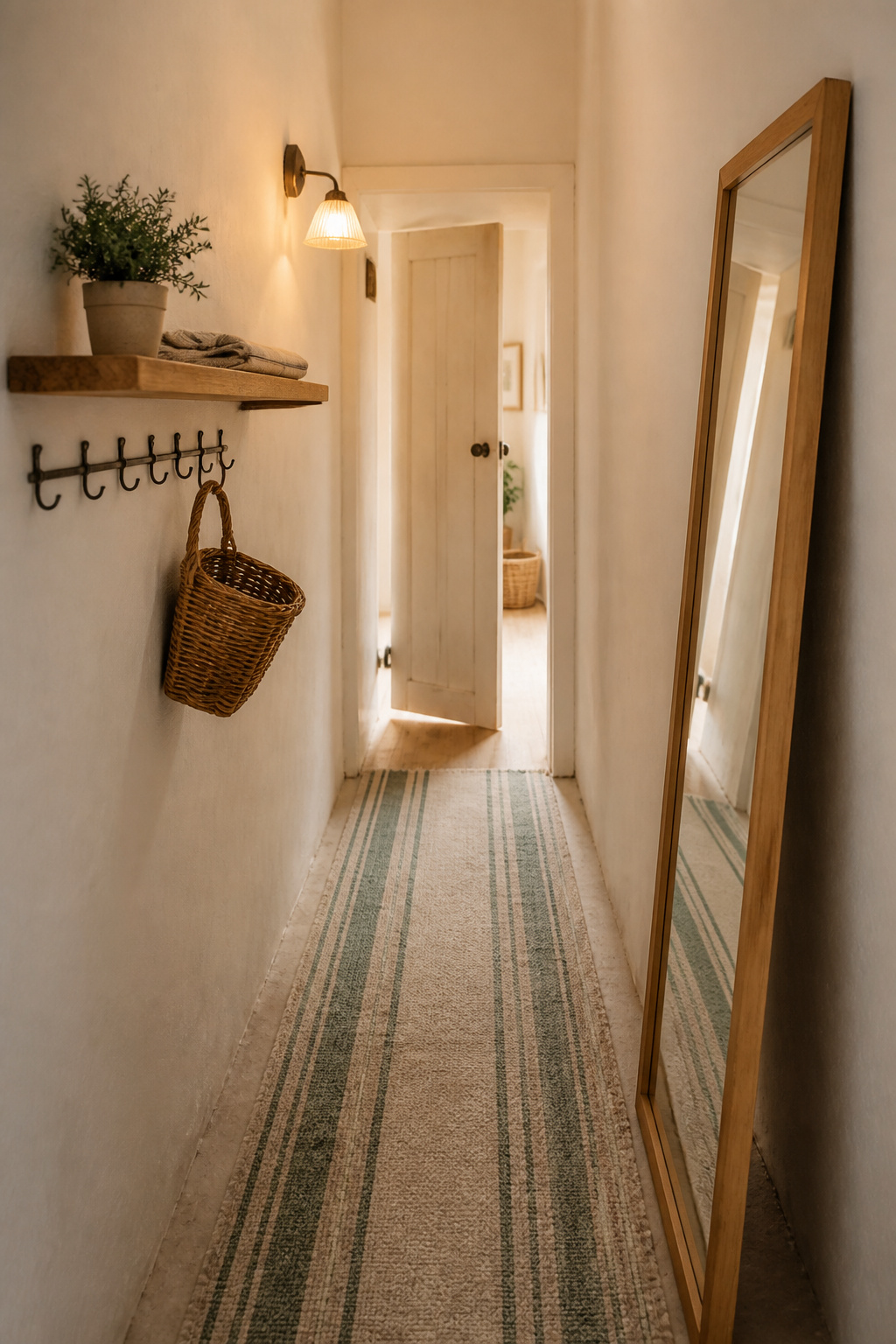
- Keep floor furniture to 10–12 inches deep, or go wall-mounted entirely below 36 inches; a floating shelf at 66 inches and a hook rail give you function with zero floor footprint.
- A mirror sized to two-thirds of the wall width plus a slim runner that leaves 4–6 inches of floor each side make the hall read wider and lighter without a single square foot added.
The Tight Entry Isn’t the Problem You Think It Is
The belief that a narrow hallway needs more space is the thing standing between you and a working entry, and it is almost always wrong. The width is fixed and usually adequate; what fails is everything allowed to accumulate inside it.
What a functional narrow entry actually needs, and what it doesn’t
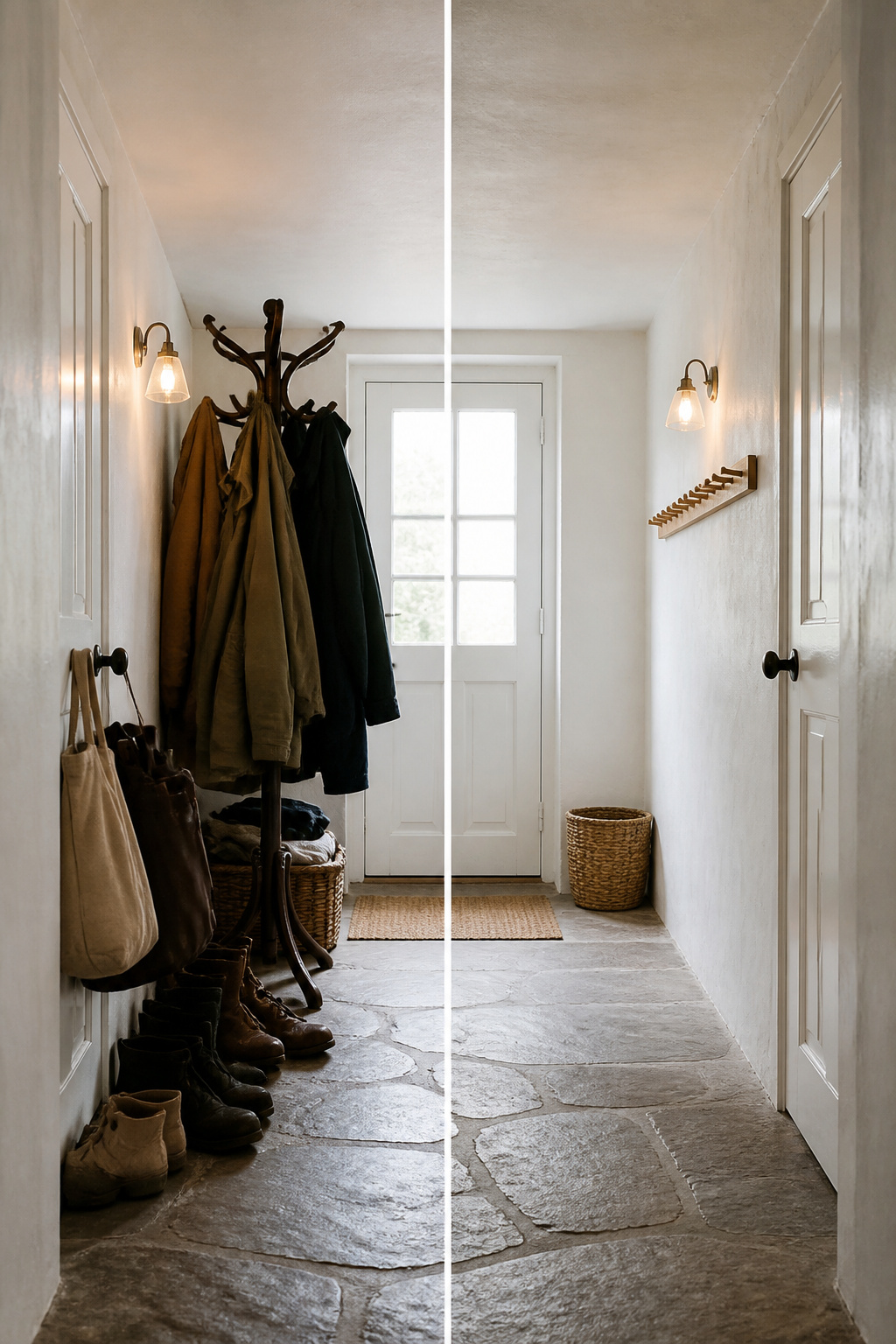
A functional entry needs four things. Clear floor to walk on. One place to hang a coat and bag. One surface for keys. Enough light to read colour by. Nothing else is load-bearing.
The International Residential Code sets the minimum hallway width at 36 inches, and most cottage halls already meet or exceed that. So the tightness you feel is not the wall-to-wall measurement. It is the boot on the floor, the bag on the door handle, the coat rack that was meant to help.
The Nordic flat and the cottage hallway
Small-footprint living is not a hardship in the Scandinavian tradition; it is a discipline. Flats with hallways of 30 to 40 inches have been made to work for generations because every object had to justify its place with a function. That logic transfers directly to a cottage: both traditions live with restricted entries, and neither tolerates visual noise. A clear floor in a tight corridor reads far wider than its actual dimension, because the eye uses the floor plane to judge width.
The single decision that changes every narrow entry
Edit before you add. Pull everything out, then decide by function what returns. A first pass typically removes 30 to 50 percent of an entry’s contents, most of it never meant to live there at all. This one decision does more than any purchase. The fuller picture of how this entry sits among flooring, lighting, and the rest lives in the cottage entryway ideas guide.
The Edit: What Stays, What Goes, and Why the Order Matters
The edit is the foundation everything else stands on. Do it first and the furniture decisions become arithmetic; do it last and you will buy storage for things that should never have been in the hall.
The one-week test
Here is the rule I trust. If an item in the entry has not been touched in seven days, it migrated there from somewhere else and belongs back there — the entry is not its home.
What earns a permanent place is short:
- One pair of in-season shoes per person who lives there
- The coats and bags in active daily rotation
- Keys, and one small tray or hook to hold them
Everything else gets a named location in another room. If a full clearance feels like too much at once, remove one item a week instead — the habit reaches the same destination without the overwhelm.
Seasonal rotation and where seasonal items belong
Off-season coats do not belong on the hooks; only the current season hangs in a narrow entry, the rest going off-site. A winter parka, vacuum-sealed, drops to roughly a third of its hung volume, making under-stair or high-shelf storage practical even in a cottage short on space. Rotate twice a year on a calendar reminder, not a weather cue, so the swap happens before the entry fills with the wrong season.
The floor clearance number
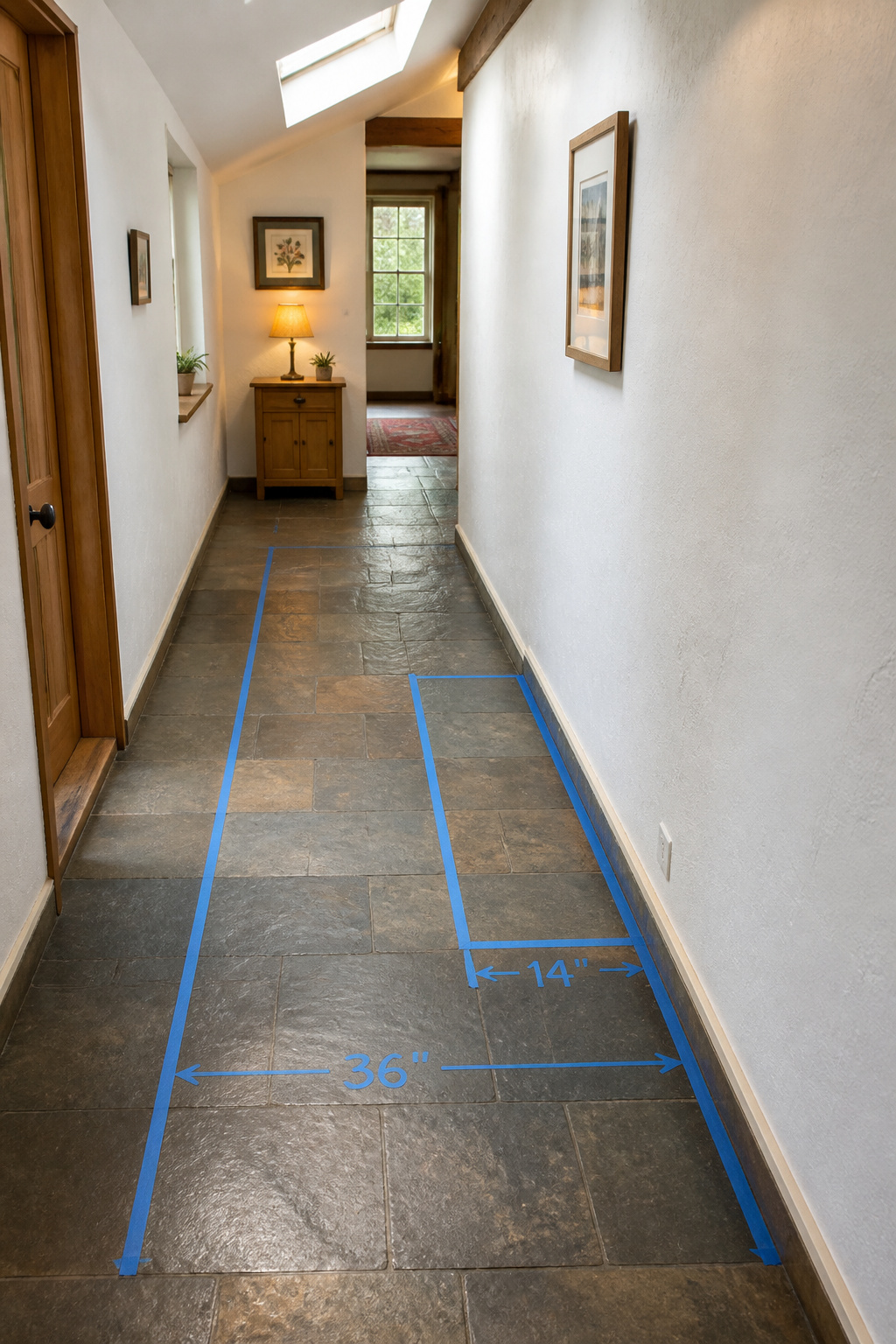
The 36-inch code minimum must stay clear of furniture, not just wall-to-wall. A 14-inch console against a 36-inch hall leaves only 22 inches of passage, and a hall reads as a dead end below about 24 inches. Before buying anything, tape its footprint on the floor, then walk through carrying a bag and opening the door fully. If either makes contact, the clearance has already failed.
Furniture That Fits: Slim, Floating, and Built for the Real Footprint
With the edit done, furniture becomes one calculation, not a shopping trip — and the calculation is depth.
The depth rule
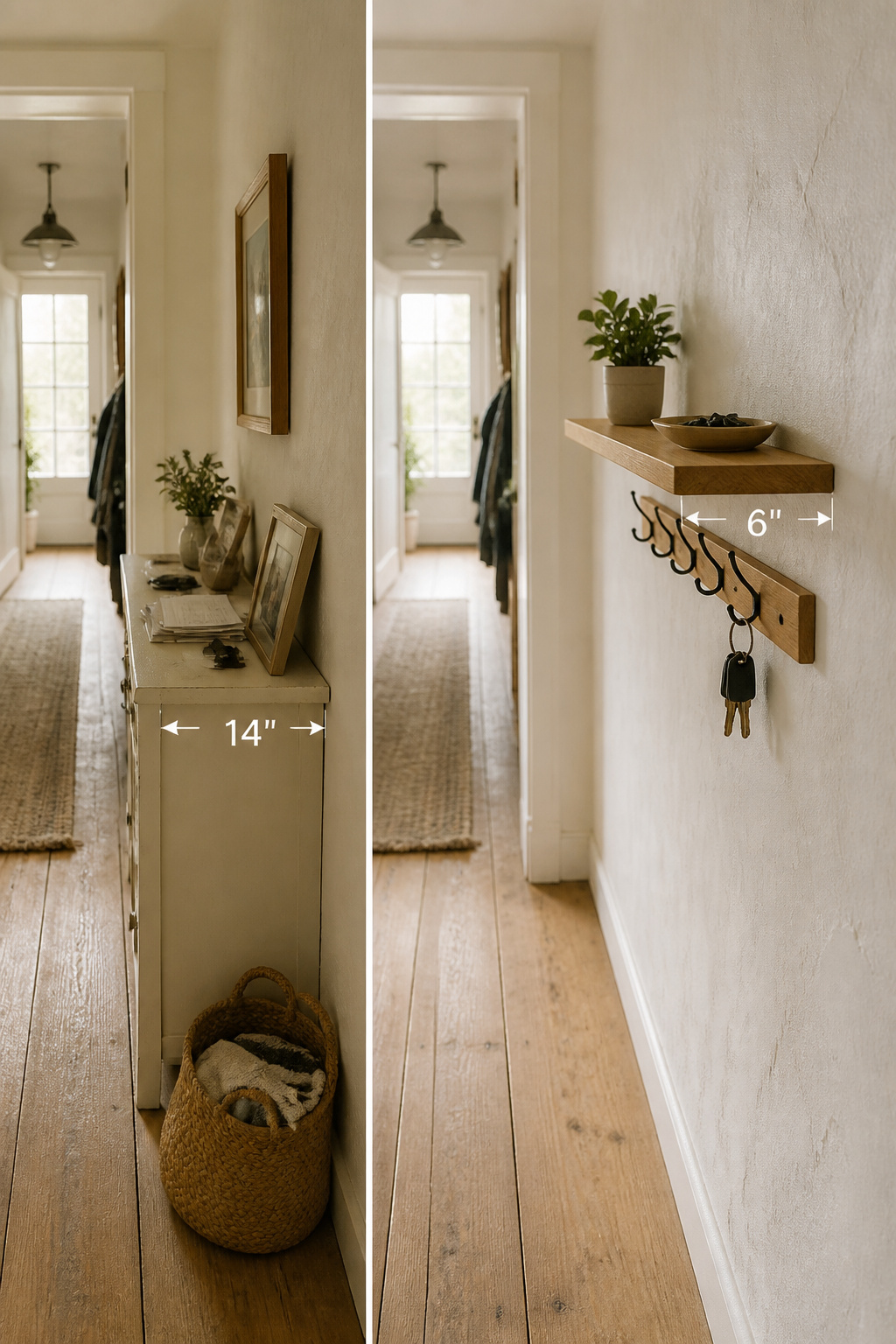
Keep entry furniture to 10 to 12 inches deep. Twelve is the sweet spot between a usable surface and a passage you can still walk. The math is plain: available width minus 36 inches of clearance equals the depth you may spend.
| Hall width | Max furniture depth | What works |
|---|---|---|
| 36 in | 0 in | Wall-mounted only: hook rail + floating shelf |
| 42 in | 6 in | Ultra-slim wall console (from 6.25 in) or shelf |
| 48 in | 12 in | One 12-in console, replacing the hooks |
In a true 36-inch hall, floor-standing furniture is out — the top row is the answer, and it is not a compromise.
Floating shelves and wall-mounted hooks
Wall-mounted storage costs you no floor at all. A floating shelf 6 to 8 inches deep holds the daily items — keys, a small plant, a folded cloth — with 8 inches the standard for a tight hall. Mount it at around 66 inches, and the visual weight sits up where it makes the hall feel taller. Pair it with a hook rail and you have hanging and surface with zero footprint. For the baskets and cubbies that handle the rest, the small-space storage ideas spoke goes deep on what fits where.
When a console belongs, and when it is the problem
A console earns its place only when the hall is 48 inches or wider, the piece is 12 inches deep or less, and it replaces the hooks rather than joining them. It becomes the problem the moment it is the first thing bought, before the edit. Where one fits, a 10-inch painted console in cream, sage, or oak gives function and character — but hold its surface to two or three objects so it never turns into a clutter shelf.
Light and Line: The Optical Tricks That Actually Work
Three moves make a narrow hall read wider, each working on a different part of how the eye reads a corridor — and none of them moves a wall.
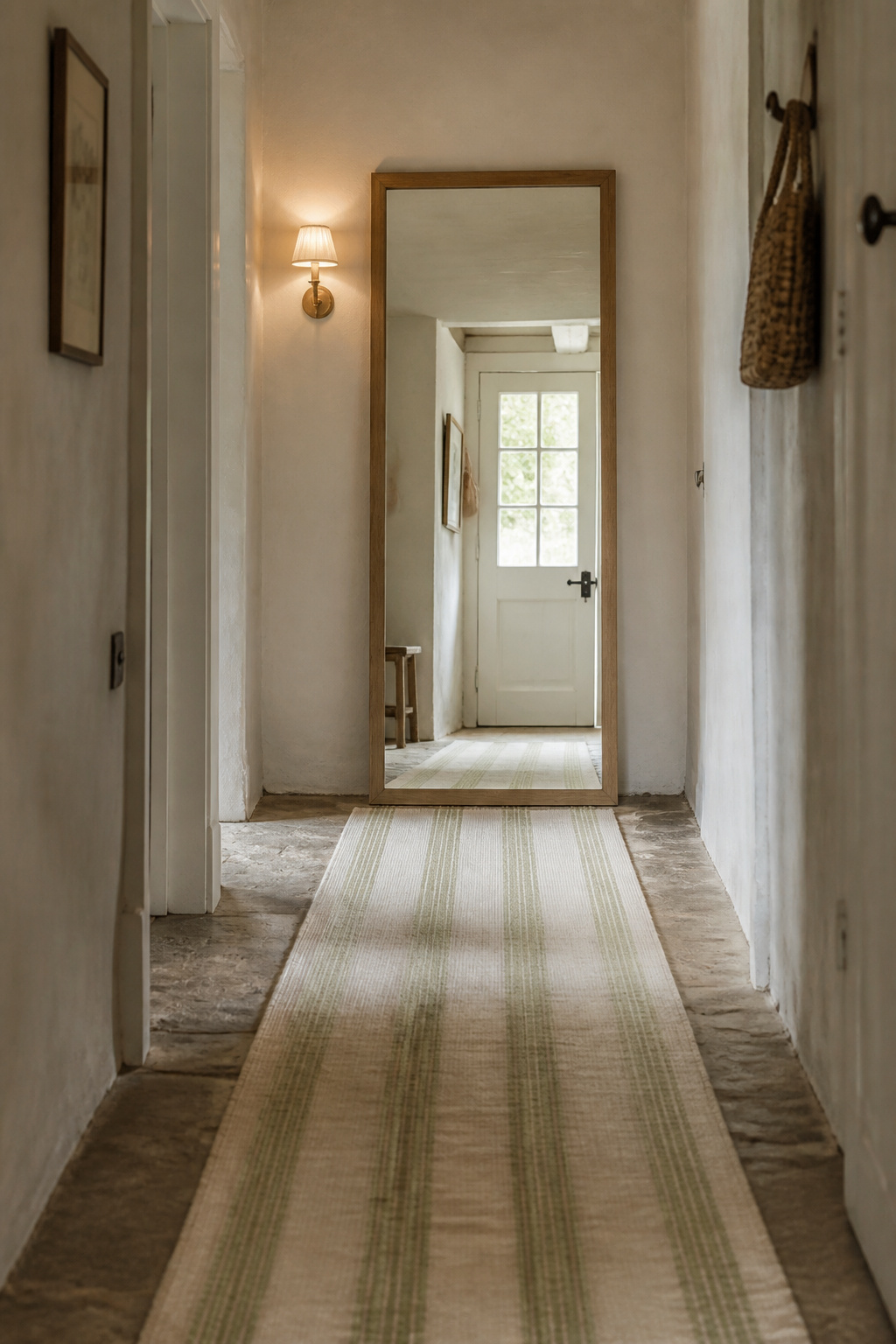
A mirror is the strongest. Size it to two-thirds of the wall width — on a 36-inch wall, around 24 inches. Hang the centre slightly high, at 60 to 65 inches, so the reflection biases upward and shows more ceiling. Set it adjacent to or facing a window rather than opposite a bright lamp, and it can meaningfully lift the daylight by bouncing it into corners a fixture cannot reach. At a corridor’s end, a mirror reflecting the path back is the best fix for the tunnel feeling: a blank-walled dead end always reads tighter than a sightline.
The runner is the second move. Stripes running lengthwise pull the eye to the far end and lengthen a short entry; stripes across widen a long tunnel-like one. Either way, leave 4 to 6 inches of floor visible each side — in a 36-inch hall, a 24-inch runner — so it reads as a deliberate element rather than wall-to-wall carpet. A simple cotton stripe suits a cottage; a busy geometric only crowds a tight space. Direction works hand in hand with the floor pattern, covered in the entryway flooring and runners spoke.
The third move works the walls. Vertical treatment — slim slat panels or board-and-batten — emphasises height over width. Keep it to about two-thirds of the wall height; carried full to a low ceiling, vertical battens press the ceiling down instead of lifting it.
Keeping Cottage Warmth in a Minimalist Small Entry
There is a trap at the other end of editing: strip too far and the hall reads bare, clinical, abandoned — discipline applied without the warmth that makes a cottage a cottage. The fix is not more objects, but the right few, in warm materials.
The materials that prevent a bare entry
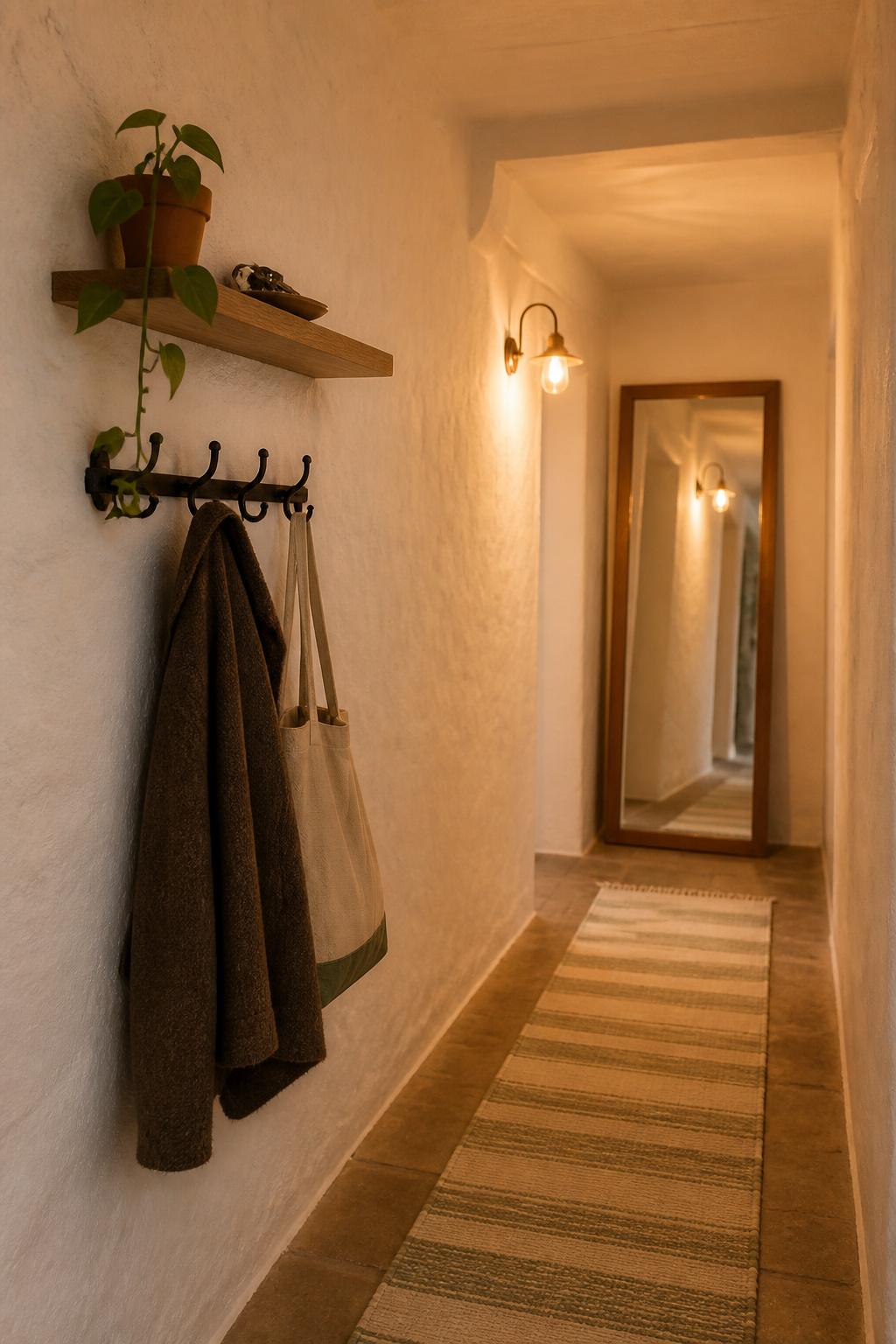
Warmth comes from material quality, not object count. A single linen runner or one wicker basket carries more character than five things in cold materials. Read the palette from the floor up: worn timber or stone underfoot, warm white walls, oak or iron hardware, one textile. The warmth lives in how those materials relate.
One textile, one natural material, one plant
This is the whole kit for a tight entry. The runner is the textile. The shelf or hook material — oak, iron, brass — is the natural material. A trailing pothos in a terracotta pot on the shelf is the living element, adding life at eye level with no floor footprint. Below this threshold the space reads abandoned; above it, you are back to editing.
Light temperature
Light is the first material of any room, and in a small space its colour matters more than its quantity. Use 2700K to 3000K warm white; cooler light at 4000K and above turns a confined entry clinical. A wall sconce beats a ceiling fitting here, casting light sideways across plaster, timber, or stone to reveal texture rather than dropping a flat shadow down the corridor. One warm sconce beside the mirror does more than a brighter overhead, because the mirror carries that light into the corners.
Narrow Cottage Hallway Done Right: A Before-and-After Summary
Look back at where this started: a hall you stepped through sideways, over boots, with nothing in its right place. Nothing about the walls has changed. What changed is the order of decisions.
The sequence that transforms it
The working entry comes from this order: edit the contents, set a depth ceiling, mount a hook rail and floating shelf, lay a runner, position the mirror, set the light to 2700K, add the warmth kit. Done in reverse — furniture first — is exactly why so many narrow entries stay broken after a redesign. In a 36-inch hall, that spec is the whole structure; everything else is decoration.
The three questions before you buy anything
Run every prospective object through these:
- How deep is it, and how much clear passage does it leave? The answer must be 24 inches minimum, 36 the target.
- Can a hook, shelf, or mirror do its job instead? If a zero-depth piece covers the function, a floor-standing one is a depth penalty for nothing.
- Does it bring material warmth — natural material, texture, living element — or is it only decorative? In an entry with room for five to seven objects, decoration without warmth does not earn its place.
What it should feel like to walk through
The real test is not the photograph. Come in carrying a coat and a bag, hang both without stepping sideways, pick up your keys, and walk the full length without brushing a surface. If that sequence completes without friction, the entry works. Then the evening test: stand at the threshold with the light on. It should feel warmer and calmer than the street — the 2700K sconce, the oak shelf, the runner doing the work together. You can now design that entry without finding more square footage: by spending what you have on the right few things, and leaving the rest, on purpose, empty.
FAQ
How do you make a narrow hallway look wider without knocking down walls?
A mirror sized to two-thirds of the wall width, hung at eye level and angled slightly toward a window, reflects the space and can meaningfully increase daylight — the most effective non-structural fix. Keep the floor completely clear too, since the eye reads width from the floor plane. Cross-directional runner stripes add apparent width as well.
What furniture works in a hallway under 3 feet wide?
At or below 36 inches, use wall-mounted pieces only: a hook rail at zero depth, a floating shelf 6 to 8 inches deep, and a mirror. Any floor-standing console reduces the passage below the minimum. Ultra-slim wall consoles from 6.25 inches deep work just above 36 inches, and a leaning full-length mirror is the only floor-touching piece that fits flush.
Should you use a runner in a small cottage entryway?
Yes. A runner adds warmth, defines the passage, and protects the floor, but the width matters: leave 4 to 6 inches of floor showing on each side, so a 24-inch runner suits a 36-inch hall. Choose lengthwise stripes to lengthen a short entry, and a low-pile cotton or flatweave that won’t catch the door or trip you at the threshold.