

Retail listings and authentication writing can describe the same chest of drawers and disagree on what it is. Listings sell dark academia furniture with “antique-look,” “distressed” and “solid wood” stacked together as if the finish were the fact. Authentication writing treats those words as near-opposites. The Journal of Antiques and Collectibles defines patina as stable surface color and texture built up through age, handling, oxidation and exposure, and notes that once removed it cannot be authentically recreated. Distressing is applied in an afternoon, and only the authentication description tells you how a piece will behave under a hand in ten years.

TL;DR
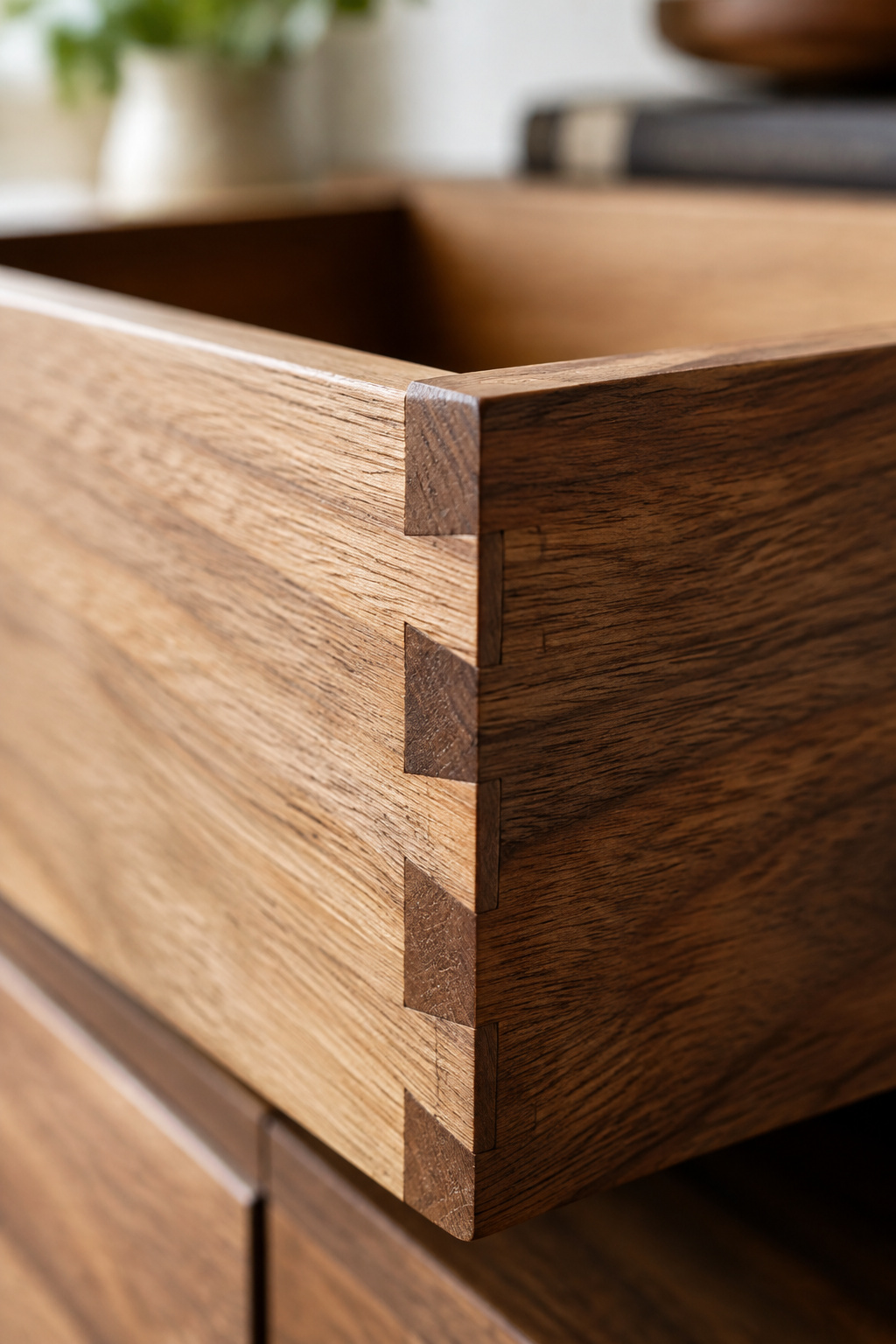
- Judge the drawer before the finish. Hand-cut dovetails show pins narrower than tails, uneven spacing and visible overcuts; identical machine-spaced pins put a piece no earlier than 1895.
- Real wear concentrates where hands and feet land (feet, runners, pulls, arm edges), while applied distressing spreads evenly over surfaces nobody touches.
- Tight growth rings help you identify old wood, but they don’t explain its strength. In a 797-specimen grading study, rings per inch explained 10 to 14% of the variance in compression strength, against 32 to 35% for density.
Dark academia furniture: why “distressed” and “aged” are different things
Patina is a record of decades of skin oils, dust, sunlight and friction settling into a surface, which is why the trade treats it as unrecoverable once stripped. A distressing kit produces marks without that history. The two look most alike in a listing photograph, which is exactly where this furniture is now bought.
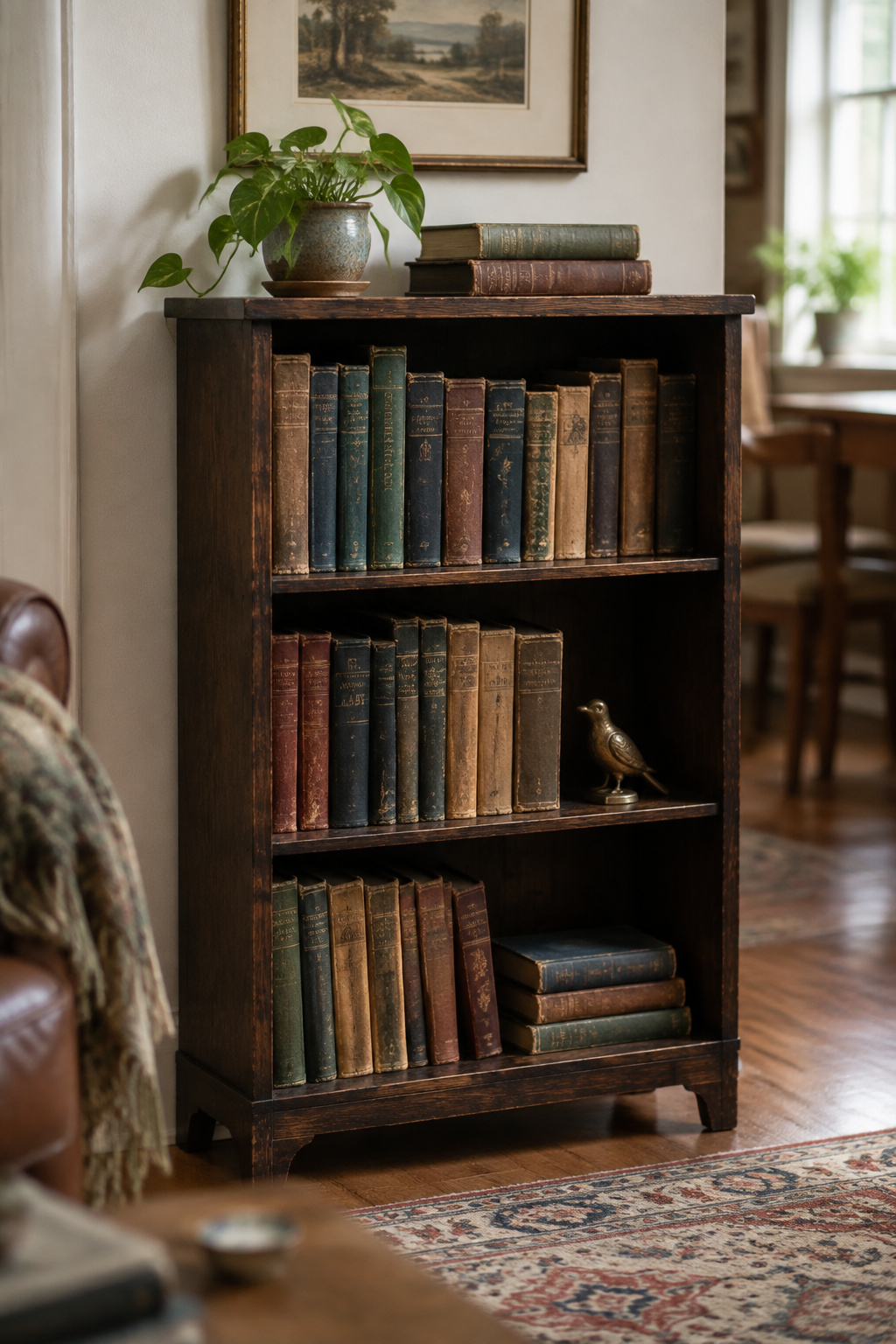
A reproduction can be a good object. A room furnished entirely in applied age, though, reads as costume the moment somebody leans on it, and the pieces in the dark academia bedroom these pieces belong to get leaned on hardest. Thrifting Vintage Furniture covers where to find old pieces; this one is about judging the piece already in front of you.
The four or five pieces the look needs
The look comes from a few freestanding decisions. Five pieces, at most, carry a bedroom:
- A writing desk or secretary. Pull a drawer and turn it over. The trade’s quality baseline is a dovetailed box with 5/8-inch solid hardwood sides and a 3/8-inch plywood bottom; particleboard, MDF or PVC sides tell you what the finish is hiding. How you set the desk up for work is covered in the desk-as-workstation article.
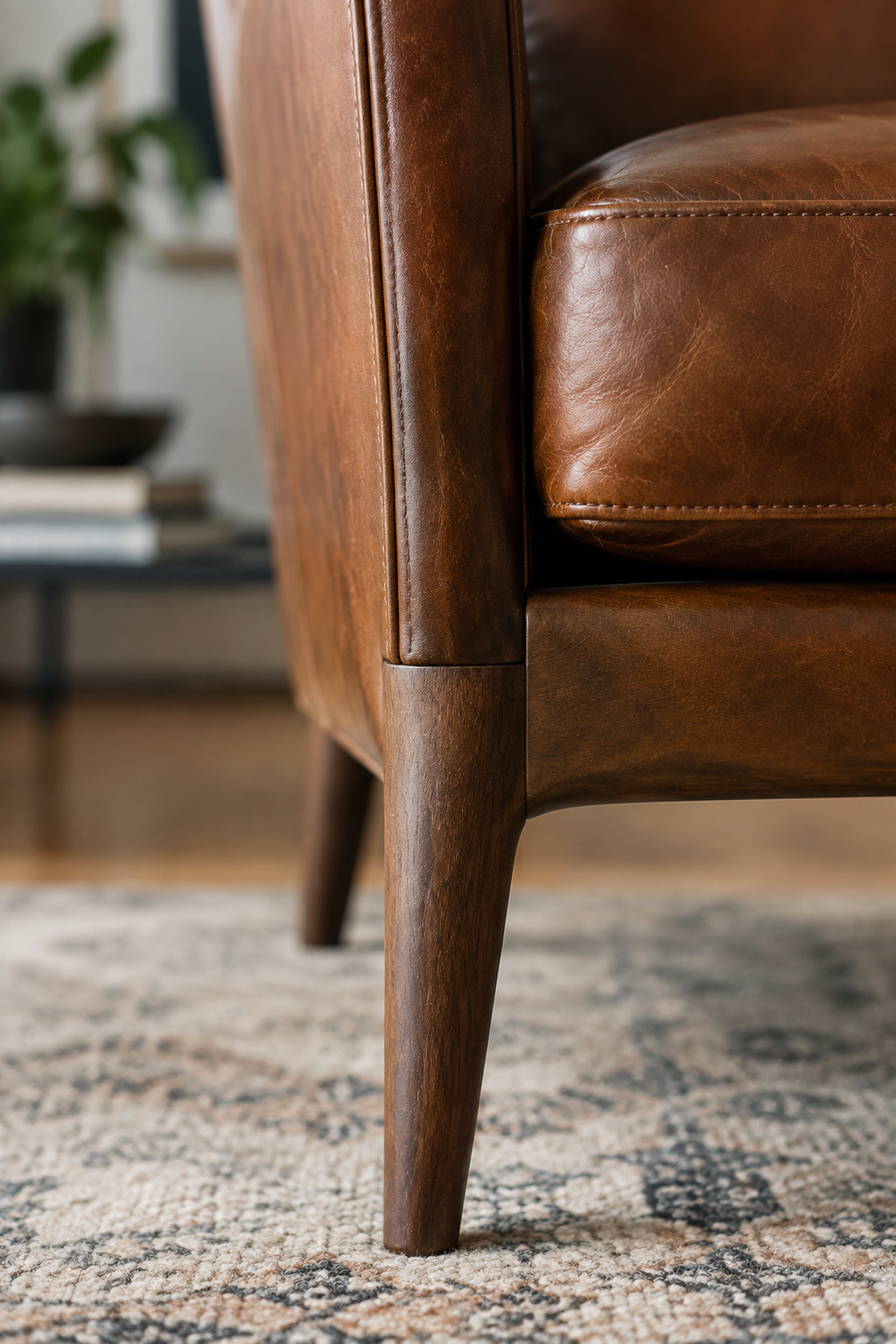
- An upholstered or leather armchair. I have less to say here. The drawer tests below don’t transfer to a chair frame, and dating evidence for upholstered joinery is thin, so judge how solid the frame is, whether the leather has creased where an elbow goes, and whether the chair is worth re-covering.
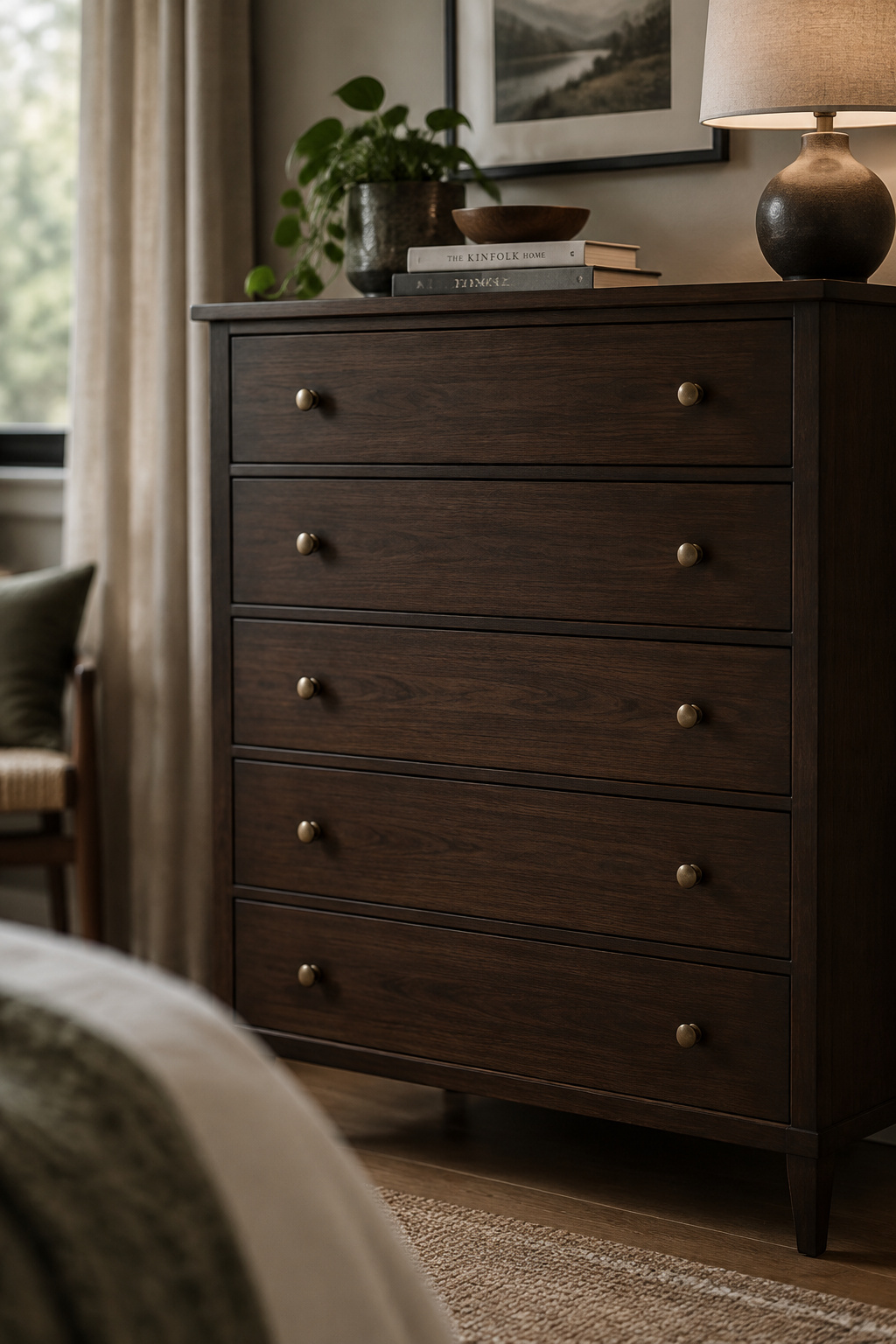
- A dark wood dresser or chest. Use the same drawer check. In a room like this, the dresser is the piece most likely to carry a dark finish applied later, so read it against the section on reversing dark finishes below.
- A bookcase, as furniture rather than as a wall system. It should be freestanding and moveable, and you judge it on its own joinery. Once it’s standing and loaded (a full run of books is heavier than almost anyone expects), styling the bookshelf once it’s in place is a separate job, worked to the shelf depth that article sets.
- A small side or accent table. These are most often sold only as reproductions, since genuine period examples at this scale are scarce.
Adding a sixth and seventh piece dilutes the five that were doing the work.
Reading joinery to tell old from aged-to-look-old
I date a piece from the drawer outward, because joinery is the most expensive thing to fake convincingly and so the last thing anybody bothers faking. These are the tells worth carrying to a viewing:
| Tell | What you’re looking at | What it signals |
|---|---|---|
| Hand-cut dovetails | Pins narrower than tails, uneven spacing, scribe lines and saw or chisel overcuts at the inside corner | 19th century or earlier — but only alongside other clues; hand-cutting never fully died out |
| Machine-cut dovetails | Pins and tails identical, spacing perfectly even, no overcuts | No older than 1895 |
| Dovetail cut ratio | A narrow 1:5–1:6 (9.5°–11°) angle vs. a 1:4 standard | Narrow marks quality hand work; 1:4 is the later machine norm; 1:2–1:3 is early or utilitarian |
| Pin-and-scallop (Knapp) joint | Dowels driven through a scalloped drawer side into the front | American work, roughly 1870–1900; patented 1867, in factory use from 1871, never adopted in Europe |
| Saw marks on unfinished surfaces | Straight parallel marks vs. arced ones | Arced means circular-sawn: not before the 1860s–1880s in furniture |
| Drawer bottoms | Hand-planed ~1/2 inch with beveled edges vs. machine-planed ~1/4 inch vs. plywood | Pre-mid-1800s / late-1800s / 1910s onward |
| Secondary woods | Pine, poplar or cottonwood vs. oak | American vs. English or Continental origin — English brown oak is specific |
| Nails and screws | Square hand-forged heads, cut nails, uniform wire nails; off-center irregular screw slots | Pre-1810 / c.1810–1890 / post-1890; screw threads even and shanks tapered after 1846 |
Hand-cut joints vs machine-cut joints
Bob Flexner draws the useful line here. Hand-cut dovetails can’t date a piece by themselves, because craftsmen never stopped cutting them, but machine-cut dovetails work as a one-way marker: identical pins mean 1895 or later. Sellers quote “dovetailed” as though the word alone carried a date, so that one-way rule is worth remembering.
The furniture historian Clive Edwards adds something most buyers miss. The angle of the cut is its own signal, whatever tool made it, and a narrow 1:5 to 1:6 ratio marks someone who knew what they were doing. Saw marks need context too. The circular saw reached structural timber earlier than it reached furniture shops, so arced marks on a chest mean “not before the 1860s to 1880s” and can’t give you a specific year.
Real wear vs applied distressing
Applied aging lands uniformly, because a rasp or a length of chain doesn’t know where a hand would have gone. Real use follows the path a body takes through a room, so a dresser worn on the top two pulls and untouched on the bottom one has been telling the truth for forty years.
Then turn the piece around. However carefully the front has been aged, a reproduction back is uniform machine-planed board. A genuinely old back is rougher, shows pit-saw marks or hand-planed undulation, and carries dust and drawer wear consistent with the face it presents. I still run a thumb along the underside of a drawer front before looking at anything else, because grit and old plane ripple register faster by touch than by eye.
Timber and grain: what tight rings tell you about old wood
On grain I part company with most of the trade literature, including sources I’ve cited myself. The folk version says tight growth rings make wood stronger, and pre-1900 furniture does show 15 to 30 or more rings per inch in the end grain, against roughly 3 to 8 in modern plantation lumber. The count is real and useful for identification at a glance.
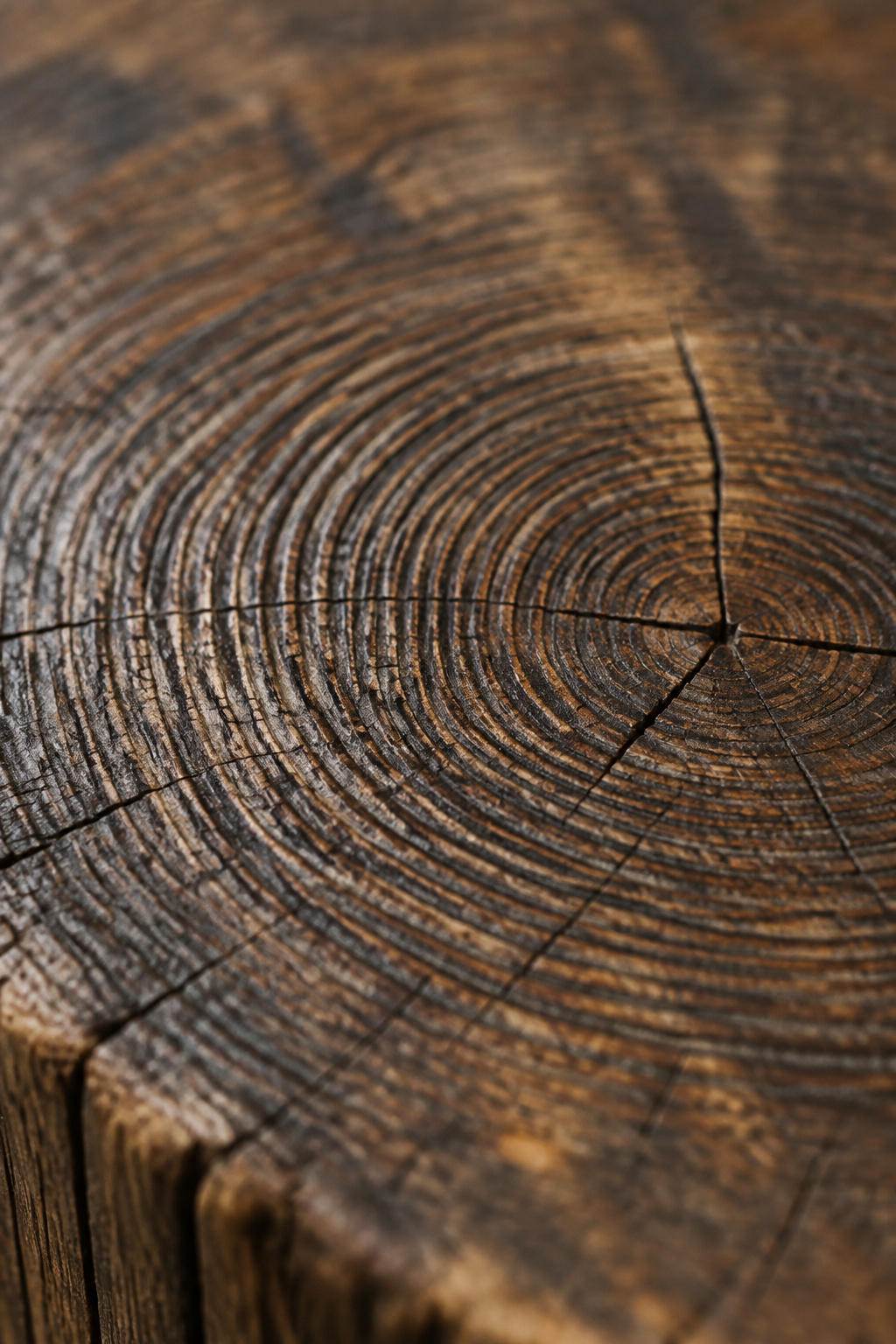
As an explanation of strength, though, ring count is weak. In a 797-specimen study of graded southern pine, rings per inch alone explained 10 to 14% of the variance in compression strength parallel to the grain, while density alone explained 32 to 35%. Density does the mechanical work. Slow growth produces a higher proportion of dense latewood to light earlywood within each ring, and that proportion depends on growth rate and stand crowding more than on the tree’s age. A 1932 USDA field study found second-growth yellow-poplar averaging higher specific gravity than older virgin-growth trees grown in open stands, which had laid down wide, earlywood-heavy rings all their lives.
So count the rings, and read them as evidence of density. Old-growth timber does measurably outperform on decay resistance and dimensional stability because of its heartwood proportion, though those controlled figures come from redwood. Most of this furniture is oak, walnut and mahogany.
Mixing wood tones and periods without building a set
The most-cited professional shorthand says a room doesn’t need to match. The rule of threes caps a room at three distinct wood tones, all sharing one undertone family: a base (the floor or the largest piece), a contrast and an accent. Designer Natasha Jain explains why it works. Limiting tones lets the eye settle, and that is what separates a collected room from a pile of unrelated finds.

Count the tones you can see. An age-darkened shellac and a stripped-and-oiled refinish on the same walnut are two tones in one room, even though both labels say walnut.
For mixing periods there’s no standard at all. My working rule is about a century of production dates: an 1880s chest beside something from the 1900s or 1920s holds together if the tones agree. Push wider and the pieces start looking unrelated. That rule of thumb comes from practice, and no published convention backs it.
What a dark finish does to a piece you may want to reverse
Traditional ebonizing changes the wood itself instead of coating it. Iron acetate reacts with the wood’s own tannins, and a peer-reviewed study measured the resulting iron-tannate color penetrating 60 to 80 micrometers into red oak and 100 to 120 into cherry. Because the color sits inside the fiber, solvent and a rag won’t remove it. A sander will, and the sander takes the surface record with it.
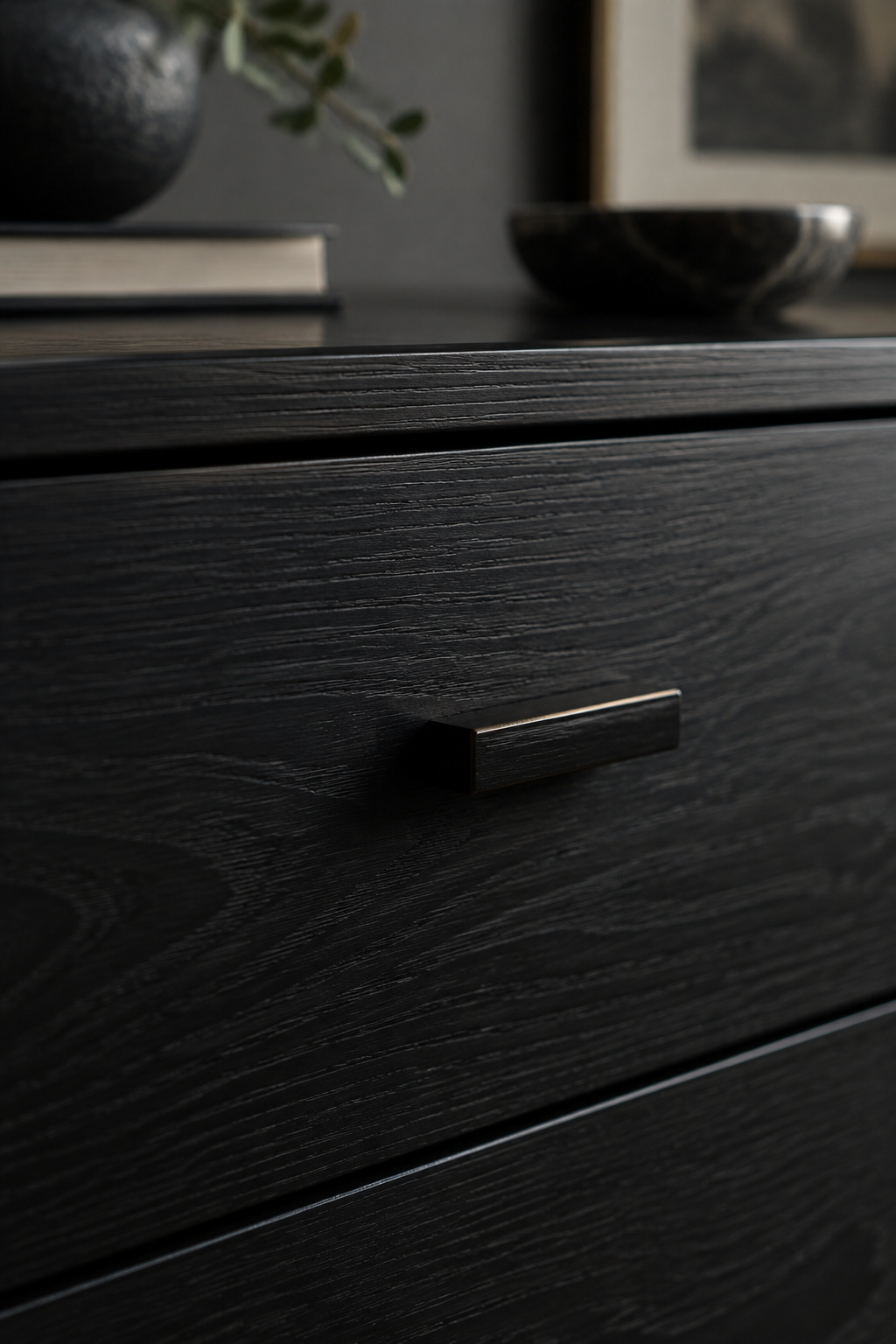
Shellac is the opposite. It stays semi-soluble in alcohol indefinitely, which is why conservators can rework or spirit off a shellac surface decades later, and why modern catalyzed lacquers aren’t recommended as substitutes on period pieces. Barbara Appelbaum’s 1987 definition is a good one to keep in mind: a reversible treatment lets a knowledgeable conservator turn back the clock, leaving future options as broad as they were before. She separates that from mere solubility, treating reversibility as a property of the treatment rather than of whatever is in the can.
Value follows the same line. Painting or heavily staining a genuine antique in original finish has been documented to cut market value by 95% or more, while solid-wood factory pieces from the 1850s to 1960s refinish with far less penalty. Before committing, dab a hidden area with alcohol or mineral spirits: a surface stain lifts, an ebonizing reaction doesn’t. You won’t be the last person to own a good piece, so ask whether the next owner can undo what you did.
What to check before you pay
Make three checks, in the order that fakery gets easier. Start with joint type and location inside the drawer. Then check that hidden surfaces on backboards and undersides are consistent, including the dust a seller never thinks to stage. Finish chemistry comes last, since it is the easiest to fake and the easiest to test.
Walk away from a piece that tells three different date stories, such as machine-cut dovetails with hand-forged hardware, or backboards in the wrong secondary wood for the claimed origin. That is a married composite or a reproduction dressed in old fittings. Asking for photographs of the drawer interior and the back before you pay is ordinary practice, not an insult. After that, the question left is deciding when and in what order to buy.
There is one argument I won’t settle for you. The trade literature says tight rings make wood strong; the grading studies say ring count explains about a tenth of the variance and density about a third. Both are in print, and two people who know their material may quote them at you at the same fair. I count the rings anyway, then I pick up the board, because heft tells me what the count only hints at.
FAQ
Does dark academia furniture have to match?
No. No published rule requires matching, and dark academia is a community aesthetic with no codified style or governing body. Designers use the rule of threes instead: three distinct wood tones as base, contrast and accent, sharing one undertone family.
Can painted furniture ever read as dark academia?
Yes, though what you paint matters more than the color. Painting a genuine pre-1900s piece in original finish has documented value drops of 95% or more; solid-wood factory furniture from the 1850s to 1960s carries far less risk. Before you paint, find out what is underneath and whether it can come back.
Which wood species reads most “dark academia” in a bedroom?
No standard ranks species by how they read. Tonal darkness and visible grain count for more than the species name. Walnut, mahogany and oak are the woods dealers and historians most associate with richly grained case pieces of the era, and ebonizing is a legitimate way to get near-black on lesser woods.