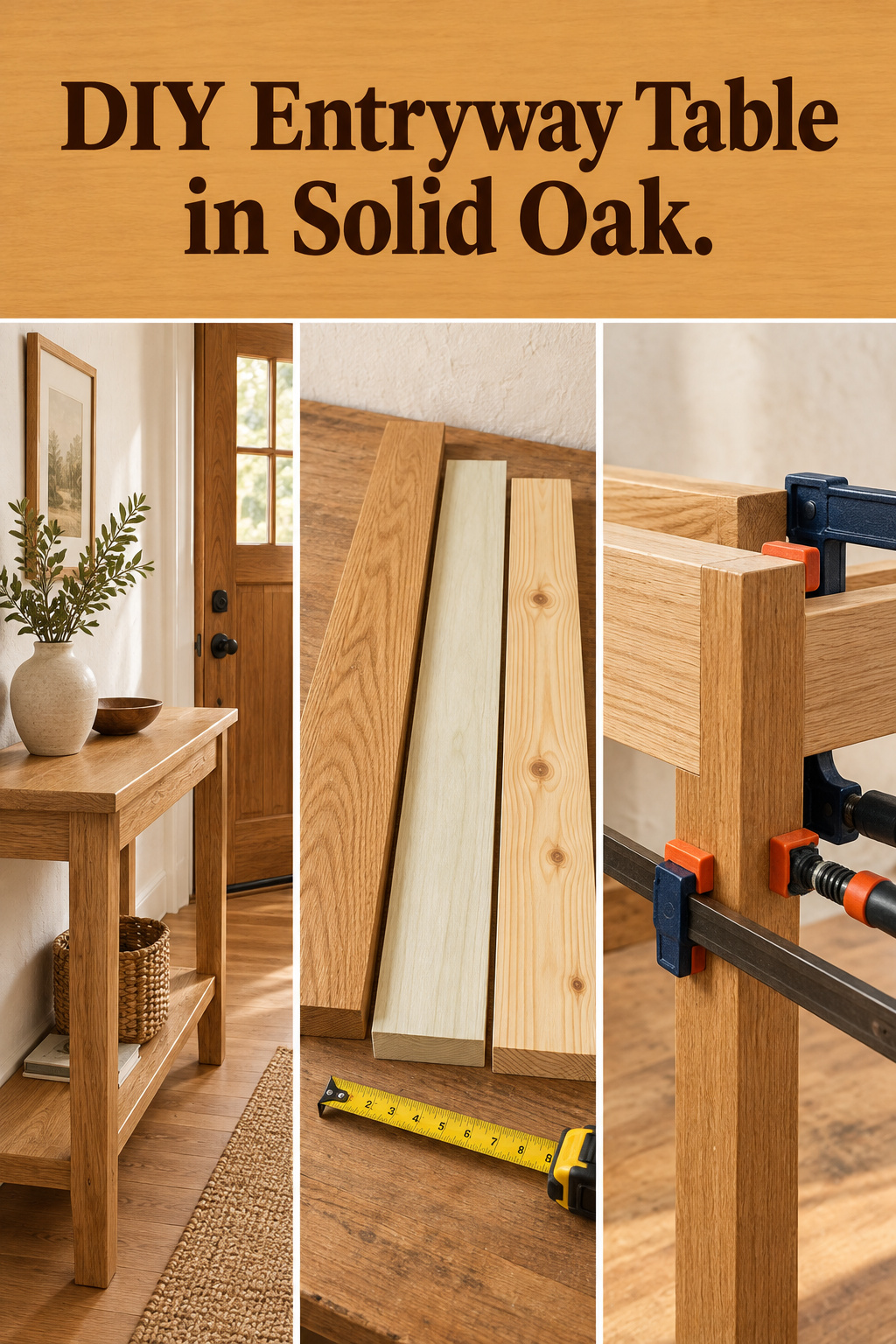
Ten board feet of red oak cost $61.00 on one Georgia hardwood yard’s price list this November. Ten board feet of white pine from the same list cost $37.50. Ten board feet is the whole of a foot-deep DIY entryway table, with room for mistakes. The usual advice is to build it in pine to save money. For a piece this small, the saving is $23.50, and I would rather have the oak.
TL;DR
- At a hardwood yard, 10 board feet for an 11 in deep table cost $61.00 in red oak and $37.50 in white pine; at Home Depot, the same table’s three 1x6x8 boards cost $150.00 in red oak and $47.22 in pine.
- Keep 36 in of walkway clear, so the table’s depth is the hall width minus 36: 12 in at most in a hall under 48 in wide.
- Build four laminated legs and a four-sided apron, then hold the solid top on with figure-8 fasteners or clips that let it move.
A Foot-Deep DIY Entryway Table Needs So Few Board Feet That Oak Barely Costs More
Lumber is sold by the board foot: thickness times width times length in inches, divided by 144, with surfaced 3/4 in stock counted as a full inch. By that rule the pine habit makes little sense here, because a narrow table uses almost nothing.
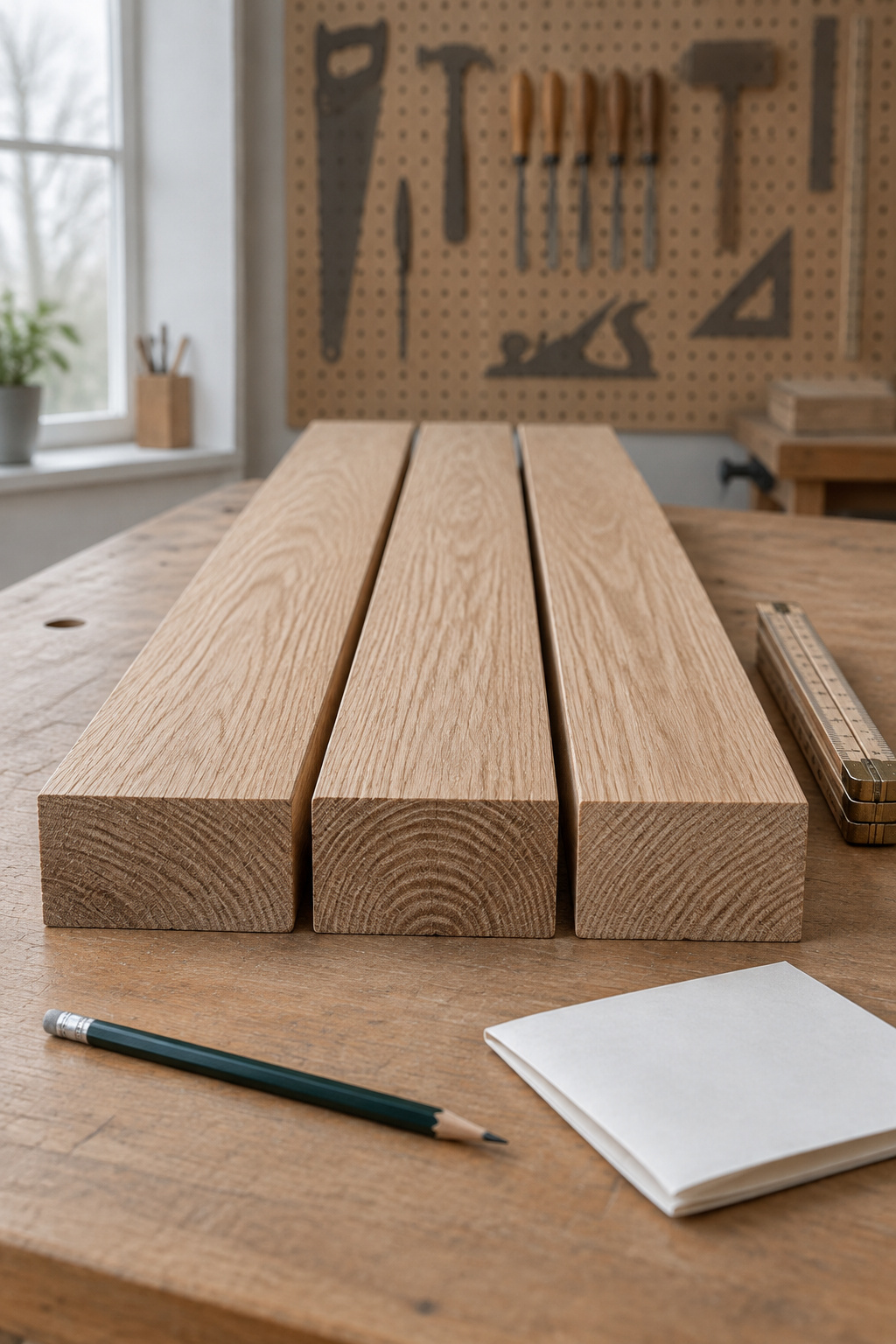
The table I priced is 40 in long, 11 in deep and 32 in high, with a 1 in overhang on every side:
- Top: two boards, 40 x 5.5 x 3/4 in, edge-glued to 11 in
- Legs: four, 1.5 x 1.5 x 31.25 in, each glued up from two 3/4 in strips
- Long aprons: two, 3 x 35 in
- Short aprons: two, 3 x 6 in
The top is 480 cubic inches of board (each 1×6 charged at 6 in), the leg strips 375 and the aprons 246. That is 1,101 cubic inches, or 7.65 board feet. Buy 10 and you have about 30 percent spare.
Not every plan reaches for pine; Pine and Poplar built its own, longer entry table in oak at about $200 against about $125 in pine. At ten board feet the species stops being a budget question: the gap is $23.50.
So ask what you want the table to be in ten years. Most “Scandinavian” furniture sold in the US is pale veneer pretending to be wood. That’s furniture for a photograph. Buy fewer pieces of actual wood. This is one of the DIY entryway projects, and at ten board feet it is a cheap place to learn hardwood.
Oak, Poplar and Pine Priced Against the Same One-Foot-Deep Cut List
Where you buy changes the answer, so I priced the same table two ways: 10 board feet at The Wood Yard in Concord, Georgia, on its November 2026 list, and three 1x6x8 boards (12 board feet, sold whole) at Home Depot online in November 2026.
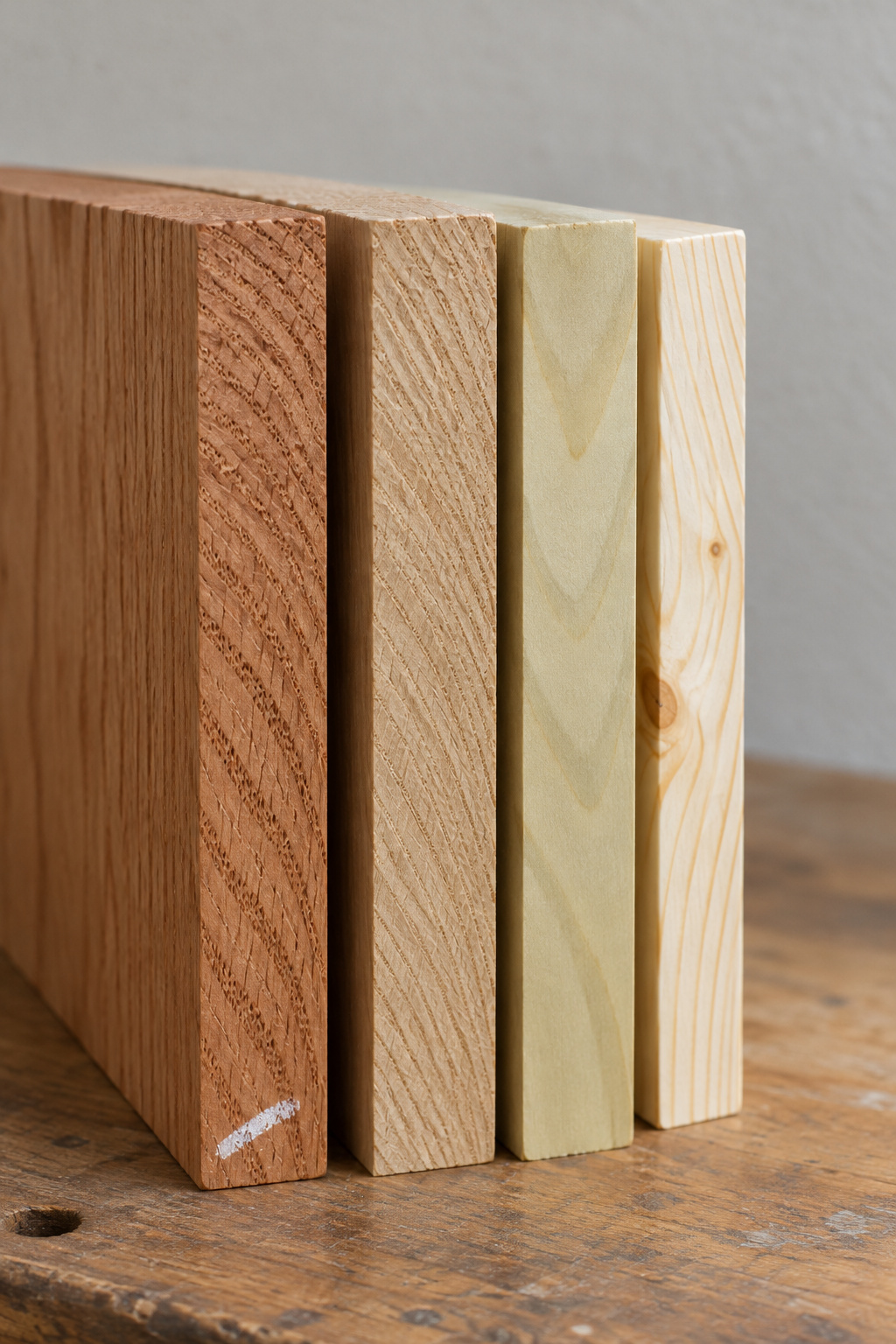
| Species | Hardwood yard, 10 bf | More than pine | Home Depot, three 1x6x8 | More than pine |
|---|---|---|---|---|
| White pine / pine S4S | $37.50 | — | $47.22 | — |
| Poplar | $53.50 | $16.00 (1.43x) | $93.45 | $46.23 (1.98x) |
| Red oak | $61.00 | $23.50 (1.63x) | $150.00 | $102.78 (3.18x) |
| White oak | $100.00 | $62.50 (2.67x) | $279.06 | $231.84 (5.91x) |
At the yard, red oak is the row I would choose. A second yard’s spring list was closer still: red oak at $50.00 for 10 board feet against $47.00 of knotty pine.
Pine and white oak are sold there in packs, so those totals use the per-board pack price. At the big box the argument does not hold. Red oak there is more than three times the price of pine, over $100 more for one small table. Part of that gap is surfacing rather than species: big-box boards come planed on all four sides, while a yard may price rough or partly surfaced stock.
White oak is the beautiful one, but even at the yard it is $62.50 more than pine, a real decision.
Buying Solid Hardwood Boards Without Paying for Waste
A cheap board list only stays cheap if every board you carry out is usable. Rockler suggests adding 20 to 30 percent for waste; The Wood Whisperer suggests 15 to 20, more when you need particular grain. Ten board feet over a 7.65 net sits at the generous end, right for a first build.
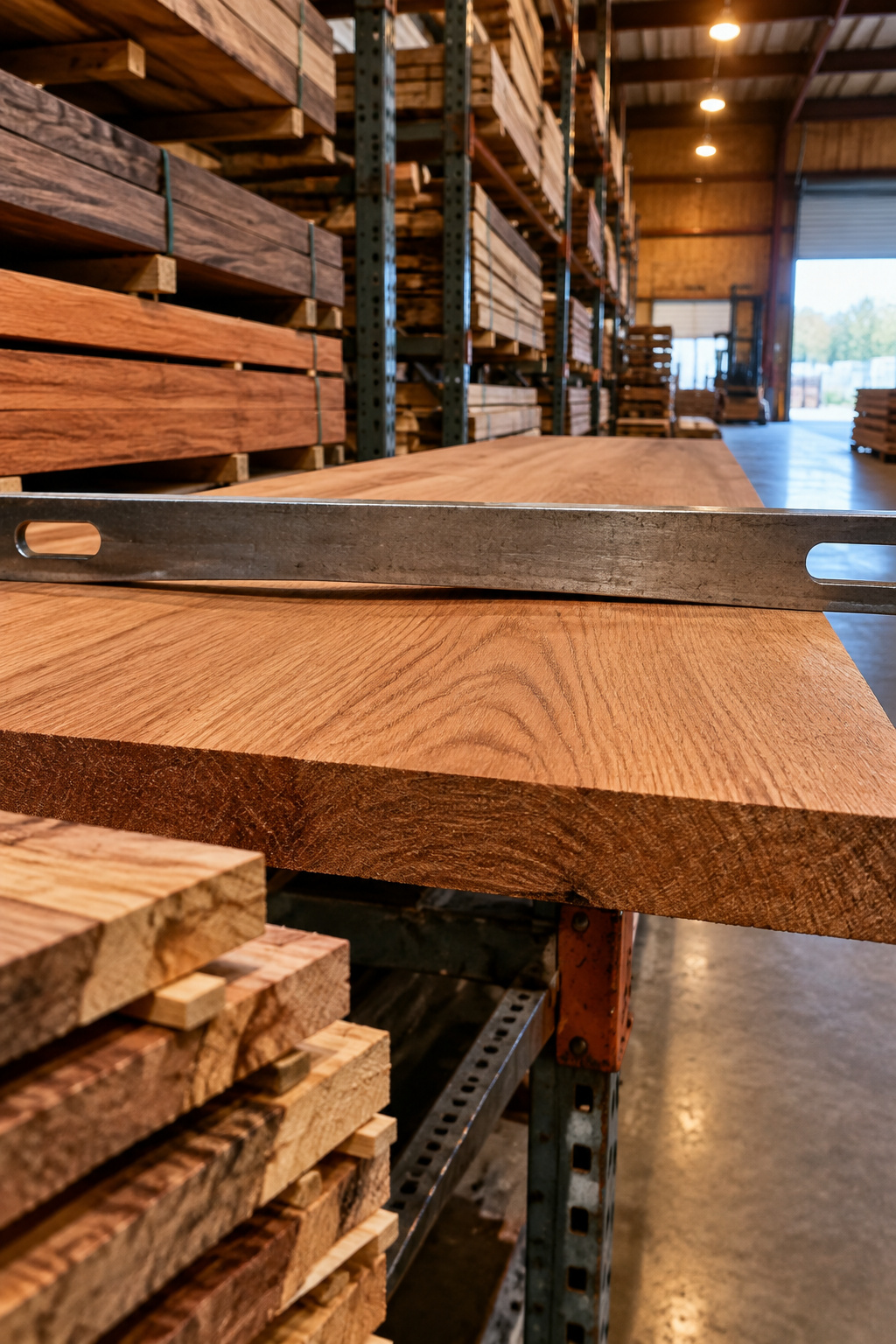
At the yard:
- Count board feet on the thickness you are charged for. Rough 4/4 is charged as an inch even though it planes to about 3/4 in.
- Buy surfaced stock (S4S) if you own no jointer or planer. It costs the most, but rough boards hide their defects until you flatten them.
- Lay a straightedge across each board and sight down its length. Even surfaced boards can cup and twist.
- Hand-pick the two boards for the top, and check they are long enough for 40 in once the ends are trimmed.
The top is the part to be fussy about, because it is the part that stays. The small oak table I’ve kept for years is the one from my first flat. For six years it was my desk, my dining table and my workbench, and now it is the breakfast table in Duluth. It has knife marks I refuse to sand out. Good furniture follows you between homes.
Size the Depth From the Door Swing and Keep the Walkway Clear
Measure the hall before you cut the top. Keep 36 in of clear walkway in front of the table. That figure is the NKBA’s kitchen walkway guideline, and it is also the minimum hallway width in the International Residential Code (R311.6). So the deepest table you can afford is the hall width minus 36 in: 12 in at most in a hall under 48 in wide. Entry consoles run 12 to 16 in deep, and 14 to 16 in suits a hall 50 to 60 in wide.
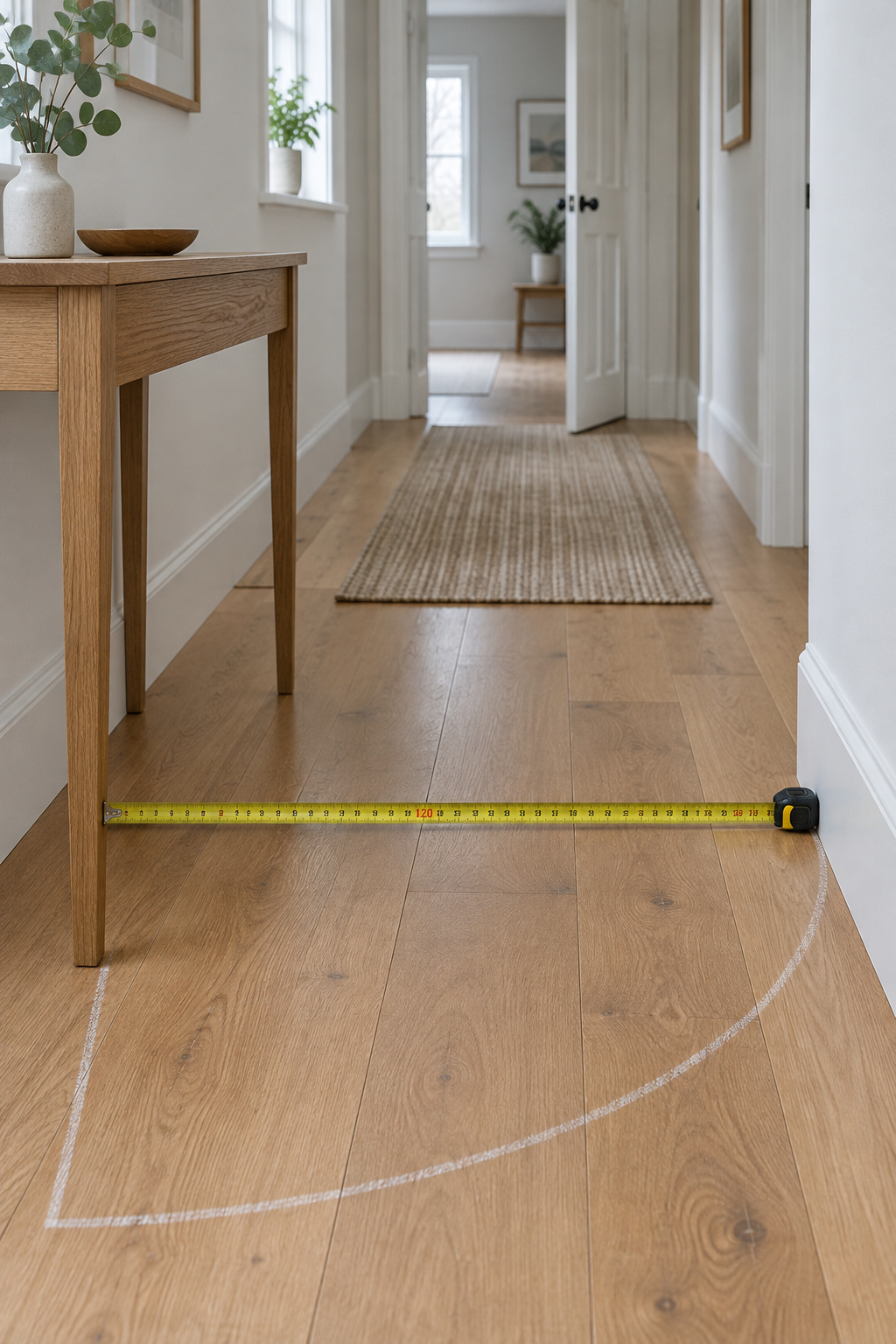
A hall built to the 3 ft minimum has no room for a freestanding table at all. There, a shelf with hooks takes the landing job instead.
Then open the door all the way. Leave 4 to 6 inches between its full swing and the table’s front edge, and at least 2 inches between the door handle and the tabletop. Measure from the handle, not the hinge. The 11 in top on the cut list sits just inside the 12 in limit for a narrow hall.
Build the Four-Leg-and-Apron Table, or a Slab on Brackets
Four legs and aprons, step by step
The frame is a plain box on four legs. A circular saw run along a clamped straightedge makes the long rips; don’t rip freehand.
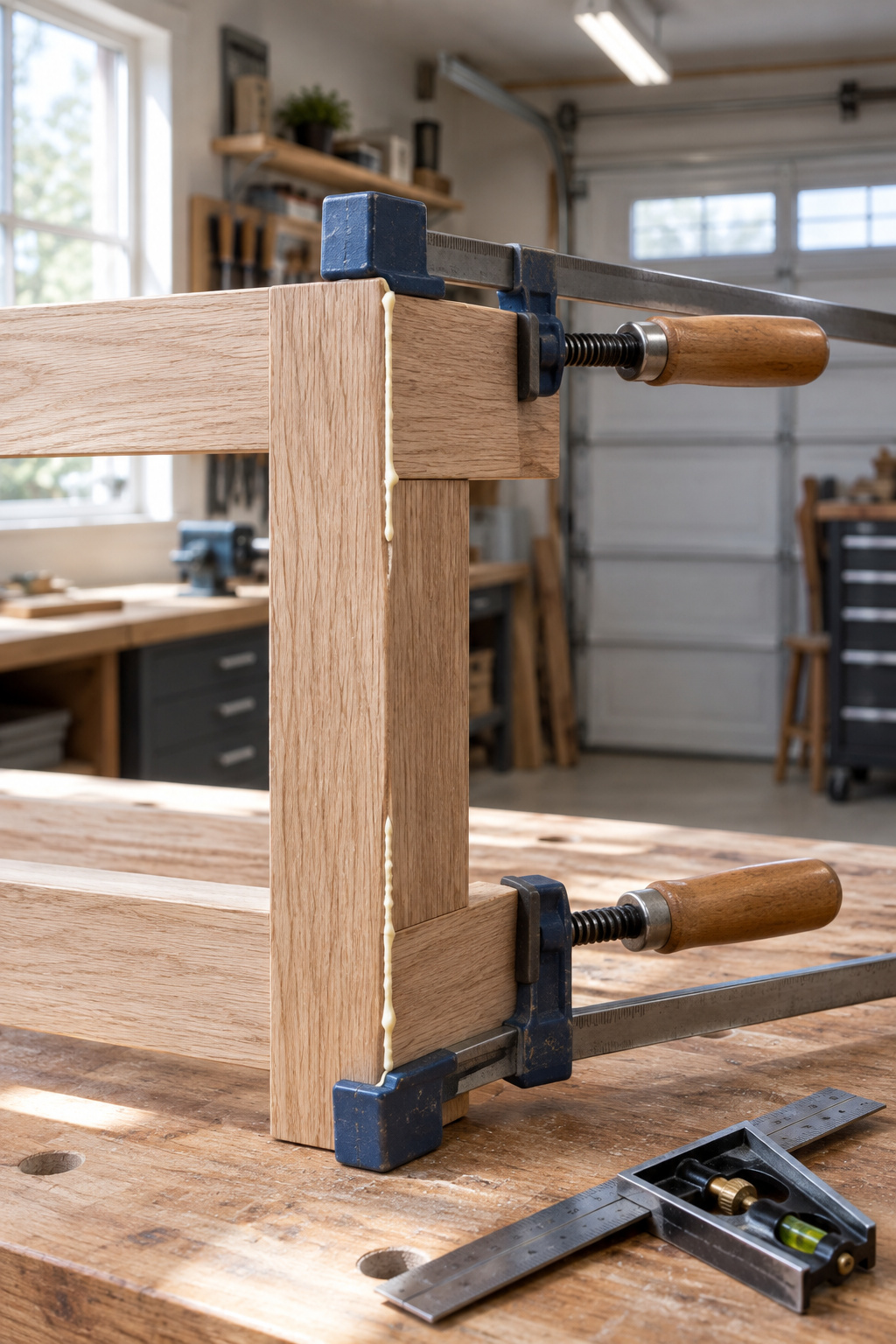
- Rip the leg strips and glue them in pairs into 1.5 in square legs.
- Cut the four aprons to length.
- Join a short apron between two legs to make each end frame. Use pocket holes set for 3/4 in stock, with 1.25 in screws and glue.
- Join the end frames with the long aprons, then check the box for square and flat.
- Edge-glue the two top boards.
- Attach the top with figure-8 fasteners, Z-clips or wooden buttons.
Those fasteners let the top move. A solid top glued or screwed down tight can crack when it shrinks in the dry months or split an apron joint when it swells. Woodcraft puts seasonal movement at about 3/16 in per foot of width, so this 11 in top moves about 0.17 in. Figure-8 fasteners suit tops up to about 18 in wide.
The slab-and-bracket alternative
With fewer tools, skip the frame and fix the glued-up top to bought steel legs on mounting plates. Lee Valley sells a 28 in hairpin leg at $17.60, so four cost $70.40 before screws. Mind the height: a 28 in leg under a 3/4 in slab gives 28.75 in, short of the 30 in where an entry table starts. Use slotted holes in the plates so the top can still move. It is quicker, but the four-leg frame is the better table.
Finish It, Anchor It to the Wall and Leave Off the Lower Shelf
A finish that shows the grain
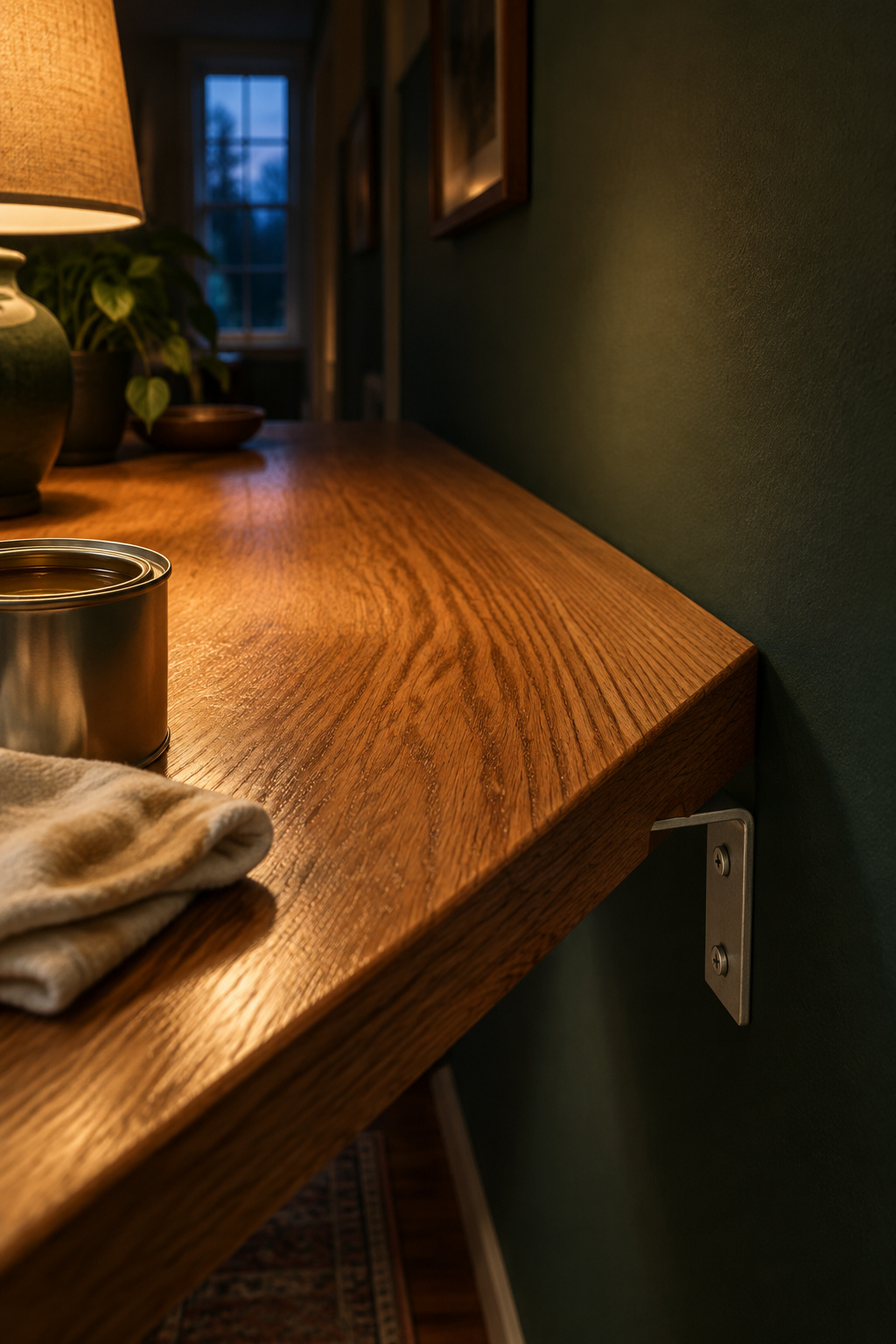
Oil it. A clear oil leaves the grain readable, which is what you paid for. Danish oil goes on in two wiped applications, is touch-dry in about 2 hours and ready for use in 8 to 10, and wants 72 hours before any topcoat. Touch-dry is not cured, so go easy with wet boots and hot mugs.
Anchoring a narrow table
The federal tip-over standard covers clothing storage units, dressers and the like. It does not cover an open table, and it does not require a homeowner to anchor anything, so anchoring this table is a choice. The CPSC advises anchoring TVs and furniture such as bookcases and dressers. A 32 in table a foot deep is none of those, but children climb and dogs lean, and almost all anti-tip kits cost under $20. If you fit one, screw it through the back apron into a stud, not into bare drywall.
Then leave the lower shelf off. Some plans add one for shoes, and those shelves turn into shoe piles. Storage that asks you to tidy it every day has already failed. Enough is a good word. Give the shoes their own place, a slatted shoe rack by the door, and let the table stay a table.
Price the boards before you pick the species, take the depth from the door, build the frame plain and let the top move. The number to carry there is $23.50: what red oak cost over white pine for 10 board feet, the whole table, on one hardwood yard’s November 2026 list.
FAQ
How tall should a DIY entryway table be?
Make it 30 to 32 inches for most entries. Console tables generally run 30 to 36 inches, and the lower end suits compact entries with ceilings of 8 feet or less. To get the leg length, subtract the top’s thickness from the height you want: a 32 inch table with a 3/4 inch top needs legs 31.25 inches long.
Can you build an entryway table without a table saw?
Yes. A circular saw run along a clamped straightedge guide makes long rips and crosscuts accurately. Measure the distance from the blade to the edge of the saw’s base once, clamp the guide on the side of the board you keep, and never rip freehand. Buy surfaced boards and pocket-hole joints need only a drill and a jig.
How do you stop a handmade table wobbling on an uneven floor?
Find out first whether the table or the floor is at fault. Stand it on a dead-flat surface. If it rocks there, the table is twisted: trim the longer of the two diagonally opposite legs, sanding on 80-grit paper if it is under 1/16 inch. If it sits flat there, the floor is uneven, so move the table.