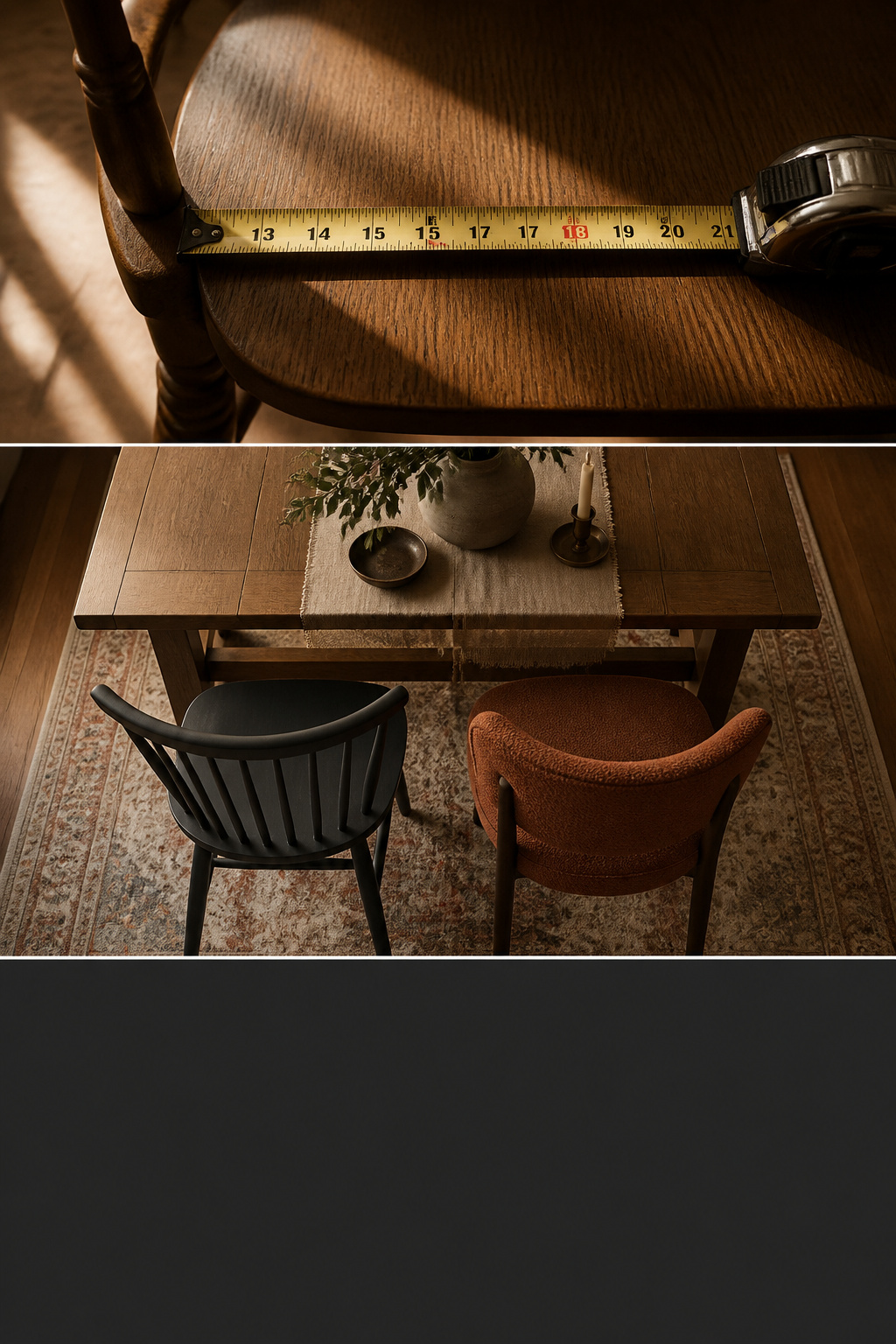
Everyone thinks mixing dining chairs takes a designer’s eye and a fat budget. It takes neither — just a tape measure and one rule most people never hear. On the crews I ran, we had a saying: pros measure, beginners guess. Nowhere does that cost you more than with eclectic dining chairs, because the difference between a collected set and a junk pile is one number. Get it right and you can mix wood, metal, paint and upholstery with abandon.
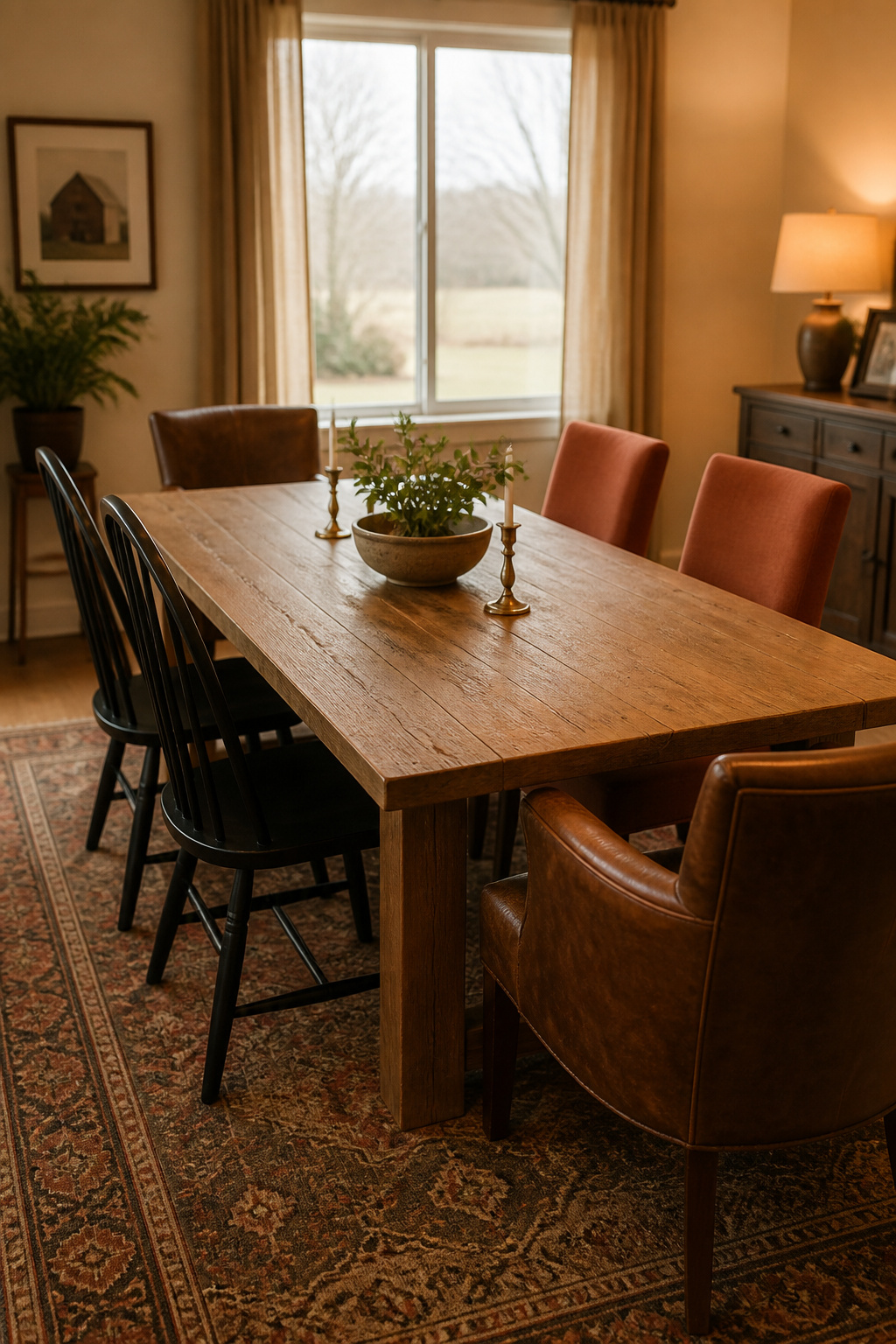
TL;DR
- Equal seat height is the only non-negotiable: shop chairs at 17–19 inches and keep every seat within 2 inches of the others, so diners sit level.
- Repeat one element across all of them — same paint, same leg stain, or same curve — to turn a mismatched grab-bag into a set.
- A solid-frame thrift chair reupholsters for $20–$100 in materials and about 2–3 hours; skip anything with a plywood seat base, because the staples pull right through.
The One Rule That Makes Mismatched Chairs Look Intentional
Here is the rule: every chair has to sit at the same height. One Kings Lane’s team says it flat out — seat height is the biggest concern, and as long as all chairs are level, you are free to mix and match styles with abandon. Everything else is style preference. This is the only structural rule, and the one nobody leads with.
Equal seat height: why this is the only non-negotiable
When diners sit at different heights, the eye catches it before it notices the chair styles. Height variation reads as a mistake; style variation reads as a choice. Emily Henderson’s team pegs the target: dining chair seats run 17 to 19 inches, tables sit around 30 inches, and within one set the chairs should land within 2 inches of each other. Wider than that and someone is reaching up to their plate while someone else is sinking below it.
How to measure seat height and what range to shop within
Put the chair on a hard, flat floor — even a half-inch rug pile throws the number off. Hook your tape at the floor and measure straight up to the seat center. Before you commit to any used chair, run this check:
- Measure to the highest point of the cushion at the center, not the piping at the edge.
- On an upholstered seat, sit in it and measure to the compressed height — foam can knock 1 to 2 inches off the listed number.
- Confirm 10 to 12 inches of clearance between the seat top and the table underside; that is the ergonomic floor for thigh room.
- Ignore the listing dimensions — they are often measured to the wrong point, or just plain optimistic.
What happens when you break this rule
Short end chairs are the classic miss — end chairs should match the sides or run taller, never shorter. The mistake I see most: somebody buys a chair without measuring, falls in love, then spends months hunting for a set to live with a 15-inch oddball. You eat the loss, or you build the entire table around that one awkward height. Measure first.
The Two-End-Chairs Starter Move
Do not mix all six at once — change just the two end chairs and leave the sides matching. One Kings Lane calls this their top starter move: symmetrical, more interesting than a matched set, composed enough to read as a decision rather than a leftover.
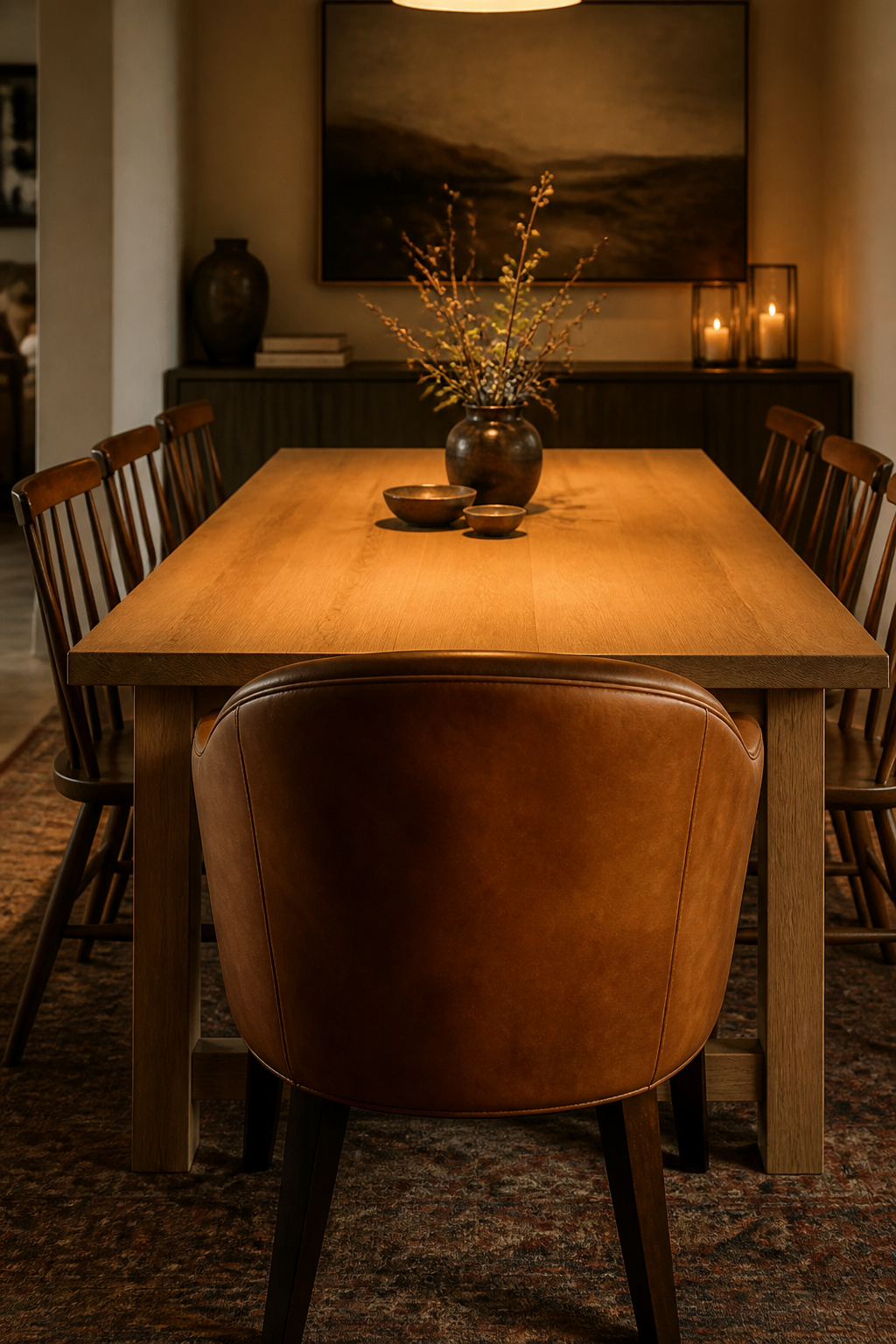
Two matching armchairs at the heads, simpler chairs on the sides
Put upholstered armchairs at the two ends, lighter side chairs down the flanks. A whole table of upholstered chairs feels heavy and stuffy; the simpler side chairs lighten the room while the end chairs deliver comfort and a focal point. Pairing in twos brings balance — leaning on symmetry is not a cop-out, it is the point.
Why anchor chairs stabilize whatever you mix on the sides
The eye enters the table from the ends. A deliberate end chair frames the whole composition; the mixed side chairs read as supported variations rather than random additions. Your end chairs need to be the bulky ones — a flimsy end chair next to heavier sides inverts the hierarchy and the whole set looks unresolved.
Choosing the anchor chairs
Upholstered armchairs or slipper chairs make the best heads — the most reliable combination in the design sources is an upholstered end chair with wood-frame sides. If your end chair has an open frame, give it heft through dark leather or upholstery. And keep back height in scale: a four-foot-tall back over a small round table looks wrong no matter how well you mixed everything else.
Giving Every Chair Equal Visual Weight
Once heights match and ends are anchored, the next skill is distributing visual weight so every chair feels equally present.
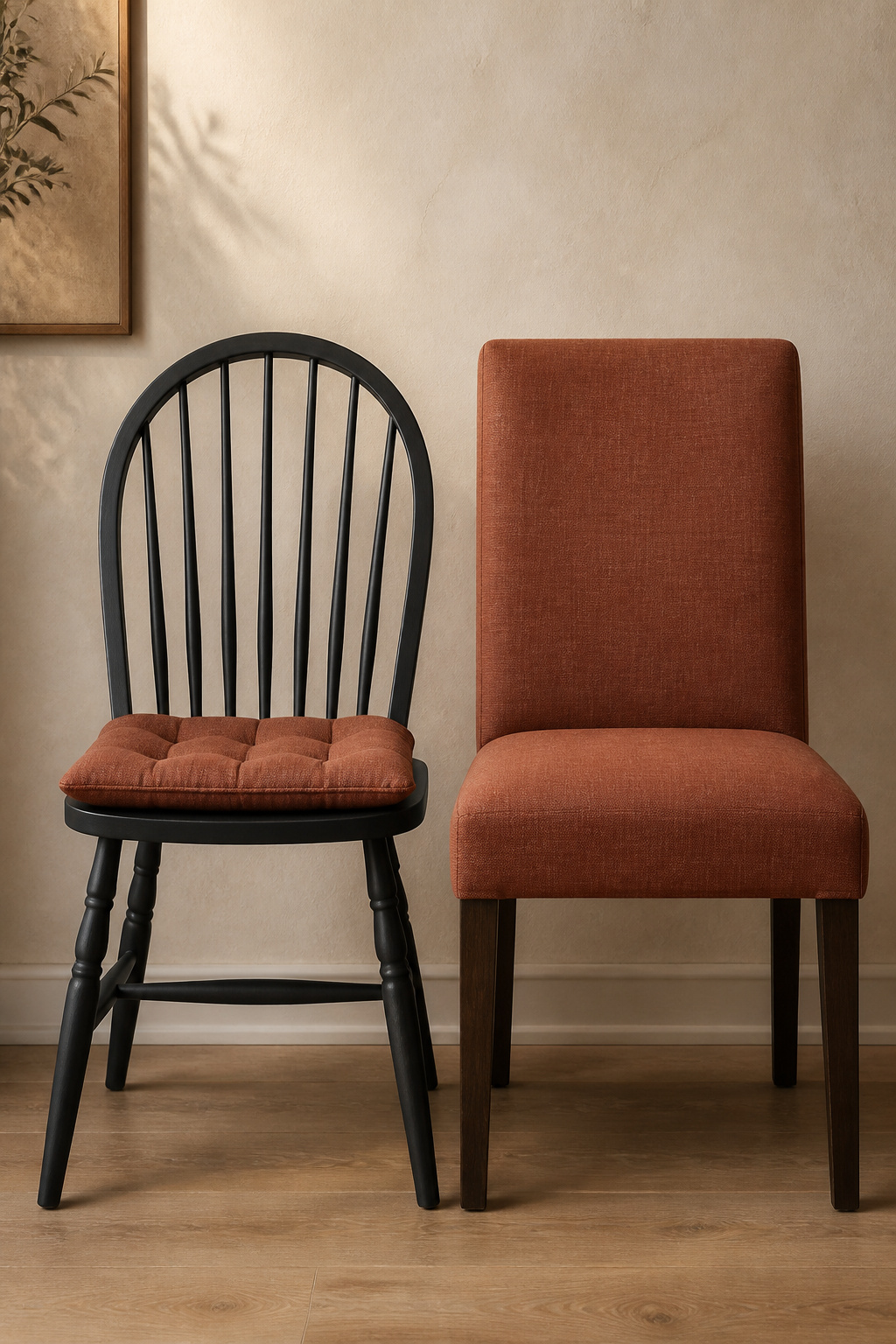
Visual weight versus physical weight
Visual weight is how heavy a chair looks. A solid back reads heavy; an open spindle back reads light. The fix is even distribution: spread heavy-looking chairs around the table. Cluster all the chunky ones on one side and the table looks like furniture storage.
Balancing a spindle-back against an upholstered chair
Emily Henderson’s team runs a “leggy versus chunky” approach: an open, leggy chair balances a filled, chunky one when they share a visual element — the same paint color, wood tone, or a matching curve. Without that thread, a very airy chair beside a very massive one looks like two strangers.
The upholstery lever
Drop an upholstered seat pad onto a spindle-back or cane-back and it closes the negative space, pushing its visual mass closer to a fully upholstered chair. No full reupholstery required — a cushion does most of the work.
Repeating One Element Across a Mixed Set
After seat height, the biggest thing separating “collected” from “random” is one repeated element. Just one — color, finish, or a shared line. Pick a thread and run it through every chair.
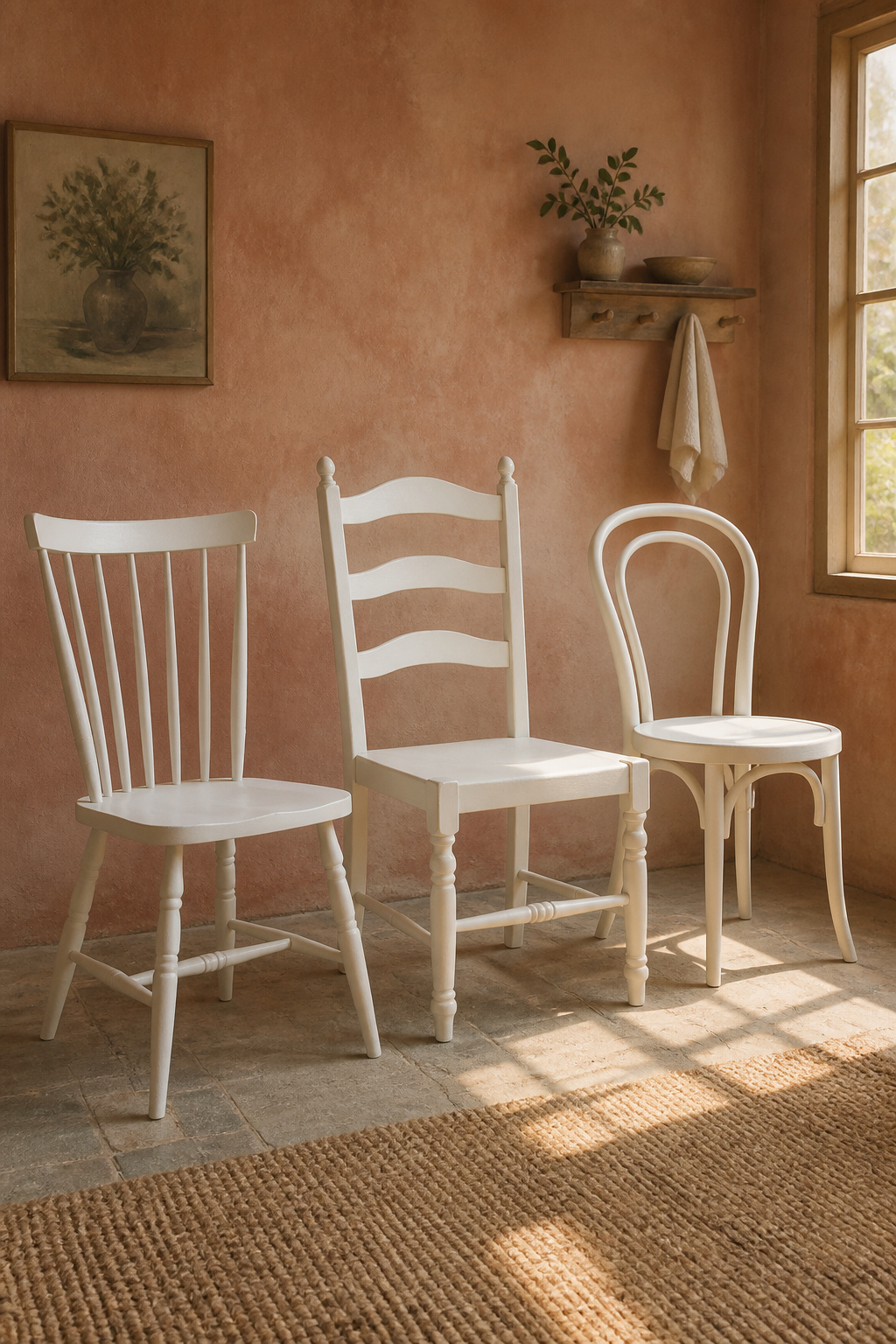
| Element to repeat | How to apply it | Difficulty |
|---|---|---|
| Color (paint or fabric) | Paint mismatched wood chairs one matte color, or recover all seats in one fabric | First-timer — fastest, cheapest cohesion move |
| Finish (leg stain) | Match the stain undertone across legs, or gel-stain them to the table base | Some experience — undertone matching takes an eye |
| Curve or line | Buy chairs that share a back shape (all curved, all angular) | Confident — it is a sourcing discipline, not a fix |
Color: one paint or fabric across different styles
Paint is the fastest, cheapest fix. One matte color across an array of mismatched chairs and you have an instant set — One Kings Lane does it with flea-market finds. The Houzz editors: give every chair a common thread — “perhaps each chair is black or caned or walnut.” Spread it evenly, two chairs each side.
Finish: the same leg stain ties a set even when silhouettes differ
Match the undertone of the wood across leg profiles — warm with warm, cool with cool. Gel stain wipes onto already-finished legs to nudge mismatched tones closer; staining the legs to match your table base knits the whole set together even when backs and seats vary. Test in a hidden spot first — stain over an existing finish behaves differently than bare wood.
Curve or line: a shared design language
If every chair shares a back shape — all curved or all angular — they read as a family regardless of material. One Kings Lane describes a set of cane-back and fiddleback chairs that “mesh seamlessly without matching perfectly, thanks to their shared colour, graceful curves, and gold detailing.” Pick one thread. Repeating two or three with no dominant one muddies the whole thing.
Reupholstering Thrifted Chairs to Tie a Set Together
Recover every seat in the same fabric. When frames vary a lot, the eye locks onto the fabric first and reads the different frames as deliberate variation — something paint cannot do. But before you buy fabric, you need the honest numbers and the go/no-go test.
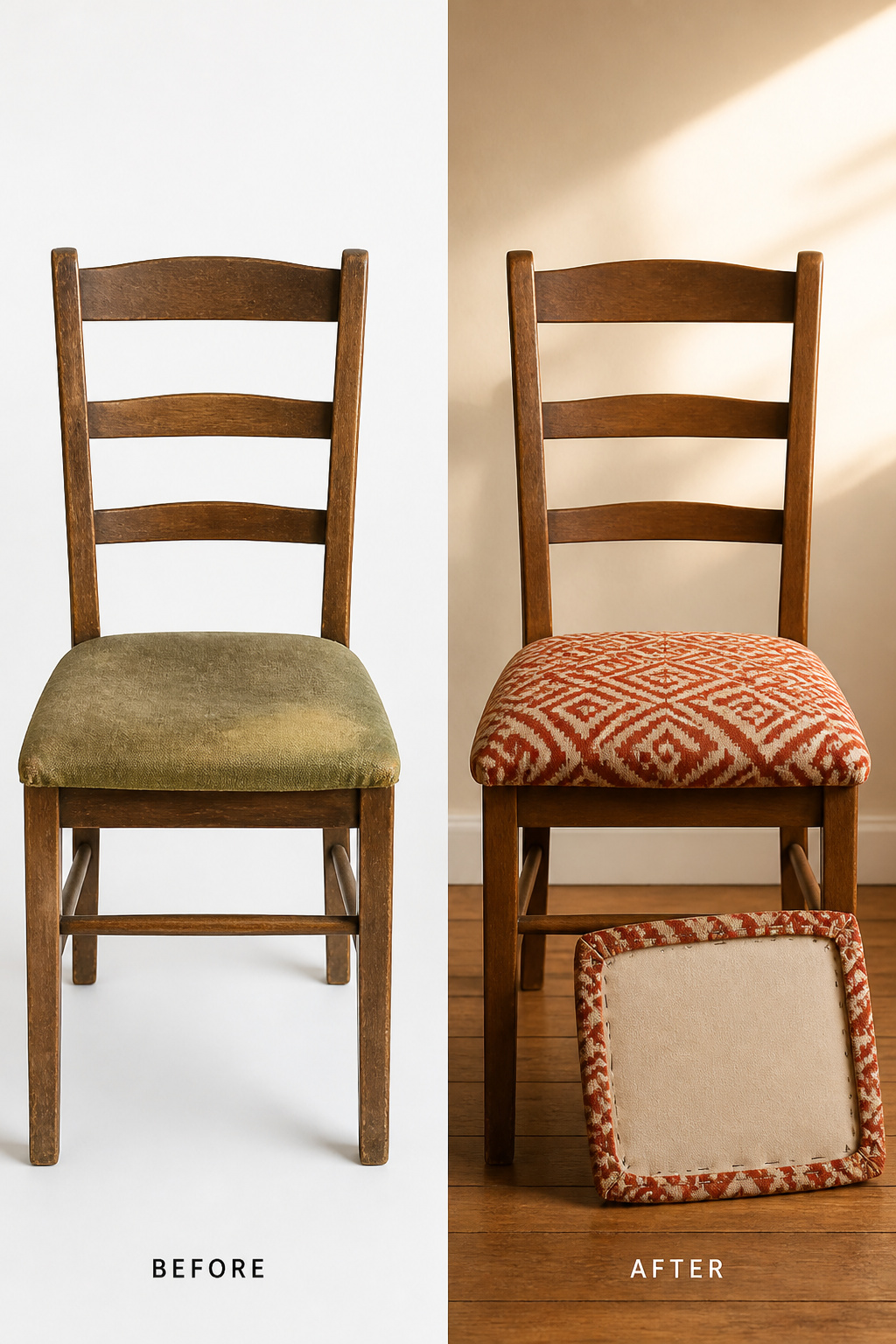
What it costs and how long it takes
Professional reupholstery runs $100–$550 per dining chair (2026 Angi data); curved or armed chairs run $210–$620. DIY slip-seat costs $20–$100 in materials — budget fabric is $10–$30 a yard, premium $30–$60, and a slip-seat pad takes half a yard to a yard.
Plan on 2–3 hours, after you have everything in hand. I once burned a whole Saturday on a “two-hour” project because I made the store run twice. Buy foam, fabric, and staples before you start. For daily-use seats, velvet needs at least 20,000 Martindale rubs; performance polyester velvet hits 40,000–100,000.
Which chairs are worth it and which to pass up
| Chair condition | Reupholstery viability | Estimated cost |
|---|---|---|
| Solid wood frame, legs run up through the seat, tight joints | Worth it — best candidate | $20–$100 DIY materials |
| Solid frame but a wobble or creak | Worth it after you re-glue the joints | Materials + an evening on repairs |
| Plywood seat base, legs screwed into thin board | Pass — staples tear through under tension | Not worth any spend |
| Water damage or rot at the leg-to-rail joints | Pass — the structure is already going | Not worth any spend |
Upholstery specialist Richelle Plett is direct: solid wood frame, legs through the seat — worth recovering; plywood is not. Furniture over 30 years old is usually the better bet — denser frames. Wobble means loose joints; recovering a failing frame just puts good fabric on a bad structure. Before committing a fabric, think about pairing chairs with the table — and reupholstering is the heart of thrifting the pieces on a budget.
Sourcing Eclectic Dining Chairs Without Overspending
You do not buy a mixed set in one trip — you build it. Facebook Marketplace and estate sales are where the chairs are; a little method keeps you from ending up with six singles that read like a waiting room.
Marketplace and estate sales: what to filter for on arrival
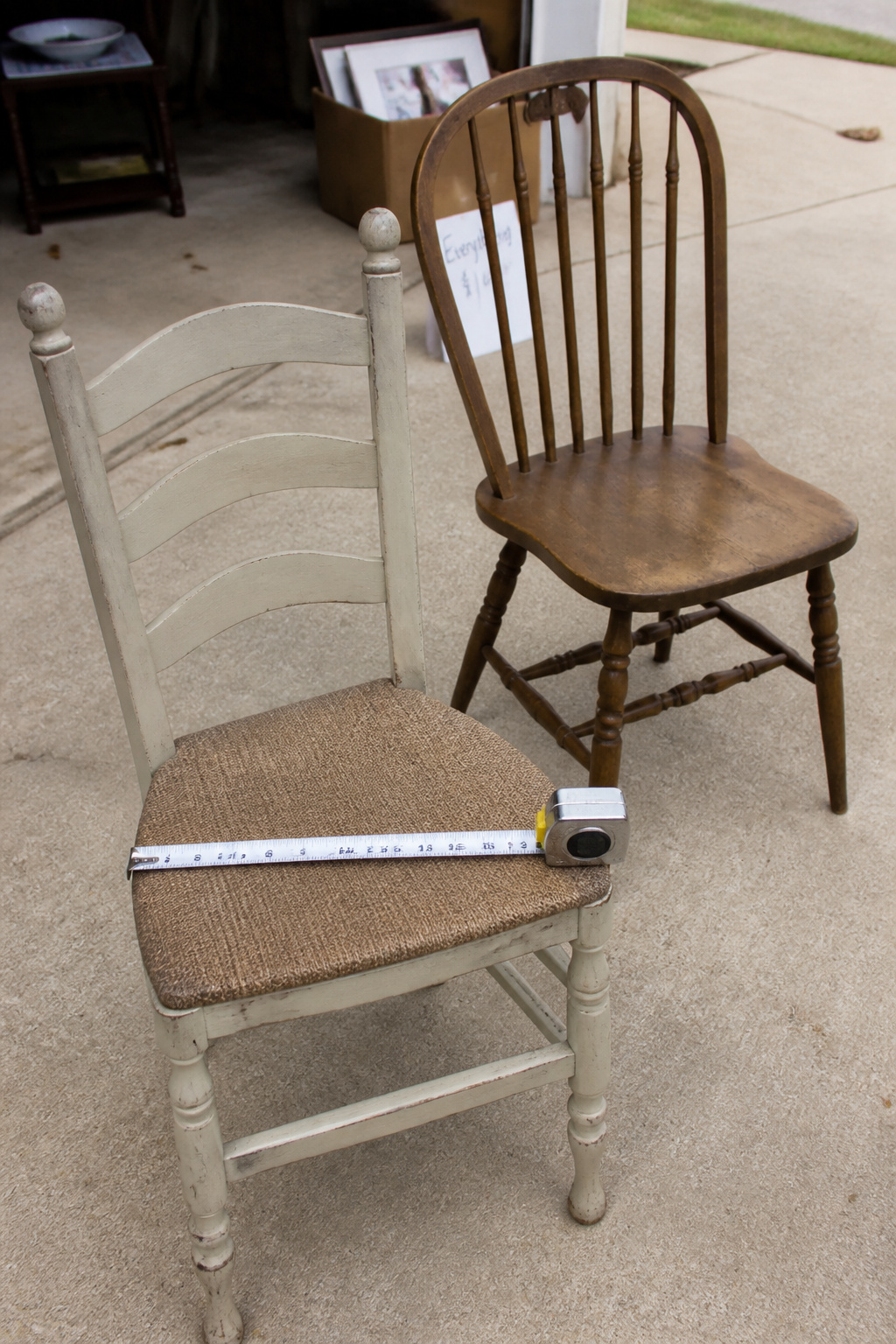
Facebook Marketplace rewards creative searching — old chairs get listed as just “old chairs,” so vary your terms. Emily Henderson’s team: training the algorithm by engaging with listings is the most important key to finding deals, and good chairs go within hours on weekends. For estate sales, aim at older neighborhoods: better-built pieces, executor pricing. Run this checklist every time:
- Measure the seat height on the spot. Bring a tape measure; bring a chair from your set if building incrementally.
- Shake the frame for wobble or creak, and check the leg-to-seat joints for cracks or rot.
- Press the seat frame — if it flexes, the chair will not survive reupholstery.
- Eyeball the construction — solid wood good, thin plywood base bad.
Buying in pairs versus singles
Buy in pairs when you can. Two of Style A, two of Style B, two of Style C distributes alternately for rhythm. Build sequence: two near-matching side chairs first, two complementary head chairs next, then two more that share an element with one of the first pairs.
The first-chair test
Your first chair sets the constraints every future chair echoes. Start easy: 17-to-19-inch seat height, simple neutral profile. A very low mid-century slung seat or ornate gilded piece is a beautiful trap as a first buy — everything else has to answer to it and affordable options dry up fast.
Measure the chairs you already own, write down the seat heights, and you instantly know the 2-inch window every future chair has to land in. Pick your one repeated element and start watching the listings. For how this fits the rest of the room, see the full eclectic dining room guide.
FAQ
Do mismatched dining chairs have to match in height?
Yes — seat height is the one non-negotiable. Every chair should fall within 17–19 inches and no more than 2 inches apart so diners sit level. With equal heights, everything else can vary freely. Measure on a hard floor, allowing for foam compression on upholstered seats.
How do you make mismatched dining chairs look intentional?
Repeat one element across every chair — paint color, fabric, leg stain, or a shared curve. The eye reads that common thread and treats the rest as deliberate variation. The two-end-chairs move helps: matching anchor chairs at the heads frame the whole mix. Keep to two or three styles so the set stays collected, not chaotic.
Can you mix wood and upholstered dining chairs?
Yes — one of the most common and successful combinations. The key is a connecting thread: match the upholstered chair’s wood legs to the wood chair’s finish in color or stain tone. Distribute the heavier upholstered chairs evenly, and a seat cushion balances a light wood chair against a substantial one.