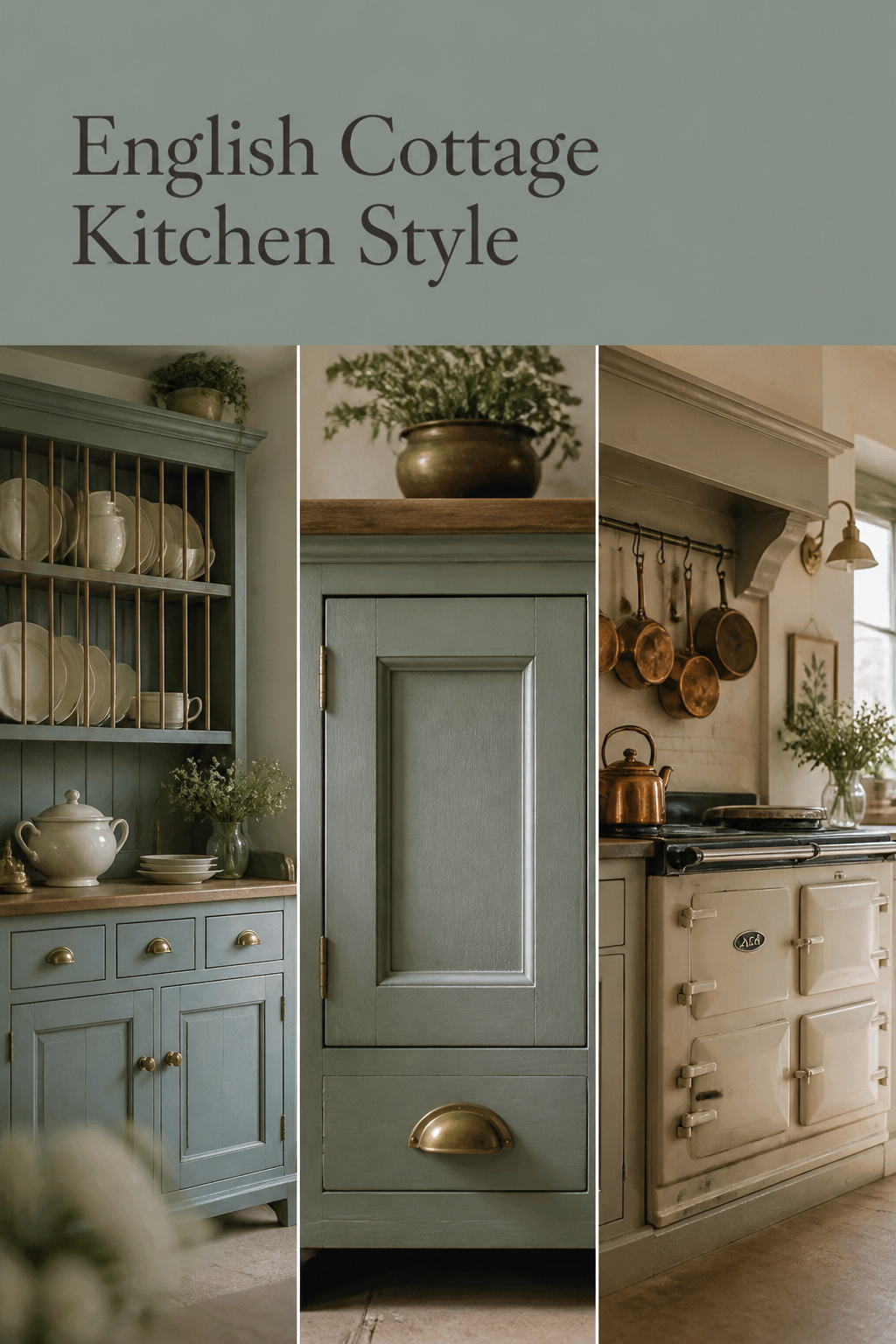
Scroll through enough English cottage kitchen photos and they blur into one warm, painted, plate-stacked room. The pictures rarely tell you which parts are three hundred years old and which a catalog invented last season. The dresser and the range are genuine working history; the distressed sign and sand-through-paint “patina” are costume. Telling one from the other lets you build the look as a real room, not a stage set.
TL;DR
- Two working pieces carry the tradition: an unfitted dresser and a heat-retaining range like an Aga; everything else supports one.
- In-frame cabinetry — a door set inside a visible timber frame — plus period hardware like Suffolk latches separates real joinery from a shaker-front lookalike.
- You can recreate it in a new build: reproduction pine dressers start around £495–£595, and a heritage-colored enamel range anchors the room without a true Aga.
Where the English Cottage Kitchen Actually Comes From
Before the fitted kitchen existed, a cottage kitchen was just furniture arranged around a fire.
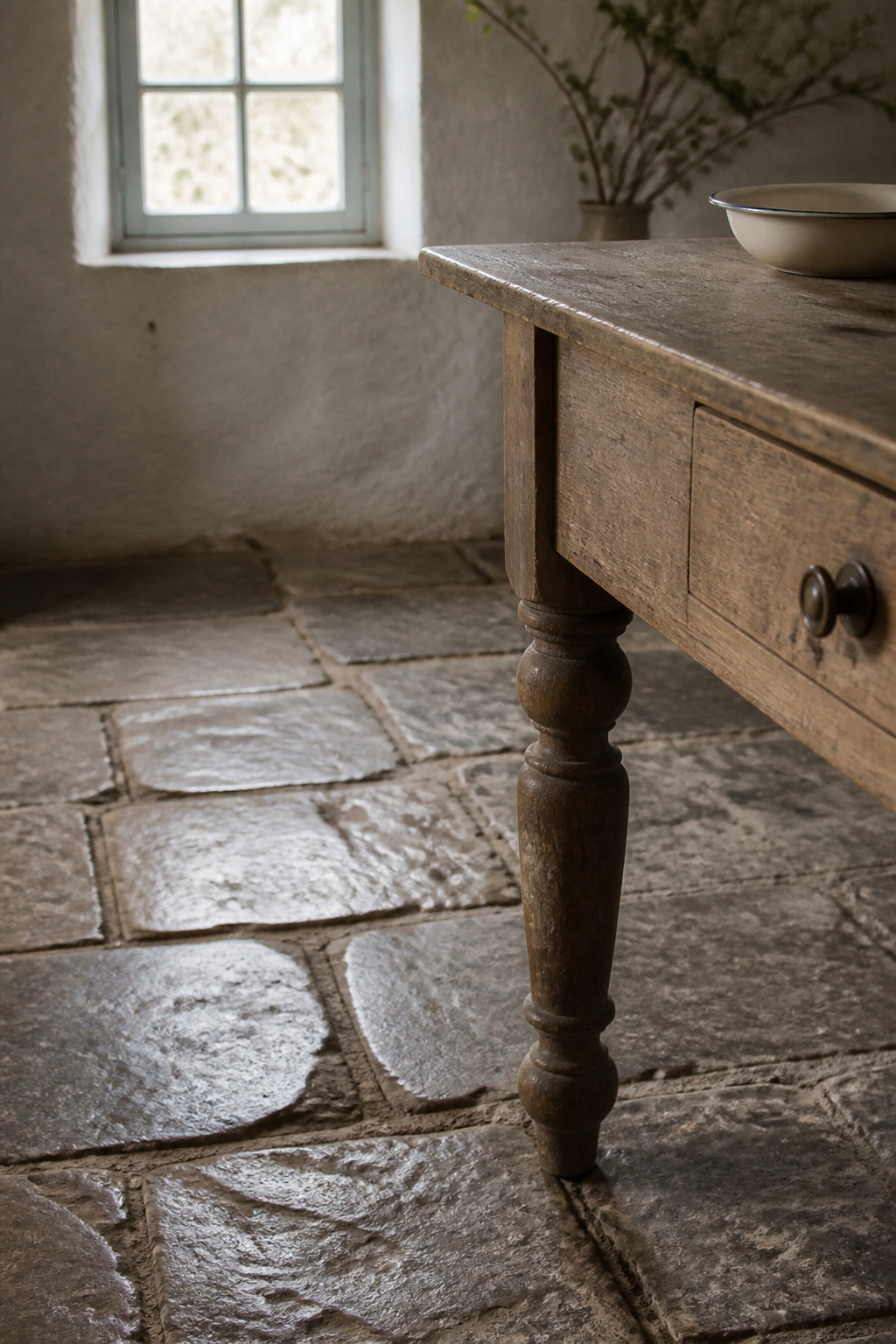
The working kitchen this style is copying
A pre-industrial kitchen had no built-in cabinetry — storage was furniture, moved close to the hearth where the work happened. The dresser sat at the center, and its name records its old job: food was “dressed,” or prepared, on it before serving. It traces to the medieval dressoir; by the 1600s, dressers were common kitchen fixtures in oak, elm or pine.
Why the look is unfitted by necessity, not choice
The fitted kitchen is a twentieth-century invention: the 1926 Frankfurt Kitchen introduced built-in workspaces, and fitted units only became the norm after WWII, with mass production. The freestanding dresser, open shelf and scrubbed mid-floor table — everything the look now treats as style — was simply how a kitchen had to be built.
What “authentic” means for this guide
Here, “authentic” means matching that working logic — furniture with a job, joinery built the old way, real period-pigment colors — not copying one photographed kitchen down to the jug. Tom Revill of Plank Hardware calls it a style that “thrives on mixed materials and styles, contrasting textures and finishes.”
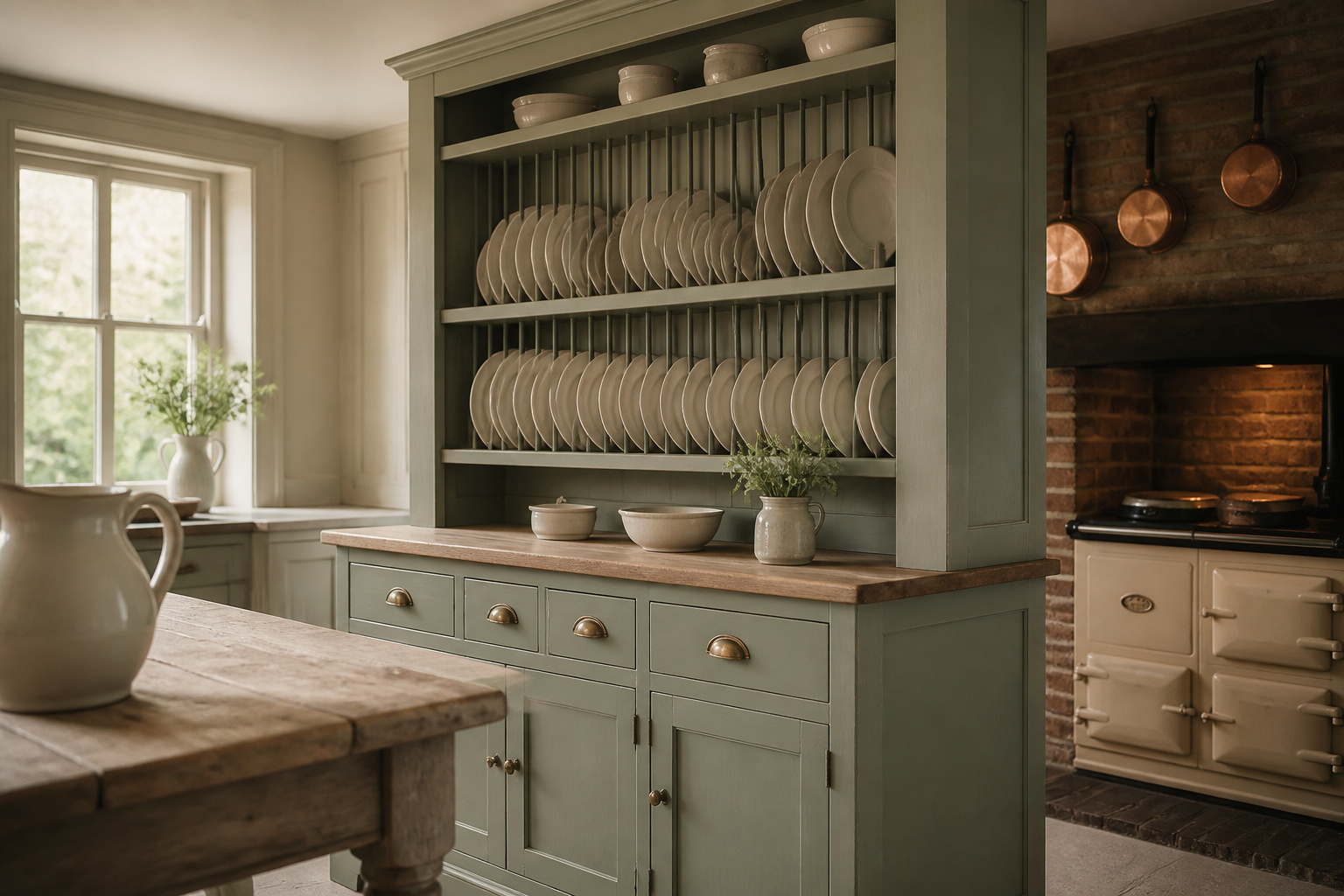
The Unfitted Dresser and Open Storage
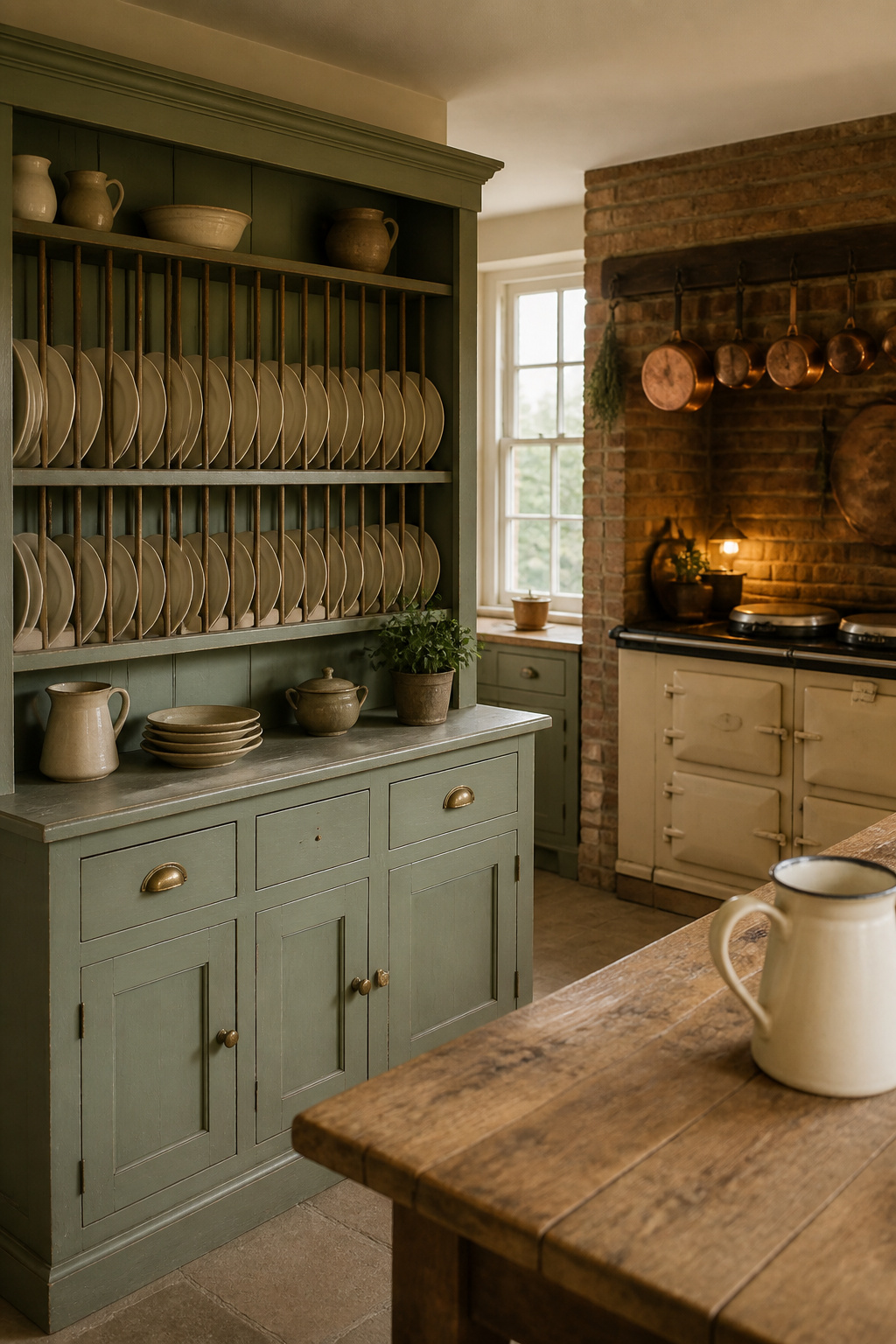
Keep only one element from this tradition and keep the dresser — the piece the whole style depends on, and the one most often faked.
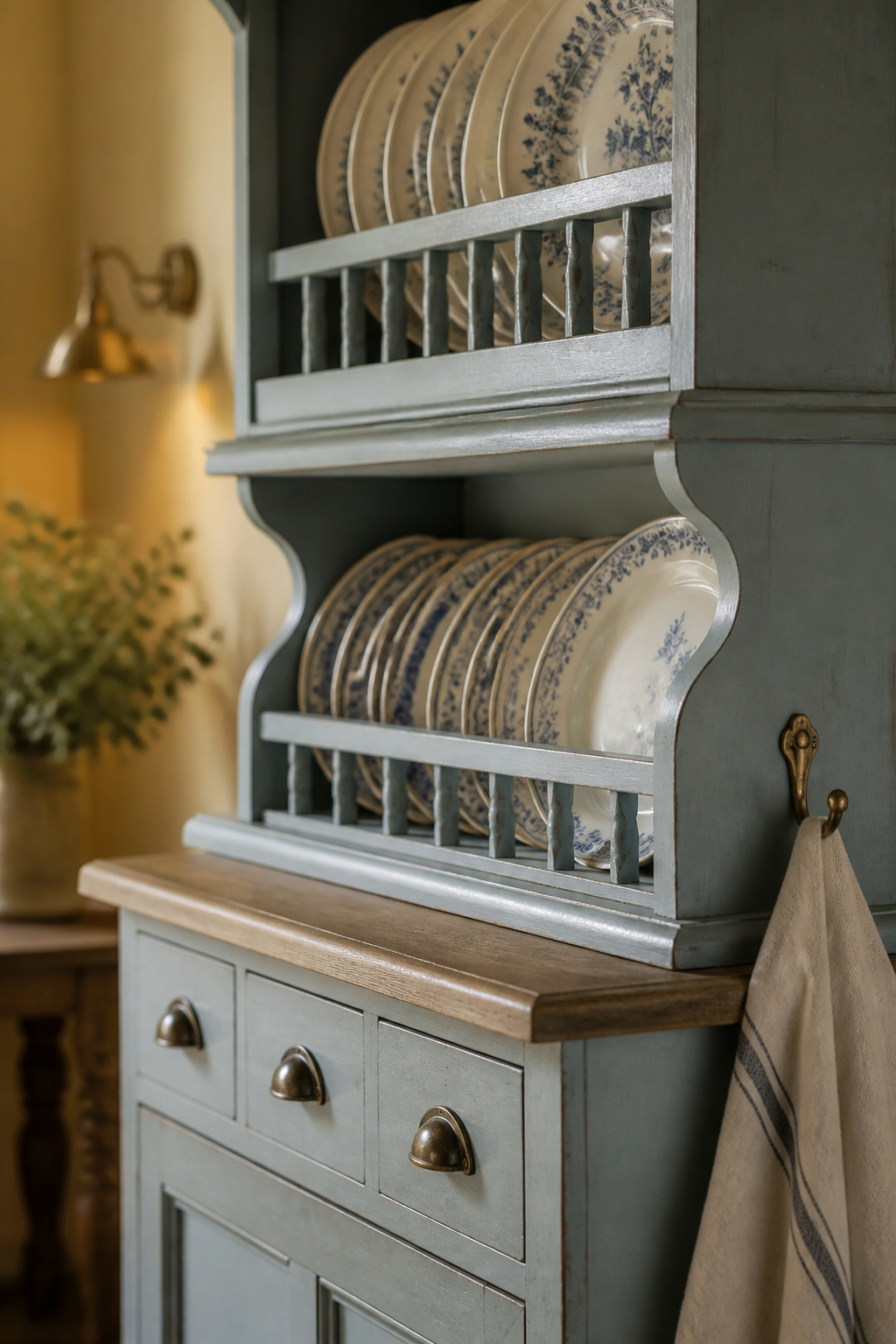
Why the dresser came before fitted cabinetry
The dresser predates built-in cupboards rather than replacing them — it was the closest thing a kitchen had to permanent storage before cabinetry existed as a built-in idea. Ceramic makers later sized patterns to fill its plate rack; arranging that crockery became regional culture, especially in Wales. Mahogany sideboards eventually pushed it from grand dining rooms, though it survived in humbler service kitchens.
Choosing or building a credible dresser today
Real dressers span a wide price range, so period character and a real budget can coexist.
| Dresser | Approx. price | What you’re getting |
|---|---|---|
| Antique Welsh oak, c.1750 | ~£10,600 | Museum-grade original |
| Victorian pine, 4ft | from ~£535 | Genuine period, affordable |
| Reproduction pine, 5ft | ~£495–£595 | New build, mid-1800s style |
| Bespoke English oak, 66in | ~£4,793 | New build, period joinery |
One caution on a painted secondhand piece: resist stripping it to bare wood on day one. At nineteen, I took the wrong solvent to an oak chest and watched three hundred years of surface dissolve in an afternoon — the finish never forgave me, and neither did I. Old paint is often part of a dresser’s history; test a hidden patch first, and when in doubt, leave the layers alone.
What to display versus store behind it
The base-and-rack form has barely changed in three centuries: crockery, pewter and silver on open shelves, working stock and linens behind closed doors below. English kitchens still pair open display — bright pans, white china, a jug of flowers — with closed cupboards for the useful, unlovely things. A dresser bought only for its plate rack, its cupboard empty, wastes half its purpose.
In-Frame Cabinetry and Real Joinery Details
What separates a period kitchen from a shaker-front lookalike? One detail — the frame around the door.
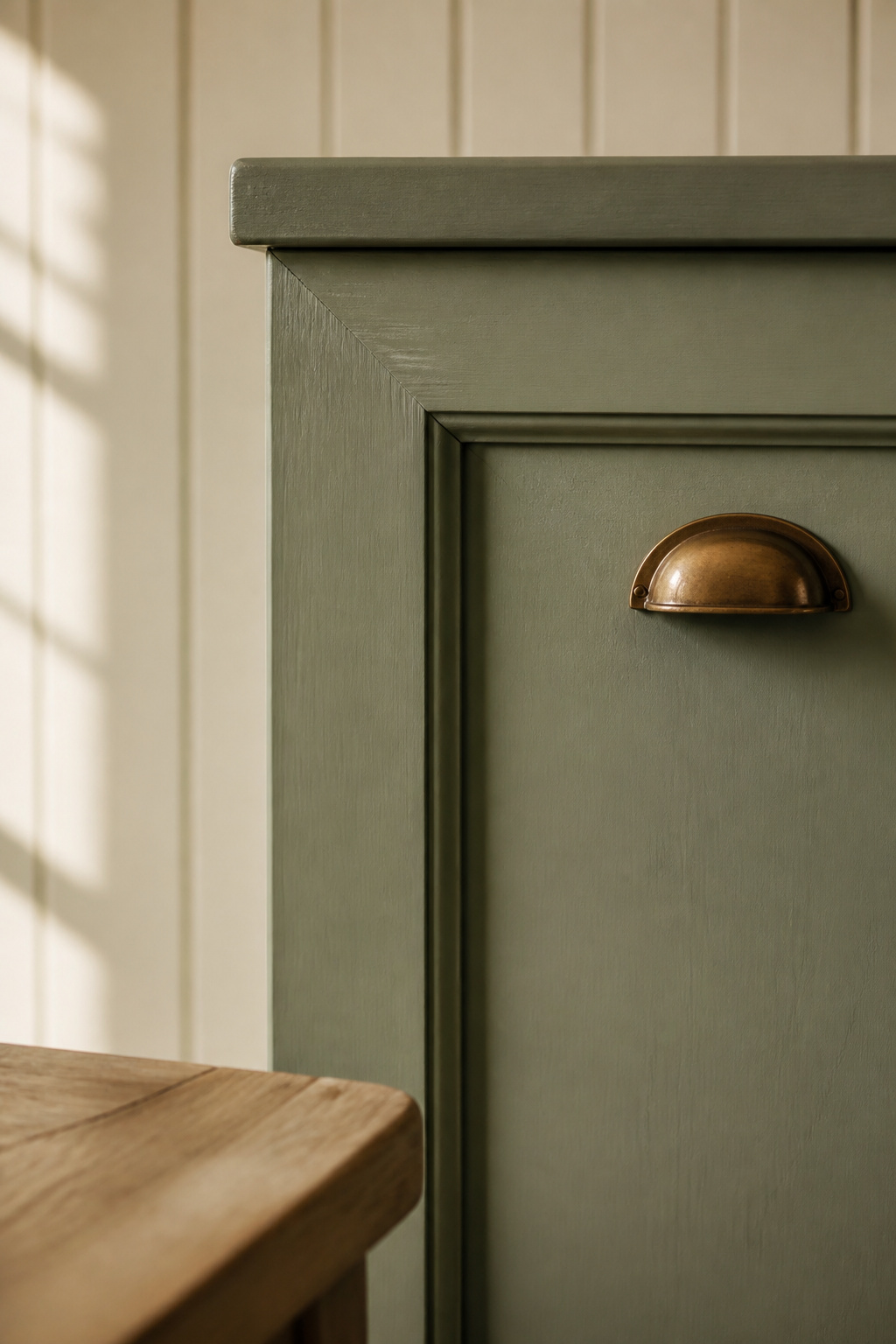
What “in-frame” construction means and why it reads as older
In an in-frame kitchen, each door sits inside a timber frame fitted to the cabinet box — smaller than the opening, resting within the frame rather than lying flush over the carcass like a frameless, or lay-on, door. The construction borrows from traditional furniture-making, so the eye reads it as older, and the frame protects the door’s edges far better than a flush edge.
Hardware that dates a kitchen correctly
Hardware carries almost as much dating power as the joinery. Suffolk latches — wrought-iron thumb latches with hand-hammered ends — were common on English doors by the 1700s, and pre-1840 houses were far more likely to have them; after industrialization, knobs took over, making a Suffolk or Norfolk latch a genuine pre-1840 marker. Brass cup pulls and pewter knobs suit chalky, muted cabinet fronts, and unlacquered brass ages into the room instead of staying factory-bright.
Where a modern kitchen can fake it convincingly
Full in-frame cabinetry costs more than frameless — extra timber, more labour, tighter tolerances, says joinery specialist Helen Lord. A budget route is birch plywood boxes and frames with the laminated edge left exposed as a feature. You don’t need full construction to borrow the cue — a period latch or cup handle signals the tradition affordably.
Heritage Colors and the Range at the Heart of the Room
Two things give this kitchen its warmth: its colors and the heavy, always-on cooker at its heart — neither came from a trend board.
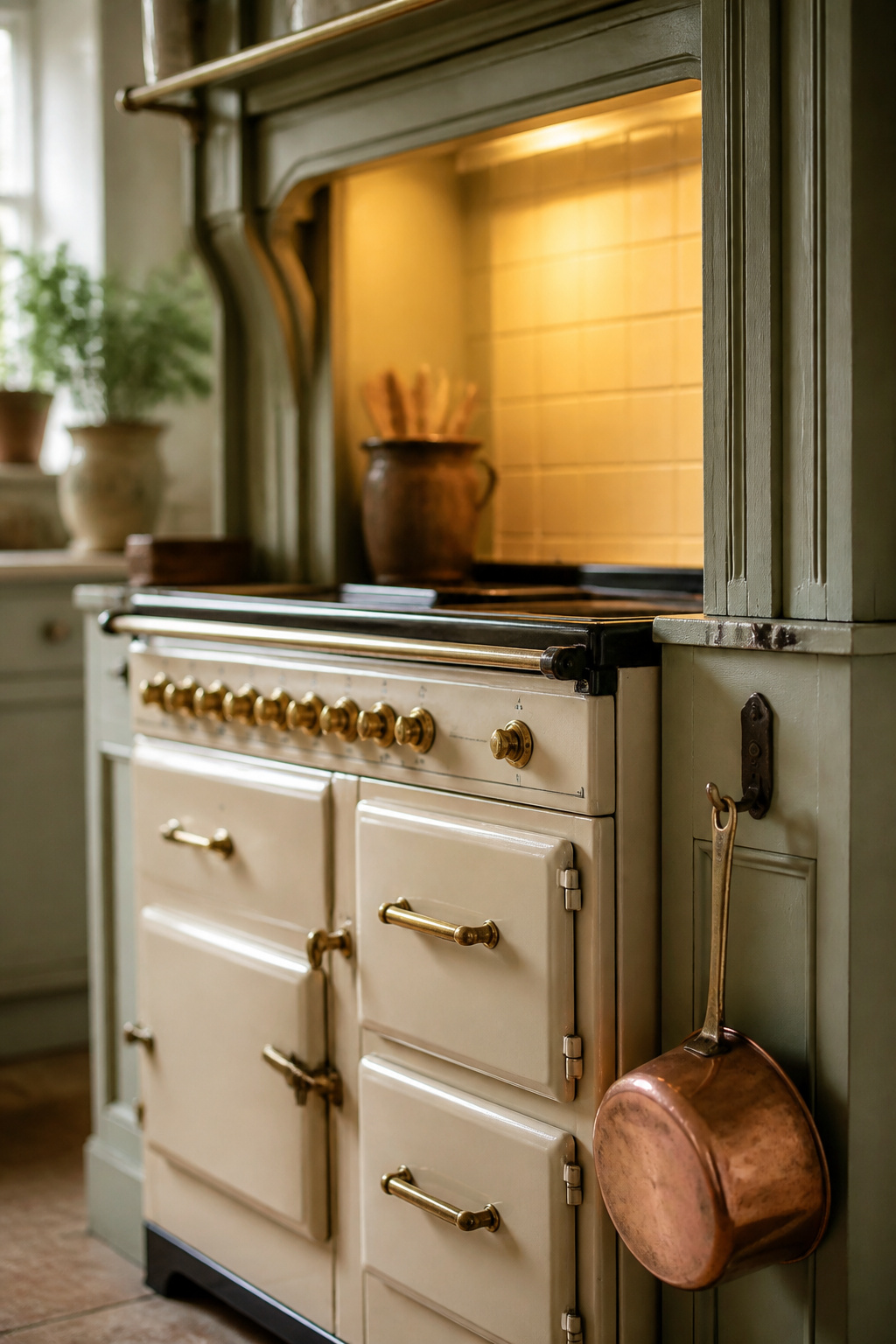
The paint colors this tradition actually used
Paint in an old English house — kitchen walls included — came from a short list of cheap, water-based finishes: limewash and distemper, suited to the lime plaster beneath. Available pigment set the palette — yellows, reds and browns, terre verte for green, Prussian Blue a rare 18th–19th-century option. Today’s English kitchens lean on that same chalky family — dove gray, oatmeal, buttermilk — kept pale so the stone floor and crockery carry the color. See our guide to heritage cottage cabinet colors for specific paint names.
The range, or its modern equivalent, as the room’s anchor
The range is the room’s anchor, and its origin story is better than most. Swedish physicist and Nobel laureate Gustaf Dalén, blinded in a 1912 accident, invented the Aga in 1922 after seeing how exhausted his wife was by cooking; it reached Britain in 1929. You don’t need a true Aga: Everhot, an electric cast-iron range from the 1970s, starts near £9,530 and runs at 6.6p an hour against the Aga ER7’s 18p. Any heavy, heritage-colored enamel range holds the center.
Plate racks, hooks, and working walls
Around the range, the walls double as storage: Shaker peg rails hang tea towels, aprons and utensils on the standard 3.5-inch peg, and a plate rack over the sink has long done service in English kitchens for air-drying crockery.
How Cottagecore Borrowed From This Tradition
Cottagecore looks ancient, but it is younger than most smartphones.
What the internet aesthetic kept from the original
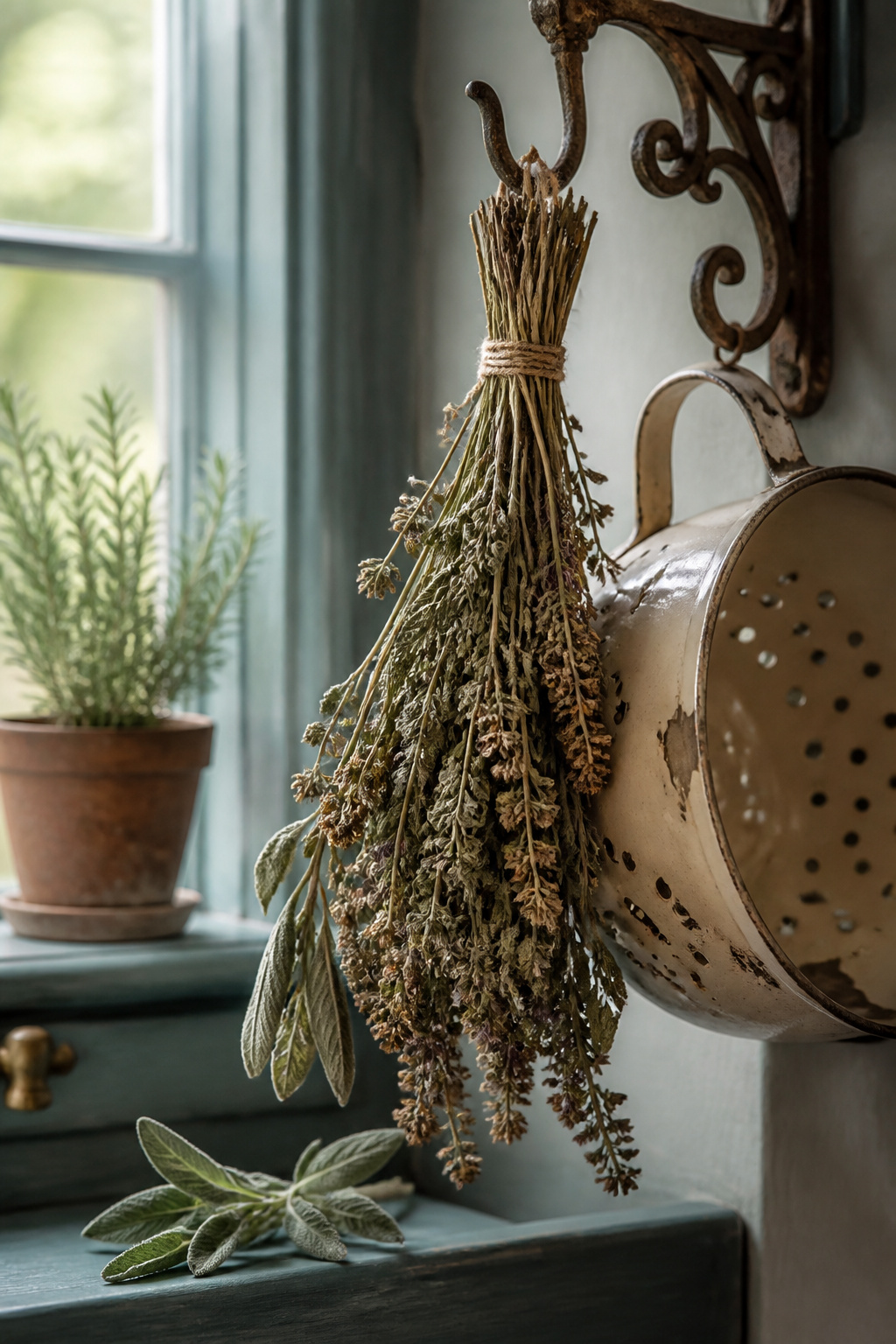
The aesthetic centers on vintage furnishings, natural materials, soft textiles, floral patterns and muted palettes — visually, a close cousin of the real working kitchen. It also carries over that kitchen’s practices — baking bread, homesteading, gardening — reframed as “slow living.” The two look almost interchangeable, which is why the differences are worth naming.
What it dropped or exaggerated
The gap shows up in the history. Cottagecore was first named on Tumblr in 2018 and went mass during the pandemic — Tumblr cottagecore posts rose 150% between March and May 2020 before spreading to TikTok. It’s a recent internet movement, not a continuous tradition, and critics argue it romanticizes rural life, glossing over real poverty and poor sanitation. The kitchen this guide describes was a labor-saving necessity, not a lifestyle.
Going back to the source for a more honest version
The honest version uses genuinely old or reproduction-grade working pieces — a real in-frame dresser, hardware that dates a door, an enamel range that holds heat — rather than props styled to look old. If it’s the decorating layer you want, pair this guide with a dedicated look at cottagecore kitchen decor, which covers the accessories.
Building the Look Into a House With No History
The most common way to blow a cottage-kitchen budget is pouring it all into decor and none into the two things that carry the style.
What to prioritize on a budget or in a new build
None of this tradition is locked to a period building. On a limited budget, spend in this order:
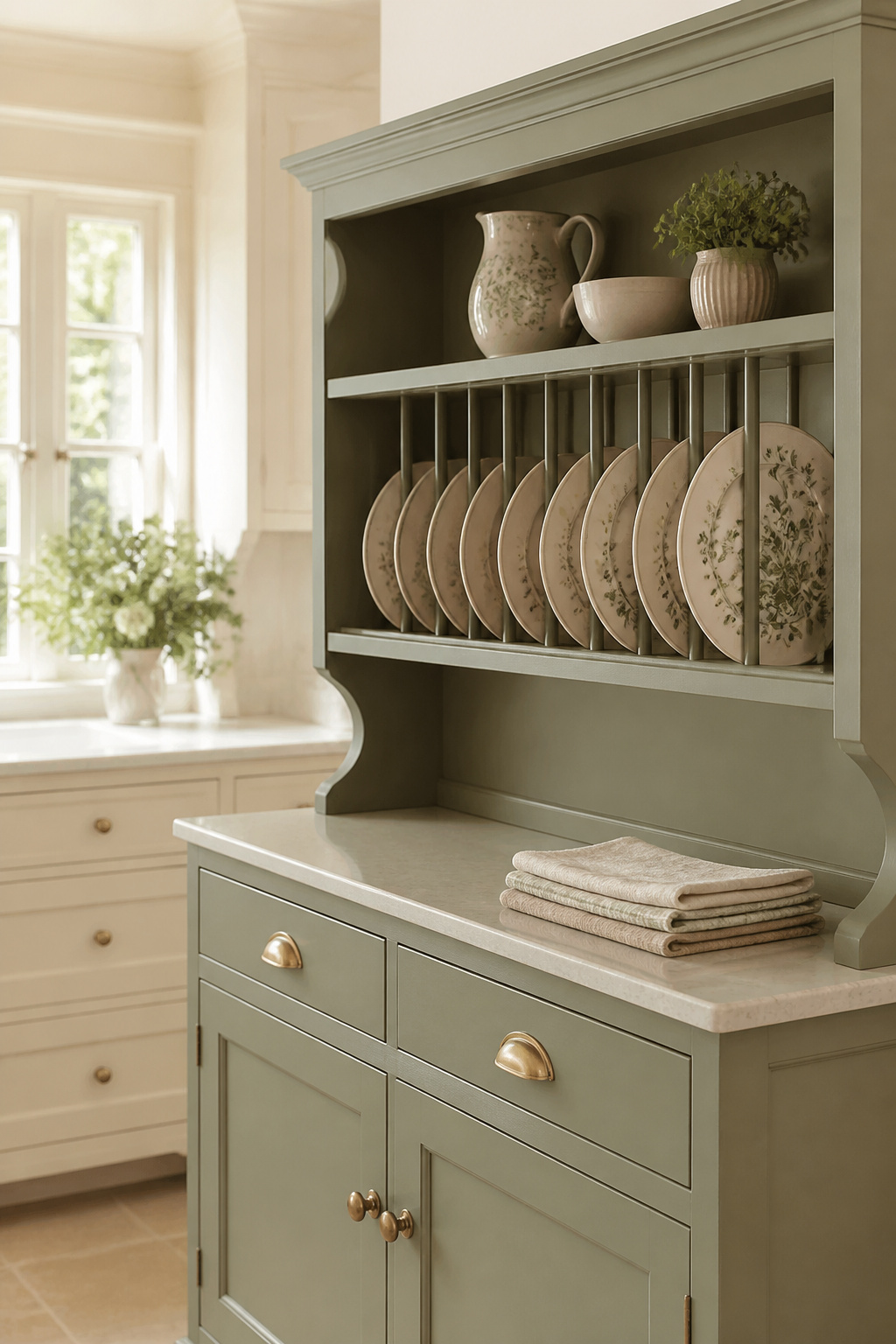
- The dresser first — a mid-range reproduction pine model (~£495–£595 for 5ft) buys the most recognizable element without antique pricing.
- In-frame doors only where they show; standard construction on the runs you don’t see.
- One piece of real hardware — a period latch or cup pull on plain doors borrows the joinery tradition for the price of a handle.
Get those three right and the room speaks the language.
Where reproduction pieces are honest, not fake
A newly built piece isn’t automatically a fake. Specialist makers such as Titchmarsh & Goodwin build bespoke English oak dressers to order — a 66-inch model runs around £4,793 — in genuine period joinery, and that’s an honest reproduction. The line is the method: real construction (in-frame doors, hand-forged or cast-iron latches, a range that truly holds heat) is honest; copying only the surface pattern onto flat-front cabinetry is costume. Real wear comes over years — sand-through-paint distressing is just a shortcut, and it’s where I part ways with applied “aging.” A reproduction built the real way is something the next steward can use, not just look at.
When to call it English-inspired instead
Borrow only the palette and open-shelf silhouette — without in-frame joinery, real hardware or a heat-retaining range — and you still have a perfectly good kitchen. It just deserves an honest label: English-inspired, or cottage-style, rather than a claim on the full heritage tradition.
So you can now do what the photos never taught you: name what’s load-bearing history in a styled kitchen and what’s set dressing. The dresser and the range are the tradition; in-frame joinery and honest hardware are its proof; everything else is support. Reproduce the real parts with real methods, stay honest about the rest, and the look holds in any house — even one built last year. See our complete cottage kitchen guide for the room-wide picture.
FAQ
What makes a kitchen ‘English cottage style’ instead of just farmhouse?
English cottage style is defined by in-frame joinery, unfitted dresser furniture and a heritage-limited paint palette rooted in the British Isles. American farmhouse leans instead on shiplap, apron sinks and barn-derived detailing. The two overlap at the Belfast sink — a British-Isles form from the 17th century — but diverge on cabinetry construction and color.
Do I need an Aga or range cooker for an English cottage kitchen?
No. Modern electric equivalents like the Everhot, made since the 1970s, or a smaller electric Aga give the same anchor effect, starting around £9,000 to £9,600. Even a conventional range in a heritage-colored enamel finish will anchor the room without any true heat-retention technology behind it.
Is English cottage kitchen style expensive to achieve?
It does not have to be. Reproduction dressers start around £495–£595, well below antique Welsh oak pieces that can reach £10,600, so the style’s defining piece is attainable at several budgets. Full in-frame cabinetry does cost more, but period hardware and a dresser on standard units still read as authentic.