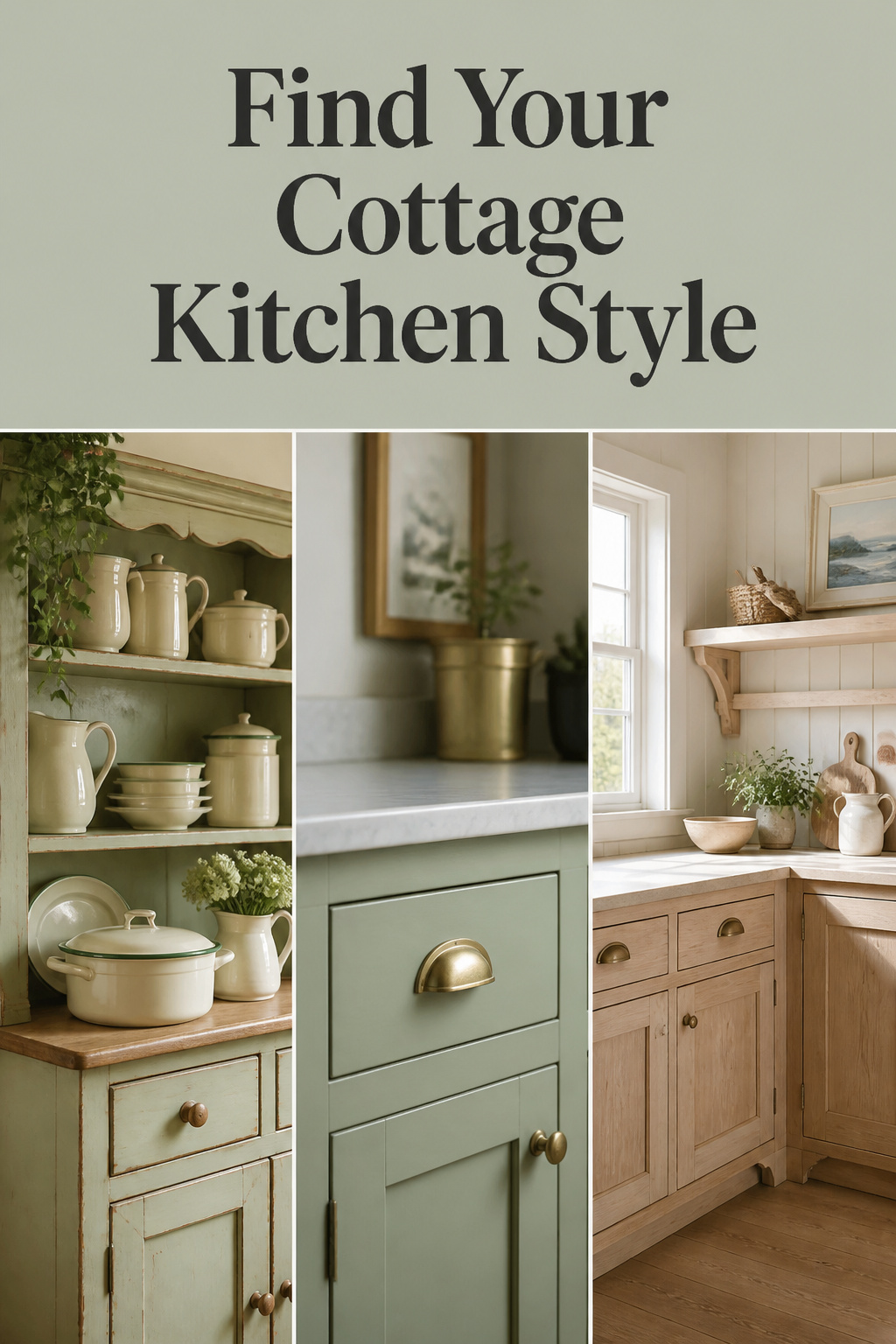
Cottage kitchen ideas are the rare search that hands you hundreds of photos and no agreement between them. One shows a beamed English room with a cream range and a dresser of blue-and-white china. The next is pale, spare, and quiet. A third is all dried flowers and enamelware; a fourth could pass for a beach house. They cannot all be the same style, and yet every one gets filed under the same two words. That is the real problem with this look — not a shortage of inspiration, but no way to sort it.
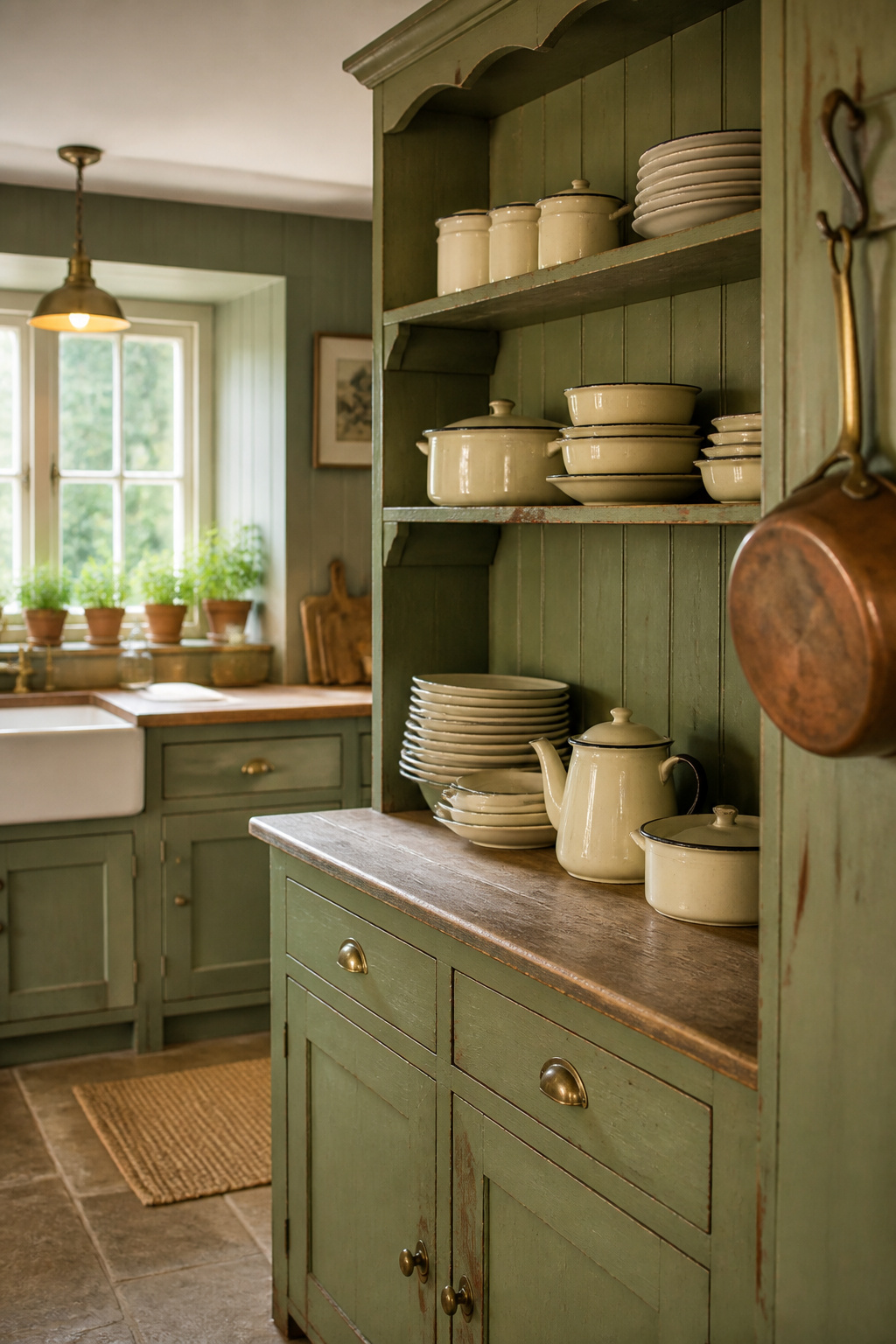
I restore old houses for a living, which means I spend most of my days telling genuine period detail from the costume version of it. Cottage kitchens reward exactly that eye. Underneath the variety sits one family of decisions — a short list of materials, one structural habit, and a soft palette — and once you can see them, every photo drops into a category. So this guide sorts the field. By the end you will be able to tell cottage from farmhouse on sight, name which variant suits your house and your budget, and know which of our deeper guides to open next.
What the Best Cottage Kitchen Ideas Have in Common
The first old kitchen I ever pulled apart sat in a narrow nineteenth-century terrace my father and I spent two years bringing back. It had no matched run of cabinets, because it had never had one. It had been furnished, piece by piece, over a working lifetime — a pine dresser against one wall, a scrubbed table mid-floor, a freestanding cupboard that had clearly arrived from another room. That kitchen taught me the thing this whole style rests on: cottage is a family resemblance, not a product line.
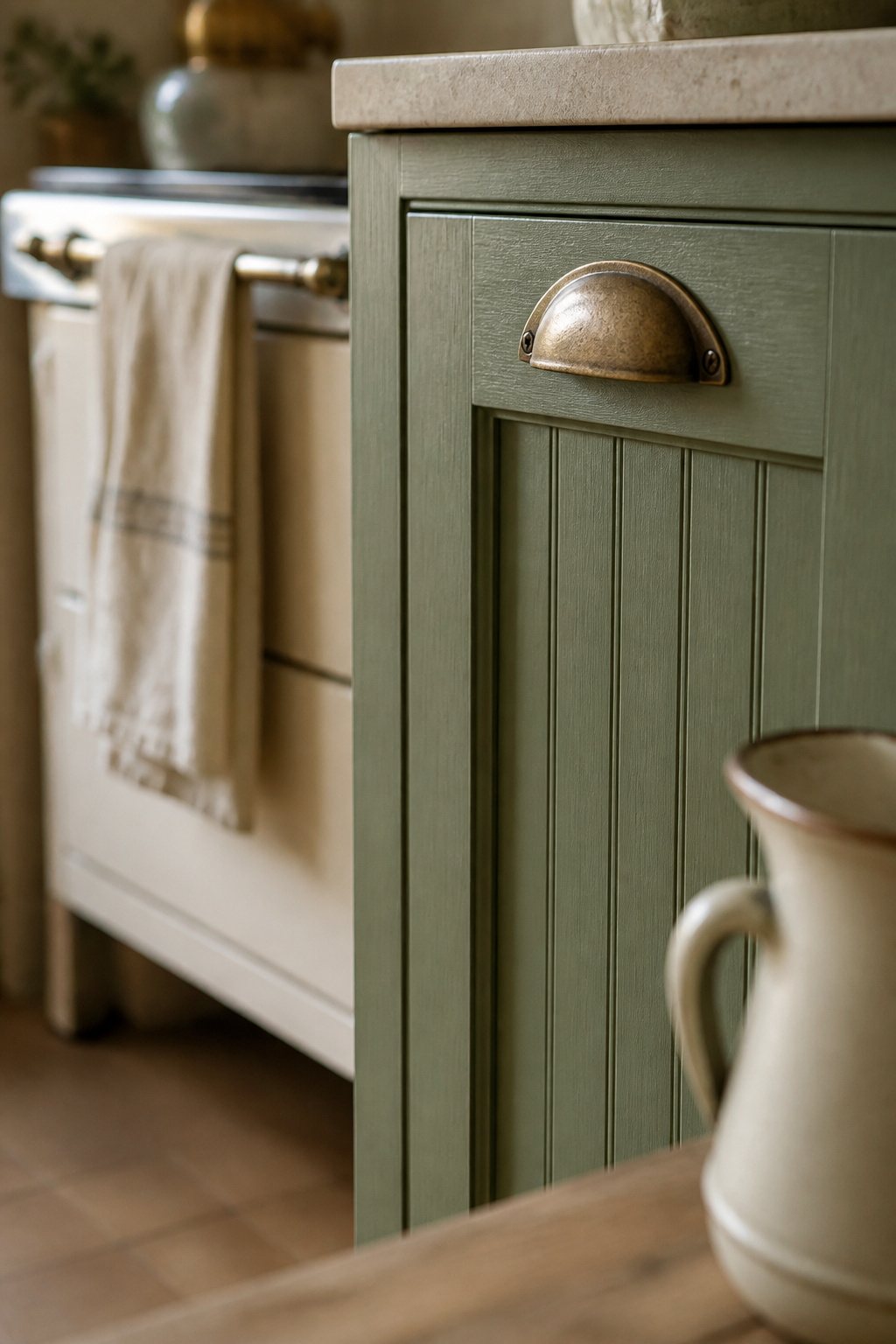
The working-kitchen roots of the look
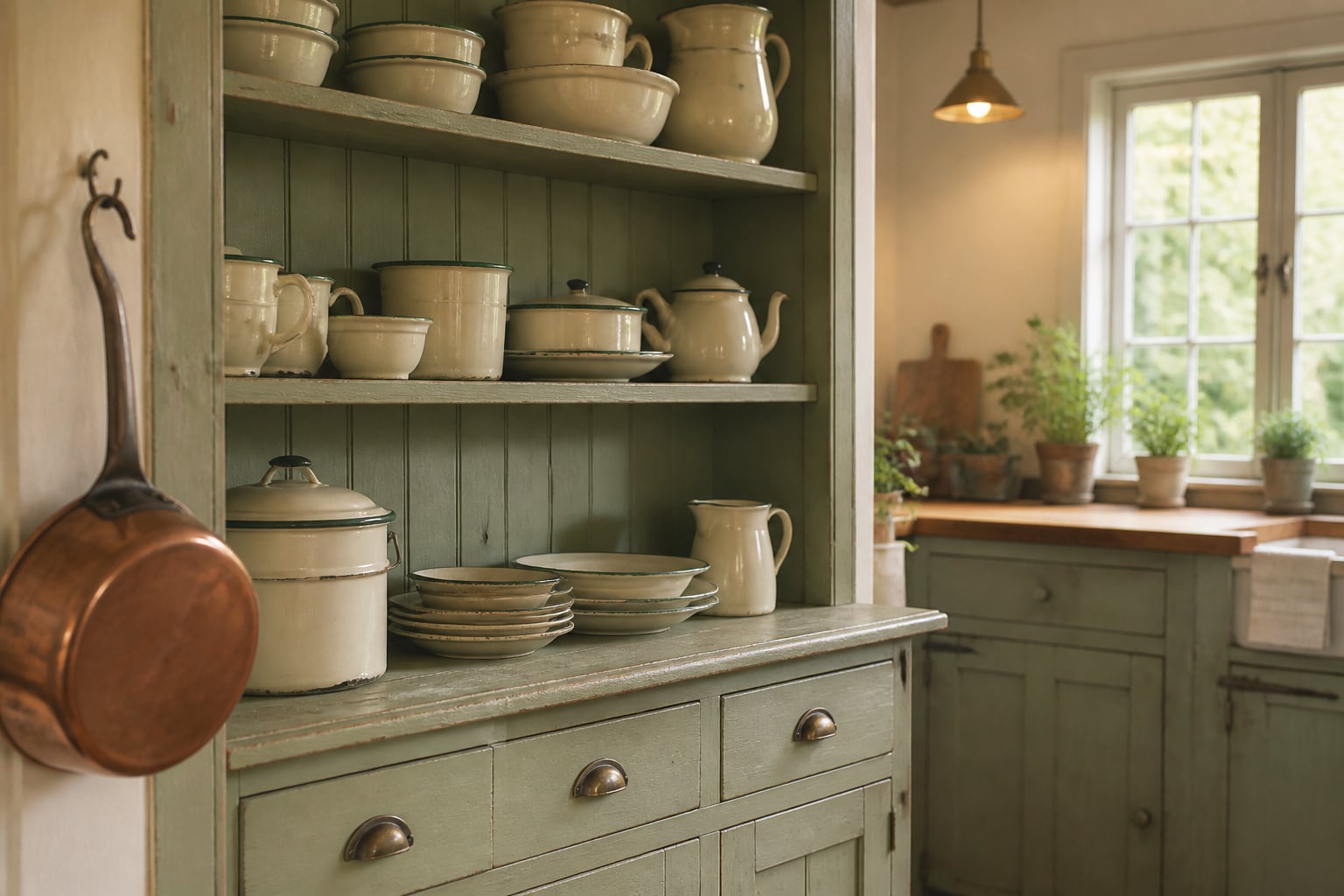
Before built-in cabinetry became standard in the early twentieth century, every kitchen was furnished the way that terrace kitchen was — with individual, movable pieces. The Welsh dresser began as a working prep surface, its lower cupboards used where meat and other foods were prepared, and only became a display piece for crockery by the nineteenth century. The apron-front sink we now call a farmhouse sink is older still, a seventeenth-century British invention built for heavy daily use. None of it was styling. Designer Johnny Grey, who coined the modern “unfitted kitchen” after conversations with the food writer Elizabeth David, simply formalized what earlier generations did because they had no other option.
The five materials that do the work
Strip the variants back and the same five materials recur in nearly every cottage kitchen: painted wood, bare timber, brass or copper, ceramic, and woven textile. Learn what each one contributes and you can read a room in seconds.
| Material | What it does | The cottage tell |
|---|---|---|
| Painted wood | Shaker and beadboard fronts, the base layer | Muted heritage color, never brilliant white |
| Timber | Reclaimed or butcher-block worktops and shelves | Hardwax-oiled and matte, not high gloss |
| Brass or copper | Hardware, pans, light fittings | Unlacquered, left to patina |
| Ceramic | Enamelware, china, glazed tile | Genuinely old, and in daily use |
| Linen | Sink skirts, runners, curtains | Woven and washed, softening hard surfaces |
The brass is worth a note, because it is where people go wrong first. Unlacquered brass is chosen precisely because it patinas — it shifts to a two-tone honey within four to twelve months and settles into an even golden warmth over one to three years. Lacquered brass never does. If you want to check a vintage piece is solid rather than plated steel, hold a magnet to it: a magnet that sticks means plated. And the material is having its moment. In the Houzz 2026 Kitchen Trends Study, wood cabinets took 29% of the field, edging out white for the first time in years.
Unfitted vs fitted: the single biggest tell
If you remember one thing, remember this: the clearest structural difference between a cottage kitchen and an ordinary one is that a cottage kitchen is assembled, not installed. An unfitted kitchen gathers individual furniture pieces — designer Hayley Johnson lists antique worktables, cupboards, baker’s racks, butcher blocks, and hanging pot racks — where a standard kitchen runs a single matched line of built-in cabinetry. Where cabinetry is fixed, in-frame joinery gives it away: a door set flush inside a solid timber face frame, the way a Georgian cabinetmaker would have built it two hundred years ago, rather than an overlay door sitting proud of the box. One caution, though. Without a curating eye, an unfitted kitchen tips from collected into chaotic, so this is the freedom that most rewards restraint.
Cottage vs. Farmhouse Kitchens: The Real Differences
This is the question I get asked more than any other, and it is a fair one, because the two styles are genuine cousins. They share a rural, pre-industrial ancestry, and the internet cheerfully files them together. But they diverge on three details that matter as much at the checkout as they do on camera — and once you have the distinction, you stop buying the wrong hardware.
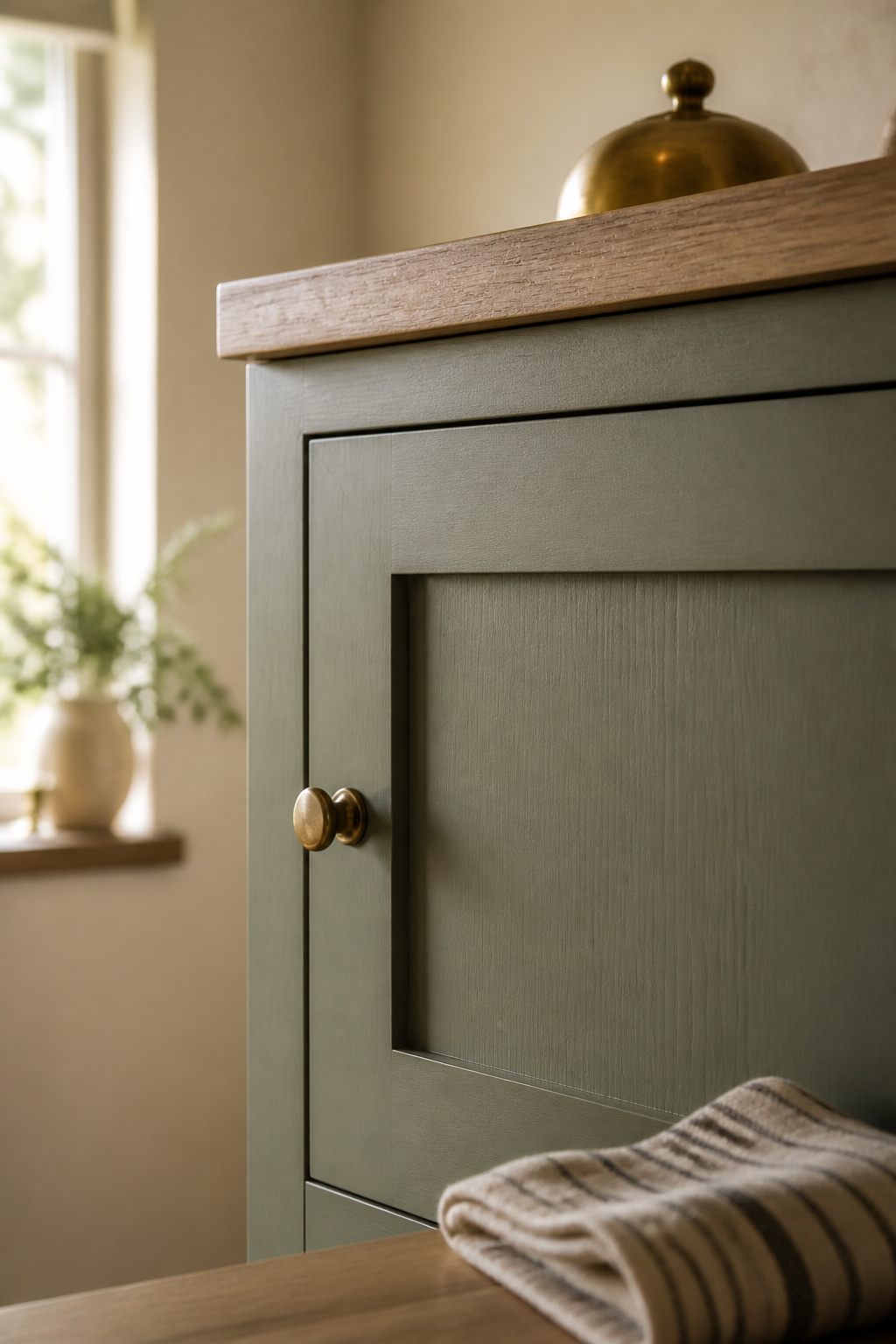
Where the styles share DNA
Both looks descend from working country kitchens, and both lean on the same shortlist of signatures: a farmhouse sink, shaker-style doors, natural wood and stone, open shelving, and vintage-flavored lighting. Photographed side by side at a glance, a cottage and a farmhouse kitchen can look like the same room. That shared vocabulary is exactly why the confusion persists — the bones are common, and only the finishes tell them apart.
The three details that actually separate them
Hardware, storage, and palette are where the two part ways. Farmhouse aims cooler and sharper, built around industrial accents and organized on a big central island. Cottage aims softer and older, built from freestanding furniture and a gentler range of color.
| Element | Cottage | Farmhouse |
|---|---|---|
| Hardware | Unlacquered or aged brass, warming as it patinas | Matte black or dark bronze, industrial accents |
| Storage | Open shelving, freestanding dressers, plate racks | A matched shaker run around a large island |
| Palette | Soft whites, pastels, sage, clotted cream | Cooler, higher-contrast neutrals, statement hoods |
Why this matters for shopping and sourcing
Hardware finish is the fastest tell of all, and it works on an identical door: swap unlacquered brass cup pulls for matte black and a cottage kitchen slides straight into farmhouse. This is where money quietly goes astray. Buy paint and hardware sold under “farmhouse” branding and you will pull a genuinely cottage-shaped room toward the wrong look without noticing. The fix is simple. Check every finish and color against the cottage heritage list — sage, buttermilk, dusty blue, clotted cream — before it goes in the cart.
Small Cottage Kitchen Layouts That Don’t Feel Cramped
Here is where charm turns treacherous. The same collected, layered look that reads generous in a large room hits visual capacity far faster in a small one, because every surface counts as “more.” A galley that could carry a plate rack, a dresser, and a shelf of enamelware in a big house will choke on all three. The good news is that small cottage kitchens have a settled playbook.
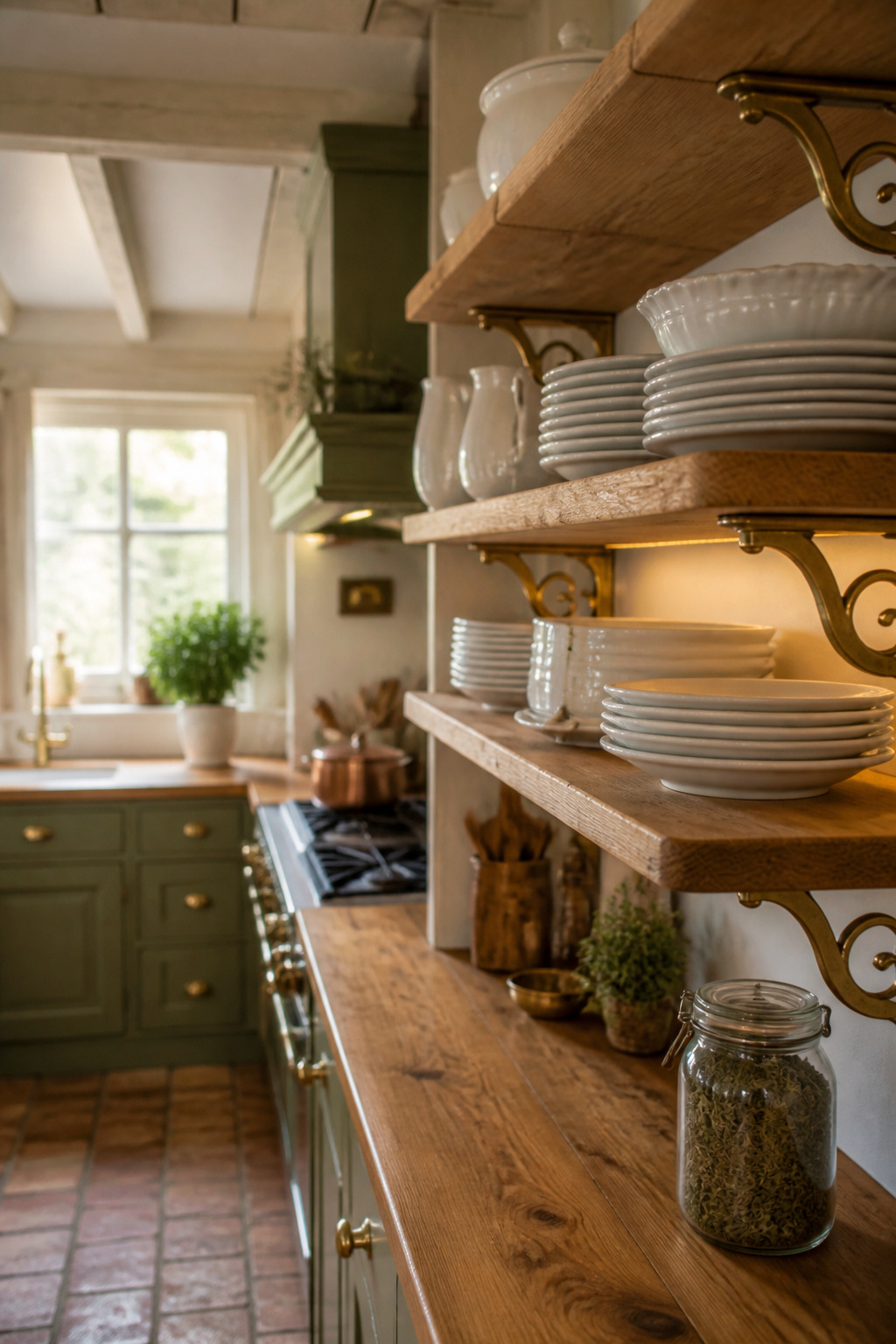
Galley and single-wall plans that keep the collected look
Galley and single-wall layouts are the workhorses, and one move matters above the rest: put a window or glazed door at the end of the run, which pulls the eye straight through and lengthens the room for free. In one 13-by-9-foot galley, the owners swapped upper cabinets for open shelving and built a six-foot banquette with two rows of drawers underneath, so the small footprint kept working hard. Every inch earned a second job.
Ceiling-height storage vs open shelving
Open shelving is the reflexive small-kitchen fix, and it does remove visual bulk. But it carries a cost most photos hide. Designer Kathy Kuo notes it needs more upkeep than a closed cabinet, since dust and grease sit in plain view — and because everything on an open shelf is visible, it has to be edited regularly, not just dusted. The workable answer is a hybrid: closed storage low for the bulk, open shelving as an accent rather than the whole upper wall, and cabinets run to the ceiling to reclaim the dead gap.
Where charm helps and where it tips into clutter
Reserve the open shelves for the things you use and would happily look at — dishes, glassware, a stack of cookbooks — and keep bulky pantry goods behind doors. A small room simply needs more ruthless editing than a large one. That editing discipline is a whole craft of its own, and Henrik Larsson walks through designing a small cottage kitchen at full depth, dimensions and all.
The English Cottage Kitchen: Where the Look Began
To understand every other variant, start with the original. The English cottage kitchen is the source the rest borrow from — furniture built like furniture, a muted heritage palette, and a cast-iron range set at the heart of the room. It is also the version most bound to real history, which makes it the easiest to get wrong by faking.
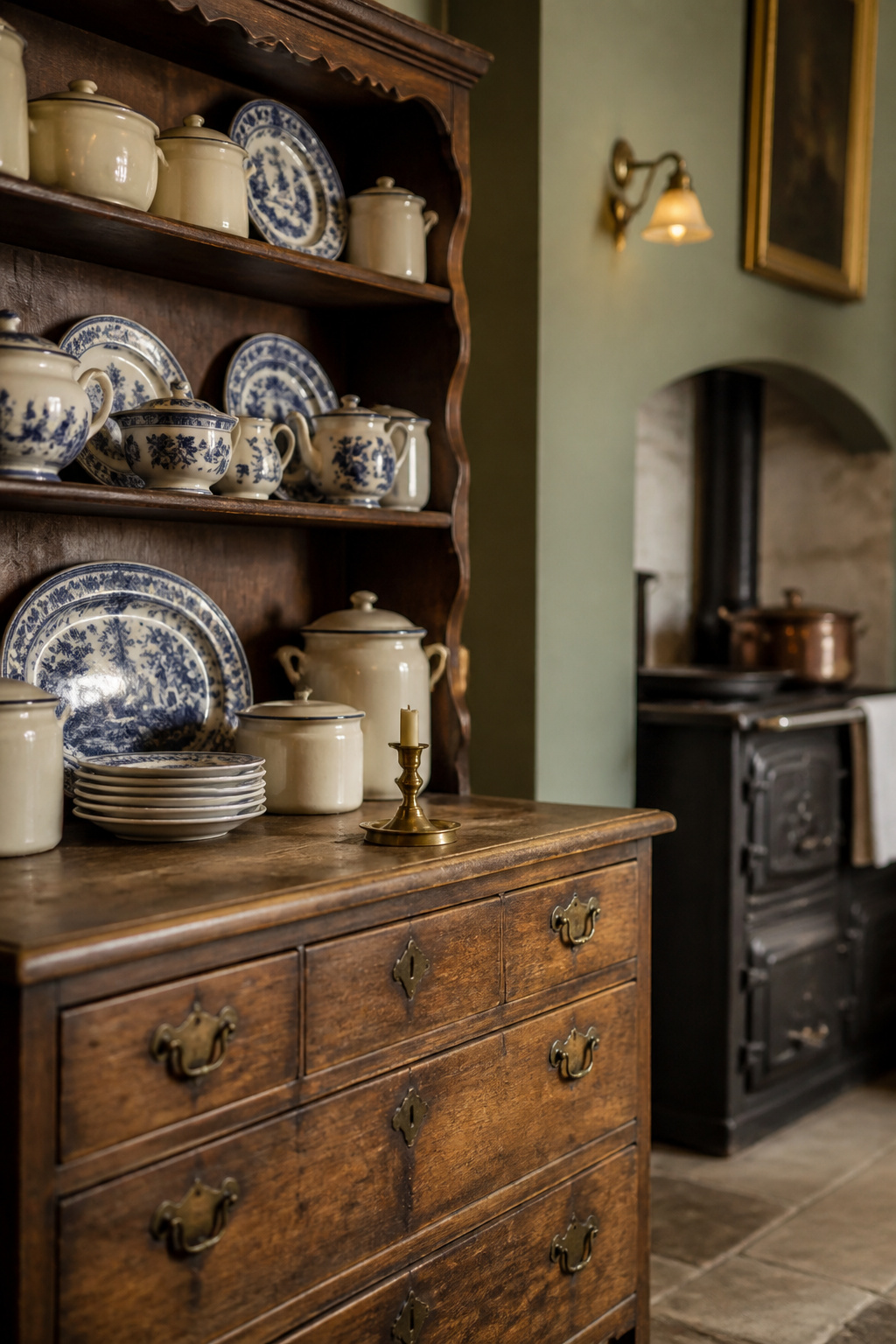
Unfitted dressers and in-frame cabinetry
The dresser is the anchor. Its lower section did the prep work while finished dishes went through to a dining-room sideboard, and Scottish Highland versions even had a tin-lined “porridge drawer” for cooling porridge — proof these were working tools, not ornaments. When cabinetry is fixed, keep it in-frame, doors flush inside a solid timber frame in the old Georgian manner. The most important habit is to break the run up: a different color on the larder cupboard, a freestanding butcher’s block instead of a fixed island, so the room looks gathered over generations rather than delivered in one van.
Heritage colors and the range at the room’s center
English heritage palettes stay earthy and muted — grey-green cabinetry, a deep forest for a larder or accent, warm off-white and putty-grey walls — with pure brilliant white and cool blue-grey deliberately left out.
At the center sits the range: a cast-iron cooker in cream, pale blue, deep green, or dusty red enamel, set into an alcove under a timber mantle. If the constant background heat of a true cast-iron range does not suit you, a reproduction from a maker like Lacanche or La Cornue delivers most of the look without it.
Translating a centuries-old look into a new build
You do not need a three-hundred-year-old shell to do this honestly. The order of operations is what keeps a new build from looking like a showroom: fit the in-frame shaker cabinetry first, then the range, then the sink, then the floor — reclaimed oak or pine finished with hardwax oil, never gloss — and let the dressers, copper, and rugs accumulate over time instead of arriving as a set. A flatweave wool runner or a worn Persian rug is what separates a country-house kitchen from a country-pub one. If this is your direction, the full get-the-look walk-through lives in our guide to the English cottage kitchen look.
Cottagecore Kitchen Decor, Done With Real Things
Now the layer that lives on top of the architecture. In its Spring Trend Report 2026, Pinterest recorded a 915% surge in searches for “dark cottagecore kitchen,” drawn from a base of 600 million monthly users — a figure that tells you cottagecore is not fading but mutating. It is the decorating movement of the moment, and its whole ethic turns on one thing: real, used objects rather than props bought to look like them.
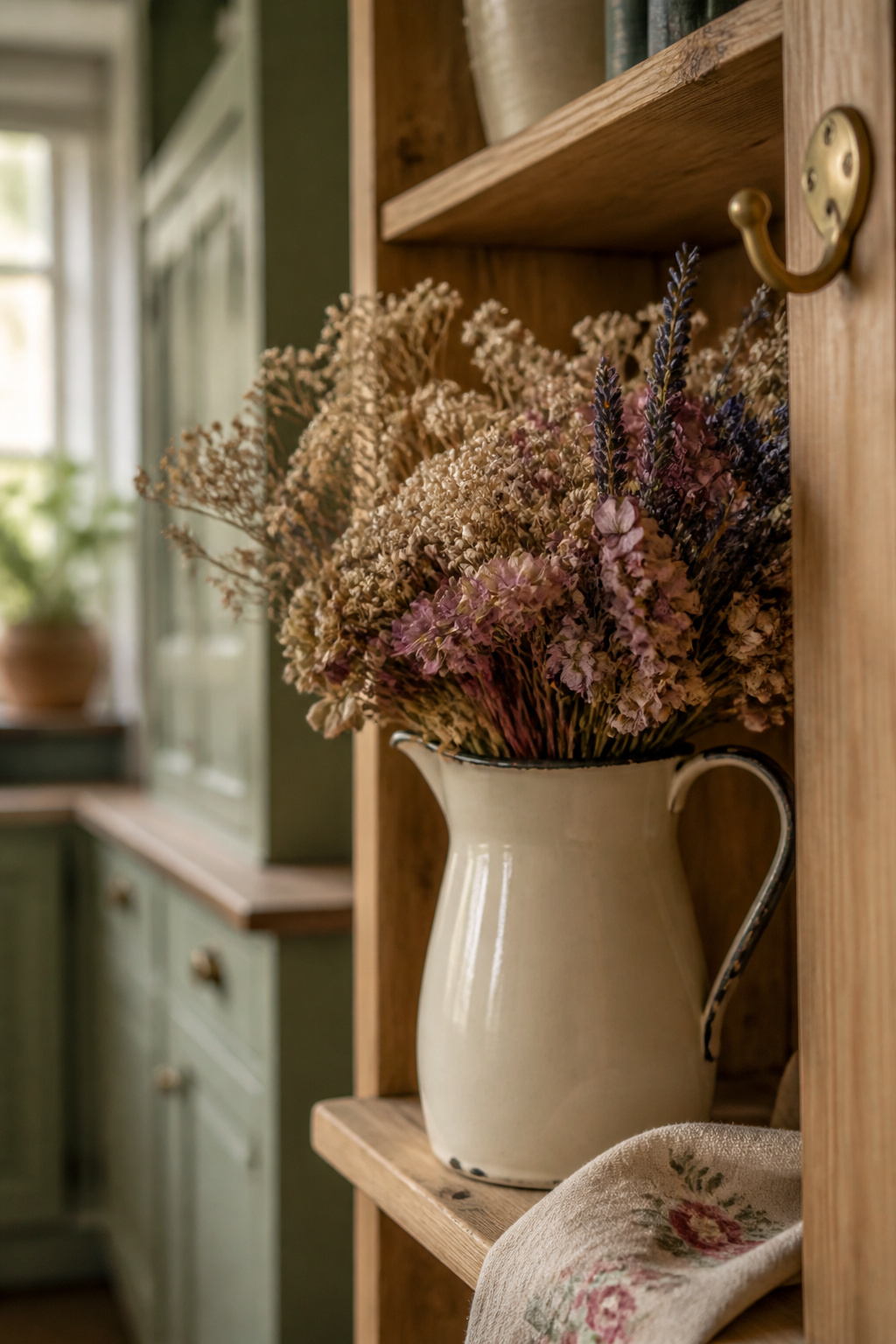
Dried flowers, vintage linens, and enamelware
The material palette is small and specific: open wooden shelves, vintage cookware, brass, a farmhouse sink with an old faucet, woven baskets, and fresh flowers or potted herbs. What makes it land is use, not arrangement. An enamelware jug earning its keep on the stove reads lived-in; the same jug staged for a photo reads like set dressing. The tell is always whether the objects look as though someone is actually cooking here.
The 2026 turn toward “dark cottagecore”
The newest branch keeps the cozy, humble spirit and drops the palette into hunter green, indigo, cobalt, burgundy, and near-black, with worn copper and wrought iron standing in for stainless steel. It sounds gothic; done well it is anything but. Helen Parker, creative director at DeVOL, described one moody scheme as all atmosphere — “cosseting and easy, uncluttered but interesting.” The depth of color is what makes it feel considered rather than costumed.
Real-vs-costume: what to avoid
The line between authentic and themed comes down to age and use. A genuinely old, chipped enamelware pot in daily service belongs; a matching printed-ceramic “farmhouse” set bought as a three-piece kit announces itself instantly. Dried botanicals, hand-thrown pottery, and reclaimed wood are the materials that hold the look together. Because this is a decorating discipline in its own right, we give it a full treatment in cottagecore kitchen decor done honestly.
Modern Cottage Kitchens: Warmth Without Clutter
There is a fear built into calming a cottage kitchen down: that the moment you subtract the layers, the room goes cold. It does not have to. The modern cottage kitchen keeps the sage, the brass, and the wood while dropping the collected clutter, concentrating the warmth into fewer, better things. It is the inverse brief of the English original — restraint instead of accumulation.
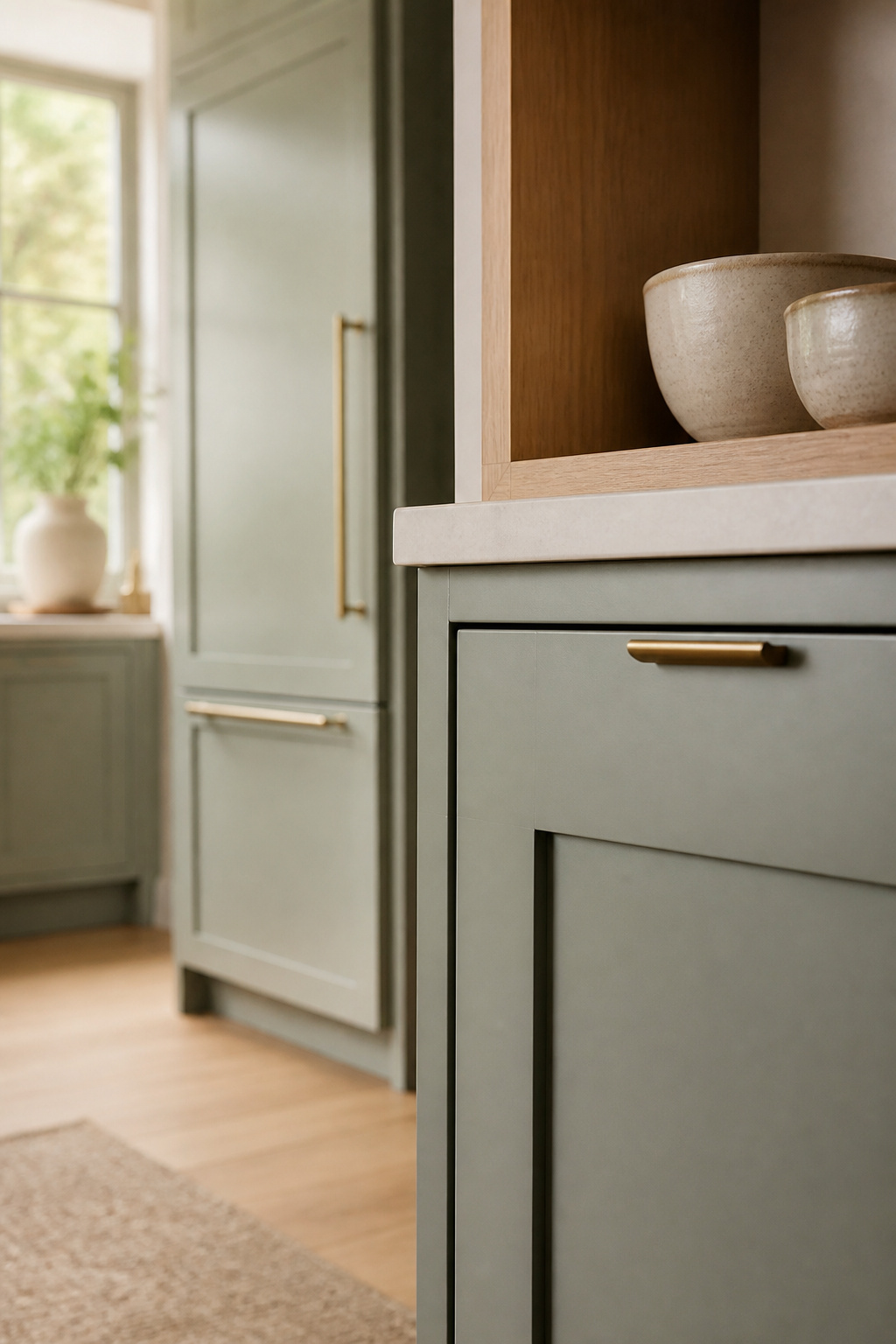
Simplified shaker fronts and quiet hardware
The shaker frame stays; its proportions shrink. A slim-shaker treatment trims the rails and stiles for a cleaner line, and the hardware quiets down or disappears entirely behind push latches and integrated pulls. Inset doors with tight, even reveals keep the joinery heritage while sharpening the tolerances. The effect is calm rather than austere.
Where to spend so minimal doesn’t go cold
With less going on, the few materials you keep have to carry more, so this is where you spend. Choose warm metals — brass or bronze over chrome — natural texture, and a genuine wood tone; wood took the top spot for kitchen islands in the Houzz 2026 study at 39%, up twelve points. The reassuring part is that warmth is the cheap part: paint and hardware return roughly 90% of their cost, where a major upscale remodel returns closer to 40 to 55%. Warm light finishes the job, so keep bulbs in the 2700–3000K range.
Integrated appliances beside open wood shelving
The signature move is contrast: panel-front integrated refrigeration and dishwashers doing the heavy lifting invisibly, paired with a single run of open wood shelving supplying all the warmth. For readers who want more depth than sage, a jewel-toned accent cabinet in navy, forest, or plum is a cottage-adjacent alternative. Henrik Larsson lays out the modern cottage kitchen approach in full, including exactly where the money should land.
Choosing Cottage Kitchen Cabinet Colors
Of every decision in this guide, cabinet color moves the room most. It is the largest painted surface you own, and it sets the temperature of everything else. Get it right and the hardware, walls, and worktops fall into line behind it; get it wrong and no amount of styling rescues the room.
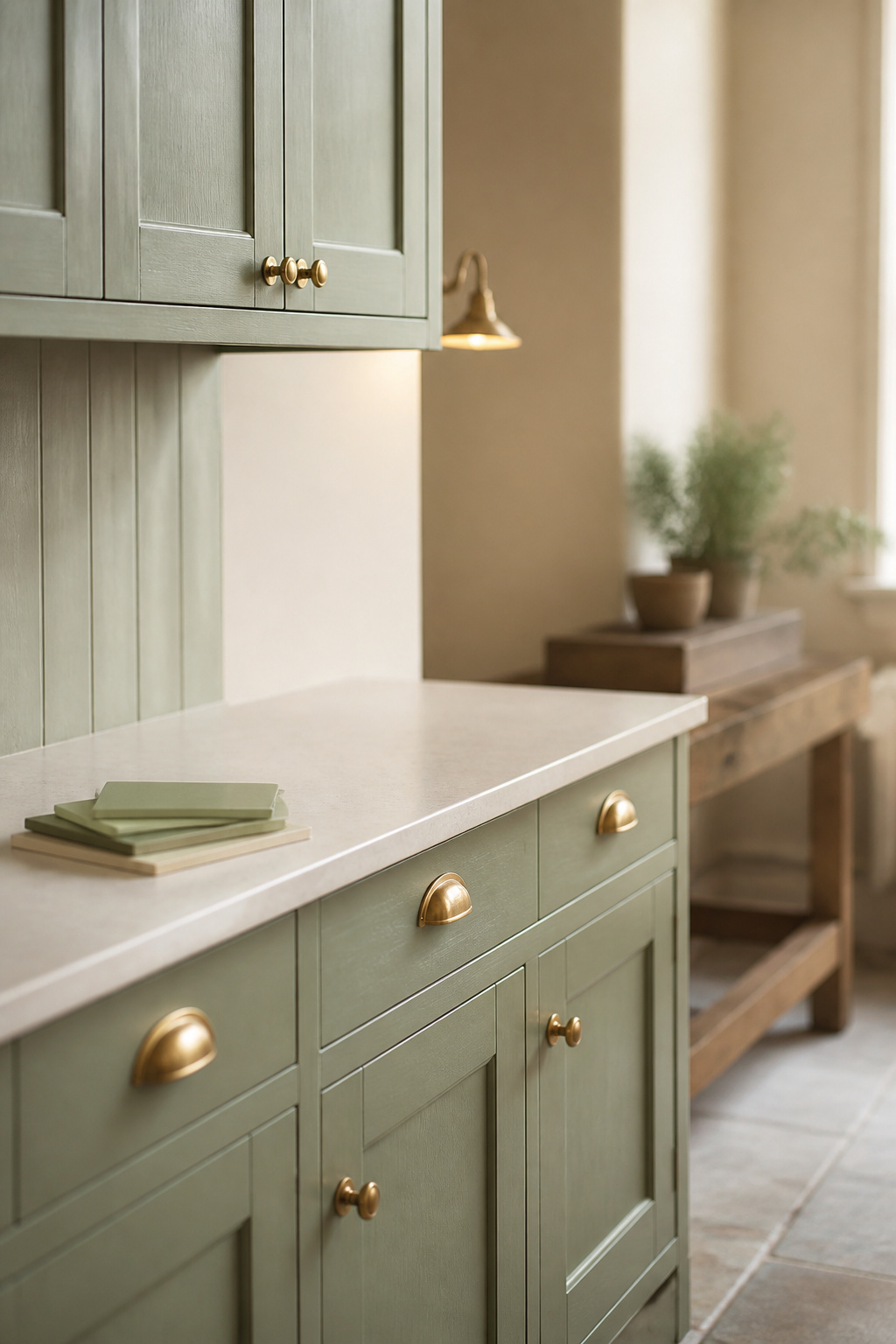
The heritage palette: sage, buttermilk, dusty blue, clotted cream
Interior designer Erika Dale frames the cottage palette as earth tones, garden greenery, and blue skies, and the buyable colors follow that logic closely. Benjamin Moore Natural Cream, Farrow & Ball Hardwick White, Sherwin-Williams Dutch Tile Blue, and Farrow & Ball Vert de Terre all sit in the muted, warm-leaning family the style wants. Keep the crisp warm off-whites like Sherwin-Williams Alabaster, with its high LRV of 82, for the walls rather than the cabinets, so the room stays soft instead of tipping toward farmhouse contrast.
Sheen and finish change the read as much as hue
One thing catches people out: the same color behaves differently depending on its finish. Sheen runs on a scale from flat at nearly zero gloss up through eggshell, satin, and semi-gloss to high gloss above 70 degrees, and moving up that scale makes a color look lighter and crisper. A soft eggshell mutes and warms a heritage green; a satin sharpens it. Whatever you choose, test a large door-sized sample in the room’s own light across a full day, because these muted colors shift markedly between morning and evening.
Pairing wall color to cabinet color
The pairing logic is tonal family, not contrast. A buttermilk or clotted-cream wall against sage cabinetry is the combination that recurs across nearly every successful cottage kitchen, because the two colors sit in one warm register. A stark white wall behind the same sage, by contrast, pushes the whole room toward hard farmhouse tension. For the named shades, LRV numbers, and finish specifics, see our full guide to cottage cabinet colors with real paint names.
Coastal Cottage Kitchens for Salt Air and Sun
A coastal cottage kitchen answers to something the others don’t: the climate it sits in. Salt air and constant humidity are the real design brief here, and they quietly punish the wrong materials long after the paint has dried. The look is light-washed and breezy; the engineering underneath it has to be tougher than it appears.
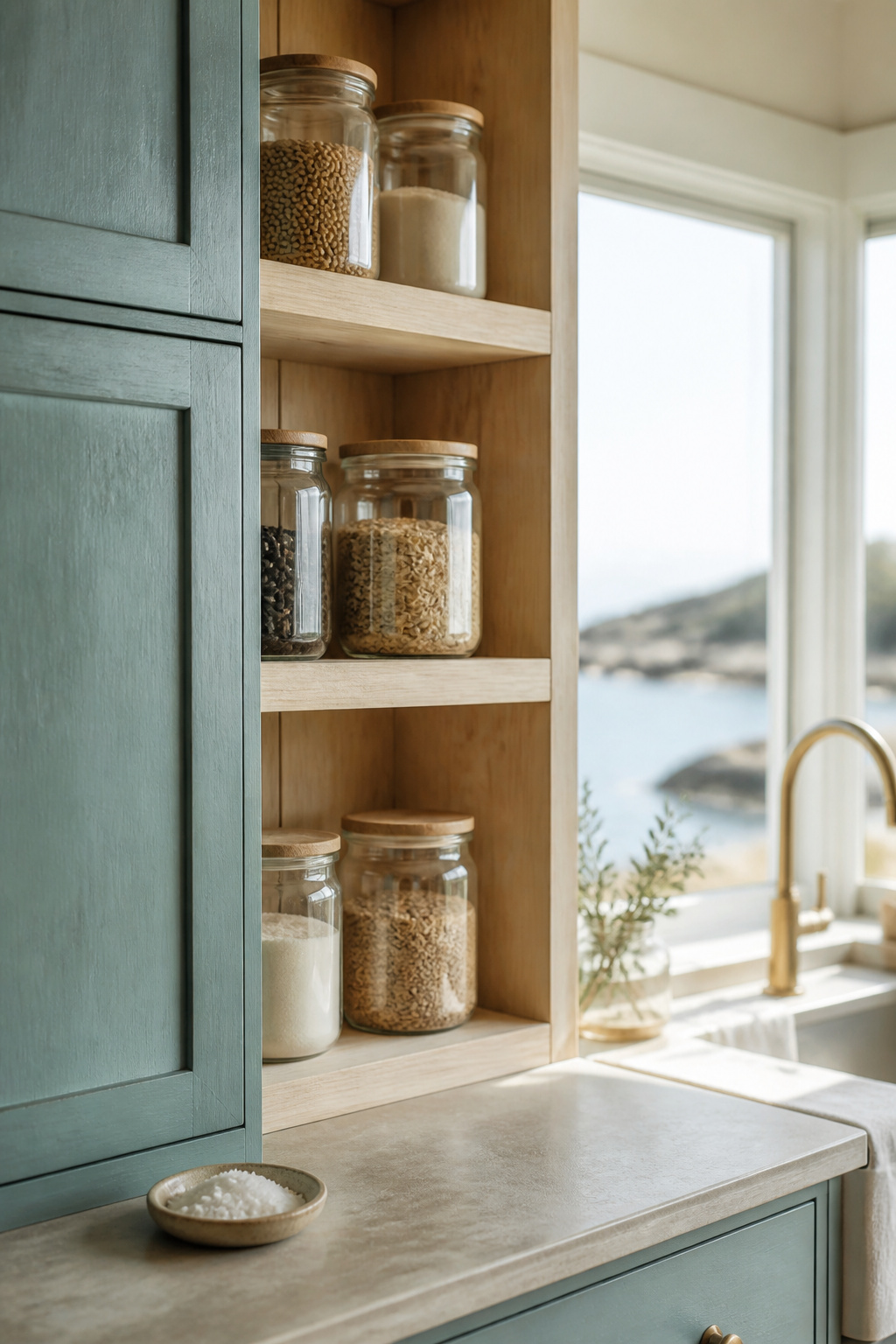
Light-washed woods and blue-green palettes
The palette pushes the heritage colors toward the water — warm and crisp whites, deep blues, and pale wood, with a blue-grey island shade like Benjamin Moore Smoky Candle. The trick is to reach for a dusty, grey-leaning blue-green rather than a saturated turquoise, which keeps the room inside the muted cottage family instead of sliding into holiday kitsch. Woven natural-fiber light fittings and exposed beams add the texture.
Materials that forgive humidity and salt air
This is where specification earns its keep. Aim to hold interior humidity between 30 and 50% to limit wood movement, and skip jute or sisal rugs entirely — the fibers are porous enough to draw mould from humid air above roughly 50%. Choose stone and glazed tile for surfaces, and corrosion-resistant metals for everything exposed; salt air attacks ordinary steel hundreds of times faster than dry inland air, which is why marine-grade stainless and solid brass belong here. Henrik Larsson details coastal cottage kitchens that survive salt air, with the full material specification.
Keeping it restrained, not theme-y
The failure mode is obvious once named: signs, rope, anchors, and sea-creature motifs turn a coastal cottage into a gift-shop version of itself. Let the pale palette and the honest materials do the talking. One or two genuine coastal gestures beat a shelf of matching props every time.
Getting the Cottage Look on a Real Budget
I will end where most readers actually start, because the biggest myth about this style is that the charm lives in the money. It does not. A cottage kitchen makeover lands in the hundreds to low thousands — a world away from the nine to twenty-five thousand a small-kitchen remodel commands — precisely because it keeps the boxes, plumbing, and footprint you already own and buys the look with paint and styling.
The highest-impact-per-dollar moves
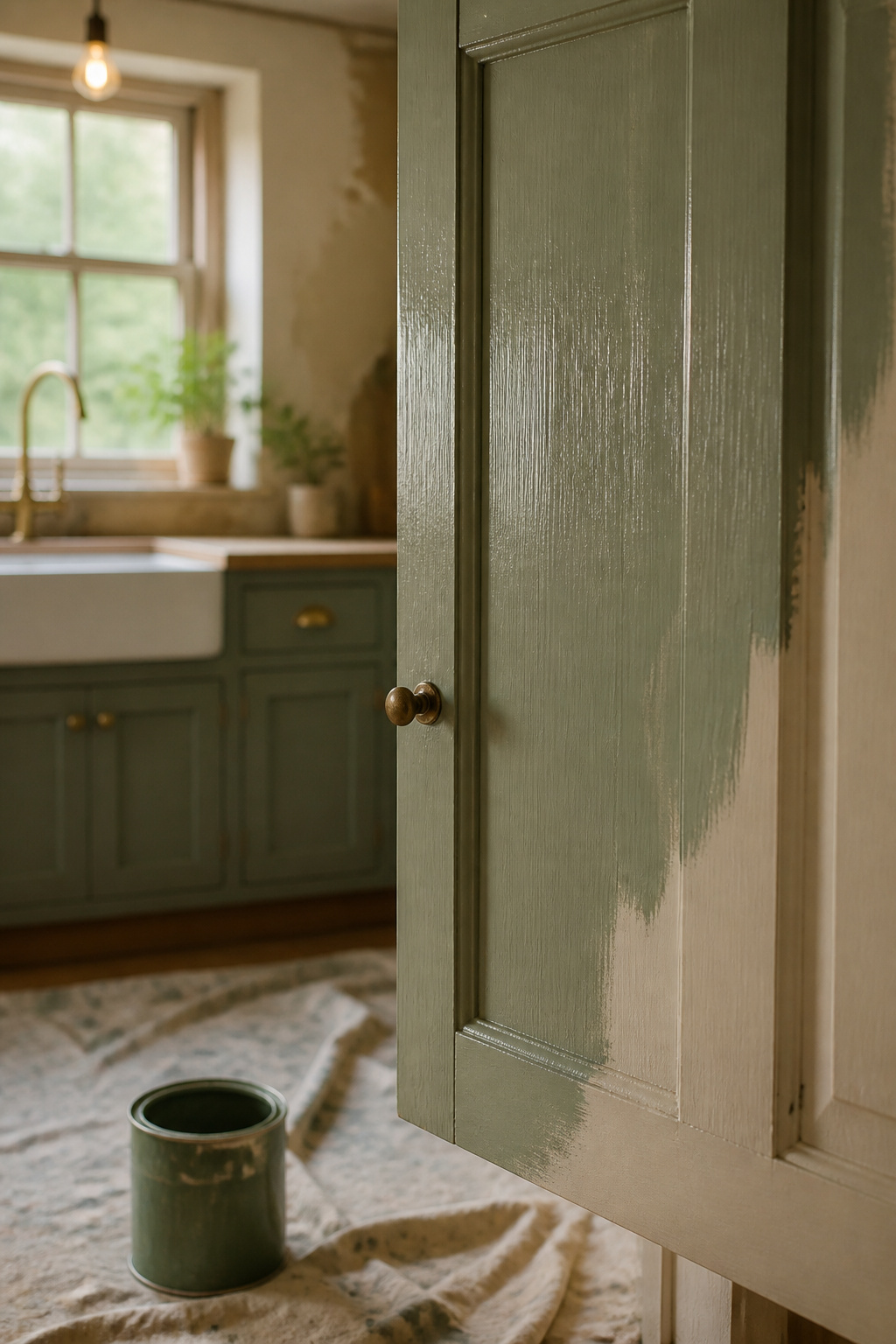
Rank the moves by impact per dollar and the order is clear. Painting the existing cabinets comes first: under fifty dollars in materials over a weekend, and nothing else you can do changes the room more. A two-tone treatment — darker below, lighter above — costs the same paint budget for a designer-looking shift. Converting a run of uppers to open shelving runs roughly fifty to a hundred dollars, and a single statement pendant over the sink can land under a hundred, or two to five hundred for a premium brass fitting.
What to DIY and what to hire out
The judgment call is knowing your line. Cosmetic work — painting, tiling a backsplash, hanging shelves — is squarely DIY territory, and one documented makeover saved hundreds by installing its own quartz backsplash. Gas and major plumbing are the opposite: that same homeowner hired a plumber for the gas line to a new range, reasoning correctly that the one-off tooling would have cost more than the labor. Code-regulated work where a mistake carries real risk is where you pay the professional.
Where readers overspend chasing the look
Most overspending comes from three habits. Replacing cabinets that only needed paint. Buying a matched decor set instead of thrifting the real thing. And rushing — going slowly on one makeover let the owners cancel a dish rack they discovered they never needed once the shelves went up. Spend on the lasting big pieces and keep the decor cheap, so that when the aesthetic shifts under you, the expensive layer survives. Tess Carver prices the whole path in getting the cottage look on a budget, hours and dollars included.
Where to Take It From Here
Strip away the hundreds of disagreeing photos and cottage kitchens come down to a few durable rules. The style is assembled, not installed — freestanding pieces and an unfitted habit over a matched run. Hardware finish and palette are your fastest tells, and they are what separate cottage from farmhouse on an otherwise identical door. Cabinet color is the decision that sets the temperature of the room, and real, used objects always outlast bought-to-look-old props.
With those in hand, every cottage kitchen photo now sorts itself. You can name the family it belongs to, and more usefully, you can name the one that fits your house. If you are working in a tight footprint, start with layout. If the budget is the constraint, start with paint. If you want the heritage original, start with the dresser and the range; if you want it calm and contemporary, start by subtracting. The look was never a single thing to chase — it is a set of choices you can now make on purpose, one honest piece at a time.