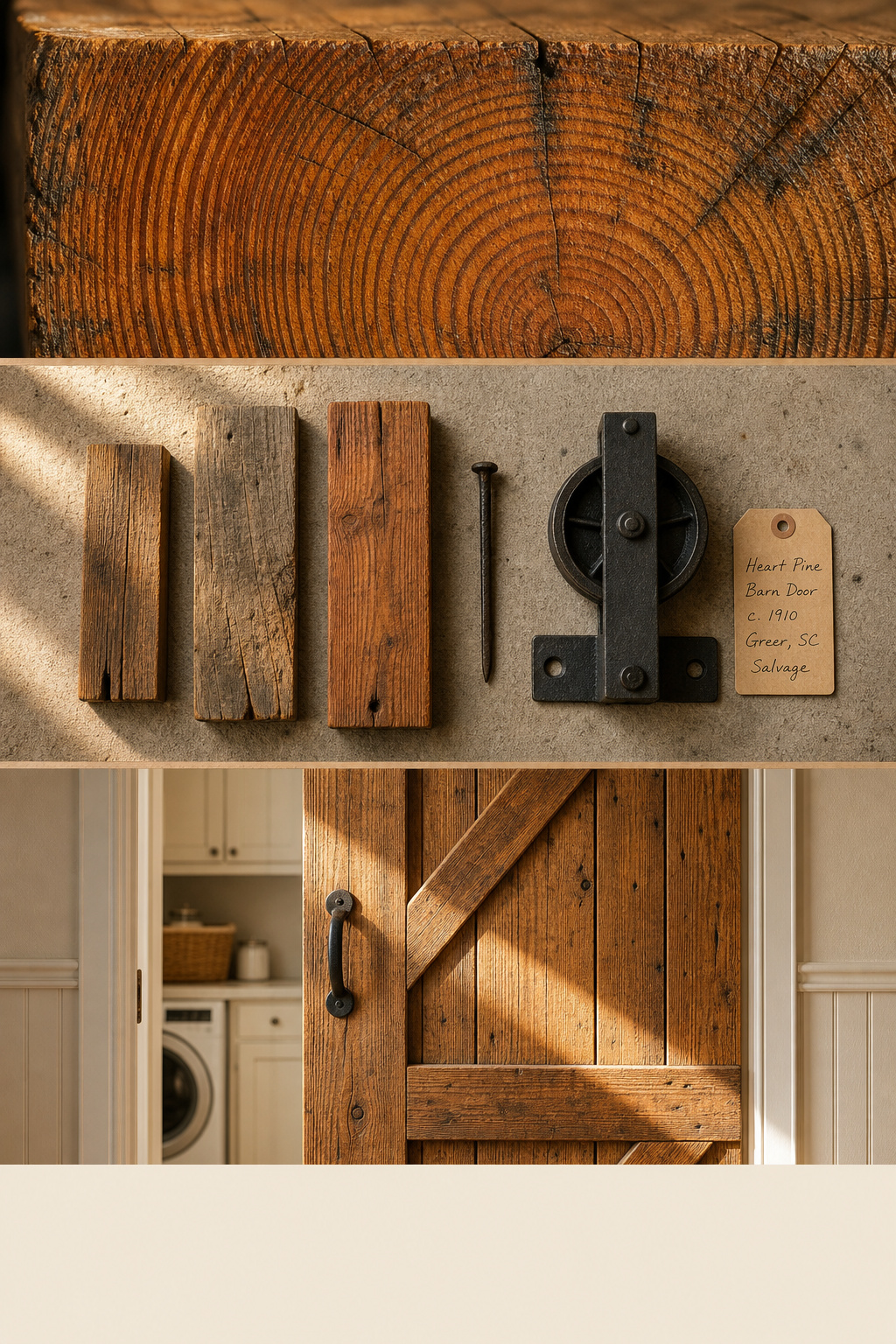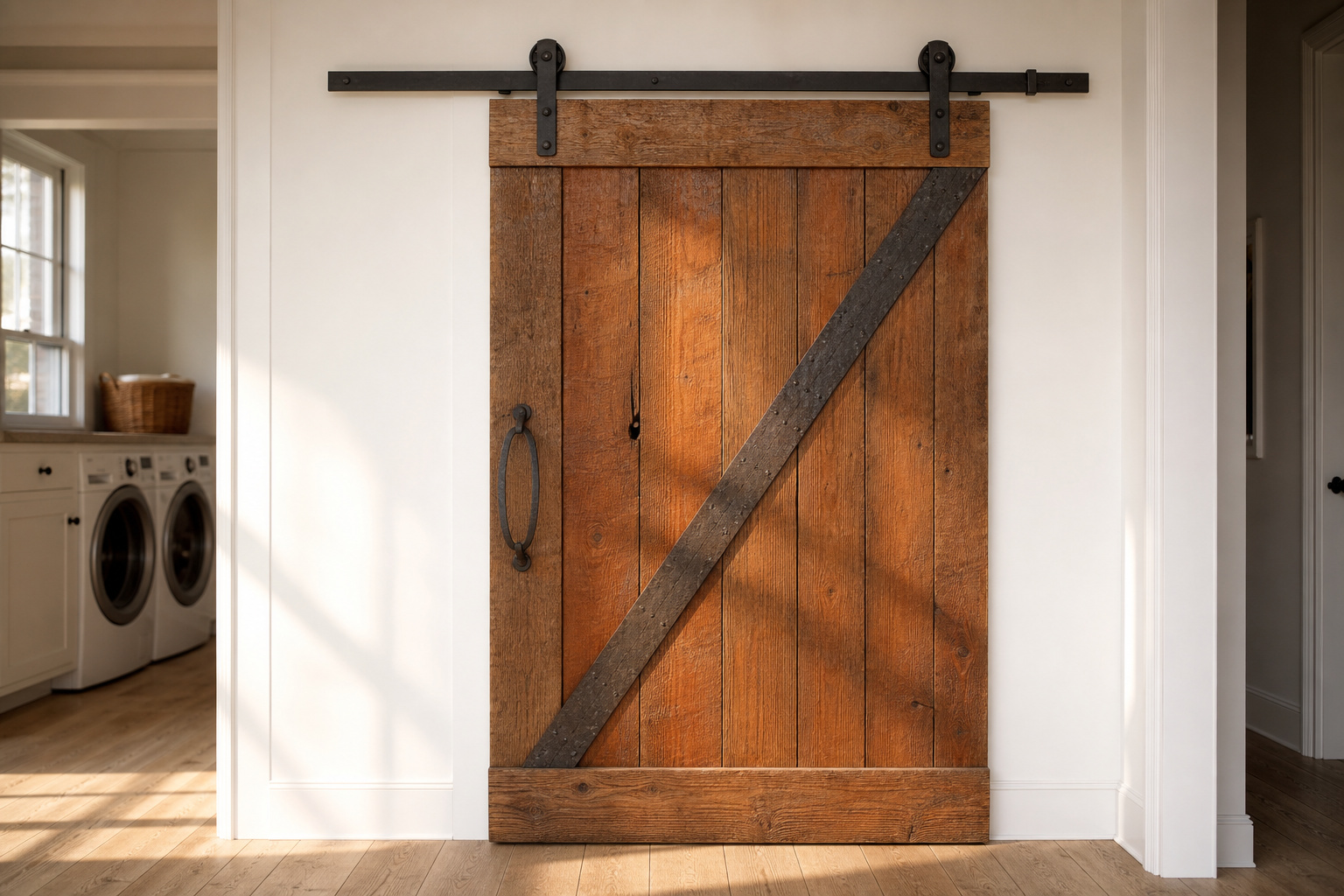
The sliding barn door did not begin as a decorating choice. It began because a farmer needed to move a horse through a fourteen-foot opening, and a hinged door swinging into that arc was useless — hang the panel from a track and the floor stays clear. Almost everything we now call the farmhouse look descends from solutions like that, which is why the best farmhouse sliding door ideas are the ones that still honour the original logic: the grain that proves a board’s age, the Z-brace that runs the way load travels, the iron that wears rather than pretends.
TL;DR
- Genuine reclaimed barn wood is the heart of the look: old-growth heart pine, white oak and chestnut run 20–40% denser than farmed lumber and show 15–30+ growth rings per inch — a count of 12+ rings confirms old growth.
- Before buying salvage, check moisture content (target 8–12% for interior use with a meter), scan boards with a magnet for hidden metal, and ask whether the stock was kiln-dried to kill insects.
- The Z-brace diagonal must run bottom-hinge to top-latch (compression, not tension); matte black or aged-bronze cast iron suits reclaimed wood, while brushed nickel reads as a period conflict.
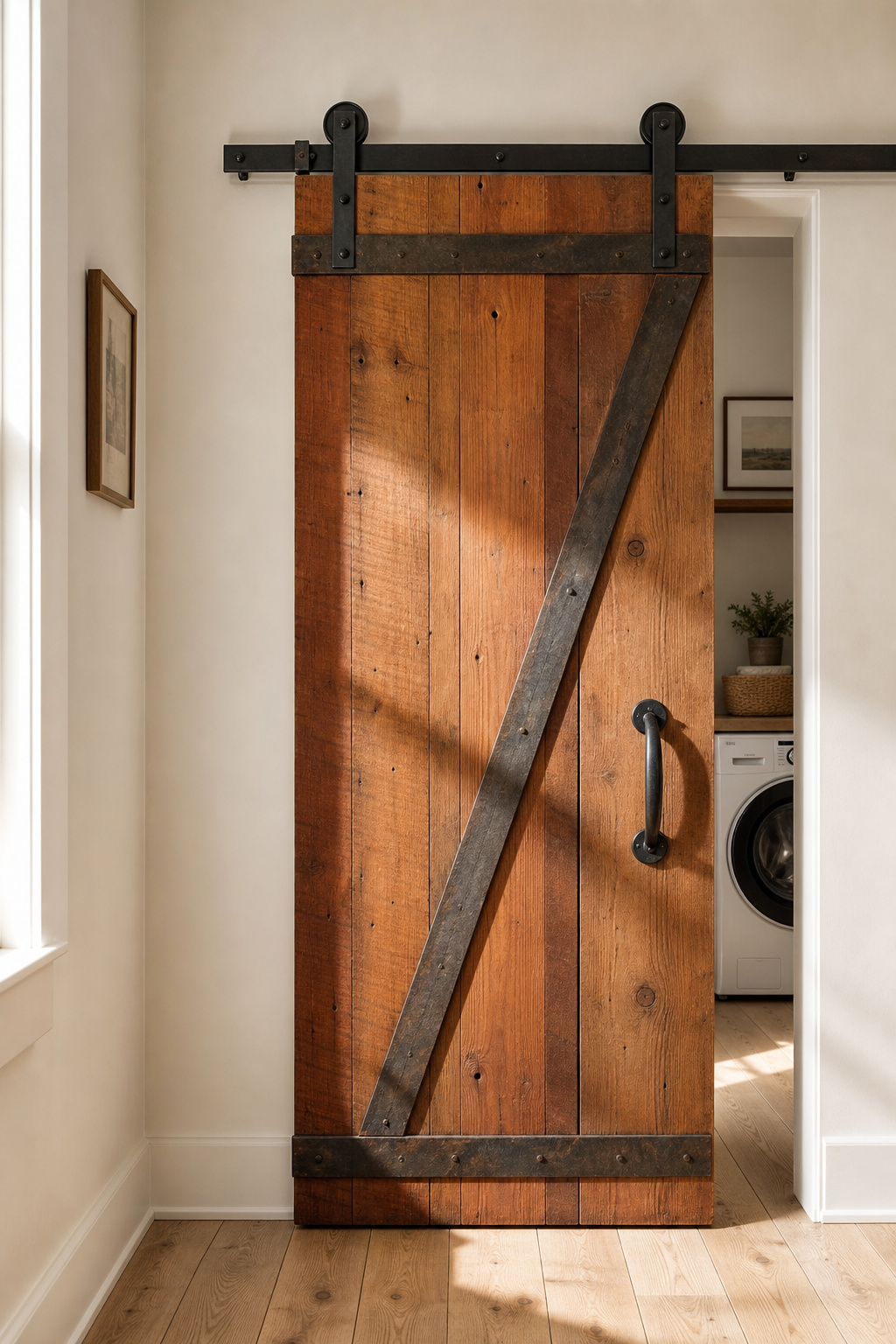
This is the style-and-sourcing chapter, not the build manual. The full barn door buyer’s guide covers sizing, hardware and budget across every door type.
Where Farmhouse Sliding Door Ideas Came From, and Why That History Matters
American barn sliding doors answered a working problem before they answered anyone’s taste. Large livestock needed openings of ten to fourteen feet, and a top-hung sliding panel was the only way to close that span without a swing arc through the threshing bay; interior residential use is that geometry, shrunk to a doorway.
The details we read as decorative were structural answers too. The Z-brace is a compression member, its diagonal carrying weight back toward the hinge — the strongest anchor — so the latch corner cannot sag (more on its correct orientation below). Plank-and-batten worked the same honest way: vertical planks for the face, battens behind to fasten them and resist racking.
Reclaimed wood matters because old-growth timber is not sentimentally better — it is physically better. Felled from virgin forest where trees grew slowly, it carries far more fibre per cubic inch: 20 to 40 percent denser than plantation stock, and up to 40 points harder on the Janka scale. As the Boston Lumber team puts it, old-growth wood “does not move the way modern lumber does, because the growth rings are so tightly packed.” American chestnut compounds the point: a blight wiped the species from the wild a century ago, so any chestnut board today is definitionally reclaimed old growth — among the rarest interior timbers in existence.
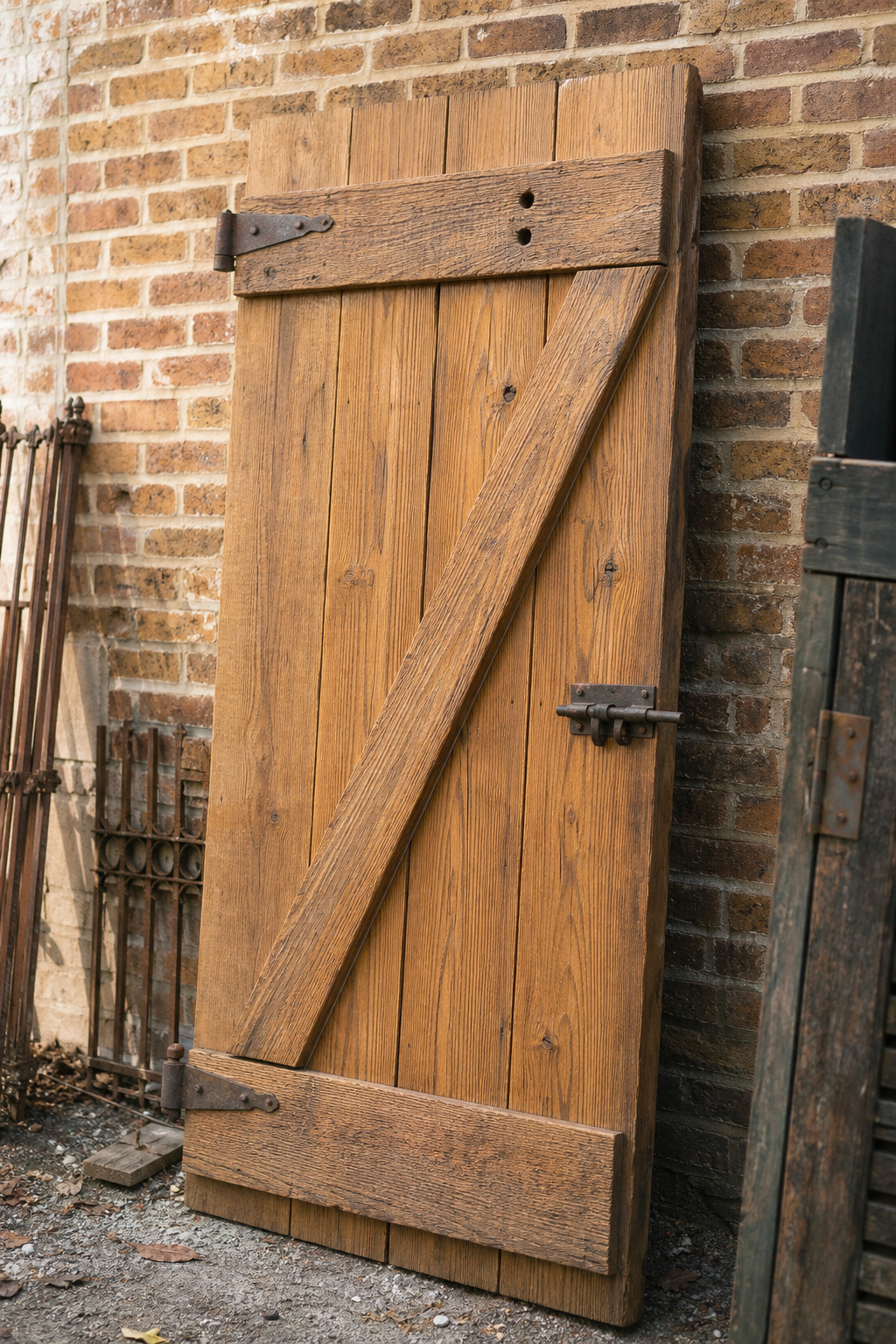
Sourcing Reclaimed and Salvaged Timber
Reclaimed barn board reaches you through three channels that trade convenience against cost. Salvage yards and deconstruction companies — Longleaf Lumber, All American Reclaim, Olde New England Salvage Co. (over 135 structures dismantled since 1982) — sell curated stock, sorted by species and often kiln-dried. Estate sales and direct-from-demolition finds are cheaper but arrive unsorted; SalvageYardFinder maintains a US directory.
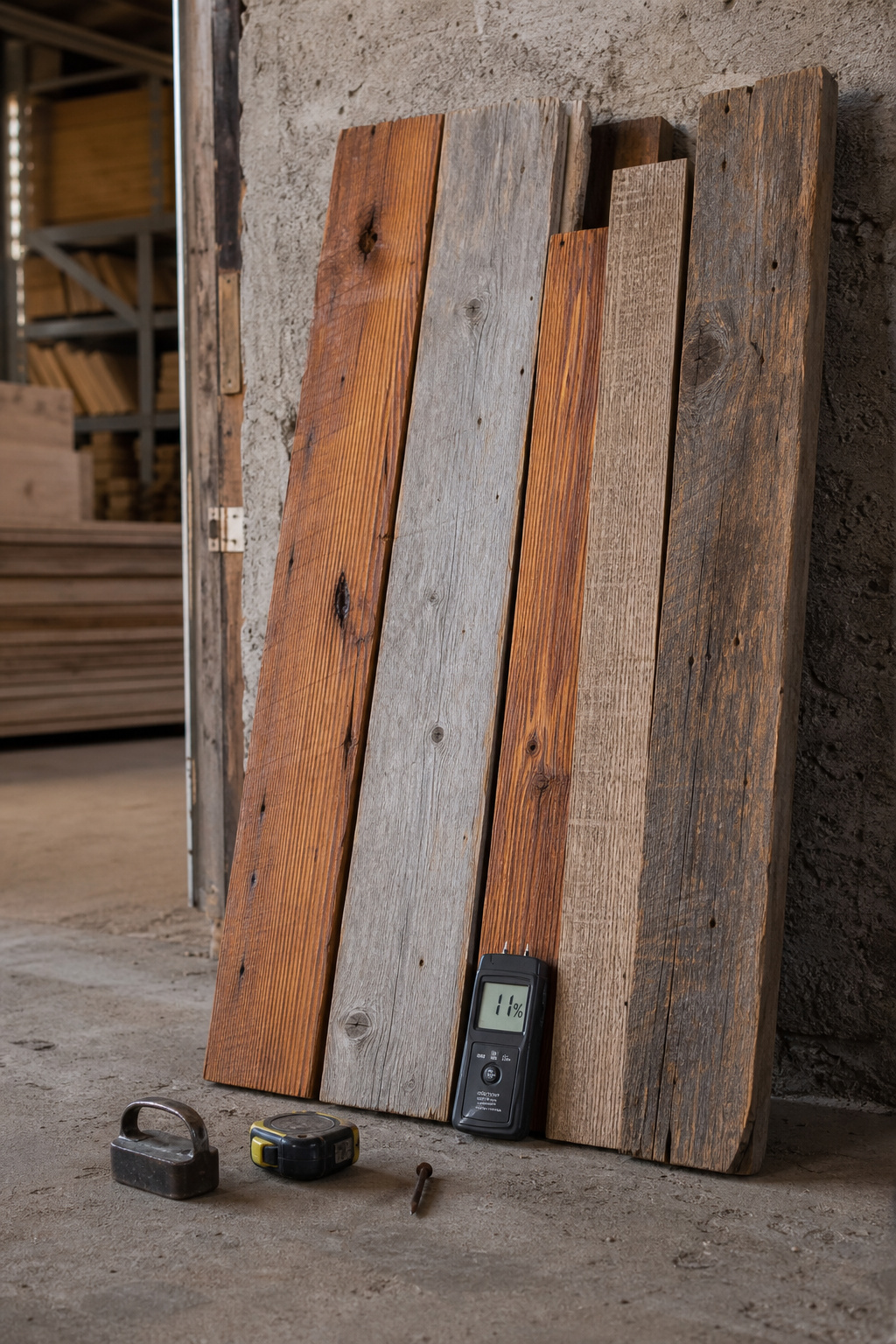
Read the end grain — it does not lie. Old-growth boards show 15 to 30 or more growth rings per inch; plantation timber shows three to eight, so twelve or more confirms old growth. Heart pine shows uniformly dark amber-red heartwood; chestnut reads knotty and heavily checked from the blight. The face holds dates too: broad-axe strokes mean hand-hewing, straight marks sash-saw milling before the 1850s, circular arcs the mid-1800s onward.
Then check the board. Aim for 8 to 12 percent moisture content for interior use, and trust a meter rather than your eyes — reclaimed wood damp from outdoor exposure can look bone dry. As one reclaimed-wood seller told Wagner Meters, even experienced contractors assume old wood needs no drying, when “it still generally has a good amount of moisture (as well as potential bugs) and still needs to be run through the kiln.” Ask whether stock was kiln-dried. Run a magnet over every board for buried nails, and tap along the length: a hollow note means internal decay, while surface checks are merely cosmetic.
Classic Farmhouse Layouts: Plank-and-Batten, Z-Brace, and Board-and-Groove
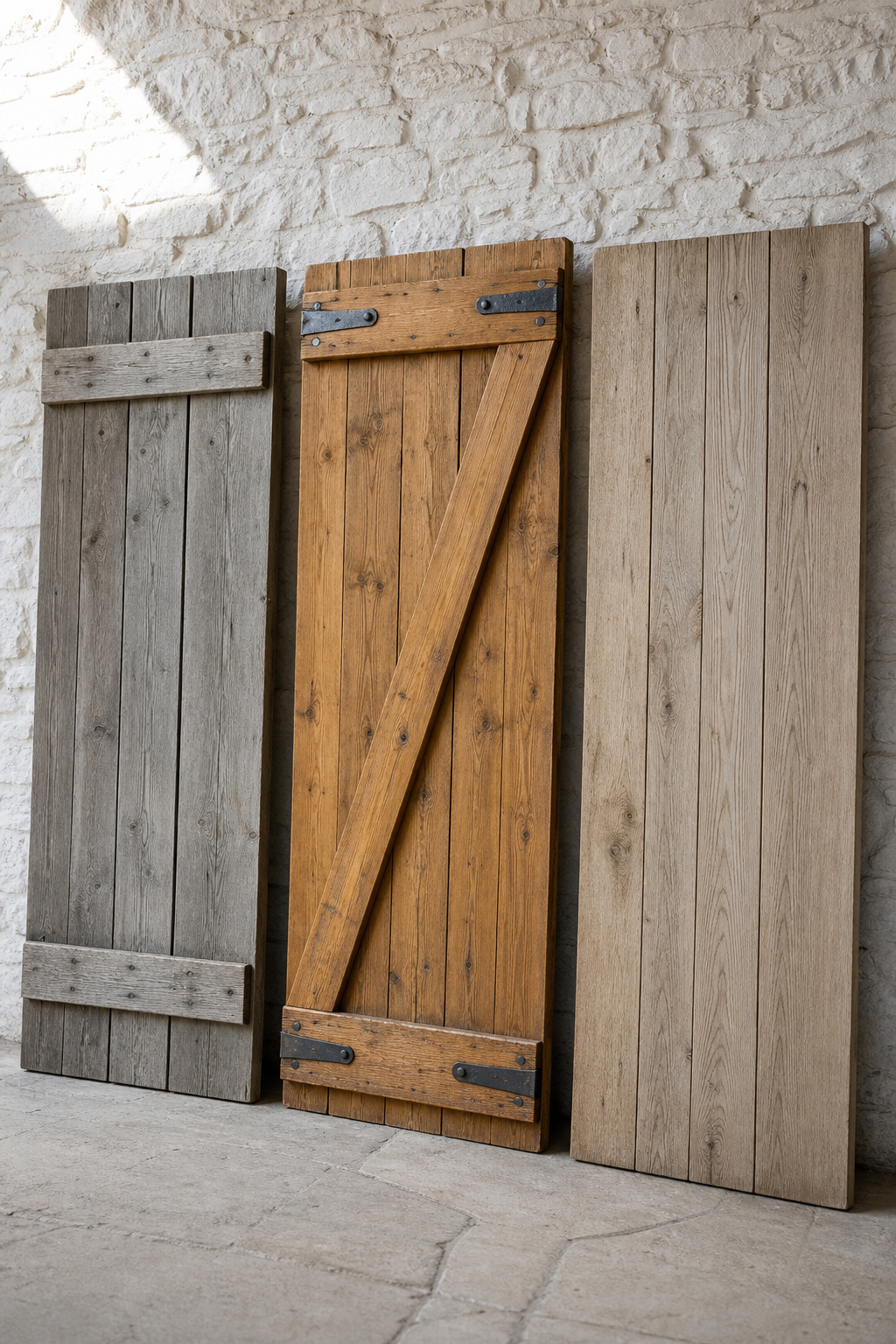
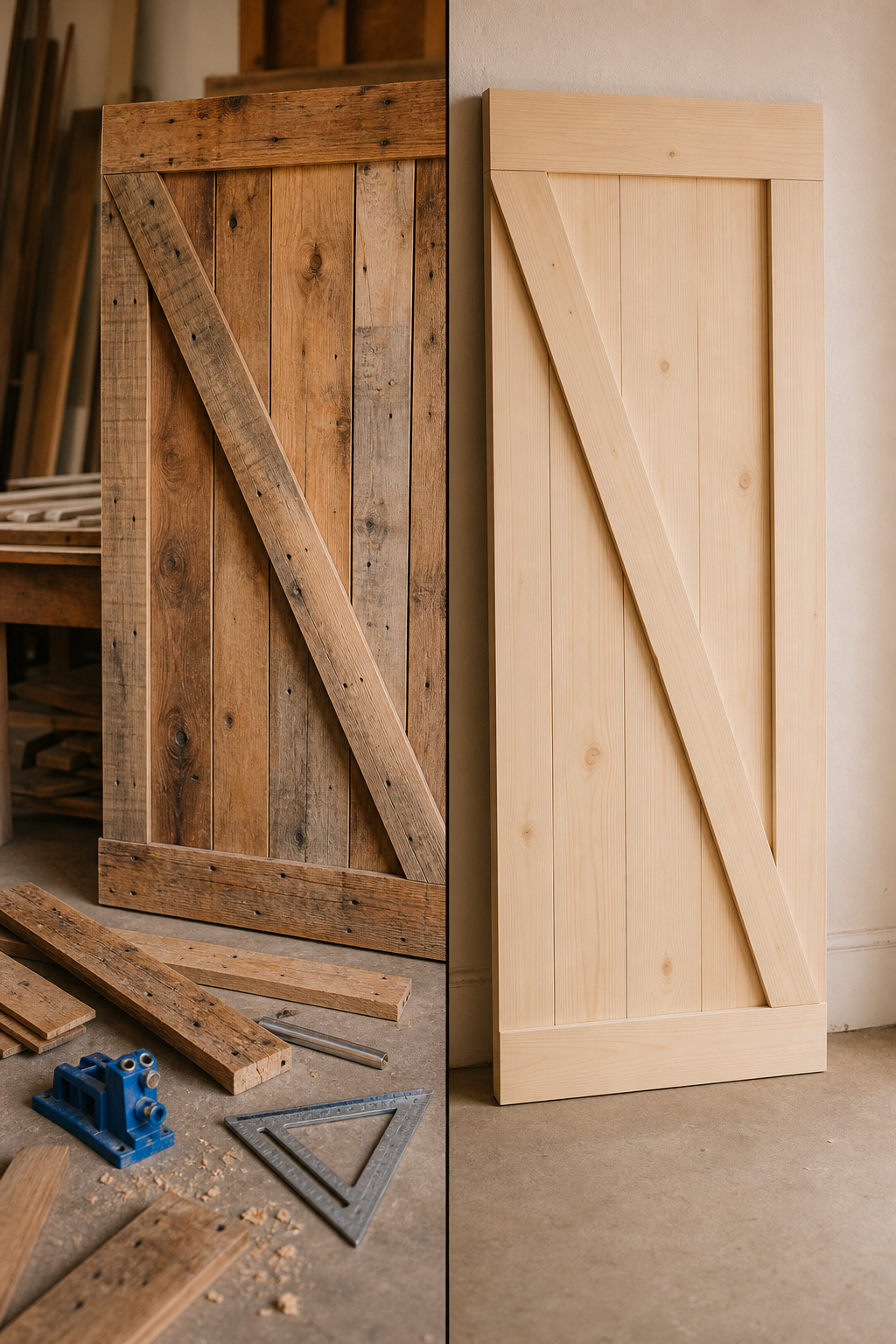
Three layouts carry the farmhouse look, each at a different degree of rusticity. Plank-and-batten is the foundational form — vertical planks held by two or three horizontal battens, the only style most door specialists recommend to a first-time builder. Its vulnerability is the latch corner: a single fastener per plank-batten junction lets the frame rack, which is why the old builders added either a diagonal or a second fastener at each crossing.
The Z-brace is that diagonal made expressive — running bottom-hinge to top-latch, the Z reads as rural and worked. Run it that way and it sits in compression; reverse it and it falls into tension, which timber resists poorly. On an interior door it is structurally optional, but it is one of the few details a knowing eye grades right or wrong, so orient it correctly. Board-and-groove is the most finished of the three: tongue-and-groove planks lock edge to edge for a tighter, panel-like surface that suits a refined room.
| Layout | Historical use | Skill to build | Visual character |
|---|---|---|---|
| Plank-and-batten | Universal working-barn base | First build | Clean, minimal, Shaker-adjacent |
| Z-brace | Carolinas wide-plank doors | First build | Most rural and expressive |
| Board-and-groove | Weather-tight barn doors | Some builds | Most finished, refined |
One proportion matters across all three: historic doors used wide old-growth boards of eight to fourteen inches. A door built from narrow new 1×4s reads as a budget replication; reclaimed boards in their original widths carry the proportions the form was born with.
Finish Choices: Stain, Paint, and Leaving Wood Honest
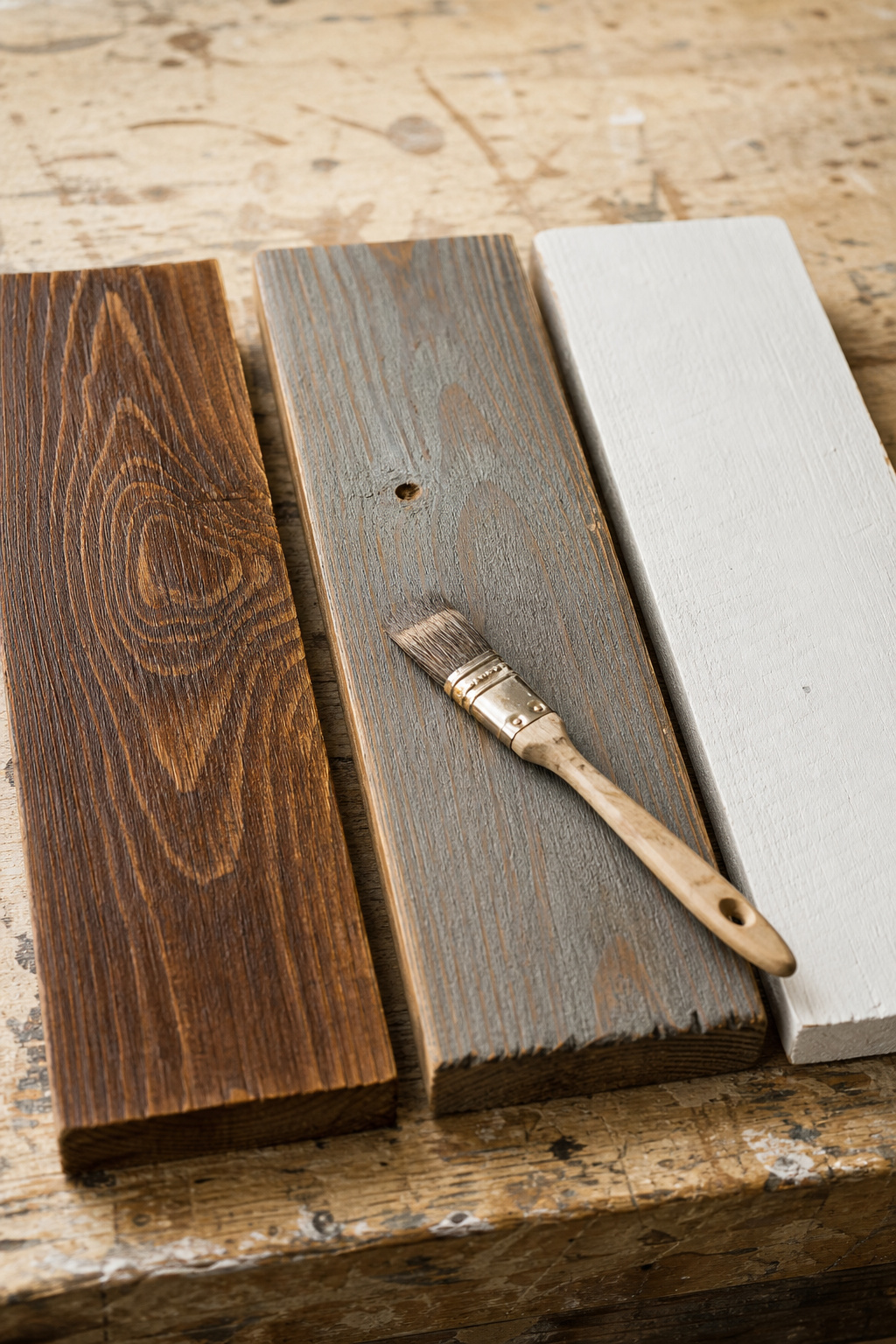
The finish decision is a question about honesty to the material. As The Reclaimed Barn’s finishing guide states plainly, staining “brings out the features of the natural wood grain, knots, and character,” while painting “covers everything visible on the wood’s surface, including its rustic characteristics.” If a board is genuinely good, stain it. A dark walnut gel deepens heart pine toward antique-furniture brown; a weathered grey wash — thinned grey over a dark walnut base, finished with fine steel wool — cools the amber while letting grain show.
Paint earns its place in specific cases. White and off-white dominate the contemporary farmhouse look, reading best against a dark wall; matte black is the period-honest black, since working barns used iron-oxide paints, not gloss. Barn red is the truly authentic colour — historically iron oxide, linseed oil and turpentine — though it overwhelms a small laundry room, so keep it dark and muted. Prime correctly whichever you choose: heart pine and oak carry tannins that bleed yellow through latex within weeks, so seal with a shellac-based primer, and test any pre-1978 residue for lead before sanding.
For timber interesting enough to leave visible, the minimum is one thin coat of penetrating oil — Danish, tung, or hardwax — stabilising the surface without changing colour or closing grain. Leave wood completely raw only when genuinely clean; mould or stubborn paint residue must be treated and sealed, not admired.
Vintage Hardware That Completes the Farmhouse Look
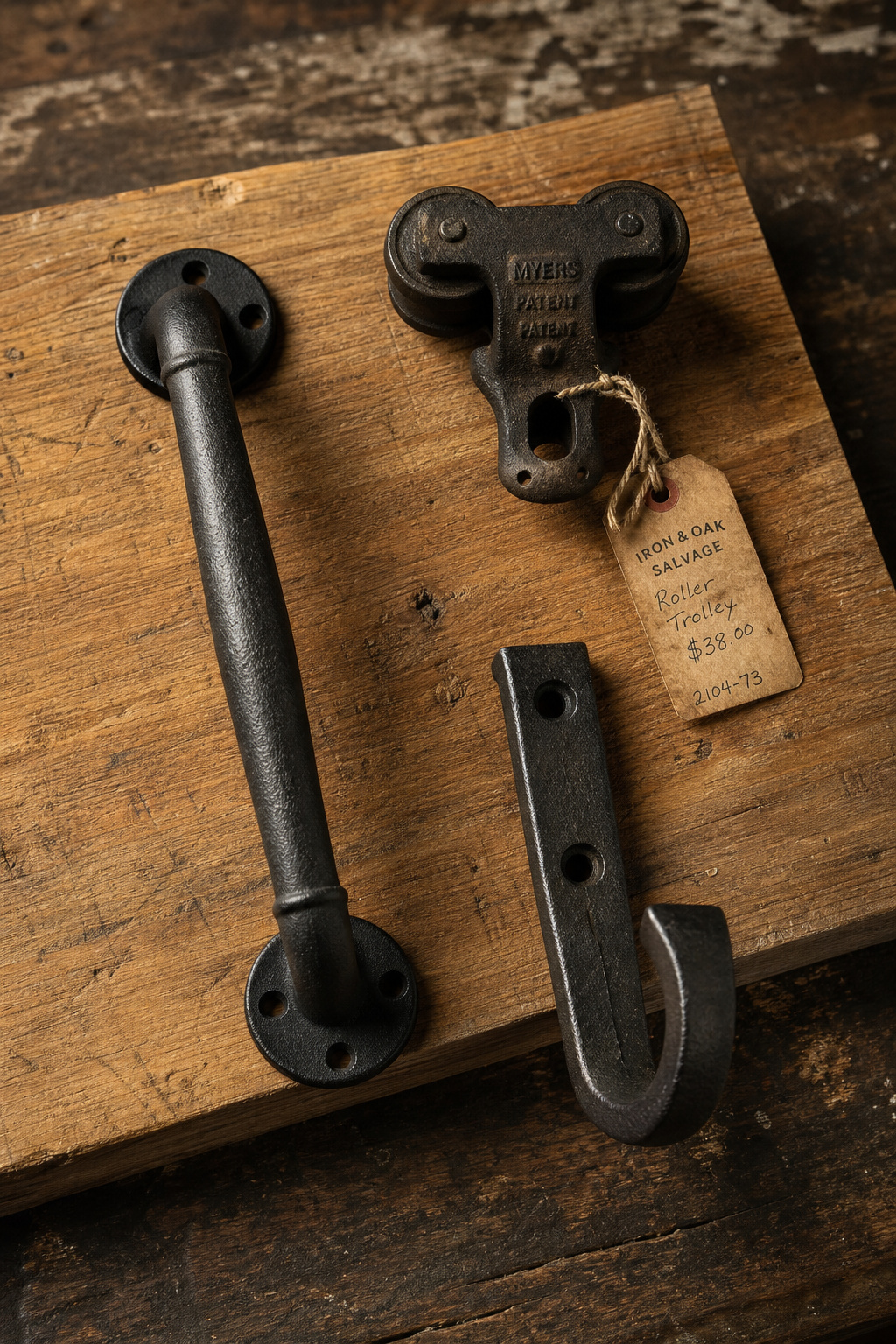
Hardware is the detail that confirms the look or quietly contradicts it. Working barns hung on cast-iron roller trolleys and wrought-iron strap fasteners, so the period-honest choices are matte black and raw cast iron. Dimensions for antique pieces come largely from dealers’ own product listings, so treat them as a working guide: salvage-shop trolleys are listed around 7.5 inches wide by 8.75 tall on two 2.75-inch cast wheels, each near three and a half pounds — meaningfully heavier than modern steel reproductions. Classic cast-iron pulls list at about eight inches tall and under two wide, a long narrow proportion that reads more period than the wider decorative pulls sold today.
Genuine antiques are available through salvage shops, eBay, Chairish and Etsy; makers such as Ageless Iron Hardware pour cast iron by hand to give casting weight without the sourcing hunt. The authenticity tell is the surface: real cast iron is granular and matte with a faint casting seam, ageing unevenly so recesses darken while contact points stay bright. Reproductions that try too hard apply a uniform distressed finish — the real thing ages in use, not in a factory.
Match the patina to the wood. As Patina Yard notes, black iron gives “a more modern, industrial look, while bronze offers a warmer, more traditional appearance that complements aged wood naturally.” Aged bronze, left unlacquered, develops a living patina toward dark old-penny brown. Avoid brushed nickel or satin chrome: both are post-barn-era finishes that create a period conflict on heart pine with nail holes and saw marks.
Building a Reclaimed-Wood Door, or Buying a Pre-Made Slab
The build-versus-buy question turns on whether you want the character of a specific salvaged board or simply the farmhouse aesthetic. A sourced reclaimed build gives you marks no factory can reproduce — hand-cut nail holes at the original board spacing, a mill signature, grain from a tree that no longer stands. A pre-made slab gives convenience but not that provenance; “reclaimed look” doors built from new lumber with applied distressing read differently up close.
Price is not the deciding factor it appears to be. A self-build from salvage stock runs roughly $200–$400 in materials for a standard laundry-room door; a pre-made new-lumber slab runs $200–$1,000. Custom reclaimed commissions sit well above both — market pricing typically starts around $1,500–$2,000 or more per slab, varying by maker; treat any published figure as an indicative floor.
If you build with reclaimed timber yourself, the sequence follows an ordinary build with two extra steps: denailing and acclimating the wood to room moisture. The full method lives in the guide on how to build a reclaimed-wood door. Old-growth heart pine and oak are heavy, so spec hardware rated for at least 150 pounds. If a dim laundry room is the real problem, glass doors for a brighter room trade some warmth for daylight while still hiding the clutter.
The farmhouse barn door rewards the same judgement an old chest does: buy the material for what it is, and let the construction follow the logic the original builders already worked out. Source genuine old growth. Orient the Z the way load travels. Stain what deserves staining; choose iron that wears honestly; refuse the finishes — chrome, faux-distressing, narrow new lumber — that turn heritage into costume. Get those decisions right and the door will look, and last, like the real thing.
FAQ
Where can I find authentic reclaimed wood for a barn door?
Architectural salvage yards are the primary source — SalvageYardFinder lists US operations, and deconstruction companies like All American Reclaim and Olde New England Salvage Co. sell curated, kiln-dried, species-sorted stock. For custom builds, Etsy artisans and specialists such as Rustic Roots Reclaimed and E.T. Moore ship nationally. Always check moisture and confirm kiln-drying first.
What is the difference between a Z-brace and a plank-and-batten barn door?
A plank-and-batten door has vertical planks held by two or three horizontal battens, with no diagonal. A Z-brace adds a diagonal running bottom-hinge to top-latch, forming a Z. That diagonal was originally a structural compression member preventing sag; on interior doors it is mainly decorative but should still be oriented correctly. Visually, the Z reads more rural and expressive.
Does a farmhouse barn door have to be painted white?
No. White suits the modern farmhouse look but is not the authentic colour — that was barn red (iron oxide and linseed oil), with weathered grey the default for working doors and black a legitimate period choice. For genuine heritage character, a dark walnut or weathered-grey stain preserves the wood grain and provenance that paint would cover entirely.