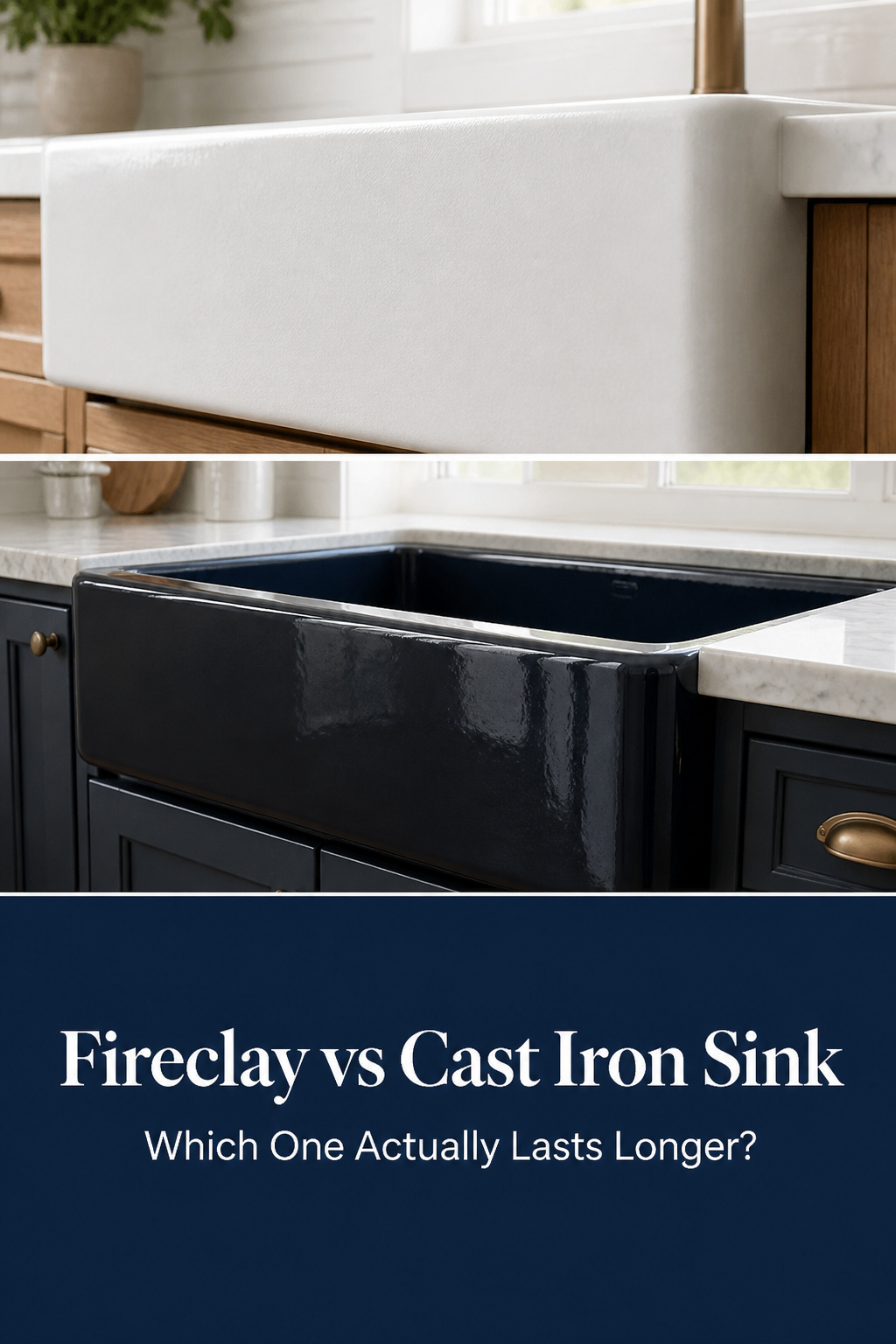
Here’s what nobody tells you before you spend $300–$800 on an apron sink: the pricier material fails more gracefully. In a fireclay vs cast iron sink match-up, fireclay chips into white ceramic — no rust, barely visible. Cast iron chips into bare iron and starts a rust clock. That one fact drives almost every trade-off below.
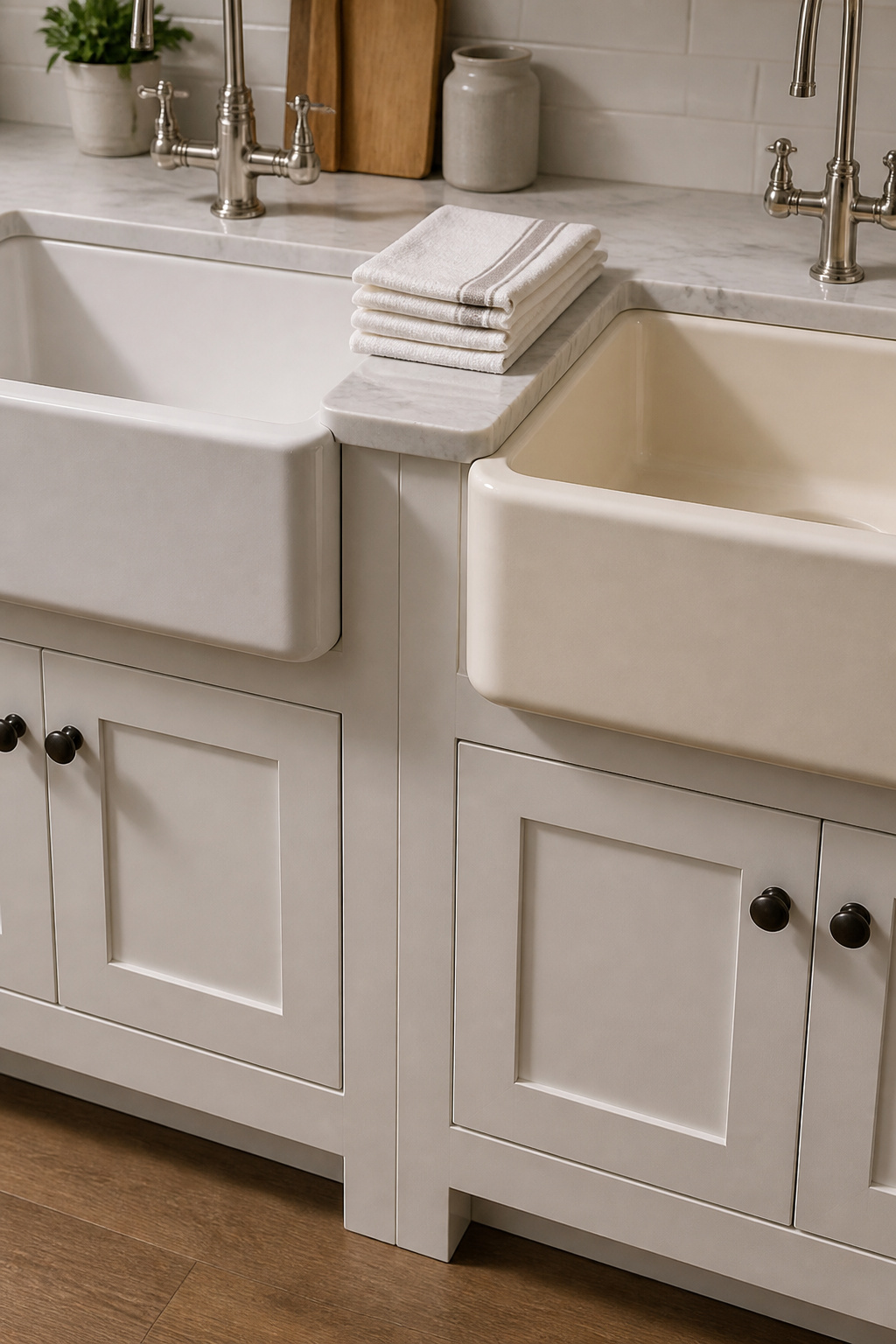
TL;DR
- Fireclay is fired ceramic all the way through, so a chip exposes white body and never rusts; cast iron is enamel over iron, so a chip exposes metal that rusts within days unless you patch it.
- Cast iron is heavier (roughly 110–160 lbs empty for a 33-inch model vs 80–120 lbs for fireclay) and pricier at matched sizes ($600–$1,500 vs $270–$800), so fireclay usually wins on budget and install.
- Both need a 2×4 support frame and prompt chip repair, so neither is zero-maintenance — and on stain resistance they’re a genuine toss-up.
The Key Difference Most Buyers Discover Too Late
They look like cousins on the showroom floor, but they’re built nothing alike.
What fireclay actually is (and why it isn’t just ‘clay’)
Fireclay blends refined clay, quartz, and feldspar, moulded to shape and fired at 1,600°F to 2,100°F for about 24 hours. That process, called vitrification, fuses clay, quartz, and glaze into one non-porous, glass-like body harder than ordinary ceramic. The glaze isn’t a coat on top — it’s part of the material.
What cast iron enamel is and where it fails
Cast iron is molten iron cast into a mould, then coated with porcelain enamel and fired. The enamel and the iron stay as two separate layers, and the iron base is essentially indestructible — so the enamel is the single failure point. Drop a heavy pan and it can chip; once bare iron meets water, rust develops within days and creeps under the surrounding enamel.
The one question that separates the right choice from the regret
The real question is “what happens when this sink gets hit?” A fireclay chip shows white ceramic body — rust-free, touched up with a brand glaze kit. A cast iron chip shows metal and starts the rust timer. As Angi’s Audrey Bruno puts it, the base “may rust if [the] coating isn’t patched quickly” — structural damage, because rust under the enamel can’t be stopped with surface epoxy alone. The full farmhouse sink buyer’s guide maps every material and size decision.
Fireclay Sink: What You Get for the Higher Price
Fireclay costs more than budget cast iron and overlaps mid-tier. Here’s what the money buys.
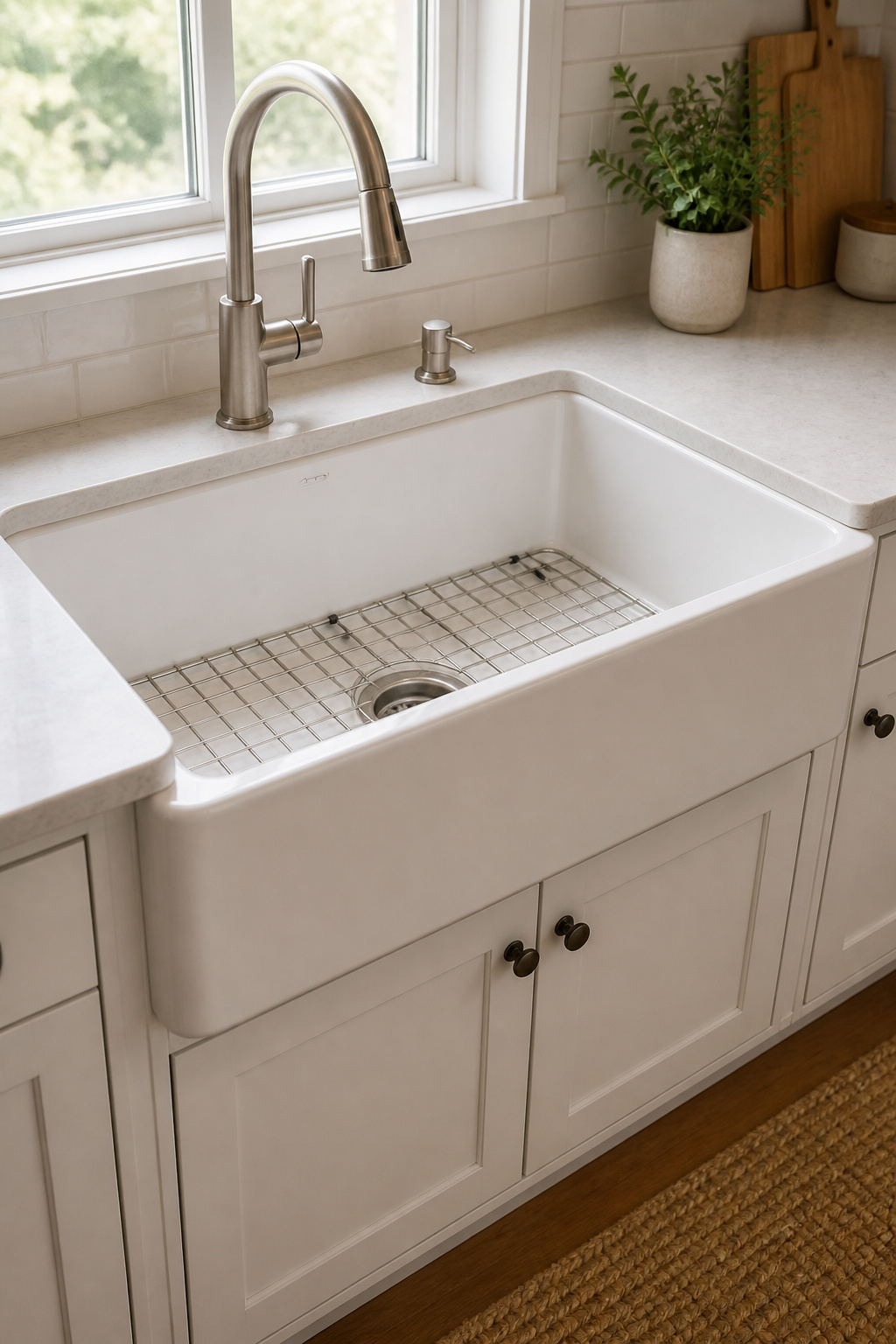
Composition and firing process — why the glaze goes all the way through
Firing temperature is the quality tell: hotter means denser, so better sinks fire near 2,100°F and cheaper ones near 1,600°F. On brands, BOCCHI competes on value, Rohl and Shaws on English heritage, Sinkology mid-range with a lifetime warranty.
Weight, typical dimensions, and cabinet support requirements
Fireclay apron sinks run 80–120 lbs empty, then 200–300 lbs full of water, so sub-sink support is structural, not optional. The standard fix is a 2×4 frame screwed and glued to the cabinet sides and back. Size the cabinet at least 3 inches wider than the sink: a 33-inch sink wants a 36-inch cabinet.
Chip behaviour, stain resistance, and the realistic maintenance load
Fireclay’s non-porous surface means most stains wipe off with water; Bar Keepers Friend handles the rest. The stain story is contested, though: Angi notes the ceramic glaze is actually more porous than cast iron’s enamel, so fireclay stains more easily if a spill sits. Counter-argument: fireclay releases stains more readily once you clean. Neither material has a decisive edge — it’s a wash. Buy a sink grid in either case — Shaws of Darwen recommends one “especially to the base of your sink,” where a dropped pan does the damage. Skip steel wool; it micro-scratches the glaze. For the full routine, see keeping fireclay clean.
The fireclay case, in short:
- Chips stay white and rust-free, with a cheap glaze touch-up.
- Lighter than cast iron, so easier to support and install.
- White or off-white only; the glaze micro-scratches if you’re rough with it.
Price range and where it sits on the cost-per-year-of-use scale
Entry fireclay starts around $415; mid-range 33-inch models run $479–$799; premium Rohl and Shaws reach $1,500–$2,039. Fireclay lasts 20–50+ years, backed by lifetime residential warranties from Elkay and BOCCHI. At $600 over 30 years, that’s $20 a year — illustrative, but the sticker looks different against that math.
Cast Iron Farmhouse Sink: The Classic That Has One Weak Point
Cast iron is the heritage choice. The iron body never wears out — it has exactly one vulnerability.
Enamel-over-iron: strong until it isn’t
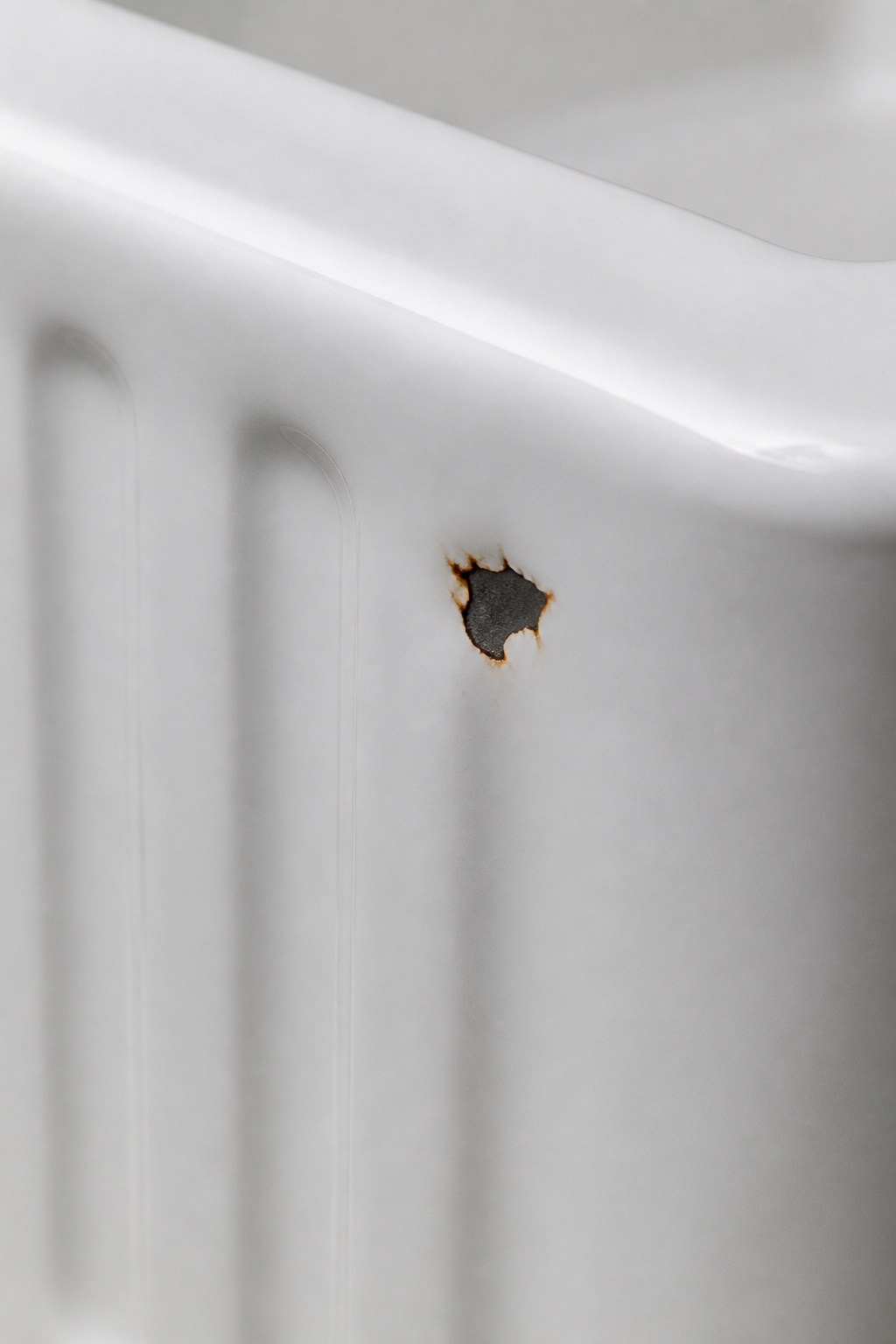
Cast iron’s enamel is glass-ceramic bonded to the iron — a coating on a substrate, not a fused monolith, so a hard impact shears the bond and leaves a chip that can’t self-seal. The trade is colour: Kohler’s Whitehaven line comes in white, biscuit, and black, so cast iron is the place to look if you need something other than white.
Weight and the structural demands on base cabinets
Cast iron is the heavier sink at matched widths. One commonly cited figure puts a 33-inch Kohler Whitehaven near 140 lbs empty — but that comes from a single Q&A, not a spec sheet, so treat it as a ballpark and check the cut sheet for your model. A sink this heavy needs extra underneath support — three people, not two.
The rust-if-chipped risk and how quickly it escalates
This is the whole case against cast iron, so don’t skim it. An unrepaired chip exposes bare iron; rust forms fast and spreads under the enamel, lifting a growing area around the chip. The mistake people make is waiting until they see rust — by then the iron under the surrounding enamel is often already affected. DIY epoxy kits cost $25–$60, but only on a fresh chip; if rust is present, sand it to bare metal with 400–600 grit first. Once it has spread, you’re into professional reglazing at $300–$650.
Price range and value case
Cast iron apron sinks start around $600; standard 33-inch models run $700–$1,500, specialty formats to $5,000. The value case is real: a 1920s cast iron sink remains structurally sound if the iron’s intact, and worn enamel can be professionally recoated. That makes cast iron one of the few sink materials where repair genuinely beats replacement — worth it if you’ll patch chips promptly.
Head-to-Head: Fireclay vs Cast Iron Across Every Dimension That Matters
Here’s the whole comparison in one place, every cell traced to a source.
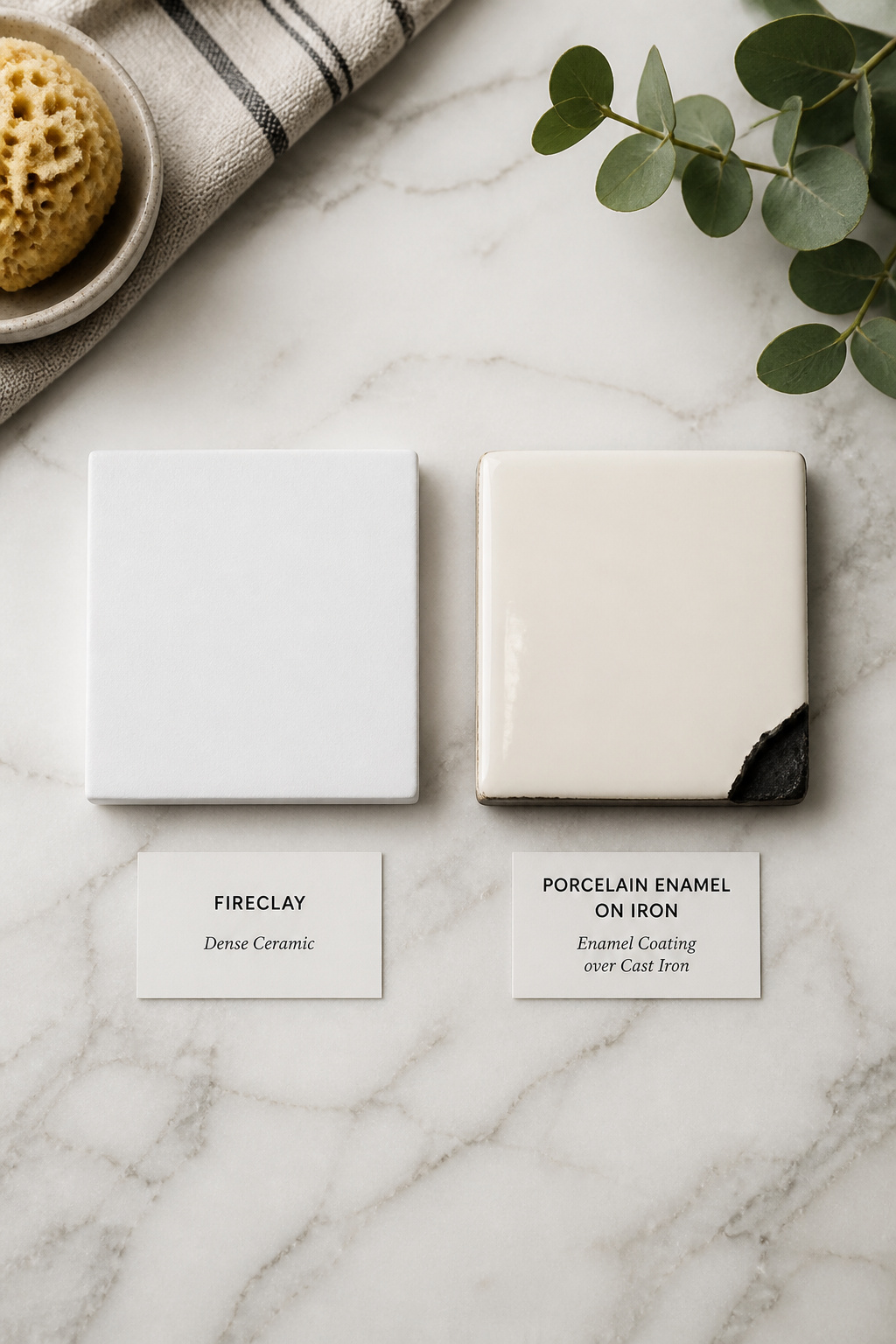
How the comparison table reads
| Attribute | Fireclay | Cast iron |
|---|---|---|
| Price (apron, standard) | $270–$800 ($1,500–$2,039 heritage) | $600–$1,500 ($1,900–$5,000 specialty) |
| Weight (empty, apron) | 80–120 lbs | 110–160 lbs |
| Chip exposes | White ceramic body — no rust | Bare iron — rusts in days if unrepaired |
| Stain resistance | Glaze more porous, but stains sit on top | Enamel less porous — genuinely close |
| Repair | Glaze touch-up kit ~$15–$40 | DIY epoxy $25–$60; reglaze $300–$650 |
| Colours | White / off-white only | Wide range (white, biscuit, black, custom) |
| Lifespan | 20–50+ years | Effectively indefinite if maintained |
The verdict row: pick fireclay if… / pick cast iron if…
Pick fireclay if your budget is $400–$1,000, you cook with cast-iron pans, you want the matte-white look, and you’d rather not have a rust timer on a missed chip. Pick cast iron if your budget starts around $700, you need a colour other than white, you’d rather reglaze than replace, and you’ll patch chips promptly.
Edge cases: budget constraints, existing cabinet strength, and rental kitchens
Under $500, the field narrows to fireclay — apron cast iron starts around $600. With stock cabinets and no reinforcement, fireclay at 80–100 lbs is likelier to ride on a simple 2×4 ledger, while a 120–160 lb cast iron sink may force more cabinet work. Block Renovation notes both want gentle cleaning — neither is zero-maintenance.
What This Comparison Doesn’t Cover: When to Look at the Metal Alternatives
Fireclay and cast iron aren’t the only apron sinks — two metals sit just outside this comparison.
Copper: when warmth and patina are the point
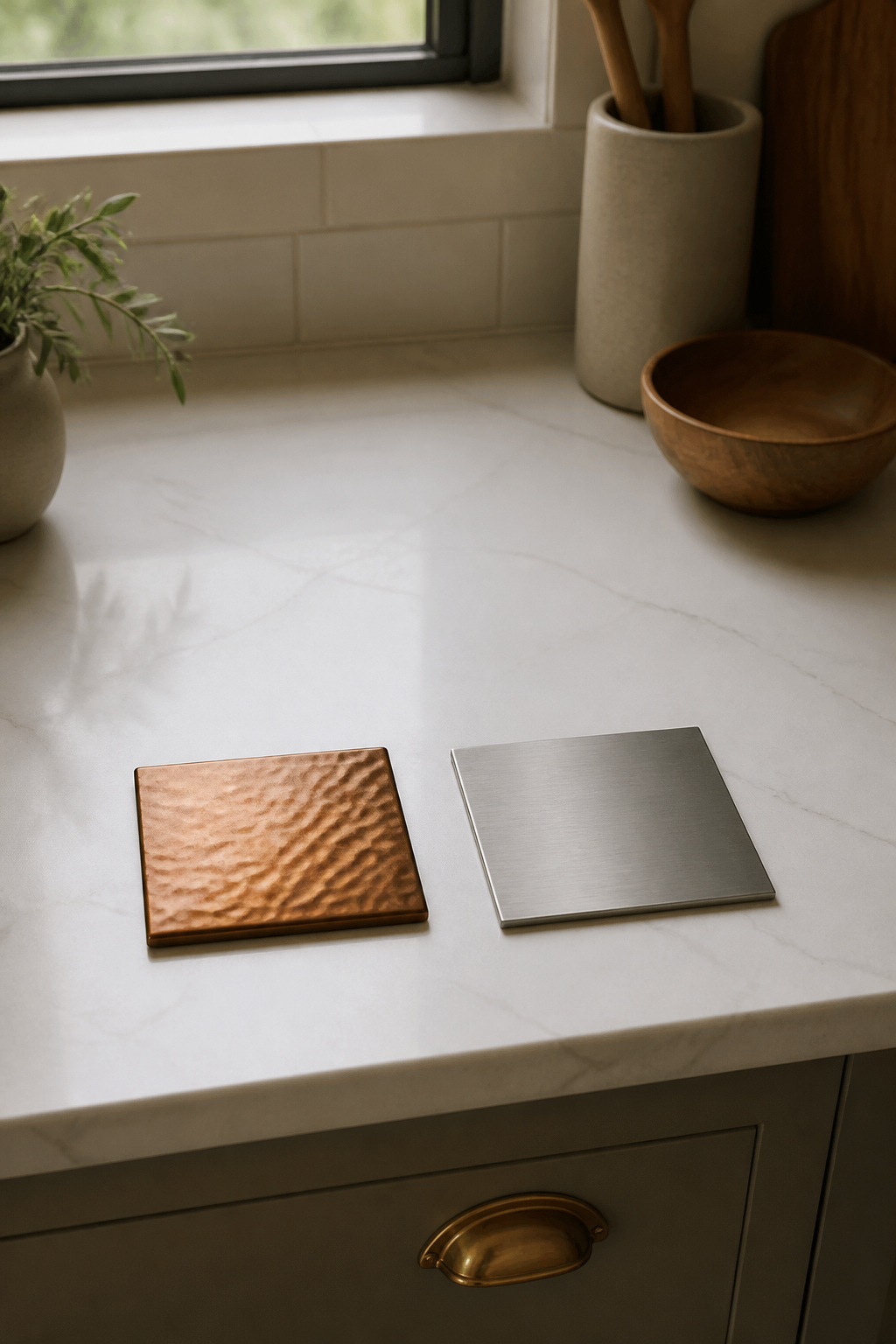
Copper develops a living patina — the darkening is intentional, not damage — the opposite of keeping a white sink new. It’s antimicrobial and at home with warm wood and heritage palettes. If that’s your direction, or consider a copper sink, where the gauge, finish, and patina care get the full treatment.
Stainless: when durability and a modern look matter more than white
Stainless is the lightest apron material — often 20–50 lbs for a 33-inch model — which erases the cabinet-reinforcement question. It’s the most scratch-resistant surface day to day, though it shows water spots. It reads modern and industrial rather than heritage — the line buyers draw against the ceramic-and-enamel options.
Cabinet and Install Implications: How Material Affects the Build
Your material choice shows up before the sink is even in the hole. Weight decides how much cabinet work you’re signing up for.
Weight comparison and what each means for cabinet reinforcement
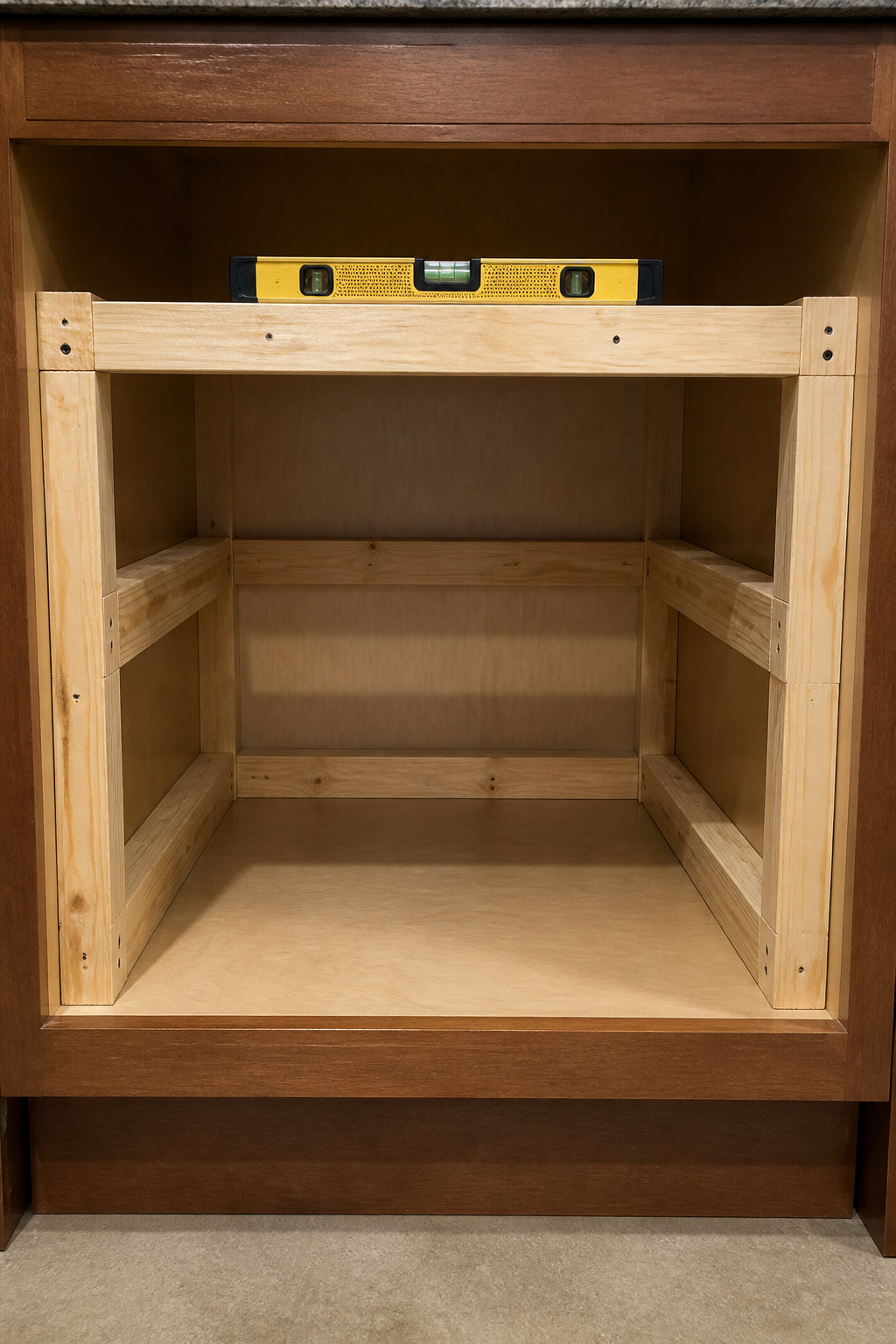
Fireclay at 80–120 lbs rides on a 2×4 ledger frame screwed to cabinet sides and back. Cast iron at 110–160 lbs uses the same frame, but installers add cross-members for the higher weight. Either way, the existing face frame needs notching with a circular saw — irreversible, so measure first.
Which material is easier to handle solo on install day
Neither is a solo job. Fireclay at 80–100 lbs is a two-person lift; cast iron at 120–160 lbs is three. You need the hands to hold it level while you line up the apron cutout.
One mistake to avoid when seating either sink type
Here’s the error I see most: setting the support frame so the rim sits flush with the counter instead of 1/8 inch below it. A flush rim collects water at the seam; a slight drop sheds water into the basin. Cut the face frame before you build the support frame — a frame in place blocks your saw. Seal with silicone, not painter’s caulk. As The Sink Boutique notes, failures “are most often caused by improper load transfer, not the sink itself.”
Both can outlive the kitchen. Fireclay is the lower-drama choice — a missed chip is a cosmetic shrug, not a rust emergency. Cast iron rewards the buyer who monitors and patches. Match the failure mode to your habits, build the frame right, and either will last.
FAQ
Can you repair a chip in a cast iron farmhouse sink yourself?
Yes, with a two-part epoxy porcelain repair kit ($25–$60 at hardware stores, such as Rust-Oleum Tub and Tile). First sand the chip to bare metal with 400–600 grit to remove any rust, then colour-match the epoxy and let it cure for several hours. For large or multiple chips, professional reglazing ($300–$650) is more reliable.
Is fireclay heavier than cast iron?
No — cast iron is heavier at equivalent widths. A typical 33-inch fireclay apron sink runs 80–110 lbs, while a 33-inch cast iron model runs roughly 110–160 lbs empty. Both need a 2×4 support frame and at least a two-person install, and cast iron’s extra weight is why three people are recommended for it specifically.
How long does a fireclay farmhouse sink last?
With proper care — non-abrasive cleaning, a sink grid to absorb cookware impacts, and prompt chip touch-ups — fireclay farmhouse sinks last 20–50+ years. Elkay and BOCCHI back this with limited lifetime residential warranties on defects. What ends one early is cracking from severe thermal shock or heavy impact, not the ordinary chip, which is cosmetic and repairable.