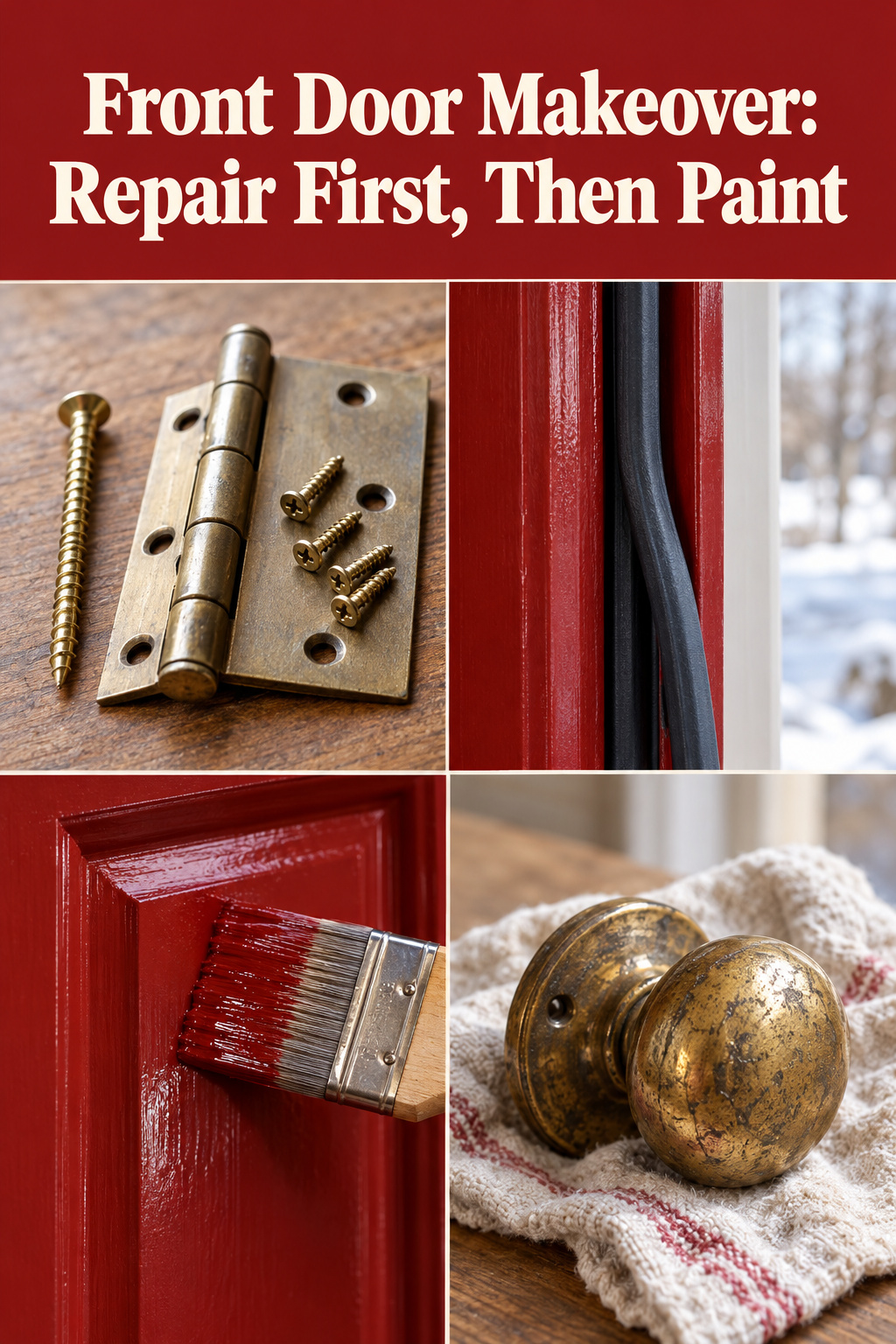
The front doors at Mount Vernon are a pair of leaves, each a frame of two stiles and four rails joined by mortise and tenon, with panels left floating so they can swell and shrink. We know the original doors were a two-leaf pair because Benjamin Latrobe painted the Washington family on the piazza in 1796, with the doors behind them. The 1954 pair, made of fast-grown pine, lasted over 60 years before traffic and weather finished it, and in 2018 a carpenter built replacements by hand from salvaged old-growth yellow pine. Most people planning a front door makeover picture a new color, or a quote for a new door because the old one sticks. Both skip the part that decides whether the paint holds.
TL;DR
- Repair comes first: drive hinge screws long enough to reach the framing (3 in is the common example), then weatherstrip, because the DOE’s own work specification says to fix loose hinges and strike plates before sealing a door.
- Paint with the hardware off, edges included on every coat, on a dry day around 60–75°F, out of direct sun.
- Replace only when the door fails a real check such as rot, a racked frame or a delaminated skin; installed replacements run about $550–$2,000 in one 2026 guide and $800–$2,500 in another.
A Front Door Makeover Is Not a Paint Color
A door that rubs its jamb scrapes fresh paint off the edge every time it closes, and a door that binds presses new paint against the frame before it hardens, so it peels. Benjamin Moore points to two causes of sticking paint: coats that haven’t cured when the door closes, and old coats so thick there’s no room left for the door to move.
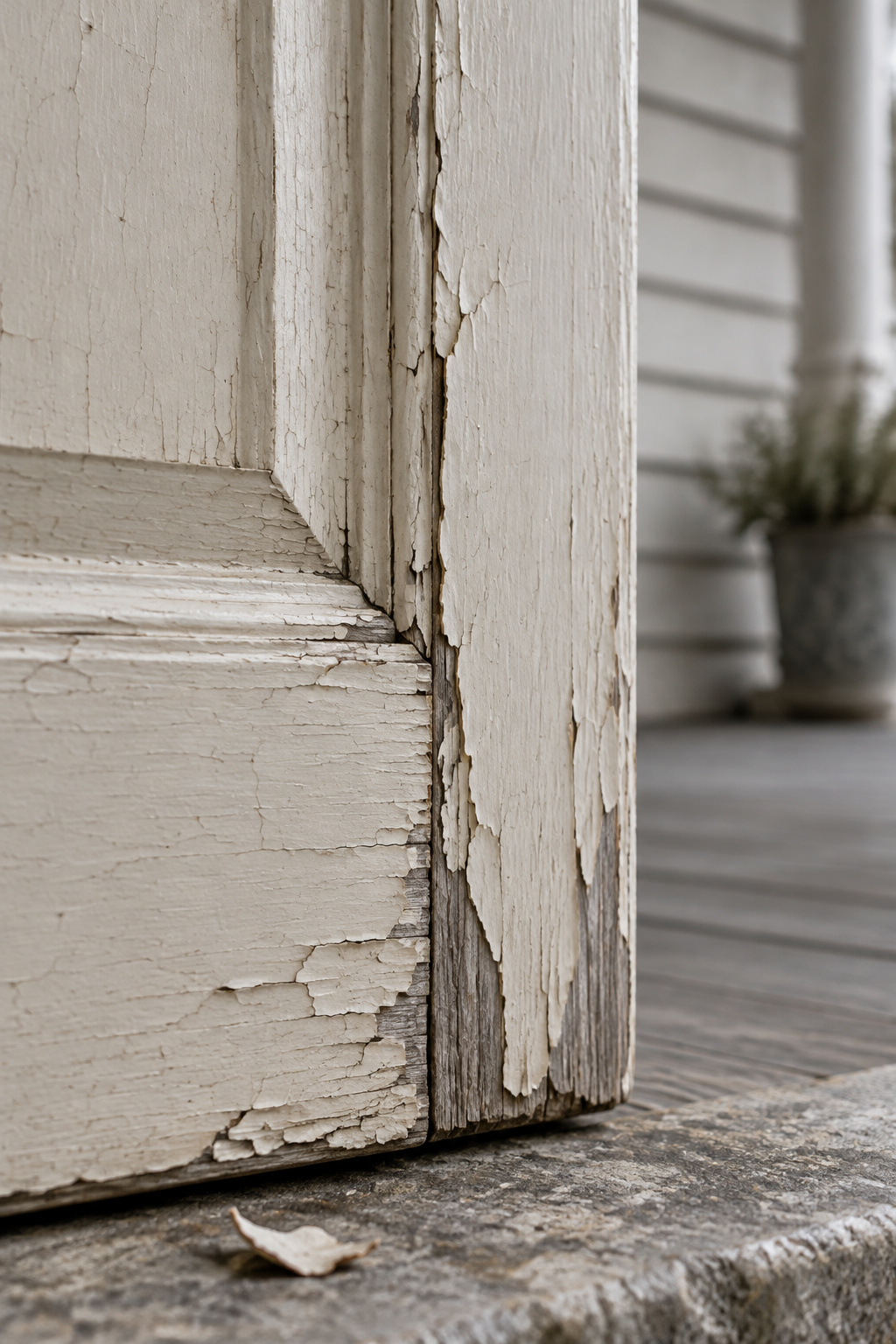
The order I work in is repair, then paint, then hardware, with color chosen last. The SPAB, the British conservation society, says existing doors can frequently be repaired and upgraded for draught-proofing, and that replacement is a last resort. I agree. If you rent, ask your landlord before you take a door off its hinges or paint it. A rehung door is reversible; paint on someone else’s door isn’t.
The door comes first among the weekend entryway projects because everything else in the hall is planned around it.
Sag, Draft, Rattle: Three Repairs Before Any Paint
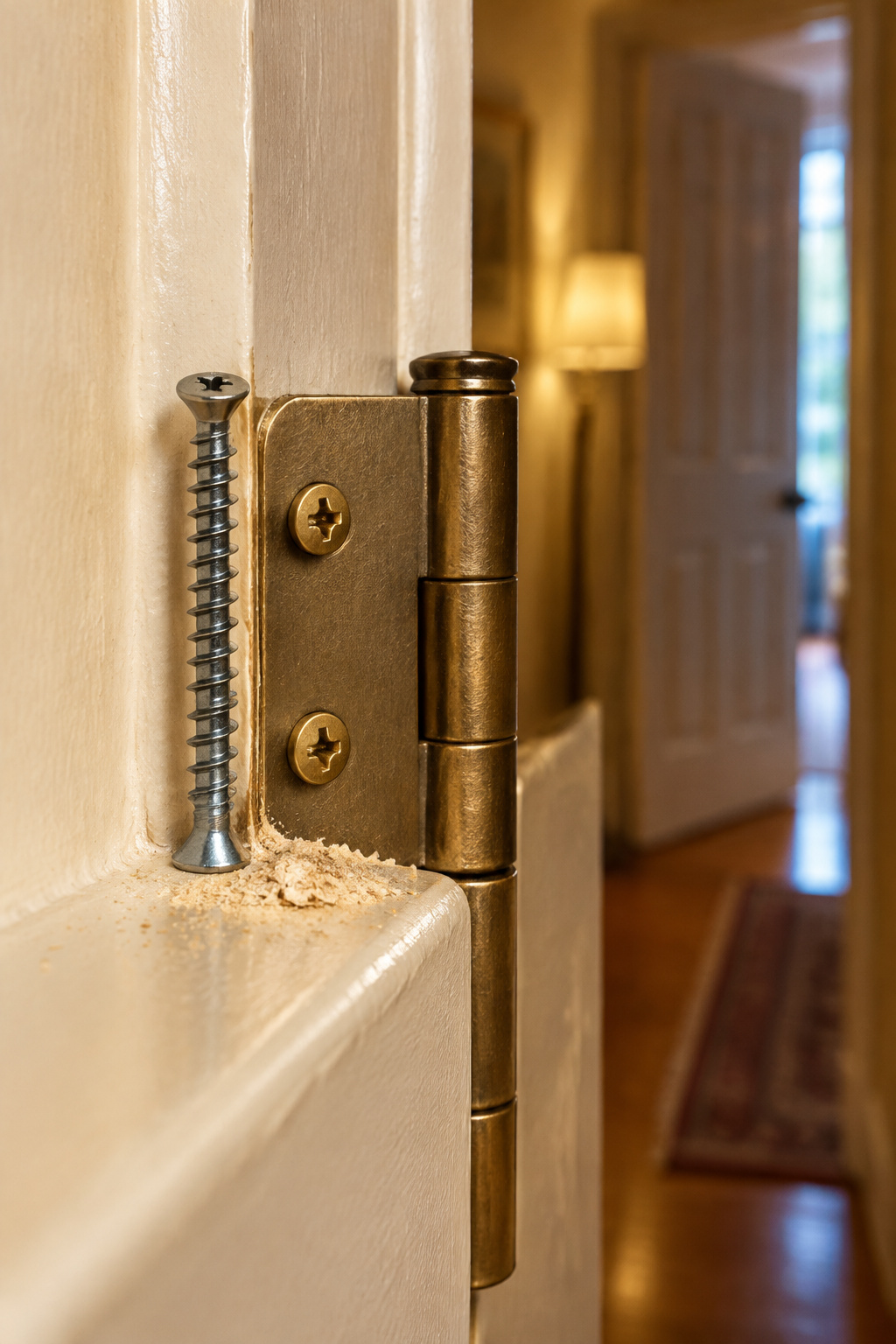
Open the door halfway and lift the handle. Any hinge leaf that moves needs new screws. The top hinge carries most of the door’s weight, and its original screws, usually about an inch long, bite the jamb and nothing behind it.
| Symptom | Usual cause | The fix |
|---|---|---|
| Sag: latch side drops, top corner rubs | Short or loose screws in the top hinge | Swap the jamb-side screws for ones long enough to reach the wall framing; fill a stripped hole with a glued dowel first |
| Draft: daylight or a loose fit | Gaps at the stops and under the door | After the hinges, weatherstrip the top and sides and fit a sweep; aim for less than 1/4 in under the door |
| Rattle: door shifts when latched | Latch sits loose in the strike plate | Bend the metal tab in the strike plate out slightly (This Old House); the SPAB calls it adjusting the keep |
Guides range from half an inch longer than the original to 3 in; what matters is reaching the framing, and 3 in is the common example. On a hollow-core door the stiles can be only an inch thick, so a long screw on the door side hits air, and the fix belongs on the jamb side.
The Department of Energy’s work specification for weatherstripping an exterior door tells the installer to adjust loose hinges, knobs and strike plates before fitting the strip. For a 36 by 80 in door you need 196 in of strip for the top and both sides, and buying 5 to 10 percent extra brings that to about 206 to 216 in.
Repair or Replace: the Verdict and the Four Checks That Settle It
Before I’ll price a new slab, I fix one hinge and see what the door does. When it still won’t close, these four checks are the sequence I use to decide:
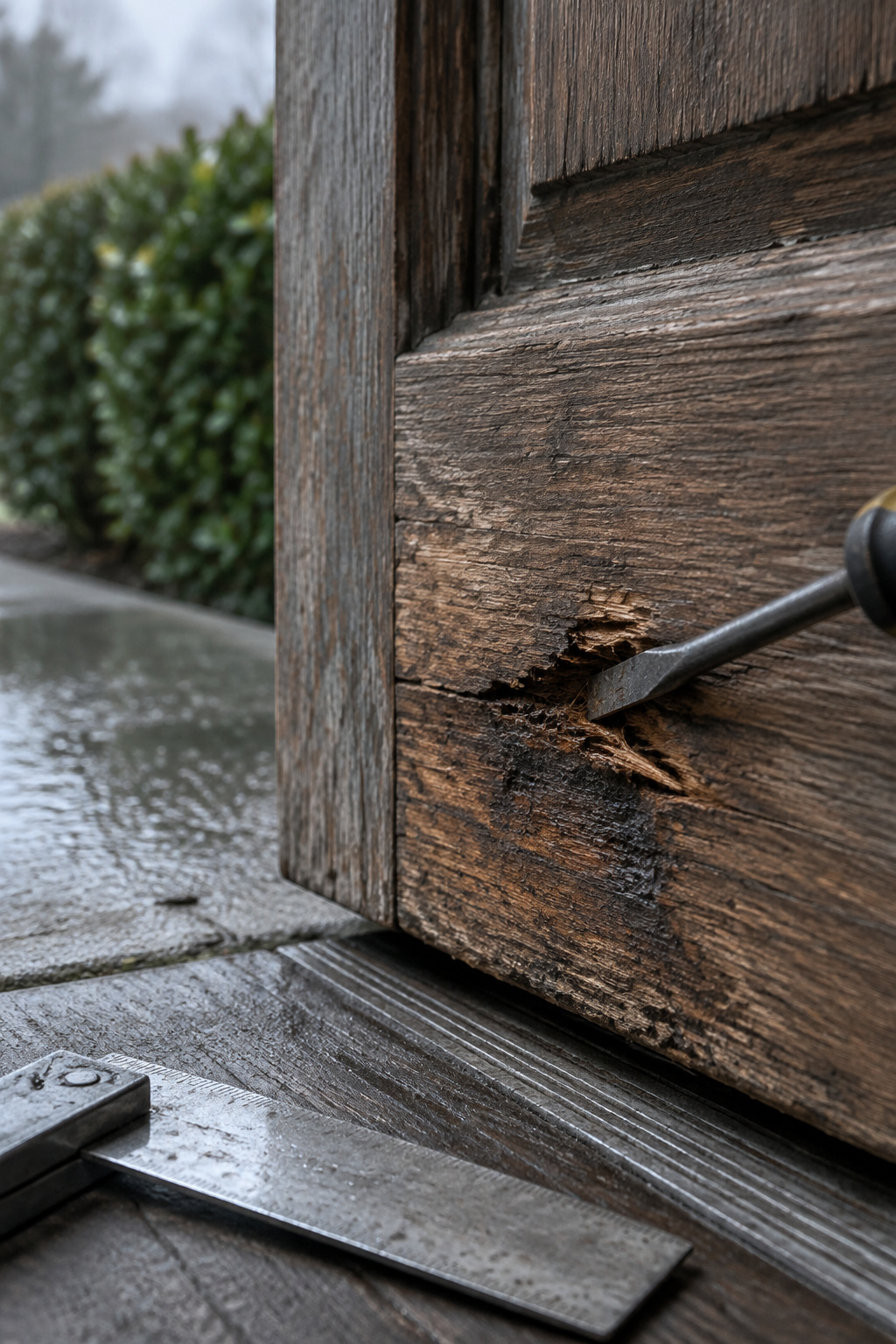
- Rot at the bottom rail. Paint over soft or rotted wood there is wasted. If the rot runs into the frame, replace the whole prehung unit, not just the slab.
- A racked frame. If no hinge adjustment lets the door close, the opening has probably changed shape as the foundation settled, common in old houses. Reshaping a frame is a job for a pro.
- A failed skin or core. A delaminated door or a finished insulated core points to replacement, and so does a hollow-core door whose hinge-side stile has come loose and won’t hold a screw.
- Rubbing only. If the slab is square and the weatherstrip still seals, it’s a repair. Tighten the hinges first, and plane only if it still rubs, then seal the bare edge.
One 2026 guide puts a standard prehung steel or fiberglass door at about $550–$2,000 installed, and another at $800–$2,500 with basic weatherstripping. Against that, one Massachusetts contractor charges $250–$750 to repaint a standard front door.
Once the door swings freely, plan the furniture around it, starting with a table sized to the door swing.
Paint the Door Exterior With the Hardware Off, in One Weather Window
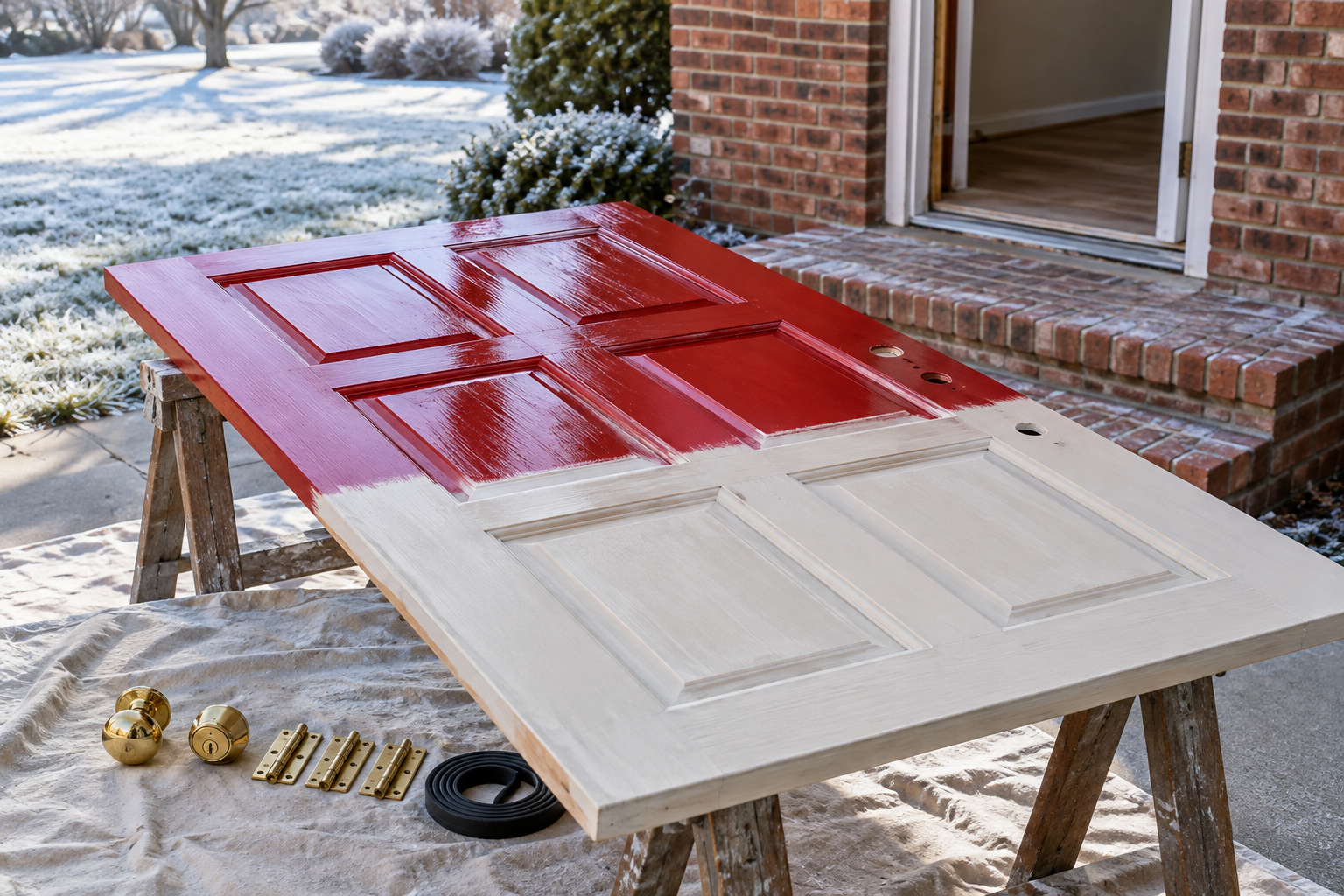
Pick the day before you pick the color. Aim for dry weather around 60–75°F, with low humidity and the door out of direct sun; one door paint’s data sheet allows 50–90°F with humidity under 75%, and whatever your can says overrides both. Once the door has been hung and has dried, paint the floor inside it in the next dry spell.
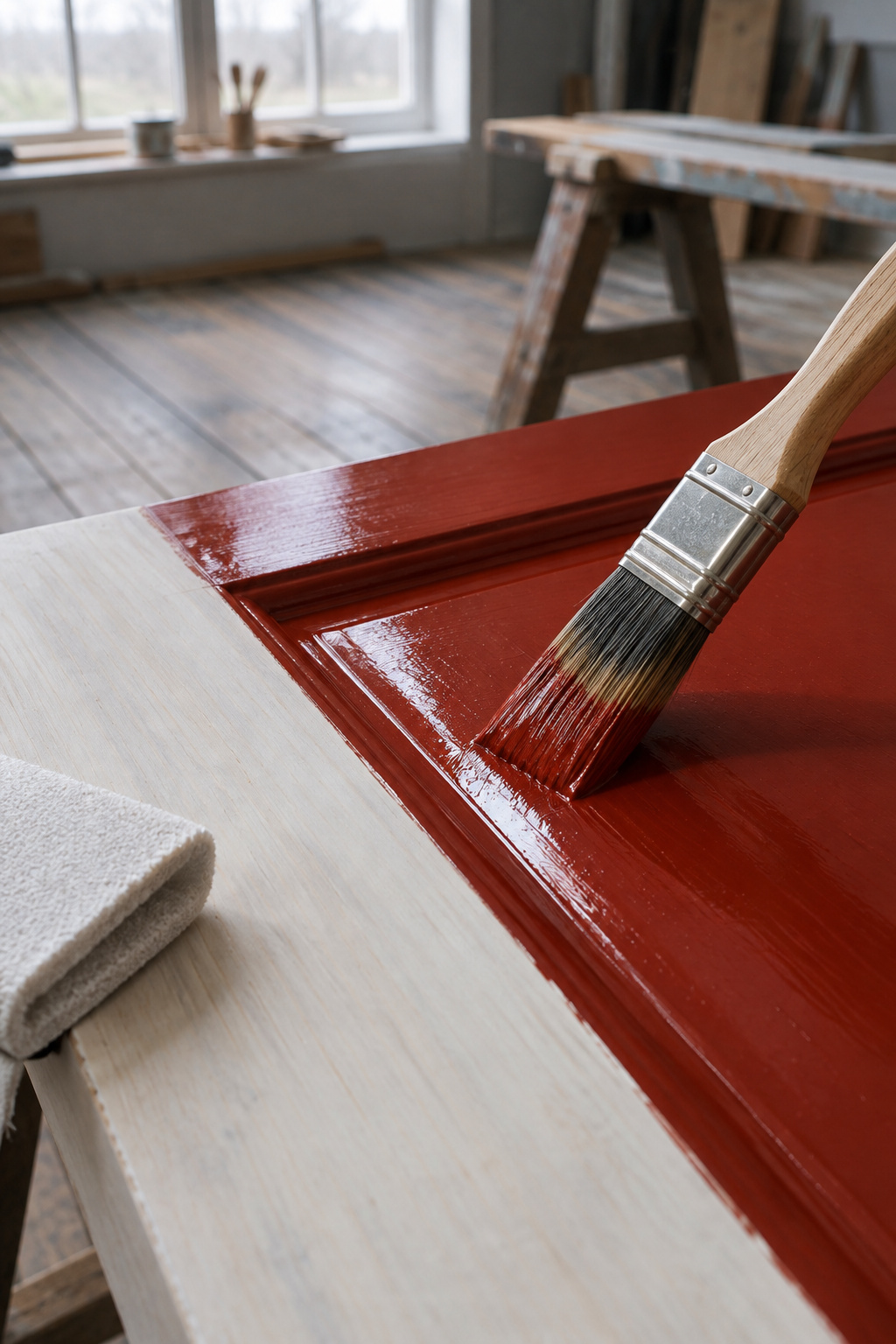
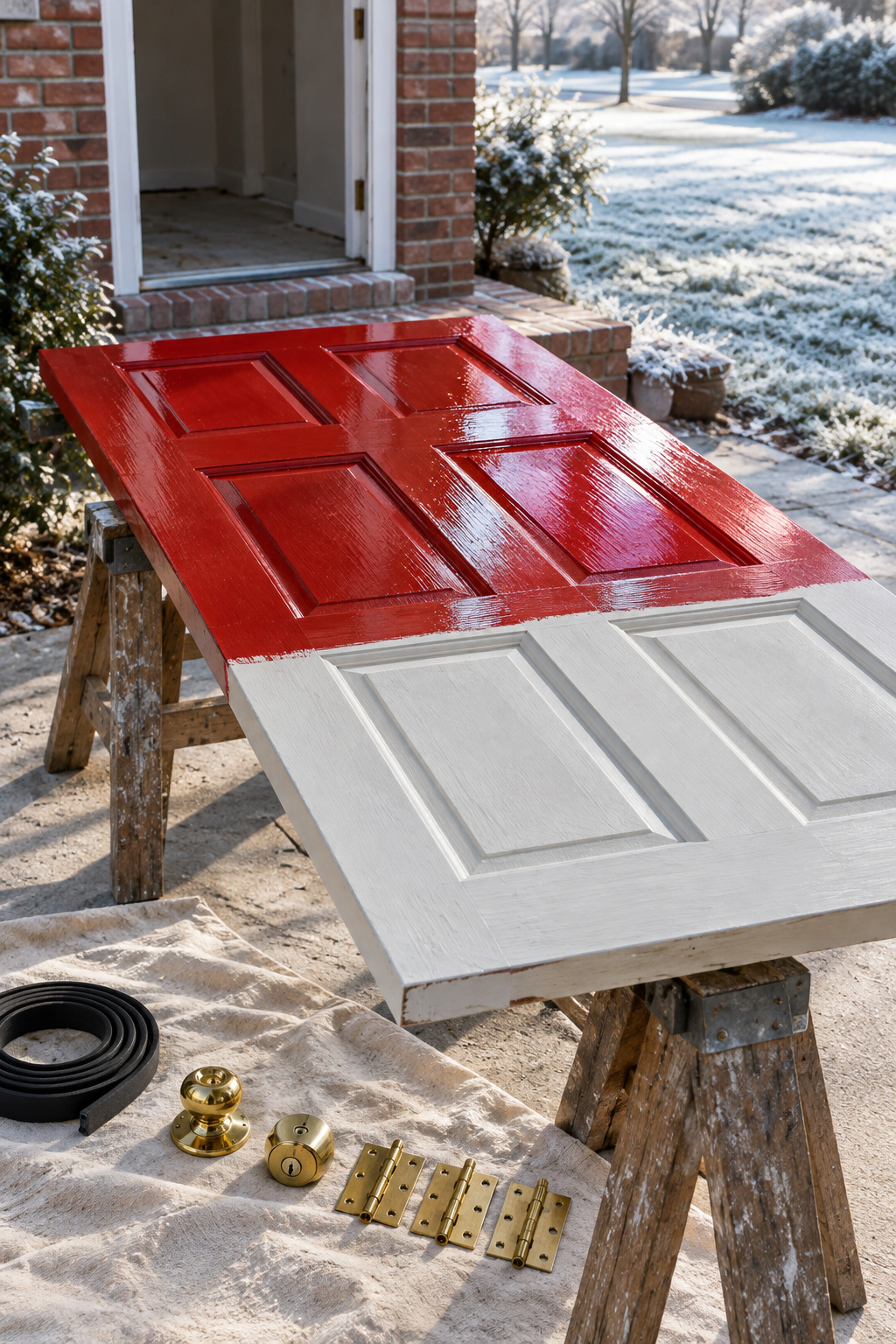
- Take the hardware off. Photograph it in place, then bag the parts in labeled bags. Taping around a knob can leave brush marks.
- Check the edges. If the door still rubs anywhere, sand or cut that edge to make room for the new coat. Sand down old paint that has built up thick.
- Wash with a mild detergent or TSP and let it dry.
- Sand along the grain to dull the gloss, for example 120-grit then 220. Fill cracks with wood filler, sand flush and wipe the dust off with a tack cloth.
- Prime bare wood, stains and any big change from dark to light. Stained or varnished wood needs a stain-blocking primer or the tannins bleed through.
- Two coats, with the top, bottom and side edges getting every coat the face gets. Simpson Door, a wood door maker, wants all six surfaces finished, and sealed edges keep moisture out.
I used to strip every painted door to bare wood, until I learned some were always meant to be painted. Why fresh paint sticks to weatherstrip, and how long it takes to cure before you close the door on it, is covered in the interior front door color article on the site.
Pre-1978 doors: lead-safe first
The U.S. banned lead paint for consumer use in 1978, so treat any door painted before then as if it contains lead. EPA’s RRP rule requires certified firms and lead-safe practices when someone is paid to renovate or paint a pre-1978 home. If you do the work yourself, EPA advises lead-safe practices; it doesn’t require certification, though your state or city may add rules. Never use an open flame, a heat gun above 1100°F, or a power sander without a shroud and HEPA vacuum. Contain the area, clean up with a HEPA vacuum and wet wipes, and bag the waste. Lead paint on a surface that rubs is a hazard even when intact, one more reason to fix the rub first.
Hardware: Restore It or Swap It, but Never Paint Over It
Painting over original hardware is worse than replacing it. A swapped knob can go in a drawer and back on the door whenever someone wants it. A painted hinge has its finish buried, and the next owner has to strip it, under lead rules if the paint is old. Paint build-up is a common reason old doors operate badly, and one heritage guide advises against painting hinges.
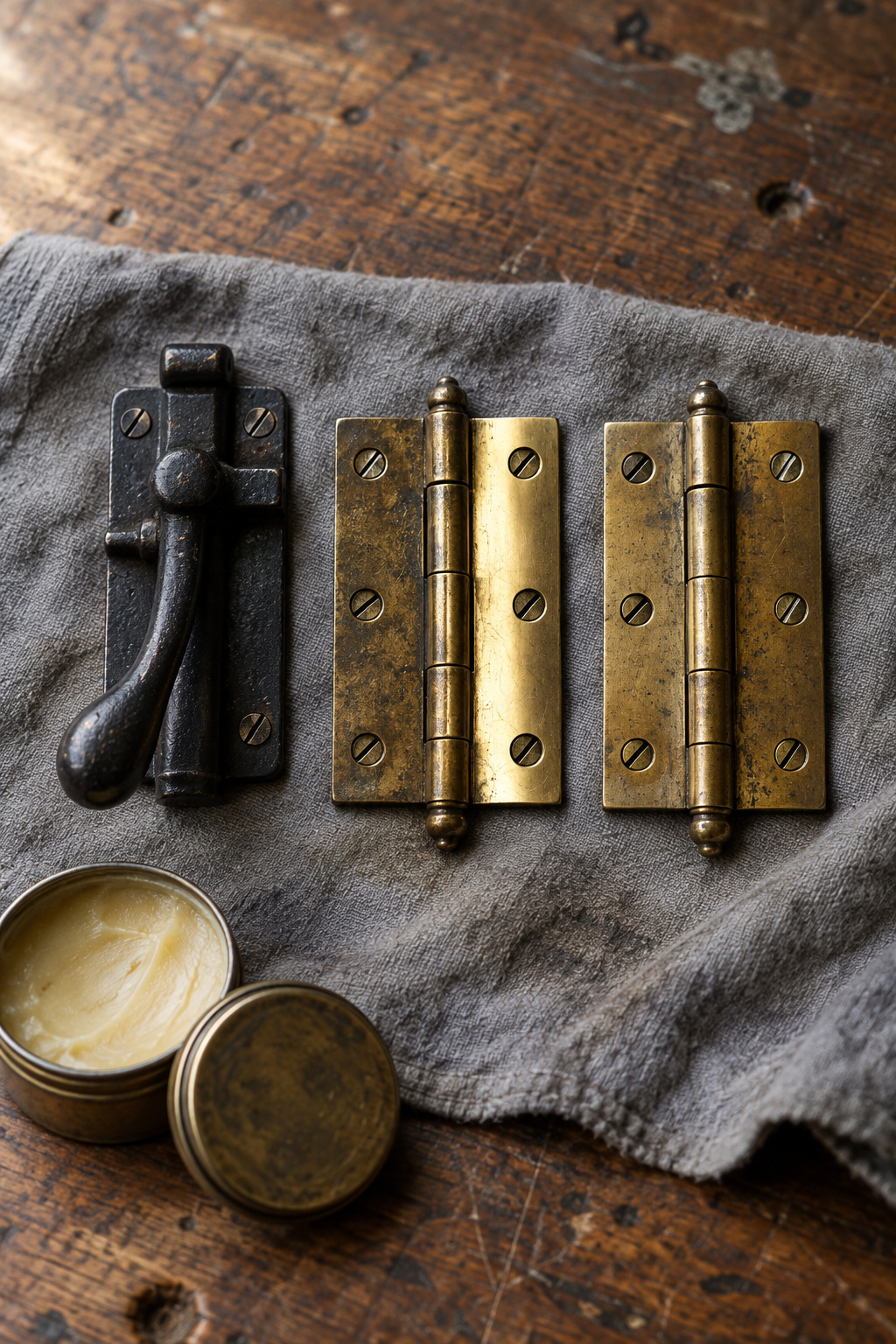
With the hardware off for painting, look at it properly. Let’s see what it’s made of. Clean it with a soft damp cloth and go easy on mineral spirits, which strip original finishes if used often. Leave a patina alone rather than attacking it with chemicals. I prefer powdered graphite to oil, which collects dirt.
Swap what is worn out, missing or unsafe. Missing pieces can be found at restoration shops, and my old pickup usually has a salvaged door or two in the back. Where an old lock can’t meet modern security expectations, add a modern lock alongside it and keep the original plate. If a smart lock or a light by the door needs wiring, I hand it to an electrician.
Color Last: a Short Shortlist and the Principles to Keep
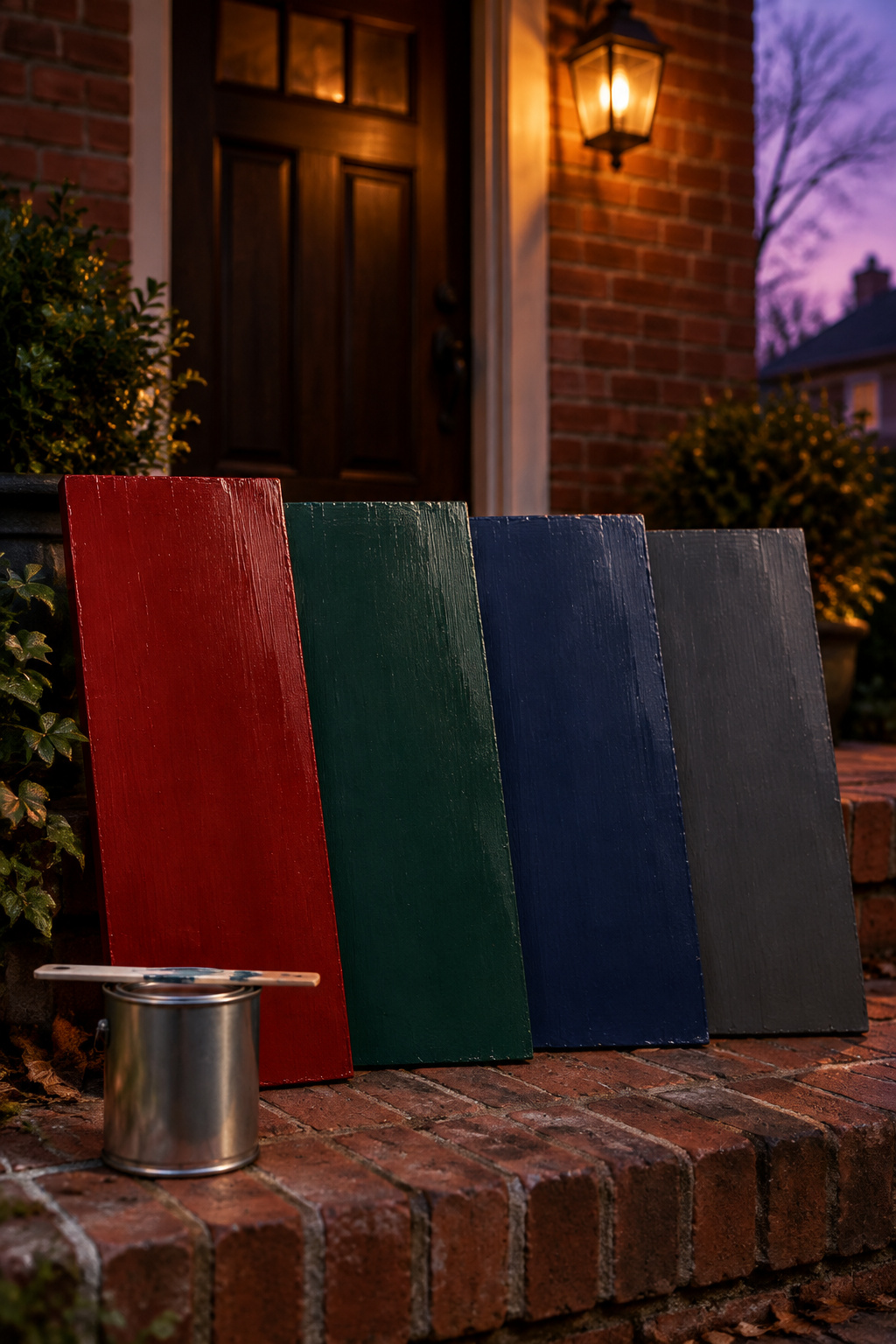
For color, one door paint maker’s quart range is a sensible shortlist: black, white, cranberry, a deep navy, gray and a dark green. The list comes from one product line. A saturated red usually needs three coats unless the primer is tinted about halfway toward the topcoat. Judge any dark color on a large board with two coats, moved around and seen in three kinds of light, never from a small chip. The inside face of the door is a separate color decision that the interior front door color article works through.
The principles I’d keep:
- Fix the sag, draft and rattle before buying paint; the DOE sequence puts hinges before weatherstrip.
- Replace only when a check fails: rot, a racked frame or a dead core.
- Hardware comes off for painting and never gets painted.
- Every coat goes on all six surfaces.
A front door makeover is mostly mechanical work, and I’d allow a weekend or two for it. Sometimes the door you thought needed replacing just needs its screws. I can tell you whether a door is worth saving and how; a racked frame, a rotten sill or anything with wiring needs a carpenter or an electrician standing in your doorway.
FAQ
Should you take the door off its hinges to paint it?
You don’t have to, but it helps. Painting in place works on a door in good shape, while laying it flat gives cleaner lines and fewer drips. Either way, take the hardware off and paint the top and bottom edges. A door can weigh 45 to 90 lb or more, so get a helper to lift it.
What sheen is best for an exterior front door?
Satin or semi-gloss is best for most front doors, because a higher sheen hides imperfections and wipes clean more easily. Use an exterior acrylic latex rated for UV and weather; a premium 100% acrylic lasts around 8 to 12 years or more on wood. Buy a good door-and-trim product, since cheap gloss sticks in warm, damp weather.
How much does a DIY front door makeover cost?
There’s no parts total that holds everywhere, because screw, sweep, weatherstrip and lockset prices vary too much. What you’re comparing against is clearer: one Massachusetts contractor charges $250 to $750 to repaint a standard door, and a replacement runs about $550 to $2,000 installed. One quart of Rust-Oleum Door & Trim covers two coats on each side of a door.