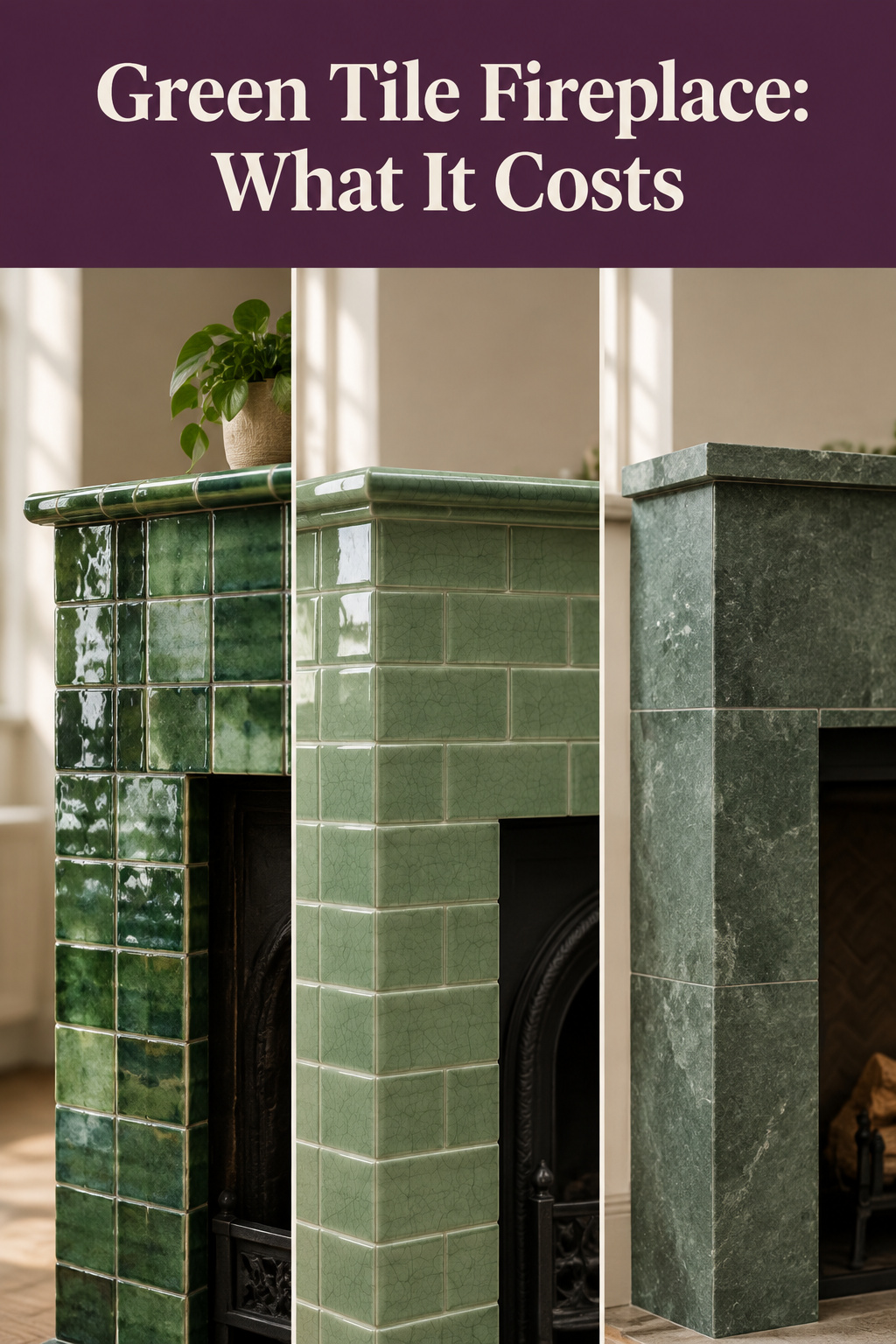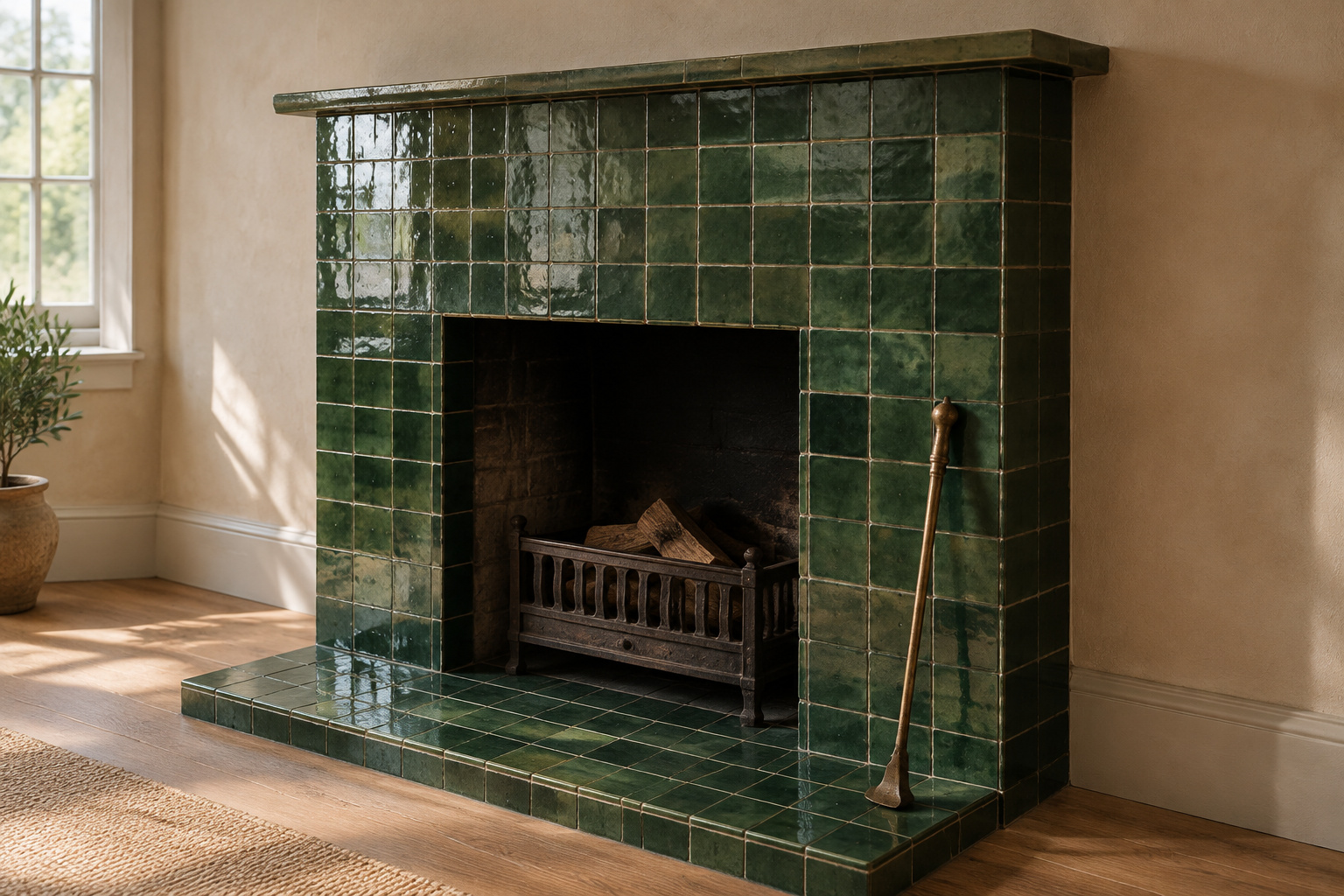
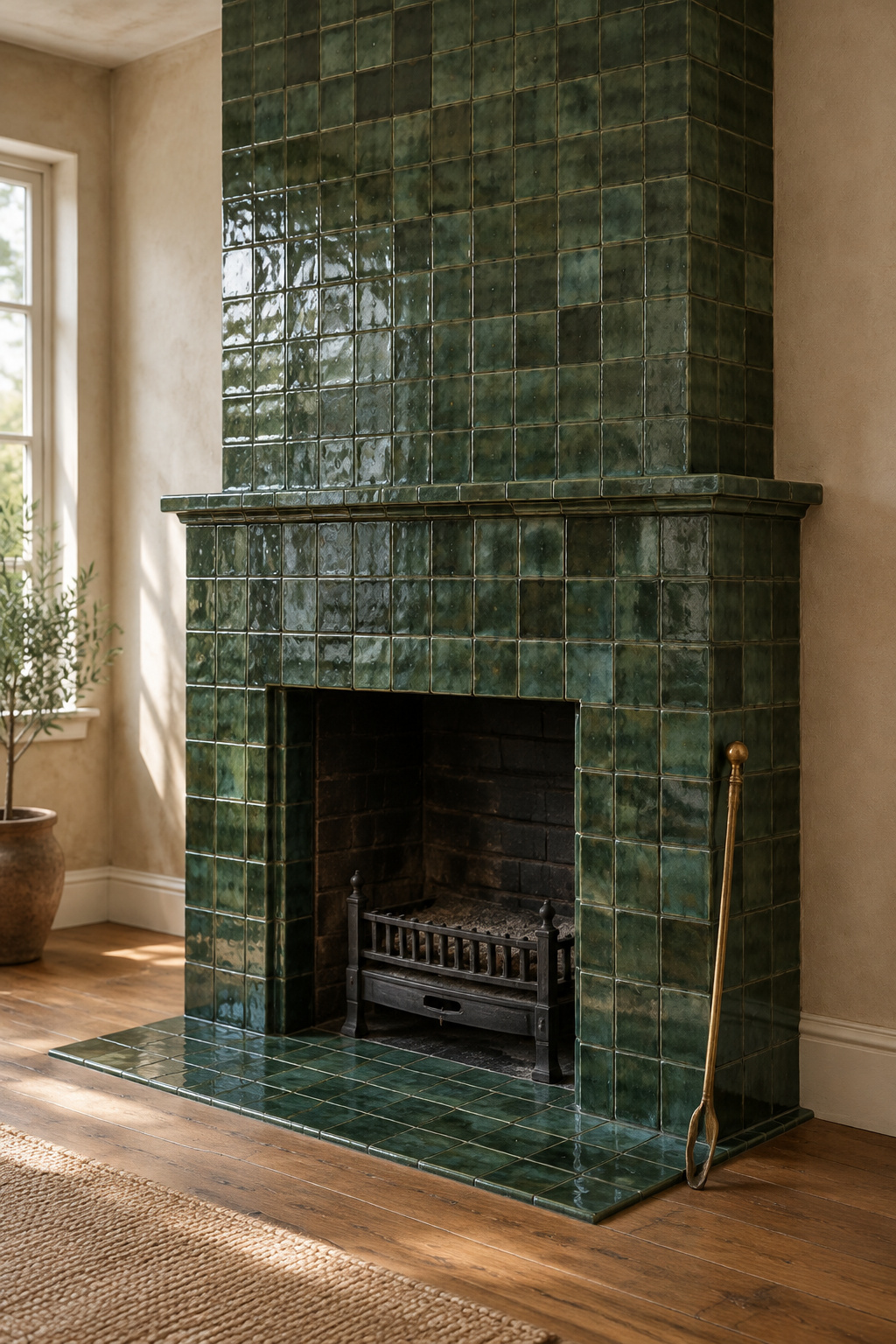
The green tile on your inspiration board was probably made the way Fez has made it since the 10th century: clay shaped by hand, dipped by hand, fired in a beehive kiln burning olive branches. That is why one green tile fireplace surround costs $7 a square foot and the next costs $60. Photos flatten that. Your invoice won’t.
TL;DR
- Authentic handmade zellige runs $15 to $60 per square foot, material only, typically $18 to $28 imported from Morocco. Machine-made lookalikes are $7 to $10.
- Order 15% to 25% extra tile to cover breakage, cutting and color variation, and blend from several boxes as you set.
- Combustible trim on the fireplace front stays at least 6 inches from the opening, per Section R1001.11 of the 2024 IRC.
Where the Green Handmade Look Actually Comes From
Zellige’s origins as hand-cut, kiln-glazed Moroccan tile
Zellige comes out of Fez, where the craft dates to the 10th century. Each tile is hand-shaped from local clay, sun-dried, hand-dipped in glaze and fired in beehive kilns fueled by olive branches. It has stayed largely unchanged for over 1,000 years and is UNESCO intangible cultural heritage.
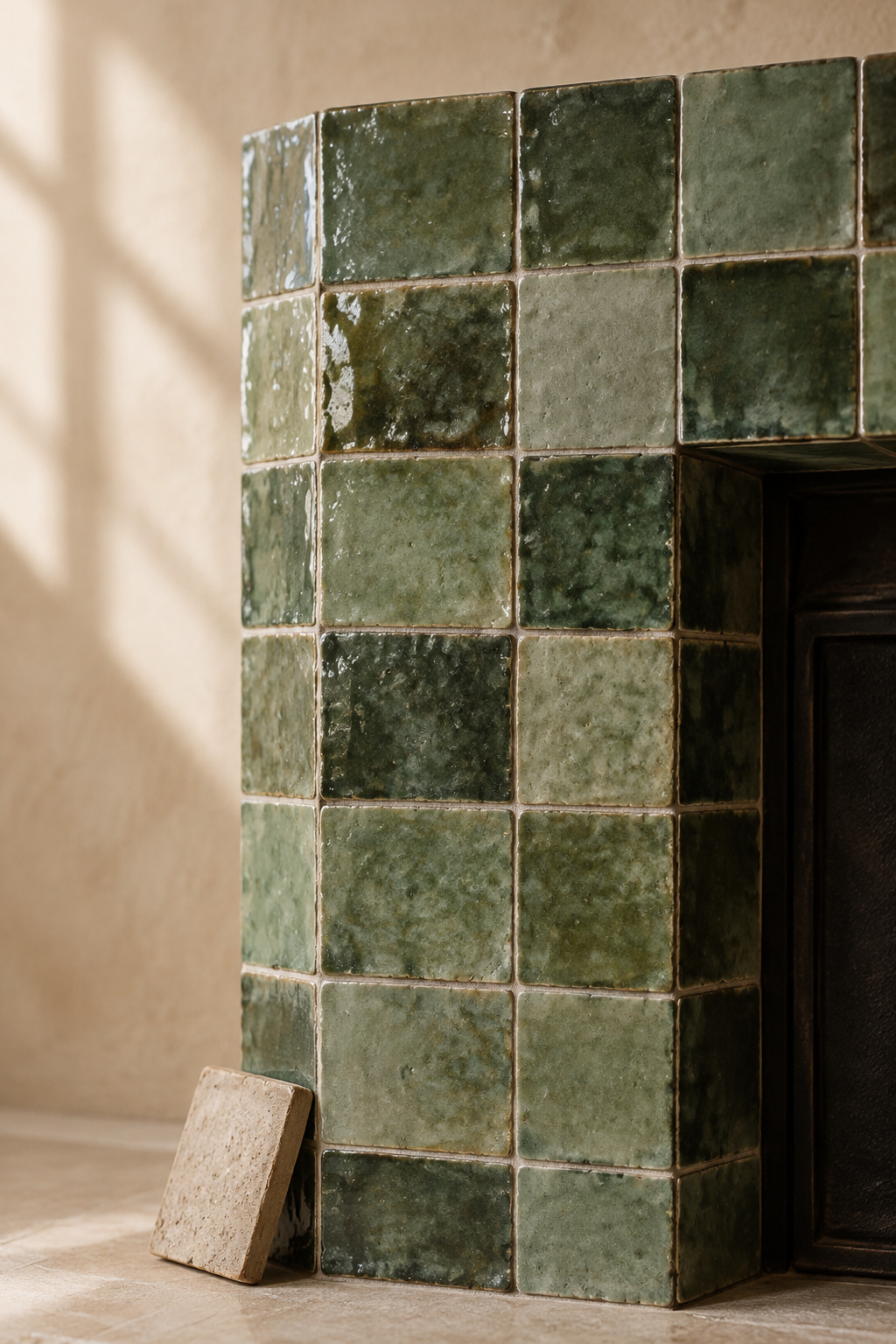
Why handmade glaze varies tile to tile — and why that’s the point
Hairline cracks, glaze shifts and thickness variation up to roughly 3/16 inch per tile are marks of character, not defects. Quality also swings hard supplier to supplier, because individual artisan teams make these by hand. The color’s own history is told in where those green glazes come from.
What that heritage costs you once it’s on a modern fireplace
Authentic zellige runs $15 to $60 per square foot, material only, and imported Moroccan tile typically lands at $18 to $28. Lookalikes give the same look for $7 to $10. The premium buys variation, not toughness. Zellige chips underfoot, so vertical facing is its home.
What a Green Tile Fireplace Surround Costs: Four Tile Classes Compared
Skill levels below use my usual scale, not difficulty stars.
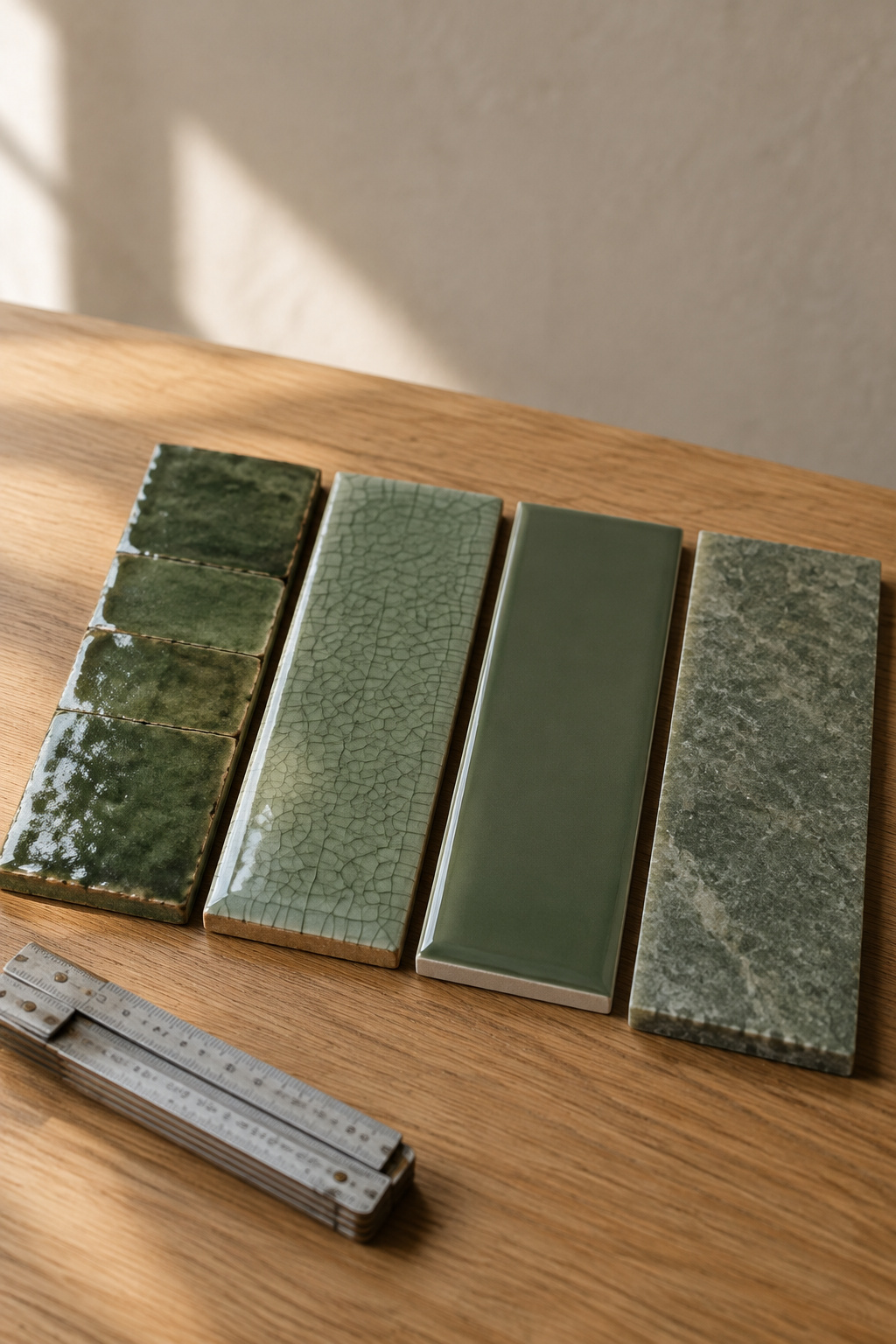
| Tile class | Material $/sq ft | Box-to-box variation | Skill level |
|---|---|---|---|
| Handmade zellige | $15–$60 (typically $18–$28) | Highest, by design | Some builds behind you |
| Crackle-glaze ceramic | Roughly $30–$48 (estimate) | Glaze varies, format doesn’t | Some builds behind you |
| Machine-made subway | $1–$8 | Minimal | First build |
| Honed green stone | $15–$50 | Low, but damage can’t be patched | Confident builder, or hire |
Handmade zellige: price, variation, and what it demands from an installer
Thickness varies piece to piece, so you back-butter every tile and adjust its bed instead of laying a flat bed. That is why the NTCA added a dedicated zellige installation document to its 2024-2025 Reference Manual.
Crackle-glaze ceramic: the mid-ground option
Treat this as an estimate for the glaze family, since I could find no independent crackle-specific pricing. Fireclay’s own 2026 price sheet puts handmade artisan field tile at roughly $30 to $48 per square foot.
Machine-made subway tile: the consistent, budget-friendly choice
At $1 to $8 per square foot, $7 to $35 installed, this is the cheapest way to get green onto a chimney breast. Uniform thickness means a flat bed and no per-tile adjustment. It’s the forgiving choice for a first tile job.
Honed green stone: the highest cost, the least room for error
Natural stone tile is $15 to $50 material and $15 to $75 installed, with the highest labor rate of the four at $12 to $22 per square foot. That pays for waterproofing membrane, sealing and stained thinset. A chip can’t be reglazed. It gets replaced.
How Much of This Job You Can Actually Do Yourself
What a confident DIYer can tackle: the substrate and the field tile
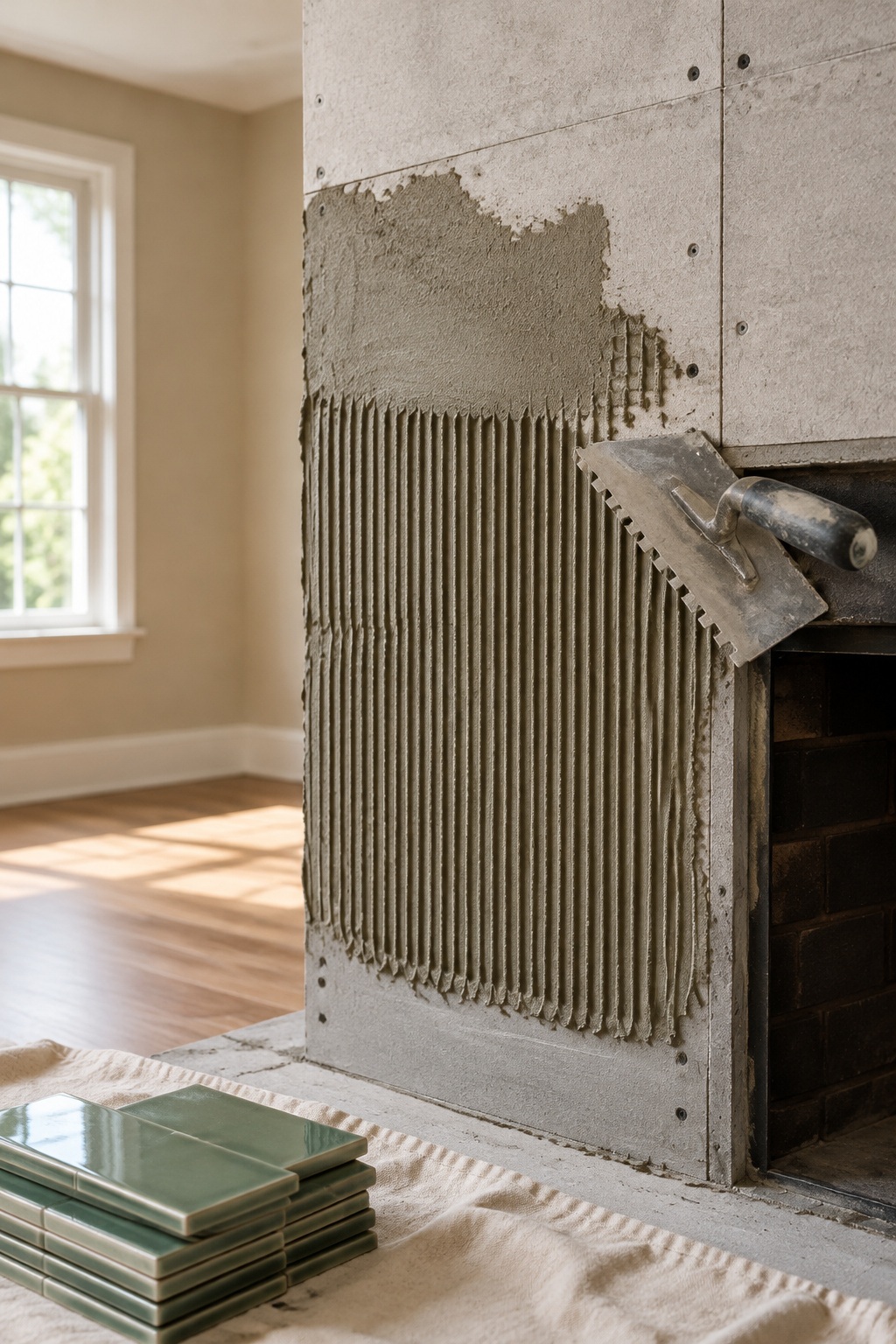
Tiling a surround is cosmetic work with no structural component, a genuine weekend project. Brick won’t take tile directly. Skim it with thinset at a mayonnaise consistency, worked into every mortar joint, then allow 24 to 48 hours of drying time. Framed drywall wants cement backer board. Jake Anderson, 200-plus installs in, says: “Tiling is 90% prep, 10% installation.”
Where hiring a tile setter earns back its cost
Zellige sets about twice as slow: 12 hours for 150 square feet, against about 6 for subway. Nobody publishes setter rates for a surround specifically, so these are general zellige and stone labor figures. What follows is my read, not a rule. Eight years running crews for a remodeling contractor in Tennessee taught me the tell: every setter dry-laid the rows and measured twice before mixing a batch. Pros measure and beginners guess. Tiled before and the area is small? Take it on. First tile and a bill in the thousands? Hand it over.
The mistake that turns a weekend project into two
Don’t score and snap handmade tile. Snappers crack zellige more than half the time, so use a wet saw with a continuous-rim blade, rented for the day if you won’t own one. Don’t work carton by carton either: that clumps color by shipment and can’t be fixed after grouting. I budget the extra weekend out loud, since thinset goes off in the bucket whether you’ve decided or not.
Grout Color Against a Green Glaze
Why the wrong grout can flatten a beautiful glaze
A stark cool-white or cool-gray grout against a sage or olive green looks clinical, and the contrast drags the green toward a dull, lifeless tone. Haze is the costlier failure, since it’s hard to lift off a porous handmade glaze without damage. Seal the tile face before grouting.
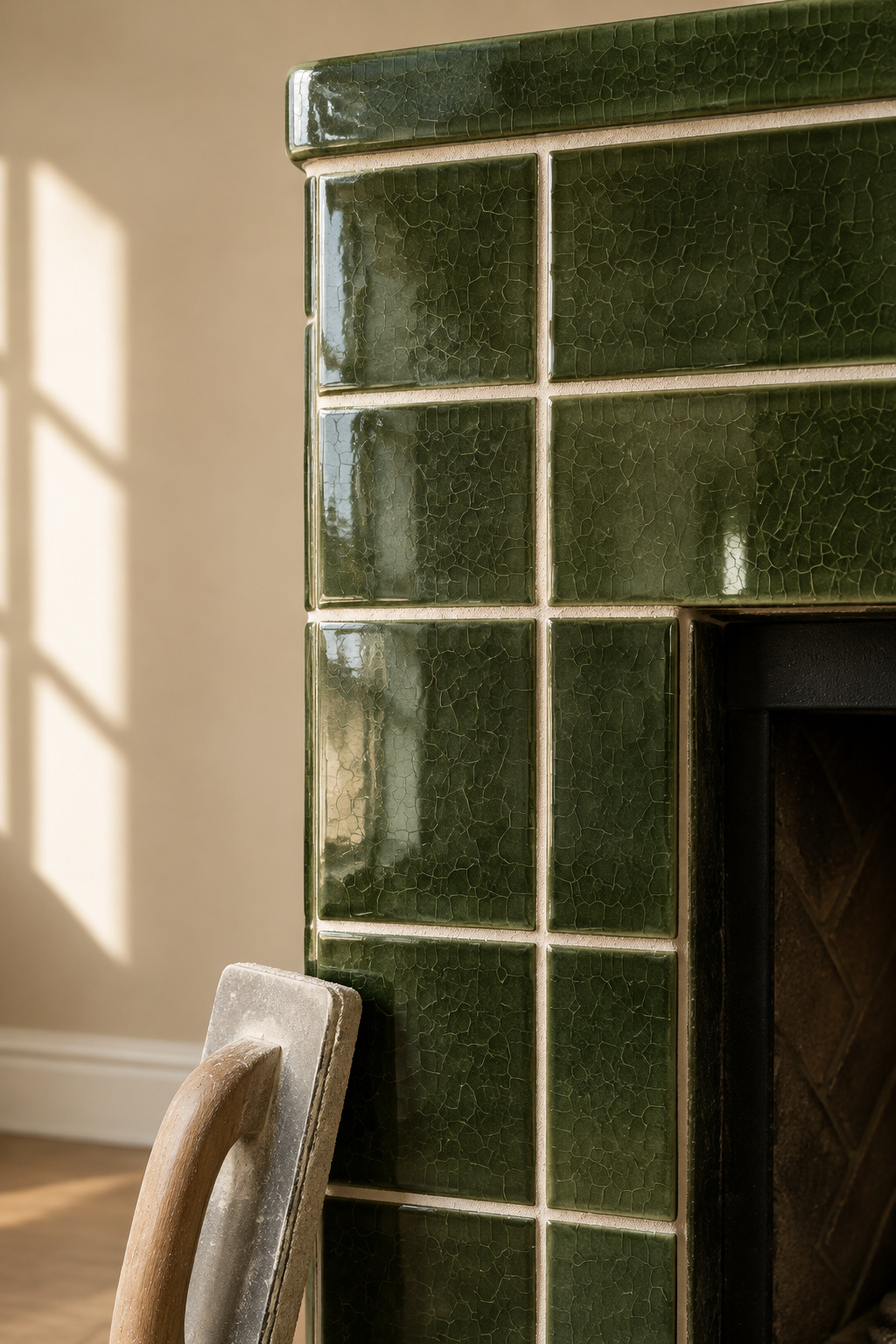
The grout tones that let the green read clearly
Warm white, meaning a beige or cream undertone rather than a cold bright white, gives gentle contrast that shows each tile’s shape without competing with the glaze. On a deeper emerald or bottle green, invert it: charcoal grout makes the shape and glaze depth read as deliberate. Choose off a grouted sample board, not a chip.
Sanded vs. unsanded — which this job actually needs
For zellige, keep the joint 1/16 inch or narrower and use unsanded or fine-aggregate polymer-modified grout, since coarse sanded grout scratches the glaze. Mapei Ultracolor Plus FA is the usual reconciliation. Standard tile: unsanded under 1/8 inch, sanded at 1/8 and wider.
Clearance Rules Around a Working Firebox
The minimum clearance a tiled surround has to respect
The code text, from Section R1001.11 of the 2024 IRC, chapter 10:
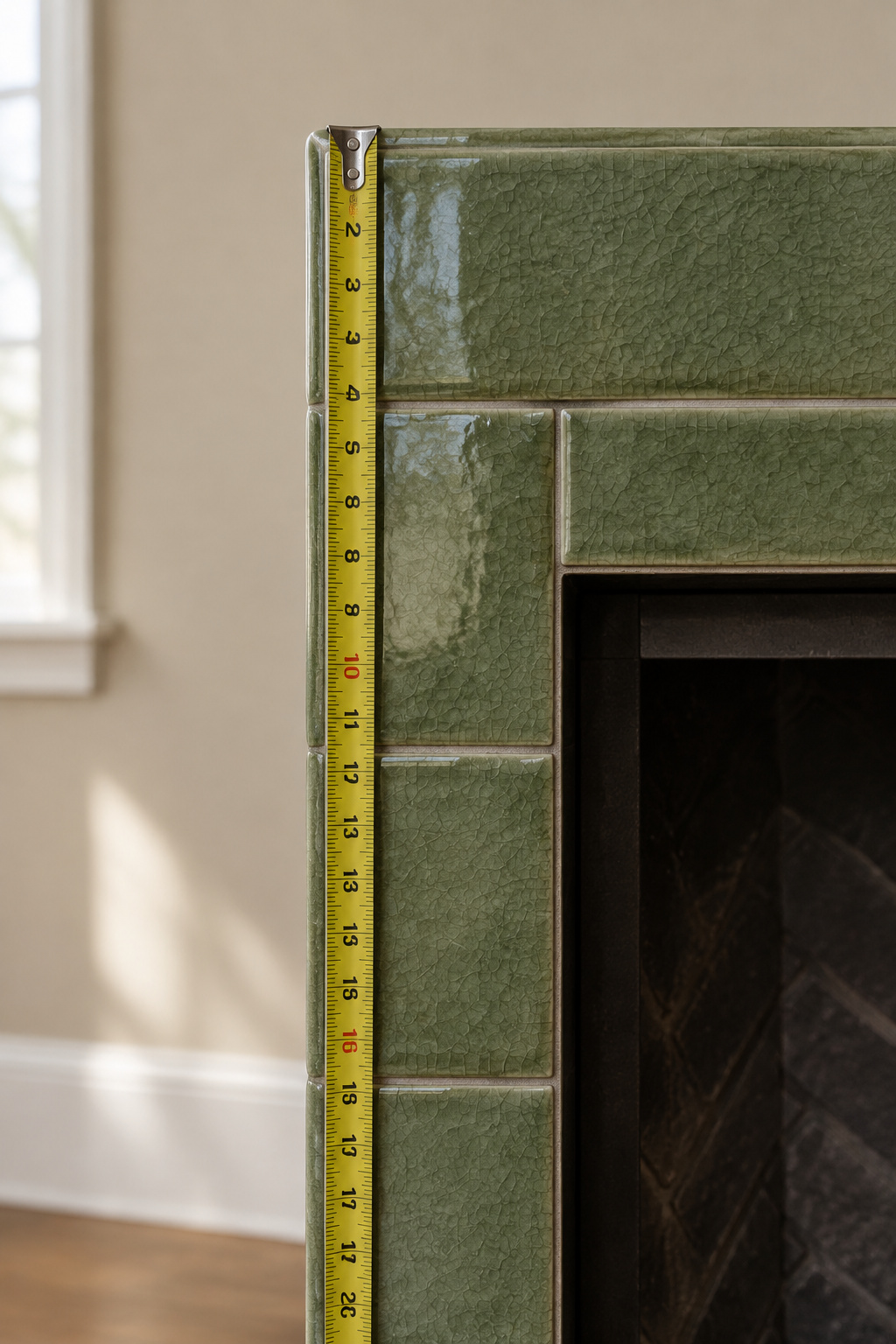
- Keep combustible trim on the fireplace front at least 6 inches from the fireplace opening.
- Within 12 inches of the opening, combustible material may project no more than 1/8 inch per 1 inch of distance from it.
- Keep combustible trim and sheathing abutting the masonry sidewalls at least 8 inches from the firebox lining, or 12 inches where the opening is 6 square feet or larger.
How that clearance changes with a gas vs. wood-burning firebox
That governs a wood-burning masonry fireplace. A factory-built gas insert is a listed appliance, so its clearances come from the manufacturer’s own instructions and listing label, and they can be tighter or looser than the code figures.
Why this is the one step not to guess on
Tile is non-combustible, so what matters is what sits behind and beside it: furring strips, a combustible substrate edge. All of it vanishes once the surround is finished, which is why it gets skipped. Check your unit’s label first, and settle the wall the surround sits in before committing to a tile.
The Surround Is the Job — Not the Mantel
Why this guide stops at the firebox opening
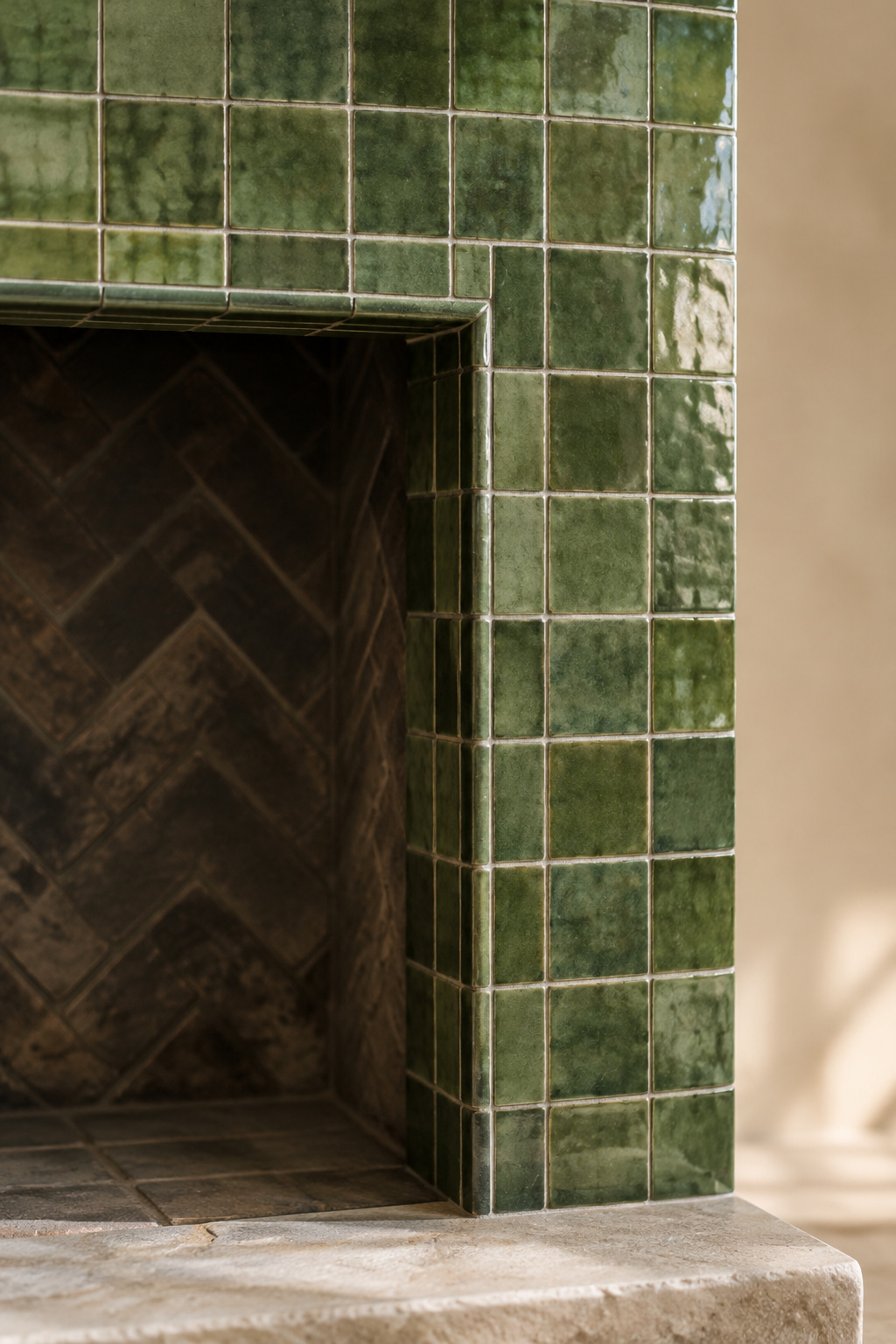
Every decision that makes or breaks a tiled surround sits around the opening: material class, cost per square foot, grout against the glaze, clearance. None of it happens at shelf height.
Where mantel styling gets its own guide
The shelf is a separate project with its own clearance rules and its own guide on decorfull. Pick your class on skill first and budget second, since handmade versus machine-made costs you less in money than in effort. Order the overage, blend the boxes, match the grout to your green, and measure clearance off your own firebox, not a photo. Still deciding where green belongs at all? Ideas for a green living room is the wider view.
FAQ
Can you tile over an existing brick fireplace surround?
Yes, but not directly. Wire-brush it to strip loose mortar and clean it with vinegar to lift soot. Skim it with thinset at a mayonnaise consistency, worked into every joint, with a second coat if joints show. Allow 24 to 48 hours of drying.
How long does a fireplace tile install typically take?
For machine-made subway or ceramic on a prepped substrate, the tiling is close to a day’s work, but the project runs two to three days because thinset and grout each cure overnight. Zellige sets about twice as slow, stretching that to most of a week.
Is green tile safe to use inside a firebox opening, or only around it?
Only around it. Standard glazed tile, zellige and crackle-glaze included, is rated for the surround and hearth outside the opening, not for direct flame. Firebrick or listed refractory tile lines the firebox interior, set in high-temperature cement, and standard thinset isn’t flame-rated either.