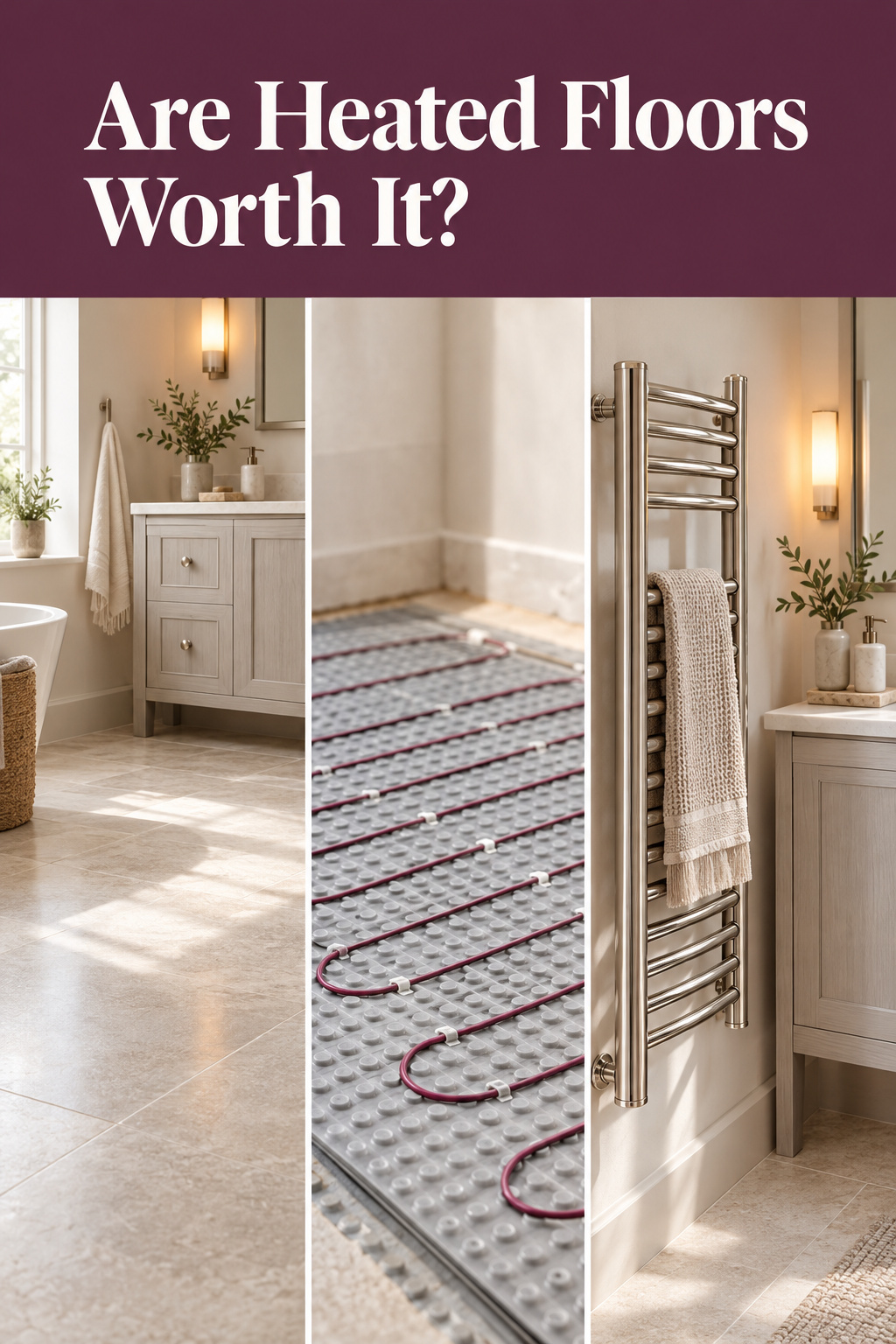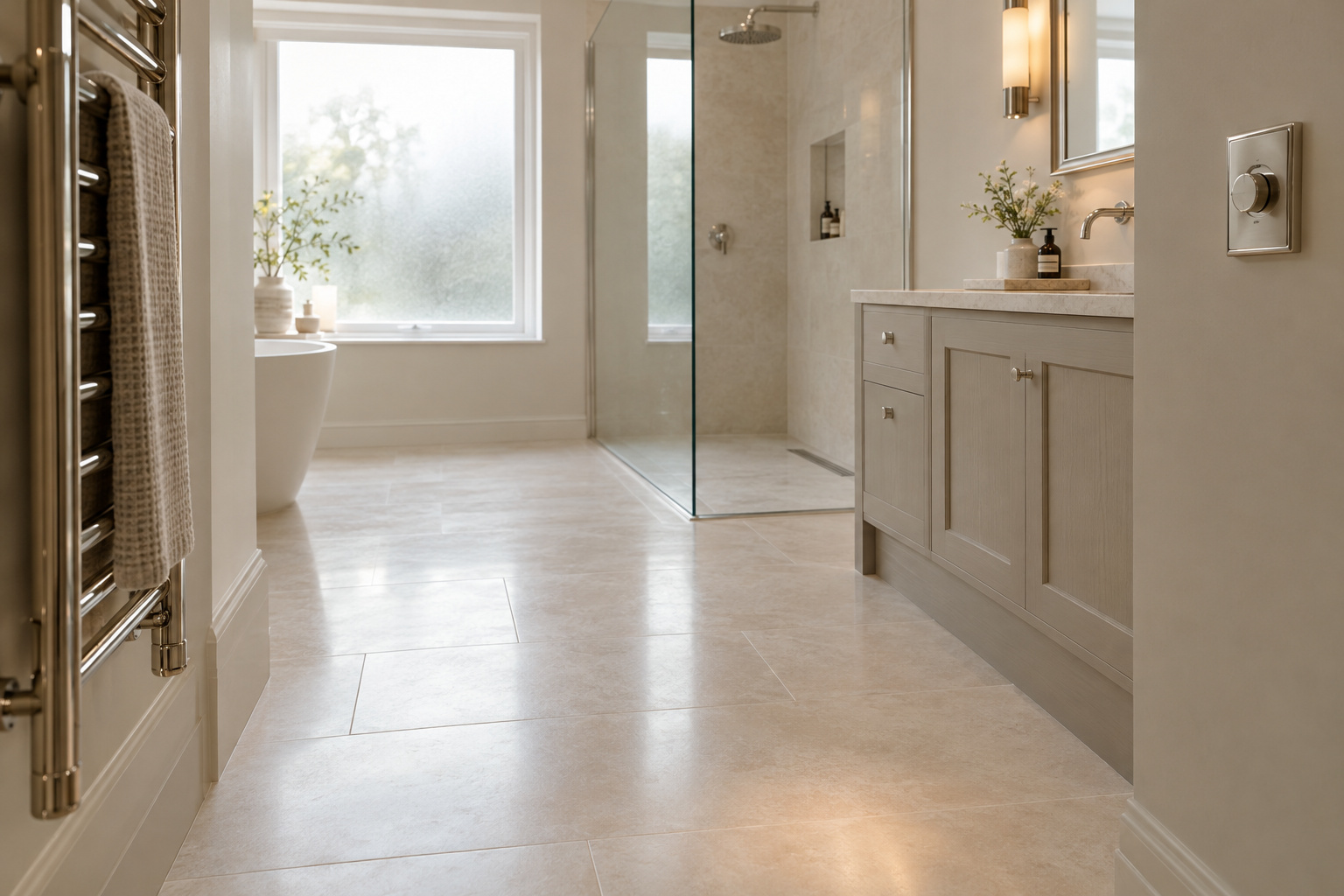

Read enough cost roundups and heated bathroom floors turn into two different products. In one they are a bill waiting to happen, $15 to $25 a month for a bathroom of 35 square feet. In the other they are the heating itself. The same thin cable cannot be both, and it is neither. In Sweden, where a house is expected to spare you bare feet on cold stone in winter, a warm floor is smaller and more sensible: comfort laid on top of a room that is already heated, and priced like it.
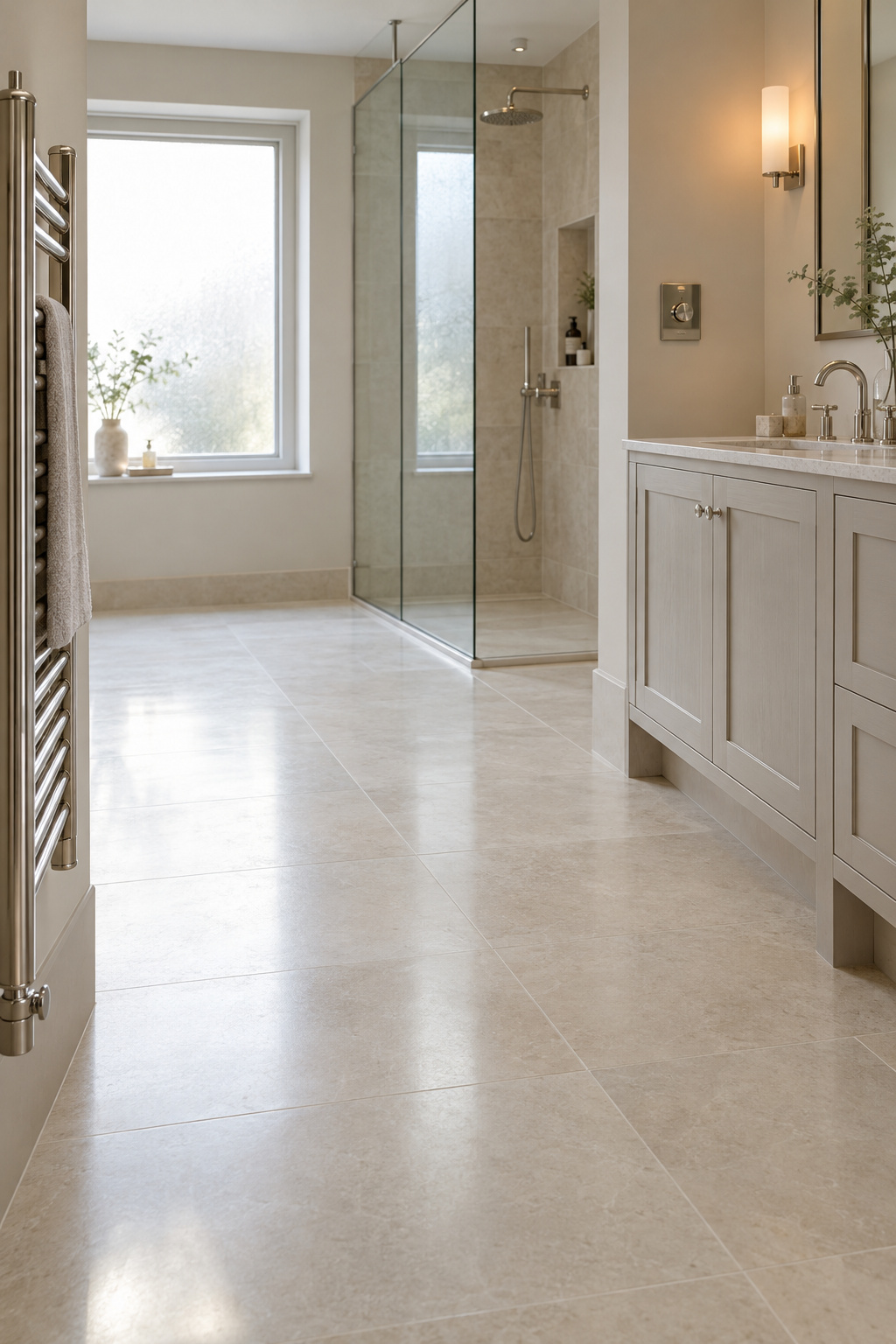
TL;DR
- A heated bathroom floor is comfort heating and not the room’s heat. Swedish floor-trade rules cap its surface at 27°C.
- For a primary bath, choose electric cable in a membrane. It costs $8–$15 per sq ft installed, or $500–$2,400 for a 60–160 sq ft primary bath before new flooring (HomeGuide).
- A 650 W cable run 4 hours a day at the US average of 17.90¢ per kWh costs about $6.98 a month if the thermostat cycles half the time and $13.96 if it never does (my sum is below).
Heated Bathroom Floors Are Comfort Heating, Not Primary Heat
The trade that has thought longest about warm floors puts a ceiling on them. GVK, the Swedish floor-trade body, rules that a heated floor’s surface must not exceed 27°C. Nexans, the Norwegian cable maker, sizes bathroom floors to run all year at 27–28°C, a degree above the Swedish cap, and notes that tile at ordinary room temperature, 22–23°C, feels cold. Those few degrees are the whole point.
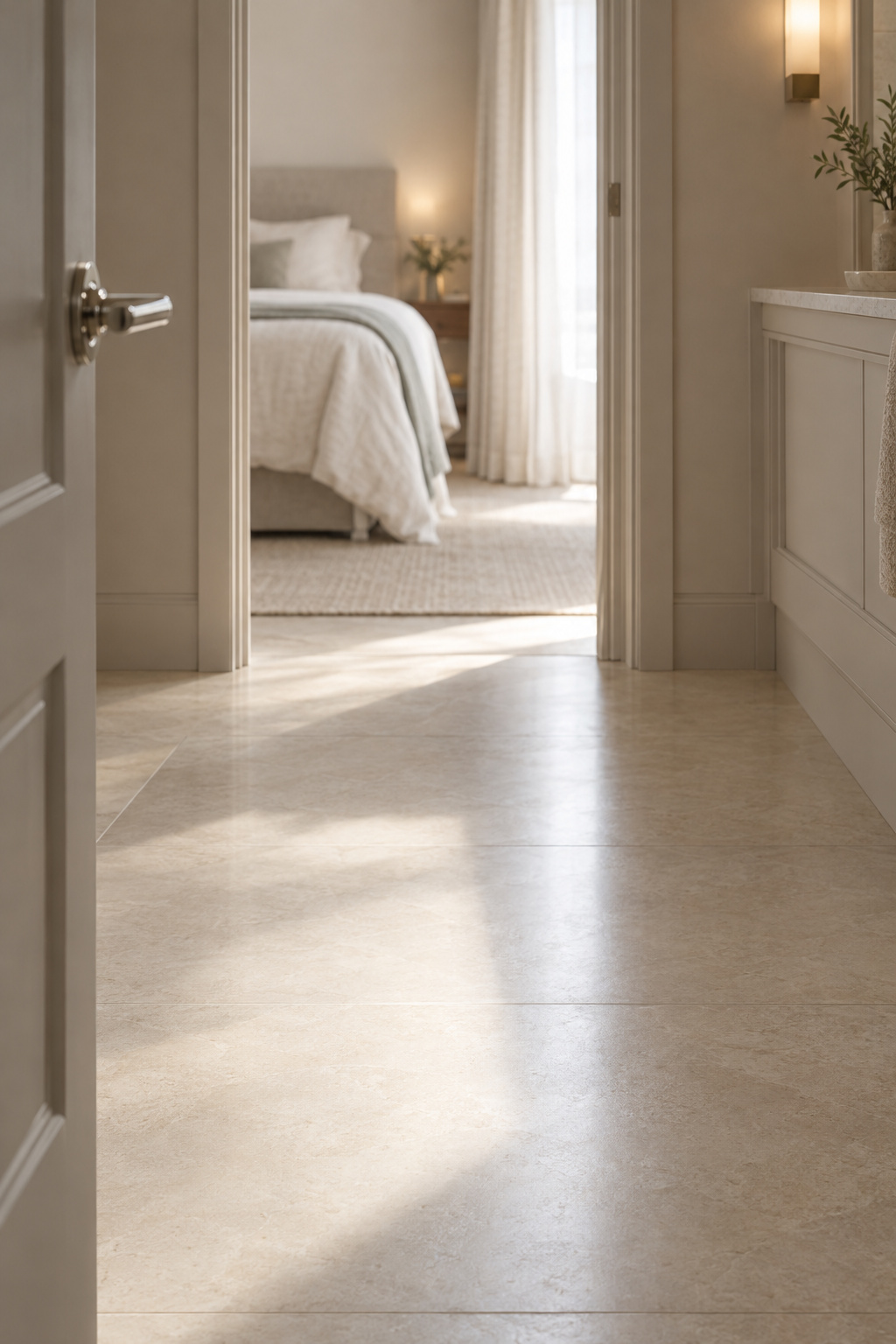
In a cold country you heat the house properly, then make the one surface you stand on barefoot pleasant; the radiator keeps its job.
Could it? WarmlyYours, a vendor, says a full-coverage system can be a well-insulated room’s only heat, but only after a heat-loss calculation. A 650 W cable puts out about 2,218 BTU per hour (by my arithmetic, 650 × 3.412), and I found no heat-loss figure for a primary bath to set against it.
So the first decision is what the floor is for. A warm first step is one of the primary bathroom design decisions about how the room is lived in each morning.
Electric Mat, Cable or Hydronic: What a Primary-Sized Bath Needs
Tracy Hall of Watts Radiant told Plumbing & Mechanical in 2005 that hydronic needs roughly the same parts for 50 square feet as for 5,000. Dated and vendor-side, but the point holds: one bathroom is a small area.
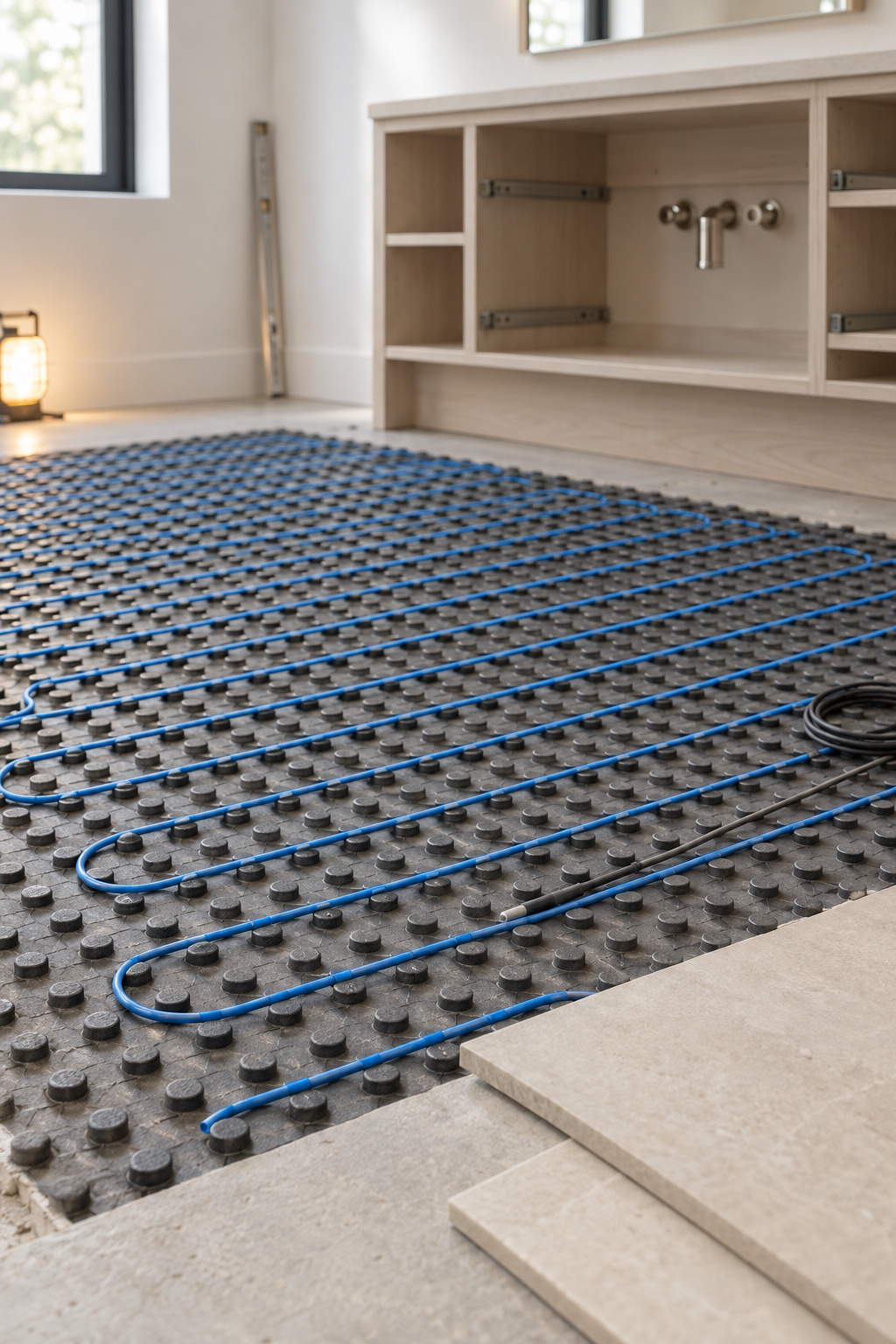
Electric is the room-sized answer. Schluter rates its DITRA-HEAT cable at 12.7 W per sq ft at standard spacing and 15.2 at alternating spacing, and the 120 V cable covers 51.4 sq ft at 650 W. Nexans recommends no more than 150 W/m² under tile, which is 13.9 W per sq ft (my conversion: 150 ÷ 10.764). The membrane keeps the cable in one thin layer, and the build-up stays thin.
The hydronic rows disagree because some sources include the boiler and some leave it out.
| System | Installed cost (source) | Heat source | Fits |
|---|---|---|---|
| Electric cable in membrane | $8–$15/sq ft before flooring (HomeGuide) | None; dedicated circuit | One room, new tile |
| Electric thin roll | 1/8 in profile in tile mortar (WarmlyYours) | None; dedicated circuit | Low build-up |
| Hydronic | $7–$17/sq ft before flooring (HomeGuide) | Not broken out | An existing boiler or loop |
| Hydronic | $12–$30/sq ft (WarmlyYours) | Boiler extra, $3,000–$10,000+ | Whole-home heat |
| Hydronic | $8–$18/sq ft (Current Cost) | Boiler separate, $3,000–$12,000 | Whole-home heat |
Start with the first row. Unless a boiler already serves the house, cable in a membrane is the system for a primary bath.
Thermostats, floor sensors and zoning the wet area
Zoning a bathroom is mostly a matter of deciding where heat must not go. Schluter keeps cable out from under vanities, tub platforms and cabinets, and the cable cannot be cut to length. The 2005 Plumbing & Mechanical piece put the heated share at about half the floor. In a 100 sq ft bath that is about 50 sq ft (100 × 50%, my own estimate), close to the 51.4 sq ft cable used below.
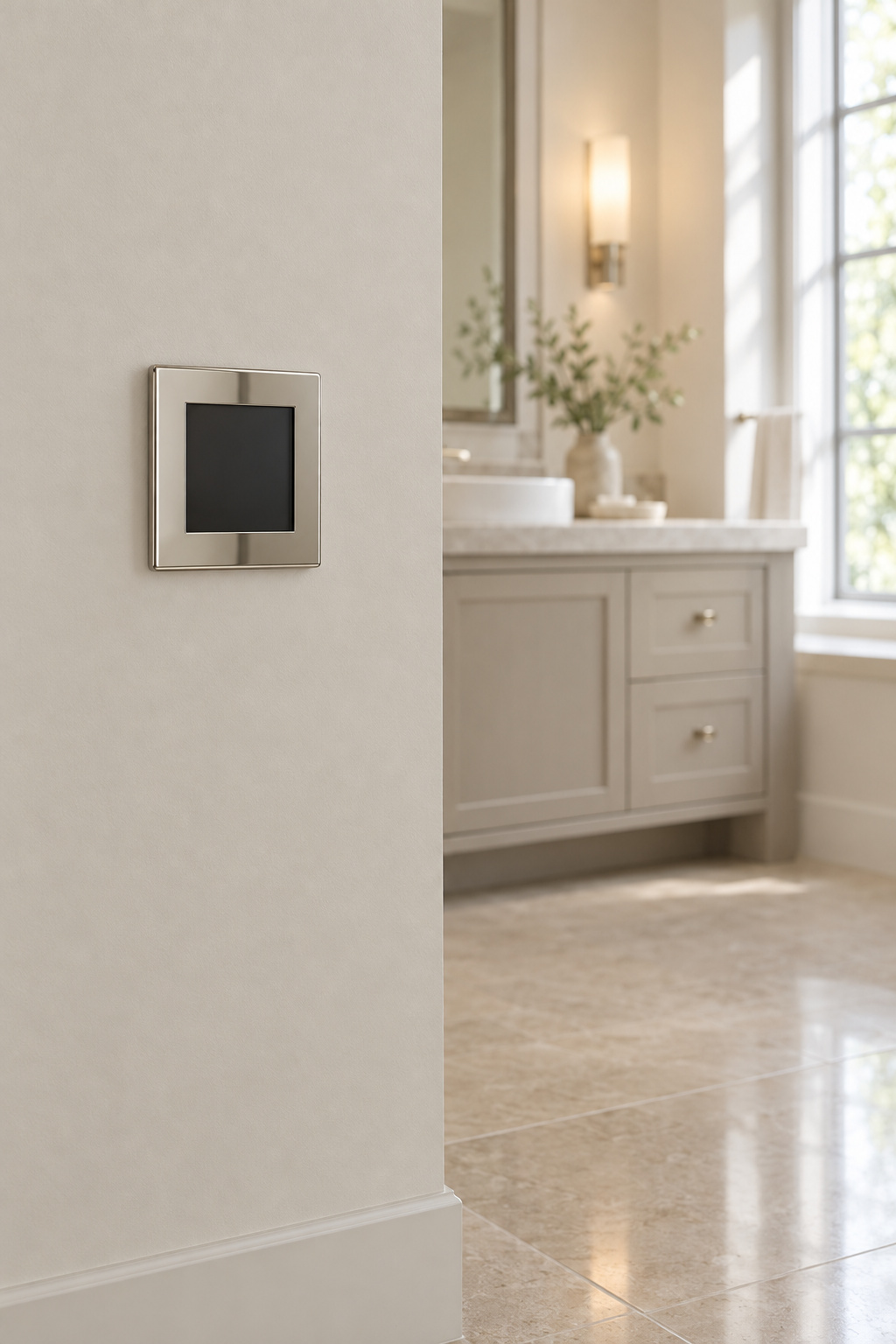
Schluter’s thermostat has a built-in Class A GFCI, ships with a spare floor sensor and needs a dedicated circuit, and each zone needs its own thermostat.
What the Install Costs in a Big Bath, and the Finishes That Can Sit on Top
The common mistake is pricing the cable and forgetting the wire behind it. HomeGuide puts electric radiant at $8–$15 per sq ft installed, before new flooring, and a 60–160 sq ft primary bathroom at $500–$2,400 for the heating alone. WarmlyYours quotes $6–$12, so both agree on $8–$12.
On 50 heated square feet, $8–$15 comes to $400–$750 (50 × $8; 50 × $15, my multiplication). Then the fixed costs arrive. Some contractors charge a $500–$600 minimum, a thermostat runs $140–$350, a dedicated circuit $250–$900, plus a permit where your jurisdiction requires one. Fixed costs are why the floor is cheapest as one line of the full primary bathroom remodel budget rather than a project of its own.
Finishes that can sit on top, and the temperature limit
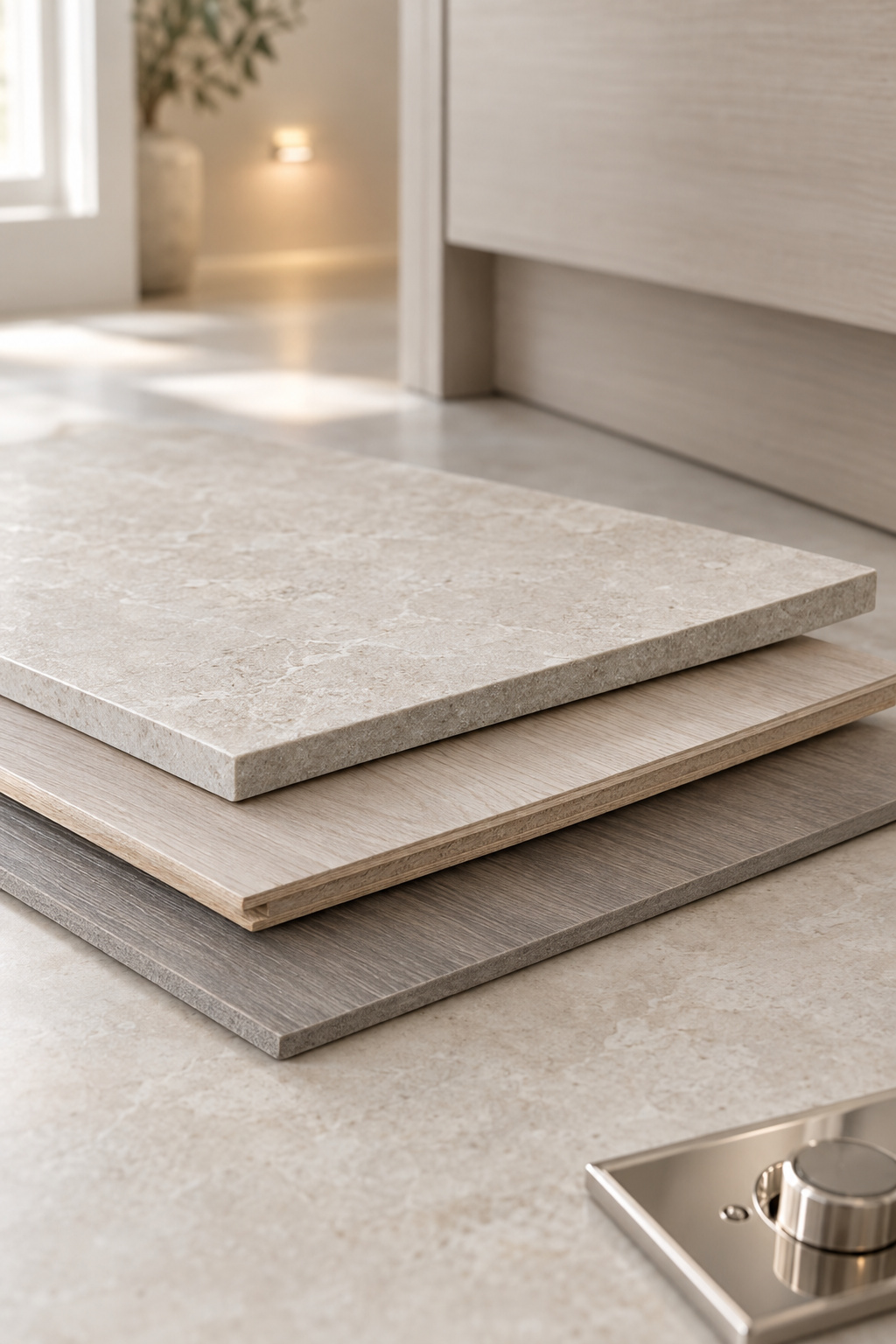
Choosing a floor is separate; this covers only what the heat allows. Schluter’s limit for any covering is a thermal resistance of R-1 or less.
- Ceramic and stone tile: nothing beyond R-1. GVK says to add no heat until 28 days after tiling, then raise it by no more than 3°C a day.
- Solid hardwood: planks under 5 in wide, surface no warmer than 85°F (Vantia Hardwoods).
- Engineered wood: 85°F at the surface, planks 5/8 in or thinner (WarmlyYours).
- Vinyl plank: Shaw, ASI, Tarkett and DuraLux cap the surface at 85°F. NorthStar’s TriCore caps the subfloor at 80°F, allows no more than a 5°F swing in 24 hours and bars a set-back thermostat.
Those two vinyl answers come from different makers, and both stand. Read your own floor’s installation sheet before anyone programs the thermostat.
The Running-Cost Sum You Can Redo With Your Own Rate
Four numbers decide the bill. The example: a 650 W cable, 100 sq ft primary bath.
- Watts. 650 W is 0.65 kW.
- Hours. A pre-shower block plus an evening block make 4 hours a day, or 2.6 kWh at full output.
- Cycling. Once the floor is warm, the thermostat switches on and off. I assume 50%, since no maker publishes a bathroom duty cycle, which gives 1.3 kWh a day.
- Rate. The EIA’s US residential average is 17.90¢ per kWh for the 12 months to June 2026.
Here is the sum: 1.3 kWh × $0.179 = about $0.23 a day, $6.98 a month and $42.35 over a 182-day heating season. With no cycling, 2.6 kWh × $0.179 gives a ceiling of $13.96 a month.
This site has published a different figure, $0.89 a day, in its modern vintage bathroom guide. On its own inputs the arithmetic is right: 73 sq ft × 12.7 W = 927 W, × 8 hours = 7.42 kWh, × $0.12 = $0.89 (my check of its own inputs). The gap comes from heating every square foot, fixtures included, for 8 hours with no cycling, even though its rate is a third below today’s. The 89-cent floor and the 23-cent floor are the same floor, asked to work different hours.
Distrust figures built on 30–50 W per sq ft. Bathify uses that range to reach the $15–$25 a month I opened with, and it is 2.4 to 3.9 times the 12.7 W nameplate (working it out: 0.03 ÷ 0.0127; 0.05 ÷ 0.0127), so the bill is overstated by the same factor.
To redo it, swap in your nameplate watts, your hours and your rate, run it at 50% and 100%, and believe the range.
Heated Towel Rail vs Heated Floor: The Cheaper Partial Answer
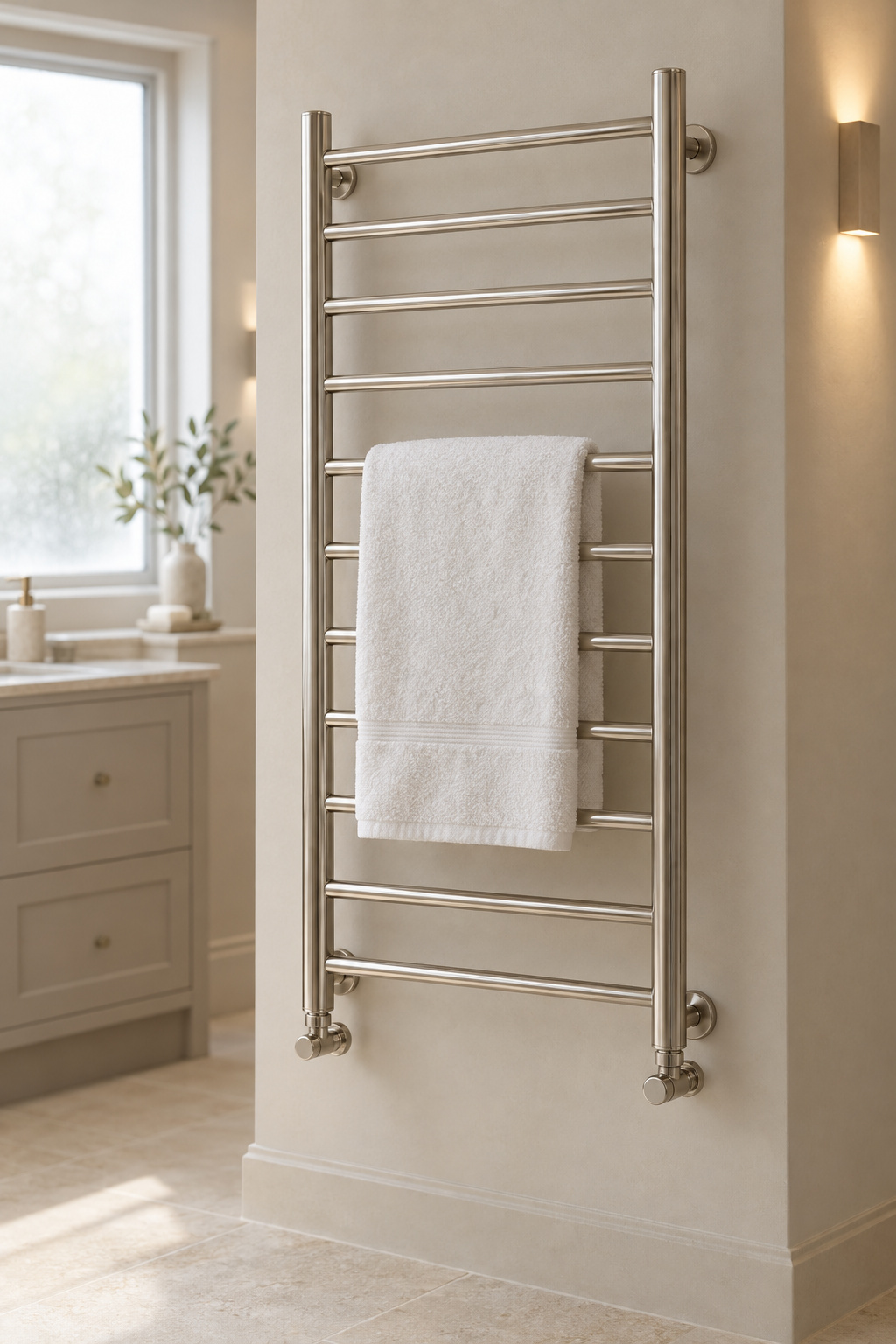
Is a towel rail the floor’s budget substitute? Only halfway. A UK retailer says most electric rails draw 50–200 W, and a Chicago contractor puts towel warmers at 60–120 W. A 100 W rail run 2 hours a day at the EIA rate costs about $13.07 a year (my arithmetic: 0.1 kW × 2 h × $0.179 × 365), and a 200 W rail costs $26.13.
| 100 W towel rail | 650 W heated floor | |
|---|---|---|
| Daily use assumed | 2 h | 4 h, 50% cycling |
| Energy per day | 0.2 kWh | 1.3 kWh |
| Running cost at 17.90¢ | $13.07 a year | $42.35 a season |
| What it warms | The towel and nearby air | The tile underfoot |
The rail is cheaper because it does less. It warms a towel and the air by the wall, and the tile you step onto first stays at room temperature, which is to say cold. Keith Homel of IRPINO Construction in Chicago calls it a split, with warmers winning on cost and floors on comfort.
Are Heated Floors Worth It? Who Should Skip Them and Who Should Add Them
Add the floor when the floor is already coming up. That is Bathify’s verdict, and the arithmetic backs it: the heating is a small addition once tile and labor are being paid for anyway.
- Add it if you are lifting the floor of a primary bath used every day, somewhere with a real winter.
- Skip it if the bath is rarely used or already has a warmer finish like vinyl plank. Bathify, the one roundup on this, says a towel rail gives a similar payoff for far less.
- Skip it if the tile is sound and no other work is planned. I found no source describing a way to add heat without lifting the floor, and HomeGuide puts a retrofit at 50–80% more than new construction.
A warm floor matters most at the step out of the shower, the same spot that designing a bathroom to age in place treats most carefully. The tile’s wet slip rating is a separate decision.
Swap in the rate from your last electricity bill. If your thermostat never rests, decide on $13.96. For a primary bath my answer stays at about $6.98 a month (the sum: 0.65 kW × 4 h × 50% × 30 days × $0.179), assuming the thermostat cycles half the time.
FAQ
Do heated floors need their own circuit or GFCI protection?
Yes, in practice both. NEC Article 424 requires ground-fault protection for heating cables in bathroom floors, though section lettering varies by edition and local amendments apply. Schluter requires a dedicated circuit and builds a Class A GFCI into its thermostat, and HomeGuide prices the circuit at $250–$900.
Can you add heated floors without ripping out existing tile?
Not in the usual way. The cable or mat sits in mortar beneath the finish, and I found no source describing a method that leaves existing tile in place. HomeGuide says retrofits cost 50–80% more than new construction because the floor comes up. Thin rolls reduce build-up, but they still go under new tile.
How long does a heated bathroom floor take to warm up?
According to WarmlyYours and Bathify, electric systems under tile take 30–60 minutes to reach a comfortable temperature, and hydronic takes 60–120 minutes. Most owners program the thermostat to start 30–45 minutes before they need the floor, and Schluter’s lab notes imply about 25 minutes over plywood.