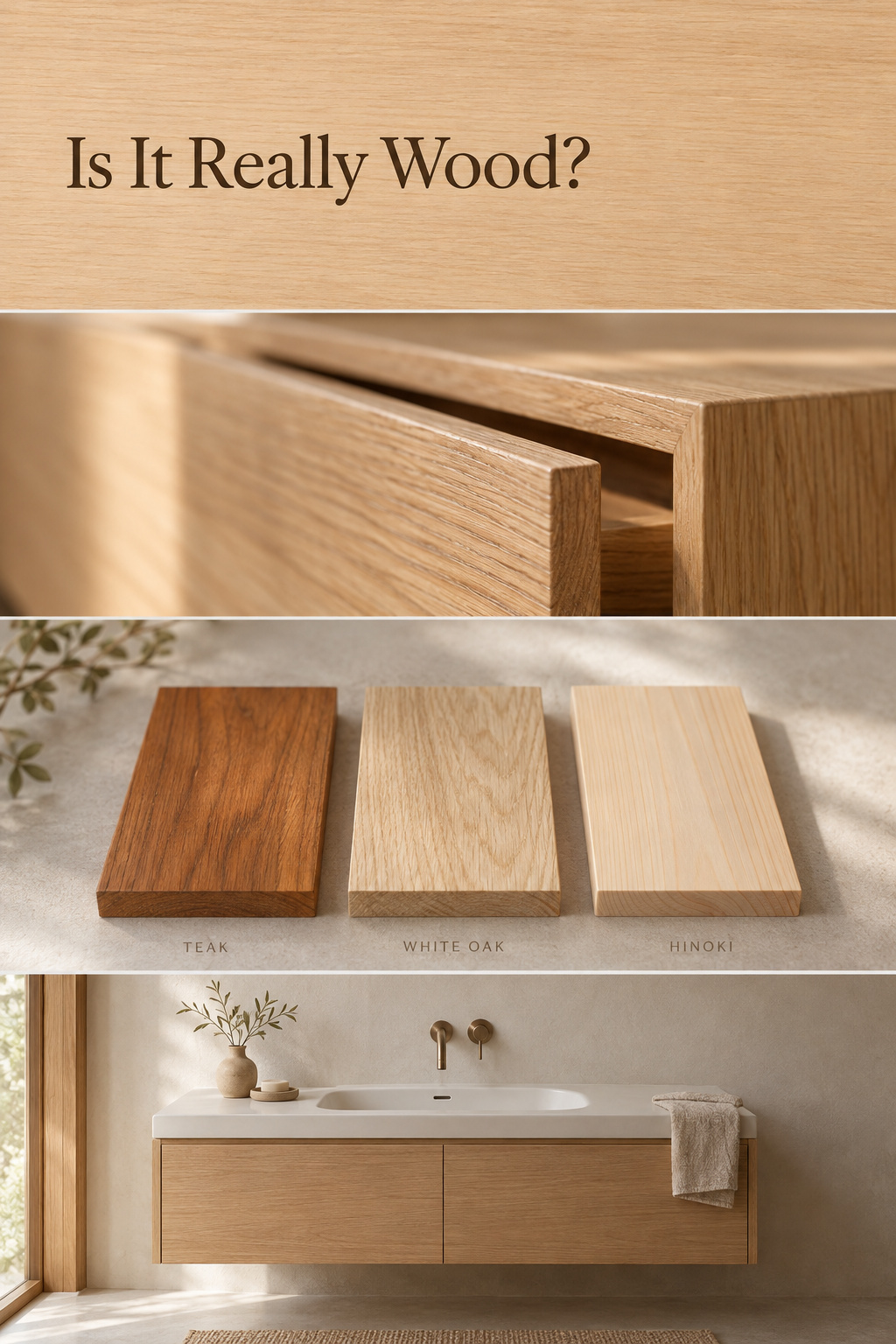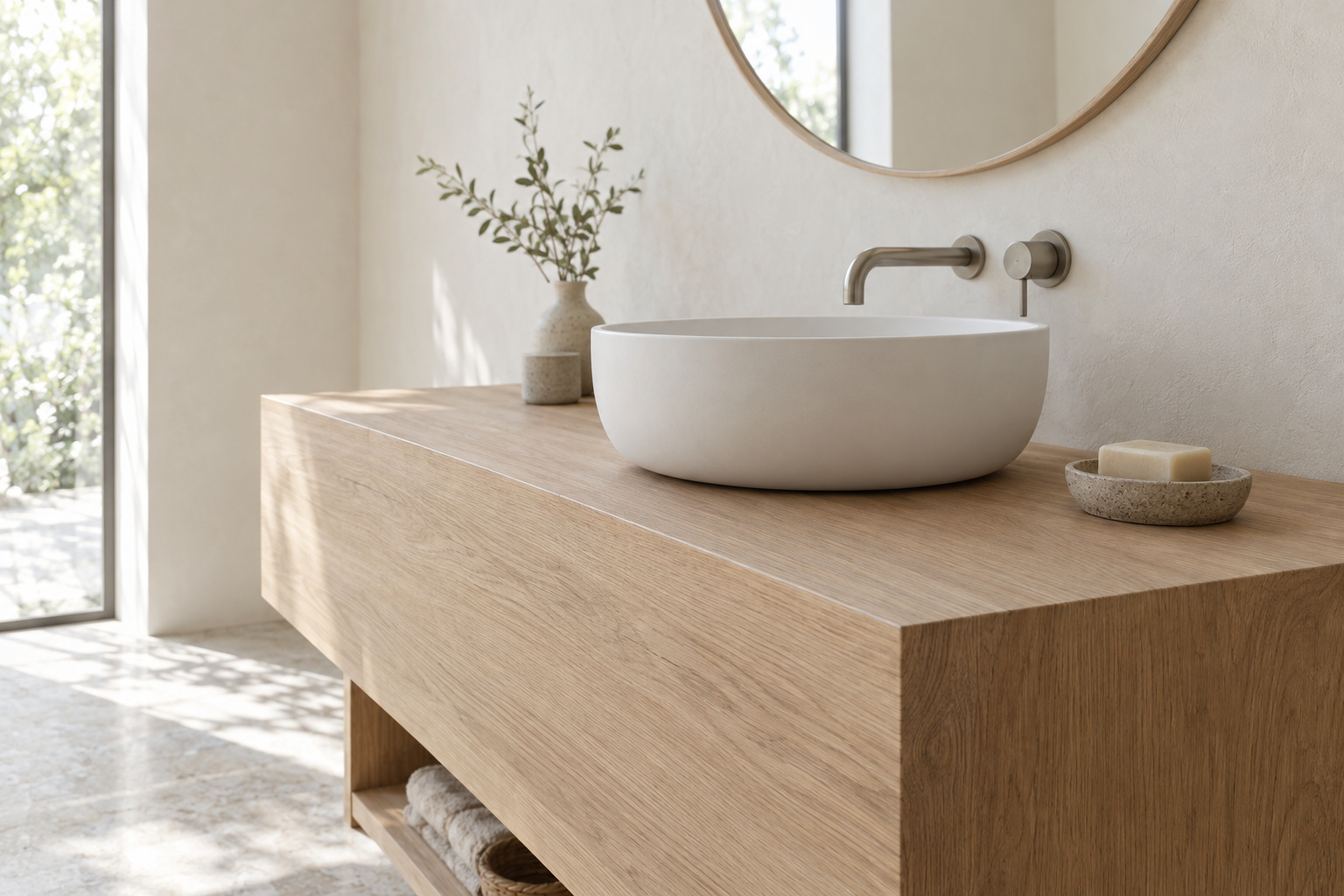
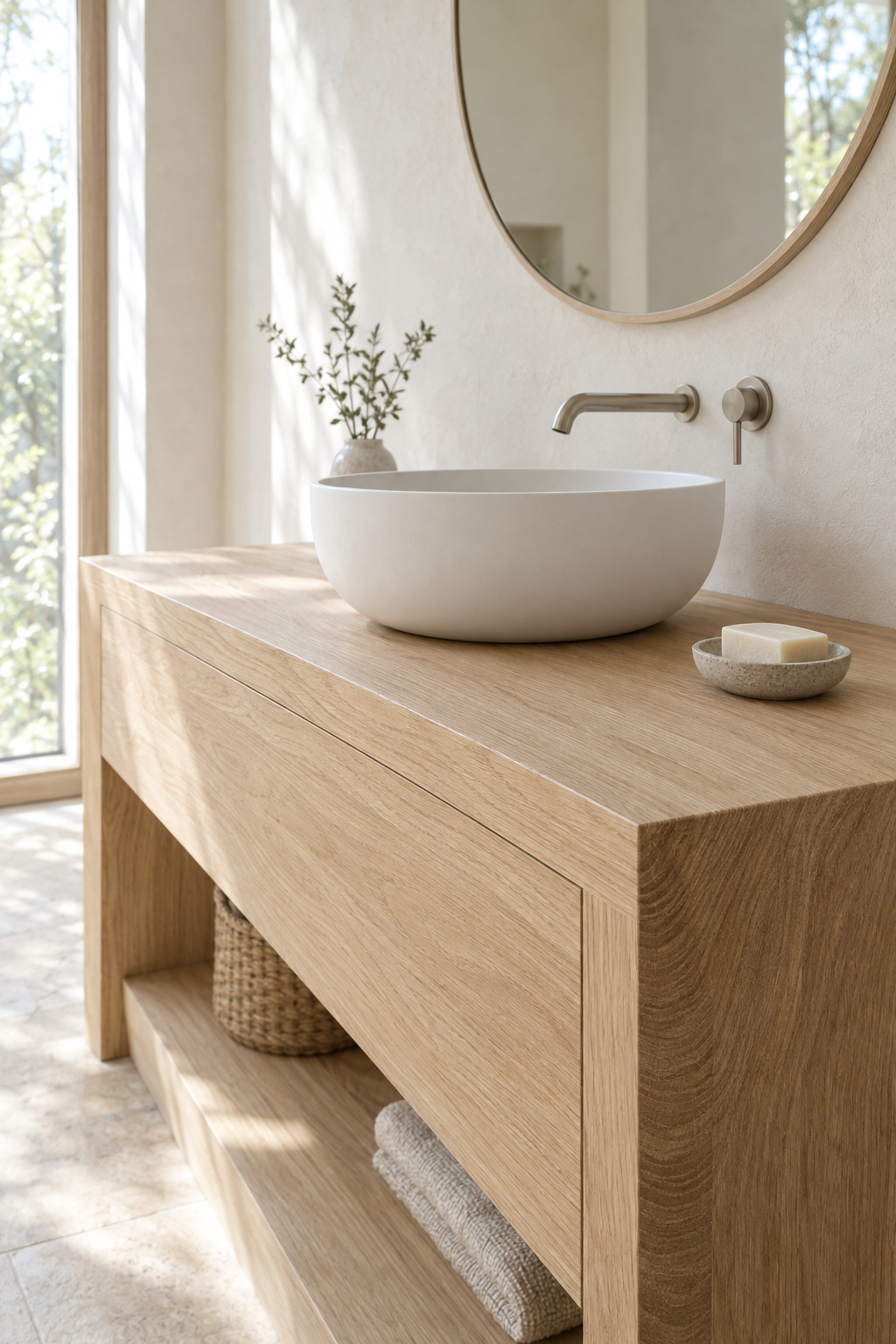
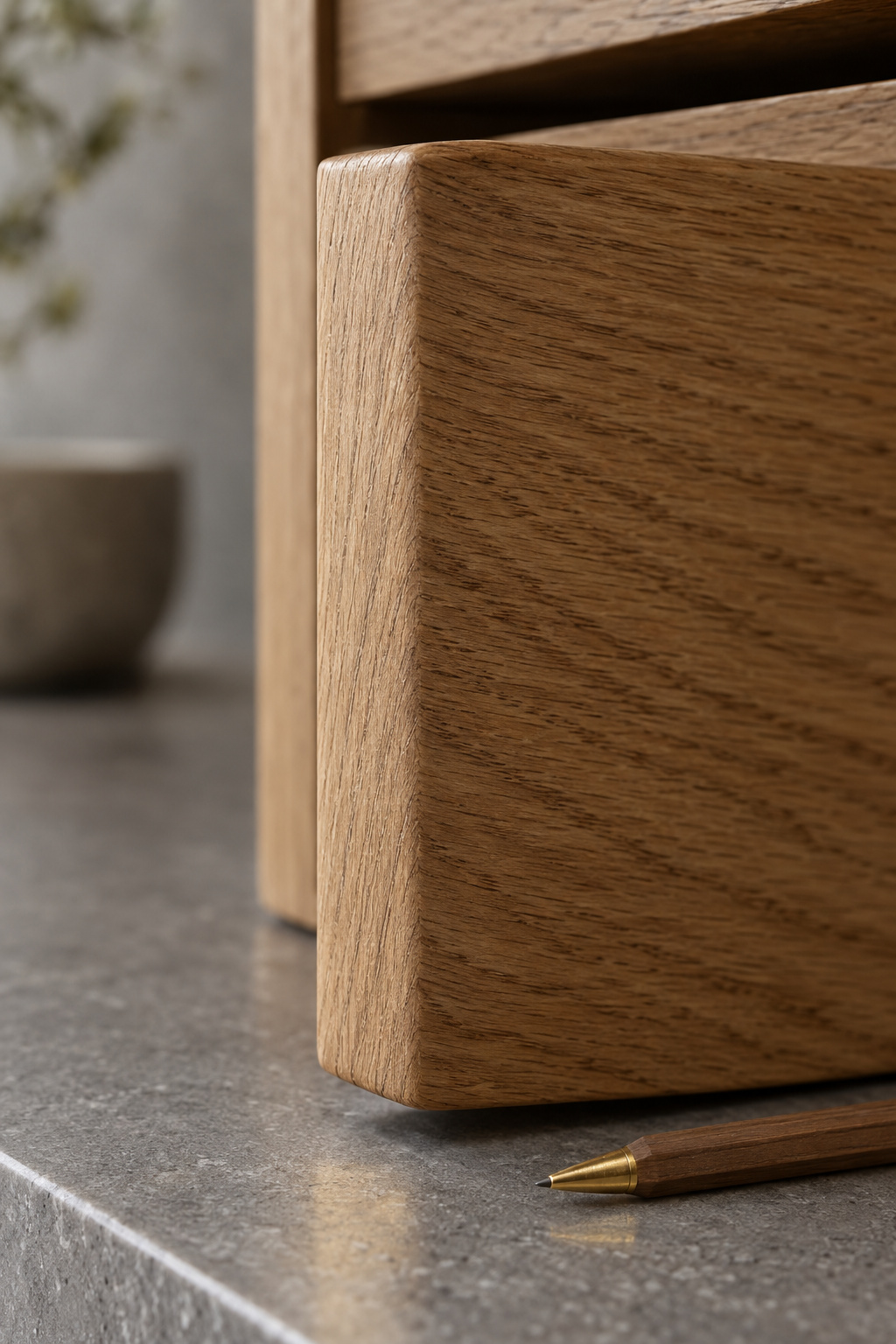
Look at the drawer front in the photograph. Pale oak, the grain running in long, quiet lines across a slatted face, a white stone top, a round ceramic basin sitting on it like a bowl on a table. It is a lovely Japandi bathroom vanity, and it is easy to assume the grain goes all the way through. Often it does not. These vanities look alike in a photograph, so I sort them by one standard: what the box is made of, and what happens when water reaches its edges.
TL;DR
- A heavy vanity can still be MDF, which is as dense as white oak or up to about a third denser, so check the cut edges and the listing’s material line instead of lifting a corner.
- MDF and particleboard hold their strength up to about 65% humidity; they fail where liquid water reaches an unsealed edge, a screw hole or the basin cutout, and that swelling mostly stays.
- Buy solid wood, a plywood box with a solid or well-edged front, or an honest non-wood surface, and walk past a thin wood-look skin over MDF.
How to Tell If a Japandi Bathroom Vanity Is Really Wood: Edge, Weight and Listing Words
Start at the edge. On solid wood the grain wraps the corner of a door or drawer front and carries on down the side. On a skinned board you see a seam, or a thin line about a millimetre in from the face where an edge band meets the panel. A face veneer is only 1/42 in thick, so there is very little to see.
Then find the material line in the listing and read which parts it names. One 36-inch vanity at a big-box store headlines “Solid Wood Structure”; underneath, the pine is the frame and the doors and panels are MDF. Another lists “Hardwood, Plywood” with oak as the species, which says nothing about the front. Some sellers are plain about it. Victorian Plumbing lists its slatted Osaka vanity as “Vanity Material: MDF” with an oak-effect finish, and Bathroom City says most of its Japandi units are MDF with a sealed finish. An effect word is a reason to find the material line.
Do not trust your arms. Medium-density fibreboard has a specific gravity of 0.7 to 0.9 and white oak 0.68, so for the same volume MDF can be up to about 32% heavier ((0.9 − 0.68) / 0.68). Only a plywood or hollow build feels noticeably lighter.
My view, and not only about vanities: most “Scandinavian” furniture sold in the US is pale veneer pretending to be wood. Buy fewer pieces of actual wood.
Solid Wood, Veneer, Foil and Laminate: What Each Does in Steam and Splash
Steam gets the blame, and mostly it is innocent. MDF and particleboard keep their strength and stiffness practically constant up to about 65% relative humidity. The damage comes from liquid water: MDF and particleboard take it in through any unprotected edge or screw hole, then swell, warp and delaminate, and edge banding and a finish on all six faces slow that down. According to the USDA Forest Products Laboratory, much of that swelling does not reverse, and each round lets the next one in faster.
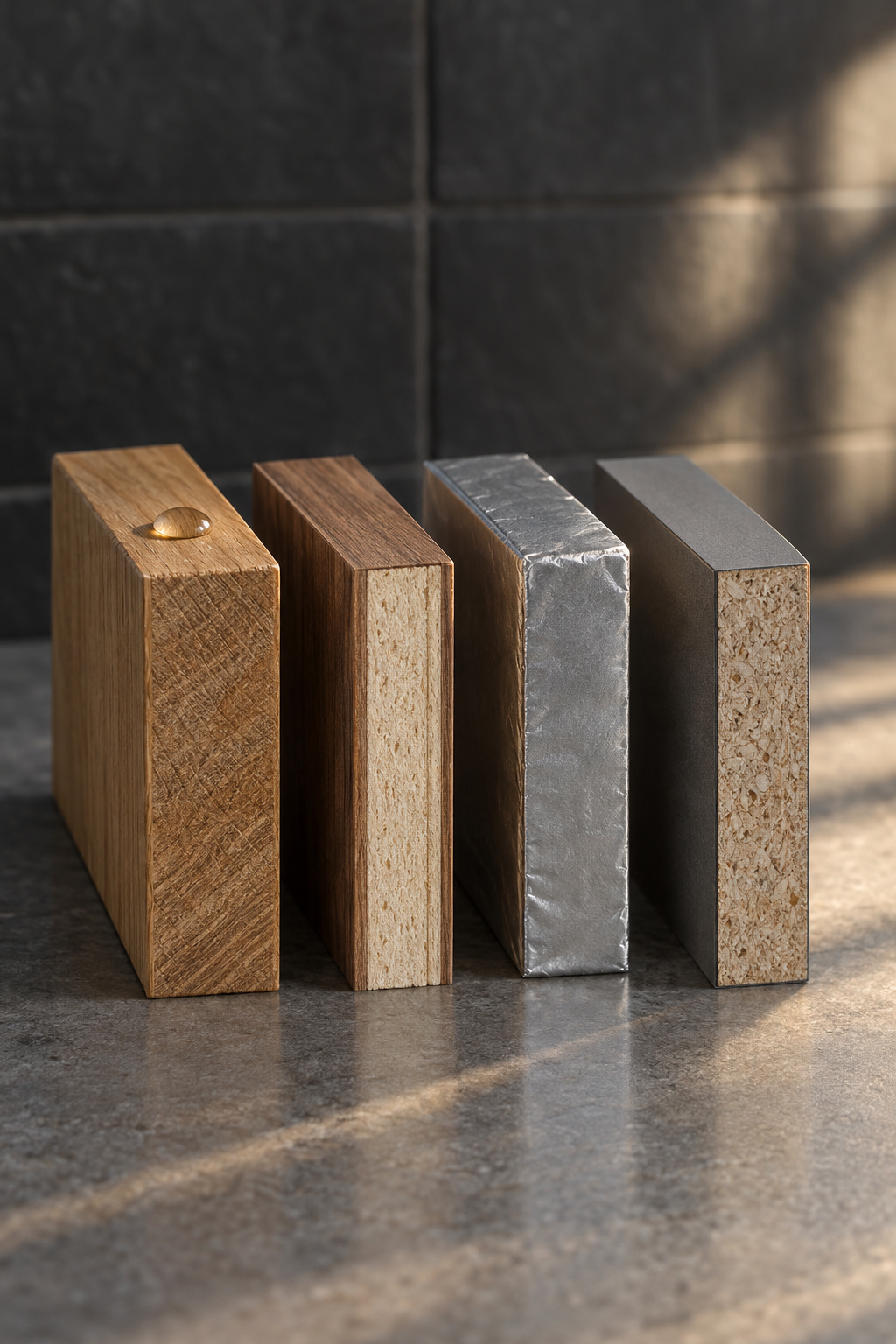
How the four constructions behave where a vanity gets wet:
| Construction | How to spot it | Steam and splash | Can you refinish it? |
|---|---|---|---|
| Solid wood | Grain wraps the edges and runs on down the sides | Moves with humidity; a finish slows the movement but does not stop it | Yes, many times |
| Plywood box, solid or veneered front | Material line names plywood for the box, back and shelf | Interior plywood is water-resistant, not waterproof; more stable than solid wood | The front, if solid; a veneer only lightly |
| Wood-look veneer or skin over MDF | Seam or thin line just in from the face; material line says MDF | Fine in steam; swells where water reaches a cut edge | Barely: one prep sanding takes a quarter to a third of a veneer |
| Foil, laminate or melamine | Material line says melamine, foil or laminate; check edges and seams | The surface copes; the core and the edges decide its life | It is a surface layer, so no |
Solid wood moves. A flat-sawn white oak board goes from 7.7% moisture content at 40% humidity to 13.1% at 70%, a swing of 5.4 points. With oak’s 10.5% tangential shrinkage, that is 10.5% × 5.4 / 28 = about 2% of its width, or 0.49 in on a 24-inch board, unfinished. A veneer cannot be sanded back to fresh wood: one pass of a floor sander takes 1/32 to 1/16 in, more than the whole 1/42 in face.
I would pick the plywood box with a solid front over every other row; independent guides rank it the safest vanity build. The birch cabinets in our narrow, north-facing kitchen are the originals, and I have only ever rehung their doors. For what Japandi asks of materials across the room, see my japandi bathroom design ideas.
Where a Vanity Fails First: Edge Banding, Carcass and Drawer Boxes
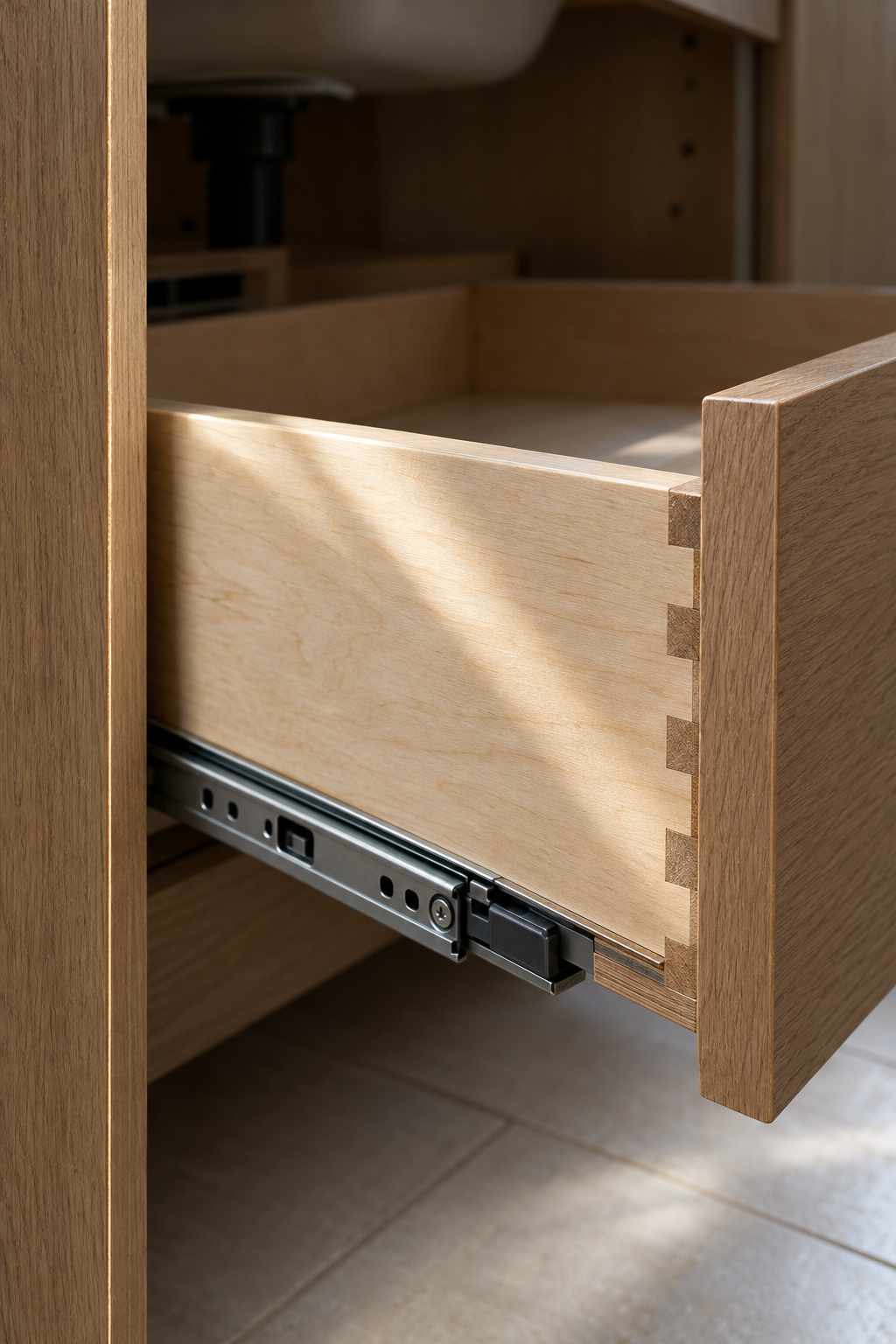
Pull a drawer out and look at its sides before you look at the front. The front is what the photograph sells; the sides, the back and the glue line under the sink say how long it will last. The checks to carry into any showroom:
- The edge band. An even glue line with no gaps between band and panel is what keeps water out of a banded board.
- The box, back and shelf. Ask what each is made of, not just the door. Plywood is the safe box; MDF is fine for painted doors and drawer fronts while the paint is intact and the edges are sealed.
- The drawer boxes. Good ones have 5/8-inch solid hardwood sides, dovetailed corners and 3/8-inch plywood bottoms. Particleboard, MDF or PVC sides are a sign of a cheap build.
- The sink cutout. Splashes and small leaks live here. A top that overhangs slightly keeps drips off the doors; check the seams around the basin now and then.
- The hinges and slides. Hinges and glides are the parts that frequently fail in uncertified cabinets. Every drawer-slide grade in the BHMA cabinet hardware standard is cycle-tested to at least 50,000 openings. Buy the better hinge.
Teak, White Oak or Hinoki: Which Wood and Which Finish Hold Up
For real wood, the finish matters as much as the species. Teak is the standard for decay resistance, and its natural oils resist moisture without any finish. Leave it untreated or seal it; if sealed, reseal about once a year and never oil over the seal. White oak is the other good choice. Its heartwood pores are plugged with tyloses, which make it close to impenetrable to liquids, and at 1,350 lbf on the Janka scale it is harder than teak (1,070). Flat-sawn oak moves more than teak, and steel that rusts against wet oak leaves a dark stain, so keep corroding steel screws and hinges away from it. Hinoki is the soft one, roughly 510 to 800 lbf, or 38% to 59% of white oak’s hardness, and finishing guidance for a hinoki vanity is hard to come by. I would trust it as a tray before a top.
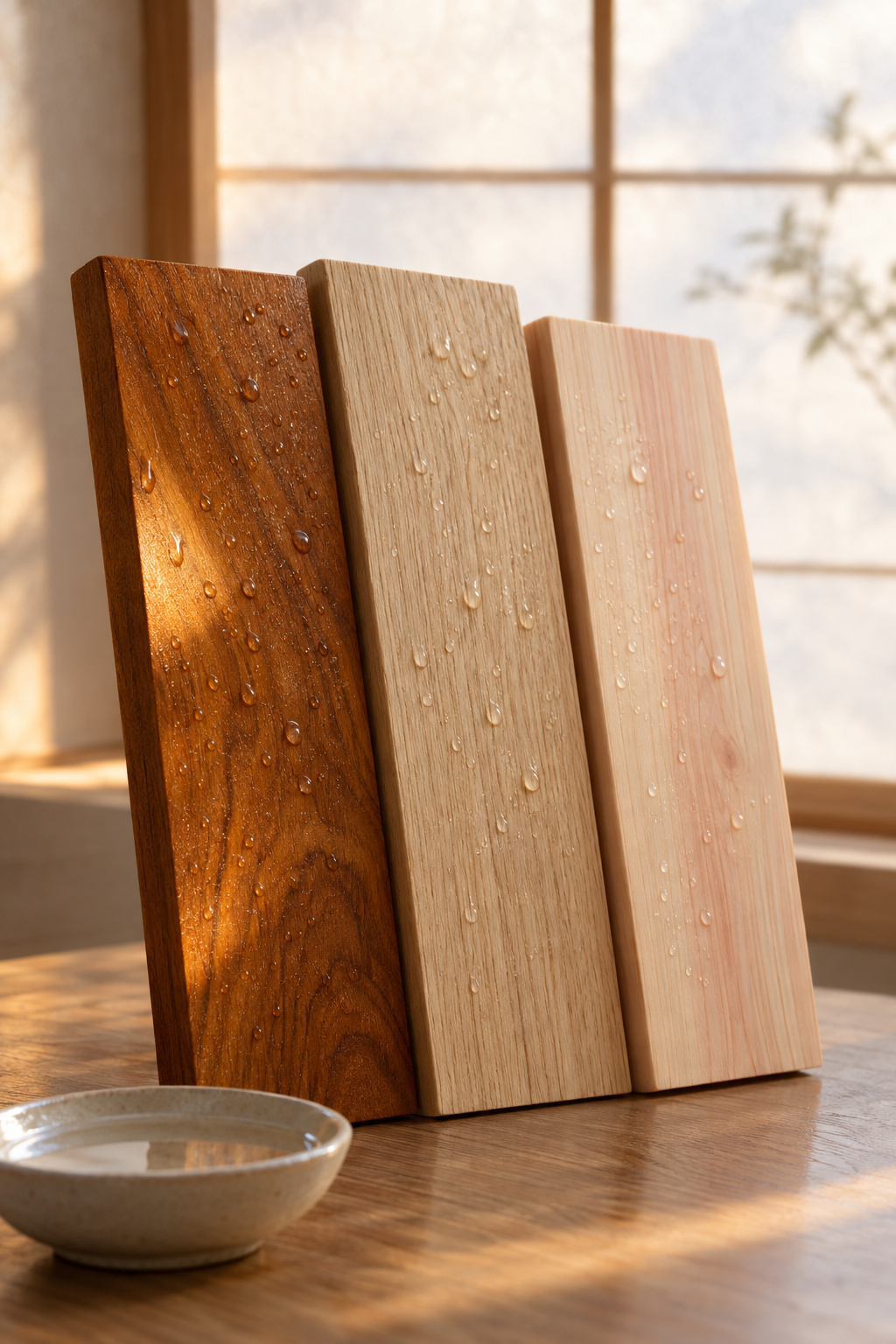
There is no standard reseal interval for a wood vanity. Makers give 6 to 12 months for an oil finish, about a year for a hard-wax-oil top (sooner if it feels dry around the basin) and once a year for sealed teak; oiled teak furniture can want oil two to four times a year. The wood around the basin tells you before the calendar does.
The same question applies to a slat wall behind the vanity, where how far the spray reaches matters more. For a wall-hung vanity, the floating vanity guide covers mounting height.
Choose the Vanity by the Basin: Vessel, Integrated or Undermount
The basin decides the height, the depth and where the water lands. Choose it first.
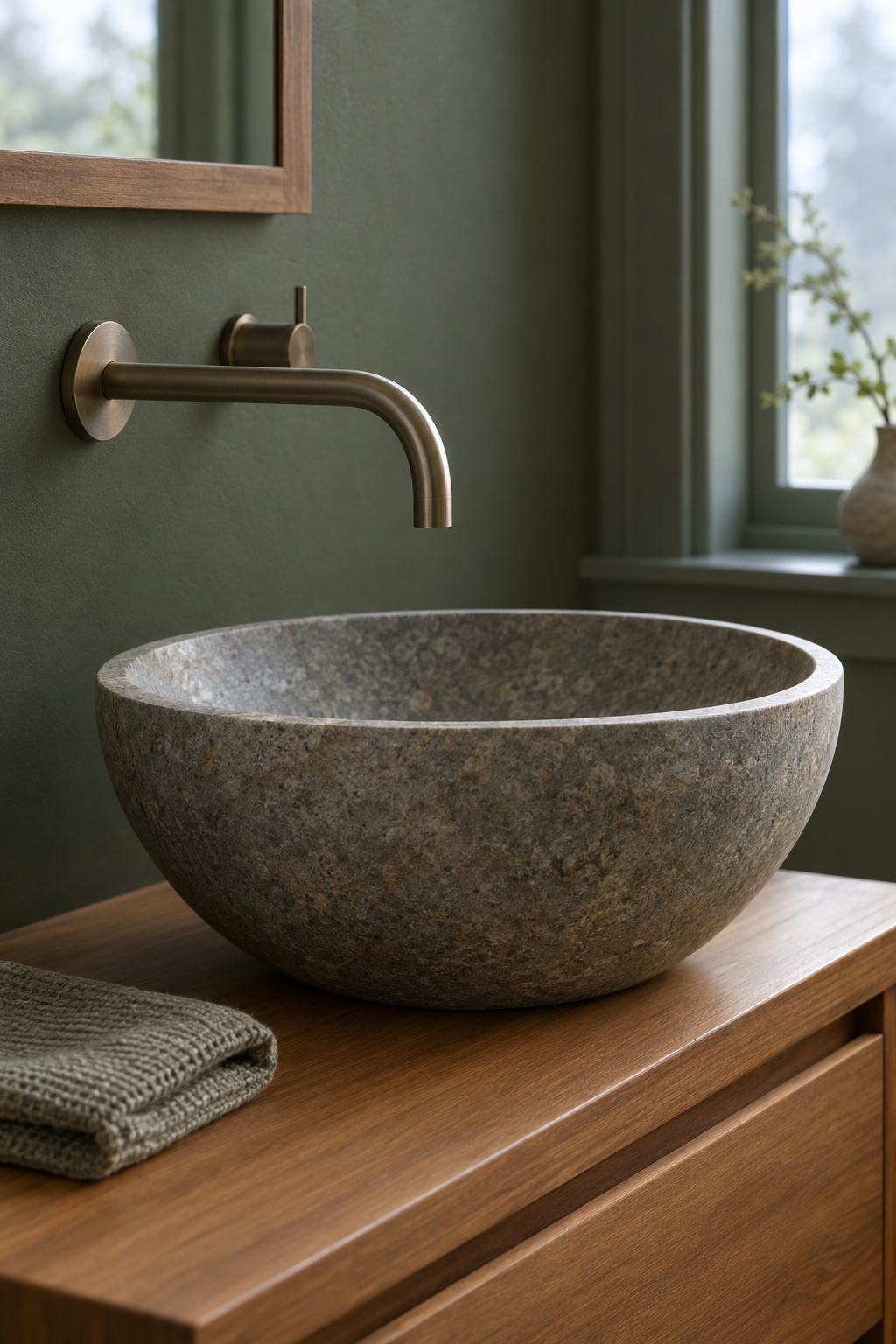
A vessel bowl brings its whole height to the rim. Aim for a base of 29 to 31 in, measured to the top of the counter, for a rim at 35 to 36 in, and add your own bowl’s height to the counter top before you buy. Bowls usually run 4 to 7 in. Wide, shallow, flared bowls throw water outward onto the wood; deeper bowls with near-vertical walls keep it in, and the spout should land near the drain.
An integrated top is one piece of ceramic or solid surface with the basin formed in it, so there is no seam at the bowl for water to find; solid surface absorbs less than 0.25% moisture long term. An undermount basin puts the cutout edge right at the counter surface, so the top has to stand up to water pooling at that edge. Quartz needs no sealing; marble is porous.
On a wood vanity I choose the integrated top, because it leaves fewer seams near the wood for water to enter.
Low, Plain and Open: The Japandi Shape, and When an Honest Non-Wood Vanity Wins
No standard defines a Japandi vanity. For me the shape is low, a plain front, an open or slatted base, and a ceramic or stone basin. Low is a judgement: the Osaka unit stands 750 mm, about 29.5 in, and the designer Amy Youngblood notes that 29 in was once standard and 36 in is today’s average. A tall, carved vanity in pale oak is furniture for a photograph.
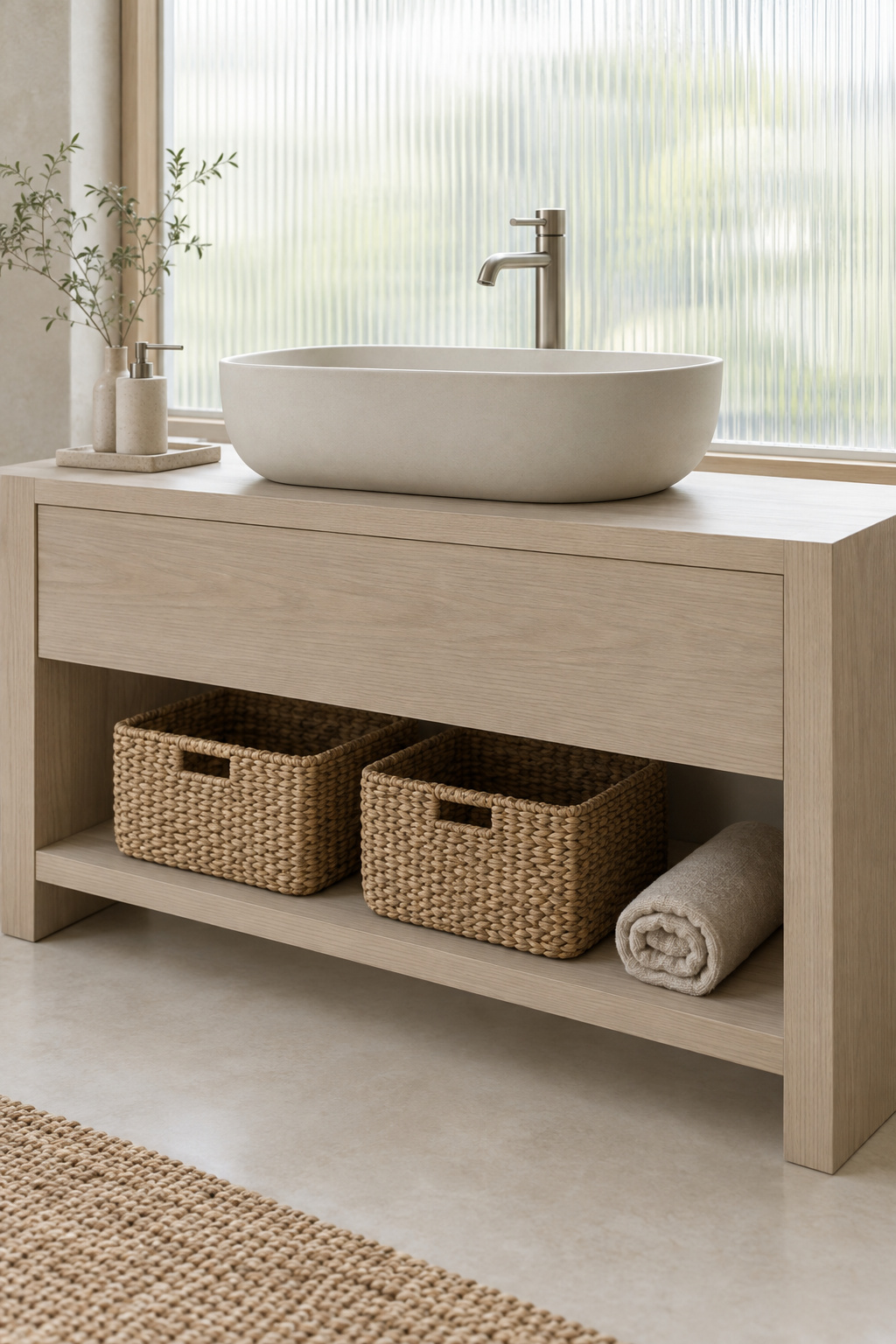
When an honest non-wood vanity is the better buy
An MDF vanity that says it is MDF, with a sealed finish and a stone or ceramic top, is a fair buy. So is melamine over a plywood box, or a solid-surface unit with its basin built in. In a family bathroom where water goes everywhere, I would choose one of these over a pretend-wood front. The failure is a “wood” claim the material line does not back up. Prices vary widely: one guide starts solid wood at $500, another at $1,500.
The short list to take shopping
- Which material is the box, the back, the shelf and the drawer sides?
- If it is MDF or particleboard, is it a moisture-resistant grade, and what is its thickness swell? One maker’s moisture-resistant board lists under 12% after 24 hours.
- Are all the exposed edges banded, with no gaps in the glue line?
- What grade are the hinges and slides?
- For solid wood, which parts, which species, and what finish?
A plain vanity needs few objects, and what to keep on the vanity top is its own short list. The grain in the photograph tells you about the surface, never the box. A skin over MDF swells where water reaches its edge and mostly stays swollen. Solid oak moves with the air instead: 0.49 in across a 24-inch board, unfinished and flat-sawn, between 40% and 70% humidity.
FAQ
How wide and how deep should a Japandi bathroom vanity be?
Size it to the room and the basin, because there is no Japandi rule. Listings in this look run 24, 36 and 48 in wide and 18 to 22 in deep overall. Most vanity cabinets are about 18 to 20 in deep inside, and doubles work well near 21 in.
How do you care for a wood bathroom vanity day to day?
Wipe up puddles, not every drop, with a soft damp cloth and warm water, then dry it. Skip bleach and surface sprays, never hang damp towels over the doors, and wipe toothpaste off the top the same day. Cabinet makers suggest keeping indoor humidity at roughly 40 to 50%.
What vanity top suits a Japandi bathroom: stone, solid surface or ceramic?
Any of the three suits it; choose by how wet the top gets. Quartz is non-porous and needs no sealing. Solid surface and ceramic can both be made in one piece with the basin, which leaves no seam beside the wood. Natural marble is porous and etches.