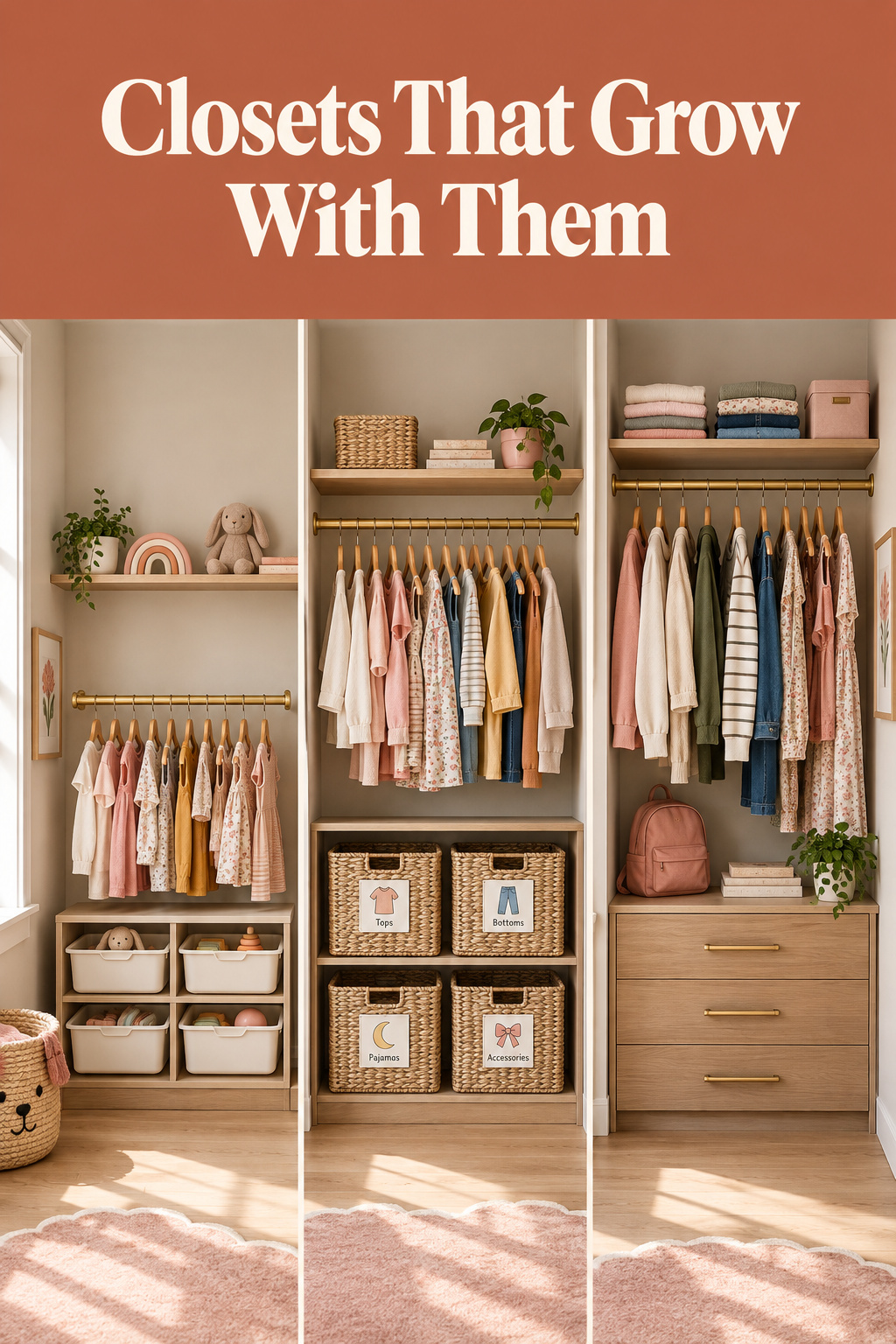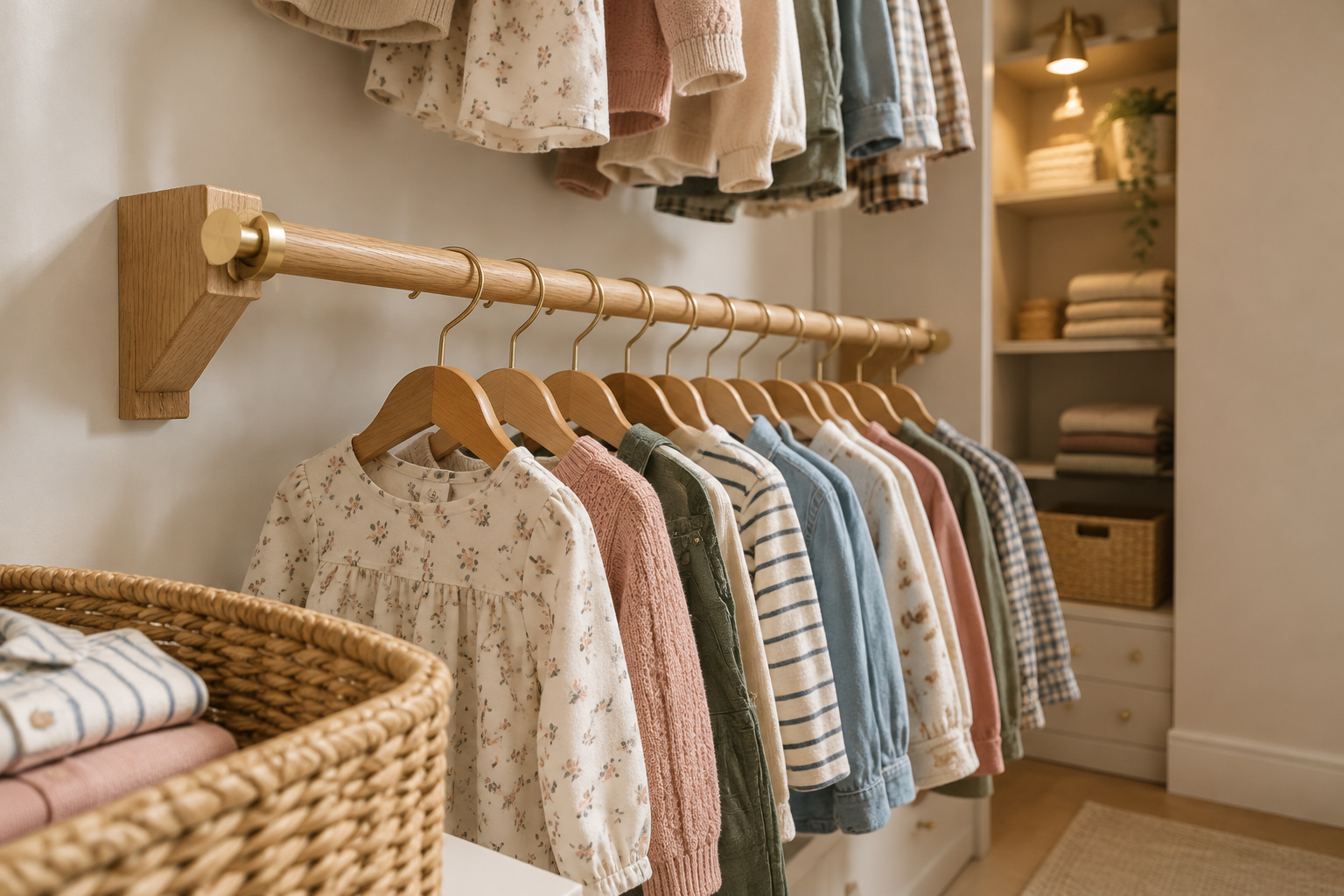

Most kids closet ideas are photographed for the parent. They’re color-blocked, with three hangers per section and everything hung where the child who lives there can’t touch it. Builder-grade closets put one rod near 60 inches, while the conventional child-accessible rod sits at 30. A closet can look finished and still fail its owner the first morning she dresses herself. The fix is reach.
TL;DR
- Plan by reach: ADA data puts average high reach at 33 inches at ages 2–4, 41 at 5–8 and 44 at 9–12; set a young child’s rod at 30 inches, a preteen’s near 48.
- Buy adjustable: one track moves a rod from 36 inches for a toddler to 60 for a teenager. Wire shelving runs $40–$150, tower kits $200–$500, IKEA PAX $400–$1,200.
- A tired kid maintains open bins and picture labels, not folded stacks. Children rarely take real responsibility for their belongings before ages 7–9, so the system does the work until then.
The Catalog Photo Isn’t the Goal — a Kid Who Can Use It Is
A styled closet photo shows an adult’s taste at adult eye level, which is a poor brief for a room a six-year-old operates alone at 7:15 on a school morning.
Why a ‘perfect’ closet a kid can’t reach fails on day one
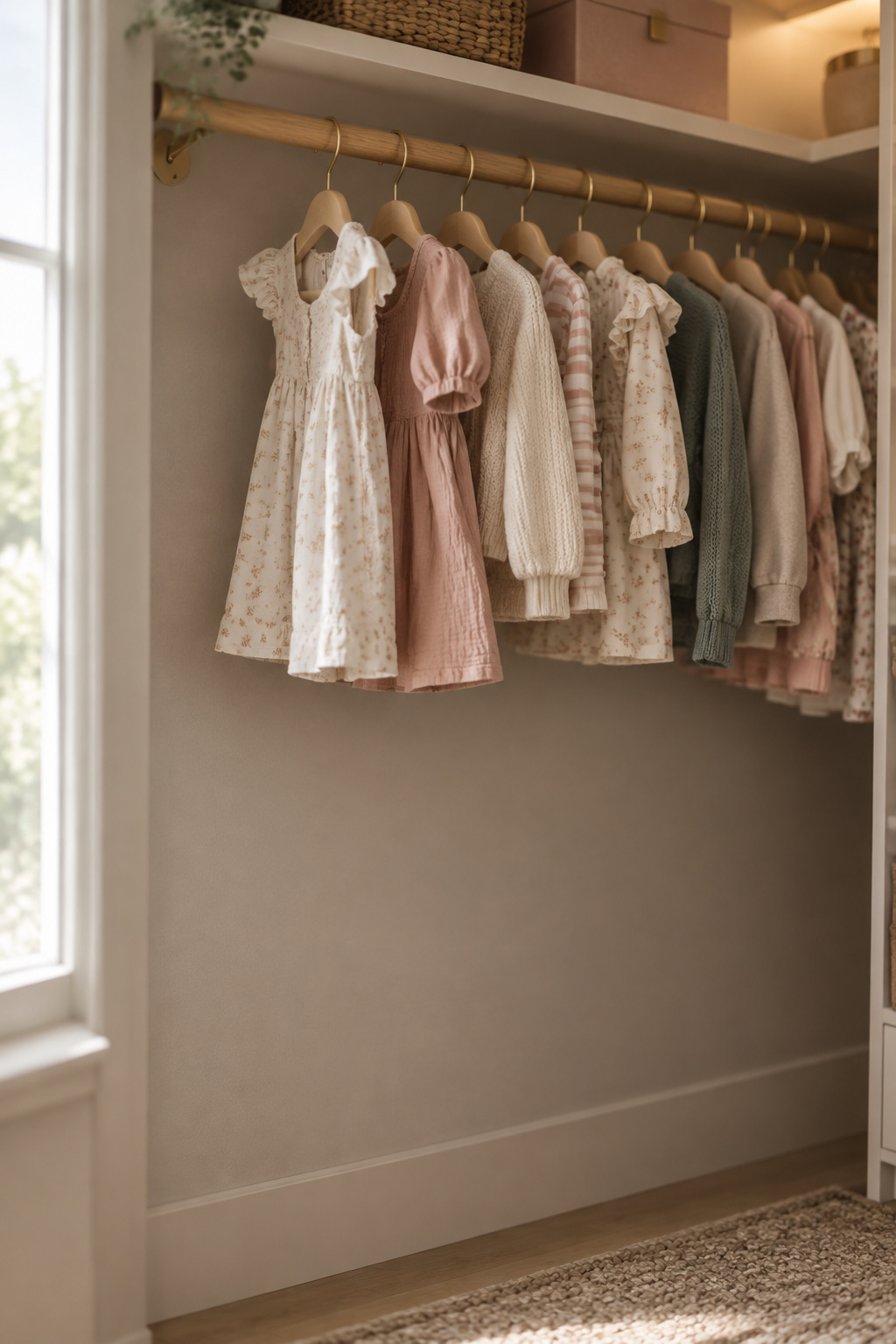
Builder-grade closets are built for adult clothes: one rod near 60 inches with a shelf above. The rod is useless for self-dressing and the shelf becomes an out-of-reach dumping ground. The conventional child rod hangs at 30 inches, roughly half the adult single-rod standard of 66 inches from the walk-in closet layout guide. Catalog shots hide that gap. Families live in it.
What I actually rate every kids’ storage idea on
Three tests a photo can’t answer:
- Can she reach it unaided?
- Can she see inside without tipping a bin out?
- Can she put it back right, first time?
Independence is a design outcome. If a child can’t reach it, open it or put it back, the room is decorating, not designing. That’s the filter behind closet organization for every stage.
Reachable Rod and Shelf Heights by Stage
Per the ADA’s children’s anthropometric reach appendix, a two-to-four-year-old can reach about 33 inches up. Most kids’ closet plans never consult that figure.
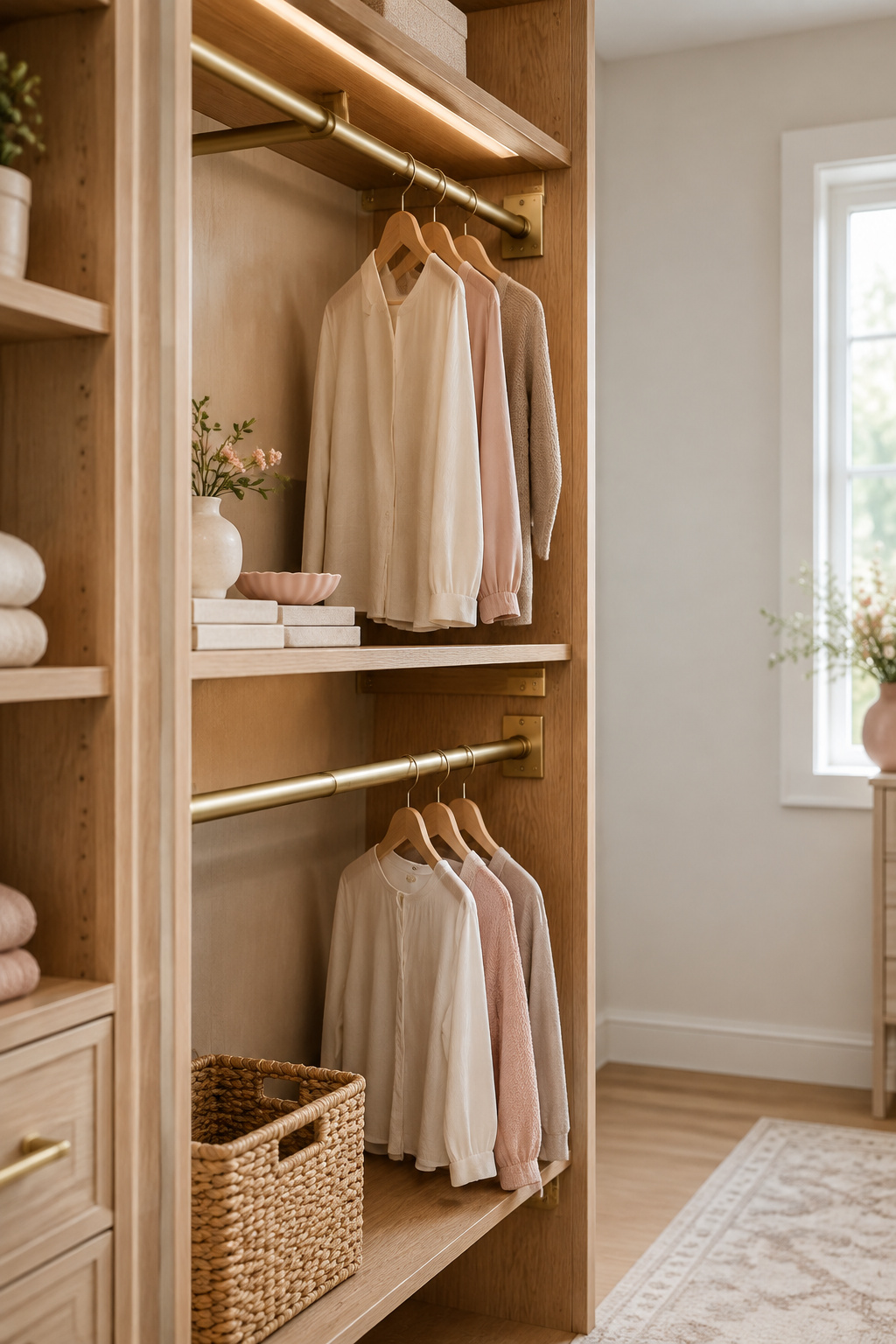
Treat the table below as the reference, with one caveat. Nobody publishes a reach table built only for closet rods, so it combines that standard-grade source with a converging trade convention. It’s a combination, not one study.
| Age band | High reach (ADA) | Rod height | Shelves |
|---|---|---|---|
| Ages 2–4 | 33 in | 30 in | 24 in maximum |
| Ages 5–8 | 41 in | rises with reach | second shelf in sight line |
| Ages 9–12 | 44 in | near 48 in | shelf above rod usable |
Toddler through early elementary
The rod sits below fingertip reach because it needs clearance for the hanger and the garment as well as the hand. Shelves sit lower again, since a child has to see into a shelf as well as reach it.
Tweens and up
Keep the system low for safety as much as independence, since nothing stacked overhead can topple onto a child. That logic holds to roughly 48 inches for a preteen. By the teen years a full-length rod near the adult standard finally fits.
Adjustable Kids’ Closet Ideas That Move as They Grow
The expensive mistake is a fixed-height system sized for the child you have this year.
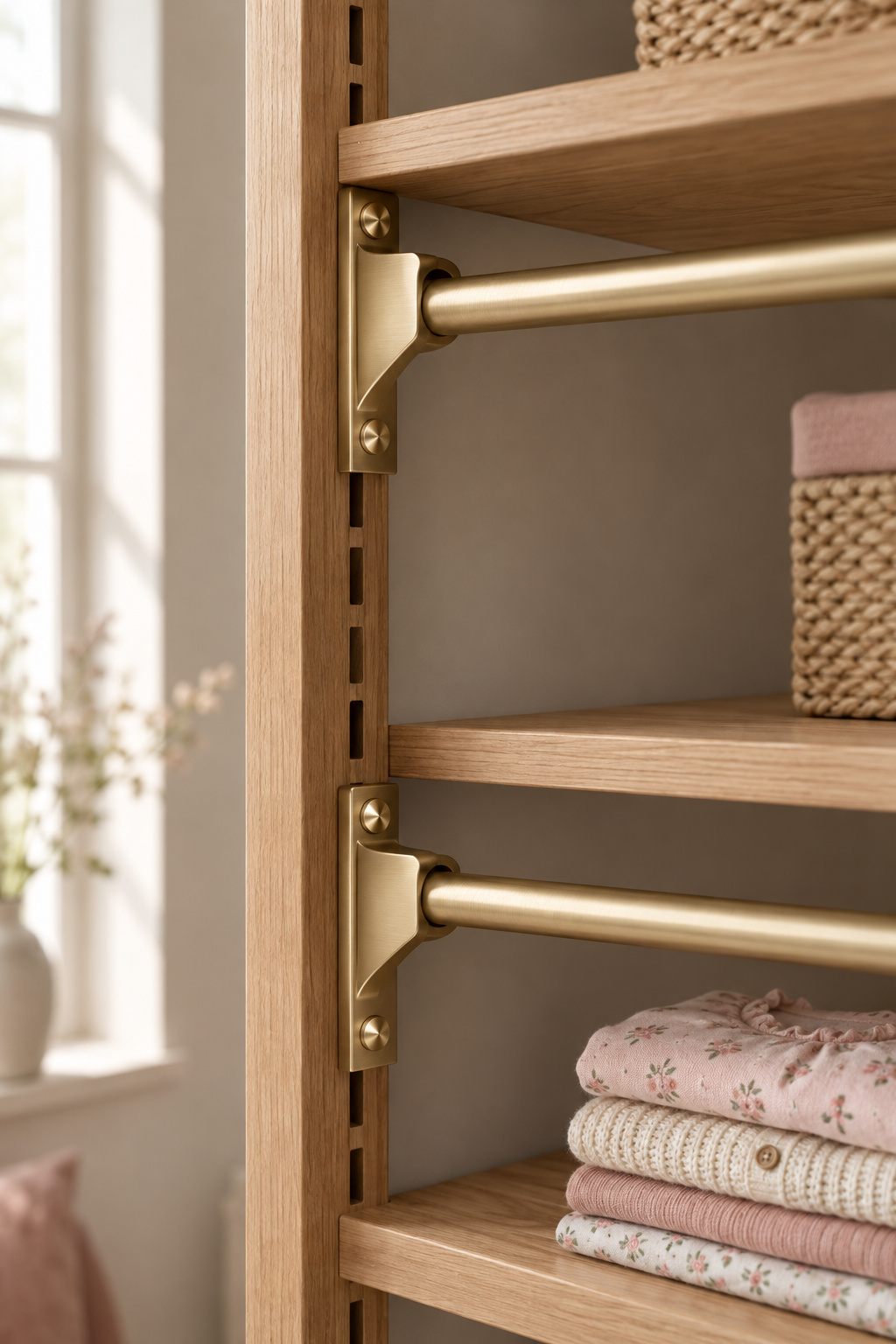
Rods and shelves you reposition instead of replace
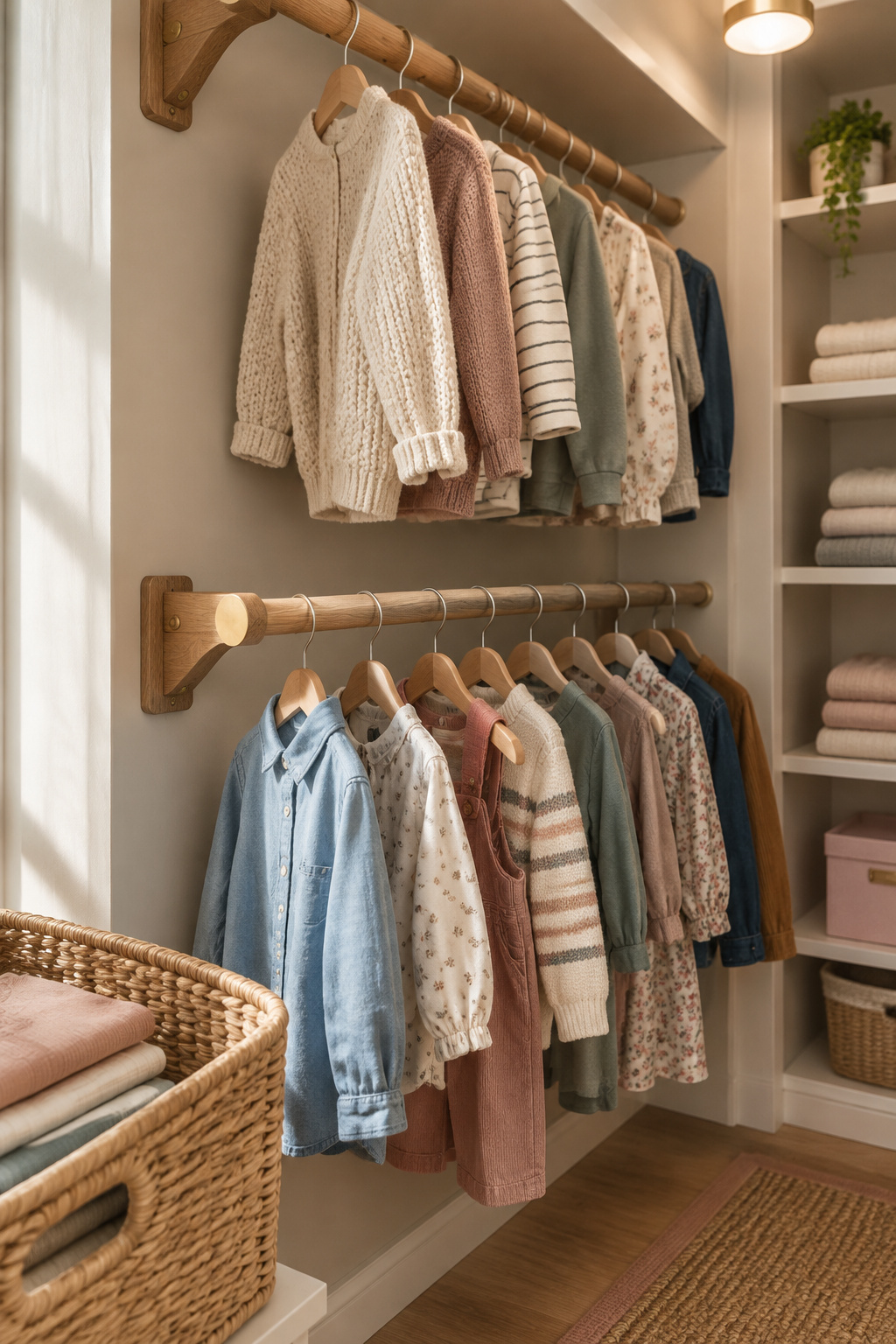
Track and shelf-pin systems move without tools: a triple-hang setup converts to a double, then to one full-length rod as garments lengthen. On one track, a rod at 36 inches for a toddler repositions to roughly 60 for a teenager, with the same hardware and the same holes. The table sorts costs by tier. These are kids’-system prices, separate from the whole-closet cost-per-linear-foot figures covered elsewhere.
| System type | Typical cost, small closet | Adjustability |
|---|---|---|
| Wire shelving | $40–$150 | Easiest to reconfigure |
| Melamine tower kit | $200–$500 | Shelves and drawers adjust |
| IKEA PAX with Komplement | $400–$1,200 | Rearranges as she grows |
| Custom millwork | $2,000–$8,000+ | Limited once cut |
Buying for the stage after next
Do the arithmetic before buying cheap: a $300 kit replaced three times over twelve years is $900 spent on something that still doesn’t fit. Plan to reconfigure at three moments instead: self-dressing around two or three, school at five, choosing her own outfits around eight. Build for that now with spare track length, an empty bracket slot and a deliberate gap on a shelf.
Sharing a Closet Between Siblings Without Daily Conflict
My own two are four years apart and shared one small bedroom, so they shared one closet wall. For months I split it by category, shirts here and pants there, and couldn’t work out why the younger one stopped hanging anything up. Half the system sat above her hands, and none of it was visibly hers.
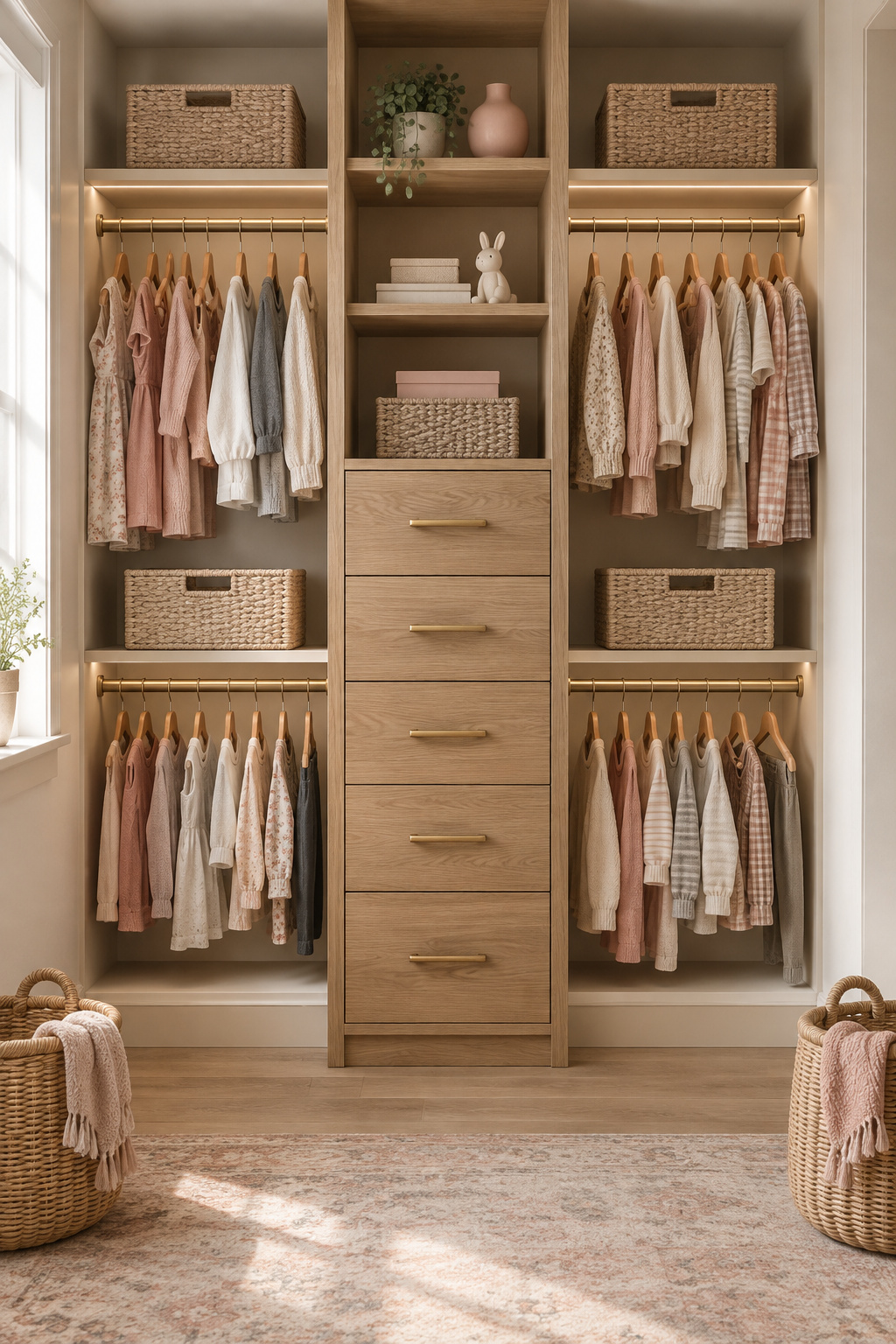
Splitting hanging space fairly
Shared is the normal case. In a SleepFoundation.org survey of 1,250 US parents, 70.4% of households with two or more children share a bedroom, and 77.8% of those rooms hold exactly two kids. The split that holds up is mirrored: a central drawer tower with equal drawers each, hanging sections running symmetrically to either wall, and one nook reserved for hand-me-downs.
Whose stuff goes where — a system, not a negotiation
Palludan and Winther, in the Journal of Material Culture, found siblings use possessions and spatial markers to claim visible territory inside a shared room. That’s why mirrored halves beat a category split: each child sees which part is hers without being told. Give each one a matching set of containers, then subtract. Spare blankets and board games shouldn’t live in a shared closet.
What a Tired Six-Year-Old Will Actually Put Back
What happens in that closet at 7 p.m., after swimming, when everyone is done? That’s the only maintenance test that counts, and folded stacks fail it most nights.
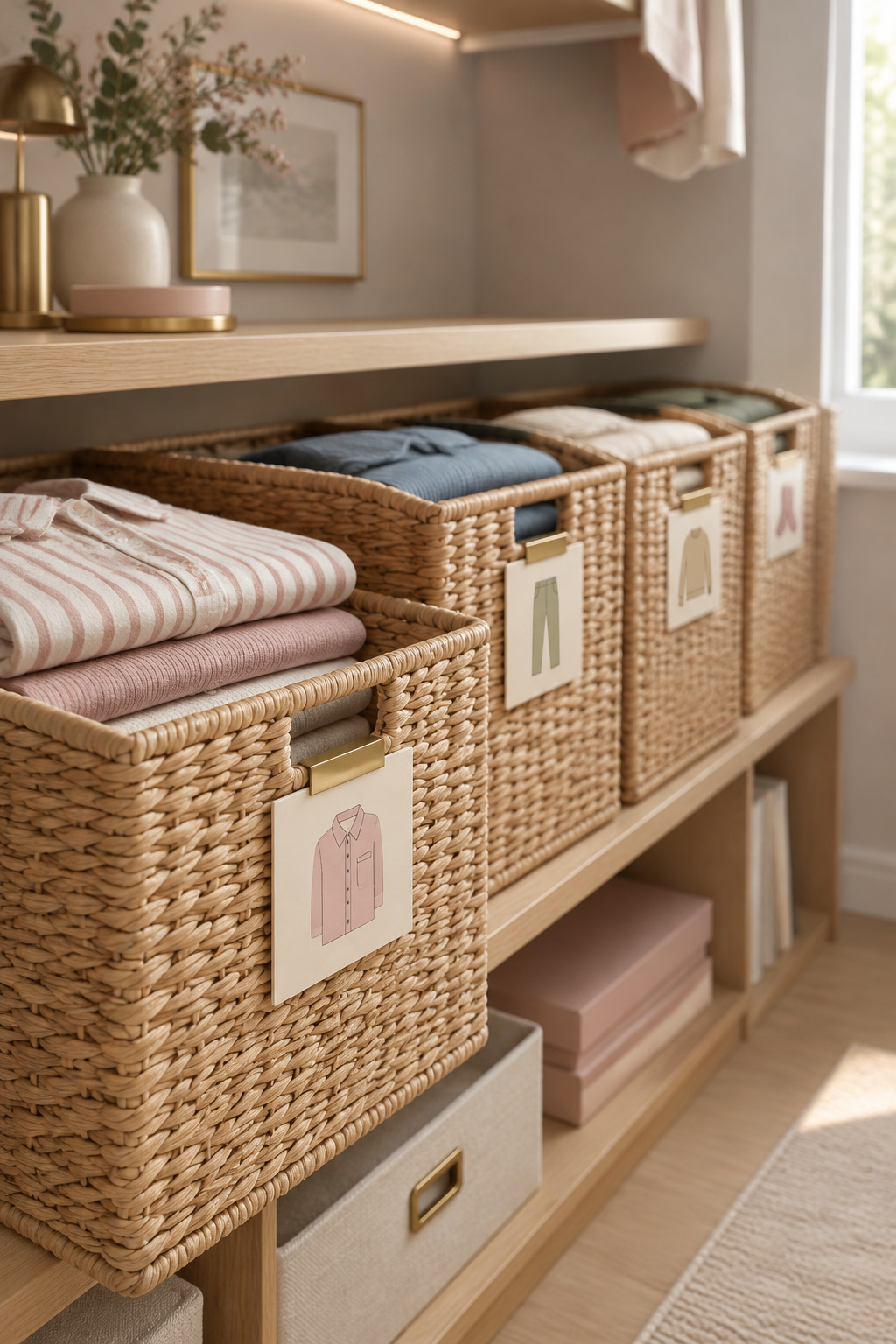
Bins beat folding, most days
Open bins beat drawers because they delete a step: no pulling open, no refolding, just drop and go. Clear and shallow beats deep and opaque every time. The fewer-and-contained principle has research behind it, too. In a University of Toledo study, toddlers given four toys instead of sixteen played 108% longer per episode and in 63% more distinct ways. Remember the developmental floor as well: kids rarely take real responsibility for their belongings before seven to nine, so a six-year-old isn’t failing your system. Your system has to carry her.
Labels that work before a kid can read
Picture labels, meaning a photo or drawing on each bin, let a pre-reader sort and return things unaided. Color-coding does the same job: pants in one color, shirts in another. Toddlers get pictures and open bins, preschoolers do better with whole outfits pre-grouped on one hanger, and by six to nine kids handle written labels.
Scaling Down the Zone Logic From a Bigger Closet
A kid’s closet needs the same planning method as a big one, dropped about three feet.
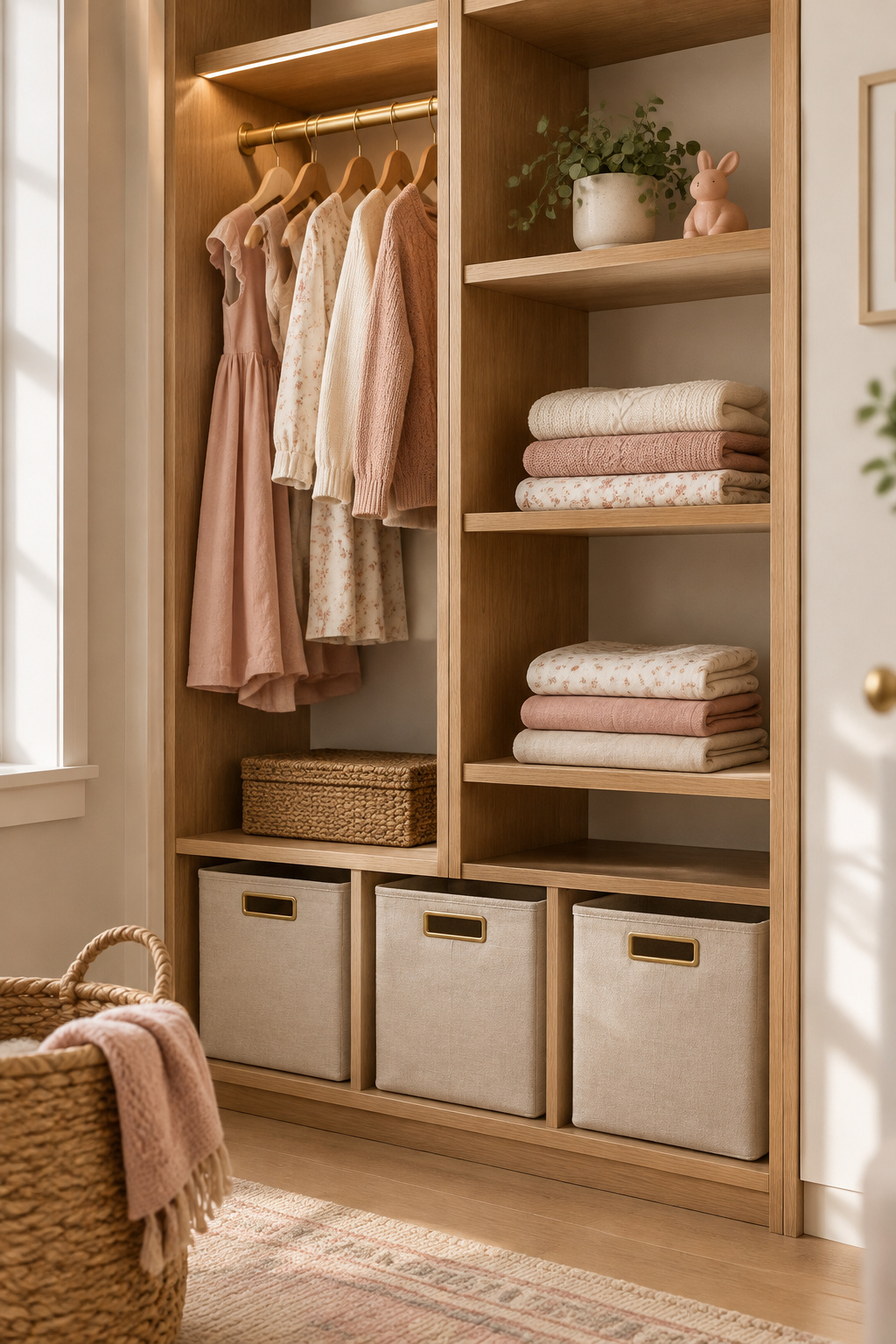
What carries over from an adult walk-in plan
Zone planning transfers straight down: group by what an item is and how it’s used, not by where it fits. A kid’s version needs two hanging heights plus shelving for what doesn’t hang, such as pajamas, socks and shoes, with every zone reset to a reachable band. The full reasoning behind those zones lives in the guide to zoning a larger shared closet.
Most Kids’ Closets Are Small Closets Too
Standard reach-in closet depth is 24 inches, sized around a 17-to-19-inch hanger plus a couple of inches for a jacket shoulder.
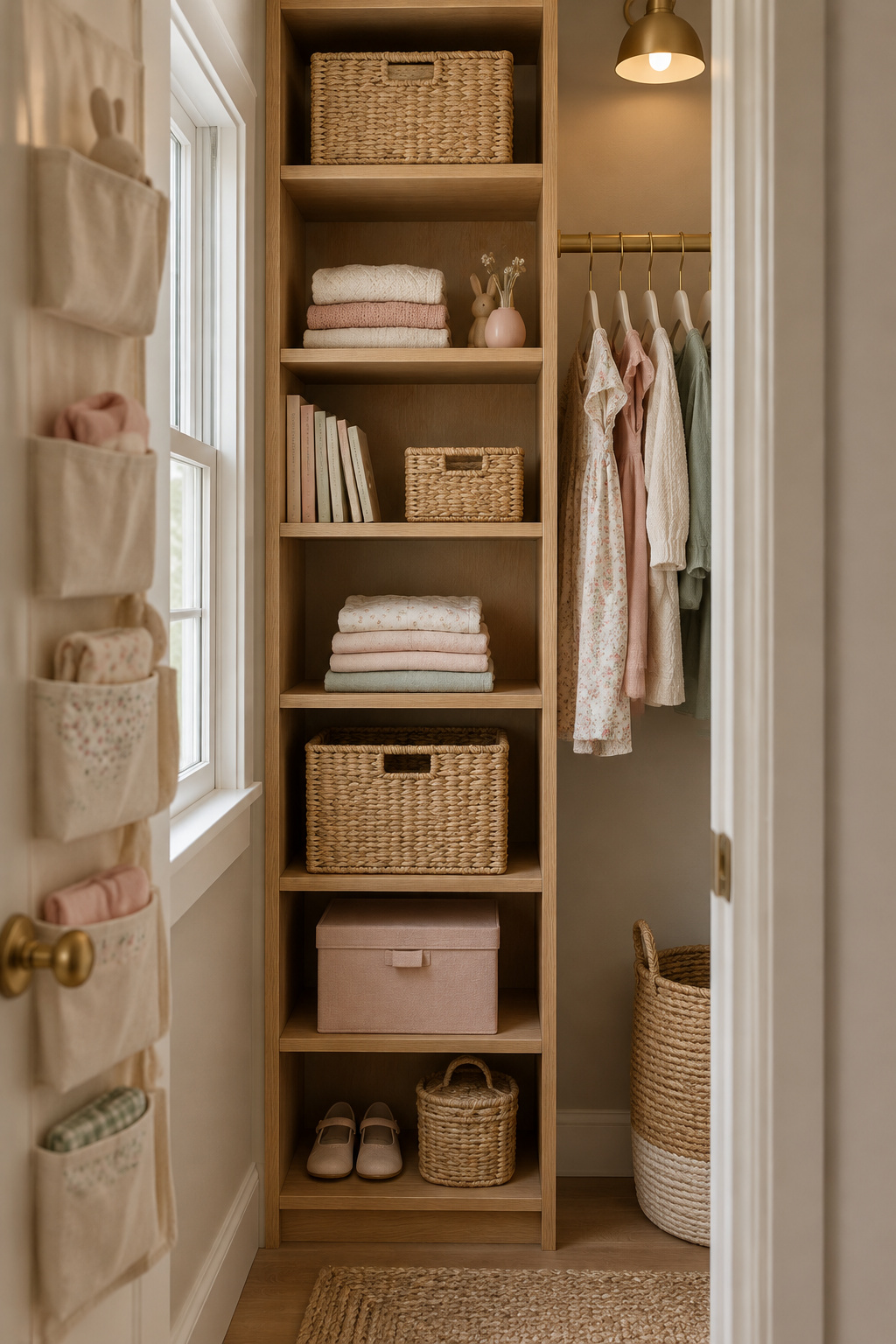
Applying space-tight tactics at kid height
There’s good news in that number. A kid’s closet is usually the same depth but holds much smaller garments, so the slack an adult wardrobe eats becomes free depth for bins. Everything else about a tight reach-in, such as vertical space, slimline hangers and door-mounted add-ons, stacks on top of the reach planning here. If your kid’s closet is also genuinely small, run these small closet space-saving tactics at kid height.
Do the Kneel Test This Weekend
Kneel in the closet doorway at your child’s height and look around. Then measure floor to fingertips with her arm up, and pencil that line on the wall. It tells you whether the rod drops to 30 inches, climbs toward 48 or holds another year, and whether the shelf she can’t see into should become a bin she can. A catalog photo never gives you that: a plan sized to a real child at a real stage, flexing at three predictable moments instead of being rebuilt at every growth spurt.
FAQ
At what age can a kid start organizing their own closet?
Meaningful responsibility for belongings emerges around ages seven to nine, and by ten to twelve most kids manage independently. Before that, the system does the organizing: picture labels and open bins for toddlers, pre-assembled outfit groupings for preschoolers, readable zoned sections for elementary-age kids.
How do I stop my kid’s closet from turning into a dumping ground?
Use clear, shallow, open bins instead of opaque containers or drawers, so a child can find and return items without emptying everything out. Then reduce the volume: frame donating outgrown items positively and cap collections. Purging what doesn’t belong there is the biggest lever.
How do I organize one shared closet for two kids with a big age gap?
Split it into mirrored, evenly divided sections instead of by category, which feels unfair when wardrobes differ in size. That means a central drawer tower with equal drawers each and symmetrical hanging sections on either side. Within each child’s section, set a low bar with shelving above, plus a hand-me-down nook.