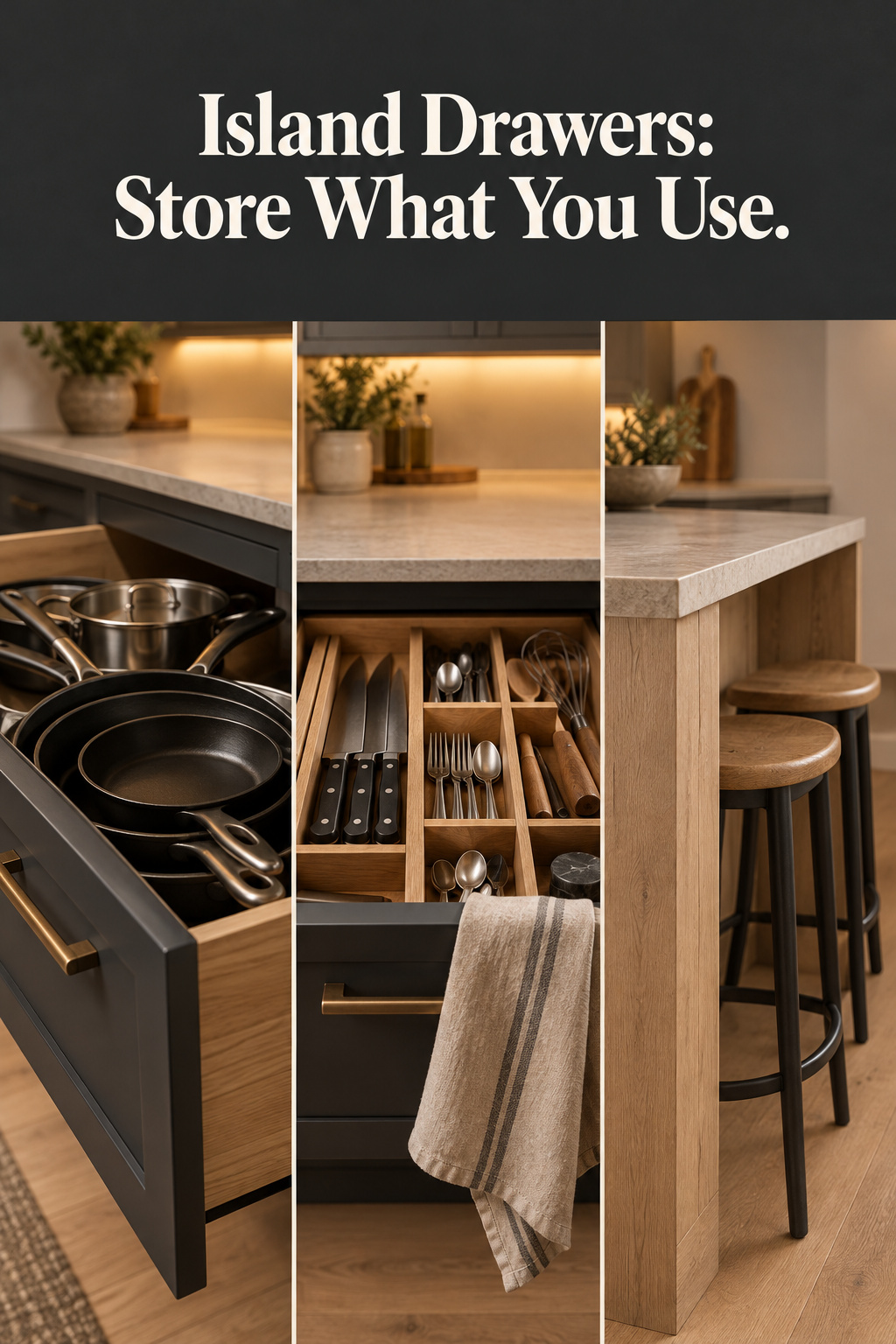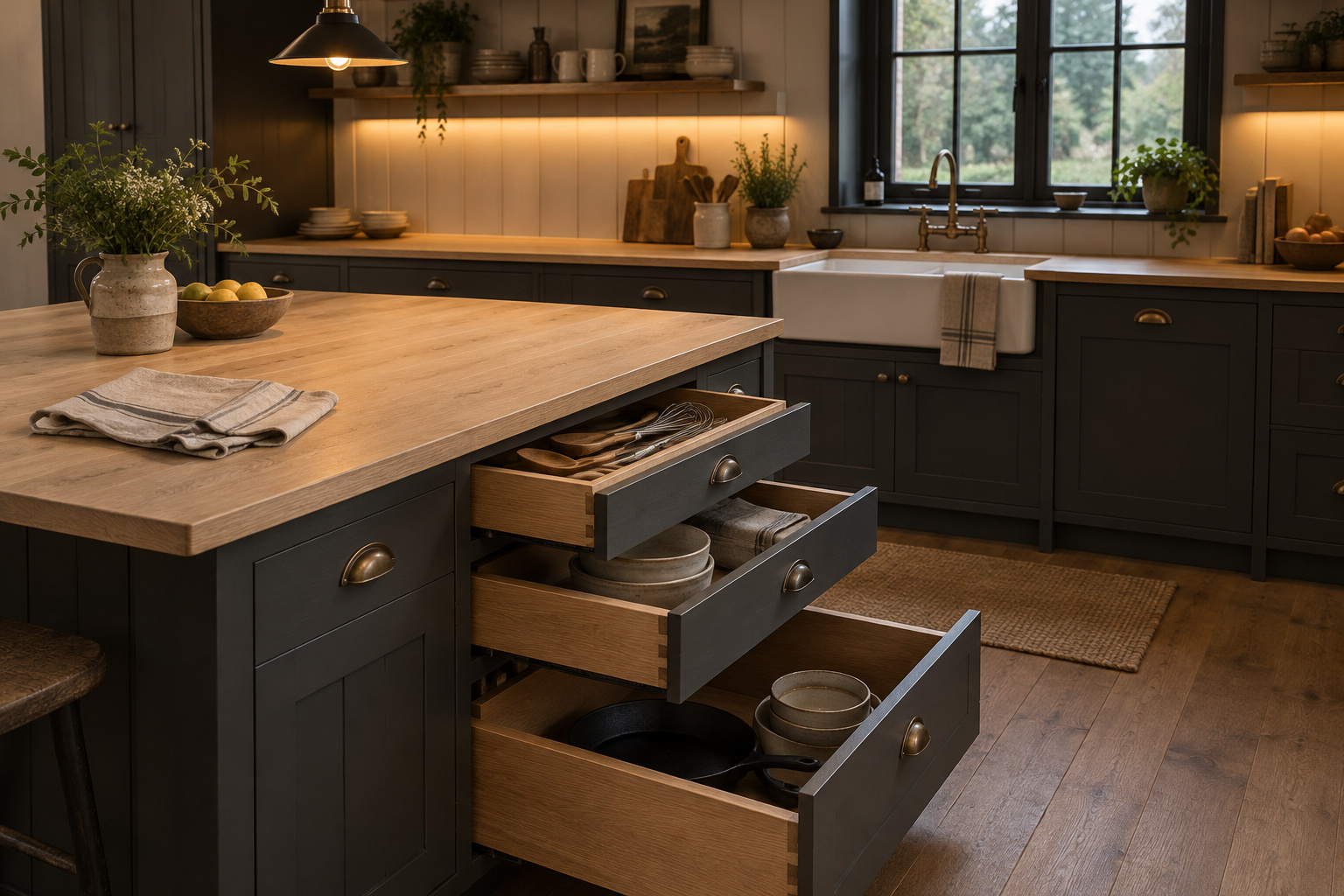

Ask why kitchen island drawers beat doors and most people will tell you drawers hold more. The people who design kitchens say otherwise: Scott Peterson of HKUK holds that a cabinet with adjustable shelves will always store more than drawers the same size. Even the drawer makers argue something else, that a drawer brings the back of the box to you. So stuffing an island with everything it can hold misses the point. Plan it around a smaller question: what does the cook reach for while standing there?
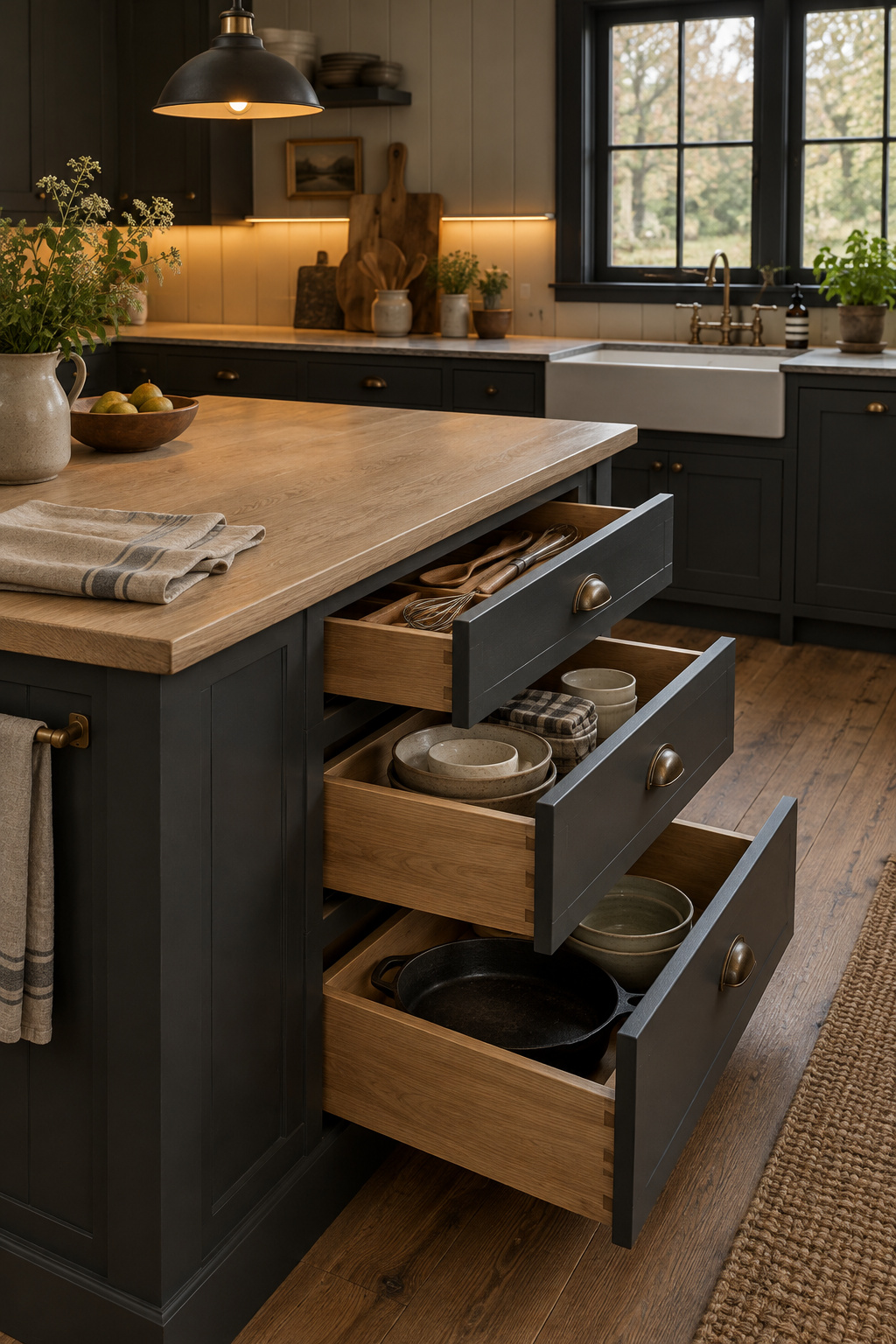
TL;DR
- Drawers beat doors on access, not capacity. A full-extension drawer shows its whole contents from above, while shelves behind a door may hold more but let things drift to the back and be forgotten.
- Keep only what you use standing at the island: knives, utensils, boards and bowls on the prep side, pans and lids near the cooktop. NKBA’s Access Standard tier puts frequently used items 15 to 48 in above the floor.
- Retrofit before you replace. Pull-out kits for existing base cabinets ran from about $50 to $215 in 2026, a pro-installed single pull-out from about $500, and the box is ordered 1 in narrower than the clear opening.
Kitchen Island Drawers Beat Doors, but Not Because They Hold More
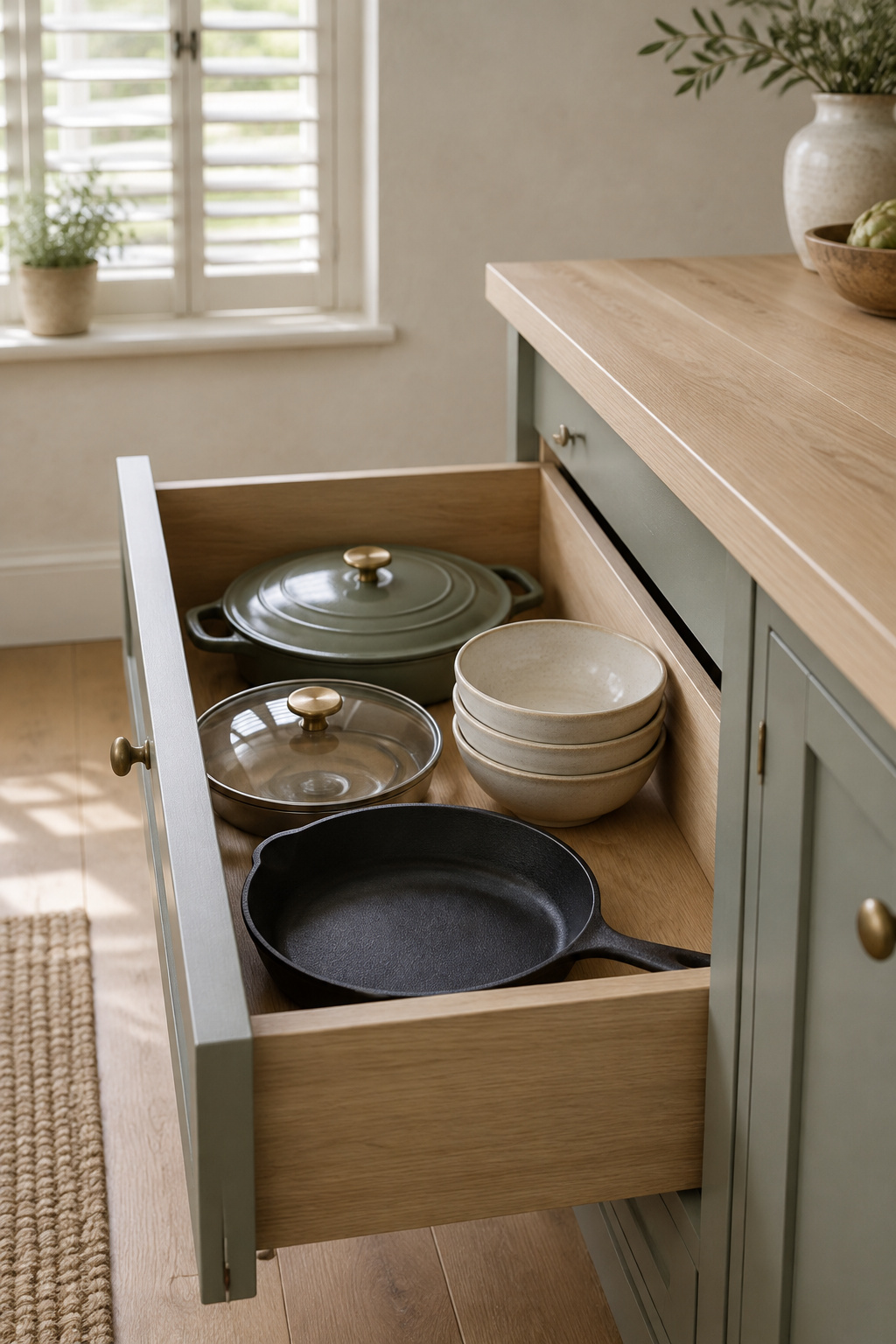
Picture the low cupboard in any kitchen. The everyday pan sits at the front, and behind it is a roasting tin from two Christmases ago. Blum, which makes drawer hardware and so has an interest in the answer, describes exactly this: in a base cabinet with doors and shelves, things migrate to the back and get found again on hands and knees. A drawer on full-extension slides puts everything in view from above. An extension guide written for wheelchair kitchens agrees: drawers bring the full depth of a base cabinet within reach, and if shelves must stay, pull-outs are essential.
NKBA’s planning guidelines take no side. They count shelves and drawers together as one frontage figure and recommend a total for each kitchen size. Drawers make up roughly a quarter in every case: 360 of 1,400 in for a small kitchen (25.7%), 400 of 1,700 for a medium one (23.5%), 525 of 2,000 for a large one (26.3%). NKBA has no rule that drawers beat doors, so the case for them rests on reach.
So the first decision is which few things deserve the best seat in the kitchen. Where the island sits in the room, and how it fits the farmhouse look, is in the full farmhouse kitchen island guide.
Store Only What the Cook Reaches For Standing at the Island
My test is one question per object. Do you use it standing at the island? It goes in. Do you carry it over from across the room? It lives on the perimeter.
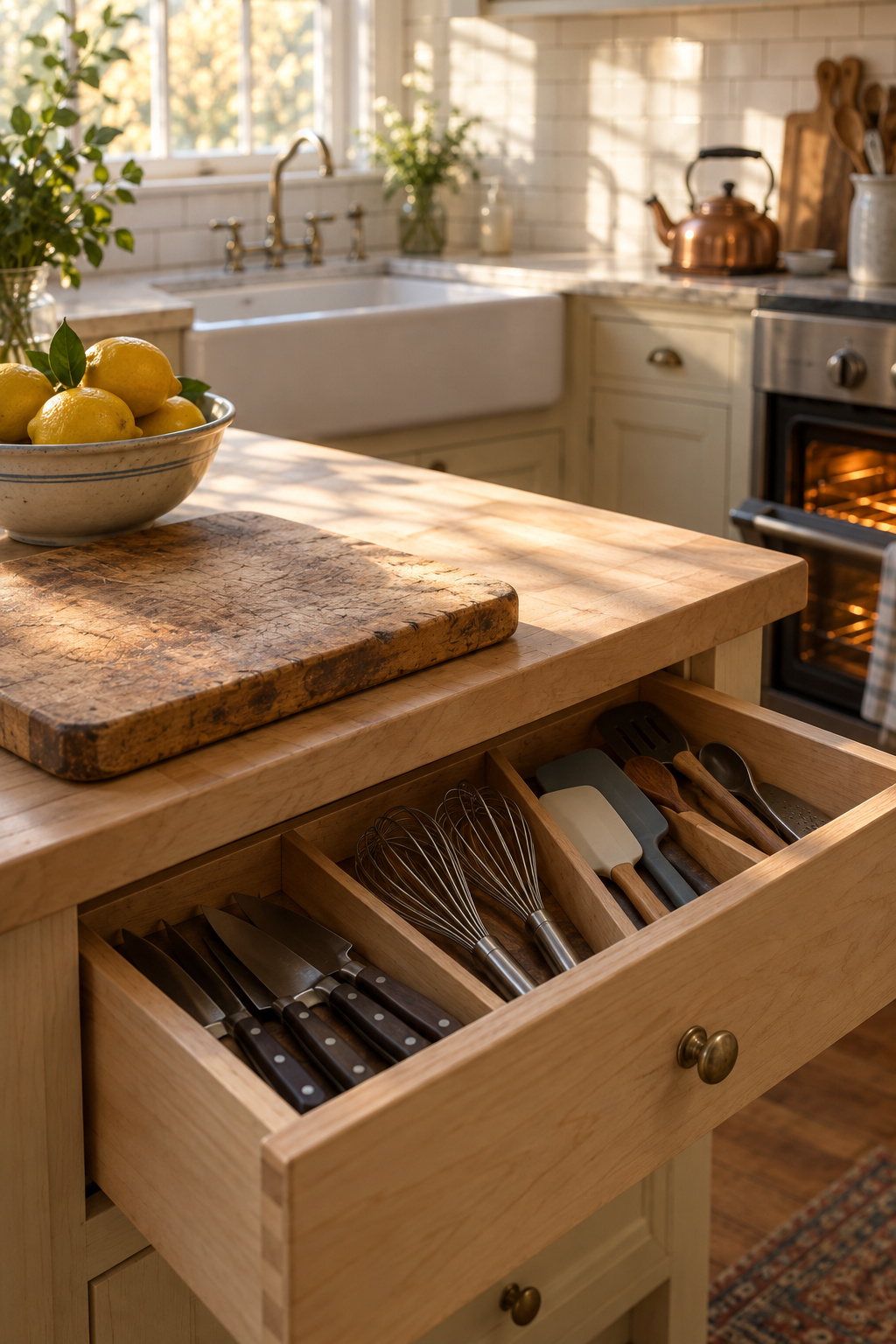
Height matters too. NKBA’s Access Standard tier plans frequently used items 15 to 48 in above the floor. Universal-design guidance, and an NKBA knowledge-base article, use 18 to 48 in instead. I would name the tier rather than average the two. Either way, the top two island drawers are prime space.
Here is how I sort a typical kitchen; the middle column is my judgment, not a measurement.
| Item | How often it’s used at the island | Where it lives |
|---|---|---|
| Knives, spatulas, whisks, peelers | Every meal | Island, top drawer, prep side |
| Cutting boards | Every meal | Island, upright in a narrow divided drawer |
| Mixing bowls | Most days | Island, deep drawer |
| Pots, pans and lids | Most days, if the island faces the cooktop | Island deep drawer beside the cooktop; otherwise near the range |
| Wraps, foil, zip bags | Most days | Island, second drawer on the prep side |
| Everyday plates and glasses | Rarely at the island | Near the dishwasher or sink; island only if it faces one |
| Serving platters, seasonal ware | A few times a year | Perimeter or a high cupboard |
| Daily mail | Never | Not in the island |
Everyday plates and silverware, like the mail, belong somewhere else.
Deep Pot Drawers, a Knife Drawer and a Utensil Drawer: What Each Should Hold
A three-drawer base does most of the work in a typical island: one shallow drawer on top for tools, two deep ones below for pans. If you are building from scratch, pick full-depth drawer bases over door bases; see choosing drawer bases when you build. An existing island can get the same split from retrofit pull-outs.
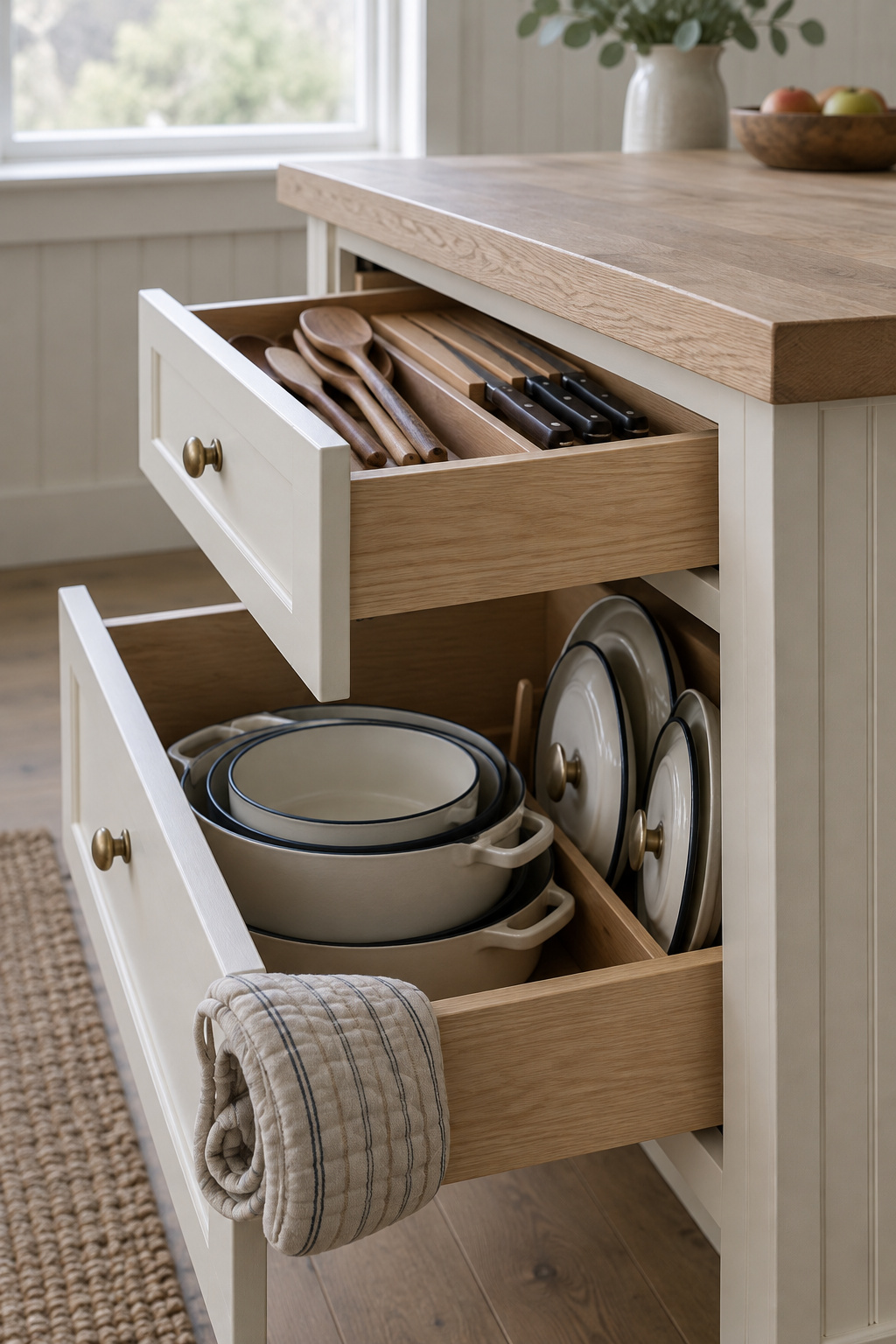
Deep drawers for pans and bowls, and the knife and utensil drawer
A few rules of thumb I trust:
- Size the drawer to its contents. A university extension guide suggests 3 to 4 in deep for silver, small tools and spices, 6 to 7 in for saucepans and canned food, and 11 to 12 in for canisters and big packages.
- Give heavy drawers heavy slides. One cabinetmaker’s guide to Blum’s MOVENTO runners lists 40 kg and 70 kg classes, 88 and 154 lb, and says to ask for the heavier one under cast iron or stacked dishes.
- A slim internal drawer for lids, or a divider that files them upright, lets the pans nest.
- Knives are shallow. A pull-out knife tray set into the top of a drawer leaves room underneath for foil, parchment or towels.
Slides also cost width. Side-mount slides need about 1/2 in per side, so the box comes out roughly 1 in narrower than the opening. On a 30 in opening that is 3.3% gone. Undermount slides take 3/16 to 5/16 in in total, which is 0.6 to 1.0% of the same opening. On a drawer used every day, I would pay for undermount.
I would also pay for the box, because a drawer box is where you find out what the maker saved money on. Buy fewer drawers and make them real.
The Seating Side Should Hold Almost Nothing
On the side where people sit, the knees decide, and the knee-space clearances are worth reading before you cut anything. Where the overhang takes the full knee depth, there is often no base cabinet on that side at all, and I think that is right.
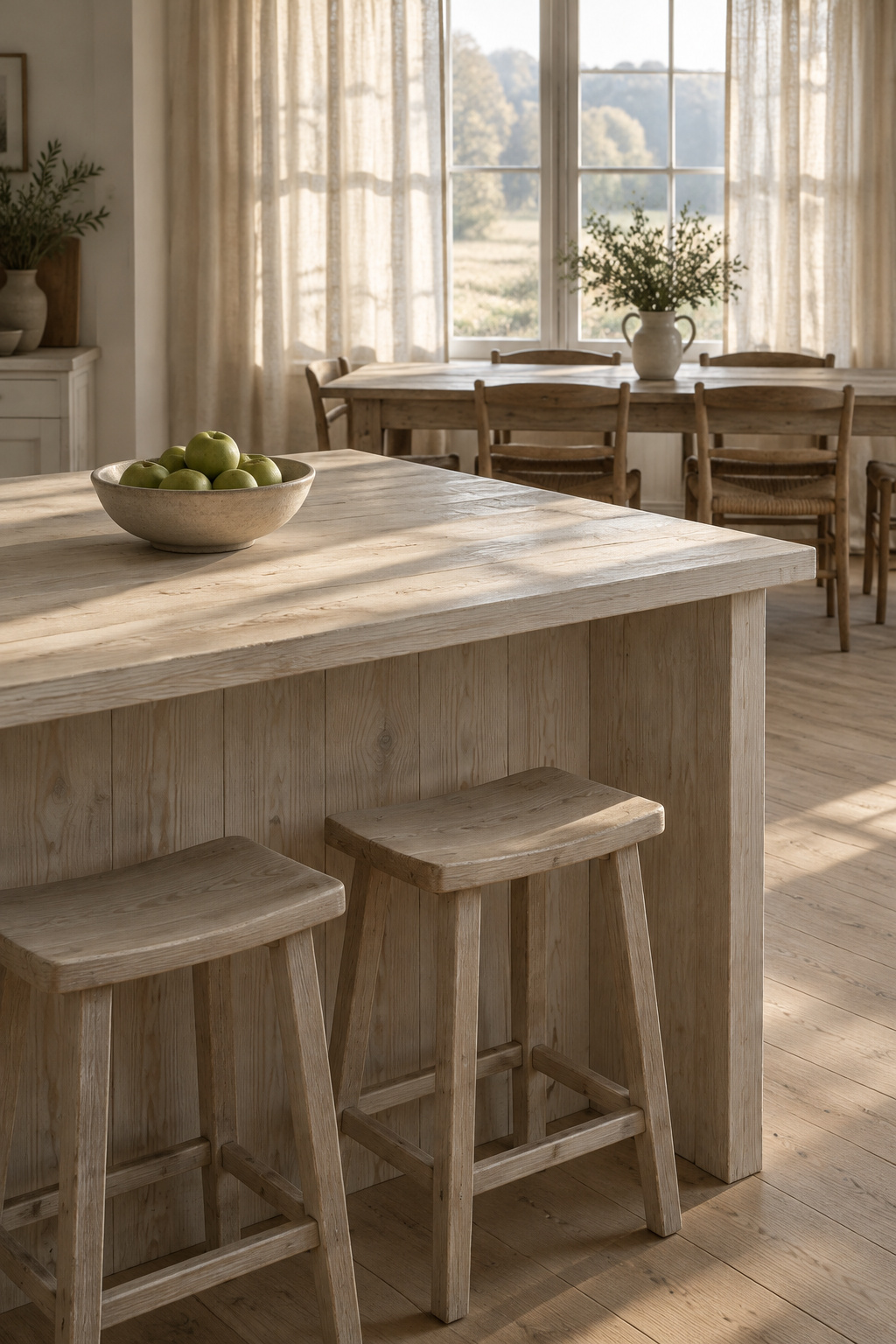
No standard says the seating side must be empty; I get there from the knees. A deep drawer there opens only when nobody is sitting, so it fills with things nobody needs. If there must be storage on that face, keep it shallow.
Trash causes the most trouble here. On an island mostly used for sitting and serving, a trash pull-out puts guests about two feet from the bin. Richard Davonport’s phrase fits: an island should read as a permanent architectural element, not a convenient storage platform.
Empty space on the seating side gives legs room and the eye a rest. Enough is a good word.
Open Shelves on an Island End Collect What You Don’t Use
The other way to add island storage is an open shelf on the end. It looks generous in a photograph. In use, it depends on where the end points.
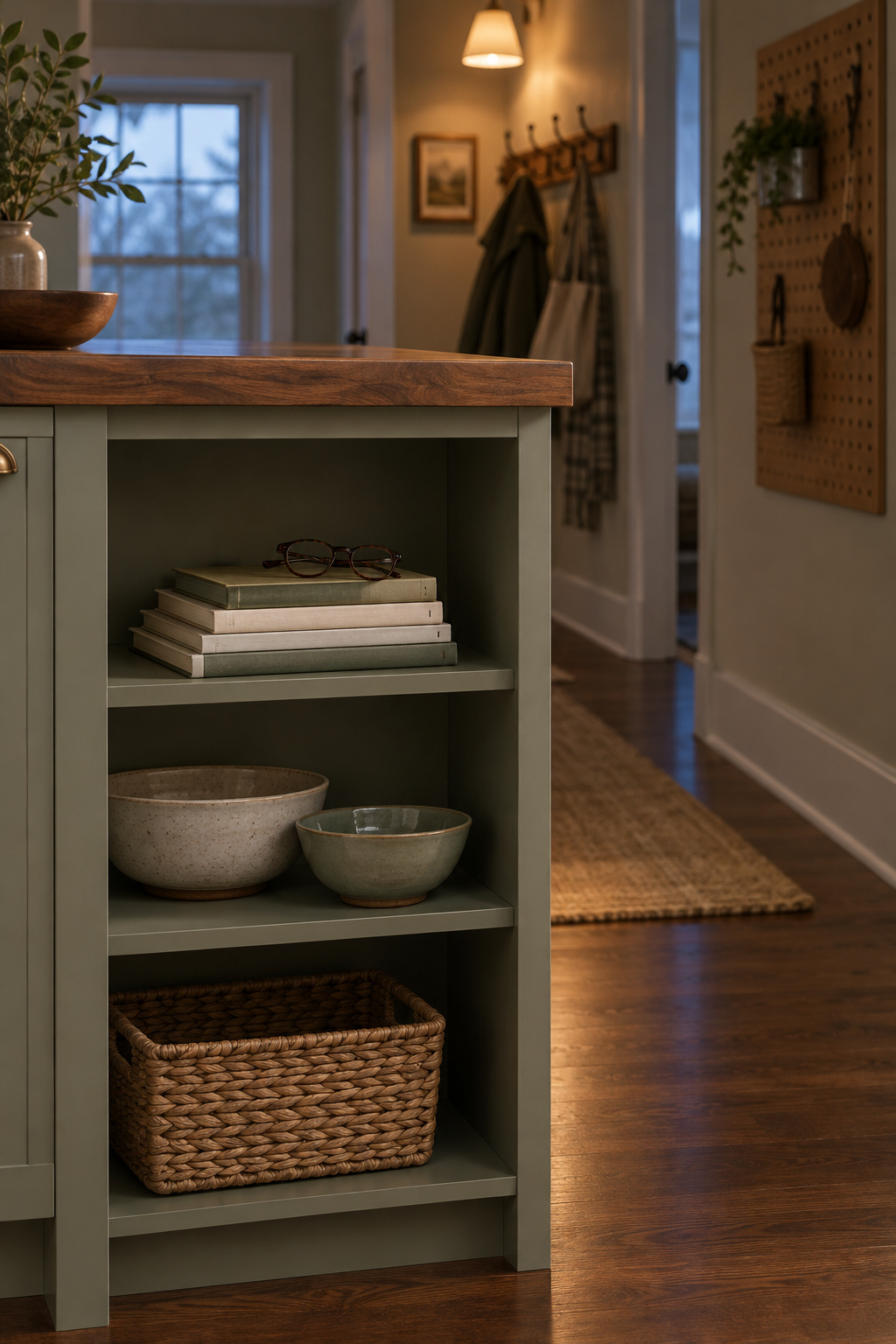
Facing a walkway, a deep end shelf collects bags and mail. Facing a quieter part of the room, it can hold one calm category, a short stack of cookbooks or two serving bowls, with space left empty.
The test is whether the shelf holds a stable set of things or the overflow from cupboards that are already full. Mastercraft Kitchens, a UK kitchen company, says open shelving works for a curated, stable selection, and more generous drawers take the pressure off it. If you need more storage, add drawers first. Open shelving on walls is a separate question, covered in the open shelving kitchen guide.
Retrofit Pull-Outs Before You Replace the Island
The doors on the original 1950s birch cabinets in our house outside Duluth were sagging. A contractor quoted new cabinets. I spent two evenings with new hinges and a level instead, and the doors close better than new ones would. Buy the better hinge. Change the one thing that’s failing, not the whole system.
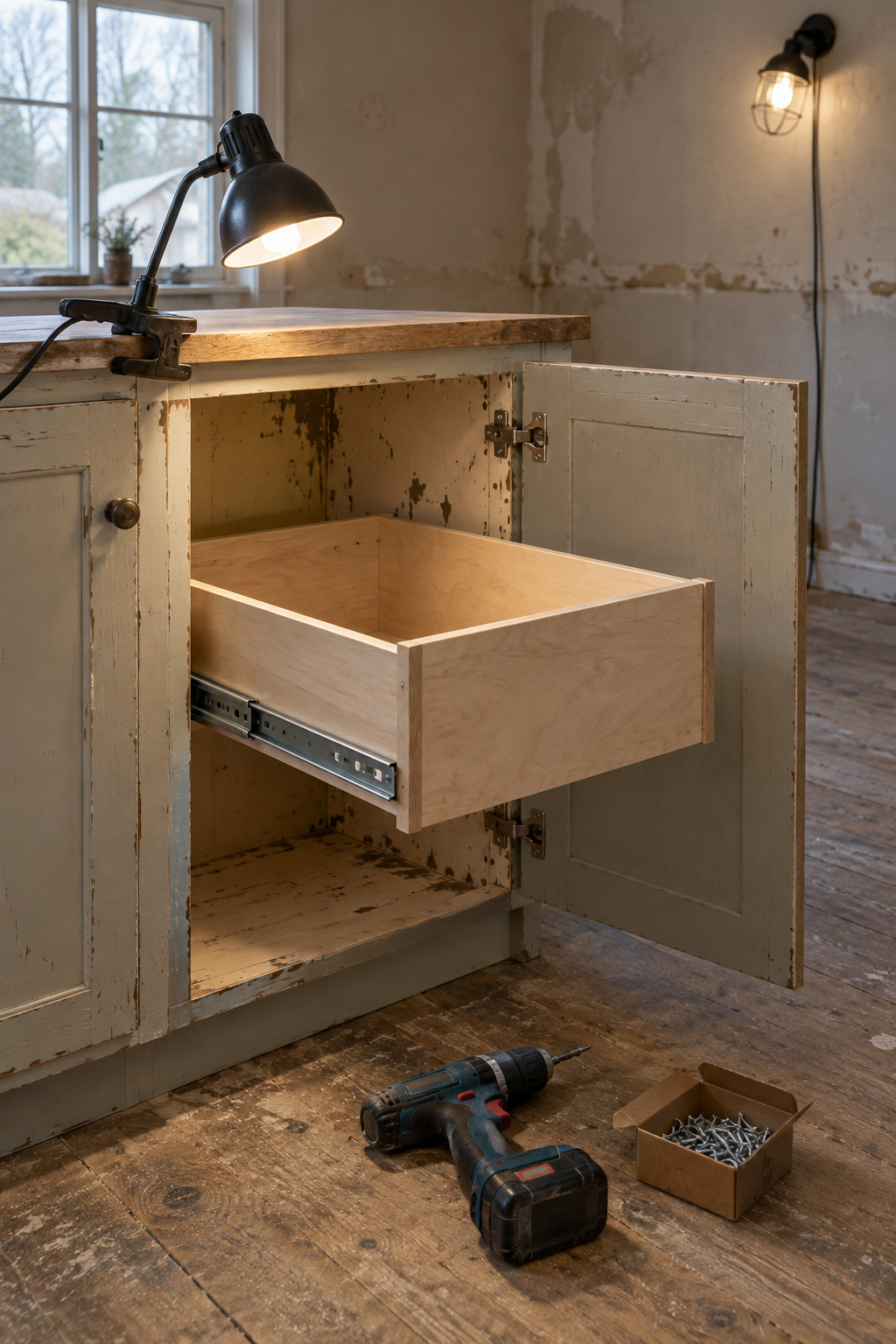
An island with doors and fixed shelves often has the same fault in a different place: the box is sound, and reaching into it is what fails. A pull-out fixes the reach.
Kits for existing base cabinets are easy to find. In late 2026, one US retailer’s custom pull-out shelves listed from about $50 to $140, soft-close slides added $25, and an 18 in dovetailed maple drawer sold for $213.40. Installed, a single pull-out started around $500 with one handyman service, and one contractor’s blog put a franchise custom pull-out at $350 to $600 or more. Prices vary by region, so treat these as bands.
The fitting sequence is short:
- Open the door fully and check it swings at least 90 degrees. If it doesn’t, a hinge swap may be needed first.
- Measure the clear opening at its narrowest point, past the hinges and the face frame.
- Order a box 1 in narrower than that opening, since the slides take 1/2 in on each side. An 18 in clear opening takes a 17 in box; a 15 in opening behind a hinge takes a 14 in box.
- Check the cabinet floor is flat and solid. A slide is only as steady as what it is screwed to. Swap any plastic shelf pins under a loaded shelf for metal ones.
- Mount the pull-out with L brackets, set back about 1/2 to 3/4 in behind the face frame, and secure it so it cannot tip when extended.
A pull-out behind a door still takes two motions, open then pull, so for heavy daily pans a true deep drawer is better. Taking the door off to build one with a matching front is a bigger job, and the one I would hand to a cabinetmaker. If you are starting from old furniture instead, an old dresser’s drawers as island storage is a different route with its own drawers already in place.
Put drawers where the cook stands and fill them only with what gets used there. Keep the seating side shallow or empty, and try pull-outs before a new island.
Not everyone agrees on the back of the island. Some designers, including Artichoke’s Anthony Earle and CabinetIQ, put entertaining ware, seasonal pieces and overflow staples there, on the logic that hard-to-reach space suits things used rarely. I see the logic, and I still would not. Space you don’t reach is space you forget, and an island has better work to do.
FAQ
Do kitchen island drawers need soft-close slides?
No, soft-close is a convenience, not a requirement. Slides are graded by load and cycle life, from 20 lb up to heavy-duty 200 lb classes, all tested to at least 50,000 cycles. For an island, load matters more: heavy pans want a heavier slide. On one retrofit line, soft-close added $25 a shelf.
How do you keep island drawers organized?
Divide each drawer by job, not by size. In the top drawer, a knife insert, one row of everyday utensils, one of measuring tools and small compartments for peelers. In pan drawers, nest pans by size and file lids upright. Store foil and wrap boxes on their sides so the labels read from above.
Should an island have a trash and recycling pull-out?
Only if the island is where you prep. A trash pull-out works within a step of the main prep spot and fails on an island used mostly for sitting and serving. An 18 in cabinet holds two standard bins side by side; a 15 in one fits a full-size bin plus a narrow recycling bin.