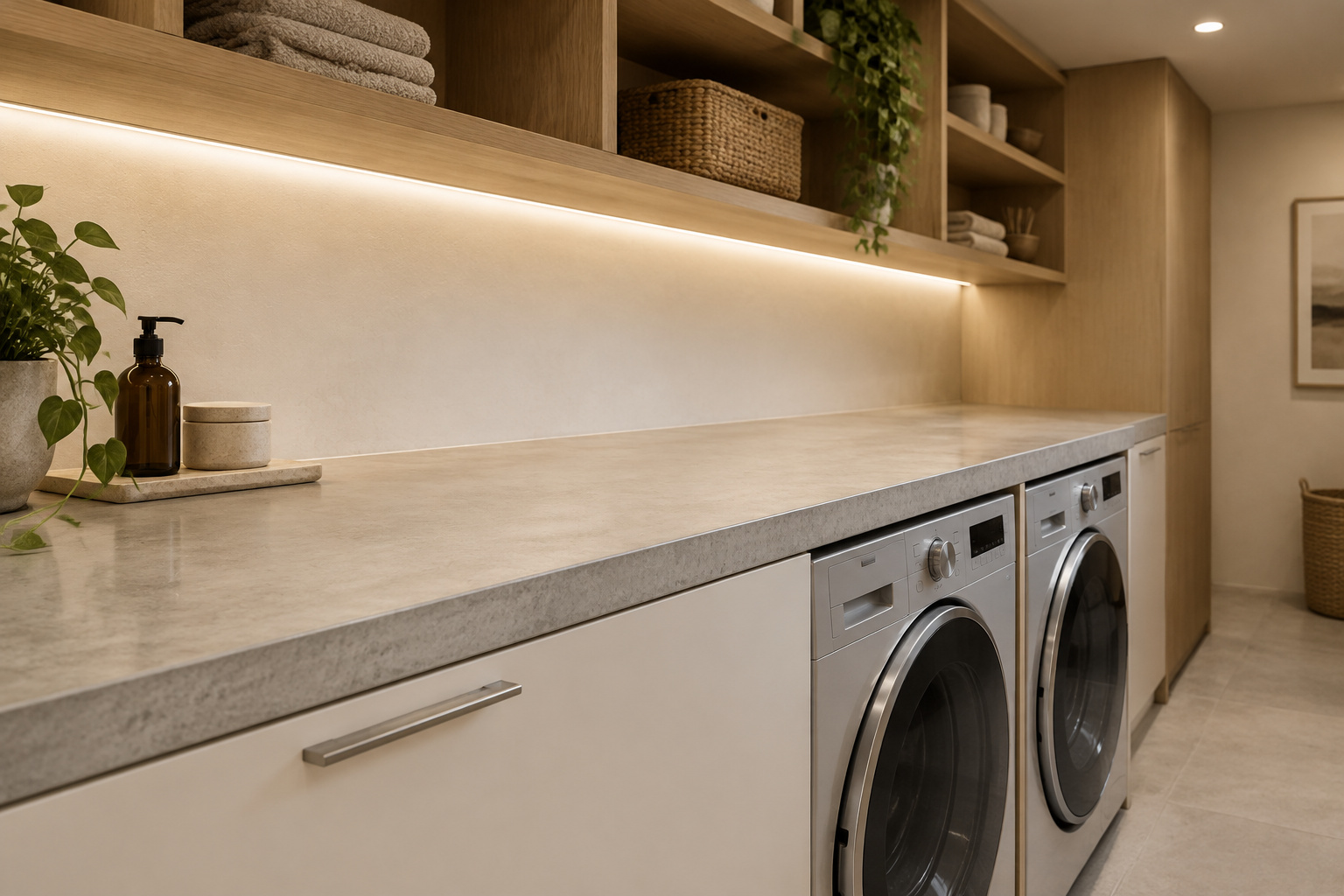

The navy sock goes in with the blacks, under a bulb whose box promised “daylight.” That is the mistake most laundry room lighting ideas quietly encourage: you buy by color temperature, 5000K or cooler, believing a cool, bright number shows true colors and catches stains. It doesn’t. Kelvin tells you how warm or cool a light looks, and a different number on the same box says whether colors are rendered faithfully. Below you will find which number that is, how much light your counter needs, and where each fixture belongs, plus the awkward fact that nobody publishes a home laundry light level at all.
TL;DR
- Color temperature is not color rendering. Kelvin is the light’s own warmth; CRI (Ra) measures how accurately colors appear, and its average omits R9, saturated red. Look for CRI 90+ and R9 where listed, at any Kelvin you like.
- The only IES row named “Laundry” belongs to a hospital. A reproduction of the Handbook’s table files it under Health Care Facilities support spaces at 30 foot-candles. No residential table or US code sets a home level.
- Size ambient and counter light separately. By my arithmetic, a 48 sq ft room at 20 fc = 960 lumens of ambient light, plus an 18 sq ft counter zone at 50 fc = 900 lumens of its own. Both targets are borrowed.
The Daylight-Bulb Myth That Won’t Show You the Stain
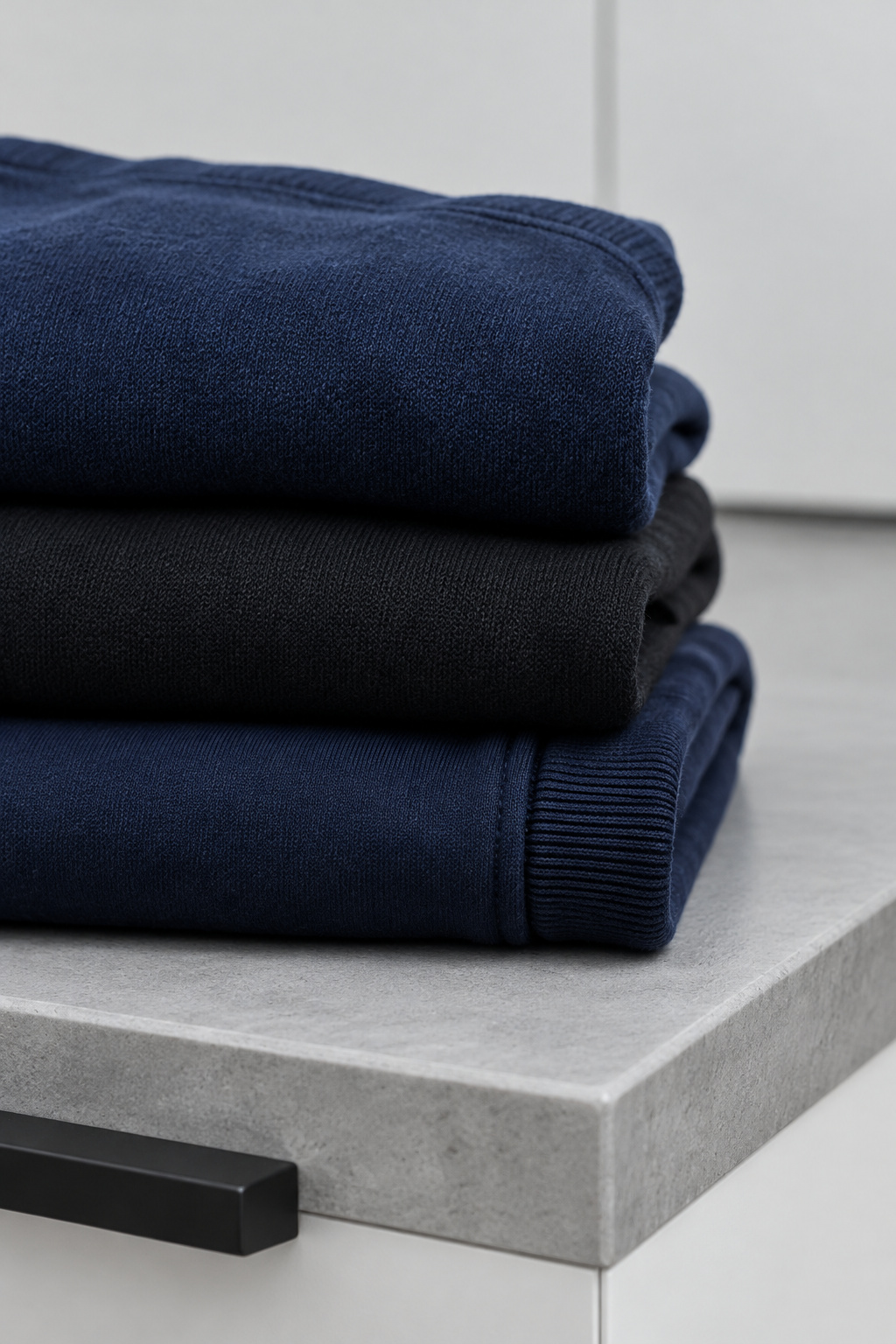
My test for any light I’m asked to judge is unglamorous: a navy sock laid beside a black one, on the surface where the sorting actually happens. Under a bright cool-white bulb the two can collapse into a single dark, and the mismatch shows up later, on your feet. The brightness was fine. You trusted the wrong number.
Packaging labels lamps of 5000K to 6500K “daylight” and sells them on true color. But Kelvin, or correlated color temperature (CCT), measures only how the light itself looks, warm to cool. Color rendering is a separate property. The International Commission on Illumination (CIE) defines it as the effect a source has on how object colors appear compared with a reference illuminant. Jason Livingston, a lighting designer on the IES Color Committee, draws the line plainly: the CRI figure on the box tells you one thing, fidelity to a reference, and it is a fundamentally different measurement from color temperature.
A declaration before going further: the numbers here are lighting engineers’, cited as theirs. All I carry over from library work is the habit of checking a color under the light you will actually use.
Four Tasks a Laundry Light Actually Has to Serve
What do you actually do at that counter? Before any fixture or foot-candle, name the four seeing tasks, because each asks something different of the same light:

- Sorting darks. Navy against black, charcoal against brown. This is color discrimination, which is a rendering problem more than a brightness one; extra light with poor rendering still muddies close tones.
- Spotting a stain. A stain is often a subtle color shift, not a hard edge, so it takes enough light at the surface and accurate color together.
- Reading a care label. Small, often low-contrast gray type on a pale tag is fine print, and general residential guidance asks for well above ambient room light there, though no laundry-specific label figure exists.
- Folding. Folding wants even, shadow-free light across the whole counter width, which is why task light is usually specified as a linear strip and not a single point-source pendant.
Any reading room settled this long ago: the ceiling lights the room and the desk lamp lights the page. A laundry room is the same problem at smaller scale. One ceiling fixture, however generous, is asked to do four jobs from the one spot where it does none of them best.
Color Temperature Isn’t What Reveals a Stain — Color Rendering Is
The CRI score printed on a bulb box averages eight test colors, samples R1 through R8, all moderately saturated, and the one most relevant to a wine or blood stain is not among them. R9, saturated red, sits outside that average, so a lamp can advertise CRI 90 or more and still score low, or even negative, on red. Red is the channel tied to skin tone and, by extension, to reddish and brownish stains.
In practice, “cooler equals truer” fails as a rule. A 5000K LED can sit at a mediocre CRI in the 80s, while a 3000K to 4000K LED reaches the mid-90s and renders color more accurately. Standard consumer LEDs are commonly sold around CRI 80, which is acceptable for general lighting and not for color-critical work. Waveform Lighting’s figures show how R9 tracks the headline number:
| CRI (Ra) | Typical R9 | What it means at the counter |
|---|---|---|
| 80 | roughly 0–25 | Fine for finding the door; poor on reds |
| 90 | about 50 | The professional floor for vanity and grooming light |
| 95 | about 90 | Reds and near-reds rendered with confidence |
So a 5000K bulb at CRI 80 shows you less than a 3000K bulb at CRI 95. That does not make 4000K a poor choice. It is a fine one; it just isn’t what shows the stain. Check rendering in addition to Kelvin, not instead of it. The fuller ANSI/IES TM-30 metrics fix this, but consumer packaging has not caught up, so CRI plus R9 is what you can shop by.
With black cabinets, read how a dark finish changes how much of that light you keep before you settle on lumens.
How Much Light Your Counter Needs, Worked Out for Your Room
With rendering settled, quantity is a fair question, and the honest answer starts with where the popular figure came from. Retailer pages repeat “50 to 75 foot-candles, per the IES Lighting Handbook,” yet every instance I could trace links only to the Handbook’s purchase page and never to a table. Super Bright LEDs’ residential guide gives “Basement – Laundry” 20 to 100 foot-candles, also uncited.
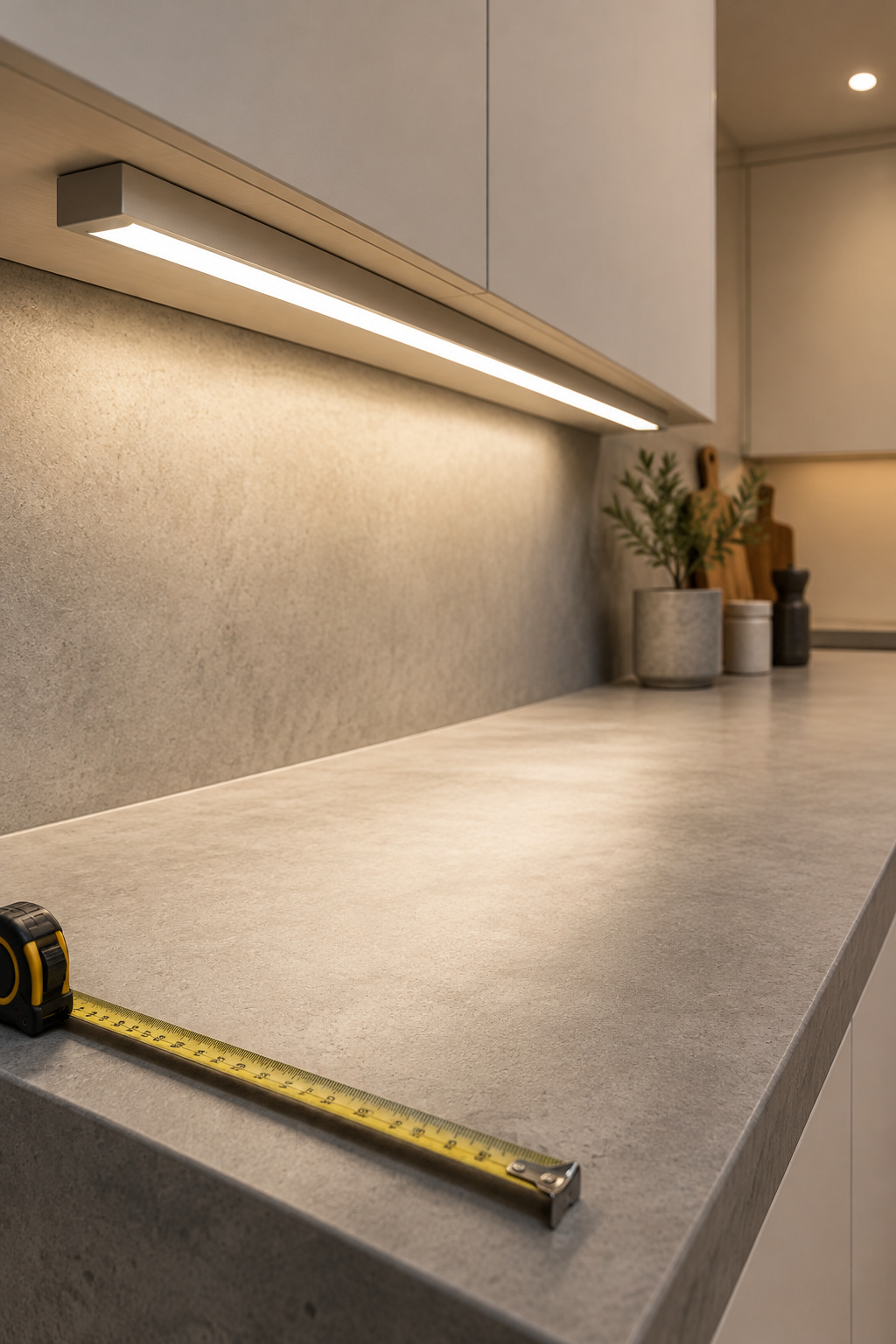
A reproduction of the Handbook’s table (10th edition) tells a different story. The only row named “Laundry” sits under Health Care Facilities, among a hospital’s support spaces, at 30 foot-candles average for general light, measured at a 3′-6″ work plane. A separate industrial “Laundries” category asks 75 foot-candles for fine hand ironing and machine-and-press work. The retailer numbers land near those values but for the wrong building type, most likely from a row copied without its heading.
Code does not fill the gap either. IRC R202 limits habitable space to living, sleeping, eating and cooking, which excludes utility rooms such as a laundry; R303.1’s light rule, with its 6-foot-candle alternative to a window, covers only habitable rooms. So you supply the target:
- Measure the floor area. A 6 ft by 8 ft room comes to 48 sq ft.
- Choose a general target, and know its source. Twenty foot-candles is the low end of that residential guide’s 20–100 band.
- Multiply for the ambient layer. Here is the sum: 48 sq ft × 20 fc = 960 lumens.
- Size the counter as its own zone. Working it out, a 3 ft by 6 ft counter zone = 18 sq ft; 18 sq ft × 50 fc = 900 lumens, on top of the ambient fill. The 50 is borrowed too: it sits between the health-care table’s 30 and 75, at the foot of the retailer range.
| Zone | Area | Target (borrowed from) | Lumens |
|---|---|---|---|
| Whole room, ambient | 48 sq ft | 20 fc (residential guide, low end) | 960 |
| Counter zone, task | 18 sq ft | 50 fc (between IES health-care 30 and 75) | 900 |
A footnote on units: a foot-candle is one lumen landing on one square foot from a foot away, roughly 10 lux. It measures light arriving at a surface, while the lumens on a box measure everything the source emits. What reaches your counter depends on distance, beam spread and surface reflectance, so treat these totals as a purchasing floor and mount the counter’s 900 lumens close to it.
Fixtures for Each Zone: Laundry Room Lighting Ideas From Ceiling to Counter
Stand at the counter and look up. Your own head and the wall cabinet sit between the ceiling fixture and the work, which is the whole case for layers.
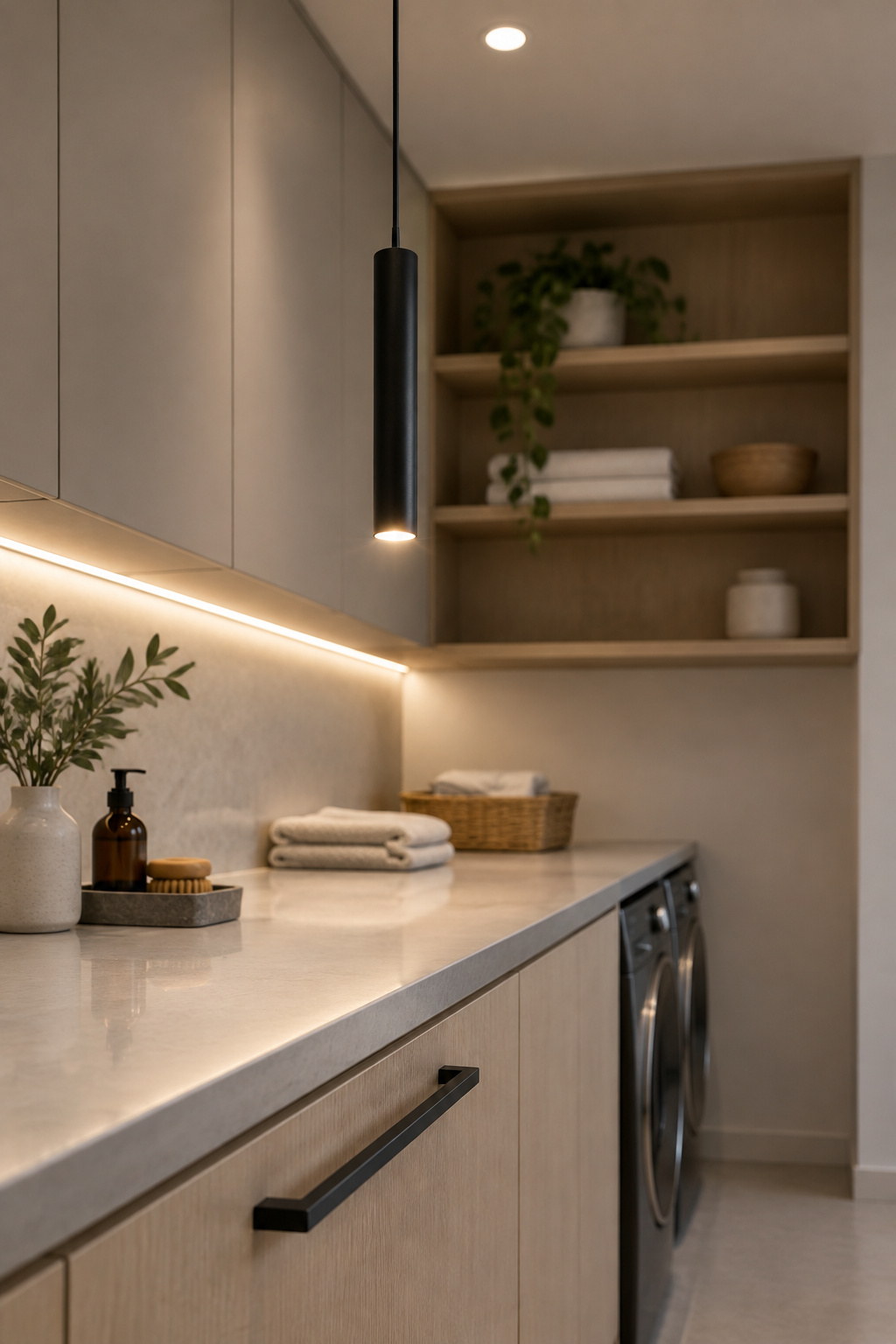
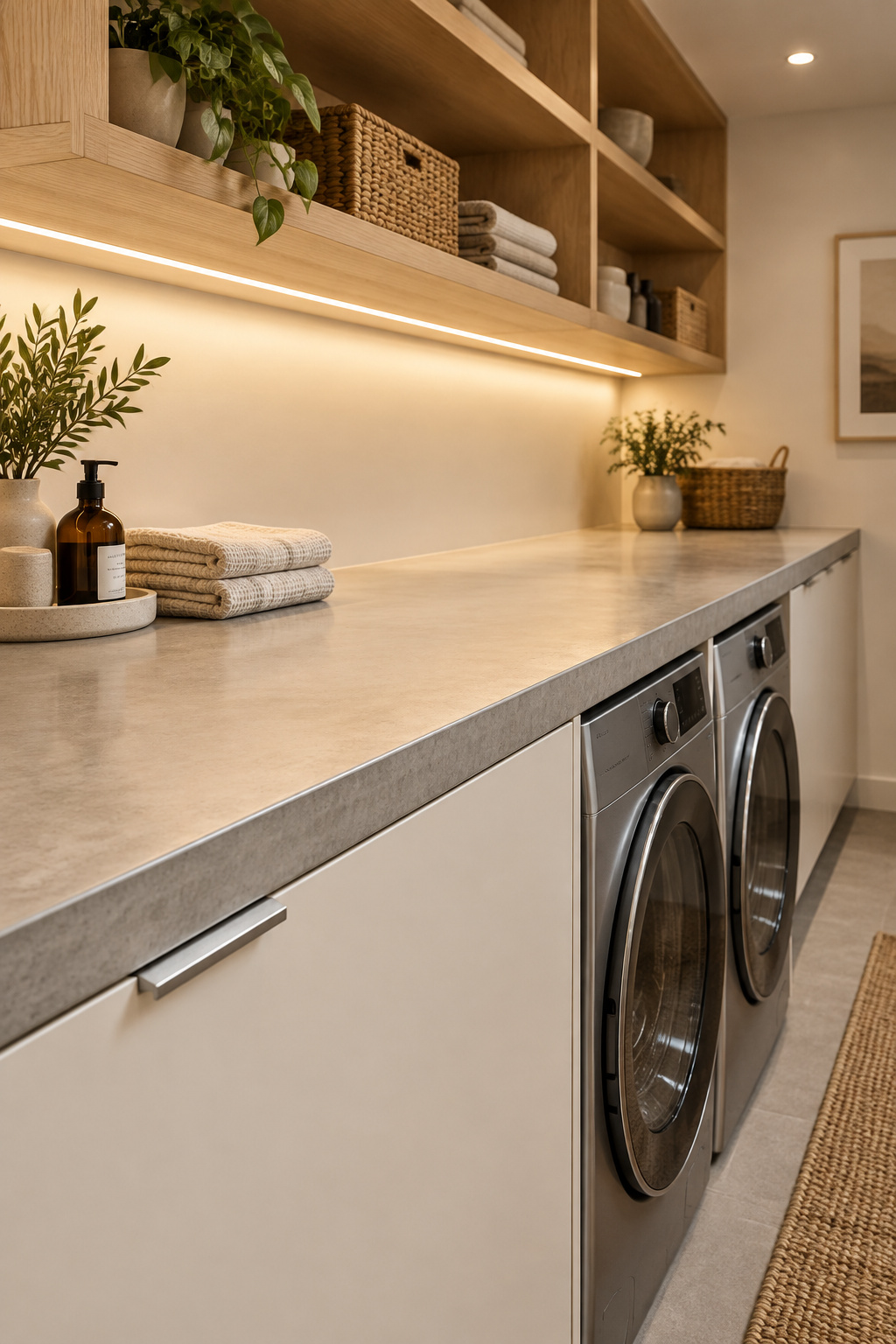
For the base layer, use a flush-mount or semi-flush fixture, the sensible choice under a low ceiling, or recessed downlights, which give the most even, shadow-free general light. Over the counter goes a separate task source: a wall sconce or pendant aimed at the surface, not the room. Beneath any wall cabinet, an LED strip fills the shadow the cabinet casts on the counter, exactly where sorting, stain inspection and label reading happen. It complements the ceiling light and does not replace it. If the budget stretches to one high-CRI source, spend it here, closest to the sock.
Motion sensors and scheduled controls are an efficiency layer and no substitute for a fixture; putting those fixtures on a schedule or a sensor is a separate controls decision.
The One Bulb to Buy Today
Turn over the box of the bulb above your counter tonight. If it says CRI 80, or says nothing about rendering at all, that is the lamp to replace first.
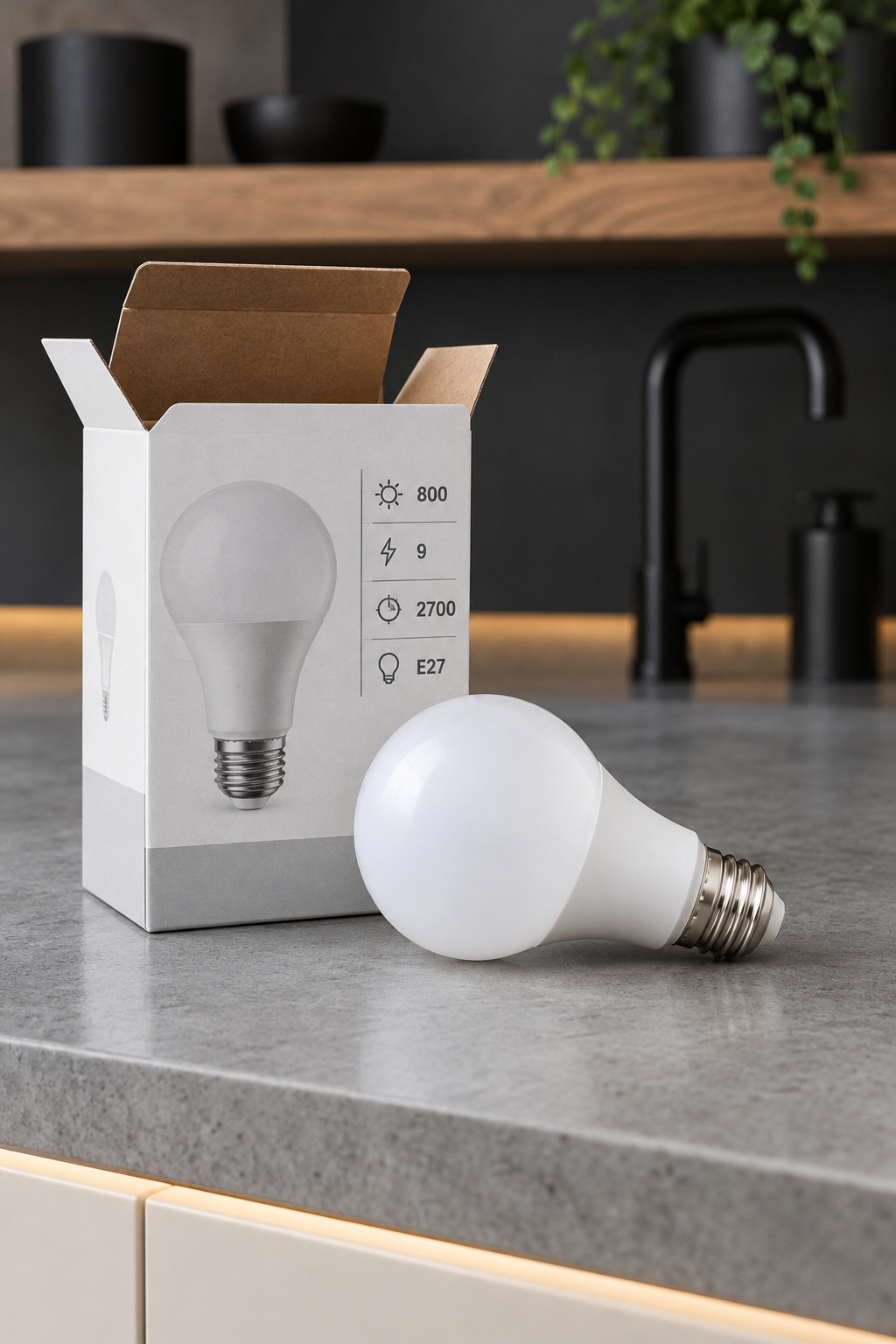
The rule I shop by is CRI 90 or higher, R9 positive and ideally 50 or more where published, and whatever Kelvin you find comfortable, 3000K and 4000K alike. Be clear about the 90. It is not a laundry-specific citation, because the one source claiming it for stain detection leads to a page with nothing on CRI. It rests on an analogy with vanity and grooming light, the closest documented color-critical task, where CRI 90 is the professional minimum. A good analogy, and still an analogy. R9 is harder to check, since most packaging omits it.
Then run the sock test under the new lamp, and carry the same care into the rest of a modern laundry room plan.
What I cannot hand you is a settled light level. Retailers say 50 to 75 foot-candles, one residential guide says 20 to 100, and the only real table row belongs to a hospital. No residential standard or code takes a side. That disagreement is still standing, and I would rather give you the multiplication than pretend it has been resolved.
FAQ
Is 3000K or 4000K better for a laundry room?
Either works. Color temperature sets only how warm or cool the light looks, and says nothing about how accurately it shows color. What decides it is rendering: look for CRI 90 or higher and, where listed, a strong R9. A 4000K lamp reads neutral-cool without extremes, but its rendering spec, not its Kelvin, determines whether you see the stain.
Do I need a separate light over the folding counter?
Yes. A single ceiling fixture leaves the counter in its own shadow, cast by your head and any wall cabinet above it. A dedicated task source puts light on the work surface itself, where sorting, stain-spotting, label reading and folding actually happen. A pendant, a sconce or an under-cabinet strip can do it, working alongside the general ceiling light.
What CRI should laundry room light bulbs have?
Aim for CRI 90 or above and look for a published R9 value, because the headline average leaves out saturated red. The threshold is borrowed by analogy from vanity and grooming light, the closest documented color-critical task, not from any laundry-specific source. Standard LEDs around CRI 80 are fine for general light but not for judging colors.