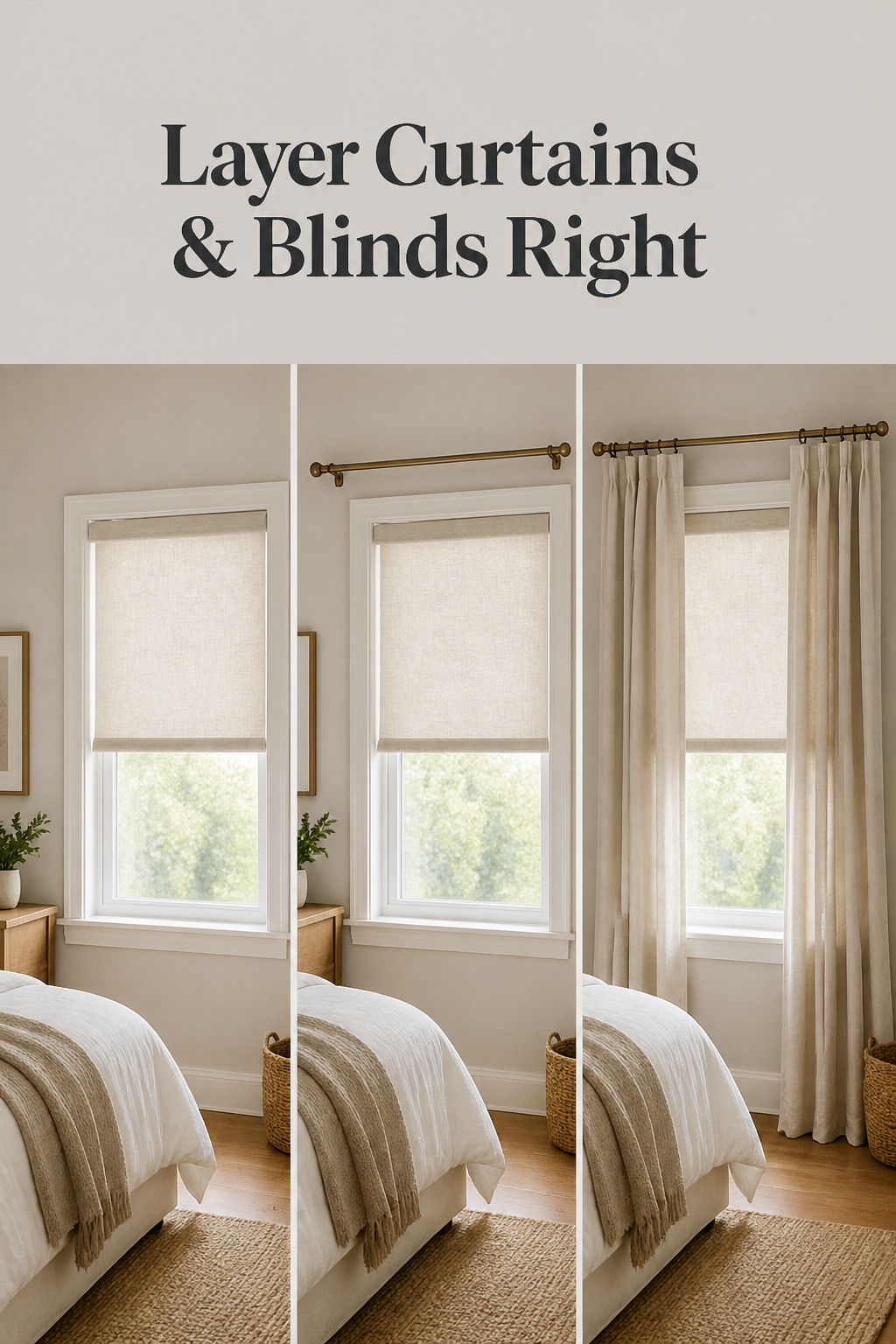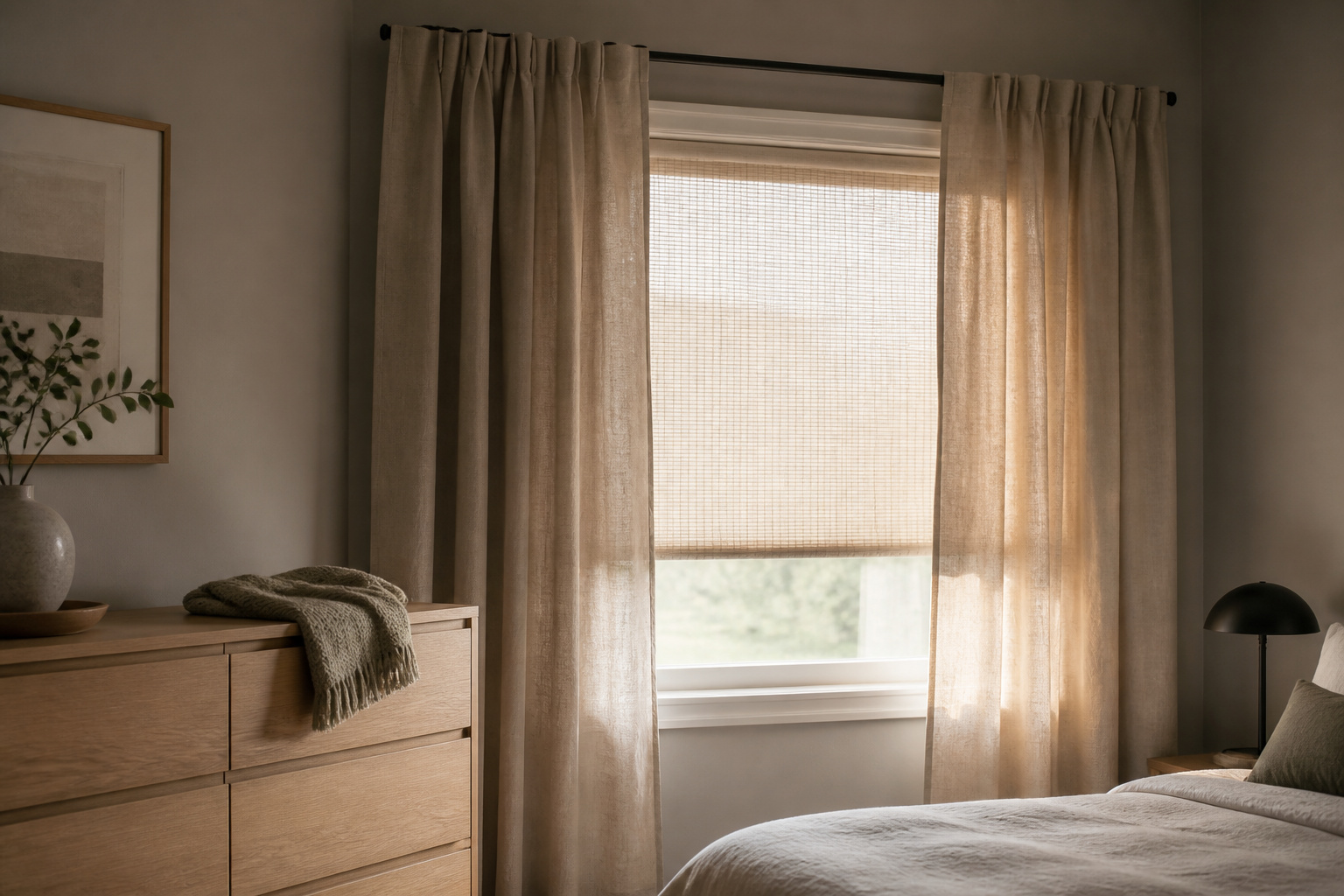

Most people assume that layering curtains and blinds is decorating for the sake of decorating — one more thing on the wall, one step closer to a fussy, crowded window. So a minimalist should skip it. That is the belief, and it is wrong. A second layer isn’t excess. It is a function the first layer can’t perform, and adding it is a decision, not a flourish. I have hung far more two-layer windows in spare rooms than in showy ones, precisely because the reason to layer is almost always practical.
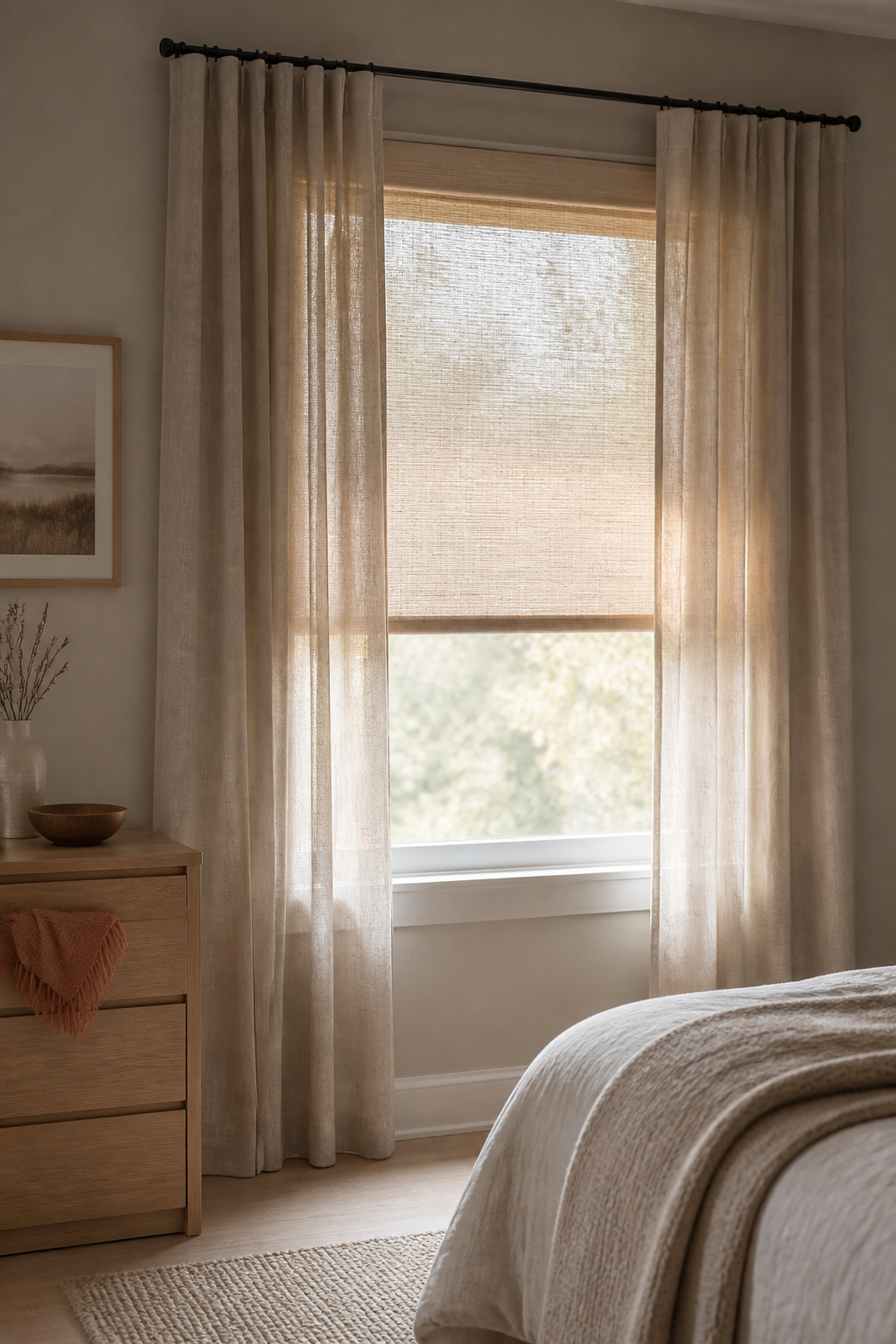
TL;DR
- Layer for function, not decoration: the base blind or shade controls light and privacy, and the curtain adds warmth, insulation, and daytime softness a single layer can’t cover.
- Use a woven roller shade as the base — under 2 inches thick, it leaves roughly 1.5 inches of clearance to the outer curtain, where a roman shade stacks 4–6 inches of fabric in the way.
- Keep pattern on one layer only, avoid two same-weight fabrics, and hang the outer rod near the ceiling on brackets rated for the load.
Layering Curtains and Blinds Isn’t Excess — It’s a Function Decision
The clutter people fear is real, but it comes from execution, not from the act of layering. Two fabrics of the same weight read as bulky. Pattern on both layers competes with itself. Get those wrong and the window looks heavy. Get them right and two layers read as one calm decision.
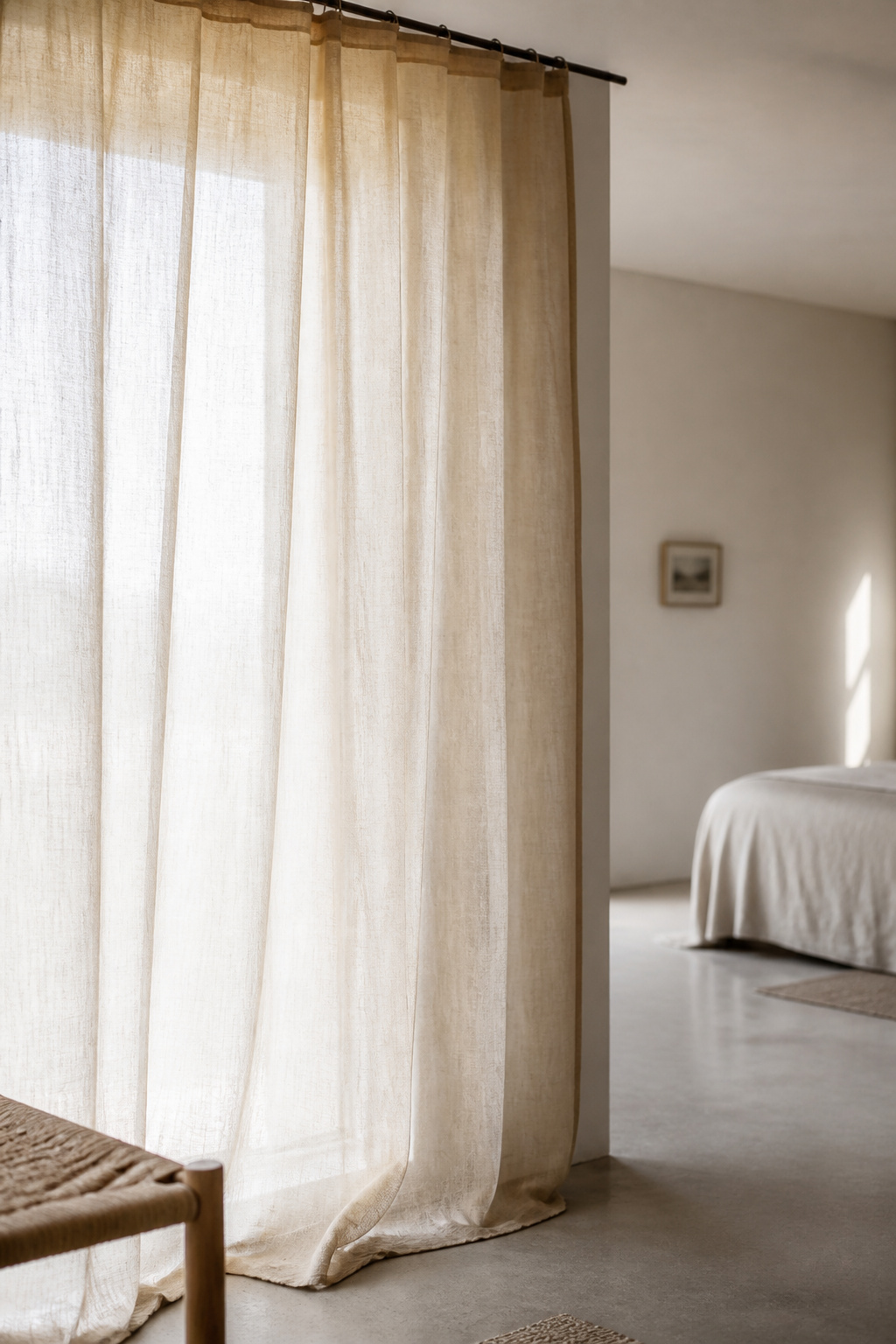
The myth: more layers means more clutter
Layering is one of the more talked-about window ideas for 2026, framed by designers as a double-duty treatment that balances function and softness — not as maximalist decorating. The line between layered and cluttered is a matter of restraint. Keep the tones coordinated, a neutral base against a curtain with colour or texture, and never pair two fabrics of the same weight. Professionals aim for roughly a one-to-three texture ratio between the layers, so the two read as depth rather than competition.
Context matters too. Layering earns its place in a bedroom that can carry it; in a very small room or a cramped window, two visual layers do start to crowd. The technique isn’t the problem there — the room is.
What a second layer actually earns you
A base blind blocks glare and UV; the curtain adds the softness and the insulation. Split that way, the two layers cover two independent jobs instead of duplicating one. The insulation gain is real: with a blind at the glass and a curtain trapping a pocket of still air behind it, heat transfer drops in both directions, and layered treatments can cut heating and cooling costs by 15–25% against a single treatment.
Privacy works the same way. A sheer or light curtain gives you daytime privacy without losing the view out, while the blind delivers full darkness at night. One layer can’t do both times of day.
When one layer is genuinely enough
Not every window needs two layers. A single, well-proportioned curtain works on a large window or when the goal is a deliberately spare look — provided the panel is wide enough, the rod is high enough, and the fabric reaches the floor. When one layer looks flat, the fault is usually a narrow panel or a low rod, not the single layer itself.
One layer is the honest answer when you don’t need independently adjustable daytime privacy and nighttime blackout in the same window — a guest room kept for short stays, for instance. If you’re still weighing which single treatment suits the room, it’s worth reading how each treatment type compares before you commit to two. Start by asking what the window actually has to do at 7am and at midnight; the answer tells you whether one layer is enough.
Choosing Your Base Layer
The base layer sits closest to the glass and does the functional work — light and privacy — before any decorative choice is made. Get this layer right and the curtain becomes a free hand: it only has to look good, because the blind is already handling the light.
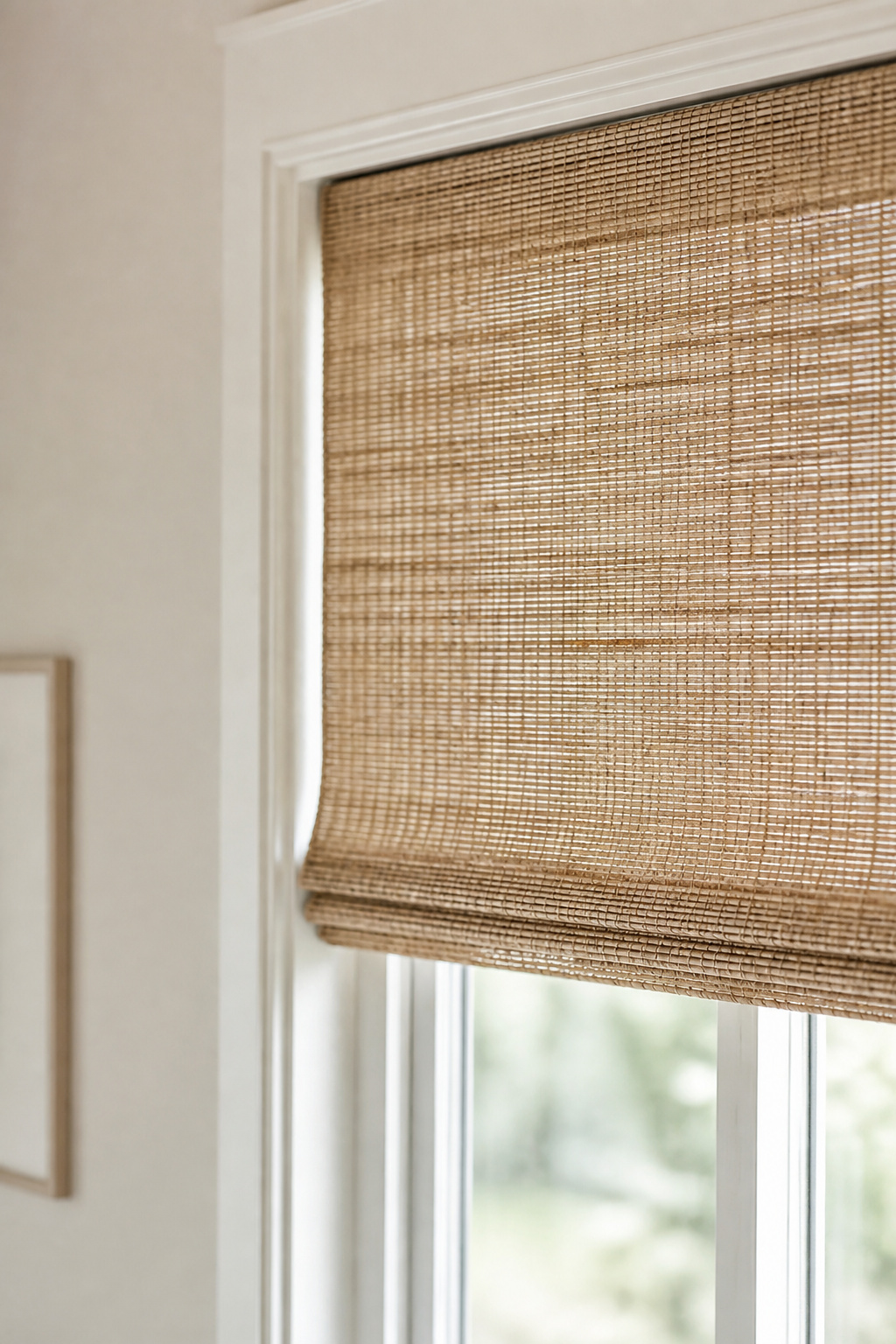
Roman shade vs. roller blind as a base
Here the choice is easy to make badly. A raised roman shade folds over itself into a stack 4–6 inches thick, sitting exactly where the drapery rod wants to be. That forces either a rod mounted far out from the wall or curtains resting against a visible bulge. A woven roller shade keeps its profile under 2 inches and leaves about 1.5 inches of air between the shade and the outer curtain — the clearance that stops the two fabrics snagging when you draw the curtain shut at night.
A roller shade fits behind drapery cleanly because it is one piece of fabric on one tube, where a roman shade gathers multiple layers on a cord system. You still get the organic, textural warmth of a natural fibre, just without the bulk. For a curtain-plus-blind bedroom, the roller shade is the better default base.
Blackout base layers for sleep
In a bedroom the base layer usually needs to go dark. A dark room lets the body secrete melatonin, the hormone that governs falling and staying asleep, and light exposure interferes with that directly. Even blackout-rated curtains leave edge gaps that let 1–15% of light in, so relying on the curtain alone rarely gets you to true dark.
For maximum darkness, put the light-blocking at the base: a natural-fibre woven shade layered under the curtain, or a portable blackout panel fitted between the base blind and the glass. If sleep is the priority driving the whole setup, let the base layer carry the darkness and choose the fabric and heading of the outer curtain for warmth and look rather than for blackout.
Mounting the base layer inside the frame
Mount the base layer inside the window casing. An inside-mount shade sits within the frame, looks clean and modest, and minimises the edge gaps that leak light. It also does something structural: it reserves all the wall space beyond the frame for the outer curtain rod and its stack-back, which is what keeps a two-layer window from feeling crowded.
Inside mount needs at least 1.5 inches of casing depth. Shallow casings, or a sash that tilts inward to open, call for an outside-mounted base instead — mount inside where you can, outside where the window forces it.
Adding the Decorative Layer
With the base layer doing the functional work, the curtain has one job: contrast. Colour, texture, and weight should differ enough from the base that the two layers read as two intentional decisions, not one blurred one.
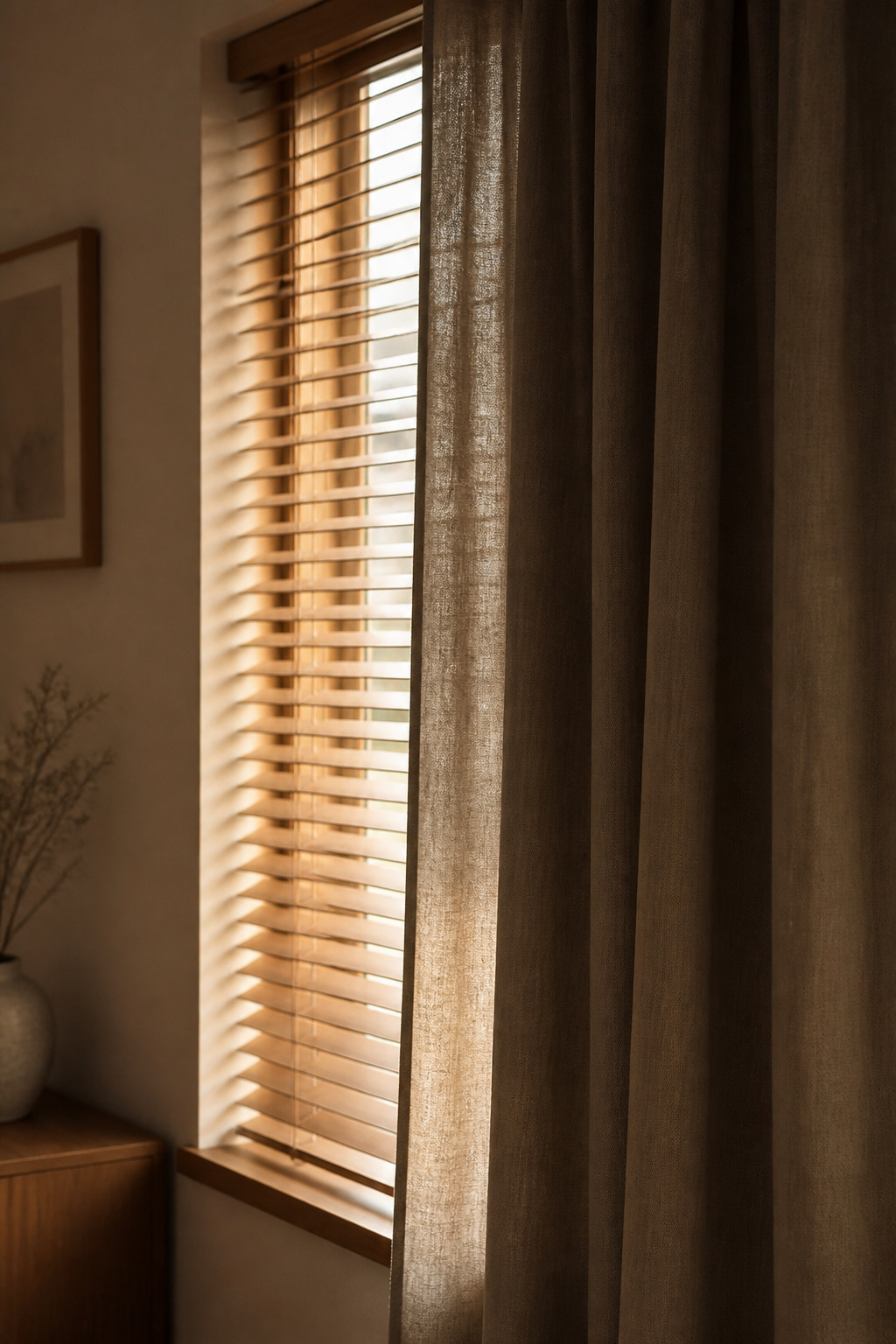
Colour and texture contrast that doesn’t compete
Keep pattern on exactly one layer. A bold geometric curtain wants a solid, neutral base shade underneath it to ground the design; two patterns fight. The common mistake runs the other way — matching the base and curtain too closely in colour and texture, which flattens the whole window. Contrast in material and finish is what gives it life.
Texture does this work quietly. A faux-wood venetian blind brings horizontal, architectural structure; a linen or cotton drape softens it with vertical flow, and the two organic textures complement rather than compete. In a small room, a monochromatic pairing — different shades of one colour across base and curtain — reads as serene and expansive, where high contrast would chop up the space.
Fabric weight for drape
Weight is where layering succeeds or fails. Pair two mid-weight fabrics — a mid-weight shade under a mid-weight cotton curtain — and the window looks bulky and undifferentiated. Choose the curtain weight deliberately against what the base already contributes. Lightweight linen gives an airy, flowing drape and filters light; heavyweight velvet gives a structured drape and absorbs more of it, adding real insulation in a cold-weather bedroom.
The rule is simple: let the curtain’s weight answer the base layer’s job, not just match the room’s colours.
Panel width for a layered look
Each layer needs its own width math. Because the outer decorative panel usually stacks open at the sides while the inner layer may be drawn shut, size the inner layer the same width as the outer, or slightly wider. For the outer panel, fullness sets the look: 1.5x the window width reads tailored and minimal, 2x is the balanced standard, and 2.5–3x gives a lavish, deep-folded drape. As a working default, aim for panels totalling 2–2.5x the window width, hemmed to kiss or lightly pool at the floor.
If the outer panel isn’t wide enough to clear the base shade when it stacks open, hanging two narrower panels of the same fabric per side adds width without a full custom order.
The Hardware Two Layers Actually Need
Two working layers need hardware built to carry them: either a double rod or a combination track, mounted with enough clearance and rated for the weight. This is the part that separates a considered two-layer window from a makeshift one, and it is worth getting right before you buy fabric.
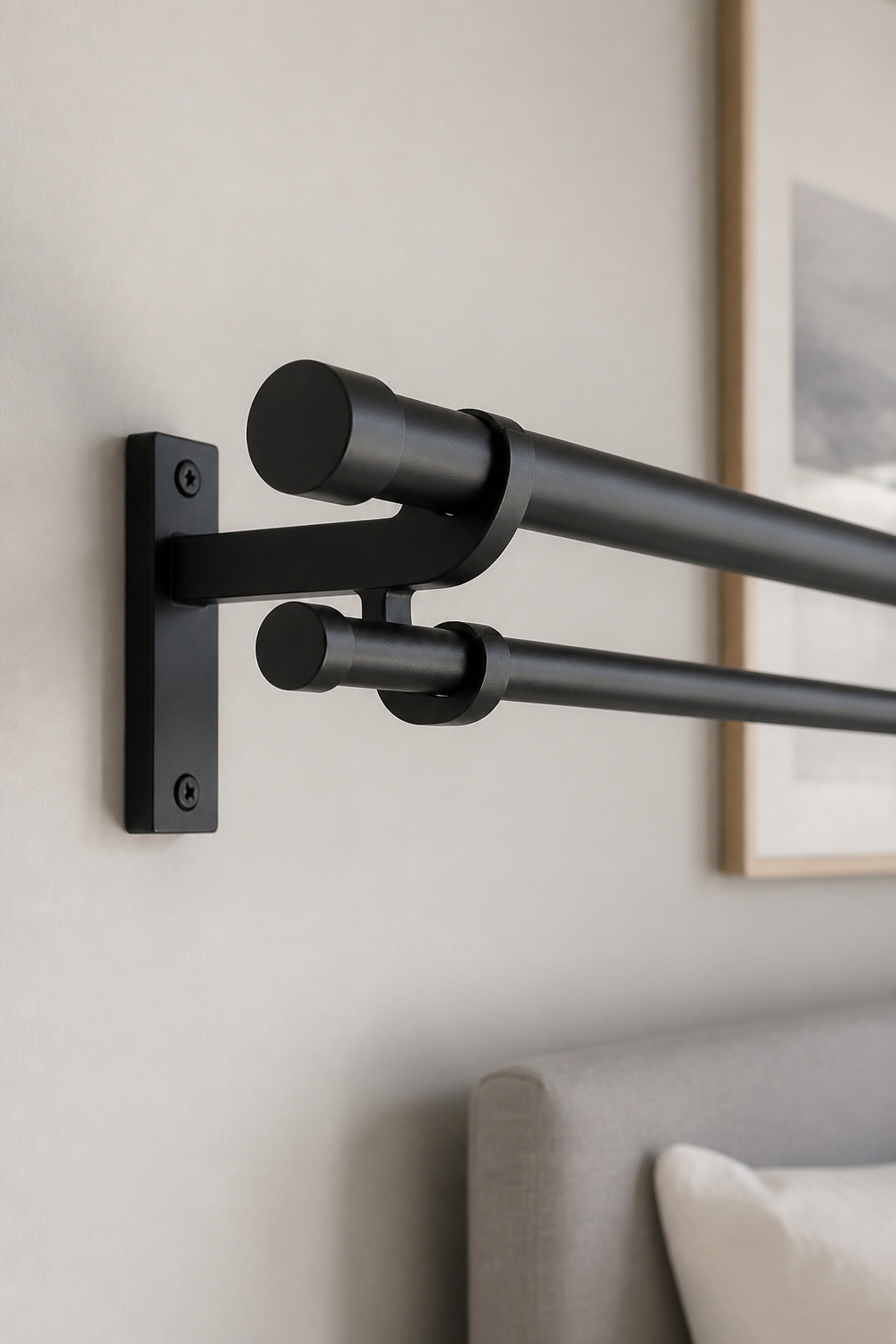
Double rod or combination track
A double rod mounts two rods together, usually on shared brackets, one set in front of the other — the standard hardware for hanging a sheer or blackout layer behind a heavier drape. A combination track uses two parallel wall-mounted tracks instead, giving a more minimal look and a smoother glide, better suited to heavier drapes and wider windows. Tracks pair naturally with pinch-pleat or ripple-fold headings and can be recessed at the ceiling for a cleaner finish, where a double rod stays more visibly decorative.
For most bedrooms the double rod is the simpler, cheaper choice; reach for a combination track when the drape is heavy or the window is wide.
Mounting depth and wall clearance
Clearance is the number people miss. A standard single curtain rod returns 3.5 inches from the wall, but a layered setup needs a deeper 6-inch return to clear the base blind’s projection into the room. In practice, plan for the outer rod to sit 4–5 inches off the wall, and remember that clearance has to account for the bunched fabric stack when the curtain is drawn fully open, not just the flat rod.
Height matters as much as depth. Hang the outer decorative rod 4–6 inches below the ceiling or crown moulding rather than just above the frame — it draws the eye up and makes the window taller. Extend that rod 4–10 inches past each side of the frame so the panels stack clear of the glass and off the base shade’s headrail when open.
Weight-rated brackets for heavier fabric
Two layers of fabric weigh more than one, so the anchors have to match. Reserve plastic expansion anchors, rated for only 5–20 pounds, for the lightest work — a sheer on a light rod. For a heavier decorative layer, use toggle bolts, which hold up to 50 pounds in half-inch drywall, or a screw-and-anchor combination for up to 75 pounds, the strongest option short of hitting a stud.
| Anchor type | Holds (½-inch drywall) | Use for |
|---|---|---|
| Plastic expansion anchor | 5–20 lbs | Sheer curtain, light rod only |
| Zinc self-drilling anchor | 25–50 lbs | Medium curtain and rod |
| Toggle bolt | up to 50 lbs | Heavier outer decorative layer |
| Screw-and-anchor combination | up to 75 lbs | Heaviest layered fabric |
For anything heavier than a single sheer, the toggle bolt is the honest default. And add a support bracket every 30–36 inches of span: on a longer rod carrying two layers, a centre support bracket isn’t optional. If you want the full mounting sequence rather than just the anchor choice, get the mounting hardware right covers rod placement and measurement in detail.
Getting the Proportions Right
The method holds across windows, but the numbers scale with width. A narrow window and a wide one carry two layers differently, and sometimes the right answer for a tight space is one layer done well.
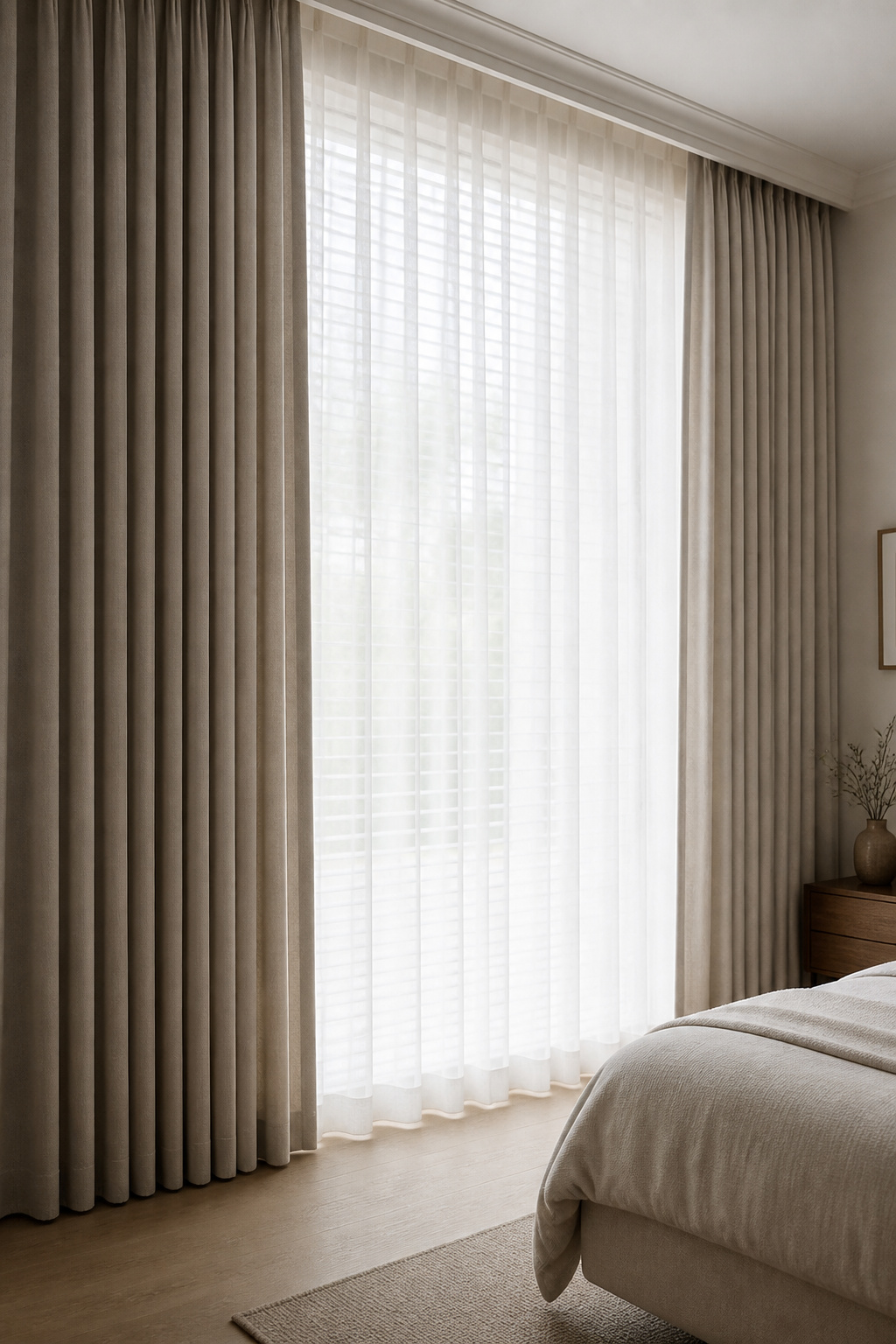
Layering in a small or narrow window
For a window under 36 inches wide, drop the fullness to 1x–1.5x so the curtains stay proportional instead of cramped, and mount the rod 4–6 inches above the frame to add visual height against the narrow width. Even then, a narrow window often needs a wider panel than you’d expect — or multiple panels per side — to reach enough fullness once both a base and an outer layer are accounted for.
Layering across a wide expanse
Wide or tall windows carry drama that narrow ones can’t. Fullness up to 3x the width won’t look skimpy, which gives you room to layer a decorative panel over a wide base shade without either layer looking thin. On a wide window with a double rod, do the width math for each layer separately: the outer panel stacks open at the sides while the inner layer may still be drawn across the full span.
The one-layer alternative when space is tight
When the wall space is genuinely tight, one well-proportioned layer beats two forced ones. An inside-mounted single shade, with no outer rod and no stack-back, reclaims the wall space a second layer would need for its return and side clearance. I lived this rule before I taught it: six years in a 38-square-metre Malmö apartment, where every object owned exactly one place and the window got exactly one treatment, because there was no wall to spare for a second rod. The test is honest: if the window can’t give the outer rod its 4–5 inches of clearance, it is telling you to run one layer.
Putting It Together: A Simple Layering Plan
Every rule above collapses into one sequence, done in one order. The order matters because the base layer’s mechanics decide where the curtain rod can go — reverse it and you find out too late that the rod fouls the shade.
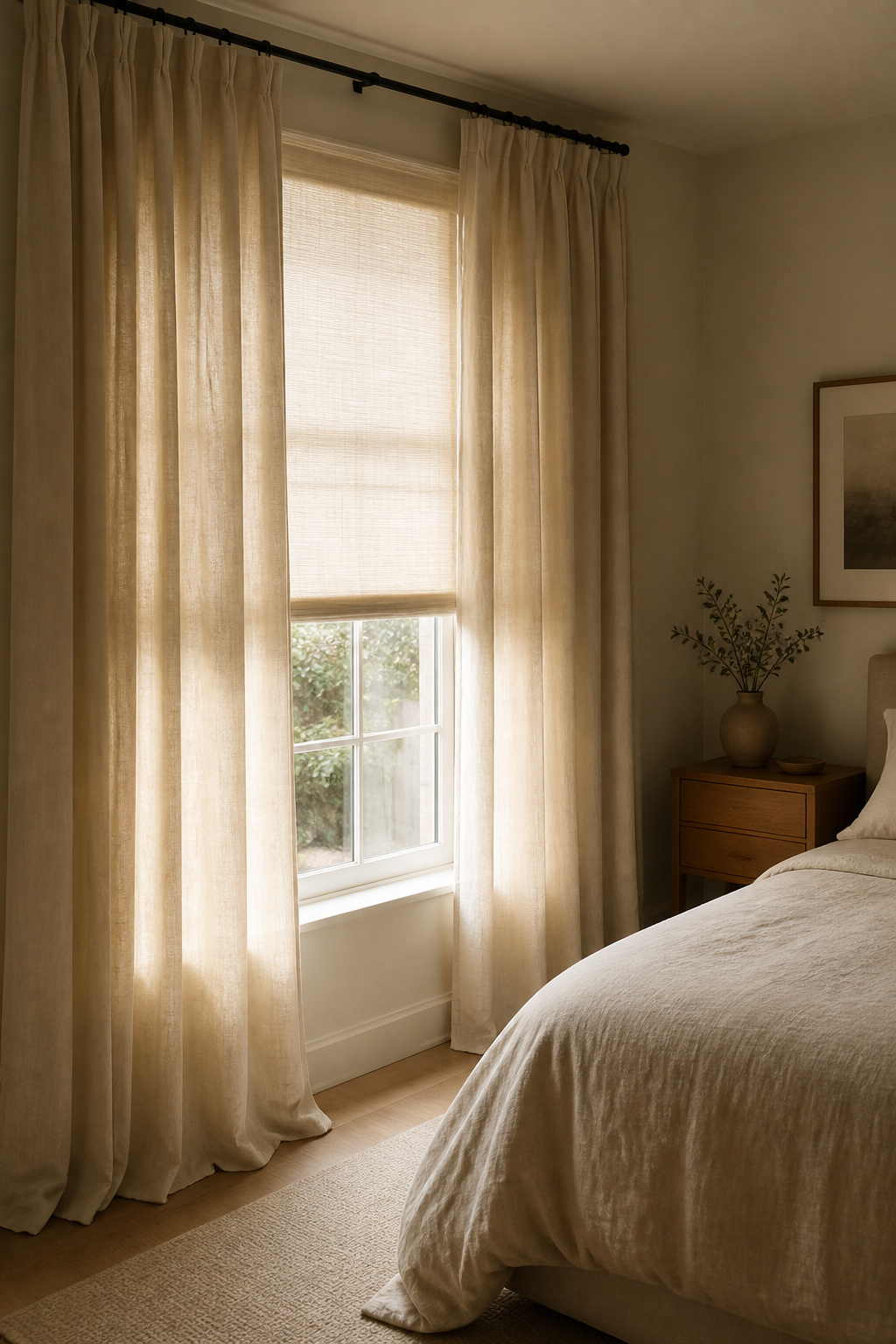
A three-step planning sequence
- Install the base layer first — blind or shade, closest to the glass — and confirm it raises, lowers, and sits cleanly before you touch the curtains.
- Mount the outer curtain rod with 3–5 inches of projection from the wall, so the fabric hangs free and clears the base layer’s headrail when the curtain opens and closes.
- Hang the curtains high and wide — rod extending roughly 4–8 inches past the frame each side — with panels reaching the floor or lightly pooling.
That is the whole method: base layer proven, rod cleared, curtains high and wide.
The mistake to avoid on your first attempt
The mistake almost everyone makes first is proportion. Hang the rod too low — just above the frame instead of near the ceiling — and the window looks shrunken, no matter how well you chose the fabrics. Curtains that hover above the floor or bunch unevenly break the finished look the same way. Aim for a clean floor-length hem or a slight, deliberate pool, and hang as high as the wall allows. This one setup decision undoes more layered windows than any fabric pairing ever does.
You now have the method: a base layer chosen for function, a curtain chosen for contrast, hardware rated to hold both, and the order to hang them in. Start with the base blind this weekend — get it operating cleanly inside the frame — and the decorative layer becomes the easy part. For the full range of bedroom window treatment options behind this technique, see the full range of bedroom window treatment options.
FAQ
Do you hang curtains in front of or behind blinds?
Curtains hang in front of blinds, on an outer rod, while the blind or shade stays closest to the glass on its own mount. Extend the outer curtain rod 4–10 inches past each side of the frame so the panels stack fully clear of the blind’s headrail. This order also keeps the blind’s cord or wand reachable for daily use.
Can you put curtains over roller shades?
Yes. Roller shades have a low profile that fits easily beneath curtains, which makes the pairing a common way to combine privacy, light control, and insulation. Mount the rod 2–4 inches above the shade’s headrail, or use no-drill options like tension rods and adhesive hooks if you rent. The shade handles light; the curtains handle softness.
How much more expensive is layering curtains and blinds than one treatment alone?
Typically more, but not dramatically. A basic layered combination — roller blind plus simple curtains — usually runs $150–300 per standard window, against $30–200 for blinds alone or $50–500 for curtains alone. Premium pairings like cellular shades with custom curtains reach $400–800. Layering can offset some of that by cutting heating and cooling costs 15–25%.