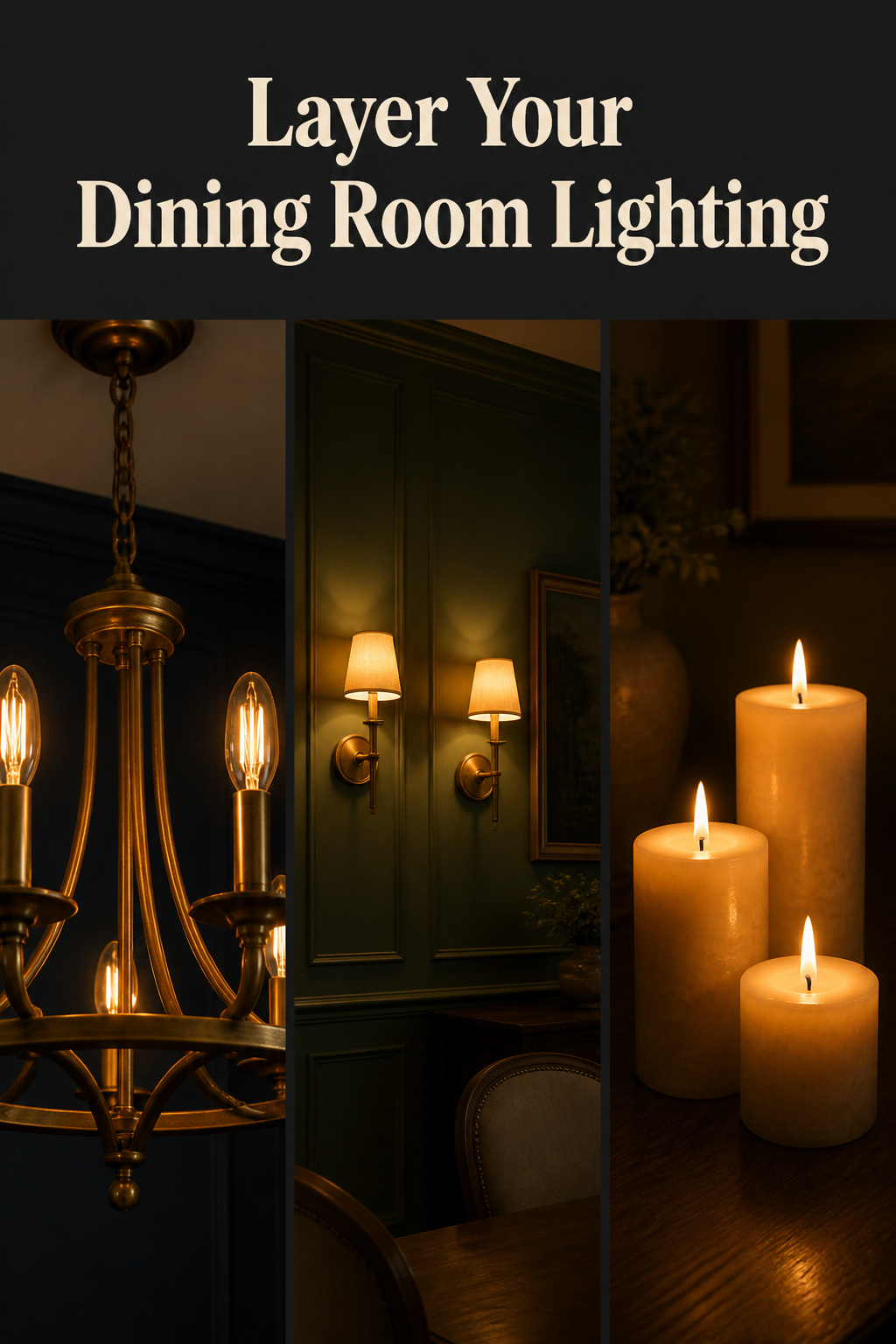
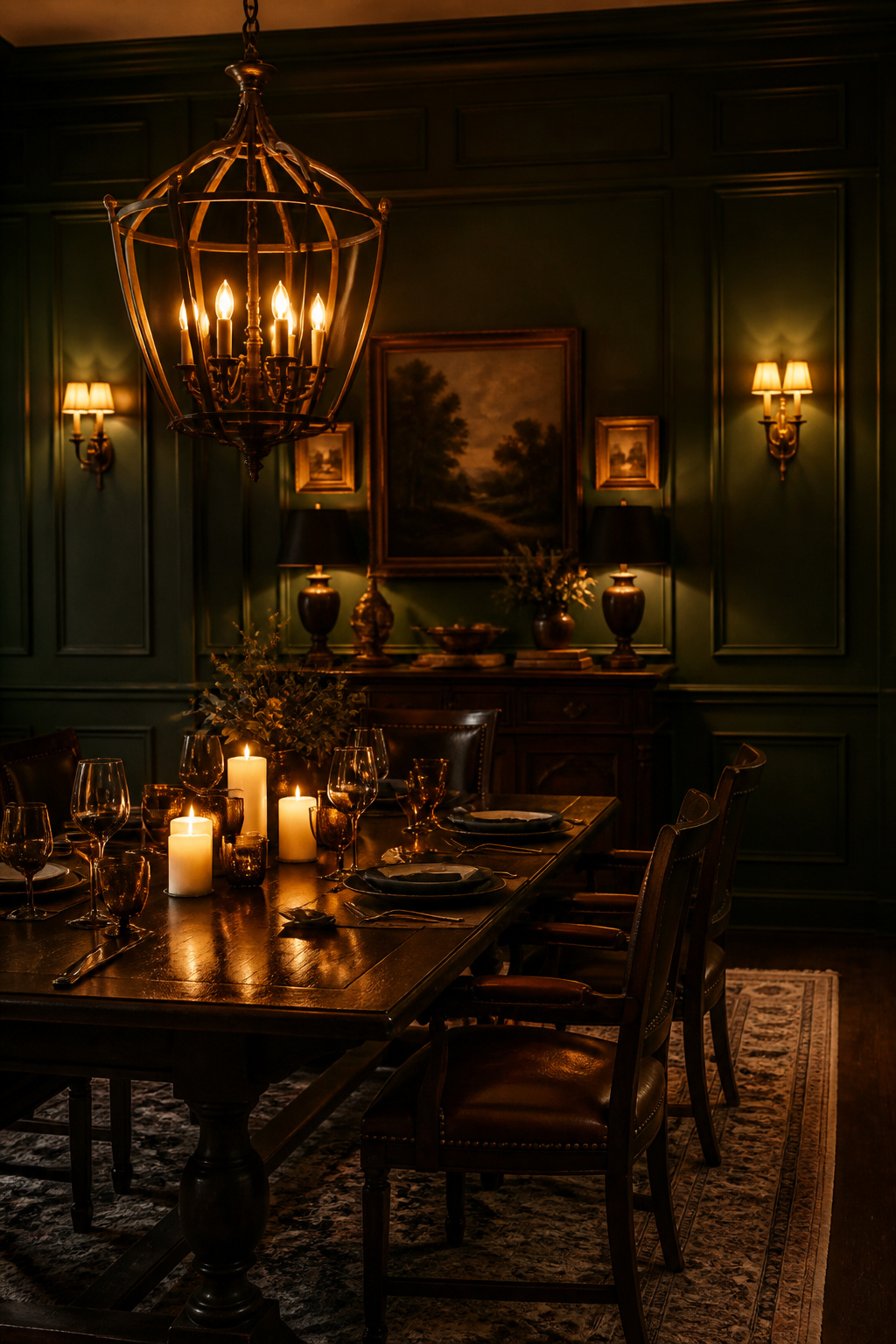
Here is the thing nobody tells you about moody dining room lighting: the fix for a dark room is almost never a brighter bulb — it is more sources, each turned down low. One bright overhead fixture leaves the walls as a flat black void. A warm pool over the table, two glowing on the walls, and candle flames at the cloth: same darkness, opposite feeling.
TL;DR
- Set every bulb to 2700–3000K warm white and put every circuit on a trailing-edge dimmer — those two moves do most of the work before you touch a single fixture.
- Layer four sources at different heights: a chandelier 30–36 inches above the table, sconces at 60 inches, buffet lamps, and candlelight that no LED can fake.
- More sources at low brightness beat one bright fixture every time; dark walls swallow 10–20% more light, so you compensate with layers, not glare.
The One Number That Changes Everything: Colour Temperature
Before you choose a fixture, choose a Kelvin number. Get it wrong and the most beautiful chandelier will make your navy wall look like a waiting room.
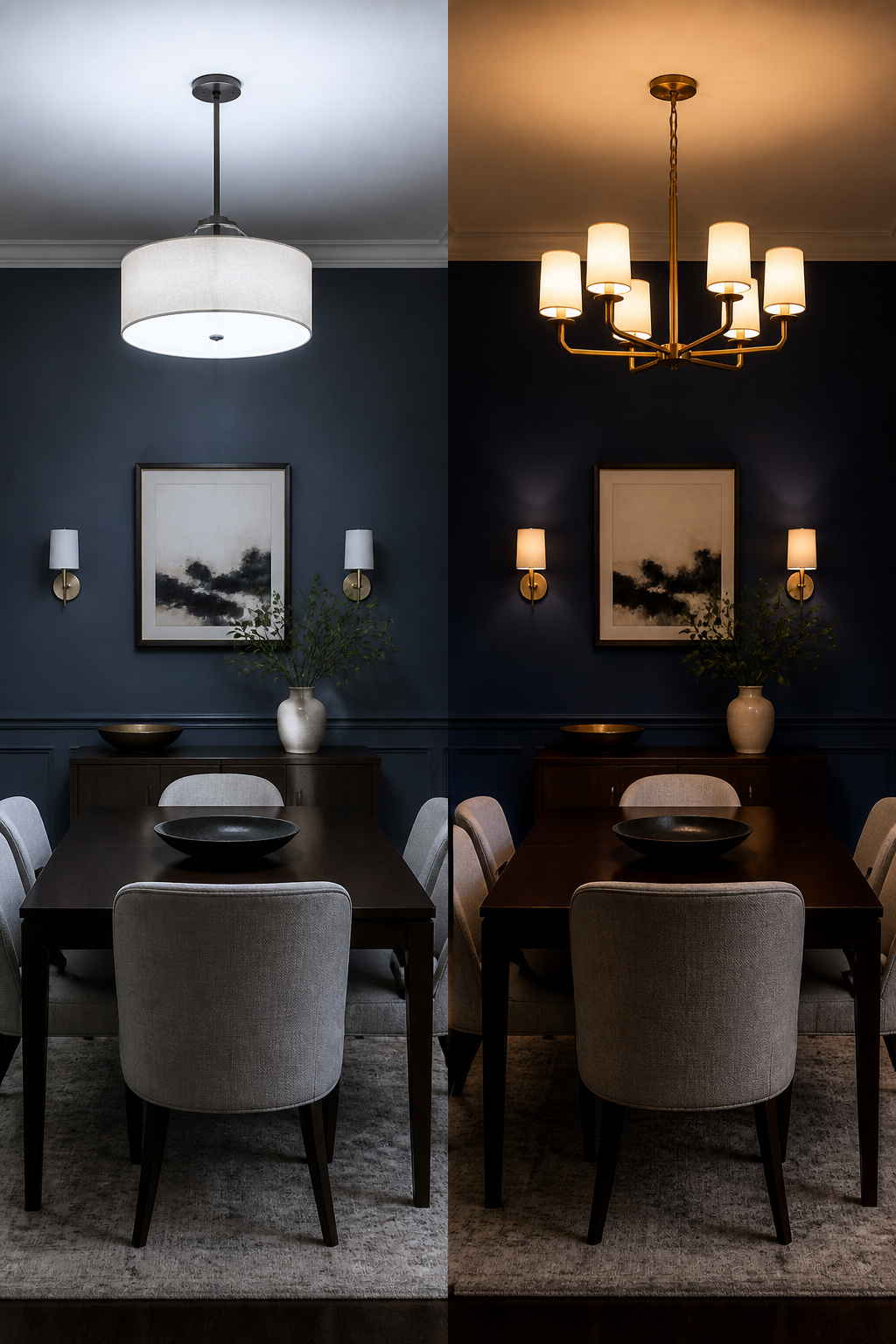
2700K vs 3000K vs 4000K: what each does to a dark wall at dinner
A 2700K bulb throws a yellow-amber glow close to candlelight — the professional default for dining rooms. 3000K is crisper, which helps when the table is dark and food clarity matters. One nuance: over cool-toned walls like deep navy or forest green, 2700K can cast a faint greenish-yellow tint, and 3000K reads cleaner. Test both in the room before committing.
| Colour temperature | What it does to a dark room | Where to use it |
|---|---|---|
| 2700K (warm white) | Amber, candle-like, intimate; flatters walnut, brass and velvet | Default for warm-toned walls and most moody rooms |
| 3000K (warm white) | Slightly brighter and crisper; avoids the green cast on cool walls | Dark navy or forest-green walls; when food clarity matters |
| 4000K+ (cool/daylight) | Institutional, harsh; pushes navy and green toward clinical | Never in a moody dining room |
Why cool-white bulbs kill the atmosphere
Cool-white light at 4000K sharpens blues and greens, pushing a dark wall toward institutional. Warm 2700K does the opposite: it animates walnut, aged brass and dark velvet so every surface looks richer.
How to find the Kelvin rating on any bulb
Buy by the number, not the label — “warm white” can mean 2700K to 3000K. Shop for “2700K LED dimmable” or “3000K LED dimmable” and confirm dimmability. Do not mix Kelvin across the room: one cool source breaks the whole mood. This is step one in how to create a moody dining room.
Layer One: The Statement Chandelier Above the Table
The chandelier is the anchor — it sets the visual hierarchy and delivers most of the ambient light.
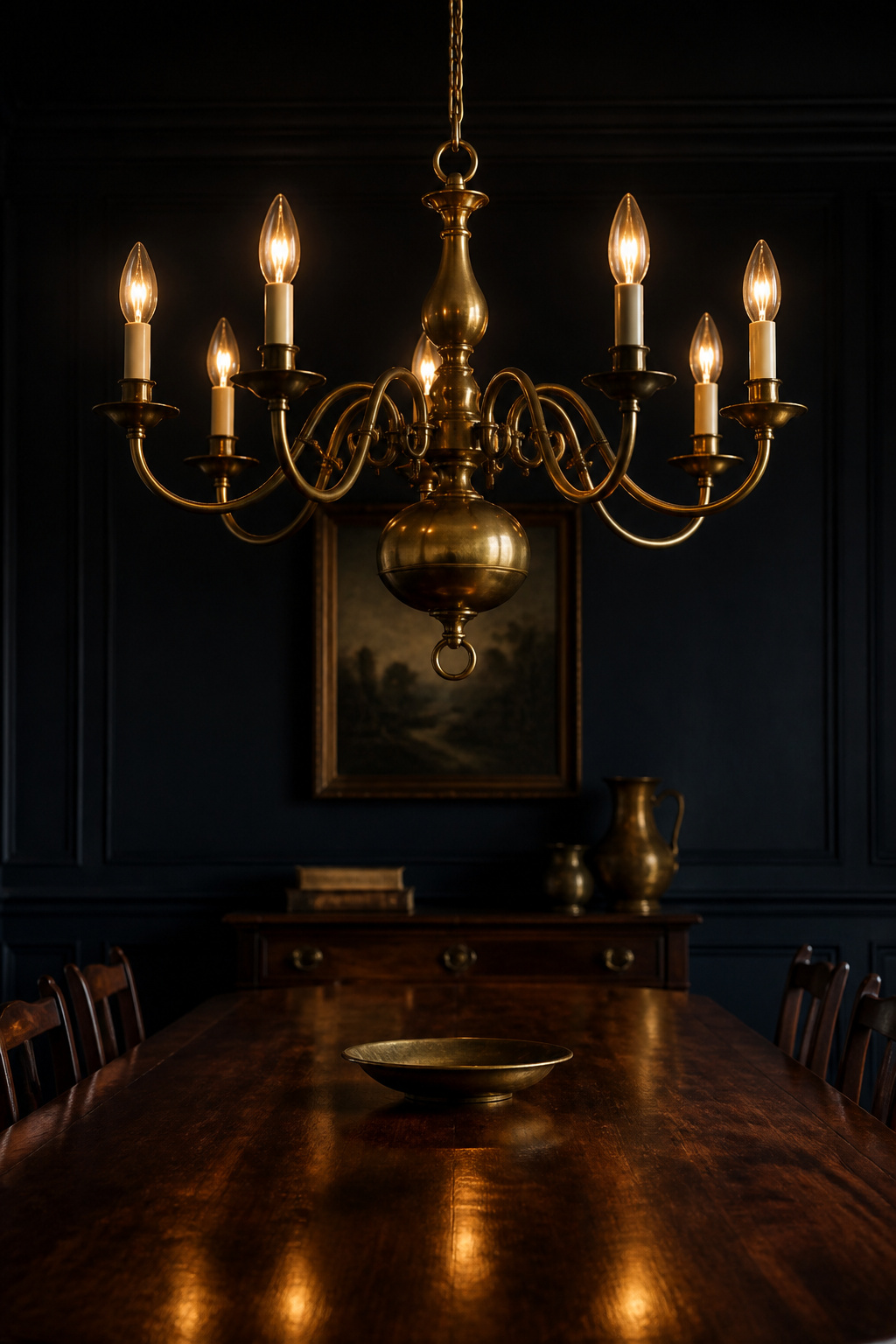
Scale rules: how to calculate chandelier diameter from table length
A chandelier should measure one-half to two-thirds of the table’s width, never wider. Room formula: add room length and width in feet — that sum is the diameter in inches. A 12-by-14-foot room calls for a 26-inch fixture. For a long table, pendants spaced 30–36 inches apart down the centreline work better than a single chandelier.
Hanging height — the number most homeowners get wrong
The lowest point should sit 30–36 inches above the table on a standard 8-foot ceiling, adding 3 inches per extra foot. Measure from the tabletop — measuring from the floor parks the fixture too high.
- Confirm your ceiling height; start from 30–36 inches for 8 feet.
- Add 3 inches for each foot of ceiling above 8 feet.
- Measure from the tabletop up to the fixture’s lowest point.
- Confirm the lowest point clears 7 feet from the floor for safe passage.
Fixture styles that suit a moody room
Dark metals — aged brass, oil-rubbed bronze, blackened steel — absorb light at low dimmer settings instead of turning into a mirror, which is exactly what polished chrome does. Open silhouettes — cage, candle-arm and lantern — let the warm filament bulbs show so the fixture itself becomes part of the glow.
Layer Two: Wall Sconces and the Mid-Height Glow
If the chandelier is the anchor, sconces are the layer that does the most for atmosphere.
Why sconces change a room’s perceived depth more than any chandelier can
Overhead light leaves the walls dark at their edges, and your brain reads that as oppressive. Sconces introduce light at eye level — where your gaze naturally rests — so the room reads as having depth rather than darkness pressing in. Dark walls absorb 10–20% more light than pale ones; sconces top up brightness without adding overhead glare.
Placement: height, spacing and the relationship to wainscoting or panel lines
Mount sconces with the centre at 60 inches from the floor — above seated sightlines, washing the wall rather than the ceiling. When panel moulding is present, align the backplate at or just above the chair rail. A pair flanking a mirror should sit 36–40 inches apart. Above 72 inches and you light the ceiling — the surface you want to keep dark.
Hardwired vs plug-in sconces — when each makes sense
Hardwired sconces give the clean, cordless look, typically $150–$400 installed. Plug-in sconces are the renter-friendly route — no wall surgery, and a fabric cord cover turns the cable into a detail. Run one through a smart plug and you get the full layered effect with zero electrical work — the make-or-break move when lighting a small dark room.
Layer Three: Buffet Lamps, Accent and Fill Light
The third layer fills corners and spotlights focal points. This is also where diminishing returns kick in. The goal is contrast — pools of light against genuine shadow — not even illumination.
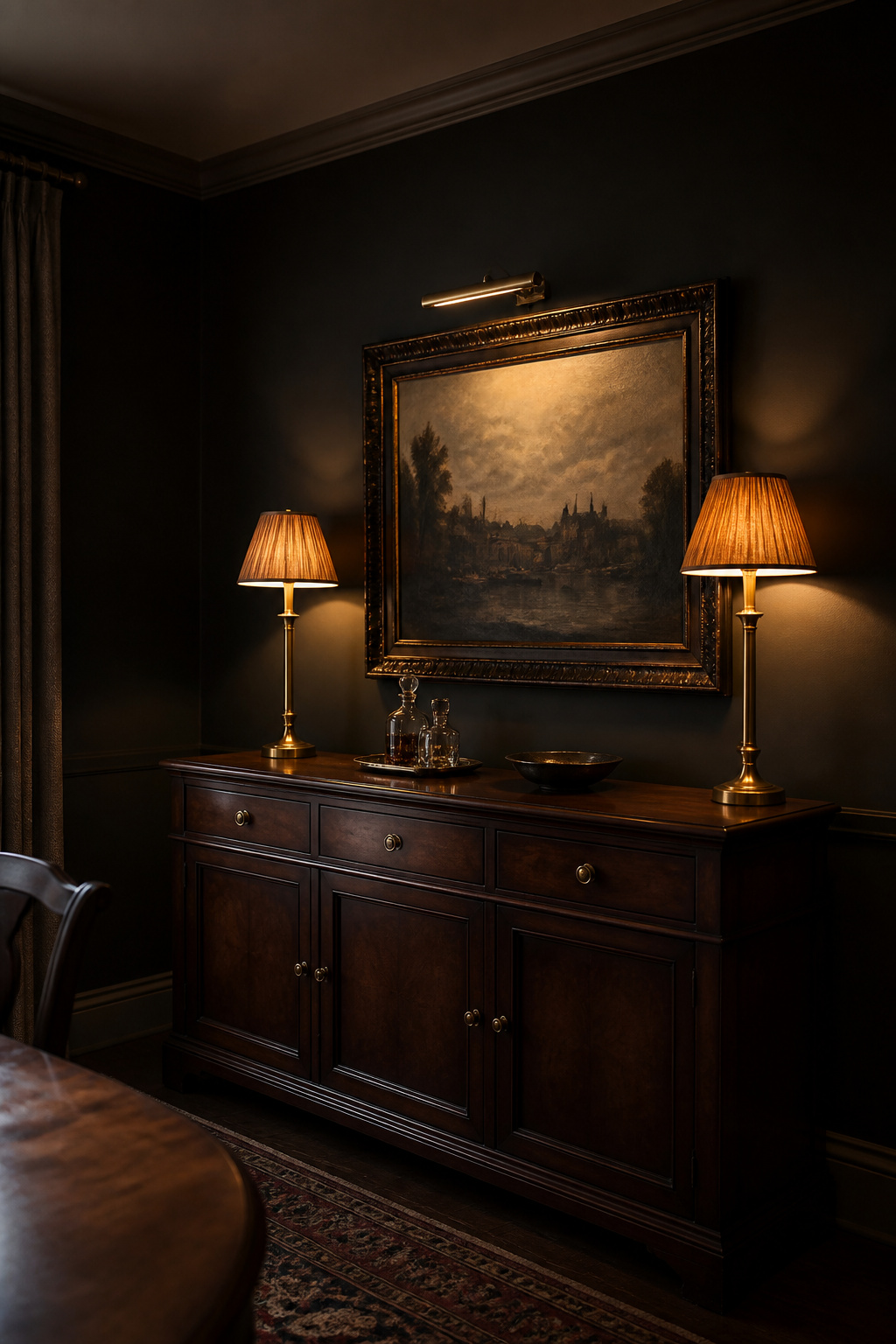
- Buffet lamps on a sideboard. Keep them under 40 inches tall and run 40–75W-equivalent bulbs (600–1100 lumens). A matched pair reads as intention; a single lamp reads as an afterthought.
- Picture lights over art. These illuminate the canvas and add a warm source at eye level — accent light and design element at once.
- Deliberate dark pockets. A uniformly lit dark room looks flat; pools of light and genuine shadow look dramatic.
- Under-shelf or cove light, sparingly. Only at 2700K behind a diffuser — bare LED strips read retail, not residential.
Dimmers: The Single Most Important Hardware Decision
A dimmer on a well-chosen chandelier is worth more than buying a second fixture.
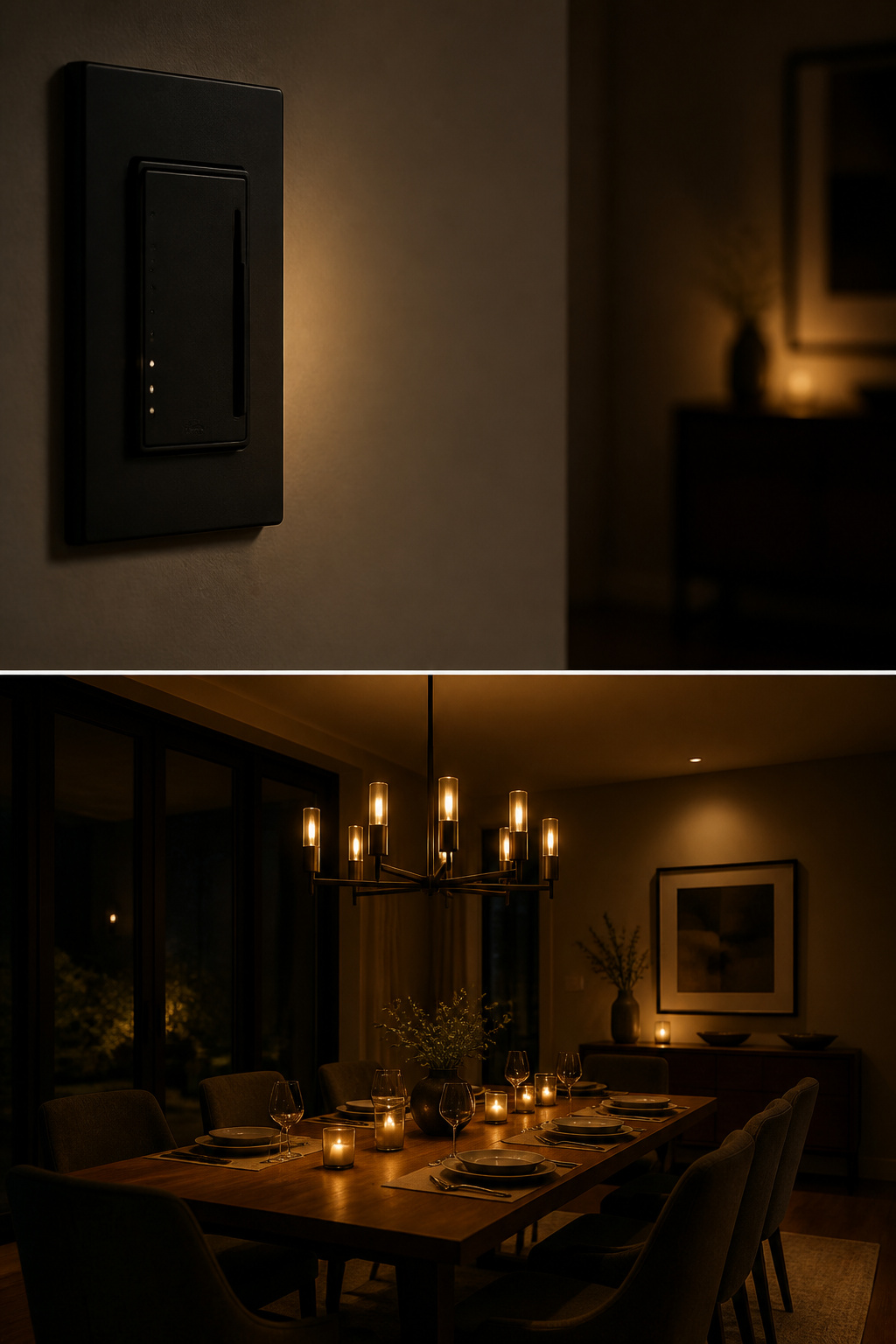
Why every circuit in a moody dining room needs a dimmer
Two dimmer circuits minimum — one for the chandelier, one for the sconces. The same room then hosts a dinner party (chandelier at 70%, sconces at 60%), an intimate dinner (chandelier at 30%), and a candlelit close.
Dimmer compatibility with LED bulbs — the problem most people hit
LED bulbs carry a driver that makes them fussy about dimmer type. A leading-edge dimmer often causes flicker or buzz. Trailing-edge dimmers are the answer: lower minimum load, silent, full range.
| Dimmer type | LED compatibility | Cost tier |
|---|---|---|
| Leading-edge (TRIAC) | Poor — flicker, buzz, narrow range | Budget |
| Trailing-edge | Excellent — silent, smooth, full range | Mid-range |
| Smart (e.g. Lutron Caséta) | Excellent — trailing-edge, plus scene presets | Premium |
Scene presets: setting the dial for dinner, for hosting and for clear-up
Three scenes cover every evening: Setup at 80–100%, Dinner at 25–40%, and Intimate at 5–15% with candles taking over. A smart dimmer recalls each with one press; a basic dimmer can hold a preset at installation — make Dinner your default. Scene control is a signature of modern moody design.
Candlelight: The Layer That No Electrical Fix Replicates
In Barry Lyndon, Kubrick shot whole scenes by candlelight, and the footage has a softness no electric rig has reproduced. Candlelight does something the best 2700K LED cannot.
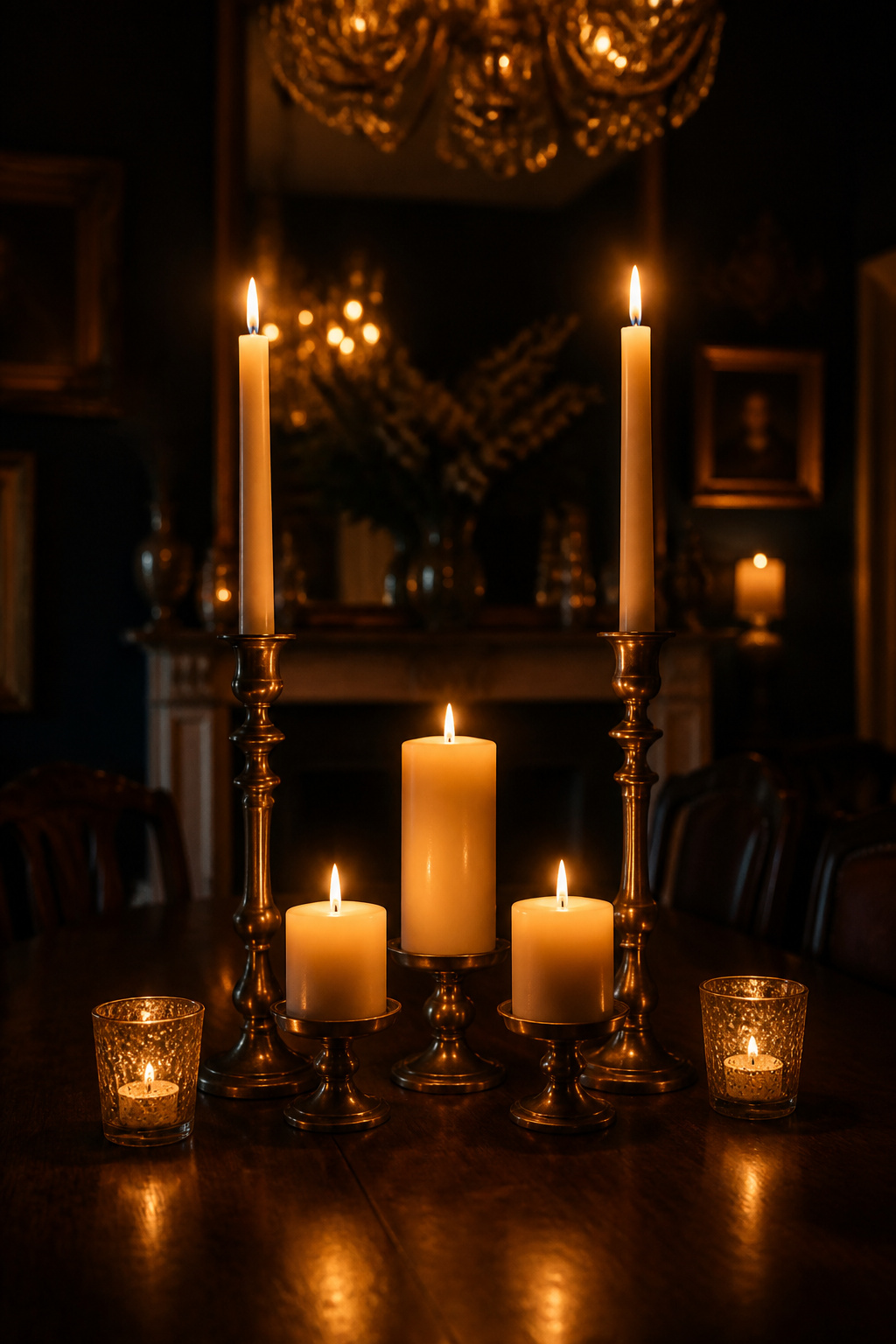
What candlelight does that 2700K LED cannot
A flame burns at roughly 1800K — warmer than any warm-white bulb — so it flatters skin and food past what 2700K can reach. Its gentle flicker mimics natural movement that the nervous system reads as safe. Research published in Building and Environment found that even luminaires simulating candlelight improve perceived warmth; the real flame does it more completely.
Candlestick heights and grouping for a dining table
One firm rule: keep candle arrangements below 12 inches or above 24 inches — never in between, where they block sightlines. Vary the heights: low votives at 3–4 inches, pillars at 6–8 inches, tall tapers at 18–24 inches in holders. On a six-foot table, three to five candles spaced 6 inches apart is the right rhythm.
Flameless candles in the right context — when they earn a place
Quality flameless options glow around 2200K with realistic flicker, earning their place where open flame is impractical — under a low chandelier or near fabric runners. Skip the cheap flat-yellow LEDs and the effect collapses.
The Moody Dining Room Lighting System: How the Layers Work Together
The reveal — more sources, not brighter ones — proves itself when all layers run at the right Kelvin, each on its own dimmer, each at a different height.
The layered lighting stack at a glance
| Layer | Function | Spec |
|---|---|---|
| Chandelier | Visual anchor, primary ambient | 50–67% of table width, 30–36 in above table, 2700–3000K |
| Wall sconces | Atmospheric depth at eye level | 60 in from floor, 2700K dimmable, at least two |
| Buffet lamps | Fill and focal pools | Under 40 in tall, 600–1100 lumens, 2700K; optional |
| Candlelight | Analogue warmth no LED matches | Below 12 in or above 24 in; real or 2200K flameless |
Common mistakes: what happens when one layer is missing
No dimmers: the scheme collapses into a workroom. No sconces: the walls stay dark at their edges regardless of the chandelier. Wrong Kelvin: one cool source breaks cohesion. No candlelight: the room is well-lit but missing its last five percent.
Starting from scratch vs upgrading an existing room
Building from nothing, budget the dimmers before the fixtures — two trailing-edge dimmer circuits unlock more atmosphere than one expensive chandelier on a basic switch. Upgrading a finished room, swap the bulbs to 2700K and add a trailing-edge dimmer. Then add plug-in sconces and a candlelit centrepiece — no electrician required — and you have the cocooning room described in how to create a moody dining room.
FAQ
How many lights do you need in a moody dining room?
Plan for at least four distinct sources across three layers: one overhead anchor, at least two wall sconces, and candlelight, with buffet lamps as a fourth where you have a sideboard. The key principle is more sources at low brightness rather than fewer at high — and each source should sit on its own dimmer circuit.
What wattage bulbs should I use for a dark dining room?
Aim for 40–50 lumens per square foot — dark walls absorb more light, so the target is higher than a pale room. A 150-square-foot room needs roughly 6,000–7,500 lumens across all sources. Choose 2700–3000K dimmable LEDs with a CRI of 90 or above so food and décor colours read accurately.
Can I make my dining room feel moody without replacing the ceiling fixture?
Yes. The two highest-impact changes need no new fixtures: swap all bulbs to 2700K dimmable LEDs and add a trailing-edge dimmer to the existing circuit. Then add plug-in sconces and a candlelit centrepiece — no electrical work required. Together these deliver most of the moody lighting effect.