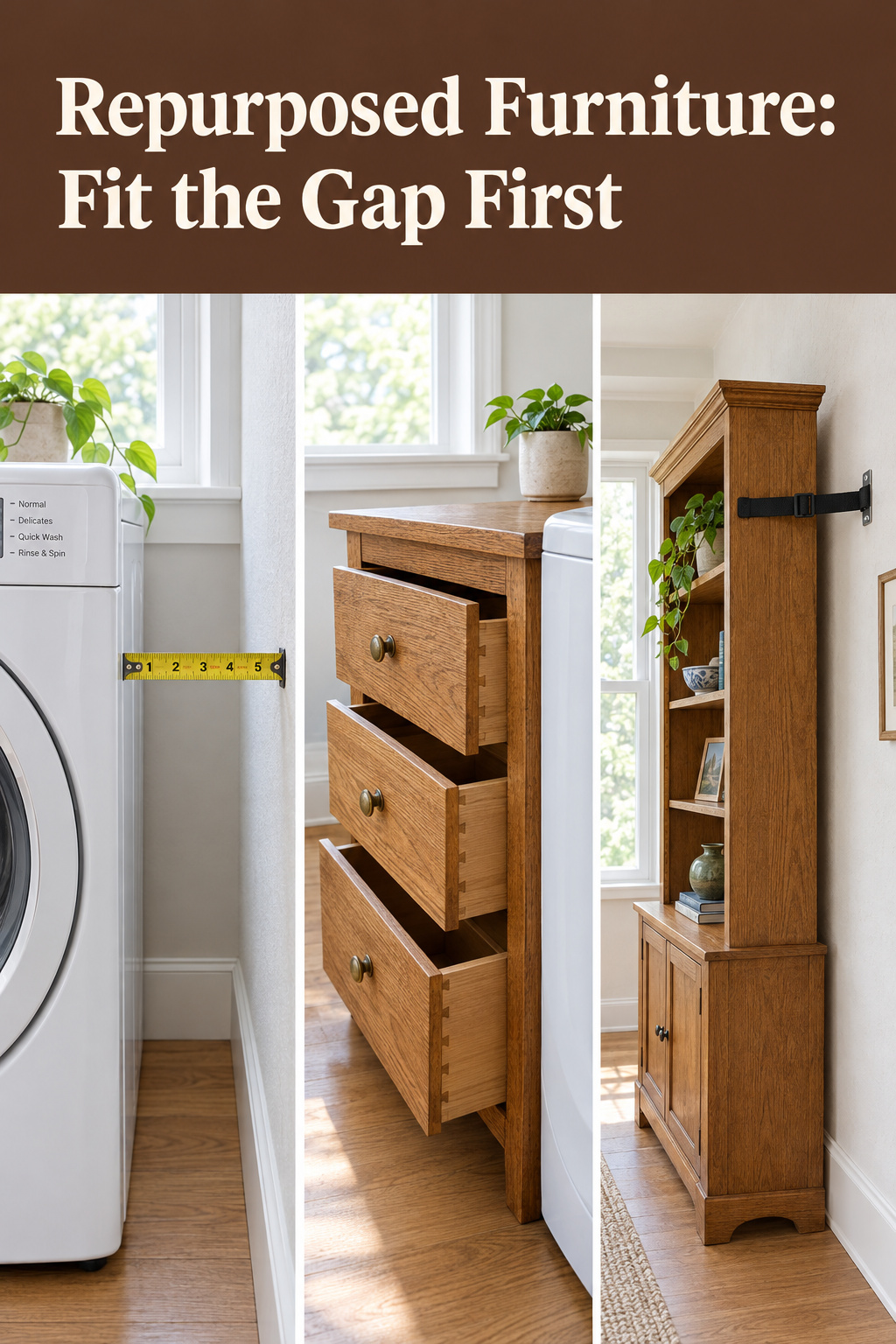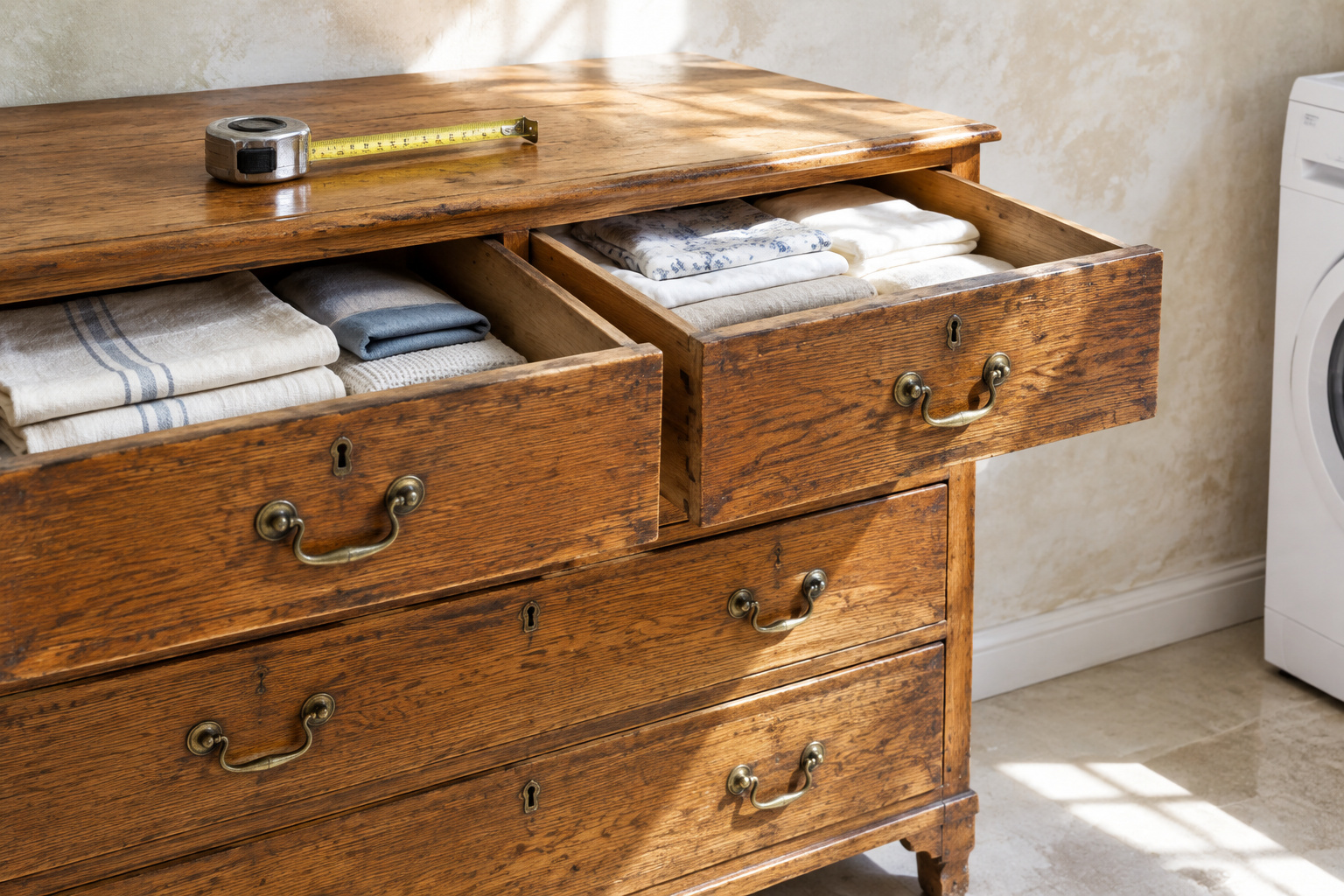
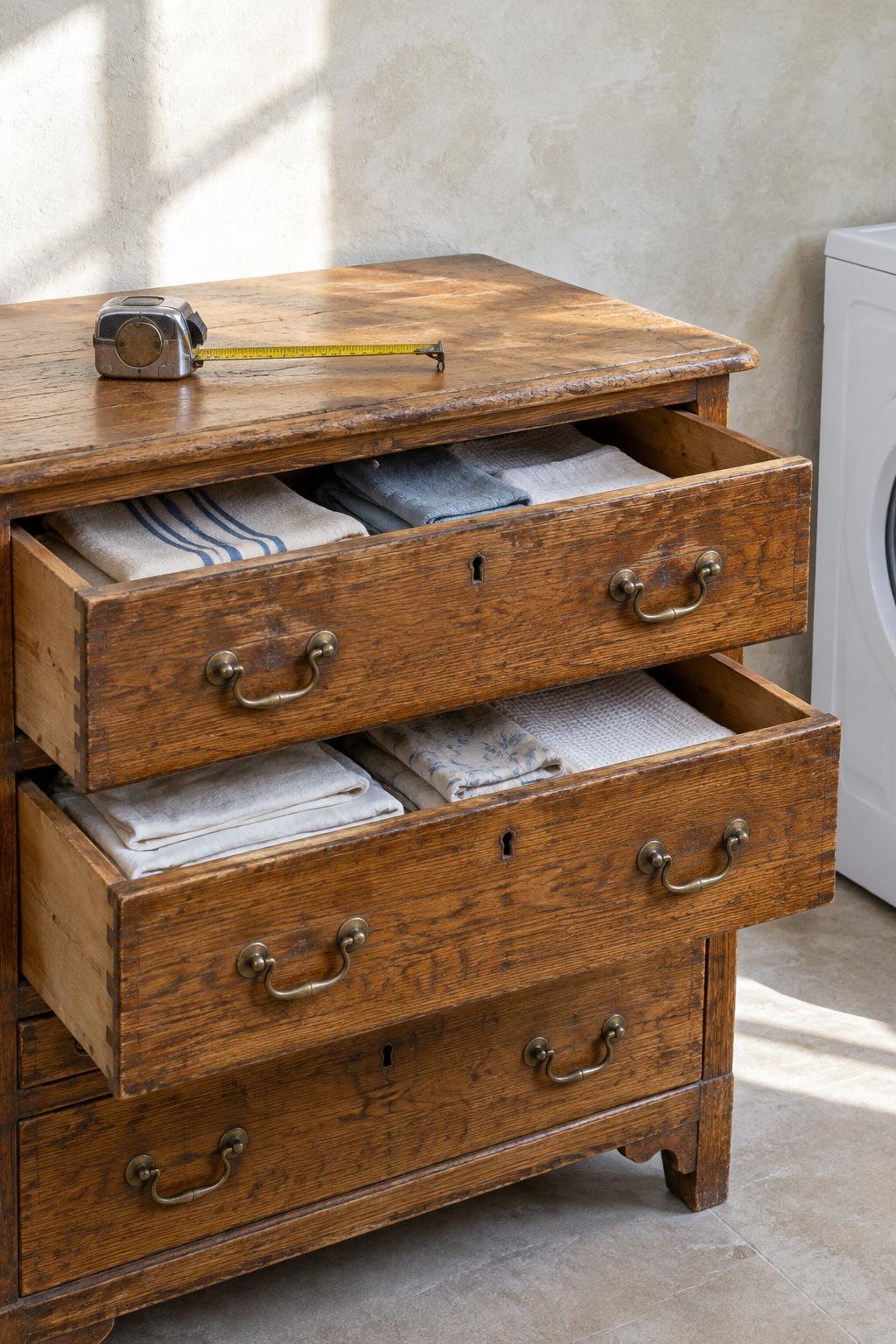
A finished repurposed furniture laundry room has an old oak dresser across from the washer, towels in the top drawer, the machine door wide open and nobody bumping a hip on a knob. The sum that gets you there is short. A 34 in deep washer, 36 in of clear floor in front of it, and an 18 in antique dresser against the opposite wall add up to 88 in, which is 7 ft 4 in from wall to wall. If your room is narrower than that, the dresser you love on the listing is already the wrong dresser. Start with a tape measure, not a style.
TL;DR
- Measure the gap before you shop: a piece opposite a 34 in machine needs 88 in wall to wall with an 18 in antique dresser, 92 in with a 22 in modern one, and 100 in if you want the full 48 in a front-load door likes.
- Old furniture in a laundry fails at the floor, not in the air: particleboard does most of its swelling above 80% humidity and homes should sit below 60%, so leaks, mop water and a wet floor line are what ruin them.
- Assume paint on anything made before 1978 has lead, swab through every layer before you sand, and fix any tall piece to a stud, because drywall cannot typically hold a 50 lb pull.
Measure the Gap First: Depth, Door Swing and Front Clearance
Pros measure. Beginners guess. The dimension people miss is the machine door standing open.
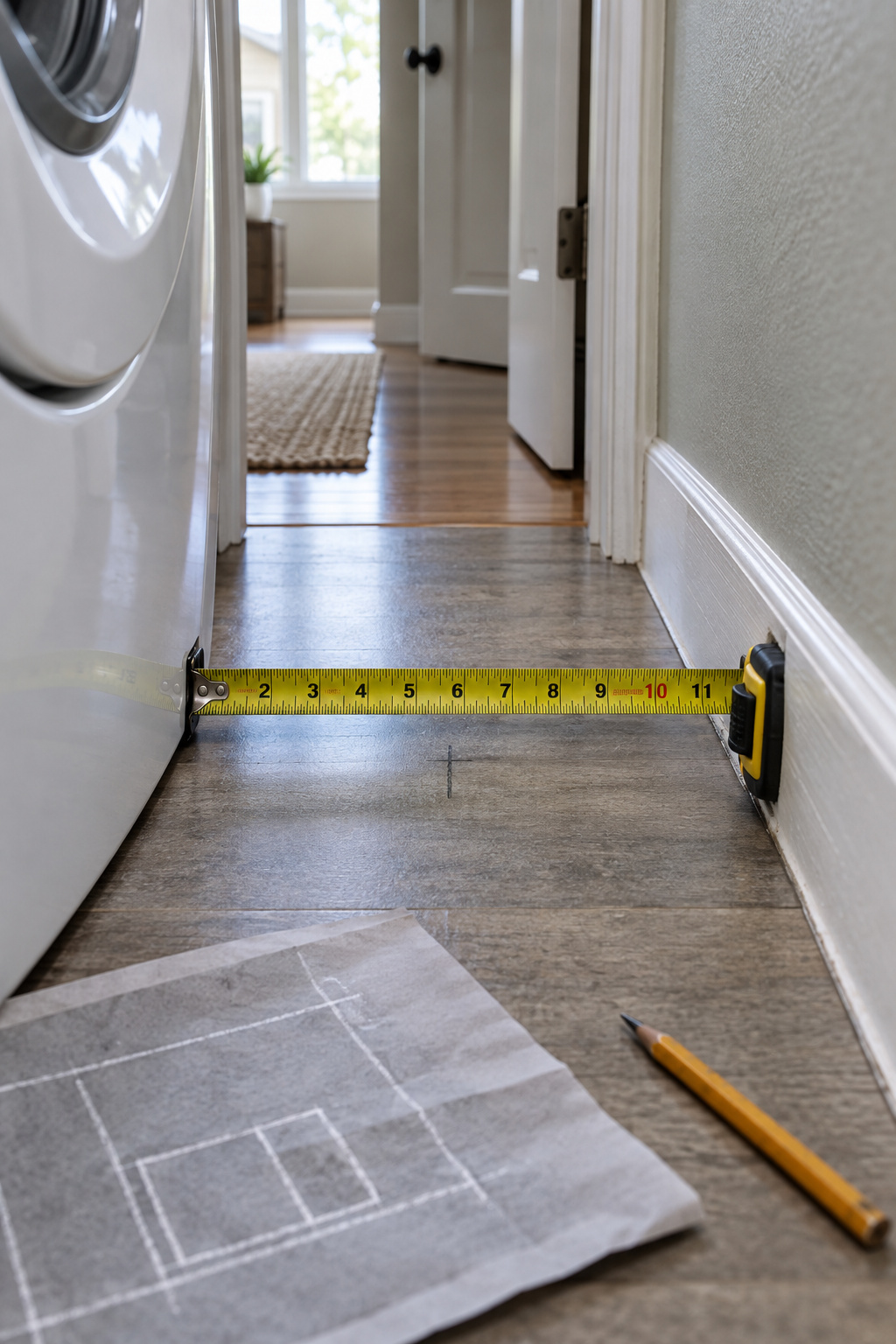
- Measure the machine depth, then add the hoses. Standard machines run about 30 to 34 in deep, and they need another 4 to 6 in behind them for hoses, vent and cord, so a standard laundry space wants 36 to 40 in of total depth. Machines vary; I plan on 34 in because it’s the worst case.
- Open the washer door all the way and measure to its edge. A front-load door swings out roughly 6 in past the cabinet. Your piece goes against the open door, not the closed one.
- Mark the clear floor in front of the machines. The minimum is 36 in to load and stand; a front-load door fully open is happier with 48 in.
- Do the sum. Machine depth, plus clear floor, plus the depth of the piece, has to fit the room.
Put the piece on the wall opposite the machines. With 34 in of machine and 36 in of floor, an 18 in antique dresser needs 88 in. Swap in a 22 in modern dresser and it’s 92 in. Give the front-loader its full 48 in and even the 18 in dresser needs 100 in.
The mistake is shopping first. A secondhand dresser that doesn’t fit rarely costs much money. It costs a borrowed truck, two people, a Saturday and a spot on the curb.
Which Repurposed Furniture Fits a Laundry Room Gap: Dressers, Hutches, Lockers and Counters
Once you have the number, the piece picks itself. Antique dressers tend to run 16 to 18 in deep against 20 to 22 in for modern ones, and those 4 in are the difference between a walkway and a hip bruise.
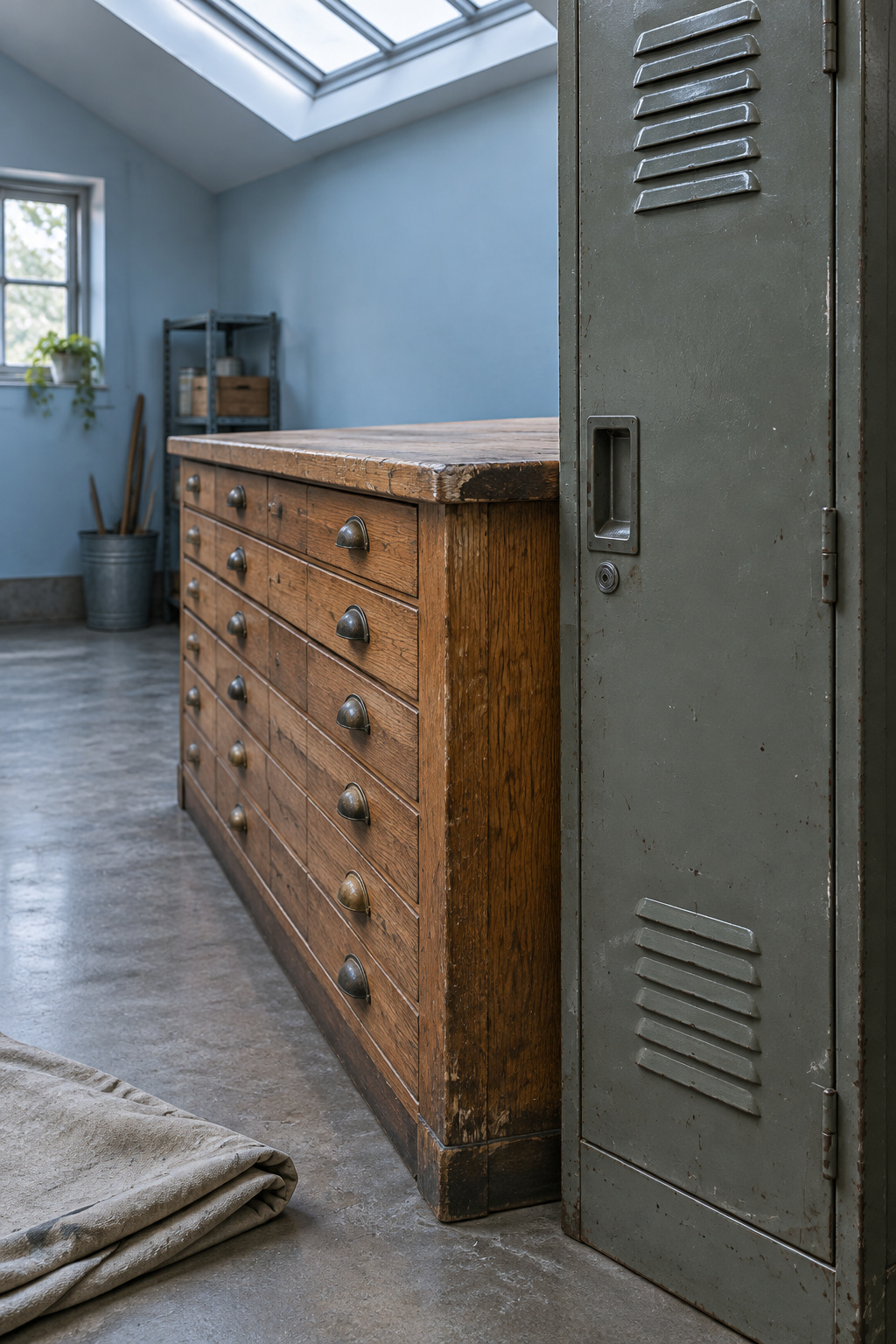
| Piece | Typical depth | Where it suits | The catch |
|---|---|---|---|
| Antique dresser | 16–18 in (about 19 in for a Victorian with mirror) | Opposite or beside the machines | Mirror versions stand about 71 in tall |
| Modern dresser | 20–22 in | Wide rooms only | Costs you 4 in of aisle |
| Two-part hutch | 12–16 in top, 15–19 in base | Opposite wall; top can go up alone | Base counter sits about 32 in high |
| Steel locker | About 15 in (current stock 12–18 in) | Narrow end walls, tall storage | 72 in tall, 78 in on legs |
| Store counter | 19–27 in | Sorting wall beside the machines | Heavy (a 52 in pine one is about 130 lb) and priced as an antique |
A hutch is the most useful piece on that list, because most two-part hutches separate. The top section is about as deep as a standard 12 in laundry wall cabinet, and the base works on its own as a low buffet. Its open bays are the natural home for old baskets for the open shelves.
Store counters are the romantic choice and the expensive one, listed at about $1,500 to $6,950. Most are too shallow to go over the machines, which wants 27 to 34 in of depth, so use one beside them as a sorting station.
Drawer Reach, Counter Height and Light: Make the Top Work
Pull the drawer before you pay for the dresser. Inside, a dresser drawer is typically 14 to 18 in deep, and fully open it reaches that far into your 36 in of clear floor. That leaves you 18 to 22 in to stand in while it’s open, and it has to share that space with the washer door.
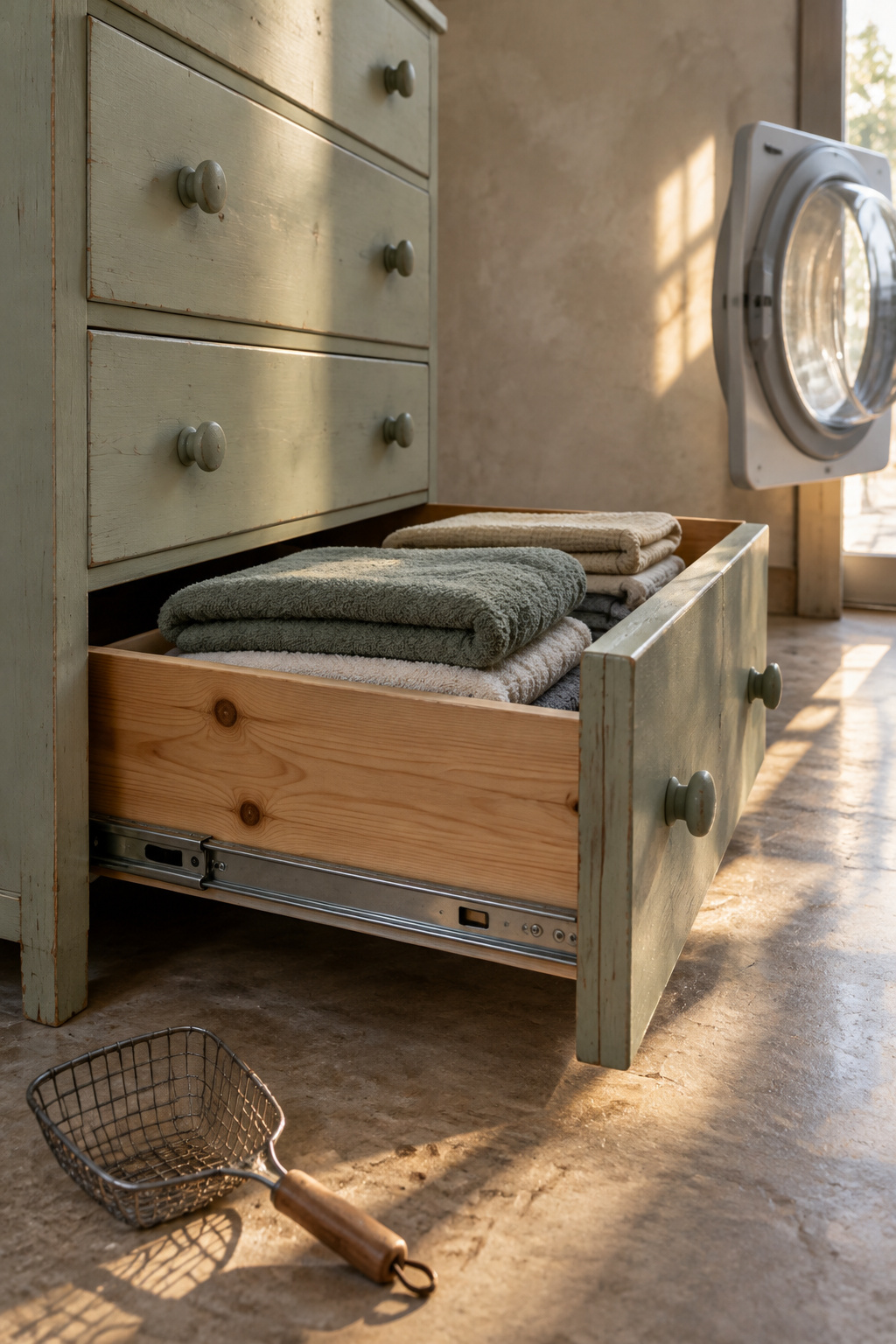
If you put a top over or beside the machines, don’t let it rest on them. A counter over front-loaders gets its own support, cleats screwed into studs, and a gap above the machine tops. How big a gap depends on who you ask: one trade source says at least 1/4 in, a laundry layout calculator says 1 in. How hard a spinning washer shakes a dresser beside it has never been measured, so I treat both the gap and the wall anchor as cheap insurance.
Set the top height where your elbows say, not a chart. And a dresser top is a work surface now, so plan an old light over the dresser top before you fill the drawers.
Check the Build Last: Solid Wood vs Particleboard at the Floor
Rock the carcass, look for dovetails rather than staples, knock on the panels and smell the drawers for damp; our pantry cabinet guide walks through that check in full. The check matters more in a laundry, because a drawer box with particleboard sides instead of 5/8 in solid hardwood is the one that swells and lets its corners go.
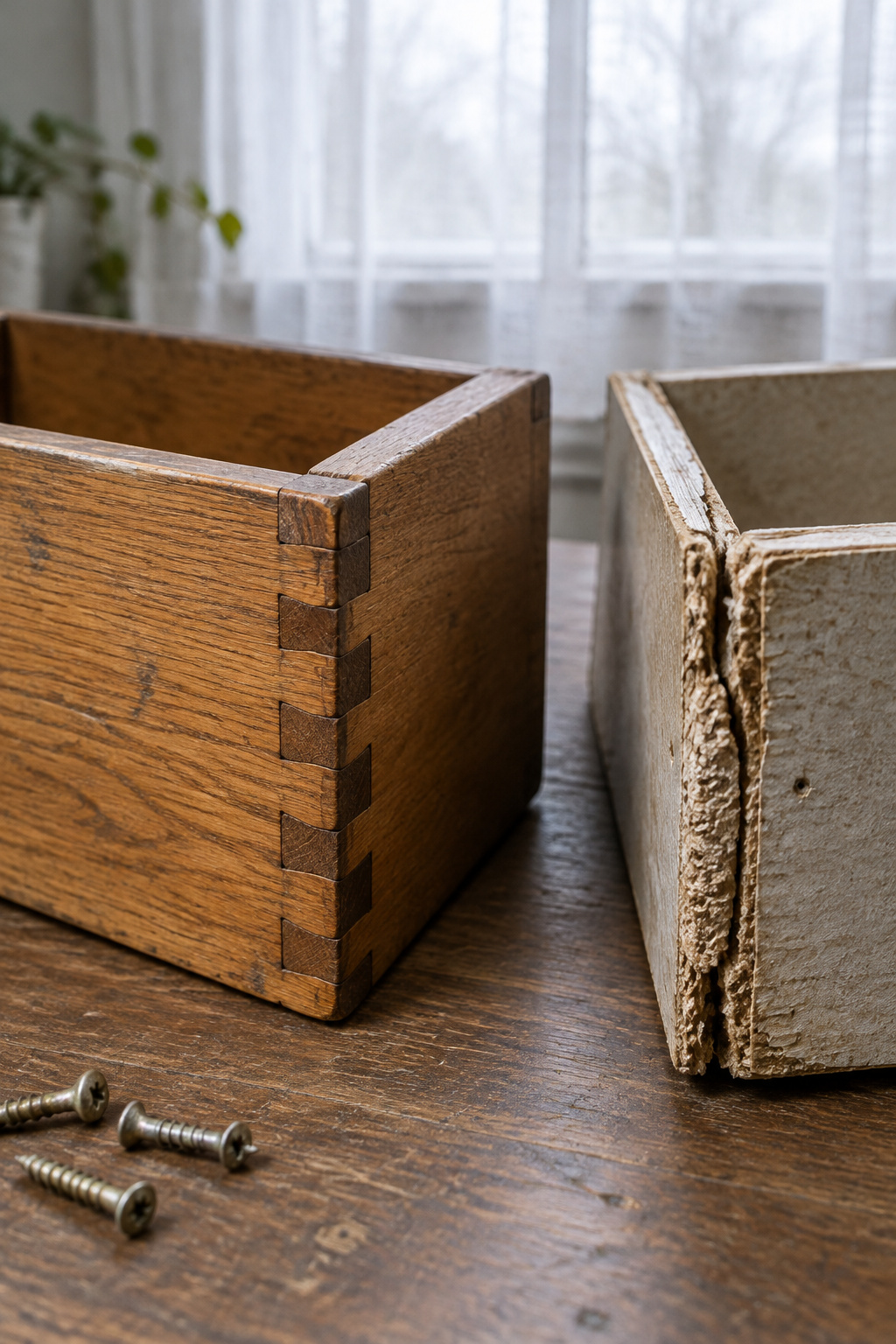
Dryer steam usually isn’t what ruins it. Particleboard and MDF hold their strength up to about 65% relative humidity, particleboard does most of its swelling above 80%, and a normal home should sit below 60%. What does the damage is liquid water at the floor: a leaking hose, a wet mop, an overflowing tub, and the wetting and drying that follows. Swelling at a soaked edge doesn’t fully come back.
| Material | What water does | The tell in a shop | Verdict |
|---|---|---|---|
| Solid wood | Swells and shrinks with the air, reversibly; repeated cycling can split it or crack the finish | Splits along the grain, crazed finish | Best choice; seal every face, end grain included |
| Plywood | Swelled up to about 8% in a lab test above 95% humidity and didn’t return | Lifting veneer at the bottom edge | Fine if the bottom edge is sealed and dry |
| Particleboard | 5.5–15% swell through a humid cycle, one-third to one-half permanent; about 39% of its bending strength gone at 93% humidity | Crumbly edges at the floor line, loose screws | Keep it off the floor or pass |
| MDF | Swells more than particleboard; about 46% of its strength gone at 93% humidity | Puffed edges at the floor line | Pass, unless it’s a moisture-resistant MR10 or MR30 grade |
One more shop check: a stripped screw hole in particleboard won’t grip again, so a wobbly chipboard dresser stays wobbly.
Is It Worth More Unpainted? Sealing, Lead and the Paint Decision
If it’s a genuine 18th- or 19th-century country piece with its original surface, leave it alone. Skinner, the Boston auction house, has described a Windsor chair worth about $80,000 in its original paint that would bring about $800 refinished. Most laundry-room dressers aren’t that. A solid-wood factory piece from the 1930s to the 1960s can be refinished without much loss; even on true antiques, one Arts and Crafts specialist puts a careful refinish at perhaps a 25% deduction.
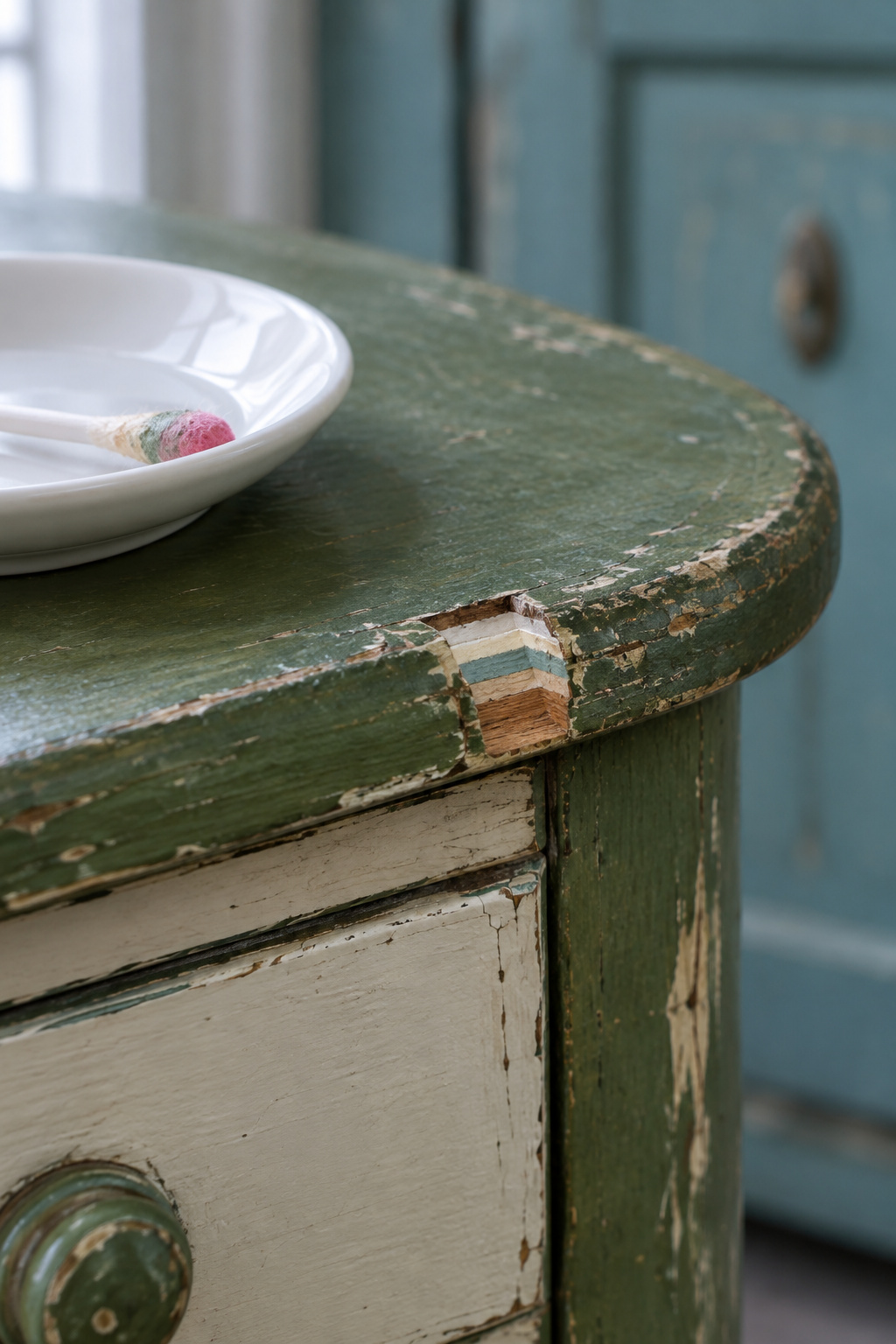
Before any sanding, assume the paint has lead if the piece was made before 1978. That’s the year consumer lead paint was banned. For furniture the federal limit was 0.06% lead by weight from 1978, cut to 0.009% in 2009. A home swab test screens for it: clean a small spot, cut a notch through every layer down to the wood, activate the swab and rub the notch for 30 seconds. Pink or red means lead is there.
The swab tells you whether lead is present, not how much, and testing only the top coat is the usual reason for a false negative. A dresser here gets handled every day at hand and machine height, and worn paint on drawer fronts is the worry, mostly for small children who crawl and mouth things.
Painting technique is covered in our guide to painting vintage furniture. For a laundry, pick the sheen and coverage: satin at minimum, never flat, and seal the back, underside and end grain too, because a board finished on one side only can cup.
Lift It Off the Wet Floor and Anchor It Like It Will Be Pulled On
Lift it off the floor
End grain pulls water in like a bundle of straws, and the bottom of a dresser’s legs or plinth is all end grain. Give the cut bottoms extra coats of sealer and get the piece off the floor so a spill can dry underneath. Rubber caps suit tile and splash zones; screw-in glides take heavy pieces. A flat-based hutch can take legs, though a hollow base needs a wood plate first so they have something to screw into.
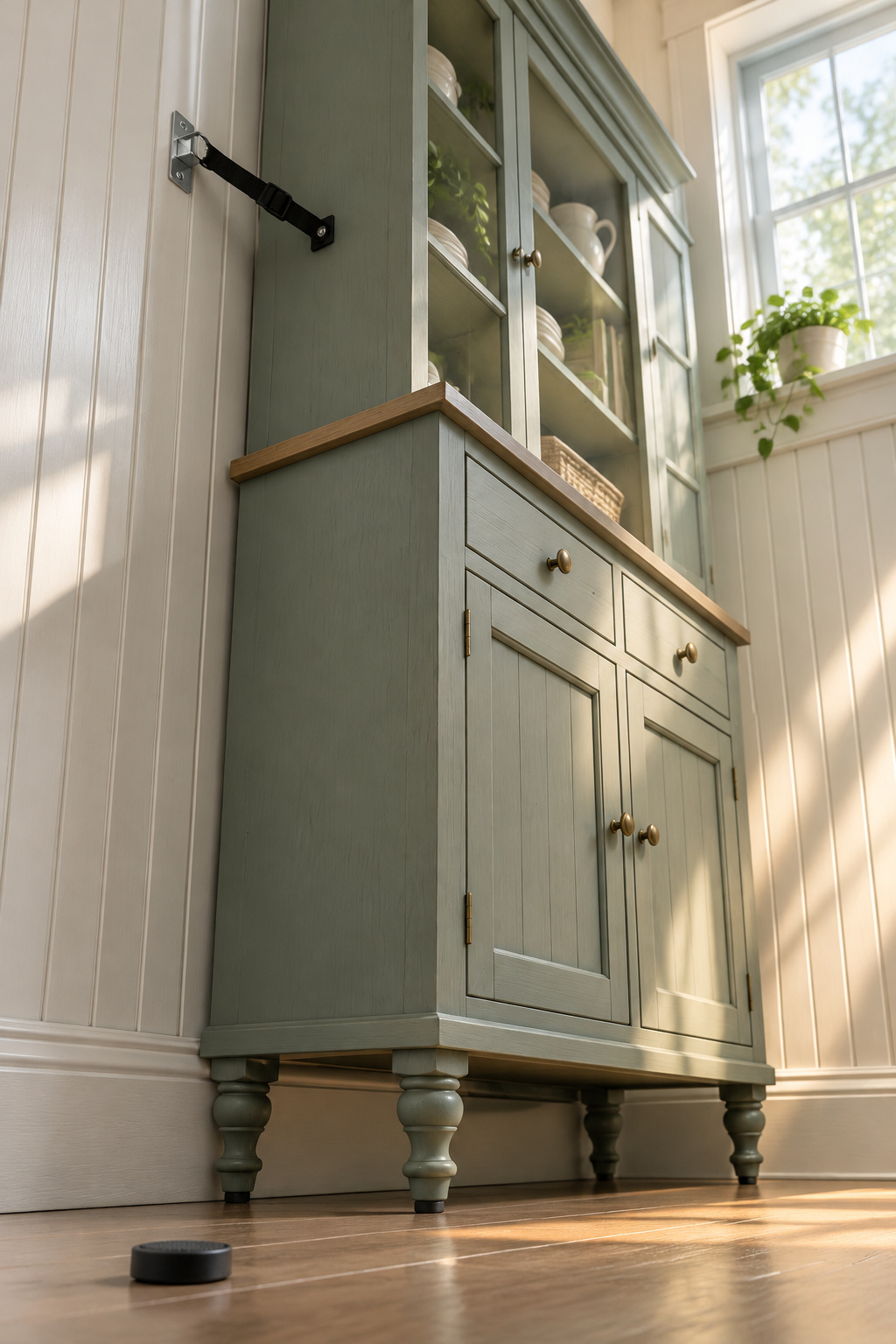
How high? There’s no standard for it. My own rule is high enough that I can see the floor under the piece and get a mop in, so a puddle never sits against the wood unnoticed.
Anchor it to studs, not drywall
The law won’t make you do this. The STURDY rule only covers new clothing storage units manufactured after September 1, 2023, so it doesn’t reach a secondhand dresser or hutch. Anchoring an old piece is the Consumer Product Safety Commission’s advice, and it’s good advice: anti-tip kits almost all cost under $20, and CPSC staff found that drywall cannot typically withstand a 50 lb pull.
A shelf I hung on drywall anchors in my twenties came down at 2 a.m. Anchors are not studs, and I’ve screwed into studs ever since. My neighbors call me when something falls off a wall.
Stud finders lie. Check with a nail or a magnet; on plaster, a magnet finds the lath nails. Then:
- Find the stud and mark it in pencil.
- Mark the bracket height on the piece, high up, in thick solid wood. Never the thin back panel.
- Screw the furniture bracket into that solid wood.
- Fix the wall bracket into the stud with a wood screw at least 2 in long, lower than the furniture bracket.
- Tighten the strap, and double-loop it if the kit allows.
- Test each screw by hand with a screwdriver.
- Pull-test the piece, then load it.
Allow a few minutes per piece, plus one trip back to the store for longer screws.
That’s the sequence for building a laundry room from old pieces one piece at a time: gap, build, finish, wall. Start with the number. With the dresser opposite a 34 in machine and 36 in of floor in front of it, an 18 in piece needs 88 in wall to wall.
FAQ
How much does it cost to turn an old dresser into laundry storage?
Not much for the dresser itself. Secondhand furniture runs roughly 10 to 20% of retail, and the one add-on you can’t skip is an anti-tip kit, almost always under $20. Sealer and feet vary with the piece. Other pieces cost far more: a new steel locker is about $220, and antique store counters are listed in the thousands.
Will an old dresser walk or rattle when the washer spins?
It can shift, which is why a tall piece gets fixed to a stud. Keep any top off the machines entirely, with a gap of 1/4 in to 1 in depending on the source. A heavy solid piece, like a 130 lb pine counter, will move less than a light flat-pack one.
What can you store in a hutch in a laundry room?
Small bottles and spare linens up top, folded textiles below. A hutch’s upper section is typically 12 to 16 in deep, about the depth of a standard laundry wall cabinet, and the base runs 15 to 19 in deep with drawers and doors. A dryer raises humidity, so keep towels behind doors rather than on open shelves.