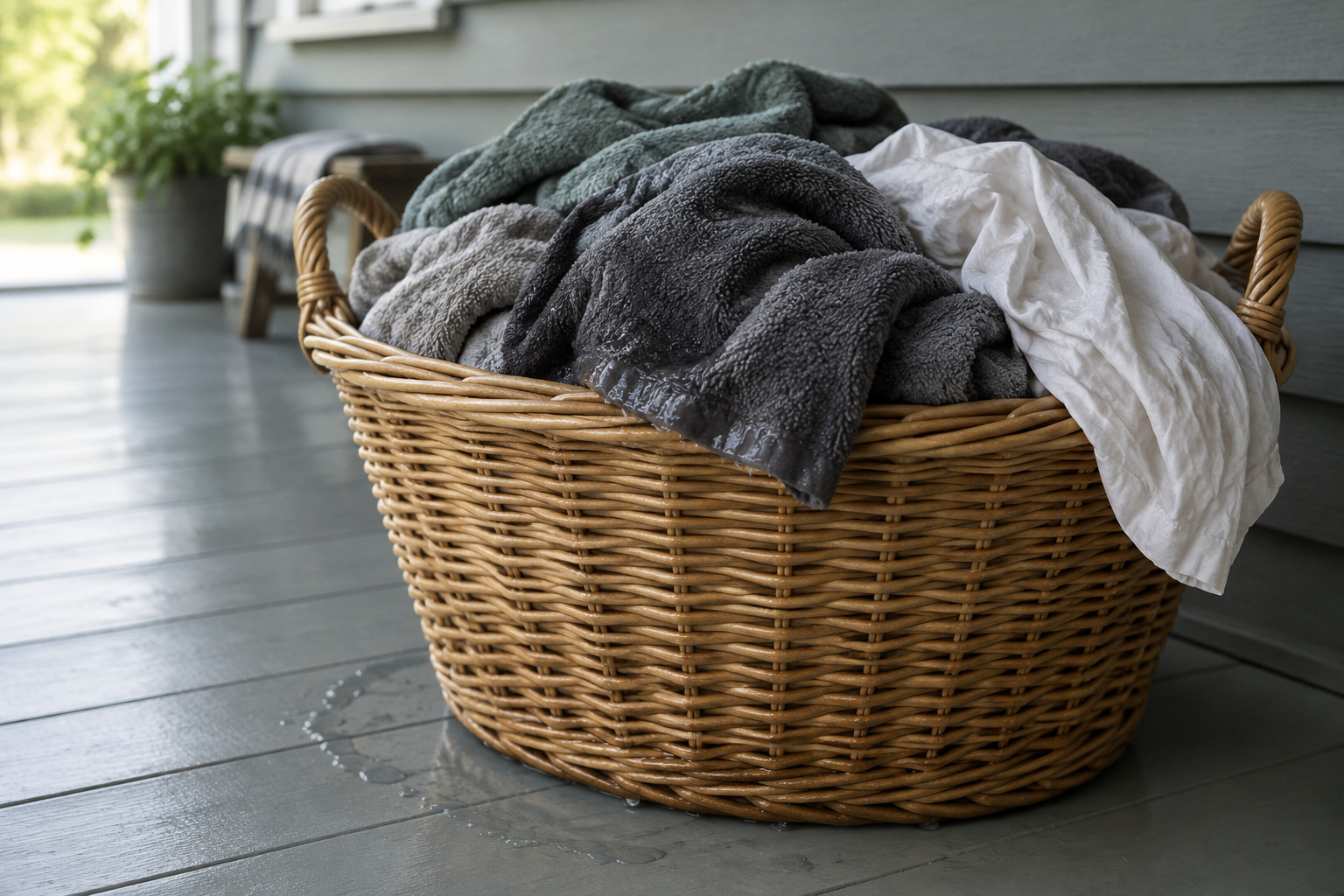
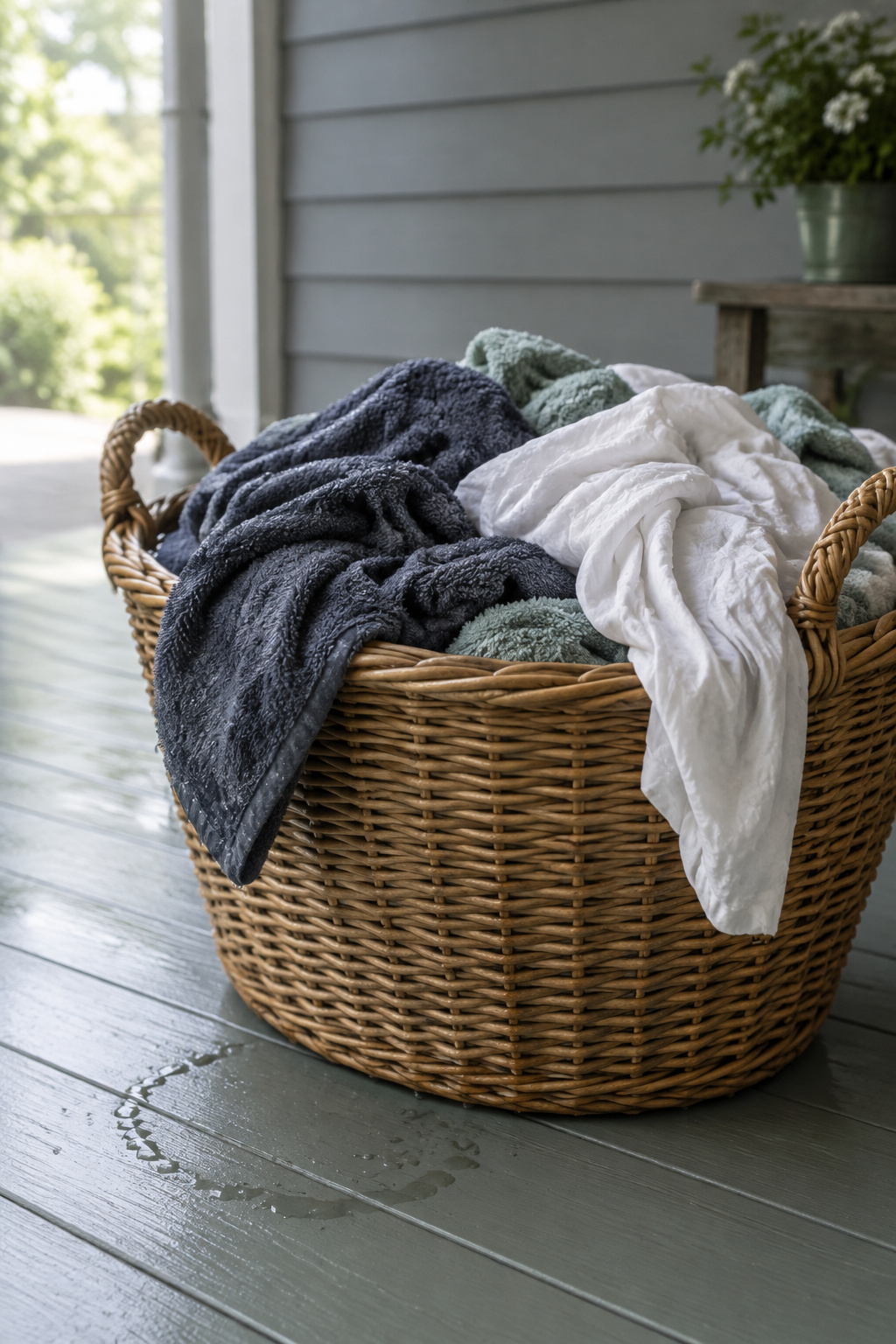
Eleven pounds. That is roughly what an ordinary load of washing weighs when it leaves the drum, and a good vintage laundry basket takes it from the machine to wherever it is going without a creak. The water left in the cloth after the spin comes to about 45 to 52% of its dry weight, so an average 7.6 lb load comes out at 11 to 11.5 lb, and a bigger 12.25 lb load at 18 to 19 lb. All of that hangs from two handles and presses on one base.
Baskets were tools before they were decoration. In Bridgwater, in Somerset, willow basket-making was a major trade through the nineteenth century and well into the twentieth, mostly in small cottage workshops, and laundry baskets were made there alongside picnic hampers and fishing baskets. Museum records of working laundry baskets show the same build: battens nailed under the base, rims lashed twice, handles notched in so they cannot pull out.
Now they reach you as lookalike listings. Some will carry a wet load across the house; others will let go at the base on the first trip. You need one of the first kind, and probably only one.
TL;DR
- A spun load still holds water equal to about half its dry weight, so an average wash weighs about 11 to 11.5 lb and a large one 18 to 19 lb. Buy the basket for that weight, not for the shelf.
- Old baskets fail at the handles, the rim and the base, so turn one over, look for cleats or battens under it, and check that the handles pass through the rim and are fixed there, whether stapled, lashed or bound.
- For mildew, let the basket dry first, brush the mold off outdoors out of direct sun, wipe it barely damp and never soak it. Bleach and a dunk in warm water are the riskier route.
Vintage Laundry Basket Identification: Willow, Splint, Wire or Rattan, and What a Sound One Costs
Wicker is a way of weaving, not a plant. A basket sold as wicker may be willow, rattan or reed, and it pays to know which before you think about price.
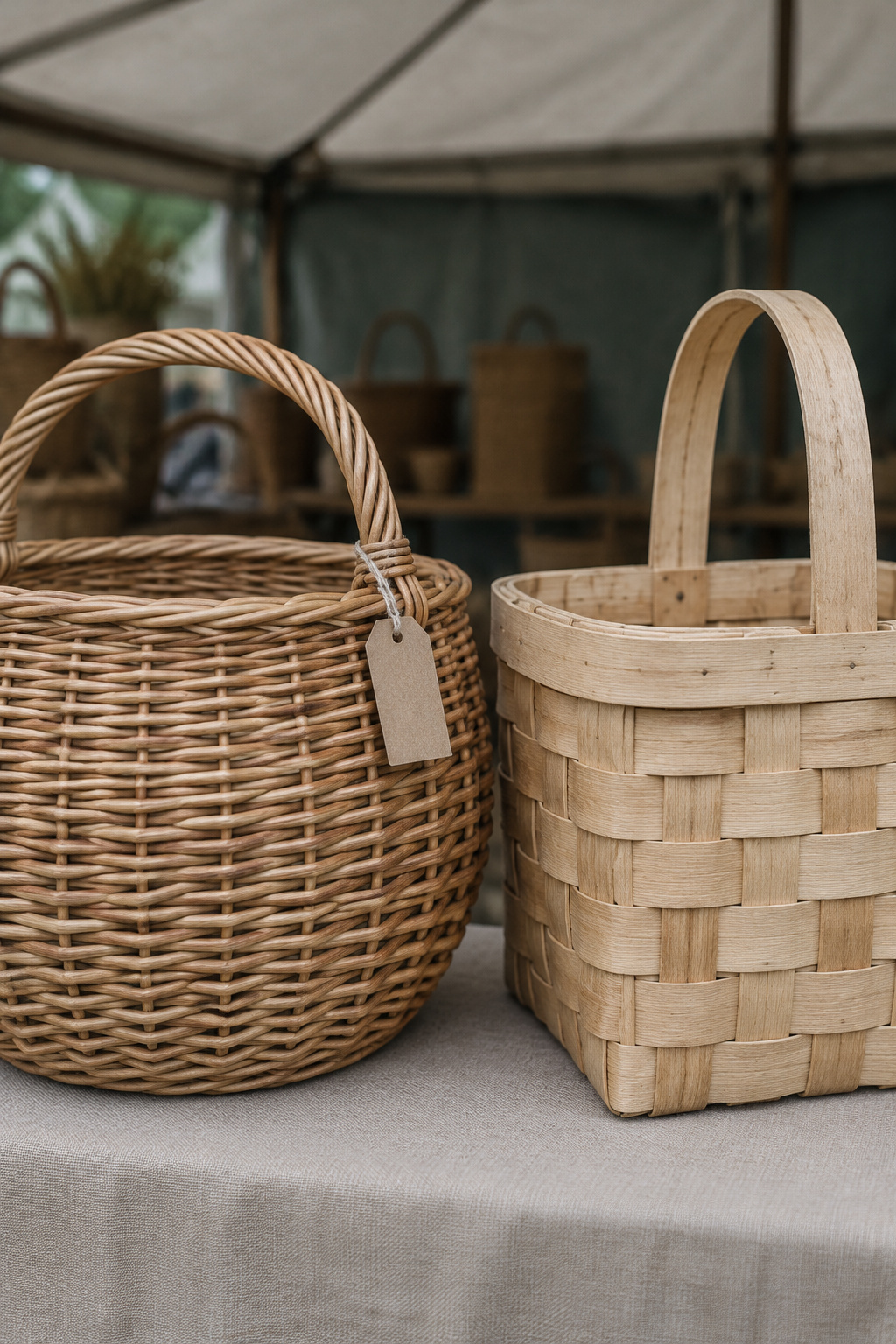
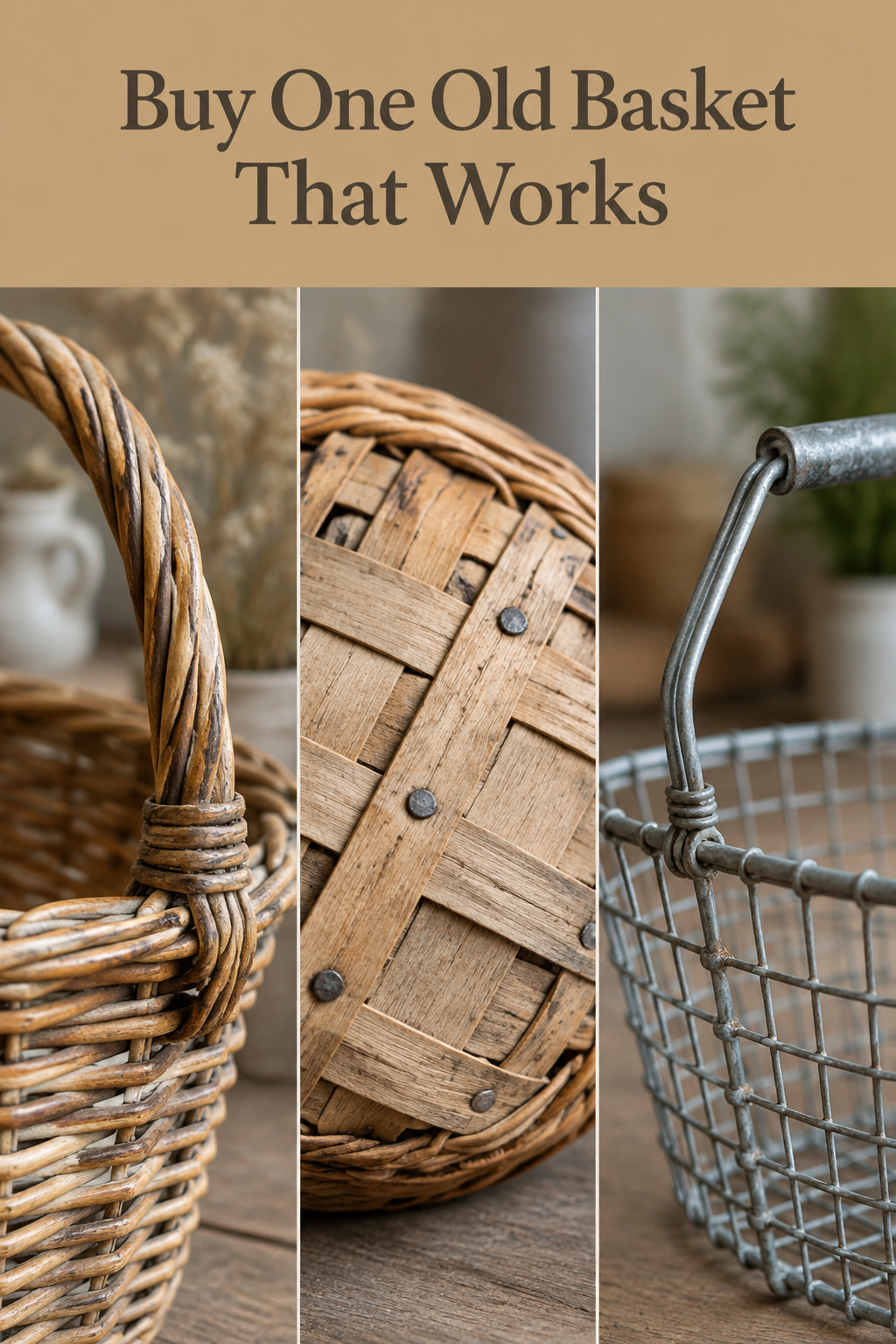
Willow is round-stemmed and tightly woven, and older pieces may have a braided rim. Splint is flat strips of ash or oak, often on a square base that turns round at the rim. Unpainted splint darkens with age, and a fuzzy, hairy surface almost always means newer material. Wire is welded galvanized steel, sometimes collapsible and on castors. Rattan is a climbing palm: the thick stems make the frame, and the thin stripped cane is weaving material, better suited to detail than to carrying full loads.
| Material | How to recognize it | Base and handles on a working one | What one has sold or been listed for |
|---|---|---|---|
| Willow | Round stems, tight weave, sometimes a braided rim | Wooden battens nailed under the base; finger-holes in a cane-reinforced rim | £281.60 at Bonhams (2025); $695 dealer asking for one on wheels; $10–20 estimate for a plain round hamper (2025) |
| Ash or oak splint | Flat strips, square base turning round at the top, darker with age | Cleats nailed across the bottom; handles notched into a double-lashed rim, or stapled to it | $400–600 hammer for splint lots at a New England auction house, 2016–2019 |
| Wire | Welded galvanized wire, some collapsible on castors | Welded frame, sometimes a solid metal base | $30 at auction (2015); £55 dealer asking |
Those figures are years and channels apart, so read them as bands rather than a market price. An asking price is what a dealer hopes for, and sold results run lower.
A basket is one of the old tools that make a vintage laundry room, and like the others it should come home with a job.
The Vintage Laundry Basket That Can Carry a Wet Load: Base, Rim and Handle Tests
Handles, rims and attached bases are where old baskets break. The Canadian Conservation Institute names exactly those three, because they have taken the most strain in use, and the weakest points are where a flexible weave meets something rigid. Eleven to nineteen pounds of wet cloth will find them on the first trip.
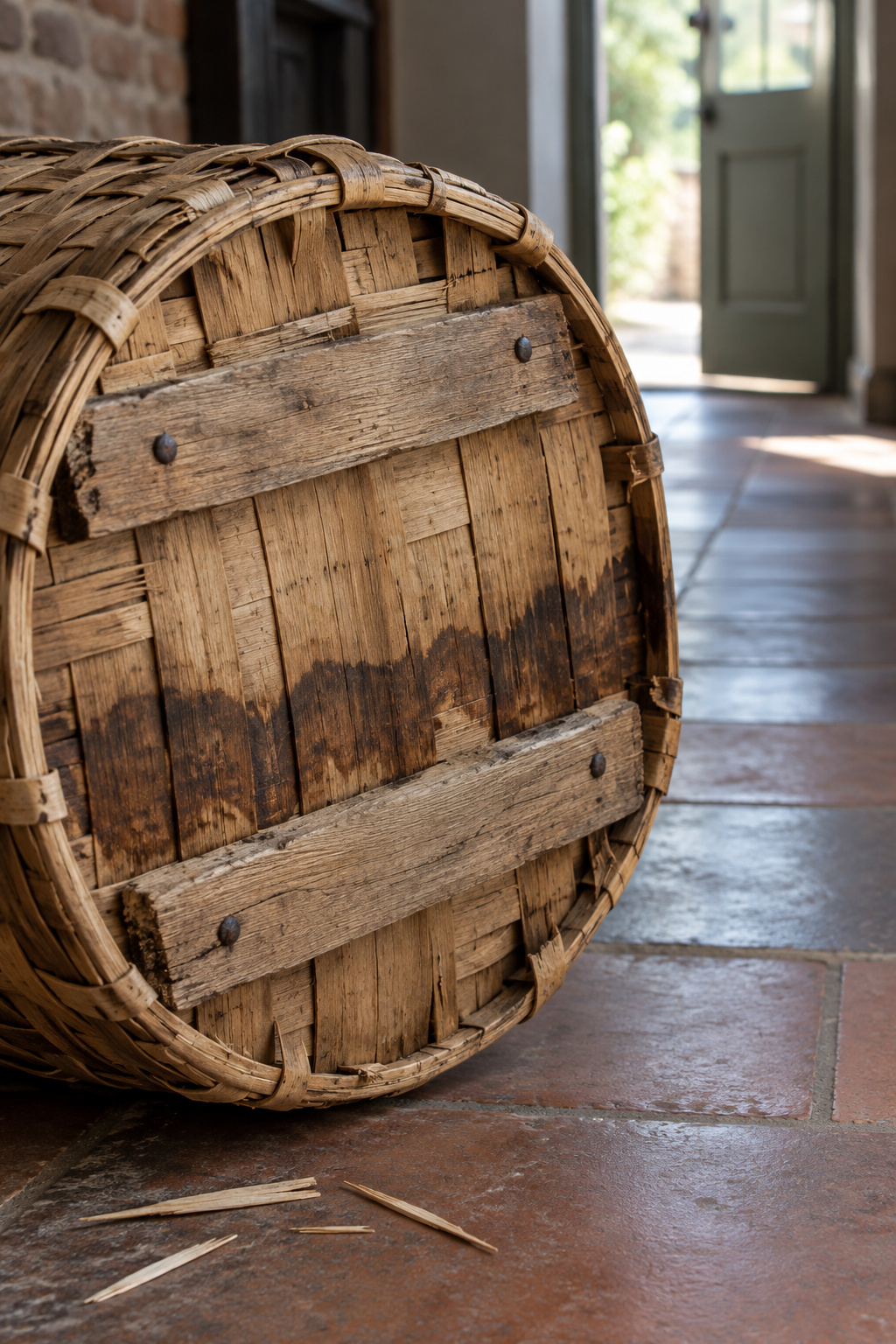
Conservators add a rule worth borrowing in a shop: never lift an old basket by its rim or handles, which may be brittle. Carry it from the base with both hands, then check it in this order.
- Turn it over. Look for cleats or battens fixed across the bottom, or a solid wood base. A Shaker black ash laundry basket has four cleats nailed to its underside; a 1963 museum willow one has two wooden battens fixed with split nails. A base pulling away from the sides is a no.
- Look at where the handles meet the rim. Good handles pass through the rim and are fixed there: notched and lashed, like the Shaker basket’s double-grip ear handles, or stapled, like the bent ash handles held with iron staples on an auctioned splint basket. A handle that only sits on the weave puts the whole load on two small points.
- Check the rim lashing. A double lash crossed in X stitches locks rim and handles together. A loose or broken lash is where the next failure starts.
- Press each handle gently while your other hand supports the base. Any give at the fixing, and the basket goes back on the table.
I like objects whose working parts are all in view, the way a plain filter cone is. A basket is one of them, if you turn it over.
A basket that passes all four does the carrying: from the machine to an old wash tub as a soaking station, and back again with the rinsed load.
Willow, Splint, Wire, Rattan: Which Old Basket Does Which Job
Nobody has loaded willow, splint and wire baskets with wet washing side by side and recorded which held. So the verdicts below are mine, drawn from how each one is built and from what damp does to plant fiber.
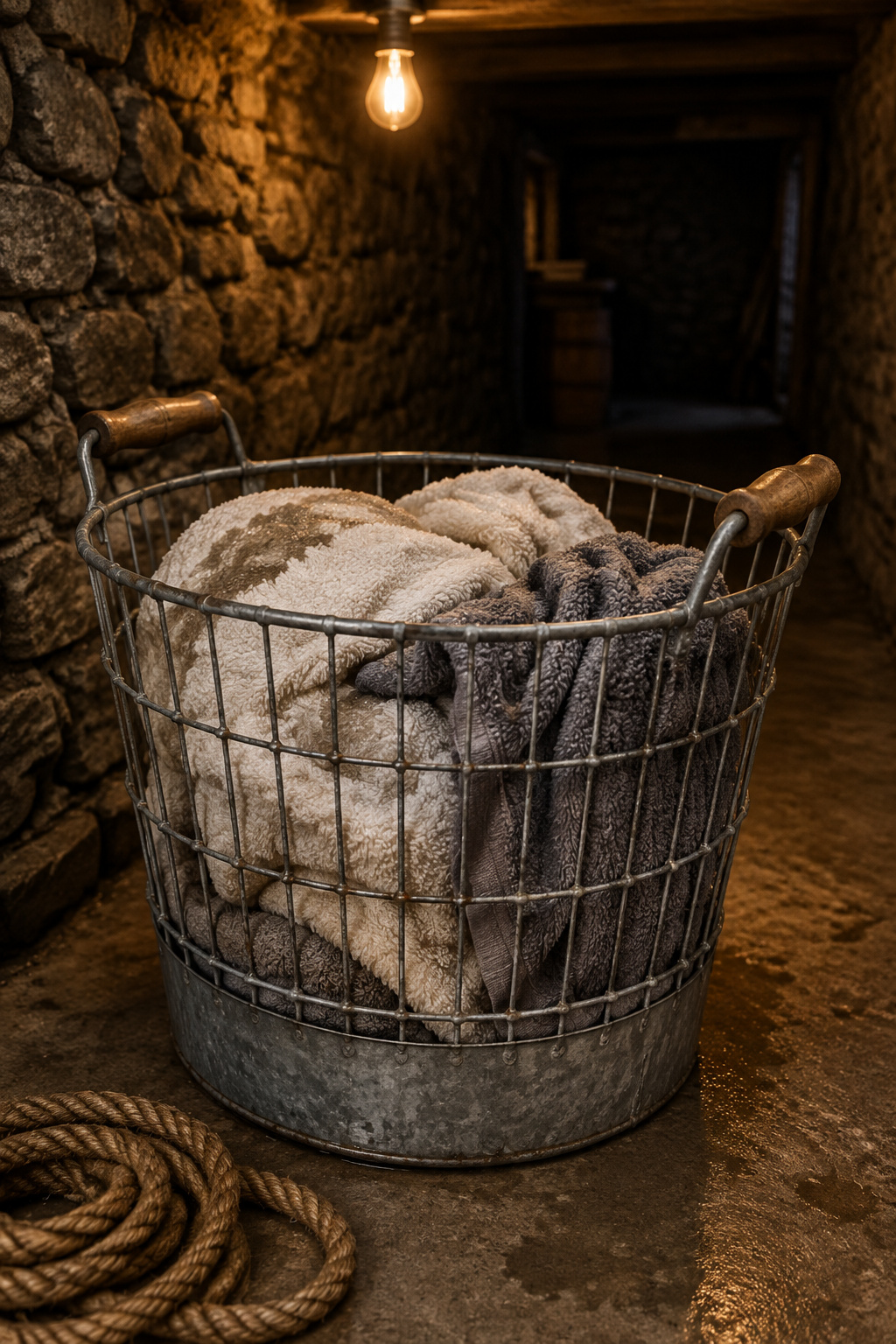
Damp matters as much as weight: above 65% relative humidity, mold can grow on basketry, and below 40% plant fiber turns brittle. Steady steam in a laundry loosens a natural weave and, in time, brings mold.
| Material | Carrying a wet load | Dry linen | Living in a damp room |
|---|---|---|---|
| Splint with a cleated base | Yes, if the handles pass the rim test | Yes | No; carry, then let it dry elsewhere |
| Willow with battens | Yes, for an ordinary load | Yes | No; the tight weave holds damp |
| Wire | Yes, if the frame is sound | Yes, with a lining | Yes; open wire dries fast |
| Rattan | No; thin cane is weaving, not structure | Yes | No |
If I could keep only one, it would be the splint basket with cleats under it. It carries, and between loads it waits somewhere dry. If your machines live in a damp basement and the basket has to live there too, buy wire. Open wire has no weave to hold water. Trapped moisture can leave a white powdery stain on the zinc, and in its light form that stain is cosmetic.
Keep the Pretty Ones for Dry Linen, and the Basket at the Bottom of the Chute
After one move, I realized I would miss only about a third of what we owned. Since then I have kept a short list, taped inside a cupboard door, of everything in the house I would buy again. My wife calls it my monk phase. One laundry basket belongs on a list like that: the one that carries. A basket that only looks good on a shelf would not make it.
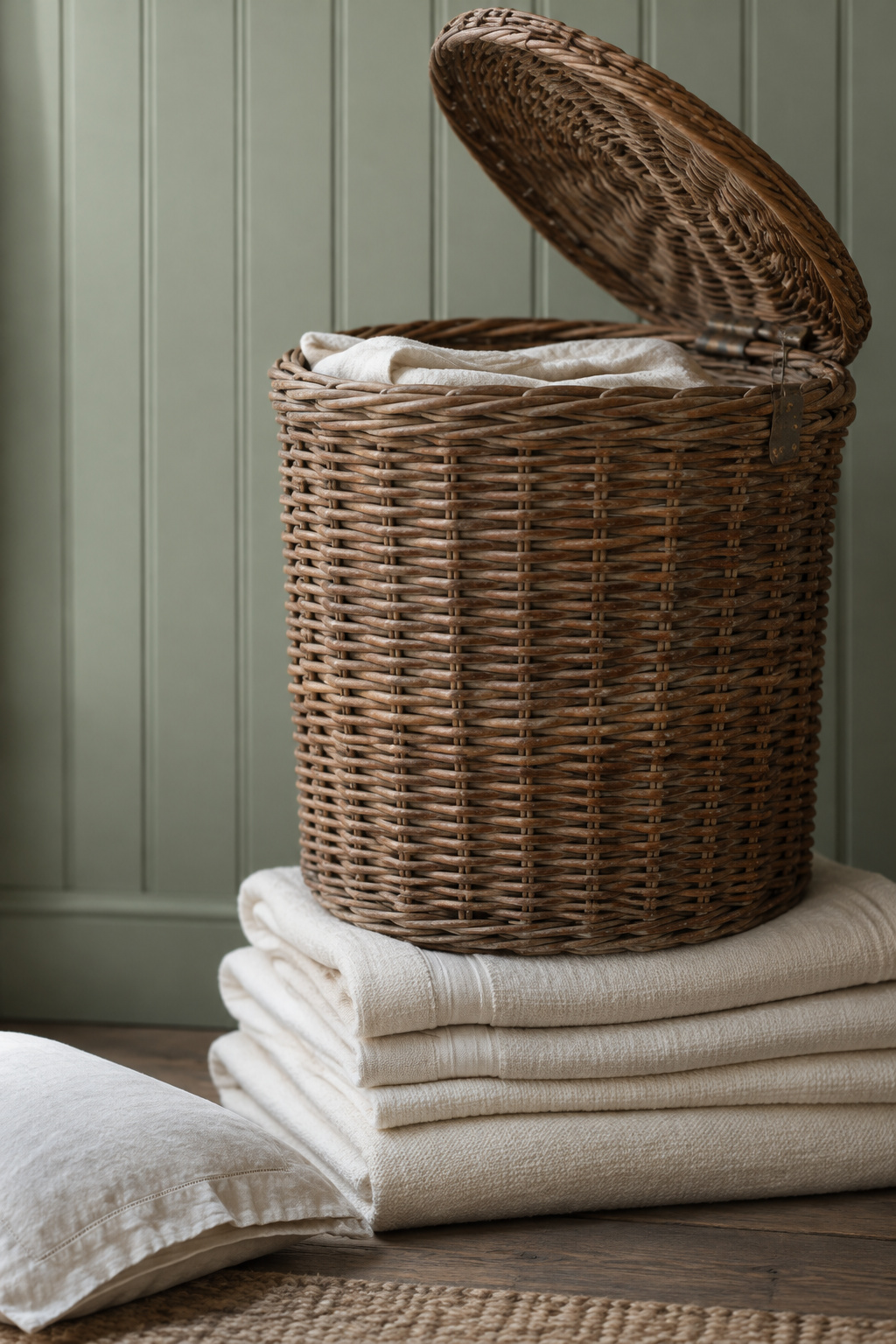
The pretty ones don’t go; they get a smaller job. I would rather own one good wool blanket than six decorative cushions, and baskets work the same way: one that carries, perhaps one more that holds linen. A lidded wicker hamper is a sound place for folded towels and sheets. Its base only has to hold dry cloth, and the weave lets air move around what is inside.
A sound but plain basket also has an honest job as a basket at the bottom of the chute, catching dry laundry where it lands. Baskets as shelf styling are another subject, covered in our farmhouse laundry decor guide.
Getting Mildew Out of an Old Basket Without Ruining It
A basket put away damp in a closed cupboard comes out spotted, and the two common ways of cleaning it disagree. Conservators say never immerse basketry in water, and keep bleach and most household cleaners off it. Sellers of working willow baskets allow a brief soak in warm water and a 1:1 mix of mild bleach and water for mold.
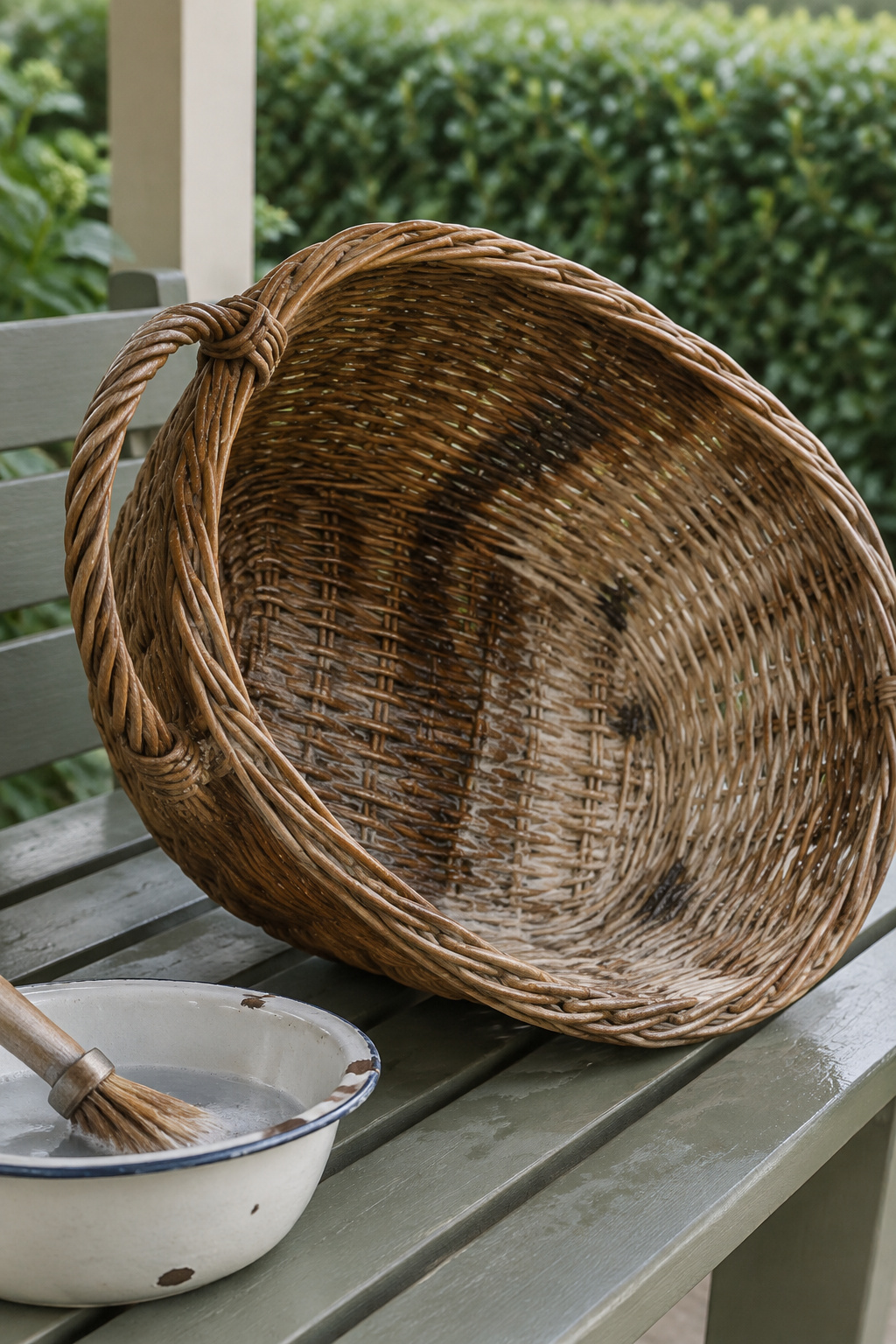
Take the conservator’s route. Soaking swells the fibers unevenly and can loosen the weave and the rim, the very parts that carry the load.
- Let it dry first. Mold that is damp and smears when brushed is still active. Once dry, it brushes off.
- Brush it outdoors, in a sheltered spot out of direct sun, so the spores stay outside. A vacuum with a HEPA filter picks up what the brush loosens.
- Test a barely damp swab somewhere hidden, then wipe the basket damp, never wet, and never let water pool in the weave.
- Dry it slowly on a stiff board in moving air, out of the sun, with any fan pointed away from it. Pad out a dented side with crumpled tissue while it dries.
Mold is never fully removed, only kept from growing. The basket goes back into a room below 65% humidity, and never into a cupboard while it is still damp.
Buy One Basket That Works, Then Stop
Enough is a good word. One basket carries the wash, so buy that one well. A spun load weighs 11 to 19 lb, and an old basket gives way at its handles, its rim or its base, so those three get your hands before the weave gets your eye. Trust a sold price over an asking price, and a basket in your hands over a listing title.
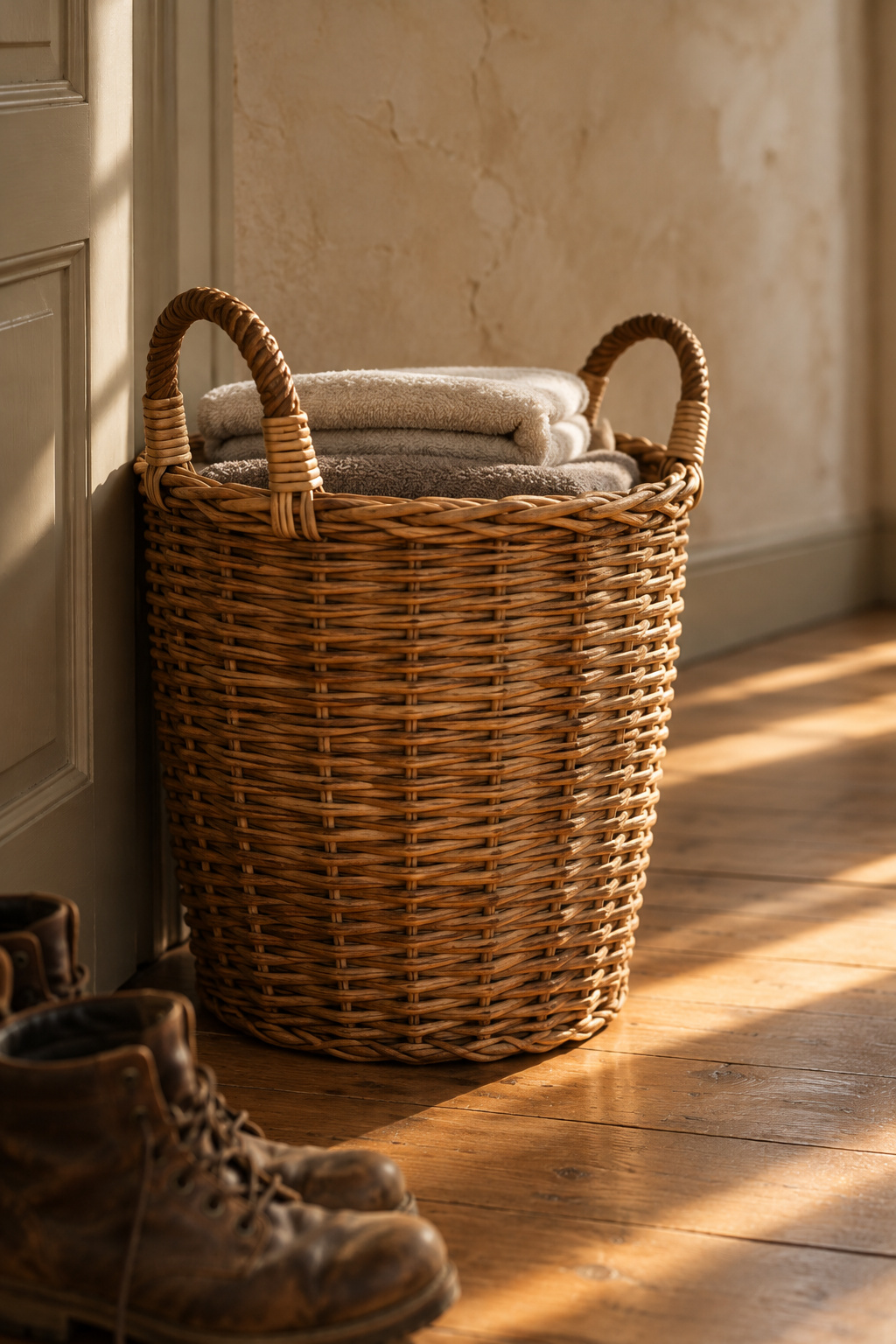
Don’t buy a basket for the shelf photograph and then ask it to carry a wet load, and never store a natural-fiber basket wet or soak one to clean it. Give the pretty ones dry linen and leave it there.
The trip ends where the basket sets its load down. The tub at the other end has its own checks, seams first and bleach kept out, and those belong with the tub.
FAQ
What is the difference between a laundry basket and a laundry hamper?
In everyday use, very little. A general reference treats them as the same thing, a container for clean or dirty clothes, usually made so air can move through it. Dealers tend to call the large lidded wicker form a hamper and the open, handled one a basket. A lid keeps dust off dry linen but slows drying in a damp room.
Are old wicker laundry baskets on wheels worth buying?
Only if the base and handles pass the same checks as any other basket. Wheels roll well on a flat floor, but a full basket still has to be lifted up steps. Prices vary widely: an English willow basket on cast-iron wheels was listed at $695, while a wheeled collapsible wire one sold for $30 at a 2015 auction.
How do you line a vintage wicker basket so it doesn’t snag clothes?
Use a lift-out fabric bag sized to the basket. An unlined woven basket catches threads, while a lining protects clothes and bedding, and a removable one makes the basket easier to empty and wash. IKEA’s willow laundry basket comes with a liner you can machine wash at 40 °C. If yours has an old lining, clean and dry it separately first.