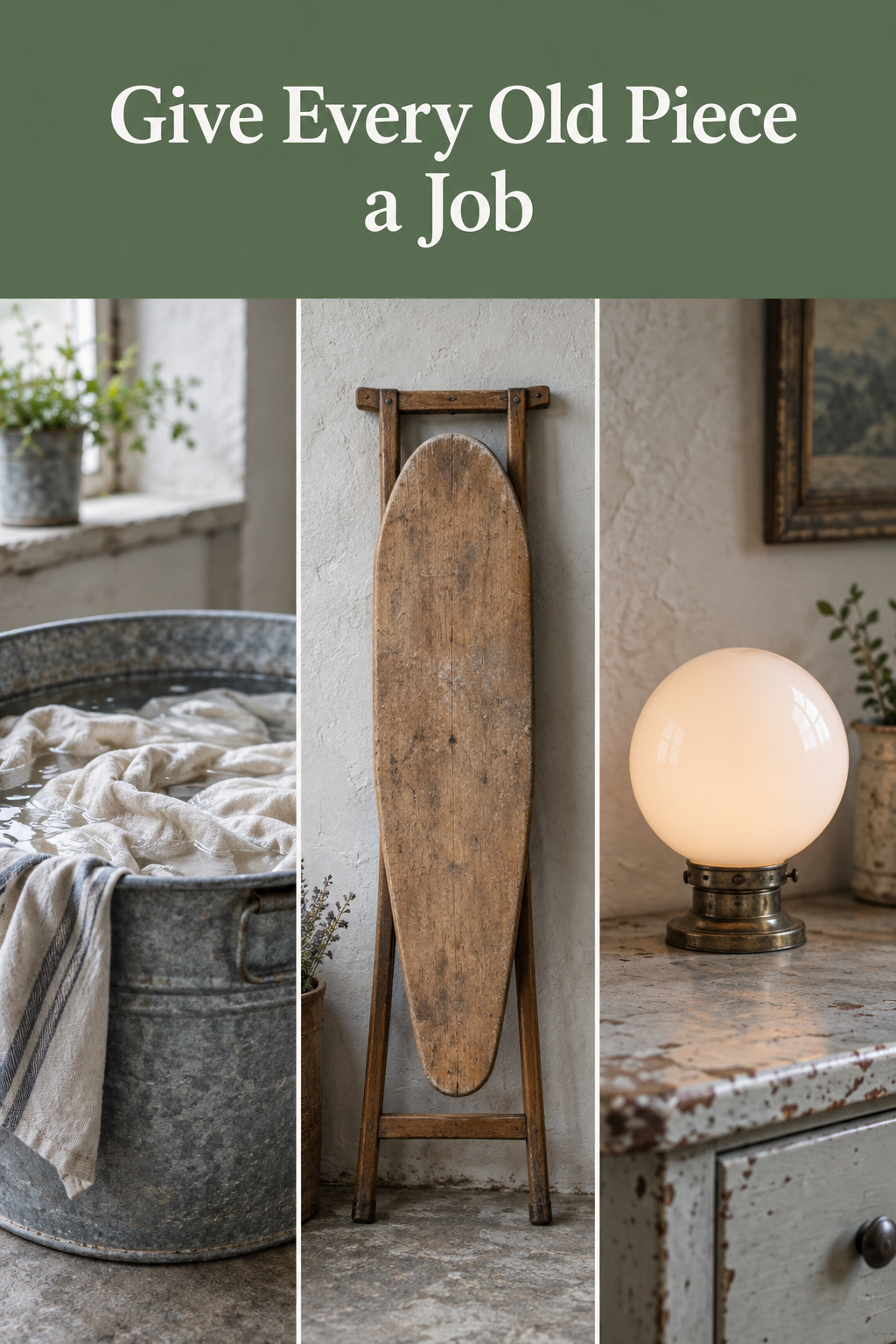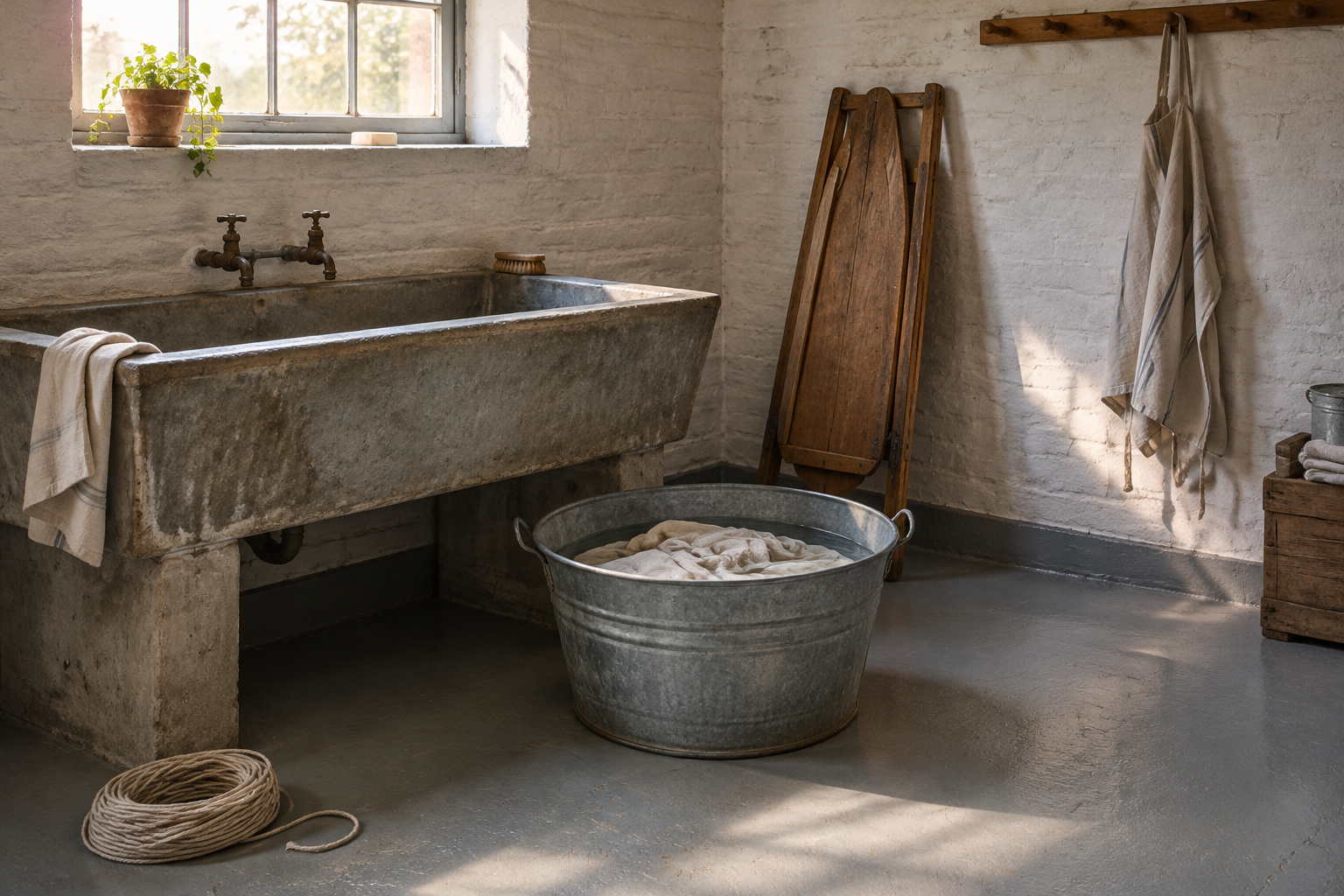

A vintage laundry room is a working room, and every old thing in it should once have done the wash or should hold something for it now. That is the test I bring to vintage laundry room decor, and it rules out a surprising share of what gets sold under the name.
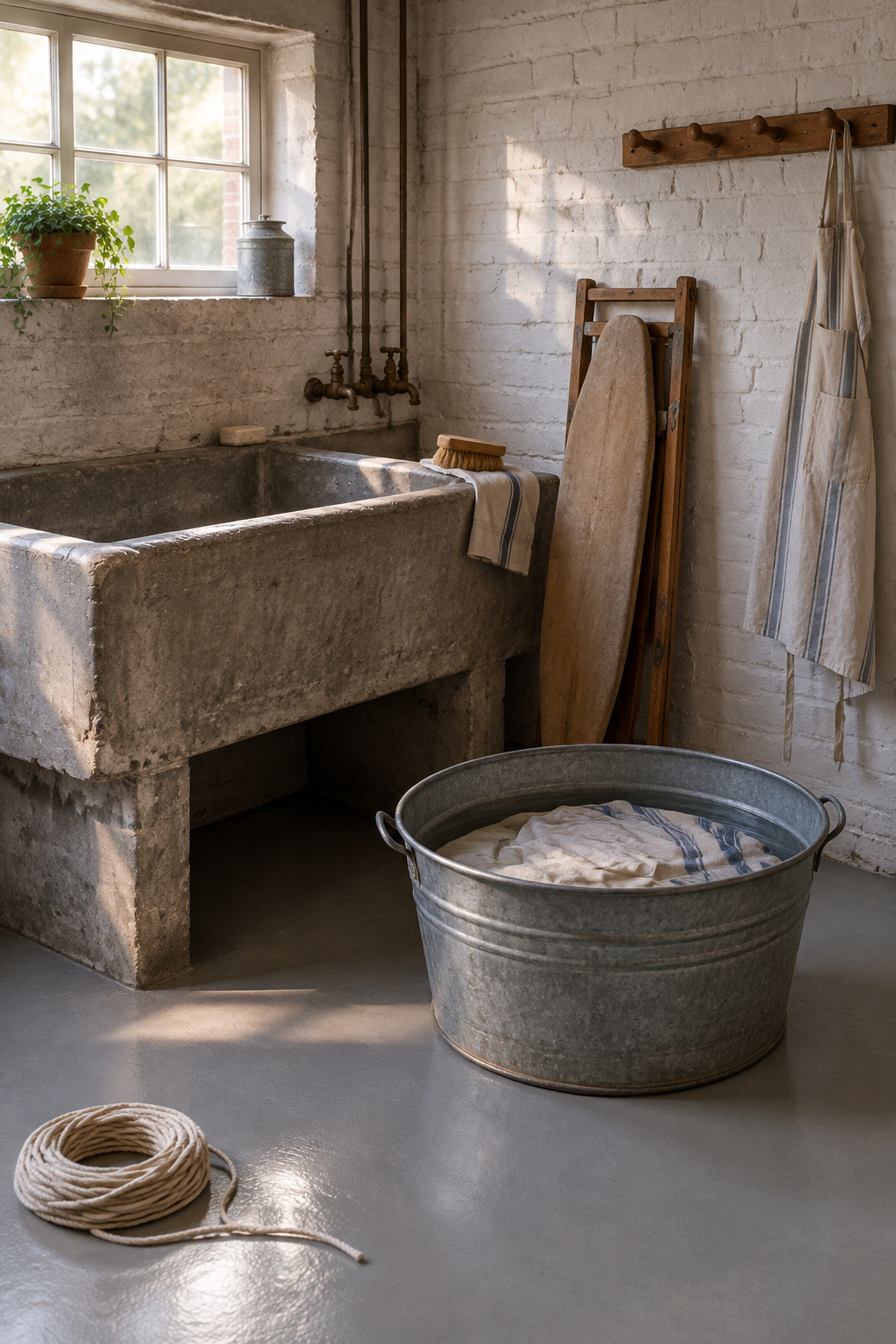
The usual corner fails it. A reproduction laundromat sign, a row of glass jars, a new crate sanded at the corners to look old, and a washboard on a single nail doing nothing at all. Meanwhile the house may be holding better material behind small doors: a hinged hatch at the top of the stairs, a long narrow cabinet in the back hall with an ironing board folded up inside it. Nobody has opened either in years.
Here is the corner I would build instead. A double galvanized tub on its stand beside the machines, tea towels soaking in one side and the next load sorted into the other. A washboard on the wall with a few notes tucked into its frame. One splint basket strong enough to carry a wet load across the room. An old oak dresser with towels in its drawers, and a rewired glass shade lit over its top. Every piece has a job on wash day, and the washer and dryer are new and look it.
What stands in the way is habit more than money. Props are easy to buy, and real old pieces raise awkward questions: is this original, is it safe, will it survive the damp? Each of those has an answer, and the answers start with the house you already live in.
Wash Day Before the Laundry Room: The Basement, the Kitchen and the Back Porch
For most of American history, wash day had no room of its own. It went wherever the water and the heat were. In colonial houses that meant the kitchen, where people also cooked and lived. Wealthy households moved the wash into a separate building, and Willie Graham, an architectural historian at Colonial Williamsburg, reads those separate laundries as “a way of showing money,” because they meant a great deal of linen.
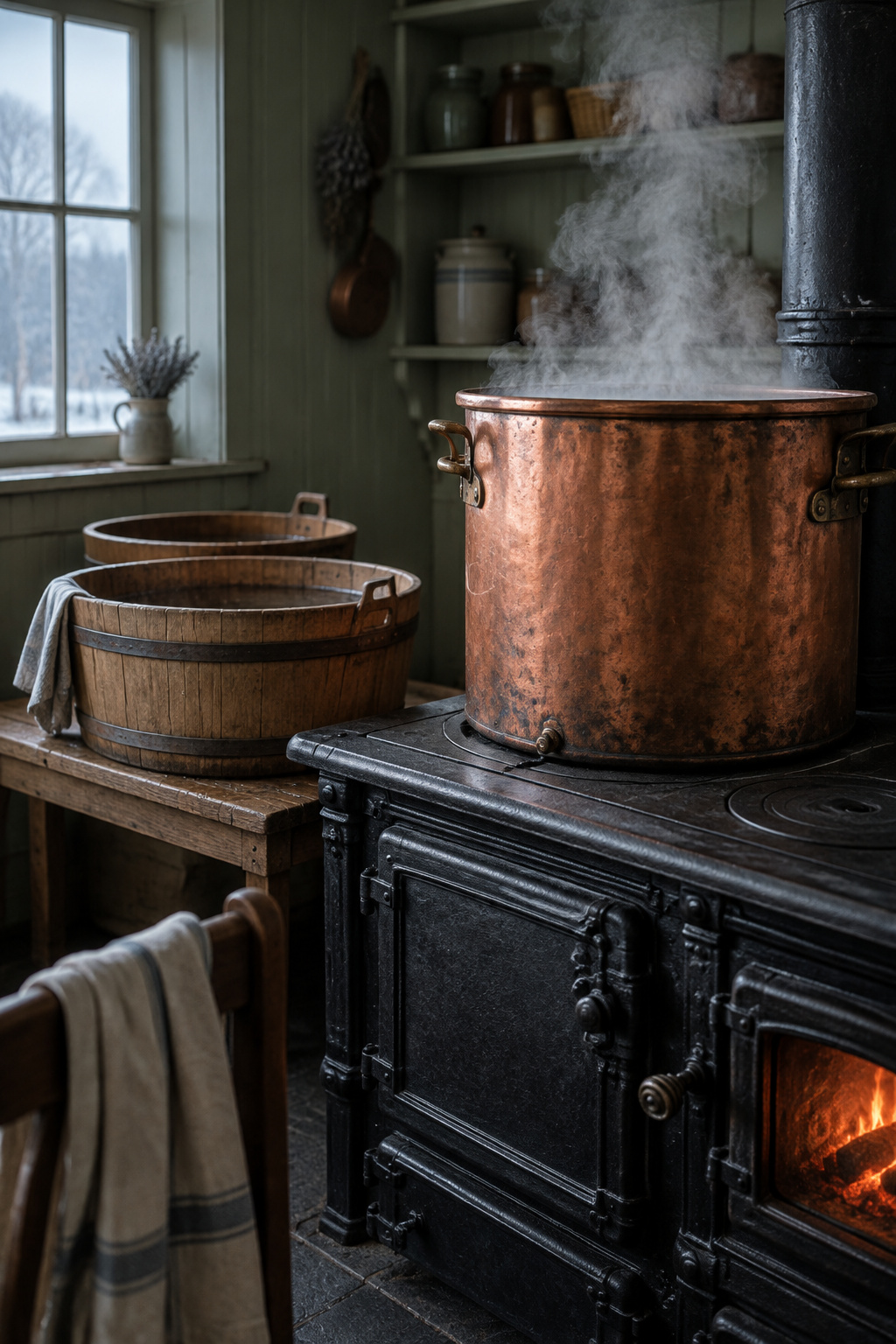
The pattern lasted well into the twentieth century. Upper- and middle-class houses usually did their washing in the basement, and working-class houses without one did it in the kitchen. A 1920s memoir from a small New York village describes the copper boiler heating overnight on the wood range, a bench with two rinse tubs, and an electric washer dragged in from the back porch for winter. On some farms the work went out to a wash house, a small outbuilding with a heavy set-kettle for heating water.
So ordinary houses had a laundry area, not a laundry room. The room came after the war with the automatic washer, and it came slowly. No year marks the change: as late as the 1960s, a housing study still found the kitchen and the open basement were where most families washed. The machines spread at their own pace too. One economic estimate puts power-driven washers in 40 to 50 percent of American households in 1940, and by 1960 the figure was 78.3 percent of housing units.
That history is useful because it tells you which objects belong in the room.
| Where the wash was done | What did the work | What survives as decor now |
|---|---|---|
| Kitchen | Copper boiler on the range, rinse bench and tubs, washboard | Washboard, tub, basket |
| Basement | Fixed concrete or soapstone tubs, wringer washer, galvanized rinse tubs, clothesline | Galvanized tub, basket, the chute door upstairs |
| Back porch | The washer in summer, tubs | Tub, basket |
| Wash house | Set-kettle, tubs, boards | Tub, washboard |
The laundromat is a later arrival than its signs suggest. My partner teaches high-school history and argues dates with me, and this one stands: the first self-service laundry opened in Fort Worth, Texas, on 18 April 1934, with four electric washers rented by the hour, and “Laundromat” was a Westinghouse trademark from 1940. In a house built before either date, a laundromat sign copies something the house never knew.
The corner I would build sits in the basement, where most of these houses did their washing anyway. If your machines live in a hallway cupboard instead, fitting them into an older house is covered in our stackable washer dryer guide.
Vintage Laundry Room Decor Starts With the Period Features Your House Already Has
What did the builder already give you? Between the 1910s and the 1930s, cottages and bungalows, not only large houses, were fitted with built-in conveniences, and laundry got its share. A chute spared the family from hauling dirty linen down to the basement. A fold-down ironing board went into a shallow cabinet in the wall. Fixed tubs went into the basement. Plenty of these survive behind doors that have been painted shut for decades.
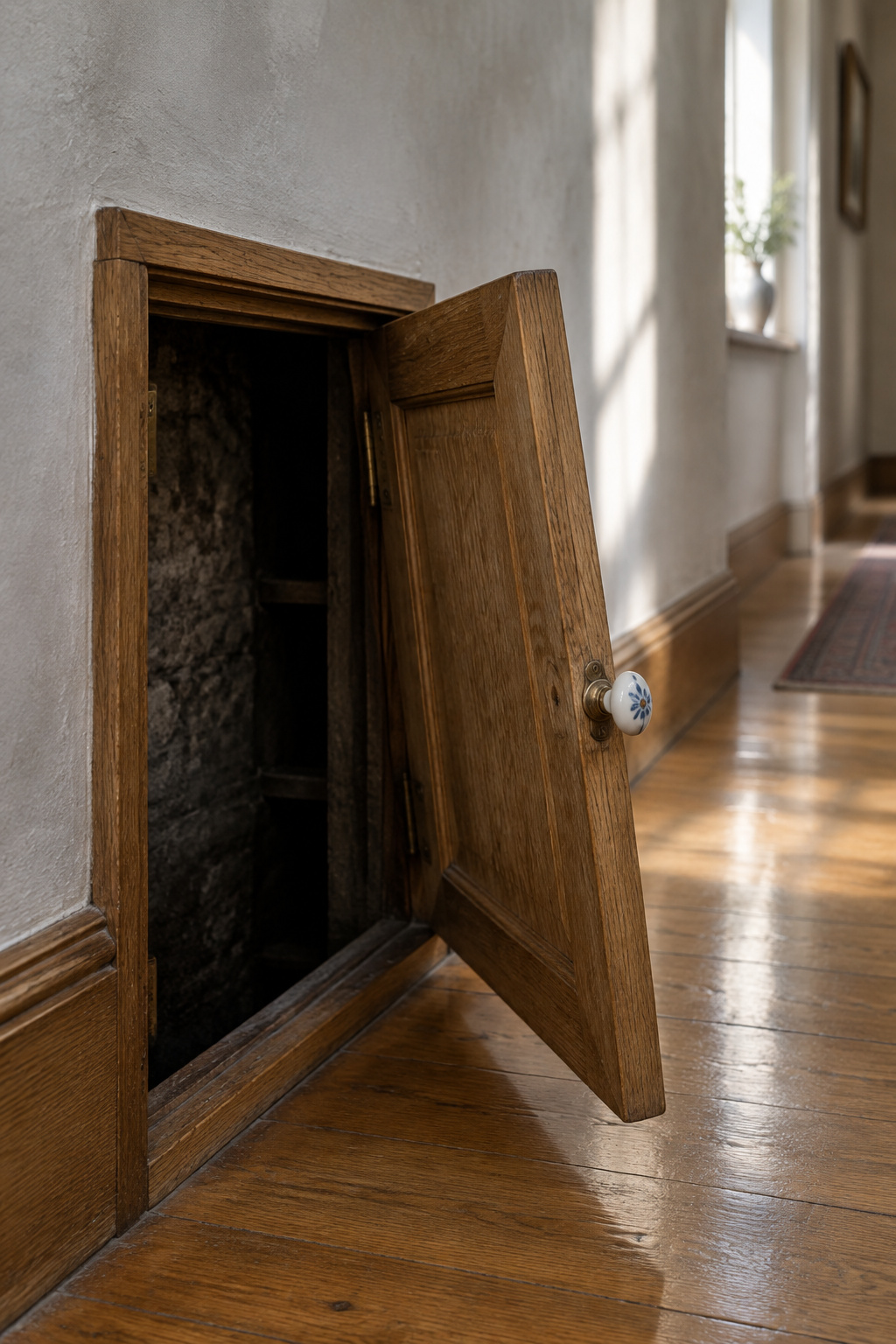
Before buying a single thing, walk the house and look for them:
- a small hinged door in an upstairs hall, bathroom or closet wall
- a long, narrow door with a shallow cabinet behind it
- fixed tubs in the basement, an original plank shelf, a floor nobody has covered
Open what you find before you decide anything about it. Covering a feature, or tearing it out, before you have looked inside is the one mistake in this room that the next owner of the house cannot undo.
In the corner I would build, the chute is the find that sets the plan. Its door upstairs gets freed, cleaned and fitted with a latch, and its outlet in the basement ceiling decides where the corner goes, because laundry should land where it gets washed. The door is also where the safety lives. With small children in the house, no opening is small enough to trust, so the door has to be the one they cannot open: latched above their reach and closing on its own. The case for keeping, restoring or adding a laundry chute rests on the trips it saves, and the latch is what lets you keep those trips.
The fixed tubs stay as they are. They are the oldest working thing in the room and the reason the corner was a laundry in the first place.
Scrubbing and Soaking: The Tools That Did the Hardest Work
Staff running a wash-day program at the Smithsonian’s American History Museum found that visitors recognize a washboard first as a musical instrument and only second as a laundry tool. That explains why one hung on a nail looks like nothing: out of its working life, a washboard is a curiosity. Given a job again, it makes sense on the wall.
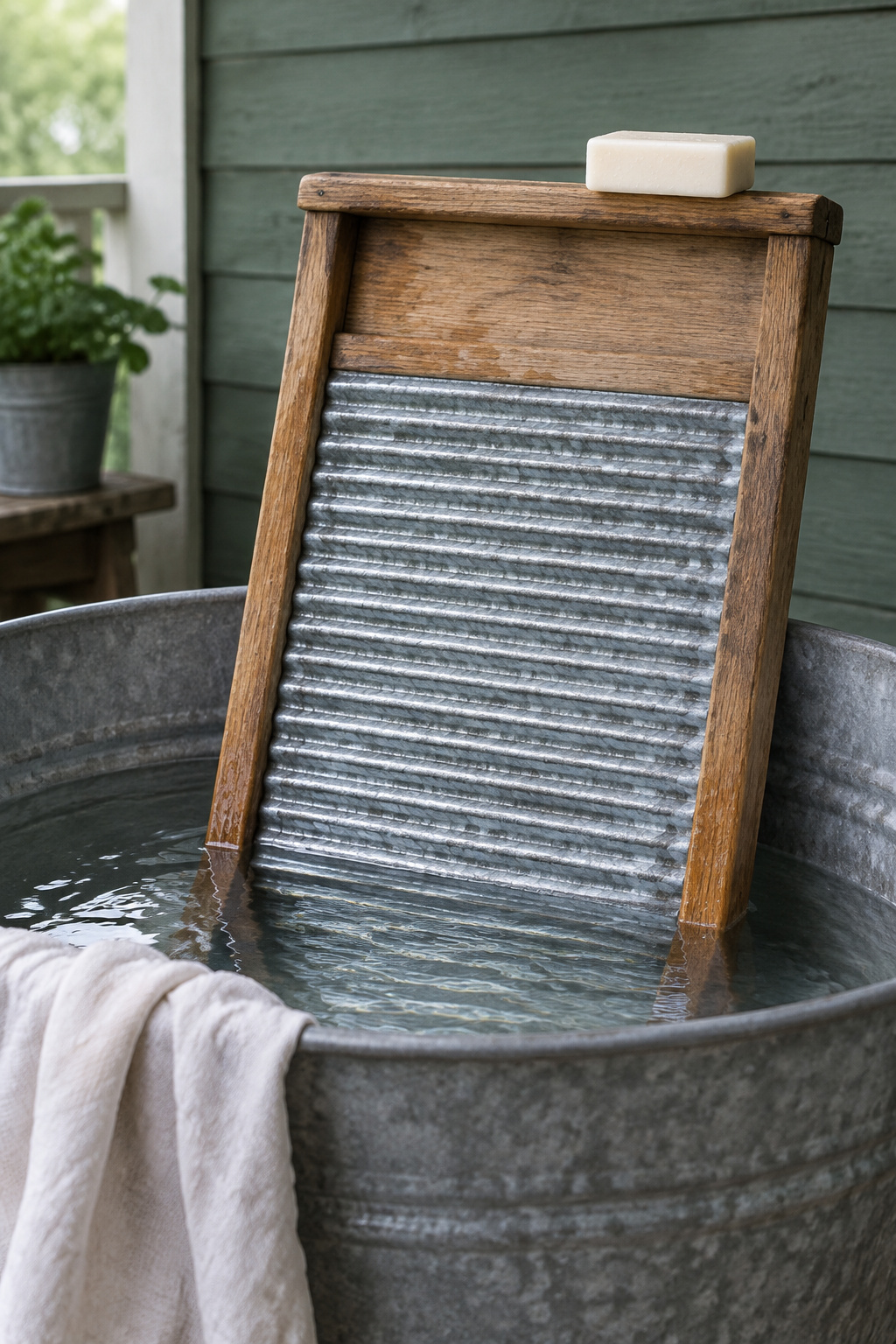
The Washboard
A board can still do real work: hold notes and lists, show off a ridged surface where light rakes across it, or scrub socks beside a tub. Choose the job and the rest follows: the surface to buy, how much damage you can live with, and how it hangs. Only a glass board is heavy enough to need serious hardware. Dating a board and fixing it safely are in our guide to reading and hanging an antique washboard. New boards are still made in Ohio, so an old one never has to be the only option.
In my corner the board holds notes, a job that forgives faded ink and a worn frame. It hangs next to the tub, because the two always worked as a pair.
The Wash Tub
In a 1940s wringer-washer setup, the wash water was pumped out of the machine into a large square galvanized tub and saved for the next load, and the rinse water went into a second tub. The tub was equipment that sat next to the machine and worked every week.
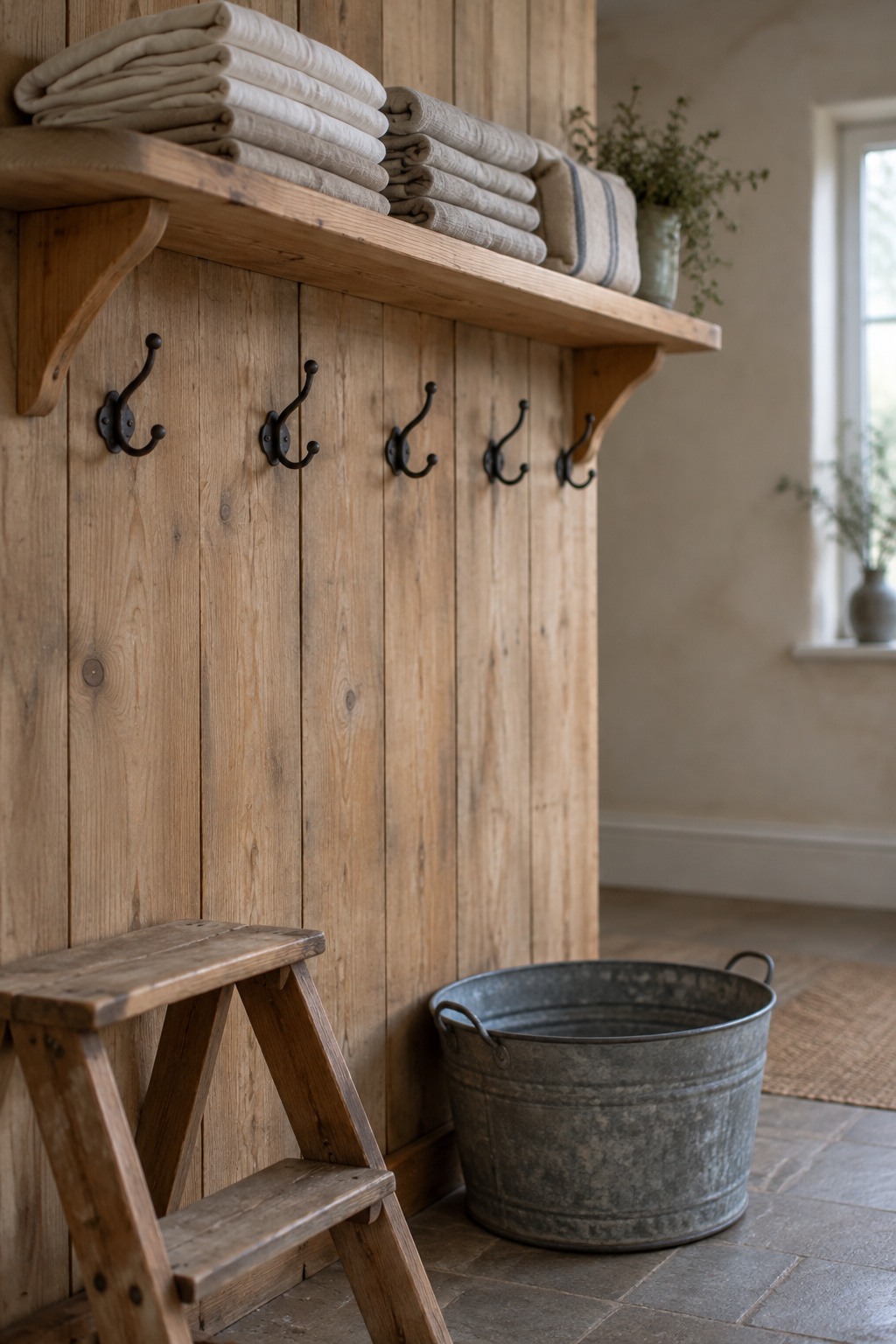
It can do that again, as a soaking tub, a sorting station or dry storage for linens. A tub earns its floor space with one of those jobs, after its seams have been checked. Sound zinc has no quarrel with water or laundry soap. What hurts it is bleach and damp left standing, so wipe the tub dry between soaks and put sealant only on worn or patched zinc. How to test an old tub before you pay, and read the white powder on it, is in our guide to using an old galvanized wash tub. Turning a tub into a plumbed sink is a different project, under laundry room sink ideas.
Carrying and Sorting: Baskets That Still Take a Wet Load
“Then the basketful of clean laundry was taken to the line and hung up, summer or winter.” That line from the 1920s memoir is the basket’s whole job description. In a 1940s house, damp clothes were caught in a clothes basket as they came through the wringer and set aside to be rinsed. The basket was the link between machine, tub and line, and it carried before it ever decorated anything.
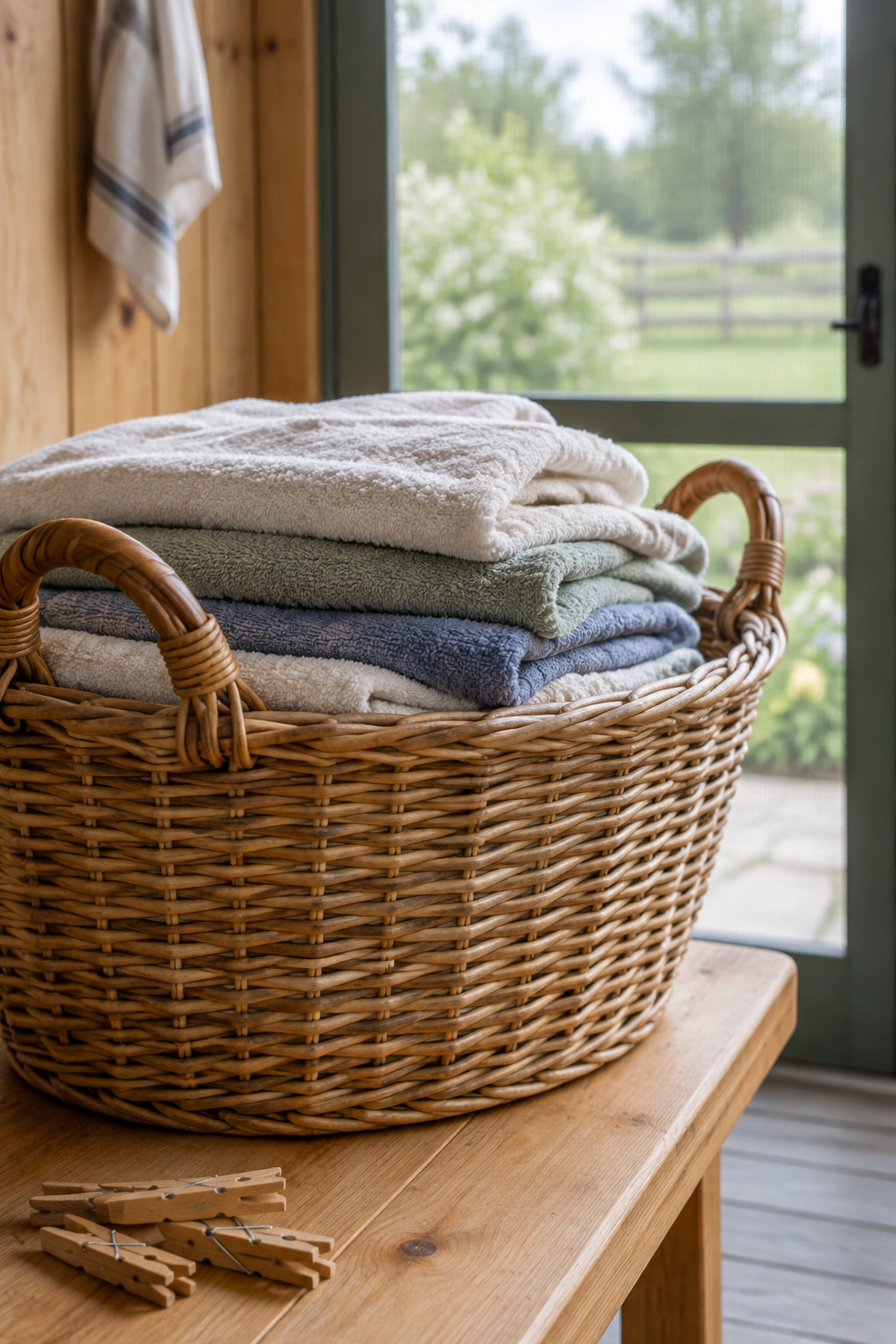
That is the test for an old one now. A basket belongs in a working laundry if it can carry a wet load, and the places where old baskets give way under that load are the base, the rim and the handles. Turn it over before you buy it, and look for handles that go through the rim and are fastened to it. Our guide to vintage laundry baskets that carry a wet load walks through those checks, and how to get mildew out of one without soaking it.
In my corner, one splint basket with cleats under its base does the carrying and rests on a dry shelf between loads. If you fall for a prettier one, give it dry linen to hold and keep it out of the steam. Baskets chosen for how they look on a shelf are a styling question, and our farmhouse laundry decor guide covers them.
Pressing: The Ironing Board Built Into the Wall
If your house has a fold-down ironing board, it is probably the best piece of laundry history you own, and it came free with the walls. These cabinets went into houses early last century. The tell is a long, narrow door with a shallow cabinet behind it, usually painted shut.
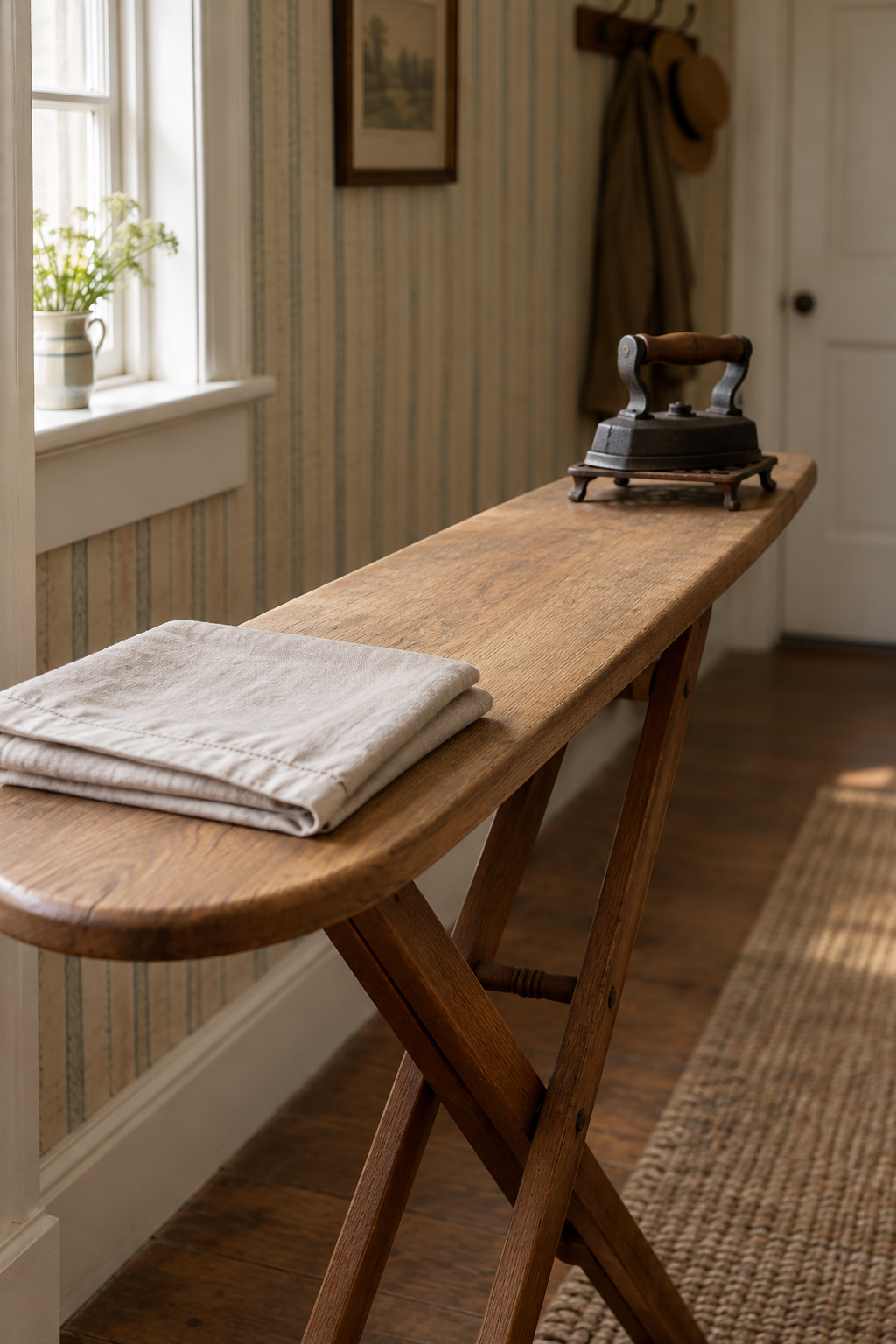
Restore it rather than cover it. Before the door is painted over for good or the cabinet is torn out, lower the board and test its brace, its surface and the wall behind it. If they hold, leave the whole thing working where it hangs. One caution: an old pad or cover is suspect, so leave it whole. The checks and the repair, part by part, are in our guide to restoring a built-in ironing board cabinet.
In the house that corner belongs to, the board lives in the back hall upstairs and comes down on ironing day. If the house has no built-in, a freestanding wooden board does the same job, though it needs somewhere to fold away.
Furniture That Holds the Work: Old Pieces Sized to the Gap Beside the Machines
Measure before you shop. The mid-century utility-room planners worked that way, laying out the sorting counter, tubs and storage together and leaving room to walk between the large pieces. The rule holds for a dresser bought secondhand: the gap decides the piece, not the listing. A beautiful dresser that blocks the washer door is the wrong dresser.
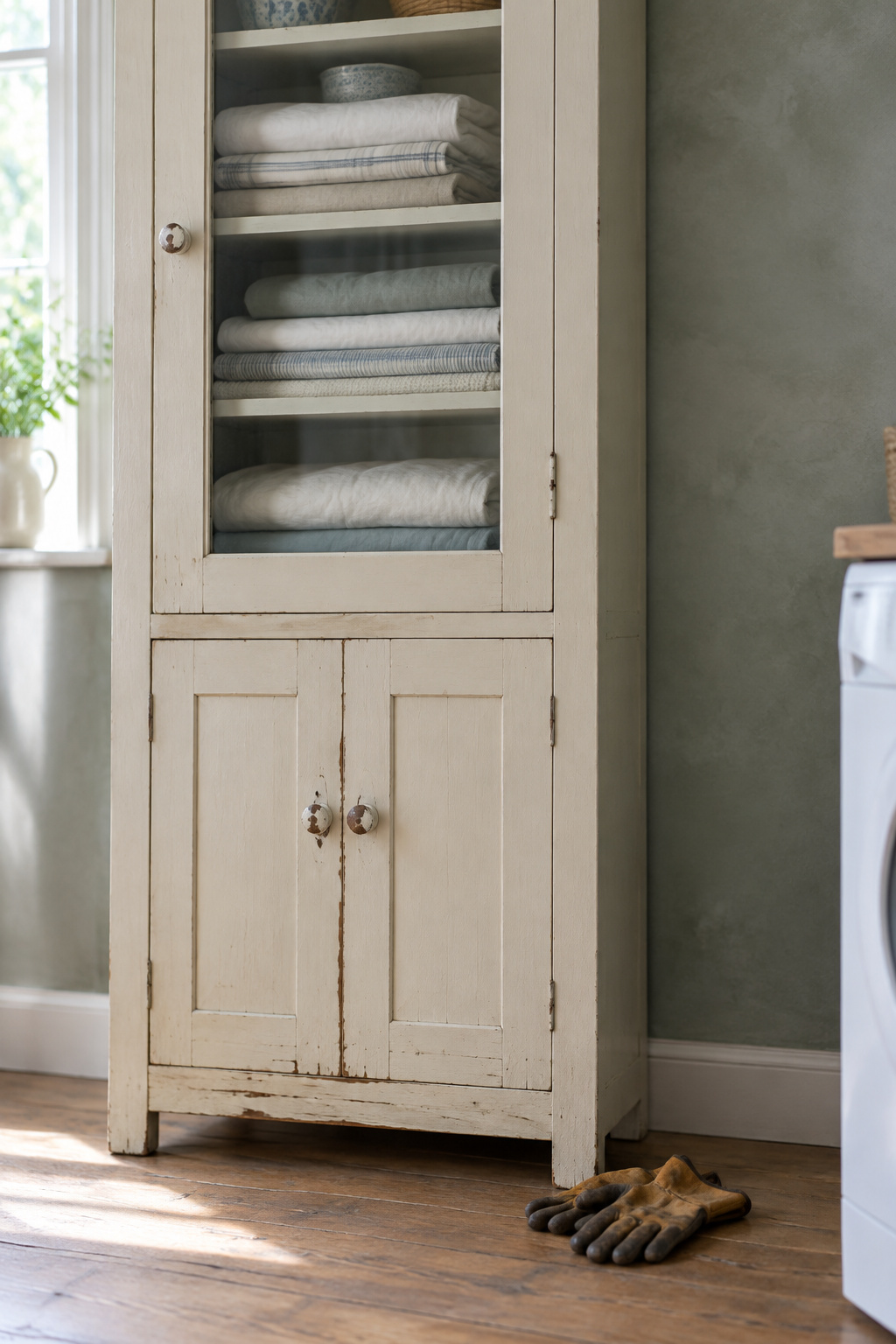
Old furniture earns its place here by holding something for the wash: towels, rags, spare sheets, the iron and its cloth. The thing that ruins it is water at the floor rather than steam in the air, from a leak, a mopped floor or an overflow. So the build gets checked against that, and the piece stands on glides so air can get under it. Painted pieces carry a second check. Assume old paint has lead and test before you sand. Both checks, and the measuring, are in our guide to old furniture sized to the gap beside the machines. How to paint or upcycle a vintage piece belongs with the vintage bedroom decor guide.
In my corner, an oak dresser stands against the wall opposite the machines, on glides, with towels in the top drawer and rags in the bottom one. Its top is the folding surface. Nobody would mistake it for new.
Old Light, Made Safe: Fixtures for a Room That Gets Damp
Over the dresser in my corner hangs an opal glass shade, lit above the folding. Of everything old in the room, it is the piece most likely to look perfect and be unsafe, because a fixture’s age is not a safety rating.
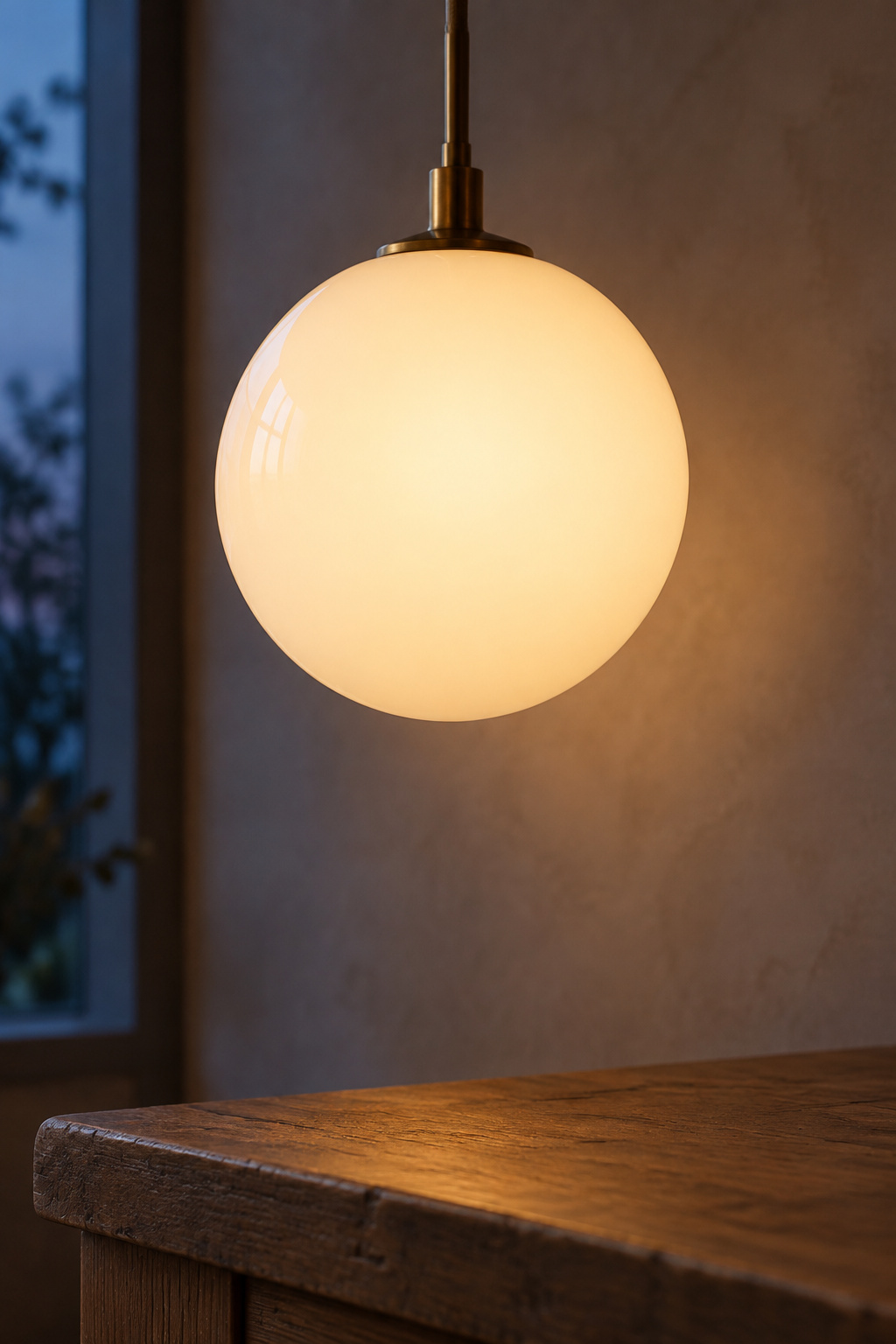
The shade, the canopy and any cage are the parts worth keeping, because glass and metal outlast what runs through them. The socket, the cord and the wire are what get replaced, every time. A laundry room also gets steamy, so the new parts and the fixture should be rated for damp. No code text names a laundry room a damp location, so that call is your inspector’s, and buying damp-rated settles it before anyone has to ask.
Check the listing on any plug-in swag kit before you rely on one to hang an old shade without an electrician: a two-socket kit from a major retailer is listed for dry locations only. The rewire and the hanging of a hardwired fixture are jobs for an electrician or a lamp-repair shop. What to keep, what to replace and what to walk away from is in our guide to old light fixtures made safe for a laundry room.
Real Wear, Reproduction or Honest New: How to Tell Which You Own
Reading Wear and Age
I keep a coffee can of paint chips in my workshop. It started when a client insisted a pink was original and the layers proved it was from the 1950s. Since then I check before I call anything original, and the habit carries straight into the laundry.
Real wear has a logic. Applied distressing is almost always too even, with dents of one size and scratches running one way. In a laundry, these are the tells I look for:
| Piece | Real wear | Applied distressing | Honest new |
|---|---|---|---|
| Washboard | Ridges and frame worn where cloth and soap went; faded ink | Even sanding across the whole face | A new board sold as new |
| Galvanized tub | Riveted seams, a dull and uneven finish | Bright, even finish over smooth welded seams | A new tub, plainly labeled |
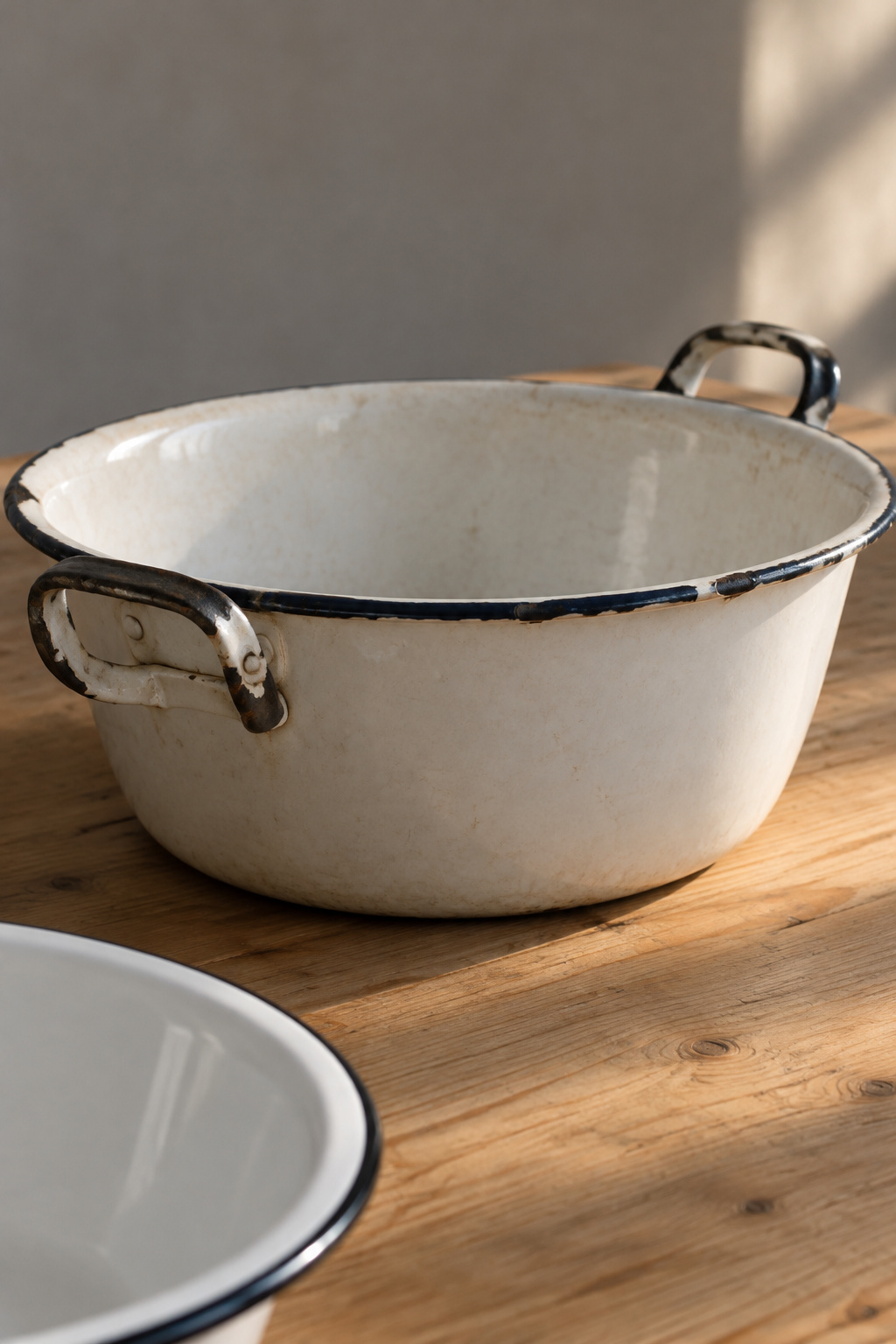
| Enamel basin or bowl | Chips at the rim, riveted handles, a dull sound when tapped | Chips scattered evenly; a tinny ring | A reproduction that says so |
| Painted dresser | Worn at the handles, drawer edges and top | Sand-through on every edge at once | Solid wood with a fresh finish |
Where New-Made Pieces Are Fine
New work should be honest about being new. The washer and dryer in my corner are new and do not pretend otherwise, and nothing about that spoils the room. A reproduction is fine on the same terms, as long as it is sold and shown as a reproduction. Antiques Roadshow appraisers put the rule well: “It’s never okay to conceal a piece’s history, age, or condition.”
I learned the cost of purism on a wall. I once told a client to keep a crumbling plaster wall, then spent three weekends patching it before admitting that new drywall would have been the honest choice. The same goes for a laundry: if the old piece cannot do the job, a plain new one beats a disguised one.
Two neighboring looks have their own guides. Signs and arranging a laundry wall live in the laundry room wall art guide, and the mid-century laundry room is covered in our modern laundry room design guide.
Lead and Damp
Old enamel and glazes can carry lead. Treat any antique, worn or chipped piece, and anything glazed in bright orange, red or yellow, as containing lead unless you know otherwise. Food is where that matters most, and a basin that only holds clothespins or a hand rinse is a far smaller worry. The risk that remains is chips handled by small children, so keep worn pieces out of their reach.
Damp is the other thing every old piece meets in a laundry: wood swells, steel rusts, natural fiber grows mildew. Each guide above deals with its own version of that.
The Finished Corner and the Rules That Decide What Stays
Here is the corner, finished. The chute door upstairs latches, and laundry lands in the basement beside the fixed tubs. The double tub stands on its locked stand with linen soaking in one side. The washboard hangs beside it with notes in the frame. The splint basket sits on a dry shelf by the washer. The oak dresser across the room holds towels and rags, an enamel basin of clothespins sits on its top, and the opal shade above is lit on new wire. Upstairs, the ironing board comes out of the back-hall wall on pressing day.
What got cut: the laundromat sign, the jars, the sanded crate, and the washboard’s single nail. Nothing in that list did any washing, and the room does not miss them. To my eye it looks more convincingly old than the propped-up version did, because every piece in it is there for a reason a visitor can see.
The rules that decide what stays are short:
- Check the house first. What the builder put in outranks anything you could buy.
- Every old piece did the laundry once or holds something for it now.
- Real wear beats applied distressing.
- New is welcome when it looks new.
Your corner will hold different pieces than mine, but it starts the same way: choosing which old thing in your house gets the first job.