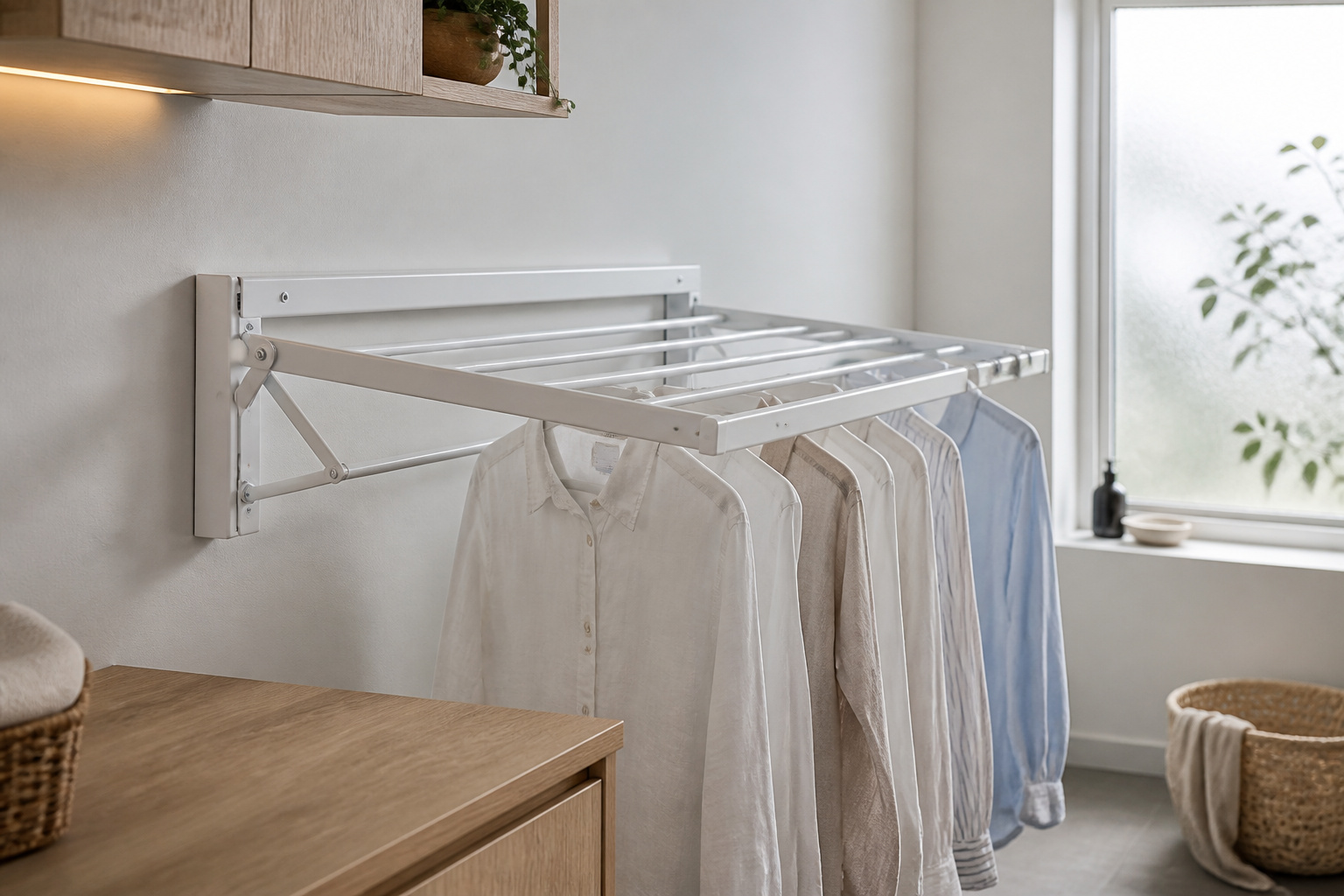

In a Swedish apartment, a tumble dryer is the exception. By 1970, 94% of Swedes in apartment buildings shared a communal laundry room — many with a heated torkrum rather than a machine. The best Scandinavian drying rack ideas come from that habit: the rack is planned into the room, not bought to apologise for the missing dryer.
TL;DR
- The three Nordic systems are the wall fold-down rack (stowing to 5–8 cm), the wall rod (the slimmest), and the ceiling pulley clothes maiden, which dries a full load in 2–4 hours using no electricity.
- Space garments at least 5 cm apart and position the rack near an opening window — overcrowding, not the rack you chose, is what leaves clothes damp at 24 hours.
- For a small room, the ceiling pulley airer wins: it claims zero floor or wall space and can repay its cost in roughly six months of saved electricity.
Why Nordic Homes Air-Dry by Default — Not by Choice
Sweden’s first modern communal laundry room opened in Stockholm in 1925. Annalisa Piccolo of StockholMania Tours calls the tvättstuga an expression of “distinctly Swedish values such as respect, organisation, and care for the common good.” The drying room came built into the building.
The Nordic relationship with air-drying: cultural habit and energy logic
A standard 9 kg vented tumble dryer uses up to 5.34 kWh per cycle; air-drying uses nothing. In a culture shaped by lagom — enough, not excess — running a machine to do what warm air does for free has always looked wasteful.
What a tumble dryer actually does to natural fabrics — and why Scandinavians noticed
Scandinavian clothing leans on wool, linen, and good cotton — the fibres a dryer harms most, shrinking them roughly twice as much as air-drying. Linen is the worst case: heat degrades its cellulose bonds permanently; wool simply felts. For a natural-fibre wardrobe, air-drying is the only safe option.
The three air-drying systems and how to choose between them
Three systems do most of the work; each gets a full section below.
| System | Footprint in use | Footprint stowed | Best room size |
|---|---|---|---|
| Wall fold-down rack | 80–130 cm wide × 45–70 cm deep | Flush, 5–8 cm deep | Clear wall 80 cm+ |
| Wall rod | Rods project 30–45 cm | 3–5 cm projection | Narrow rooms |
| Ceiling pulley airer | Overhead, no floor or wall area | Raised, 22–33 cm ceiling clearance | Ceiling 2.2 m+ |
For most rooms, the fold-down rack row is the answer. The full picture is in the complete Scandinavian laundry room guide.
Wall-Mounted Fold-Down Racks: The Modern Standard
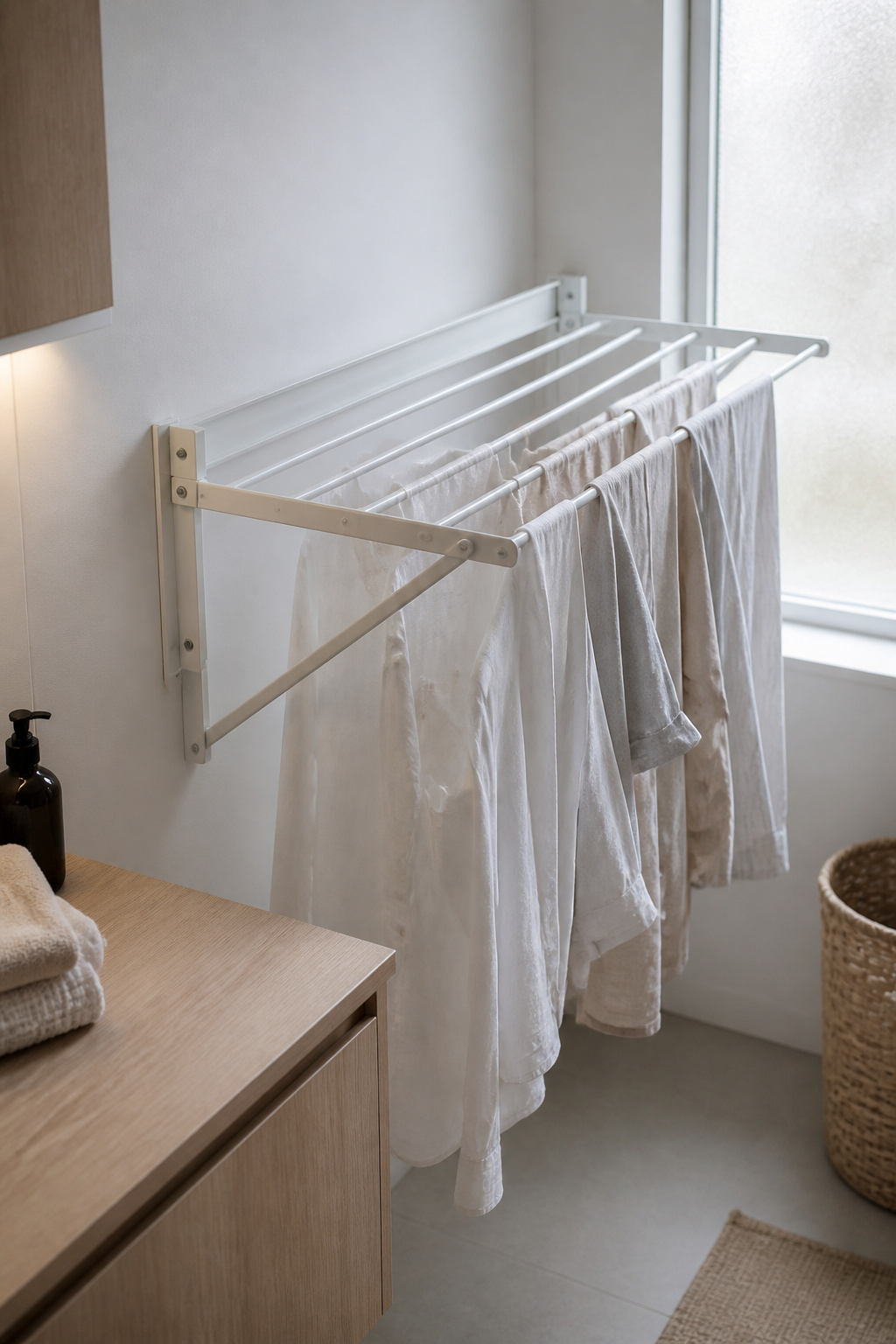
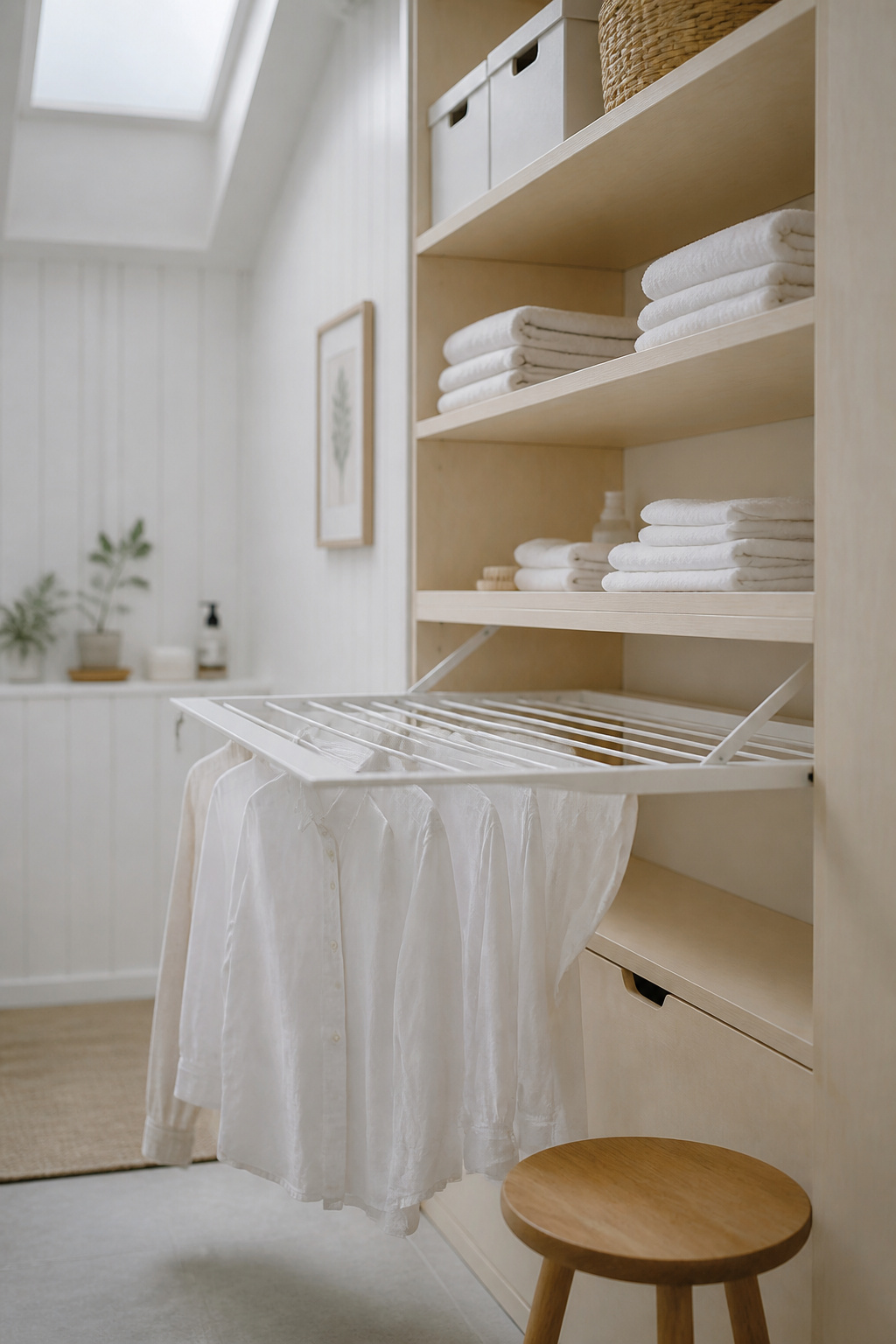
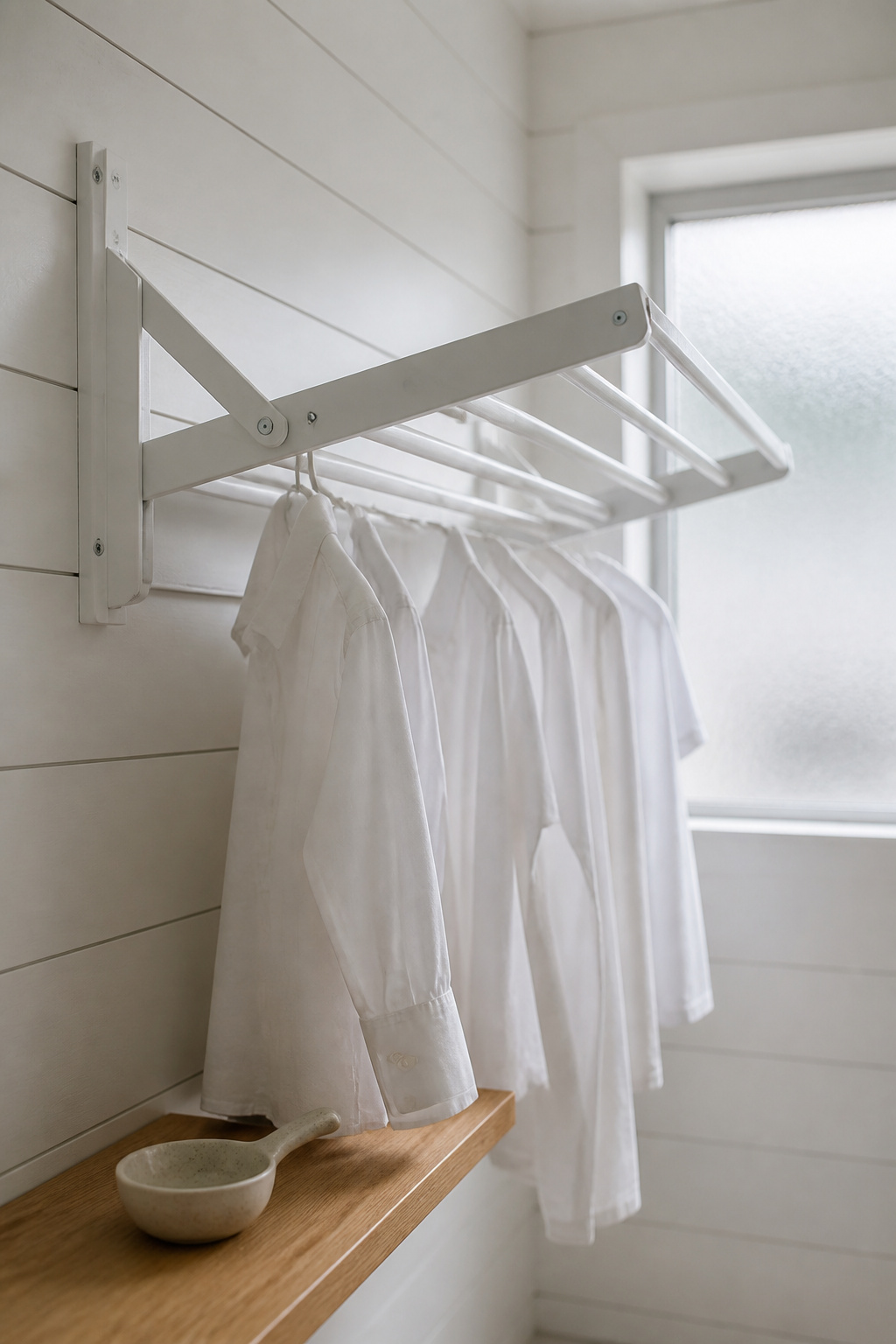
The fold-down rack is the modern Nordic default: full drying capacity that disappears when you’re done. Jennifer Ackerly of Dryer Enthusiast puts it well — a wall rack “disappears when you don’t need it, which is its biggest win.”
How fold-down racks work — mounting, hinge types and load ratings
The rack pivots on a hinge from a back plate screwed to the wall, lying flat when folded. The single number that matters is the load rating, and the wall sets it, not the rack. Standard models carry 18–36 kg; heavy-duty seven-rod versions reach 59 kg — but only fixed into studs. Mount into bare plasterboard and that collapses toward 9–14 kg.
Sizing a fold-down rack to your laundry load and wall width
A medium model of 79–102 cm with five to seven rods gives 13–16 linear feet of rod — enough for a full 6 kg load. My rule of thumb: multiply weekly wash weight in kilos by 2.5 for the metres of rod you need.
Materials: powder-coated steel versus stainless versus beech wood bar racks
Material is where the rack joins the room or fights it.
- Powder-coated steel (white or matte black): flat white disappears against a white wall, hard, chip-resistant.
- Stainless steel: rust-proof, smooth, won’t snag linen; the most durable, though it reads slightly industrial.
- Beech or bamboo bar racks: warmth alongside white cabinetry. Trade-off: solid wood needs air between loads or it grows mould.
Powder-coated white first; wood-bar second where cabinetry wants warming. The same wall-planning logic applies whether you hang a rack or Nordic wall storage.
Wall Rod Systems: The Sleek Minimal Option
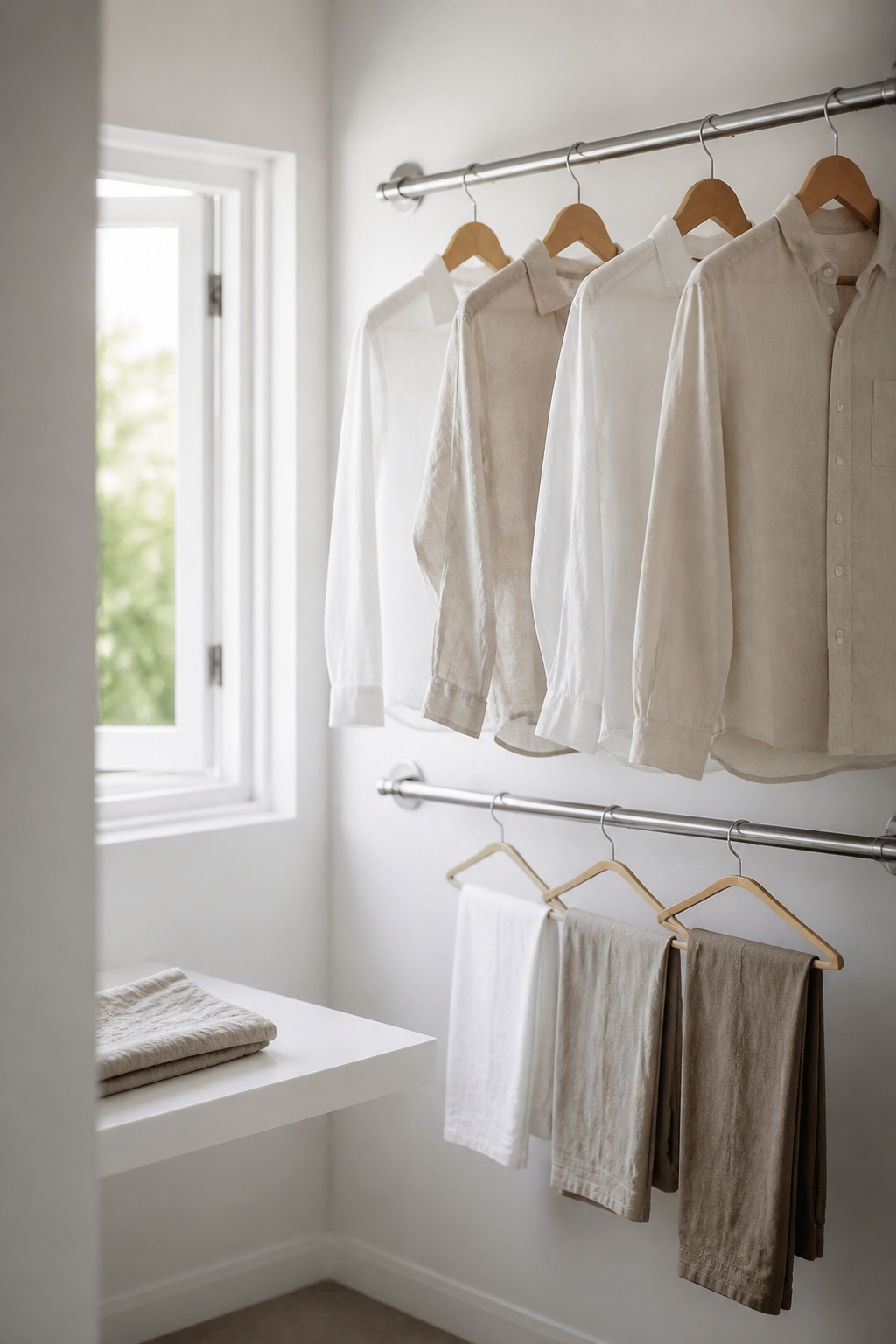
Where even a folded rack feels intrusive, the wall rod is the quieter answer: fixed horizontal tubes mounted straight to the wall, looking less like laundry equipment than an architectural line.
Single-rod versus multi-rod wall systems
A single rod, 60–120 cm long, acts as a fixed hanging bar — ideal for a narrow alcove, with garments on hangers getting airflow on every side. Where you need more, a multi-rod array stacks three or more rods, each projecting 30–45 cm. For the Nordic look: one polished-stainless rod, or two, reads as a detail.
Spacing rods for airflow — the gap that actually dries clothes
Here I’ll commit to numbers the catalogues rarely state. In my experience, 30–40 cm of vertical space between rods lets a shirt hang without its hem touching the rod below. Across a single rod, leave at least 5 cm between garments; pressed together, they stay wet where they touch and turn musty within 12–24 hours. Treat these as working guidance, not a published standard.
Retractable clotheslines as the smallest-footprint option
When wall depth is the enemy, a retractable line reels away to leave only two small brackets visible. Single-line models extend 8–12 metres; multi-line versions reach 18 metres. The catch: you peg items rather than drape them — fine for socks and light shirts, impractical for heavy trousers or bedding. Use it as overflow, rarely as the only system.
The Ceiling Pulley Clothes Maiden: A Nordic Tradition Worth Reviving
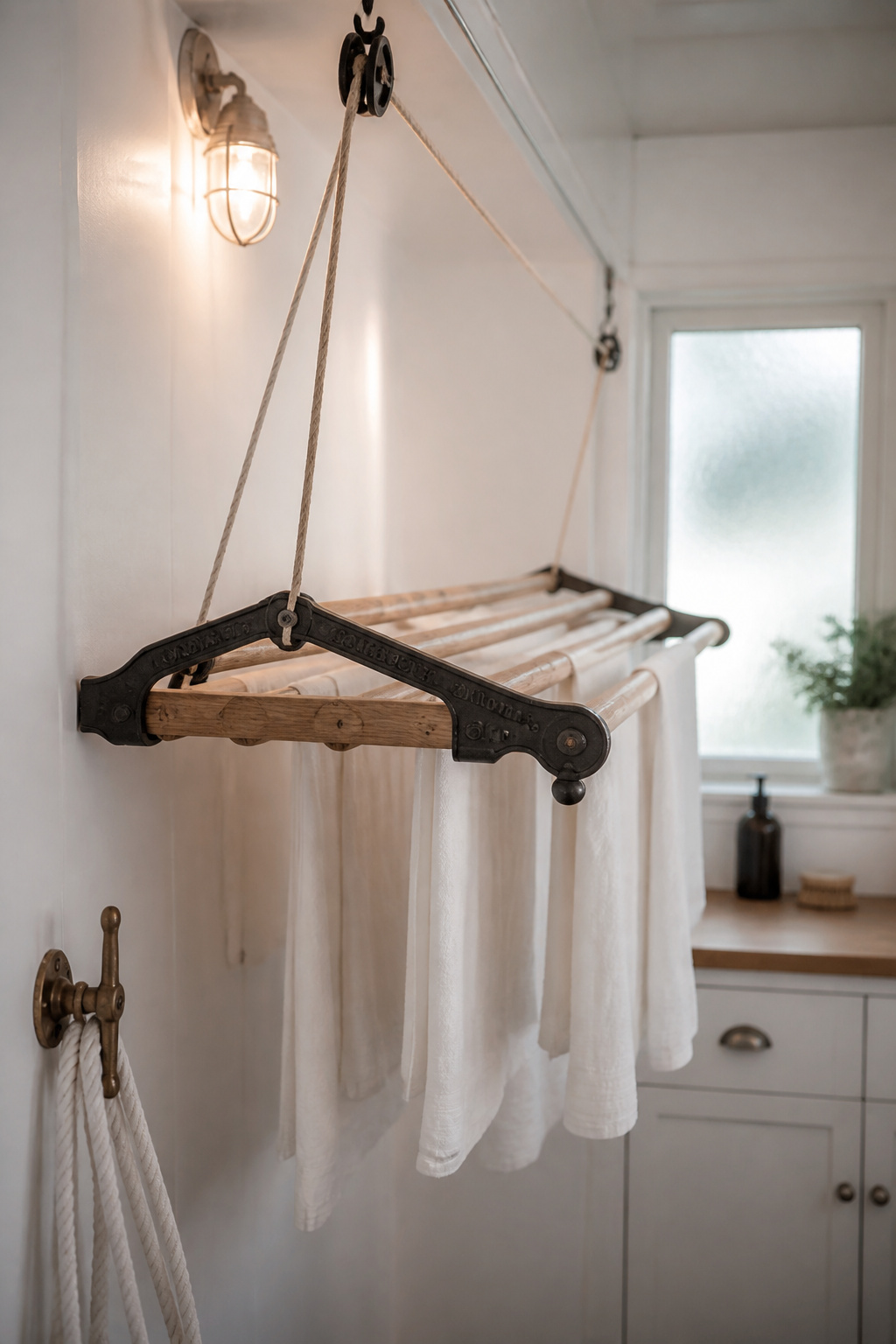
The ceiling pulley airer — the clothes maiden — hangs from the joists and rises to the warmest air in the room. It is the most overlooked system here, and arguably the most space-efficient.
History and function of the ceiling-mounted pulley airer
Overhead airers have been common since the late 18th century — pushed aside when tumble dryers arrived in the 1960s. The mechanism: cords run from the frame through pulleys in the joists to a cleat hook on the wall. Suppliers such as Cast-in-Style use FSC-certified pine laths, giving the system genuine Scandinavian material provenance.
What to check before installation — ceiling height, joist location, load
Three checks. First, pulleys must go into joists, never plasterboard — under load the fixing tears straight out. Second, weight is rarely the problem: timber joists hold 30–50 kg per square foot, well above a loaded airer’s 5–12 kg of laundry plus a 3–6 kg frame. Third, a five-lath airer needs about 23.5 cm of clearance raised — on a 2.4 m ceiling it clears to roughly 2.16 m.
Why the clothes maiden suits small laundry rooms more than floor racks
Warm air rises, so the raised airer sits in the warmest, driest part of the room — which is why a Cast-in-Style airer dries a whole load in around 2–4 hours with no electricity. Tamara Kelly of Woman & Home: “because heat rises it’s the most logical place to dry laundry indoors.” A freestanding horse eats 60 × 100 cm of floor even when empty; the ceiling airer claims none — a significant share in a 3 m² room. Reach for it in a compact laundry closet.
Placement and Airflow: Making Any Rack Actually Work
Which system you buy matters less than where you put it: all three dry faster near moving air, and all three stall when clothes are crowded.
Where to position a rack for fastest drying — door, window and vent proximity
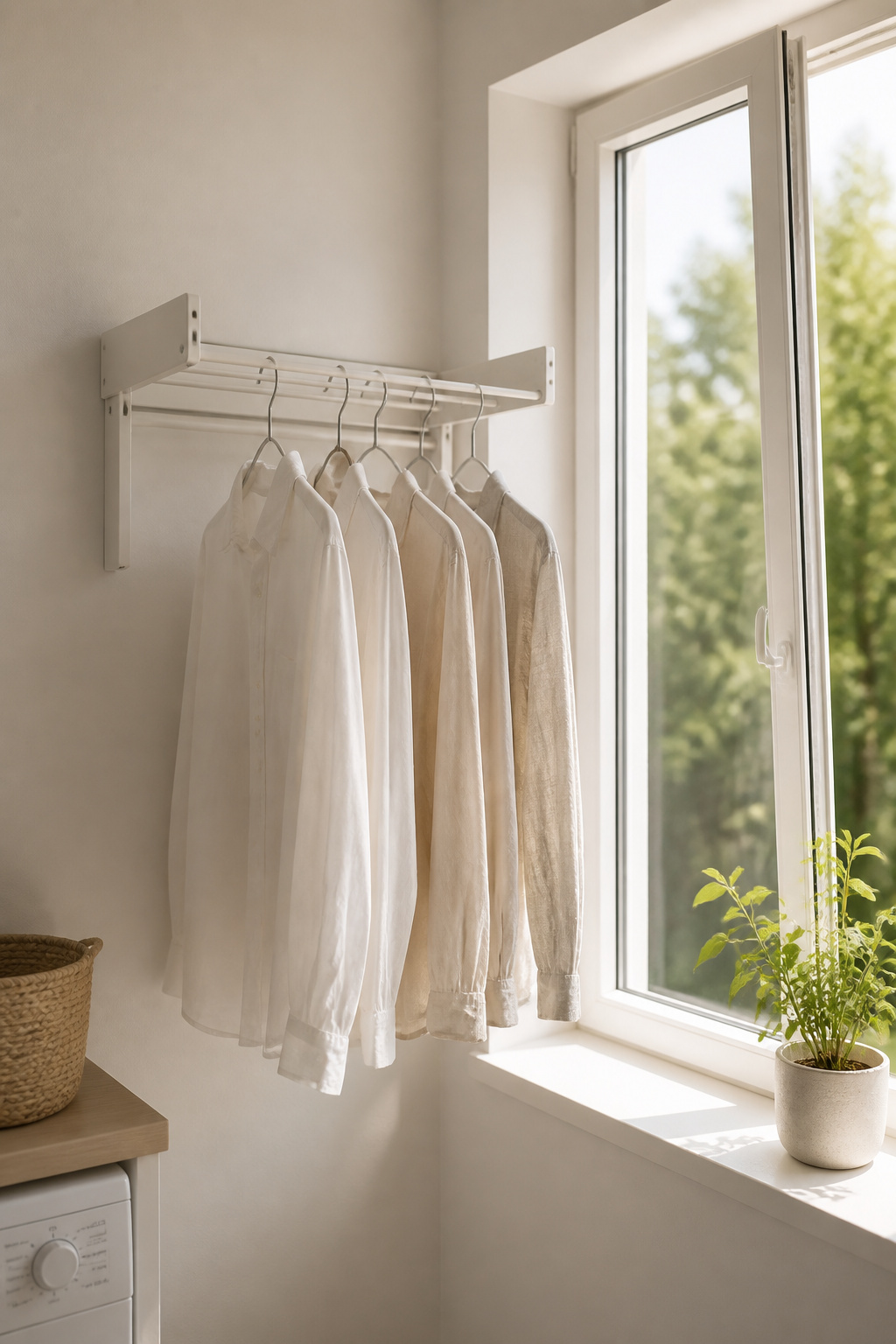
Put the rack where fresh air can cross it — near a window you can open, or in line with a doorway left ajar for a cross-draught. The fastest setup: a rack about 30 cm from a slightly open window with a fan on low pointed at the opening. Avoid the closed bathroom; a ceiling airer does best directly above the radiator.
Spacing garments on a rack: the gap rule Nordic households follow
At least 5 cm of air between each garment — touching clothes are not drying, they are sitting damp. In good conditions most items dry in 6–12 hours; overcrowding is the main reason that stretches toward 24. Hang on hangers for each garment’s own air column, and turn things halfway through.
When to open a window and when a dehumidifier makes more sense
In dry weather, opening a window lets moist indoor air escape. In rain or cold, it does the reverse — a dehumidifier in a closed room is the more efficient tool. Never run both: open windows force the dehumidifier to process outdoor moisture too. The Scandinavian middle path: open opposite windows for five to ten minutes once or twice a day, holding the room around 30–50% humidity.
Choosing the Right Scandinavian Drying Rack for Your Space
These three are not interchangeable — but I won’t leave you to guess.
Decision guide: room size, ceiling height and drying volume
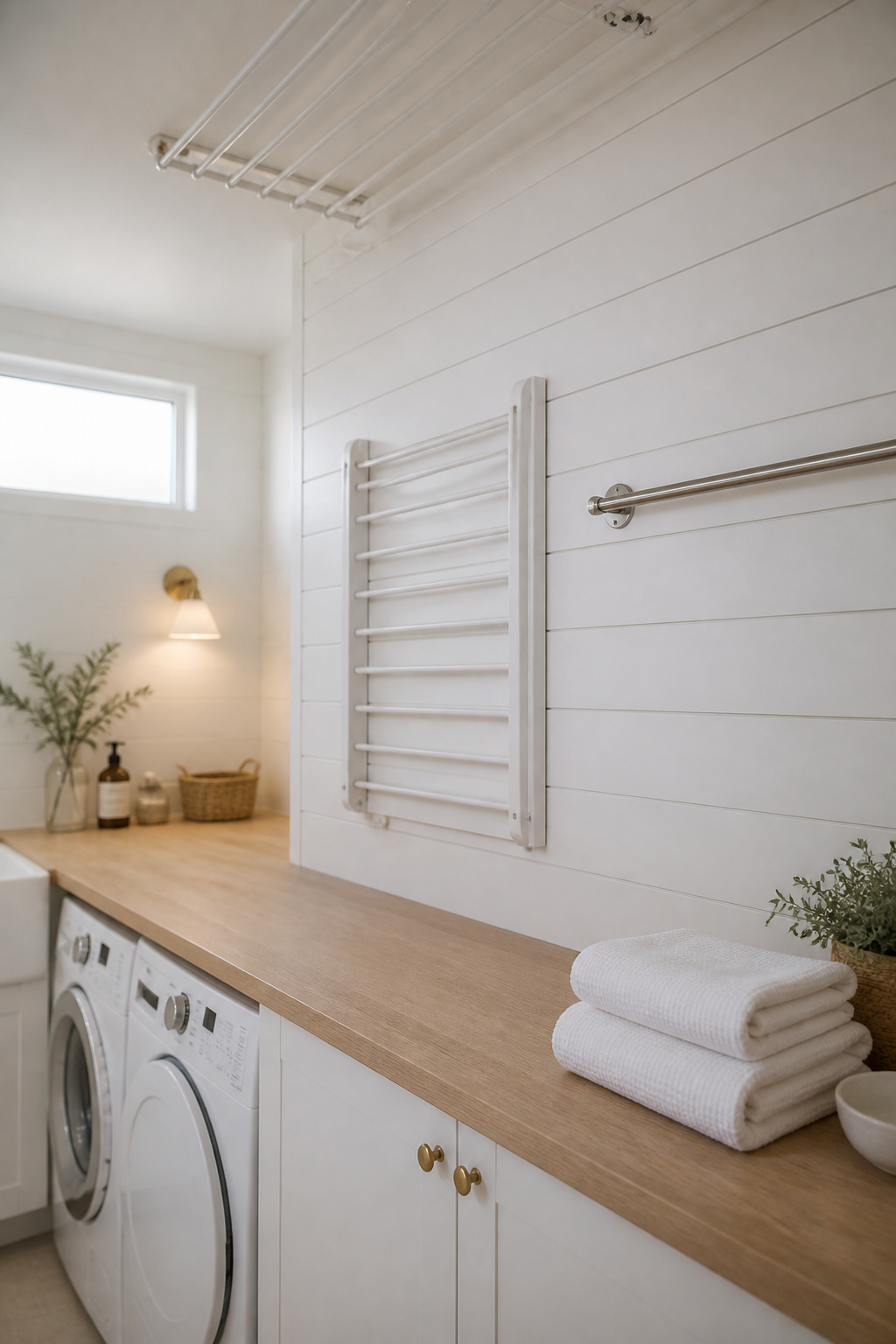
Start with the room, then the ceiling, then the wash. Below 3 m² with a ceiling under 2.2 m, a wall rod or retractable line is the only realistic option. Between 3 and 6 m² at a normal 2.2–2.4 m ceiling, the fold-down rack is my primary recommendation: most capacity, least wall. Wherever the ceiling reaches 2.4 m and floor space is precious, the ceiling pulley airer is the ideal. These are my working thresholds, not published standards.
Stowing away — which system disappears best in a minimal room
Folded, the fold-down rack projects only 5–8 cm and vanishes from any angle but head-on. The ceiling airer disappears upward — white frame against white ceiling, barely visible. Wall rods never hide, and that is the point: choose good ones and their permanence reads as architecture.
Combining systems when one isn’t enough
The most common Nordic pairing is a ceiling airer for regular loads plus a fold-down rack on a second wall for overflow — both stow completely. Avoid two fold-down racks on adjacent walls: extended, they meet in the middle. Plan the drying at the layout stage, the way a Nordic room always has.
FAQ
How much weight can a wall-mounted fold-down drying rack hold?
Most residential fold-down racks are rated 18–36 kg (40–80 lb), with heavy-duty seven-rod models reaching 59 kg (130 lb). That rating assumes secure stud mounting — the wall fixing, not the rack, sets the safe limit. Fixed into plasterboard without studs, effective capacity drops to roughly 9–14 kg, so always locate and screw into studs.
Is a ceiling pulley airer worth it in a small laundry room?
Yes. A ceiling airer claims zero floor and wall area permanently and dries a full load in 2–4 hours using warm rising air and no electricity, making it the most space- and energy-efficient option for rooms under 4 m². You need only a ceiling around 2.2–2.4 m high and accessible joists for the pulleys. Switching from a dryer saves roughly 1.5 tonnes of CO₂ a year.
How do I stop damp smells when air-drying indoors in winter?
The cause is moisture leaving the room too slowly, so the fix is airflow. Open opposite windows for five to ten minutes once or twice a day for a cross-draught, or run a dehumidifier in a closed room below 60% humidity — but never both, as they cancel out. Also space garments at least 5 cm apart, since touching clothes stay damp and breed odour at the contact zone.