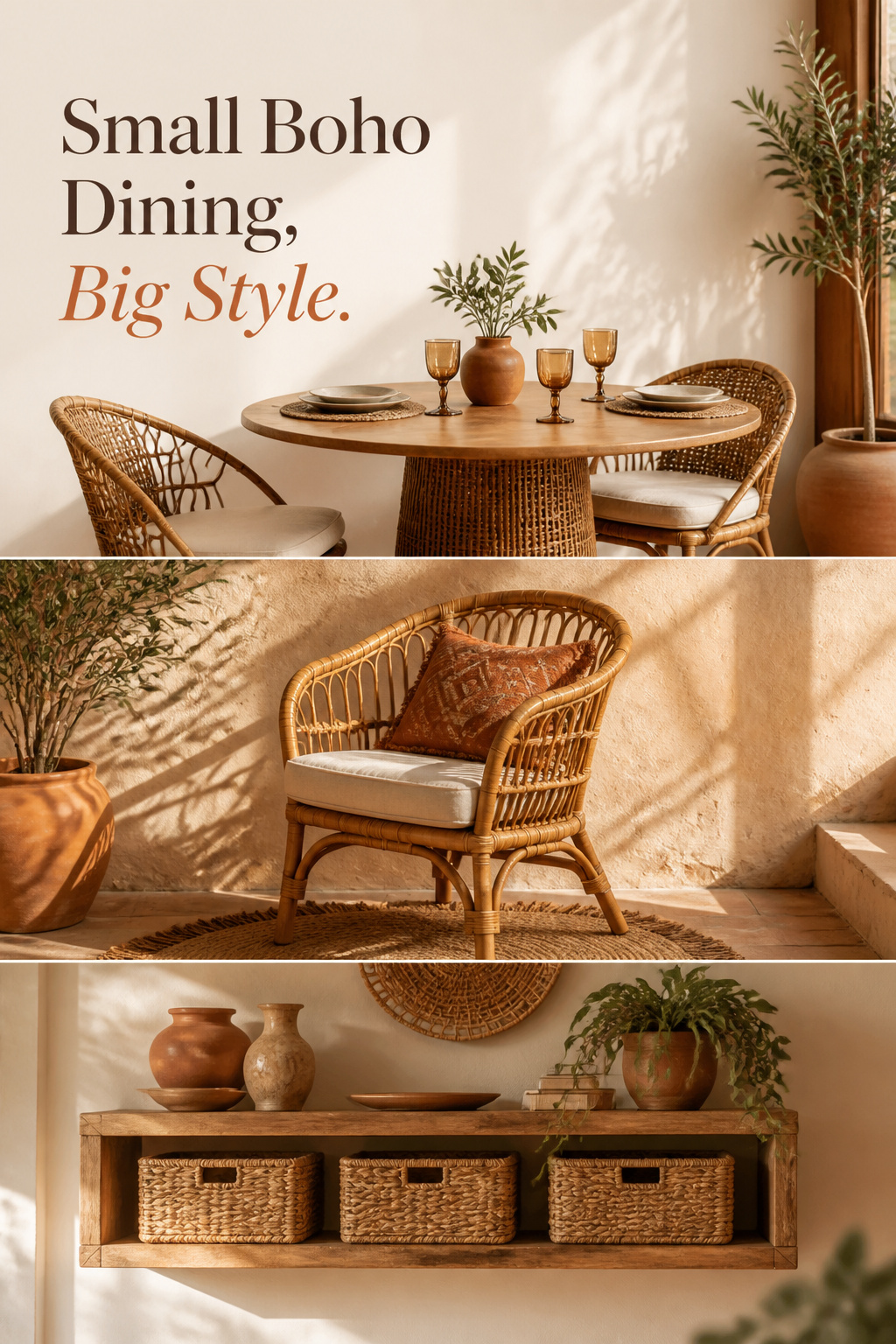
The Victorian terrace I restored with my father had a dining room just under nine feet across — built when families ate in shifts, one window, a chimney breast eating a foot of the far wall. Long after the joinery was done, I kept a Pinterest board of boho dining rooms for it, and every photo was shot in a room twice this one’s size. That’s the trap. A small boho dining room wants the same layered warmth as a large one, but a tight footprint has almost no tolerance for boho’s usual density. Get the scale wrong and the layering that looks collected in a big room turns cramped in a small one.
TL;DR
- Start with a round pedestal table, ideally 36–42 inches, sized to the room’s width, not the household’s ideal seat count — minimum room width is table diameter plus 72 inches.
- Choose open-frame rattan and cane over solid upholstered pieces, and swap a floor sideboard for wall-mounted shelving; visual weight, not footprint, is what a small room registers.
- Run one rug instead of two, cap plants around five, and edit before you add — restraint is a boho technique, not a compromise on it.
Here is the order I work in, and why every call changes in a room this size.
The Small Room That Taught Me Boho Has a Ceiling
That house pre-dated open-plan living by a century, built to seat four in less space than a modern breakfast nook. No styling conjures square footage the joiners never framed.
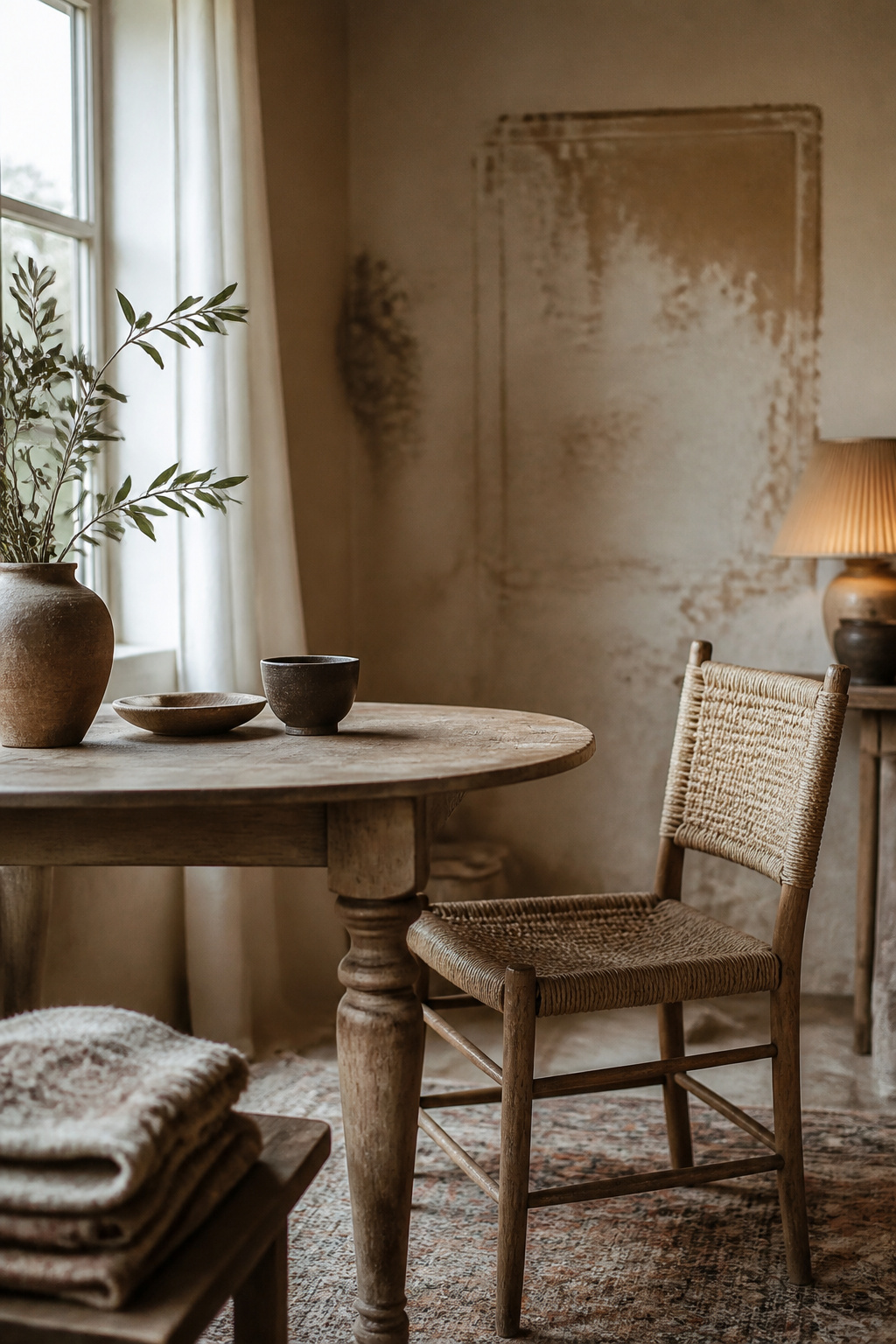
A period dining room the footprint couldn’t fully layer
Boho earns its reputation honestly. Done casually, rugs, textiles and plants pile into something messy; done deliberately — natural fibers, warm woods, a curated mix rather than sheer volume — the same elements feel lived-in. The style has never required clutter, but a small period room is unforgiving: there’s no spare wall or corner to absorb a bad call.
What had to come out first
We emptied the room before we furnished it. Out went a solid sideboard from years before, a floor-standing plant that caught every passing elbow, and two of the four bulky chairs. The room we ended up with was barer than the one we started with, and that was the point. One useful discipline borrows from the “five-layer” approach some boho decorators swear by: fix the number of layer types you allow, and refuse to add beyond it. In a small room, that number runs low.
Restraint is a boho technique, not a compromise
Editing down is not watering the style down. Slender, see-through pieces take up less visual room at the same footprint, so restraint buys the airiness that lets the remaining boho warmth land. The room felt more boho after we removed things, not less.
Start With the Table and Work Outward
The table is the single biggest space decision, so it comes first. Get it wrong and every later choice spends its energy compensating for it.
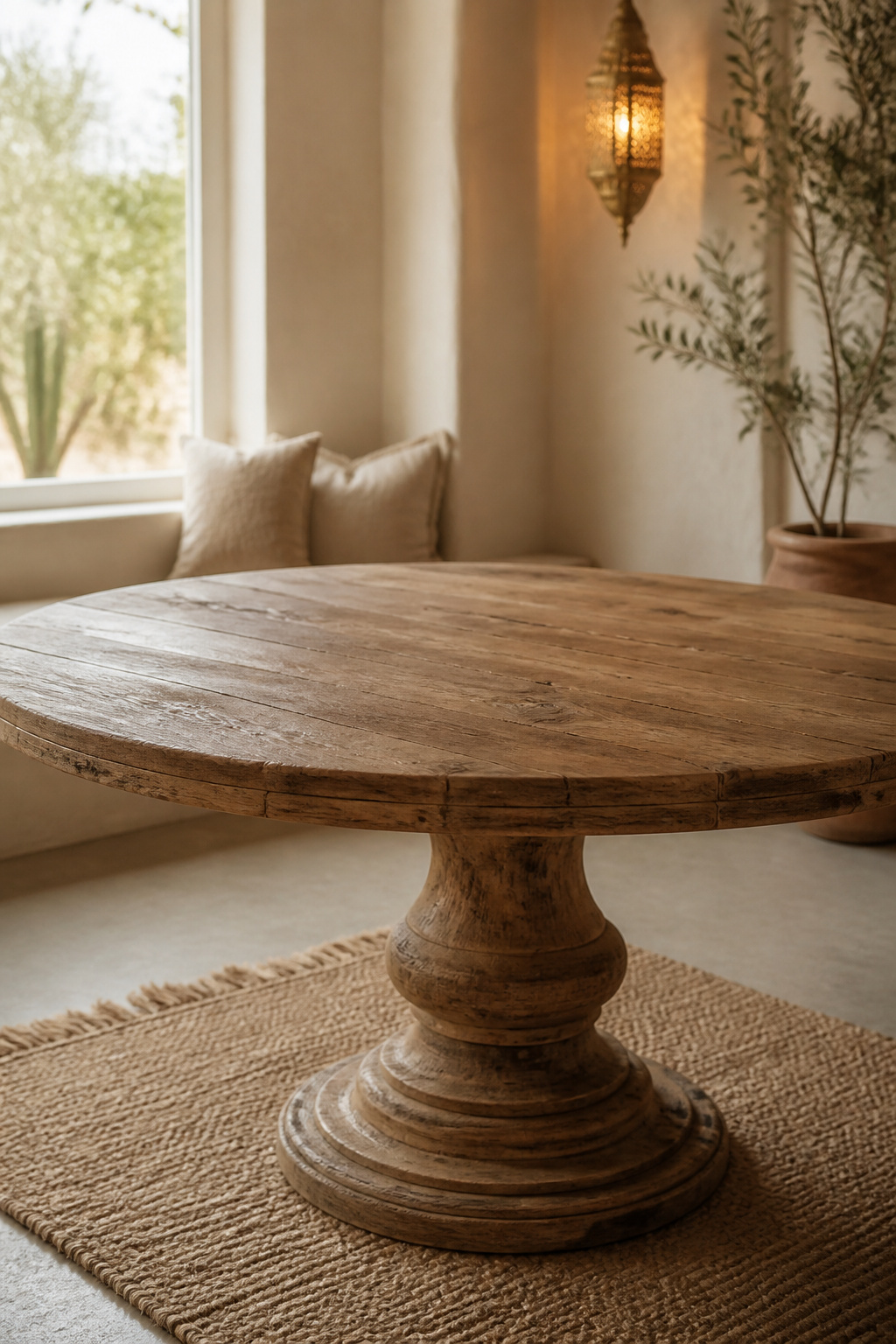
Round versus rectangular
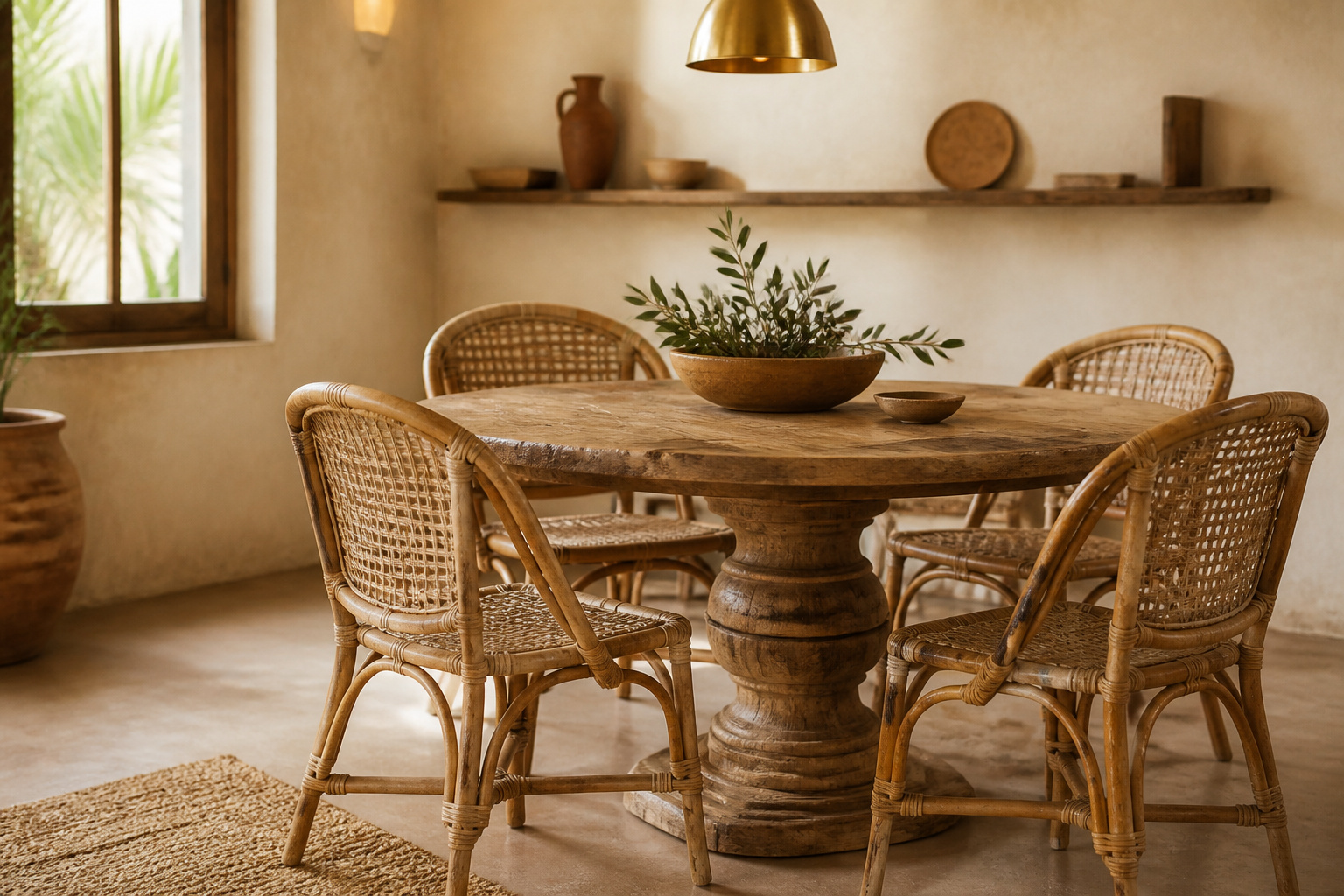
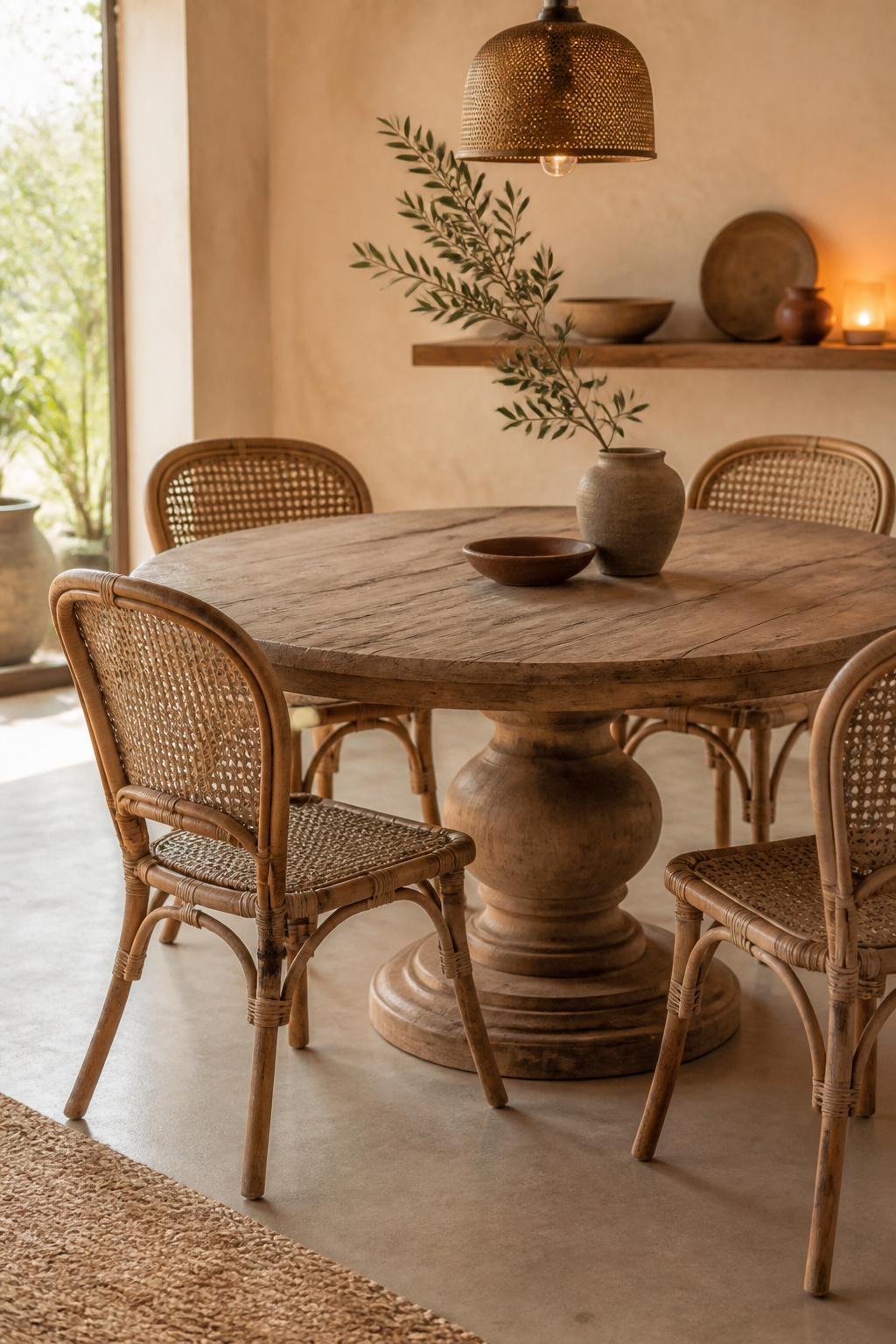
In a small, roughly square room, a round table wins almost every time. It improves traffic flow, takes up less visual space, and hands the room back its corners. A pedestal base helps more than people expect: a single column keeps legs from fighting chair frames, so the table tucks into a corner without losing seats. A rectangular table risks a boxy, boardroom feeling once other angular furniture joins it.
Sizing to the room, not the seat count
The most common mistake is buying for the household’s dream dinner party rather than the room’s actual width. The number that matters: minimum room width equals table diameter plus 72 inches — a 36-inch clearance on each side to pull a chair and pass behind. That gives a clean starting map:
| Room width | Round table diameter | Seats |
|---|---|---|
| Under 9 ft | 36 in | 4 |
| 9–11 ft | 42–48 in | 4–6 |
A 36-inch round pedestal is the sensible minimum for a room under nine feet wide, and it still seats four comfortably.
Drop-leaf and extendable options
For occasional guests, a drop-leaf table is genuinely clever. Folded, it collapses to a slim 14-to-22-inch depth and lives against the wall like a console, opening only when company comes. It suits one or two daily diners who sometimes seat three or four; a family extending it nightly needs a standard extendable table instead, steadier over years of use. Measure all three states before buying — folded, one leaf up, both out — and leave eight to ten inches of wall clearance for the leaf to swing up. On a well-made piece, look underneath for a rule-joint hinge, where leaf and top nest like puzzle pieces — the strongest, most traditional joinery for the job.
Lighter Furniture Reads Bigger
With the table sized, the furniture around it does the next round of work — and here the principle is visual weight, not physical footprint. A small room registers how heavy a piece looks, not its inches.
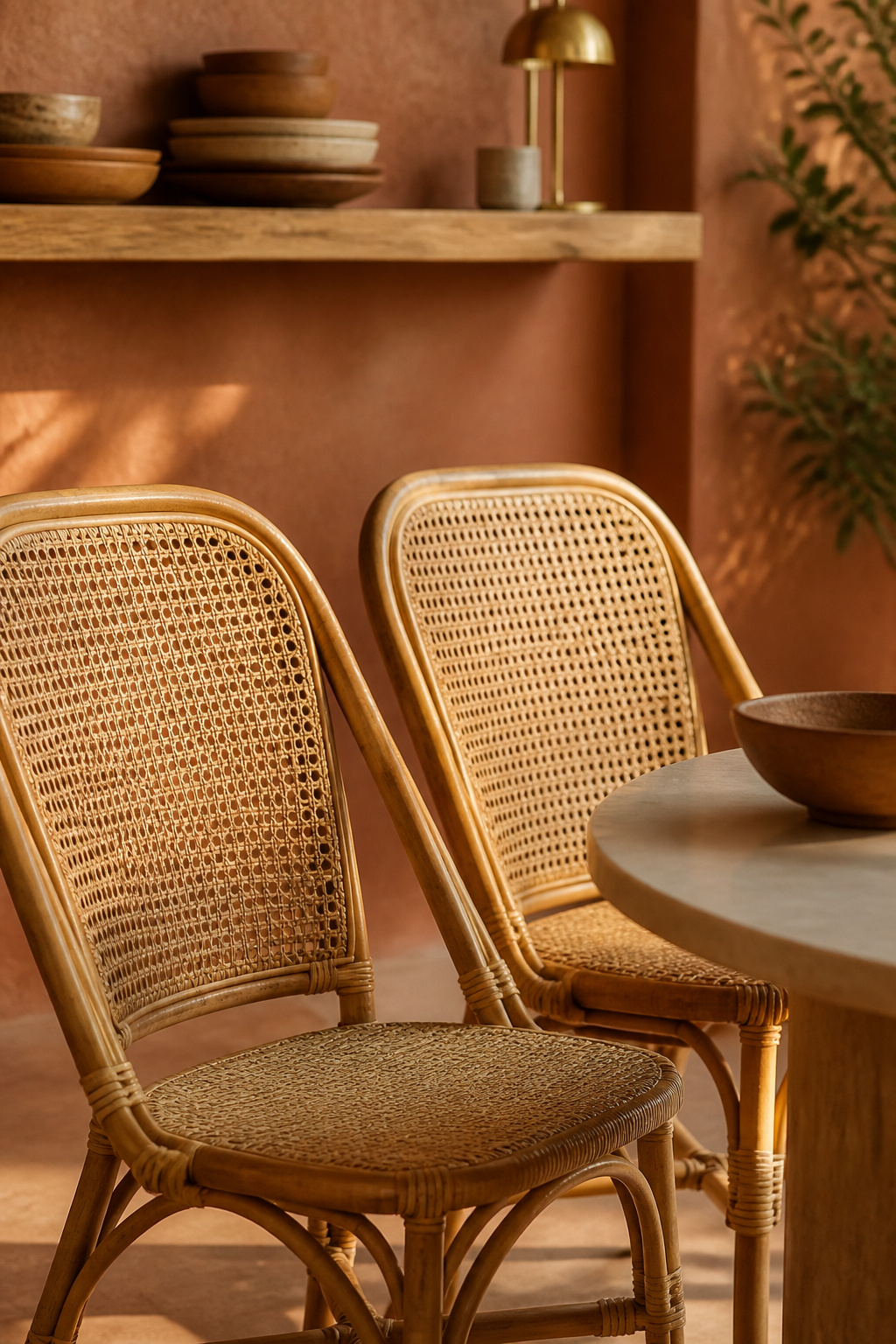
Why rattan and cane beat upholstered chairs
Rattan is lightweight and visually airy, exactly why it suits a tight room where bulk turns to clutter fast. Woven chairs balance a table’s mass with texture while keeping the setting laid-back rather than heavy. A boxy upholstered chair does the opposite: a blocky solid-fabric seat can seem to occupy more of a room than an open-framed piece, even when the open piece is technically larger. As Livingetc puts it, visual weight — not footprint — is what the eye registers, and in a small boho dining room that’s the whole game.
Open frames over solid case pieces
Open-frame furniture lets light and the eye travel past it, so the room feels brighter than the same footprint filled with solid case pieces. Furniture on legs rather than a skirted base opens up the floor plane — unnoticeable in a large room, but in a small one it’s the difference between breathing space and a wall of furniture.
Wall-mounted shelving instead of a sideboard
This is where I part ways with the standard boho setup: a floor-standing sideboard is bulk you usually can’t afford. Wall-mounted floating shelves do the same storage job at zero floor cost, and staggered at different levels they double as styled display. One caution: bracketed shelves carry stacked plates and ceramics far better than floating glass, so choose the bracket for real weight.
How Much Layering a Small Room Can Actually Carry
No guide gives you a hard number for this, and I’m not going to invent one. From rooms I’ve stood in, here’s where the tipping point sits and how to test for it.
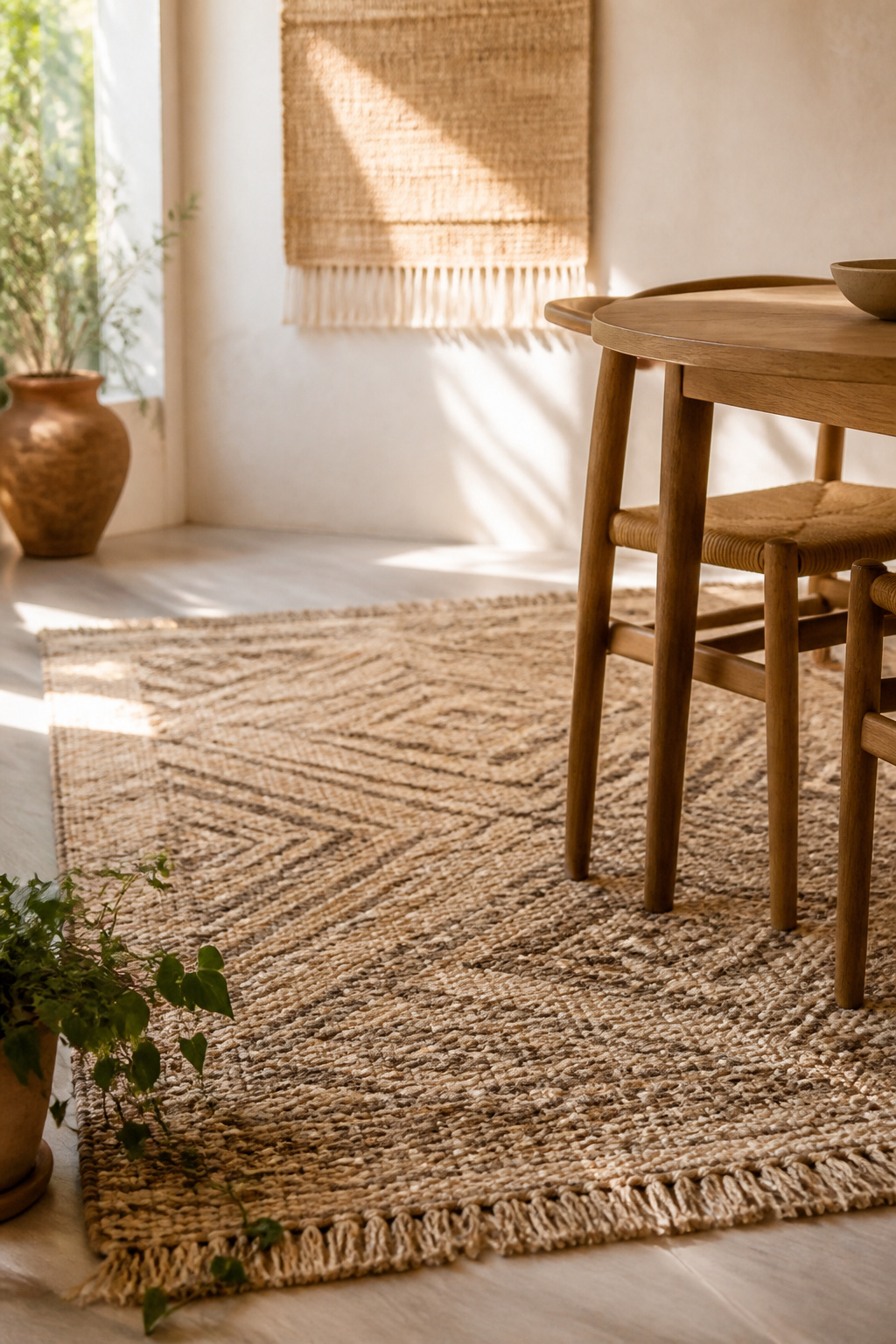
One rug, not two
Standard rug layering wants a larger neutral base — jute, sisal, a stripe or a simple pattern — topped by a smaller patterned rug covering roughly 60 to 70 percent of it. A genuinely small room can’t show the base rug’s border, so the layered effect collapses into a bunched mess. Skip it. Choose one rug with built-in depth instead — a patterned or textured weave that suggests layers on its own — and get the richness without spending floor space on two pieces.
Edit the plant count first
Plants are where a small boho room quietly overflows, because each new pot feels too small to matter. It matters. Most homes settle at two to five houseplants total, and only a minority push past six — treat that as your ceiling, not your starting line. Send greenery up the wall or onto shelves so it never competes with chair clearance.
Stand in the doorway and count
Here’s the self-check I run on every finished small room: count the distinct textures your eye lands on before it settles. If pots, textiles and surfaces have crowded in far enough that sitting down to eat feels harder, you’re over the line — boho’s clutter reputation in miniature, reached sooner in a small room.
Lighting and Chairs Matter More When Space Is Tight
Two calls carry an outsized penalty here: there’s less volume to absorb a mistake.
Fixture scale is less forgiving
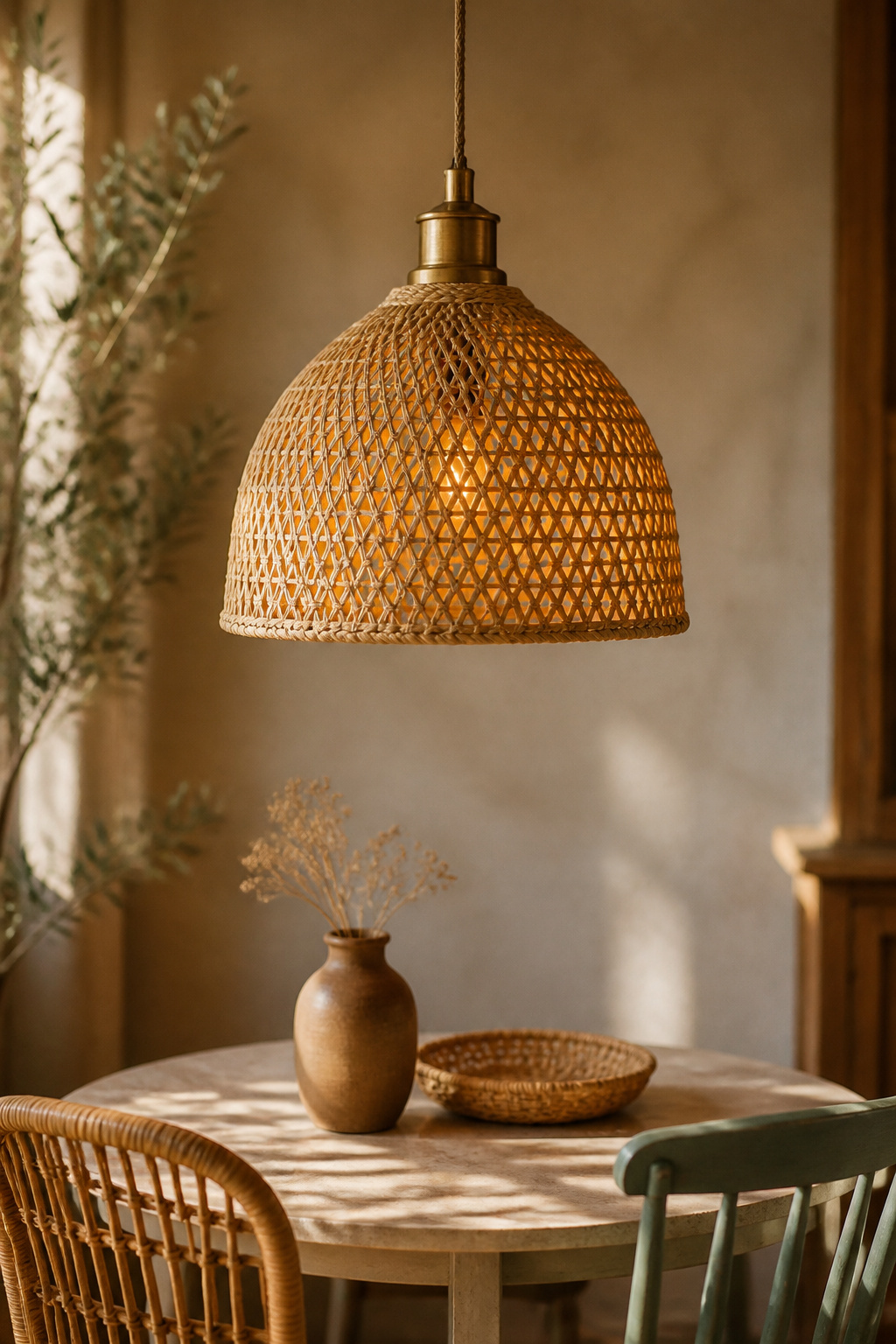
Over a small table, an oversized pendant is glaringly obvious — there’s no extra ceiling to read it against. Keep the diameter to roughly a third to a half of the table’s width, hung 30 to 36 inches above the surface; a 36-inch table wants an 18-to-24-inch fixture. The margin is narrow, so it’s worth choosing the right pendant scale for a small room before you commit.
Mismatched chairs that suit a tight footprint
Mixed chairs are a boho signature, but a small room wants them curated harder. Too many set close together makes a room feel smaller, and unstructured mismatch amplifies that into noise. Cap the mix at two or three types, unified by one shared feature — a wood tone, a fabric, a metal finish. A bench along one side is the small-room ace: it seats extra people when needed and hands back walking clearance the rest of the time. Learn which mismatched chairs that suit a tight space hold together and which fight each other.
Your First Weekend in a Small Boho Dining Room
You don’t need to buy anything this weekend to make the room better — editing down comes before adding on, and it’s free. Start there, then follow the sequence; each step stands on the one before it.
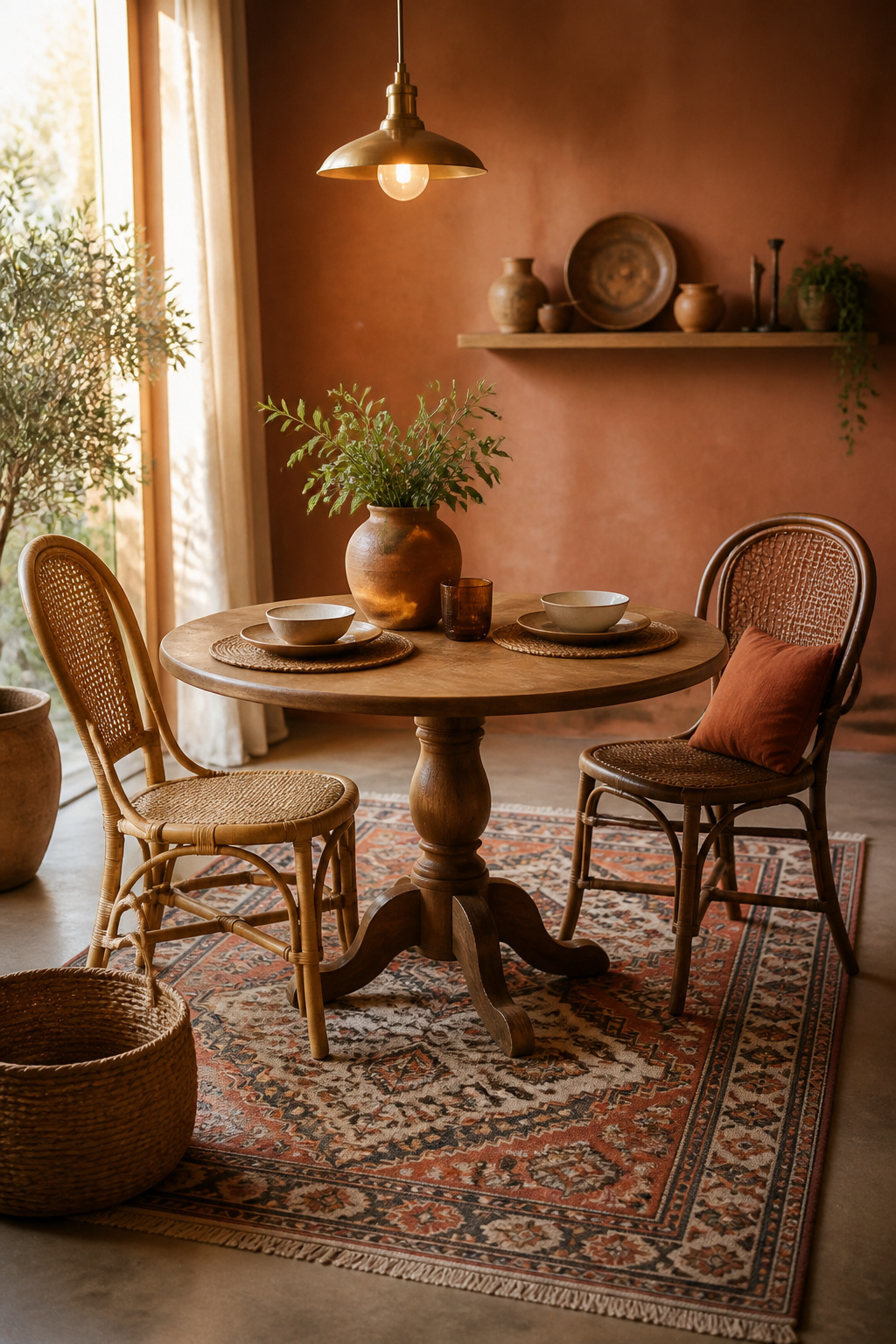
- Edit before you buy. Empty the room to the table and one chair, then return only what earns its way back. The highest-impact swap is trading one heavy upholstered or solid case piece for an open-frame or rattan equivalent.
- Size the table to the room. Use the diameter-plus-72-inch clearance rule to fix the largest round table your width allows. Every later choice follows from this number.
- Settle the chairs. Two or three types, one shared feature, a bench if you need flexible seat count.
- Add one rug. A single textured or patterned piece, sized to the table — a 6-by-9-foot rug suits a 36-to-48-inch table.
- Then edit again. Stand in the doorway, count the textures, and stop the moment the room works against its own purpose.
That’s the whole method: table, chairs, one rug, then edit. Run it in order and you scale the boho look down to a tight footprint without losing the warmth that drew you to it — the same warmth the complete guide to boho dining rooms delivers at full size. A small room doesn’t get a smaller version of the style; it gets a more disciplined one.
FAQ
Can a boho dining room work in an apartment with no separate dining space?
Yes. A compact bistro-style round table around 30 inches high fits an empty corner of a living space and seats two to four. Corner plant stands and wall-mounted shelving deliver the layered boho look without eating floor area, and a pendant that doubles as task light and sculptural piece makes the corner feel like an intentional room.
What’s the smallest table size that still comfortably seats four?
A 36-inch round pedestal table is the recommended minimum for rooms under nine feet wide and seats four comfortably. The rule that governs it is table diameter plus 72 inches for minimum room width. In metric terms, a 90-to-100-centimetre round is the commonly cited compact benchmark for seating four in a tight footprint.
Should a small boho dining room use a pendant light or a flush mount?
For ceilings under eight feet, a flush or semi-flush mount usually wins, avoiding the “shrinking” effect a hanging pendant creates in a low room. If you choose a pendant, keep its bottom at least 30 to 36 inches above the table and size its diameter to roughly a third to a half of the table’s width.