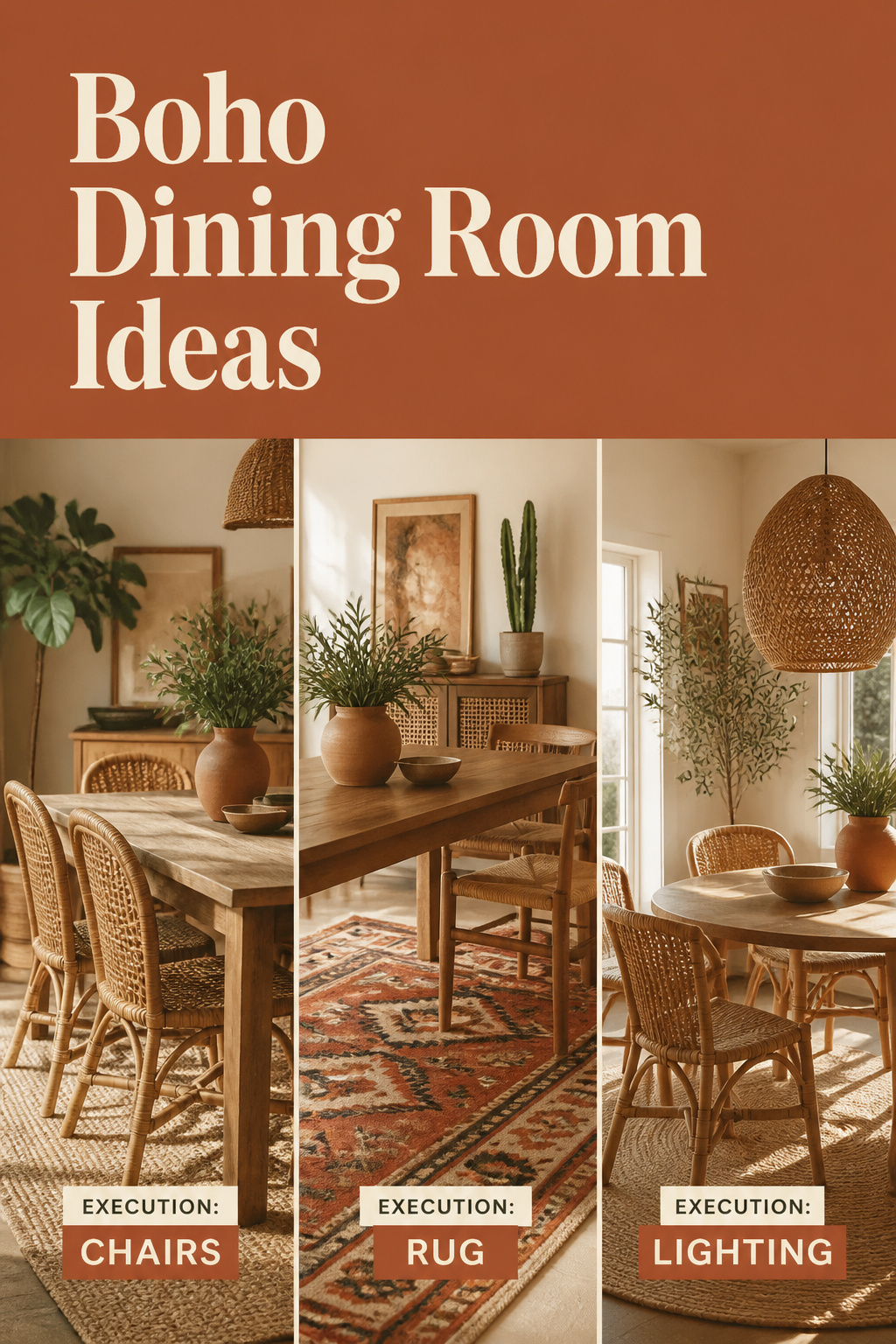
Search “boho dining room ideas” and you get a thousand photographs that all look right and none of which tell you why. Rattan chairs, layered rugs, terracotta walls, a woven pendant, a fiddle-leaf fig in a corner — the same handful of elements shuffled into a hundred arrangements, each one captioned as if the objects were the answer. They aren’t. The rooms that cohere share something the photographs hide; the rooms that fail share a different thing entirely. After years of dating and rescuing old furniture, I’ve learned to read a piece by its provenance before its price tag — where it came from, what it was built to sit beside. Apply that same reading to a whole boho dining room and the noise sorts itself. Out of everything the search returns, only a few decisions determine whether your room reads as gathered or just cluttered. This guide covers those decisions, points to the deeper method behind each, and hands you the rule that ties them together.
What Actually Makes a Dining Room Read as Boho (Not Just Cluttered)
Here is the uncomfortable truth about most “boho” rooms that miss: nothing in them is wrong on its own. The rattan chair is lovely, the kilim genuine, the terracotta the right terracotta. They simply don’t answer to each other — and a room full of unrelated good objects is clutter. Boho gets blamed for being messy when the real culprit is a missing thread.
The provenance test: why mixed-vintage-and-new beats matched sets
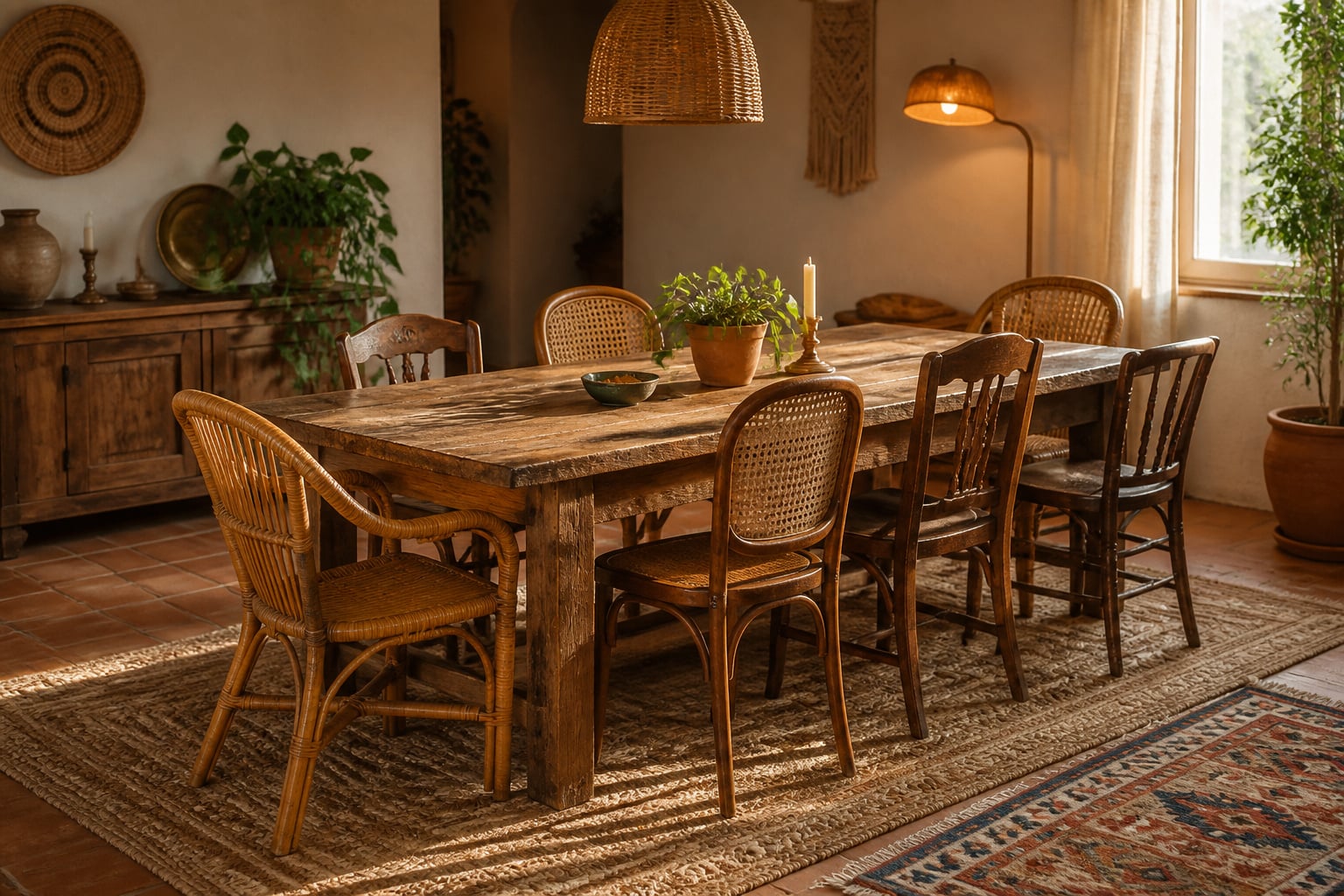
The instinct most people fight is the instinct to match. A boho dining room is built the opposite way — combining pieces from different eras and origins, vintage finds and thrift rescues and handmade objects, rather than ordering a coordinated set from one retailer. Decorating this way is collecting, not purchasing: source from a variety of shops so the room reads as assembled over time rather than delivered in one van.
I put every piece through a quick question before it earns a spot: could I tell you where this came from, and does that origin sit believably beside what’s already here? Call it the provenance test — my own way of thinking, not a rule printed anywhere, but it maps cleanly onto how the style works. A few pieces with real history do disproportionate cohesion work; one honest vintage object sets a whole room’s mood in a way three new “boho-look” purchases never will. One caution follows straight from provenance: don’t refinish the wear off an old piece. The worn edges and settled patina are evidence of its past — sand them away and you’ve turned a piece with a story into one pretending to have one, the applied-distress costume I’ll always argue against.
Repetition is the hidden rule: one material or undertone repeated across furniture, rug and light
If provenance earns a piece its place, repetition is what makes the pieces cohere once they’re in the room — the rule the good photographs hide. A mismatched dining table holds together because one thread — a shared seat material, a wood undertone, a repeated weave — runs through otherwise unrelated chairs. The frames can argue; the thread keeps the peace.
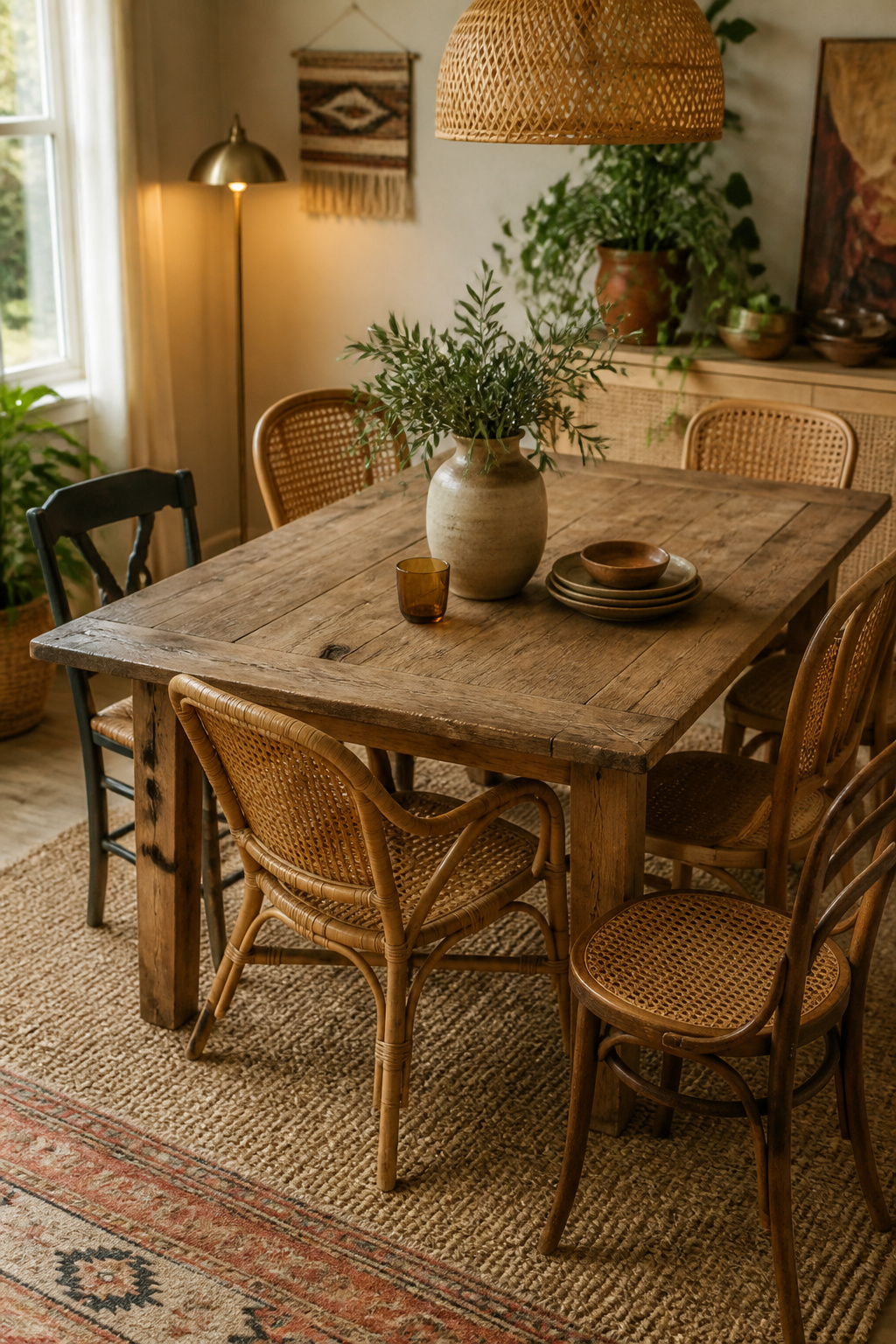
The thread doesn’t have to be furniture. The strongest boho dining rooms repeat one material or one undertone across three different jobs — the chairs, the rug and the light — so the eye reads the room as one hand’s work. Rattan on a chair back, jute underfoot, a woven shade overhead: same texture, three places, and the mix looks deliberate. Earth-tone palettes do the same with colour: terracotta, rust, ochre and warm cream act as a tonal undercurrent that lets pattern, texture and multiple eras coexist without conflict. The soul of the room comes from a few contrasting materials chosen on purpose — smooth wood against rough jute — not from adding more objects.
Where boho dining tips into cluttered, and how to spot the line before you cross it
The line between collected and cluttered is not a quantity of objects. It’s whether each object repeats something already in the room or introduces a fourth unrelated element competing for attention — the single most common failure across every boho dining source I read.
The self-check costs nothing. Before any new piece comes into the room, ask whether it repeats a material, an undertone or a texture already present — or whether it’s a stray. Deliberately mismatched chairs unified by one warm-earthy palette carry irreplaceable personal charm; the same chairs with no unifying thread look like a garage sale. The mixing was never the problem. The missing thread was.
Mismatched Chairs: The Technique Behind the Look
Of every boho dining move, mismatched chairs is the one people try first and botch most. It looks like the easy part — buy different chairs, done — yet it carries the tightest rules, because chairs have to work as furniture, not just photograph.
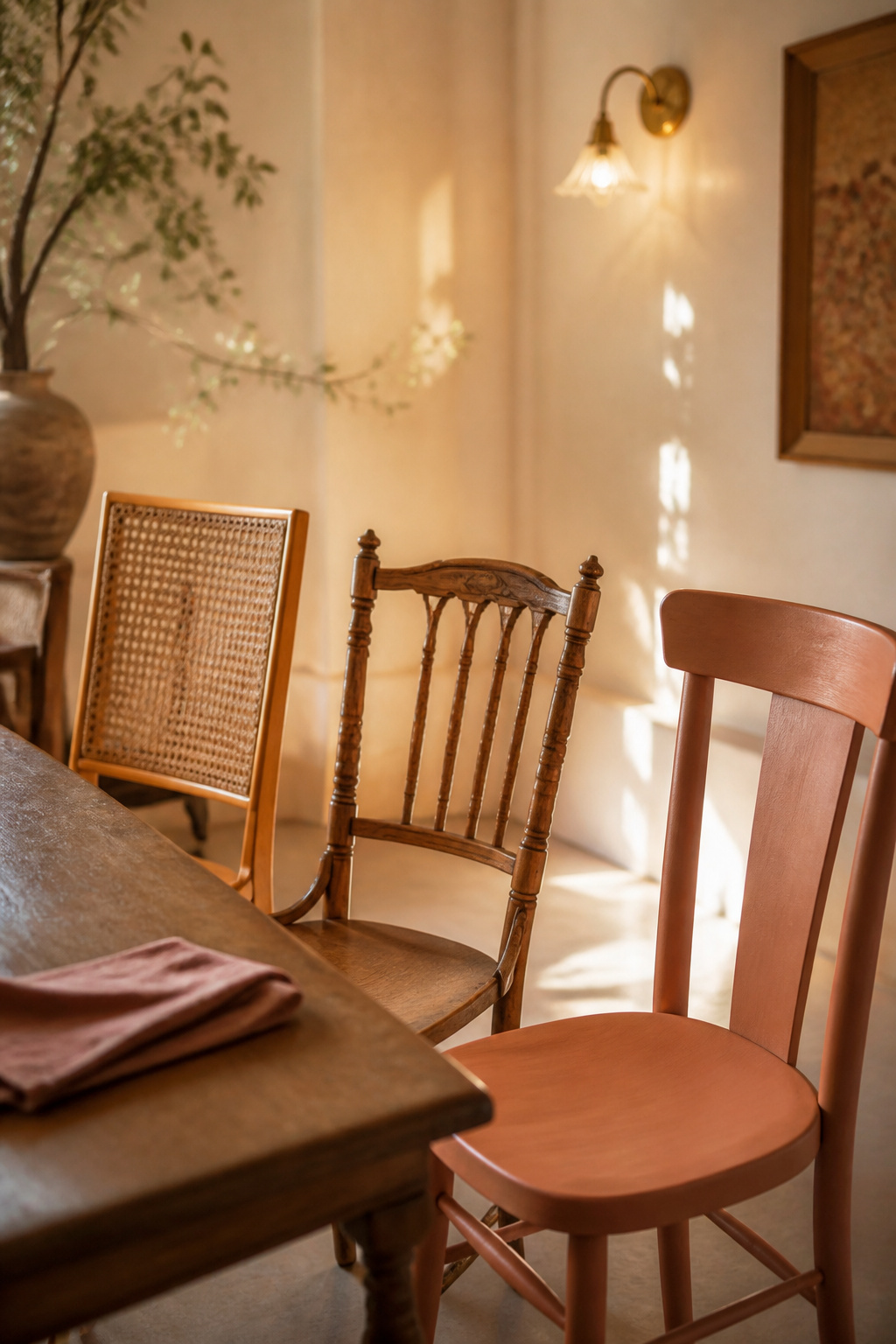
Why one shared material or color line saves a mismatched set from looking accidental
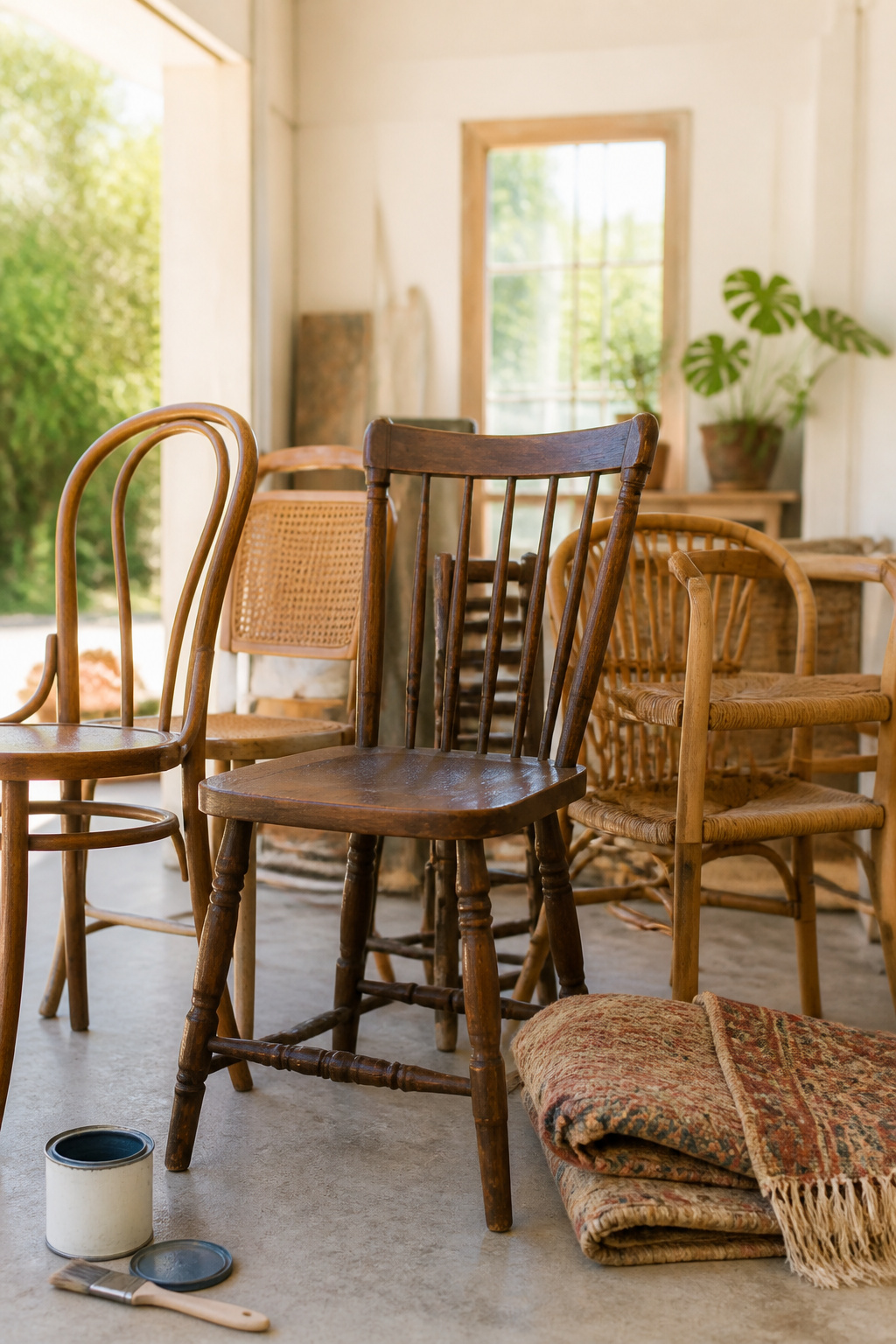
The rule from the section above, applied to seating: pick a single thread and repeat it. Chairs in the same material family — all wood-tone seats, or all natural-fibre seats — hang together even when the frames have nothing in common. If the material varies, let a shared undertone carry the thread: warm woods with warm rattan, cooler woods with whitewashed pieces. When two tones genuinely clash, a single painted chair, or matching seat cushions run across every frame, becomes the bridge that unifies the run. One thread, repeated at least twice, is the difference between “collected” and “random.”
Seat height and proportion tolerances that keep the table usable
The inspiration photos never mention that a mismatched set has to be comfortable to sit in. Standard seats sit 17 to 19 inches from the floor, against a 29-to-30-inch table, leaving 10 to 12 inches of thigh room. The tolerance that matters: within a mixed set, every seat should land within 2 inches of the others. Get that consistent and every diner sits level, which frees the styling to vary as boldly as you like above the seat.
A quick read on what to try first if you’re starting from a single existing chair
Most people don’t build a mismatched set from scratch — they build it around one chair they already own. Start there. Source one or two more chairs in a different material, rattan or vintage wood, sharing your existing chair’s finish tone, rather than replacing everything. If a chair is close but its seat fights the room, reupholstery unifies by fabric without touching the frame: $100 to $550 a chair professionally, $20 to $100 for a DIY slip-seat swap. The full method — the three threads, the anchor-first sourcing order, the joinery to inspect before you buy — belongs to the spoke on mismatched boho dining chairs.
Scaling the Look Down for a Small Dining Room
Every rule above assumes room to spare. Shrink the footprint and the calculus flips: a small dining room has little tolerance for the density boho usually leans on, so the same elements need editing, not adding.
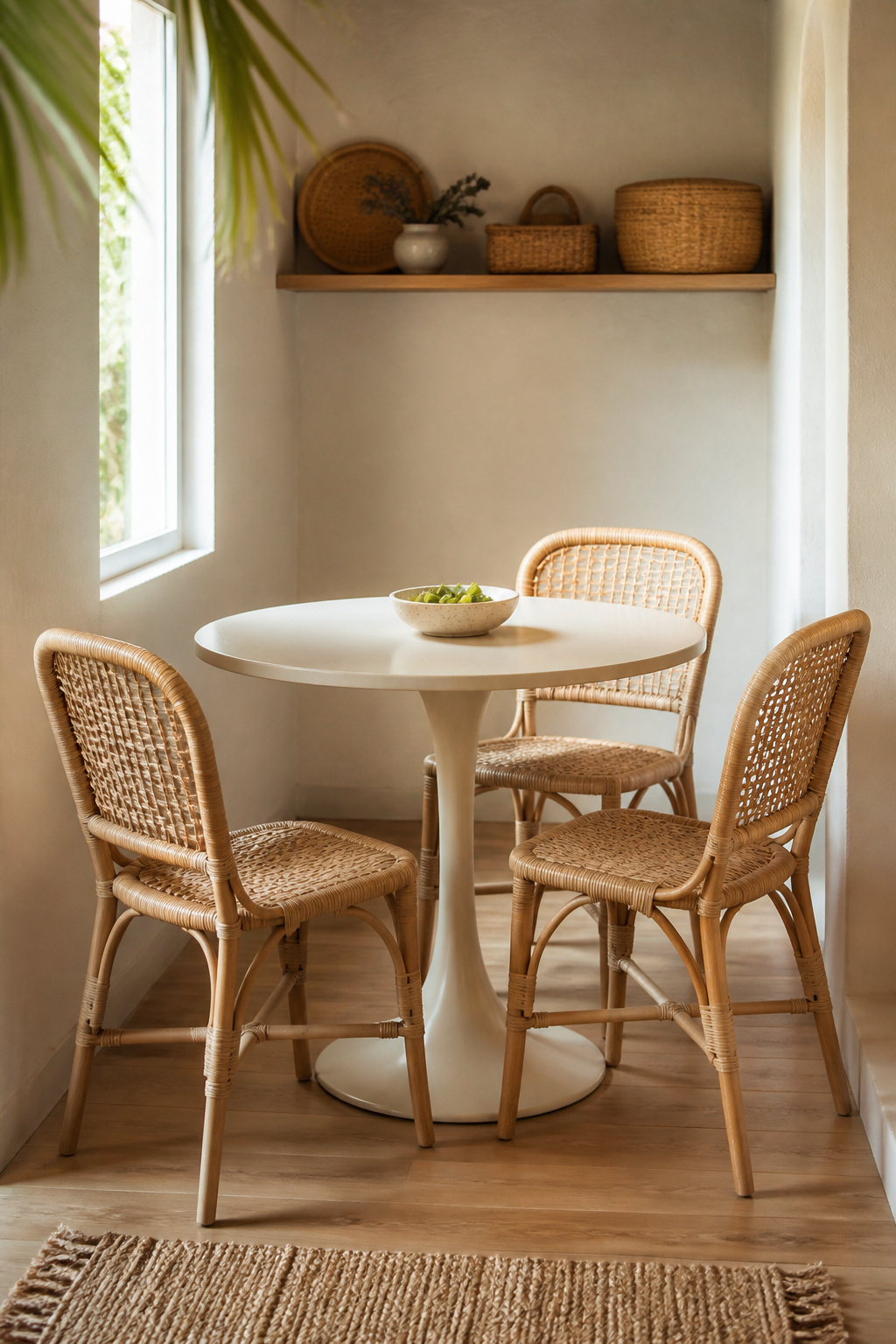
Why lighter rattan pieces work harder in a tight footprint
In a tight room, visual weight matters more than physical footprint — the eye registers how heavy a piece looks, not the inches it occupies. This is why rattan earns its keep here. A cane or rattan chair back looks light and airy and lets the eye travel past it, so the room breathes; a solid-backed upholstered chair seems to occupy more space than an open-frame piece even when it’s smaller. Rattan’s texture adds the warmth a small boho room needs without the bulk that turns a tight room into a storage unit.
Round tables and wall-mounted storage as small-space defaults
The table is the biggest space decision, and in a small room a round pedestal usually wins. A 36-inch round is the sensible minimum for rooms under nine feet wide and still seats four; a 42-to-48-inch round suits rooms 9 to 11 feet across. The formula worth memorising: minimum room width equals table diameter plus 72 inches — two 36-inch NKBA clearances, one per side, enough to pull a chair out where no one needs to pass behind it (budget 44 inches per side instead if a walkway runs behind seated guests). A round pedestal forgives an uneven chair mix better than a rectangular table and hands the room back its corners, and wall-mounted shelving does the sideboard’s job at zero floor cost.
How much layering is too much once square footage shrinks
Layering is where a small room quietly overflows. The full boho material mix — wood, jute, linen, metal, plush fabric — needs a large room to absorb it; in a tight one, hold texture to one or two contrasting materials, and let a single well-scaled woven pendant carry the room’s textural statement. The complete small-space playbook, from drop-leaf joinery to the doorway texture-count test, lives in the spoke on the small boho dining room.
Layering Rugs the Way Boho Dining Rooms Actually Do It
Look at the boho dining rooms you keep saving and count the rugs. Almost never one — nearly always two. Rug layering isn’t an optional flourish here; it’s near-mandatory, the technique that most reliably separates assembled from furnished.
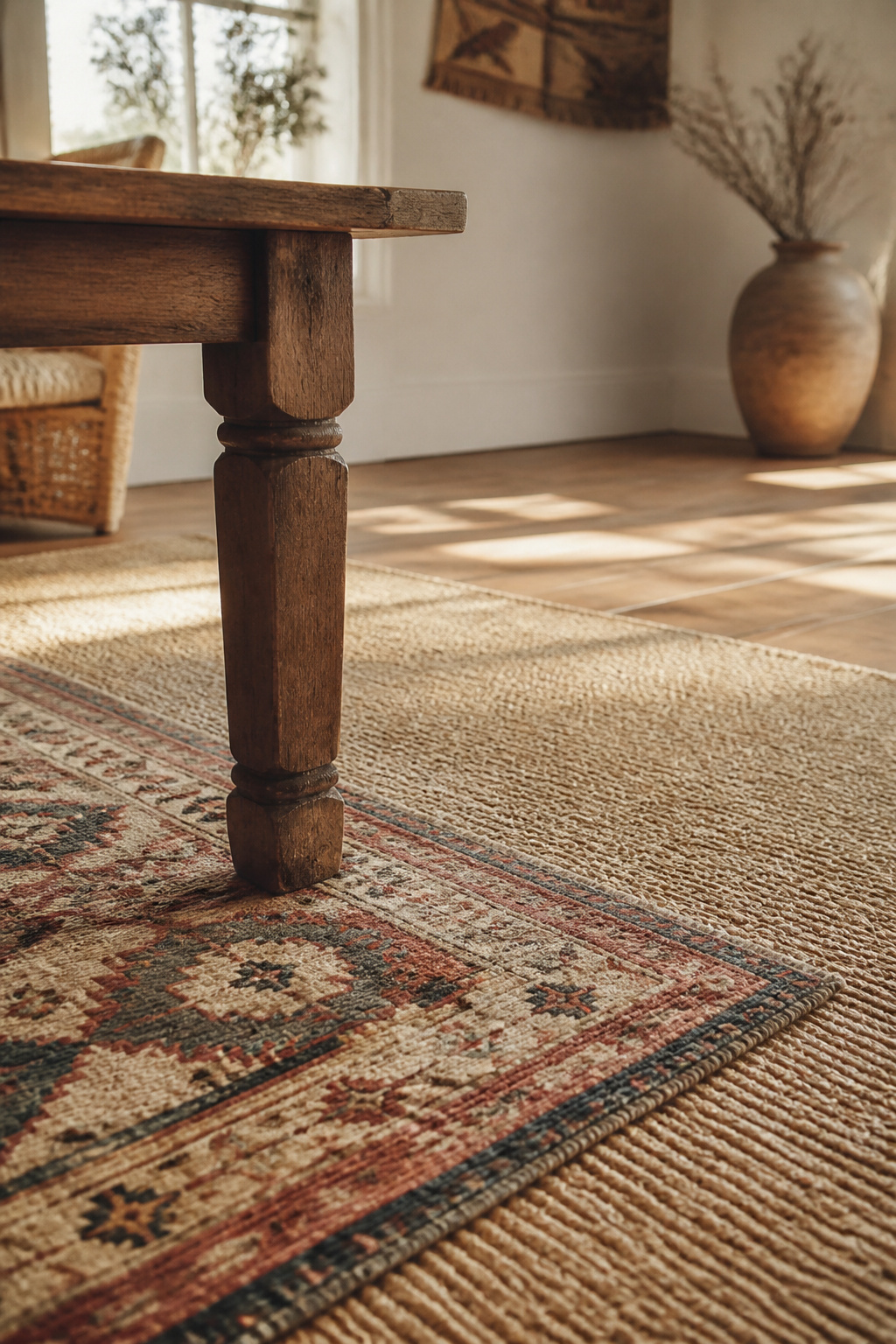
The neutral-base-plus-vintage-top-layer formula
The formula is consistent enough to write down. Start with a neutral base — jute or sisal, earthy and robust underfoot before any pattern arrives. Then set a smaller, more characterful rug on top: a vintage Persian, a Moroccan geometric, or a colourful kilim. The base grounds the space and frames the intricate top layer, while the seam between them does the quiet work of suggesting a room built over time.
Placement and sizing under a dining table specifically
Under a dining table, the base has one job it can’t skip: hold every chair at full pull-out. Size it to extend 24 to 30 inches beyond the table on all sides — roughly a 5×8-foot base for a four-to-six-person table and an 8×10 or 9×12 for a six-to-eight. The top rug then sits inside that footprint at about two-thirds the base’s size, the ratio that looks like deliberate layering rather than two mismatched rugs slipped together.
Buying real vintage and kilim versus new reproductions
The top layer is where authenticity is worth checking with your hands, not your wallet. Two tells separate a genuine flat-woven kilim from a printed reproduction. The first is abrash — the subtle colour variation across a single field, caused by dye lots differing between wool batches; in a real vintage piece it works almost like a certificate of handwork. The second is faster: flip the rug over. A genuine kilim’s back mirrors its face, the same geometry reversed, because it’s woven into a fully reversible cloth; a power-loomed fake shows an indistinct back or a mesh backing glued on to hide the construction. The full sourcing checklist, the placement rules for mismatched-height chairs, and the sizing tables belong to the spoke on layering rugs in a boho dining room.
Building an Earthy Boho Color Palette That Doesn’t Turn Chaotic
Underneath every decision so far sits colour, doing more work than any single object. Get the palette right and mismatched chairs, layered rugs and multiple eras settle together; get it wrong and no sourcing rescues the room.
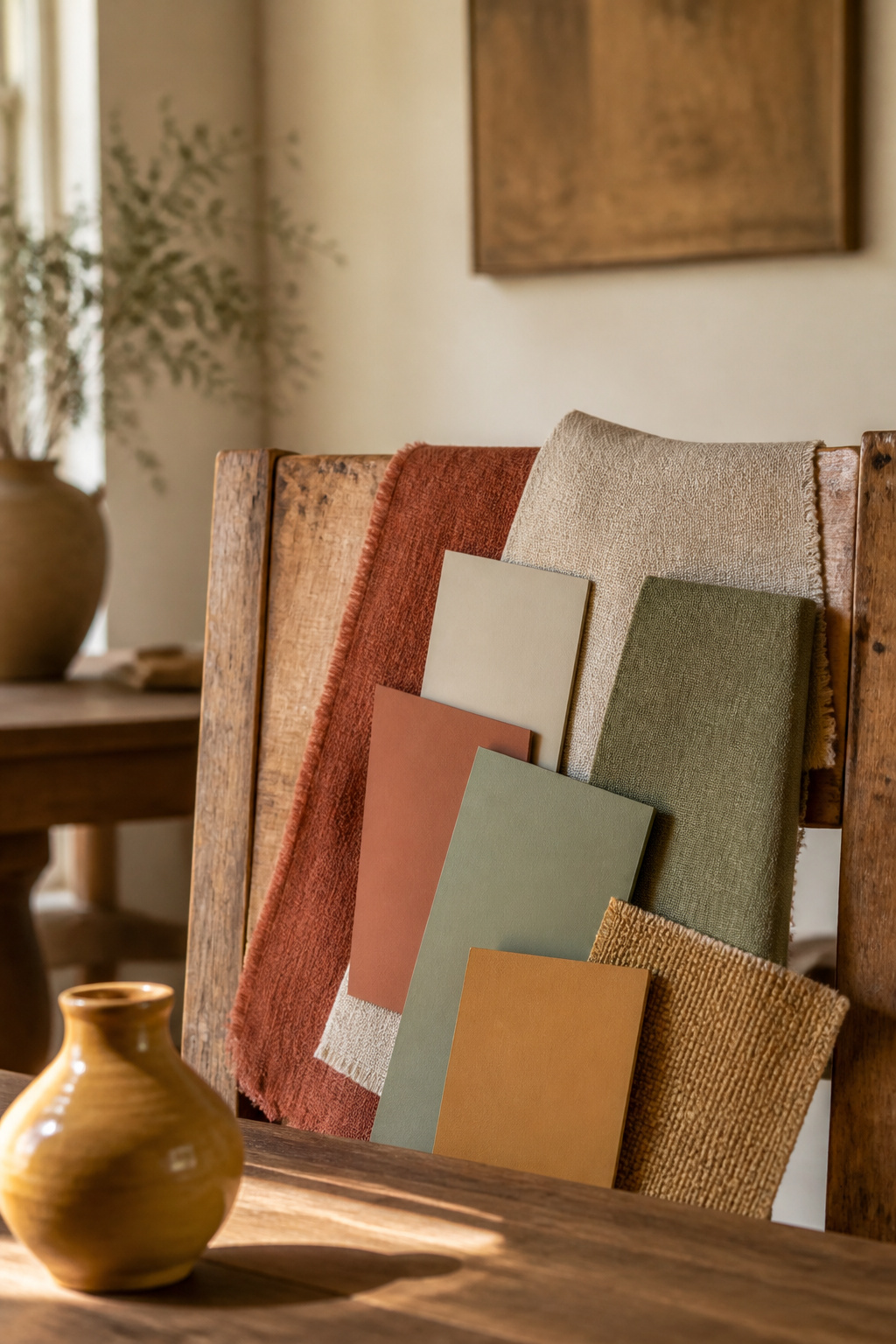
Terracotta, sand, olive and ochre as a base-plus-accent system
The successful boho palettes all follow a base-plus-accent structure: one dominant warm neutral, one or two supporting accents, and small pops of a bolder tone. The core earth-tone family is terracotta, rust, warm ochre, raw sienna, warm cream, sandy beige and muted olive. The sequence matters as much as the colours: start with warm-white or soft-beige walls, bring terracotta and rust in through a large rug or a statement pottery piece, then layer ochre and olive last through candles, vases and textiles. Earth tones are having a genuine moment — Spacejoy calls this the return of warm, grounded interiors after years of cool grey and stark minimalism.
Why undertone agreement matters more than any single color choice
Here’s what separates a calm earth palette from a muddy one: it isn’t the hues, it’s whether their undertones agree. A warm undertone running consistently beneath every colour is what lets pattern, texture and mixed eras coexist without conflict; two “earth tones” of opposite temperatures — a cool olive against a warm terracotta — will quietly fight even though both sound right on paper. A 60-30-10 proportion (60% neutral, 30% earthy accent, 10% bold accent) keeps the ratio predictable even when individual pieces are mismatched.
Testing a palette against your existing furniture before committing to paint
Never commit to wall paint from a chip. Hold fabric and paint swatches against your actual wood tones and chair upholstery in the room’s own daylight, because warm earth colours shift noticeably under artificial light — a terracotta that glows at noon can turn muddy under a cool bulb. The full method for building and testing the palette is the spoke on the boho dining room color palette.
Where Plants Belong in a Room You Actually Eat In
Plants are the boho element most likely to be styled for a photograph and least likely to survive daily use of the table. The difference comes down to placement: a dining room splits into three plant zones, each with its own height and light demand.
Trailing plants for shelves and sideboards versus centerpiece greenery
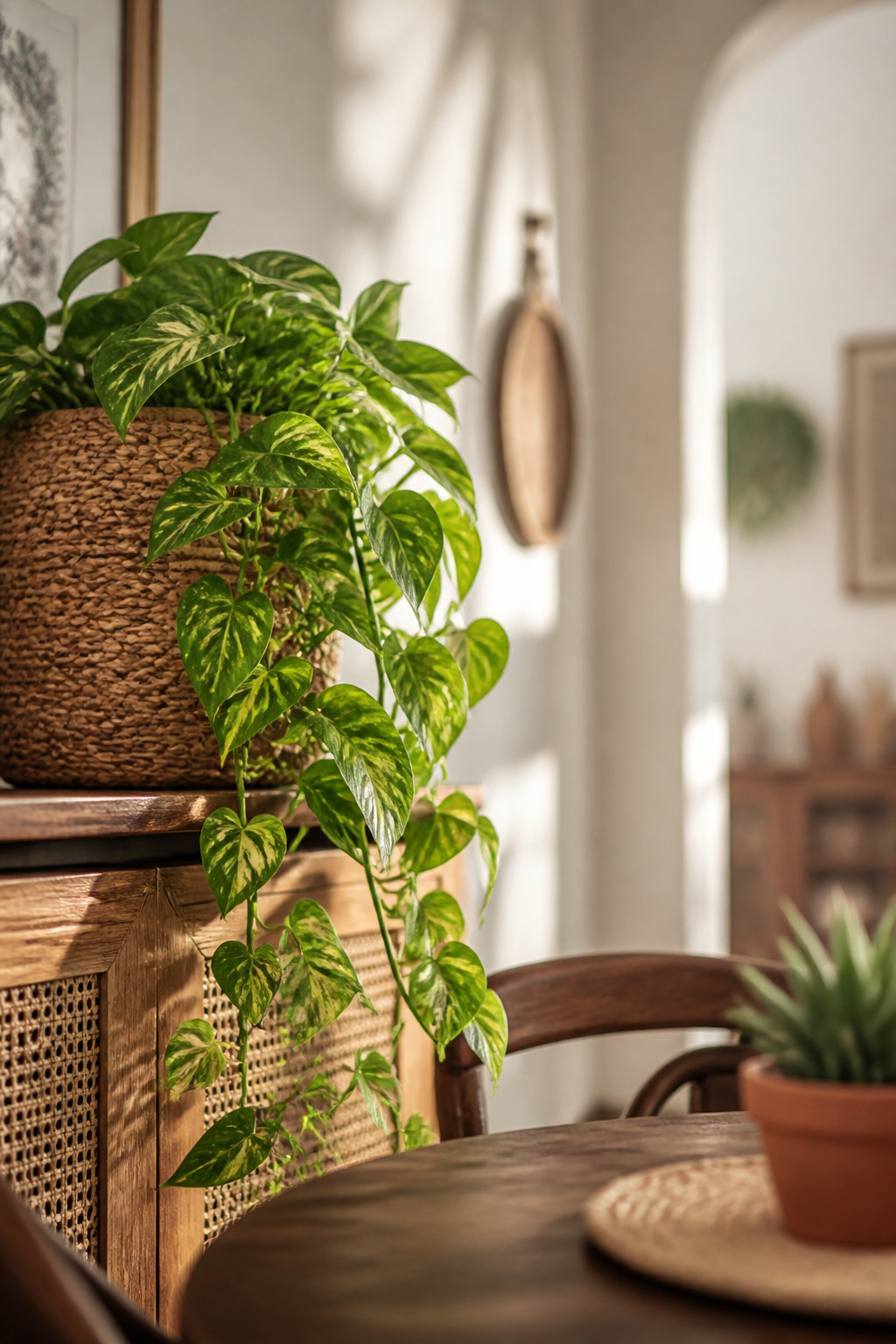
Most greenery belongs off the table entirely. Trailing plants — pothos, ivy — do their best work spilling from a shelf, adding movement without competing for surface space, while sideboards and consoles are the natural home for larger arrangements and a tall fiddle-leaf fig or palm in a woven basket anchors a corner. Each zone does a different job; crowding them all onto the table is where the trouble starts.
Keeping sightlines clear across a table that gets used daily
The table itself has one rule most style guides skip: the centerpiece must stay low. A tall arrangement that blocks the view across the table is a livability failure — the single most common complaint from people who eat at their tables daily, and why a low potted plant, a terrarium or a small succulent run beats a dramatic vertical every time. Keep plants clear of doors, vents and walkways too, so pathways and sightlines both stay open.
Low-light options for dining rooms without much direct sun
Dining rooms are often set back from windows, dimmer than the living room next door, so plant choice has to start from the room’s real light level. Check whether your room reads bright, medium or low first. For genuinely dim rooms, the reliable performers are the ZZ plant, snake plant, pothos and peace lily — all tolerate low or indirect light and want watering only every one to three weeks. The plant-by-plant placement guide, from sightline-safe centerpiece heights to the low-light picks that actually thrive, is the spoke on styling plants in a boho dining room.
Lighting That Shapes the Room, Not Just Brightens It
A woven pendant is the boho element that does the most with the least — and the one whose real job is misunderstood. It isn’t there to brighten the table; it’s there to shape the light and the shadow the room sits inside.
Why rattan and woven pendants dominate boho dining lighting searches
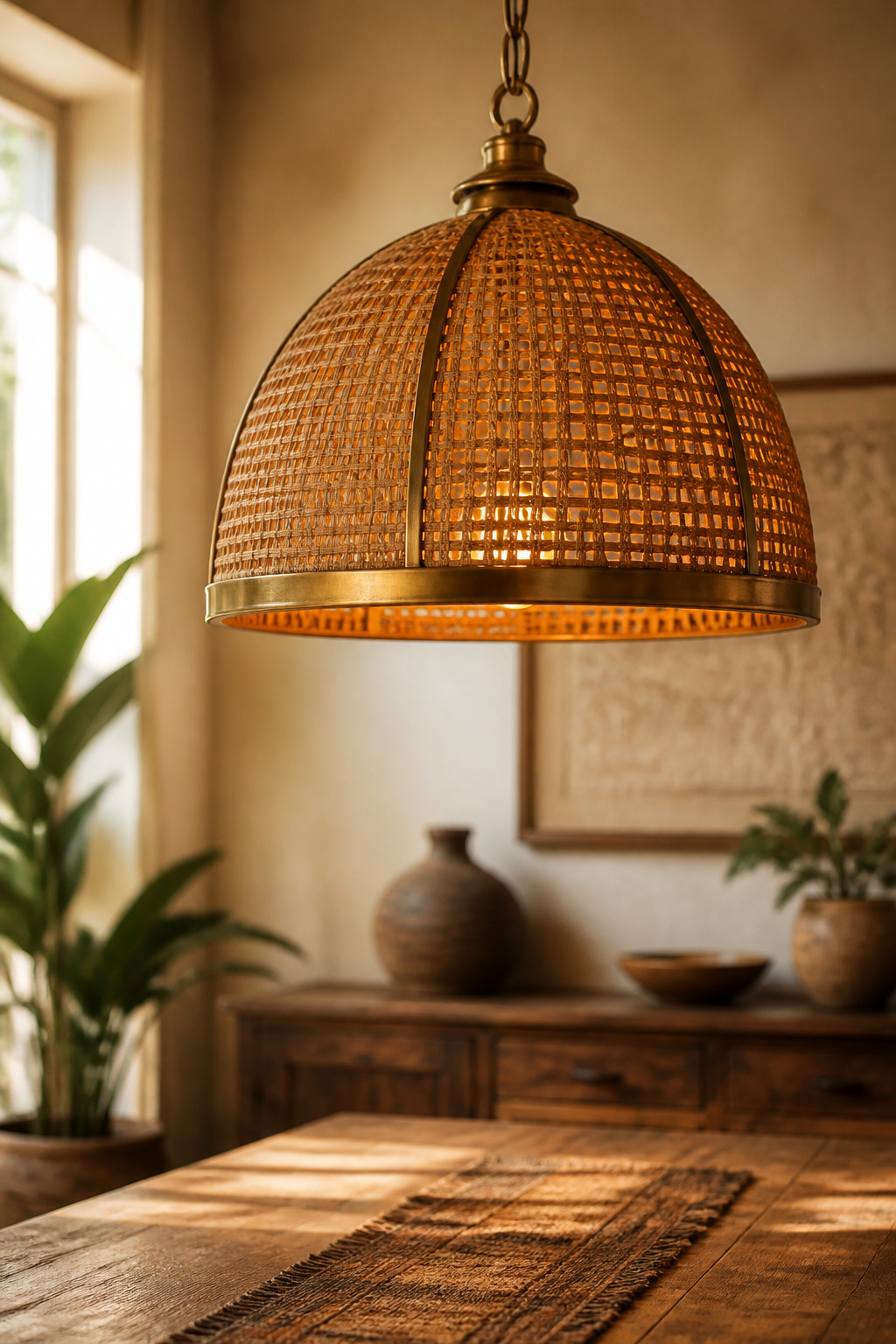
Rattan and woven pendants dominate boho dining lighting for a reason beyond looks: they’re chosen as much for the dappled shadow their woven shade throws across the table and walls as for the light they put out. The fixture works as illumination and texture at once — an open weave scatters pattern, a tight weave holds a soft, even glow. The same silhouette can suit two completely different rooms depending on how the shade is woven, a distinction a thumbnail can’t show you.
Fixture scale and hanging height over a table
Scale wrecks more otherwise-good rooms than any other lighting mistake. Size the pendant to the table, not the ceiling: aim for a diameter roughly one-third to one-half the table’s width, and never let it exceed the table. Hang the lowest point 30 to 36 inches above the surface on a standard 8-foot ceiling, adding about 3 inches per extra foot of height. Over a long table, run multiple pendants 24 to 36 inches apart — three over a 96-inch table land about 32 inches apart, lighting it end to end without overlap.
Brass accents as the room’s warm-metal counterpoint
A room built only from woven fibre and pale wood can drift soft, without a line for the eye to rest against. Brass is the warm-metal counterpoint that grounds it — rattan pendants are often built on a burnished-brass frame under a flat woven dome for exactly this reason, giving the fixture a metal accent that echoes brass hardware used elsewhere. The full fixture-selection guide, with the scale tables and the weave-density decision, is the spoke on boho dining room lighting.
Getting the Look Without Overspending
Now the part everyone assumes wrong. A layered, collected boho dining room looks like a large furniture budget, so people price it against a new matched set — yet it’s usually cheaper to furnish, because the collected look is a sourcing technique, not a spending signal.
What’s worth buying new versus sourcing secondhand
The split is simple: buy the table base new, source almost everything else secondhand. A quick coat of paint or fresh upholstery turns thrifted vintage chairs into cohesive boho pieces, which makes secondhand seating a primary budget lever rather than a compromise. Mismatched chairs mixing painted wood, rattan and vintage finds look artsy and collected — not like a discount buy — when a shared paint colour or matching cushions ties them together. The unification does the work the price tag doesn’t.
Thrift and flea-market strategy for chairs and rugs specifically
Flea markets and thrift stores are the reliable channels for the two categories that matter most here — vintage chairs and rugs — rather than general secondhand furniture. A small colourful rug over a larger neutral one, both sourced cheaply, delivers the layered look without new-rug pricing. A negotiating note: bargaining lands better as a conversation than a confrontation. Compliment the craftsmanship first — mean it — then ask politely whether the price has any give.
Sequencing a room over months instead of one big purchase
The collected look is, in practice, the natural result of sourcing gradually rather than furnishing all at once. Build the room in stages — a solid table base first, then chairs and rugs found opportunistically over months — because thrift and flea-market inventory is unpredictable week to week. Completing the room in one trip works against the quality boho depends on. The full sourcing plan, with the price spreads and the phasing calendar, is the spoke on a boho dining room on a budget.
Weekend Projects That Finish the Room
The last layer is the one you make rather than buy — the fastest way to put a genuinely personal, unmistakably boho signature on the room. A handful of weekend projects finish a dining space in ways no purchase quite matches.
Macrame and no-sew textile projects as the fastest boho signature
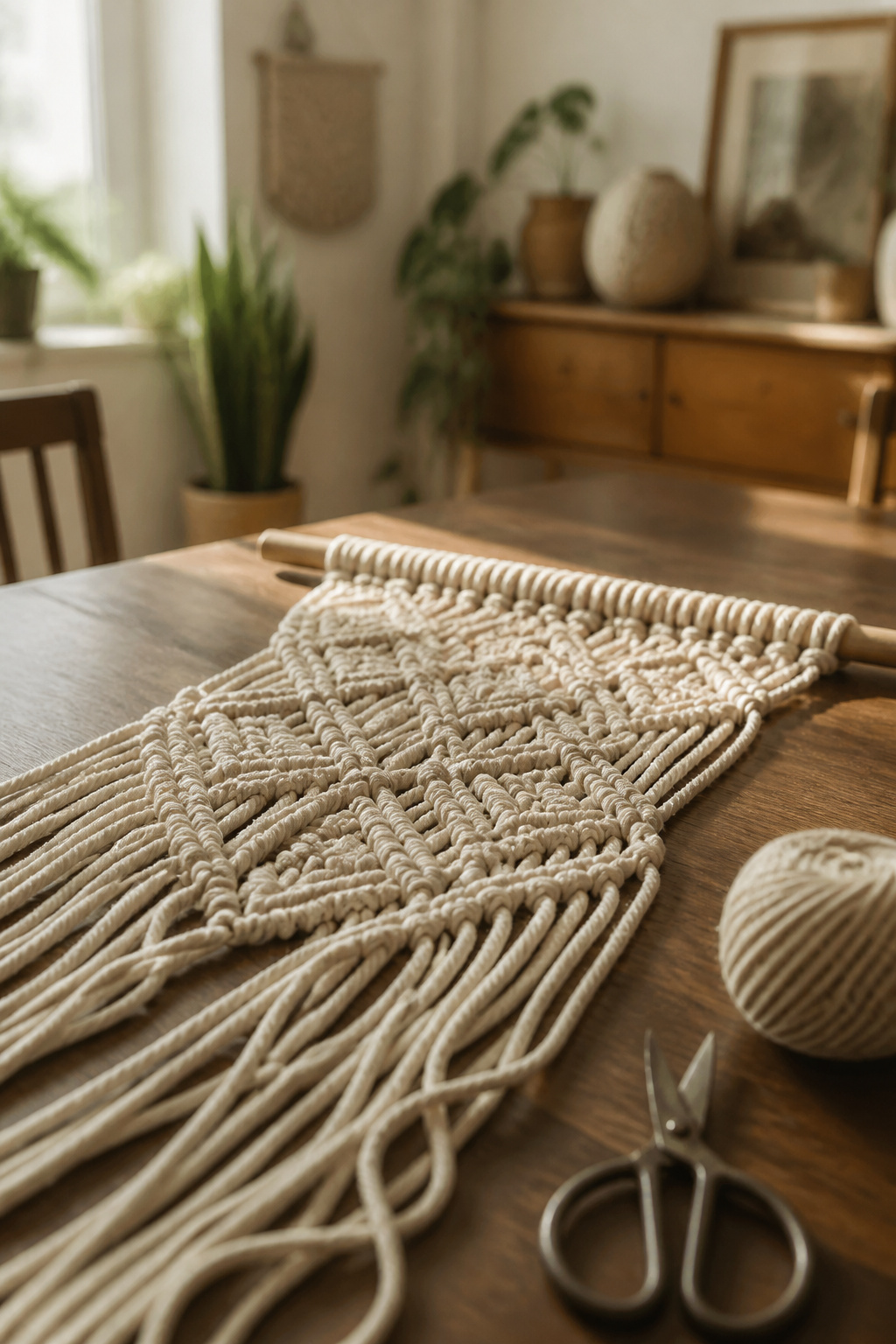
Macrame is the boho signature people picture, and it’s more approachable than it looks. A table runner comes together from a 12-inch dowel, cotton rope and three simple knots in an afternoon; an oversized wall hanging costs around $66 in materials and a few hours including installation, and a no-sew burlap runner suits anyone avoiding sewing entirely. One durability note: natural-fibre cord (cotton, jute, hemp) wants replacing every two to three years indoors, while synthetic cord lasts five to ten — a real trade-off for a piece meant to last.
Restyling a single thrifted chair or table instead of buying new
This is the project I’d steer any beginner toward, and it’s where I learned my hardest lesson. At nineteen, sure of myself, I stripped an oak chest with the wrong solvent and scoured decades of honest patina straight off the wood — turned a piece with a past into one I’d ruined, in an afternoon. So restyle a thrifted chair by all means — a coat of paint or new upholstery is the standard weekend swap, $20 to $100 in DIY slip-seat materials against $100 to $550 professionally — but respect the finish that’s already there before you remove it. Reversibility is the whole ethic: never do to an old piece what the next owner can’t undo.
A seasonal centerpiece rotation that keeps the table from going stale
The trick that keeps a boho table from going stale is a swappable centerpiece — a low potted plant, a terrarium or a small dried arrangement that rotates with the seasons without breaking the sightline rule. Painted terracotta pots and dip-dyed textiles are cheap seasonal swaps that fit the rotation. The step-by-step builds, with real cost and honest hours for each, are the spoke on DIY boho dining room decor projects.
Boho Dining Room Ideas: The Handful of Decisions That Actually Matter
Step back from the survey and the noise resolves. A boho dining room isn’t a dozen purchases; it’s four or five decisions that determine cohesion, plus plants and projects that finish the room rather than found it. Here is the whole thing, distilled to the rule for each and where to go deeper.
| Decision | The rule | Go deeper |
|---|---|---|
| Chairs | One shared material or colour; seat heights within 2 in (17–19 in standard) | Mismatched chairs |
| Rug | Smaller vintage rug (~⅔ the base’s size) over a neutral jute base; base extends 24–30 in past the table | Rug layering |
| Palette | Warm-neutral base plus one or two earth accents, undertones agreeing, at 60-30-10 | Colour palette |
| Lighting | Woven pendant ⅓–½ the table’s width; hung 30–36 in above the surface | Lighting |
| Small room | Round pedestal table, lighter rattan, edit the layering down | Small dining room |
| Plants | Trailing on shelves, low centerpiece under the sightline, low-light picks for dim rooms | Plants |
| Budget | Table new, everything else secondhand, sequenced over months | On a budget |
| Projects | Macrame, a restyled thrift chair, a rotating centerpiece | DIY projects |
The one mistake that undoes an otherwise well-sourced room
If you take one thing from this guide, take this: the failure mode isn’t mixing, it’s mixing without a thread. The single most-cited mistake across every source is adding boho-tagged objects with no shared material, colour or undertone connecting them to what’s already there. Quantity of “boho” pieces produces clutter; a repeated element produces a style.
Where to start if you’re building from nothing
Building from an empty room, work in the order that constrains the most decisions first. Settle the table’s size and shape — round for small rooms, per the diameter-plus-72-inch formula — because everything else answers to it. Then the rug base, then the chairs, then the lighting, and only last the palette accents and plants. Run every purchase through the provenance test from the top of this guide: where did this come from, and does it repeat something already here? A reader who couldn’t tell whether their boho ideas added up to a real style can now name the decisions that unify one, and knows which guide to open for each. The chairs won’t match. The rugs won’t match. Done with a thread running through it, that’s the whole point.