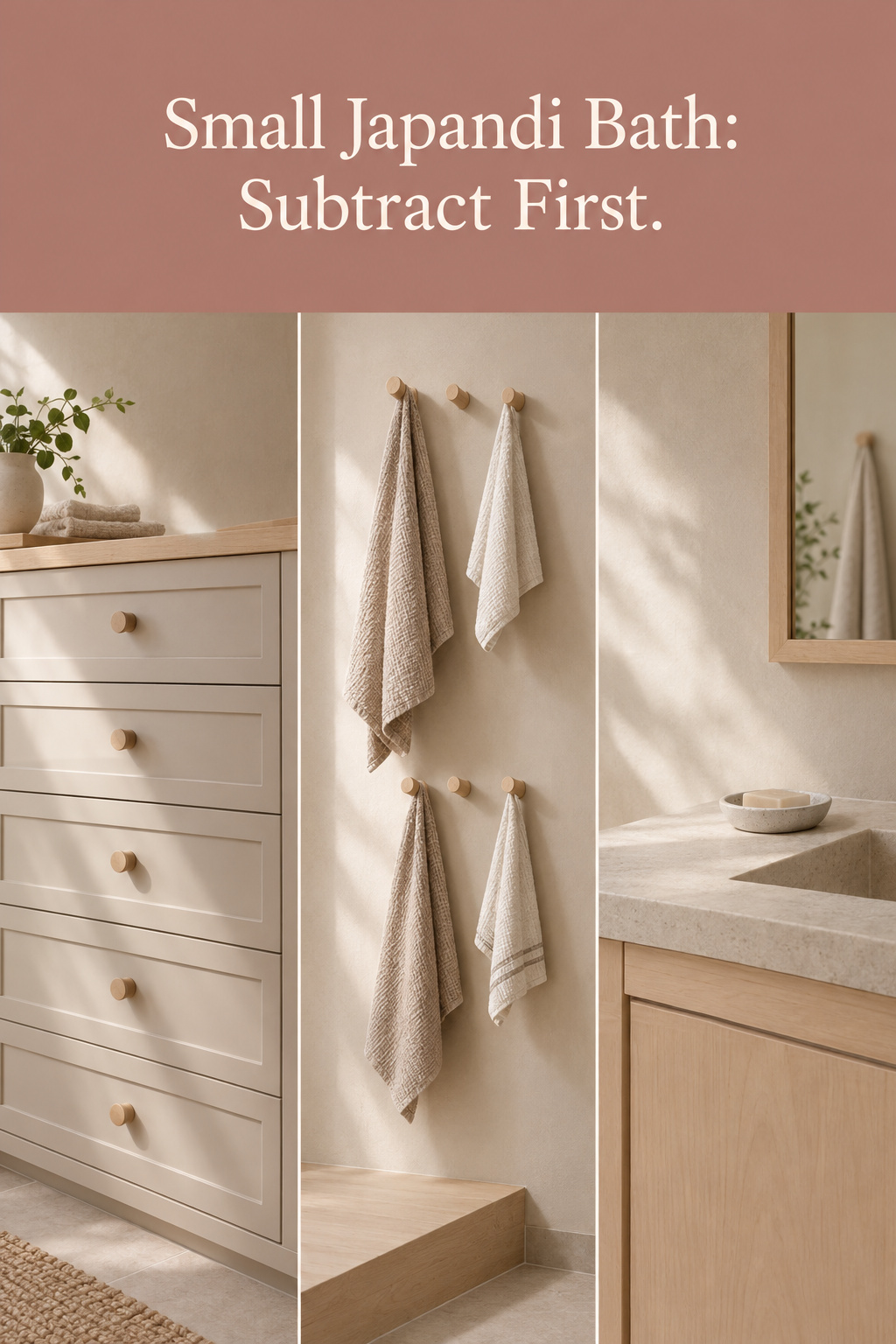
It’s 7:40 on a school morning. The tap is running, someone is spitting toothpaste around someone else’s elbow, and the tile is cold and wet under bare feet. Four people, one counter, and on that counter a forest of bottles, two cups of toothbrushes and a hairbrush nobody claims. The small Japandi bathroom you picture has a bare stone counter and one soap dish, and it looks like nobody has ever brushed their teeth in it.
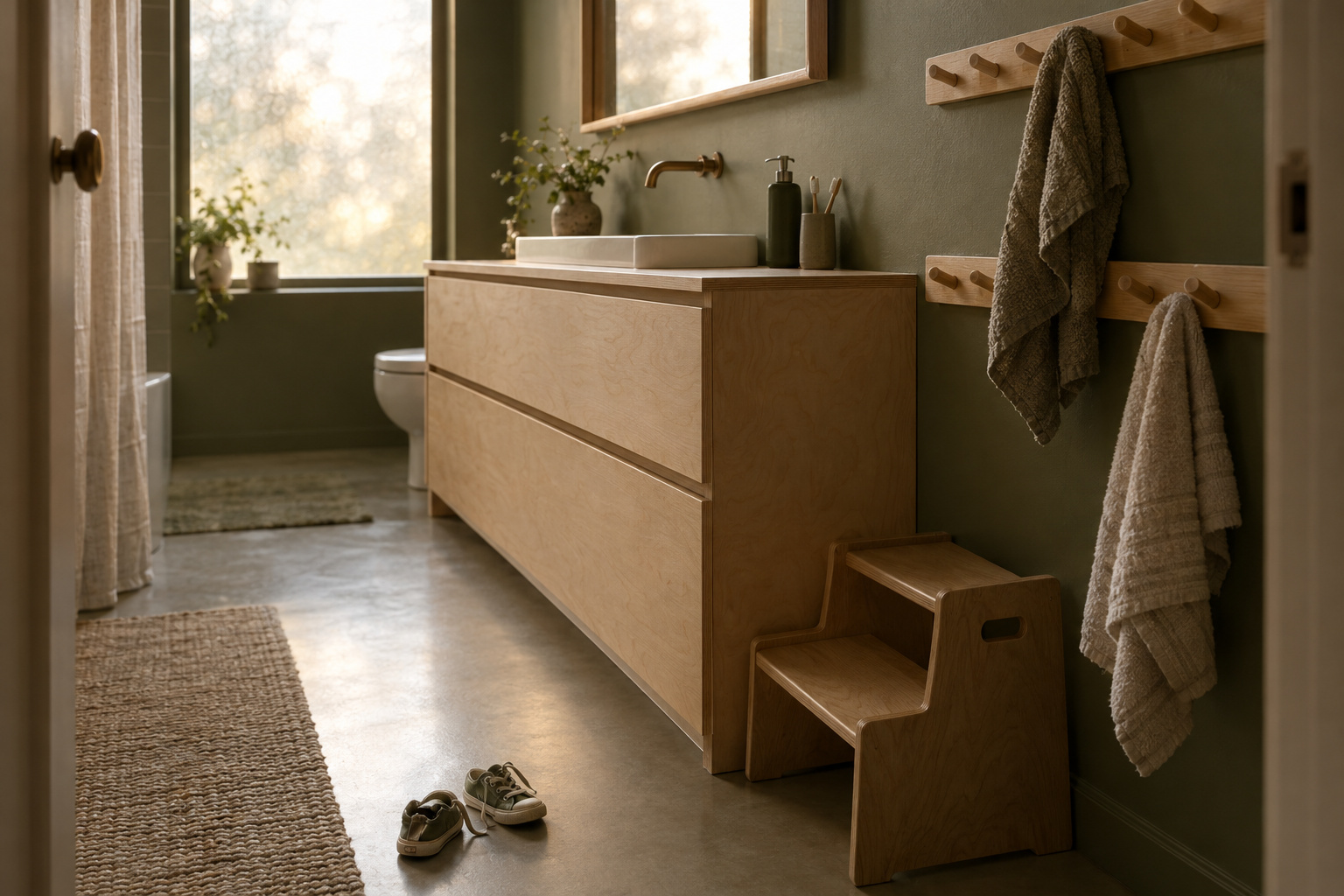
That calm is buildable in a 5×8 room with kids in it. You get there by taking things away in the right order, then giving everything that has to stay a front that the right person can open.
TL;DR
- Subtract before you buy: in a room of about 40 square feet, clear the floor, then the counter, then the walls, and add back only what has a daily job.
- Put each person’s own things behind a front they can reach (the advisory reach range for ages 5 to 8 is 18 to 40 inches), but keep medicines, cosmetics, toothpaste, soap and shampoo high and latched, as pediatricians advise.
- Make the bare room safe wet: choose floor tile rated 0.42 or higher for wet interior use, and check that the tub’s hot water is limited to 120 °F.
What Leaves a Small Japandi Bathroom First
Most American full bathrooms are 40 to 50 square feet, and the most common layout is 5×8. That’s 40 square feet for a tub, a toilet, a sink and everyone’s stuff. The building code sets no minimum size for the room, only clearances in front of each fixture: 21 inches of clear floor in front of the sink, toilet and tub, while the kitchen and bath designers’ association recommends 30. In a room 5 feet wide, 30 inches is half the width before anyone drops a laundry basket.
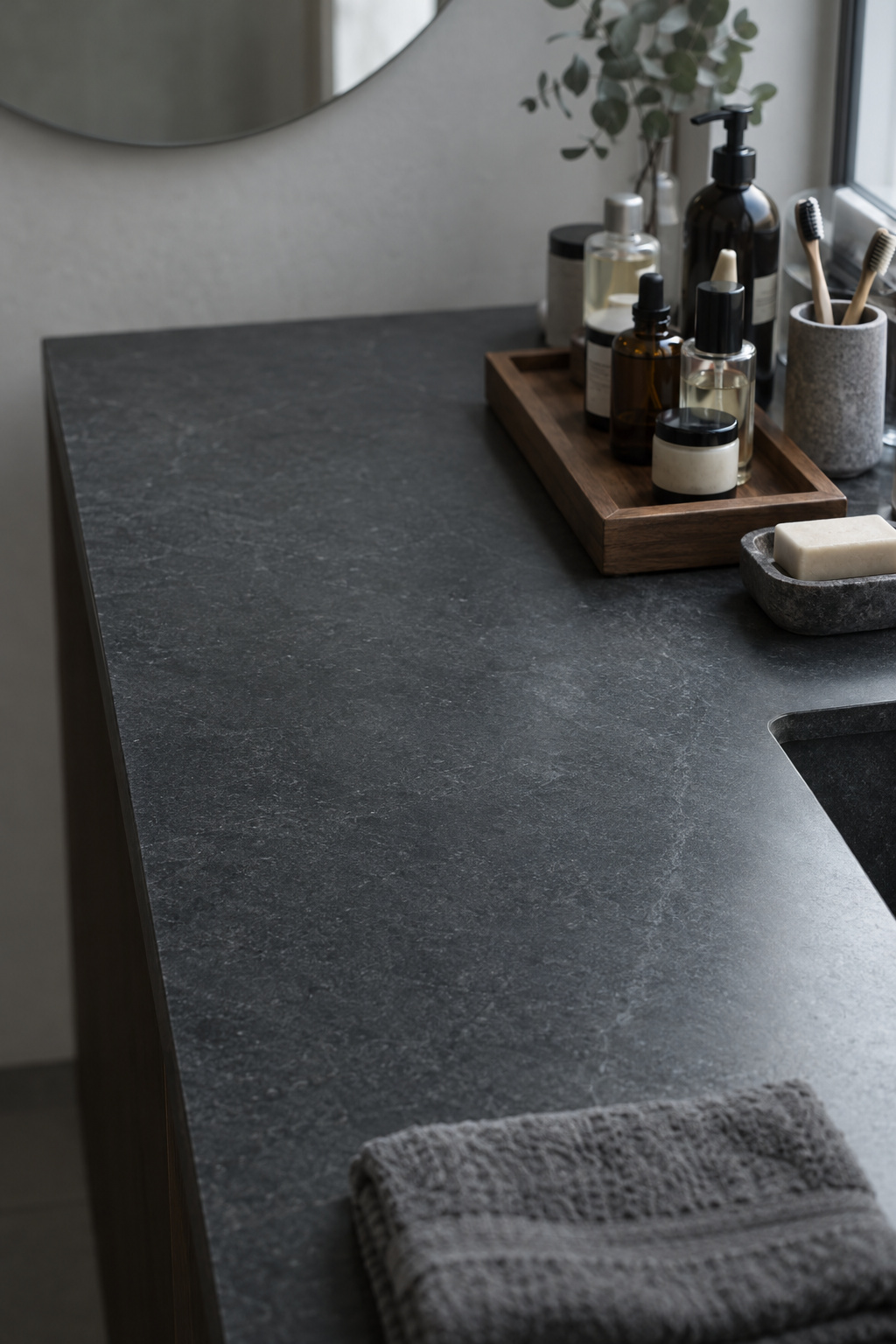
I clear things in this order, from what crowds the eye most to least:
- Everything on the floor: the basket, the spare toilet rolls, the bath toys.
- Everything on the counter. All of it, even the soap, for one week. You’ll learn what gets used.
- Everything stuck to the walls: suction caddies, over-the-tub racks, the shelf that became a junk drawer without a front.
- Decorative extras.
What Japandi borrows here is restraint: wall-mounted or leg-supported furniture so the floor stays open, simple shapes, few objects. The materials and the wider look belong to designing a Japandi bathroom; in a shared room, restraint comes first.
Closed Fronts Are What Make a Small Room Look Empty
I think your counter is crowded because it’s the only place in the room nobody has to open.
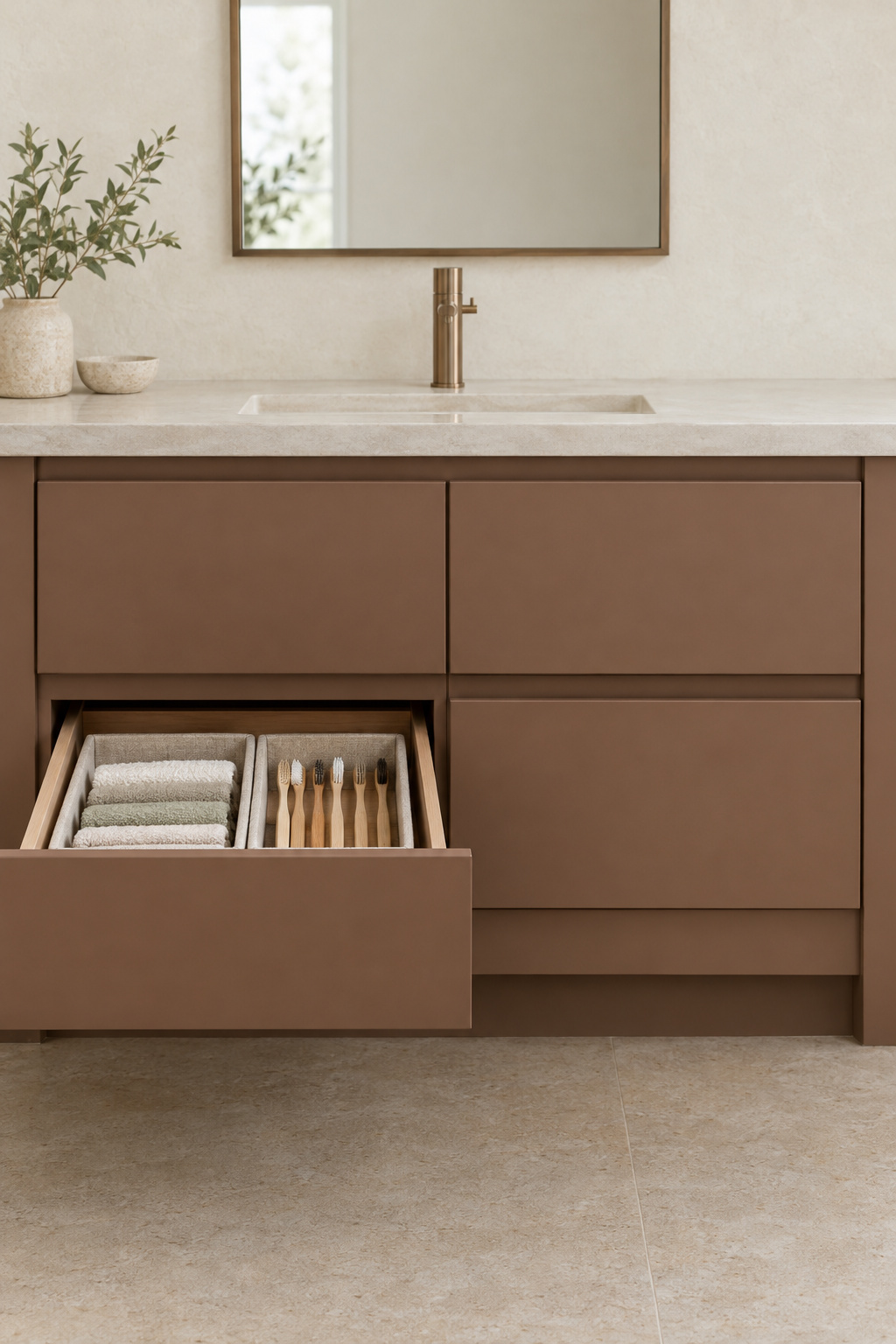
I moved my kids’ plates and cups to the lowest drawer in my kitchen, and they started setting the table without being asked. Things need to be within reach, not just out of the way. A bathroom works the same. When a child’s toothbrush lives in a drawer at their height, that’s where it goes back.
Some things still have to go high. Pediatricians advise keeping medicines and cosmetics high in a locked cabinet, and toothpaste, soap and shampoo behind a safety latch or lock. So a family bathroom needs two kinds of closed front:
| What was on the counter | Where it lives now | Who opens it |
|---|---|---|
| Kids’ toothbrushes, cups, washcloths | Low vanity drawer, one box each | Each child |
| Kids’ hand towels | Low hook row | Each child |
| Adult toothbrushes, razors | Upper vanity drawer | Adults |
| Toothpaste, soap refills, shampoo | Latched cabinet, high | Adults |
| Medicines, cosmetics | Locked cabinet, high | Adults |
Most of that closed storage is the vanity, so it pays to choose a vanity with drawers children can reach and to think about how it’s built. The guide to small-bathroom storage has the boxes and dividers if you want product ideas.
I used to buy matching storage bins until my kids couldn’t tell which held what. Now every bin gets a picture label, bathroom drawer boxes included. And skip push-to-open fronts on the low drawers: a small child often can’t work them, so the toothbrush stays out.
One Room, Several Heights: Planning Storage Everyone Can Reach
I think of independence as small jobs a child can finish alone, and putting a towel back is one of them. If a child can’t reach it, open it or put it back, the room is decorating, not designing.
Reach heights by age
Before you buy anything, kneel in the bathroom doorway and look around at your child’s height. Then use the advisory reach ranges from the federal accessibility guidelines. They’re design ranges for fixed things like hooks and storage, not measurements of real children:
| Age | Reach range | What lives in that band |
|---|---|---|
| 3 to 4 | 20 to 36 in | Their drawer, their towel hook |
| 5 to 8 | 18 to 40 in | Drawer, hook, their own washcloth |
| 9 to 12 | 16 to 44 in | All their own things |
Hooks at two heights and a step that is also a seat
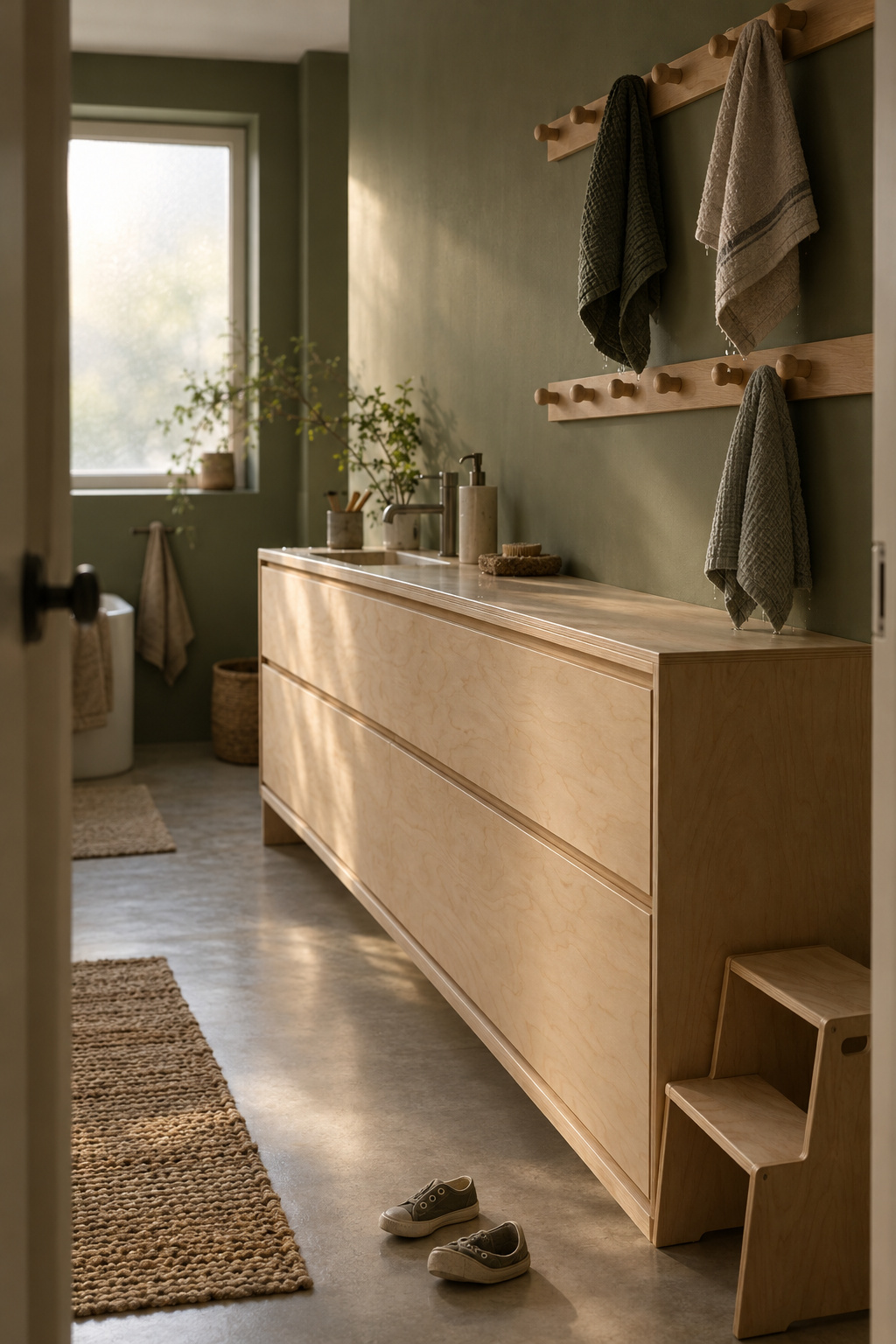
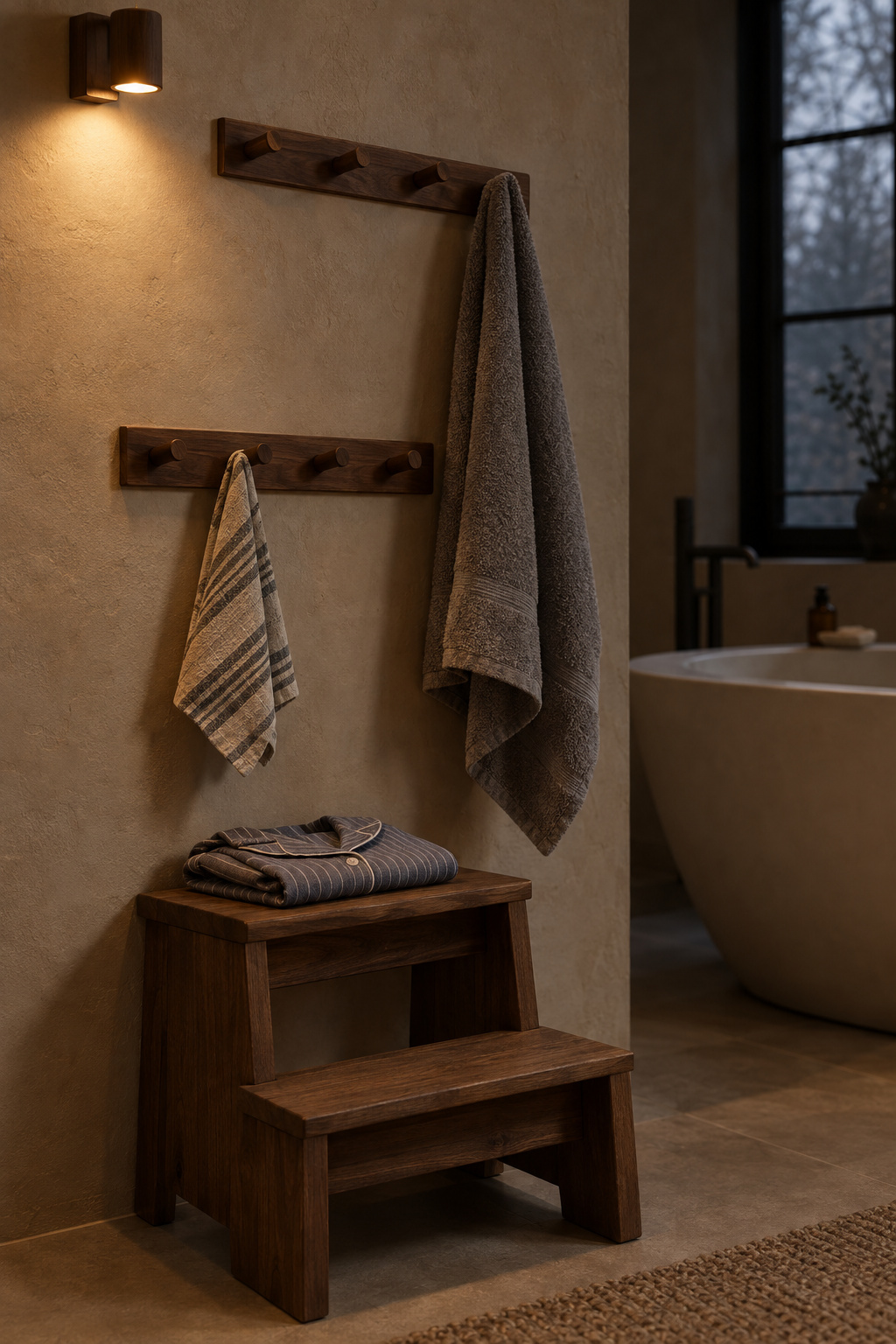
A low hook does more for tidiness than any organizer. An organizer is one more object on a surface; a hook is a place a wet towel can go in one move. Hang one row low, around 36 to 40 inches, and the adult row at 60 to 65. Plan for the next stage: a nine-year-old can still use the low row, so it doesn’t move every birthday. Our growth-chart doorframe has moved house with us twice and now lives in the hallway. Kids outgrow heights faster than you redecorate.
A sturdy step at the sink, sized to your child and your basin, finishes the job. Pick one solid enough to sit on, and it doubles as the seat for drying feet.
Scald safety when children use a deep tub
Water heaters should be set no higher than 120 °F (48.9 °C). At that temperature hot tap water takes about five minutes to cause a third-degree burn in an adult; at 140 °F it takes about five seconds. Most tap-water scalds involve older people and children under five, and no one has established how much faster a child burns, so 120 °F is a ceiling, not a target. Test the bath with your wrist or elbow; it should be no hotter than 100 °F.
The model building code requires a temperature-limiting device on bathtubs, set to a maximum of 120 °F, and tub-shower valves need a high-limit stop at the same figure. Older houses may have neither, and only a plumber can tell you what yours has. If you’re planning a deep tub children can use safely, check this first, and never leave a young child alone in the bath, even for a moment.
A Wooden Mat and a Floor That Are Not Slippery When Wet
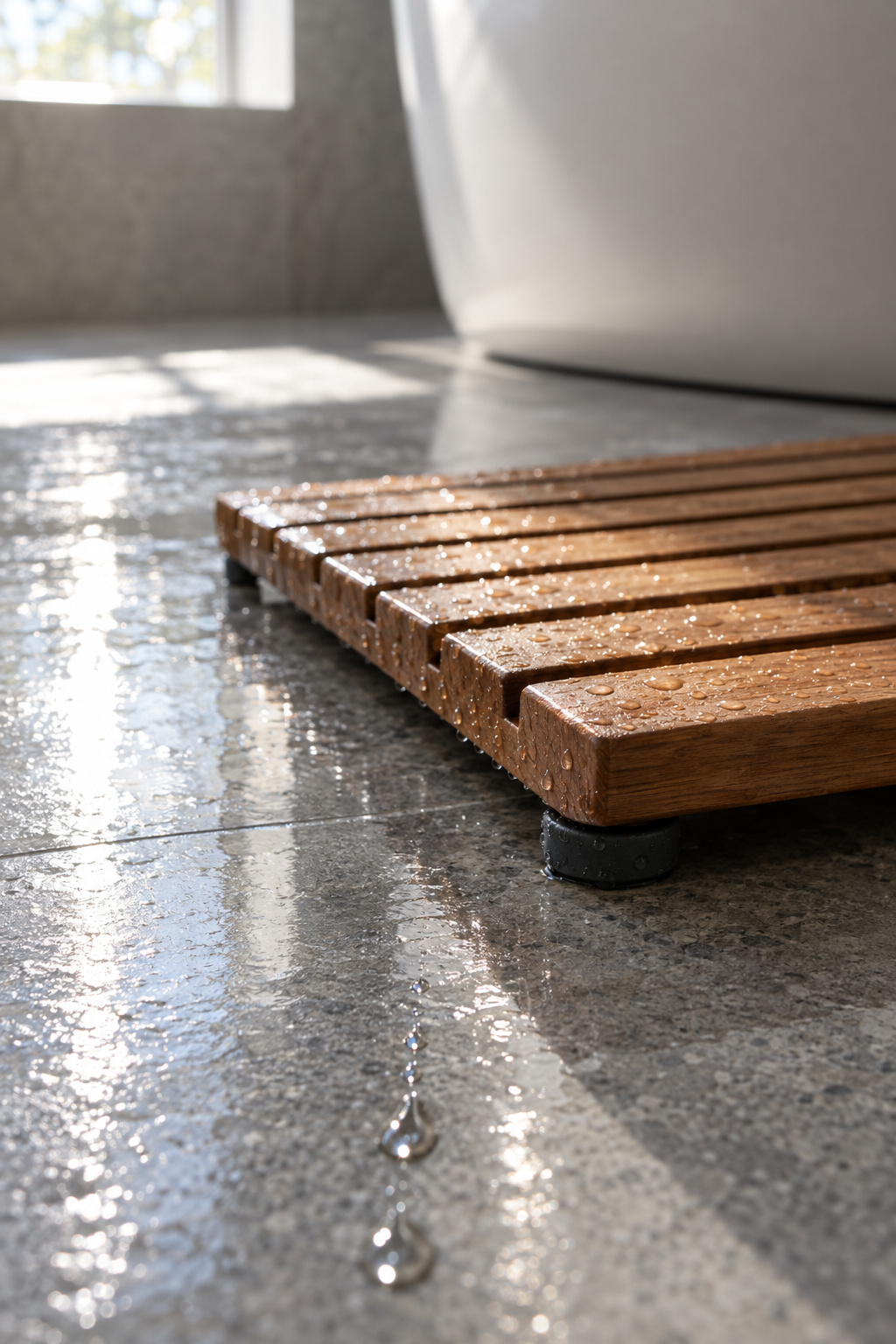
Bare stone and a wooden mat look calm, but both have to grip once they’re wet.
For floor tile, look for a wet dynamic coefficient of friction (DCOF) of 0.42 or higher, the standard’s minimum for level interior floors walked on when wet. Read it as a comparison between tiles, not a promise. The tile industry’s own council says DCOF doesn’t predict whether a person will slip, and the 0.42 figure was not originally set for shower floors or soapy water. Glazed handmade tile can be far lower; glazed zellige measures around 0.16. Smaller tiles with more grout lines drain better; polished finishes don’t belong where water lands.
If your floor is already slick, clean it properly before buying anything. Residue cuts traction, and topical waxes and coatings change how tile grips, while penetrating sealers mostly don’t.
There is no slip rating for wooden bath mats. The rubber feet on a hinoki or teak mat grip the floor underneath, not the sole of your foot on top. Lift it to dry after the last bath, and don’t leave it on a floor that stays wet, where mold can grow under the feet. In the tub itself, pediatricians recommend no-slip strips.
The One Open Shelf, for Adults Only
After all that closing, one open shelf is allowed. It goes up last, and it belongs to the grown-ups.
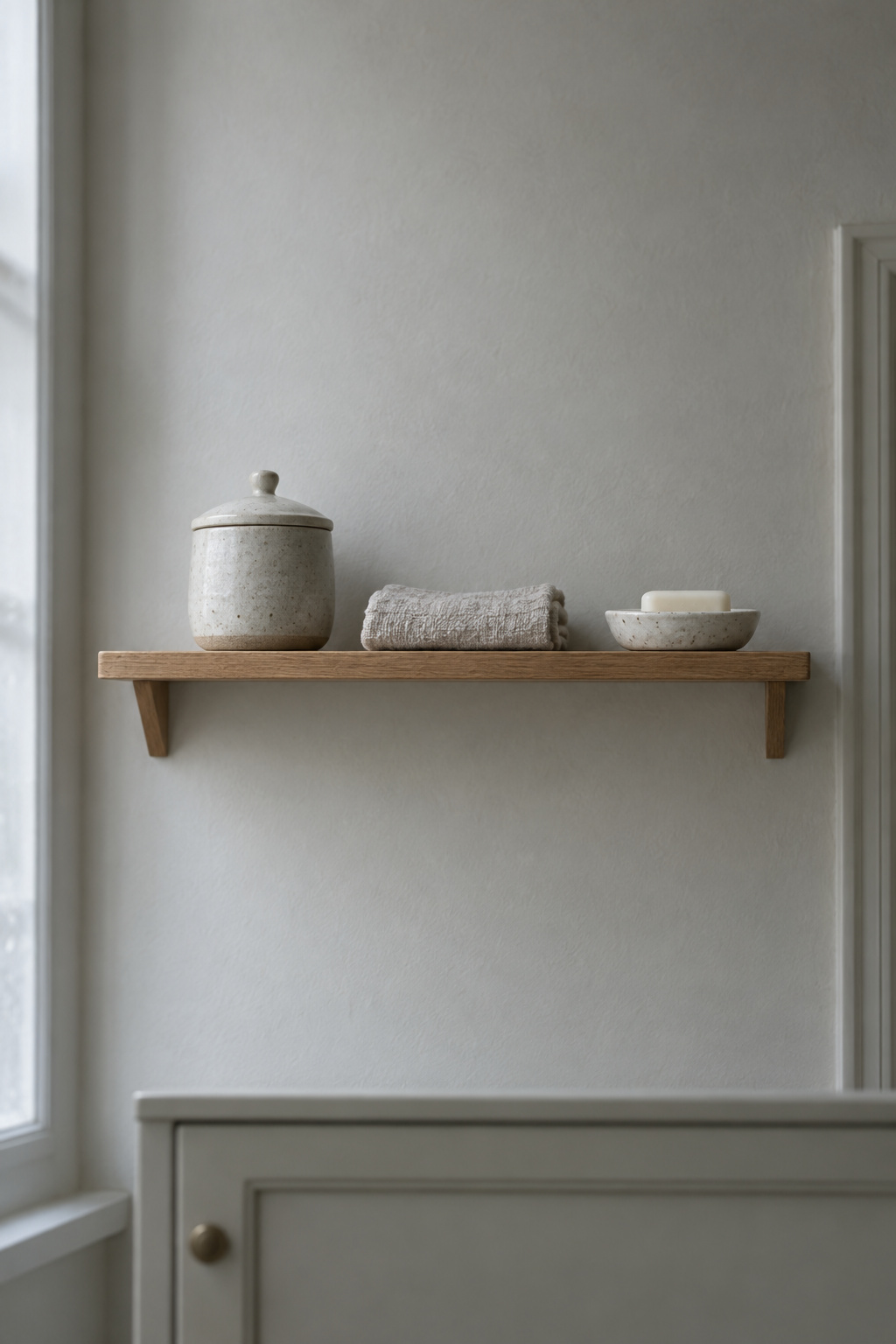
Hang it above the oldest child’s reach. The advisory range tops out at 44 inches for 12-year-olds, so set it well above that, at a height the adults can still reach without a step. A depth of 6 to 8 inches is plenty, screwed into studs.
My rule is two or three things, each used every day or worth looking at: a lidded ceramic jar, a folded linen hand towel, a soap dish. Never medicines or cosmetics, because an open shelf can’t be locked. Never the counter’s overflow either, or you’ve just moved the clutter up a few feet. The decor guide goes further into which few objects to keep and what they’re made of.
A School Morning in the Same Room, Now
Same room, 7:40, same four people. The counter holds a soap dish. Each child pulls their own drawer, grabs their own toothbrush and drops it back (mostly; it’s a room, not a museum). Towels go on two rows of hooks, and you can see the floor.
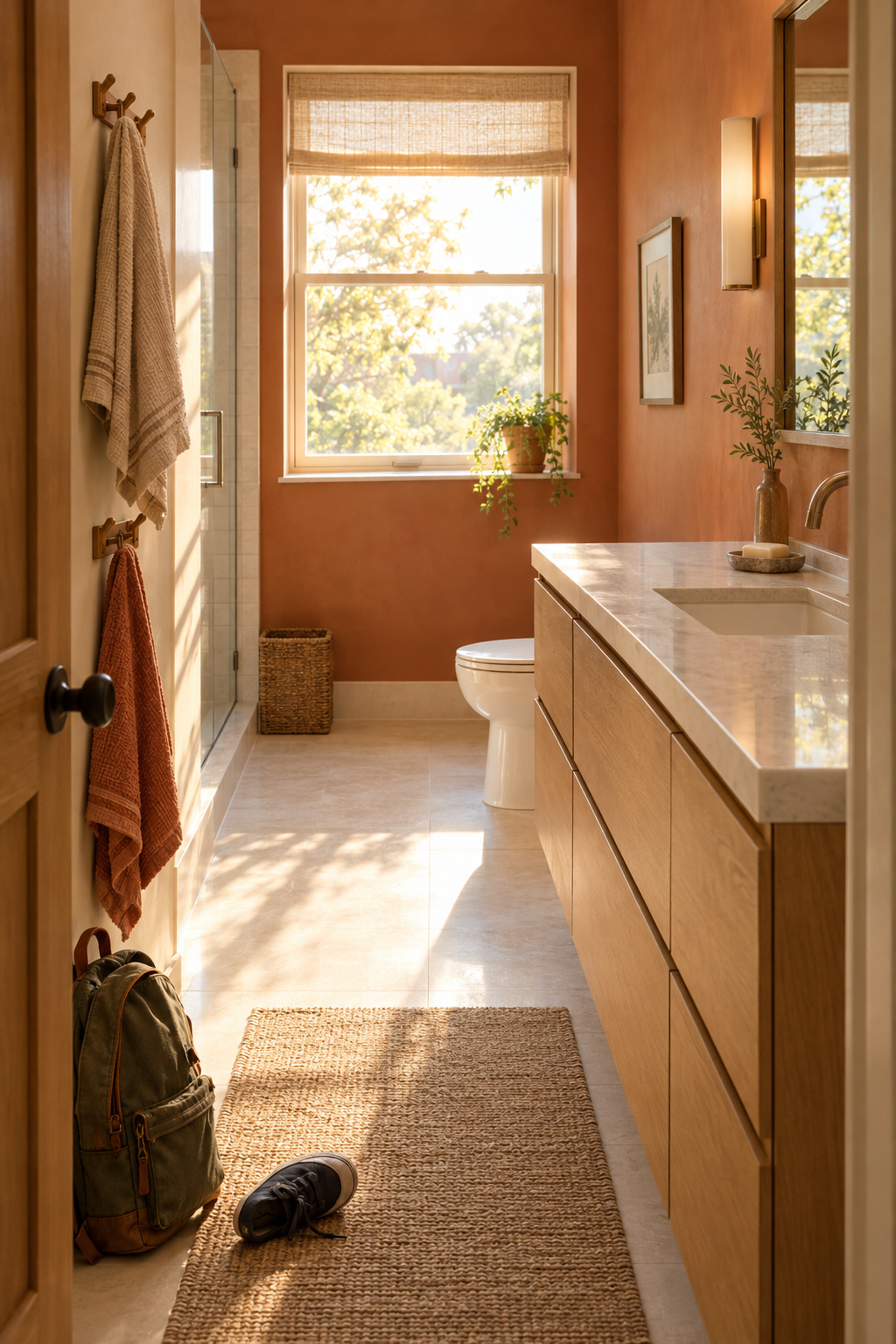
The floor emptied, then the counter, then the walls. Everything that stayed got a front: low for each child’s things, high and latched for adult products. One shelf went up last, out of reach.
Begin with the counter: put all of it in one drawer and see what you actually miss.
Every household settles the latch question its own way. Low fronts a child can open are what make them put things back, and latches are what keep a toddler out of the shampoo. The pediatric guidance gives no age when the latch can come off. I lean toward taking it off sooner, once a child can be trusted with soap. A parent with a two-year-old who eats toothpaste will lean the other way, and both of you are right about your own bathroom.
FAQ
Can a Japandi bathroom work with a shower-tub combination?
Yes. A 5×8 is the most common plan that still holds a sink, a tub with a shower and a toilet. Dallas designer Joseph Tsedaka recommends a combination tub and shower for children, with a glass panel instead of a door to save space. Its valve should cap hot water at 120 °F.
How do you make a small Japandi bathroom feel warm without adding clutter?
Let the materials do it. Wood, stone and ceramic, with linen or cotton towels, warm a room without adding things to dust. Use daylight wherever you can. If your colors are all earthy, keep one clearly lighter and one clearly darker than the rest, so the scheme doesn’t turn muddy.
Can a rented bathroom be Japandi without renovating?
Mostly, yes, because subtraction costs nothing. Removable adhesive hooks give you the low row; check the weight rating, since they hold 3 to 7.5 pounds on smooth surfaces only. Over-door hooks, new knobs and peel-and-stick tiles all come off when you move. The water heater setting is a question for your landlord.