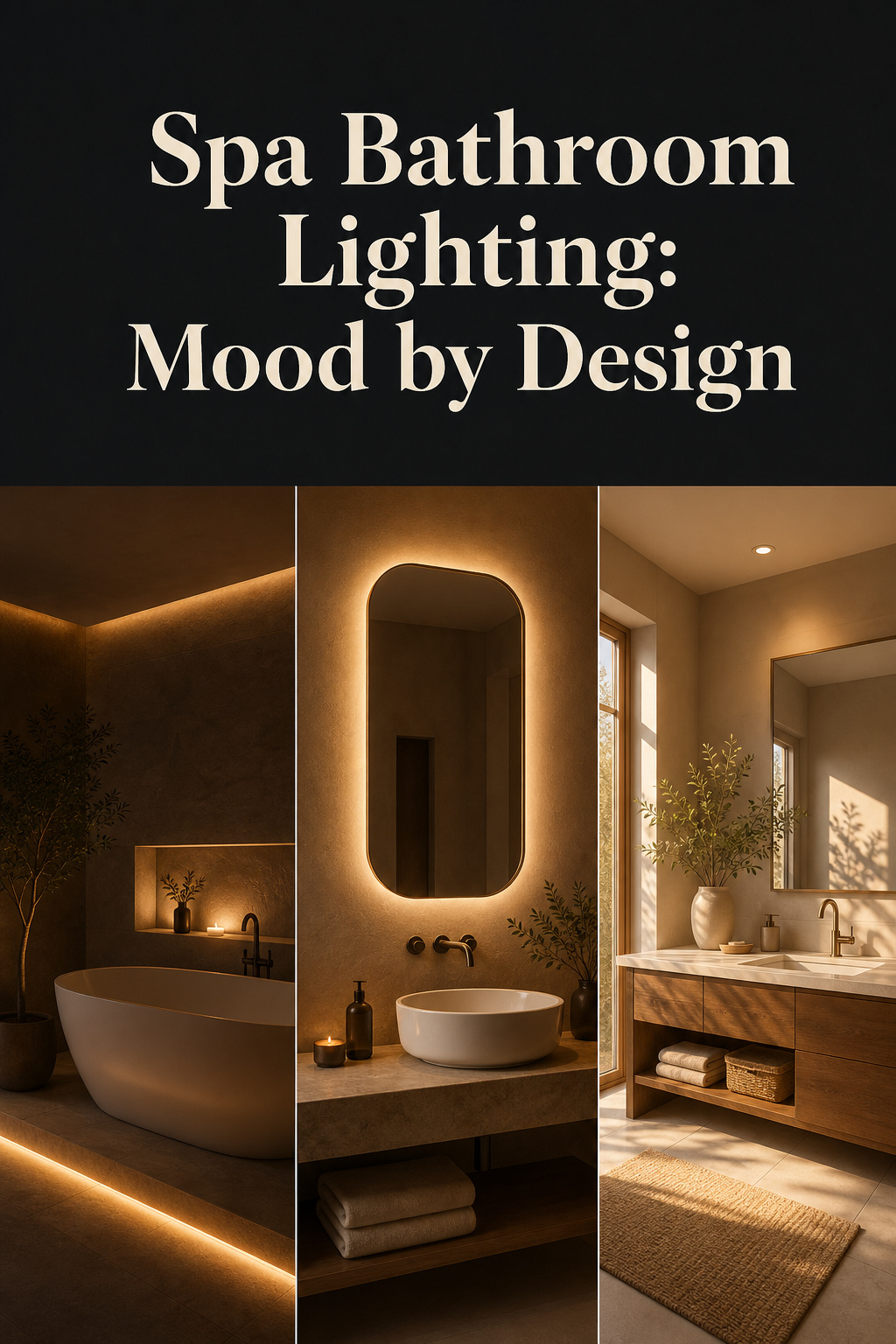
You open the door at the end of a long day. You reach not for the morning switch but the other one, and the overhead settles to a third. Behind the mirror, a soft halo wakes. The room exhales before you do. This is what spa bathroom lighting actually is — not a fixture you buy, but a feeling you build. And almost any bathroom can hold it.
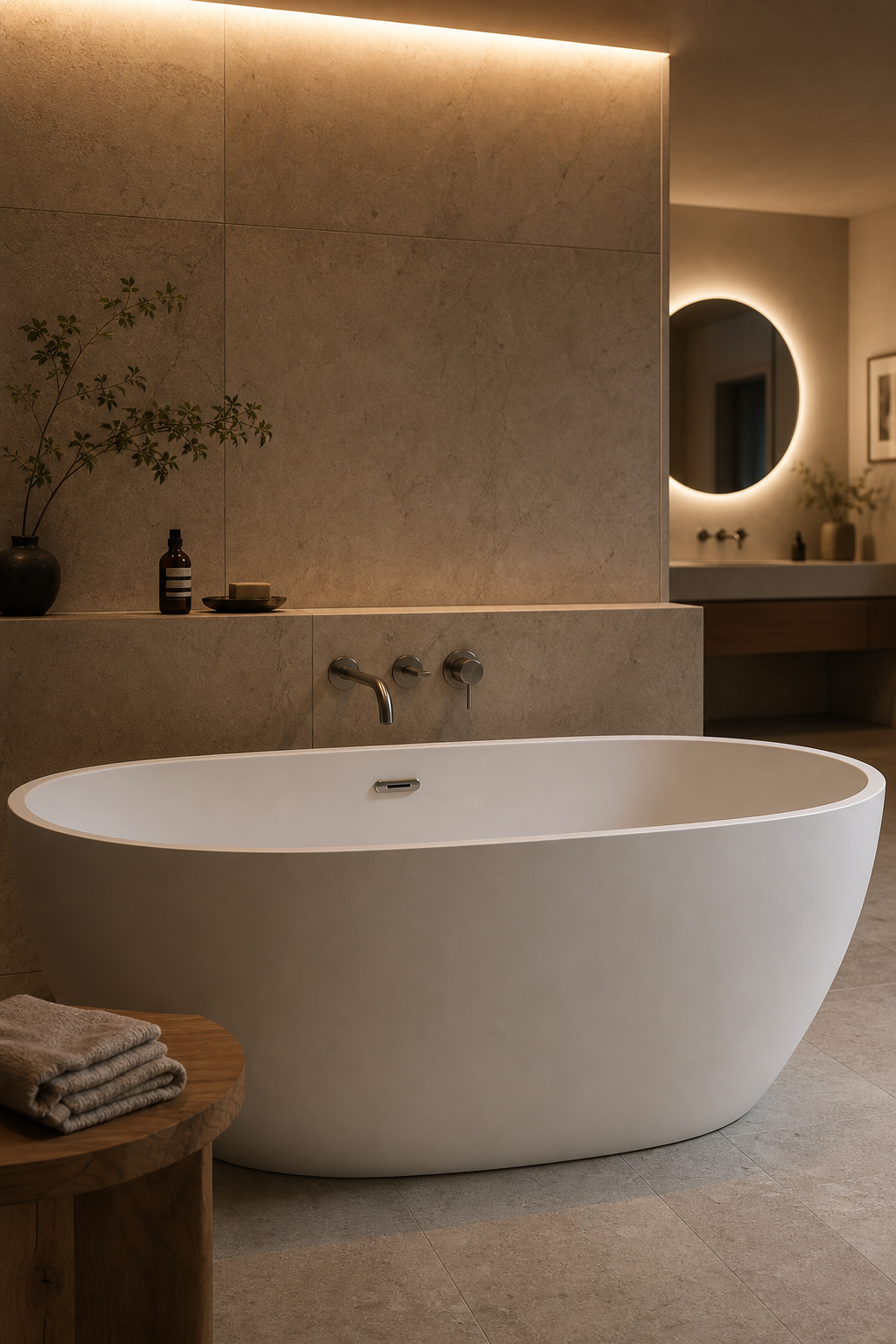
TL;DR
- Warm, dimmable, layered light is the single biggest lever; aim for 2700K or lower in the evening at around 400 lumens of ambient light — a third of what daytime tasks need.
- A trailing-edge dimmer (look for RC, ELV or MOSFET on the box) is the highest-return upgrade; one circuit, three modes, no rewiring.
- Conceal the source: a backlit mirror and an under-vanity strip put glow on surfaces instead of in your eyes — and the harsh sources come out before the soft ones go in.
The gap between a clinical bathroom and a restful one is almost entirely a lighting decision. Designer Laura Hammett notes that overhead fixtures alone feel clinical, while a blend of soft ambient light and a few accents creates an enveloping calm. For where this fits the wider scheme, see our full bathroom lighting guide.
The Feeling Before the Fixture: What Spa Bathroom Lighting Actually Does
Name the feeling first. A spa bathroom should leave you settled, quiet, unhurried — and the light is what carries that, long before any tile or tub does.
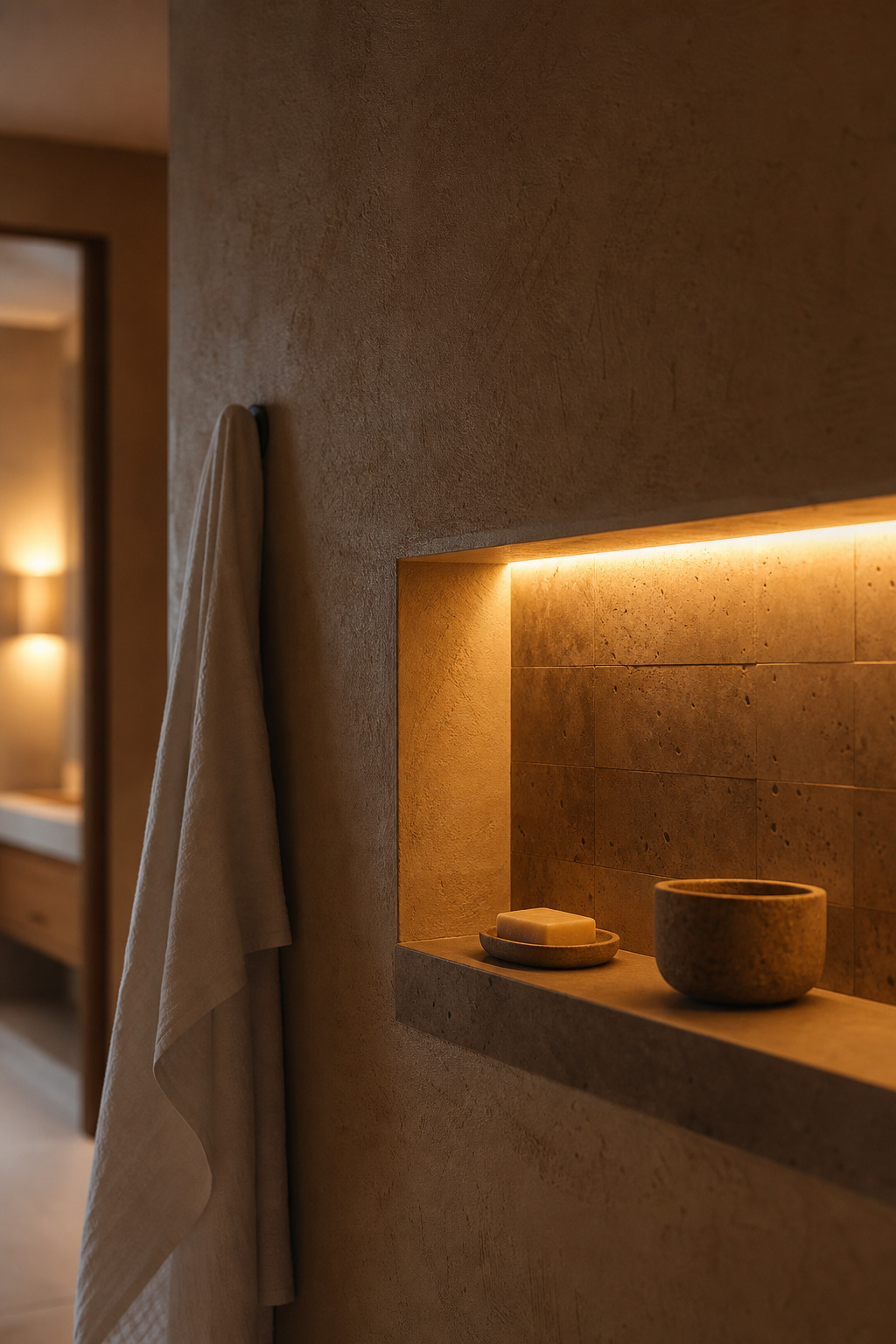
You step in, and the room is already calm
Nicci Kavals of Articolo Studios puts it simply: lighting in the bathroom is more than functional — it is about creating an atmosphere. A spa scheme layers four things: ambient light for the room, a little task light at the mirror, accent light to catch a texture, and a low mood glow. Layered, they make depth and warmth. Flat, from one source, they make a clinic.
What the body reads in warm dim light
Your body reads light as information. Research has long noted that bright bathroom light in the evening suppresses melatonin and nudges you toward alertness. Warm dim light, in the 1800K to 2700K range, sends the gentler signal; light above 3000K delays the wind-down. The room can work with that rhythm or against it.
Why this lives in any bathroom, not only expensive ones
You do not need a renovation. A dimmer swap costs very little and needs no new wiring in most bathrooms. In a compact room, two LED strips — one behind the mirror, one under the vanity — build more atmosphere than five competing with each other. Warm bulbs in the 2700K to 3000K range animate stone, timber and linen; anything above 3500K greys those materials out.
The Dimmer: The Single Most Important Upgrade in Any Bathroom
If you change one thing, change this. A dimmer is not really a light control. It is a way to give one room several different states — and it costs almost nothing.
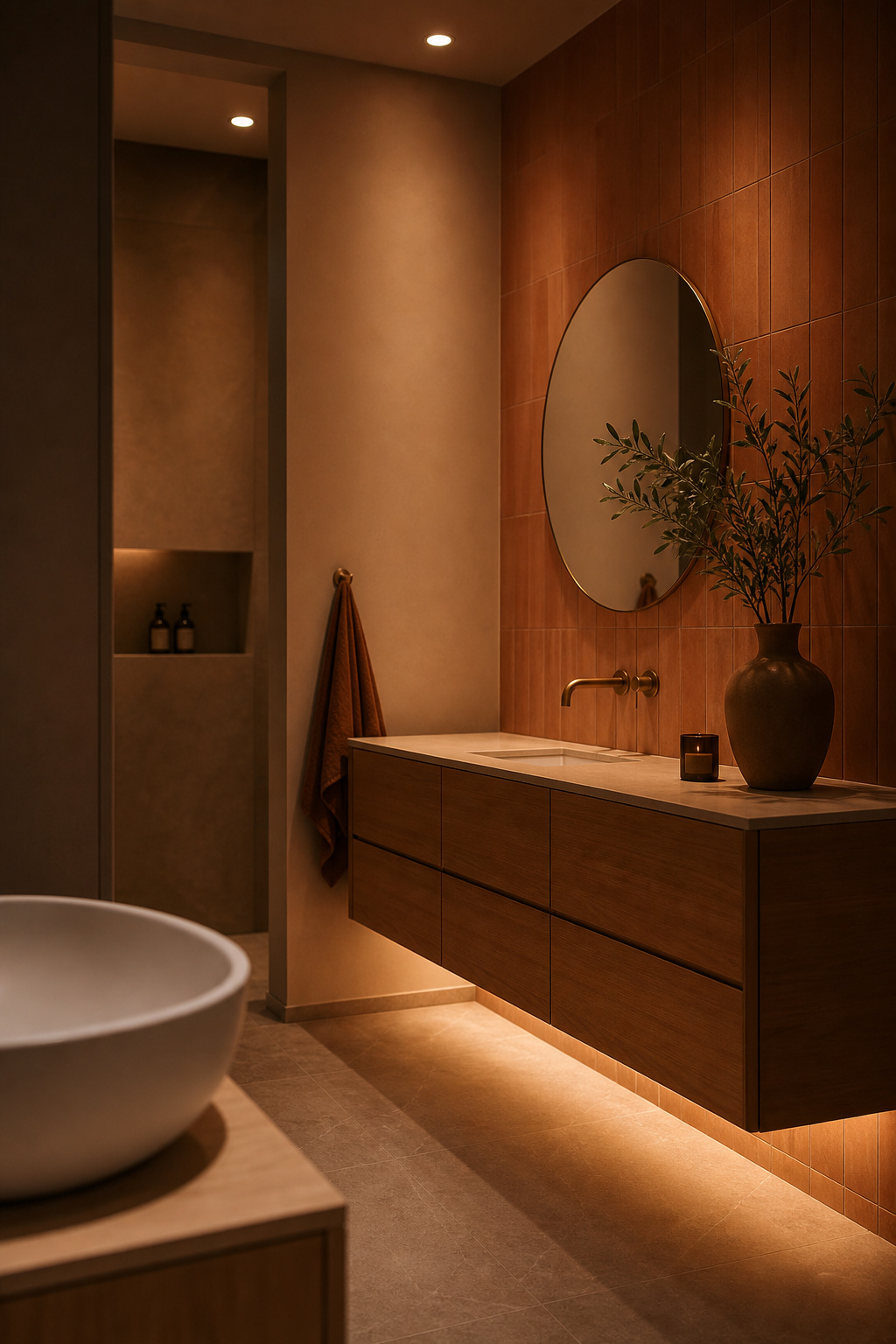
Why a dimmer is a wellbeing tool, not a light control
Think of dimming not as turning a light down but as changing what the room asks of you. The same fixtures that wake you for grooming can, at a lower setting, tell your body the day is closing — with nothing rewired. Dimming the LEDs also eases their thermal stress, so the bulbs last longer.
One switch, three rooms
A single dimmable circuit gives you three different rooms. Full output for tasks. A relaxed evening at 30 to 40 percent. A night-safe trace at 5 to 10 percent for the 2am walk that should never wake you fully. Luke Thomas of John Cullen Lighting recommends making everything dimmable and running at least two circuits — and a spa mood depends on those dimmable lighting layers sitting on separate controls.
What to look for so it won’t buzz or flicker
Modern LEDs need a trailing-edge dimmer, not the old leading-edge (TRIAC) kind, which buzzes and flickers at low levels. On the box, look for labels like RC, ELV or MOSFET, and a low minimum load — around 5 to 10 watts — since a low-wattage LED stutters on a dimmer built for old incandescent loads. Tonight, read the back of your current dimmer: if it predates your LED bulbs, that buzz has a name and a fix.
Warm Low Light for Evenings: The Temperature and Lumen Targets
Two numbers make the evening: how warm the light is, and how little of it there is. Both run lower than most bathrooms default to.
Why 2700K or lower signals the day is ending
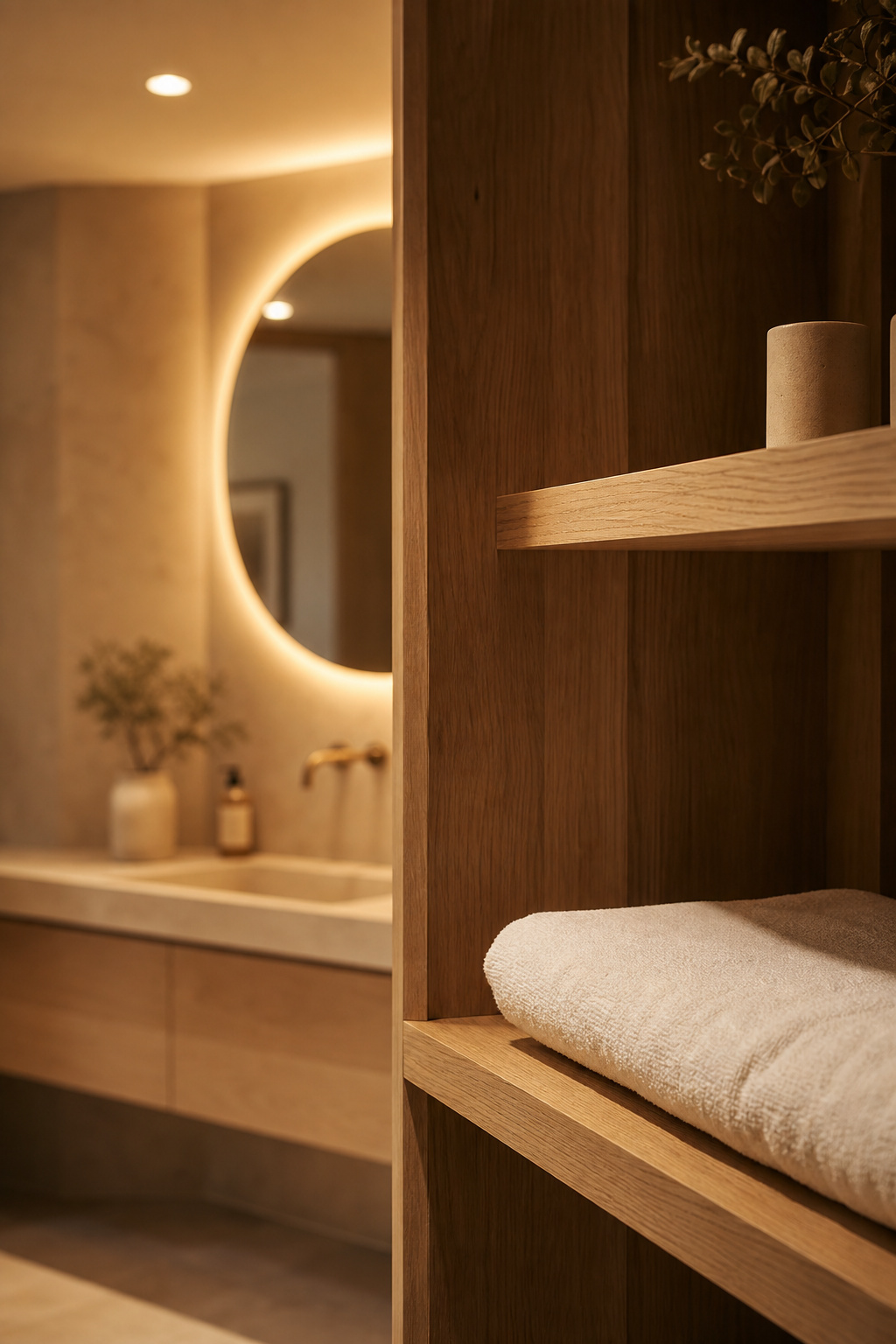
Warm amber-toned light works with the body’s clock rather than against it. Designers reach for 2700K to 3000K for spa ambiance because it is candlelight-adjacent and lets warm materials hold their warmth. For the full reasoning on Kelvin and CRI, the warm Kelvin range is covered there; here, 2700K or below is the number to remember.
Lumen targets for a relaxed bath: lower than you think
A relaxed bath wants roughly 400 lumens of ambient light; general bathroom tasks want 1,600 to 2,400. That is the gap most rooms get wrong — they light a bath like a task. Treat 400 lumens as a practical target, not a code rule. A secondary source of 200 to 300 lumens — a backlit mirror or a toe-kick strip — gives safe passage without the overhead waking at all.
What each layer does at its dimmed setting
The simplest way to hold this is a short table of what the evening asks for.
| Time of evening | Target Kelvin | Ambient lumens |
|---|---|---|
| Winding down | 2700K | ~400 |
| Soaking | 2200–2700K | 200–300 (accent only) |
| Night passage | 1800–2200K | 50–100 |
Tunable-white LED fixtures shift between roughly 2700K and 5000K — one fixture, cool and bright in the morning, warm and low at night. At the tub, keep bright sources out of a reclined sightline: an uplight, a floor wash or a dimmed sconce serves better than anything overhead at full output.
Backlit Mirrors and Concealed LED: A Soft Glow Without a Harsh Source
The most distinctive spa effect is light you feel but cannot trace. Before you add any of it, though, take something away.
Why a backlit mirror is kinder than a fixture at your face
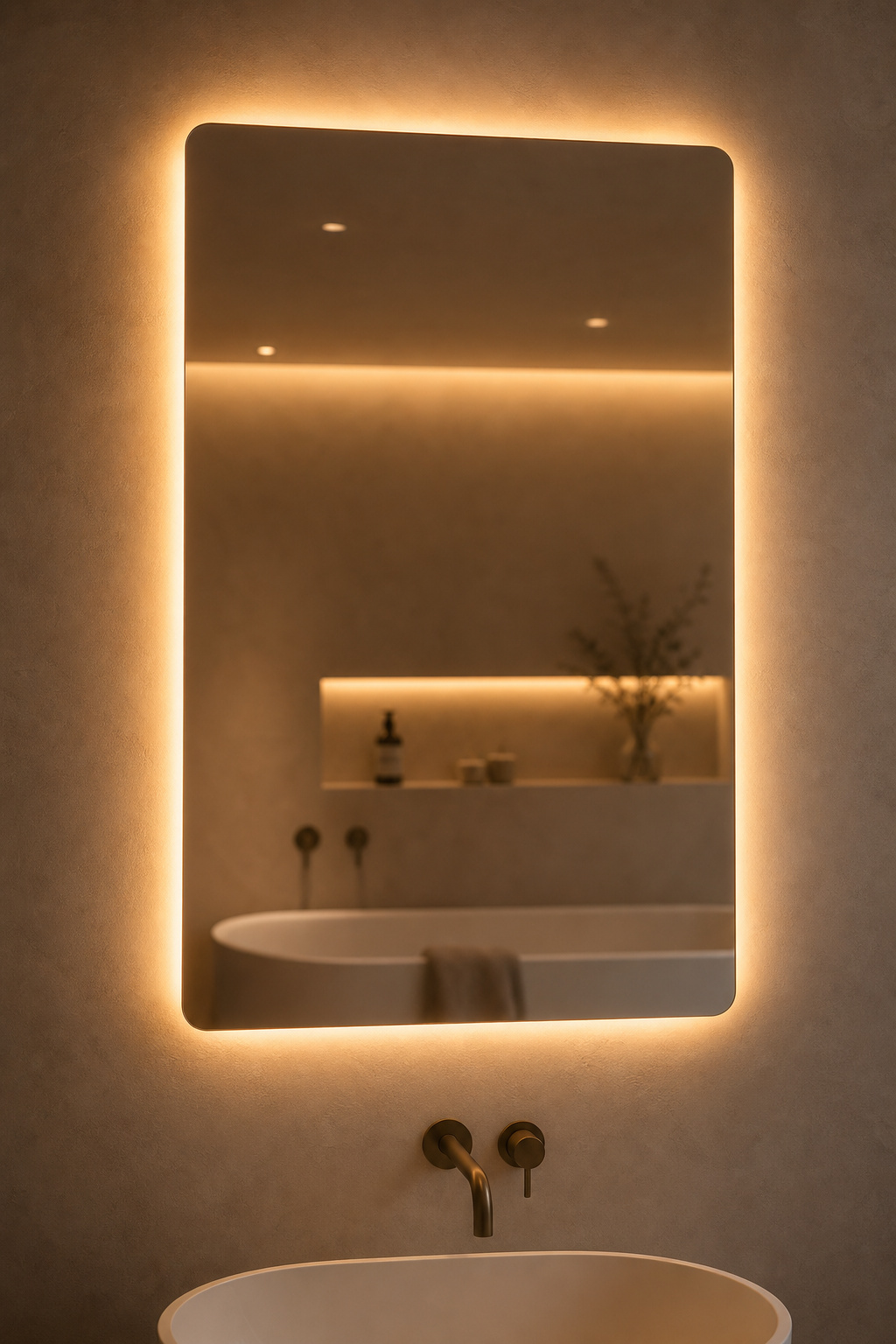
A backlit mirror sets its LEDs behind the glass, throwing light outward to the wall and back as a soft floating halo. No source is aimed at your eyes — only diffuse light that softens shadows instead of carving them. Ben Bryden of RAK Ceramics suggests integrated-lighting mirrors that shift colour temperature, with a demister pad to keep the glass clear.
The under-vanity glow that grounds a room
A gentle strip beneath a floating vanity grounds the room and lights the floor path, so the overhead never has to. Hayley Robson of Day True makes the rule plain: conceal the strip behind, beneath or inside something — only the glow should show, never the fixture. Two details matter: a frosted diffuser that dissolves the dotted line of LEDs into one smooth blade of light, and an IP44 rating minimum outside direct water, rising to IP65 inside the splash area above a bath.
What to remove before you add anything
The soft sources only work once the harsh ones are gone or dimmed. Caroline Greig of Ripples: avoid harsh, direct lighting in favour of concealed strips and floor spots that wash up walls. Take these out, or turn them down, first:
- The vanity bar run at full brightness — dim it or replace it before anything else.
- Exposed globe bulbs, the most common glare source working against a spa feeling.
- Highly polished chrome and mirror tiles that bounce light sharply; matte surfaces hold warm light instead of throwing it.
The Tub: Lighting the Space Where Unwinding Happens
The tub is the hardest place to light well — because you are lying back, eyes turned toward the ceiling.
Why overhead light above a tub confronts you
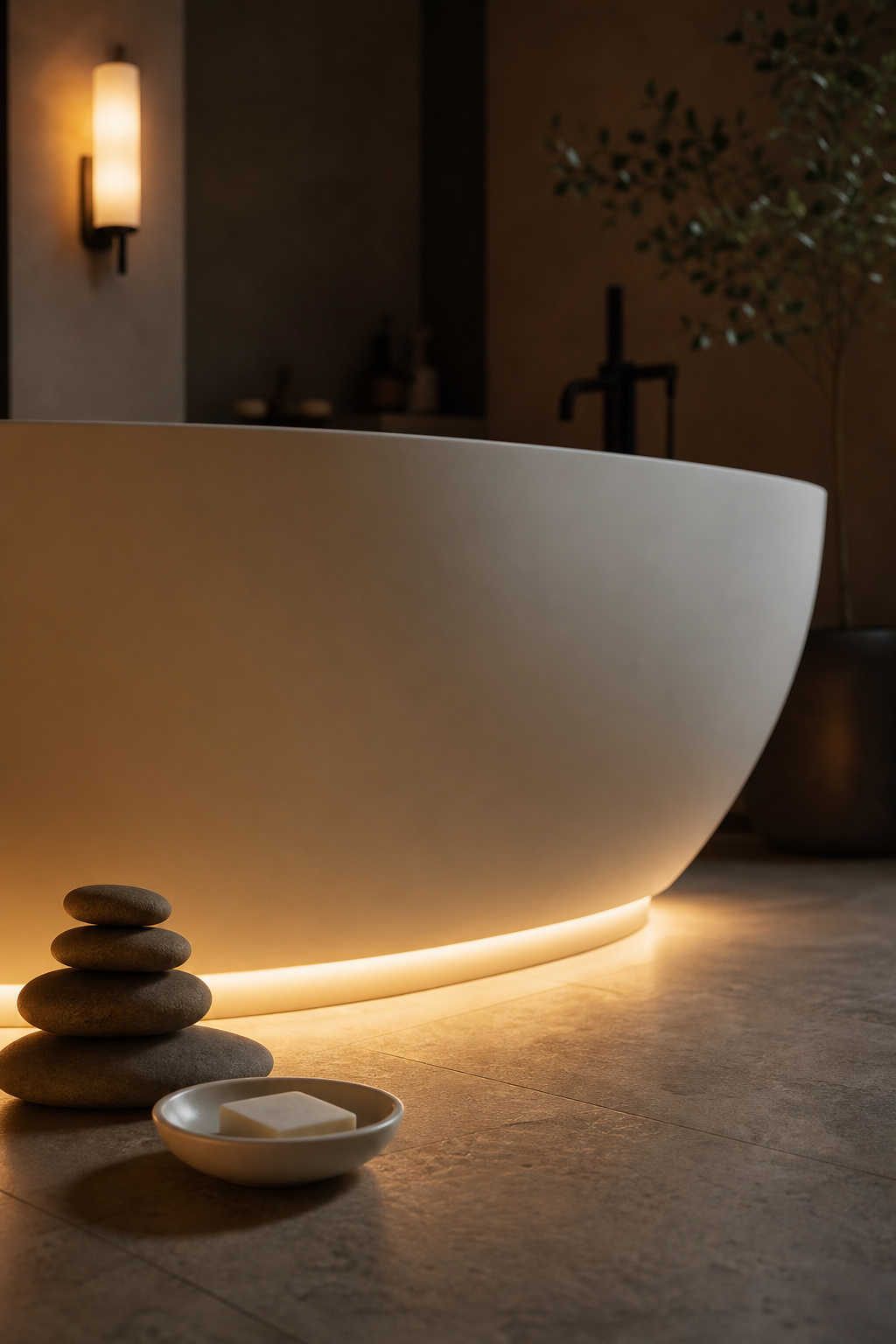
A reclined bather looks straight up. An overhead fixture there is the most direct path from source to eyes in the whole room. Monique Tollgard of Tollgard Studio frames the balance well: keep the light low enough to calm, functional enough that no one trips. So bring light up from behind and beside the tub rather than down from above — uplights trace its shape and wash the floor, and the room recedes the way it should.
What works beside the tub, and what the code allows
Wall sconces beside the tub and a concealed cove or plinth strip behind it keep the source out of sightline. NEC Section 410.10(D) prohibits cord-suspended luminaires, pendants and track within 3 feet horizontally and 8 feet vertically of the tub rim — no pendant over the water, however lovely in a photo. Any fixture within those dimensions must be damp-rated at minimum, wet-rated where shower spray reaches it.
Candles, and the LED line beside them
Real candlelight sits around 1800K — warmer than any warm-white LED, with an amber flicker no bulb fully copies. I love it, and I am careful with it. A bathroom holds aerosols — hairspray, deodorant — that are highly flammable; candle fires cause roughly 90 deaths a year in the US. Place any flame on a stable, non-combustible surface, keep linens and aerosols well clear, and never leave the bath with one burning. Where you want the look without the risk, flameless LED candles and bulbs with a candlelight mode dim toward 1800K — the same amber, no flame.
The Doorway Test: How to Know When the Room Is Done
After all the decisions, there is one more step — stop measuring and simply look. I have a practice for it.
Standing at the threshold at the end of the day
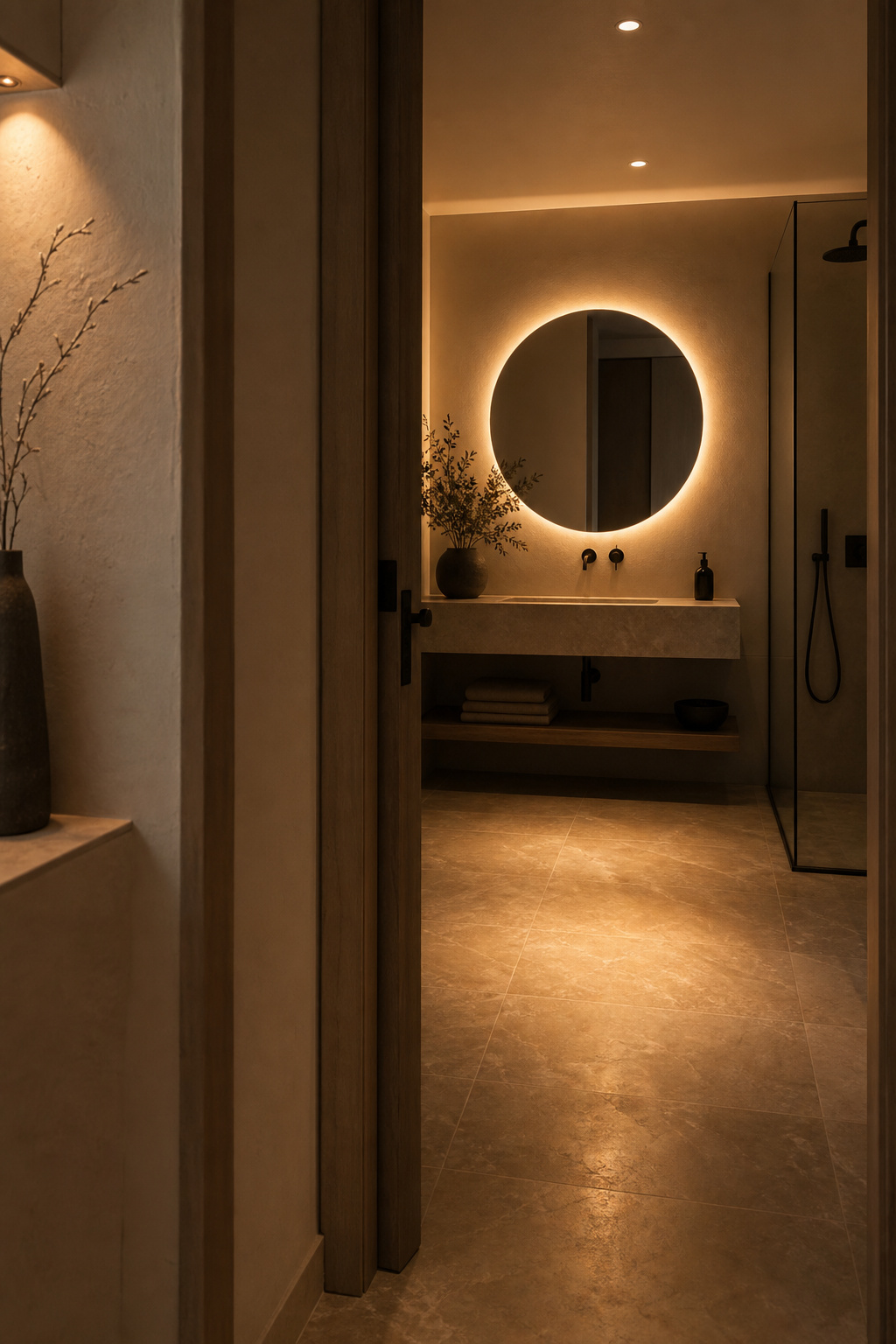
When a room is finished, I stand at its doorway in the evening light and do nothing for a breath. I let my eyes go where they want to go. The light is set, the harsh sources gone, the mirror glowing. The only question left is not technical.
Where the eye lands first
Watch where your gaze settles. If it lands on warmth — the halo of the mirror, a soft gradient on plaster, the pool of light on the floor — the room is right. If it snags on something bright, a source you can see directly or a glare off chrome, dim that thing until only the glow on surfaces remains. Natural textures help: warm timber, velvety stone and plaster hold soft light and give it back.
A room that asks nothing and gives everything back
This is the whole aim — a bathroom where the light has done the settling before you have done anything, where you step in tired and the room meets you halfway. Stand at your doorway tonight, before you change a single fixture, and notice the one thing your eye snags on first; that is where to begin.
FAQ
What kind of lighting makes a bathroom feel like a spa?
Layered, dimmable light makes the difference: ambient, accent, and a backlit or edge-lit mirror replacing a single overhead source. Warm white bulbs at 2700K to 3000K give the soothing, candlelight-adjacent glow real spas use. Conceal LED strips under the vanity and behind the mirror so only the glow reaches your eyes, never the fixture.
What dimmer setting is best for a relaxing bath?
Around 30 to 40 percent of full output on a warm 2700K circuit gives roughly 400 lumens — enough to move safely, low enough to feel immersive. The overhead can stay off entirely if a backlit mirror or accent strip is running. Dim until the source itself disappears and only the glow on surfaces remains.
Can you use candles in a bathroom instead of electric light?
Yes, with care. Real candles are safe near a bath on stable, non-combustible surfaces kept well away from flammable aerosols like hairspray and deodorant; never leave the bath unattended with one burning. Flameless LED candles remove the fire risk entirely, producing a warm amber flicker that holds up in humid conditions.