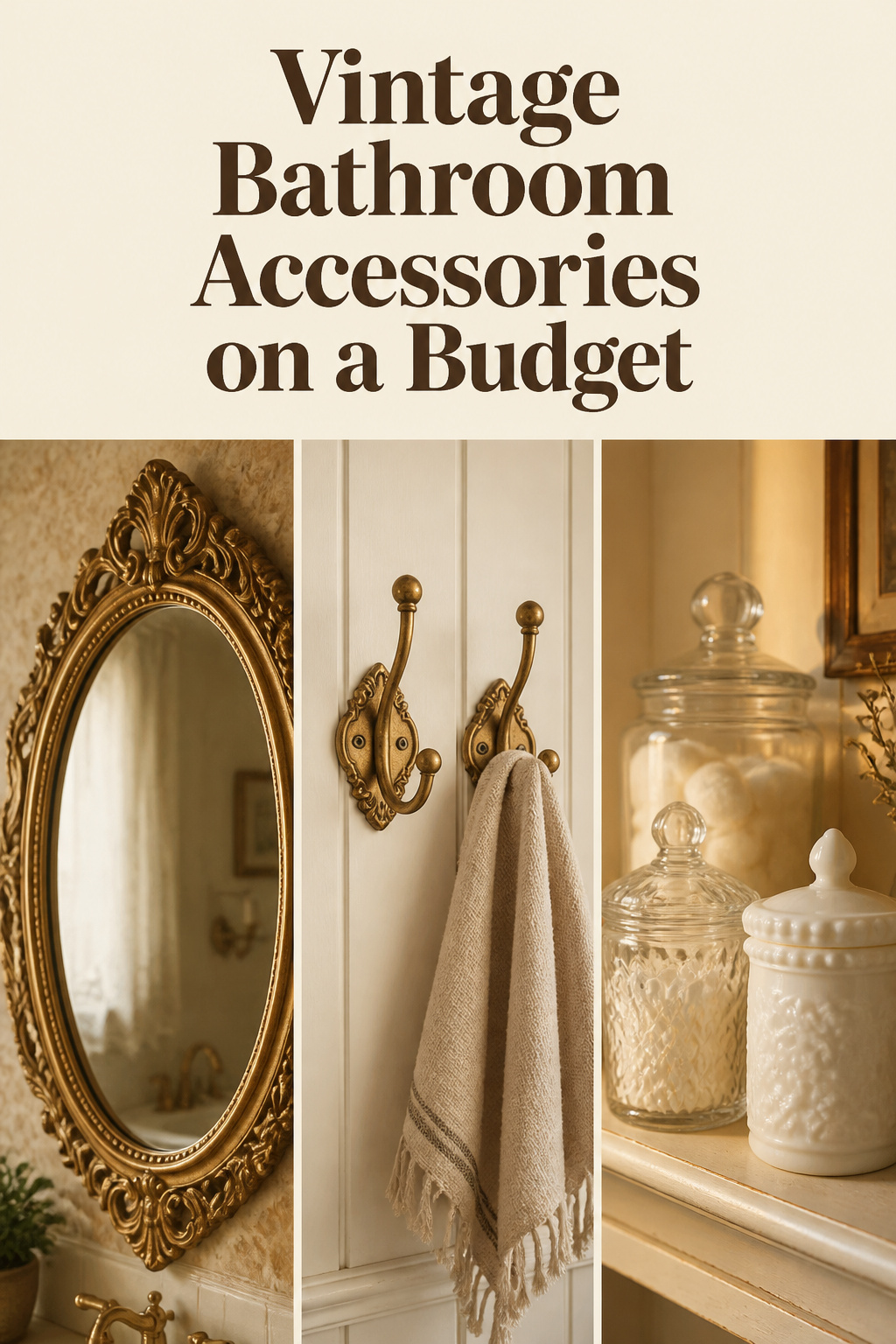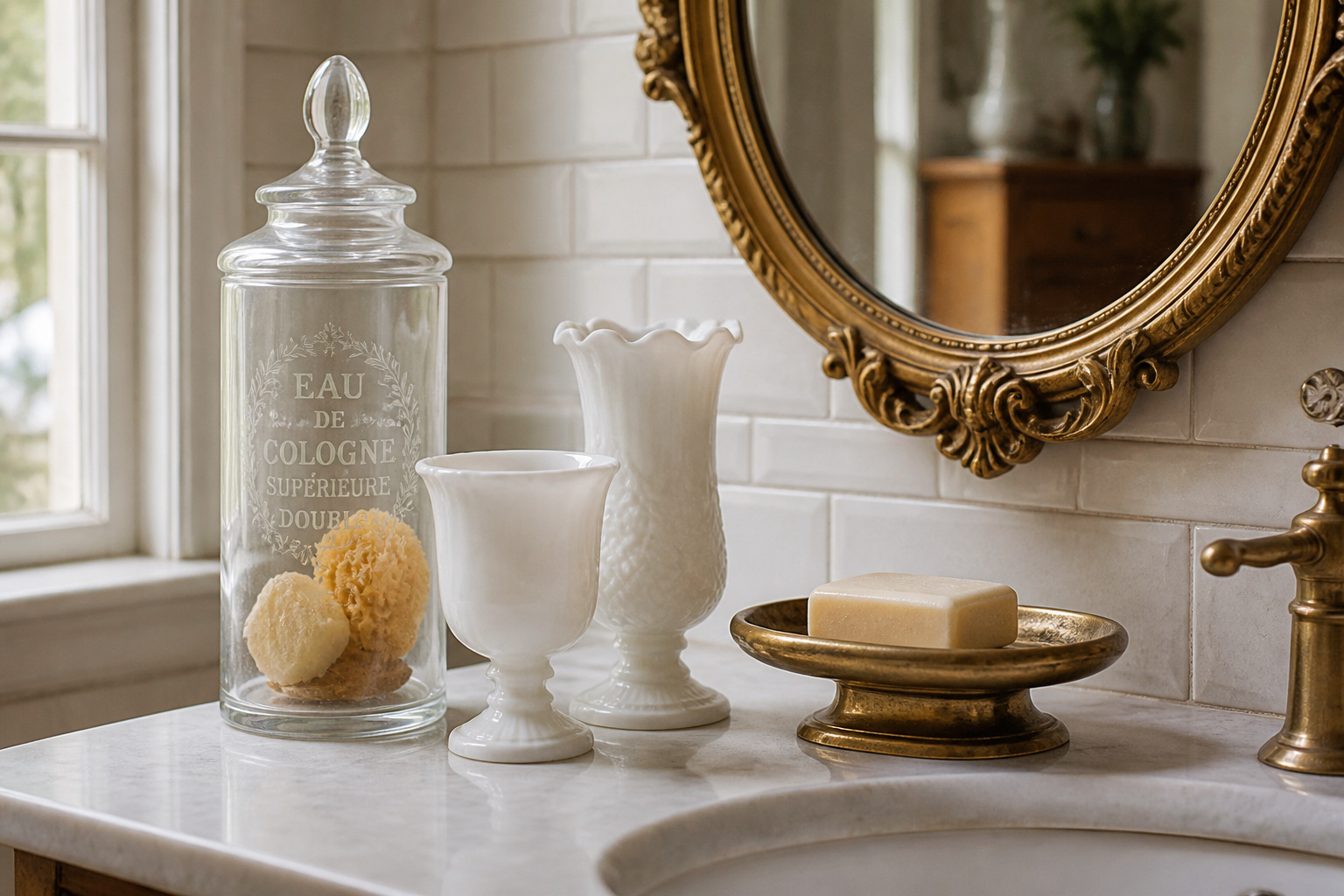

Everyone thinks vintage bathroom accessories mean antique-store prices. They don’t. The look comes from five categories of object — four of which you should thrift. I’ve pulled the whole layer together for under $60 at a Goodwill before lunch: a gilded mirror, glass jars, a tray, towels. The one piece worth buying new is the brass hardware. Here’s what each costs and where to find it.
TL;DR
- Five categories do 90 per cent of the work: a gilded mirror, brass hooks and towel bars, apothecary and milk-glass jars, fringed or lace textiles, and a styling tray. Thrift everything except the brass.
- The honest budget: buying everything new runs $158–$275; thrift the mirror, jars, and textiles, buy only the hardware new, and the same result lands at $80–$150.
- Thrift-store ceilings: don’t pay over $12 for any unbranded apothecary jar or over $15 for any unbranded milk-glass piece — and check every milk-glass piece for the “ring of fire” before it goes in your basket.
Vintage Bathroom Accessories: You Do Not Need to Spend a Lot, But You Do Need to Know What to Buy
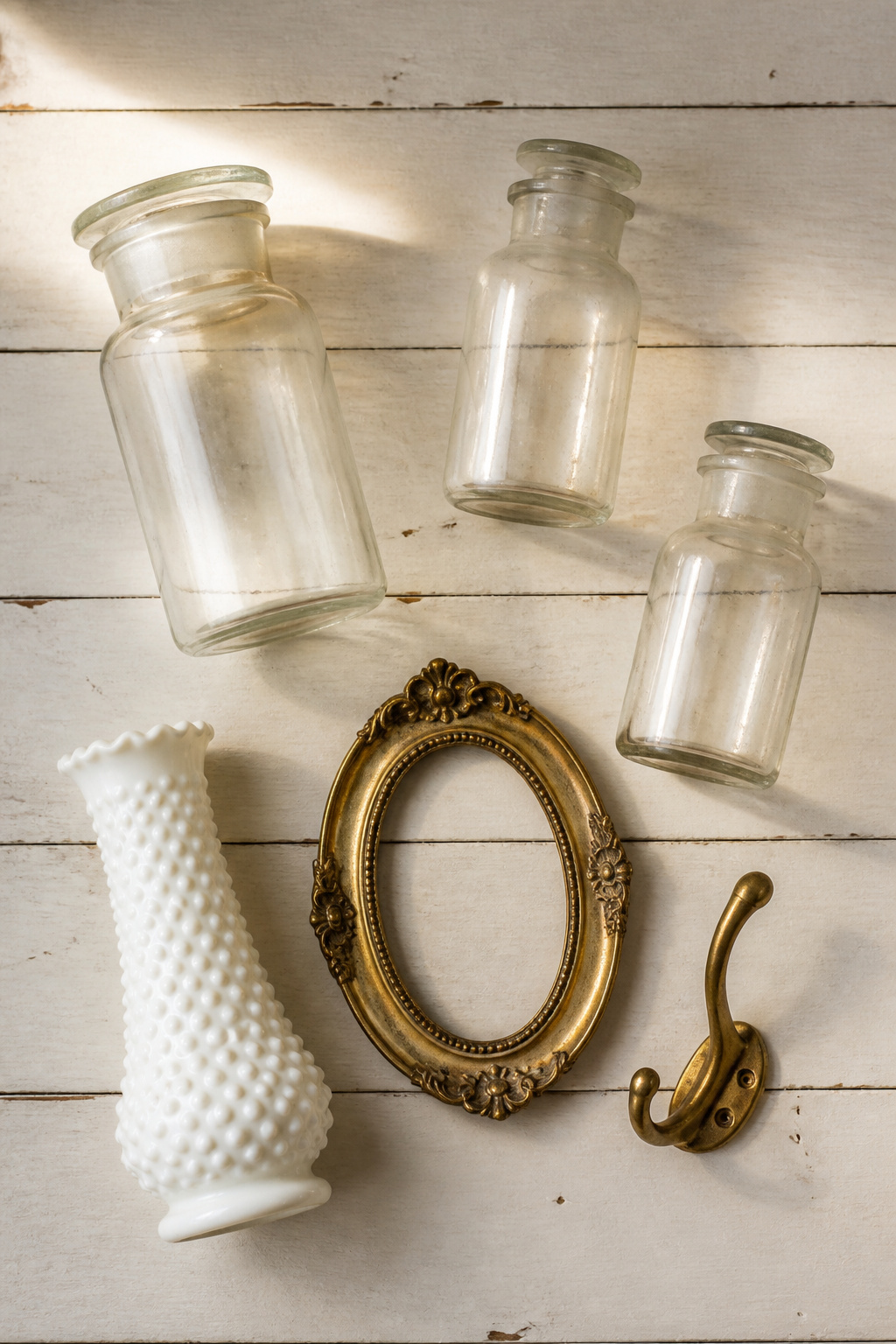
The myth is that this look needs antiques or a specialist store. Designers thrift mirrors, trays, and glass jars for paying clients — glass, ceramic, and metal survive a humid bathroom whether they cost $8 or $800.
The myth: vintage accessories require antiques or specialist stores
Antique dealers sell the same ornate mirrors, milk-glass jars, and linen towels at five to ten times the thrift-store price. Online, Etsy and Facebook Marketplace fill the gaps.
The reality: five categories do most of the work
Five things consistently read “vintage bathroom”: a gilded or distressed mirror, brass hooks and towel bars, apothecary and milk-glass jars, fringed or lace textiles, and a counter tray. Glass jars are the highest-ROI — new ones run $10–$50, thrift equivalents $2–$10.
The honest number for a complete layer
A full transformation — mirror, textiles, jars, hooks, tray — runs $158–$275 at mid-range retailers. Those figures come from accessory-category pricing rather than a vintage-specific study, so treat them as a ballpark. Thrift the mirror, jars, and textiles, buy the brass new, and the same result lands at $80–$150. Brass is the one category where buying new earns its cost. For how this layer sits on top of the architecture, see the vintage bathroom design ideas guide.
Mirrors: The Piece That Changes the Room Most Per Dollar
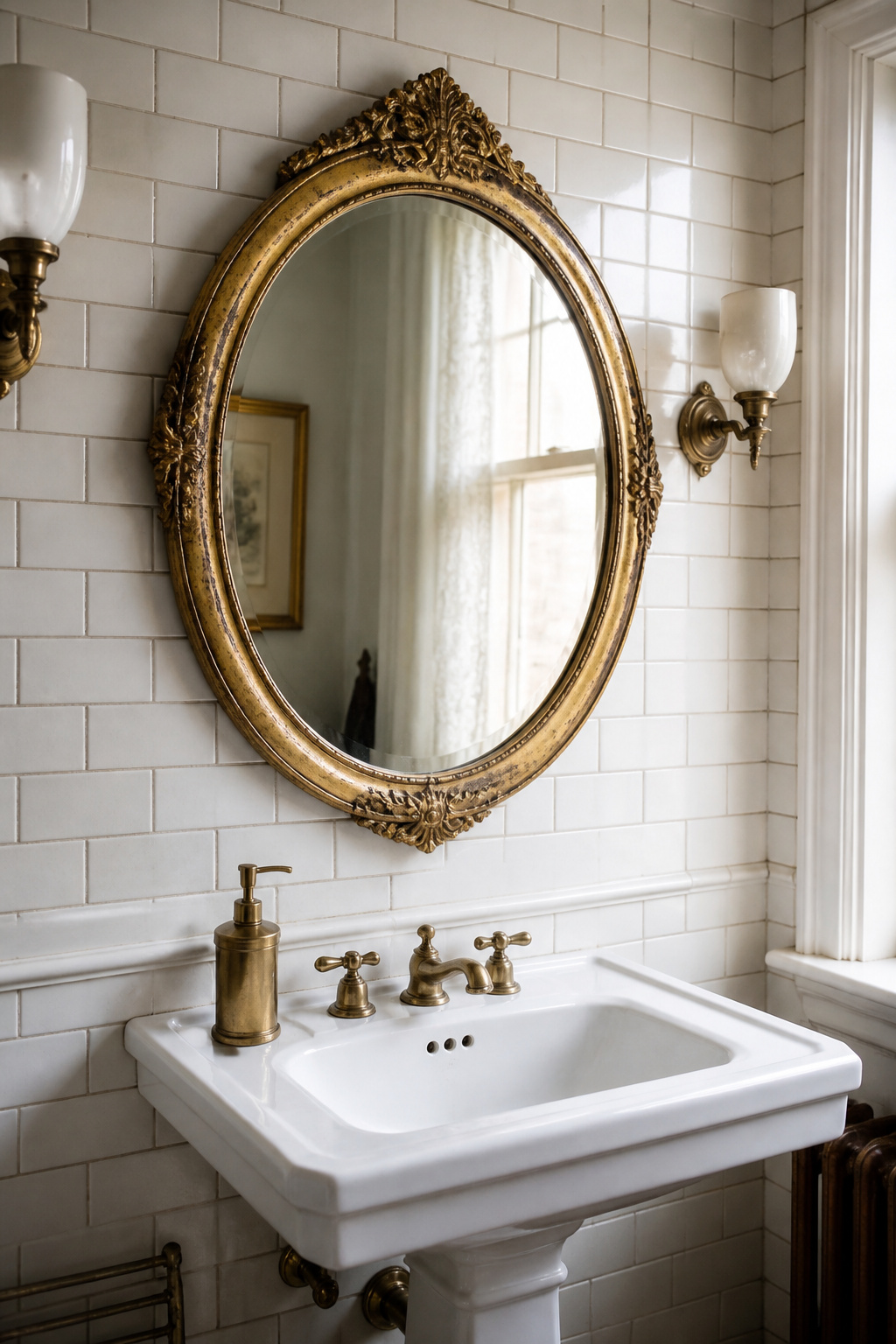
A gilded oval mirror is the highest-impact accessory relative to its cost. New ones run $130–$300; thrift stores yield comparable frames for $10–$40 — and a designer’s $800 antique reads the same as your $18 find.
What to look for at the thrift store
Hunt for ornate Baroque or Art Nouveau frames in distressed or gilded gold — they signal period character on their own. Check three things: the frame isn’t delaminating at the corners, the glass has no large black spots (edge de-silvering is fine and adds age), and there’s a hanger on the back. A $5 wicker mirror plus an $8 can of metallic Rust-Oleum gives you a custom piece for under $15.
New-but-vintage mirrors, and the cheap tier to avoid
When no thrift frame fits your size, buy new. Ornate Baroque-arched mirrors run $133 for a 20×30 up to $298 for hand-gilded gold leaf. Avoid the sub-$80 tier — thin plastic frames with gold foil that flex, chip within six months, and read cheap up close. The tell is weight.
| Mirror type | Where to source | Typical cost | What makes it read vintage |
|---|---|---|---|
| Ornate gilded/Baroque | Thrift, estate sale | $10–$40 | Distressed gold frame, real weight |
| Wicker, painted | Thrift + spray paint | Under $15 | Custom color, woven texture |
| New Baroque-arched | Mid-range retailer | $133–$298 | Resin or wood frame, gold leaf |
| Sub-$80 “vintage-style” | Big-box | Under $80 | Avoid — plastic frame, chips fast |
Hanging a heavy mirror: the one rule that matters
Weigh the mirror on a bathroom scale, then use anchors rated to at least twice that weight — a 20-lb mirror needs hardware rated to 40 lbs minimum. Where it goes wrong: people hang a heavy antique frame on one picture hook and find it on the floor a week later. No stud? Toggle bolts handle 50–100 lbs; a French cleat is safest for a very heavy frame. Rating: first build.
Brass Hardware: Towel Bars, Hooks and Toilet Paper Holders
Hardware ties every other accessory together once the finish matches. Buy it new: matching five thrifted brass pieces of different ages and tones is a losing game.
Unlacquered versus lacquered brass
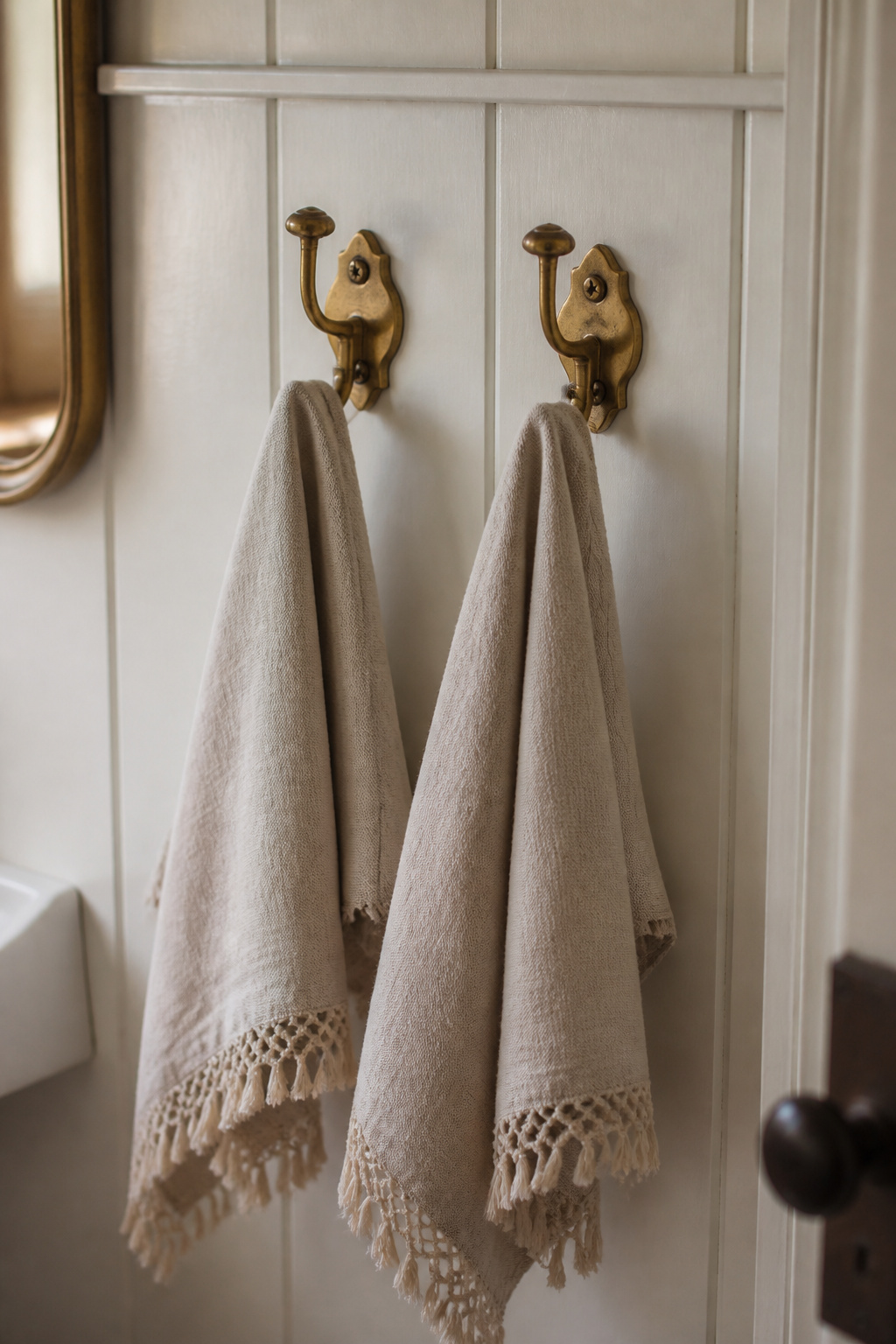
Lacquered brass keeps its bright gold coating forever — it never ages. Unlacquered brass oxidizes into a warm honey patina within 6–18 months in a bathroom, and that aging is what reads authentically old. It costs 20–40 per cent more, but it’s the right call. As Kingston Brass notes, the absence of lacquer lets brass develop a patina “that lacquered hardware simply cannot replicate.” Bar Keepers Friend takes it back to bright if you change your mind.
The minimum set and what it costs
The functional minimum is five pieces: two towel bars, one toilet-paper holder, two hooks. A lacquered 4-piece set from Home Depot runs $72–$78; unlacquered from a supplier like Rejuvenation runs $150–$300. The cheaper workaround: Amazon carries unlacquered brass hook sets for $18–$35 — fine for hooks, but not for structural towel bars that take real weight.
Mixing brass with a chrome tap
Yes — it’s deliberate, not a compromise. Brass brings period warmth; chrome adds a clean modern note. Design pros endorse the pairing because it “prevents it from feeling too matchy-matchy.” Use one dominant finish (brass), one secondary (chrome), each appearing at least twice. What fails is stacking polished, satin, and antique brass at close range — that reads cluttered, not curated. More on the modern vintage balance if you’re mixing eras.
Apothecary and Milk-Glass Jars: The Countertop Signal
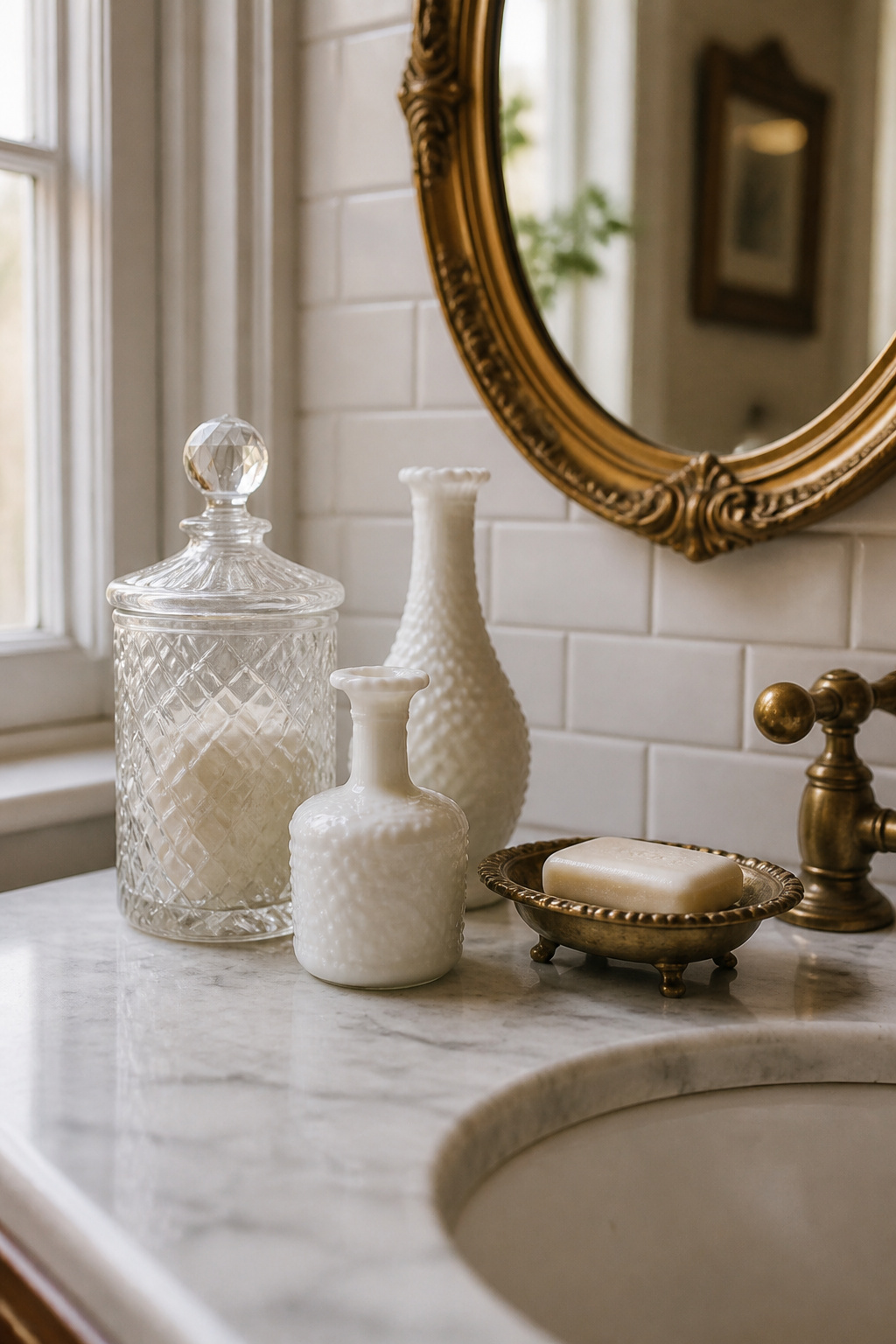
Three to five glass pieces on a counter produce instant period character, and milk glass thrifts for $2–$10 if you know the tells. One note: apothecary jars with stoppers borrow from old pharmacy aesthetics — period-inspired shorthand, not a verified original bathroom fixture. They read right anyway.
Thrift apothecary glass: what to look for
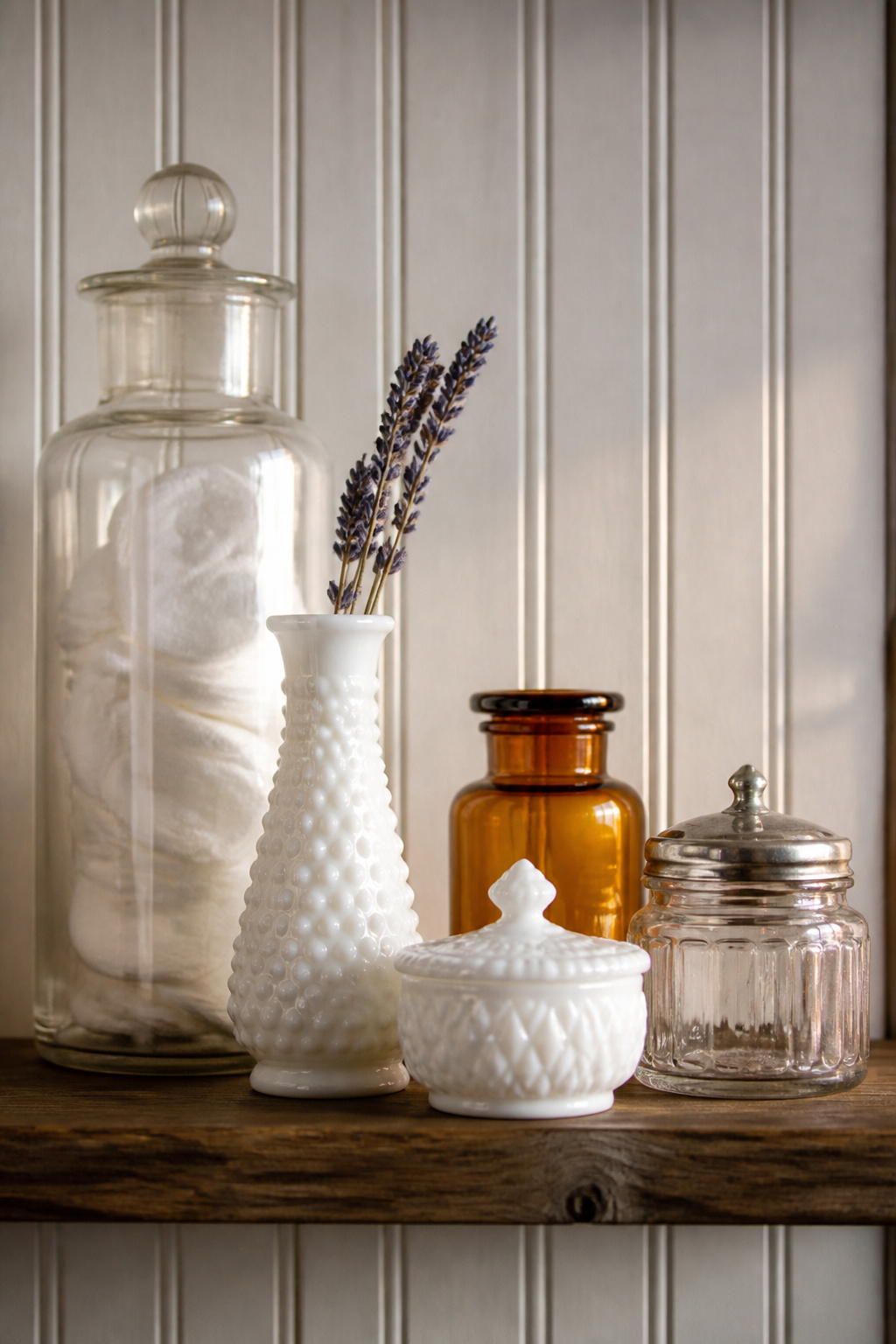
The best jars have a narrow ribbed base, a glass stopper, and stand 10 to 15 inches tall. New runs $9.99 (an Aldi 2-piece set) to $50+ a piece; thrift runs $2–$10. Don’t pay over $12 for an unbranded jar — these were mass-produced and aren’t scarce. Pay more only for a marked maker, a jewel tone, or a rare tall pharmacy form.
Milk glass — pressed, not painted
Milk glass is opaque white glass pressed into shape, peaking in US production from the 1940s to 1970s — opacity is structural, not painted. The definitive test is the ring of fire: hold the piece to a light and look for iridescent red, purple, or blue shimmer at the rim. Authentic glass shows it; flat chalky-white reproductions don’t. Maker’s marks confirm it — Fenton uses an oval stamp, Westmoreland a WG mark. Don’t pay over $15 for any single unbranded piece.
What goes inside, and arranging the pieces
Fill the jars honestly: cotton rounds in opaque jars, swabs in narrow necks, bath salts in a wide mouth. Functional fill keeps it from looking like a display. Group at least five pieces tallest to shortest — three or fewer reads as display, five as a collection. In a tight room, scale this down; see small-bathroom styling.
Fringed Towels, Lace Textiles and Café Curtains: Fabric as Atmosphere
Textiles are the cheapest, most removable layer — and the most renter-friendly. New runs $15–$60; thrift runs $1–$8. Both café curtains and fringed towels are period-inspired styling conventions, not documented original bathroom features. They still read genuinely vintage.
Towels that don’t look like a hotel lobby
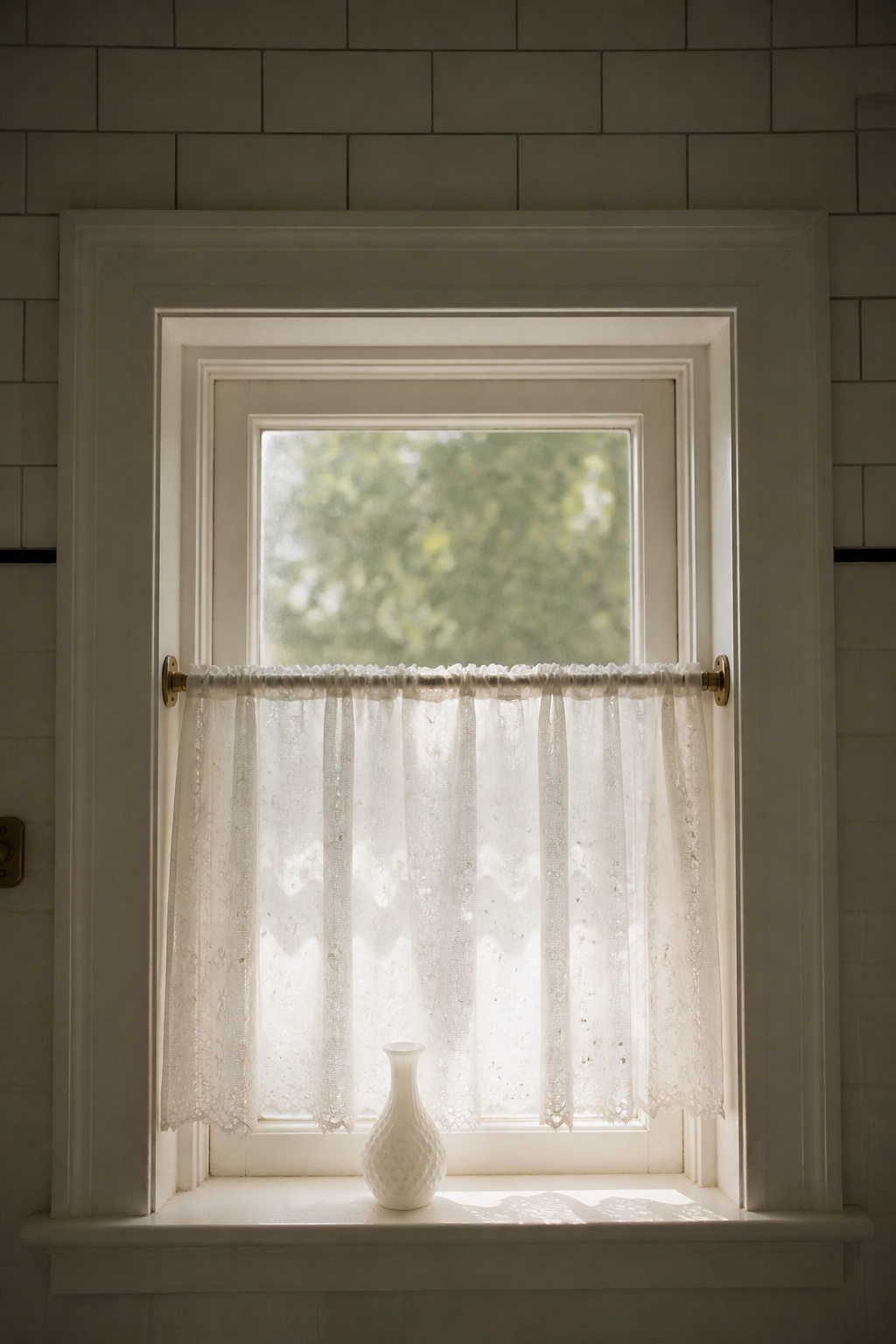
Look for waffle-weave hand towels in Turkish cotton with short fringe — $8–$25 new, or $1–$5 thrifted (wash thoroughly on arrival). Avoid thin bright-white terry; choose linen, cream, or ecru with visible texture. A $59 lace-trimmed guest towel is overkill — a plain linen towel plus under-$10 iron-on lace trim gets the same result.
Café curtains on a tension rod: the renter’s best friend
A spring tension rod sits inside the window casing on its own internal spring — no brackets, no screws, no wall contact, zero deposit risk. The whole job:
- Measure the inside frame width at three points (top, middle, near bottom); use the smallest.
- Buy a tension rod that adjusts to that width — a brass-toned café rod runs about $24 at Home Depot.
- Cut or hem your fabric to cover the lower half of the window.
- Hang the rod and drape the fabric. Done in under two minutes.
For fabric, cotton eyelet, white muslin, or a thrifted lace tablecloth cut to size all read right — under $5 versus $50+ for a new lace shower curtain. Rating: first build, no tools.
Lace and eyelet: where it belongs, where it tips into fussy
Lace reads vintage in one place — a café curtain or a single shelf liner. Use it in more than two spots and it tips into themed. The guideline: lace on one surface, fringed linen on the other. If the casing is too shallow for a tension rod to grip, adhesive hooks rated for light rods (up to 7.5 lbs) mount one without drilling.
Styling the Shelf or Counter: The Three-Item Rule and How to Break It
The three-item rule is a floor, not a ceiling — three pieces read intentional; five or more, arranged by height with a tray to corral them, reads collected.
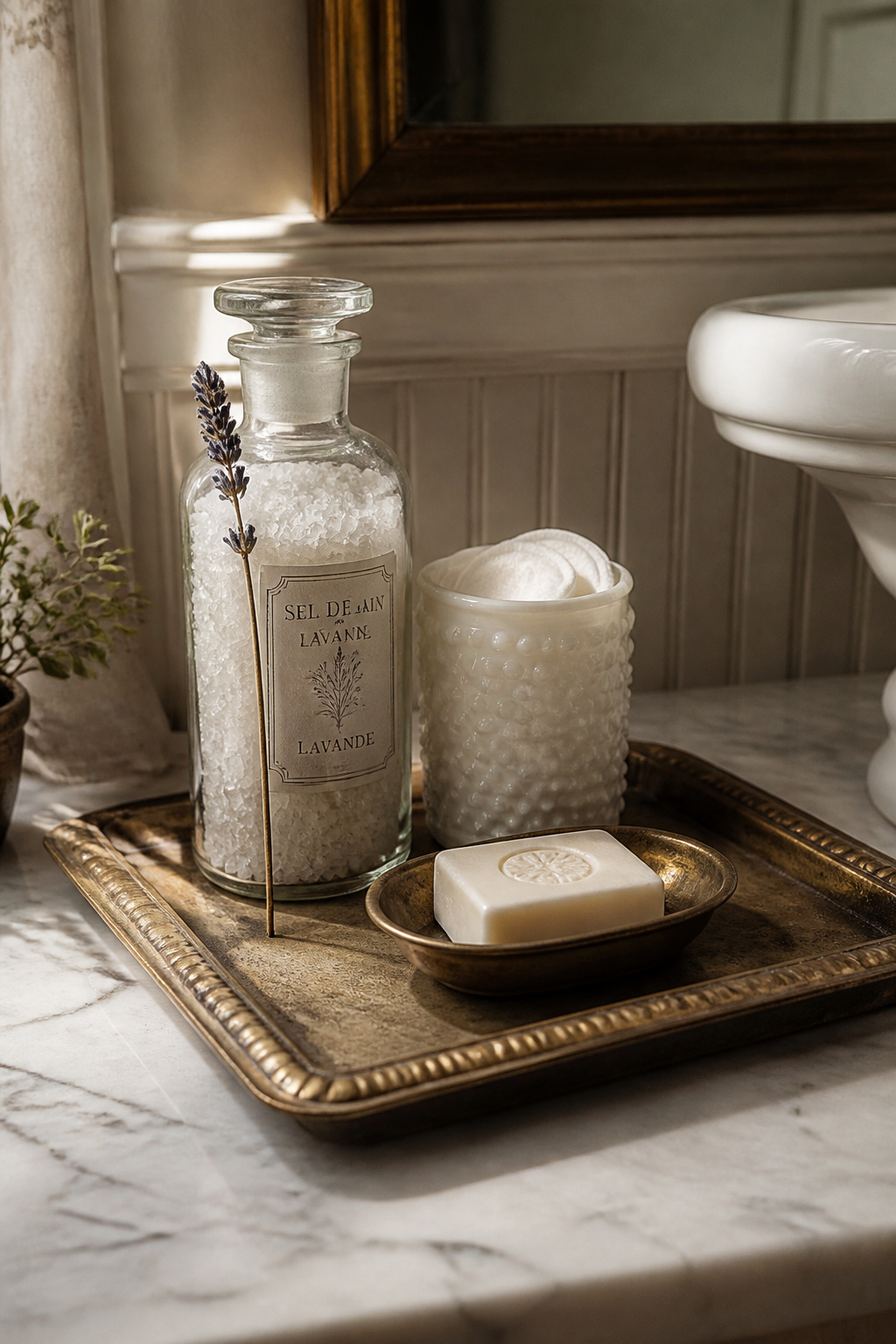
Why three items at different heights almost always wins
Three pieces — one tall, one medium, one short — create a hierarchy your eye reads in sequence. A tall apothecary jar, a mid-height hobnail vase, a low dish: that’s rhythm, not clutter.
The tray that keeps the counter honest
A tray frames the grouping, signaling that everything inside is intentional. Wayfair and Amazon carry trays for $12–$30, but a thrifted pressed-metal tray with real patina reads more period than a new one. The mistake: over-styling past seven pieces with no tray — that’s when collected tips into cluttered.
What reads vintage versus what just reads old
Here’s the test I run at the thrift store, two questions. First: does this have a texture, weight, or pattern a reproduction would find expensive to fake? Second: does it belong to a recognizable material tradition — milk glass, ironstone, pressed glass, unlacquered brass? Yes to both, it’s in the basket. Age alone isn’t enough.
So pick one category this weekend. Hit a thrift store with a phone torch for the ring-of-fire test and a $40 cap, walk out with the mirror or the jars, and order the brass tonight. The layer accretes over trips — which is exactly why it ends up looking collected instead of bought.
FAQ
Where can I find vintage bathroom accessories without paying antique prices?
Thrift stores, estate sales, and flea markets are your primary sources, reliably yielding mirrors, glass jars, textiles, and trays for $2–$20 versus $50–$300 new. Online, try Etsy and Facebook Marketplace. Buy brass hardware new, though, because matching finish across a five-piece set matters; thrift everything else.
Does brass hardware go with a chrome tap in a vintage bathroom?
Yes. Design pros endorse mixing chrome and brass as an intentional warm-cool pairing that keeps a room from feeling too matchy. Use one dominant finish (brass for hooks, bars, and mirror) and one secondary (chrome for the tap), and repeat each at least twice. Avoid stacking multiple brass tones at close range.
What is milk glass and how do I tell it from painted glass at a thrift store?
Milk glass is opaque white glass pressed into shape, peaking in US production from the 1940s to 1970s — the opacity is structural, not painted. The field test is the “ring of fire”: hold it to a light and look for iridescent red, purple, or blue shimmer at the rim. Reproductions stay flat white.