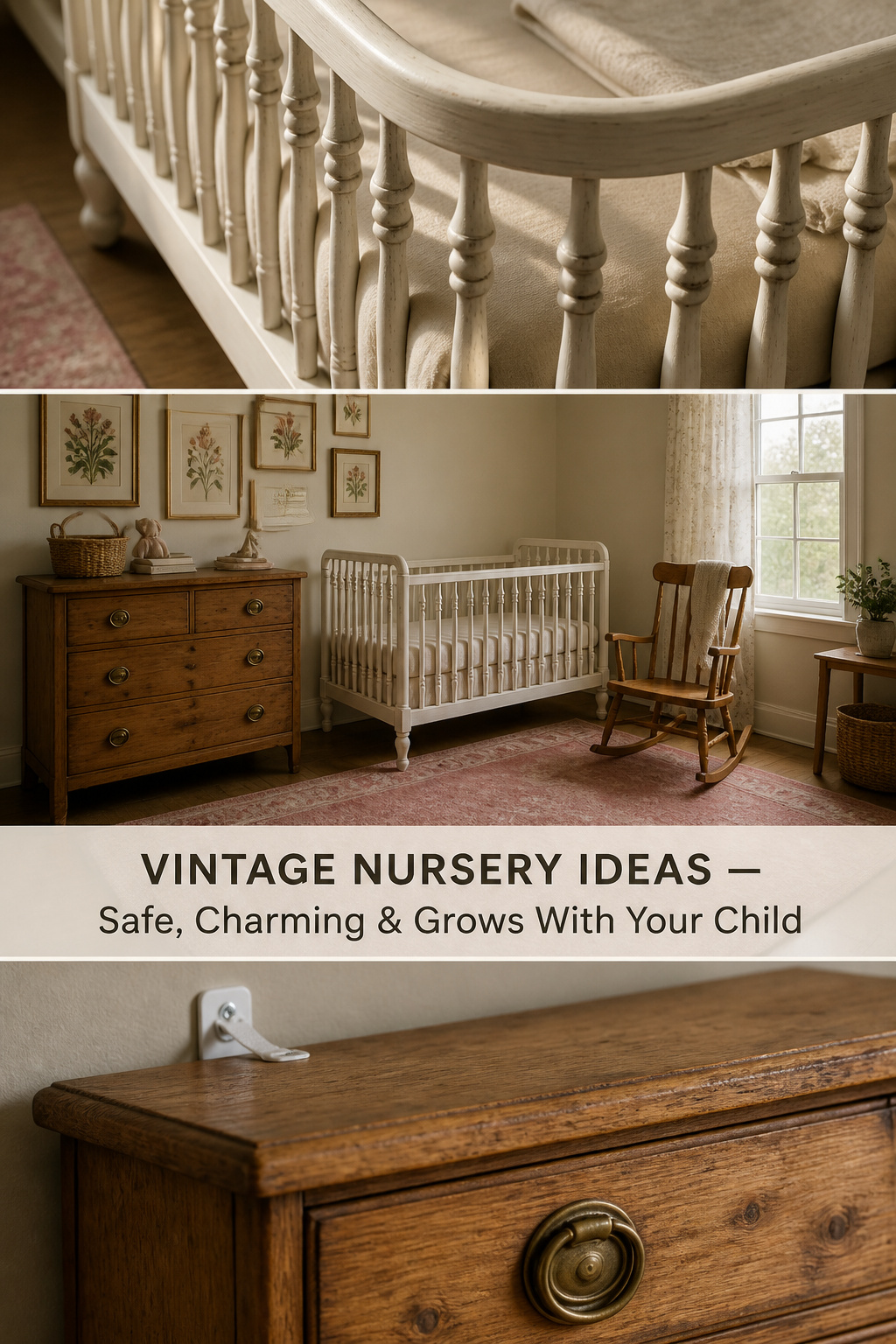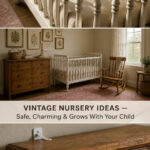
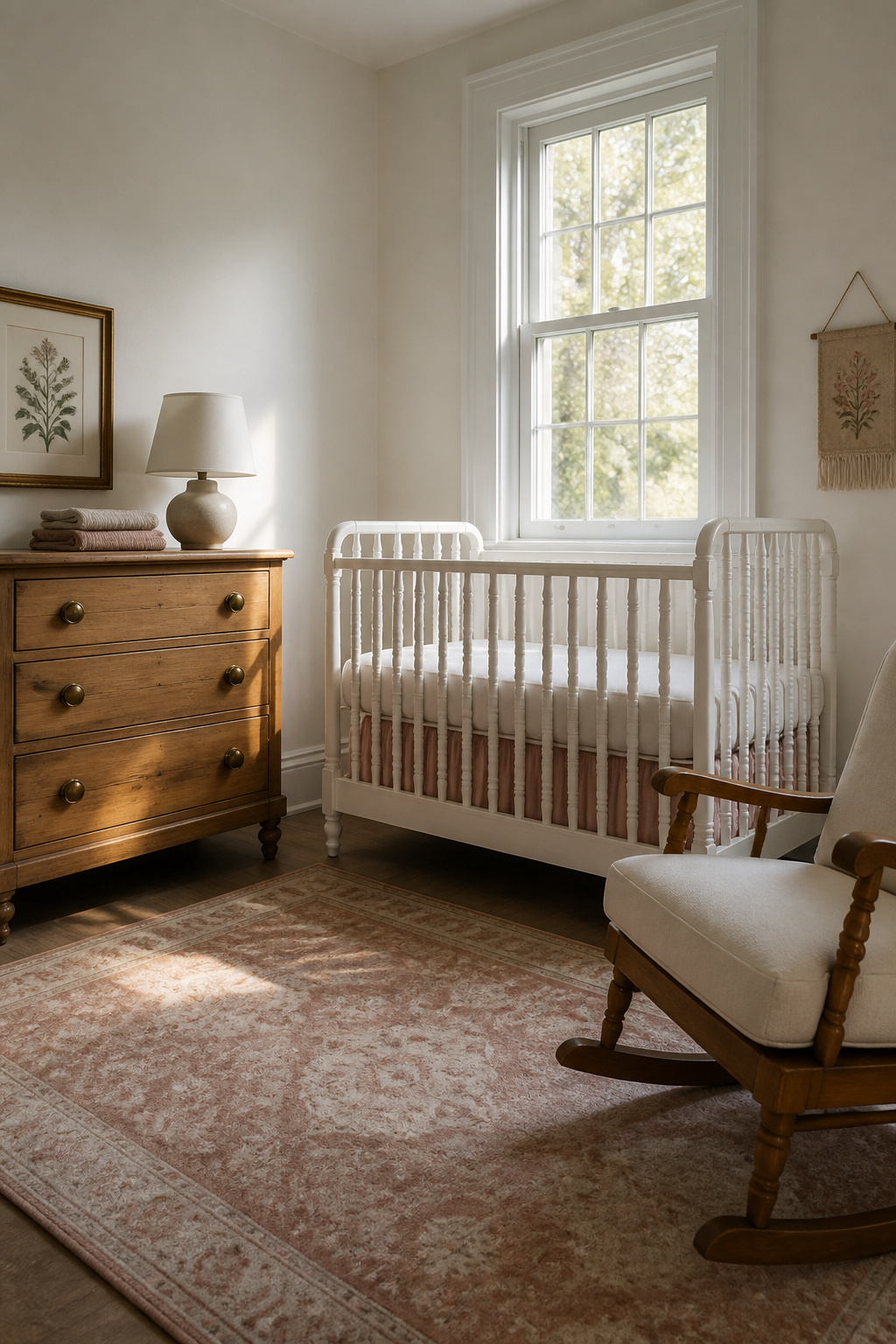
You can picture the room already: a spindle crib by the window, an old dresser with brass pulls, a wool rug, a rocking chair worn just enough to feel handed down. Then the worry lands. Is the antique crib safe? Will the fabrics survive a baby? Will the whole thing need ripping out the day the crib goes? Those three worries talk most parents out of the look — yet all three have answers, and most of the vintage nursery ideas you love are achievable once you know which rules apply.
TL;DR
- The sleep surface must be modern and certified — any crib made before June 2011 fails current federal standards (no drop-sides, slats no wider than 2 3/8 inches); everything else in the room can be genuinely old.
- Get the vintage look with a new spindle-style convertible crib plus a lead-tested, wall-anchored antique dresser, a refinished rocking chair, lace curtains, a wool rug and a botanical gallery wall.
- Three pieces carry the room from newborn to age five — the convertible crib, the dresser and the rocking chair — so you add a low bookshelf later, not redo the room.
Why Vintage Nursery Ideas Scare Parents — and Why They Shouldn’t
Babies don’t read decor; they explore by mouthing, pulling and wedging into gaps. The rules that feel like they fight your vintage dream are really just the rules of how a small body moves. Separate the two jobs a nursery does — safety and style — and the fear shrinks fast.
The three worries most parents have: safety, washing and longevity
The safety worry is real but narrow. The CPSC and the American Academy of Pediatrics both advise against any crib that doesn’t meet the federal standards in full effect since June 2011 — the sleep surface must be modern, and that’s the one hard line.
The washing worry dissolves once you stop putting fabric where it isn’t allowed — the vintage look comes from natural fibers you can buy new in machine-washable cotton and linen. The longevity worry is the easiest to design away: choose pieces that convert or adapt, and only the sleep surface ever changes.
What ‘vintage’ actually means in a nursery: the look, not the objects
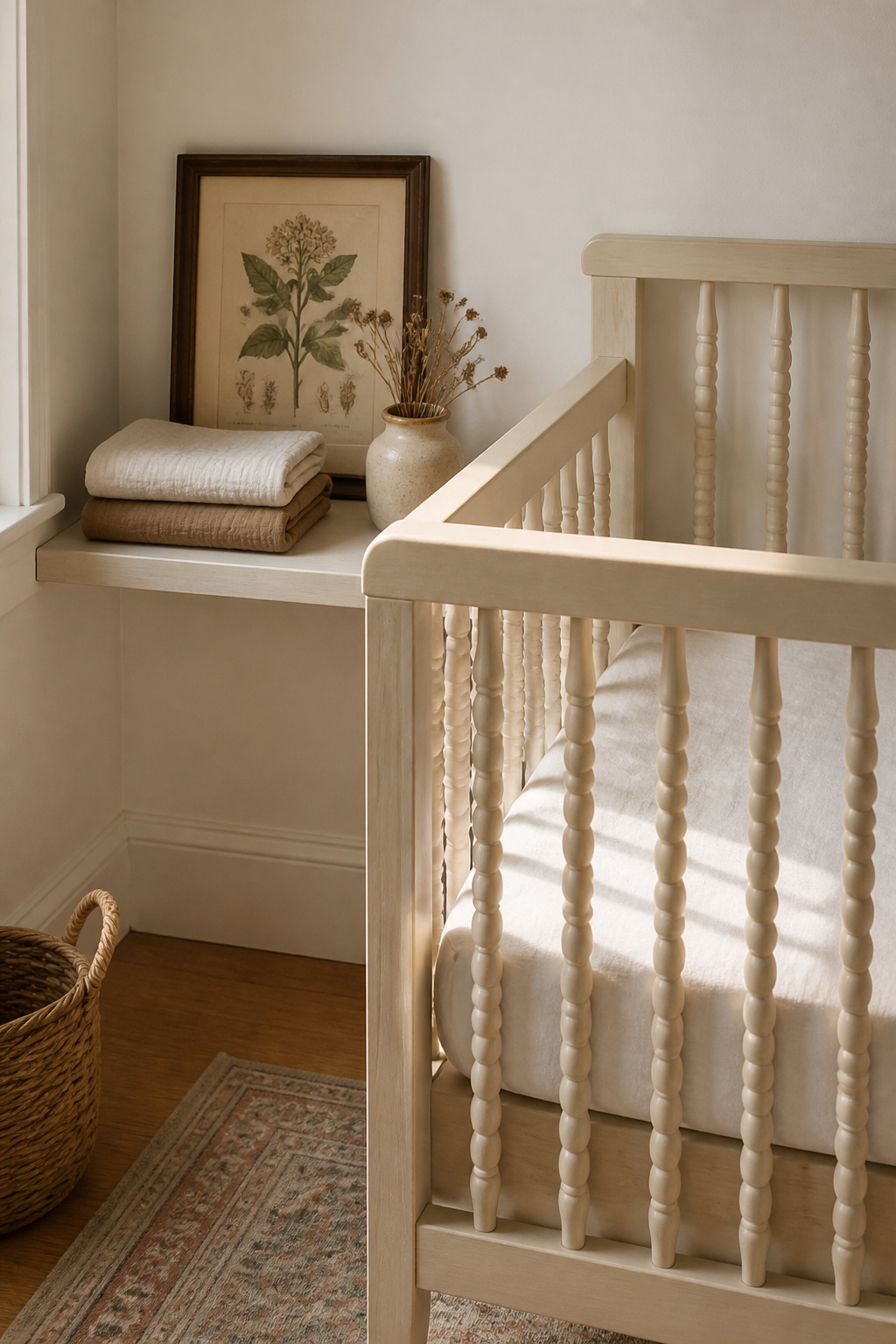
“Vintage” describes a feeling — warm wood, worn texture, soft period color — not a manufacturing date. Modern cribs now wear that feeling (turned spindle rails, curved footboards, warm tones) over certified-safe construction. The genuinely old things in the room become everything except the crib.
The room this article builds: vintage in character, modern in safety
We’re after a room built on four pieces that survive the full newborn-to-age-five run: a modern-safe convertible crib, an antique dresser, a rocking chair and — added later — a low bookshelf. For the wider logic of mixing old and new, the vintage bedroom decor guide covers the whole approach; here we do the child’s-room version.
Safety First: Which Antique Pieces Are Safe in a Nursery
The safety rules sort into two lists: the sleep surface, where they’re absolute, and everything else, where two checks make almost anything usable.
| Antique piece | Main concern | Safe to use if | If not, swap for |
|---|---|---|---|
| Crib / sleep surface | Made before June 2011 | Never for sleep | New spindle-style convertible crib |
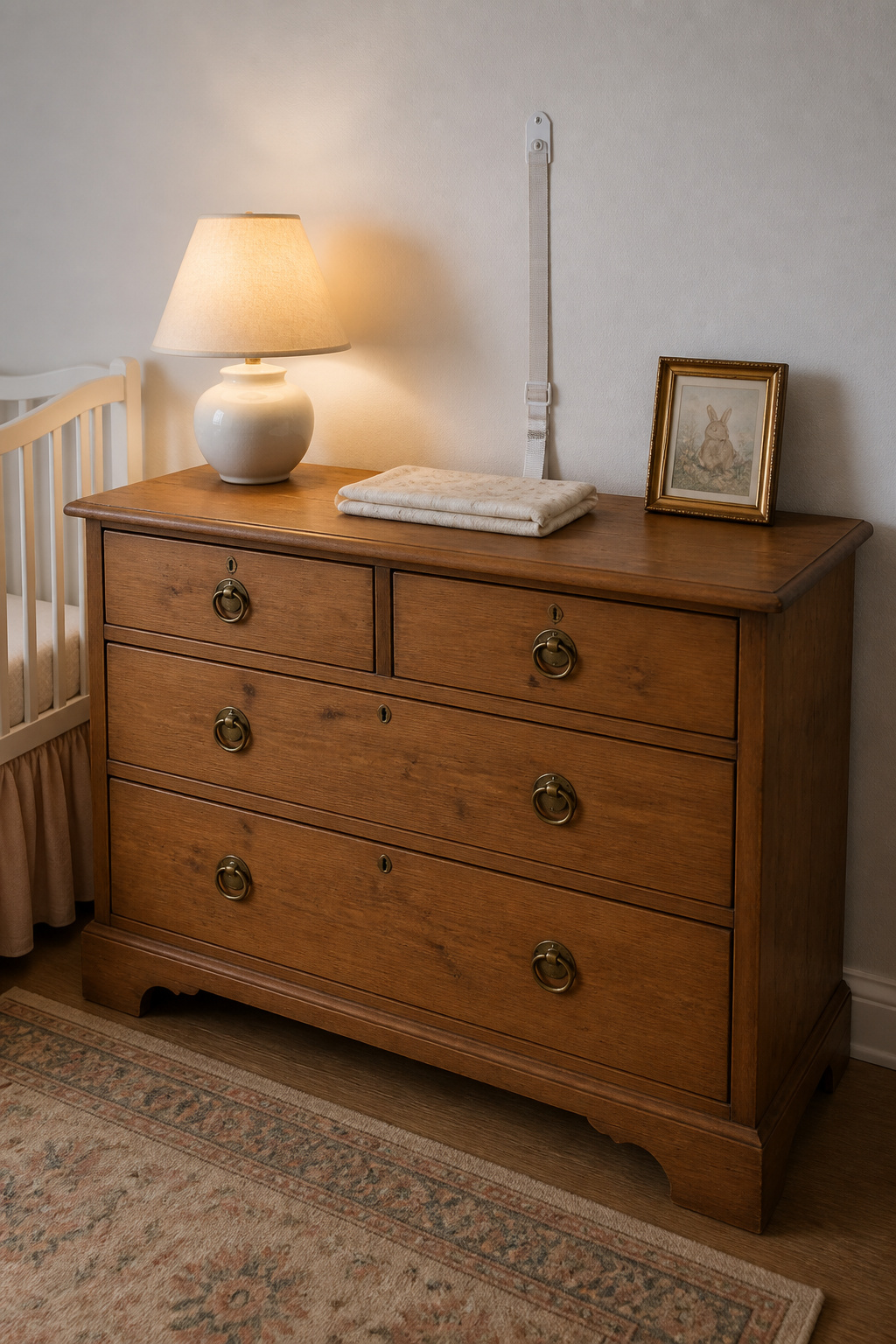
| Dresser / storage | Lead paint, tip-over | Lead-tested and anchored to a wall stud | Same dresser, properly anchored |
| Lamps / lighting | Hot bulbs, dangling cords | LED bulb, cord secured out of crib reach | Vintage-look lamp with LED |
Cribs and sleep surfaces: why pre-2011 cribs fail current standards
Mandatory crib standards (16 CFR Part 1219) took effect June 28, 2011. The headline change banned drop-side rails, linked to 32 suffocation and strangulation deaths between 2000 and 2010. The standards also cap slat gaps at 2 3/8 inches — about a soda can’s width — because a wider gap lets a baby’s body through while their head can’t. Antique cribs routinely exceed it.
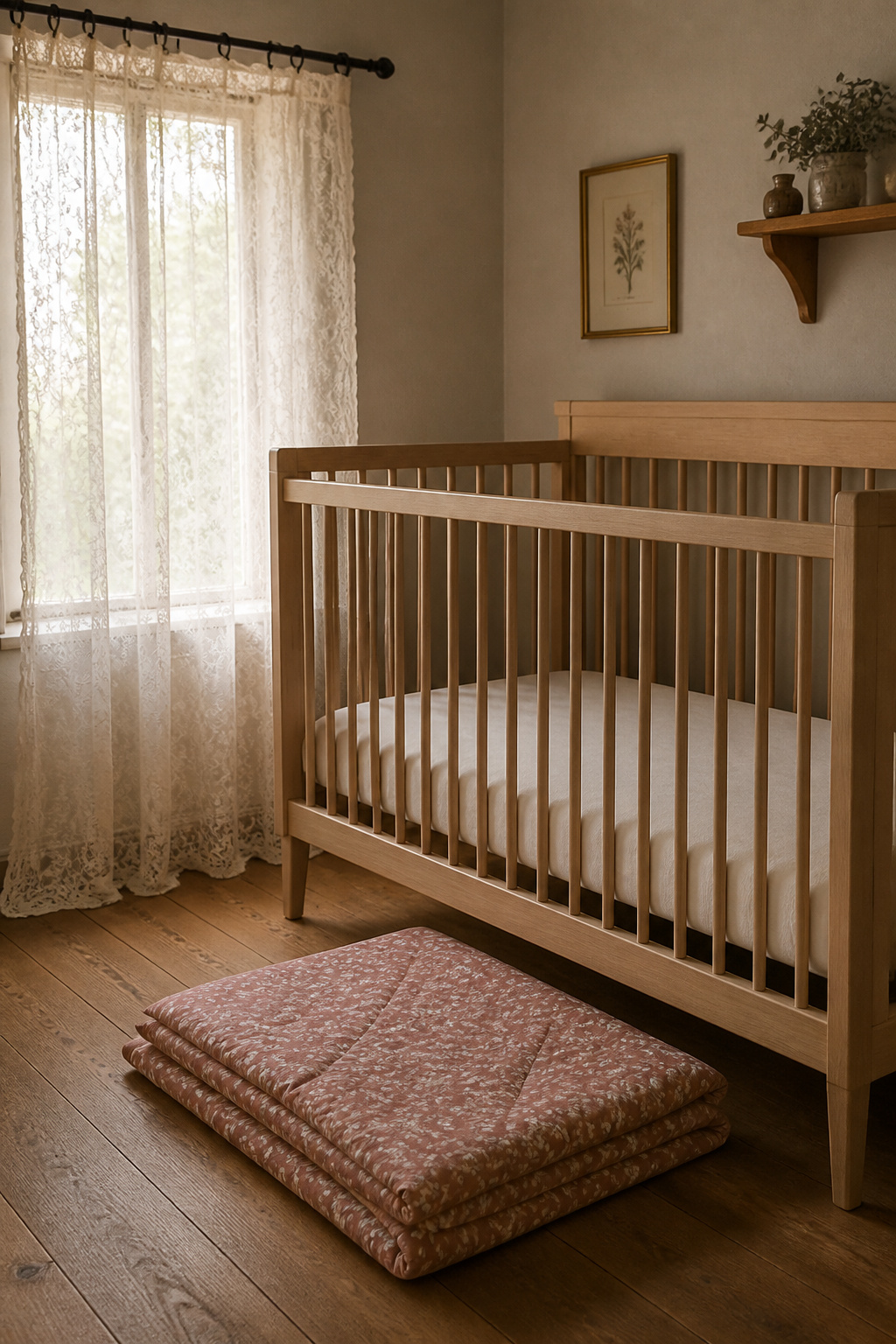
As Cleveland Clinic pediatrician Dr. Heidi Szugye puts it, you don’t have to part with a cherished crib — just don’t use it for a sleeping baby. A vintage-inspired crib like the GREENGUARD Gold-certified Namesake Liberty 3-in-1 gives you the spindle look and meets every current standard.
Antique dressers: what to check for lead paint and tipping
Two checks make an old dresser safe. First, lead: the government banned lead-based paint in consumer products in 1978, so treat any painted piece made before then as suspect — children under six are most at risk through hand-to-mouth contact. An EPA-recognized swab kit ($10–$40) reads the surface in seconds; XRF testing is the gold standard, reading through layers. Never dry-sand old paint.
Second, tipping. Furniture tip-overs send an estimated 5,300 children to emergency rooms each year, and nearly 80 percent of all furniture tip-over fatalities involve kids five and under. The CPSC’s Anchor It campaign: strap tall furniture into a wall stud, not drywall. The STURDY Act covers only new dressers, so anchoring an antique is on you.
Vintage lamps and lighting in a sleeping room
A vintage lamp needs two fixes. Swap the old incandescent bulb for a warm 2700K LED — same amber glow, cool enough not to burn a curious hand. Then run the cord behind the furniture, never across open floor, and keep the lamp on the dresser top, away from the sleep surface, where no cord reaches the crib.
Getting the Vintage Look With Washable Modern Basics
One rule governs the crib; everything else in the room is yours to play with.
The crib bed: how modern sheets read as vintage
Inside the crib: a firm, tight-fitting mattress and one fitted sheet made for crib use — no pillows, quilts, bumpers or stuffed toys. A washed linen-cotton fitted sheet reads as aged and heirloom on sight while staying breathable and safe. Check it fits snugly on all four corners — a sheet that lifts when the baby moves is an entrapment risk.
Vintage-style quilts and blankets that wash well
A quilt doesn’t belong in the crib — but it’s perfect everywhere else: a nursing lap cover, a supervised floor playmat, a drape over the rocking chair arm. Machine-washable cotton gauze quilts in small vintage florals hold their softness through repeated washes, and a genuine heirloom — grandmother’s quilt — gets to live here too, displayed off the sleep surface.
Curtains, rugs and soft furnishings: where genuine vintage works
The non-sleep textiles are your green light for the real thing:
- A hand-knotted wool rug — low pile (no deep shag that traps small hands), over a non-slip underlay.
- Vintage lace curtain panels — hung to clear the floor by an inch or two, so a crawler can’t grab and pull.
- A reupholstered rocking chair seat in plain linen, small floral cotton or a muted stripe.
For more on choosing and caring for old fabric, the vintage textiles and bedding guide goes deeper than I will here.
The Furniture Layer: Antique Pieces That Work Alongside a Safe Crib
With the safety framework in place, bring in the genuinely old furniture: lead-test anything made before 1978, anchor anything tall.
A vintage dresser as the room’s anchor
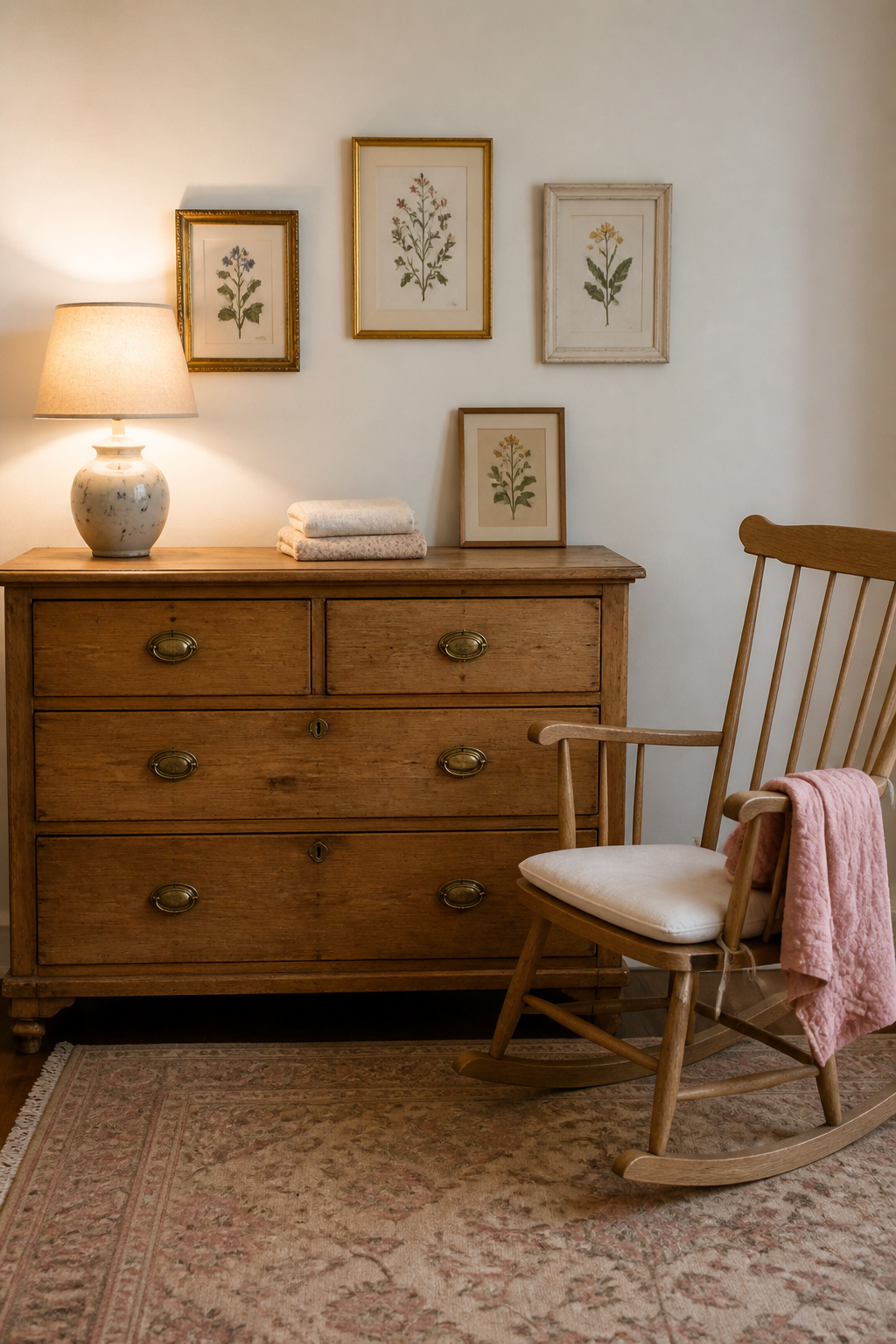
Solid-wood dressers in pine, walnut or oak from the 1940s–70s use dovetailed drawer boxes — sturdier than modern MDF — and typically run $75–$300 at estate sales. Set a contoured changing pad on top for the newborn months, lift it once your baby’s mobile, and it’s simply a dresser again. I keep a wide-drawered one because low, open drawers are the first storage a wobbly toddler will actually master — and a child who can put a folded blanket away herself does, gleefully, about forty times in a row.
A rocking chair or nursing glider: find or refinish
Vintage rocking chairs turn up at thrift stores for around $30–$75 — well under the $200-plus of a new glider — and a basic refinish runs roughly $50–$100 in materials (ballpark, not retail pricing). Apply the same lead rule: test if it predates 1978, strip any flaking finish first. That chair has a long career ahead of it. The one I refinished for my own two — who ended up four years apart in a single small room — went from newborn feeds to bedtime stories for the older one while the younger napped, and it’s still the most-fought-over seat in the house. For the full strip-sand-paint-and-reupholster walkthrough, here’s how to go about painting a vintage piece safely.
Display shelving and small pieces that carry the character
The decor layer does a lot of vintage work for little money — keep it out of the crib zone and anchored:
- A gallery wall of mismatched gilt and whitewashed frames above the dresser, hung at adult eye height.
- Floating reclaimed-wood shelves, stud-mounted, holding ceramics and framed botanical prints.
- Grounded storage with character — a wicker toy chest or a weathered trunk for blankets.
Designing for Growth: How the Room Adapts From Newborn to Age Five
This answers your last worry — and it’s why the vintage approach beats a themed set. A room that only fits this year is the most expensive room in the house; here’s how the pieces carry through.
| Age stage | What changes | What stays | The one investment piece |
|---|---|---|---|
| 0–2 | Changing pad on the dresser; crib mattress lowered as baby stands | Crib, dresser, rocking chair, rug, curtains | The convertible crib |
| 2–4 | Crib converts to toddler bed; a play corner opens up | Dresser, rocking chair, all textiles | The antique dresser |
| 4–6 | Reading corner added; small table appears | Crib-now-bed, dresser, rocking chair, rug | A low front-facing bookshelf |
Stage 0 to 2: the subtract-don’t-add rule
A newborn’s brain isn’t taking in decor; it’s regulating sleep and feeding. The room needs less than catalogs suggest: a safe sleep surface, a feeding chair, a changing spot, storage. Add things when your child’s development calls for them — a low bookshelf has no job in the first six months. One safety rule: lower the crib mattress as soon as your baby can pull to standing, or they can tip over the rail.
Stage 2 to 4: how the dresser and textiles survive the crib transition
Most toddlers move out of the crib between 18 months and three years, when they can climb out or reach about 35 inches tall. A convertible crib handles it with a rail swap — no new bed. The dresser stays put; the rocking chair becomes the reading chair; the rug, lace and quilt all stay unchanged. The room’s vintage character rides through untouched.
Stage 4 to 6: a reading corner and the pieces worth investing in now
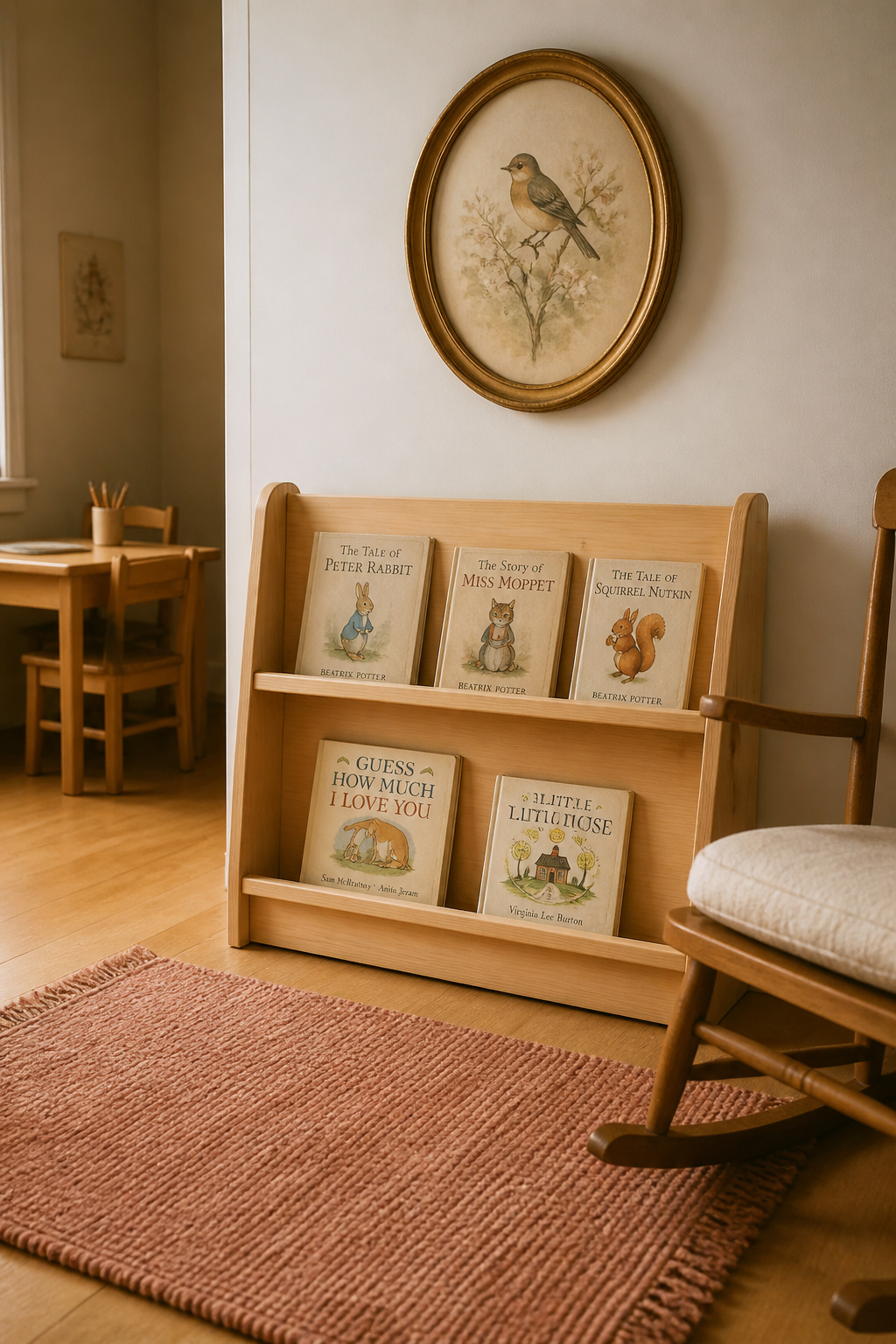
By the preschool years the reading corner becomes the room’s busiest spot. A low, front-facing bookshelf — covers visible, covers chooseable — supports the independence that book-led play is actually building. I learned that the hard way: my first toddler shelf was a beautiful forward-facing thing that got emptied onto the floor daily, because I’d designed for the catalog photo, not the kid. Once I matched the shelf to how she actually grabbed and reshelved, the floor stayed clear. Introduce one around age two to three; a small wooden table and two chairs ($20–$60 at estate sales) round out a drawing corner by age four.
The room you pictured is buildable. A certified sleep surface, genuinely old pieces everywhere else, and furniture that grows instead of getting replaced — that’s the whole framework. Before you buy a thing, kneel in the empty room and look from your child’s height. Bring in the crib, the dresser and the chair first. The charm follows the safety.
FAQ
Are antique cribs safe to use for a newborn?
No. The CPSC and American Academy of Pediatrics both advise against any crib made before 2011, when federal standards (16 CFR Part 1219) took full effect. Older cribs commonly fail on slat spacing (max 2 3/8 inches), banned drop-side rails, and corner-post height, and may contain pre-1978 lead paint. Choose a certified vintage-inspired crib instead.
How do I get a vintage nursery look without using unsafe old furniture?
Keep the sleep surface modern and certified; let everything else be genuinely old. Pair a new spindle-style convertible crib with a lead-tested, wall-anchored antique dresser, a refinished rocking chair, lace curtains, a wool rug and a botanical gallery wall. On the mattress, use a natural linen-cotton fitted sheet — its texture alone reads heirloom.
What vintage nursery pieces are worth investing in that will last through toddler years?
Three pieces pay off across the whole 0–5 range: a convertible crib (becomes a toddler bed), an antique dresser (permanent storage and anchor), and a refinished rocking chair (nursing chair, then reading chair). The one later addition is a low front-facing bookshelf around age two to three. Soft furnishings — rug, curtains, gallery wall — need no updating at all.