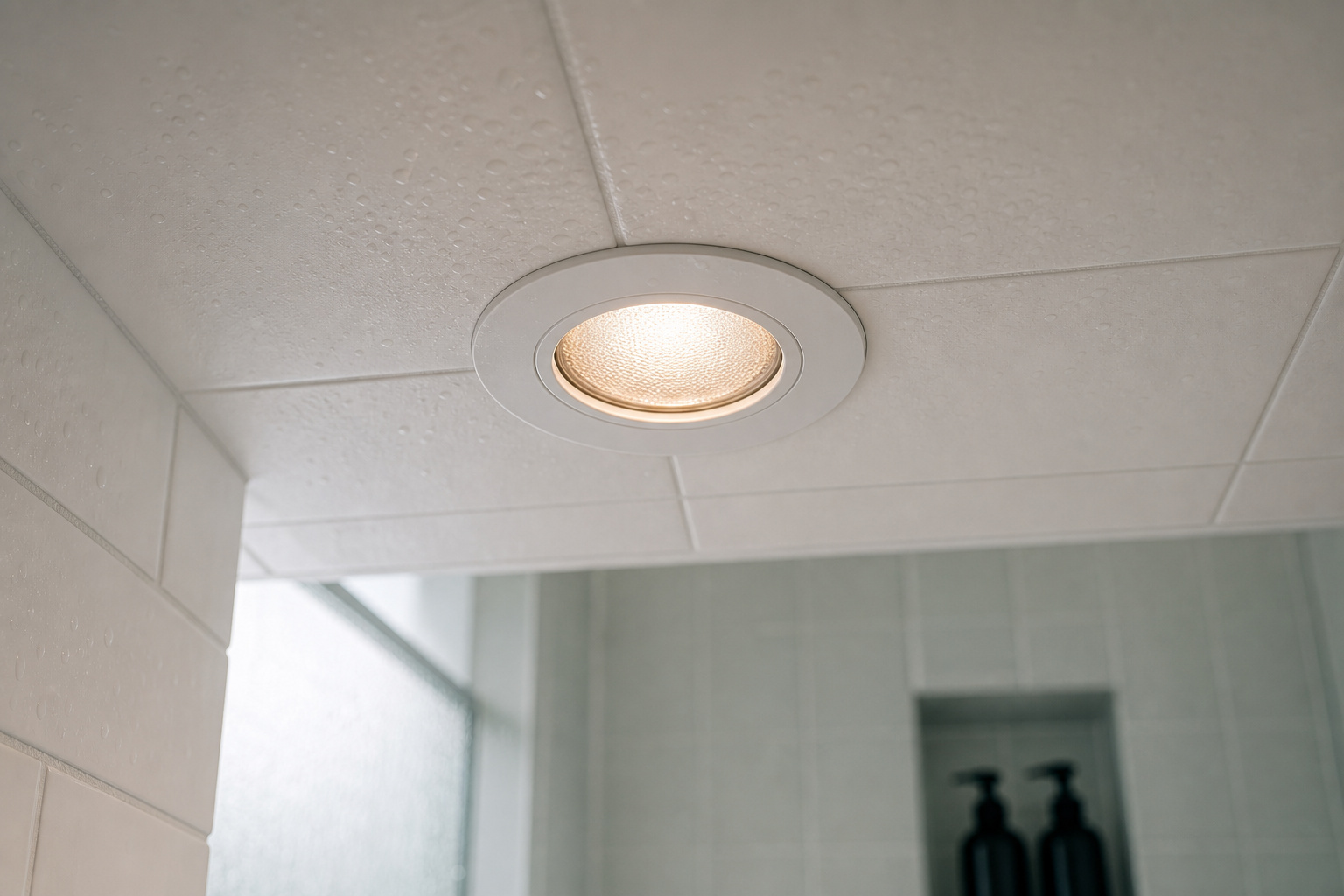

A rusting light over a shower is the cheapest expensive mistake in a bathroom. The fixture cost forty bucks; the corrosion it grows in a daily-use shower shows up in 12 to 24 months, and a wrong-rated fixture flagged at a home sale can stall a closing. It comes down to one detail nobody checks: whether the light is rated for the moisture it’s about to live in.
TL;DR
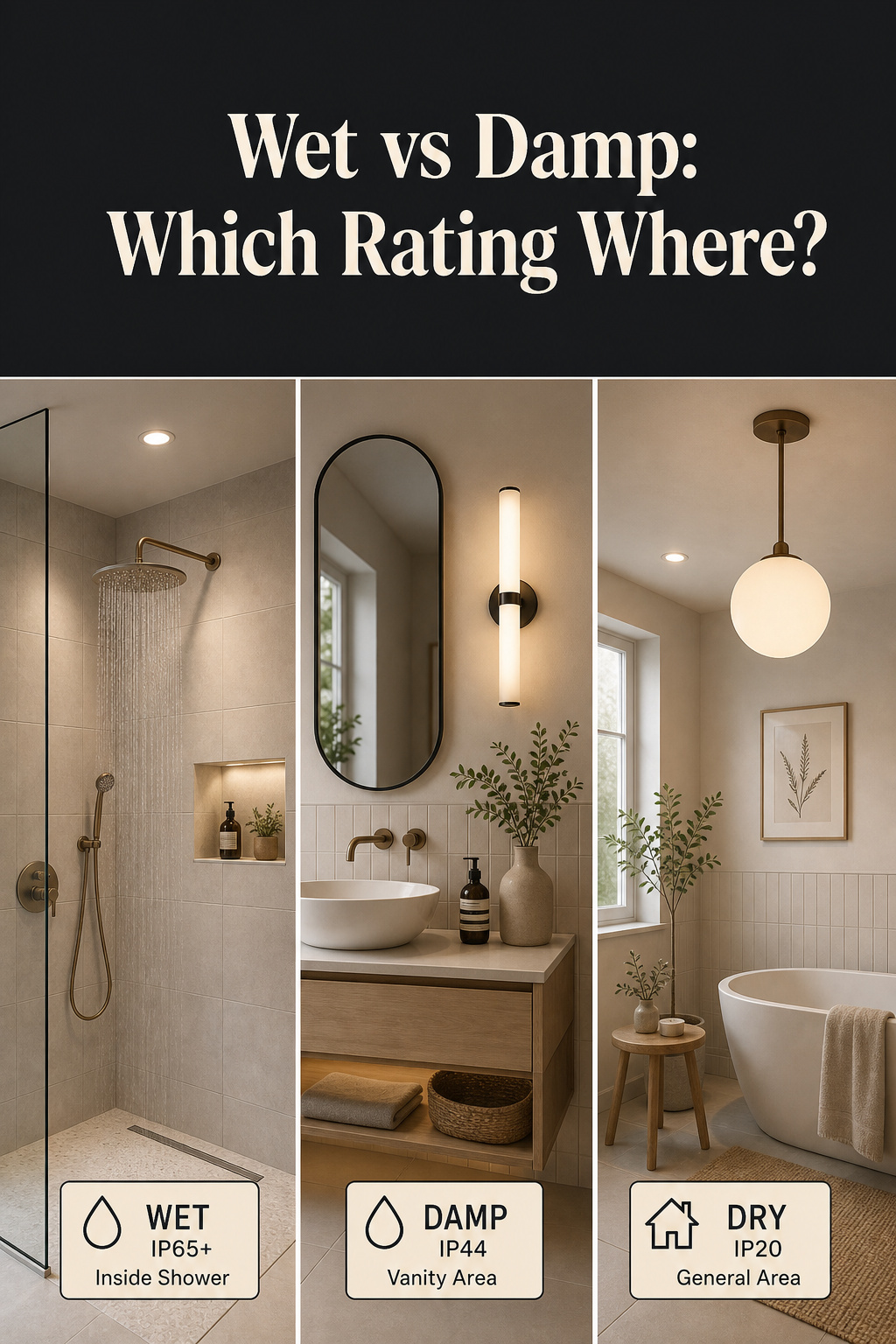
- Match the rating to the spray: wet-rated (industry shorthand IP65+) directly over or inside a shower, damp-rated (roughly IP44) for the general ceiling and vanity, and look for a UL or ETL “Wet Location” mark — that’s what US code keys on, not the IP number.
- A wet-rated fixture can always replace a damp-rated one; a damp-rated fixture must never go where wet is required.
- NEC 210.8 requires GFCI on bathroom receptacles, not hardwired lights — a GFCI breaker is the clean way to cover a light circuit, but it isn’t code-required for the fixture itself. Verify your local code and hire a licensed electrician for new wet-zone wiring.
The Fixture Rating Your Bathroom Already Has (And Whether It’s Right)
That fixture already has a moisture rating — or the lack of one is its rating. Most homeowners pick by looks and learn about ratings only when something corrodes. This is the safety piece of bathroom lighting ideas; here we get specific.
Why bathroom zones exist and what they determine
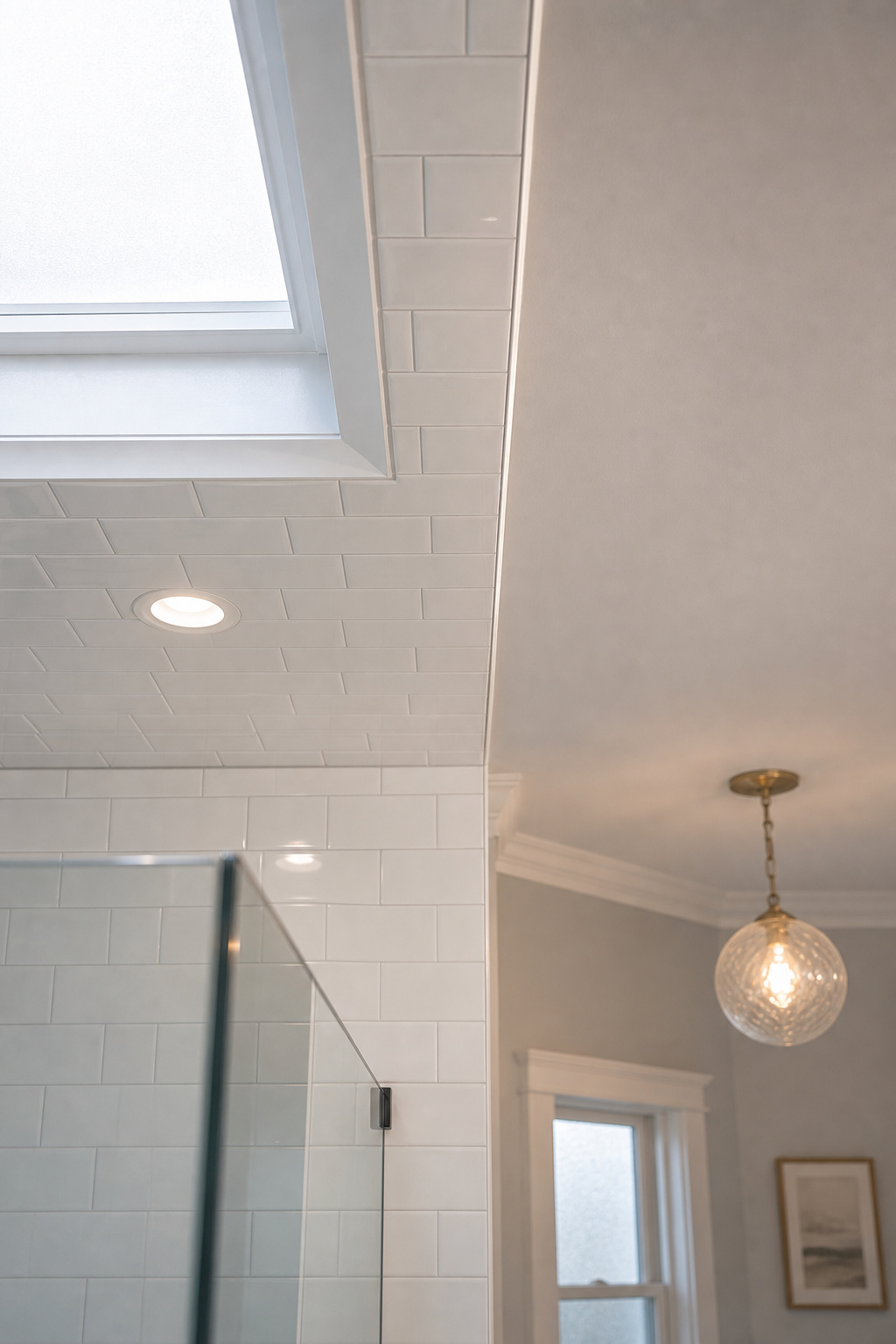
Exposure isn’t uniform. In the US, the National Electrical Code (NEC) doesn’t number “zones.” It uses two plain classifications, “damp location” and “wet location,” plus a defined bathing area under NEC 410.10(D). You’ll see “Zone 0/1/2” all over the internet; those are UK wiring terms (BS 7671), not NEC designations. They don’t apply to US installs.
The before: most homeowners have the wrong fixture in at least one zone
A damp-rated fixture directly over a shower ceiling is the most common bathroom lighting code violation — it isn’t sealed for direct spray. Dry-rated fixtures are worse: anywhere in a bathroom they’re a violation. Plenty of builder-grade fixtures carry no UL mark. When there’s no marking, assume dry-rated and replace it for any moisture zone.
What’s at stake — code, insurance, and the fixture that corrodes in two years
Put a damp-rated fixture in a wet zone and water works into the unsealed housing: rust, degraded seals, eventually an electrical fault. You can also void the warranty, fail a point-of-sale inspection, and hand your insurer a reason to deny a claim. “It looked fine” is no defence when the fixture was wrong-rated.
The Three Bathroom Moisture Zones and What Each Allows
The NEC’s two classifications map onto three practical areas. I’ll use the familiar Zone 0/1/2 labels below as reader shorthand — remember they’re descriptive, not US code terms. What the NEC cares about is whether spray reaches the fixture.
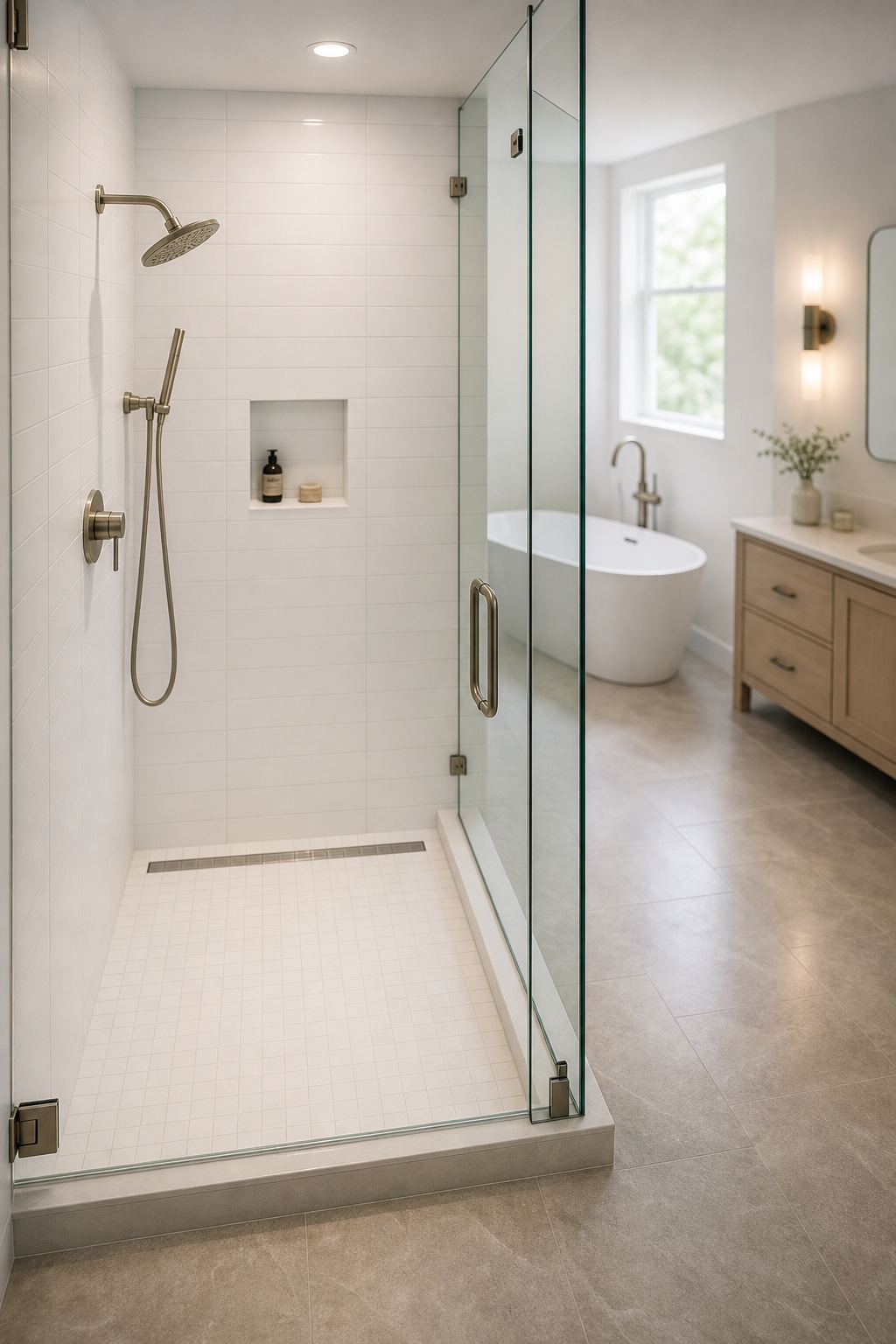
| Area (shorthand) | Where it is | Practice IP min | Rating required |
|---|---|---|---|
| Zone 0 | Inside the shower/tub enclosure | IP67 | Wet-rated only |
| Zone 1 | Directly above shower/tub | IP65 | Wet-rated |
| Zone 2 | Within ~60 cm of the edge | IP44 | Damp-rated min |
| Outside zones | The rest of the room | — | Dry OK; damp better |
Zone 0: inside the shower or tub — IP67 minimum, wet-rated only
Inside the enclosure is the highest-risk spot — spray, steam, even standing water. Use a wet-rated (UL or ETL wet-listed) fixture; IP67, meaning dust-tight plus immersion resistance to 1 metre, is the practical minimum. One rule surprises people: NEC 410.10(D) prohibits pendant, cord-, chain-, cable-, or track-suspended luminaires and paddle fans within 3 ft horizontally and 8 ft vertically of the tub rim or shower threshold — even wet-rated ones. The ban is on the fixture type, not the rating. Hire a licensed electrician before wiring anything into this zone from scratch.
Zone 1: directly above the shower or tub — wet-rated, IP65 minimum
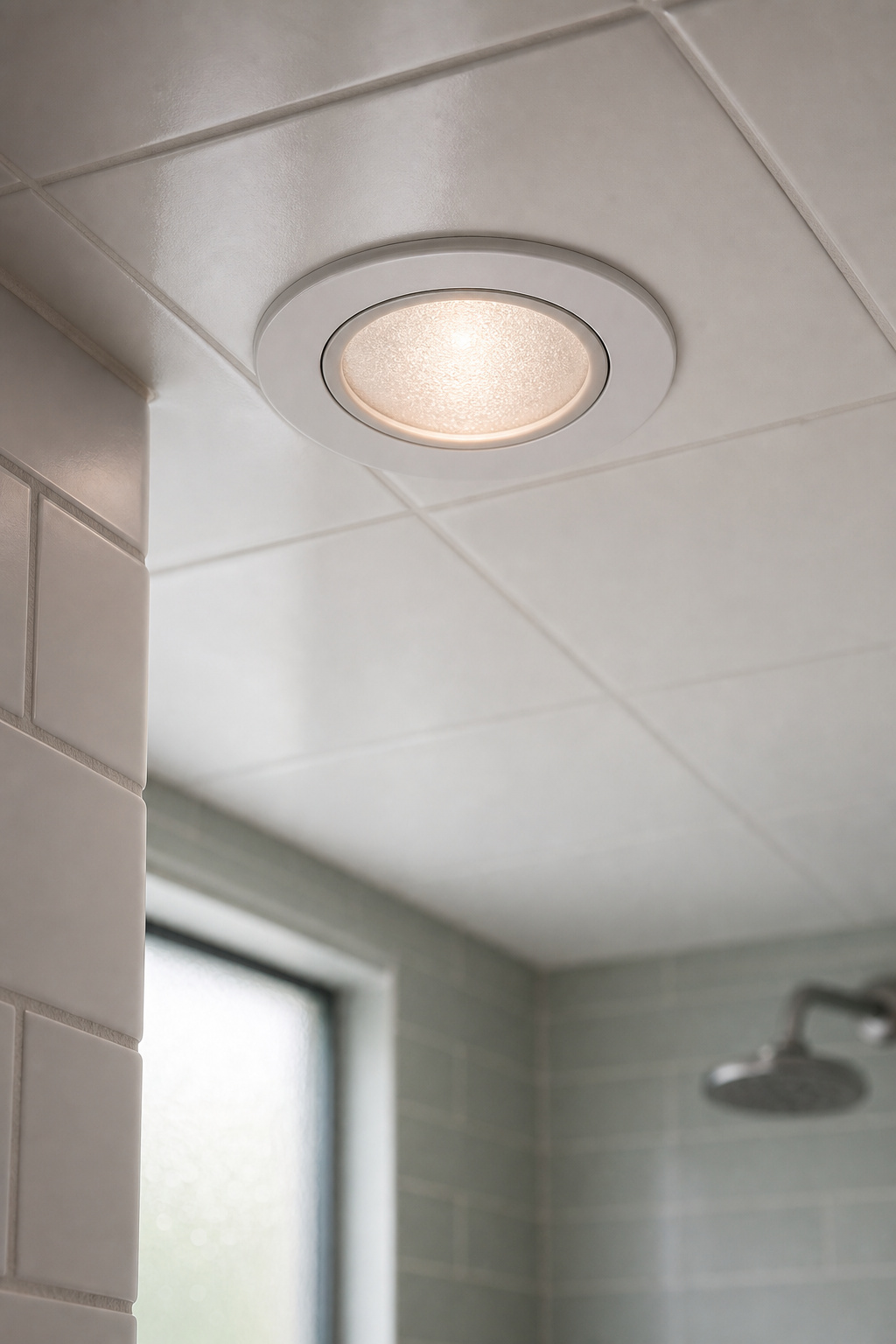
Above the showerhead, spray reflects up off the tiles, so the fixture must be wet-rated where subject to spray. IP65 is the cited minimum: dust-tight, resistant to water jets from any direction. Most residential shower ceilings fall within the NEC’s 8-ft vertical bathing zone, so wet-rated is the safe default.
Zone 2: within 60cm of the shower or tub edge — damp-rated minimum
Step back from direct spray and you’re in damp territory. IP44 — protection against objects over 1 mm and splashing from any direction — is the practical floor, and the professional pick for a vanity light within about 24 inches of the basin.
Outside the zones: dry-rated is fine, but GFCI still applies
In the open part of a well-ventilated bathroom, the NEC doesn’t mandate a moisture rating for ceiling fixtures. A dry-rated light there isn’t a violation — but bathroom humidity still corrodes unsealed fixtures, and damp-rated costs only marginally more.
IP Ratings Decoded: What IP44, IP65 and IP67 Protect Against
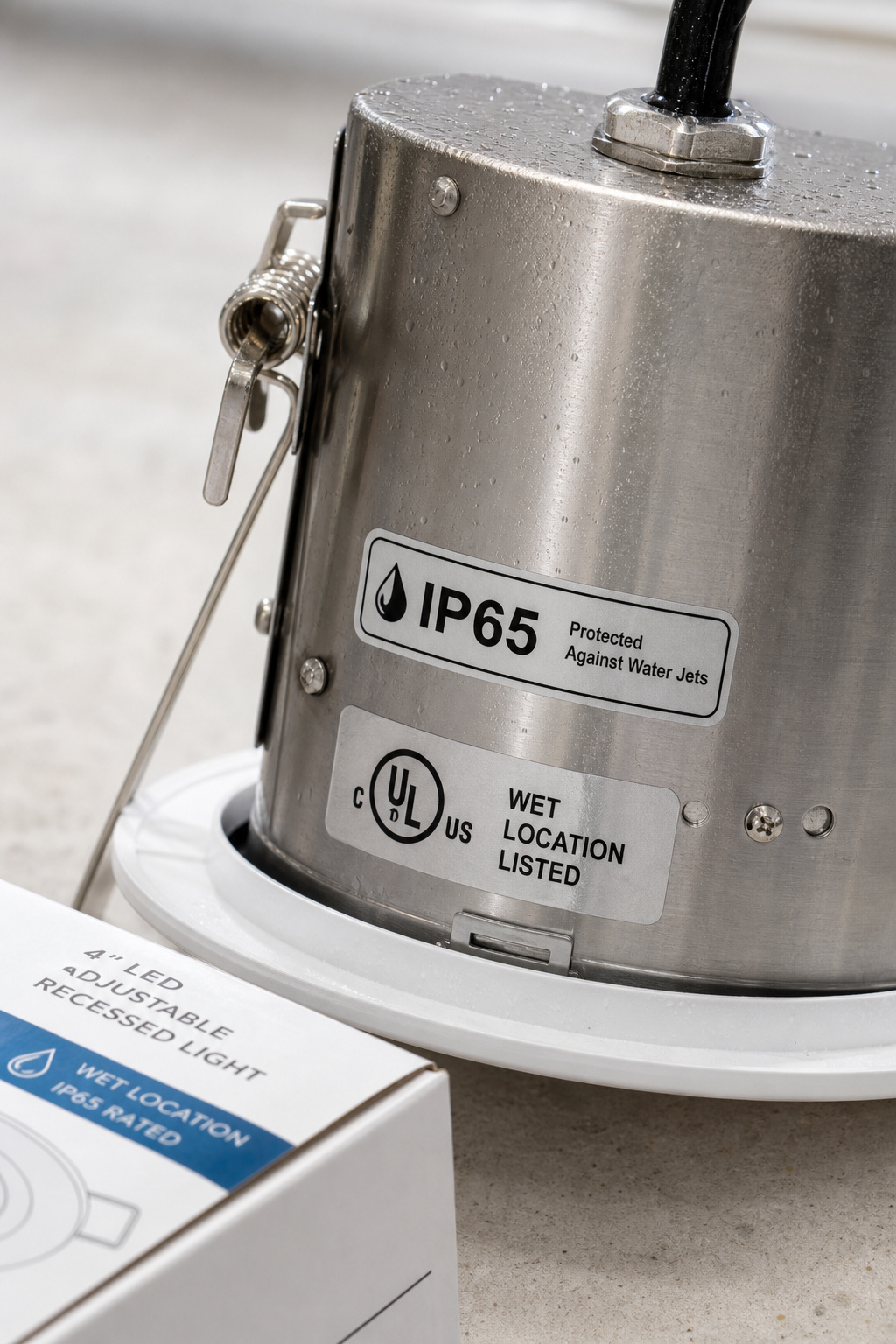
Before you trust an IP number, know what it is and isn’t. IP codes come from IEC 60529 — an international standard, not the NEC. US code speaks in “damp” and “wet location”; the IP number on the box is the manufacturer’s claim tested to that standard. For a US install, the UL or ETL listing is the credential that matters. IP is supplementary.
What the two numbers mean — in plain English
Two digits. The first (0–6) is solid-particle protection: 4 means objects over 1 mm blocked, 6 means fully dust-tight. The second (0–9) is liquid protection: 4 is splashing, 5 is water jets, 7 is temporary immersion to 1 metre. An “X” in either slot means that protection level wasn’t tested.
IP44 at the sink: splash protection, the minimum for any bathroom
IP44 means objects over 1 mm blocked and splashing handled — but no jets, no immersion. It lines up with a damp-location listing and is the practical minimum for any bathroom fixture, vanity included.
IP65 in the shower: directional water jet protection
IP65 is fully dust-tight plus protection against water jets from any direction — the cited minimum for a wet-zone shower ceiling. Paired with a UL wet-location listing, an IP65+ fixture gives you two independent confirmations on one box.
Why not all wet-rated fixtures carry an IP rating
UL wet-location listing and IP ratings are separate frameworks from separate testing bodies. A fixture can be UL wet-listed with no printed IP code. Look for the UL or ETL mark plus “Suitable for Wet Locations” on the box, body, or instruction sheet. No marking means dry-rated by default — “bathroom-safe” with no listing is just a claim, not a certification.
Damp-Rated vs Wet-Rated: The Difference That Decides What You Buy
Damp-rated handles humidity and indirect moisture; wet-rated is sealed for direct water. One question decides which you buy: does spray hit the fixture?
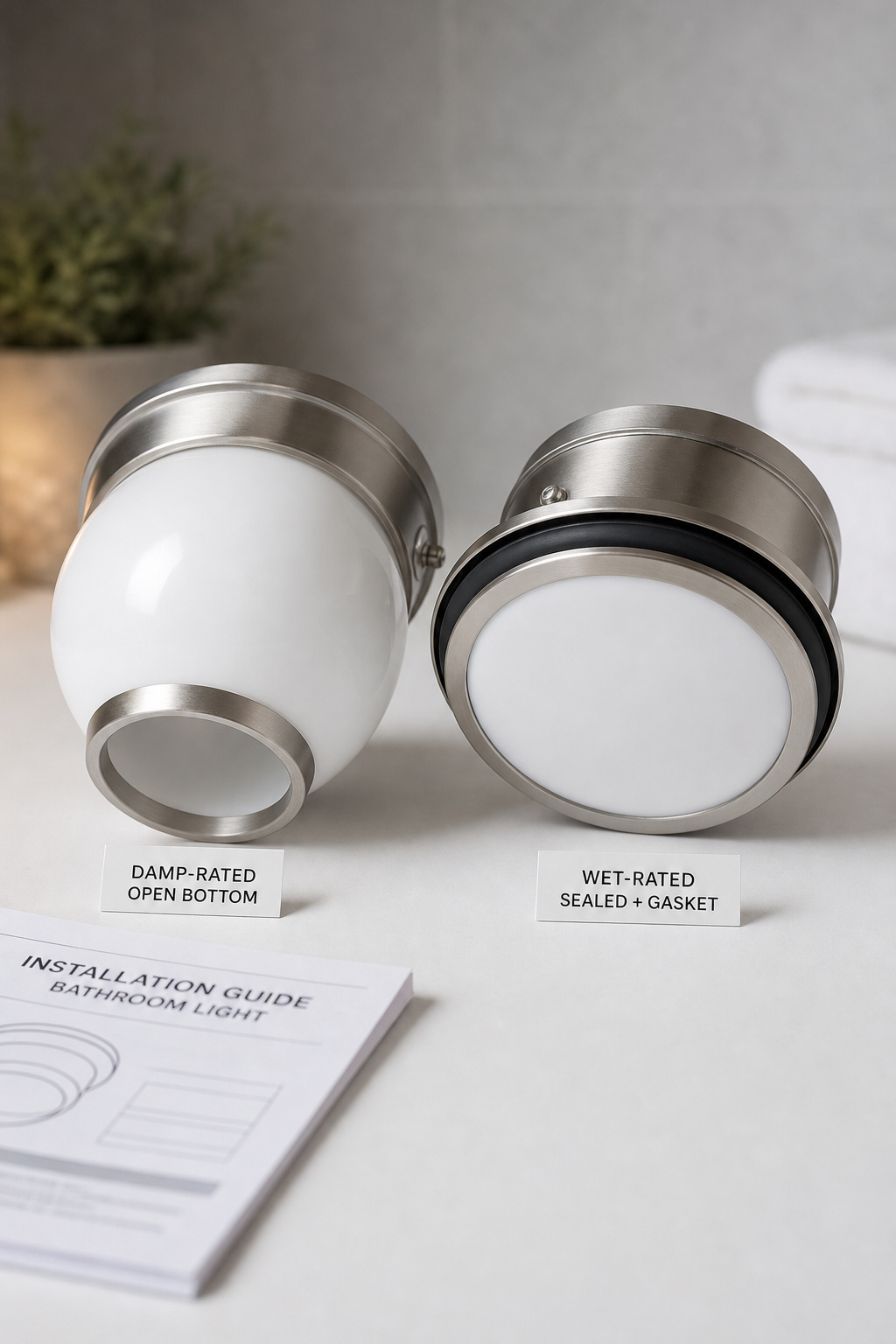
| Rating | What it handles | Use it | Don’t use it |
|---|---|---|---|
| Damp-rated | Humidity, condensation | General ceiling, vanity, away from spray | Shower ceiling, above-tub spray zone |
| Wet-rated | Direct water spray | Shower, above tub, anywhere damp is asked for | Nowhere — over-spec is always safe |
Damp-rated: humidity and indirect moisture
A damp location is “subject to condensation of moisture” but not saturation or direct contact. Damp-rated fixtures have moisture-resistant housings but aren’t fully sealed — they skip the gaskets and watertight enclosures of wet-rated gear. Good for the general ceiling and vanity, typically IP44 or below on the liquid digit.
Wet-rated: direct water contact
A wet location is “subject to saturation” or direct spray — shower ceilings, above-tub areas, outdoor fixtures in rain. Wet-rated fixtures use rubber gaskets, sealed enclosures, and corrosion-resistant finishes, and they pass a direct-spray test for the UL wet listing. They run IP65 or higher. The substitution rule is absolute: wet replaces damp anywhere; the reverse is never acceptable. That rule matters most when you’re choosing rated fixtures for a shared shower-and-tub alcove.
The common mistake: a damp-rated fixture on a wet-zone ceiling
Water gets past the unsealed housing, rusts the metal, breaks down wiring insulation, and eventually shorts or trips the breaker — 12 to 24 months from install. An inspector or adjuster spots a missing UL/ETL wet mark on a shower ceiling immediately. Check the label before you buy, not after you’ve wired it in.
GFCI Protection: The Code Requirement That Protects Every Outlet and Circuit
GFCI is a separate safety layer from fixture ratings. It’s worth being precise about what code requires — this is the NEC baseline. Your jurisdiction may be on a different edition with its own amendments, so confirm with your AHJ or a licensed electrician before any work.
What a GFCI does, and why every bathroom outlet needs one
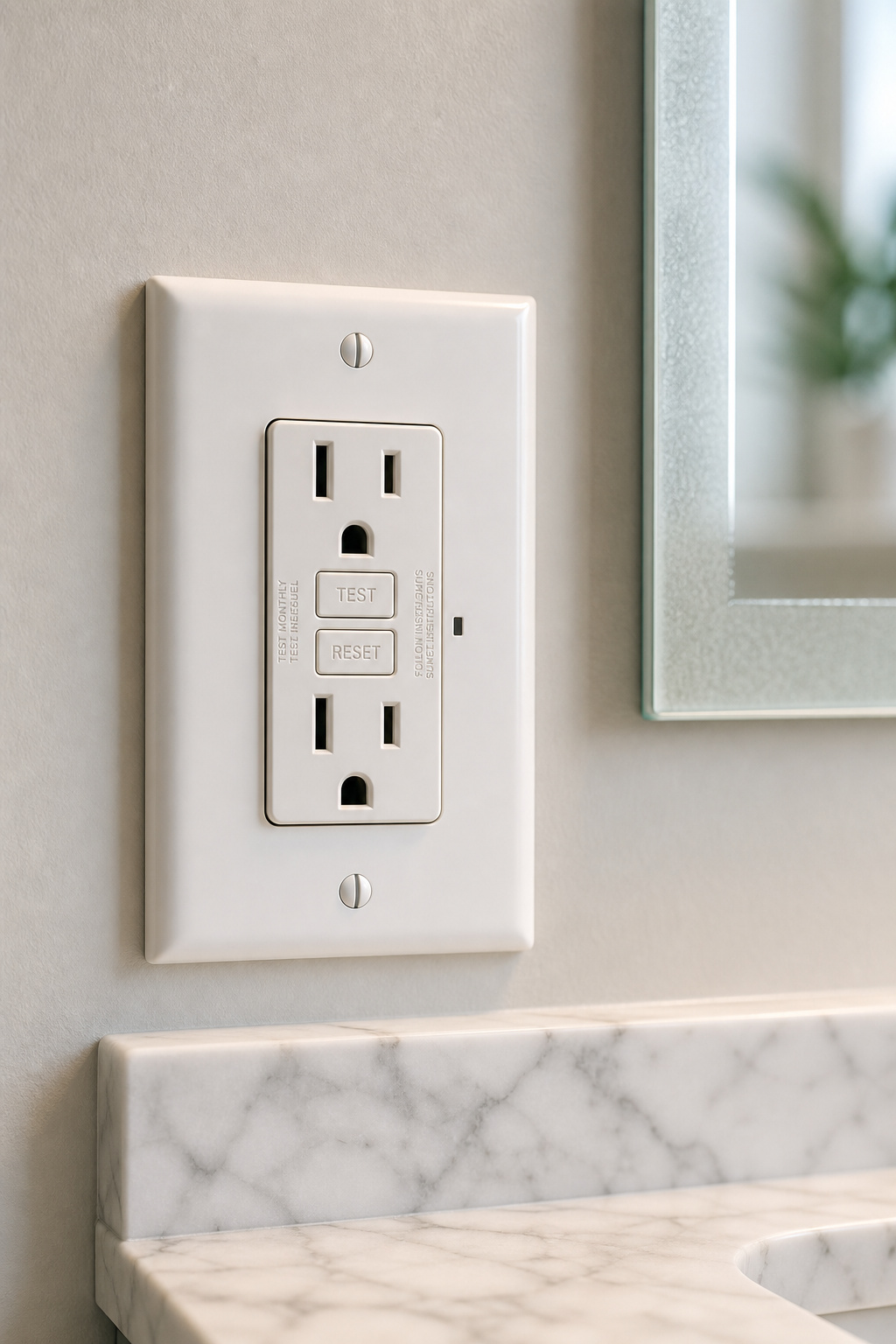
A GFCI (Ground Fault Circuit Interrupter) watches current going out against current coming back. If 4–6 milliamps leak to ground — through water or a person — it cuts power in about 1/40th of a second, before a shock turns lethal. NEC 210.8(A)(1) requires GFCI protection for every 125V–250V receptacle in a dwelling-unit bathroom, no matter how far from water.
GFCI outlets vs GFCI breakers: which covers your sconce circuit
A GFCI receptacle protects itself and outlets wired downstream — but not hardwired loads like lights and fans, unless specifically wired to do so. A GFCI breaker at the panel protects everything on the circuit, hardwired fixtures included. The key point: the NEC does not mandate GFCI for hardwired bathroom luminaires — only receptacles are explicitly required. A GFCI breaker is the clean way to cover a light circuit, not a code obligation for the fixture itself. If a fan/light combo’s instructions require GFCI, follow the manufacturer. A receptacle runs about $15; a breaker, about $50. Plan how the shower light fits the layers first — fit it into the layers before you wire.
Testing and resetting GFCI monthly — the step most people skip
Ten seconds, once a month, and nobody does it:
- Press TEST. Hear a click; anything plugged in loses power.
- Press RESET to restore power. If it didn’t trip, or won’t reset, the device has failed — replace it.
- Test GFCIs the same day you test smoke alarms.
If a GFCI trips again the instant you reset it, stop — that’s a wiring fault for a licensed electrician. Don’t tape the button down or swap in a regular outlet.
When to Stop DIYing and Call a Licensed Electrician
Knowing where to stop isn’t a failure — it’s the skill. The line is sharp.
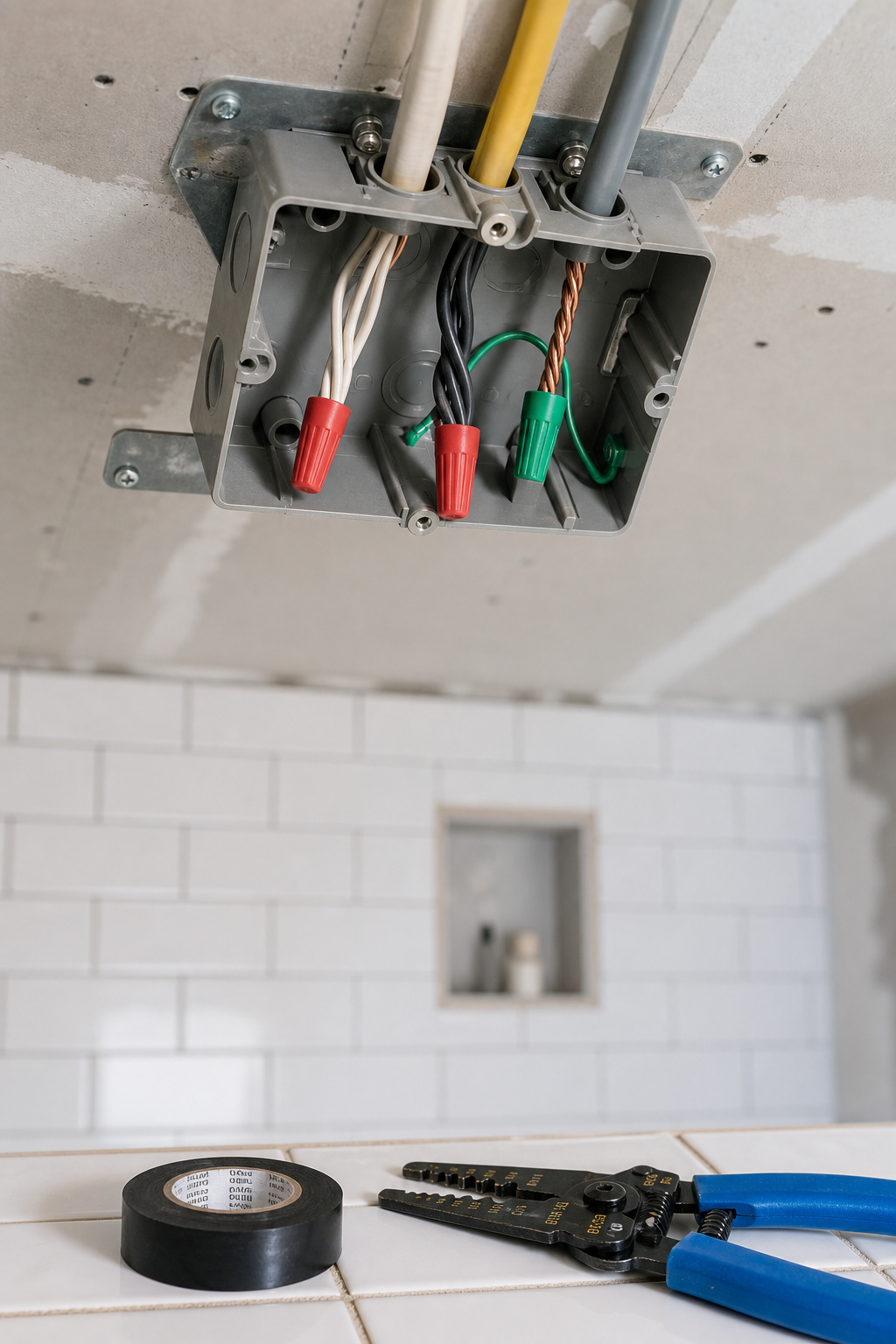
A like-for-like fixture swap on an existing junction box — same box, same wiring, wet-rated replacement going in — is confident-builder DIY. It usually needs no permit. Everything past that changes:
- New wire, a new outlet or switch, or a new junction box in a wet zone — permit required in nearly every US jurisdiction, often a licensed electrician too.
- A new shower light from scratch (routing cable, adding a box, tapping a circuit) — permitted work, and most states want a licensed electrician to perform or supervise it.
- Adding a GFCI breaker at the panel — opening the panel means a permit in most places, qualified-electrician territory regardless of skill level.
Inspections exist for a reason: an inspector checks the box, wire gauge, fixture rating, GFCI provision, and ground continuity before the ceiling is tiled. Finding a fault afterward costs far more.
If you’re hiring out, tell the electrician the fixture type and IP/UL rating, whether the shower light needs its own switch, and whether the circuit should be GFCI-protected at the breaker or outlet. When they’re done, verify: the label confirms the right rating, the GFCI trips and resets on TEST, and a permit was pulled and passed — ask for the card. Local codes vary; some jurisdictions are still on the 2017 or 2020 NEC. Your AHJ is the final word. Verify locally before buying a fixture.
FAQ
What is the difference between wet rated and damp rated bathroom lights?
Damp-rated fixtures handle humidity and condensation but not direct spray — suitable for the general ceiling and vanity. Wet-rated fixtures are fully sealed with gaskets and corrosion-resistant finishes; NEC 410.10(D) requires them above any shower or tub where spray reaches the fixture. Wet can replace damp anywhere; the reverse is never acceptable.
What IP rating do I need for a light inside a shower?
IP65 is the widely cited minimum for a shower ceiling or in-enclosure fixture: complete dust protection plus resistance to water jets from any direction. At floor level inside a shower tray where standing water could reach it, step up to IP67. For US installs, pair the IP rating with a UL or ETL “Wet Location” listing.
Does a bathroom vanity light need to be GFCI protected?
NEC 210.8 covers receptacles, not hardwired luminaires — so GFCI isn’t explicitly required for a hardwired vanity light. But if the light shares a GFCI breaker with bathroom outlets, it’s protected automatically. If a GFCI receptacle is upstream, check whether the light runs through that protected leg. Always follow manufacturer specs.