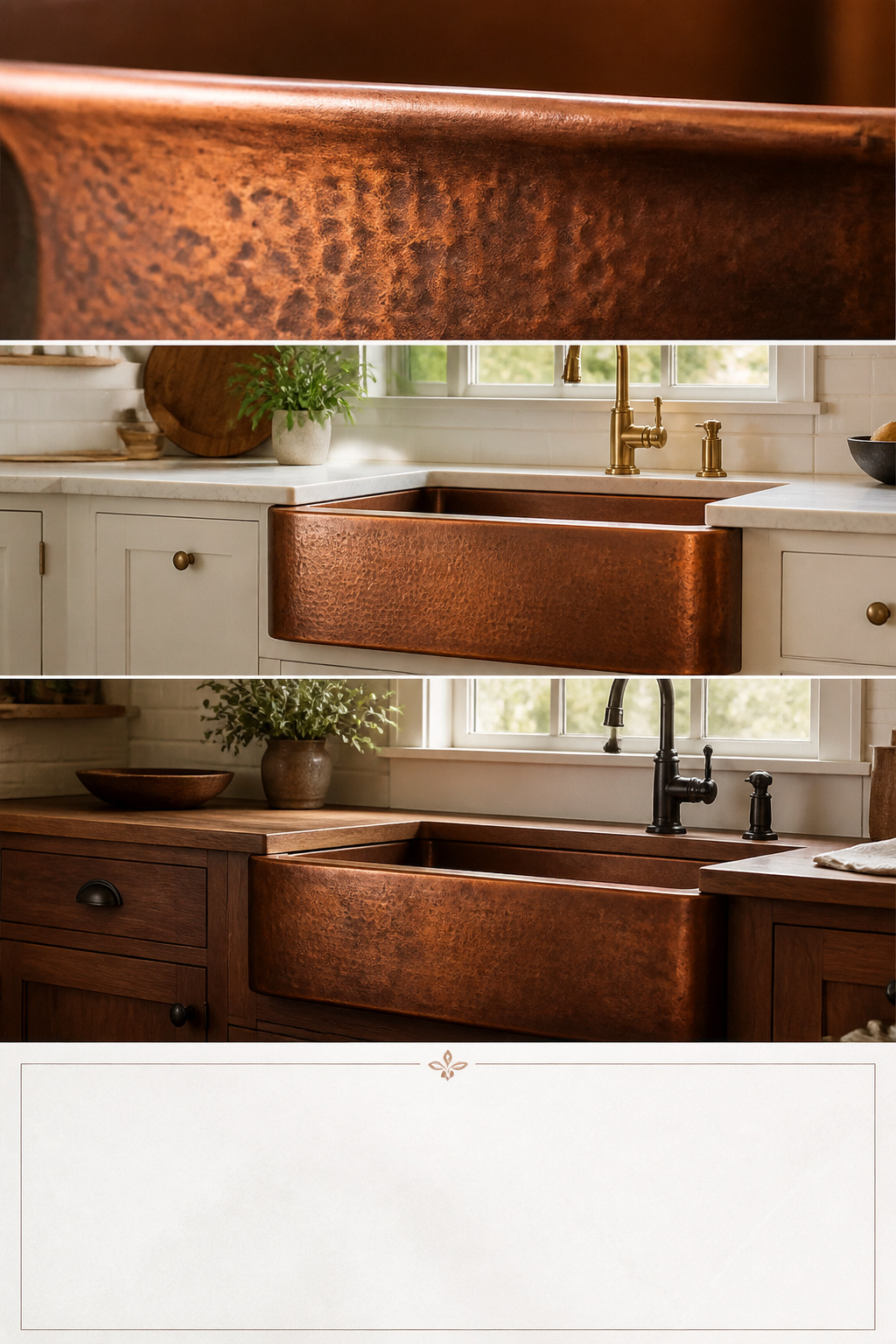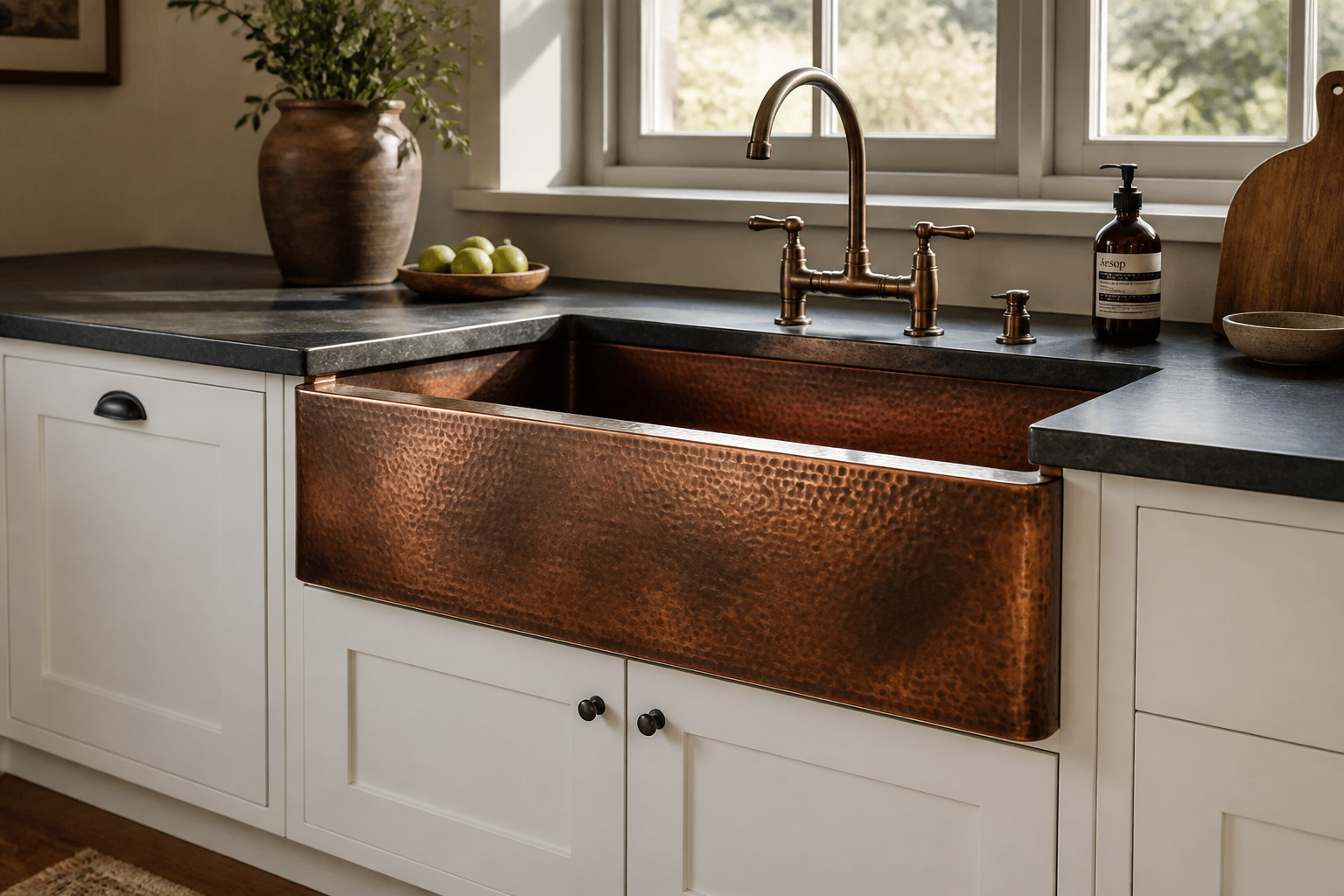
Long before stainless steel existed as a kitchen material, copper did this job. The first indoor kitchens of the late 1800s ran sinks of copper, nickel silver, or cast iron, and butler’s pantries chose copper deliberately — gentle enough to hand-wash crystal without breaking it. A copper farmhouse sink today is not a trend lifted from a mood board. It is a revival of the material that ran kitchens for a century, and the reasons it worked then still hold.
TL;DR
- Copper patina is protective, not a flaw: the oxide layer that darkens the surface from bright penny to warm brown is a chemical barrier, and most indoor sinks settle at brown within one to three years — they do not turn green.
- Buy on gauge: 16 gauge (1.29mm) is the quality floor and 14 gauge (1.63mm) the premium tier; expect $600 to $3,500, and walk away from anything above 18 gauge or with soldered rather than welded seams.
- Copper is genuinely antimicrobial — EPA-registered to reduce specific bacteria by more than 99.9% within two hours, when cleaned regularly, as a supplement to hygiene rather than a substitute for it.
Copper in the Kitchen: A Material With a Working Past
Copper is the oldest metal humans worked at scale, and that lineage still governs how a good sink is made and why it behaves as it does.
Why copper was the original kitchen workhorse — and what displaced it
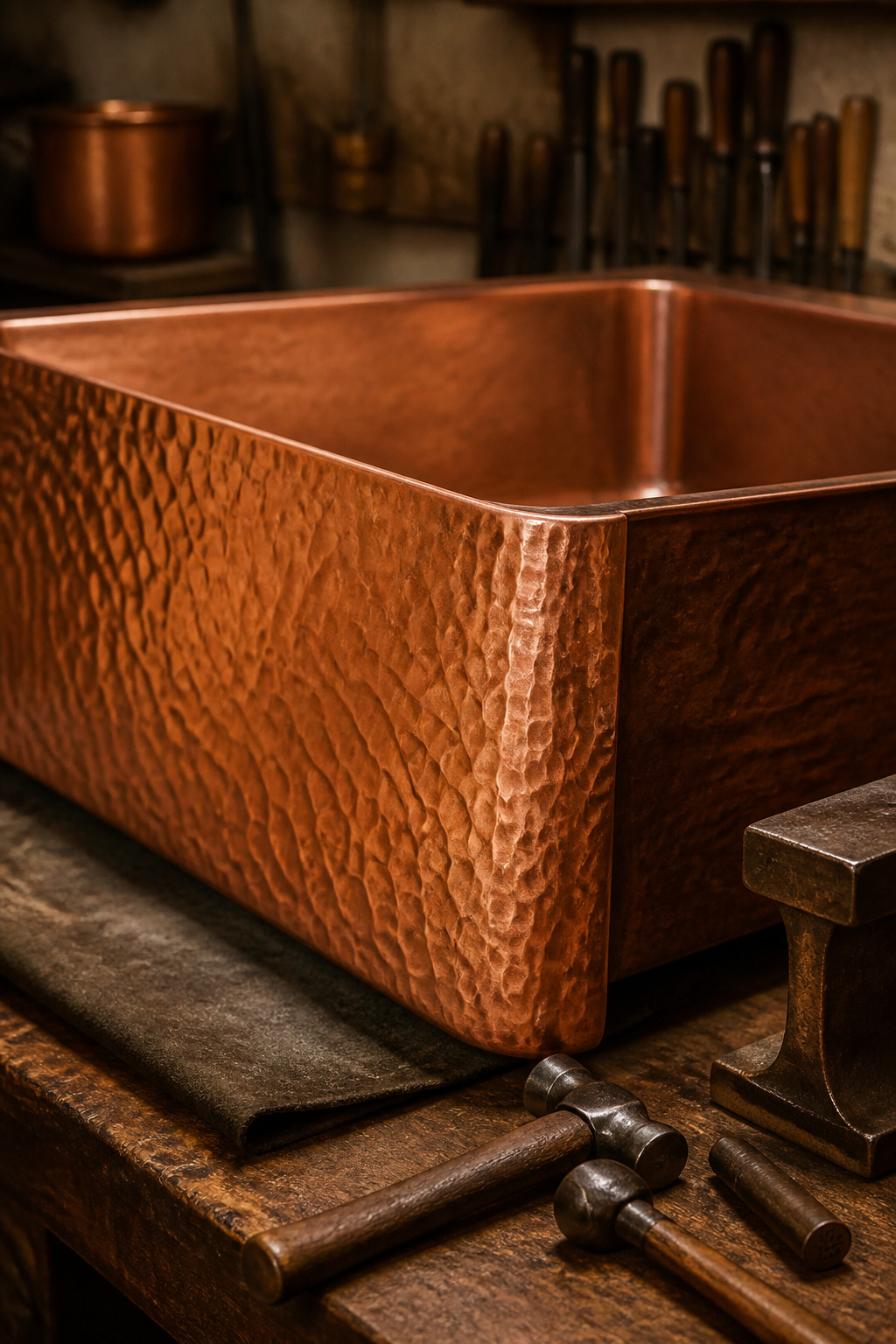
Sinks connected to indoor plumbing in the late 1800s were primarily copper, nickel silver, or cast iron. The 19th century’s mass-production techniques made copper sinks widely affordable. The turn of the 20th century brought enamelled cast iron, and as kitchens modernised the apron sink gave way to the cheaper undermount stainless basin. Copper did not fail; it was displaced by something cheaper to manufacture. That history matters to buyers now because the craft it produced — hand-hammering, welded seams, a 99% copper / 1% zinc composition — is still the mark of a sink built to last. Quality sinks are not machine-stamped; an artisan hammers the metal into shape, which is the origin of the hammered finish and the reason hand-made units differ slightly. A craftsman-made sink is fully welded; soldered seams eventually leak and turn grey.
What that lineage means for buyers today
The properties that made copper useful in a Victorian kitchen — malleability, natural antimicrobial behaviour, longevity — are still the argument for it. A well-made sink commonly lasts thirty years or more. Buyers who choose it want a material that carries the marks of its use and passes them on. For where copper sits among the alternatives, the farmhouse sink styles and materials guide maps the full field.
Living Patina: Why the Change Is the Point
The fear that stops most people is simple: a copper sink will not look in year ten as it did on day one. But the change is not decay — it is copper doing what it has always done.
How copper patina develops and what drives it
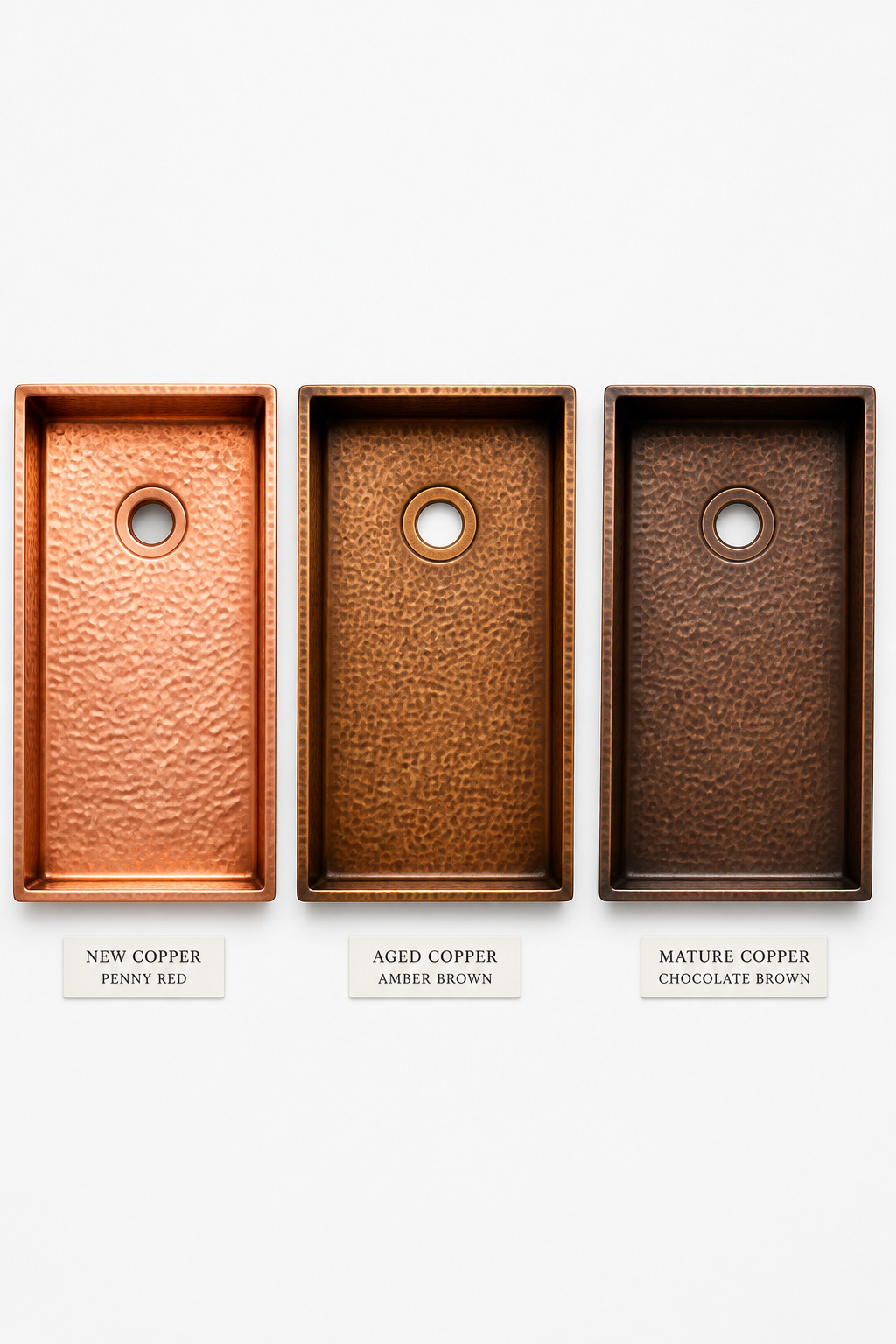
Patina begins when copper meets air and moisture and forms a thin layer of copper oxide. Frequency of use drives the pace most, with humidity close behind. Acidic contact — citrus, tomato, vinegar — lightens the patina where it touches, but only temporarily: rinse it, and the spot re-darkens to match.
The colour arc: from bright penny to deep warm brown
A new sink arrives shiny and reddish, then deepens through amber into warm brown over months. Most kitchen sinks reach a stable dark chocolate brown within one to three years. The dramatic green of outdoor copper — the Statue of Liberty, inevitably — is not a realistic indoor outcome: full verdigris takes more than a decade and usually needs coastal salt air.
Why patina is protective — and what ‘sealing’ actually does
The oxide layer that gives copper its colour is also a stable barrier against further exposure, so a well-patinated sink is literally a better-protected one. Wax slows the change but only moderates it. Lacquer stops it entirely, which is why specialists advise against lacquer on kitchen sinks: heavy use wears it unevenly, leaving patches where sealed and bare copper age differently. Unlacquered living-finish copper is the kitchen standard.
What a patina should not look like and when to act
Green spotting around the faucet or drain is mineral build-up with a little oxidation — not damage, and it lifts with a soft cloth. A bright spot from acid or a harsh cleaner will re-patinate on its own. Real over-stripping is the only case calling for action: reset the basin to an even matte and let it re-darken uniformly.
Gauge, Finish, and Antimicrobial Properties: What Differentiates a Good Copper Sink
Three things separate a sink that serves for decades from one that dents on day one: how thick the copper is, how it is finished, and what the metal genuinely does.
Gauge explained: the number that tells you how thick the copper is
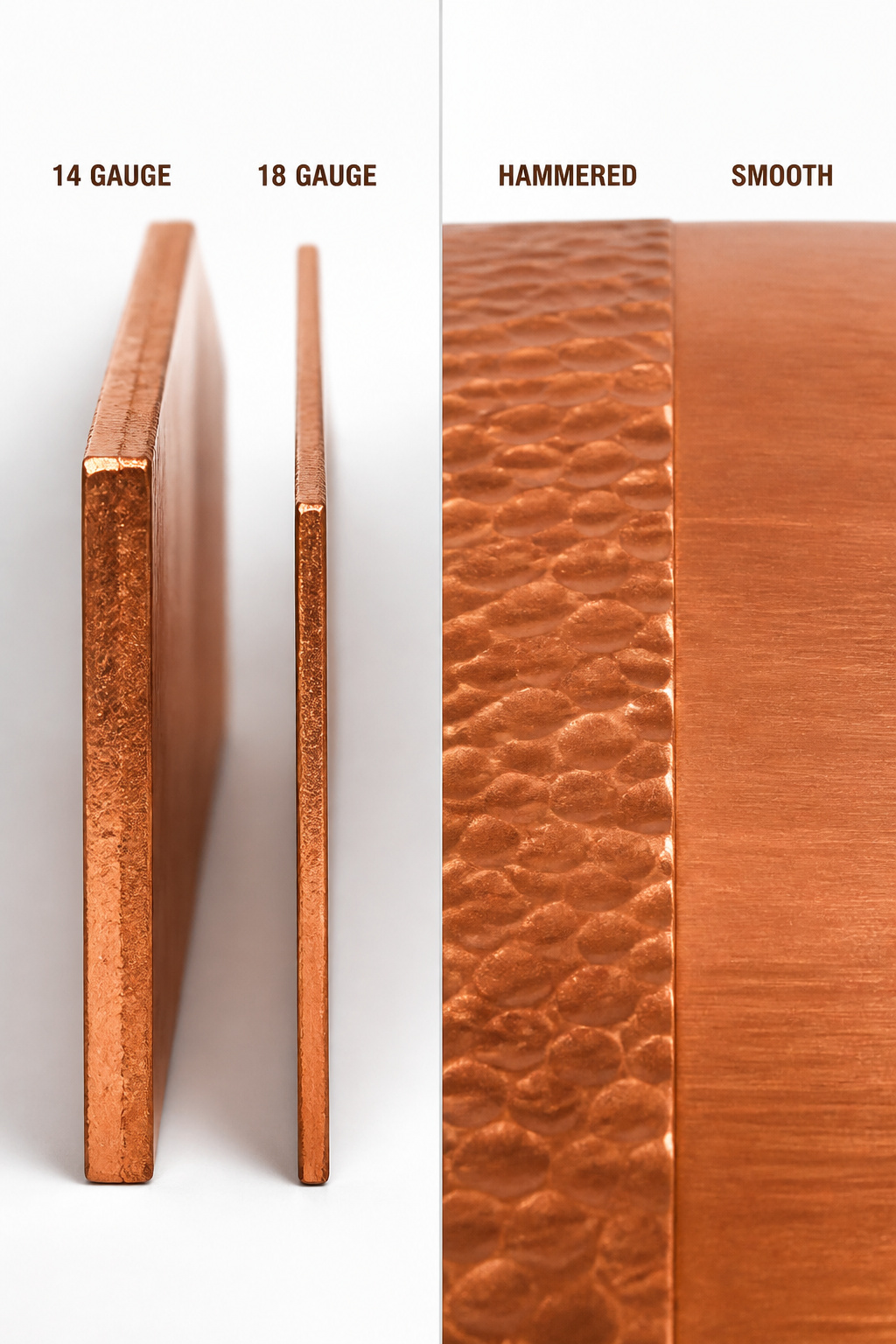
Gauge runs backwards from intuition — the lower the number, the thicker the metal. The kitchen range is 14 to 18 gauge:
| Gauge | Approx. thickness | What it means in use |
|---|---|---|
| 14 | 1.63mm | Premium tier; 33% thicker than 16, resists dents, deep resonant tone when tapped |
| 16 | 1.29mm | Quality floor for kitchen use; solid, weighty feel and a richer sound |
| 18 | 1.02mm | Minimum acceptable; thinner than this dents easily and should be avoided |
A field test costs nothing: tap the basin with a knuckle. A 14 gauge sink answers with a deep, full tone; thinner copper gives back something light and tinny.
Hammered vs smooth finish: aesthetic and practical differences
A hammered surface camouflages everyday marks because its texture breaks up new scratches, and the hammering compresses the metal fibres — valued for centuries as both decoration and structural reinforcement. A smooth finish reads cleaner but shows every blemish in a working kitchen. A hand-hammered sink should be uniform: a basin noticeably out of round is a defect, not character.
The antimicrobial case — what the research says and what it doesn’t
In February 2008, the US EPA registered 275 copper alloys with public-health claims — the first time the agency recognised a solid material for continuous antimicrobial properties on touch surfaces. The registered claim is specific: when cleaned regularly, antimicrobial copper alloy surfaces kill greater than 99.9% of specific bacteria within two hours of exposure, including MRSA, Staphylococcus aureus, and E. coli O157:H7. The registration is equally specific about limits: antimicrobial copper is a supplement to, not a substitute for, standard hygiene practice. The effect applies only when cleaned regularly. Read honestly, it is a real material advantage, not a marketing claim.
What to look for and what to walk away from
Look for 14 or 16 gauge, fully welded seams, and a stated 99% copper / 1% zinc composition. Walk away from anything above 18 gauge, soldered seams, or a “pure 100% copper” claim without alloy disclosure — pure copper is softer and shorter-lived than the 99/1 standard. A quality copper farmhouse sink starts around $600; one under $300–$400 is almost certainly thin copper.
Caring for Copper Without Killing the Patina
Care for copper runs on a different logic than every other kitchen surface: clean without disturbing the oxide layer that gives it both colour and protection.
Daily care — do and don’t:
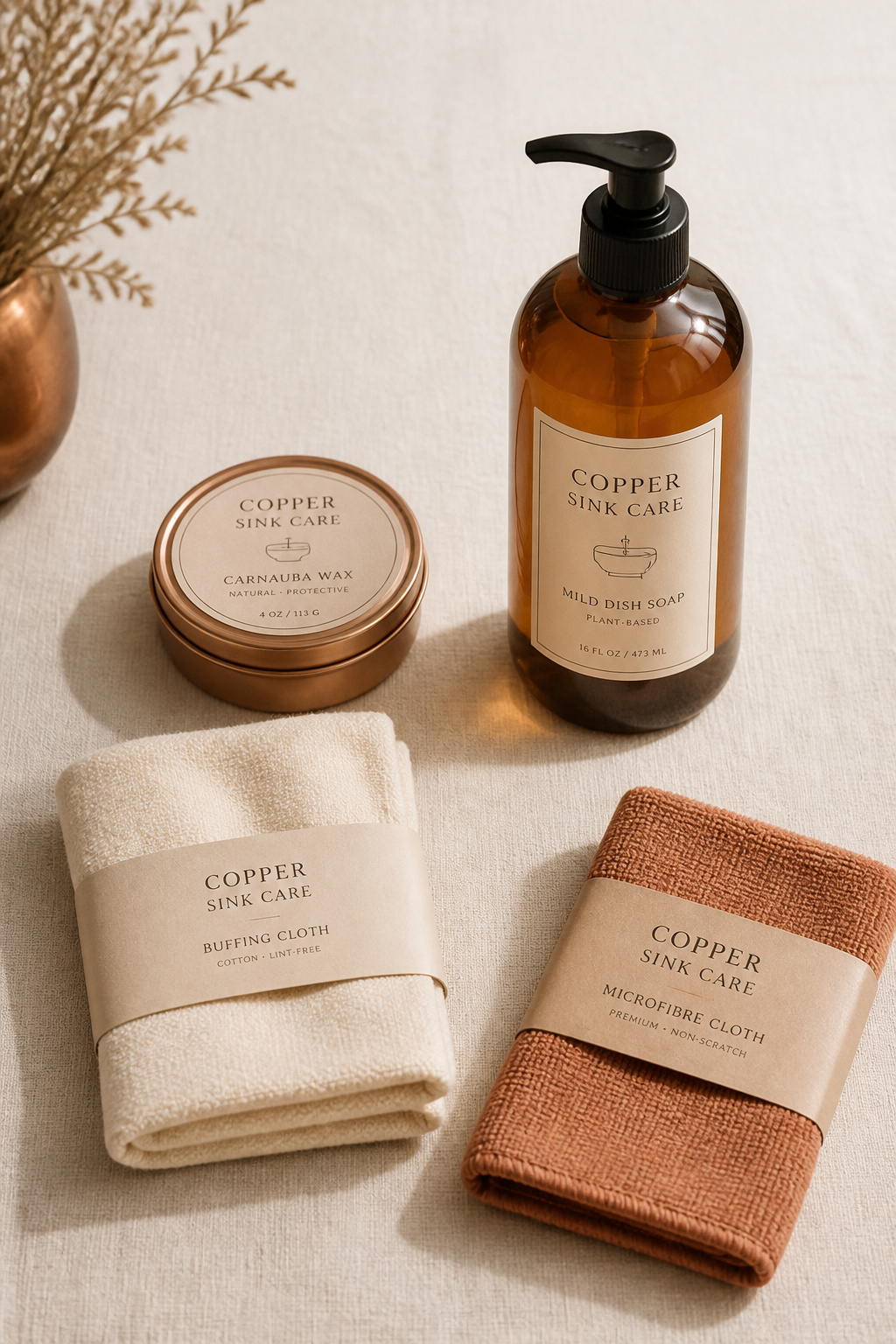
- Do: mild dish soap, warm water, soft cloth; rinse acids promptly; dry after use.
- Do: run water when disposing of citrus or tomato waste to dilute the acid.
- Don’t: bleach or ammonia cleaners — they strip colour unevenly.
- Don’t: steel wool, scouring pads, or copper polishes for routine cleaning — these remove patina, not dirt.
Those don’ts are where most damage happens: abrasive pads leave bright spots that re-patinate at a different rate than everything around them, and polishes like Wright’s Copper Cream are reset tools, not maintenance. The single most protective step is an occasional wax. Renaissance Micro-Crystalline Wax is the specialist’s pick, with carnauba the accessible alternative: apply a thin coat, leave it five minutes, then buff. Redo it when water stops beading, roughly every three to six months. For how copper care compares with the white sink options, see fireclay and cast iron compared.
Styling a Copper Farmhouse Sink: Pairing With Cabinets, Stone, and Hardware
Copper works through warmth and honest material contrast, which is why it sits most naturally in a kitchen built around warmth, deliberate contrast, or visible character.
White cabinets and copper: the high-contrast look and how to balance it
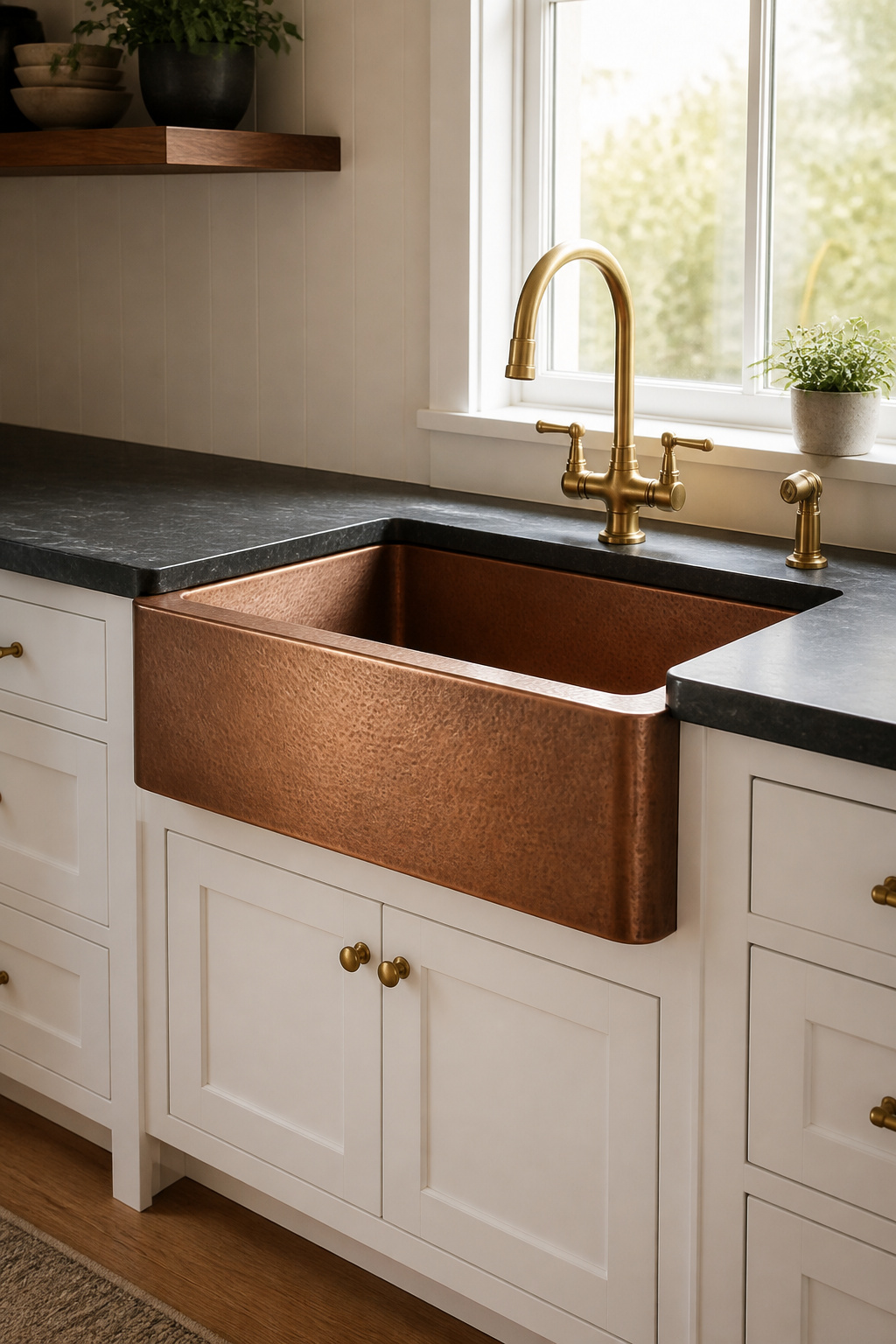
White shaker cabinets with a copper apron sink make the most photographed copper kitchen combination there is, the copper reading as the warm centrepiece against a clean white surround. White-on-copper alone can feel cold, so give the copper an anchor elsewhere — a walnut shelf, butcher-block counter, or natural-wood stools — to carry its warmth into the wider room.
Natural wood and copper: the warm-on-warm combination
Where white cabinets work through contrast, wood works through resonance. Walnut, white oak, and reclaimed timber share copper’s warm amber undertones, and both age visibly and reward maintenance. A butcher-block counter beside a copper apron sink is a particularly honest pairing: two surfaces that carry their history and deepen with use.
Stone countertops that complement the sink’s patina arc
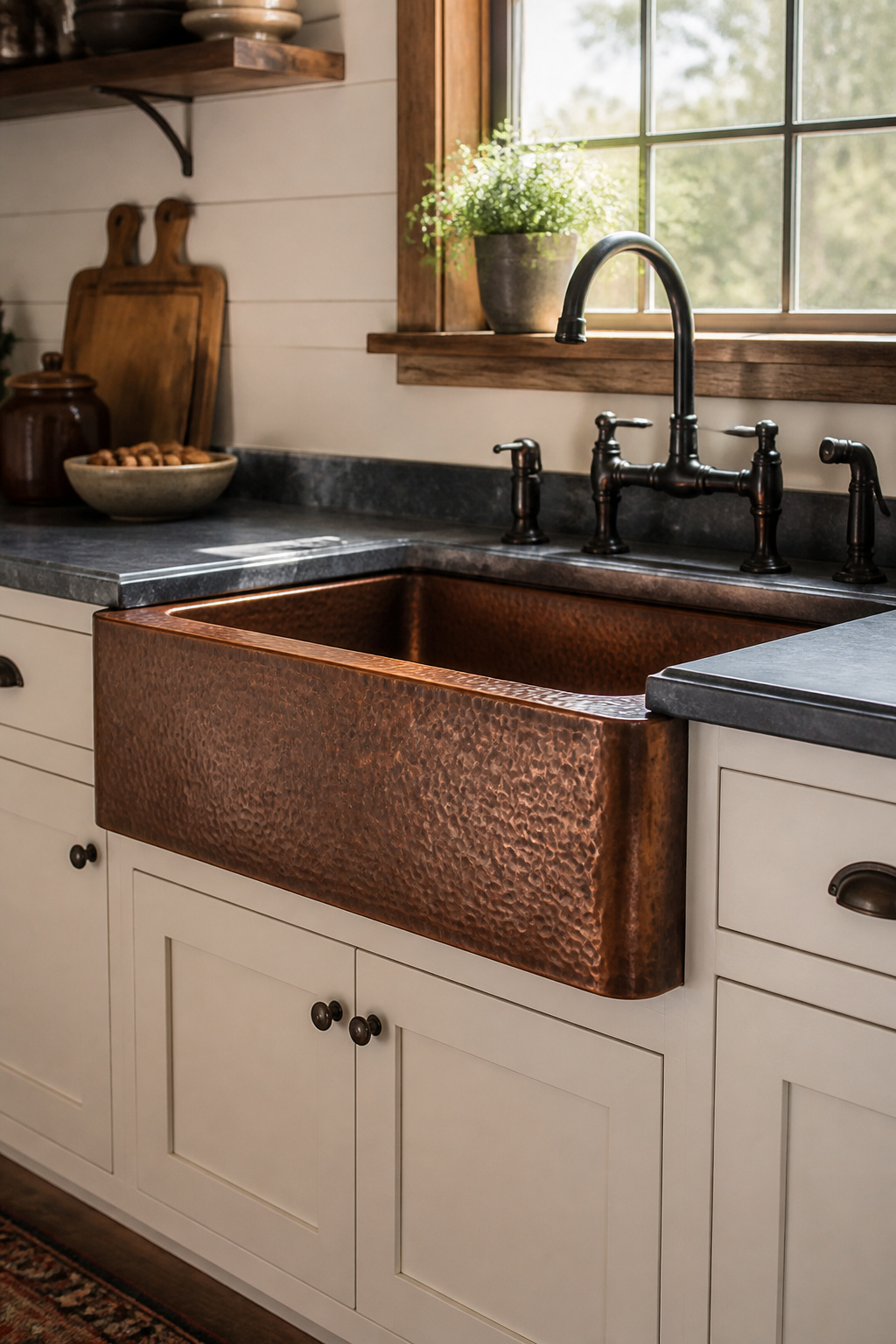
Soapstone is the strongest historical pairing: both are living surfaces — soapstone darkens as it is oiled, copper as it is used — and soapstone’s blue-grey-green undertone is the natural counterpoint to copper’s warm brown. Quartzite with warm beige veining extends the copper’s amber into the counter; white Carrara marble swings back to contrast.
Hardware finish pairings: unlacquered brass, oil-rubbed bronze, and matte black
Three finishes earn their place beside copper:
- Unlacquered brass — echoes copper’s warm tone and develops its own patina in parallel, so the two age together. The most historically coherent choice.
- Oil-rubbed bronze — the most widely recommended complement; its deep brown-black grounds the copper without competing.
- Matte black — a contemporary contrast that frames the copper cleanly, for warm character over strict period reproduction.
Polished chrome is the one to avoid: cool and bright where the sink wants warmth.
Is a Copper Farmhouse Sink Right for You? How It Compares to Stainless, Fireclay, and Cast Iron
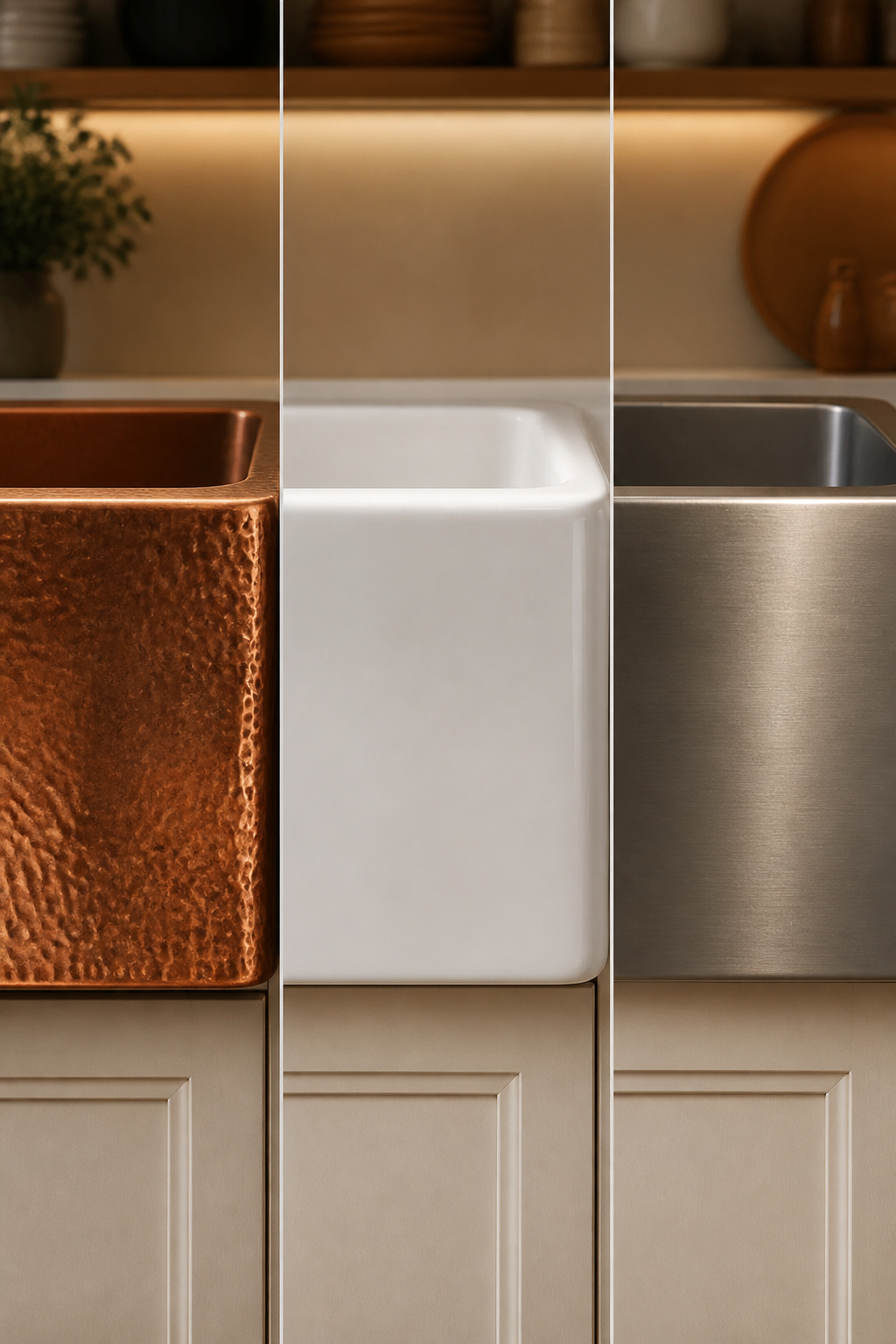
Copper costs more than stainless, asks more attention than fireclay, and lasts as long as either when cared for. It is also the only material in this group with a registered antimicrobial property. The decision is less a spec comparison than a values question.
When copper is the right call and when it isn’t
Copper is right for the buyer who wants the sink to be a living part of the kitchen — a surface that develops a character they own rather than a finish they merely preserve. It is the wrong call for anyone who wants the same appearance in year ten as year one. A household with young children and heavy cast-iron cookware may be better served by stainless, which shrugs off impact without complaint.
The maintenance trade-off
Fireclay is the lowest-maintenance option: its nonporous glaze resists stains and holds its white surface for decades. Cast iron, being enamel over iron, requires gentler handling — chip the enamel and the exposed iron rusts. Copper asks more than stainless but offers a different return: the attention you put in is the character you get out.
Budget reality: what a good copper sink actually costs
A quality 14–16 gauge copper farmhouse sink starts around $600 and climbs to $1,000–$3,500 for premium hand-hammered single bowls. Quality fireclay starts near $500 and apron-front cast iron around $600. If your brief is durability and ease over living character, weigh the modern stainless alternative before you commit. Otherwise: buy on gauge and welded seams, leave it unlacquered, keep bleach and abrasives away, and copper will outlast most of the kitchen around it.
FAQ
Does a copper farmhouse sink need to be sealed?
Not in the way stone is sealed, but applying carnauba wax or Renaissance Wax every few months is the single most effective care step — it slows patina change, prevents mineral spotting, and keeps water beading off the surface. Lacquer seals copper permanently but isn’t recommended for kitchen sinks, since heavy use wears it unevenly.
How do you stop a copper sink from turning green?
Indoor copper sinks almost never turn fully green — verdigris takes over a decade and usually needs coastal salt air. Most kitchen sinks develop a warm brown patina and stay there. The green spotting people notice around the faucet or drain is mineral build-up with a little oxidation, and it wipes away with a soft cloth.
Is a copper kitchen sink hard to maintain?
No, but it asks for specific care rather than effort. Daily cleaning is just mild dish soap and a soft cloth; you avoid bleach, ammonia, abrasive pads, and acid left sitting. The one extra task is waxing every three to six months — a ten-minute job that gives copper its richer character.