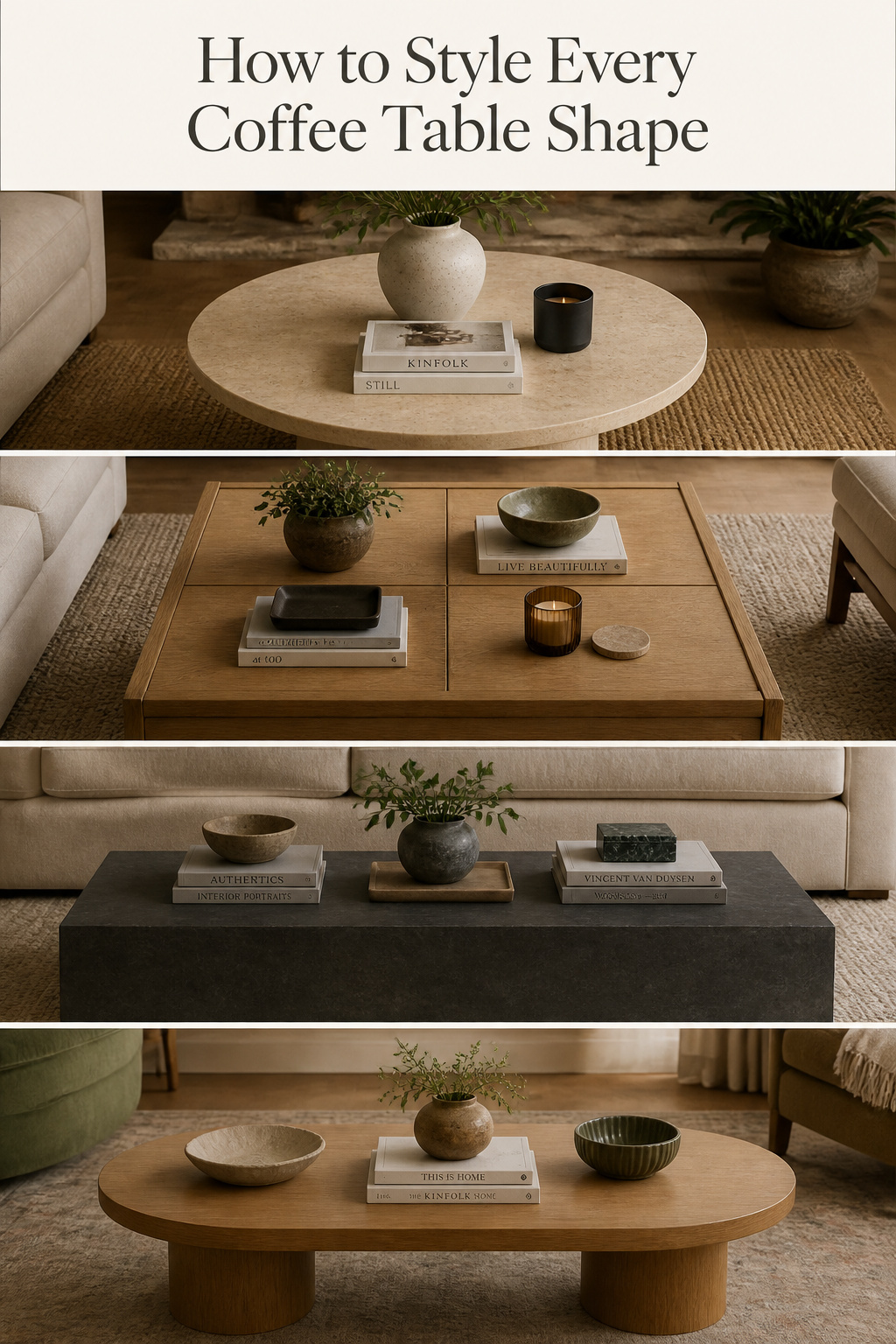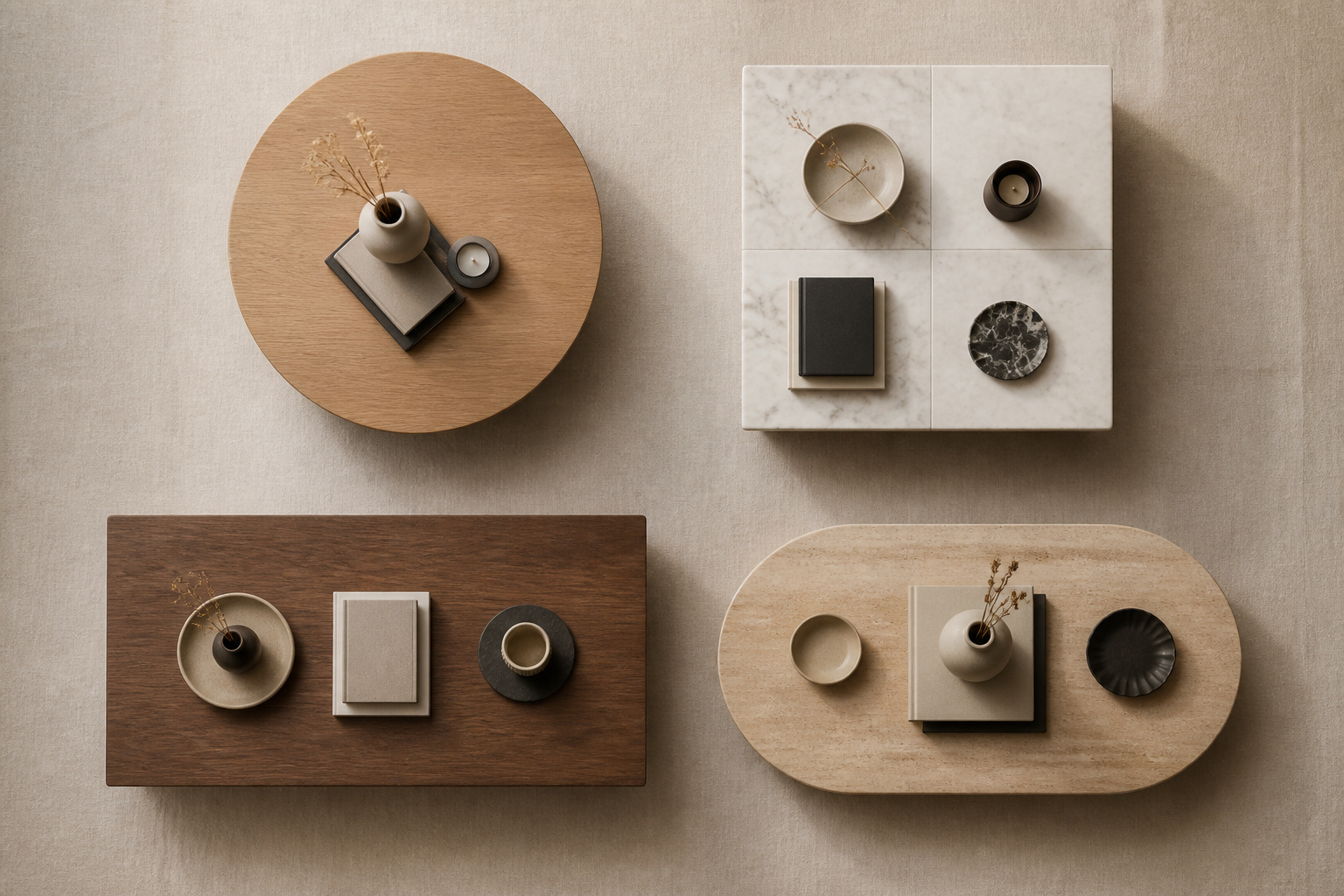

A row of objects across a round table is fighting the table. Nothing wrong with the pieces — they are simply arranged for a shape with corners, on one that has none.
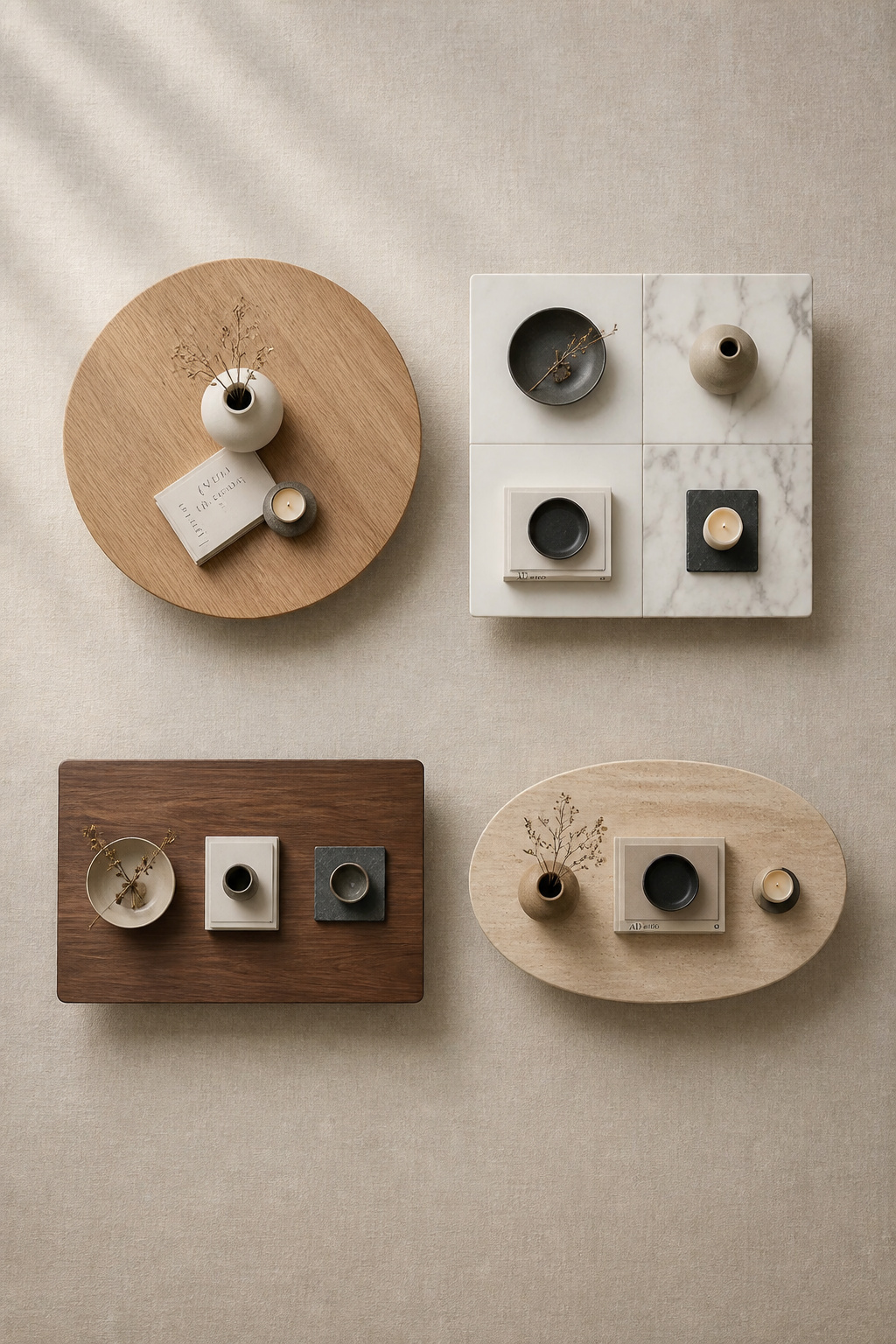
That is the logic of coffee table decor by shape: the outline already decides where weight wants to sit. Read it first, and the arrangement places itself. Below are four formulas, one per shape.
TL;DR
- Round tables take a central triangle of three objects at different heights — for a round table, roughly 10–12 in tall, 6–8 in medium, 2–3 in low works well because the compact centre keeps objects in proportion; full-size tables can run taller (the general 10–15 in range). Square tables divide into four quadrants: activate three, leave one open.
- Rectangular tables need the long axis split into three sections — tall element, anchoring tray, book stack — so neither end goes bare. Oval follows the same rule with rounded objects kept along the long axis.
- Match the tray shape to the table by contrast, not repetition: a round tray on a square table, a square tray on a round one.
Why Your Table Shape Is the First Styling Decision, Not the Last
Stylist Melissa Barnes of Sense of Spencer puts it plainly: study enough coffee tables and there is a formula for each shape. The ones that look effortless are easy — once you read the geometry first.
How shape determines the visual weight distribution you are working with
Each outline pushes weight somewhere different. Round and oval tables concentrate it at the centre; there are no corners to anchor anything. A rectangle has a long axis that divides into thirds, and the eye expects three beats. A square gives four equal quadrants. That reading answers half the styling question.
The contrast principle: your tray and object clusters should echo or oppose the table’s geometry
I will commit to this: contrast the tray against the table. Circle on circle is monotonous, so a square tray suits a round table, and a round tray softens a square one. For tray selection in detail, see choosing a coffee table tray.
A quick shape-to-layout reference before you start placing anything
This is the whole article in one table. Find your shape, read across, then skip to its section below.
| Table shape | Natural layout | Tray shape to use | Key move |
|---|---|---|---|
| Round | Central triangle cluster | Square or rectangular | Keep weight off the edges |
| Square | Three activated quadrants, one open | Round | Vary object footprint across cells |
| Rectangular | Three-section stretch across the length | Rectangular or oval | Anchor one end, vary heights |
| Oval | Three-section stretch, softened | Oval or rectangular | Avoid sharp corners, hold the long axis |
For the principle behind all four — rule of three, height tiers, negative space — the complete guide to coffee table styling covers the full system.
Round Coffee Table Decor: The Central Triangle Cluster
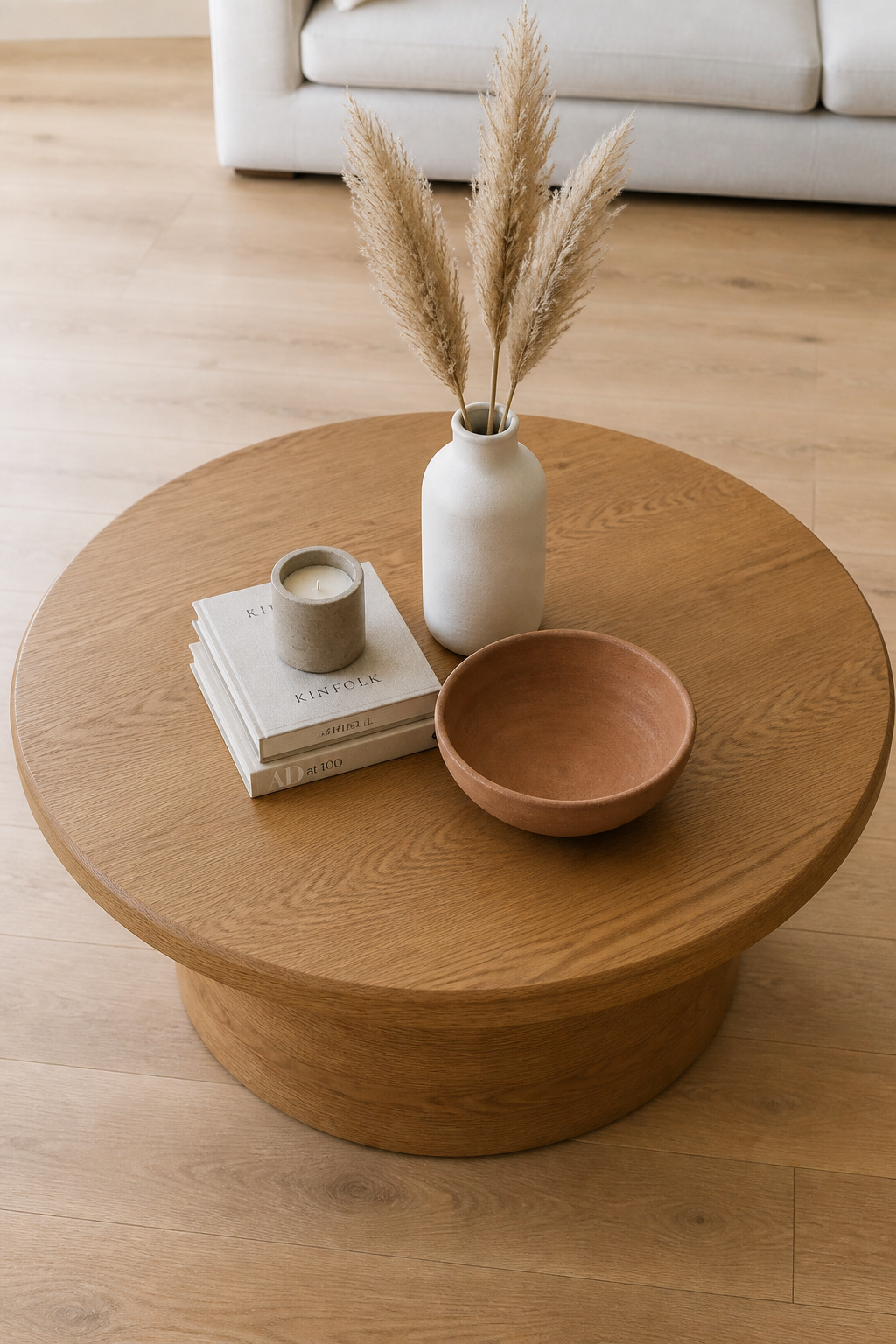
A round table asks for a centre: pull objects to the edge and you break the circle.
Why round tables need a central anchor rather than a tray
The corners are cut away, so a round table has less usable surface than it looks and everything concentrates in the middle. The smaller the top, the more ruthless you must be about that centre.
Building a triangle of three objects at different heights in the centre
Three objects, three heights, in a triangle: tallest at the back, medium at eight o’clock, low at the front. The cluster reads from every seat:
- Tall: 10–12 inches — a vase or small plant
- Medium: 6–8 inches — a candle or ceramic bowl
- Low: 2–3 inches — a flat dish or book stack
Leave clear space around the triangle; a round table loses its impact the moment it fills up.
When to place one single accent piece instead
One large piece of real weight in stone or ceramic — an oversized bowl, a low vase with a single branch — set slightly off-centre is often the stronger choice. As Melanie Boyden of Melanie Jade Design notes, asymmetry creates intrigue where symmetry is only what the mind expects.
What to avoid on a round table: edge-heavy arrangements that break the circle
Three habits undo a round table: objects pushed to the perimeter (breaks the circle); round objects piled on round objects (kills contrast); four or more pieces (cluttered).
Square Coffee Table Styling: The Four-Quadrant Approach
A square gives you a grid for free. The work is choosing which cells to use and which to leave open.
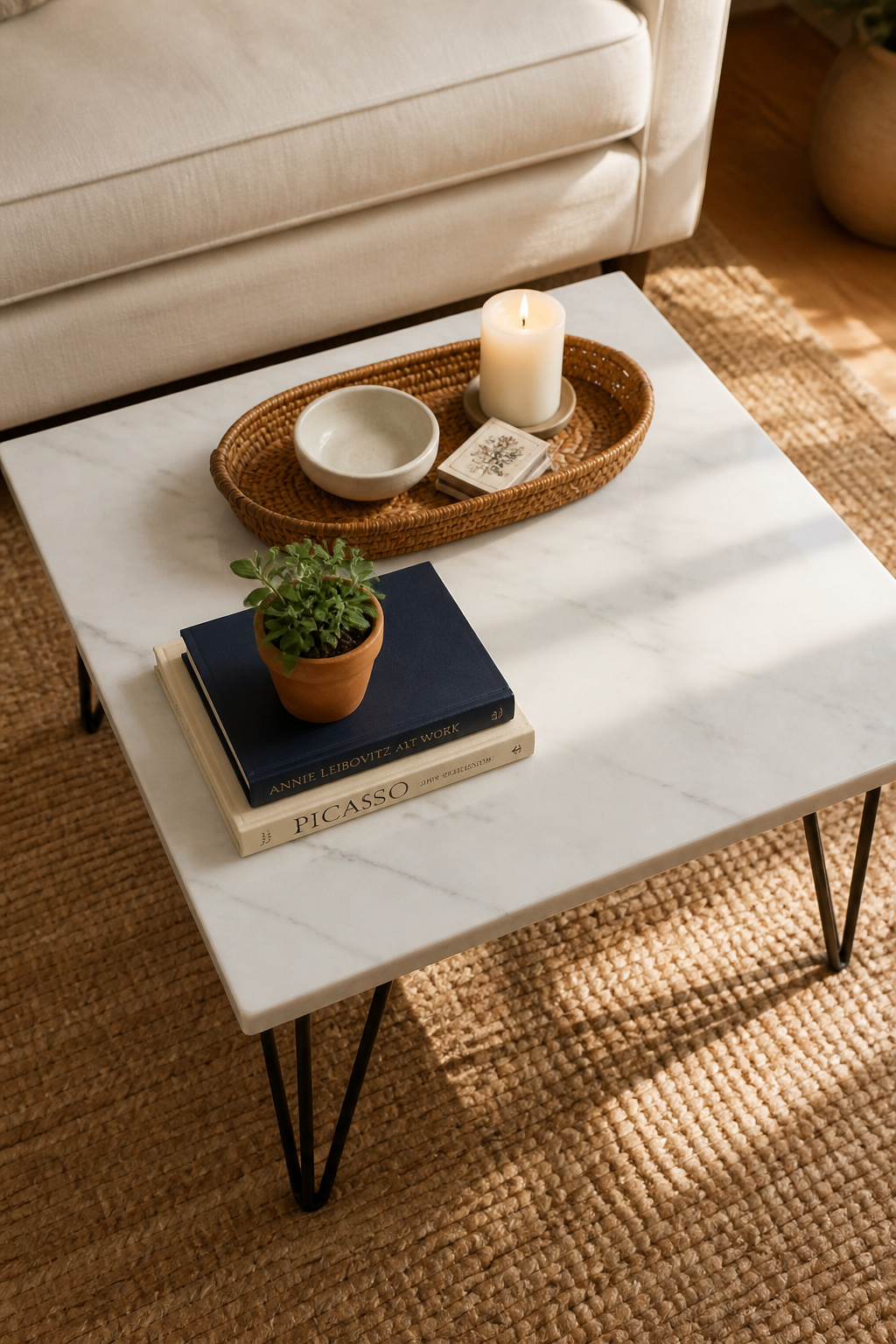
Dividing the square mentally into four zones
Picture a two-by-two grid. Place each grouping inside its own quadrant, with space between — each cell a vignette of two or three objects. A large square can activate all four; a standard one rewards restraint.
Activating two or three quadrants and leaving one open
Barnes’s formula: divide the square into four, build three scenes — one spanning two adjacent quadrants, plus the two across from it, each holding one or two objects. The fourth quadrant stays open: the day’s drink, the remote, the book in use. That deliberate empty space reads as confidence. Spread three heights across the active scenes.
Using a low tray to define one quadrant as the styled zone
Set a round tray in the two-quadrant zone to gather small things — candle, coasters, a dish — so they read as one object. Round against square is the right contrast. Keep it to a quarter to a third of the surface.
Proportion on a square: why objects must not all be the same footprint
If every object shares the same base, the cells become identical spots and the composition flattens. Vary the footprint — a wide flat tray, a narrow candlestick, rectangular book stacks against round bowls — and hold the total to four or five objects across three heights.
Rectangular Coffee Table Decor: The Three-Section Stretch
The rectangle is the most common shape and the most demanding: the long axis exposes a lazy arrangement instantly. Three sections fix it.
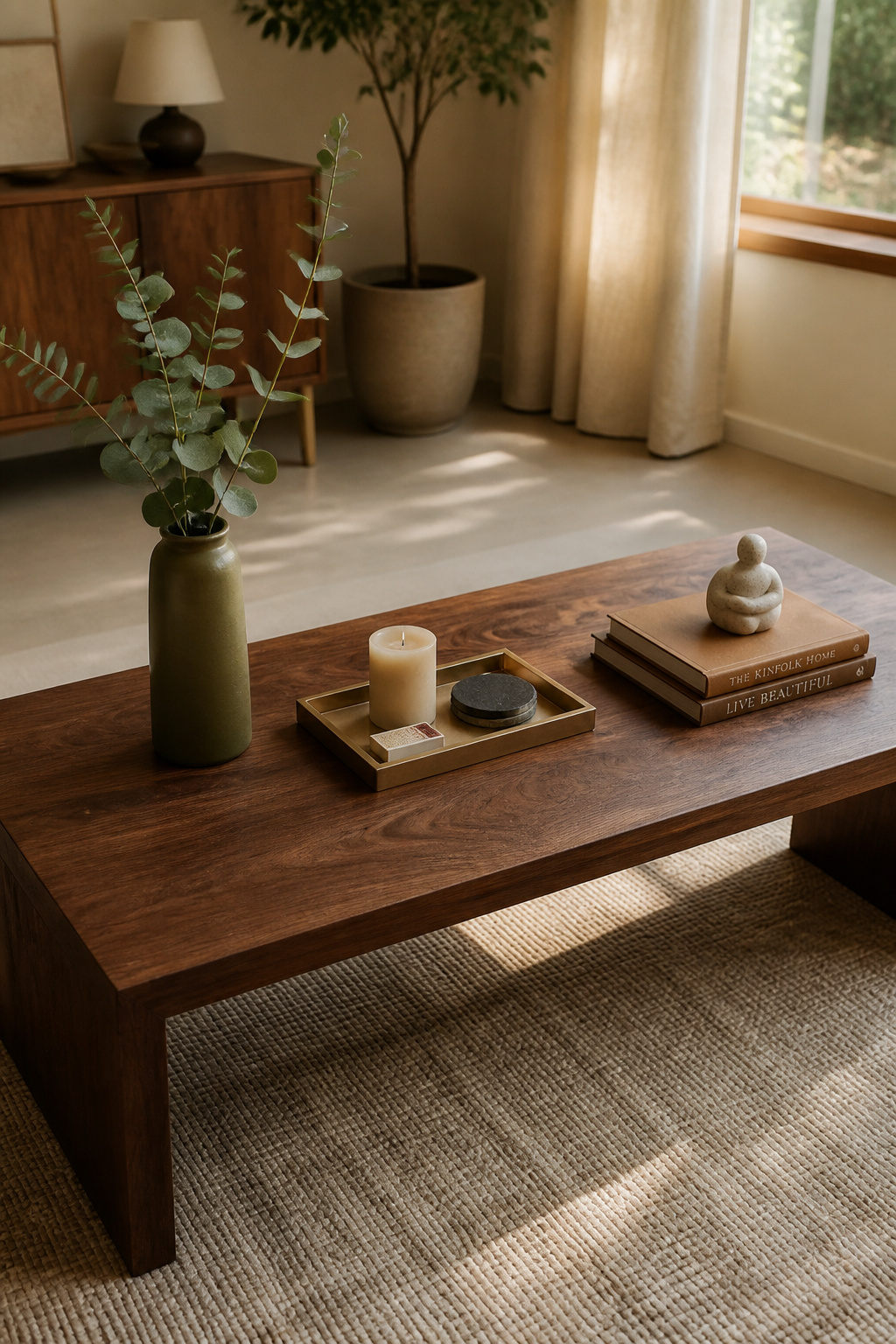
Dividing the length into three visual zones: left cluster, centre, right object or open space
Split the length into thirds — they need not be equal, but each must read as distinct:
- Left third: a tall moment — a vase with branches, 10–14 inches
- Centre third: an anchoring tray holding smaller objects together
- Right third: a book stack with one decorative piece on top
Designer Kathy Kuo, in Living Etc, frames each cluster as one vertical, one horizontal, and one sculptural item — a vase, a book stack, a ceramic. Keep the centre lightly occupied so a mug can land there.
The tray’s role in anchoring one end of a rectangular table
A rectangular or square tray anchors a third of the surface, giving small objects a boundary so they hold together. Placed slightly off-centre with a tall element at the opposite end, each side pulls different weight yet the whole reads balanced.
Balancing visual weight across the long axis
Aim for equivalent density in each zone — not matching objects, but matching presence. Run book stacks parallel to the long axis, spines lengthwise. Gather small items onto the tray so they count as one mass.
What fails on rectangular tables: one central cluster that leaves the ends empty
Everything in the middle, both ends bare — a round-table arrangement stranded on the wrong shape, where the eye slides off each end. A single oversized object can work, but only when it is large enough to justify the empty flanks.
Oval Coffee Table Decor: Rectangular Rules with Softened Corners
An oval is a rectangle with the corners rounded off: take the three-section stretch and make one adjustment for the curves.
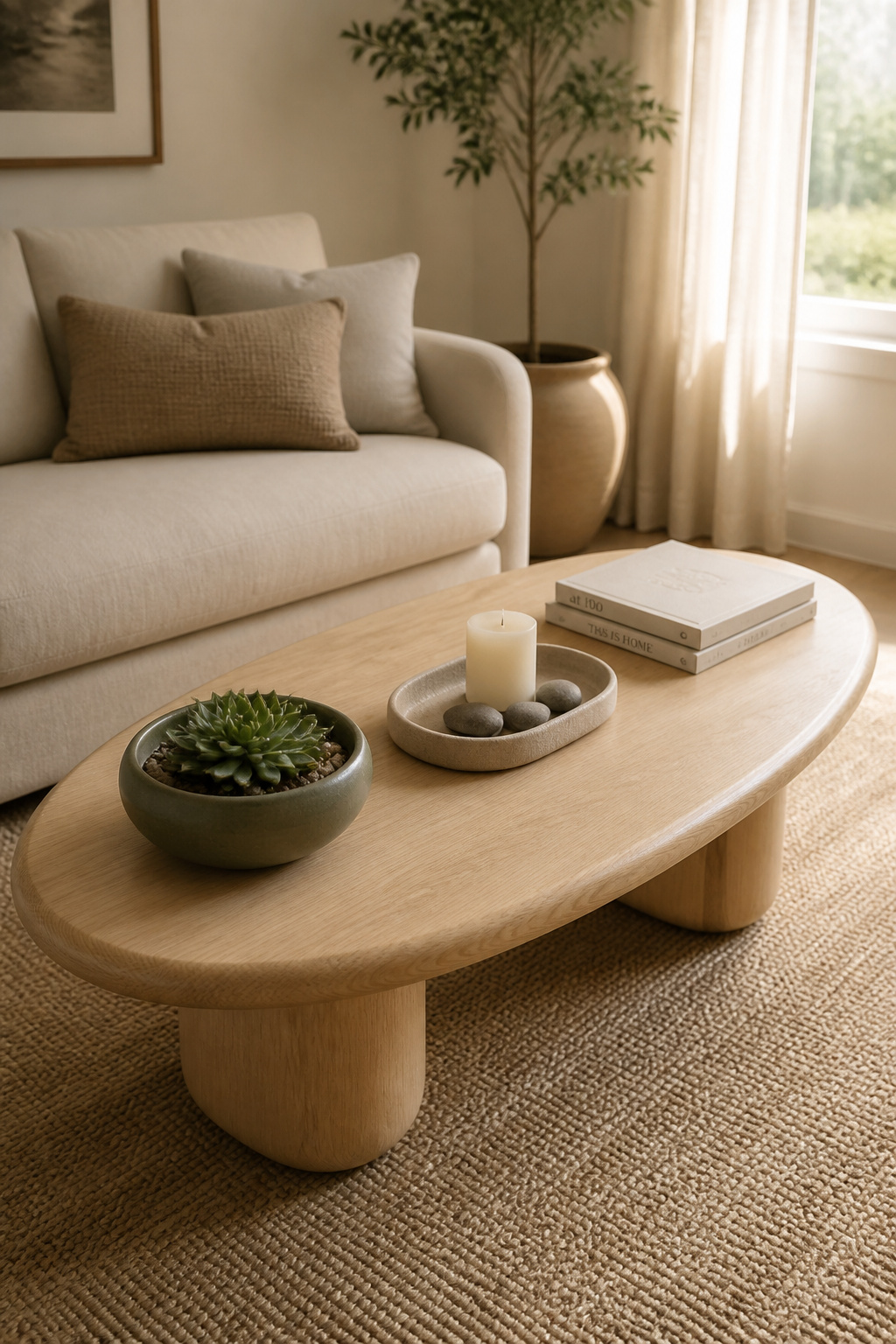
Why oval follows the rectangular three-section model with one adjustment
The long axis still rules. Keep the tray within the central corridor — the narrowing ends offer little surface. One move the oval allows that a rectangle does not: matching objects mirrored at each end, two candles or two small plants, honouring its bilateral symmetry.
Avoiding sharp-cornered objects that fight the oval’s curves
Hard-angled objects — square boxes, books upright in a stand — read as jarring against a softened outline. Rounded forms agree with it: ceramic spheres, wide low bowls, smoothed stone, book stacks laid flat.
Proportion of objects to the oval’s narrower width
Scale to the narrow axis: medium vases over oversized centrepieces, low trays over deep baskets. Layer upward instead — a flat book as the base, a mid-height vessel, a small plant. Edit harder than on a rectangle; the narrow width makes clutter immediately visible.
Shape, Proportion, and the Furniture Around the Table
A coffee table is never styled in isolation; its shape answers to the sofa and the space around it.
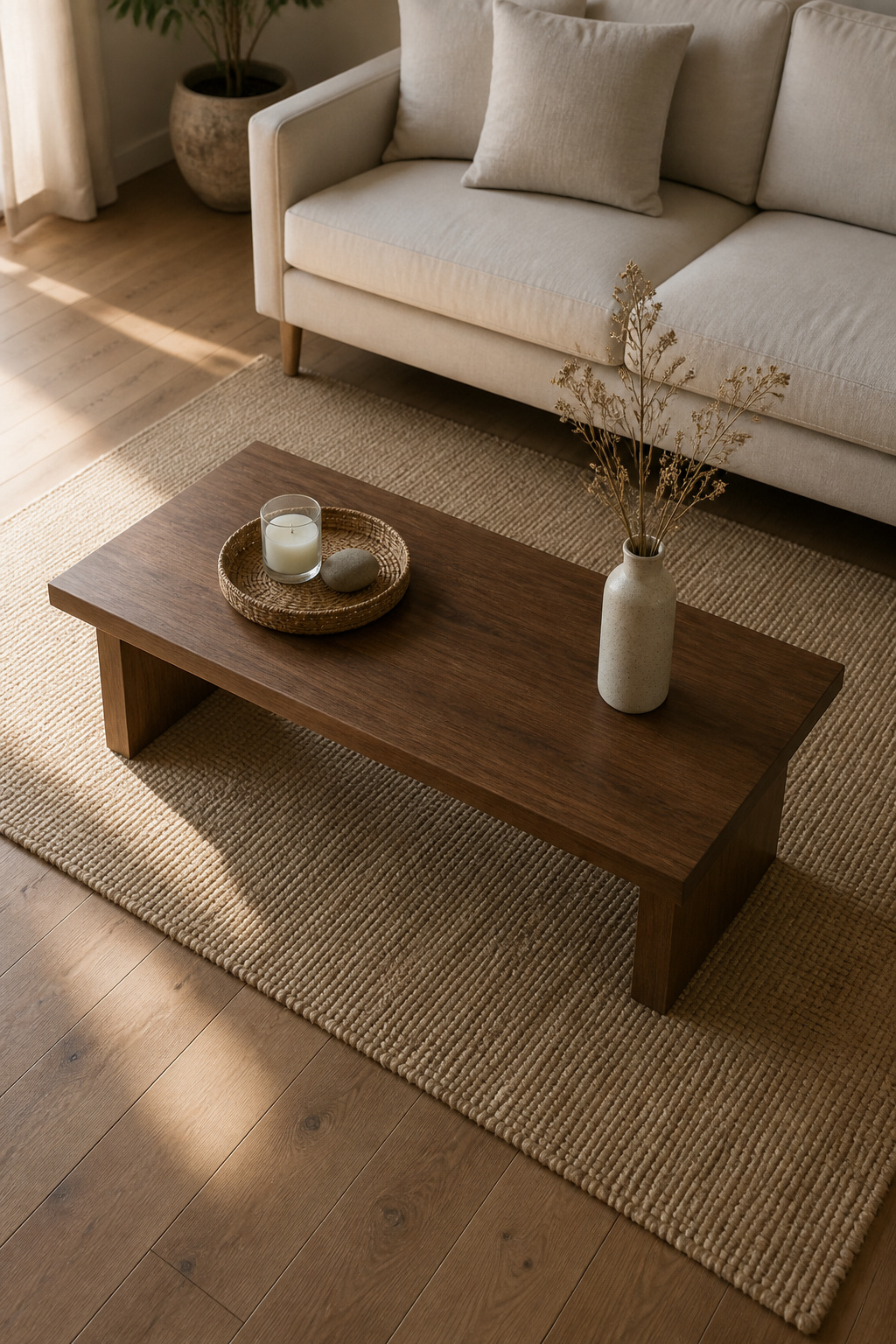
How the table shape should relate to the sofa and rug beneath it
Two numbers settle most of this. Run the table to roughly two-thirds the sofa’s length, at 16–18 inches high. Leave 14–18 inches of clearance: closer feels crammed, further forces a lean. Sit the front legs of both pieces on the rug so they anchor as one zone.
Small rooms: which shapes make a table look lighter on the floor
Shape changes how heavy the floor feels. In a small square room, a round table softens the angles; in a long narrow room, a rectangle echoes the proportions. Material multiplies the effect: glass, light oak or ash, and slim metal bases reduce visual weight whatever the shape. When table and room are both tight, small-space coffee table decor takes the proportion question further.
Matching tray shape to table shape vs contrasting it — Henrik’s position
The one rule worth carrying away: contrast the tray, do not match it. The single exception is a round tray on a round table used as the focal piece itself — never as a container for clutter. There is a Nordic habit underneath this, lagom, the sense of just enough: one contrasting shape, committed to. Restraint reads as a decision; proliferation as indecision.
FAQ
How do you style a round coffee table?
Group three objects of different heights in a triangle at the centre — tallest at the back, a medium piece to one side, a low flat object to the front — and keep everything centred rather than pushed to the edges. Use a square or rectangular tray for contrast. For a minimal look, place one large accent piece slightly off-centre.
What looks good on a rectangular coffee table?
Divide the length into three zones: a tall element such as a vase with branches at one end, an anchoring tray with small objects gathered in the centre, and a book stack topped with one decorative piece at the other end. Run book stacks parallel to the long axis. Avoid a single central cluster that leaves both ends bare.
Should you use a tray on a square coffee table?
Yes. A tray in one zone corrals small objects — candles, matches, coasters — so they read as a single element rather than scattered pieces, and a round tray adds useful shape contrast. Size it to cover no more than one quadrant, leaving the remaining zones open for daily items and intentional negative space.