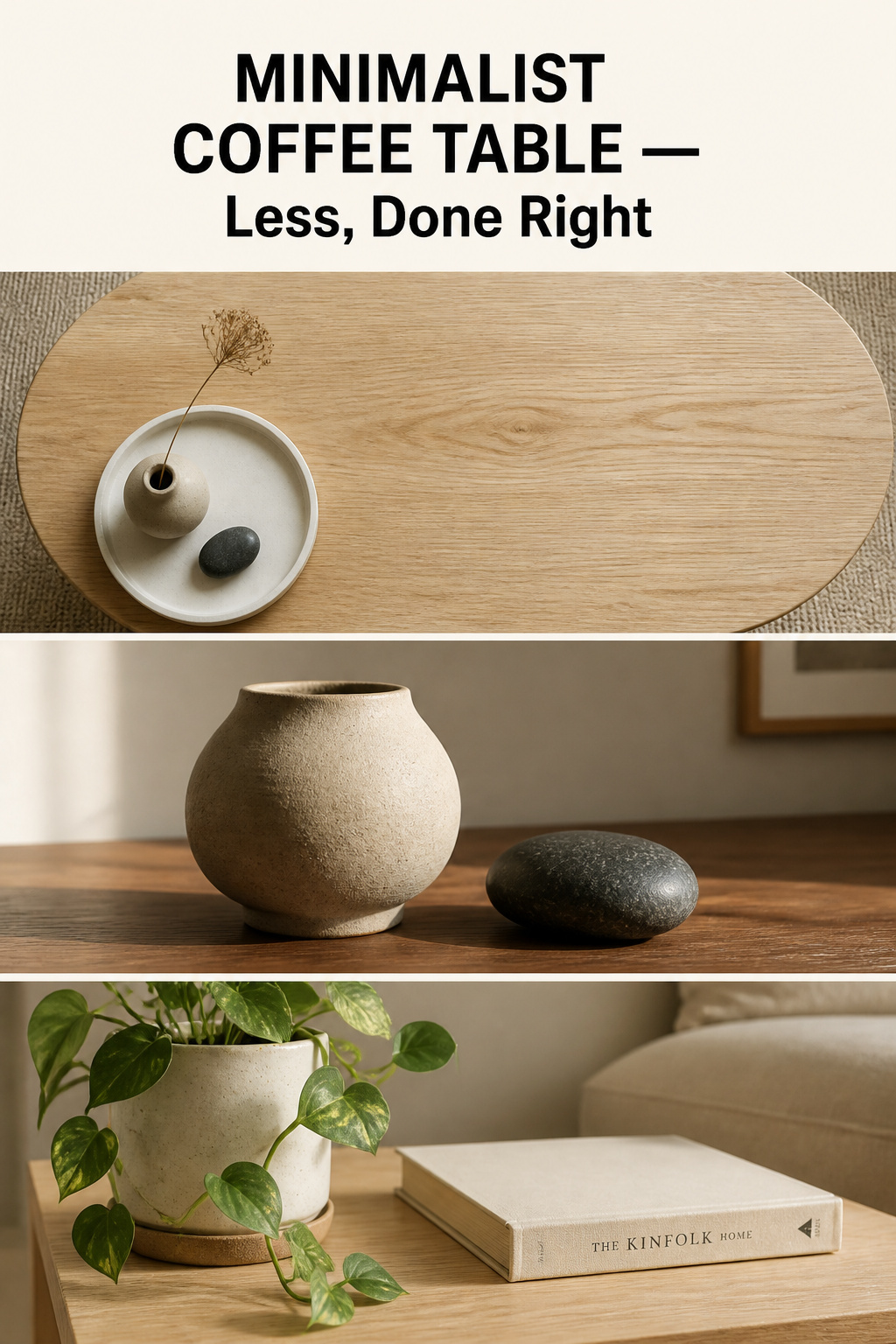
There is one shelf in my grandparents’ summer cottage I still measure rooms against. Unpainted pine, a row of everyday crockery, an oil lamp at the end — nothing on it that did not earn its keep. It never looked sparse. It looked like a decision had been made. That shelf is the whole argument for minimalist coffee table decor: not the fewest possible objects, but the exact right ones, placed so the bare surface around them reads as calm rather than neglect.
TL;DR
- Style with three objects at most — a corralling tray, one tall sculptural or organic piece, and one flat element such as a book or stone — each filling a different role.
- Leave at least one-third of the table bare; the minimalist sweet spot is roughly 30 to 50 percent of the surface covered, with objects grouped in one zone rather than scattered.
- Choose pieces for material honesty over shine, keep greenery low and low-light-tolerant, and finish by removing one item to test whether the table looks calmer without it.
What Minimalist Coffee Table Decor Is Actually About
Before any object goes down, the real question is what you want the surface to be — a quiet focal point, or a place where the day’s debris collects. Minimalism answers the first.
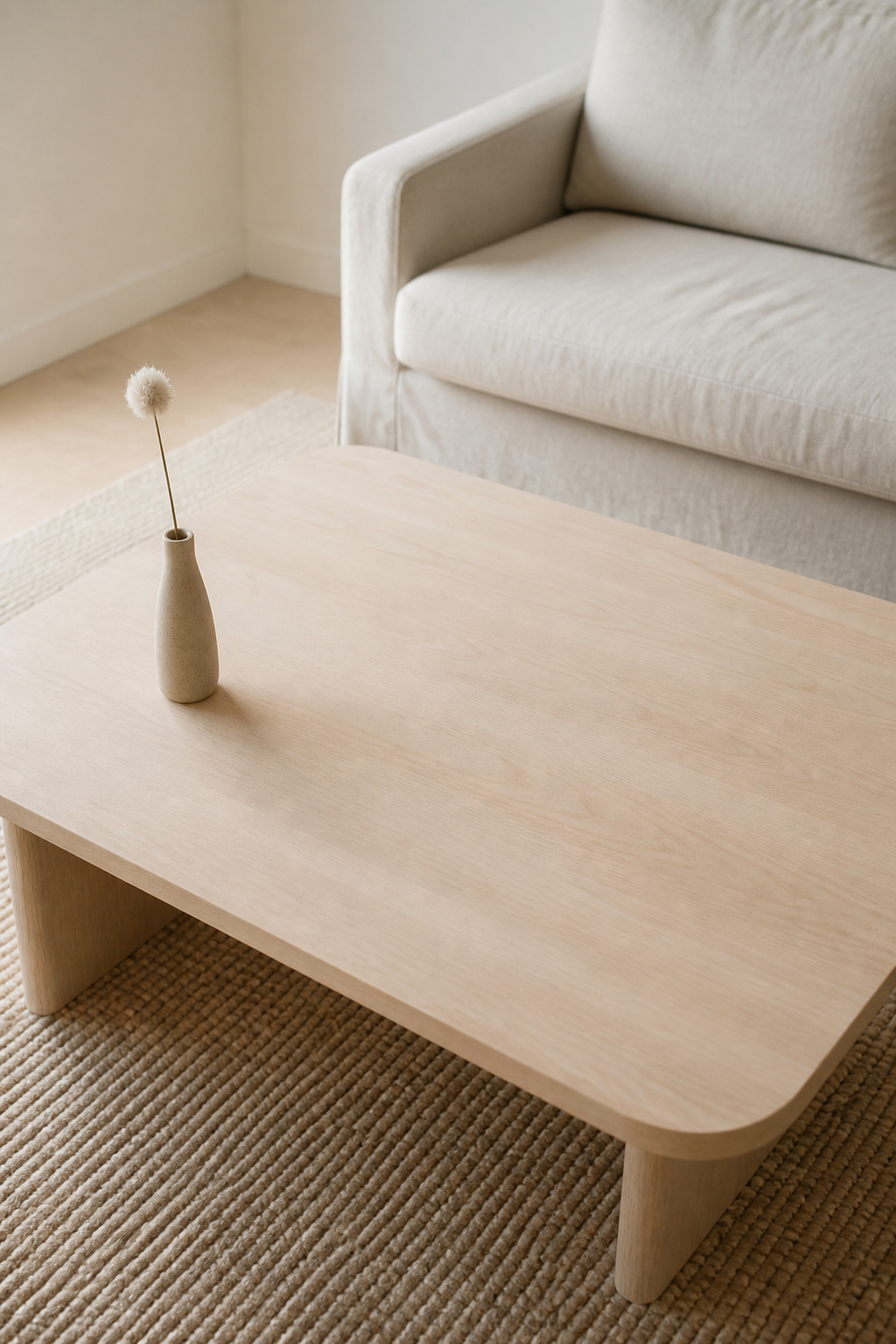
The Swedish concept of lagom: exactly enough, nothing more
There is a Swedish word for this: lagom, meaning roughly “just the right amount.” One account traces it to the Old Norse laget om — the fair passing of mead around the group, so each person received exactly enough. Applied to a table, lagom is not deprivation but balance: buying less and better, keeping only what has earned its place. Scandinavian minimalism aims for lightness, not white-walled severity. Warmth stays; excess goes.
Why restraint reads as intentional, not empty
A pared-back table looks deliberate because the absence of clutter signals choice. As interior designer Kristen Thomas of Studio Thomas puts it, “minimalism doesn’t mean sparse — it means considered.” Designer Rachel Blindauer calls the result “a more intentional minimalism, one that isn’t cold or austere but rather deeply reflective of personal style and well-being.” That is the register to aim for.
The difference between a minimalist table and a bare one
The line between the two is intention. A bare table looks forgotten; a minimalist one keeps one quiet focal point — a single vase, a sculptural bowl, a small plant — so the eye has somewhere to land. The pillar guide on how to style a coffee table covers the full object kit; here the discipline runs the other way. Minimalism is reached by subtraction.
The Minimalist Object Kit: Three Pieces, Maximum
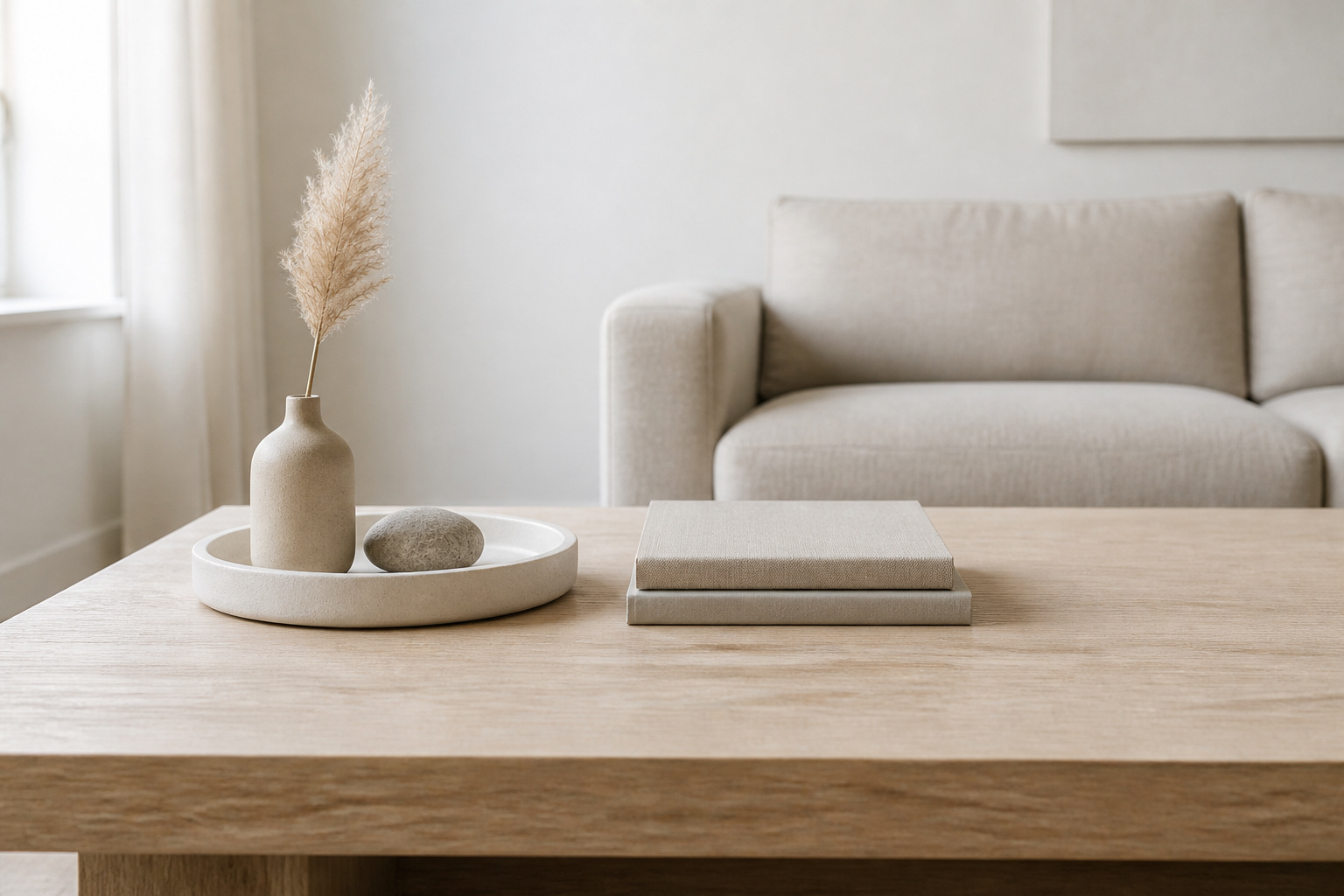
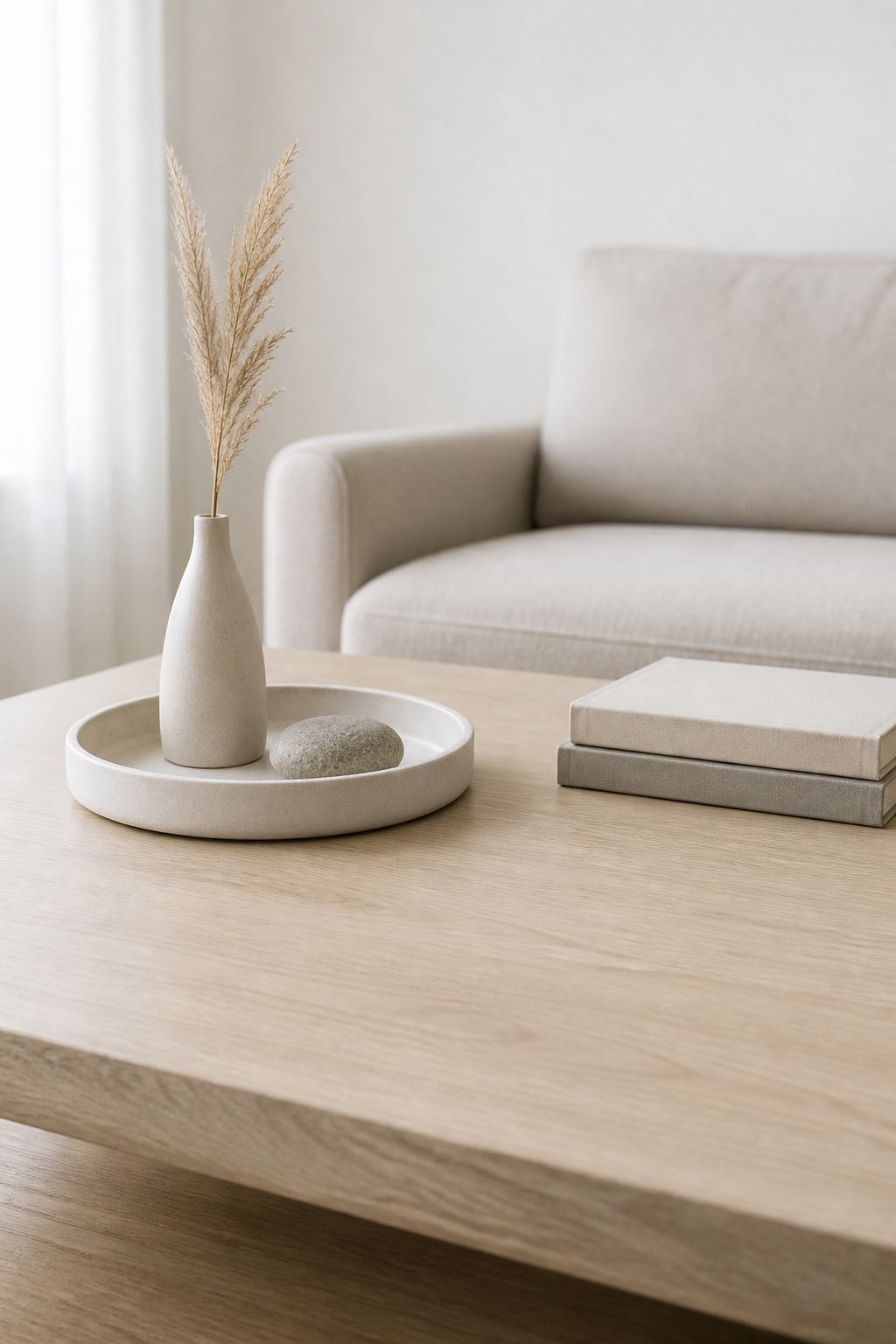
Three is the number designers keep landing on. Three objects form a visual triangle; the brain finds perfect symmetry dull and perfect imbalance restless, so three sits in the comfortable middle. Each piece earns its place by filling a distinct role:
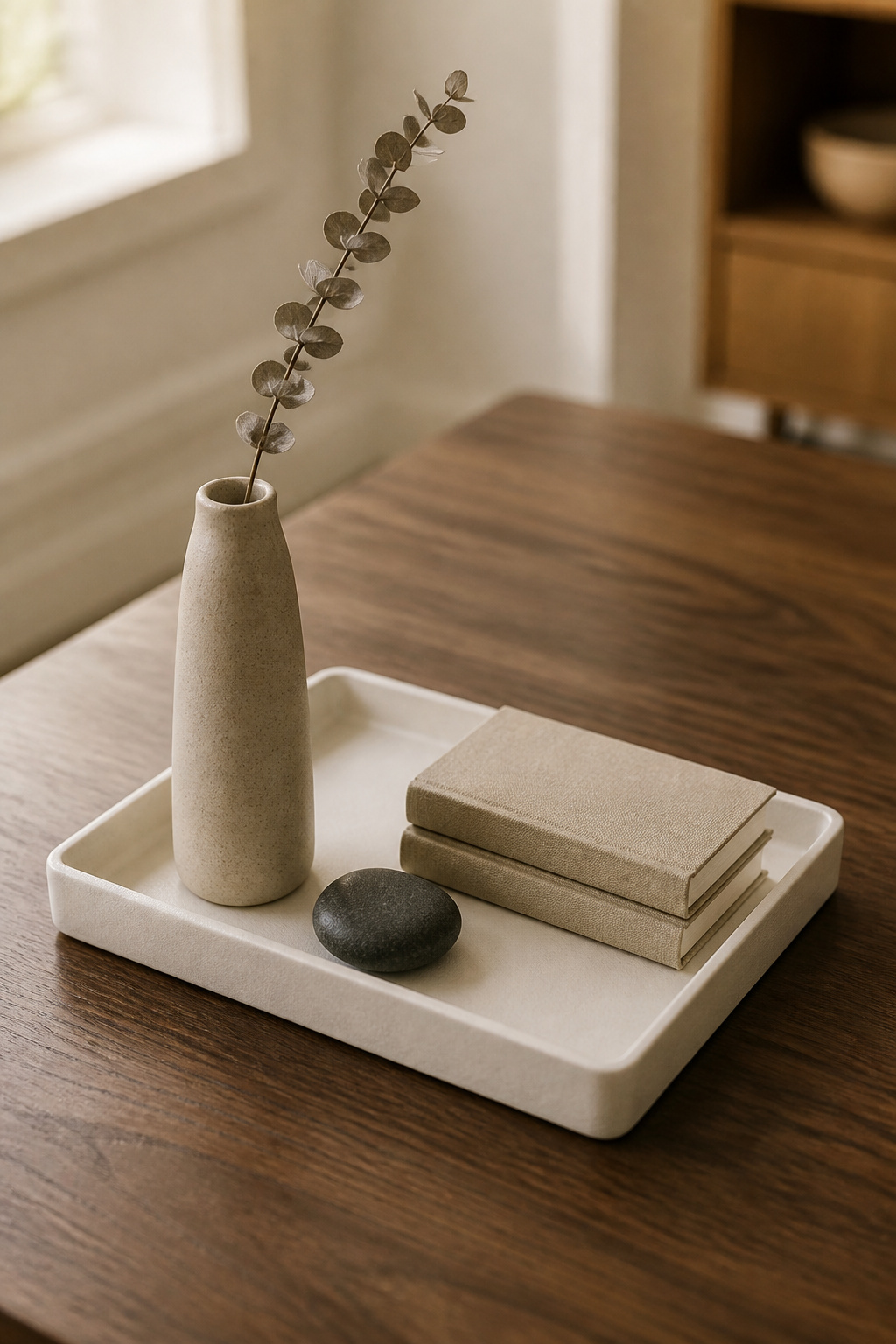
- One tray — the corralling anchor that gives the group a defined zone.
- One tall sculptural or organic piece — a bud vase with a single stem, a small plant, a stone.
- One flat element — a book or short stack that adds a low, mid-height platform.
One tray as the corralling anchor — the non-negotiable
Without a tray, three good objects look scattered; inside one, they look placed. The tray draws the boundary that turns individuals into a group. Nate Berkus uses a tray for exactly this — structure first, contrasting texture as a bonus. Keep it in a natural material so the arrangement never feels trend-driven; the full case for coffee table tray decor sits in its own guide.
One sculptural or organic object
This is the piece the eye returns to. Berkus’s own formula is books, something organic — a stone, a geode — and a handmade vase with greenery. At around 30 cm, the tall element bridges the gap between the low table and the sofa behind it. Choose one piece that resonates rather than several that compete.
One book or small stack
A stack of two books at mid-height sits between the low tray base and the tall vase, giving the eye a resting point and completing the triangle. Set the organic object on top to lift it slightly — a small move that adds a platform without adding a fourth thing.
Why a fourth object is almost always one too many
Add a fourth and the triangle breaks; the table tips from selection back into accumulation. My own rule — the two-item drop — is editorial framing, not a published standard: when you reach for object four, take two off the pile and keep three. The result reads as chosen rather than collected almost every time.
Materials and Finishes That Do the Work
When three objects carry an entire surface, material is not a finishing detail — it is the main event. Texture replaces pattern, which is why natural, honest surfaces do so much more work than their number suggests.
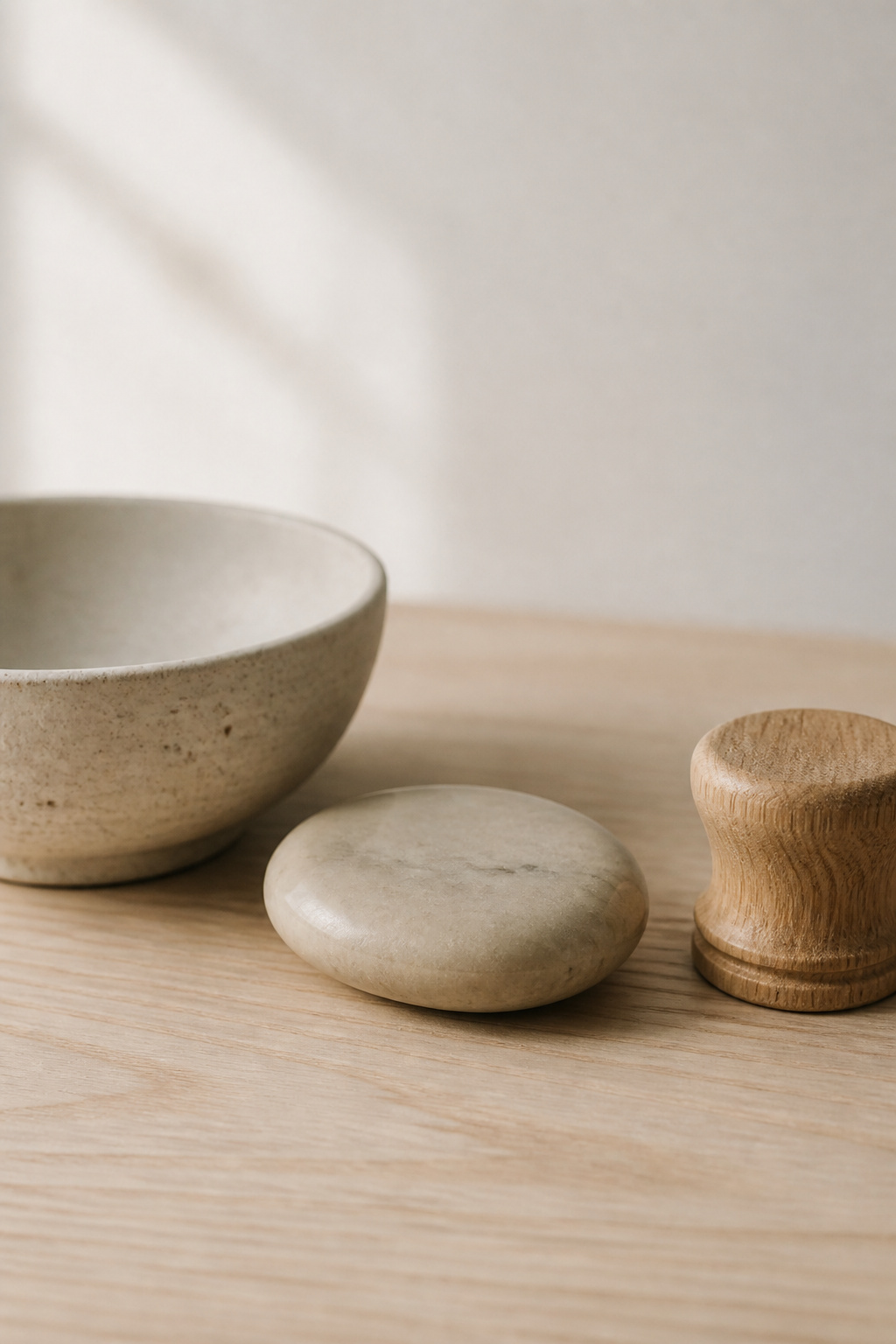
The table below sets out the materials that earn a place and what each brings.
| Material | Texture effect | What it adds to a minimalist palette |
|---|---|---|
| Unglazed stoneware | Matte, faintly irregular | Hand-made softness; throwing marks the eye keeps reading |
| Honed stone (limestone, basalt) | Smooth but unpolished | Geological weight; collects light without flashing it |
| Oiled wood (oak, walnut) | Warm, open grain | A grounding setting that flatters stoneware’s earth tones |
| Hand-blown glass | Translucent, light-catching | Quiet movement and depth, used sparingly |
| Patinated metal (bronze, brass) | Aged, low-sheen | Hard punctuation — one piece, not a theme |
Natural materials: stone, wood, ceramic
The most reliable pairing is ceramic on wood. The warmth of oak or walnut gives stoneware’s matte earth tones a setting, and both share a humility of surface that makes them reinforce rather than compete. Stone grounds a surface like little else; favour honed over polished, which gathers light with subtlety.
Glass and matte metal: light-catchers, used sparingly
Glass and metal are accents, not the palette. Hand-blown glass catches light a flat surface cannot — smoky grey, pale green, amber — while patinated bronze or brass adds a hard edge. Metal works as the punctuation mark, never the sentence: one bowl or one small holder.
Avoiding shiny, patterned, or novelty objects
High-gloss chrome reads as commercial; novelty pieces bring logos and trend associations that pull the eye out of the group. A useful curator’s test, from Trove Object Gallery, is to ask whether you would place an object in a room with only three other things. Most of the home-goods market fails it.
Greenery in a Minimalist Context: The Living Element
A plant or cutting adds the one thing material alone cannot: something genuinely alive. In a pared-back arrangement that means one species, one pot, one position — never a windowsill’s worth of pots migrating across the table.
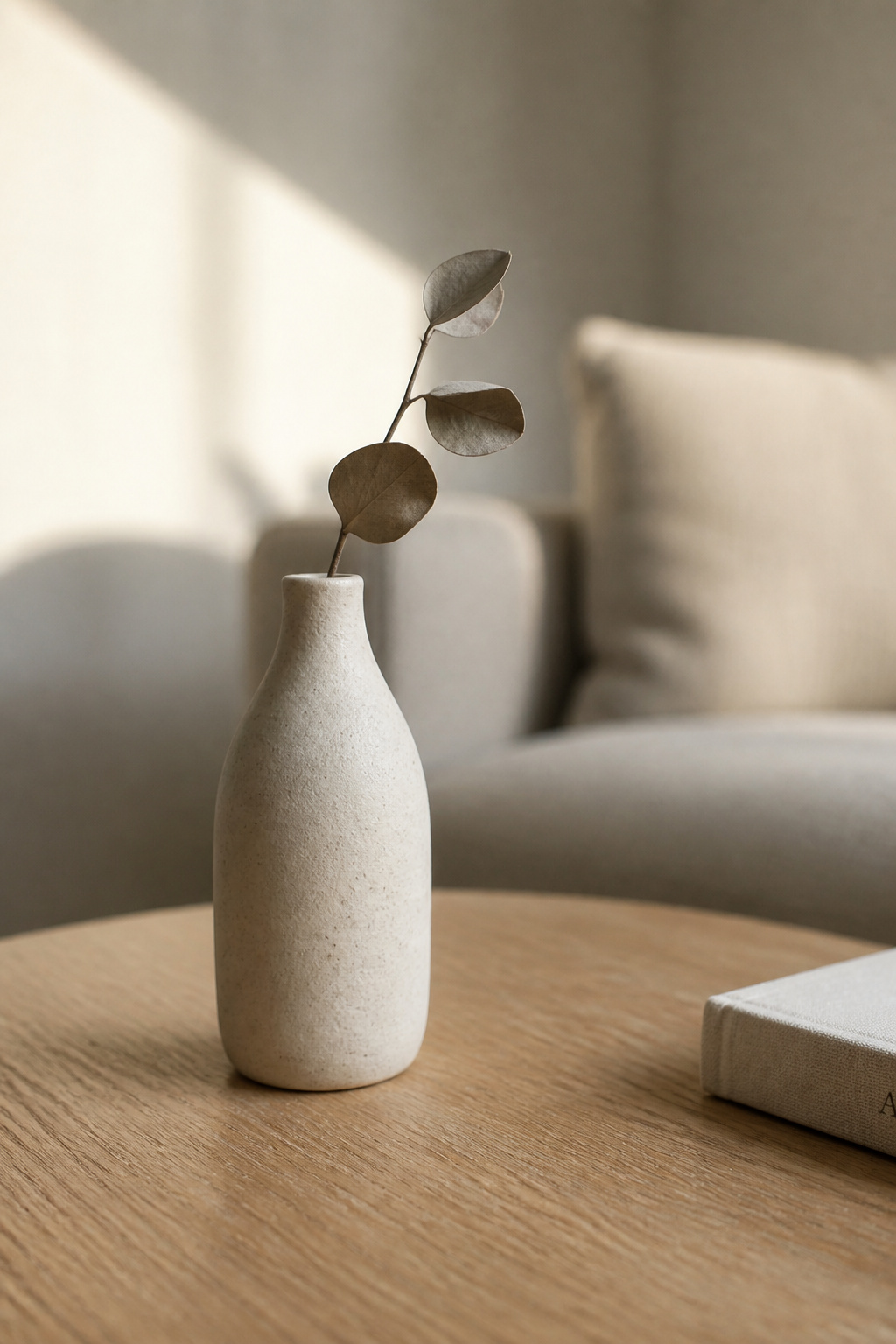
One low plant or cutting that works
Three options earn their place on a minimalist table:
- Trailing pothos — grows in low to moderate indirect light, forgives irregular watering, and trails gently over a tray edge without demanding height.
- A compact succulent — echeveria or jade stay small and need almost no water. The honest caveat: succulents want at least moderate indirect light and will decline in a genuinely dark corner, so this is the wrong pick for a shadowed centre-of-room table.
- A single dried stem — eucalyptus, a cotton stem, a poppy head in a bud vase holds its form for months with zero care, which suits the buy-better-replace-less ethic exactly.
Scale: keep the plant within the height hierarchy
No designer names this rule outright, so I will state my own position: the plant should not rise above the tallest object already in the tray. Let it sit as the mid- or low element, slightly off-centre. A cutting that overtops the vase promotes itself to focal point and unbalances the group it was meant to complete.
No-fuss care for a low-light, occasionally-knocked plant
Water only when the top few centimetres of soil are fully dry — overwatering in low light kills more table plants than drought does. If no window sits within two or three metres, switch to a dried arrangement or a convincing faux stem; the visual job is done and the care drops to nothing.
Negative Space Is the Material: How to Use What You Leave Empty
This is where the philosophy becomes placement. The empty surface is not what is left over after styling — it is part of the styling.
Group objects together, do not distribute them
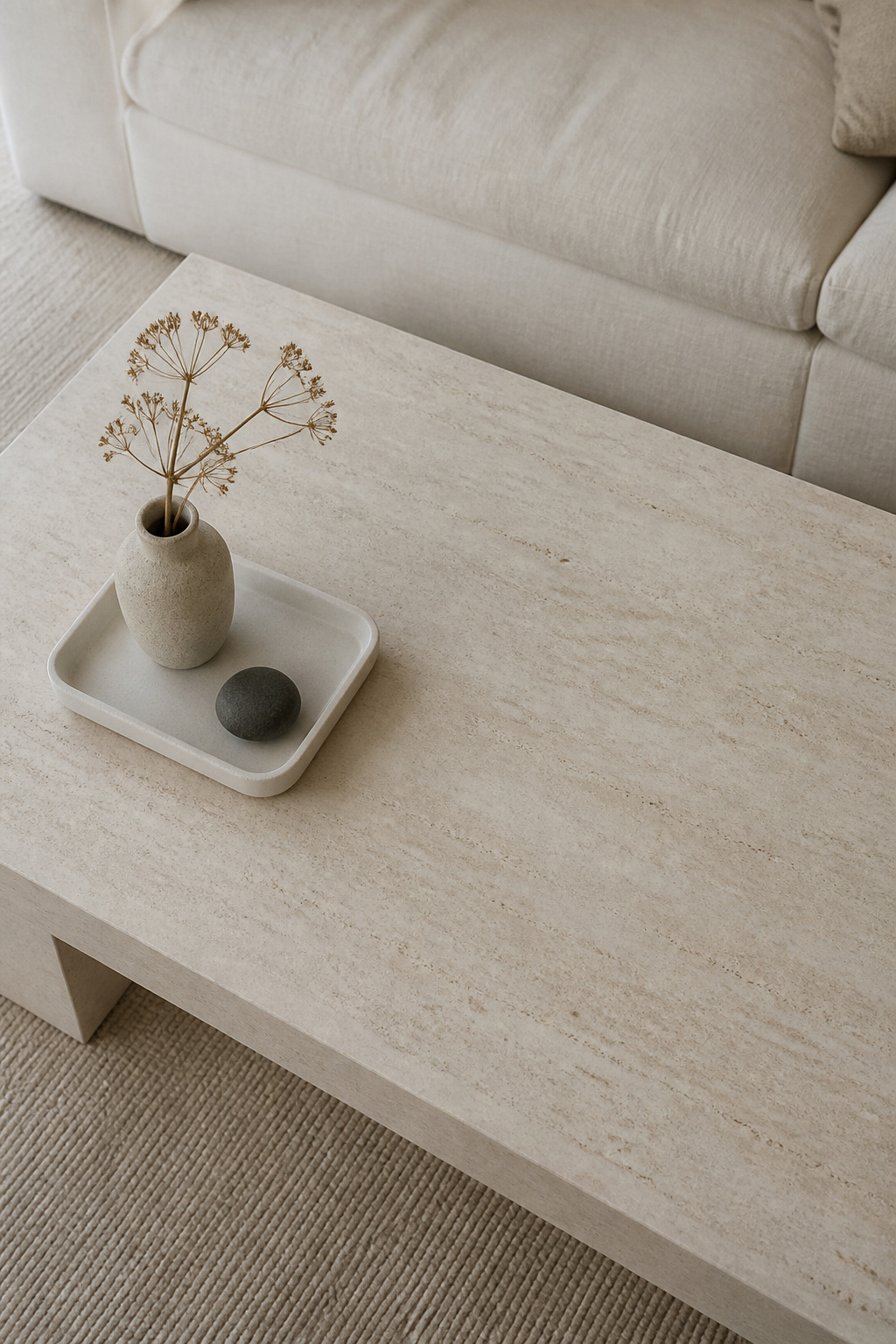
Concentrate everything in one zone — the left or right third — and leave a clear expanse beside it. Distributed objects read as clutter even when there are few; a tight grouping reads as composition. Berkus works this way: distinct zones, more table on show than objects, the bare surface making every piece look more deliberate.
The remove-one-item finishing step
Take one object away and look again. If the table feels calmer, that object was not earning its place. The idea is older than any styling blog — Coco Chanel’s instruction to take one thing off before leaving the house — and it works identically here.
How much bare table to leave
Style no more than two-thirds of the surface; leave at least one-third clear. The sweet spot is 30 to 50 percent coverage — nearer 30 for a stricter look, nearer 50 for something warmer. Think of the open area the way a photographer keeps sky in the frame: it gives everything else its scale.
Keeping a Minimalist Table Minimalist in Daily Life
A styled table that cannot survive a normal evening is decoration, not design. My one fixed belief about storage: the system has to be easier than the mess, or it will lose.
Where daily-life objects go
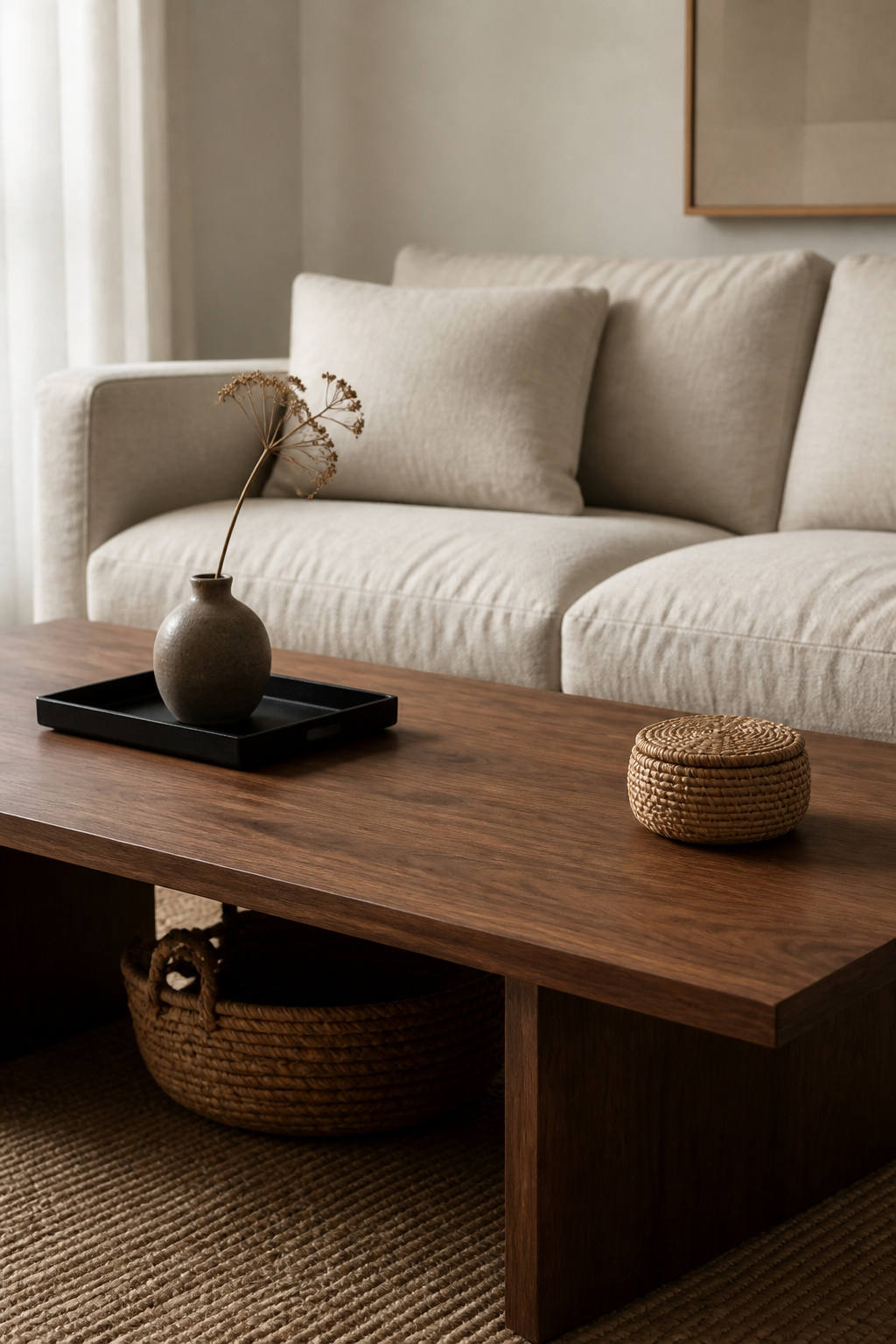
Daily objects will land on the table. Give them a rule other than “on the styled part.” A small glass dish inside the vignette can hold keys or a lip balm and double as decor — putting things away costs no extra step. Make the right action the lazy one.
A small basket or concealed tray for temporary items
Keep a lidded basket beside or under the table — separate from the styled tray — as the obvious home for whatever drifts in. Dropping something into a basket is easier than balancing it on a composed arrangement, and that ease is the point. Hidden storage removes the evidence of daily life rather than tidying it into view. For everyday styling decisions that extend the same thinking, small-space coffee table decor covers a related set of questions.
The two-minute reset habit
Once a day, scan the surface, return strays to their home, and lift off anything that does not belong. It borrows from the two-minute rule — if a task takes under two minutes, do it now — and stays fast because the system is already in place. Stack it onto an existing habit, after morning coffee or before bed, and it turns automatic within a couple of weeks. A three-object table resets in three moves. That ease is the reward for restraint at the start.
FAQ
What do you put on a minimalist coffee table?
Three elements cover it: a corralling tray in a natural material, one sculptural or organic object such as a bud vase with a single stem or a smooth stone, and one book or small stack for a flat mid-height. Each should serve a visual or functional purpose, and at least one-third of the surface should stay bare.
How do you keep a coffee table looking clutter-free?
Give functional items — remotes, chargers, coasters — a dedicated home in a small basket near or under the table, so they stop collecting on the surface. Then run a two-minute reset daily, returning strays and removing anything that does not belong. Whenever it feels full, take one object away and check whether it looks calmer.
How many items should you have on a minimalist coffee table?
Three is the designer consensus — one tall, one flat, one corralling tray — because three objects form a visual triangle the eye reads as composed. Most sources cap a minimalist table at three to five items total and at two-thirds surface coverage. If you must cover more than two-thirds to fit everything, you have too many objects.