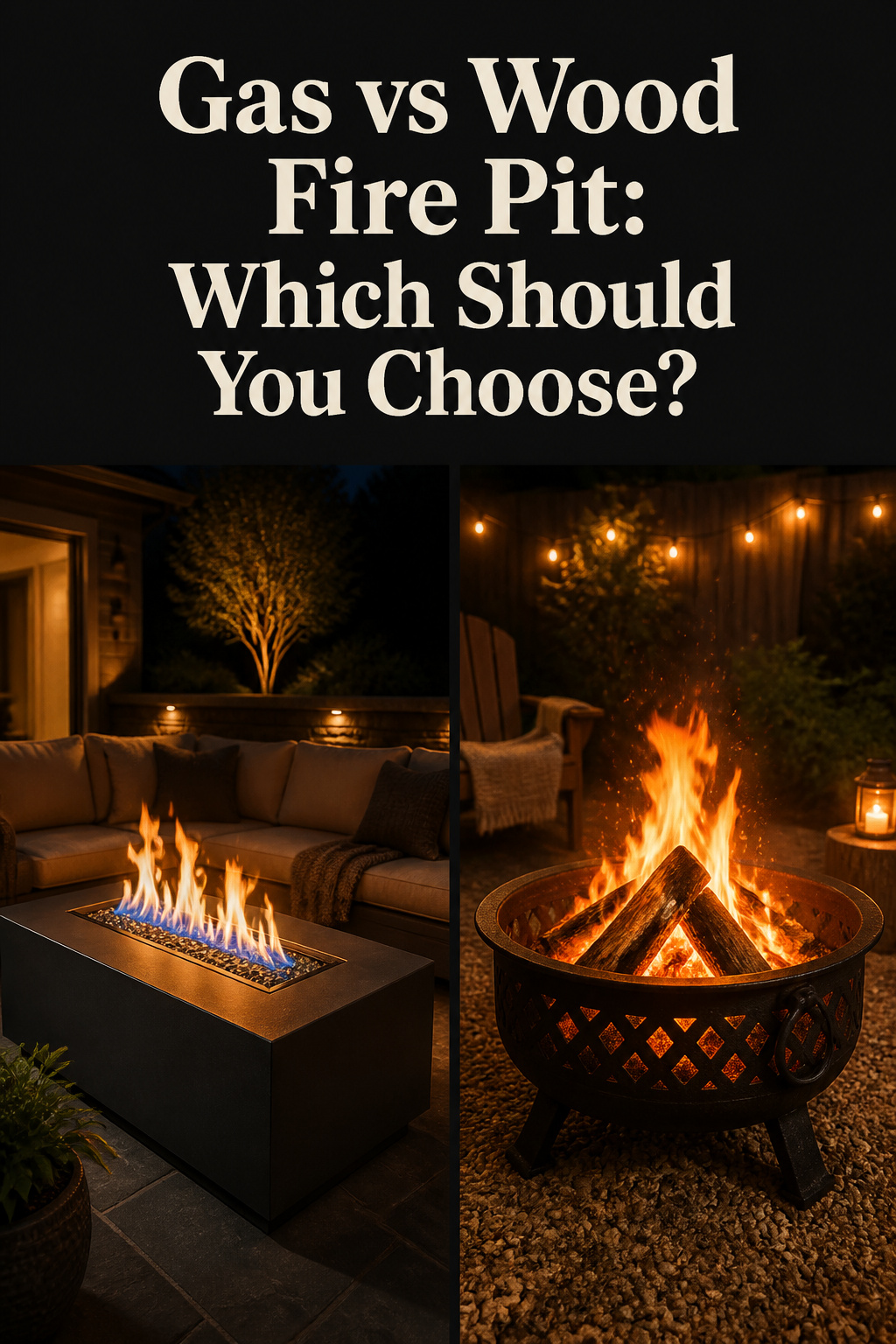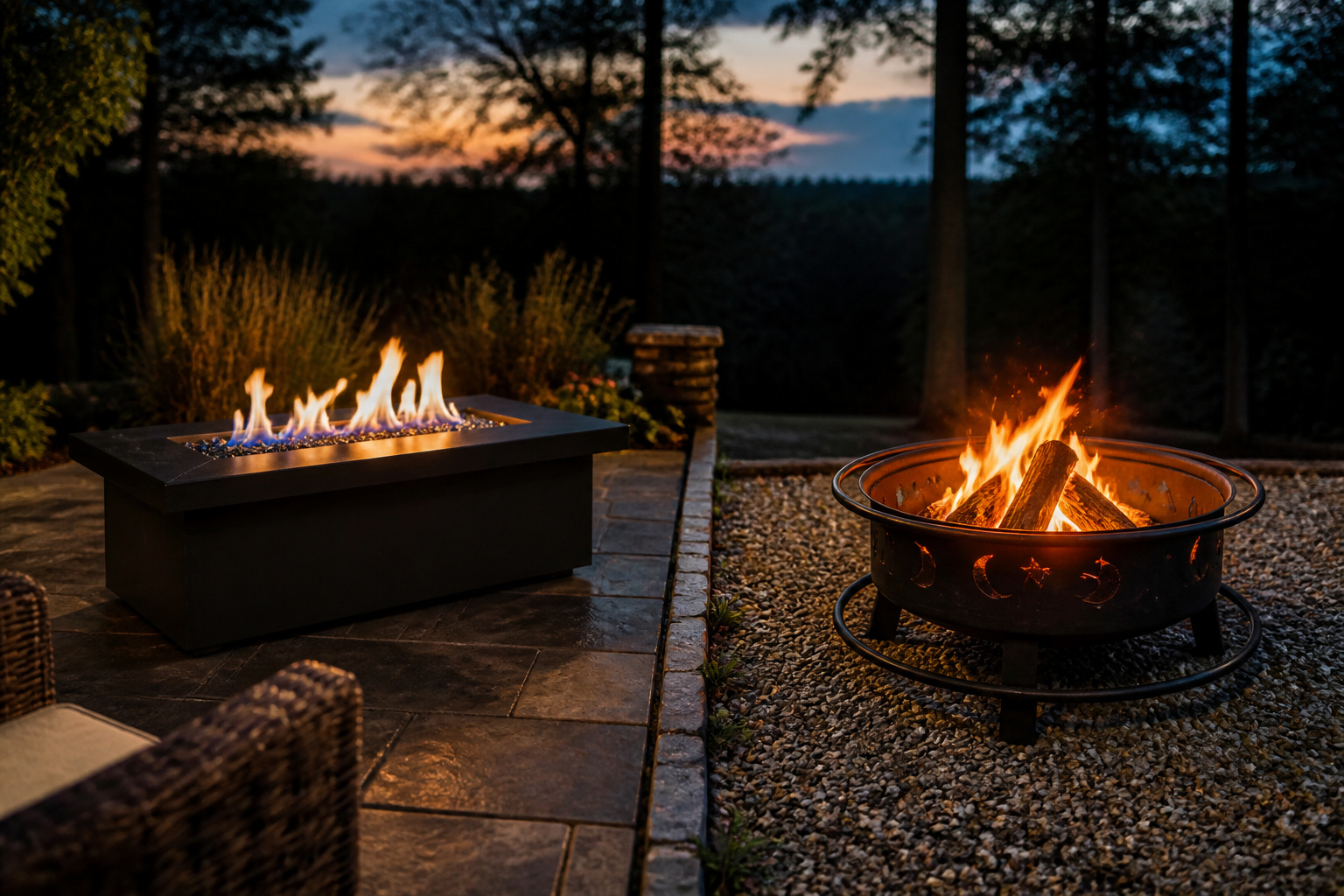

Here is the part that surprises almost everyone who asks me to settle the gas vs wood burning fire pit question: over a full season, propane usually costs about the same to run as wood. Most people assume gas is the expensive, fussy choice and wood the cheap, honest one. The running-cost math says otherwise — at twenty evenings a season, propane and seasoned cord wood both land around $80–$150. The real money gap is up front, not over the summer. So the decision rarely turns on fuel cost. It turns on how you spend your evenings, and what your weather and your neighbourhood will let you burn.
TL;DR
- Running costs are close: at ~20 fires a season, propane and cord wood both cost roughly $80–$150; the big spread is up-front (wood pits from $100, gas tables $300–$1,500, plus $1,500–$3,000 for a natural gas line).
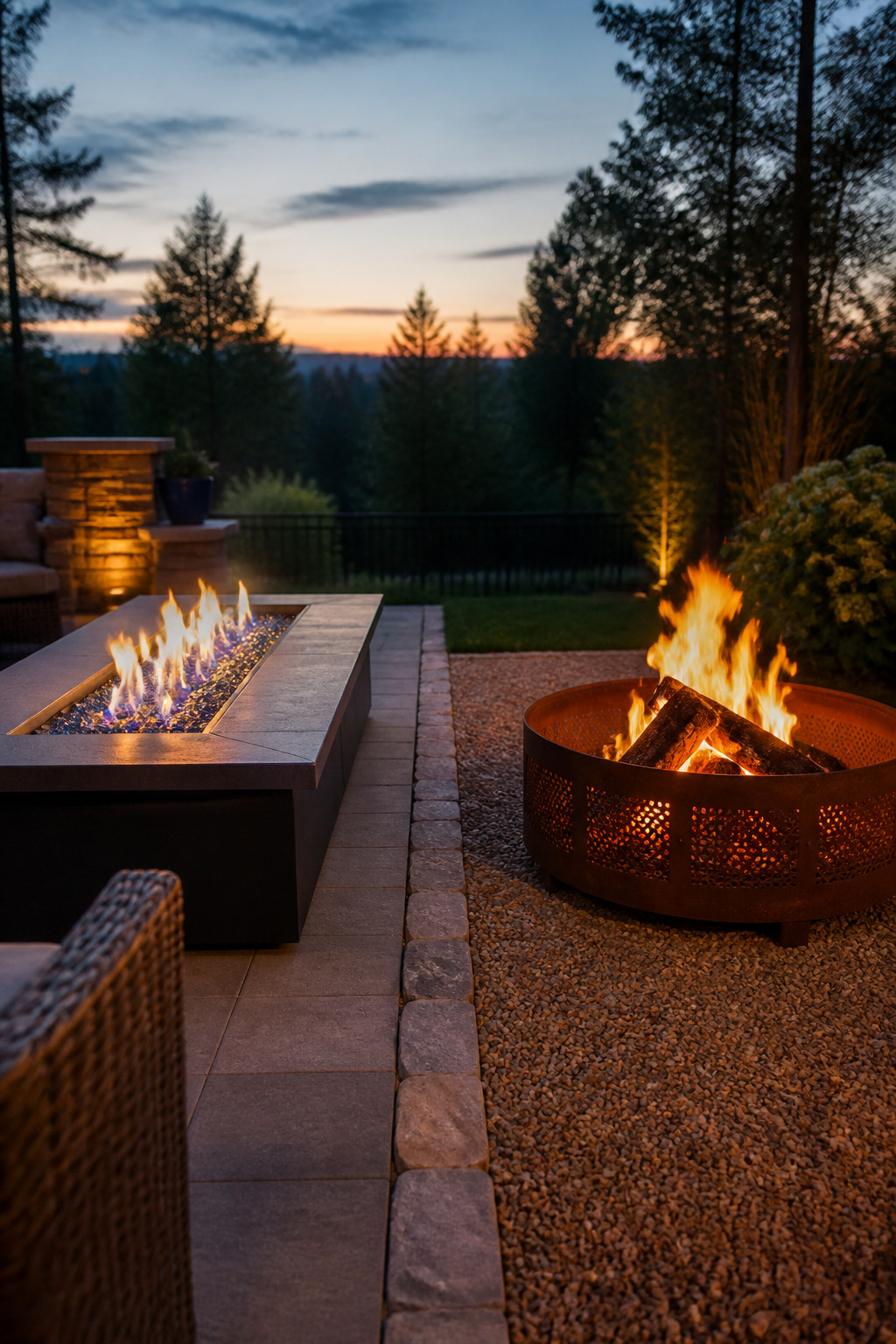
- Choose gas for weeknight convenience, HOA or burn-ban compliance, and tight yards (gas can sit 3 ft from a structure vs 25 ft for wood under NFPA 1); choose wood for the crackle, real heat, and cooking.
- Natural gas is the cheapest fuel long-term — about 12 cents per 1,000 BTU vs 65 cents for propane — but only after the line pays for itself over three to five seasons.
The Decision at a Glance: Gas vs Wood Compared on Every Factor That Matters
I design backward from a single evening. Picture the night you actually want — a quiet Tuesday after work, or a Saturday with eight people out after dinner — and the fuel almost picks itself. First, the whole decision at a glance.
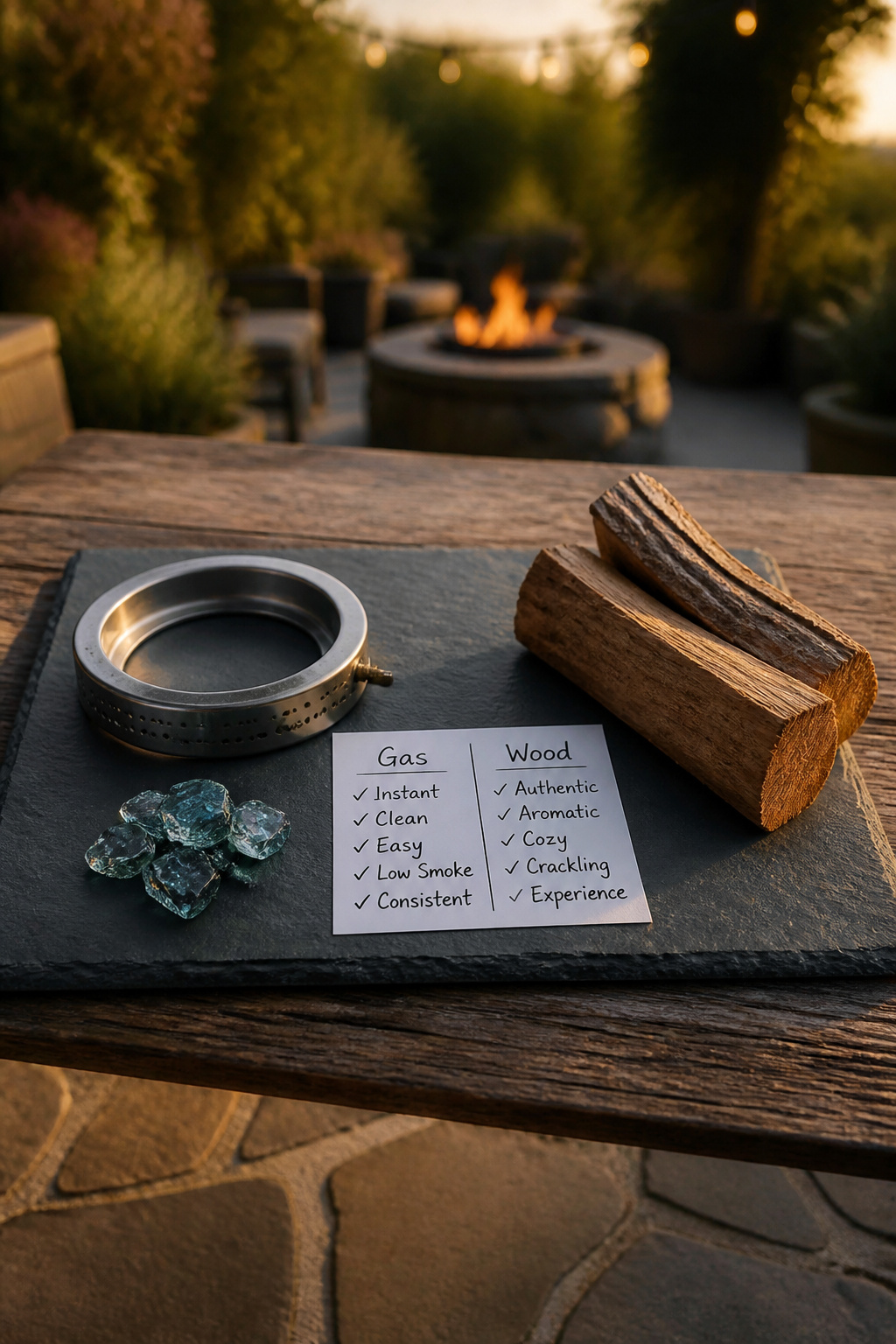
| Factor | Gas (propane / natural gas) | Wood-burning |
|---|---|---|
| Up-front cost | $300–$1,500 (table); +$1,500–$3,000 to run a natural gas line | $100–$1,000 |
| Running cost (per season, ~20 fires) | $80–$150 propane; far less on natural gas | $80–$150 on cord wood |
| Heat output | 40,000–60,000 BTU typical; 100,000+ premium | 30,000–100,000 BTU by species and size |
| Smoke | Trace CO/NOx, disperses instantly | PM2.5 particle pollution; a health concern |
| Maintenance | Annual pro inspection, $75–$175 | Ash-out after each fire; DIY spring clean |
| Convenience | Button on, button off | Source, store, build, tend |
Read the table by your own week, not the averages
The averages hide the real driver: frequency. A household burning propane thirty evenings a season spends $90–$300; the same household on a cord of seasoned hardwood often spends comparably or less. As the Fixr.com cost comparison confirms, the meaningful difference is the install horizon, not the fuel. For the full survey of types, materials and layouts, start with our guide to backyard fire pit ideas — then come back here to settle the fuel.
The two clear cases for each fuel
Two scenarios push you firmly to gas: an HOA that permits only propane, or a region with seasonal burn bans that gas pits sidestep. Two push you to wood: you want the campfire itself, or you want to cook over coals. The full checklist lands at the end.
Why the right answer moves with your climate
Weather decides more of this than people expect. In dry Western regions — California, the Pacific Northwest, the Colorado Front Range — wood can be restricted for long stretches, which quietly makes gas the only reliable year-round option. My Portland years taught me to plan for the wettest, most restricted months, not the catalog’s best night; do the same with fuel.
Convenience and Setup: Gas Wins on Evenings, Wood Wins on Weekends
The honest split is temporal. A button-start fire lights in under a minute and goes out the same way — no kindling, no ash to bag before bed. A wood fire is work, and for many families that work is the value: gathering, stacking and tending until the evening slows down.
Propane: tanks, BTU, and running out mid-evening
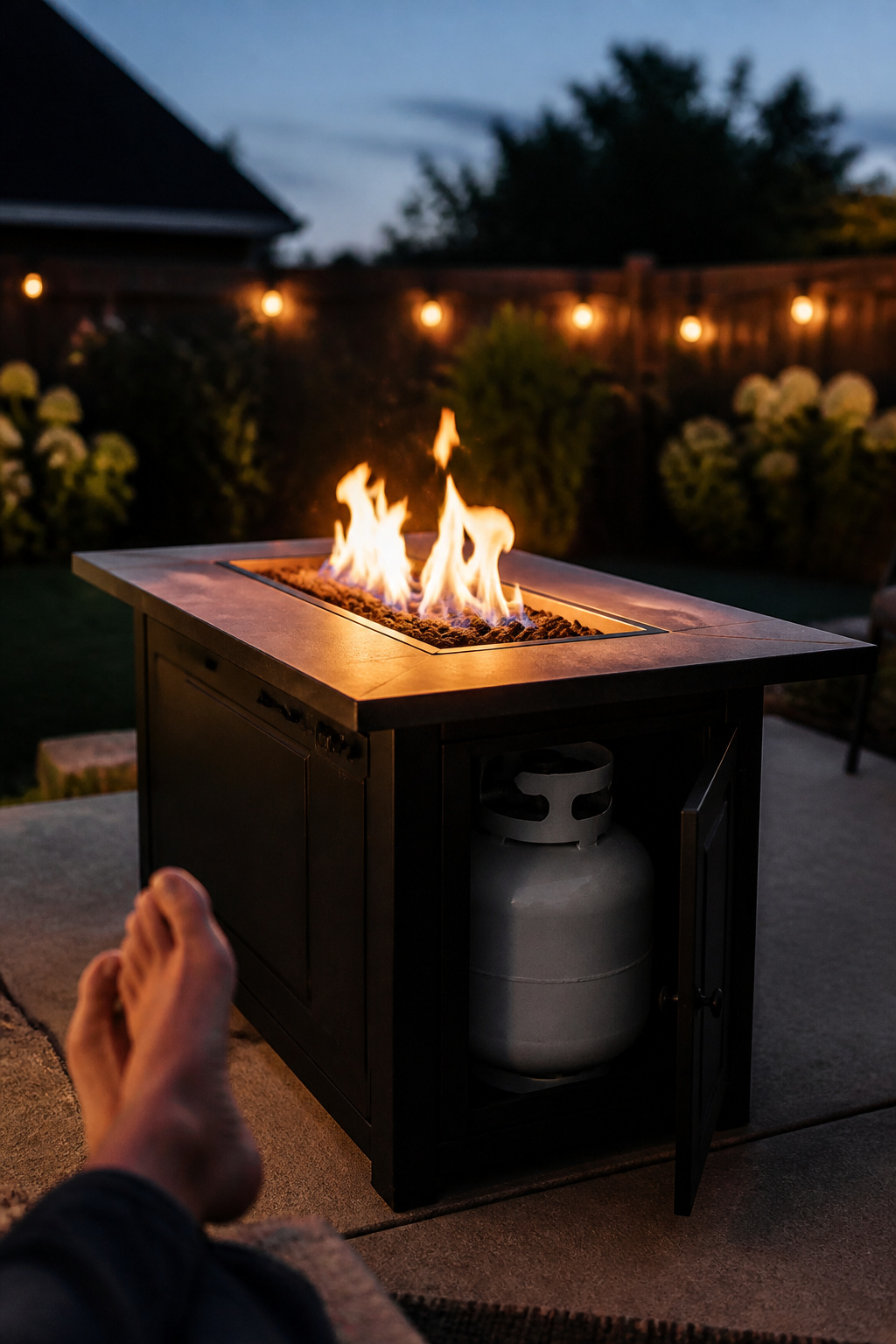
A standard 20-lb propane tank powers a typical 50,000 BTU fire pit for 8–9 hours — four or five two-hour evenings before a swap. Most residential tables run 40,000–60,000 BTU, enough for a mid-size patio. The one failure mode is running dry mid-gathering, so keep a spare tank and a cheap gauge on hand.
Natural gas: the permanent, cheapest-to-feed option
Running a line costs $1,500–$3,000 installed, and always needs a permit and a licensed contractor — DIY gas work is prohibited everywhere. The trade is permanence: once the line is in, the pit is a fixed feature, ideal for a long-term outdoor room and wrong for renters. The payoff is the cheapest fuel there is — about 12 cents per 1,000 BTU against propane’s 65.
Wood: the real time cost of a good fire
Seasoned hardwood — oak, maple, hickory dried at least six months to under 20% moisture — burns hotter and cleaner than green wood. A medium fire eats 3–4 logs an hour, so a two-hour evening runs through 6–8. Then comes the part the catalog skips: storage. You need a covered, off-ground rack away from the house, kept dry through your wettest months or the wood won’t repay you.
Heat, Flame, and the Experience of the Fire Itself
This is where the two fuels stop being interchangeable. Gas gives you adjustable warmth on demand; wood gives you a fire — peak heat, movement, sound, smell.
BTU and real warmth at the chair
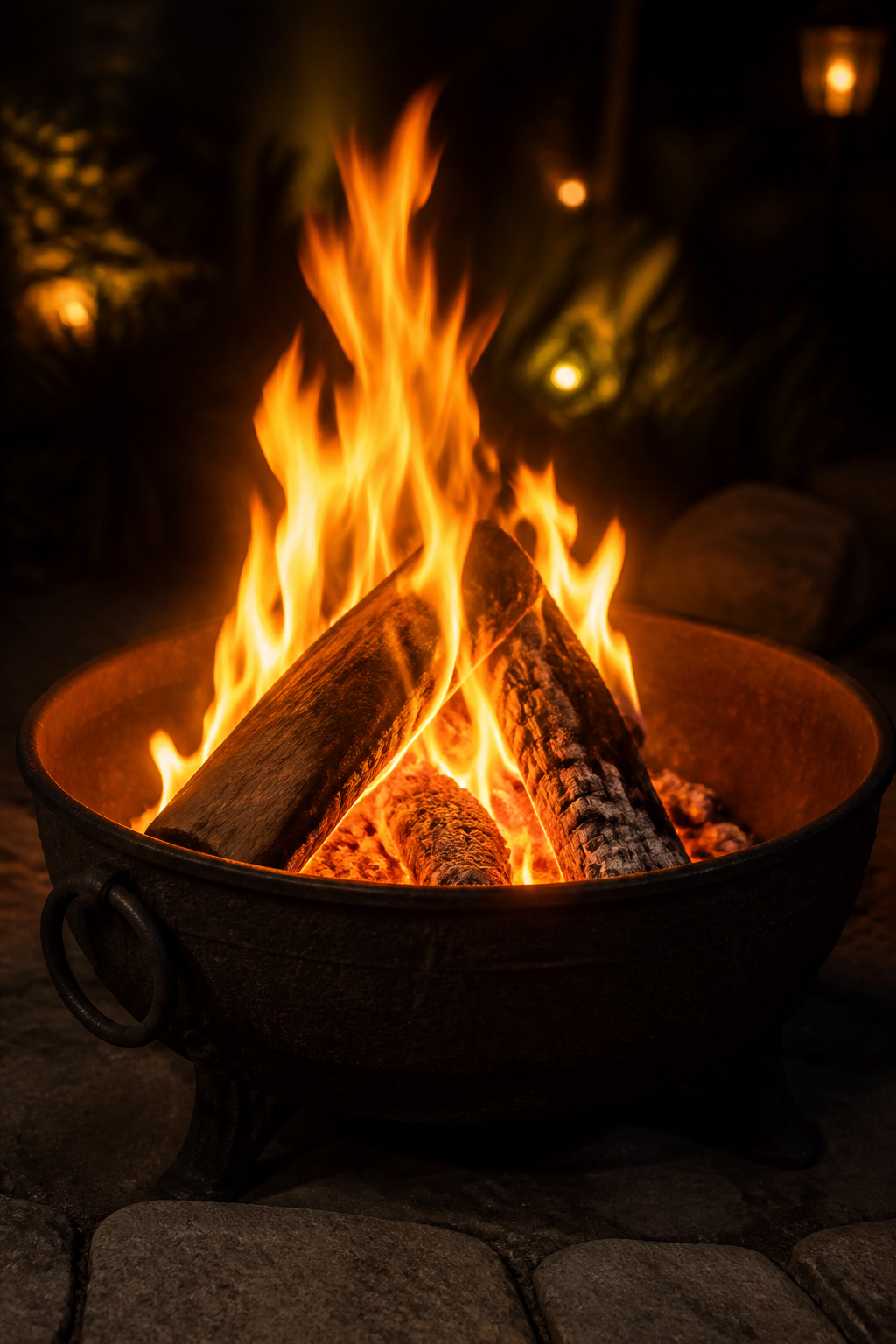
On paper the ranges overlap: most gas tables deliver 40,000–60,000 BTU and wood spans 30,000–100,000. The lived difference shows at peak. Seasoned oak or hickory can briefly top 2,000°F, where gas pits run 400–1,000°F. That matters at distance — radiant heat from coals reaches guests 6–8 feet out, while most gas tables warm best within 4–5 feet. Gas trades that reach for control you don’t get with wood.
The look and sound gas can’t fake
Wood pops and crackles because water and sap flash off as the log heats; gas burns silent, and many people notice the quiet. The smell is a defining part of the experience too, and gas produces nothing like it outdoors. Fire glass and lava rock dress a gas flame up, but they don’t move the way real logs do — the spark drift, the surge as a log catches. There’s also the coal phase: the long glow after the last flame, when a wood fire keeps throwing warmth well after gas would be cold. That persistence is a real trait of a hardwood fire, even if no one has put an exact figure on it.
Cooking: a genuine wood advantage
If you want to cook over fire, this is decisive. A standard gas fire pit is not a cooking surface — drippings clog the burner ports and soak permanently into the media, and the yellow flame coats food in soot. Dedicated gas grills with a clean blue-flame burner and a grate exist, but they’re a different product from a decorative table. Wood pits, by contrast, take grill grates, swing-arm brackets and Dutch oven tripods over hardwood coals. Marshmallows are the one truce — both fuels handle a skewer.
Smoke, Air Quality, and Neighbourhood Reality
Smoke is where this stops being a matter of taste and becomes a matter of code — and the regulatory reality genuinely favours gas in a way that catches buyers off guard.
Wood smoke: who it affects, and managing it
Wood smoke carries fine particulate matter (PM2.5), carbon monoxide and some carcinogenic compounds; the EPA flags children, the elderly and people with heart or lung disease as most vulnerable. The Bay Area Air Quality Management District attributes 94–210 premature deaths a year to it. You manage smoke with wind and fuel: site the pit downwind of neighbours with 10-plus feet of clearance, skip stagnant-air nights, and burn hot, dry hardwood. Clearance also shifts with fuel type — see our breakdown of safe distance by fuel type before you settle the pit’s spot.
Gas: near-zero smoke, but not zero risk
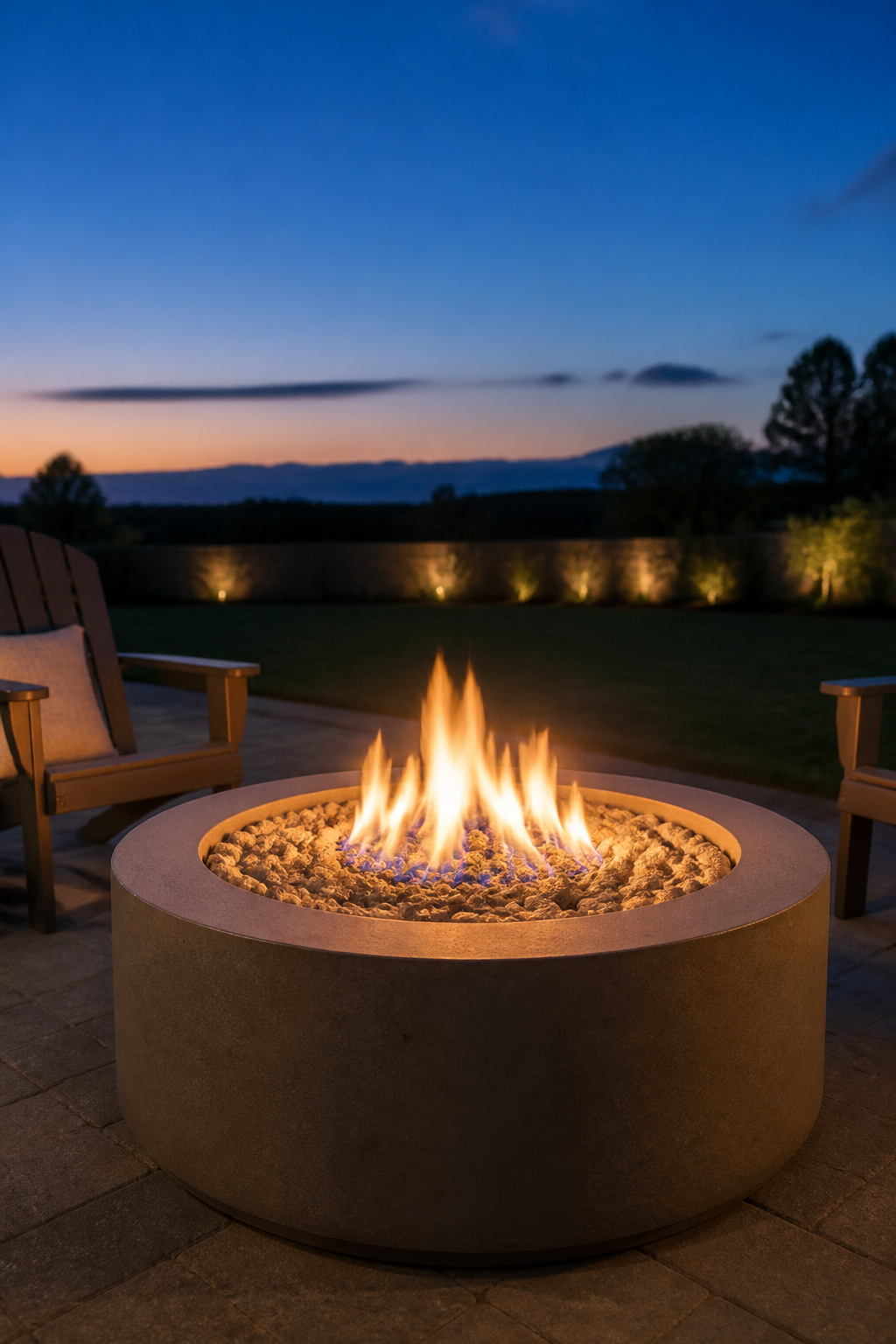
Burned completely, propane and natural gas produce mostly carbon dioxide and water vapour — no smoke, no particulates, none of the wood compounds. Incomplete combustion adds trace carbon monoxide and nitrogen oxides, but outdoors in the open those byproducts disperse almost immediately. The caution is enclosure: never run a gas pit under a pergola, gazebo or deep overhang where airflow is restricted and gases could pool.
Burn bans: which fuel survives the restriction season
This is the quiet decider in much of the West. The Bay Area’s Winter Spare the Air programme makes wood burning illegal region-wide on alert days — 15-plus no-burn days in recent winters — and a wood fire then earns a fine, up to $500 in some California jurisdictions. Propane and natural gas pits are almost universally exempt because they throw no embers. In the milder Northeast and Midwest, wood stays a year-round option — so the calculus really does depend on your zip code.
Running Costs and Ongoing Maintenance Over a Season
Season-long fuel costs run close between propane and cord wood; natural gas undercuts both once installed. What differs is the maintenance — gas needs a professional once a year, wood needs you after every fire.
Wood cost per fire
A full cord of seasoned hardwood runs $200–$400 nationally ($500-plus in the Northeast) and yields 80–120 fires — about $2–$5 each, the most economical route for regular use. Retail bundles are the trap: at $5–$10 a bag, a two-hour fire works out to $7.50–$20, three to four times the cord-wood cost. Buy in spring or summer to save 20–30%.
Propane cost per evening
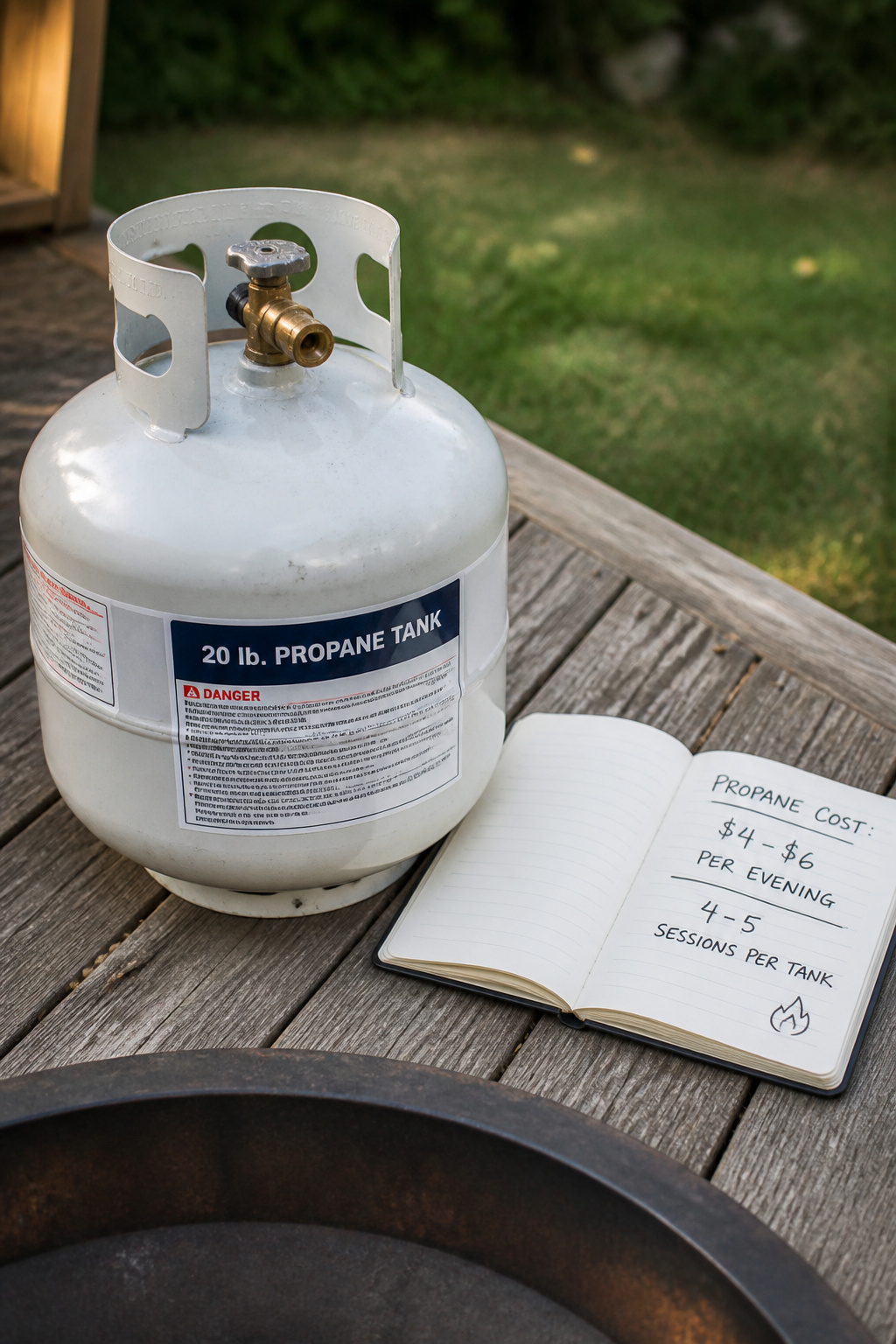
At the 2026 US average of $2.67 a gallon, a 20-lb tank covers 4–5 two-hour evenings and costs $18–$25 to refill — roughly $4–$6 per session. Regional prices range from $1.64 a gallon in Nebraska to $4.71 in Florida, so actual per-evening costs vary. One easy lever: drop the flame. Running at 30,000 BTU instead of 50,000 cuts fuel cost about 40%, plenty of ambience on a mild night above 60°F.
Maintenance: the spring truth for each
Here’s the maintenance honesty. A gas pit wants an annual technician visit, $75–$175, to clean the burner and check valves, igniters and the gas line — effectively mandatory after winter storage. Wood is DIY but relentless: empty the ash within 24 hours (it’s caustic and eats the metal), deep-clean the bowl every spring, and re-oil the metal yearly against rust. Both live or die by a $20–$60 cover — water in the bowl cracks stone surrounds and rusts steel through a freeze-thaw winter faster than anything else.
Which Fire Pit Fuel Is Right for Your Yard?
Three questions decide it: Does your HOA or air district restrict wood? Do you want to cook on the fire? And how much time do you want to spend building one on an ordinary evening? Here is the clear position, no hedging.
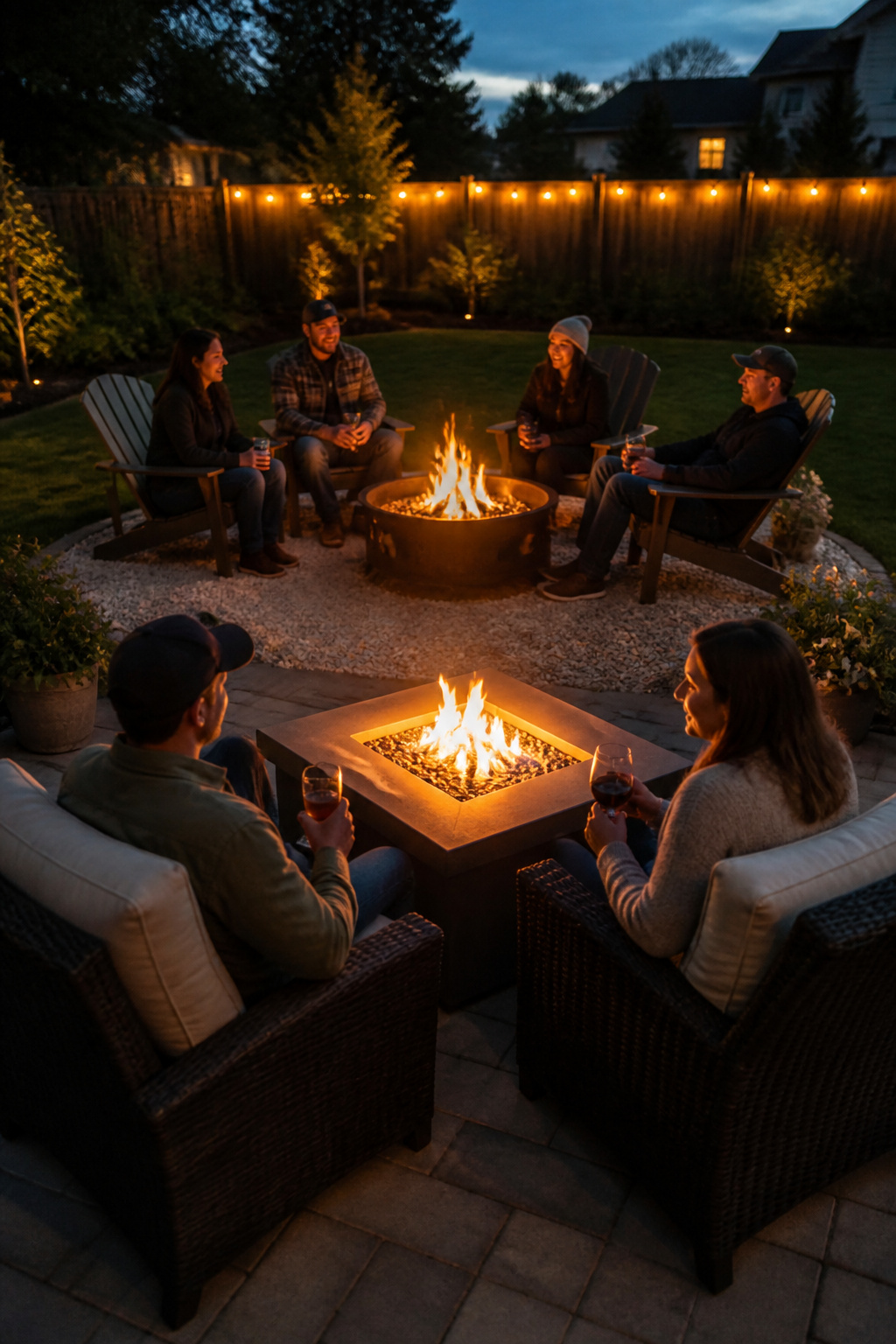
Choose gas if
- Your HOA permits only gas or propane — confirm it in writing first.
- You live somewhere with frequent burn bans, where no-burn days can top 15 a season.
- You burn on weeknights, when the barrier to lighting a fire decides whether you use the pit at all.
- A neighbour or family member has a respiratory condition that smoke drift would aggravate.
- Your yard is tight: a gas pit can sit 3 feet from a structure, where NFPA 1 wants 25 feet for wood.
Choose wood if
- The sensory campfire — crackle, smell, glowing coals — is the reason you want a fire at all.
- You plan to cook on it, which means a dedicated wood-burning setup, not a decorative gas table.
- You have a large yard that clears NFPA’s 25 feet from every structure, in a region with few restrictions.
- Up-front cost matters: a quality steel wood pit starts at $100–$300, well below a gas table. Once the fuel’s chosen, the next move is seating around the fire — the right chairs change depending on whether your flame arrives at a button press or takes fifteen minutes to build.
If you genuinely can’t decide
There’s a hedge: a convertible insert. A wood-burning surround can be fitted with a gas burner kit, changing the fuel without rebuilding the enclosure, and some fire tables ship propane-ready with hardware to convert to natural gas later. Ask your retailer about availability and pricing — costs vary, and a gas line has to reach the site regardless. One hard rule: an insert is a fuel swap, not a supplement — never burn wood on top of a gas burner.
If compliance, convenience or a small yard is your binding constraint, choose gas and don’t look back. If the fire itself — heat, sound, cooking — is the reason you’re building, choose wood and site it for the wind. And if a natural gas line is on the table and you’ll use the pit often, run it. The one mistake to avoid is buying a wood pit before checking your HOA rules and your region’s burn-ban frequency — no seasoned oak fixes a fire you’re not allowed to light.
FAQ
Is a gas fire pit cheaper to run than wood burning?
At moderate use, around 20 fires a season, propane and cord wood both run roughly $80–$150 — broadly comparable. Natural gas is far cheaper to operate, about 12 cents per 1,000 BTU versus 65 for propane, but only after a $1,500–$3,000 line install that takes three to five seasons to pay back.
Can you cook on a gas fire pit the same way as a wood fire?
No. Standard decorative gas tables aren’t built for cooking: drippings clog the burner ports and ruin the lava rock or fire glass, and the yellow flame soots your food. Dedicated gas fire pit grills are a separate, food-safe product. Wood pits, by contrast, handle full cooking — grilling, Dutch ovens, skewers — over hardwood coals.
Does a gas fire pit need a permit that a wood fire pit doesn’t?
A natural gas fire pit always needs a permit, because running the gas line requires a licensed contractor and a utility inspection. A portable propane pit usually doesn’t, much like a portable wood pit. Wood pits, however, may need a burn permit in some counties and risk fines on no-burn days — gas is almost universally exempt.